Insider risks have eclipsed external threats, and organizations aren’t keeping pace. 64% of cybersecurity professionals now believe insiders, whether malicious or compromised, pose a greater risk than external actors. And the threat isn’t static: 53% say insider threats have increased over the past year, and 54%...
Insider threats come from people or AI agents who already have legitimate access to your systems, applications, or data. These threats can be intentional or accidental and are some of the hardest for security teams to detect. Human insiders may be employees, contractors, or partners misusing access. AI agents, now...
Scammers are increasingly turning to account takeover fraud, as financial institutions ramp up their defenses. Instead of luring victims into making authorized transactions, cybercriminals are bypassing them altogether, hijacking their digital identities and draining accounts from within.
Financial institutions can use AI-fueled behavioral biometrics for real-time identity assurance. By continuously profiling how users interact with devices, firms can shift from one-time authentication to real-time identity assurance, turning every click, pause and keystroke into a frontline defense.
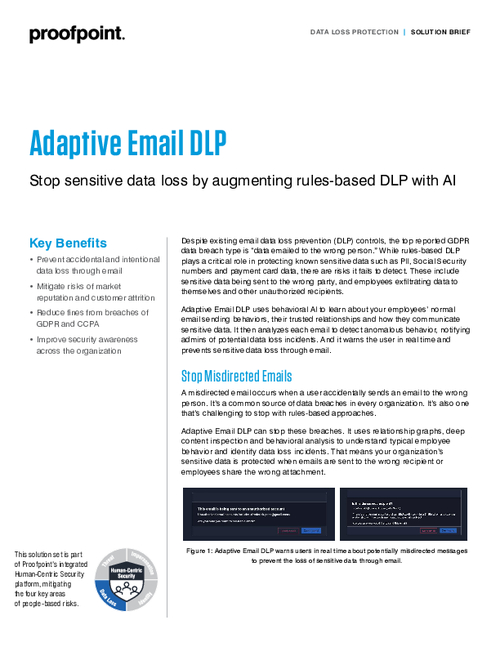
Despite existing email data loss prevention (DLP) controls, the top reported GDPR data breach type is “data emailed to the wrong person.” While rules-based DLP plays a critical role in protecting known sensitive data such as PII, Social Security numbers and payment card data, still there are risks it fails to...
This State of Phish Report gives in-depth regional summaries to explore how local nuances affect user behaviour when it comes to cybersecurity awareness and the importance of phishing protection. A few APJ highlights in this Report are: Only 28% of users in South Korea consider security to be their responsibility,...
Two SIEM stalwarts completed a merger Wednesday that their CEO said will bring industry-leading capabilities to customers on-premises and in the cloud. LogRhythm and Exabeam will standardize on the latter's New-Scale cloud SIEM given the market traction it has enjoyed since its October 2022 debut.
Banks lose tens of billions of dollars every year to credit card fraud, bad checks and intentional loan defaults, but the main culprits are not third-party scammers. Most of these crimes are being committed by the bank's customers, making detection and prevention a formidable challenge.
While AI has spurred the growth of authentication controls, it has also enabled voice cloning and video deepfakes to become much more convincing. Fraud fighters are looking at adopting a multifactor authentication system using multimodal biometrics to fight against deepfakes.
Stu Sjouwerman, CEO, KnowBe4, and Tony Pepper, CEO, Egress, discuss KnowBe4's recent acquisition of Egress, how the integration enables advanced threat detection, evolving cybersecurity challenges, such as behavioral-based attacks, and future road map.
Permira has acquired a majority stake in BioCatch at a $1.3 billion valuation, solidifying the company's global expansion plans. The behavioral biometrics company is exploring mergers and acquisitions, aiming to expand into key markets while consolidating its position in online fraud detection.
Despite advances in endpoint security, Sergei Rousakov, chief security architect at LinkedIn, said the landscape remains complex. He said endpoint tools need to take a more integrated approach that includes identity and device context to truly protect against cybersecurity threats.
User and Entity Behavior Analytics (UEBA) is a proven behavior-based insider risk-detection solution within the security community. However, without cloud computing and its big data handling capabilities, machine learning (ML)-the crux of UEBA-cannot be robustly practiced, making it difficult to take note of normal...
Splunk has executed its second round of layoffs since February, axing 7% of its workforce weeks after Cisco announced plans for a $28 billion acquisition. Splunk will reduce its 8,000-person staff by 7% or approximately 560 positions. Most of the jobs being cut are in the United States.
Two cybersecurity vendors are laying off a sizable chunk of their staff, with Exabeam axing 20% of its workforce and F-Secure cutting up to 70 employees. Exabeam eliminated roughly 134 positions this week, while F-Secure wants to shrink its workforce by nearly 14%.
Our website uses cookies. Cookies enable us to provide the best experience possible and help us understand how visitors use our website. By browsing govinfosecurity.com, you agree to our use of cookies.