30 billion transactions run through IBM Z mainframes every day, including 90% of airline bookings and 87% of credit card payments. With such a massive volume of sensitive, high-value data, these systems remain prime targets for cyberattacks and must be secured with the highest standards. Now, with new regulations...
Well-supported by highly skilled technicians, mainframes show no signs of disappearing. They remain the backbone of critical operations for financial services organizations. Yet, new and updated regulations will require enterprises to take a closer look at their approach to mainframe security. The stakes are high....
PCI DSS 4.0.1 raises the stakes for retailers and e-commerce providers, turning app security best practices into hard requirements. With sophisticated threats on the rise, businesses must adopt integrated solutions to protect digital experiences end-to-end.
On the eve of enforcement for version 4.0 of the Payment Card Industry's Data Security Standard, the council relaxed rules for smaller merchants pertaining to combating malicious scripts in their e-commerce environment. Cue confusion and ongoing cybersecurity questions.
While PCI DSS 4.0 tackled evolving threats, the newly introduced version 4.0.1 focuses on phishing-resistant authentication factors. Yew Kuann Cheng, regional VP, Asia Pacific, PCI Security Standards Council, shared insights on adapting to the new requirements and the role of MFA.
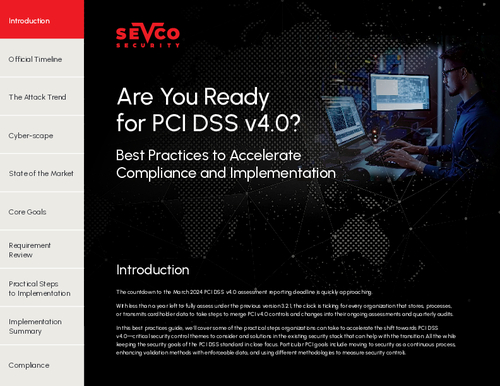
Embrace the future of payment security with this guide to PCI DSS v4.0, focusing on: Transitioning to PCI DSS v4.0: A practical roadmap for compliance before the March 2024 deadline, highlighting critical security control themes and solutions for a smooth transition. Enhancing Security...
Maintaining compliance is a difficult job—both in scope and in practical application. Organizations need to comply with a vast array of regulations, and the number is constantly increasing. Compliance is consistently tightening; businesses and financial institutions now have to learn and dive into the new Payment...
For banking and financial organizations, protecting sensitive customer data and meeting compliance requirements for regulations is critical. Balancing those requirements with the speed of business and demands of modern banking can be a challenge. As you update your cybersecurity plans and data breach prevention...
The world is moving on from magnetic stripe payment cards, with one notable exception: the United States. Credit card issuers, banks and consumers agree the magnetic stripe is prone to hacking - so why is one of the largest markets for plastic payment still clinging to decades-old technology?
Prioritizing which parts of your business need to be fixed first is daunting and your day is likely preempted by account lockouts, breaches making headlines, and simply trying to answer your CEO’s questions, like “are we secure” and “how do we know?” Watch this panel as we discuss how to use cloud-native...
Maintaining compliance is a difficult job -- both in scope and in practical application. Organizations need to comply with a vast array of regulations, and the number is constantly increasing. Compliance is consistently tightening; businesses and financial institutions now have to comprehend the new PCI-DSS 4.0...
Payment card security group PCI Security Standards Council has a new standard aimed at smoothing the contactless payment experience at retailers by ensuring that a single commercial device can process card data and a PIN. Consumers across the globe increasingly use contactless methods for payment.
In the latest weekly update, ISMG editors discuss how organizations can comply with the new PCI DSS 4.0 requirements, whether other countries should follow the U.S. lead on legislating software bills of materials, and key strategies for CISOs preparing for an economic downturn.
The transition to PCI DSS v4.0 is a major inflection point for the payments industry – not only does it restructure how risk is assessed, but it also provides a better foundation for meeting ongoing technical innovation. While organizations with mature programs may need comparatively little uplift, all organizations...
Our website uses cookies. Cookies enable us to provide the best experience possible and help us understand how visitors use our website. By browsing govinfosecurity.com, you agree to our use of cookies.