
The document discusses JavaScript inheritance. It explains that JavaScript uses prototype-based inheritance rather than class-based inheritance. It provides examples of how to implement inheritance by linking object prototypes together through the __proto__ property or Object.create method. Functions in JavaScript have a prototype property that is used to inherit properties and methods onto objects created with new.
About Inheritance • Code reuse is important – Inheritance can help • JavaScript does not have classes, so no special keyword for extending • In JS you have lot of ways to do inheritance – Classical Pa@erns – Modern Pa@erns or Prototypal Inheritance
3.
Understanding JS Inheritance • JS is not class based, it’s prototype-‐based! • Object inherit from another object • JS contains syntax and features that make it seem class based
4.
Understanding Prototypes • Prototype is an object from which other objects inherit properGes • Any object can be a prototype • Every object has internal __proto__ property
5.
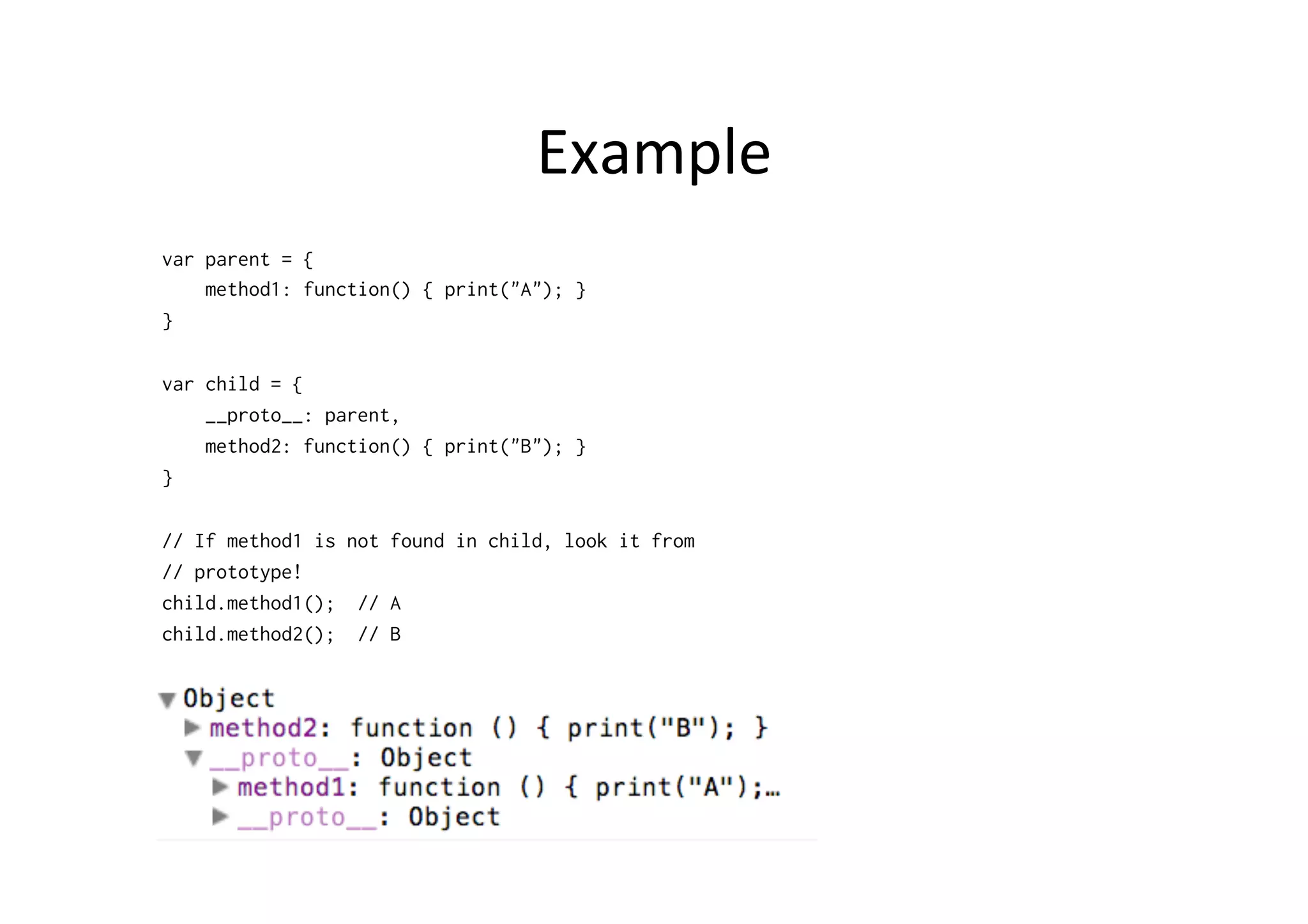
Example var parent= { method1: function() { print("A"); } } var child = { __proto__: parent, method2: function() { print("B"); } } // If method1 is not found in child, look it from // prototype! child.method1(); // A child.method2(); // B
6.
__proto__ • __proto__ is depricated and should not be used (but it works) • To get the prototype, use – Object.getPrototypeOf(object) • It’s read only! • How to set? – Proposal: Object.setPrototypeOf(obj, prototype) • Not possible to change the __proto__ ..!
7.
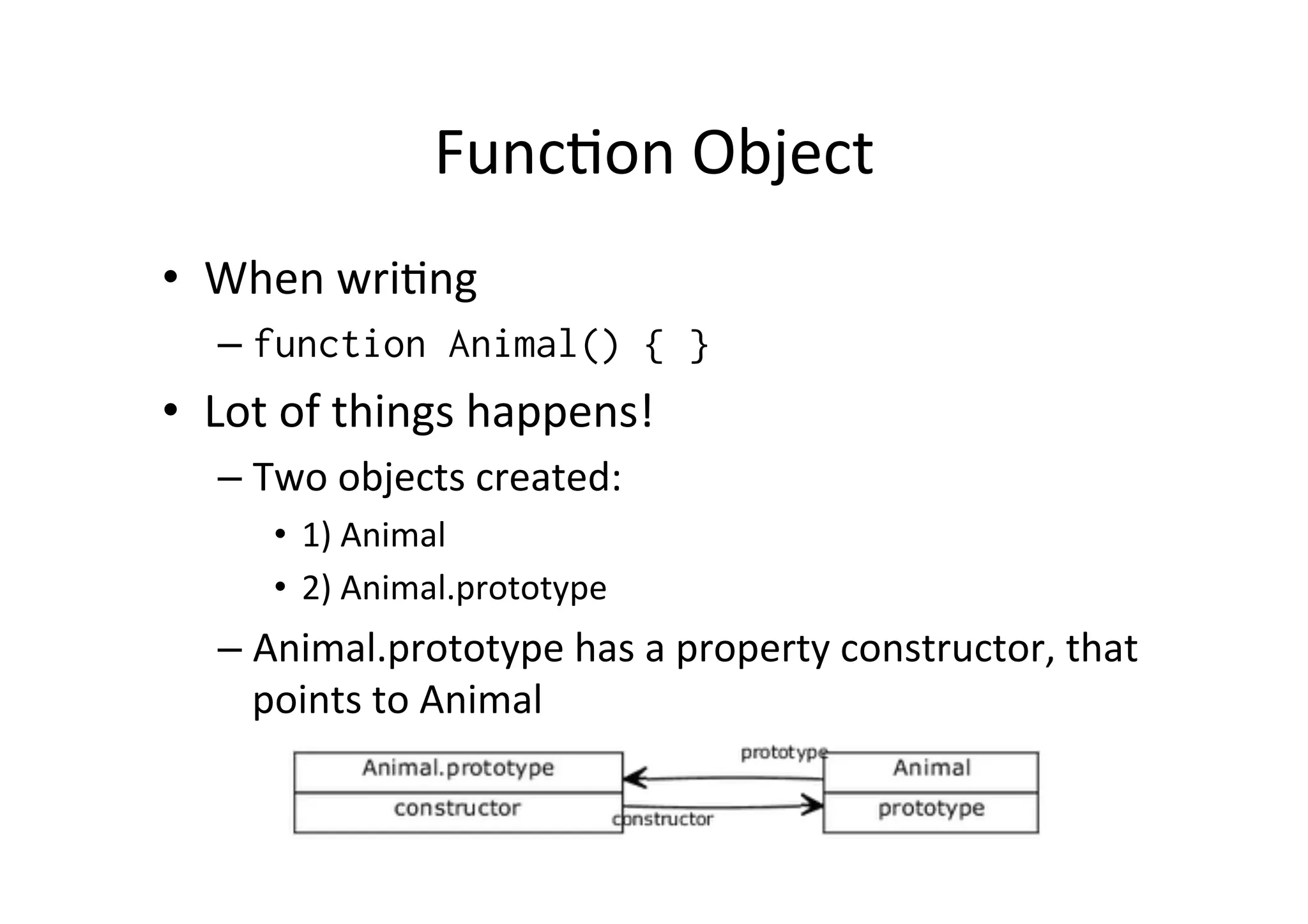
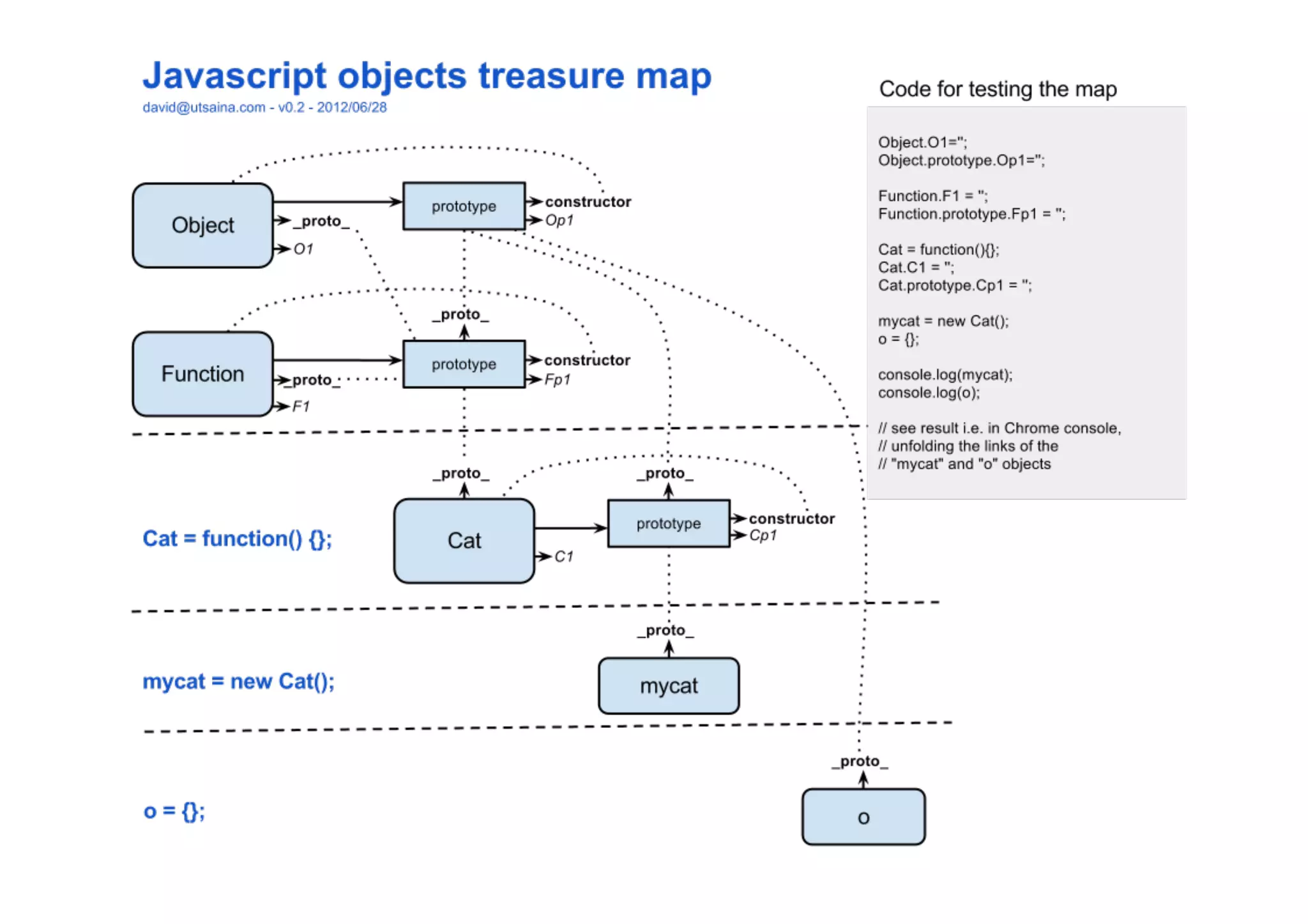
FuncGon Object • When wriGng – function Animal() { } • Lot of things happens! – Two objects created: • 1) Animal • 2) Animal.prototype – Animal.prototype has a property constructor, that points to Animal
8.
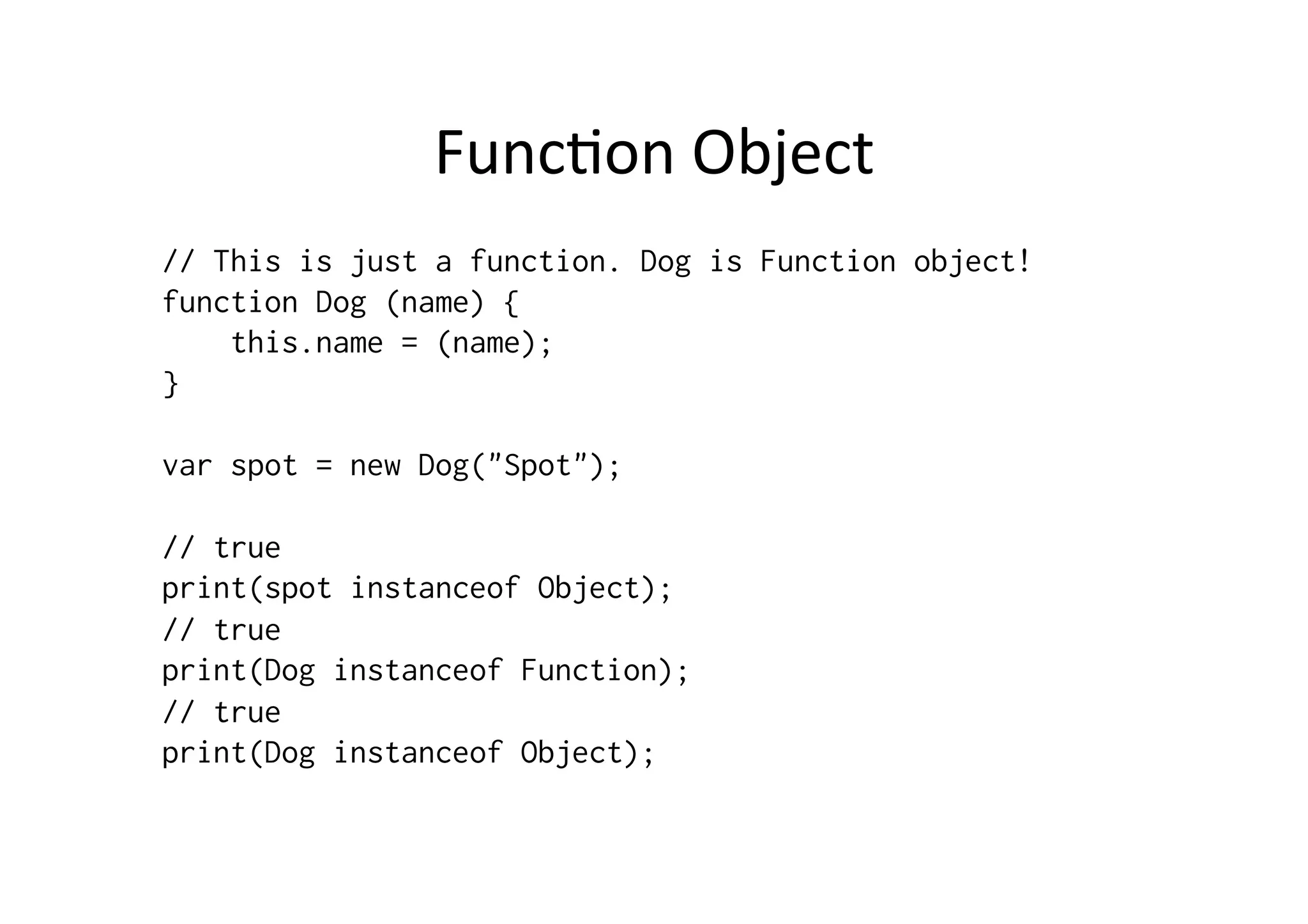
FuncGon Object //This is just a function. Dog is Function object! function Dog (name) { this.name = (name); } var spot = new Dog("Spot"); // true print(spot instanceof Object); // true print(Dog instanceof Function); // true print(Dog instanceof Object);
9.
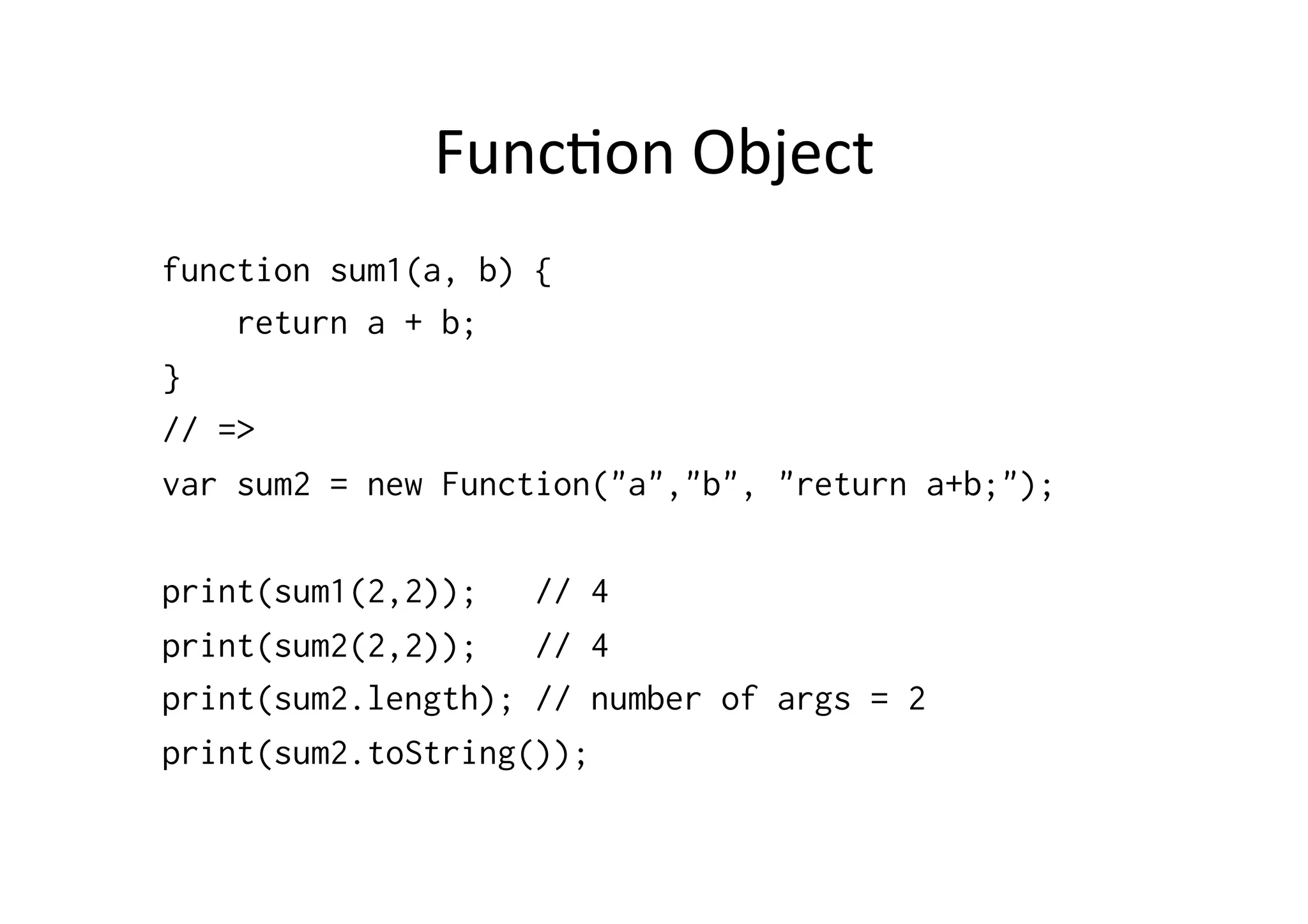
FuncGon Object functionsum1(a, b) { return a + b; } // => var sum2 = new Function("a","b", "return a+b;"); print(sum1(2,2)); // 4 print(sum2(2,2)); // 4 print(sum2.length); // number of args = 2 print(sum2.toString());
10.
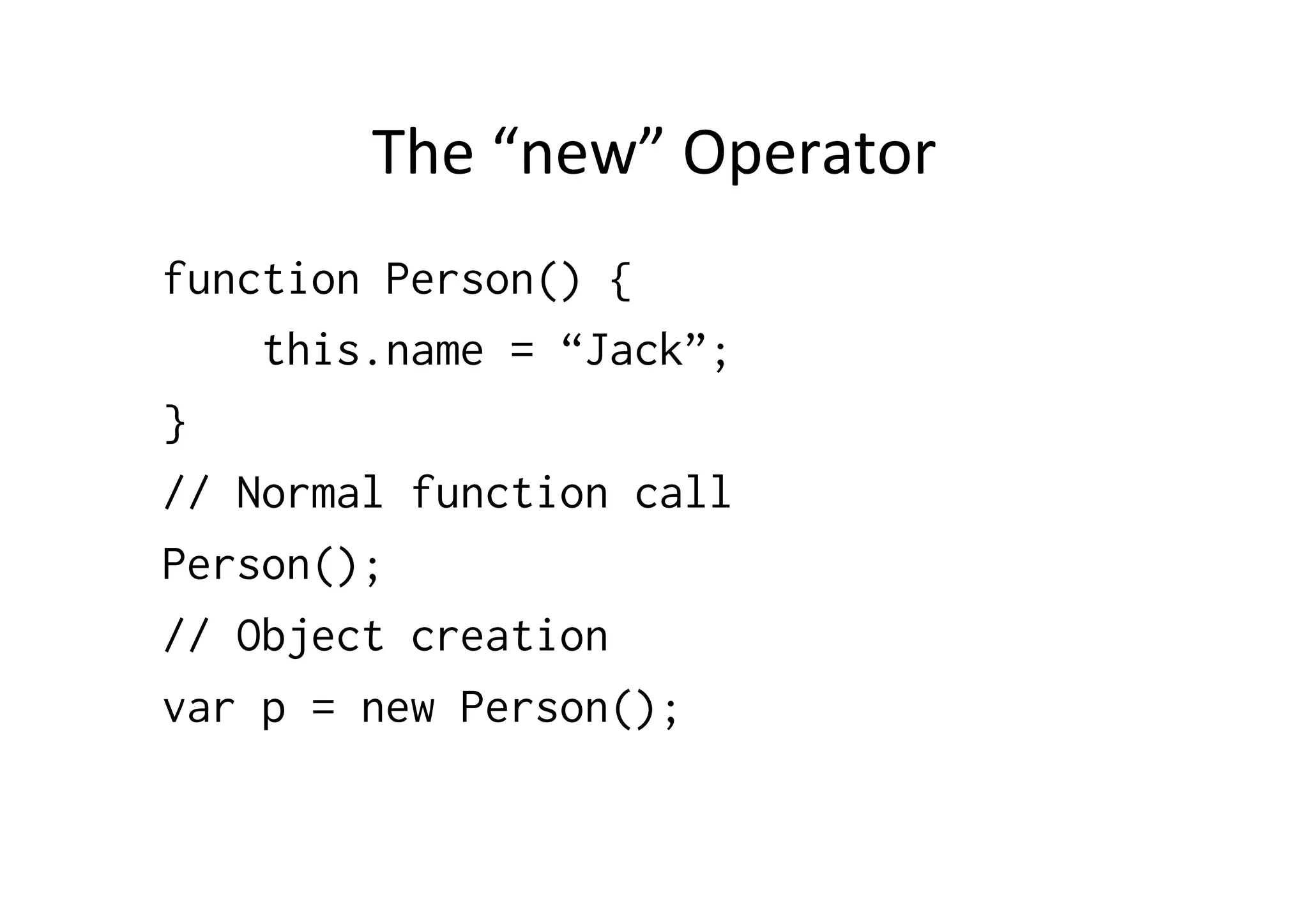
The “new” Operator function Person() { this.name = “Jack”; } // Normal function call Person(); // Object creation var p = new Person();
12.
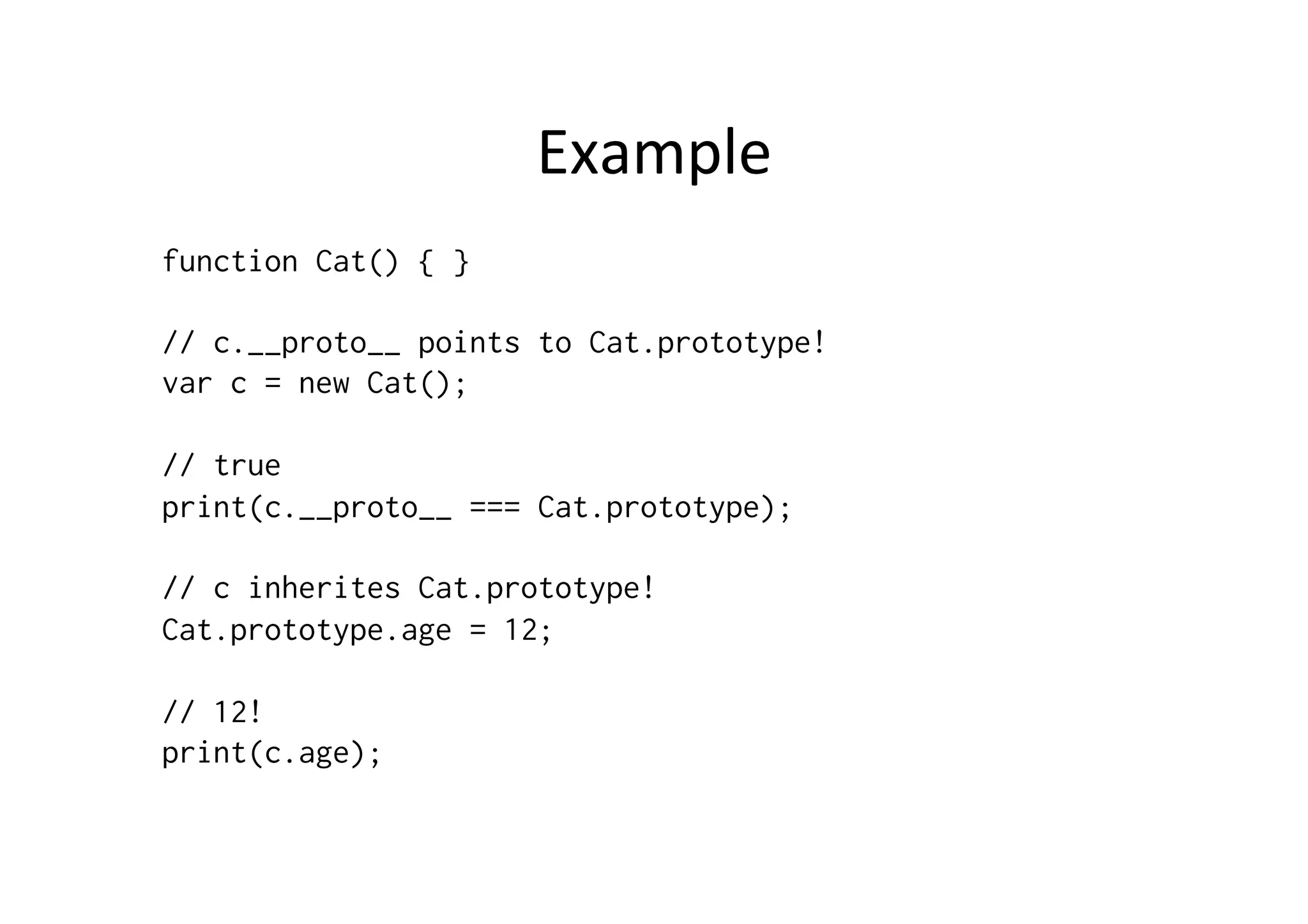
Example function Cat(){ } // c.__proto__ points to Cat.prototype! var c = new Cat(); // true print(c.__proto__ === Cat.prototype); // c inherites Cat.prototype! Cat.prototype.age = 12; // 12! print(c.age);
13.
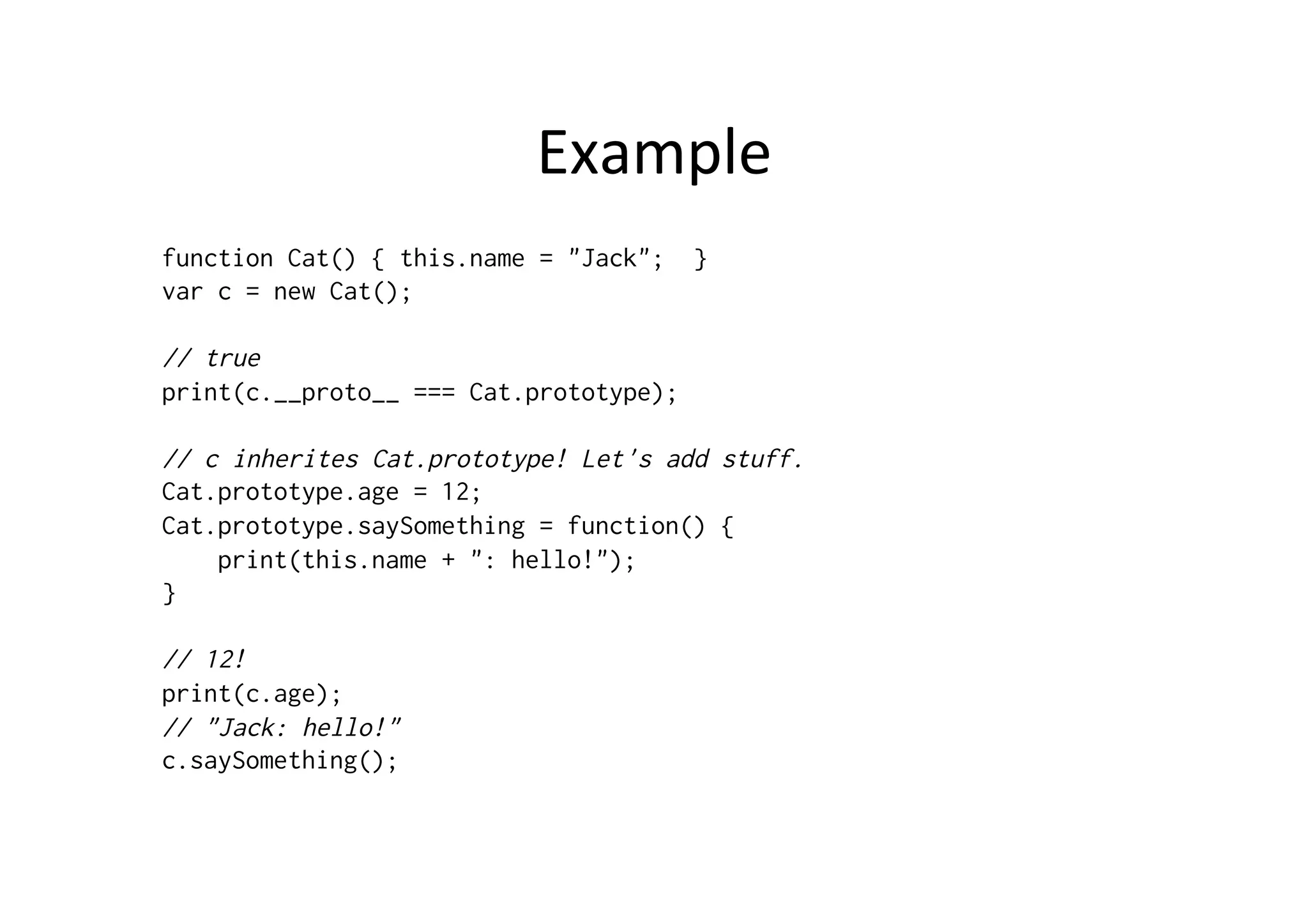
Example function Cat(){ this.name = "Jack"; } var c = new Cat(); // true print(c.__proto__ === Cat.prototype); // c inherites Cat.prototype! Let's add stuff. Cat.prototype.age = 12; Cat.prototype.saySomething = function() { print(this.name + ": hello!"); } // 12! print(c.age); // "Jack: hello!" c.saySomething();
14.
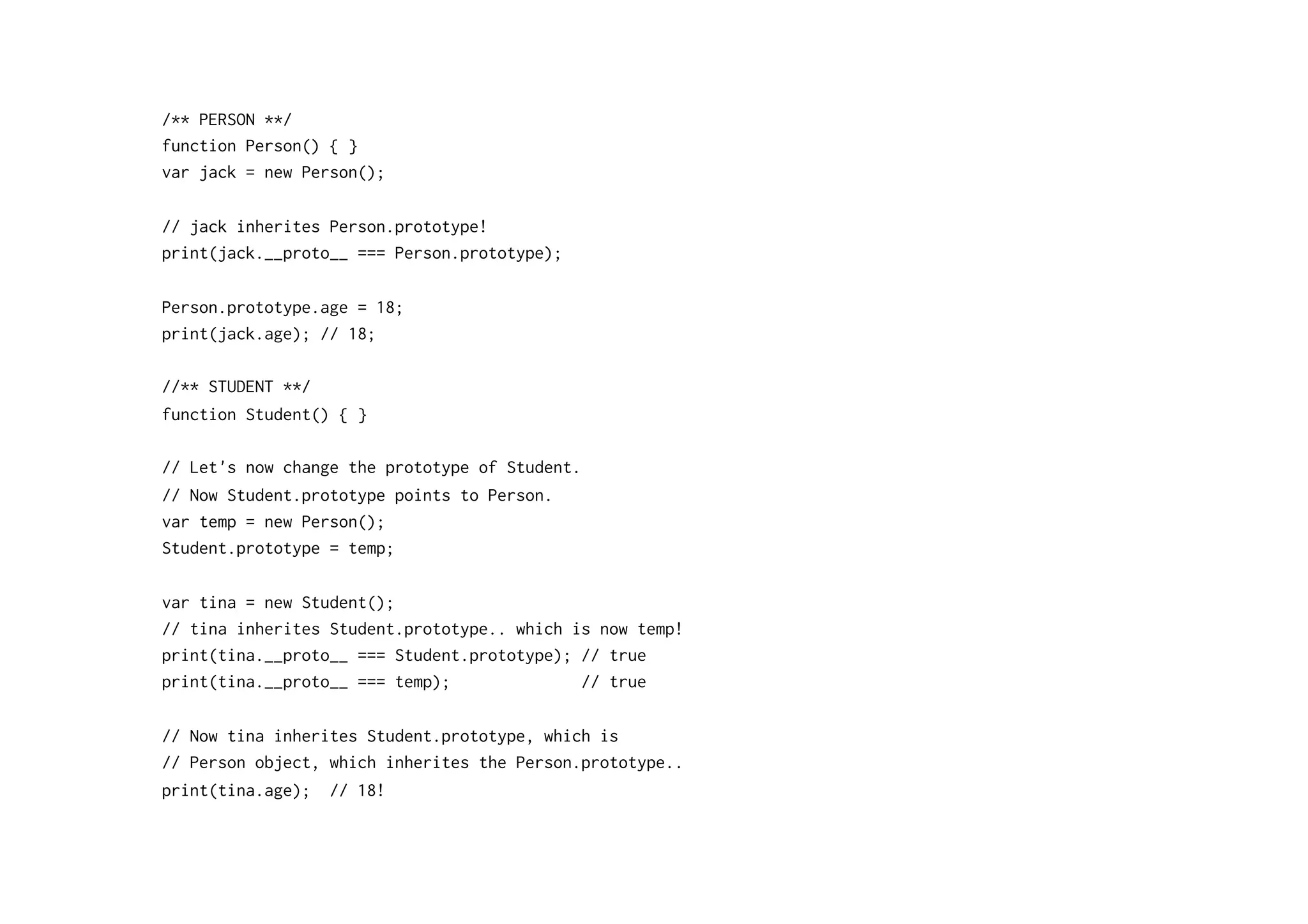
/** PERSON **/ functionPerson() { } var jack = new Person(); // jack inherites Person.prototype! print(jack.__proto__ === Person.prototype); Person.prototype.age = 18; print(jack.age); // 18; //** STUDENT **/ function Student() { } // Let's now change the prototype of Student. // Now Student.prototype points to Person. var temp = new Person(); Student.prototype = temp; var tina = new Student(); // tina inherites Student.prototype.. which is now temp! print(tina.__proto__ === Student.prototype); // true print(tina.__proto__ === temp); // true // Now tina inherites Student.prototype, which is // Person object, which inherites the Person.prototype.. print(tina.age); // 18!
15.
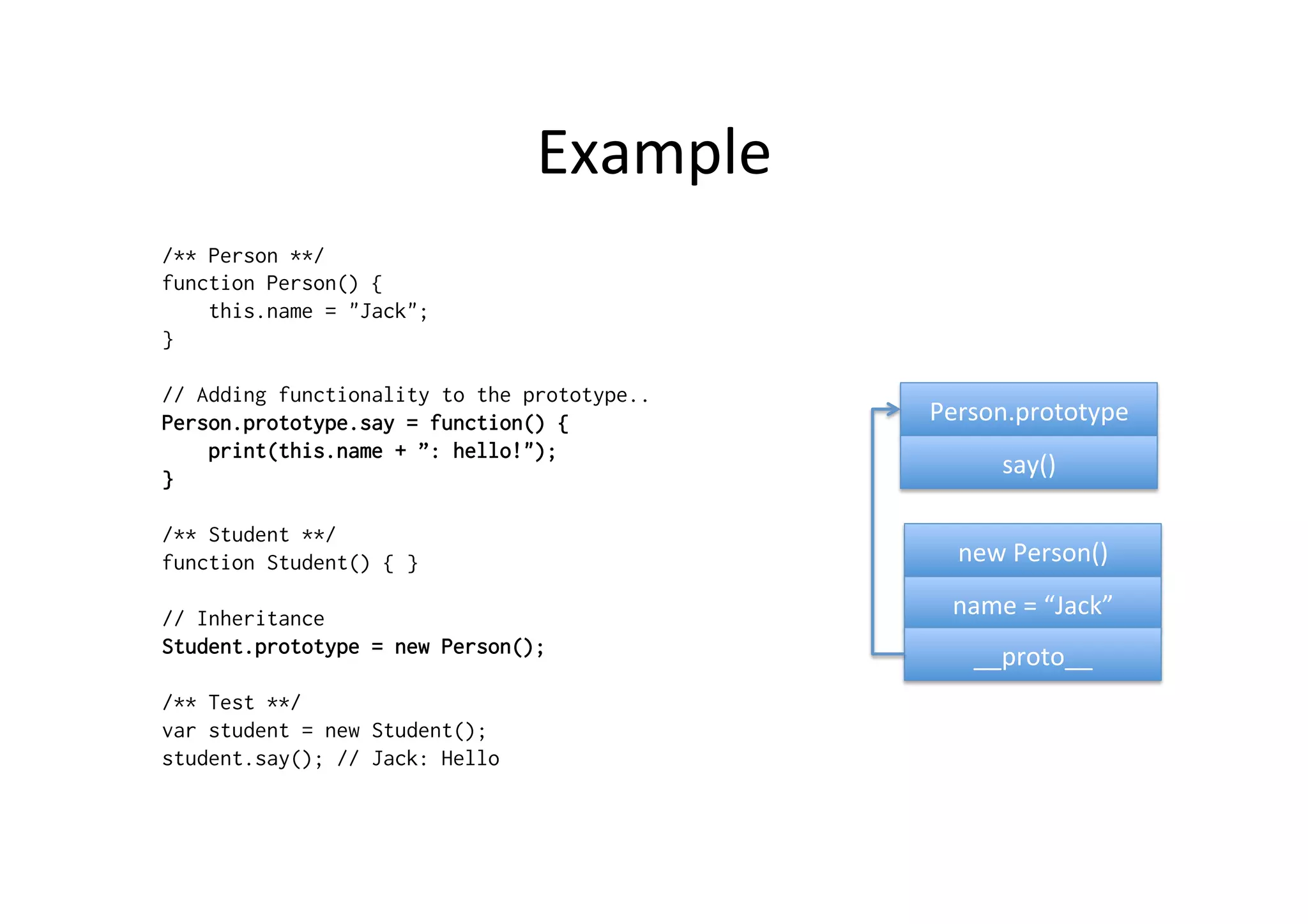
Example /** Person**/ function Person() { this.name = "Jack"; } // Adding functionality to the prototype.. Person.prototype.say = function() { print(this.name + ”: hello!"); } /** Student **/ function Student() { } // Inheritance Student.prototype = new Person(); /** Test **/ var student = new Student(); student.say(); // Jack: Hello Person.prototype say() new Person() name = “Jack” __proto__
16.
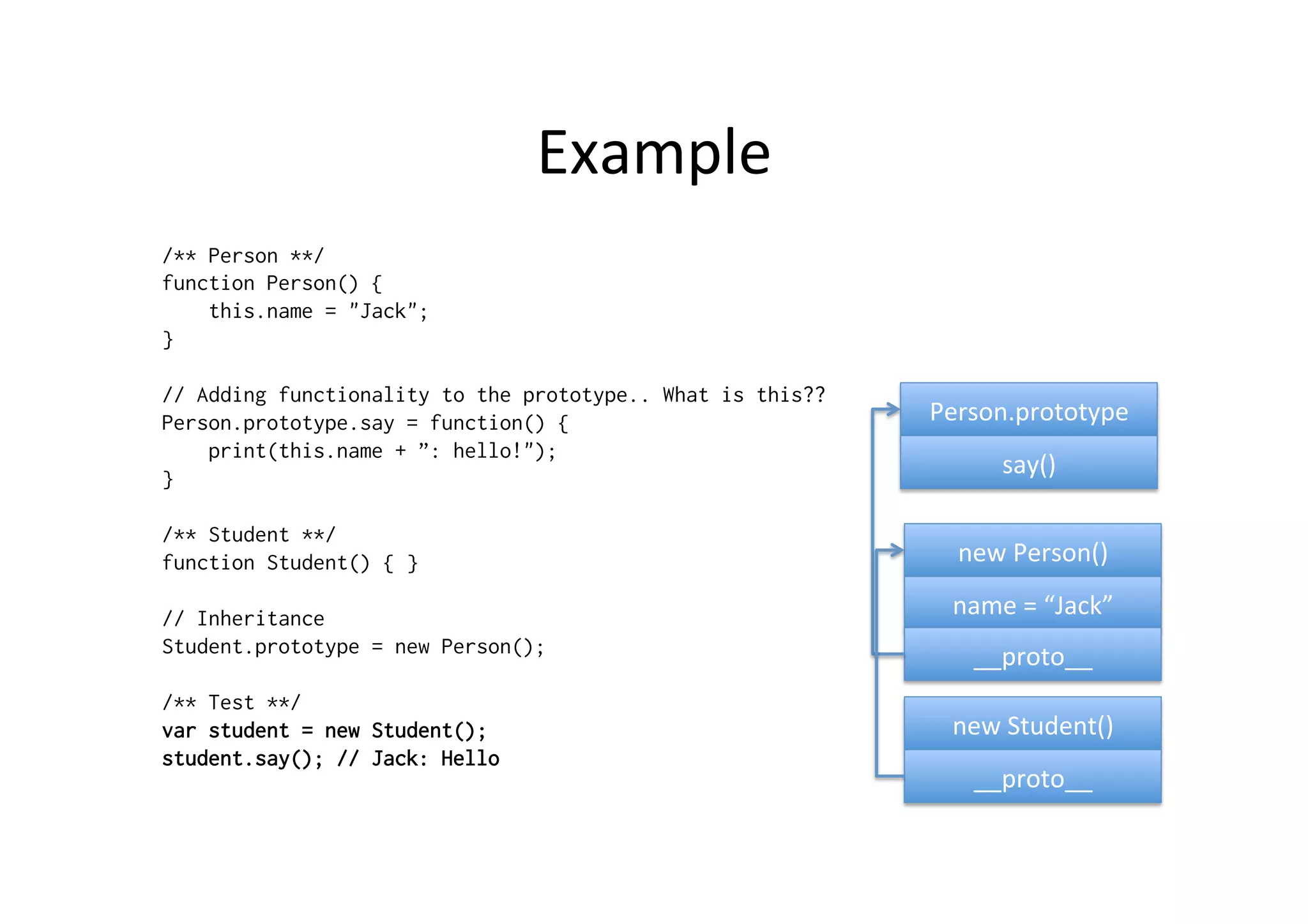
Example /** Person**/ function Person() { this.name = "Jack"; } // Adding functionality to the prototype.. What is this?? Person.prototype.say = function() { print(this.name + ”: hello!"); } /** Student **/ function Student() { } // Inheritance Student.prototype = new Person(); /** Test **/ var student = new Student(); student.say(); // Jack: Hello Person.prototype say() new Person() name = “Jack” __proto__ new Student() __proto__
17.
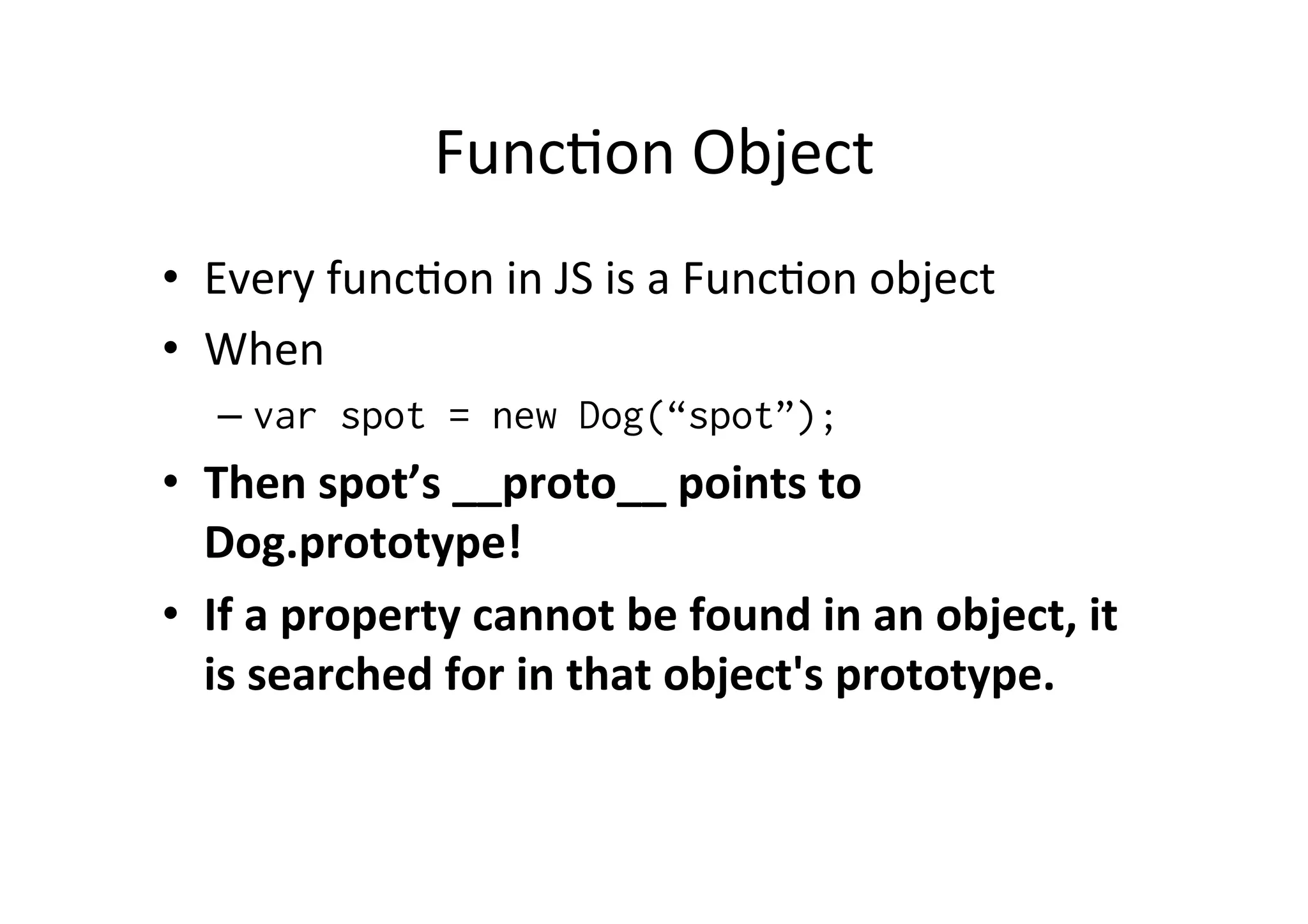
FuncGon Object • Every funcGon in JS is a FuncGon object • When – var spot = new Dog(“spot”); • Then spot’s __proto__ points to Dog.prototype! • If a property cannot be found in an object, it is searched for in that object's prototype.
18.
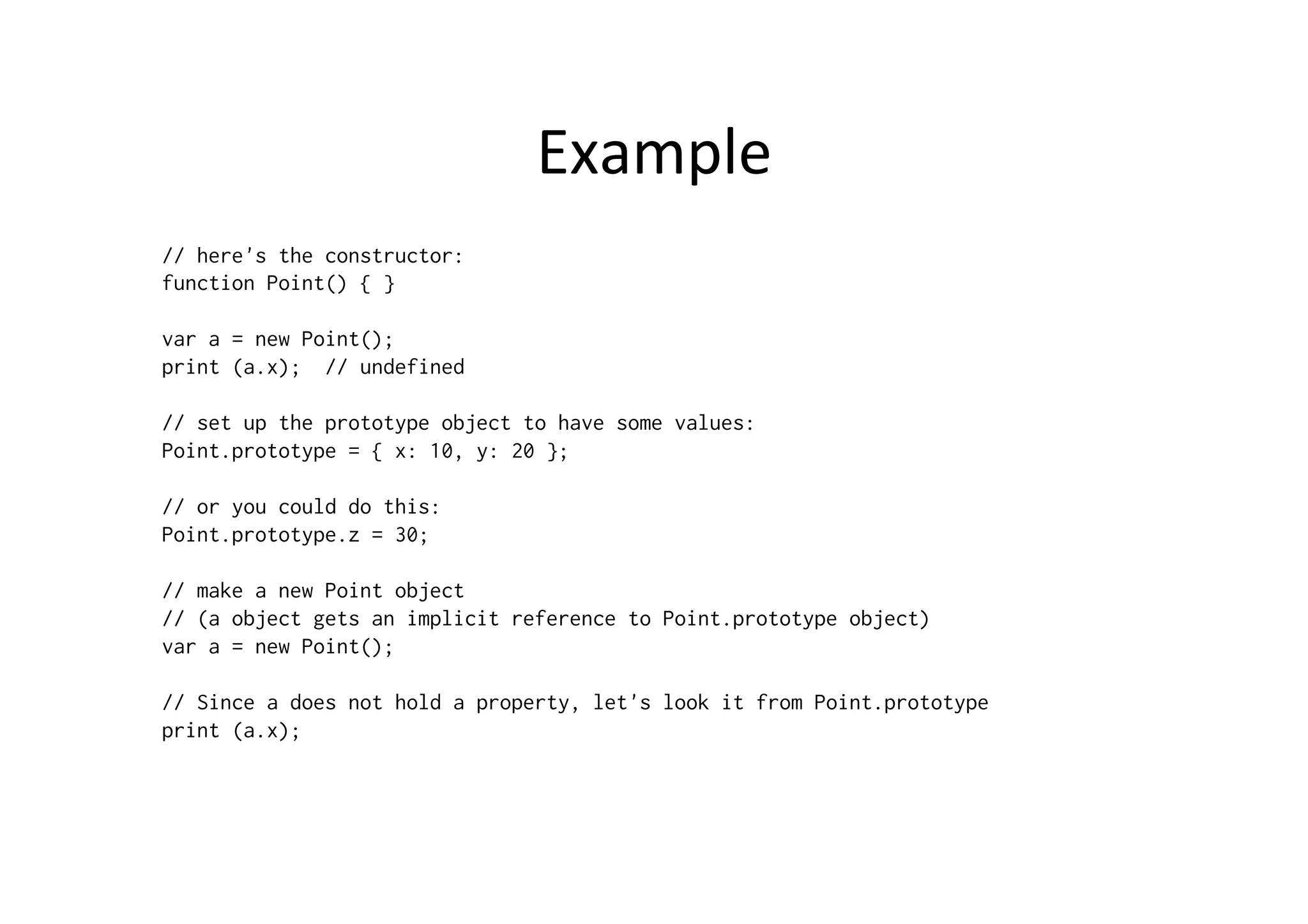
Example // here'sthe constructor: function Point() { } var a = new Point(); print (a.x); // undefined // set up the prototype object to have some values: Point.prototype = { x: 10, y: 20 }; // or you could do this: Point.prototype.z = 30; // make a new Point object // (a object gets an implicit reference to Point.prototype object) var a = new Point(); // Since a does not hold a property, let's look it from Point.prototype print (a.x);
19.
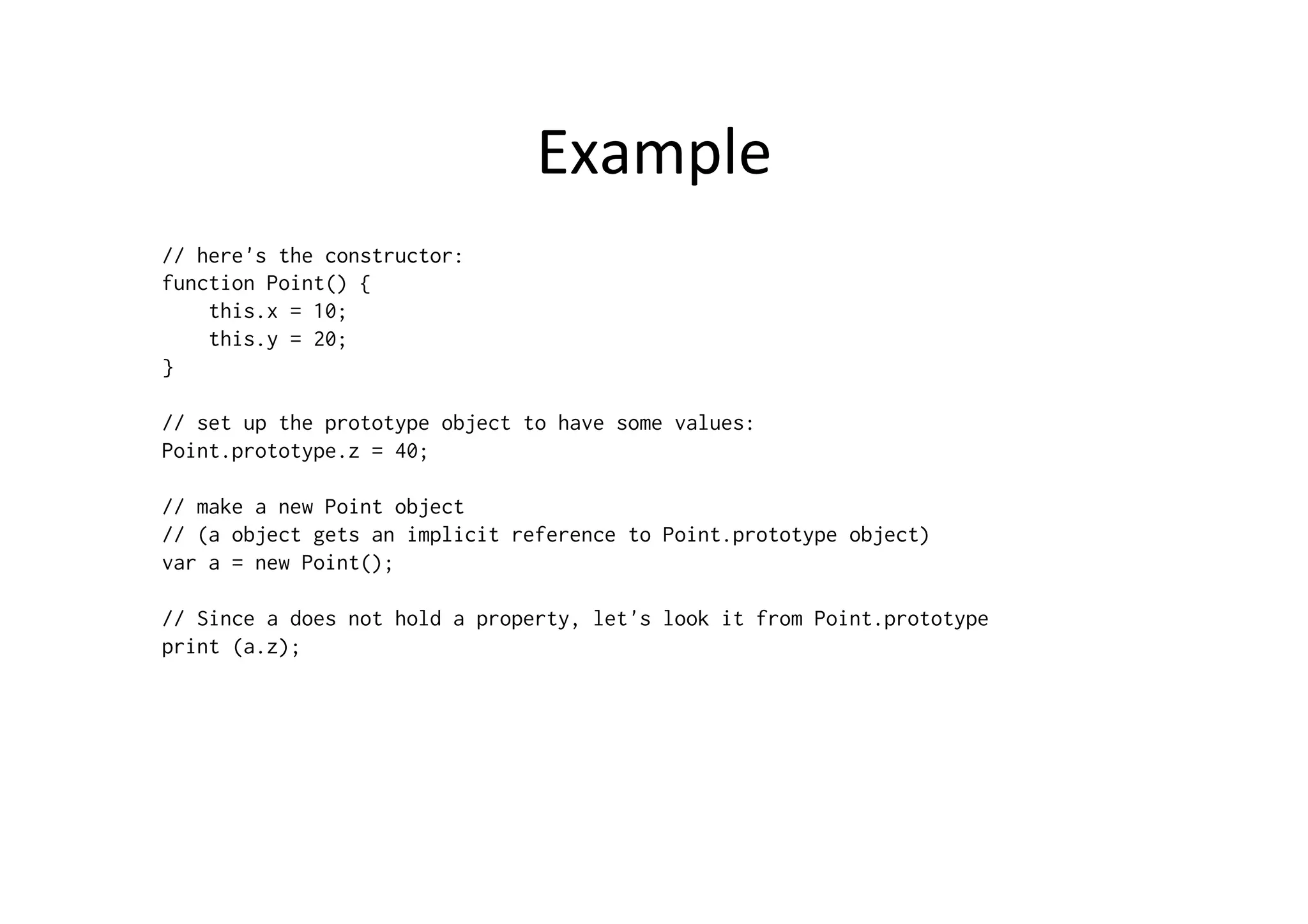
Example // here'sthe constructor: function Point() { this.x = 10; this.y = 20; } // set up the prototype object to have some values: Point.prototype.z = 40; // make a new Point object // (a object gets an implicit reference to Point.prototype object) var a = new Point(); // Since a does not hold a property, let's look it from Point.prototype print (a.z);
20.
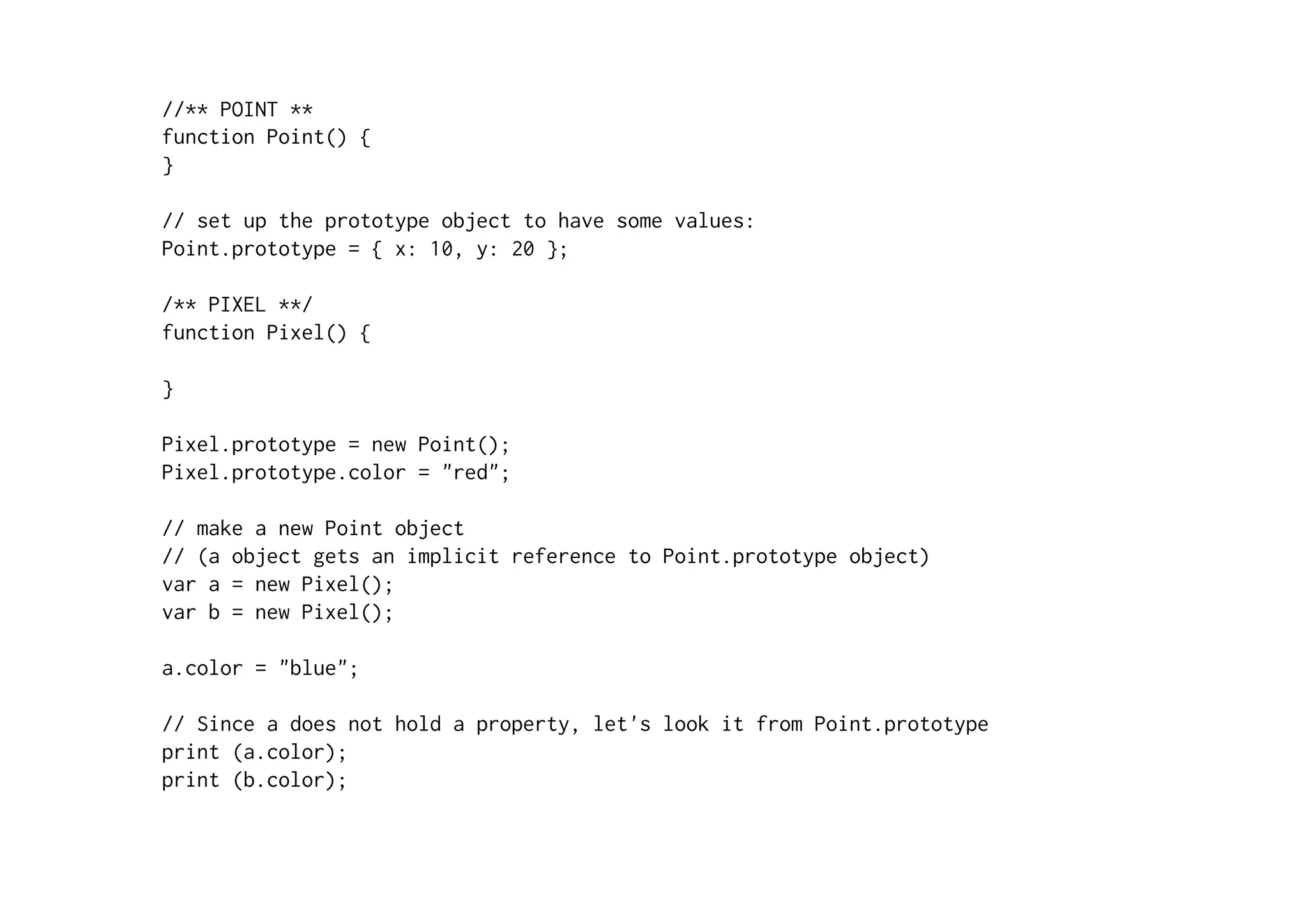
//** POINT ** functionPoint() { } // set up the prototype object to have some values: Point.prototype = { x: 10, y: 20 }; /** PIXEL **/ function Pixel() { } Pixel.prototype = new Point(); Pixel.prototype.color = "red"; // make a new Point object // (a object gets an implicit reference to Point.prototype object) var a = new Pixel(); var b = new Pixel(); a.color = "blue"; // Since a does not hold a property, let's look it from Point.prototype print (a.color); print (b.color);
21.
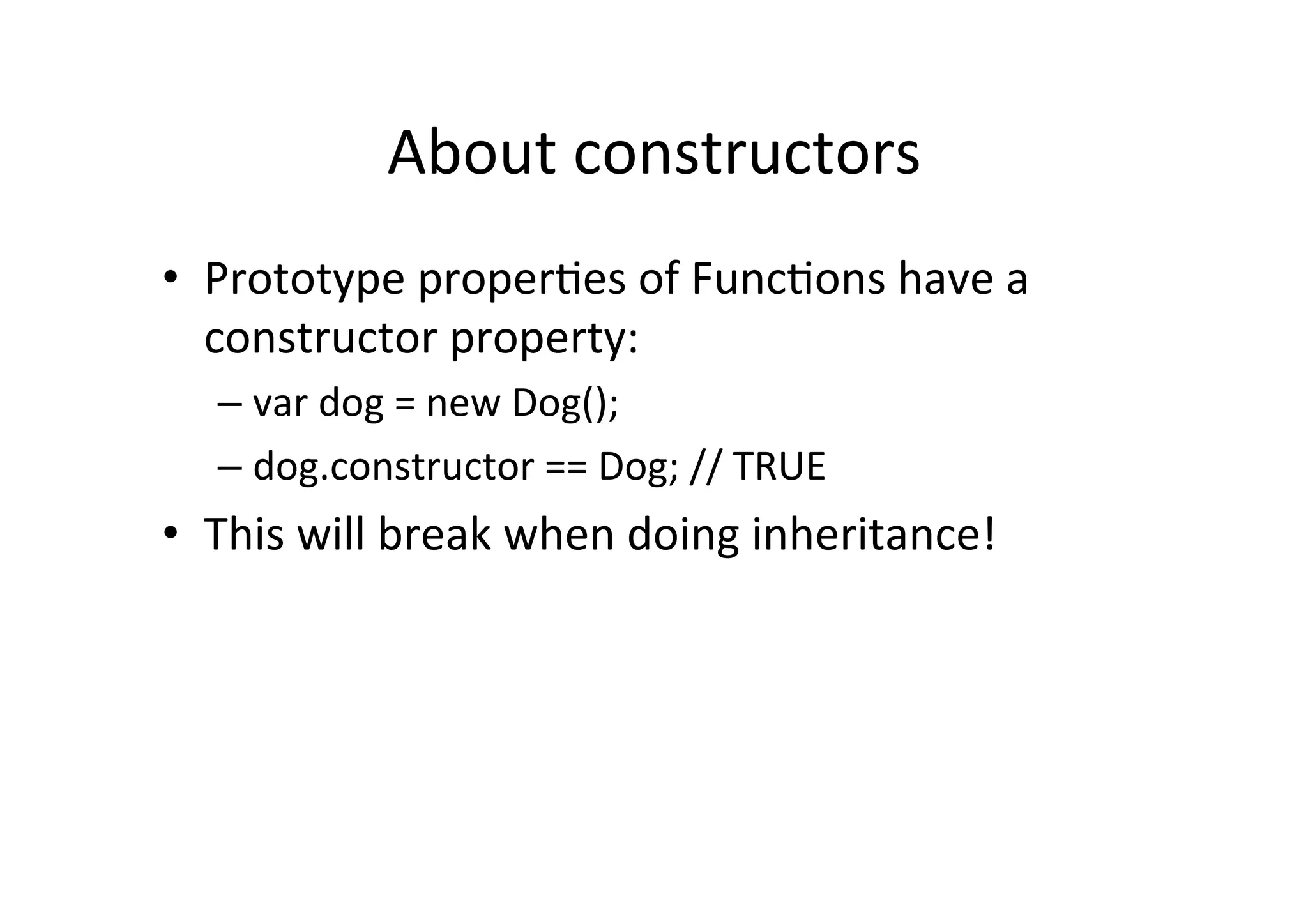
About constructors • Prototype properGes of FuncGons have a constructor property: – var dog = new Dog(); – dog.constructor == Dog; // TRUE • This will break when doing inheritance!
22.
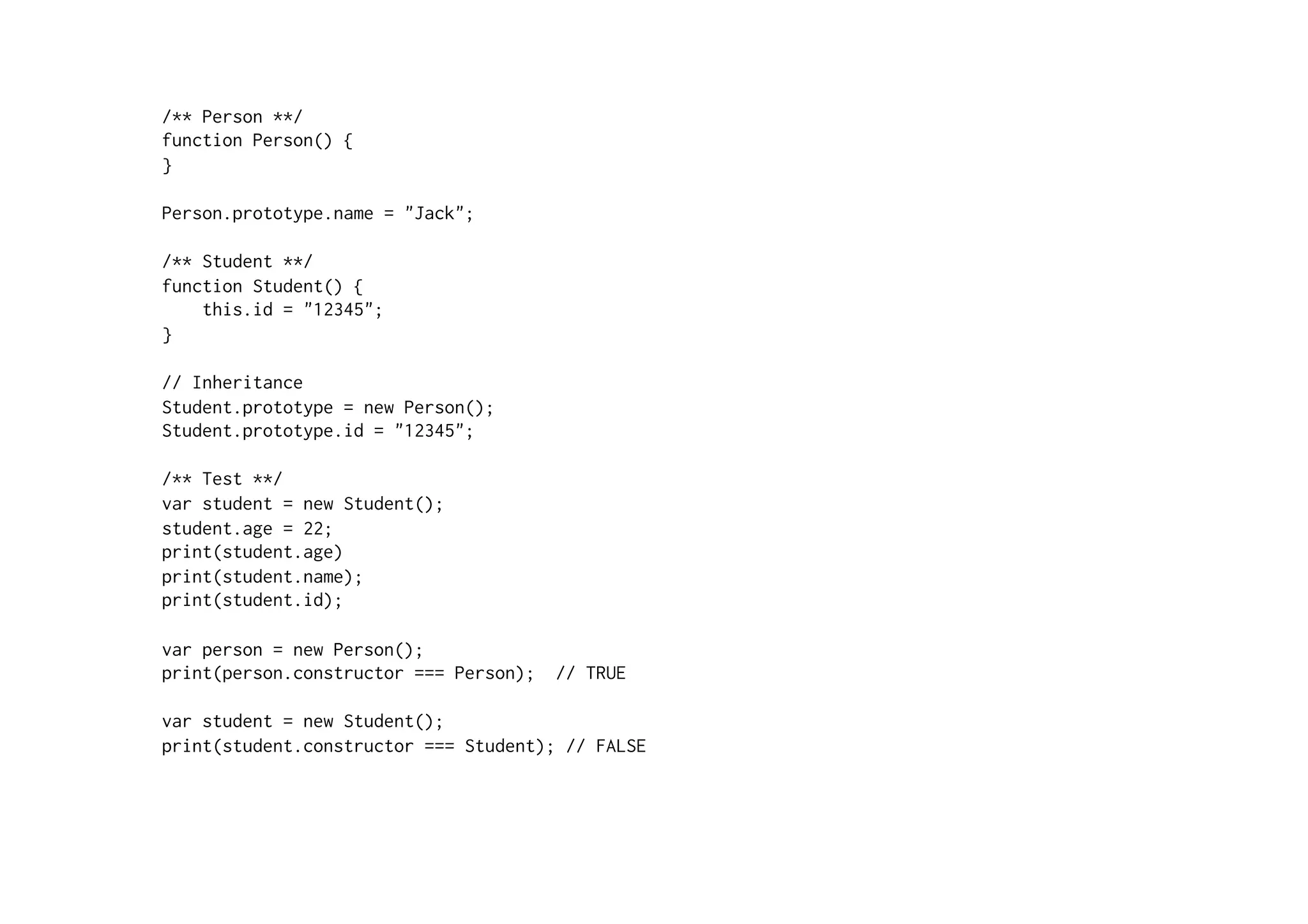
/** Person **/ functionPerson() { } Person.prototype.name = "Jack"; /** Student **/ function Student() { this.id = "12345"; } // Inheritance Student.prototype = new Person(); Student.prototype.id = "12345"; /** Test **/ var student = new Student(); student.age = 22; print(student.age) print(student.name); print(student.id); var person = new Person(); print(person.constructor === Person); // TRUE var student = new Student(); print(student.constructor === Student); // FALSE
23.
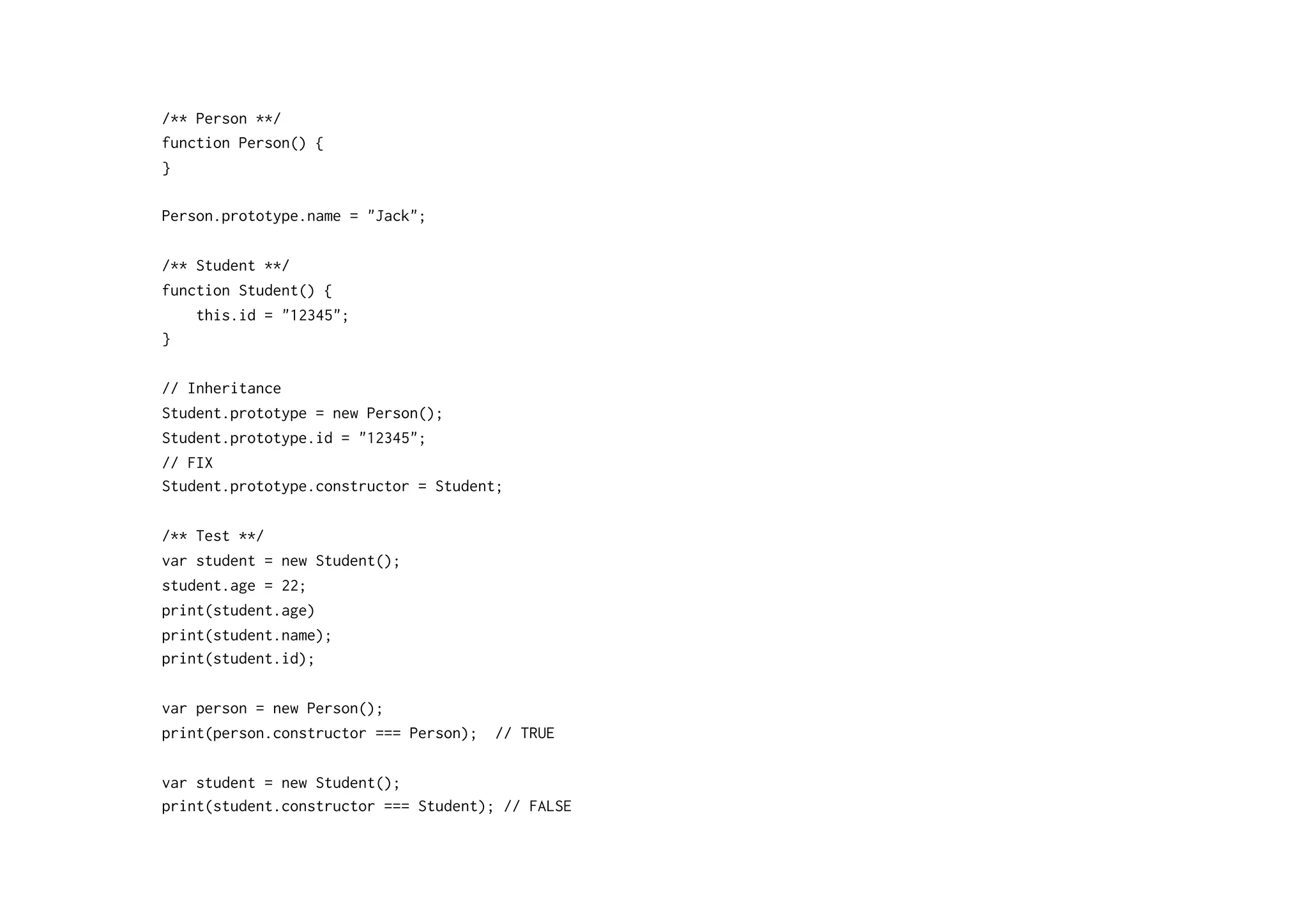
/** Person **/ functionPerson() { } Person.prototype.name = "Jack"; /** Student **/ function Student() { this.id = "12345"; } // Inheritance Student.prototype = new Person(); Student.prototype.id = "12345"; // FIX Student.prototype.constructor = Student; /** Test **/ var student = new Student(); student.age = 22; print(student.age) print(student.name); print(student.id); var person = new Person(); print(person.constructor === Person); // TRUE var student = new Student(); print(student.constructor === Student); // FALSE
24.
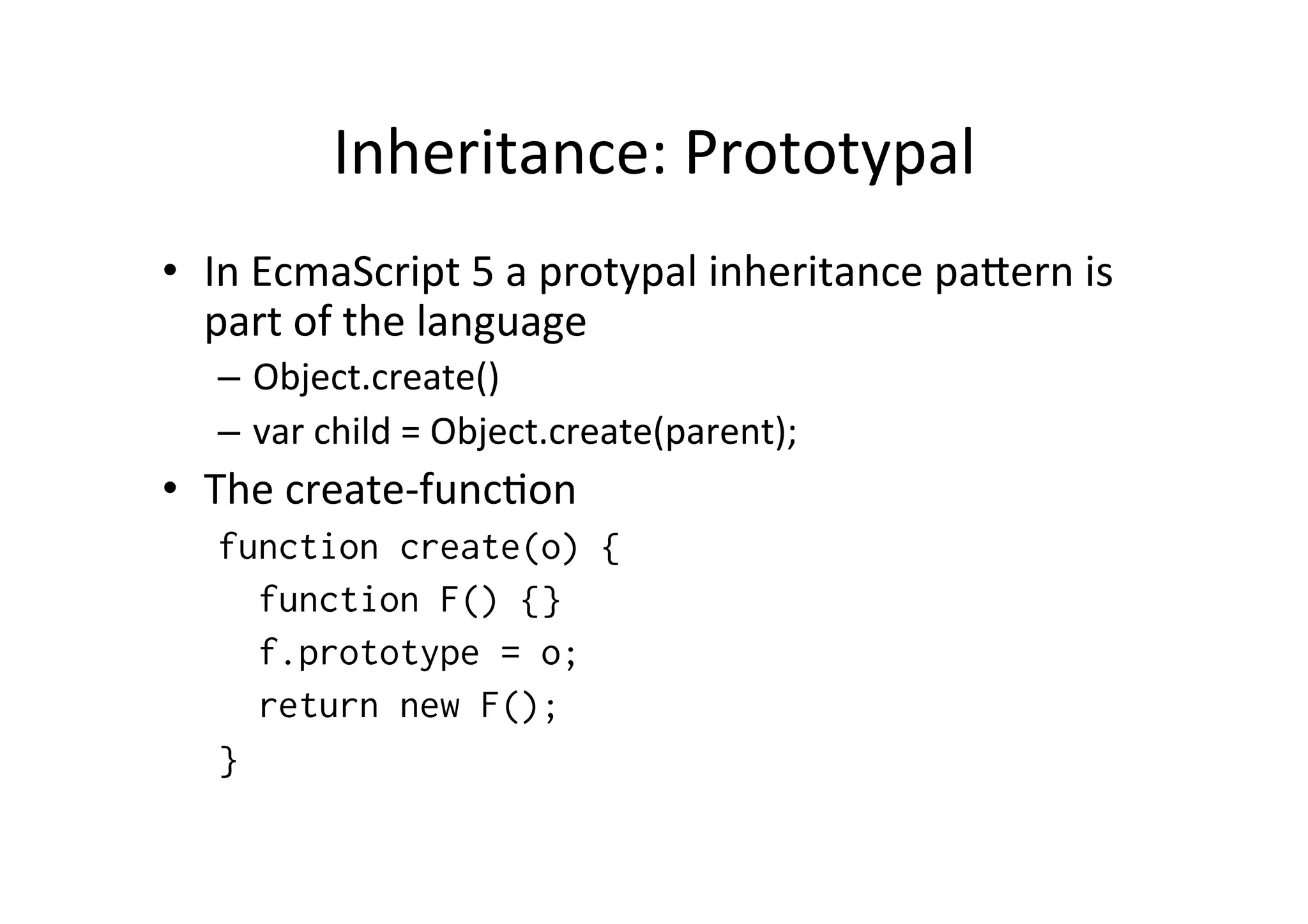
Inheritance: Prototypal • In EcmaScript 5 a protypal inheritance pa@ern is part of the language – Object.create() – var child = Object.create(parent); • The create-‐funcGon function create(o) { function F() {} f.prototype = o; return new F(); }
25.
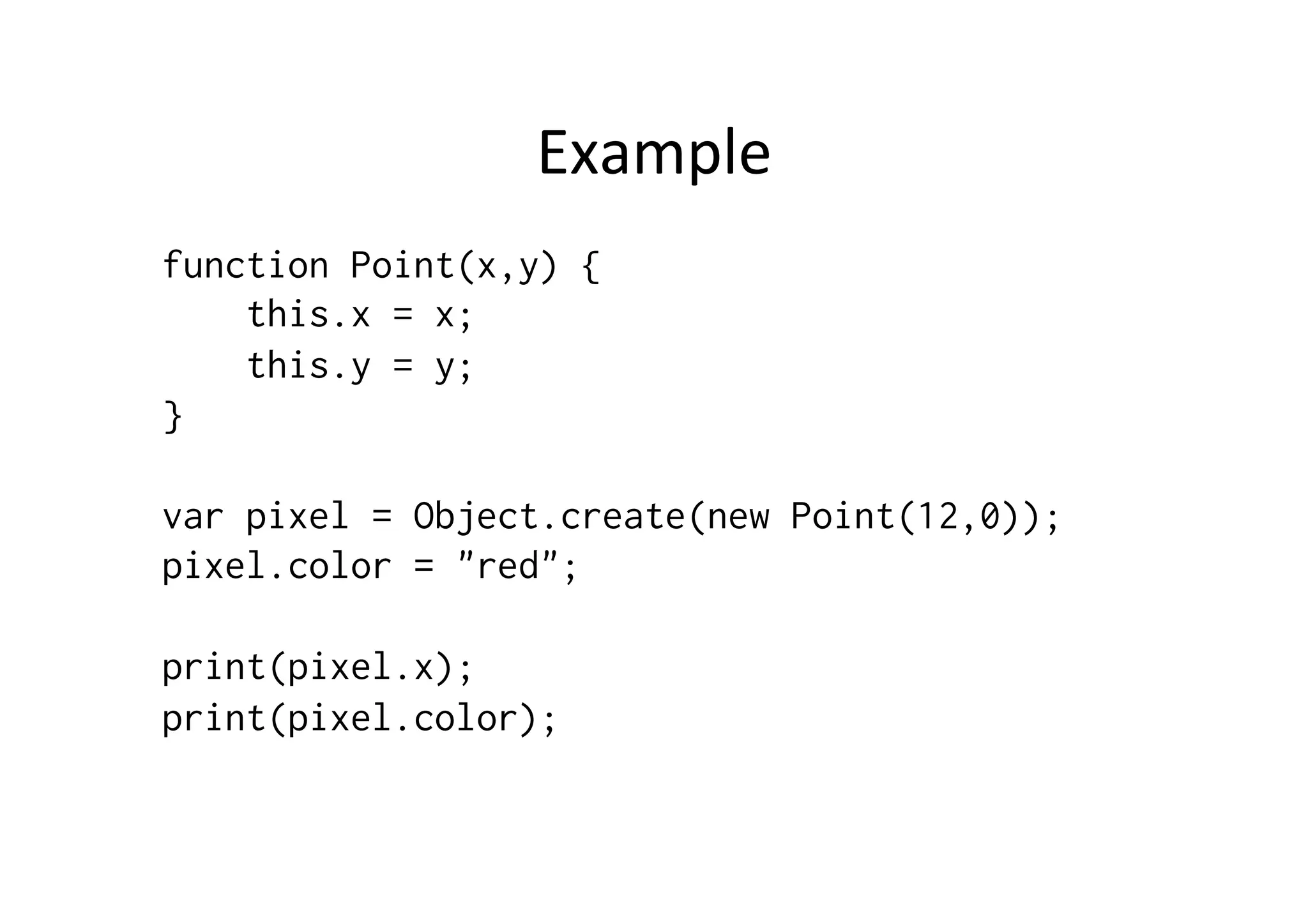
Example function Point(x,y){ this.x = x; this.y = y; } var pixel = Object.create(new Point(12,0)); pixel.color = "red"; print(pixel.x); print(pixel.color);