The System of Automatic Searching for Vulnerabilities or how to use Taint Analysis to find vulnerabilities Alex Bazhanyuk (@ABazhanyuk) Nikita Tarakanov (@NTarakanov)
Who is Alex Bazhanyuk • Security Researcher • Organizer of Defcon Ukraine Group • Working in UC Berkley in BitBlaze project • Solves problems of automation of RE
Who is Nikita Tarakanov • Independent Security Researcher • Author of some articles in ][akep magazine • Likes to reverse engineer r0 parts • Discovered a lot of LPE vulns • Solves problems of automation of RE
Agenda • Intro • Taint analysis theory • BitBlaze theory • SASV implementation • Lulz Time • Pitfalls • Conclusion
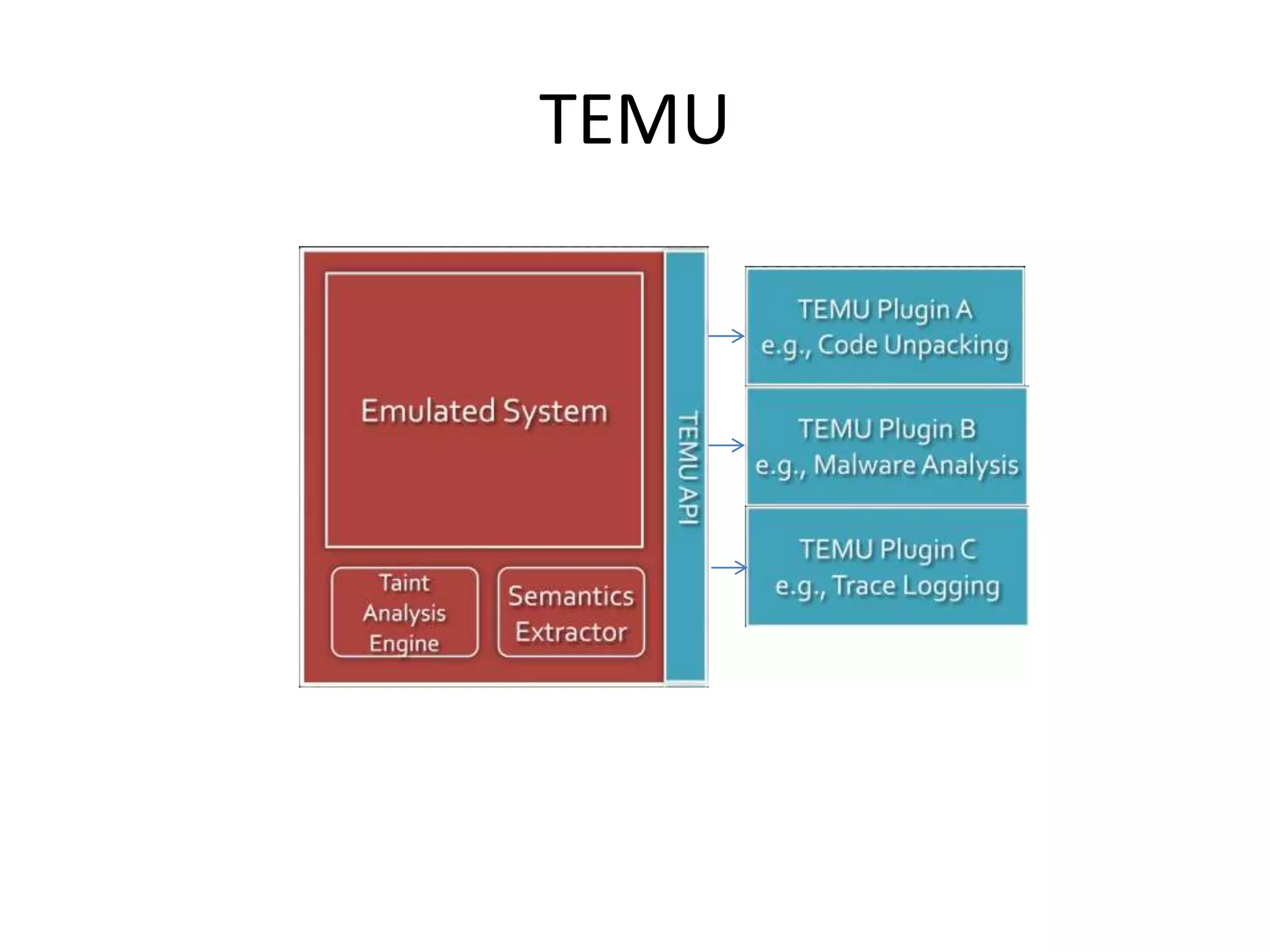
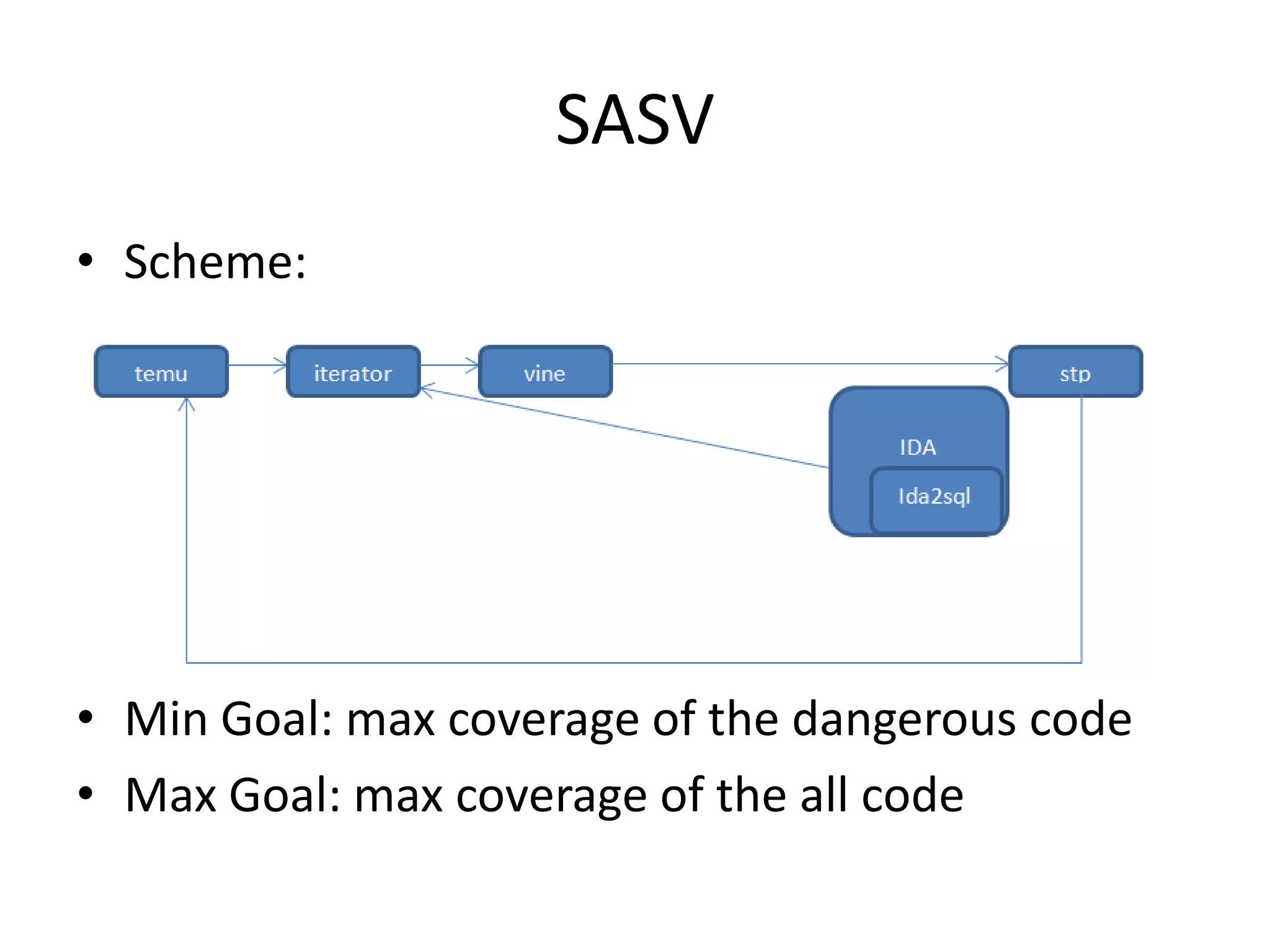
SASV main parts • IDA Pro plugins • BitBlaze: Vine+utils, TEMU + plugins
Theory
Tainting • Taint sources: Network, Keyboard, Memory, Disk, Function outputs • Taint propagation: a data flow technique Shadow memory Whole-system Across register/memory/disk/swapping
Fundamentals of taint analysis
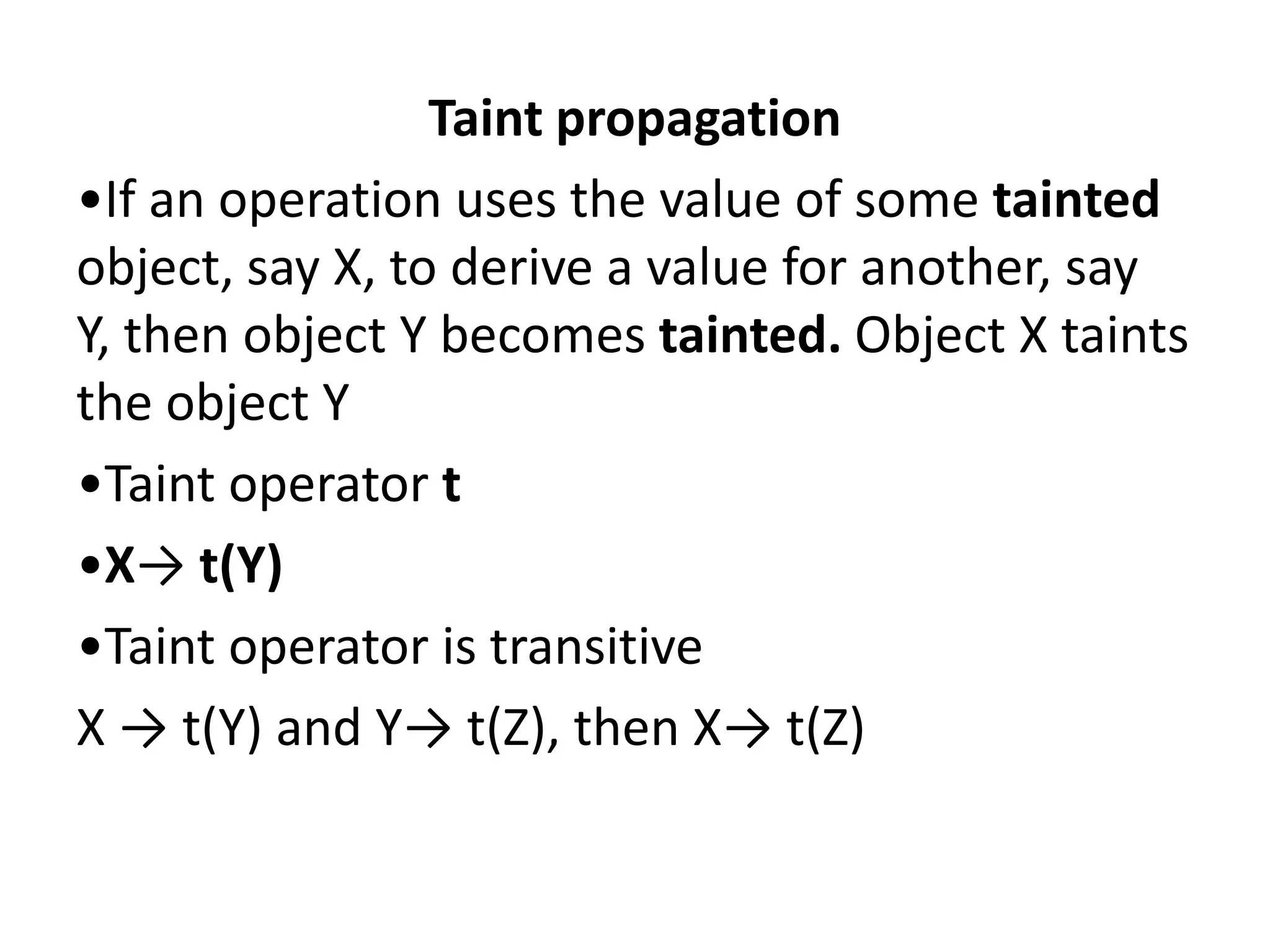
Taint propagation •If an operation uses the value of some tainted object, say X, to derive a value for another, say Y, then object Y becomes tainted. Object X taints the object Y •Taint operator t •X→ t(Y) •Taint operator is transitive X → t(Y) and Y→ t(Z), then X→ t(Z)
Static Taint Analysis Analysis performed over multiple paths of a program * Typically performed on a control flow graph (CFG): statements are nodes, and there is an edge between nodes if there is a possible transfer of control.
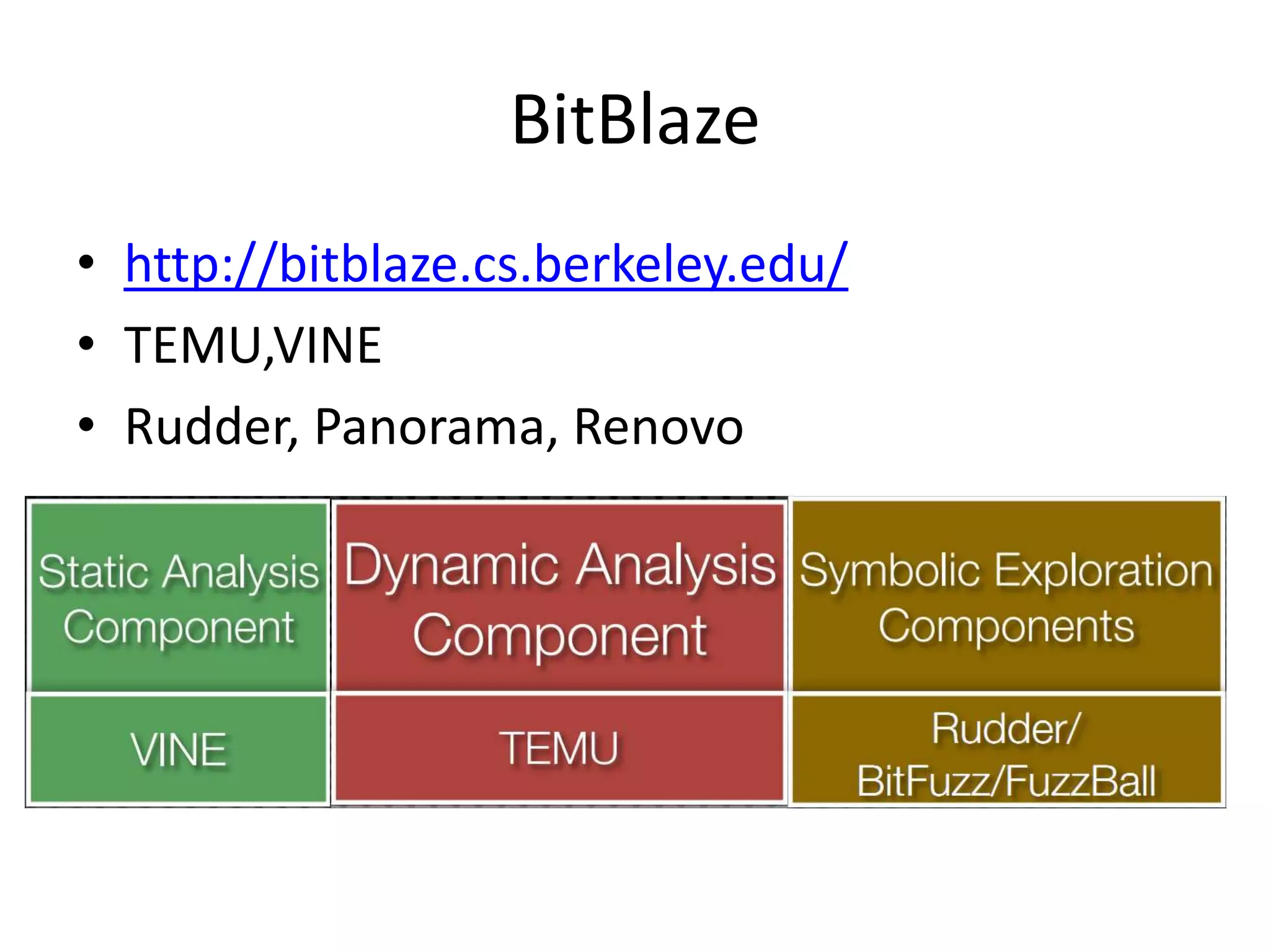
BitBlaze: Binary Analysis Infrastructure • Automatically extracting security-related properties from • binary code • Build a unified binary analysis platform for security - Static analysis + Dynamic analysis + Symbolic Analysis - Leverages recent advances in program analysis, formal methods, binary instrumentation… Solve security problems via binary analysis • More than a dozen different security applications • Over 25 research publications
BitBlaze • http://bitblaze.cs.berkeley.edu/ • TEMU,VINE • Rudder, Panorama, Renovo
TEMU
Confines TEMU • Only gcc-3.4 • Qemu 0.9.1 - TEMU • Qemu 0.10 - TCG(Tiny Code Generator)-TODO • Qemu 0.10  Qemu 1.01
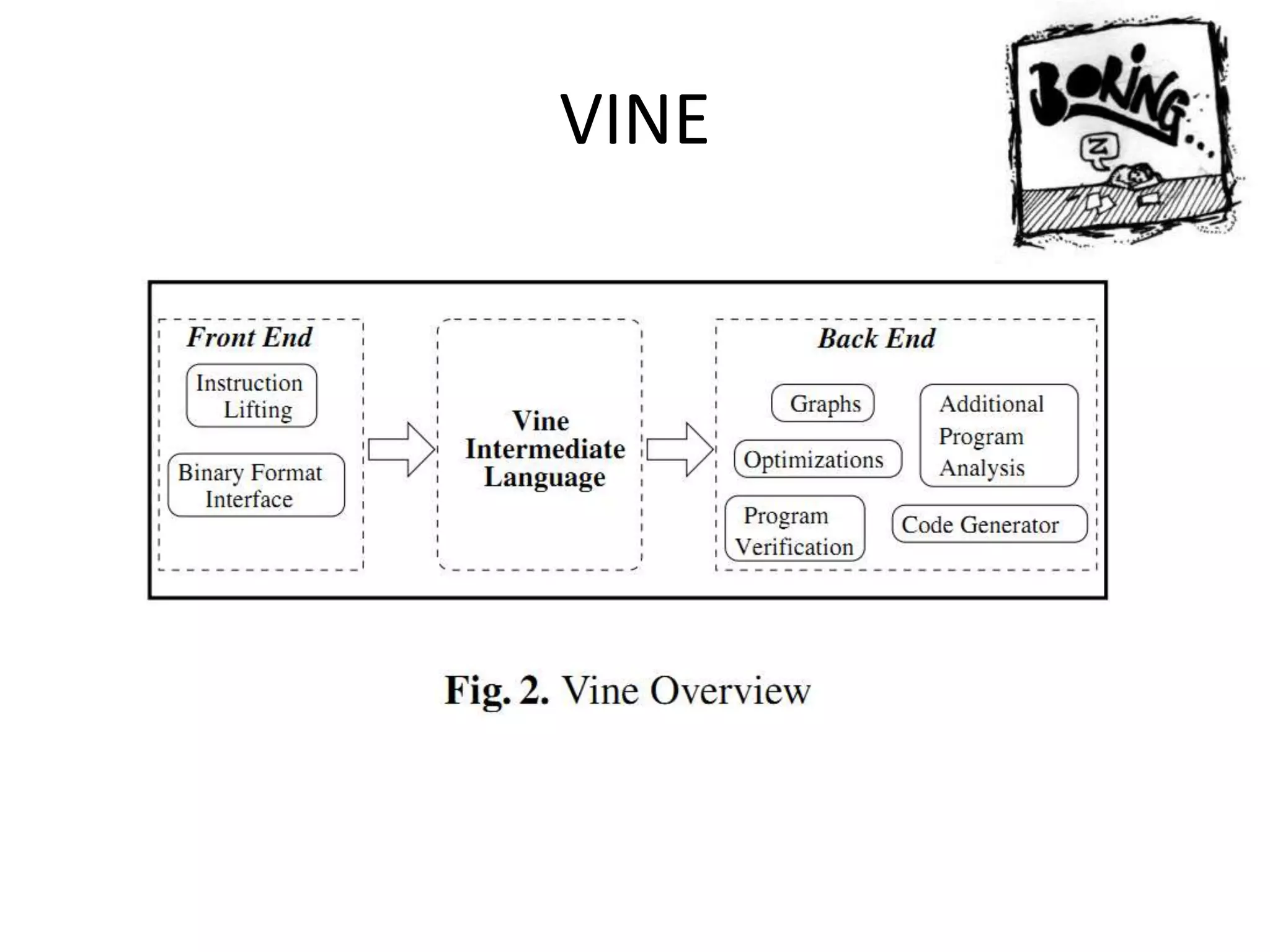
VINE
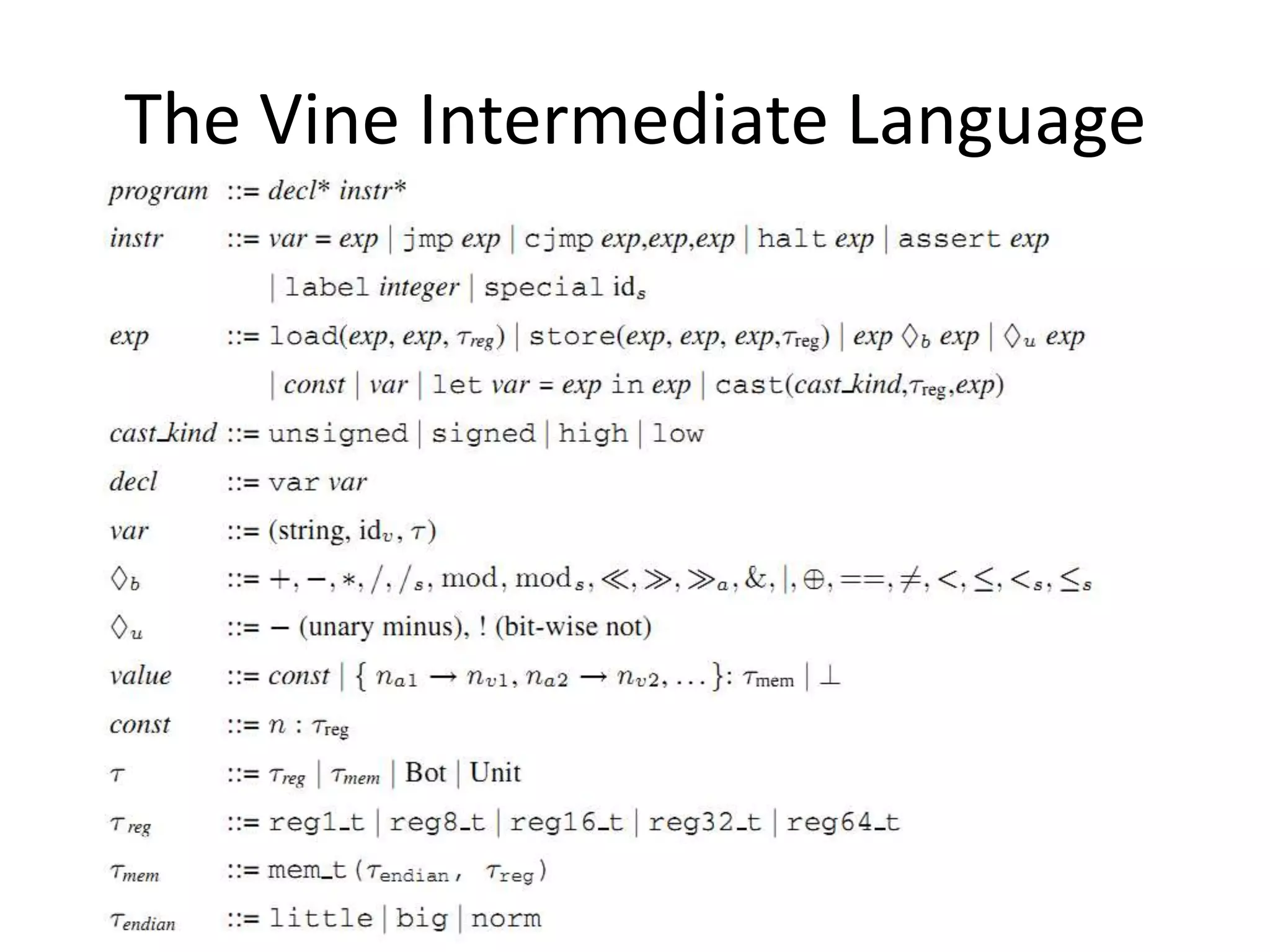
The Vine Intermediate Language
Example of disasm: fc32dcec: rep stos %eax,%es:(%edi) R@eax[0x00000000][4](R) T0 R@ecx[0x00000002][4](RCW) T0 M@0xfb7bfff8[0x00000000][4](CW) T1 {15 (1231, 69624) (1231, 69625) (1231, 69626) (1231, 69627) } fc32dcec: rep stos %eax,%es:(%edi) R@eax[0x00000000][4](R) T0 R@ecx[0x00000001][4](RCW) T0 M@0xfb7bfffc[0x00000000][4](CW) T1 {15 (1231, 69628) (1231, 69629) (1231, 69630) (1231, 69631) } fc32dcee: mov %edx,%ecx R@edx[0x0000015c][4](R) T0 R@ecx[0x00000000][4](W) T0 fc32dcf0: and $0×3,%ecx I@0×00000000[0x00000003][1](R) T0 R@ecx[0x0000015c][4](RW) T0 fc32dcf5: andl $0×0,-0×4(%ebp) I@0×00000000[0x00000000][1](R) T0 M@0xfb5ae738[0x00000002][4](RW) T0 fc32dcf9: jmp 0x00000000fc32c726 J@0×00000000[0xffffea2d][4](R) T0 fc32c726: cmpl $0×0,-0×58(%ebp) I@0×00000000[0x00000000][1](R) T0 M@0xfb5ae6e4[0x00000000][4](R) T0
Taint info • T0 - means that the statement is not tainted. • T1 - means that the instruction tainted in curly brackets can be seen that there tainted and what it depends. • Here's an example of: • fc32dcec: rep stos% eax,% es: (% edi) R @ eax [0x00000000] [4] (R) T0 R @ ecx [0x00000001] [4] (RCW) T0 M @ 0xfb7bfffc [0x00000000] [4] (CW) T1 {15 (1231, 628) (1231, 629) (1231, 630) (1231, 631)} • 4 bits of information tainted and they depend on the offset: 628, 629, 630, 631. 1231 - this number is origin(kind of ID that TEMU plugin sets).
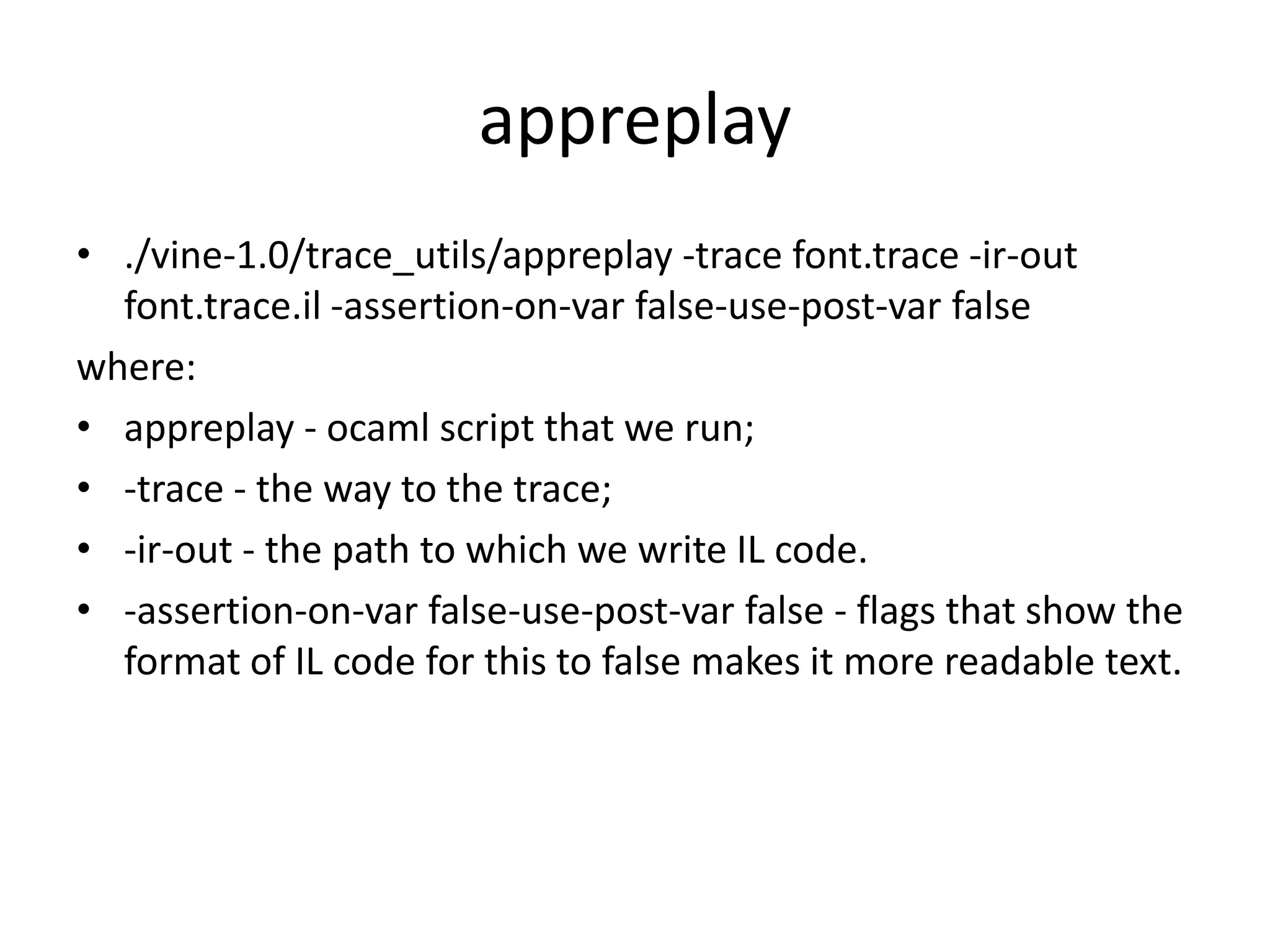
appreplay • ./vine-1.0/trace_utils/appreplay -trace font.trace -ir-out font.trace.il -assertion-on-var false-use-post-var false where: • appreplay - ocaml script that we run; • -trace - the way to the trace; • -ir-out - the path to which we write IL code. • -assertion-on-var false-use-post-var false - flags that show the format of IL code for this to false makes it more readable text.
Example of IL code: • Begins with the declaration of variables: • INPUT - it's free memory cells, those that are tested in the very beginning (back in temu), input into the program from an external source. var cond_000017_0x4010ce_00_162:reg1_t; var cond_000013_0x4010c3_00_161:reg1_t; var cond_000012_0x4010c0_00_160:reg1_t; var cond_000007_0x4010b6_00_159:reg1_t; var INPUT_10000_0000_62:reg8_t; var INPUT_10000_0001_63:reg8_t; var INPUT_10000_0002_64:reg8_t; var INPUT_10000_0003_65:reg8_t; var mem_arr_57:reg8_t[4294967296]; – memory as an array var mem_35:mem32l_t;
T_32t2_60:reg32_t = R_EAX_5:reg32_t = R_ESP_1:reg32_t; T_32t1_59:reg32_t = 0×73657930:reg32_t; T_32t2_60:reg32_t + { 0x1c8:reg32_t; T_32t3_61:reg32_t =(( var idx_144:reg32_t; cast(mem_arr_57[T_32t1_59:reg32_t + 0:reg32_t]:reg8_t)U:reg32_t var val_143:reg8_t; << 0:reg32_t | idx_144:reg32_t = cast(mem_arr_57[T_32t1_59:reg32_t 0x12fef0:reg32_t; + 1:reg32_t]:reg8_t)U:reg32_t << 8:reg32_t) val_143:reg8_t = | cast(mem_arr_57[T_32t1_59:reg32_t INPUT_10000_0000_62:reg + 2:reg32_t]:reg8_t)U:reg32_t 8_t; << 0×10:reg32_t) | mem_arr_57[idx_144:reg32 cast(mem_arr_57[T_32t1_59:reg32_t _t + 0:reg32_t]:reg8_t = + 3:reg32_t]:reg8_t)U:reg32_t << 0×18:reg32_t cast((val_143:reg8_t & ; R_EAX_5:reg32_t = 0xff:reg8_t) >> T_32t3_61:reg32_t; 0:reg8_t)L:reg8_t; }
What is STP and what it does? • STP - constraint solver for bit-vector expressions. • separate project independent of the BitBlaze • To produce STP code from IL code: • ./vine-1.0/utils/wputil trace.il -stpout stp.code • where the input is IL code, and the output is STP code
STP program example mem_arr_57_8 : ARRAY BITVECTOR(64) OF BITVECTOR(8); INPUT_10000_0000_62_4 : BITVECTOR(8); ASSERT( 0bin1 = (LET R_EAX_5_232 = 0hex73657930 IN (LET idx_144_233 = 0hex0012fef0 IN (LET val_143_234 = INPUT_10000_0000_62_4 IN (LET mem_arr_57_393 = (mem_arr_57_8 WITH [(0bin00000000000000000000000000000000 @ BVPLUS(32, idx_144_233,0hex00000000))] := (val_143_234;0hexff)[7:0]) ……. IN (cond_000017_0x4010ce_00_162_392;0bin1)))))))); Is this expression false? QUERY (FALSE); And give a counter example: COUNTEREXAMPLE;
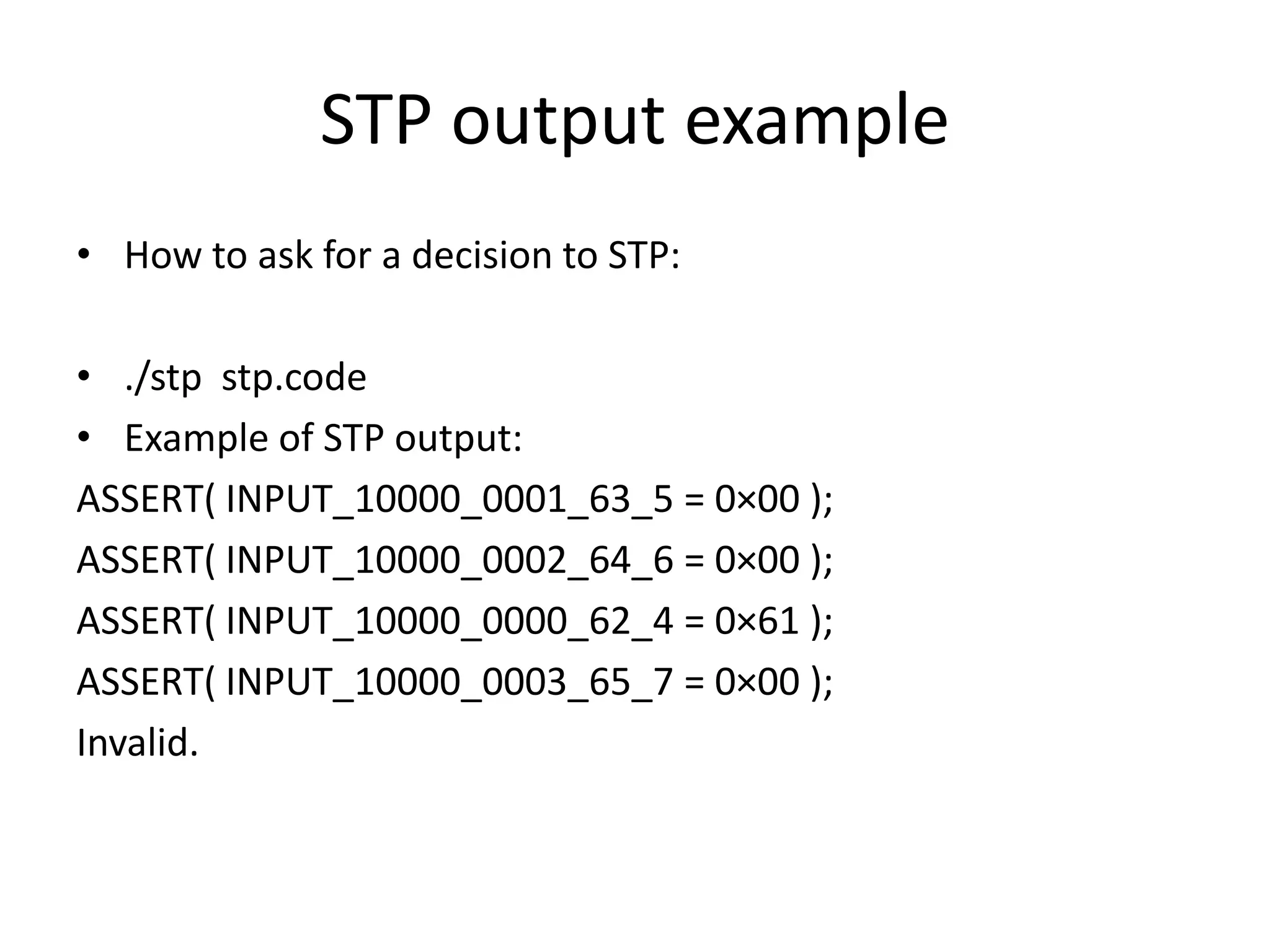
STP output example • How to ask for a decision to STP: • ./stp stp.code • Example of STP output: ASSERT( INPUT_10000_0001_63_5 = 0×00 ); ASSERT( INPUT_10000_0002_64_6 = 0×00 ); ASSERT( INPUT_10000_0000_62_4 = 0×61 ); ASSERT( INPUT_10000_0003_65_7 = 0×00 ); Invalid.
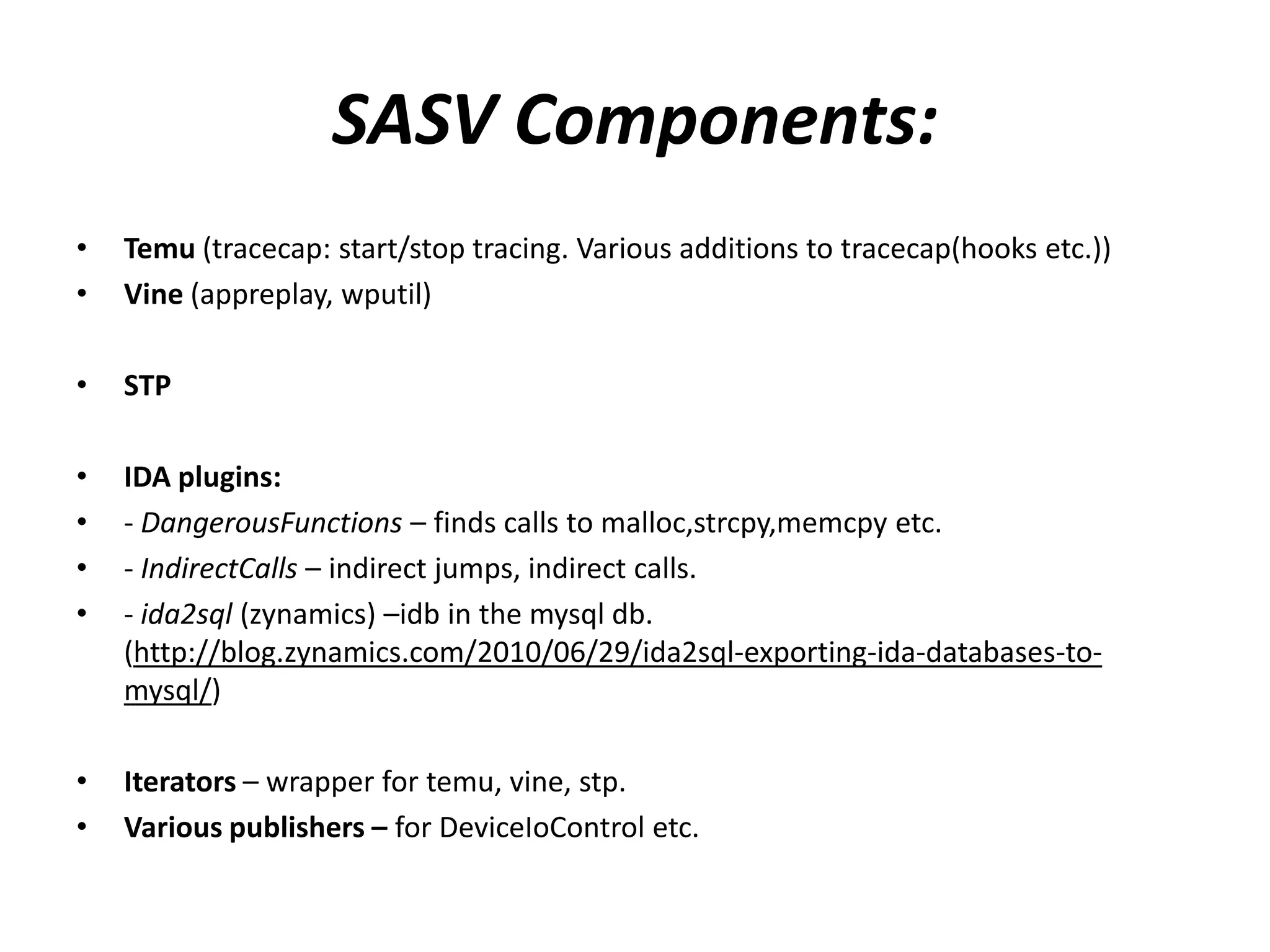
SASV Components: • Temu (tracecap: start/stop tracing. Various additions to tracecap(hooks etc.)) • Vine (appreplay, wputil) • STP • IDA plugins: • - DangerousFunctions – finds calls to malloc,strcpy,memcpy etc. • - IndirectCalls – indirect jumps, indirect calls. • - ida2sql (zynamics) –idb in the mysql db. (http://blog.zynamics.com/2010/06/29/ida2sql-exporting-ida-databases-to- mysql/) • Iterators – wrapper for temu, vine, stp. • Various publishers – for DeviceIoControl etc.
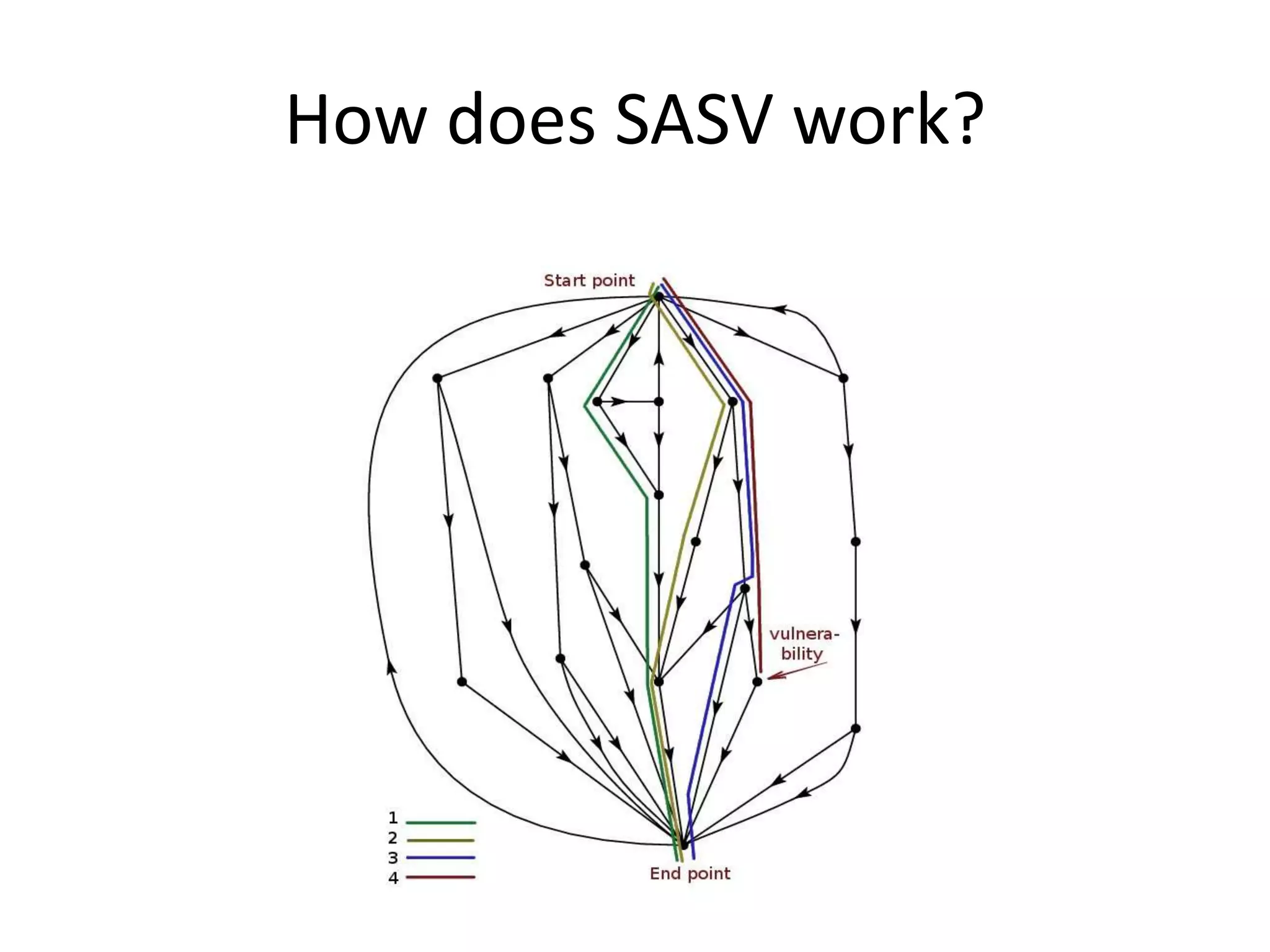
How does SASV work?
SASV • Scheme: • Min Goal: max coverage of the dangerous code • Max Goal: max coverage of the all code
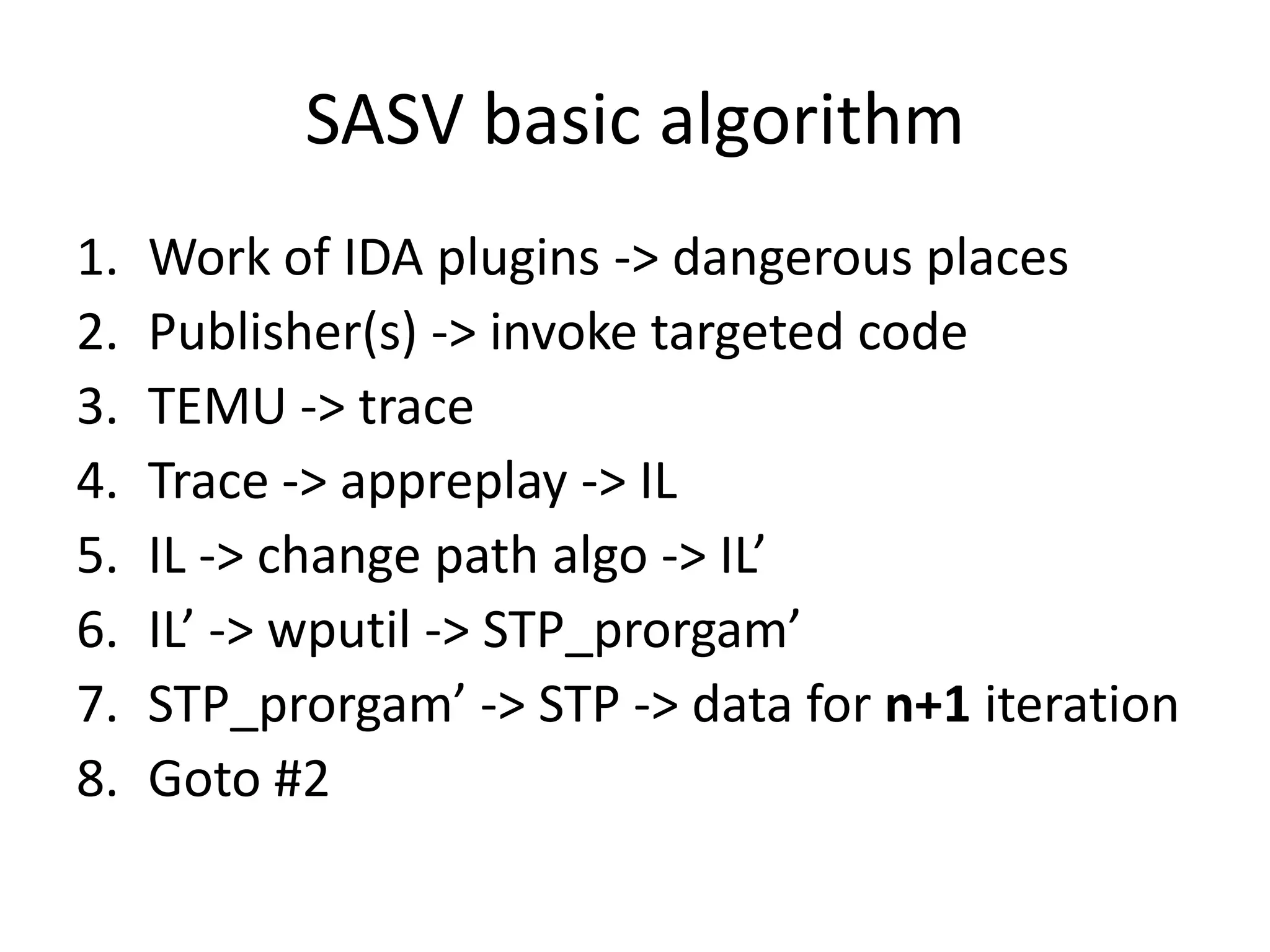
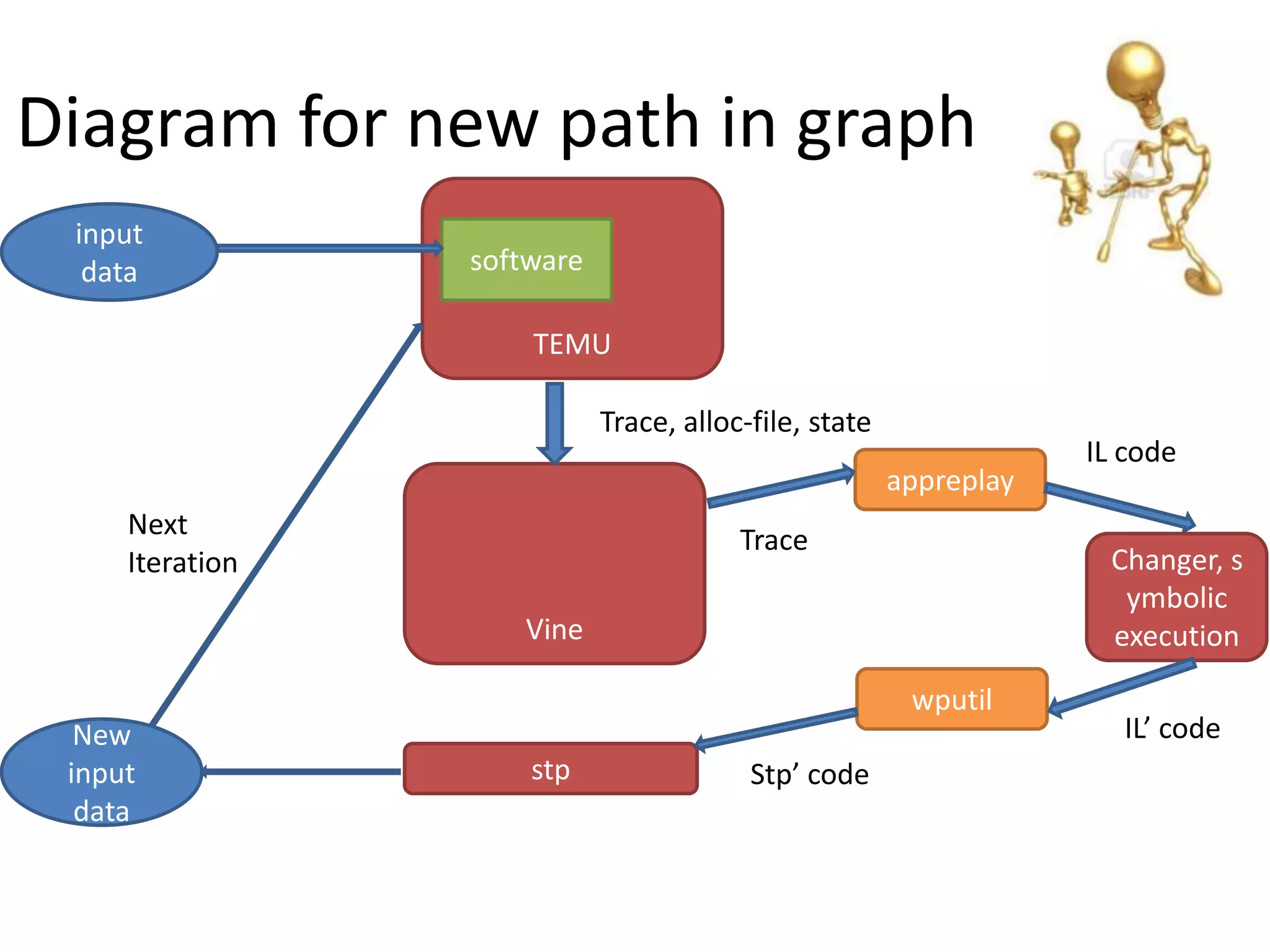
SASV basic algorithm 1. Work of IDA plugins -> dangerous places 2. Publisher(s) -> invoke targeted code 3. TEMU -> trace 4. Trace -> appreplay -> IL 5. IL -> change path algo -> IL’ 6. IL’ -> wputil -> STP_prorgam’ 7. STP_prorgam’ -> STP -> data for n+1 iteration 8. Goto #2
Diagram for new path in graph input data software TEMU Trace, alloc-file, state IL code appreplay Next Trace Iteration Changer, s ymbolic Vine execution wputil New IL’ code input stp Stp’ code data
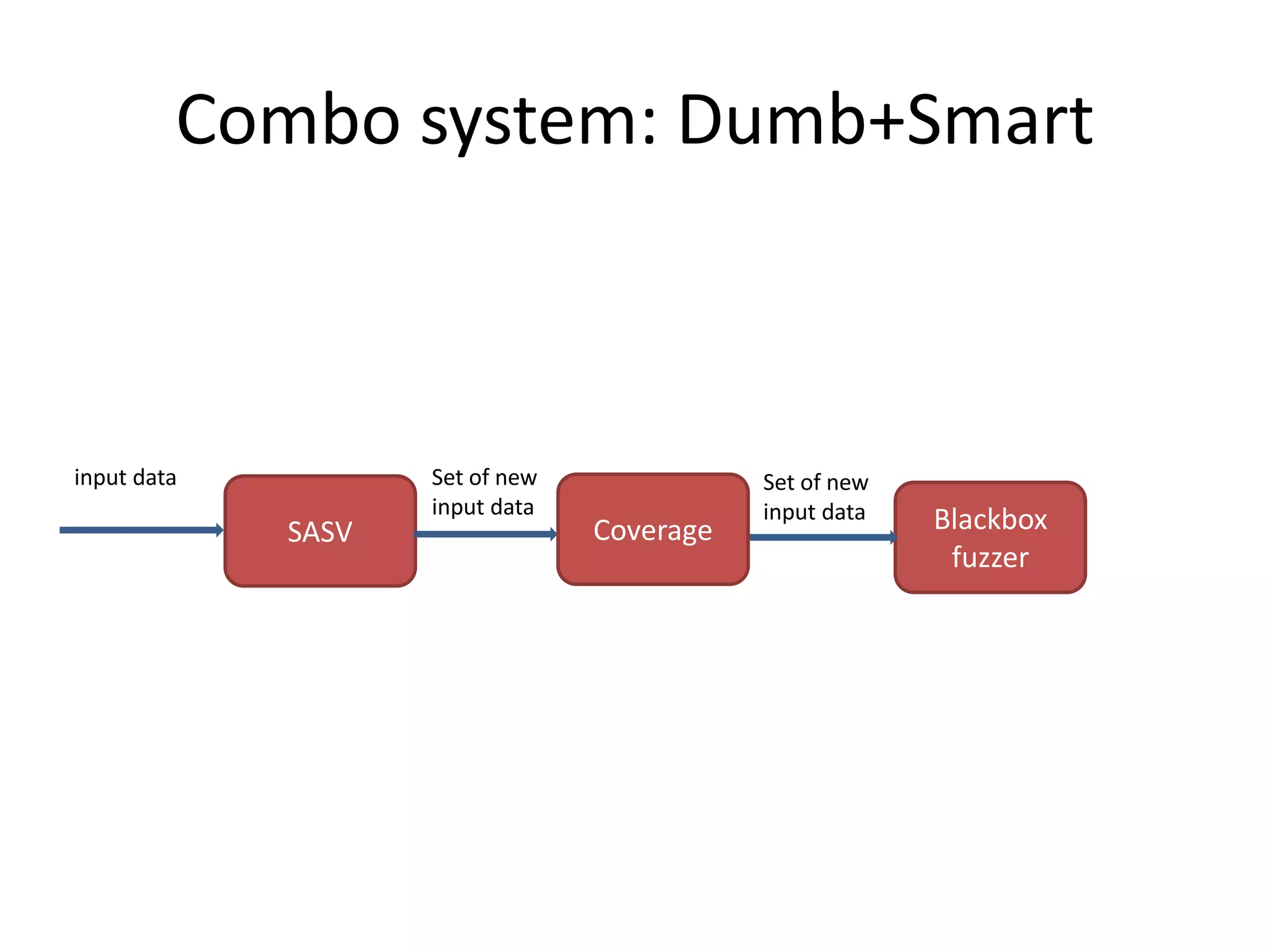
Combo system: Dumb+Smart input data Set of new Set of new input data input data SASV Coverage Blackbox fuzzer
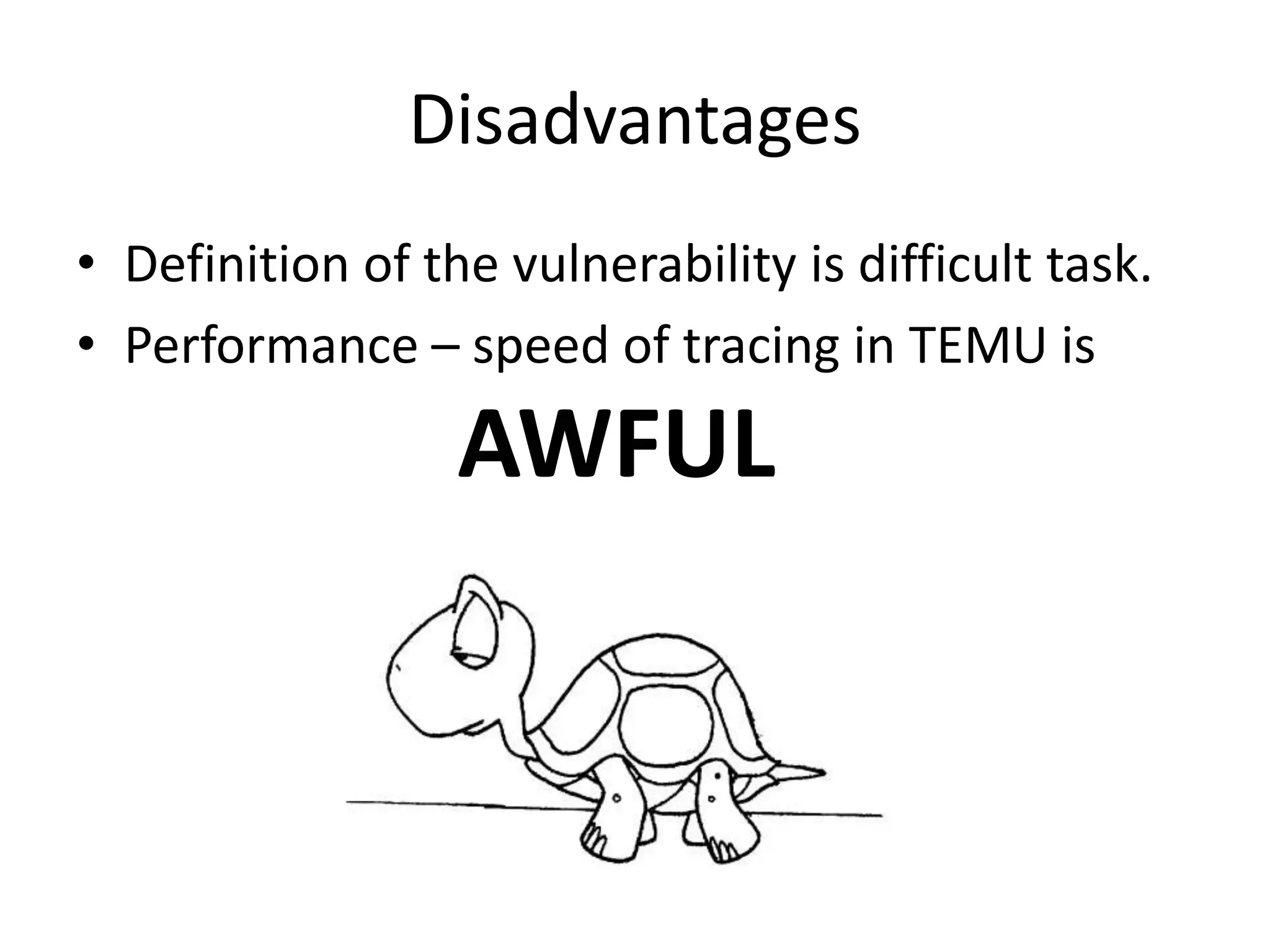
Disadvantages • Definition of the vulnerability is difficult task. • Performance – speed of tracing in TEMU is AWFUL
Overhead • Ideally – 1/1000. • In Reality - 1/(X * 10000) • Where X is dynamic and could be 1 to 10^N • Depends on your target (r3, r0) • Hooks quantity, etc
Implementation(Vine<->TEMU) issues • VEX != XED • VEX is part of valgrind - used for R3. • Formula only for single thread.
Get rid of that damned QEMU! • Move taint propagation to Hypervisor! • Damn good idea! • But a lot of code to port/rewrite
AV
Vulnerabilities in drivers • Overflows: stack, pool, integer • Pointer overwrite • Null pointer dereference(Plague) • Race condition(Plague) • Various logical vulnerabilities(how to automate?)
Example of issue • Total = var1 * var2 (var – could be const) • Mem = malloc(Total) • For(i=0;i<var;i++)memcpy(Mem, Mem2,CONS T) • Free(Mem)
Define Vulnerability (Memory corruption) • var = var1 operation var2 • Mem = alloc(heap, stack)(var) • Mem[var3] = var4 • Could var3 > var (write out-of-bounds) ?
Define vulnerability 1. tainted eip. (very rare in real life, look at KingSoft AV) 2. pointers and operations on them. 3. buffer overflow (hook *alloc function and change size of alloc). 4. integer operations and results(VSA). 5.Threads race condition – is there using of synchronising functions?
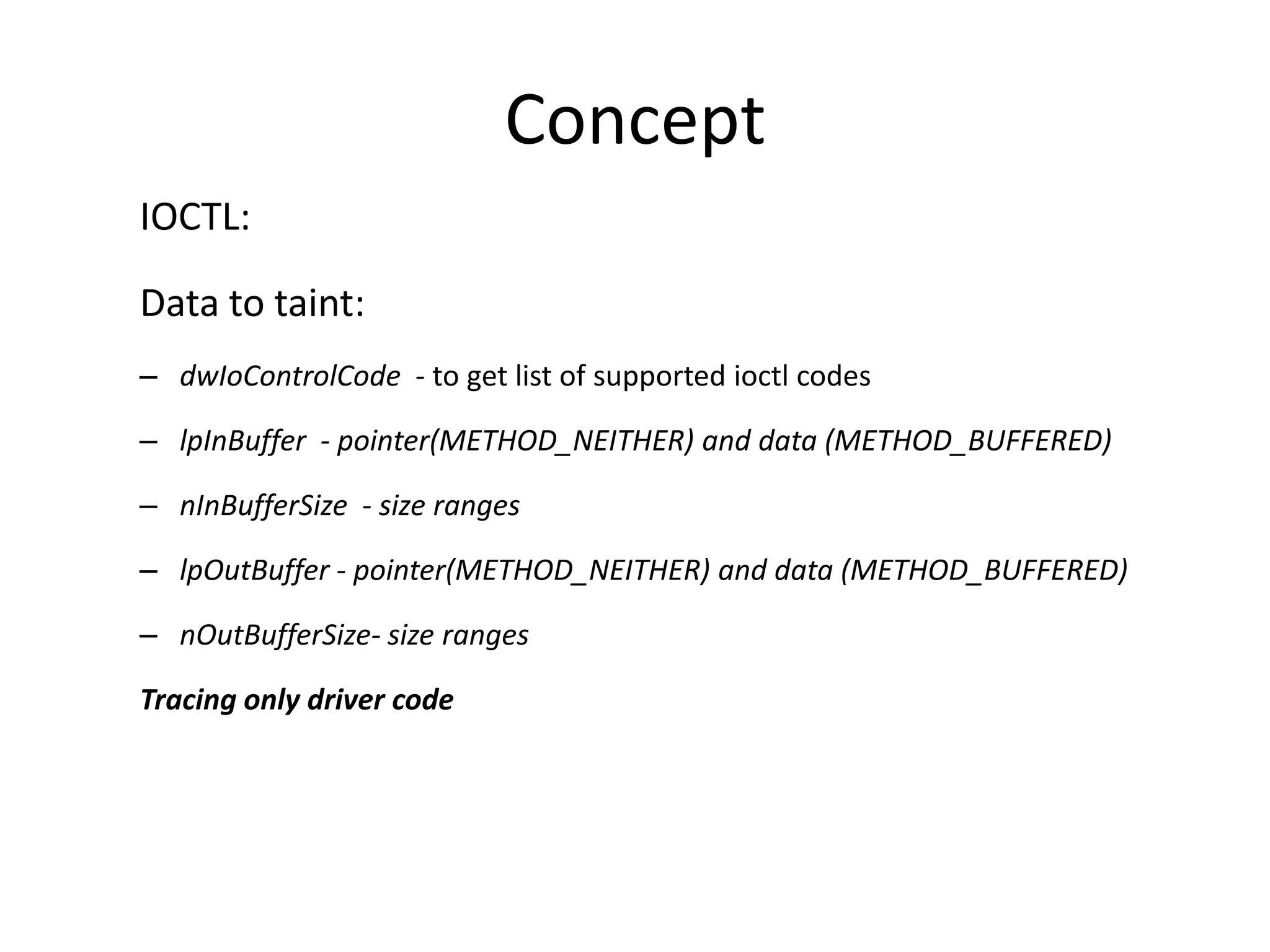
Concept IOCTL: Data to taint: – dwIoControlCode - to get list of supported ioctl codes – lpInBuffer - pointer(METHOD_NEITHER) and data (METHOD_BUFFERED) – nInBufferSize - size ranges – lpOutBuffer - pointer(METHOD_NEITHER) and data (METHOD_BUFFERED) – nOutBufferSize- size ranges Tracing only driver code
Shaming examples •Lulz Time!
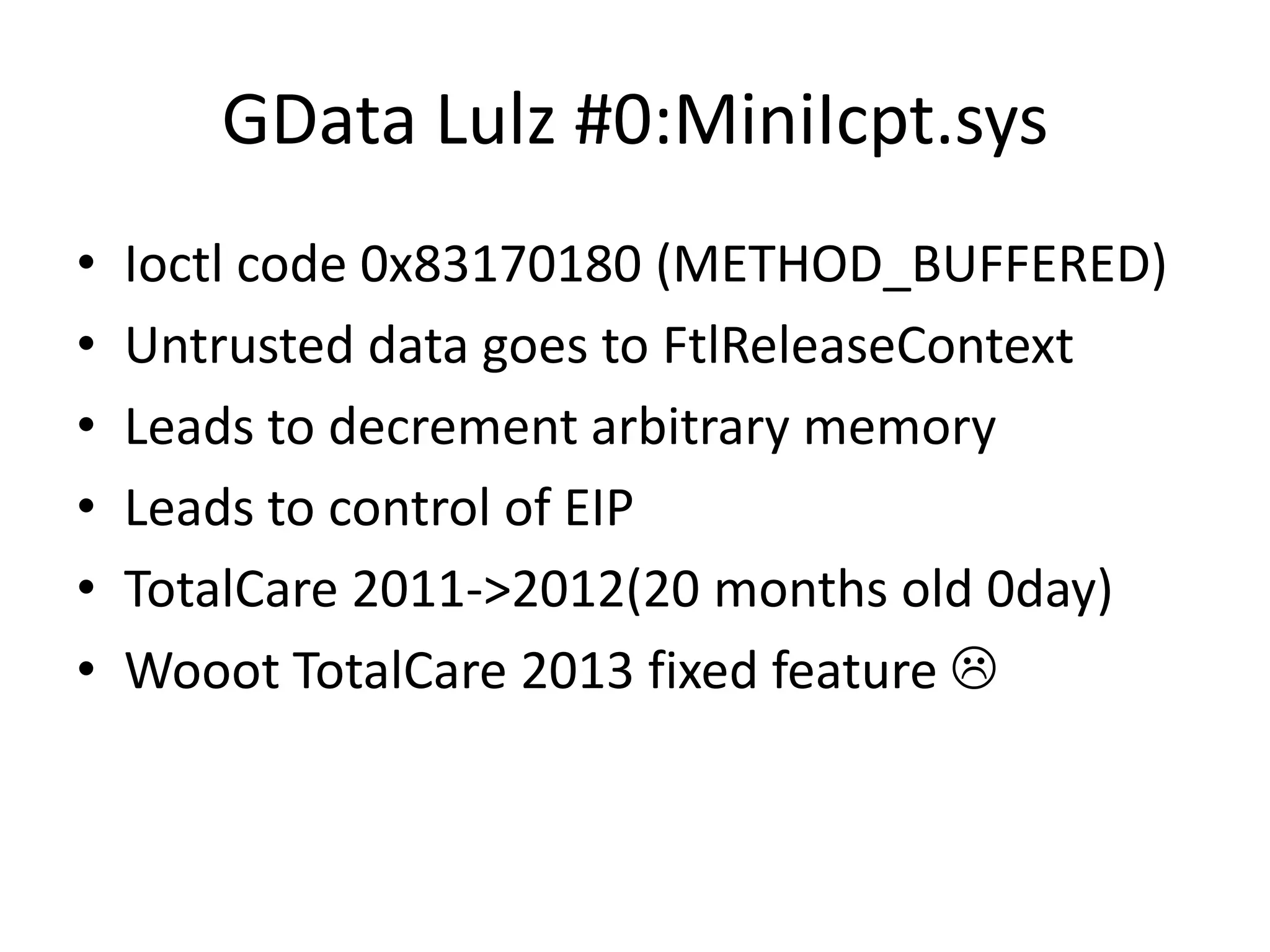
GData Lulz #0:MiniIcpt.sys • Ioctl code 0x83170180 (METHOD_BUFFERED) • Untrusted data goes to FtlReleaseContext • Leads to decrement arbitrary memory • Leads to control of EIP • TotalCare 2011->2012(20 months old 0day) • Wooot TotalCare 2013 fixed feature 
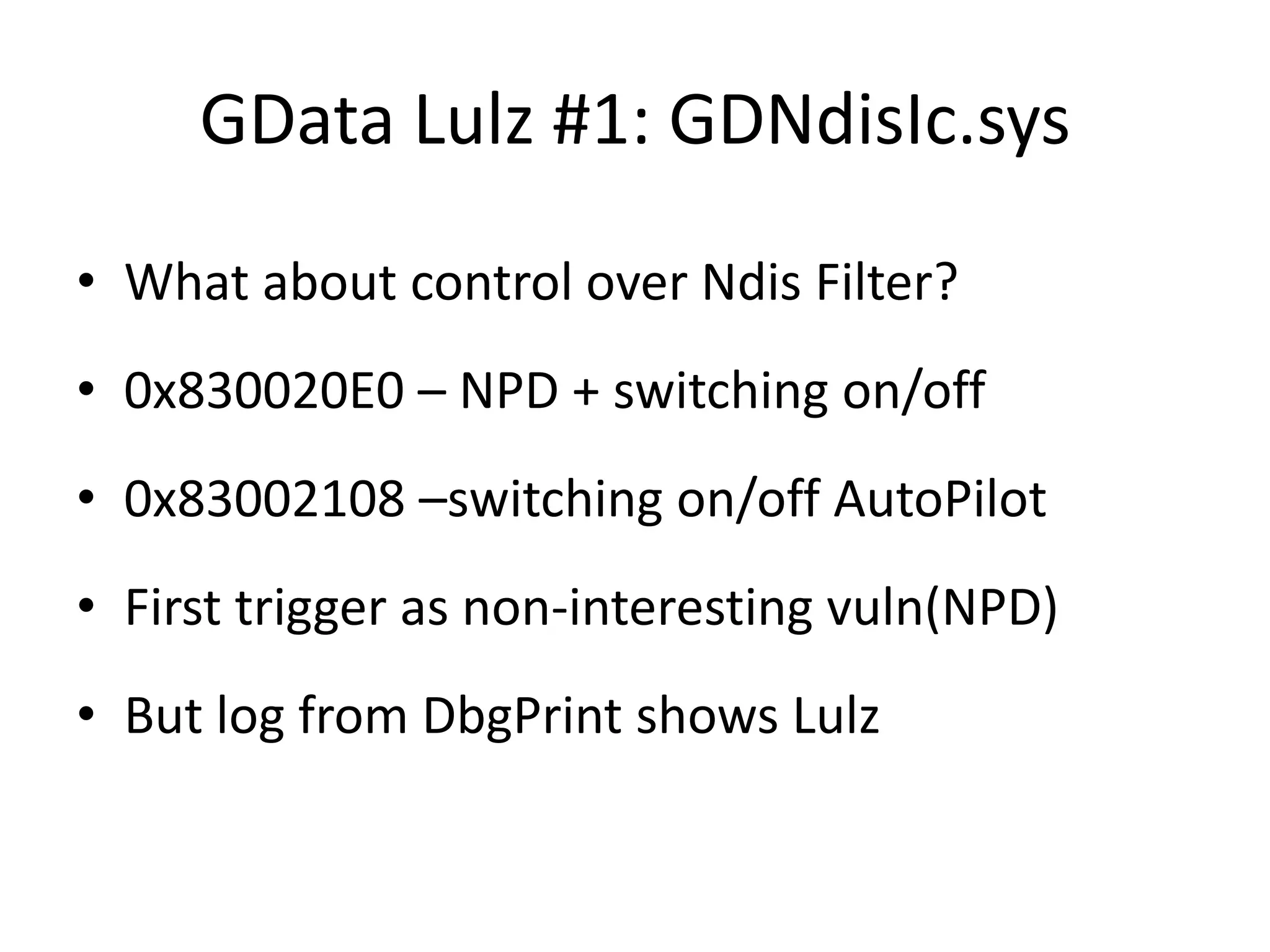
GData Lulz #1: GDNdisIc.sys • What about control over Ndis Filter? • 0x830020E0 – NPD + switching on/off • 0x83002108 –switching on/off AutoPilot • First trigger as non-interesting vuln(NPD) • But log from DbgPrint shows Lulz
GData Lulz #2: TS4nt.sys • New!!!! • Total Care 2013(future!!!) • Processes several ioctls • METHOD_BUFFERED “signal” (NPD) • Uses pointer than check – smart!
Agnitum(?) VBEngNT.sys FAIL • VBEngNT.sys – NOT Agnitum code • VBEngNT.sys – from VirusBuster! • Plays dll role in kernel land • 50(!!!) vulnerable functions – one stupid bug • Full trust on pointers • Using by several(over 8) products • Test before you buy some r0(!!!) code!!!
TrendMicro tmtdi.sys #1 • Ioctl code 0x220044 (METHOD_BUFFERED) • No range check for size • Just check for correct address – NPD check (MmIsAddressValid) • Pool corruption in cycle • No control of overflowing data 
TrendMicro tmtdi.sys #1 • .text:0001D881 mov edi, [ebx+0Ch] • .text:0001D884 push edi ; our buffer • .text:0001D885 call esi ; MmIsAddressValid • .text:0001D887 test al, al • .text:0001D889 jz loc_1DDAB • .text:0001D88F push [ebp+output_buff_size] • .text:0001D892 push edi • .text:0001D893 push offset rules_list • .text:0001D898 call ioctl_0x220044_vuln • [..]
TrendMicro tmtdi.sys #1 • .text:000156EA mov ebx, [ebp+our_buffer_size_controlled] • .text:000156ED mov [ebp+NewIrql], al • .text:000156F0 mov eax, dword_22CA0 • .text:000156F5 mov edx, offset dword_22CA0 • .text:000156FA cmp eax, edx • .text:000156FC jz short loc_15748 • [..] • .text:00015700 mov ecx, [eax+0Ch] • .text:00015703 mov [ebx], ecx • .text:00015705 mov ecx, [eax+10h] • .text:00015708 mov [ebx+4], ecx • .text:0001570B mov ecx, [eax+14h] • .text:0001570E mov [ebx+8], ecx  write outside of the pool chunk • .text:00015711 mov ecx, [eax+18h] • .text:00015714 mov [ebx+0Ch], ecx
TrendMicro tmtdi.sys #2 • Ioctl code 0x220030 • Range check for inbuff_size >= 0x2AA • Range check for outbuff_size >= 0x4D0 • Allocs pool memory for const size 0x4D0 • And… • Zeroing it with outbuff_size length! LOL
TrendMicro tmtdi.sys #2 • .text:0001D704 cmp [ebp+inbuff_size], 2AAh • .text:0001D70B jb loc_1DDAB • .text:0001D711 mov esi, 4D0h • .text:0001D716 cmp [ebp+output_buff_size], esi • .text:0001D719 jb loc_1DDAB • .text:0001D71F push 746D74h ; Tag • .text:0001D724 push esi ; NumberOfBytes • .text:0001D725 push 0 ; PoolType • .text:0001D727 call ds:ExAllocatePoolWithTag • [..]
TrendMicro tmtdi.sys #2 • .text:0001D74B push edi ; pool_mem_const_size • .text:0001D74C lea eax, [ebp+output_buff_size] • .text:0001D74F push eax ; output_buff_size • .text:0001D750 push [ebp+NewIrql] ; inbuff • .text:0001D753 push 220030h ; ioctl_code • .text:0001D758 call ioctl_several_ioctl_codes • [..] • .text:00014918 mov esi, [ebp+output_buff_size] • [..] • .text:00014977 push dword ptr [esi] ; • .text:00014979 push 0 ; • .text:0001497B push [ebp+pool_mem_const_size] ; • .text:0001497E call memset
TrendMicro tmnciesc.sys • Ioctl code 0x222404 • Kernel Pool Corruption • Your homework ;)
Pitfalls of taint analysis • Indirect propagation • Flat model problem(data is tainted, pointer is not) – strlen problem • Const values tainting(switch problem) • More taint info(levels) – more overhead
Pitfalls of tainting r0 • Taint info lost • Check of system variables • System defense mechanism(s) (win32k.sys WATCHDOG BugCheck)
Pitfalls of tainting r0(IOCTL) • KeGetPreviousMode • IoGetCurrentProcess • Even hooking NtDeviceIoControlFile!
Conclusions • Quality -> security level • Taint analysis is not key to every vuln • SASV just another approach to automate RE • Sucks for userland software analysis • Nice approach for kernel land • But fails sometimes ;) • MS should fuzz/test/analyze what it signs!
Thanks,  •Questions? http://twitter.com/#!/ABazhanyuk http://twitter.com/#!/NTarakanov

The System of Automatic Searching for Vulnerabilities or how to use Taint Analysis to find vulnerabilities

  • 1.
    The System ofAutomatic Searching for Vulnerabilities or how to use Taint Analysis to find vulnerabilities Alex Bazhanyuk (@ABazhanyuk) Nikita Tarakanov (@NTarakanov)
  • 2.
    Who is AlexBazhanyuk • Security Researcher • Organizer of Defcon Ukraine Group • Working in UC Berkley in BitBlaze project • Solves problems of automation of RE
  • 3.
    Who is NikitaTarakanov • Independent Security Researcher • Author of some articles in ][akep magazine • Likes to reverse engineer r0 parts • Discovered a lot of LPE vulns • Solves problems of automation of RE
  • 4.
    Agenda • Intro • Taint analysis theory • BitBlaze theory • SASV implementation • Lulz Time • Pitfalls • Conclusion
  • 5.
    SASV main parts •IDA Pro plugins • BitBlaze: Vine+utils, TEMU + plugins
  • 6.
  • 7.
    Tainting • Taint sources: Network,Keyboard, Memory, Disk, Function outputs • Taint propagation: a data flow technique Shadow memory Whole-system Across register/memory/disk/swapping
  • 8.
  • 9.
    Taint propagation •If anoperation uses the value of some tainted object, say X, to derive a value for another, say Y, then object Y becomes tainted. Object X taints the object Y •Taint operator t •X→ t(Y) •Taint operator is transitive X → t(Y) and Y→ t(Z), then X→ t(Z)
  • 10.
    Static Taint Analysis Analysisperformed over multiple paths of a program * Typically performed on a control flow graph (CFG): statements are nodes, and there is an edge between nodes if there is a possible transfer of control.
  • 11.
    BitBlaze: Binary AnalysisInfrastructure • Automatically extracting security-related properties from • binary code • Build a unified binary analysis platform for security - Static analysis + Dynamic analysis + Symbolic Analysis - Leverages recent advances in program analysis, formal methods, binary instrumentation… Solve security problems via binary analysis • More than a dozen different security applications • Over 25 research publications
  • 12.
  • 13.
  • 14.
    Confines TEMU • Onlygcc-3.4 • Qemu 0.9.1 - TEMU • Qemu 0.10 - TCG(Tiny Code Generator)-TODO • Qemu 0.10  Qemu 1.01
  • 15.
  • 16.
  • 17.
    Example of disasm: fc32dcec: rep stos %eax,%es:(%edi) R@eax[0x00000000][4](R) T0 R@ecx[0x00000002][4](RCW) T0 M@0xfb7bfff8[0x00000000][4](CW) T1 {15 (1231, 69624) (1231, 69625) (1231, 69626) (1231, 69627) } fc32dcec: rep stos %eax,%es:(%edi) R@eax[0x00000000][4](R) T0 R@ecx[0x00000001][4](RCW) T0 M@0xfb7bfffc[0x00000000][4](CW) T1 {15 (1231, 69628) (1231, 69629) (1231, 69630) (1231, 69631) } fc32dcee: mov %edx,%ecx R@edx[0x0000015c][4](R) T0 R@ecx[0x00000000][4](W) T0 fc32dcf0: and $0×3,%ecx I@0×00000000[0x00000003][1](R) T0 R@ecx[0x0000015c][4](RW) T0 fc32dcf5: andl $0×0,-0×4(%ebp) I@0×00000000[0x00000000][1](R) T0 M@0xfb5ae738[0x00000002][4](RW) T0 fc32dcf9: jmp 0x00000000fc32c726 J@0×00000000[0xffffea2d][4](R) T0 fc32c726: cmpl $0×0,-0×58(%ebp) I@0×00000000[0x00000000][1](R) T0 M@0xfb5ae6e4[0x00000000][4](R) T0
  • 18.
    Taint info • T0- means that the statement is not tainted. • T1 - means that the instruction tainted in curly brackets can be seen that there tainted and what it depends. • Here's an example of: • fc32dcec: rep stos% eax,% es: (% edi) R @ eax [0x00000000] [4] (R) T0 R @ ecx [0x00000001] [4] (RCW) T0 M @ 0xfb7bfffc [0x00000000] [4] (CW) T1 {15 (1231, 628) (1231, 629) (1231, 630) (1231, 631)} • 4 bits of information tainted and they depend on the offset: 628, 629, 630, 631. 1231 - this number is origin(kind of ID that TEMU plugin sets).
  • 19.
    appreplay • ./vine-1.0/trace_utils/appreplay -tracefont.trace -ir-out font.trace.il -assertion-on-var false-use-post-var false where: • appreplay - ocaml script that we run; • -trace - the way to the trace; • -ir-out - the path to which we write IL code. • -assertion-on-var false-use-post-var false - flags that show the format of IL code for this to false makes it more readable text.
  • 20.
    Example of ILcode: • Begins with the declaration of variables: • INPUT - it's free memory cells, those that are tested in the very beginning (back in temu), input into the program from an external source. var cond_000017_0x4010ce_00_162:reg1_t; var cond_000013_0x4010c3_00_161:reg1_t; var cond_000012_0x4010c0_00_160:reg1_t; var cond_000007_0x4010b6_00_159:reg1_t; var INPUT_10000_0000_62:reg8_t; var INPUT_10000_0001_63:reg8_t; var INPUT_10000_0002_64:reg8_t; var INPUT_10000_0003_65:reg8_t; var mem_arr_57:reg8_t[4294967296]; – memory as an array var mem_35:mem32l_t;
  • 21.
    T_32t2_60:reg32_t = R_EAX_5:reg32_t = R_ESP_1:reg32_t; T_32t1_59:reg32_t = 0×73657930:reg32_t; T_32t2_60:reg32_t + { 0x1c8:reg32_t; T_32t3_61:reg32_t =(( var idx_144:reg32_t; cast(mem_arr_57[T_32t1_59:reg32_t + 0:reg32_t]:reg8_t)U:reg32_t var val_143:reg8_t; << 0:reg32_t | idx_144:reg32_t = cast(mem_arr_57[T_32t1_59:reg32_t 0x12fef0:reg32_t; + 1:reg32_t]:reg8_t)U:reg32_t << 8:reg32_t) val_143:reg8_t = | cast(mem_arr_57[T_32t1_59:reg32_t INPUT_10000_0000_62:reg + 2:reg32_t]:reg8_t)U:reg32_t 8_t; << 0×10:reg32_t) | mem_arr_57[idx_144:reg32 cast(mem_arr_57[T_32t1_59:reg32_t _t + 0:reg32_t]:reg8_t = + 3:reg32_t]:reg8_t)U:reg32_t << 0×18:reg32_t cast((val_143:reg8_t & ; R_EAX_5:reg32_t = 0xff:reg8_t) >> T_32t3_61:reg32_t; 0:reg8_t)L:reg8_t; }
  • 22.
    What is STPand what it does? • STP - constraint solver for bit-vector expressions. • separate project independent of the BitBlaze • To produce STP code from IL code: • ./vine-1.0/utils/wputil trace.il -stpout stp.code • where the input is IL code, and the output is STP code
  • 23.
    STP program example mem_arr_57_8: ARRAY BITVECTOR(64) OF BITVECTOR(8); INPUT_10000_0000_62_4 : BITVECTOR(8); ASSERT( 0bin1 = (LET R_EAX_5_232 = 0hex73657930 IN (LET idx_144_233 = 0hex0012fef0 IN (LET val_143_234 = INPUT_10000_0000_62_4 IN (LET mem_arr_57_393 = (mem_arr_57_8 WITH [(0bin00000000000000000000000000000000 @ BVPLUS(32, idx_144_233,0hex00000000))] := (val_143_234;0hexff)[7:0]) ……. IN (cond_000017_0x4010ce_00_162_392;0bin1)))))))); Is this expression false? QUERY (FALSE); And give a counter example: COUNTEREXAMPLE;
  • 24.
    STP output example •How to ask for a decision to STP: • ./stp stp.code • Example of STP output: ASSERT( INPUT_10000_0001_63_5 = 0×00 ); ASSERT( INPUT_10000_0002_64_6 = 0×00 ); ASSERT( INPUT_10000_0000_62_4 = 0×61 ); ASSERT( INPUT_10000_0003_65_7 = 0×00 ); Invalid.
  • 25.
    SASV Components: • Temu (tracecap: start/stop tracing. Various additions to tracecap(hooks etc.)) • Vine (appreplay, wputil) • STP • IDA plugins: • - DangerousFunctions – finds calls to malloc,strcpy,memcpy etc. • - IndirectCalls – indirect jumps, indirect calls. • - ida2sql (zynamics) –idb in the mysql db. (http://blog.zynamics.com/2010/06/29/ida2sql-exporting-ida-databases-to- mysql/) • Iterators – wrapper for temu, vine, stp. • Various publishers – for DeviceIoControl etc.
  • 26.
  • 27.
    SASV • Scheme: • MinGoal: max coverage of the dangerous code • Max Goal: max coverage of the all code
  • 28.
    SASV basic algorithm 1. Work of IDA plugins -> dangerous places 2. Publisher(s) -> invoke targeted code 3. TEMU -> trace 4. Trace -> appreplay -> IL 5. IL -> change path algo -> IL’ 6. IL’ -> wputil -> STP_prorgam’ 7. STP_prorgam’ -> STP -> data for n+1 iteration 8. Goto #2
  • 29.
    Diagram for newpath in graph input data software TEMU Trace, alloc-file, state IL code appreplay Next Trace Iteration Changer, s ymbolic Vine execution wputil New IL’ code input stp Stp’ code data
  • 30.
    Combo system: Dumb+Smart inputdata Set of new Set of new input data input data SASV Coverage Blackbox fuzzer
  • 31.
    Disadvantages • Definition ofthe vulnerability is difficult task. • Performance – speed of tracing in TEMU is AWFUL
  • 32.
    Overhead • Ideally –1/1000. • In Reality - 1/(X * 10000) • Where X is dynamic and could be 1 to 10^N • Depends on your target (r3, r0) • Hooks quantity, etc
  • 33.
    Implementation(Vine<->TEMU) issues • VEX!= XED • VEX is part of valgrind - used for R3. • Formula only for single thread.
  • 35.
    Get rid ofthat damned QEMU! • Move taint propagation to Hypervisor! • Damn good idea! • But a lot of code to port/rewrite
  • 36.
  • 37.
    Vulnerabilities in drivers •Overflows: stack, pool, integer • Pointer overwrite • Null pointer dereference(Plague) • Race condition(Plague) • Various logical vulnerabilities(how to automate?)
  • 38.
    Example of issue •Total = var1 * var2 (var – could be const) • Mem = malloc(Total) • For(i=0;i<var;i++)memcpy(Mem, Mem2,CONS T) • Free(Mem)
  • 39.
    Define Vulnerability (Memory corruption) • var = var1 operation var2 • Mem = alloc(heap, stack)(var) • Mem[var3] = var4 • Could var3 > var (write out-of-bounds) ?
  • 40.
    Define vulnerability 1. taintedeip. (very rare in real life, look at KingSoft AV) 2. pointers and operations on them. 3. buffer overflow (hook *alloc function and change size of alloc). 4. integer operations and results(VSA). 5.Threads race condition – is there using of synchronising functions?
  • 41.
    Concept IOCTL: Data to taint: –dwIoControlCode - to get list of supported ioctl codes – lpInBuffer - pointer(METHOD_NEITHER) and data (METHOD_BUFFERED) – nInBufferSize - size ranges – lpOutBuffer - pointer(METHOD_NEITHER) and data (METHOD_BUFFERED) – nOutBufferSize- size ranges Tracing only driver code
  • 42.
  • 43.
    GData Lulz #0:MiniIcpt.sys • Ioctl code 0x83170180 (METHOD_BUFFERED) • Untrusted data goes to FtlReleaseContext • Leads to decrement arbitrary memory • Leads to control of EIP • TotalCare 2011->2012(20 months old 0day) • Wooot TotalCare 2013 fixed feature 
  • 44.
    GData Lulz #1:GDNdisIc.sys • What about control over Ndis Filter? • 0x830020E0 – NPD + switching on/off • 0x83002108 –switching on/off AutoPilot • First trigger as non-interesting vuln(NPD) • But log from DbgPrint shows Lulz
  • 45.
    GData Lulz #2:TS4nt.sys • New!!!! • Total Care 2013(future!!!) • Processes several ioctls • METHOD_BUFFERED “signal” (NPD) • Uses pointer than check – smart!
  • 46.
    Agnitum(?) VBEngNT.sys FAIL • VBEngNT.sys – NOT Agnitum code • VBEngNT.sys – from VirusBuster! • Plays dll role in kernel land • 50(!!!) vulnerable functions – one stupid bug • Full trust on pointers • Using by several(over 8) products • Test before you buy some r0(!!!) code!!!
  • 47.
    TrendMicro tmtdi.sys #1 •Ioctl code 0x220044 (METHOD_BUFFERED) • No range check for size • Just check for correct address – NPD check (MmIsAddressValid) • Pool corruption in cycle • No control of overflowing data 
  • 48.
    TrendMicro tmtdi.sys #1 • .text:0001D881 mov edi, [ebx+0Ch] • .text:0001D884 push edi ; our buffer • .text:0001D885 call esi ; MmIsAddressValid • .text:0001D887 test al, al • .text:0001D889 jz loc_1DDAB • .text:0001D88F push [ebp+output_buff_size] • .text:0001D892 push edi • .text:0001D893 push offset rules_list • .text:0001D898 call ioctl_0x220044_vuln • [..]
  • 49.
    TrendMicro tmtdi.sys #1 • .text:000156EA mov ebx, [ebp+our_buffer_size_controlled] • .text:000156ED mov [ebp+NewIrql], al • .text:000156F0 mov eax, dword_22CA0 • .text:000156F5 mov edx, offset dword_22CA0 • .text:000156FA cmp eax, edx • .text:000156FC jz short loc_15748 • [..] • .text:00015700 mov ecx, [eax+0Ch] • .text:00015703 mov [ebx], ecx • .text:00015705 mov ecx, [eax+10h] • .text:00015708 mov [ebx+4], ecx • .text:0001570B mov ecx, [eax+14h] • .text:0001570E mov [ebx+8], ecx  write outside of the pool chunk • .text:00015711 mov ecx, [eax+18h] • .text:00015714 mov [ebx+0Ch], ecx
  • 50.
    TrendMicro tmtdi.sys #2 • Ioctl code 0x220030 • Range check for inbuff_size >= 0x2AA • Range check for outbuff_size >= 0x4D0 • Allocs pool memory for const size 0x4D0 • And… • Zeroing it with outbuff_size length! LOL
  • 51.
    TrendMicro tmtdi.sys #2 • .text:0001D704 cmp [ebp+inbuff_size], 2AAh • .text:0001D70B jb loc_1DDAB • .text:0001D711 mov esi, 4D0h • .text:0001D716 cmp [ebp+output_buff_size], esi • .text:0001D719 jb loc_1DDAB • .text:0001D71F push 746D74h ; Tag • .text:0001D724 push esi ; NumberOfBytes • .text:0001D725 push 0 ; PoolType • .text:0001D727 call ds:ExAllocatePoolWithTag • [..]
  • 52.
    TrendMicro tmtdi.sys #2 • .text:0001D74B push edi ; pool_mem_const_size • .text:0001D74C lea eax, [ebp+output_buff_size] • .text:0001D74F push eax ; output_buff_size • .text:0001D750 push [ebp+NewIrql] ; inbuff • .text:0001D753 push 220030h ; ioctl_code • .text:0001D758 call ioctl_several_ioctl_codes • [..] • .text:00014918 mov esi, [ebp+output_buff_size] • [..] • .text:00014977 push dword ptr [esi] ; • .text:00014979 push 0 ; • .text:0001497B push [ebp+pool_mem_const_size] ; • .text:0001497E call memset
  • 53.
    TrendMicro tmnciesc.sys • Ioctlcode 0x222404 • Kernel Pool Corruption • Your homework ;)
  • 54.
    Pitfalls of taintanalysis • Indirect propagation • Flat model problem(data is tainted, pointer is not) – strlen problem • Const values tainting(switch problem) • More taint info(levels) – more overhead
  • 55.
    Pitfalls of taintingr0 • Taint info lost • Check of system variables • System defense mechanism(s) (win32k.sys WATCHDOG BugCheck)
  • 56.
    Pitfalls of taintingr0(IOCTL) • KeGetPreviousMode • IoGetCurrentProcess • Even hooking NtDeviceIoControlFile!
  • 57.
    Conclusions • Quality -> security level • Taint analysis is not key to every vuln • SASV just another approach to automate RE • Sucks for userland software analysis • Nice approach for kernel land • But fails sometimes ;) • MS should fuzz/test/analyze what it signs!
  • 58.