Improving Android Performance #perfmatters Raimon Ràfols
Agenda - Who am I? - Java and VMs - Examples - Do & dont's - Tooling
Who am I? - Mobile Software Engineering Manager at Imagination Technologies (@imgtec) - Twitter: @rrafols - http://blog.rafols.org
Disclaimer This presentation contains bytecode
Why do we need to talk about java?
*.java → [javac] → *.class *.class → [dx] → dex file
Android → Java
Android → javac !
Javac vs other compilers
Compilers Produces optimised code for target platform
Javac Doesn't optimise anything
Javac Doesn't know on which architecture will the code be executed
Java bytecode is stack based
Easy to interpret
Not the most optimal solution (regarding performance)
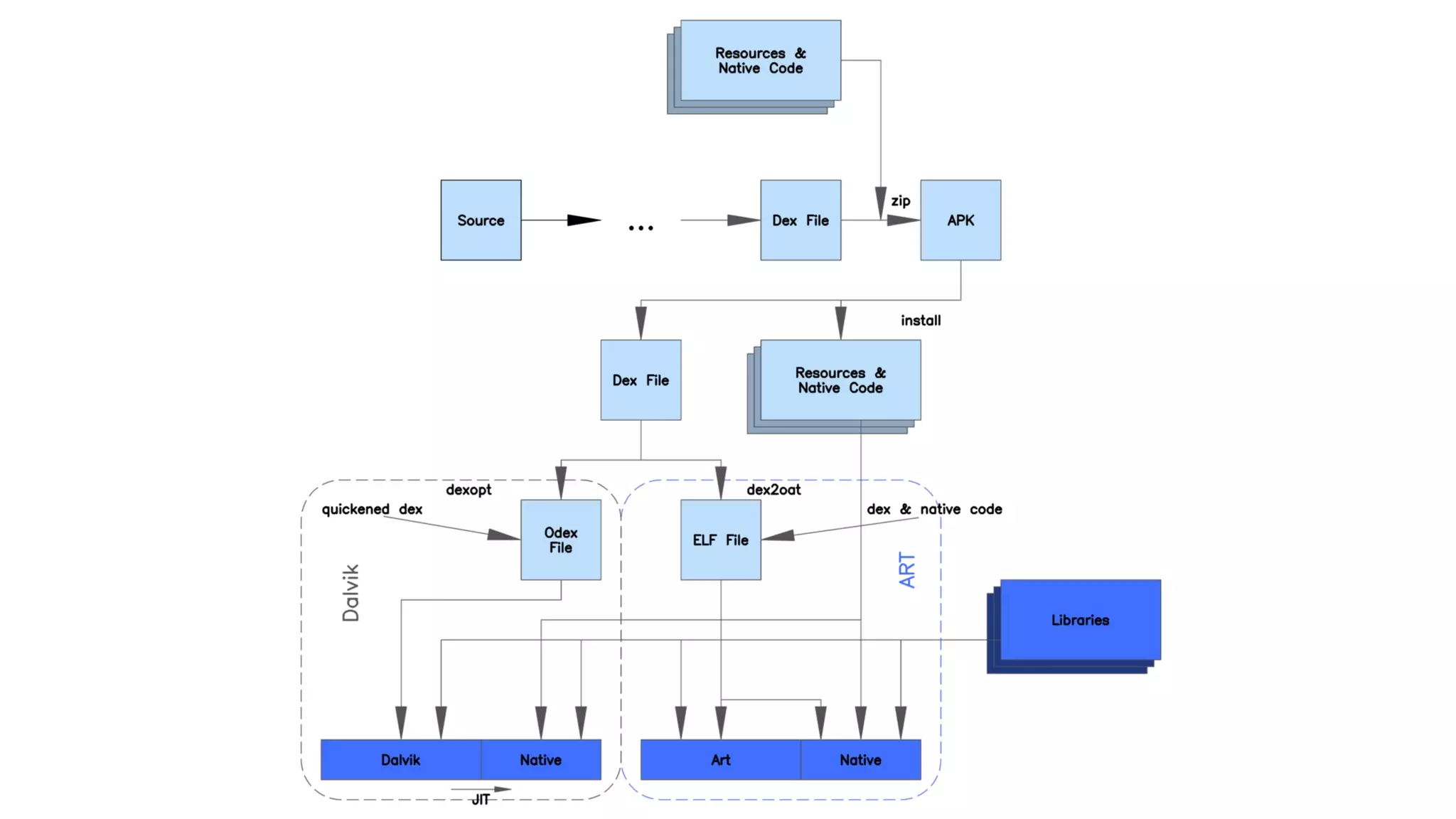
Dalvik VM and ART are register based architectures
Stack based integer addition
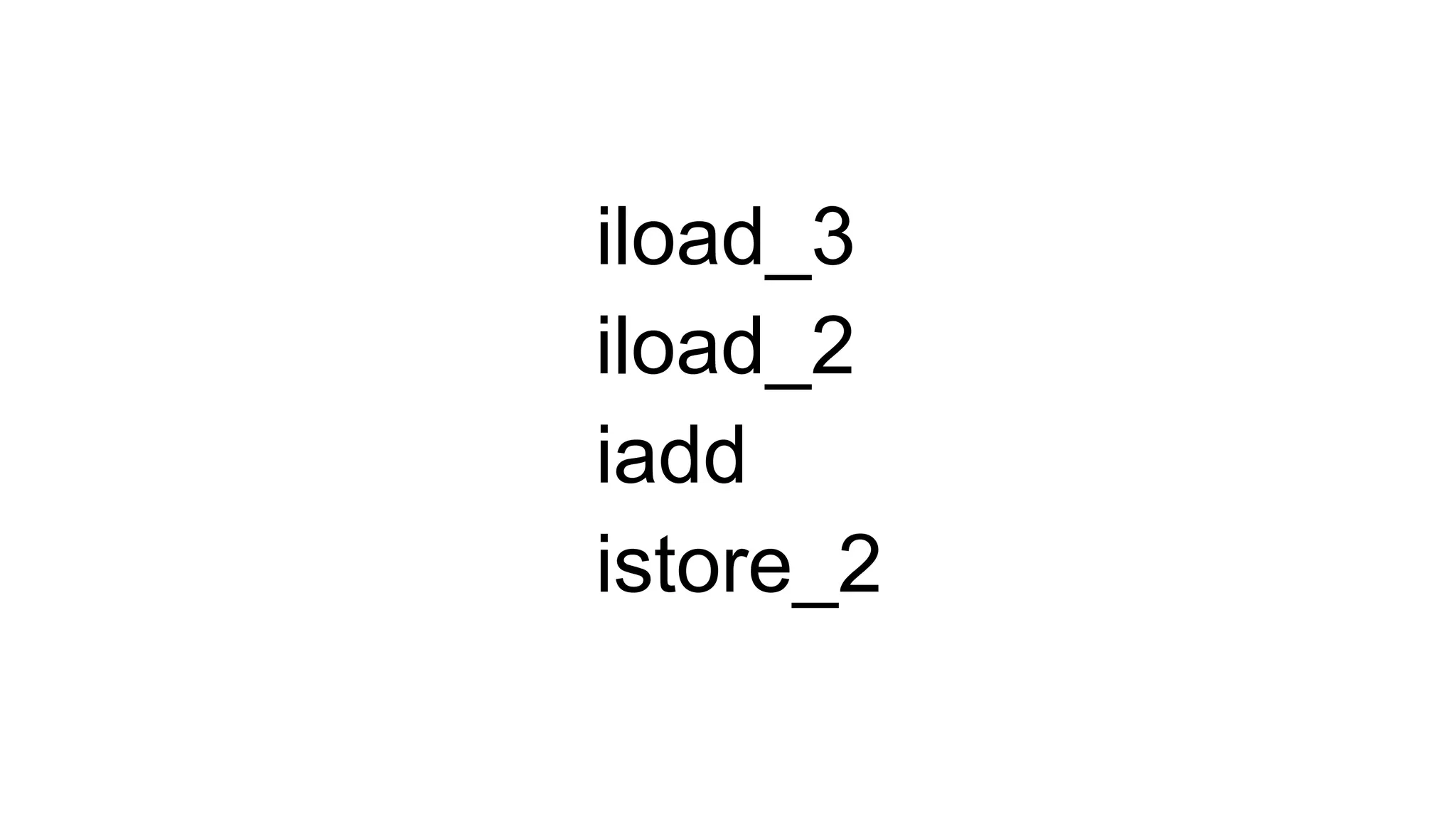
iload_3 iload_2 iadd istore_2
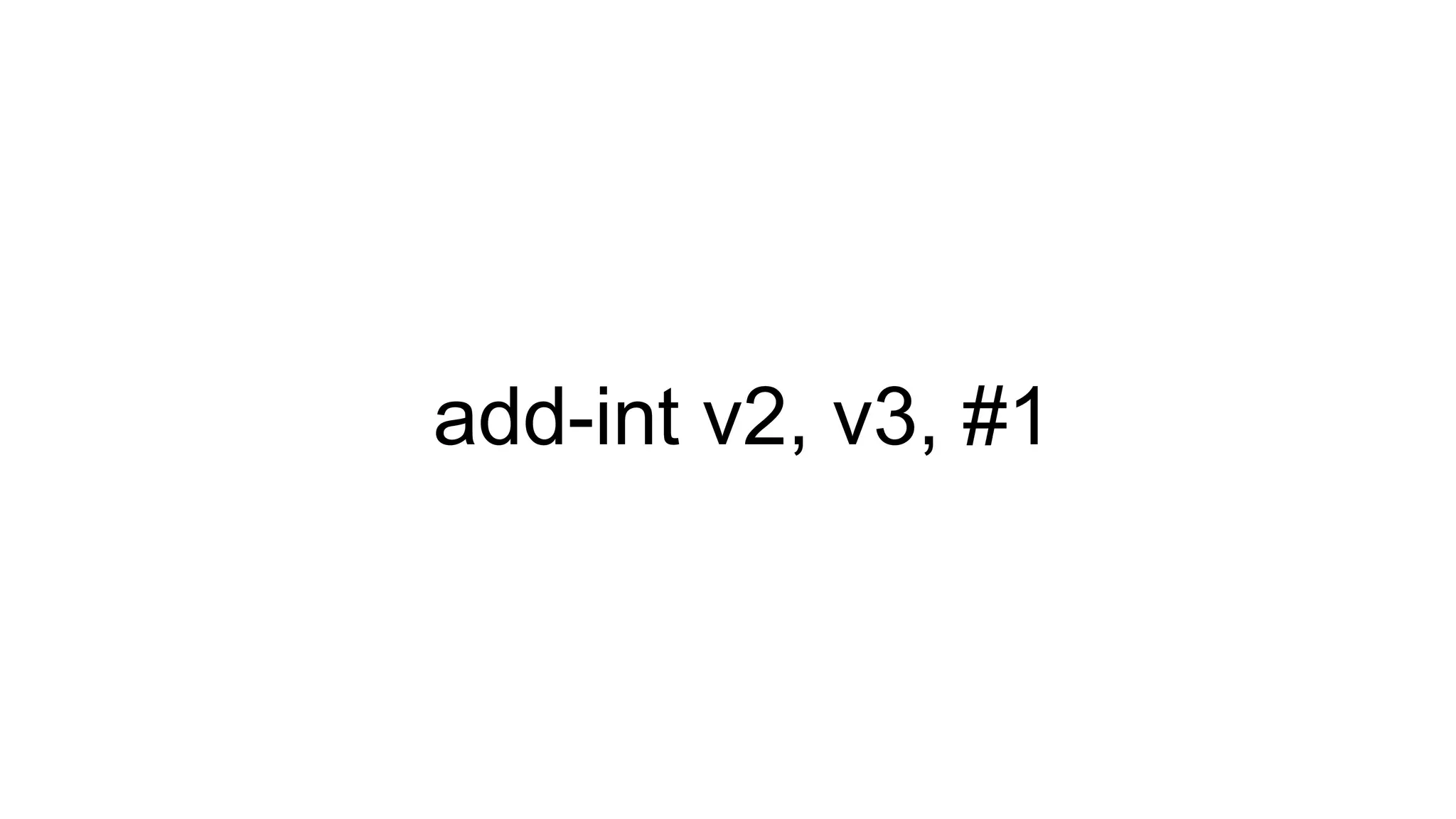
Register based integer addition
add-int v2, v3, #1
Java VM (JVM) Only the JVM knows on which architecture is running
Java VM (JVM) All optimisations are left to be done by the JVM
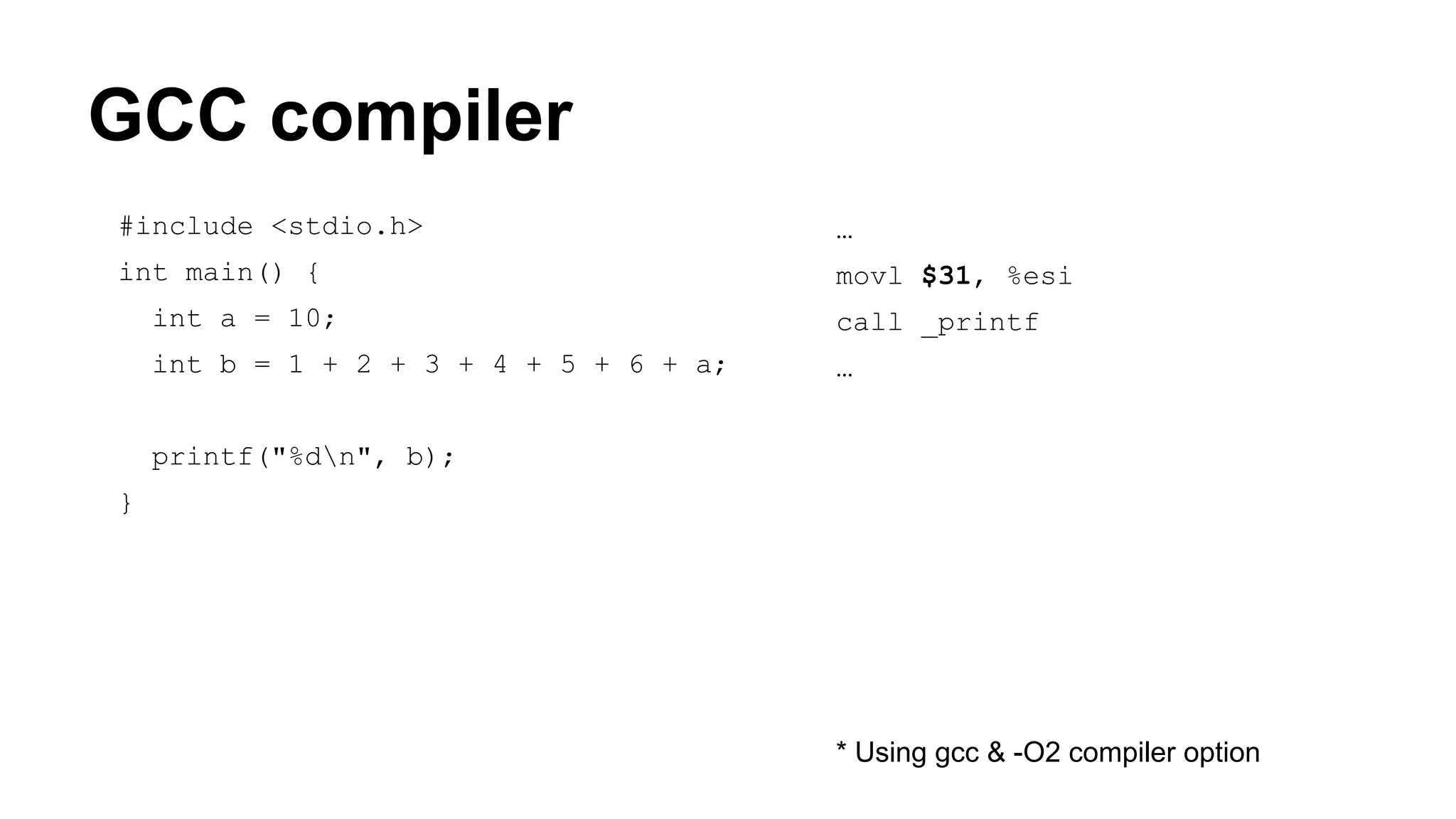
Maybe takes this concept a bit too far...
GCC compiler #include <stdio.h> int main() { int a = 10; int b = 1 + 2 + 3 + 4 + 5 + 6 + a; printf("%dn", b); } … movl $31, %esi call _printf … * Using gcc & -O2 compiler option
javac public static void main(String args[]) { int a = 10; int b = 1 + 2 + 3 + 4 + 5 + 6 + a; System.out.println(b); } 0: bipush 10 2: istore_1 3: bipush 21 5: iload_1 6: iadd 7: istore_2 ...
javac public static void main(String args[]) { int a = 10; int b = 1 + 2 + 3 + 4 + 5 + a + 6; System.out.println(b); } 0: bipush 10 2: istore_1 3: bipush 15 5: iload_1 6: iadd 7: bipush 6 9: iadd 10: istore_2 ...
javac public static void main(String args[]) { int a = 10; int b = a + 1 + 2 + 3 + 4 + 5 + 6; System.out.println(b); }
javac public static void main(String args[]) { int a = 10; int b = a + 1 + 2 + 3 + 4 + 5 + 6; System.out.println(b); } 0: bipush 10 2: istore_1 3: iload_1 4: iconst_1 5: iadd 6: iconst_2 7: iadd 8: iconst_3 9: iadd 10: iconst_4 11: iadd 12: iconst_5 13: iadd 14: bipush 6 16: iadd 17: istore_2
what?
Dalvik VM / ART
Examples Do & Dont's
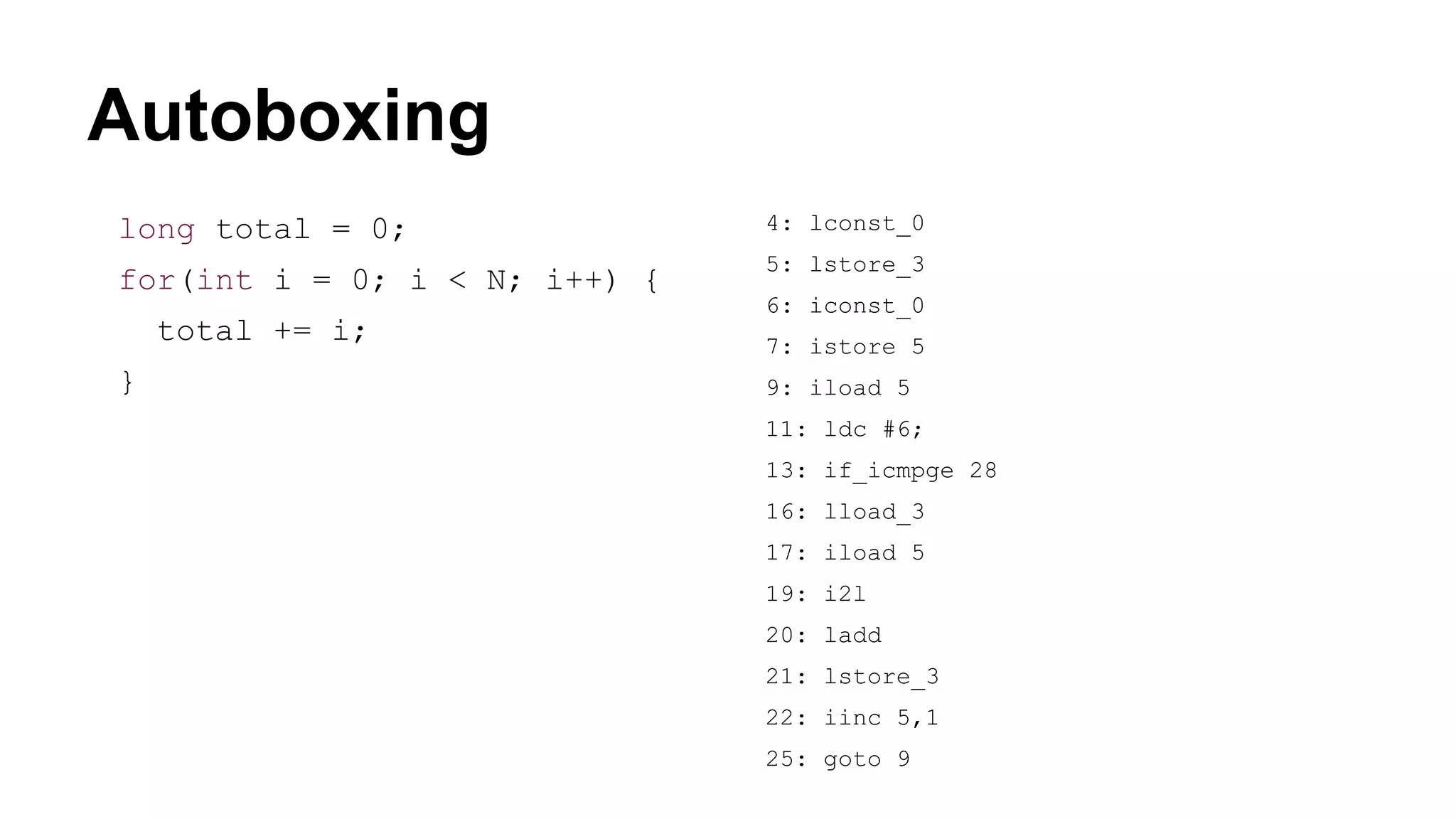
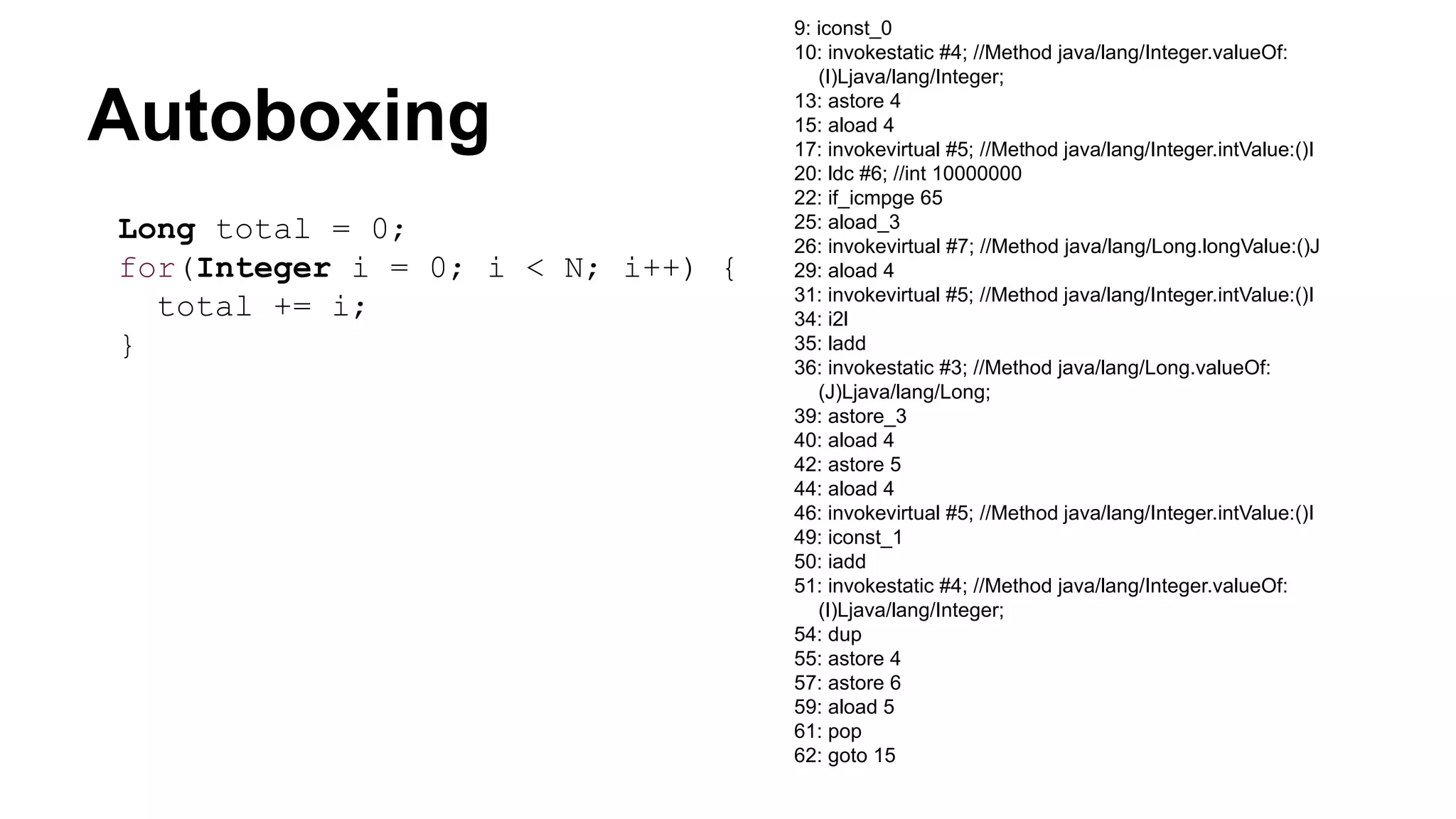
Autoboxing Transparent to the developer but compiler adds some 'extra' code
Autoboxing long total = 0; for(int i = 0; i < N; i++) { total += i; } 4: lconst_0 5: lstore_3 6: iconst_0 7: istore 5 9: iload 5 11: ldc #6; 13: if_icmpge 28 16: lload_3 17: iload 5 19: i2l 20: ladd 21: lstore_3 22: iinc 5,1 25: goto 9
Autoboxing Long total = 0; for(Integer i = 0; i < N; i++) { total += i; } 9: iconst_0 10: invokestatic #4; //Method java/lang/Integer.valueOf: (I)Ljava/lang/Integer; 13: astore 4 15: aload 4 17: invokevirtual #5; //Method java/lang/Integer.intValue:()I 20: ldc #6; //int 10000000 22: if_icmpge 65 25: aload_3 26: invokevirtual #7; //Method java/lang/Long.longValue:()J 29: aload 4 31: invokevirtual #5; //Method java/lang/Integer.intValue:()I 34: i2l 35: ladd 36: invokestatic #3; //Method java/lang/Long.valueOf: (J)Ljava/lang/Long; 39: astore_3 40: aload 4 42: astore 5 44: aload 4 46: invokevirtual #5; //Method java/lang/Integer.intValue:()I 49: iconst_1 50: iadd 51: invokestatic #4; //Method java/lang/Integer.valueOf: (I)Ljava/lang/Integer; 54: dup 55: astore 4 57: astore 6 59: aload 5 61: pop 62: goto 15
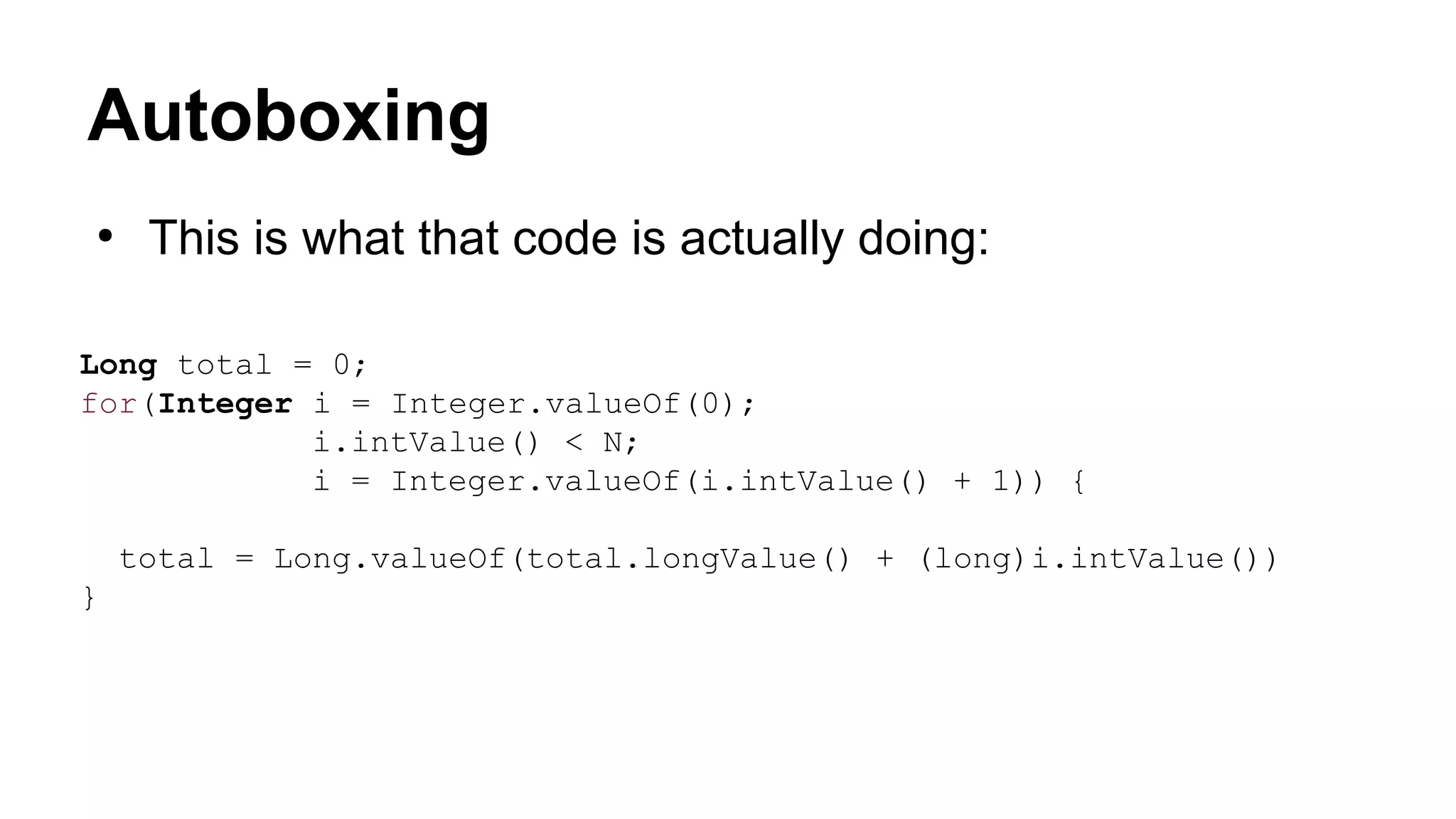
Autoboxing ● This is what that code is actually doing: Long total = 0; for(Integer i = Integer.valueOf(0); i.intValue() < N; i = Integer.valueOf(i.intValue() + 1)) { total = Long.valueOf(total.longValue() + (long)i.intValue()) }
Sorting The easy way
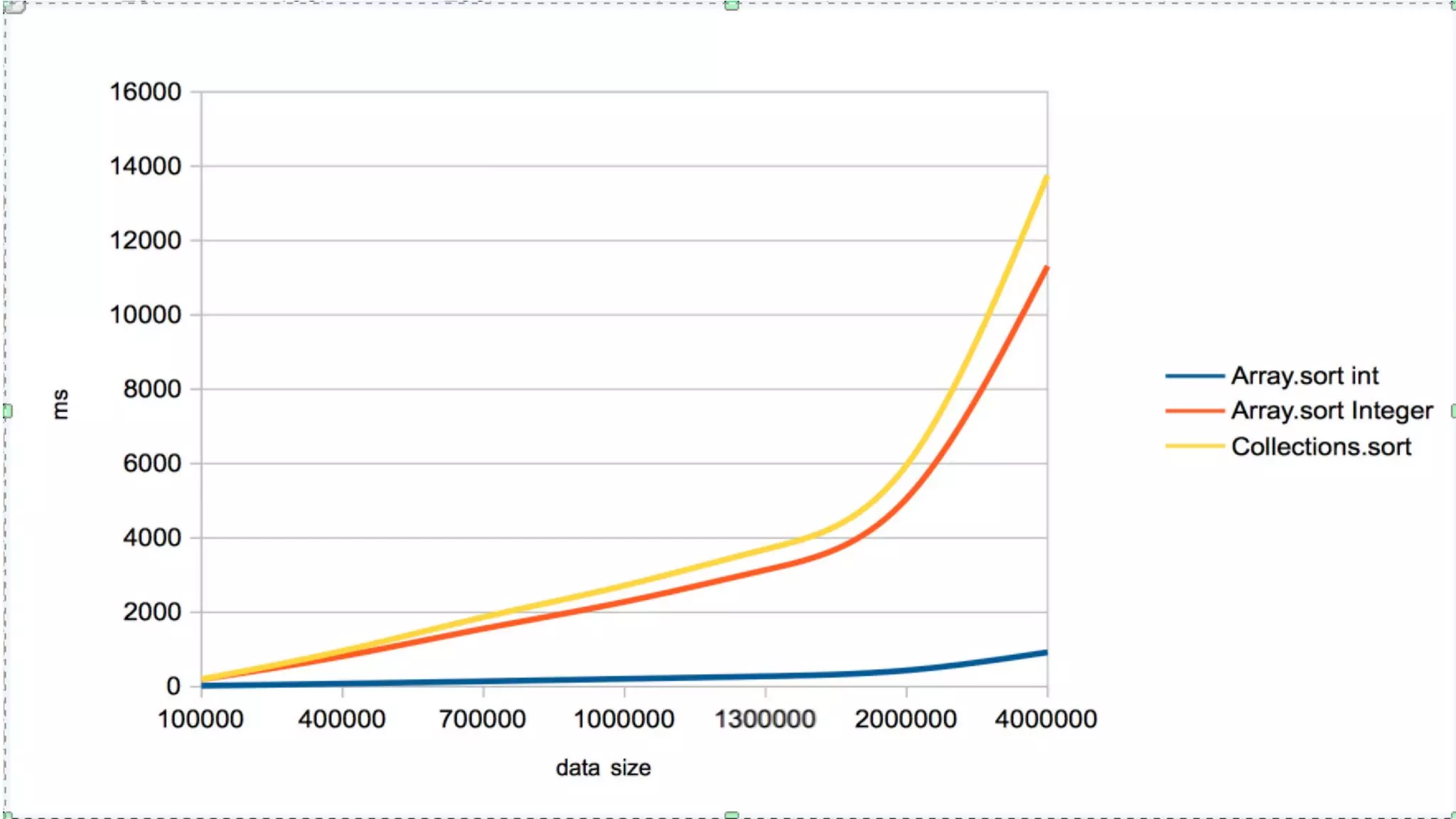
Sorting Two easy ways to sort: • Arrays.sort(array); • Collections.sort(list); Lets evaluate the performance as both data type & sorting algorithms are different.
Sorting • Arrays.sort(arrays) uses a modified version of a 3-way quicksort. • Collections.sort(list) uses a iterative implementation of mergesort (stable)
Sorting Arrays.sort(array) uses the same implementation as Collections.sort(list) for non- primitive data types.
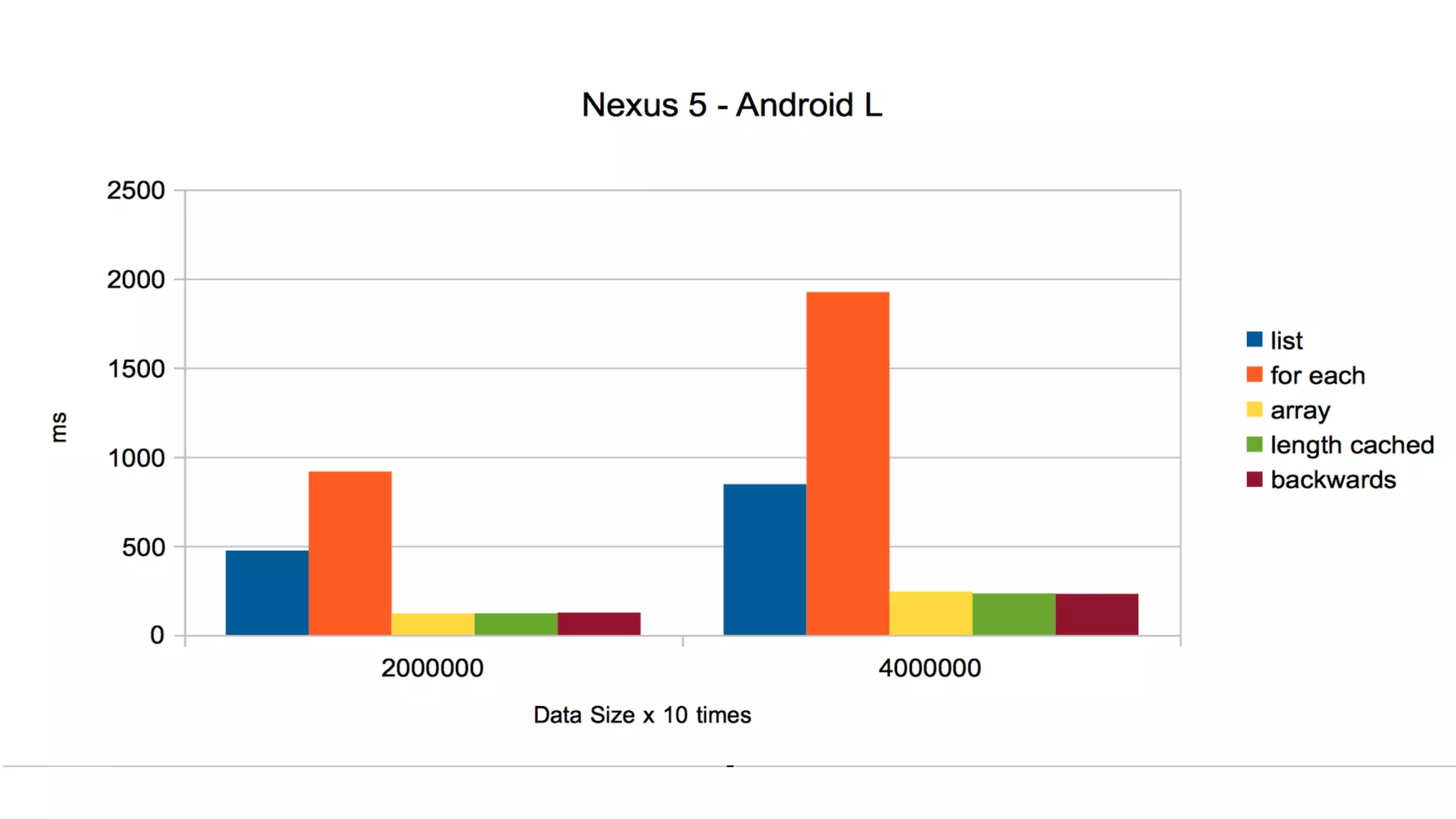
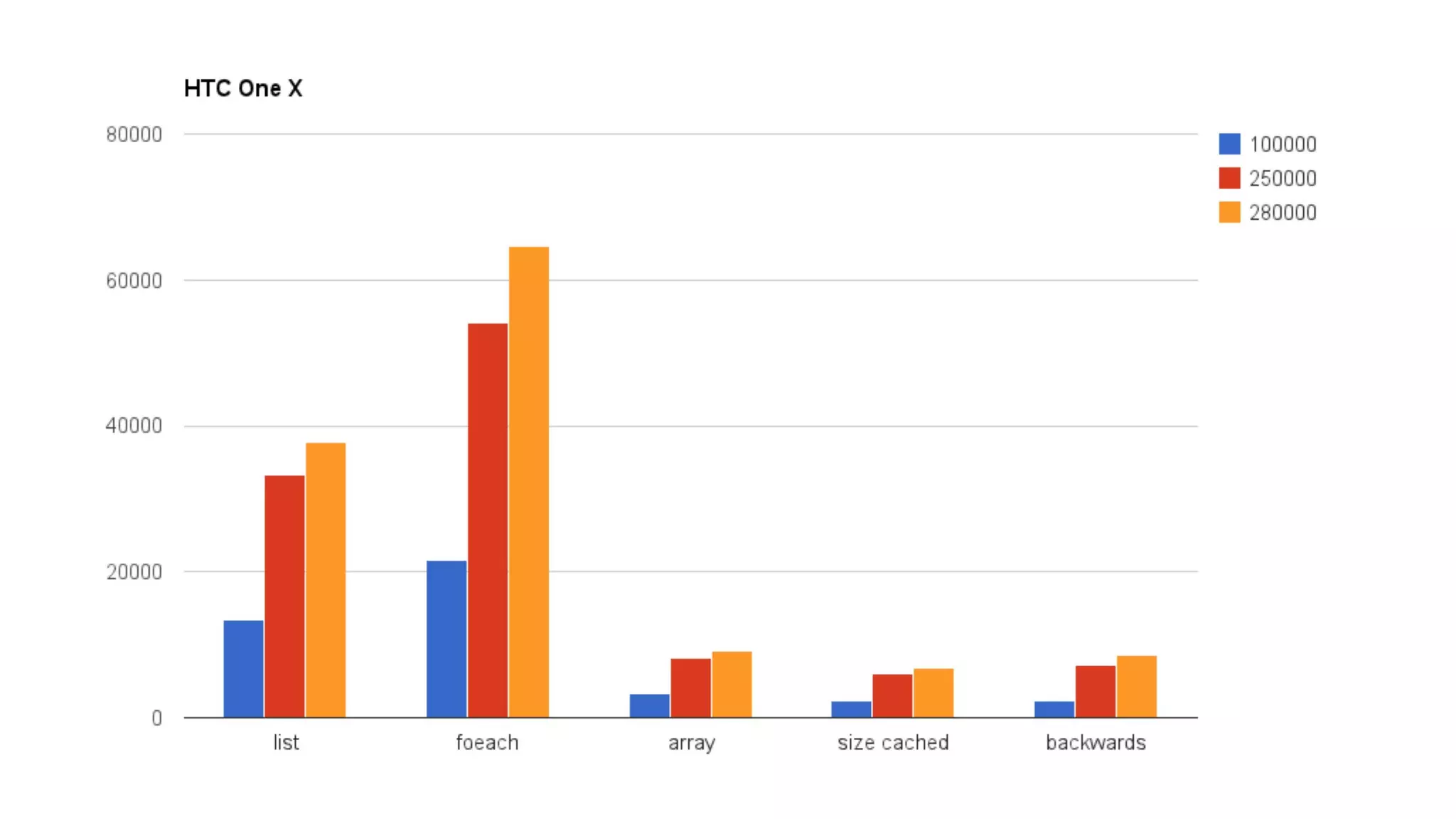
Loops What's going on under the hood
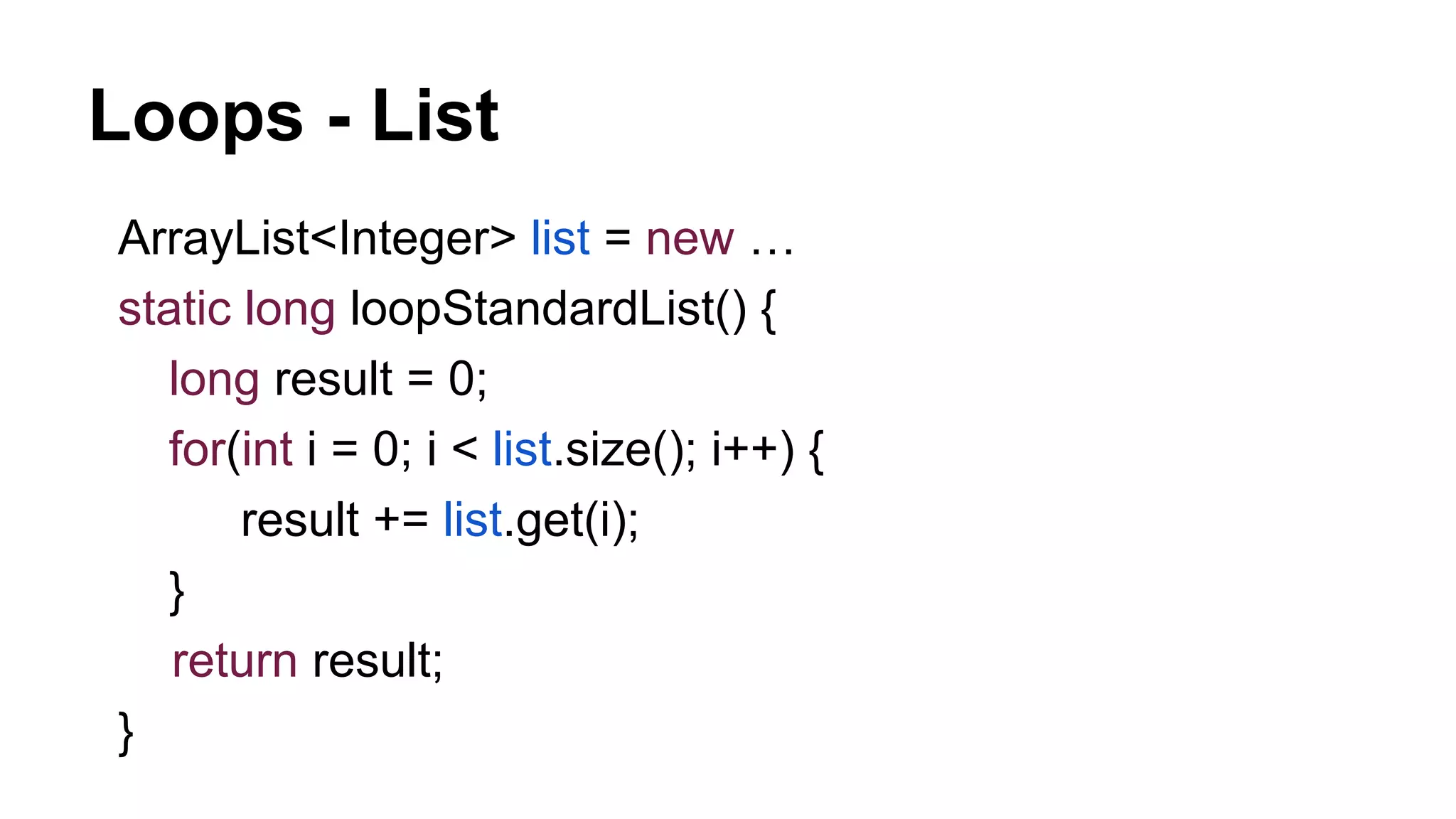
Loops - List ArrayList<Integer> list = new … static long loopStandardList() { long result = 0; for(int i = 0; i < list.size(); i++) { result += list.get(i); } return result; }
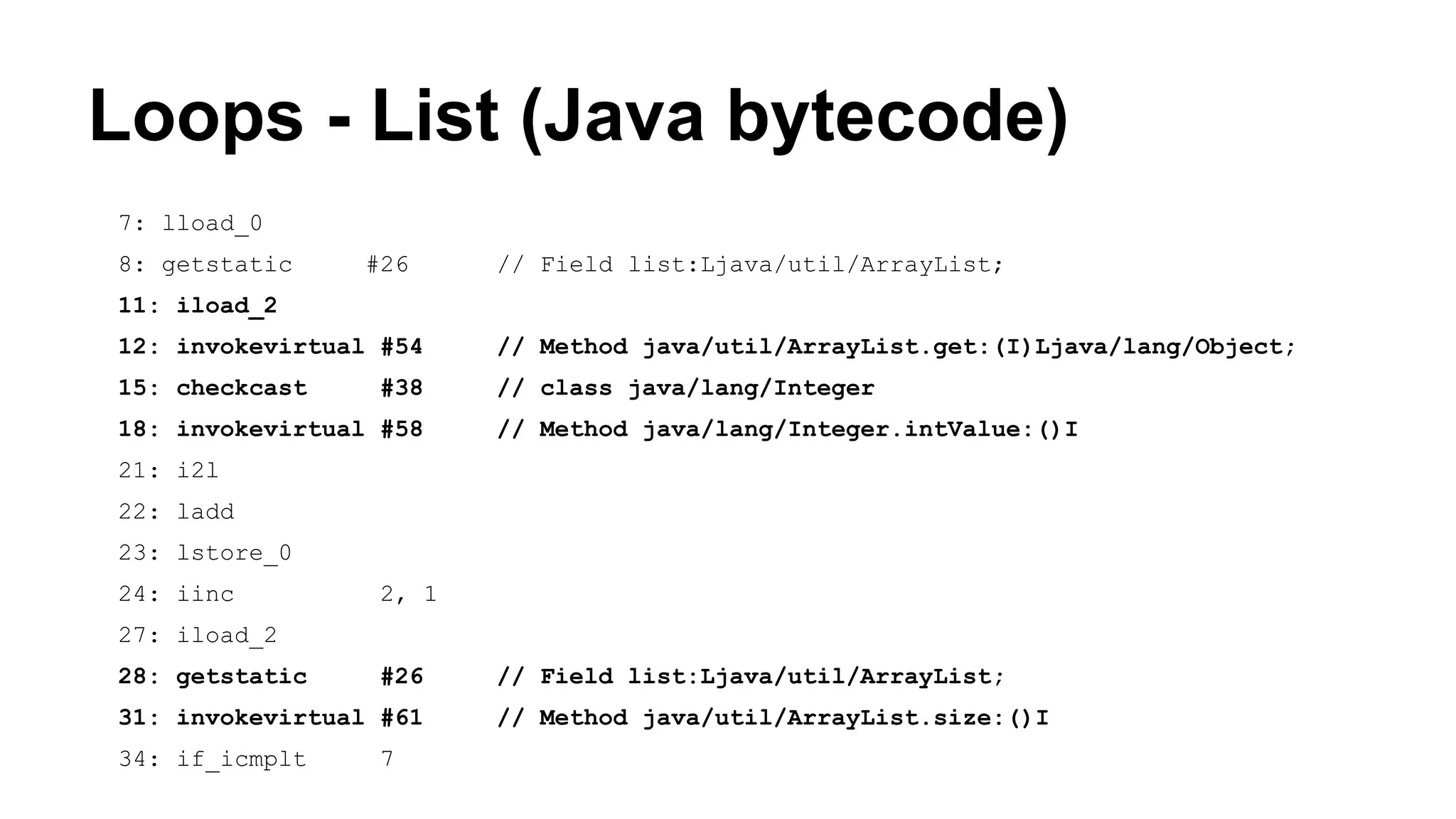
Loops - List (Java bytecode) 7: lload_0 8: getstatic #26 // Field list:Ljava/util/ArrayList; 11: iload_2 12: invokevirtual #54 // Method java/util/ArrayList.get:(I)Ljava/lang/Object; 15: checkcast #38 // class java/lang/Integer 18: invokevirtual #58 // Method java/lang/Integer.intValue:()I 21: i2l 22: ladd 23: lstore_0 24: iinc 2, 1 27: iload_2 28: getstatic #26 // Field list:Ljava/util/ArrayList; 31: invokevirtual #61 // Method java/util/ArrayList.size:()I 34: if_icmplt 7
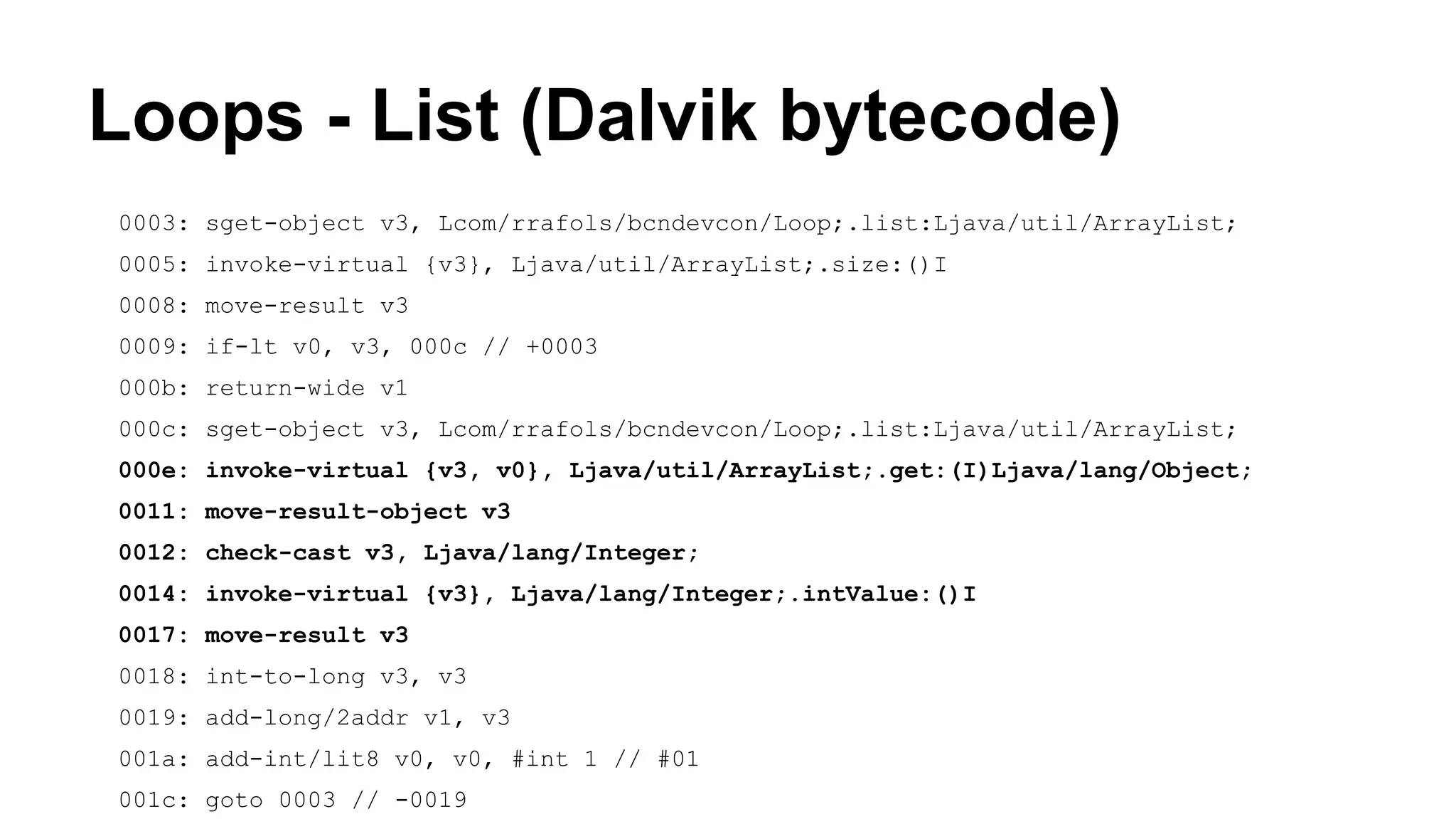
Loops - List (Dalvik bytecode) 0003: sget-object v3, Lcom/rrafols/bcndevcon/Loop;.list:Ljava/util/ArrayList; 0005: invoke-virtual {v3}, Ljava/util/ArrayList;.size:()I 0008: move-result v3 0009: if-lt v0, v3, 000c // +0003 000b: return-wide v1 000c: sget-object v3, Lcom/rrafols/bcndevcon/Loop;.list:Ljava/util/ArrayList; 000e: invoke-virtual {v3, v0}, Ljava/util/ArrayList;.get:(I)Ljava/lang/Object; 0011: move-result-object v3 0012: check-cast v3, Ljava/lang/Integer; 0014: invoke-virtual {v3}, Ljava/lang/Integer;.intValue:()I 0017: move-result v3 0018: int-to-long v3, v3 0019: add-long/2addr v1, v3 001a: add-int/lit8 v0, v0, #int 1 // #01 001c: goto 0003 // -0019
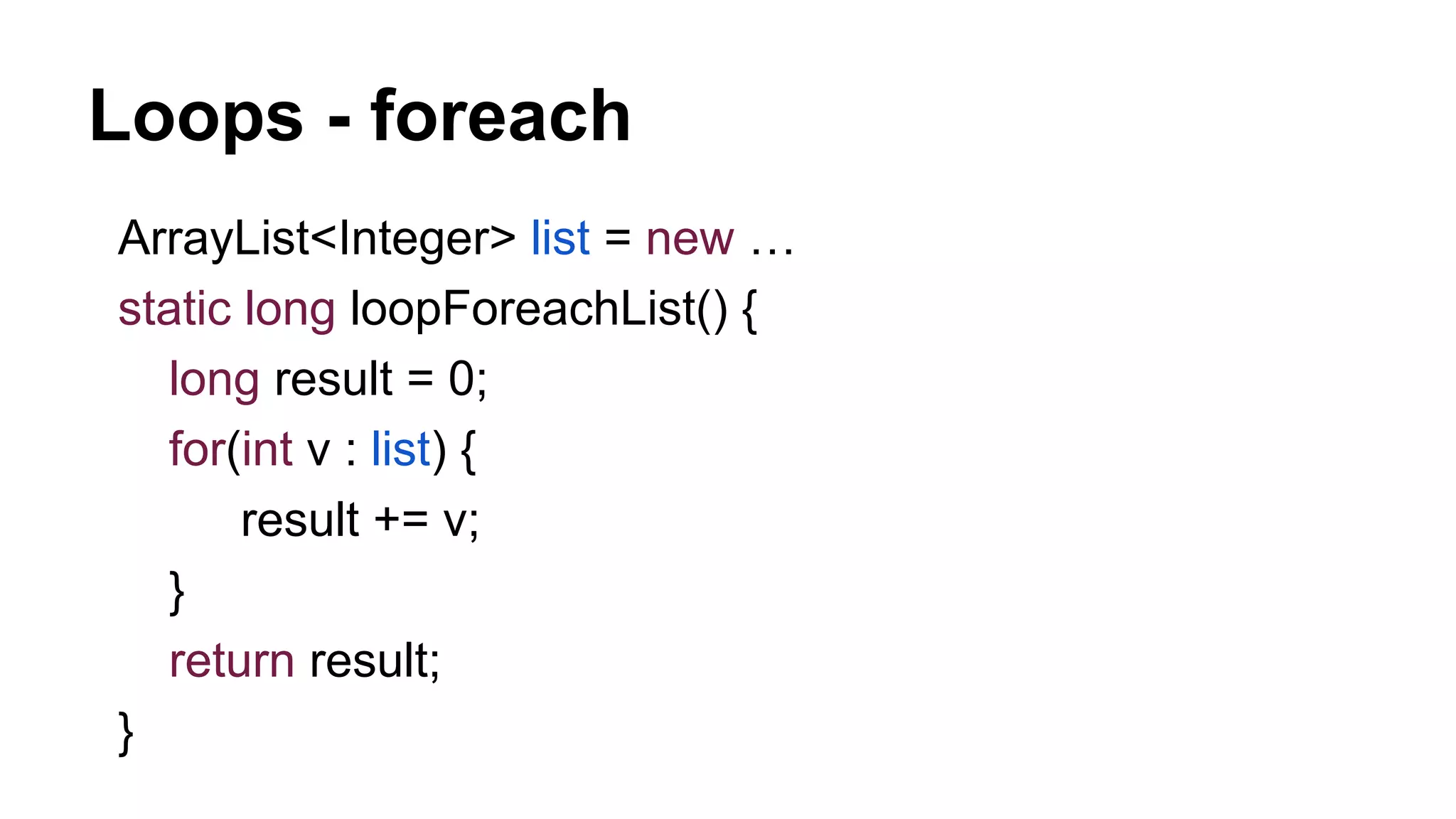
Loops - foreach ArrayList<Integer> list = new … static long loopForeachList() { long result = 0; for(int v : list) { result += v; } return result; }
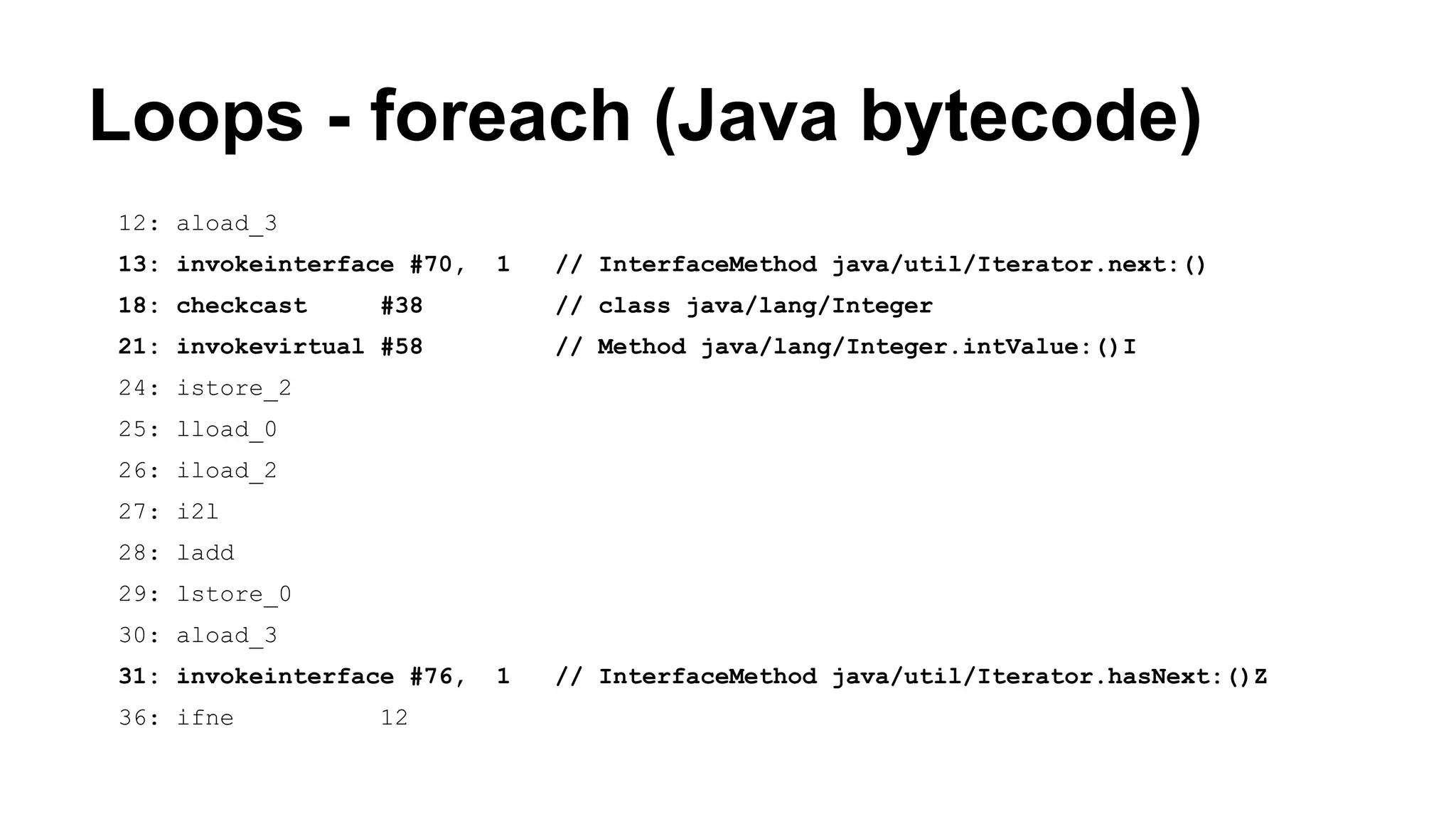
Loops - foreach (Java bytecode) 12: aload_3 13: invokeinterface #70, 1 // InterfaceMethod java/util/Iterator.next:() 18: checkcast #38 // class java/lang/Integer 21: invokevirtual #58 // Method java/lang/Integer.intValue:()I 24: istore_2 25: lload_0 26: iload_2 27: i2l 28: ladd 29: lstore_0 30: aload_3 31: invokeinterface #76, 1 // InterfaceMethod java/util/Iterator.hasNext:()Z 36: ifne 12
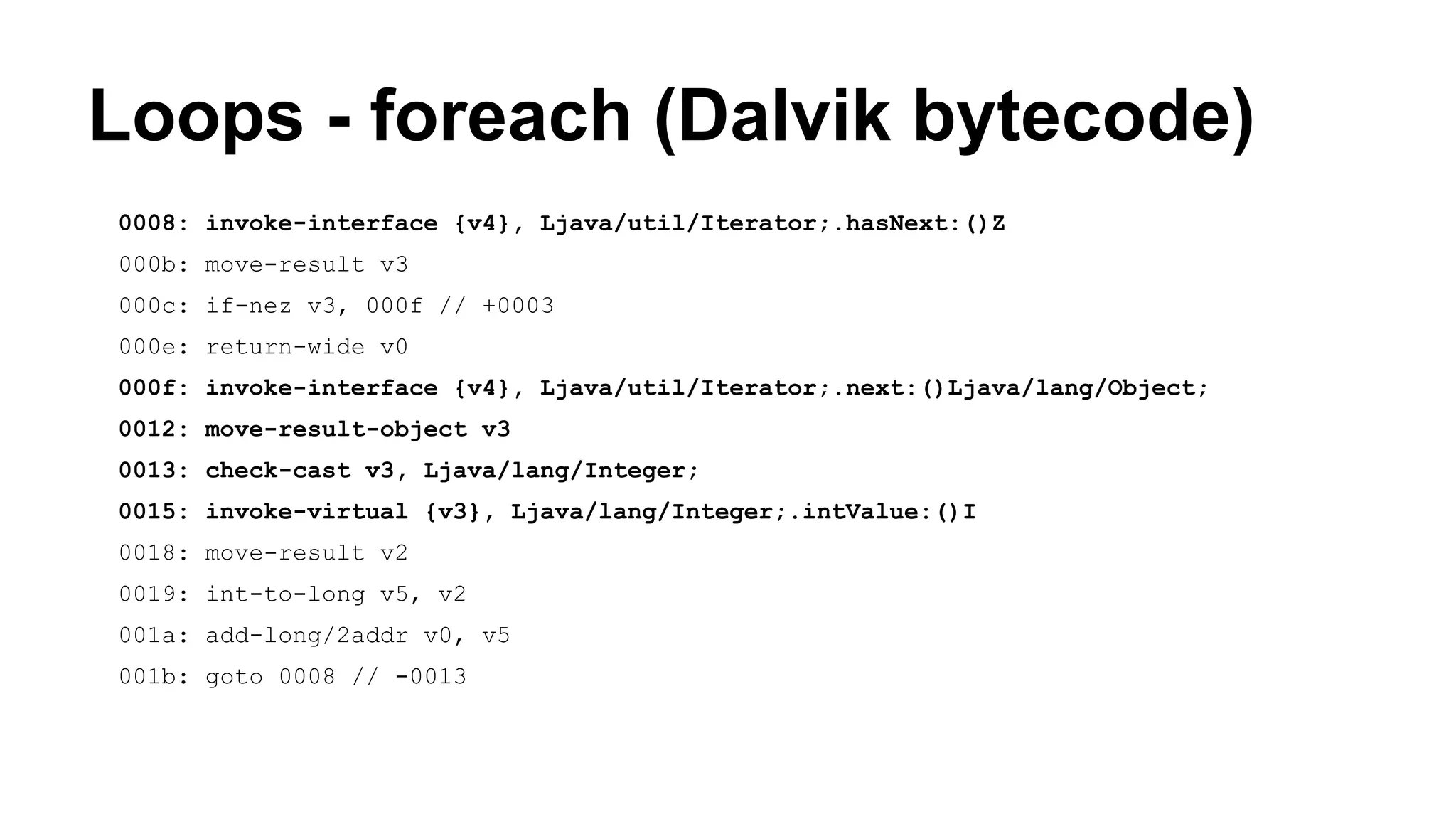
Loops - foreach (Dalvik bytecode) 0008: invoke-interface {v4}, Ljava/util/Iterator;.hasNext:()Z 000b: move-result v3 000c: if-nez v3, 000f // +0003 000e: return-wide v0 000f: invoke-interface {v4}, Ljava/util/Iterator;.next:()Ljava/lang/Object; 0012: move-result-object v3 0013: check-cast v3, Ljava/lang/Integer; 0015: invoke-virtual {v3}, Ljava/lang/Integer;.intValue:()I 0018: move-result v2 0019: int-to-long v5, v2 001a: add-long/2addr v0, v5 001b: goto 0008 // -0013
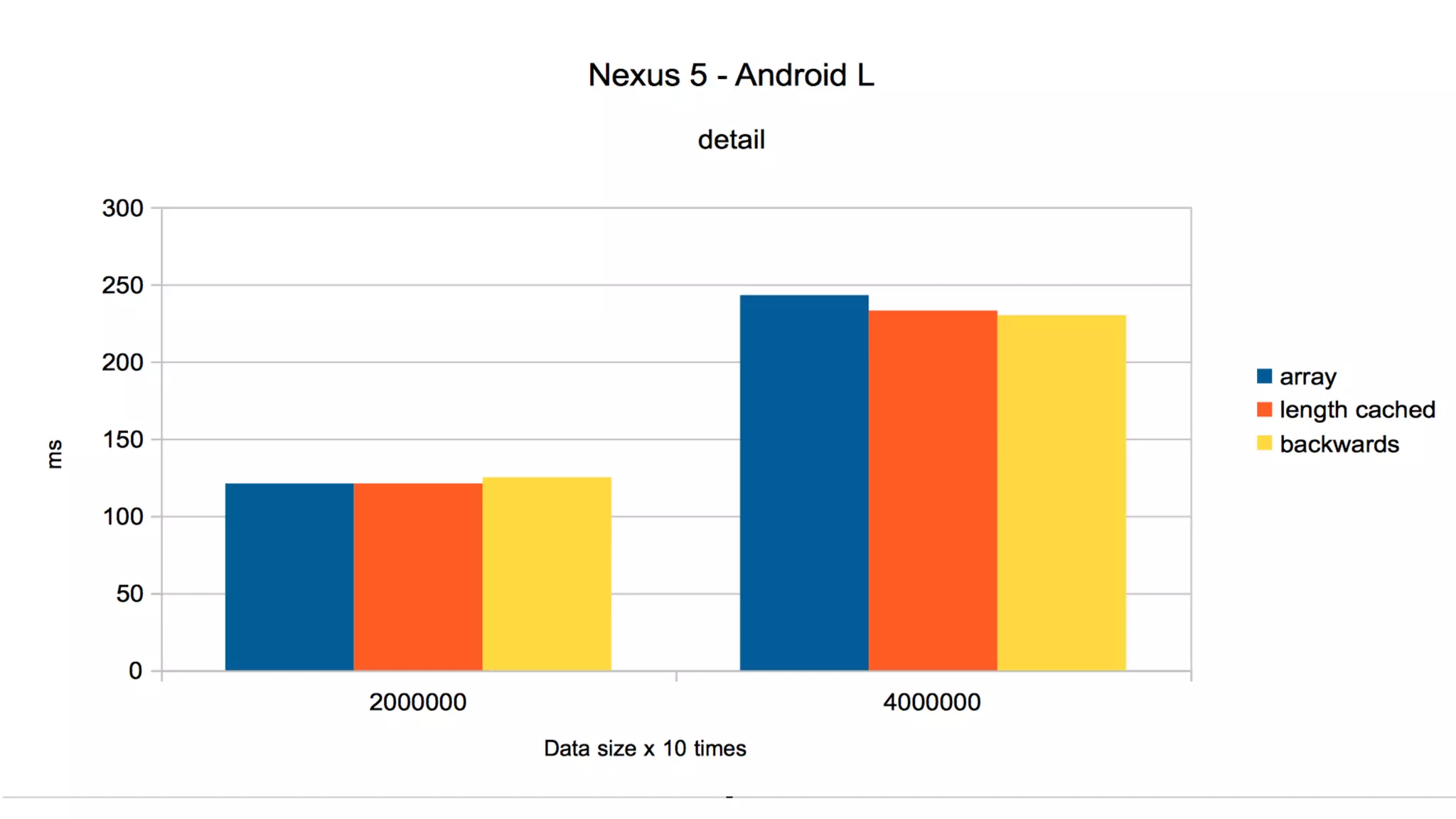
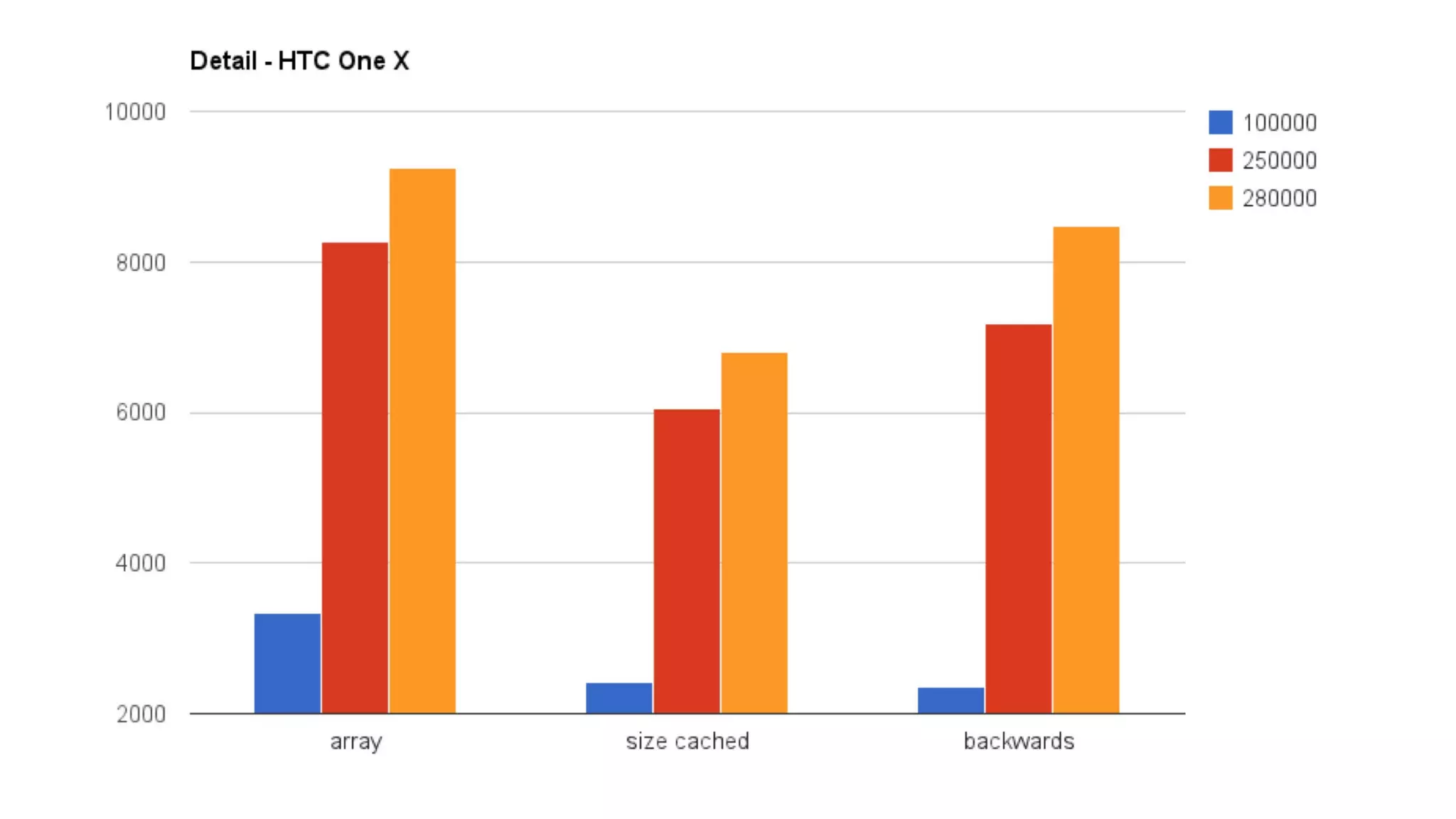
Loops - Array static int[] array = new ... static long loopStandardArray() { long result = 0; for(int i = 0; i < array.length; i++) { result += array[i]; } return result; }
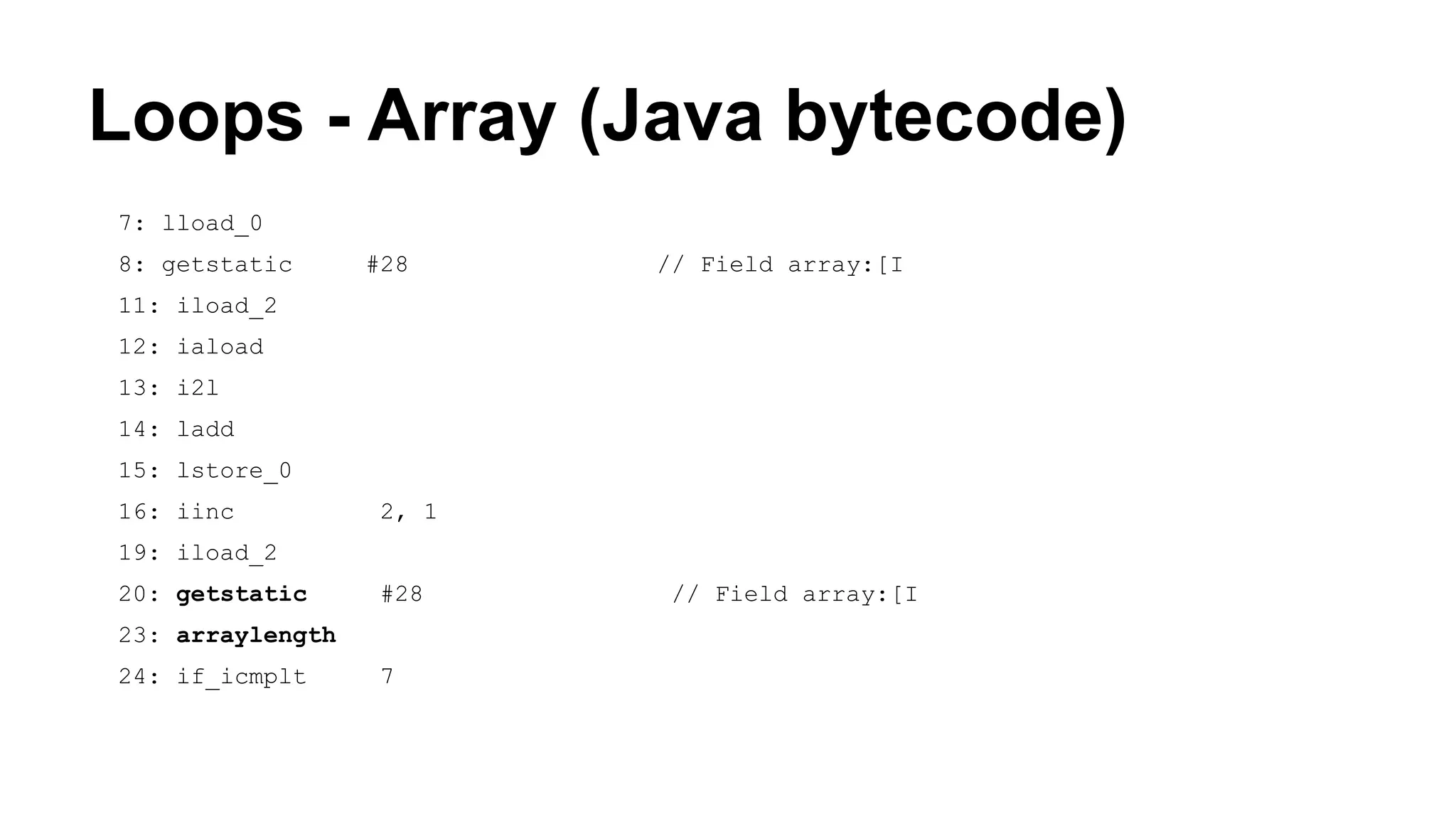
Loops - Array (Java bytecode) 7: lload_0 8: getstatic #28 // Field array:[I 11: iload_2 12: iaload 13: i2l 14: ladd 15: lstore_0 16: iinc 2, 1 19: iload_2 20: getstatic #28 // Field array:[I 23: arraylength 24: if_icmplt 7
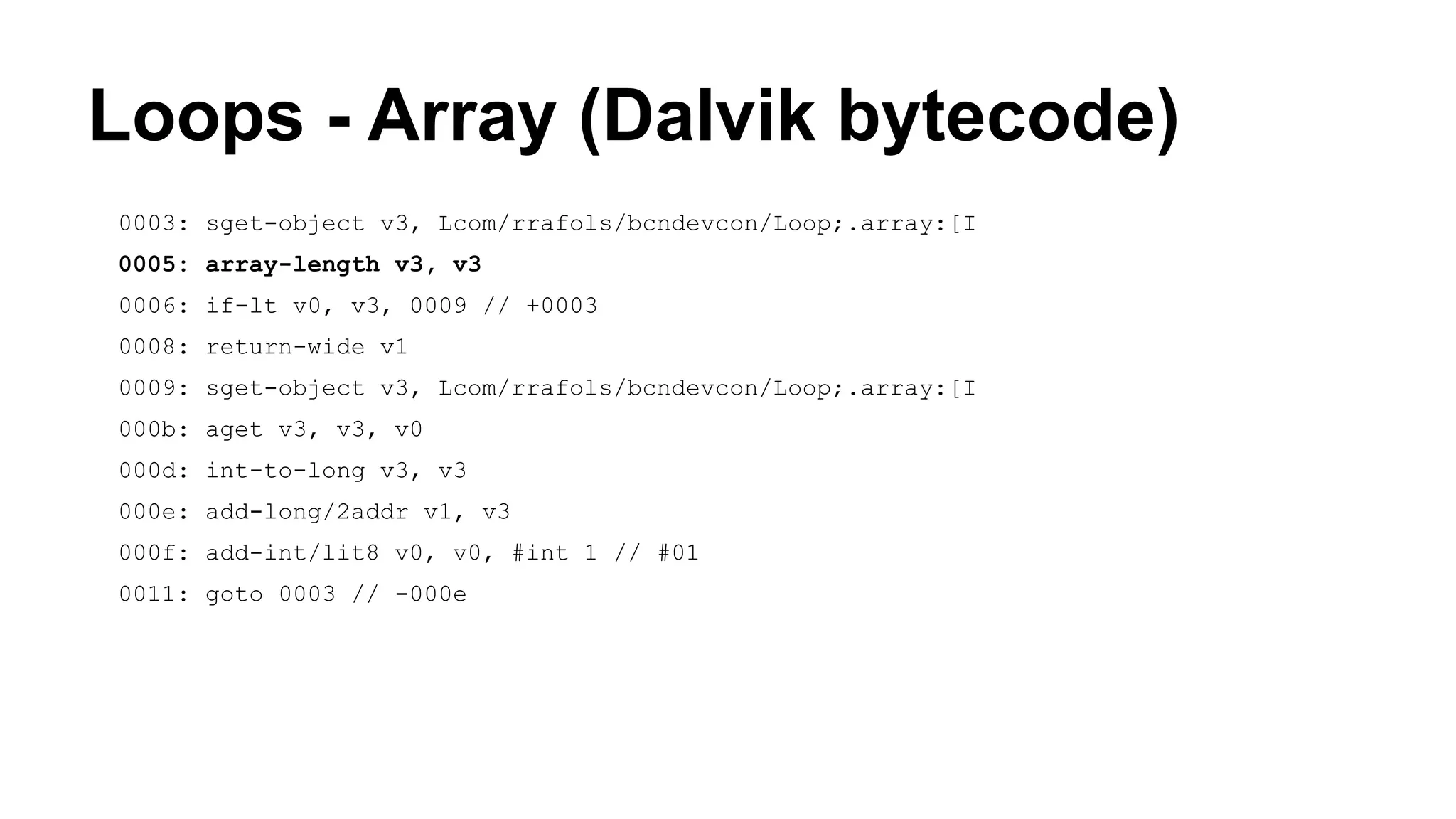
Loops - Array (Dalvik bytecode) 0003: sget-object v3, Lcom/rrafols/bcndevcon/Loop;.array:[I 0005: array-length v3, v3 0006: if-lt v0, v3, 0009 // +0003 0008: return-wide v1 0009: sget-object v3, Lcom/rrafols/bcndevcon/Loop;.array:[I 000b: aget v3, v3, v0 000d: int-to-long v3, v3 000e: add-long/2addr v1, v3 000f: add-int/lit8 v0, v0, #int 1 // #01 0011: goto 0003 // -000e
Loops - size cached static int[] array = new ... static long loopStandardArraySizeStored() { long result = 0; int length = array.length; for(int i = 0; i < length; i++) { result += array[i]; } return result; }
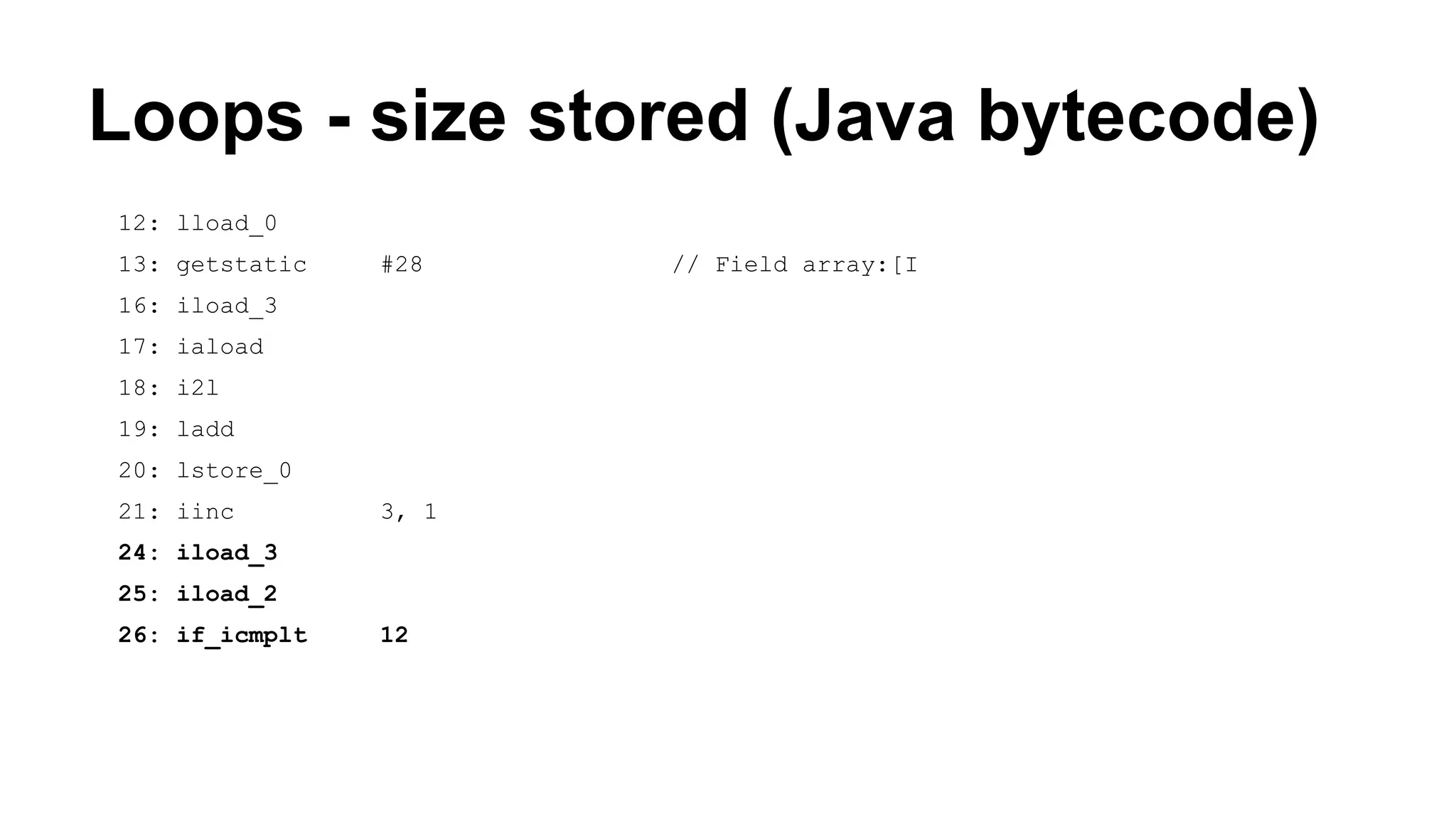
Loops - size stored (Java bytecode) 12: lload_0 13: getstatic #28 // Field array:[I 16: iload_3 17: iaload 18: i2l 19: ladd 20: lstore_0 21: iinc 3, 1 24: iload_3 25: iload_2 26: if_icmplt 12
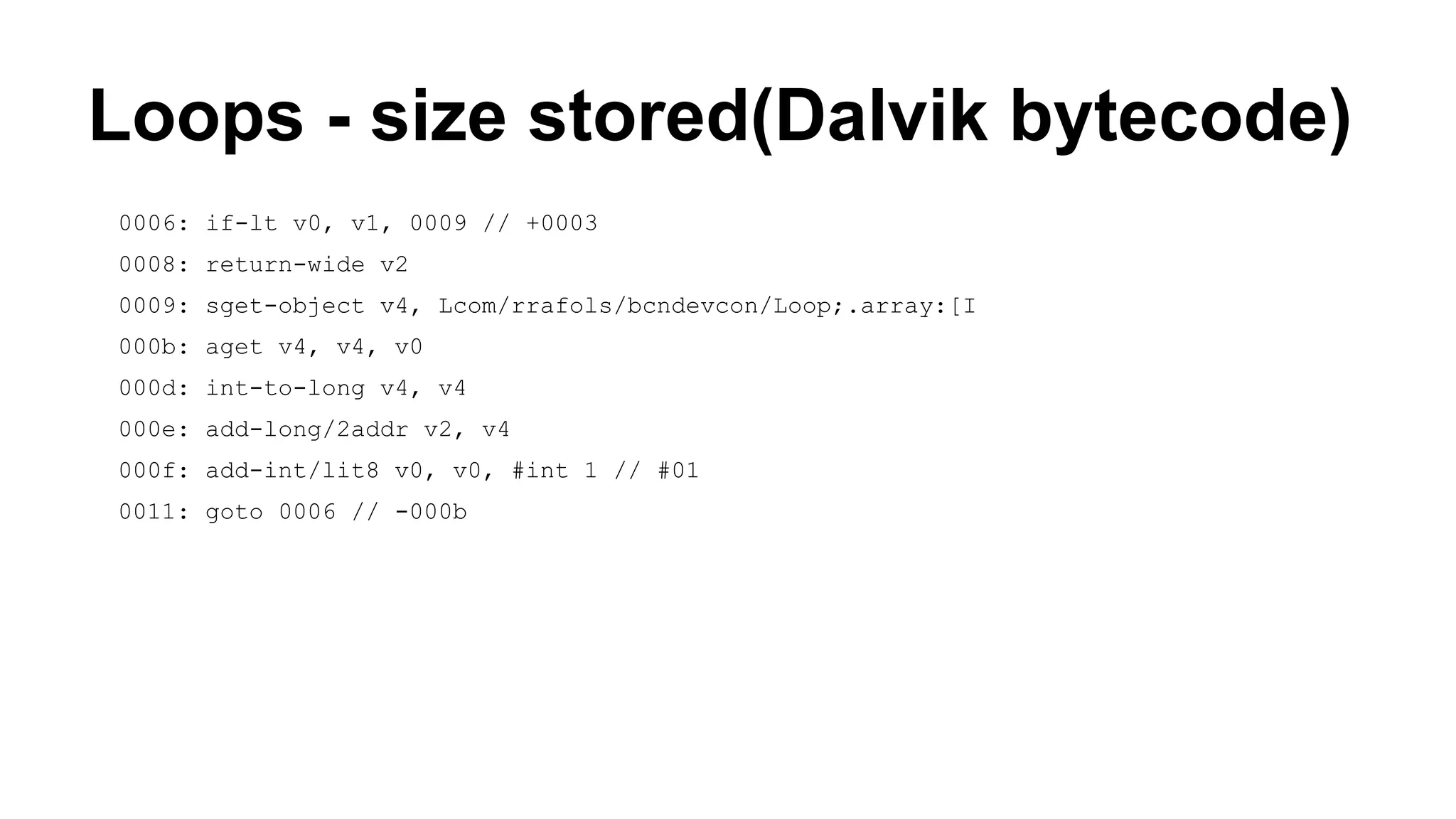
Loops - size stored(Dalvik bytecode) 0006: if-lt v0, v1, 0009 // +0003 0008: return-wide v2 0009: sget-object v4, Lcom/rrafols/bcndevcon/Loop;.array:[I 000b: aget v4, v4, v0 000d: int-to-long v4, v4 000e: add-long/2addr v2, v4 000f: add-int/lit8 v0, v0, #int 1 // #01 0011: goto 0006 // -000b
Loops - backwards static int[] array = new ... static long loopStandardArrayBackwards() { long result = 0; for(int i = array.length - 1; i >= 0; i--) { result += array[i]; } return result; }
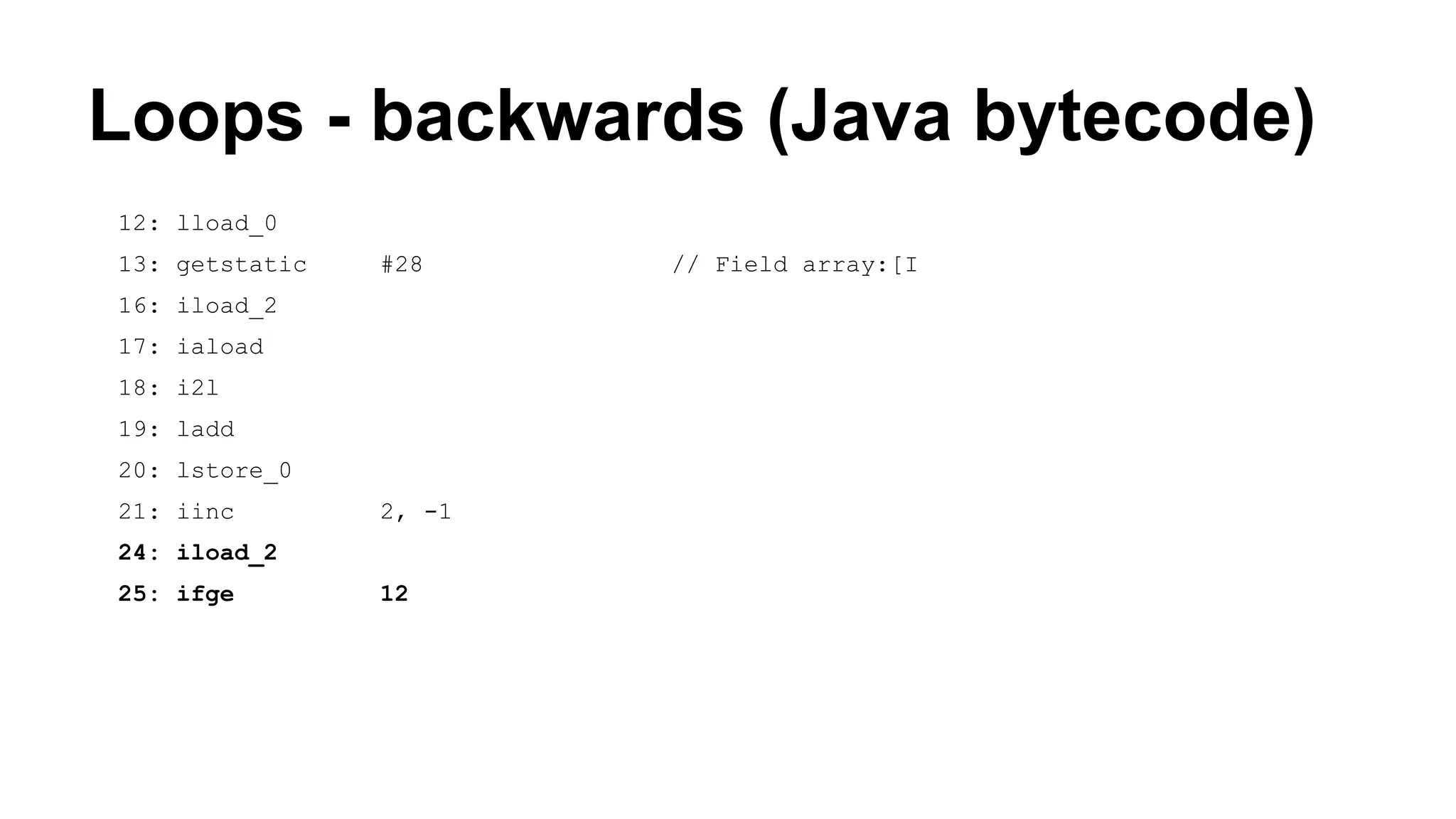
Loops - backwards (Java bytecode) 12: lload_0 13: getstatic #28 // Field array:[I 16: iload_2 17: iaload 18: i2l 19: ladd 20: lstore_0 21: iinc 2, -1 24: iload_2 25: ifge 12
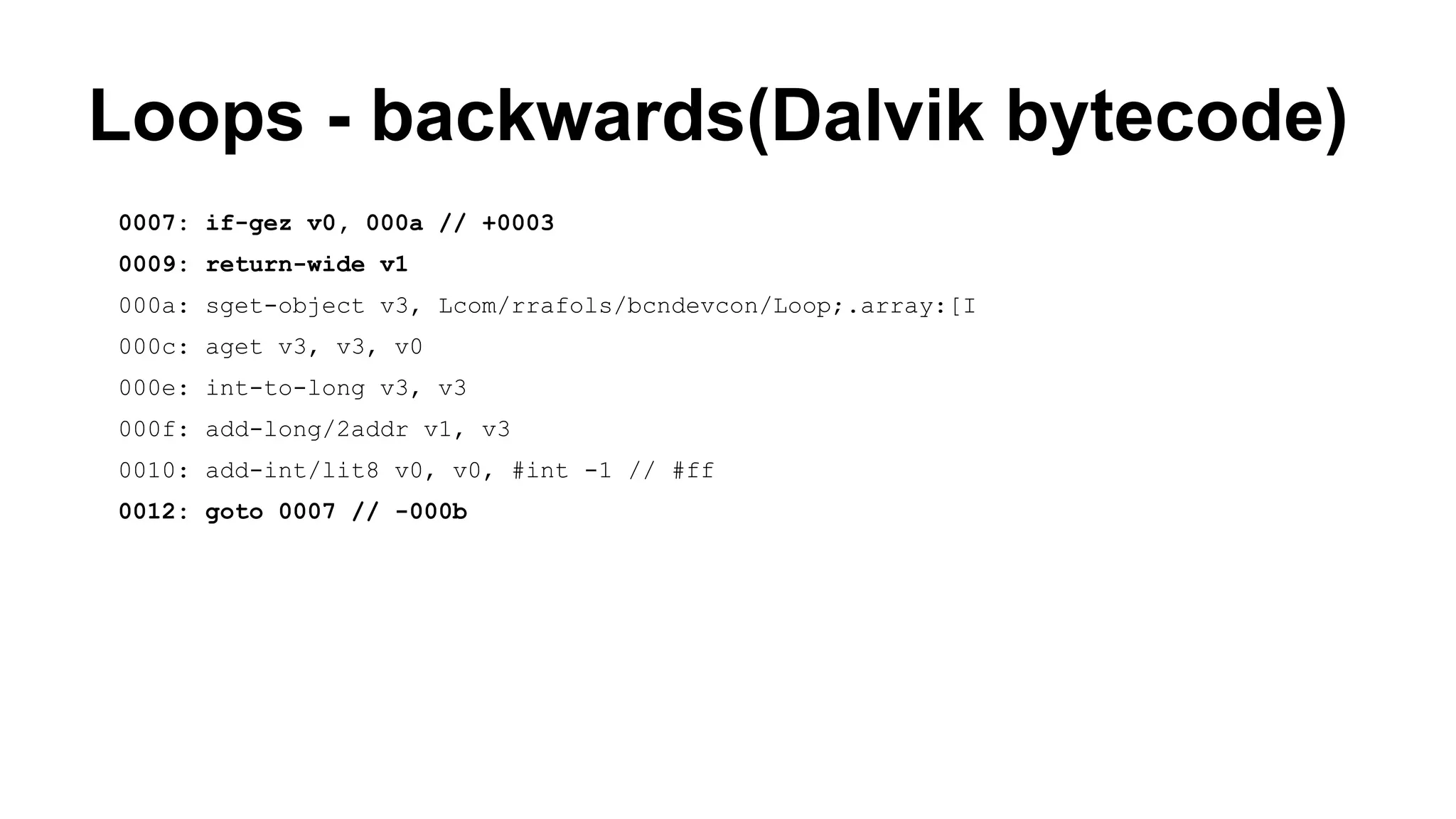
Loops - backwards(Dalvik bytecode) 0007: if-gez v0, 000a // +0003 0009: return-wide v1 000a: sget-object v3, Lcom/rrafols/bcndevcon/Loop;.array:[I 000c: aget v3, v3, v0 000e: int-to-long v3, v3 000f: add-long/2addr v1, v3 0010: add-int/lit8 v0, v0, #int -1 // #ff 0012: goto 0007 // -000b
String concatenation The evil + sign
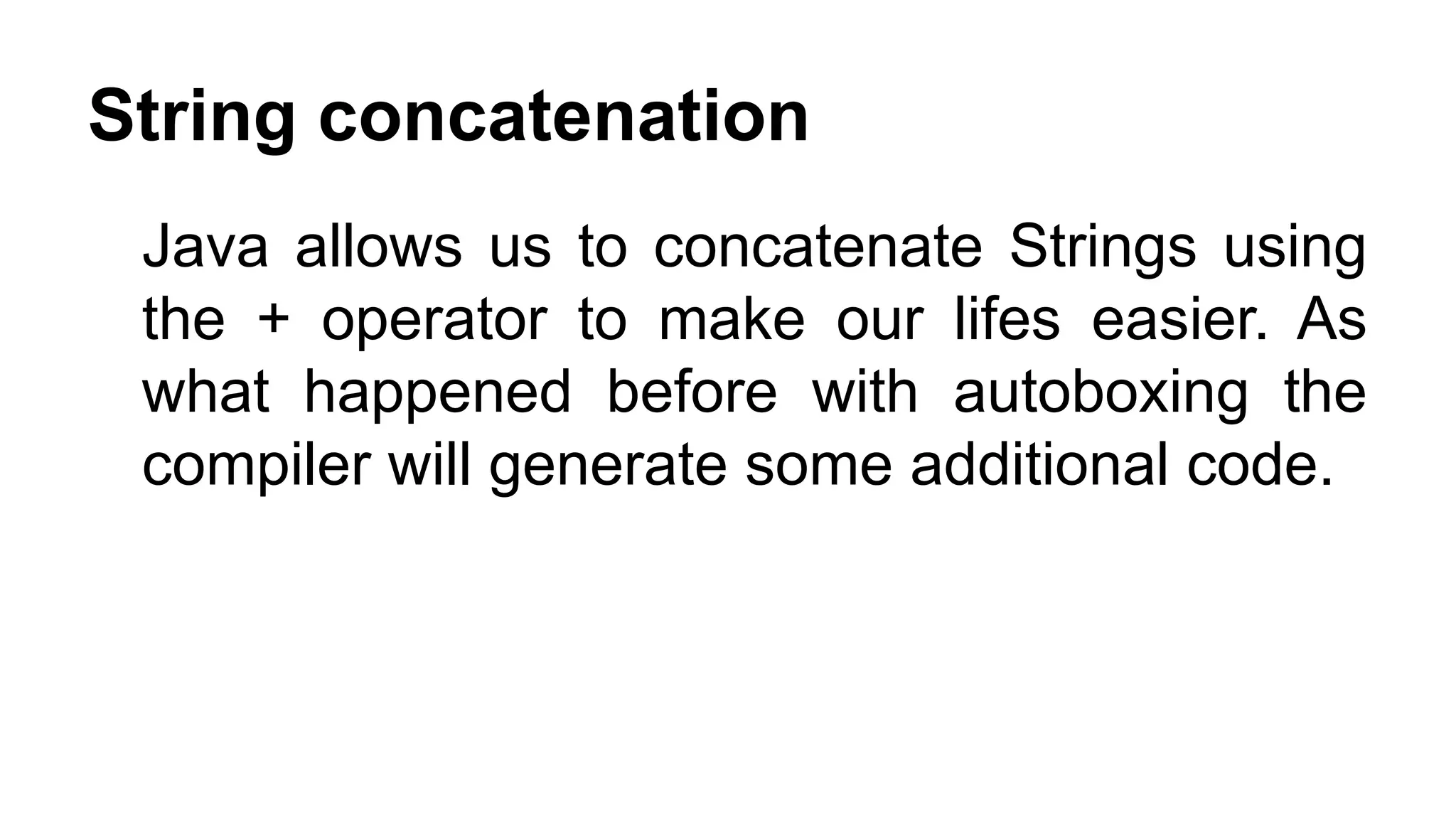
String concatenation Java allows us to concatenate Strings using the + operator to make our lifes easier. As what happened before with autoboxing the compiler will generate some additional code.
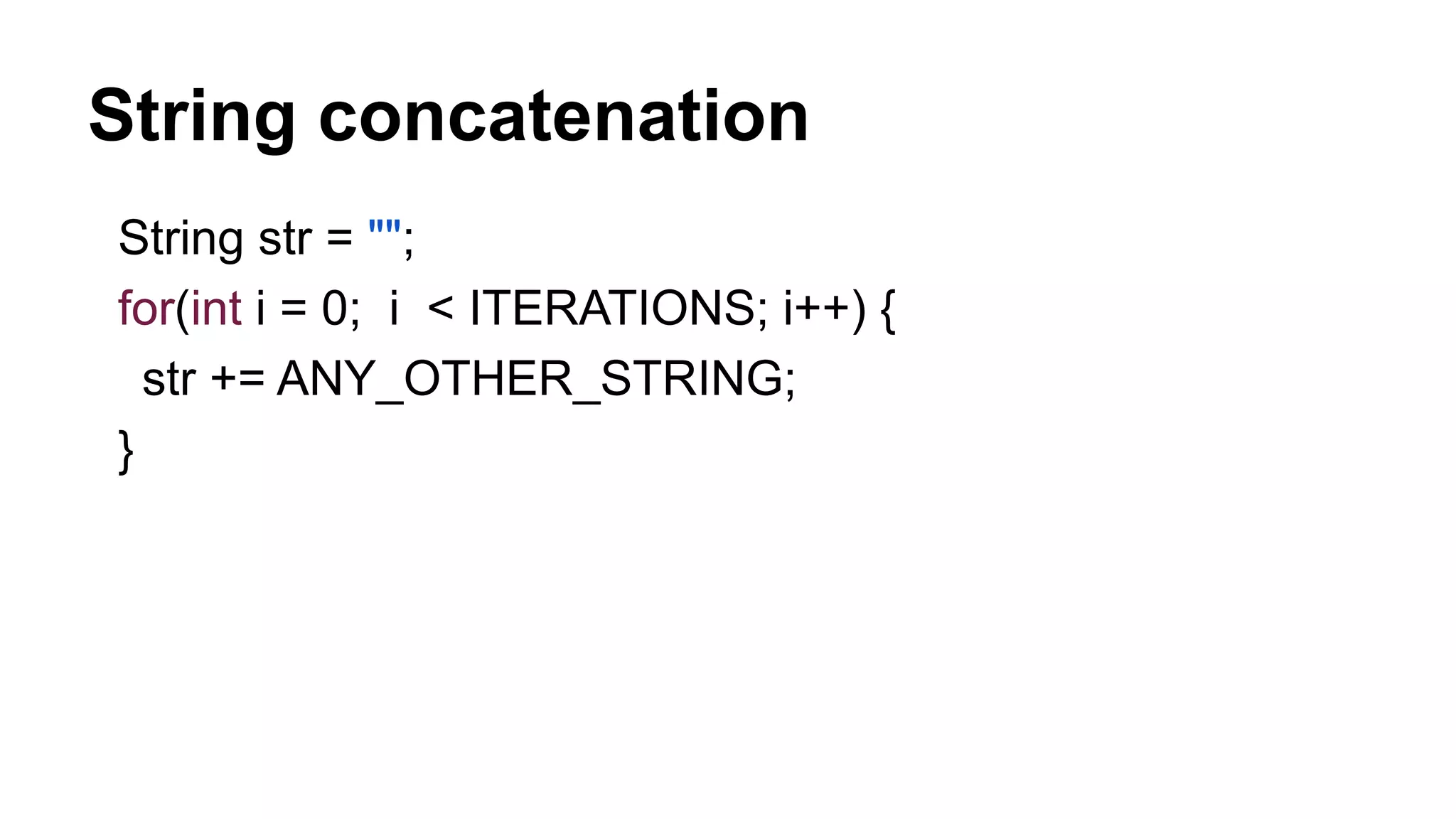
String concatenation String str = ""; for(int i = 0; i < ITERATIONS; i++) { str += ANY_OTHER_STRING; }
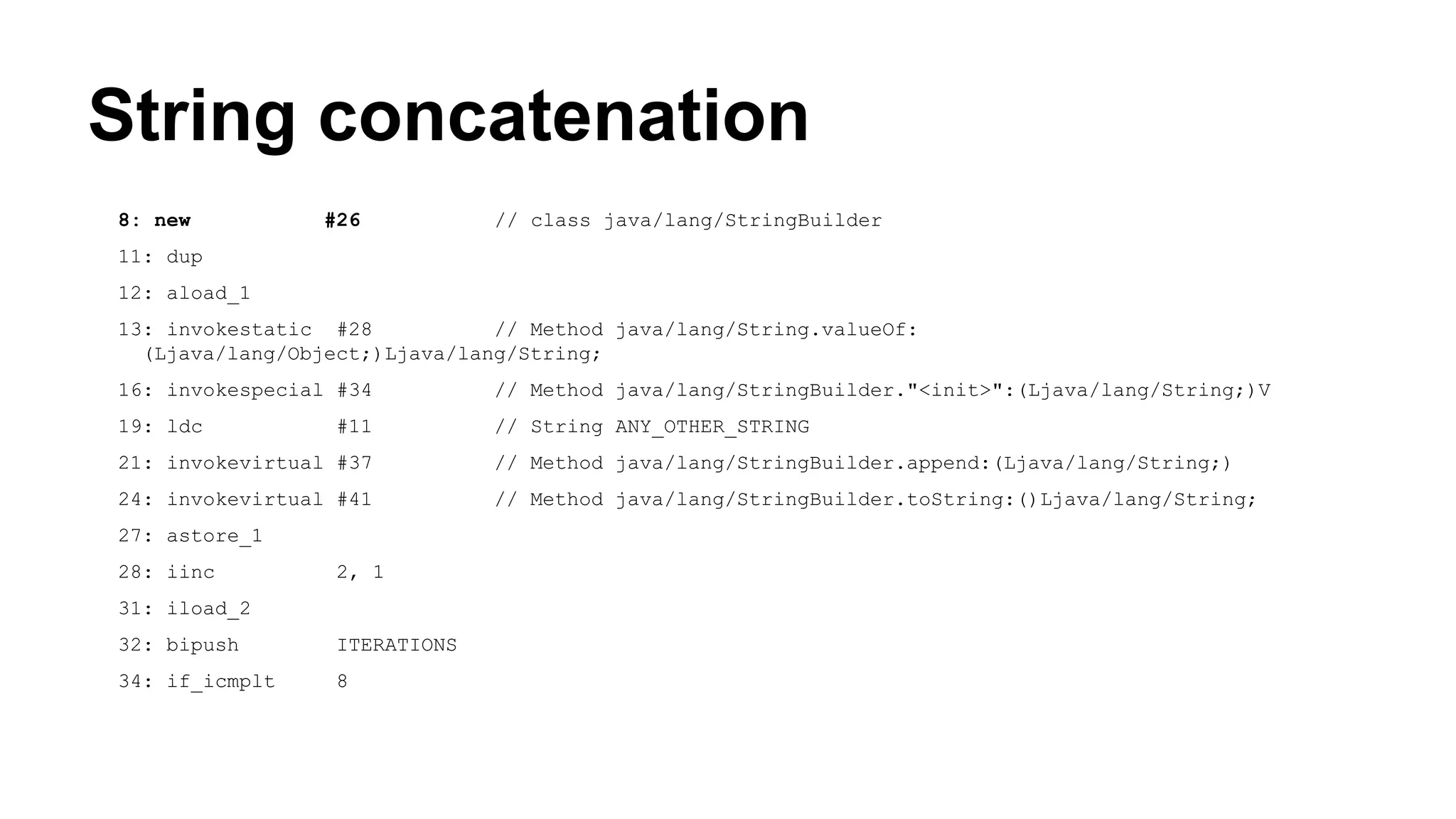
String concatenation 8: new #26 // class java/lang/StringBuilder 11: dup 12: aload_1 13: invokestatic #28 // Method java/lang/String.valueOf: (Ljava/lang/Object;)Ljava/lang/String; 16: invokespecial #34 // Method java/lang/StringBuilder."<init>":(Ljava/lang/String;)V 19: ldc #11 // String ANY_OTHER_STRING 21: invokevirtual #37 // Method java/lang/StringBuilder.append:(Ljava/lang/String;) 24: invokevirtual #41 // Method java/lang/StringBuilder.toString:()Ljava/lang/String; 27: astore_1 28: iinc 2, 1 31: iload_2 32: bipush ITERATIONS 34: if_icmplt 8
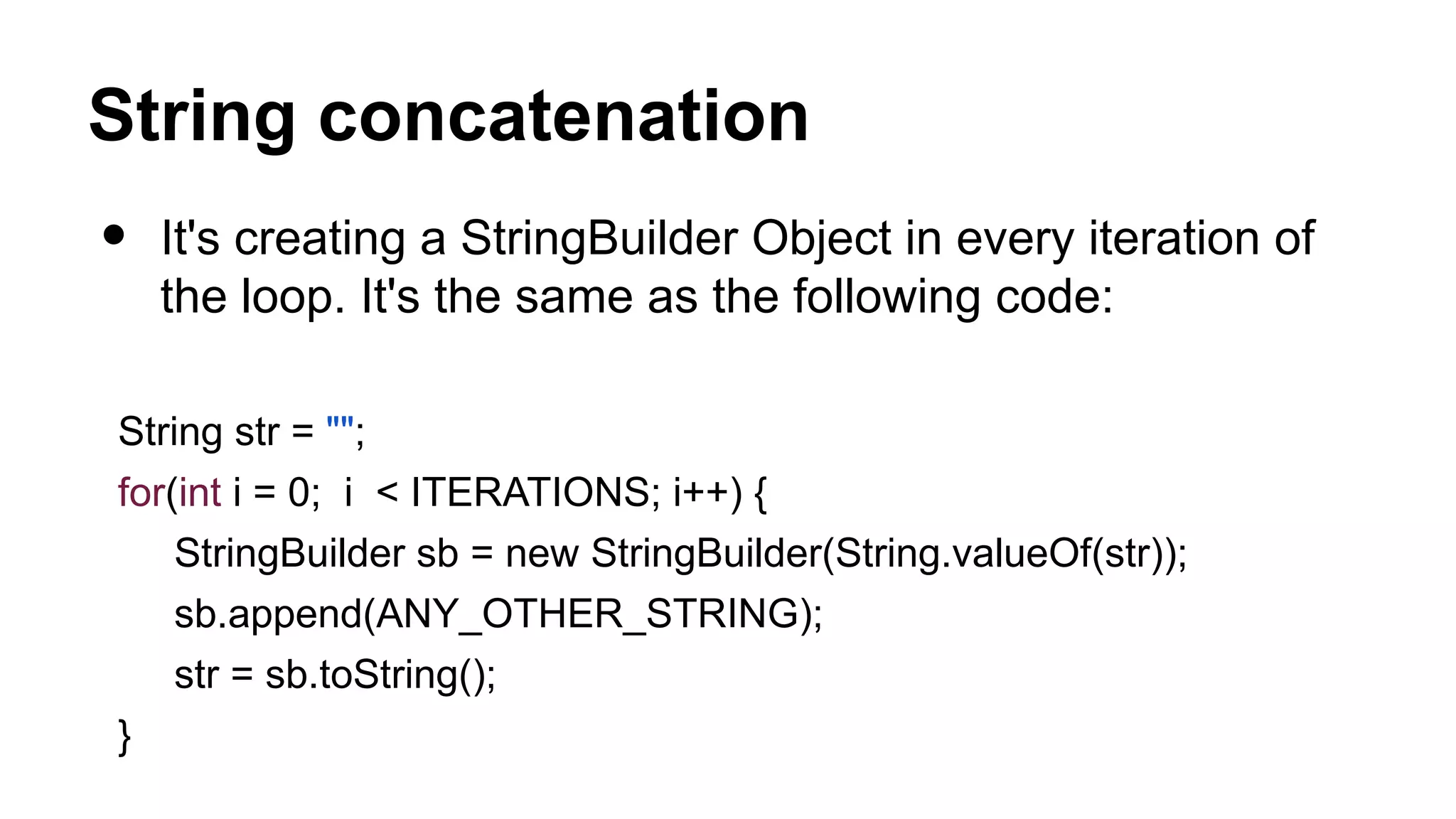
String concatenation • It's creating a StringBuilder Object in every iteration of the loop. It's the same as the following code: String str = ""; for(int i = 0; i < ITERATIONS; i++) { StringBuilder sb = new StringBuilder(String.valueOf(str)); sb.append(ANY_OTHER_STRING); str = sb.toString(); }
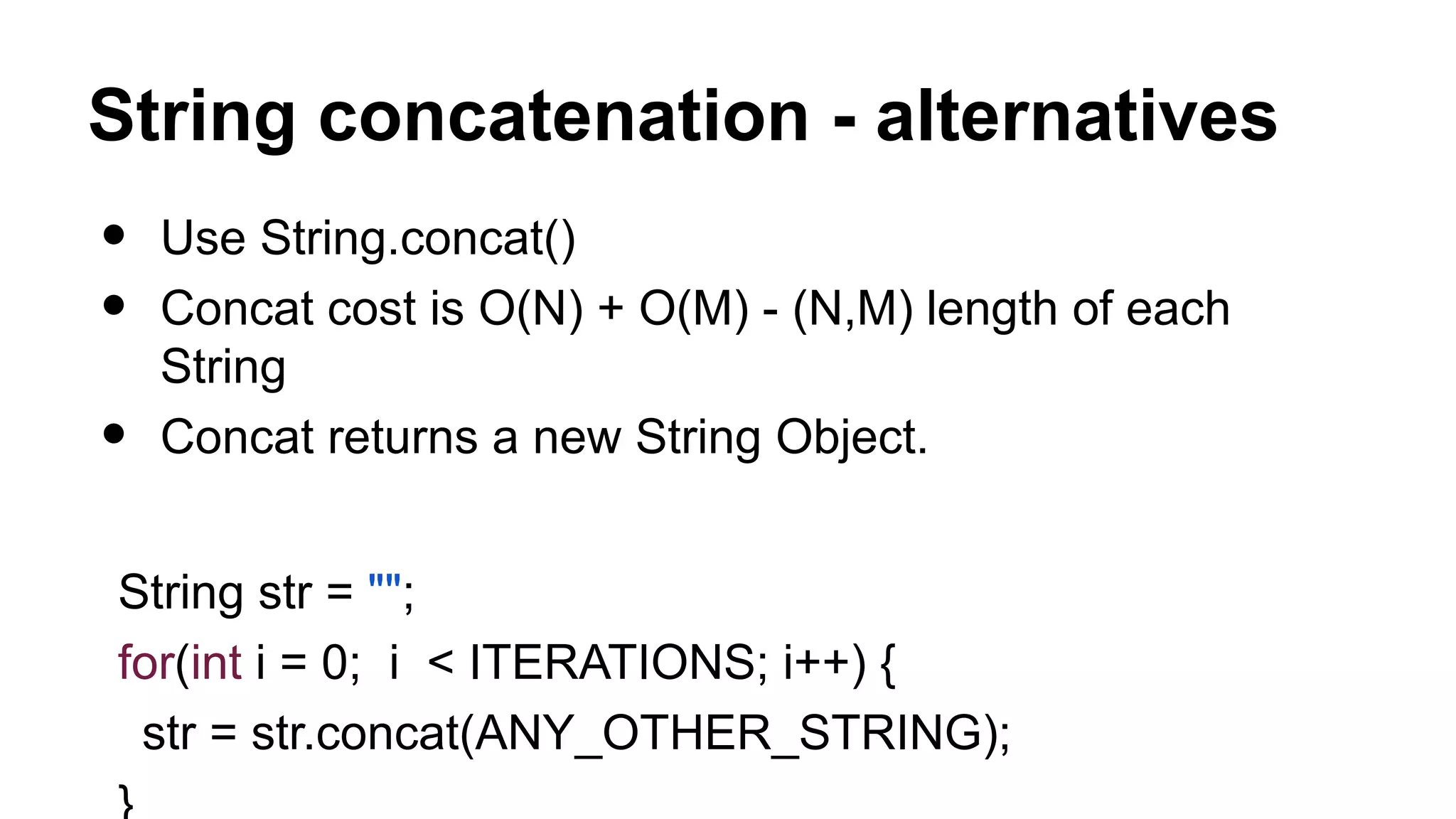
String concatenation - alternatives • Use String.concat() • Concat cost is O(N) + O(M) - (N,M) length of each String • Concat returns a new String Object. String str = ""; for(int i = 0; i < ITERATIONS; i++) { str = str.concat(ANY_OTHER_STRING);
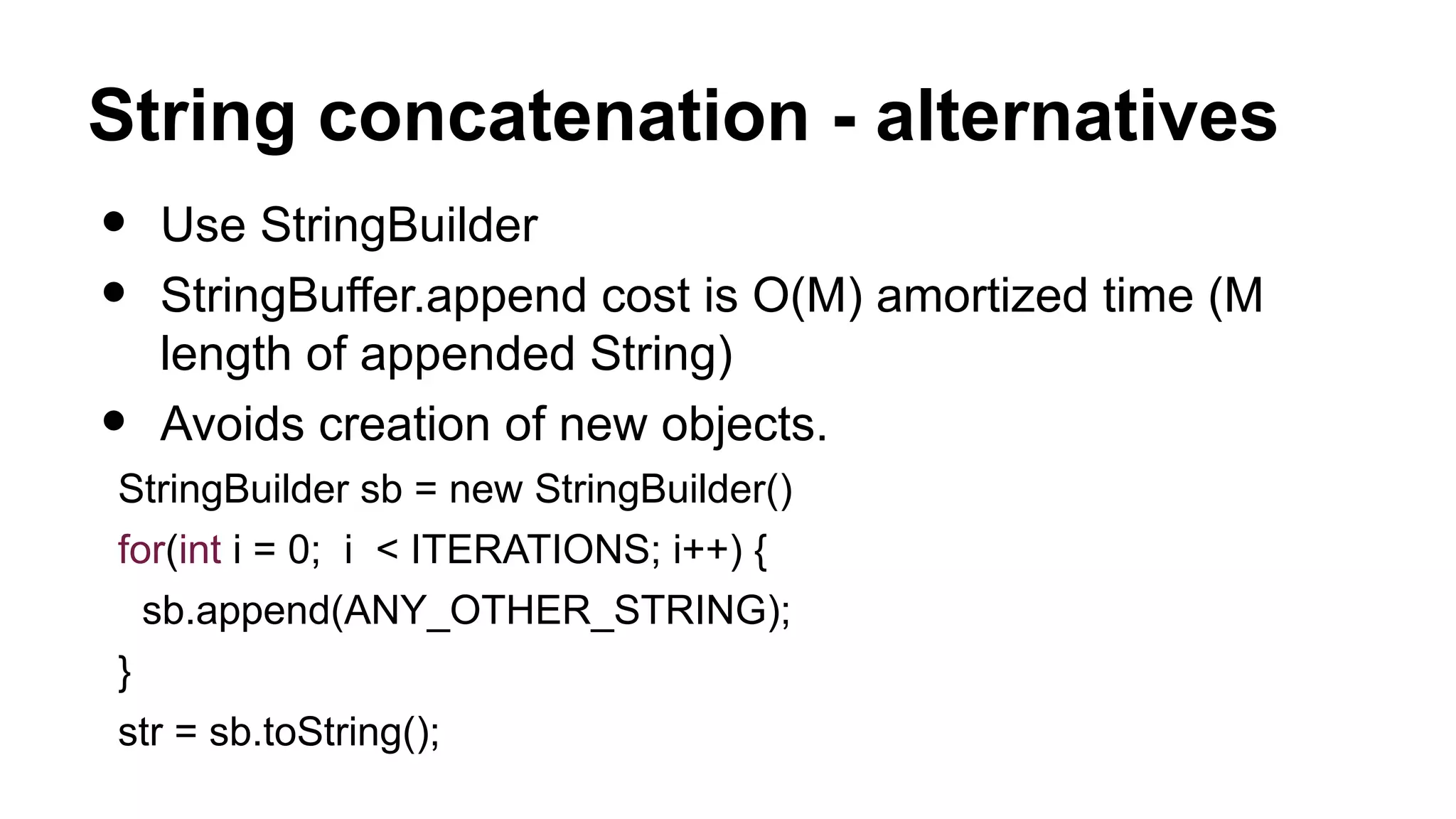
String concatenation - alternatives • Use StringBuilder • StringBuffer.append cost is O(M) amortized time (M length of appended String) • Avoids creation of new objects. StringBuilder sb = new StringBuilder() for(int i = 0; i < ITERATIONS; i++) { sb.append(ANY_OTHER_STRING); } str = sb.toString();
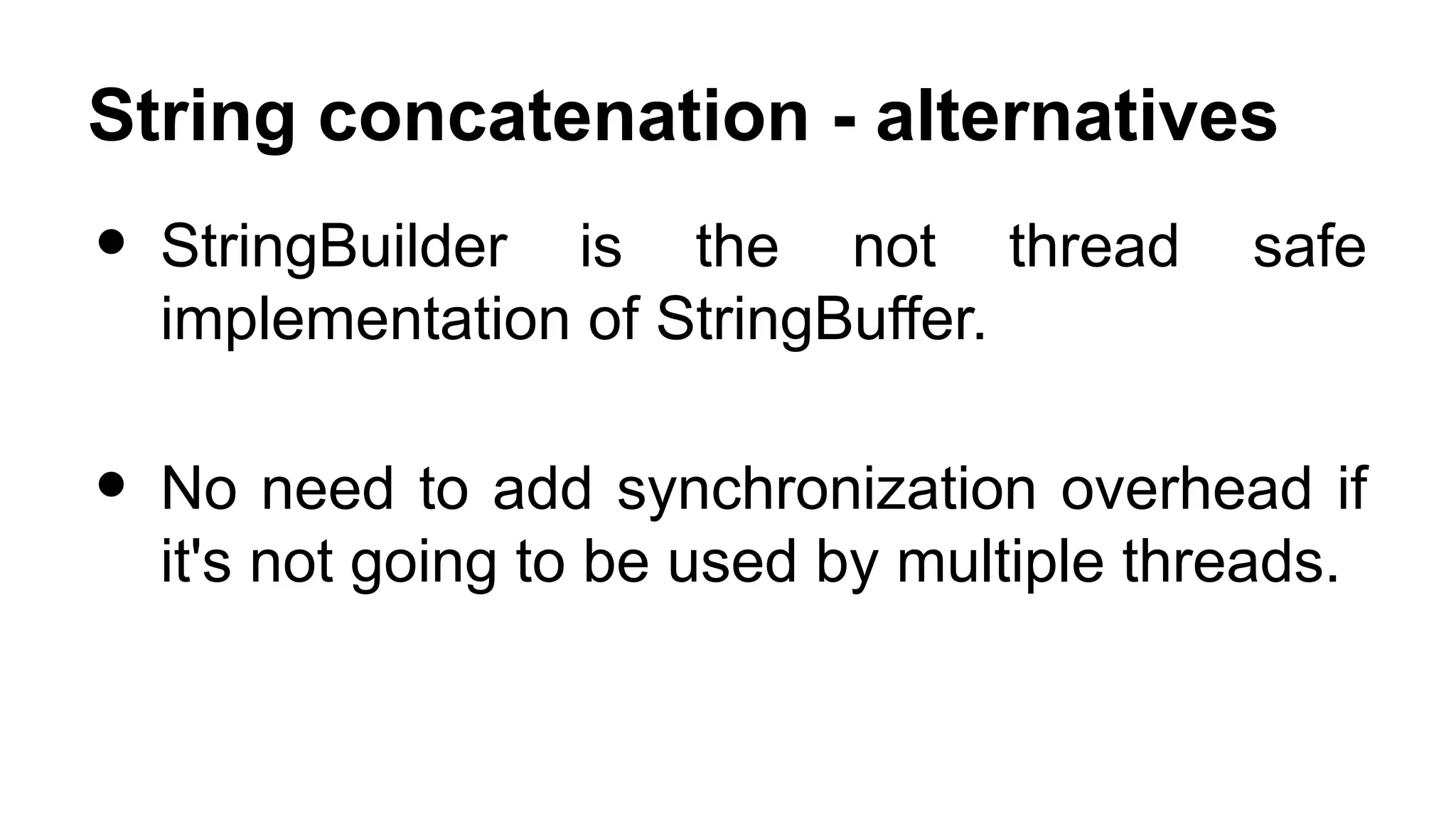
String concatenation - alternatives • StringBuilder is the not thread safe implementation of StringBuffer. • No need to add synchronization overhead if it's not going to be used by multiple threads.
Tooling
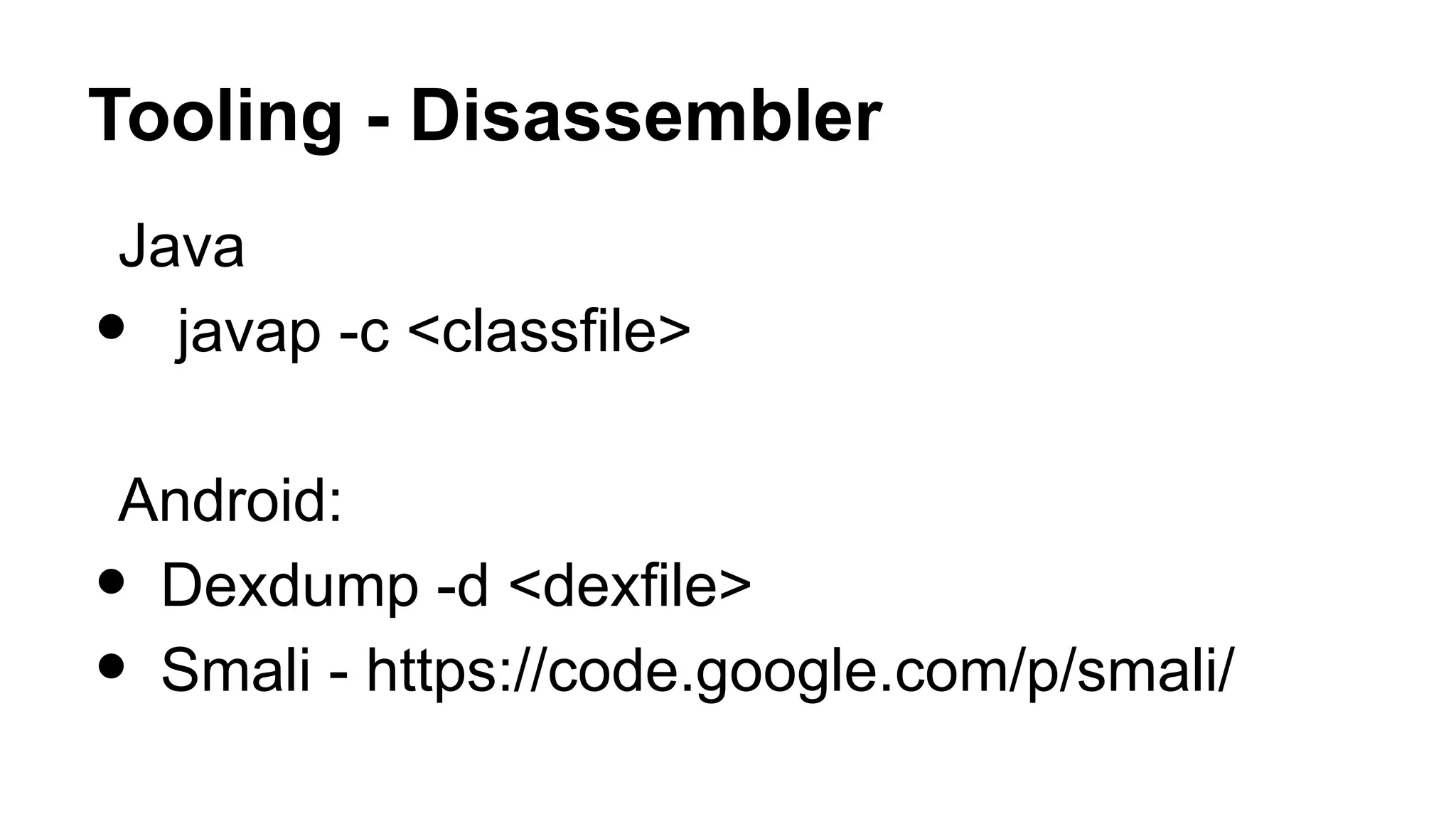
Tooling - Disassembler Java • javap -c <classfile> Android: • Dexdump -d <dexfile> • Smali - https://code.google.com/p/smali/
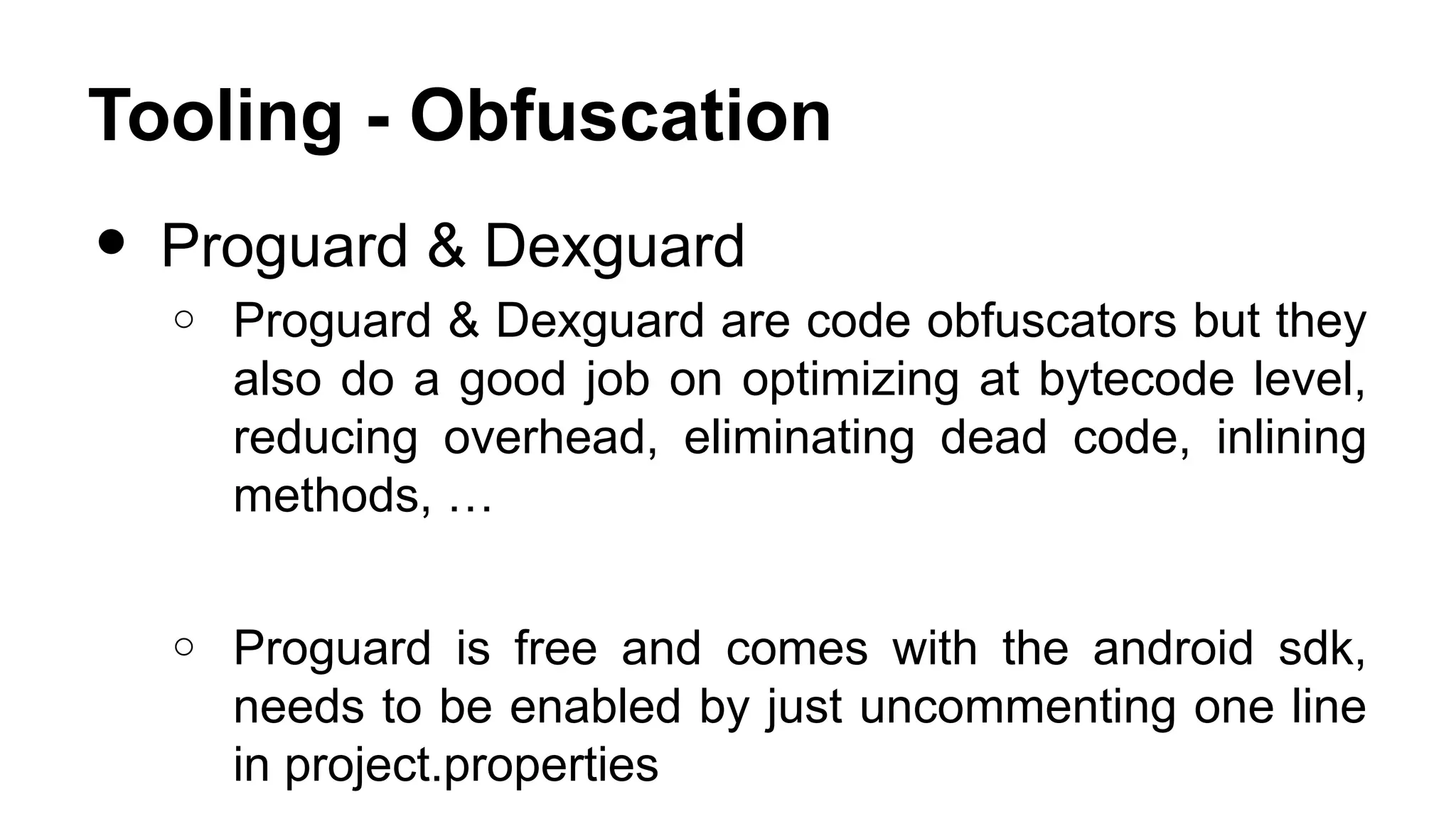
Tooling - Obfuscation • Proguard & Dexguard o Proguard & Dexguard are code obfuscators but they also do a good job on optimizing at bytecode level, reducing overhead, eliminating dead code, inlining methods, … o Proguard is free and comes with the android sdk, needs to be enabled by just uncommenting one line in project.properties
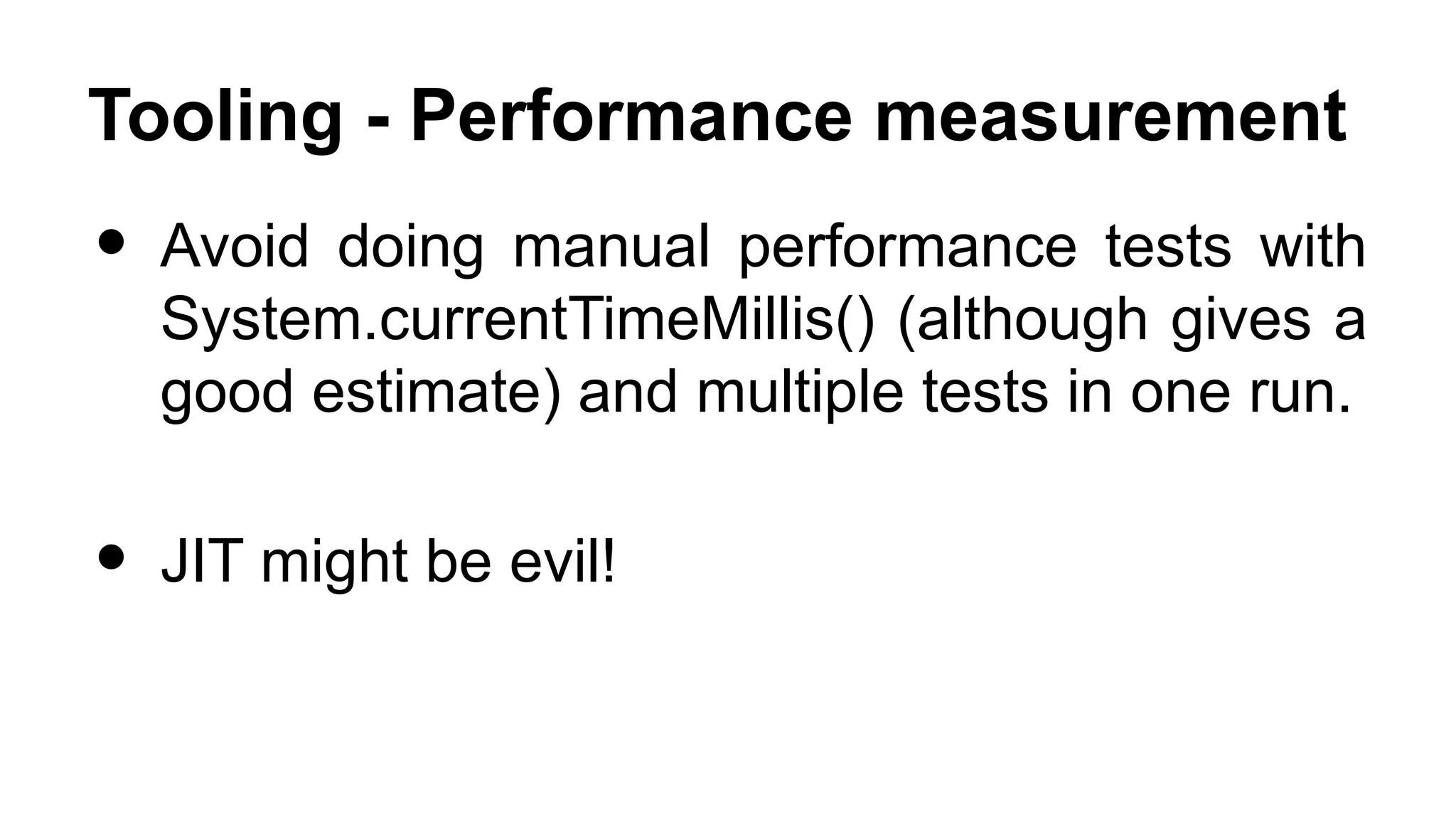
Tooling - Performance measurement • Avoid doing manual performance tests with System.currentTimeMillis() (although gives a good estimate) and multiple tests in one run. • JIT might be evil!
Performance measurements Avoid doing multiple tests in one run JIT might be evil!
Do not trust the compiler! @rrafols http://blog.rafols.org

Improving Android Performance at Mobiconf 2014

  • 1.
  • 2.
    Agenda - Who amI? - Java and VMs - Examples - Do & dont's - Tooling
  • 3.
    Who am I? -Mobile Software Engineering Manager at Imagination Technologies (@imgtec) - Twitter: @rrafols - http://blog.rafols.org
  • 4.
  • 5.
    Why do weneed to talk about java?
  • 6.
    *.java → [javac]→ *.class *.class → [dx] → dex file
  • 7.
  • 8.
  • 9.
    Javac vs othercompilers
  • 10.
  • 11.
  • 12.
    Javac Doesn't know onwhich architecture will the code be executed
  • 13.
    Java bytecode isstack based
  • 14.
  • 15.
    Not the mostoptimal solution (regarding performance)
  • 16.
    Dalvik VM andART are register based architectures
  • 17.
  • 18.
  • 19.
  • 20.
  • 21.
    Java VM (JVM) Onlythe JVM knows on which architecture is running
  • 22.
    Java VM (JVM) Alloptimisations are left to be done by the JVM
  • 23.
    Maybe takes thisconcept a bit too far...
  • 24.
    GCC compiler #include <stdio.h> intmain() { int a = 10; int b = 1 + 2 + 3 + 4 + 5 + 6 + a; printf("%dn", b); } … movl $31, %esi call _printf … * Using gcc & -O2 compiler option
  • 25.
    javac public static voidmain(String args[]) { int a = 10; int b = 1 + 2 + 3 + 4 + 5 + 6 + a; System.out.println(b); } 0: bipush 10 2: istore_1 3: bipush 21 5: iload_1 6: iadd 7: istore_2 ...
  • 26.
    javac public static voidmain(String args[]) { int a = 10; int b = 1 + 2 + 3 + 4 + 5 + a + 6; System.out.println(b); } 0: bipush 10 2: istore_1 3: bipush 15 5: iload_1 6: iadd 7: bipush 6 9: iadd 10: istore_2 ...
  • 27.
    javac public static voidmain(String args[]) { int a = 10; int b = a + 1 + 2 + 3 + 4 + 5 + 6; System.out.println(b); }
  • 28.
    javac public static voidmain(String args[]) { int a = 10; int b = a + 1 + 2 + 3 + 4 + 5 + 6; System.out.println(b); } 0: bipush 10 2: istore_1 3: iload_1 4: iconst_1 5: iadd 6: iconst_2 7: iadd 8: iconst_3 9: iadd 10: iconst_4 11: iadd 12: iconst_5 13: iadd 14: bipush 6 16: iadd 17: istore_2
  • 29.
  • 30.
  • 32.
  • 33.
    Autoboxing Transparent to thedeveloper but compiler adds some 'extra' code
  • 34.
    Autoboxing long total =0; for(int i = 0; i < N; i++) { total += i; } 4: lconst_0 5: lstore_3 6: iconst_0 7: istore 5 9: iload 5 11: ldc #6; 13: if_icmpge 28 16: lload_3 17: iload 5 19: i2l 20: ladd 21: lstore_3 22: iinc 5,1 25: goto 9
  • 35.
    Autoboxing Long total =0; for(Integer i = 0; i < N; i++) { total += i; } 9: iconst_0 10: invokestatic #4; //Method java/lang/Integer.valueOf: (I)Ljava/lang/Integer; 13: astore 4 15: aload 4 17: invokevirtual #5; //Method java/lang/Integer.intValue:()I 20: ldc #6; //int 10000000 22: if_icmpge 65 25: aload_3 26: invokevirtual #7; //Method java/lang/Long.longValue:()J 29: aload 4 31: invokevirtual #5; //Method java/lang/Integer.intValue:()I 34: i2l 35: ladd 36: invokestatic #3; //Method java/lang/Long.valueOf: (J)Ljava/lang/Long; 39: astore_3 40: aload 4 42: astore 5 44: aload 4 46: invokevirtual #5; //Method java/lang/Integer.intValue:()I 49: iconst_1 50: iadd 51: invokestatic #4; //Method java/lang/Integer.valueOf: (I)Ljava/lang/Integer; 54: dup 55: astore 4 57: astore 6 59: aload 5 61: pop 62: goto 15
  • 36.
    Autoboxing ● This is whatthat code is actually doing: Long total = 0; for(Integer i = Integer.valueOf(0); i.intValue() < N; i = Integer.valueOf(i.intValue() + 1)) { total = Long.valueOf(total.longValue() + (long)i.intValue()) }
  • 37.
  • 38.
    Sorting Two easy waysto sort: • Arrays.sort(array); • Collections.sort(list); Lets evaluate the performance as both data type & sorting algorithms are different.
  • 39.
    Sorting • Arrays.sort(arrays) usesa modified version of a 3-way quicksort. • Collections.sort(list) uses a iterative implementation of mergesort (stable)
  • 41.
    Sorting Arrays.sort(array) uses thesame implementation as Collections.sort(list) for non- primitive data types.
  • 42.
    Loops What's going onunder the hood
  • 43.
    Loops - List ArrayList<Integer>list = new … static long loopStandardList() { long result = 0; for(int i = 0; i < list.size(); i++) { result += list.get(i); } return result; }
  • 44.
    Loops - List(Java bytecode) 7: lload_0 8: getstatic #26 // Field list:Ljava/util/ArrayList; 11: iload_2 12: invokevirtual #54 // Method java/util/ArrayList.get:(I)Ljava/lang/Object; 15: checkcast #38 // class java/lang/Integer 18: invokevirtual #58 // Method java/lang/Integer.intValue:()I 21: i2l 22: ladd 23: lstore_0 24: iinc 2, 1 27: iload_2 28: getstatic #26 // Field list:Ljava/util/ArrayList; 31: invokevirtual #61 // Method java/util/ArrayList.size:()I 34: if_icmplt 7
  • 45.
    Loops - List(Dalvik bytecode) 0003: sget-object v3, Lcom/rrafols/bcndevcon/Loop;.list:Ljava/util/ArrayList; 0005: invoke-virtual {v3}, Ljava/util/ArrayList;.size:()I 0008: move-result v3 0009: if-lt v0, v3, 000c // +0003 000b: return-wide v1 000c: sget-object v3, Lcom/rrafols/bcndevcon/Loop;.list:Ljava/util/ArrayList; 000e: invoke-virtual {v3, v0}, Ljava/util/ArrayList;.get:(I)Ljava/lang/Object; 0011: move-result-object v3 0012: check-cast v3, Ljava/lang/Integer; 0014: invoke-virtual {v3}, Ljava/lang/Integer;.intValue:()I 0017: move-result v3 0018: int-to-long v3, v3 0019: add-long/2addr v1, v3 001a: add-int/lit8 v0, v0, #int 1 // #01 001c: goto 0003 // -0019
  • 46.
    Loops - foreach ArrayList<Integer>list = new … static long loopForeachList() { long result = 0; for(int v : list) { result += v; } return result; }
  • 47.
    Loops - foreach(Java bytecode) 12: aload_3 13: invokeinterface #70, 1 // InterfaceMethod java/util/Iterator.next:() 18: checkcast #38 // class java/lang/Integer 21: invokevirtual #58 // Method java/lang/Integer.intValue:()I 24: istore_2 25: lload_0 26: iload_2 27: i2l 28: ladd 29: lstore_0 30: aload_3 31: invokeinterface #76, 1 // InterfaceMethod java/util/Iterator.hasNext:()Z 36: ifne 12
  • 48.
    Loops - foreach(Dalvik bytecode) 0008: invoke-interface {v4}, Ljava/util/Iterator;.hasNext:()Z 000b: move-result v3 000c: if-nez v3, 000f // +0003 000e: return-wide v0 000f: invoke-interface {v4}, Ljava/util/Iterator;.next:()Ljava/lang/Object; 0012: move-result-object v3 0013: check-cast v3, Ljava/lang/Integer; 0015: invoke-virtual {v3}, Ljava/lang/Integer;.intValue:()I 0018: move-result v2 0019: int-to-long v5, v2 001a: add-long/2addr v0, v5 001b: goto 0008 // -0013
  • 49.
    Loops - Array staticint[] array = new ... static long loopStandardArray() { long result = 0; for(int i = 0; i < array.length; i++) { result += array[i]; } return result; }
  • 50.
    Loops - Array(Java bytecode) 7: lload_0 8: getstatic #28 // Field array:[I 11: iload_2 12: iaload 13: i2l 14: ladd 15: lstore_0 16: iinc 2, 1 19: iload_2 20: getstatic #28 // Field array:[I 23: arraylength 24: if_icmplt 7
  • 51.
    Loops - Array(Dalvik bytecode) 0003: sget-object v3, Lcom/rrafols/bcndevcon/Loop;.array:[I 0005: array-length v3, v3 0006: if-lt v0, v3, 0009 // +0003 0008: return-wide v1 0009: sget-object v3, Lcom/rrafols/bcndevcon/Loop;.array:[I 000b: aget v3, v3, v0 000d: int-to-long v3, v3 000e: add-long/2addr v1, v3 000f: add-int/lit8 v0, v0, #int 1 // #01 0011: goto 0003 // -000e
  • 52.
    Loops - sizecached static int[] array = new ... static long loopStandardArraySizeStored() { long result = 0; int length = array.length; for(int i = 0; i < length; i++) { result += array[i]; } return result; }
  • 53.
    Loops - sizestored (Java bytecode) 12: lload_0 13: getstatic #28 // Field array:[I 16: iload_3 17: iaload 18: i2l 19: ladd 20: lstore_0 21: iinc 3, 1 24: iload_3 25: iload_2 26: if_icmplt 12
  • 54.
    Loops - sizestored(Dalvik bytecode) 0006: if-lt v0, v1, 0009 // +0003 0008: return-wide v2 0009: sget-object v4, Lcom/rrafols/bcndevcon/Loop;.array:[I 000b: aget v4, v4, v0 000d: int-to-long v4, v4 000e: add-long/2addr v2, v4 000f: add-int/lit8 v0, v0, #int 1 // #01 0011: goto 0006 // -000b
  • 55.
    Loops - backwards staticint[] array = new ... static long loopStandardArrayBackwards() { long result = 0; for(int i = array.length - 1; i >= 0; i--) { result += array[i]; } return result; }
  • 56.
    Loops - backwards(Java bytecode) 12: lload_0 13: getstatic #28 // Field array:[I 16: iload_2 17: iaload 18: i2l 19: ladd 20: lstore_0 21: iinc 2, -1 24: iload_2 25: ifge 12
  • 57.
    Loops - backwards(Dalvikbytecode) 0007: if-gez v0, 000a // +0003 0009: return-wide v1 000a: sget-object v3, Lcom/rrafols/bcndevcon/Loop;.array:[I 000c: aget v3, v3, v0 000e: int-to-long v3, v3 000f: add-long/2addr v1, v3 0010: add-int/lit8 v0, v0, #int -1 // #ff 0012: goto 0007 // -000b
  • 62.
  • 63.
    String concatenation Java allowsus to concatenate Strings using the + operator to make our lifes easier. As what happened before with autoboxing the compiler will generate some additional code.
  • 64.
    String concatenation String str= ""; for(int i = 0; i < ITERATIONS; i++) { str += ANY_OTHER_STRING; }
  • 65.
    String concatenation 8: new#26 // class java/lang/StringBuilder 11: dup 12: aload_1 13: invokestatic #28 // Method java/lang/String.valueOf: (Ljava/lang/Object;)Ljava/lang/String; 16: invokespecial #34 // Method java/lang/StringBuilder."<init>":(Ljava/lang/String;)V 19: ldc #11 // String ANY_OTHER_STRING 21: invokevirtual #37 // Method java/lang/StringBuilder.append:(Ljava/lang/String;) 24: invokevirtual #41 // Method java/lang/StringBuilder.toString:()Ljava/lang/String; 27: astore_1 28: iinc 2, 1 31: iload_2 32: bipush ITERATIONS 34: if_icmplt 8
  • 66.
    String concatenation • It'screating a StringBuilder Object in every iteration of the loop. It's the same as the following code: String str = ""; for(int i = 0; i < ITERATIONS; i++) { StringBuilder sb = new StringBuilder(String.valueOf(str)); sb.append(ANY_OTHER_STRING); str = sb.toString(); }
  • 67.
    String concatenation -alternatives • Use String.concat() • Concat cost is O(N) + O(M) - (N,M) length of each String • Concat returns a new String Object. String str = ""; for(int i = 0; i < ITERATIONS; i++) { str = str.concat(ANY_OTHER_STRING);
  • 68.
    String concatenation -alternatives • Use StringBuilder • StringBuffer.append cost is O(M) amortized time (M length of appended String) • Avoids creation of new objects. StringBuilder sb = new StringBuilder() for(int i = 0; i < ITERATIONS; i++) { sb.append(ANY_OTHER_STRING); } str = sb.toString();
  • 69.
    String concatenation -alternatives • StringBuilder is the not thread safe implementation of StringBuffer. • No need to add synchronization overhead if it's not going to be used by multiple threads.
  • 70.
  • 71.
    Tooling - Disassembler Java •javap -c <classfile> Android: • Dexdump -d <dexfile> • Smali - https://code.google.com/p/smali/
  • 72.
    Tooling - Obfuscation •Proguard & Dexguard o Proguard & Dexguard are code obfuscators but they also do a good job on optimizing at bytecode level, reducing overhead, eliminating dead code, inlining methods, … o Proguard is free and comes with the android sdk, needs to be enabled by just uncommenting one line in project.properties
  • 73.
    Tooling - Performancemeasurement • Avoid doing manual performance tests with System.currentTimeMillis() (although gives a good estimate) and multiple tests in one run. • JIT might be evil!
  • 74.
    Performance measurements Avoid doingmultiple tests in one run JIT might be evil!
  • 75.
    Do not trustthe compiler! @rrafols http://blog.rafols.org