JAVA 8: LAMBDA BUILT-IN FUNCTIONAL INTERFACES ganesh samarthyam ganesh.samarthyam@gmail.com
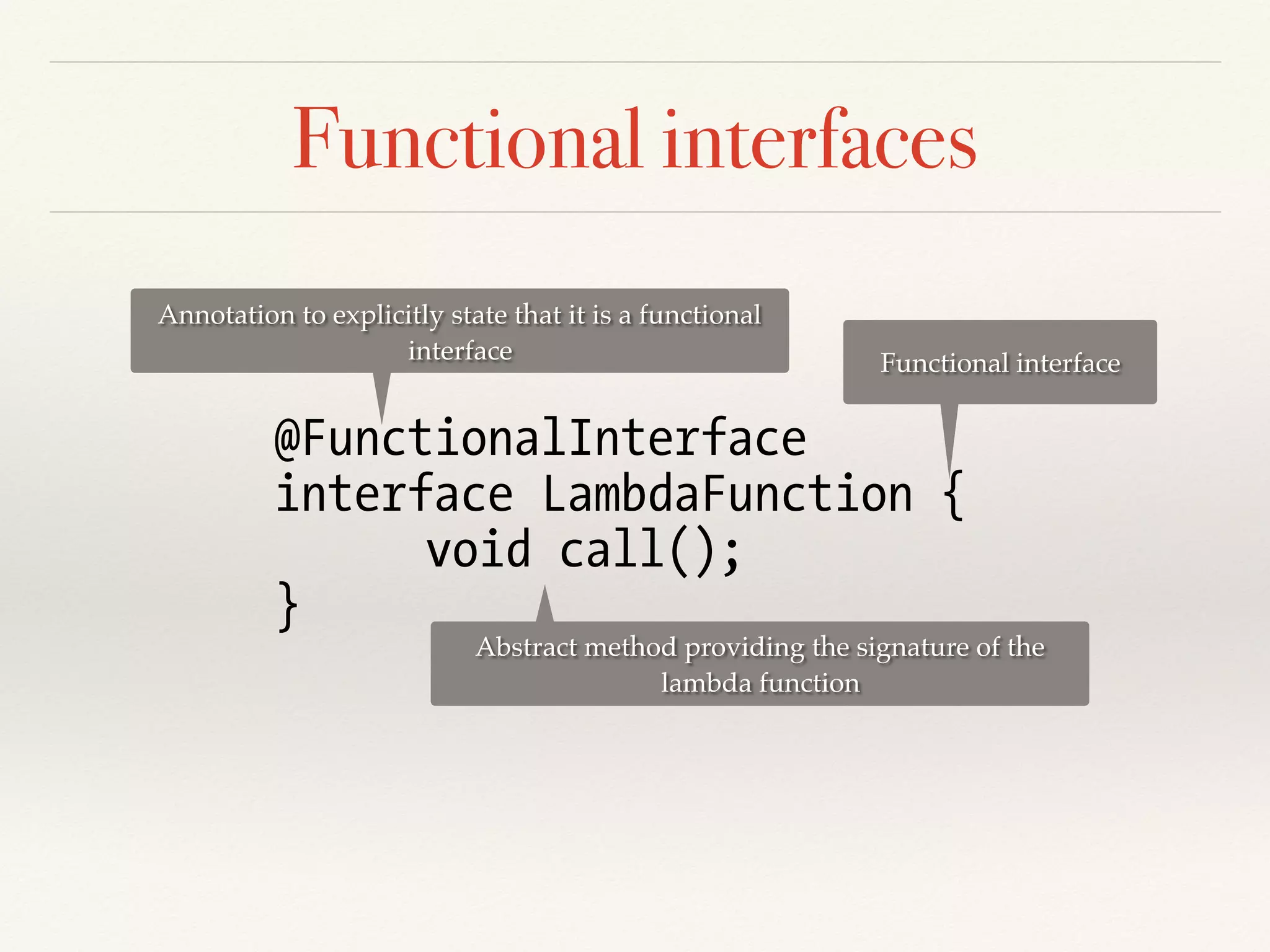
Functional interfaces @FunctionalInterface interface LambdaFunction { void call(); } Functional interface Abstract method providing the signature of the lambda function Annotation to explicitly state that it is a functional interface
Java 8 lambdas - “Hello world!” @FunctionalInterface interface LambdaFunction { void call(); } class FirstLambda { public static void main(String []args) { LambdaFunction lambdaFunction = () -> System.out.println("Hello world"); lambdaFunction.call(); } } Functional interface - provides signature for lambda functions Lambda function/expression Call to the lambda Prints “Hello world” on the console when executed
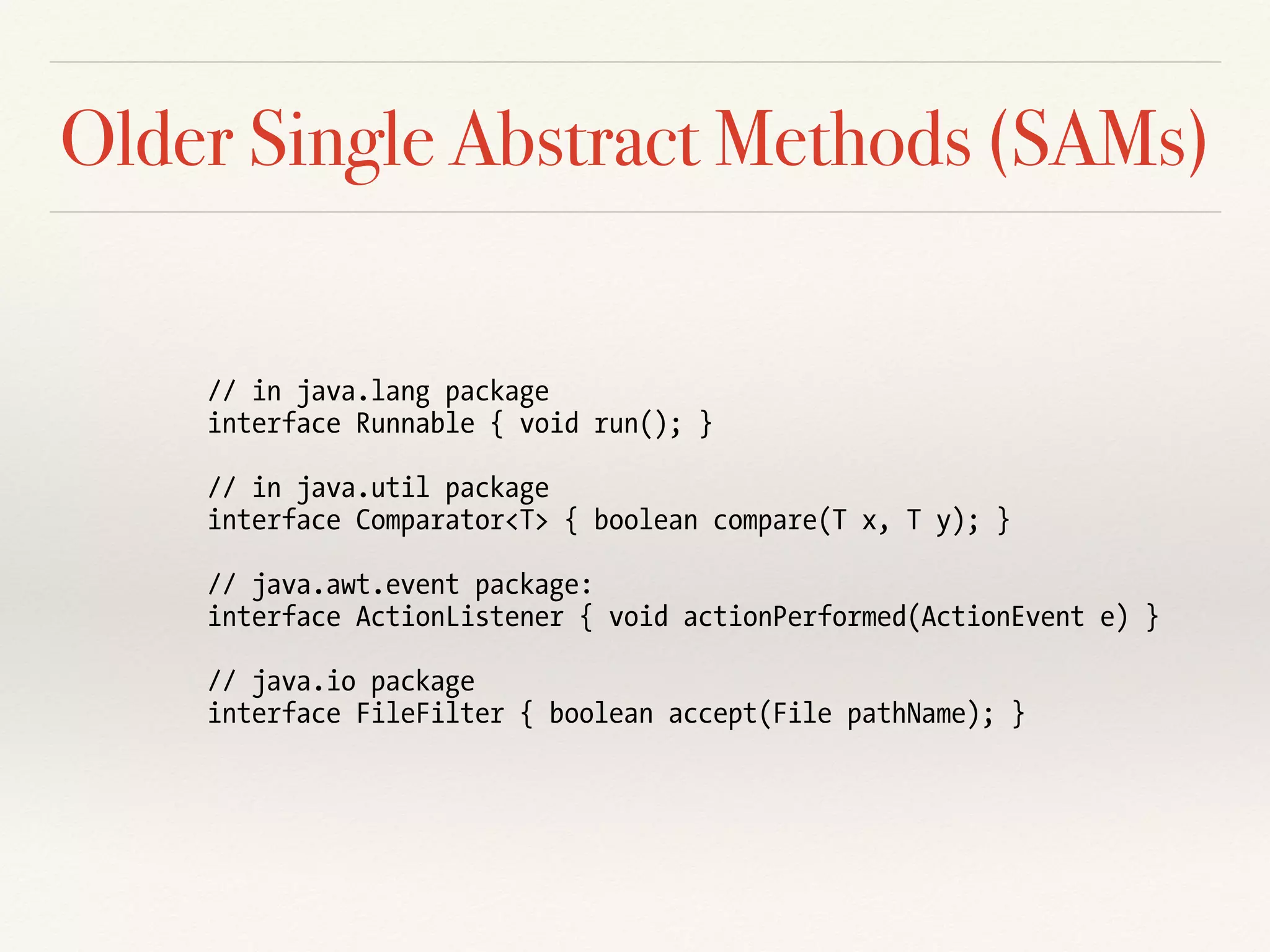
Older Single Abstract Methods (SAMs) // in java.lang package interface Runnable { void run(); } // in java.util package interface Comparator<T> { boolean compare(T x, T y); } // java.awt.event package: interface ActionListener { void actionPerformed(ActionEvent e) } // java.io package interface FileFilter { boolean accept(File pathName); }
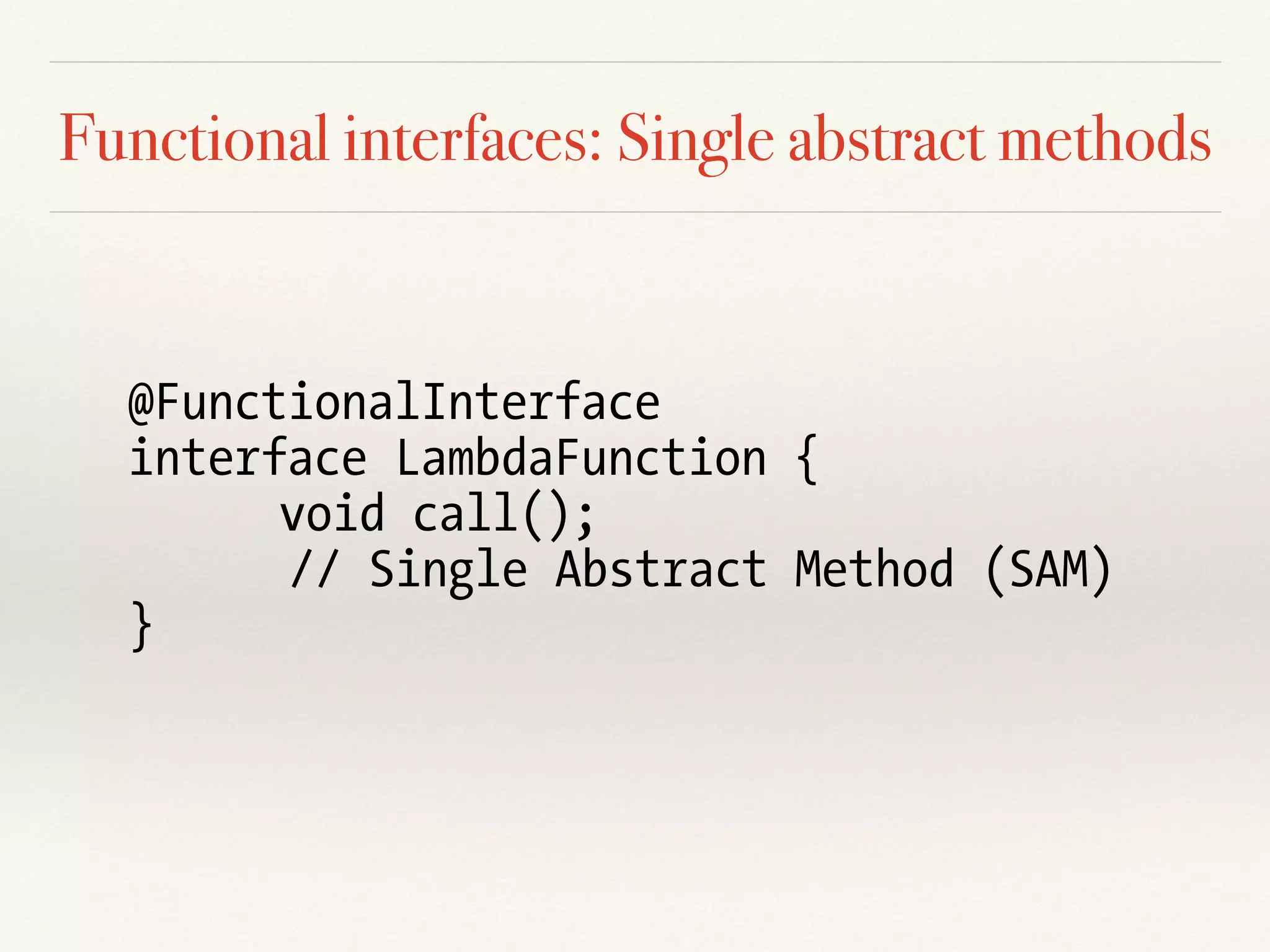
Functional interfaces: Single abstract methods @FunctionalInterface interface LambdaFunction { void call(); // Single Abstract Method (SAM) }
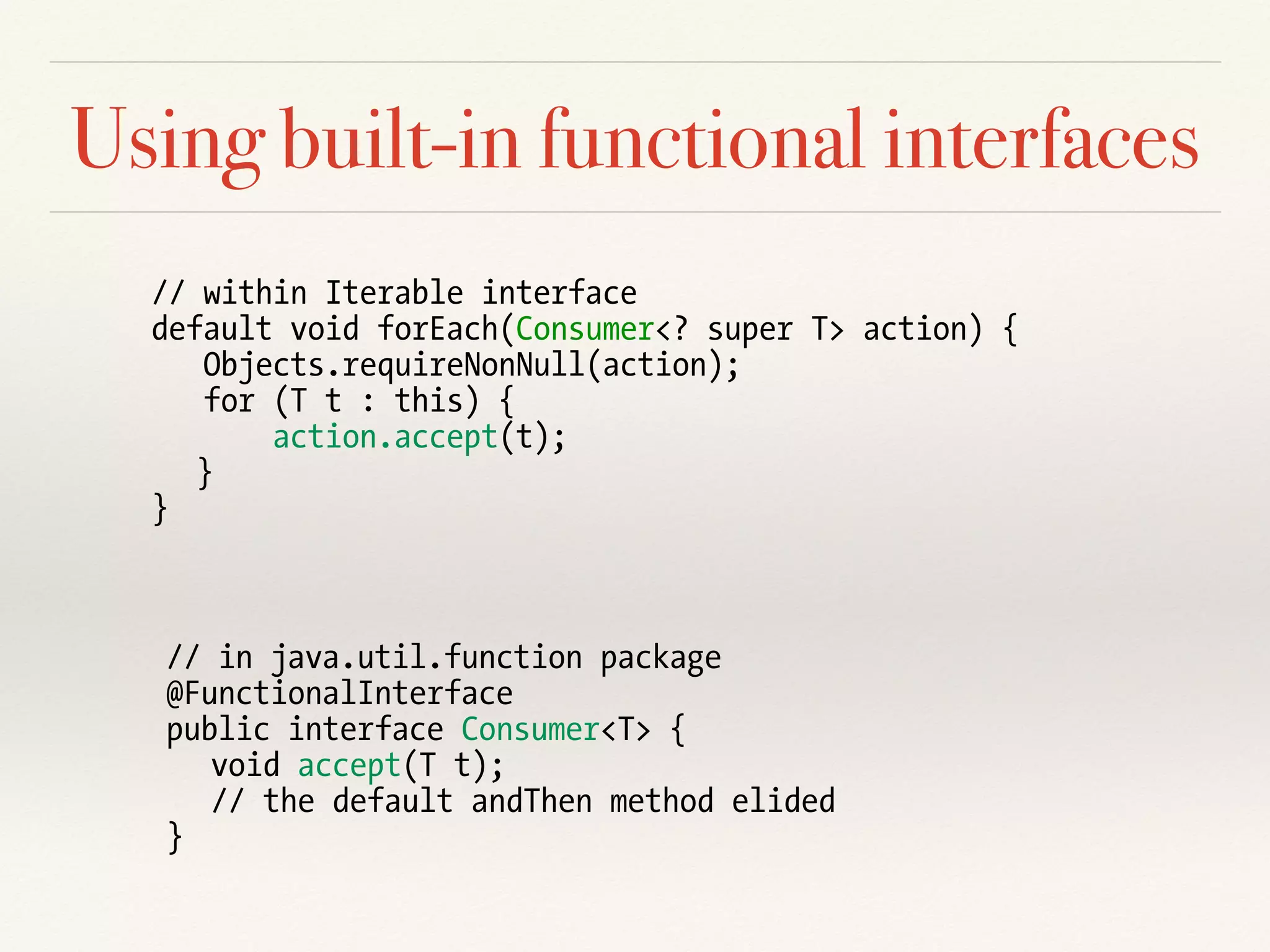
Using built-in functional interfaces // within Iterable interface default void forEach(Consumer<? super T> action) { Objects.requireNonNull(action); for (T t : this) { action.accept(t); } } // in java.util.function package @FunctionalInterface public interface Consumer<T> { void accept(T t); // the default andThen method elided }
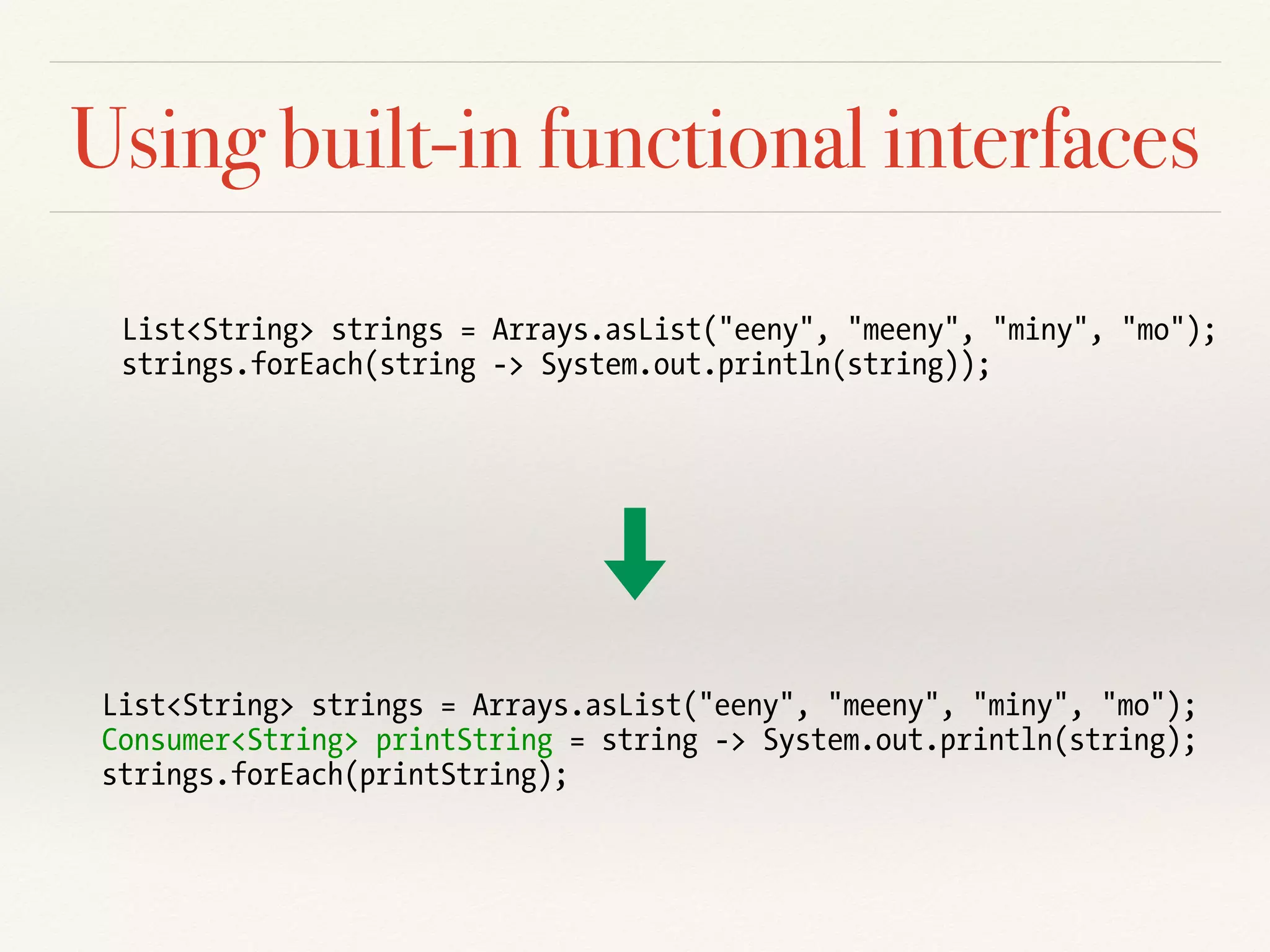
Using built-in functional interfaces List<String> strings = Arrays.asList("eeny", "meeny", "miny", "mo"); Consumer<String> printString = string -> System.out.println(string); strings.forEach(printString); List<String> strings = Arrays.asList("eeny", "meeny", "miny", "mo"); strings.forEach(string -> System.out.println(string));
Built-in functional interfaces
Built-in functional interfaces are a part of the java.util.function package (in Java 8)
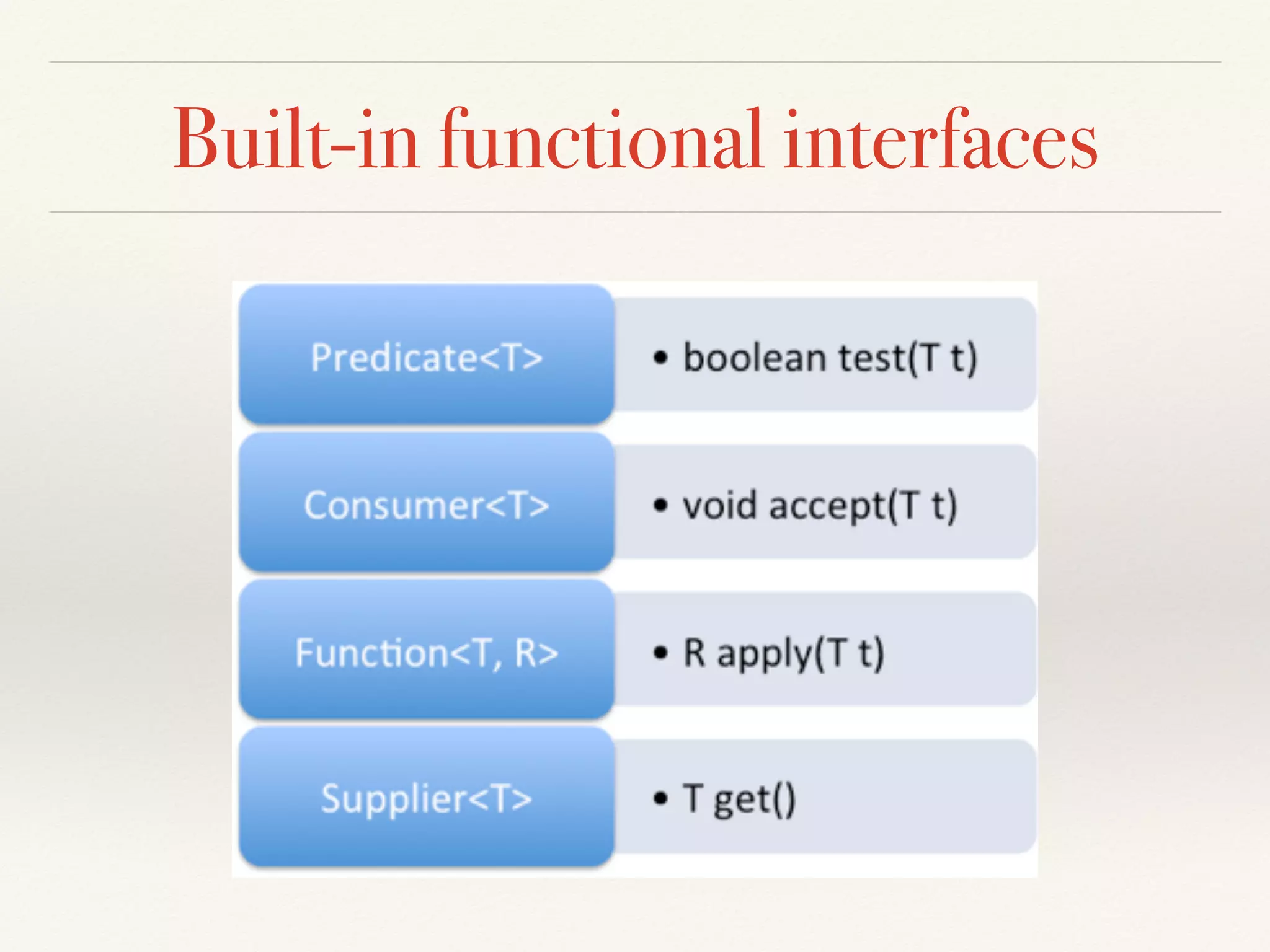
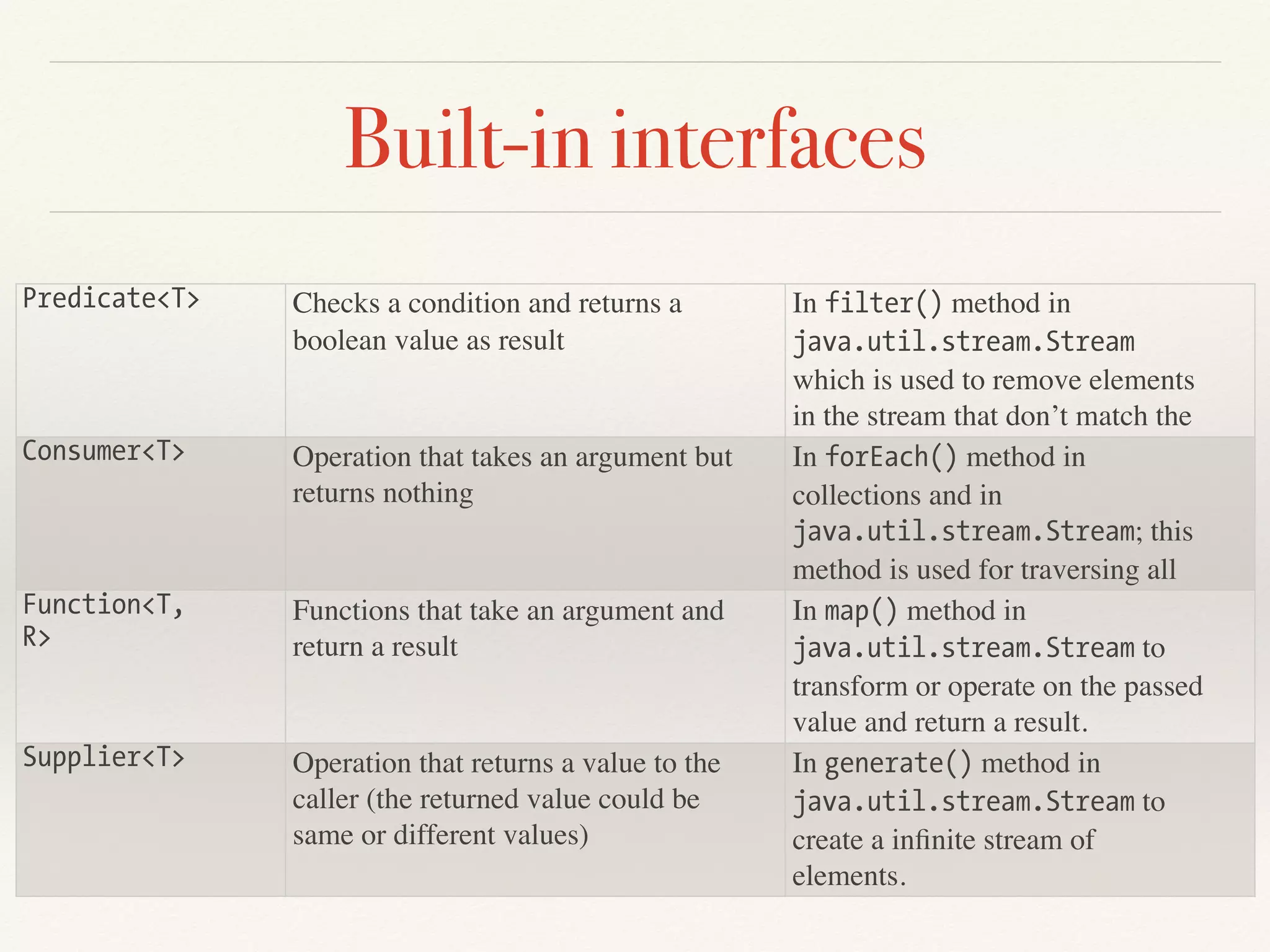
Built-in interfaces Predicate<T> Checks a condition and returns a boolean value as result In filter() method in java.util.stream.Stream which is used to remove elements in the stream that don’t match the given condition (i.e., predicate) asConsumer<T> Operation that takes an argument but returns nothing In forEach() method in collections and in java.util.stream.Stream; this method is used for traversing all the elements in the collection orFunction<T, R> Functions that take an argument and return a result In map() method in java.util.stream.Stream to transform or operate on the passed value and return a result. Supplier<T> Operation that returns a value to the caller (the returned value could be same or different values) In generate() method in java.util.stream.Stream to create a infinite stream of elements.
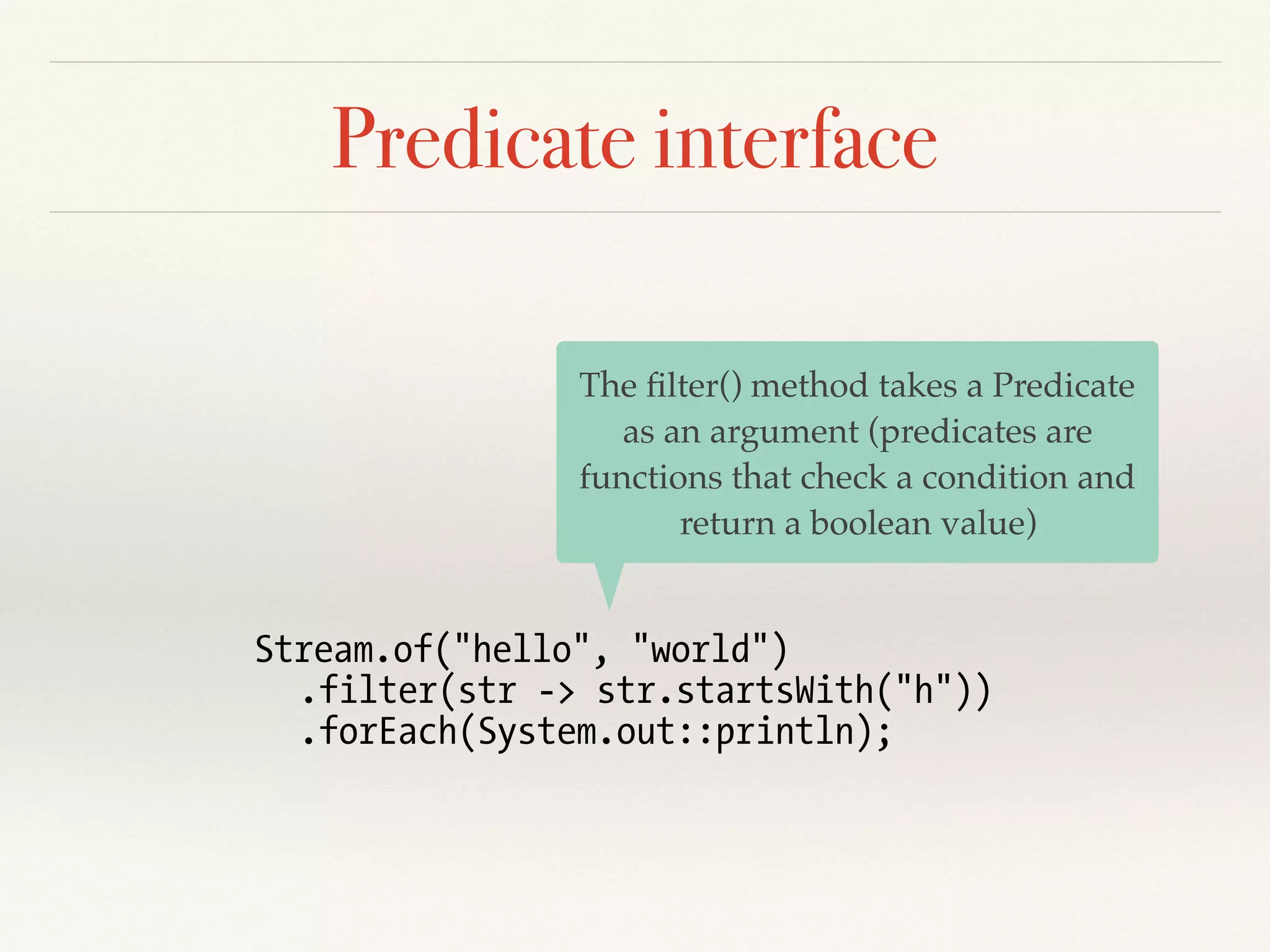
Predicate interface Stream.of("hello", "world") .filter(str -> str.startsWith("h")) .forEach(System.out::println); The filter() method takes a Predicate as an argument (predicates are functions that check a condition and return a boolean value)
Predicate interface
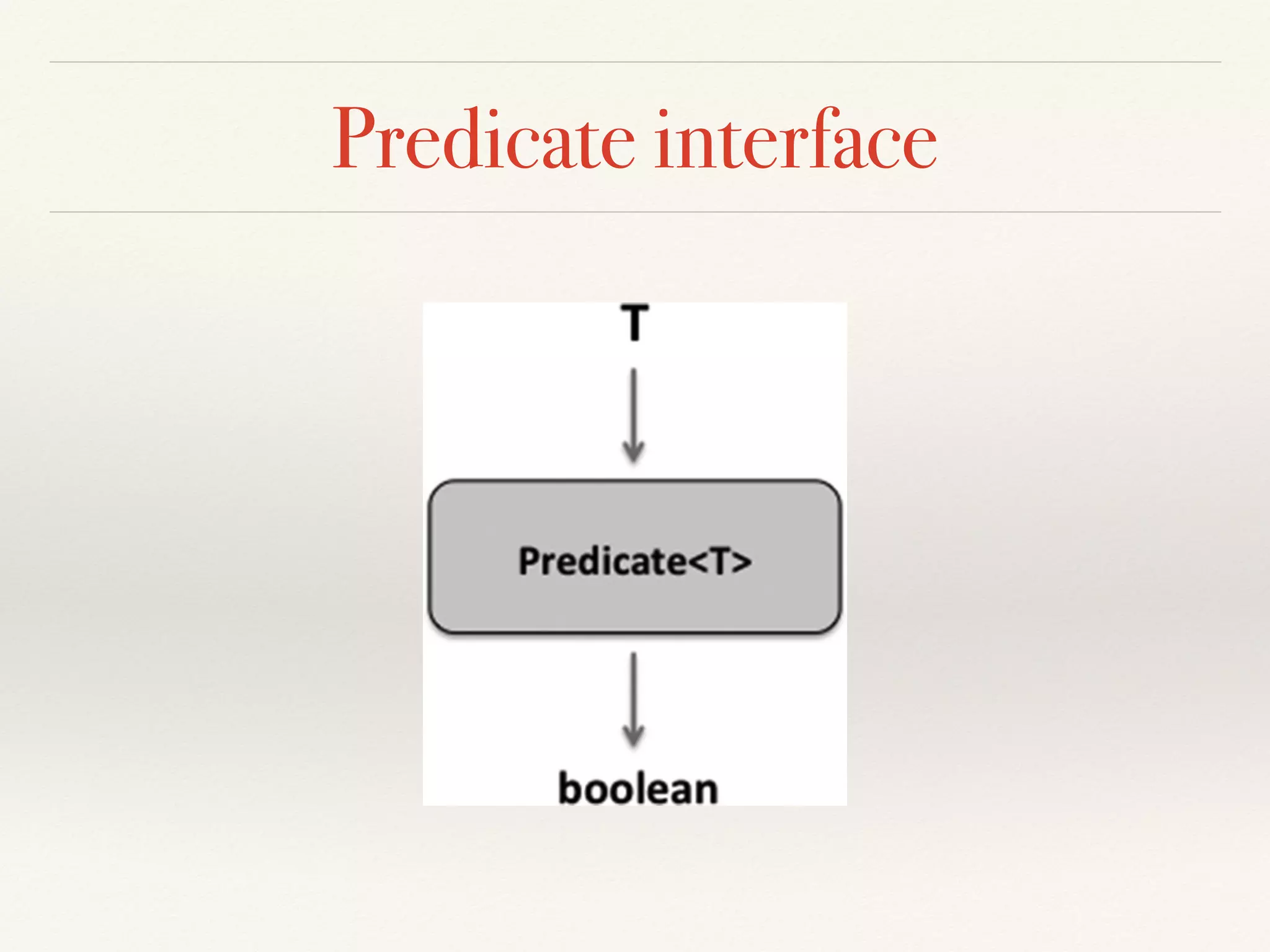
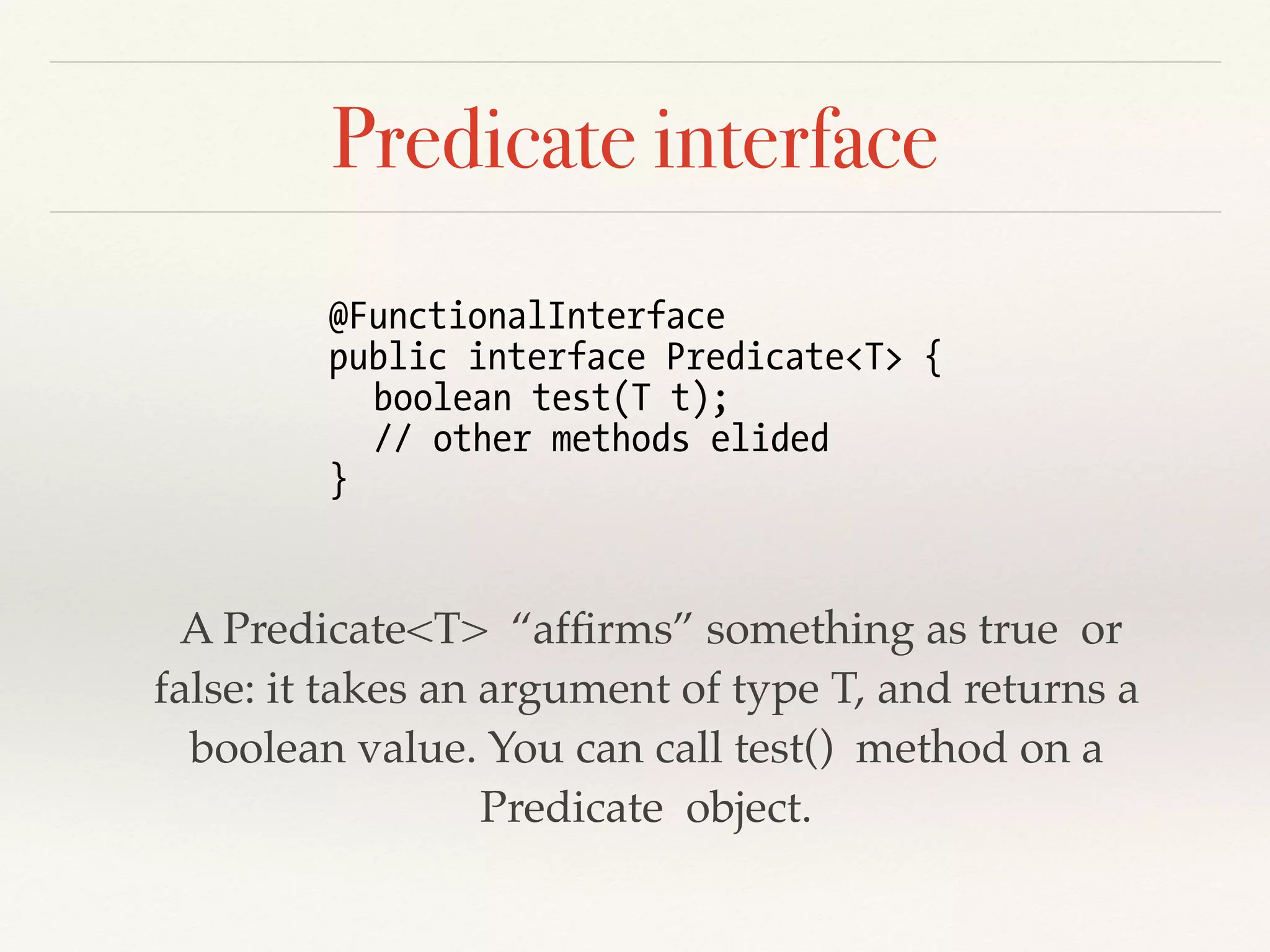
Predicate interface A Predicate<T> “affirms” something as true or false: it takes an argument of type T, and returns a boolean value. You can call test() method on a Predicate object. @FunctionalInterface public interface Predicate<T> { boolean test(T t); // other methods elided }
Predicate interface: Example import java.util.function.Predicate; public class PredicateTest { public static void main(String []args) { Predicate<String> nullCheck = arg -> arg != null; Predicate<String> emptyCheck = arg -> arg.length() > 0; Predicate<String> nullAndEmptyCheck = nullCheck.and(emptyCheck); String helloStr = "hello"; System.out.println(nullAndEmptyCheck.test(helloStr)); String nullStr = null; System.out.println(nullAndEmptyCheck.test(nullStr)); } } Prints: true false
Predicate interface: Example import java.util.List; import java.util.ArrayList; public class RemoveIfMethod { public static void main(String []args) { List<String> greeting = new ArrayList<>(); greeting.add("hello"); greeting.add("world"); greeting.removeIf(str -> !str.startsWith("h")); greeting.forEach(System.out::println); } } Prints: hello
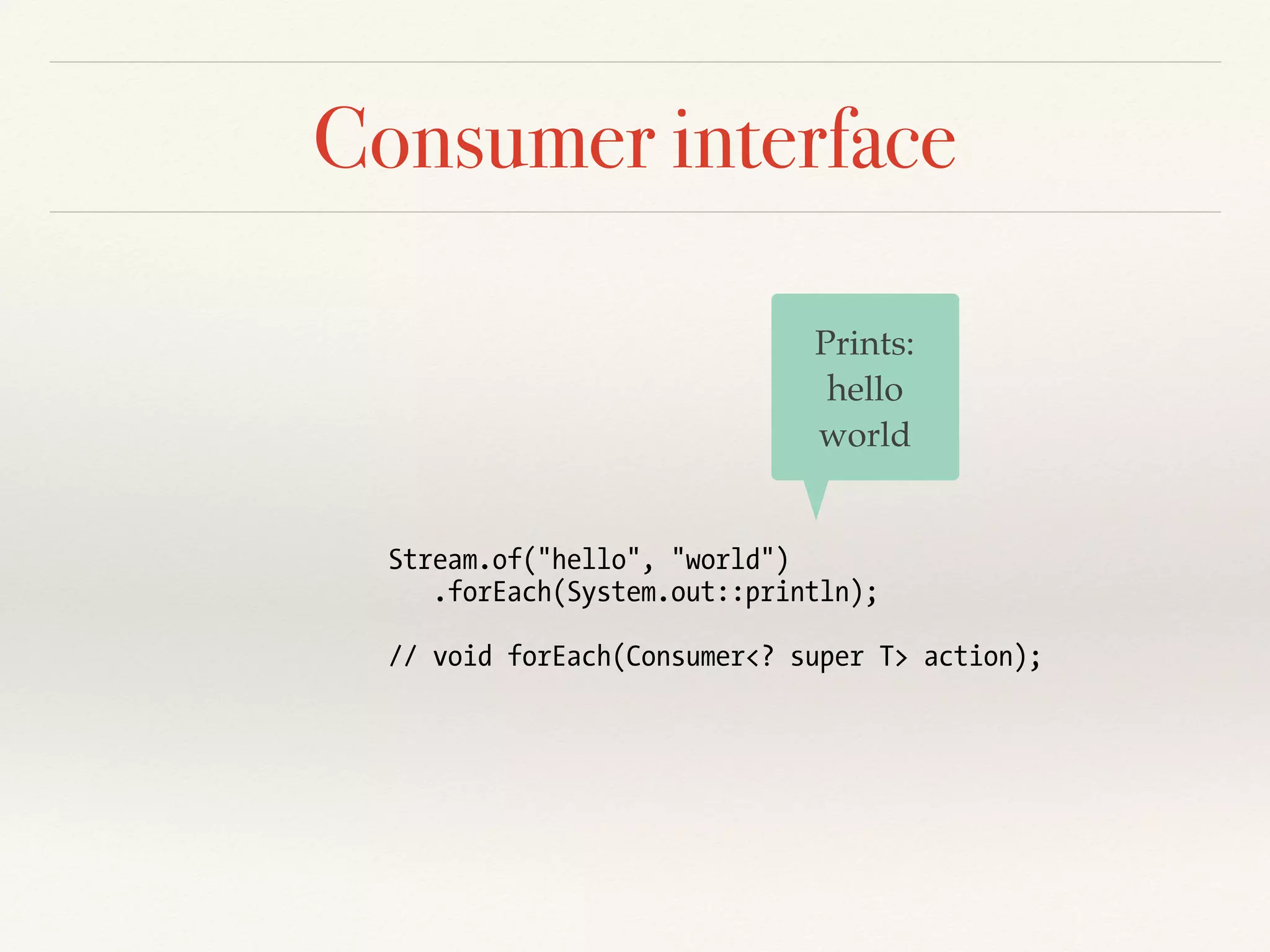
Consumer interface Stream.of("hello", "world") .forEach(System.out::println); // void forEach(Consumer<? super T> action); Prints: hello world
Consumer interface
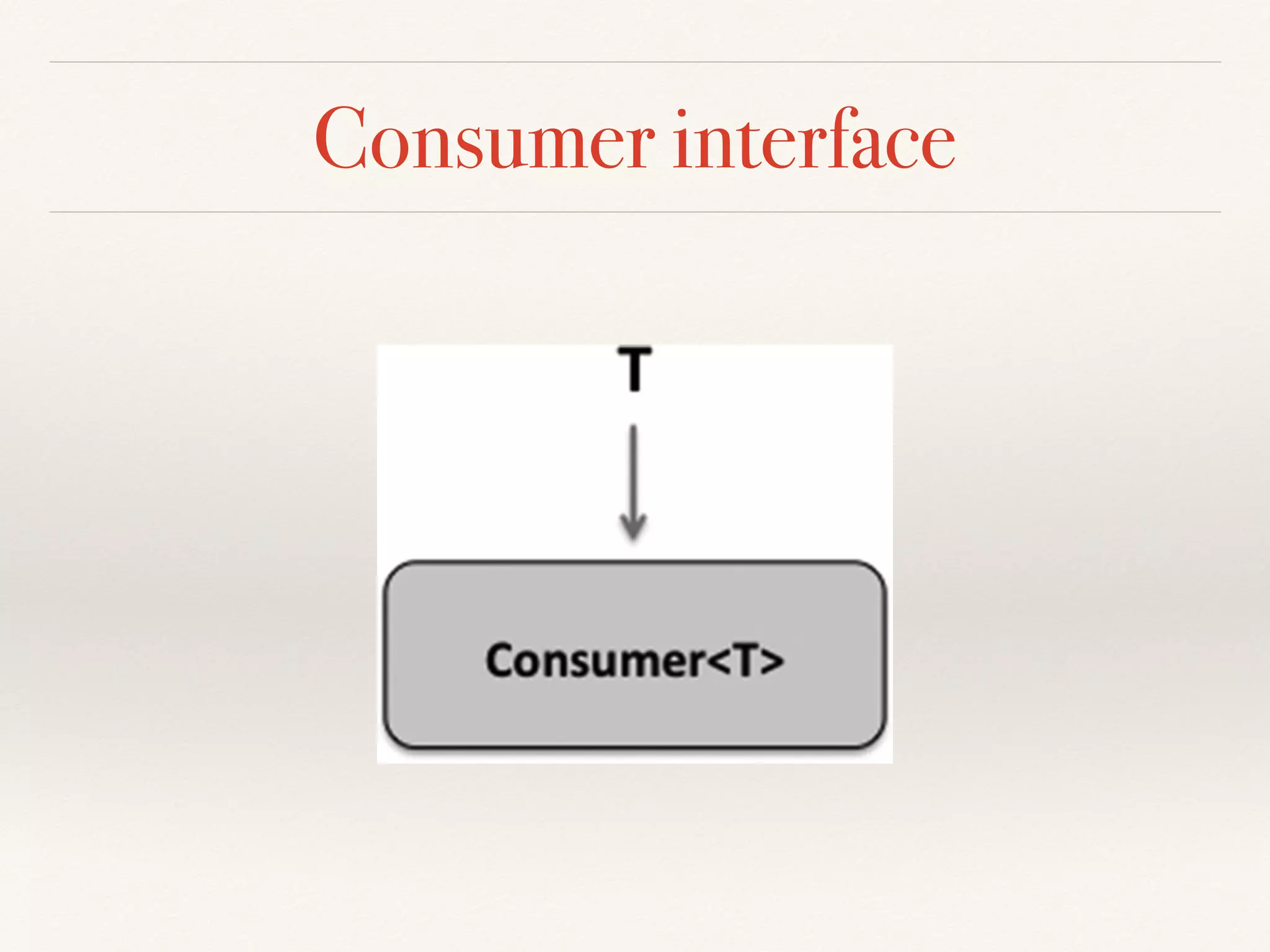
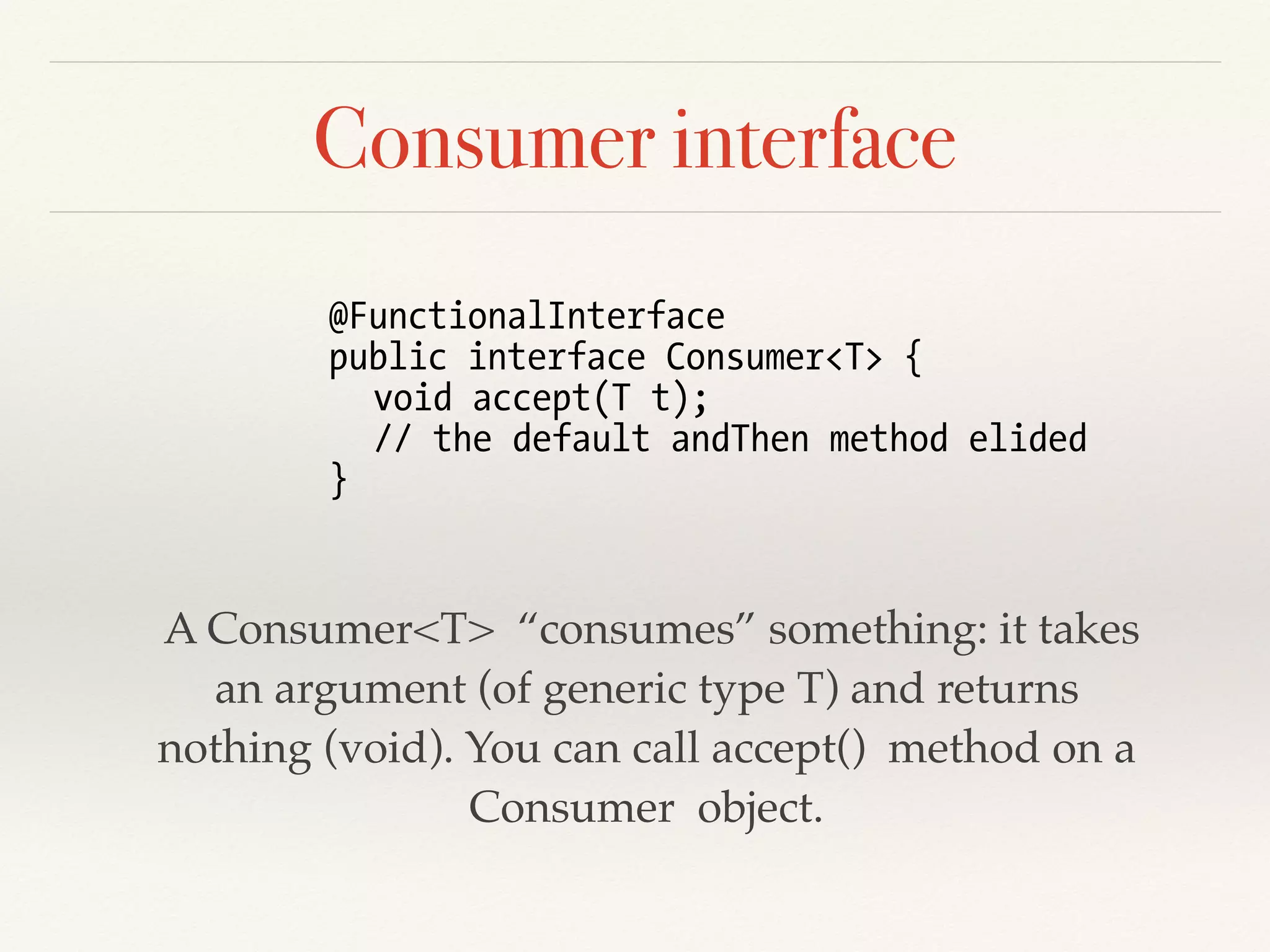
Consumer interface A Consumer<T> “consumes” something: it takes an argument (of generic type T) and returns nothing (void). You can call accept() method on a Consumer object. @FunctionalInterface public interface Consumer<T> { void accept(T t); // the default andThen method elided }
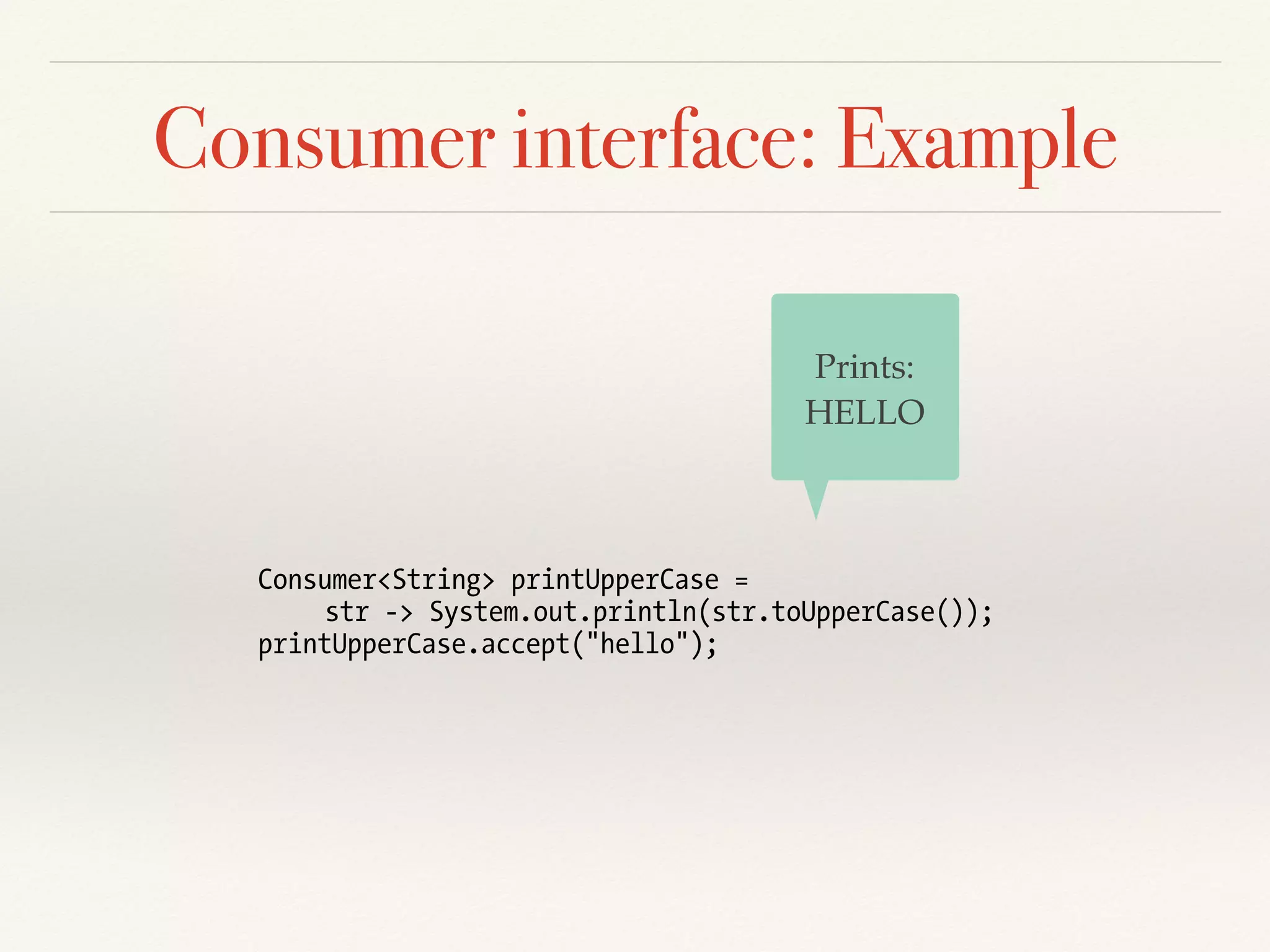
Consumer interface: Example Consumer<String> printUpperCase = str -> System.out.println(str.toUpperCase()); printUpperCase.accept("hello"); Prints: HELLO
Consumer interface: Example import java.util.stream.Stream; import java.util.function.Consumer; class ConsumerUse { public static void main(String []args) { Stream<String> strings = Stream.of("hello", "world"); Consumer<String> printString = System.out::println; strings.forEach(printString); } } Prints: hello world
Function interface import java.util.Arrays; public class FunctionUse { public static void main(String []args) { Arrays.stream("4, -9, 16".split(", ")) .map(Integer::parseInt) .map(i -> (i < 0) ? -i : i) .forEach(System.out::println); } } Prints: 4 9 16
Function interface
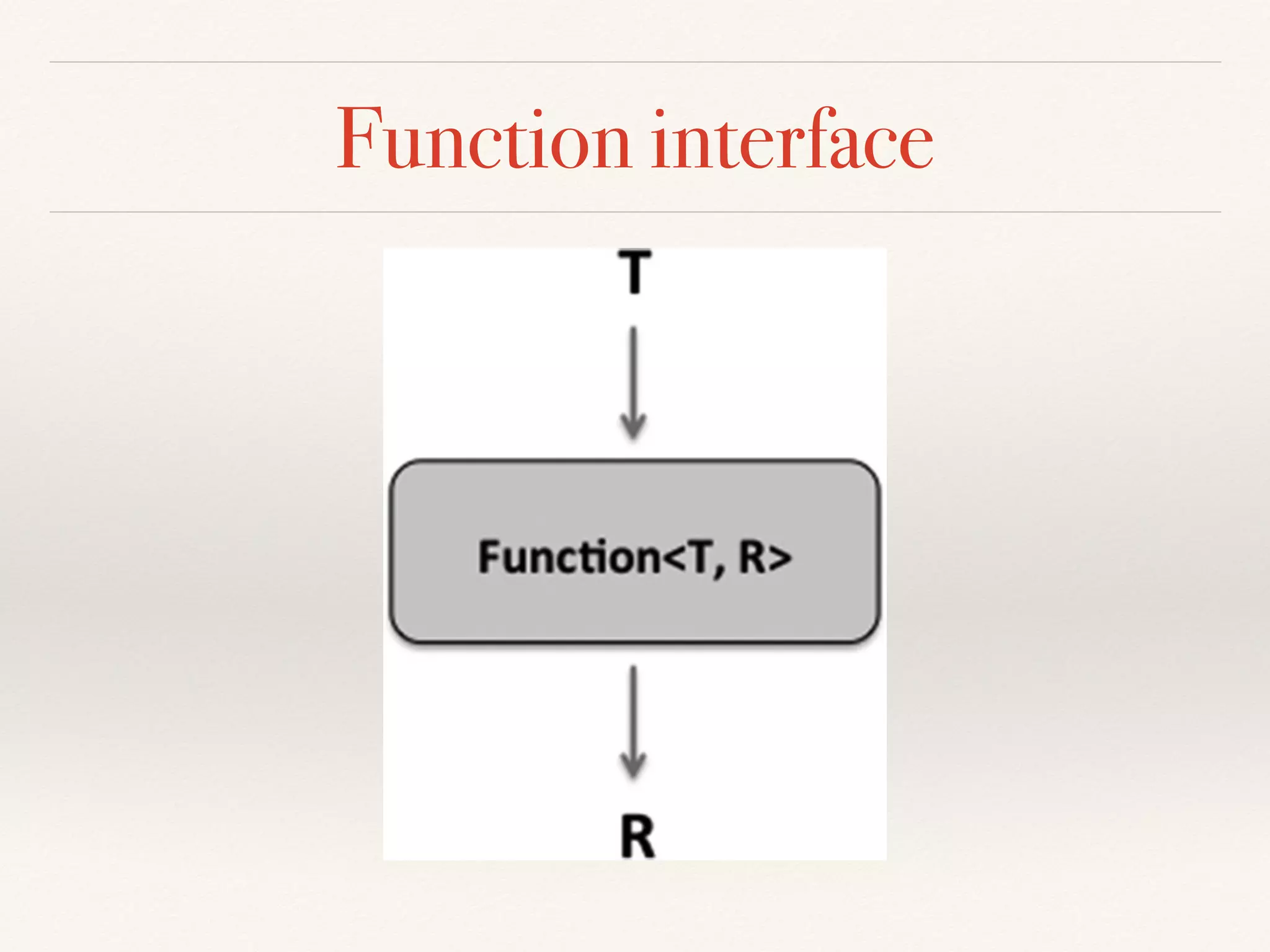
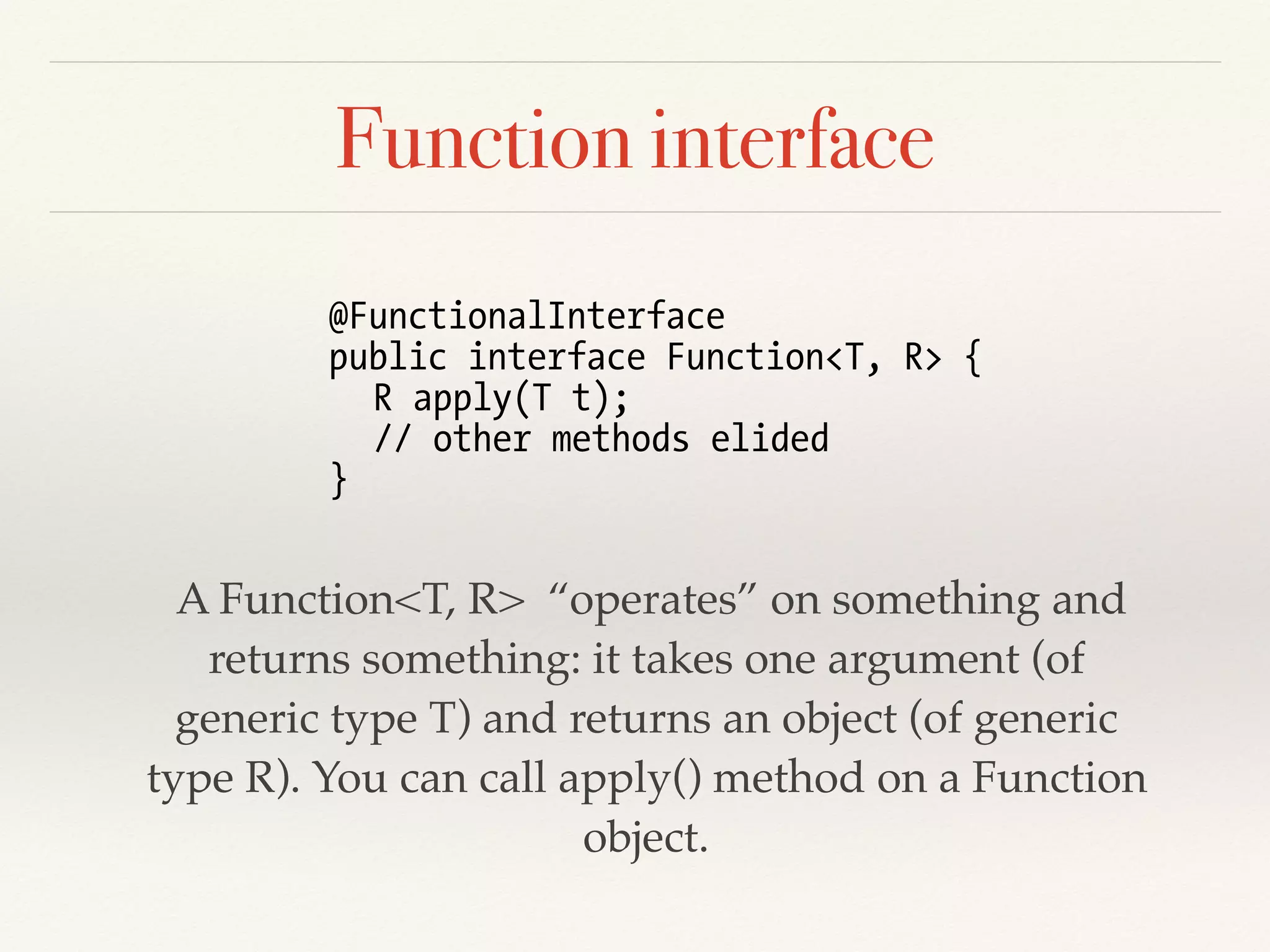
Function interface A Function<T, R> “operates” on something and returns something: it takes one argument (of generic type T) and returns an object (of generic type R). You can call apply() method on a Function object. @FunctionalInterface public interface Function<T, R> { R apply(T t); // other methods elided }
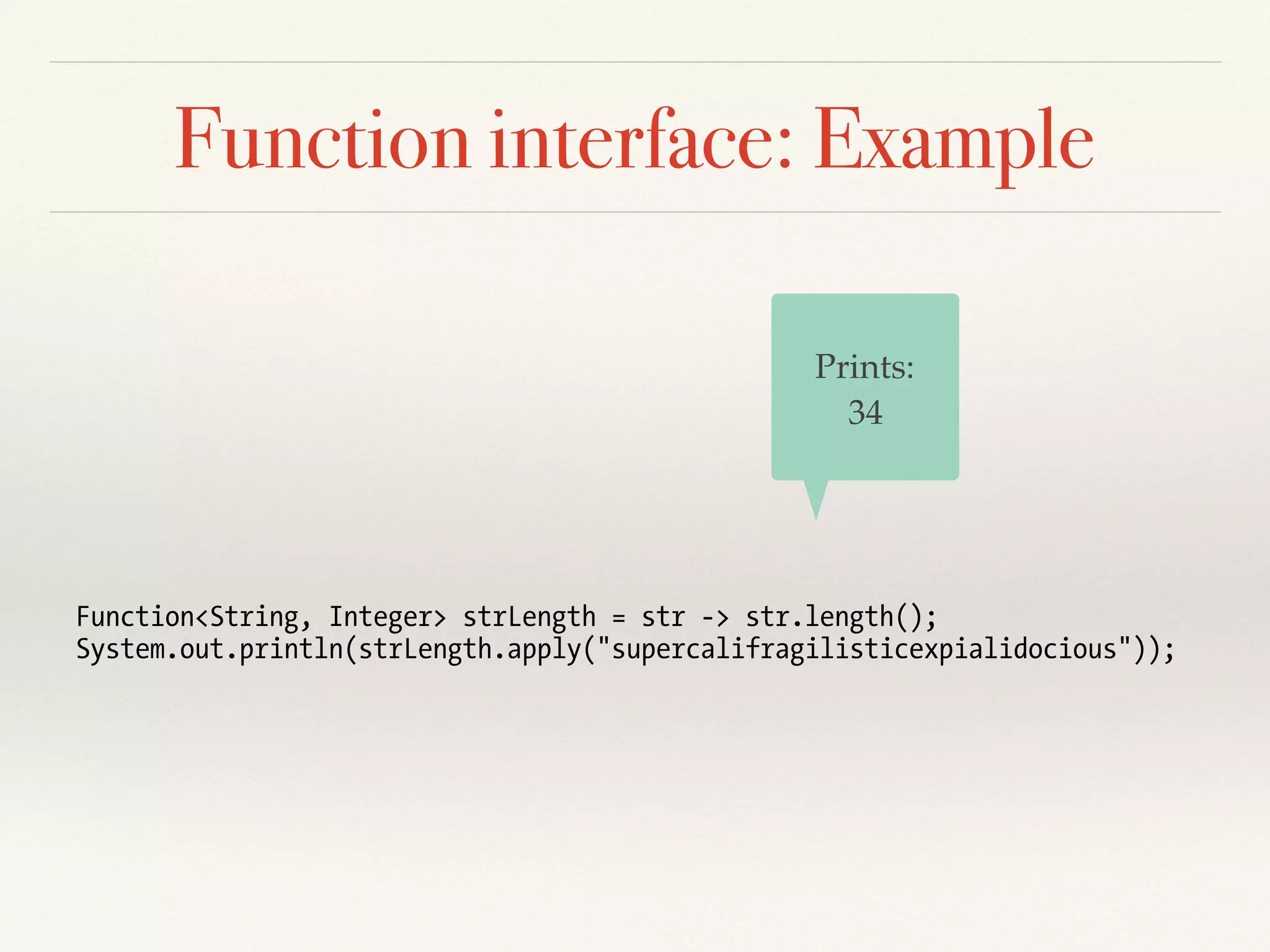
Function interface: Example Function<String, Integer> strLength = str -> str.length(); System.out.println(strLength.apply("supercalifragilisticexpialidocious")); Prints: 34
Function interface: Example import java.util.Arrays; import java.util.function.Function; public class CombineFunctions { public static void main(String []args) { Function<String, Integer> parseInt = Integer:: parseInt ; Function<Integer, Integer> absInt = Math:: abs ; Function<String, Integer> parseAndAbsInt = parseInt.andThen(absInt) Arrays.stream("4, -9, 16".split(", ")) .map(parseAndAbsInt) .forEach(System. out ::println); } } Prints: 4 9 16
Supplier interface import java.util.stream.Stream; import java.util.Random; class GenerateBooleans { public static void main(String []args) { Random random = new Random(); Stream.generate(random::nextBoolean) .limit(2) .forEach(System.out::println); } } Prints two boolean values “true” and “false” in random order
Supplier interface
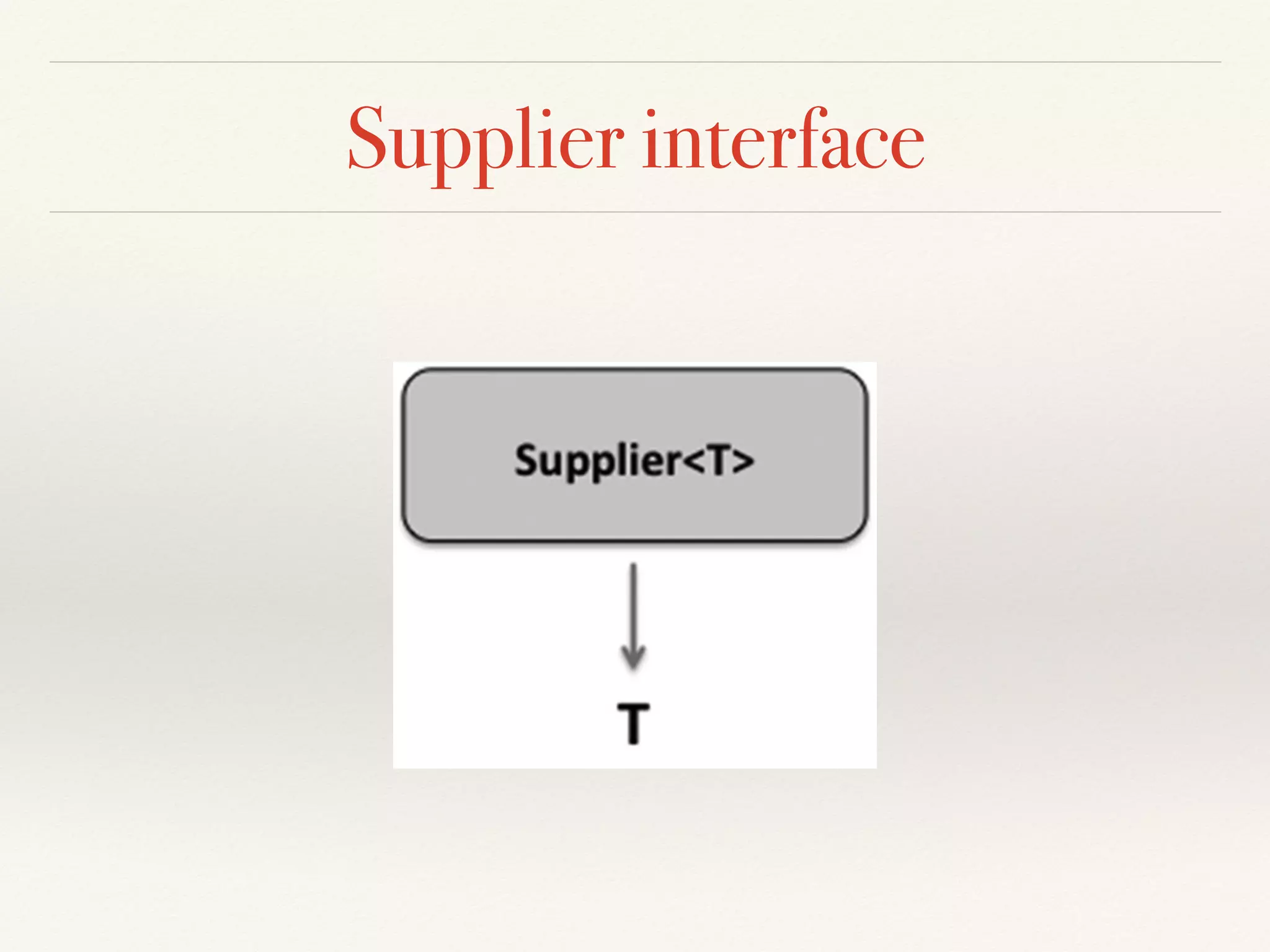
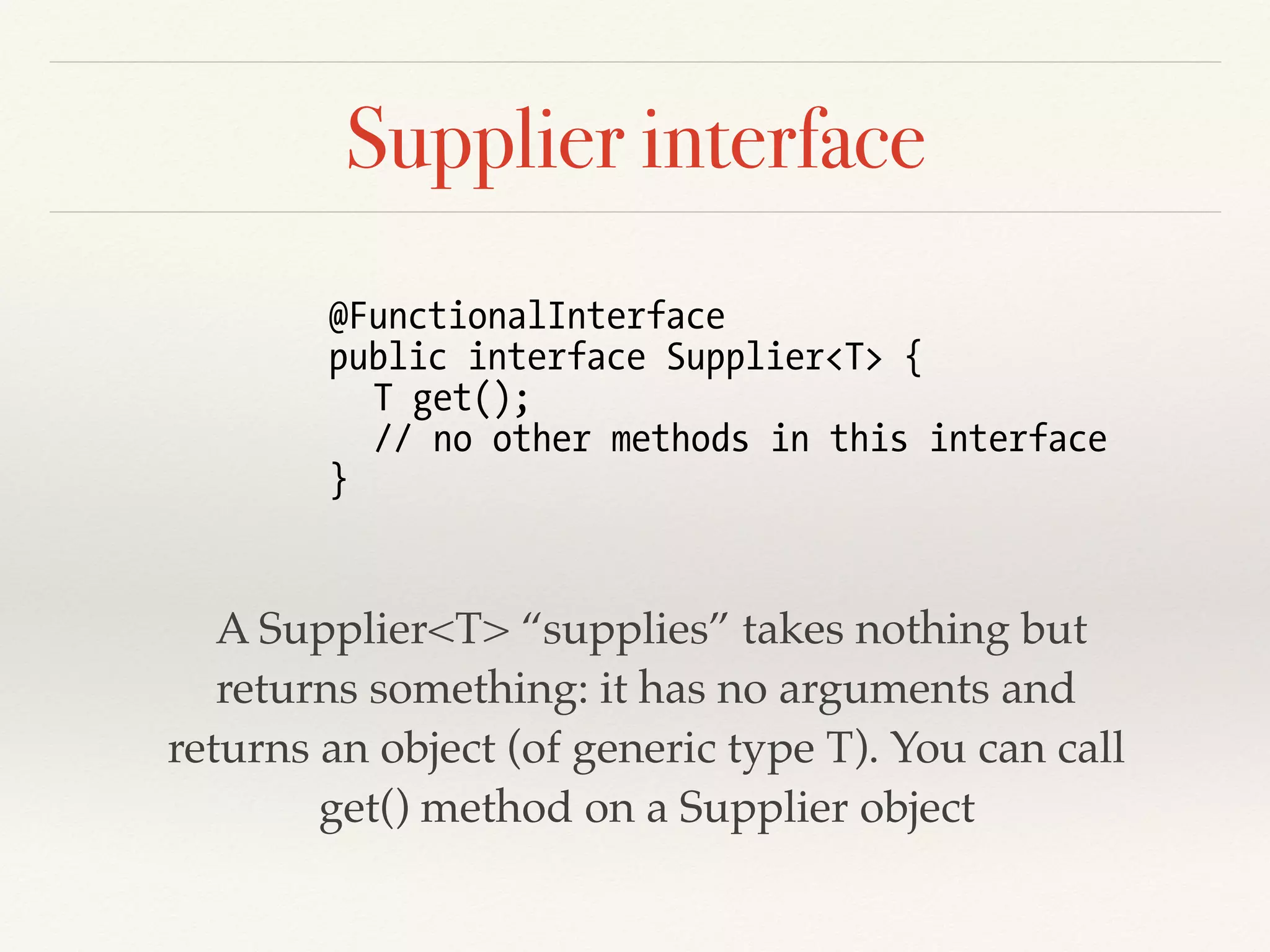
Supplier interface A Supplier<T> “supplies” takes nothing but returns something: it has no arguments and returns an object (of generic type T). You can call get() method on a Supplier object @FunctionalInterface public interface Supplier<T> { T get(); // no other methods in this interface }
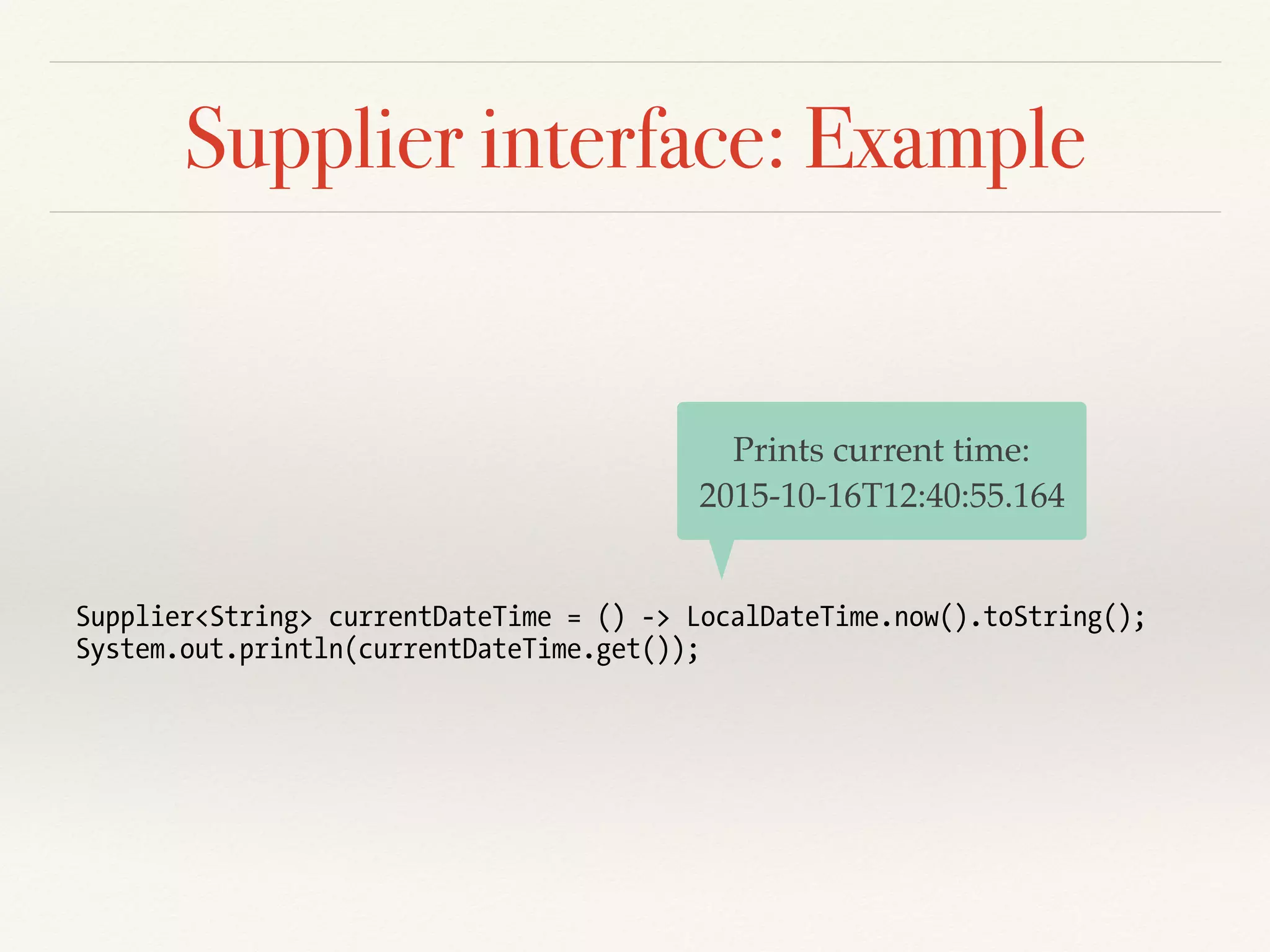
Supplier interface: Example Supplier<String> currentDateTime = () -> LocalDateTime.now().toString(); System.out.println(currentDateTime.get()); Prints current time: 2015-10-16T12:40:55.164
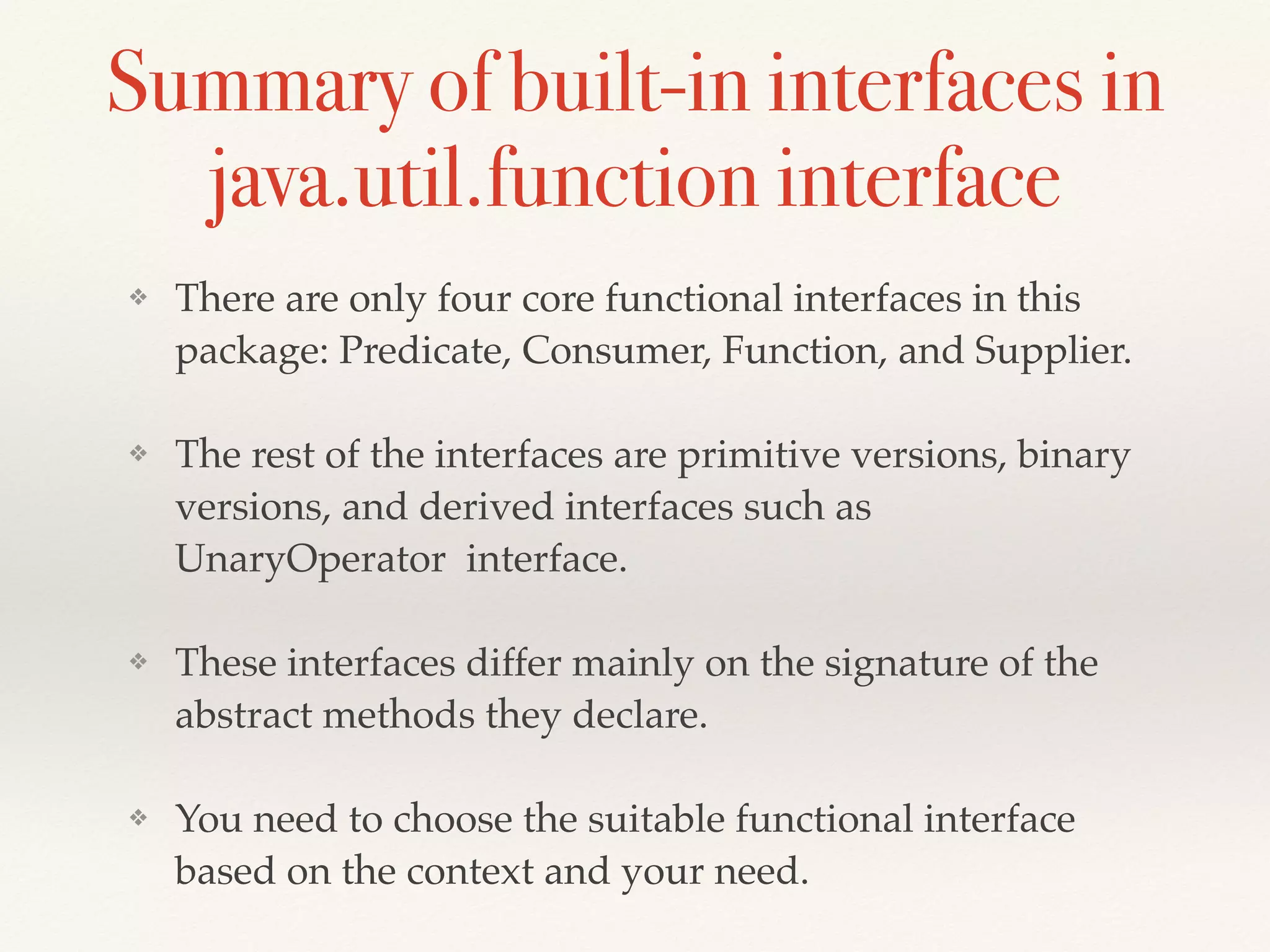
Summary of built-in interfaces in java.util.function interface ❖ There are only four core functional interfaces in this package: Predicate, Consumer, Function, and Supplier. ❖ The rest of the interfaces are primitive versions, binary versions, and derived interfaces such as UnaryOperator interface. ❖ These interfaces differ mainly on the signature of the abstract methods they declare. ❖ You need to choose the suitable functional interface based on the context and your need.
Check out our book! ❖ “Oracle Certified Professional Java SE 8 Programmer Exam 1Z0-809”, S.G. Ganesh, Hari Kiran Kumar, Tushar Sharma, Apress, 2016. ❖ Website: ocpjava.wordpress.com ❖ Amazon: http://amzn.com/ 1484218353
email sgganesh@gmail.com website ocpjava.wordpress.com twitter @GSamarthyam linkedin bit.ly/sgganesh slideshare slideshare.net/sgganesh

Java 8 Lambda Built-in Functional Interfaces

  • 1.
    JAVA 8: LAMBDABUILT-IN FUNCTIONAL INTERFACES ganesh samarthyam ganesh.samarthyam@gmail.com
  • 2.
    Functional interfaces @FunctionalInterface interface LambdaFunction{ void call(); } Functional interface Abstract method providing the signature of the lambda function Annotation to explicitly state that it is a functional interface
  • 3.
    Java 8 lambdas- “Hello world!” @FunctionalInterface interface LambdaFunction { void call(); } class FirstLambda { public static void main(String []args) { LambdaFunction lambdaFunction = () -> System.out.println("Hello world"); lambdaFunction.call(); } } Functional interface - provides signature for lambda functions Lambda function/expression Call to the lambda Prints “Hello world” on the console when executed
  • 4.
    Older Single AbstractMethods (SAMs) // in java.lang package interface Runnable { void run(); } // in java.util package interface Comparator<T> { boolean compare(T x, T y); } // java.awt.event package: interface ActionListener { void actionPerformed(ActionEvent e) } // java.io package interface FileFilter { boolean accept(File pathName); }
  • 5.
    Functional interfaces: Singleabstract methods @FunctionalInterface interface LambdaFunction { void call(); // Single Abstract Method (SAM) }
  • 6.
    Using built-in functionalinterfaces // within Iterable interface default void forEach(Consumer<? super T> action) { Objects.requireNonNull(action); for (T t : this) { action.accept(t); } } // in java.util.function package @FunctionalInterface public interface Consumer<T> { void accept(T t); // the default andThen method elided }
  • 7.
    Using built-in functionalinterfaces List<String> strings = Arrays.asList("eeny", "meeny", "miny", "mo"); Consumer<String> printString = string -> System.out.println(string); strings.forEach(printString); List<String> strings = Arrays.asList("eeny", "meeny", "miny", "mo"); strings.forEach(string -> System.out.println(string));
  • 8.
  • 9.
    Built-in functional interfacesare a part of the java.util.function package (in Java 8)
  • 10.
    Built-in interfaces Predicate<T> Checksa condition and returns a boolean value as result In filter() method in java.util.stream.Stream which is used to remove elements in the stream that don’t match the given condition (i.e., predicate) asConsumer<T> Operation that takes an argument but returns nothing In forEach() method in collections and in java.util.stream.Stream; this method is used for traversing all the elements in the collection orFunction<T, R> Functions that take an argument and return a result In map() method in java.util.stream.Stream to transform or operate on the passed value and return a result. Supplier<T> Operation that returns a value to the caller (the returned value could be same or different values) In generate() method in java.util.stream.Stream to create a infinite stream of elements.
  • 11.
    Predicate interface Stream.of("hello", "world") .filter(str-> str.startsWith("h")) .forEach(System.out::println); The filter() method takes a Predicate as an argument (predicates are functions that check a condition and return a boolean value)
  • 12.
  • 13.
    Predicate interface A Predicate<T>“affirms” something as true or false: it takes an argument of type T, and returns a boolean value. You can call test() method on a Predicate object. @FunctionalInterface public interface Predicate<T> { boolean test(T t); // other methods elided }
  • 14.
    Predicate interface: Example importjava.util.function.Predicate; public class PredicateTest { public static void main(String []args) { Predicate<String> nullCheck = arg -> arg != null; Predicate<String> emptyCheck = arg -> arg.length() > 0; Predicate<String> nullAndEmptyCheck = nullCheck.and(emptyCheck); String helloStr = "hello"; System.out.println(nullAndEmptyCheck.test(helloStr)); String nullStr = null; System.out.println(nullAndEmptyCheck.test(nullStr)); } } Prints: true false
  • 15.
    Predicate interface: Example importjava.util.List; import java.util.ArrayList; public class RemoveIfMethod { public static void main(String []args) { List<String> greeting = new ArrayList<>(); greeting.add("hello"); greeting.add("world"); greeting.removeIf(str -> !str.startsWith("h")); greeting.forEach(System.out::println); } } Prints: hello
  • 16.
    Consumer interface Stream.of("hello", "world") .forEach(System.out::println); //void forEach(Consumer<? super T> action); Prints: hello world
  • 17.
  • 18.
    Consumer interface A Consumer<T>“consumes” something: it takes an argument (of generic type T) and returns nothing (void). You can call accept() method on a Consumer object. @FunctionalInterface public interface Consumer<T> { void accept(T t); // the default andThen method elided }
  • 19.
    Consumer interface: Example Consumer<String>printUpperCase = str -> System.out.println(str.toUpperCase()); printUpperCase.accept("hello"); Prints: HELLO
  • 20.
    Consumer interface: Example importjava.util.stream.Stream; import java.util.function.Consumer; class ConsumerUse { public static void main(String []args) { Stream<String> strings = Stream.of("hello", "world"); Consumer<String> printString = System.out::println; strings.forEach(printString); } } Prints: hello world
  • 21.
    Function interface import java.util.Arrays; publicclass FunctionUse { public static void main(String []args) { Arrays.stream("4, -9, 16".split(", ")) .map(Integer::parseInt) .map(i -> (i < 0) ? -i : i) .forEach(System.out::println); } } Prints: 4 9 16
  • 22.
  • 23.
    Function interface A Function<T,R> “operates” on something and returns something: it takes one argument (of generic type T) and returns an object (of generic type R). You can call apply() method on a Function object. @FunctionalInterface public interface Function<T, R> { R apply(T t); // other methods elided }
  • 24.
    Function interface: Example Function<String,Integer> strLength = str -> str.length(); System.out.println(strLength.apply("supercalifragilisticexpialidocious")); Prints: 34
  • 25.
    Function interface: Example importjava.util.Arrays; import java.util.function.Function; public class CombineFunctions { public static void main(String []args) { Function<String, Integer> parseInt = Integer:: parseInt ; Function<Integer, Integer> absInt = Math:: abs ; Function<String, Integer> parseAndAbsInt = parseInt.andThen(absInt) Arrays.stream("4, -9, 16".split(", ")) .map(parseAndAbsInt) .forEach(System. out ::println); } } Prints: 4 9 16
  • 26.
    Supplier interface import java.util.stream.Stream; importjava.util.Random; class GenerateBooleans { public static void main(String []args) { Random random = new Random(); Stream.generate(random::nextBoolean) .limit(2) .forEach(System.out::println); } } Prints two boolean values “true” and “false” in random order
  • 27.
  • 28.
    Supplier interface A Supplier<T>“supplies” takes nothing but returns something: it has no arguments and returns an object (of generic type T). You can call get() method on a Supplier object @FunctionalInterface public interface Supplier<T> { T get(); // no other methods in this interface }
  • 29.
    Supplier interface: Example Supplier<String>currentDateTime = () -> LocalDateTime.now().toString(); System.out.println(currentDateTime.get()); Prints current time: 2015-10-16T12:40:55.164
  • 30.
    Summary of built-ininterfaces in java.util.function interface ❖ There are only four core functional interfaces in this package: Predicate, Consumer, Function, and Supplier. ❖ The rest of the interfaces are primitive versions, binary versions, and derived interfaces such as UnaryOperator interface. ❖ These interfaces differ mainly on the signature of the abstract methods they declare. ❖ You need to choose the suitable functional interface based on the context and your need.
  • 31.
    Check out ourbook! ❖ “Oracle Certified Professional Java SE 8 Programmer Exam 1Z0-809”, S.G. Ganesh, Hari Kiran Kumar, Tushar Sharma, Apress, 2016. ❖ Website: ocpjava.wordpress.com ❖ Amazon: http://amzn.com/ 1484218353
  • 32.
    email sgganesh@gmail.com website ocpjava.wordpress.com twitter@GSamarthyam linkedin bit.ly/sgganesh slideshare slideshare.net/sgganesh