Functional Programming in Javascript Yoav Rubin @yoavrubin
Today • About functional programming • A little about Javascript • Deep dive into the combination of the two – Inner functions and closures – Higher order functions – Decomplecting calls patterns
What will you gain? • Inner functions and closures – Improving performance via memoization – A different perspective on objects • Higher order functions – Avoiding mistakes due to the leaky abstraction of arrays – Composing functions from functions • Decomplecting calls patterns – Regaining the ability to use recursion – A look behind the scenes of streams
Today • About functional programming • A little about Javascript • Deep dive into the combination of the two – Inner functions and closures – Higher order functions – Decomplecting calls patterns
About functional programming • All agree – it’s a programming paradigm • There’s no agreed upon definition – See Gilad Bracha’s talk: http://www.infoq.com/presentations/functional-pros-cons
My definition • Thinking the software using data and functions – Analysis, modeling • Data and functions focused development – Data transformation instead of mutable object state • Core ideas – Data is immutable – Functions are first class citizens
Why functional programming • Higher level of programming – Faster to develop – Simpler to test MUST • A good software person should know more then one paradigm – Because problems are getting tougher
Today • About functional programming • A little about Javascript • Deep dive into the combination of the two – Inner functions and closures – Higher order functions – Decomplecting calls patterns
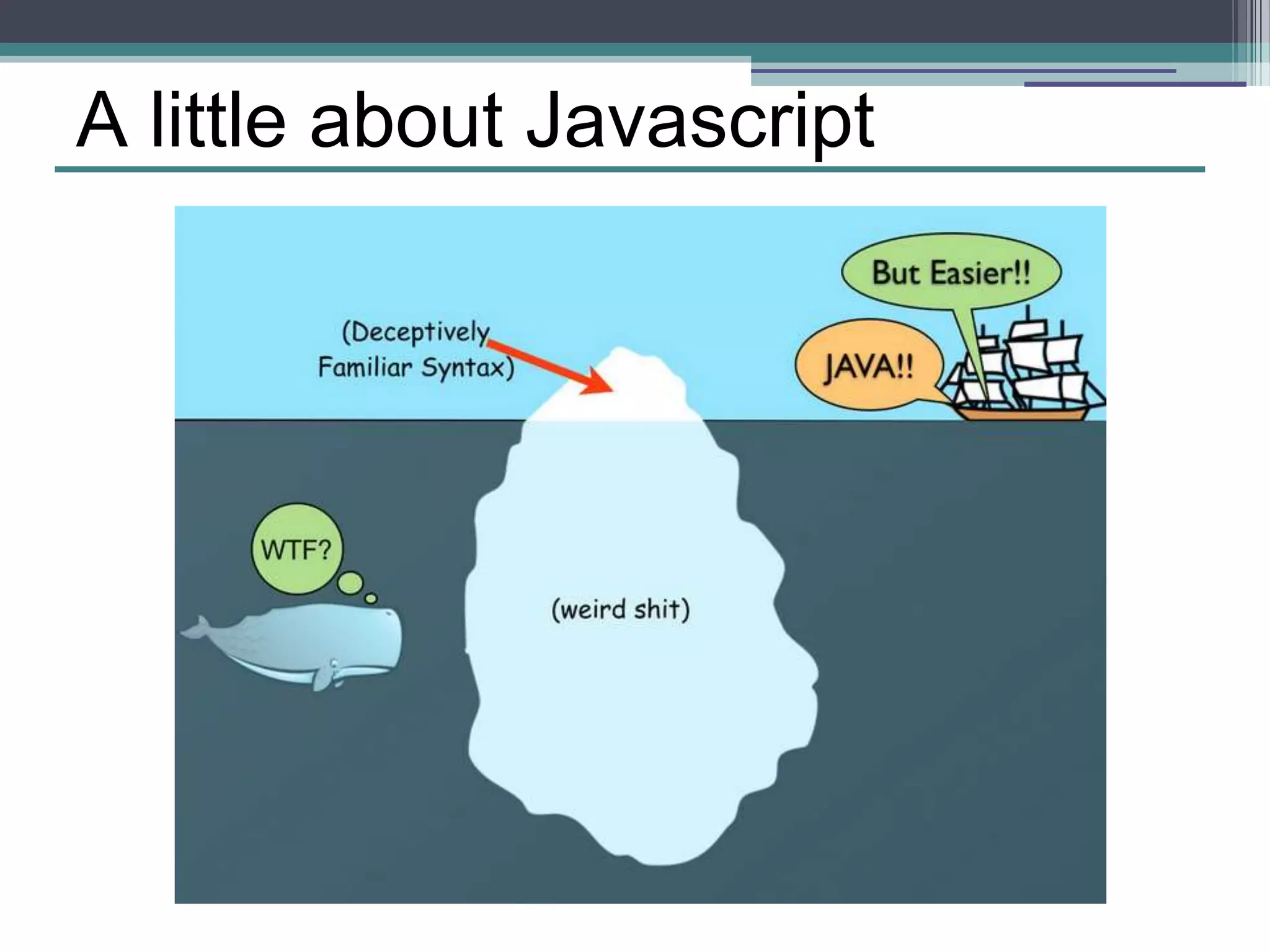
A little about Javascript
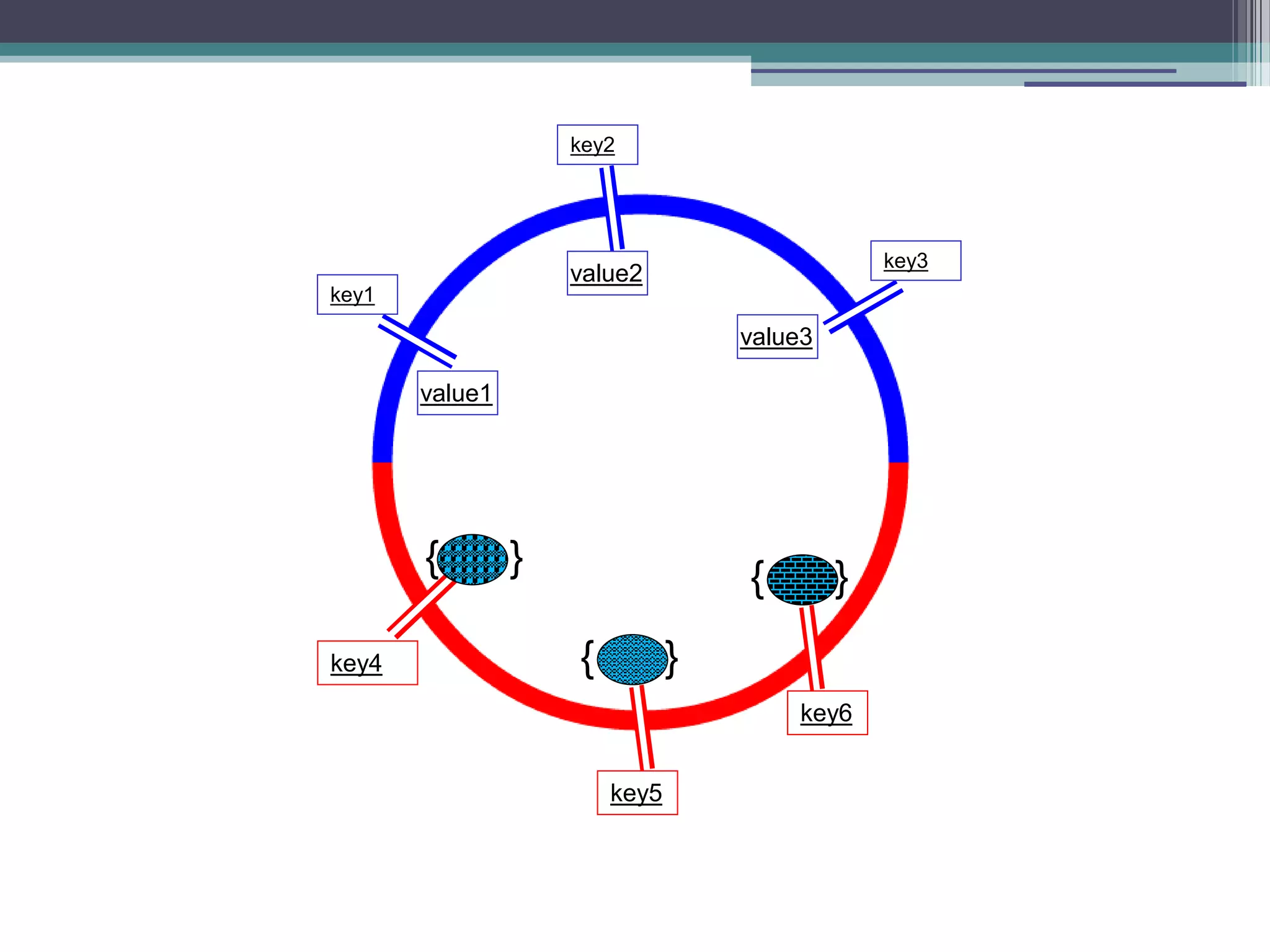
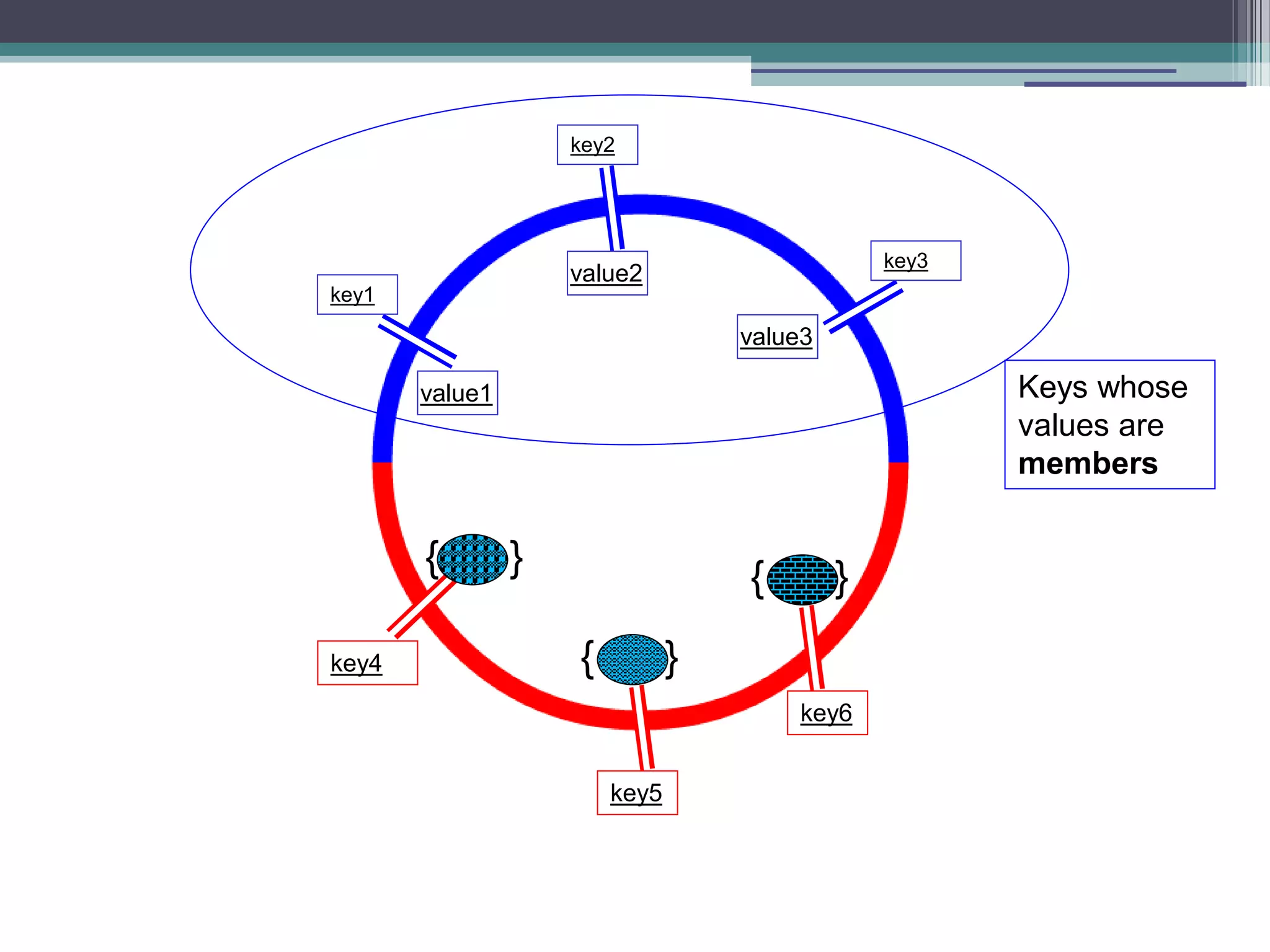
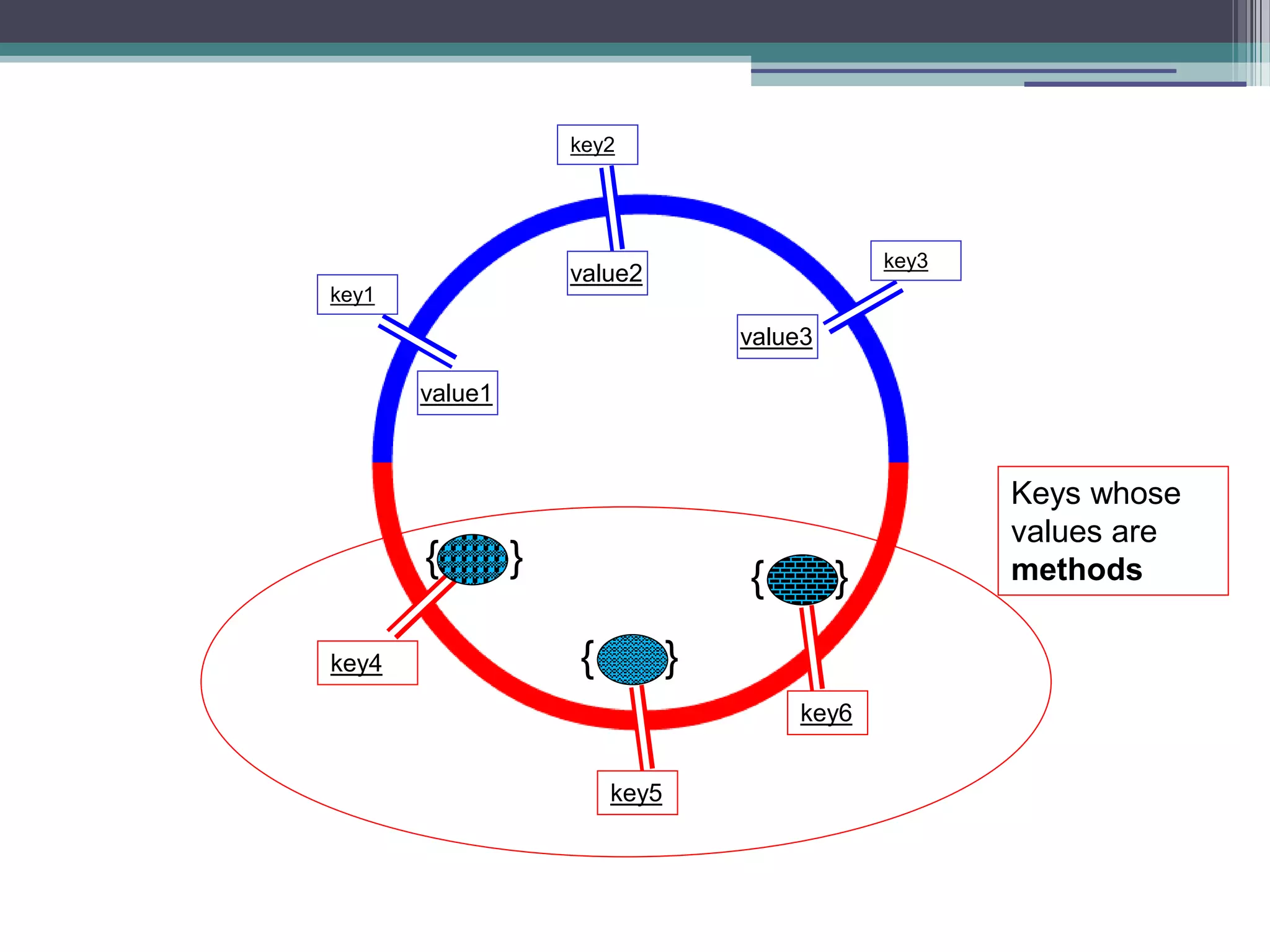
Objects are maps • An object is a set of key-value pairs • Values can be anything and may change • Pairs can be added and removed
key1 value1 key2 value2 key3 value3 key5 key4 { } { } { } key6
key1 value1 key2 value2 key3 value3 key5 key4 { } { } { } key6 Keys whose values are members
key1 value1 key2 value2 key3 value3 key5 key4 { } { } { } key6 Keys whose values are methods
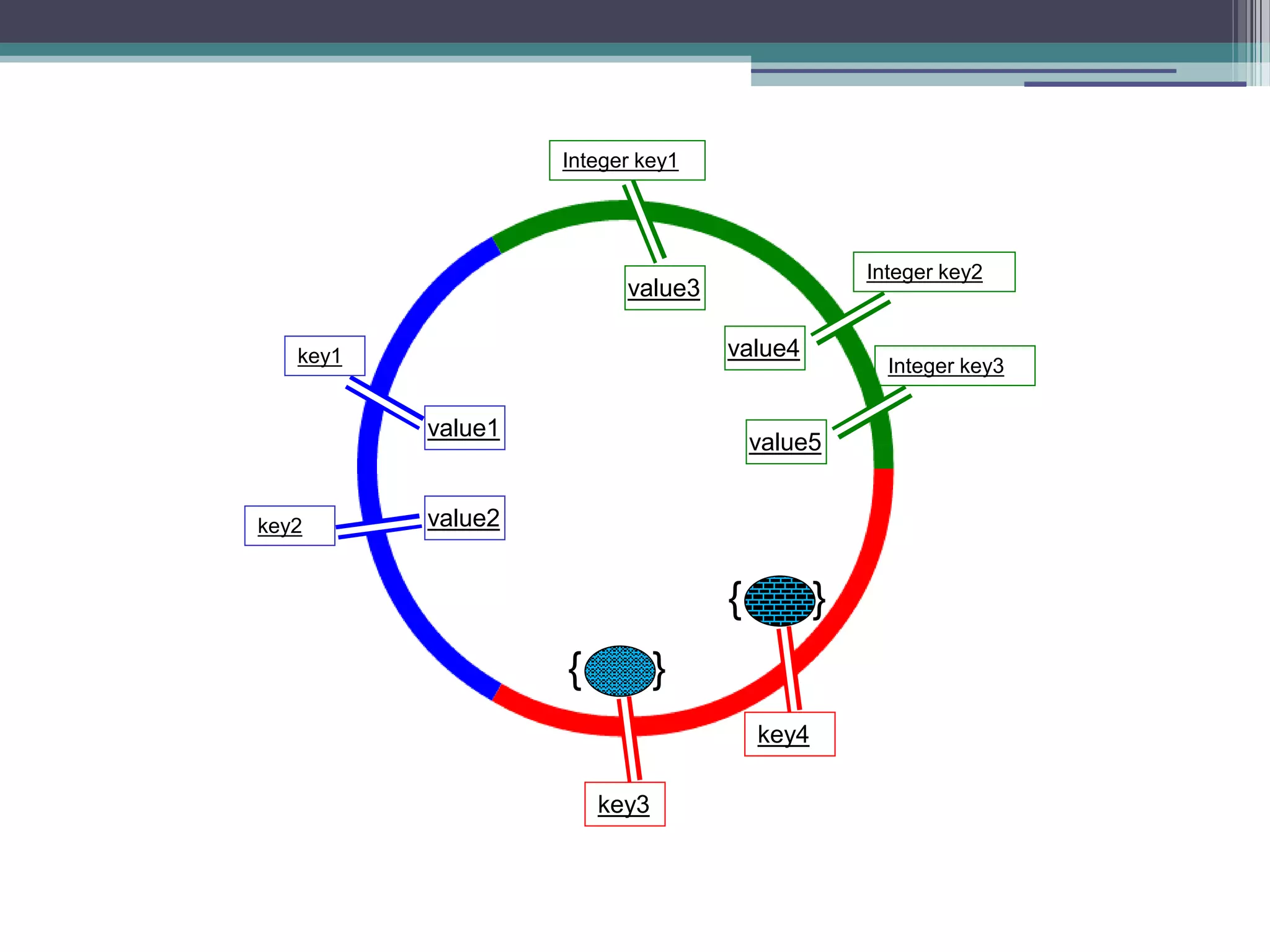
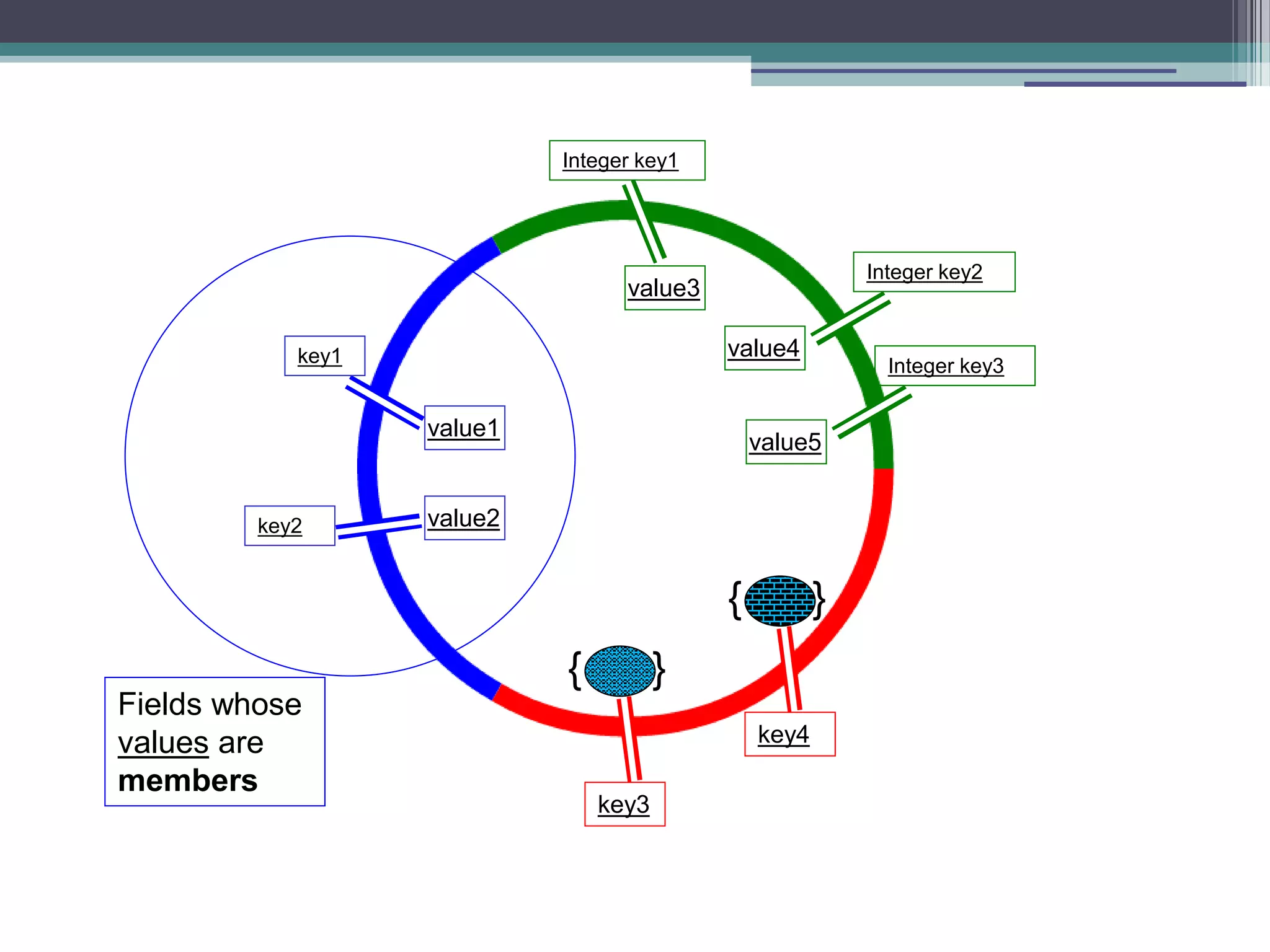
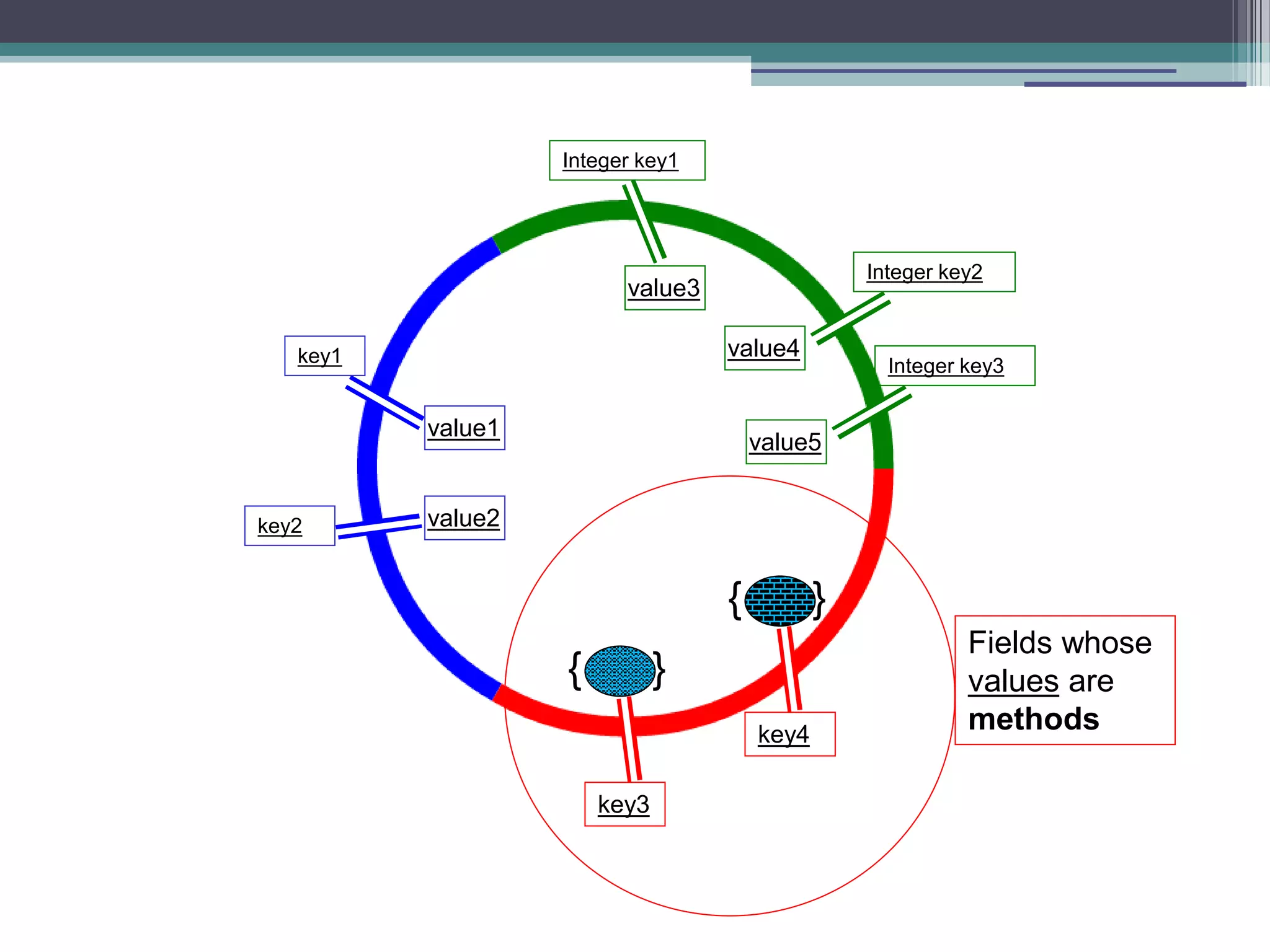
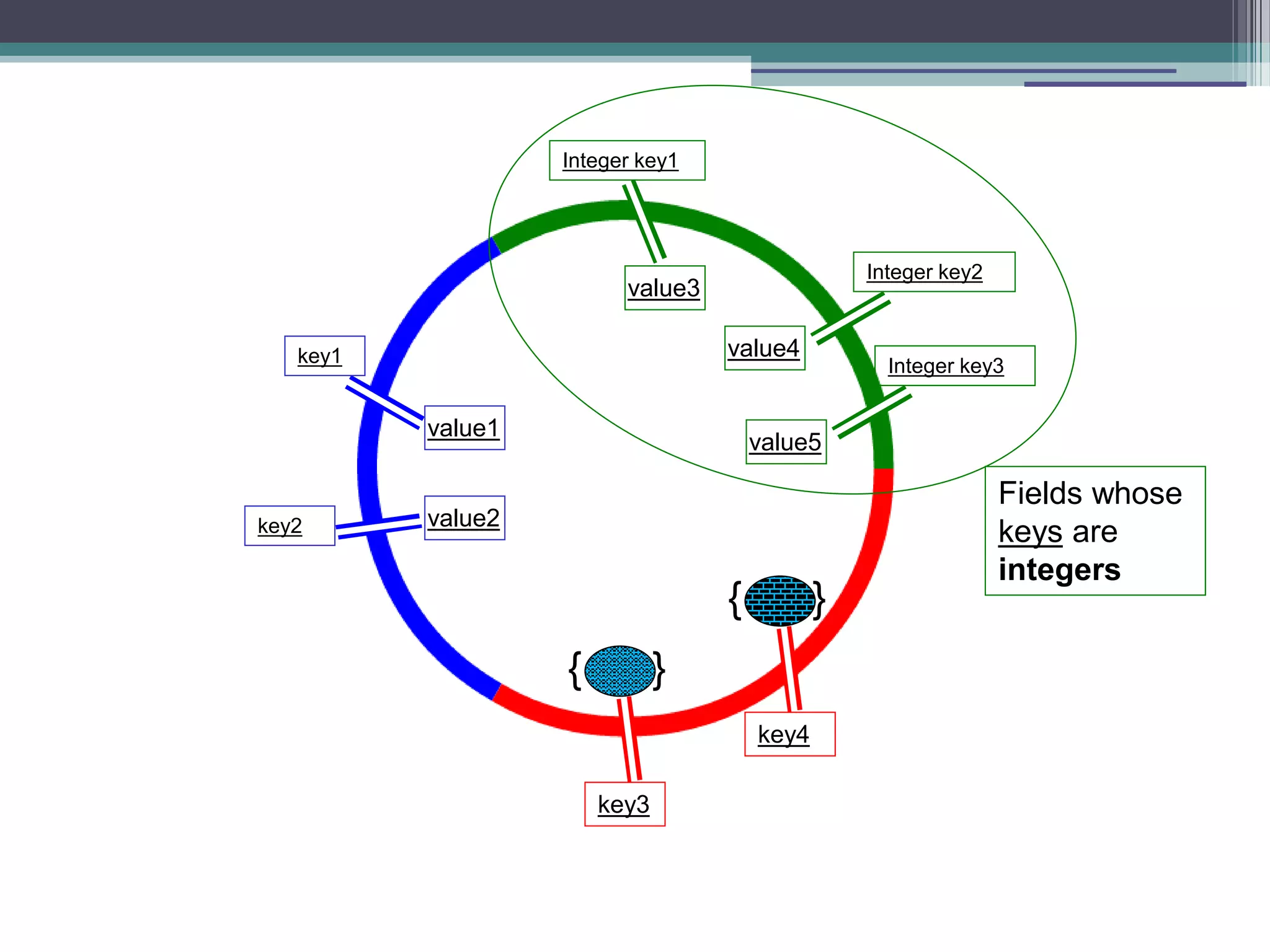
Arrays • Arrays are objects are maps • Fields whose keys are integers gain “special treatment”
key1 value1 key2 value2 Integer key2 value4 key3 key4 Integer key3 value5 Integer key1 value3 { } { }
key1 value1 key2 value2 Integer key2 value4 key3 key4 Fields whose values are members Integer key3 value5 Integer key1 value3 { } { }
key1 value1 key2 value2 Integer key2 value4 key3 key4 Integer key3 Fields whose values are methods value5 Integer key1 value3 { } { }
key1 value1 key2 value2 Integer key2 value4 key3 key4 Integer key3 value5 Integer key1 value3 { } { } Fields whose keys are integers
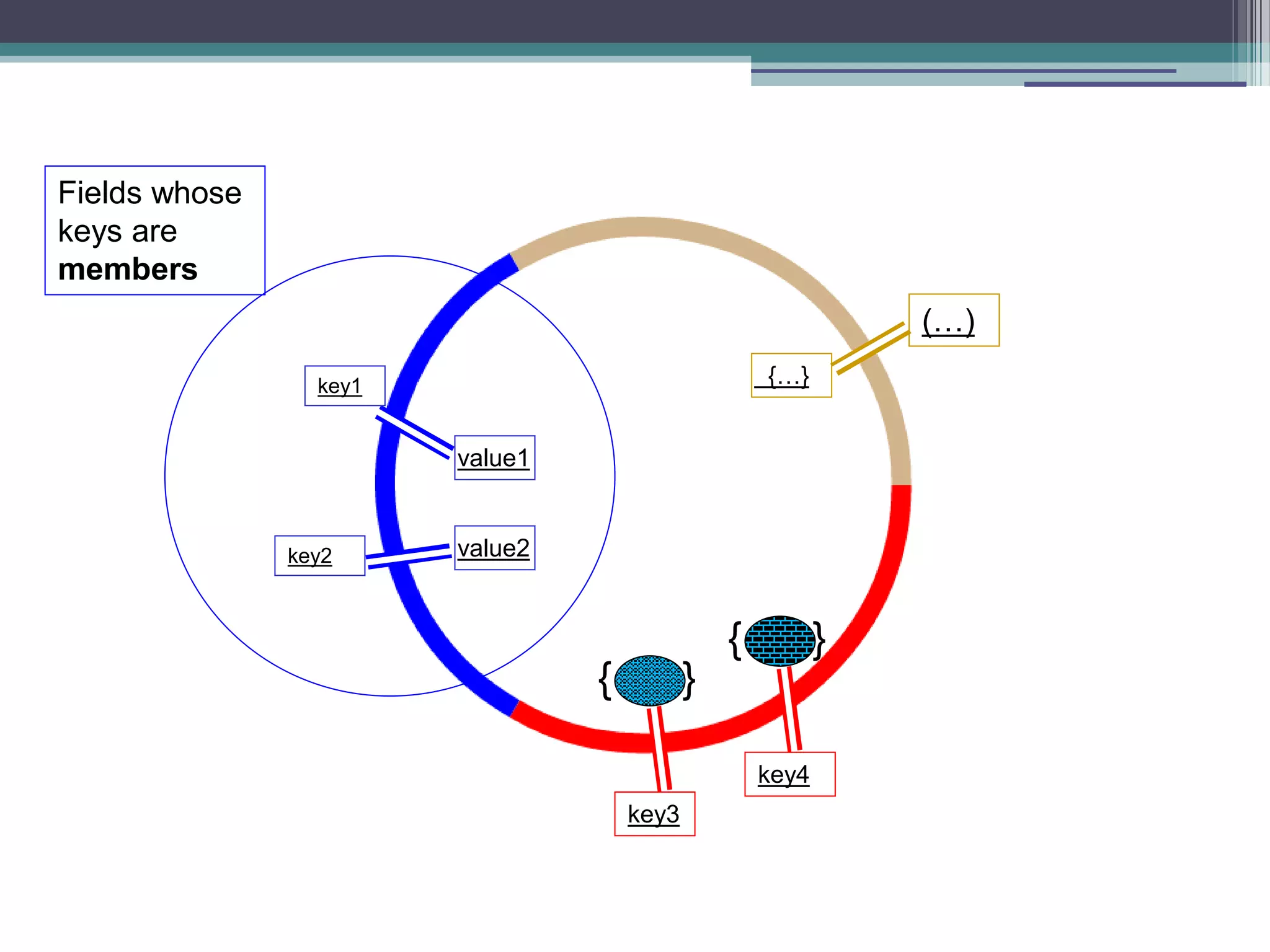
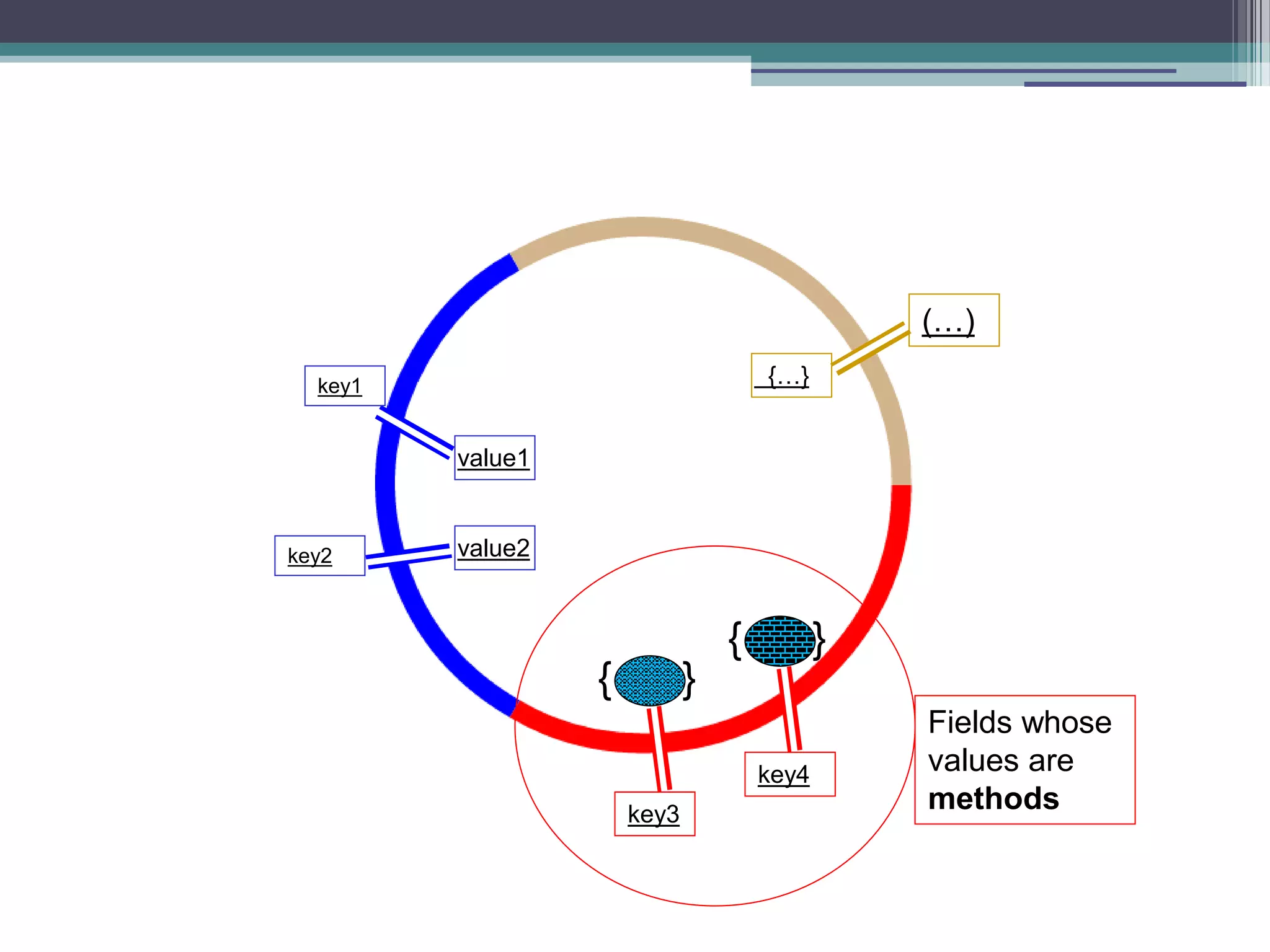
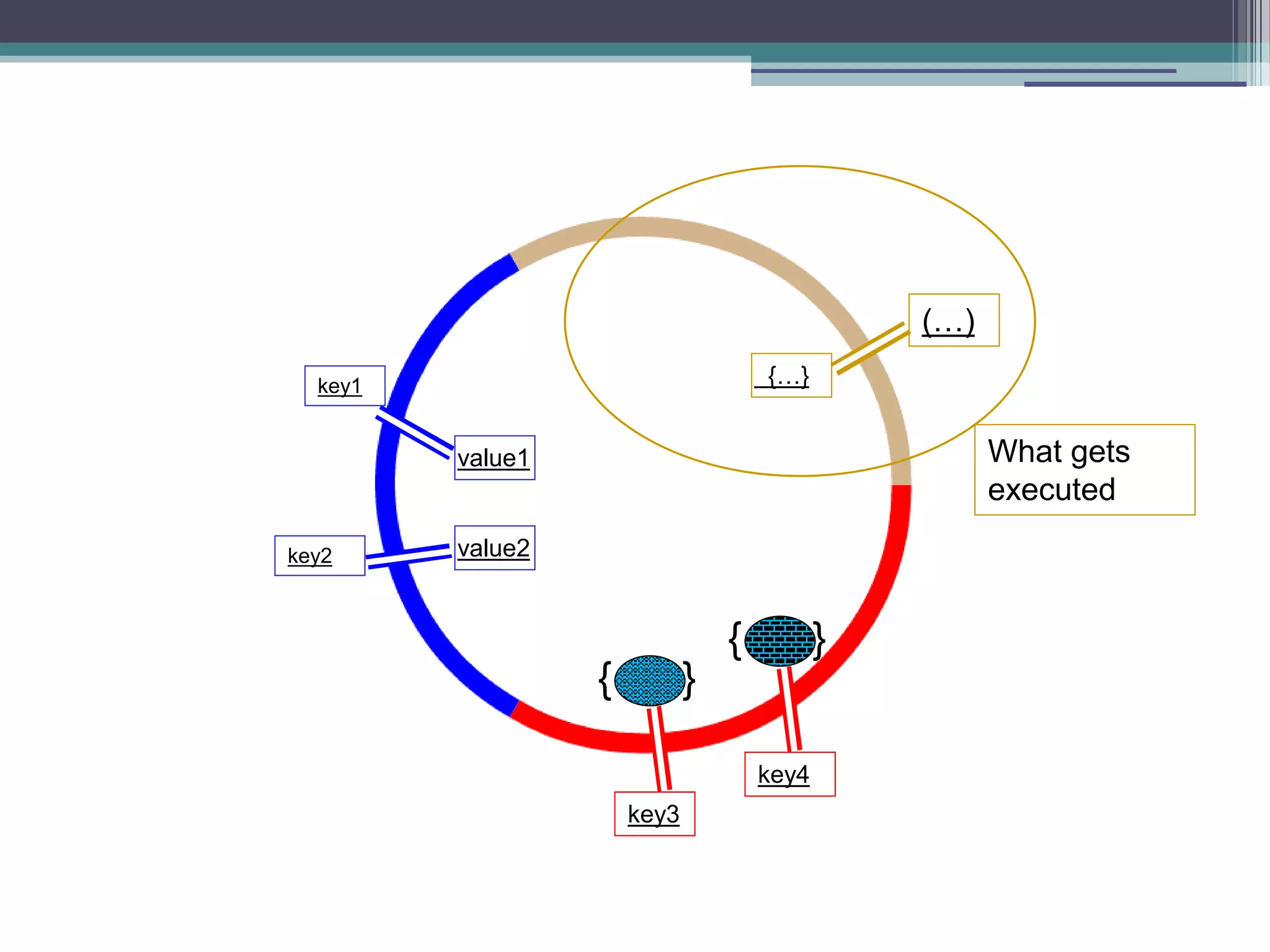
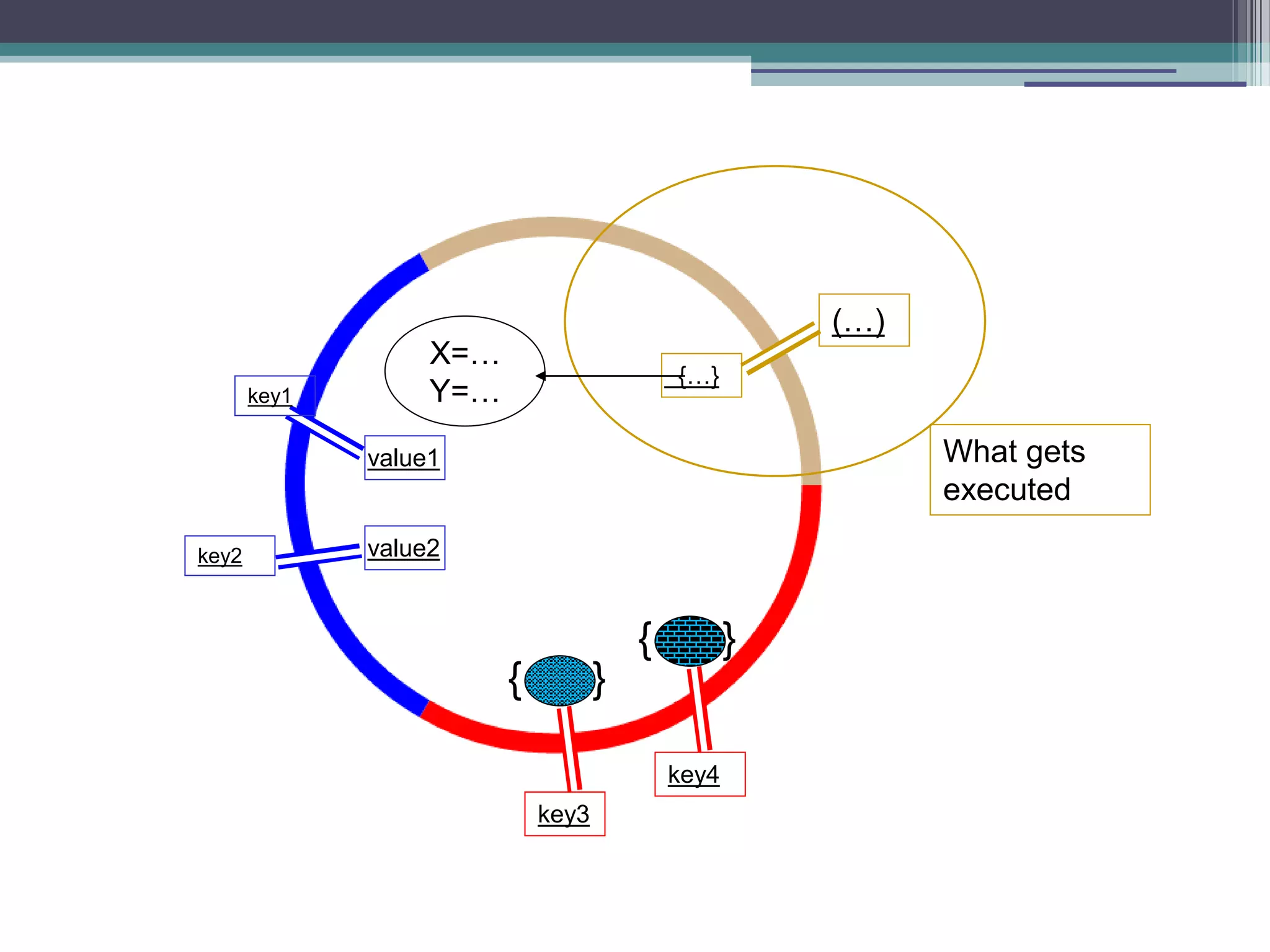
Functions • Functions are objects are maps • Can also be executed
key1 value1 key2 value2 (…) {…} key3 key4 Fields whose keys are members { } { }
key1 value1 key2 value2 (…) {…} key3 key4 Fields whose values are methods { } { }
key1 value1 key2 value2 (…) {…} key3 key4 { } { } What gets executed
Functions are objects • Can be defined anywhere • Can be assigned to a variable – Or act as a value in an object (or in an array) • Can be sent as an argument to a function • Can be returned as a return value from a function
Today • About functional programming • A little about Javascript • Deep dive into the combination of the two – Inner functions and closures – Higher order functions – Decomplecting calls patterns
Inner functions and closures • A function can be defined inside another function • The inner function can access anything found at the outer function
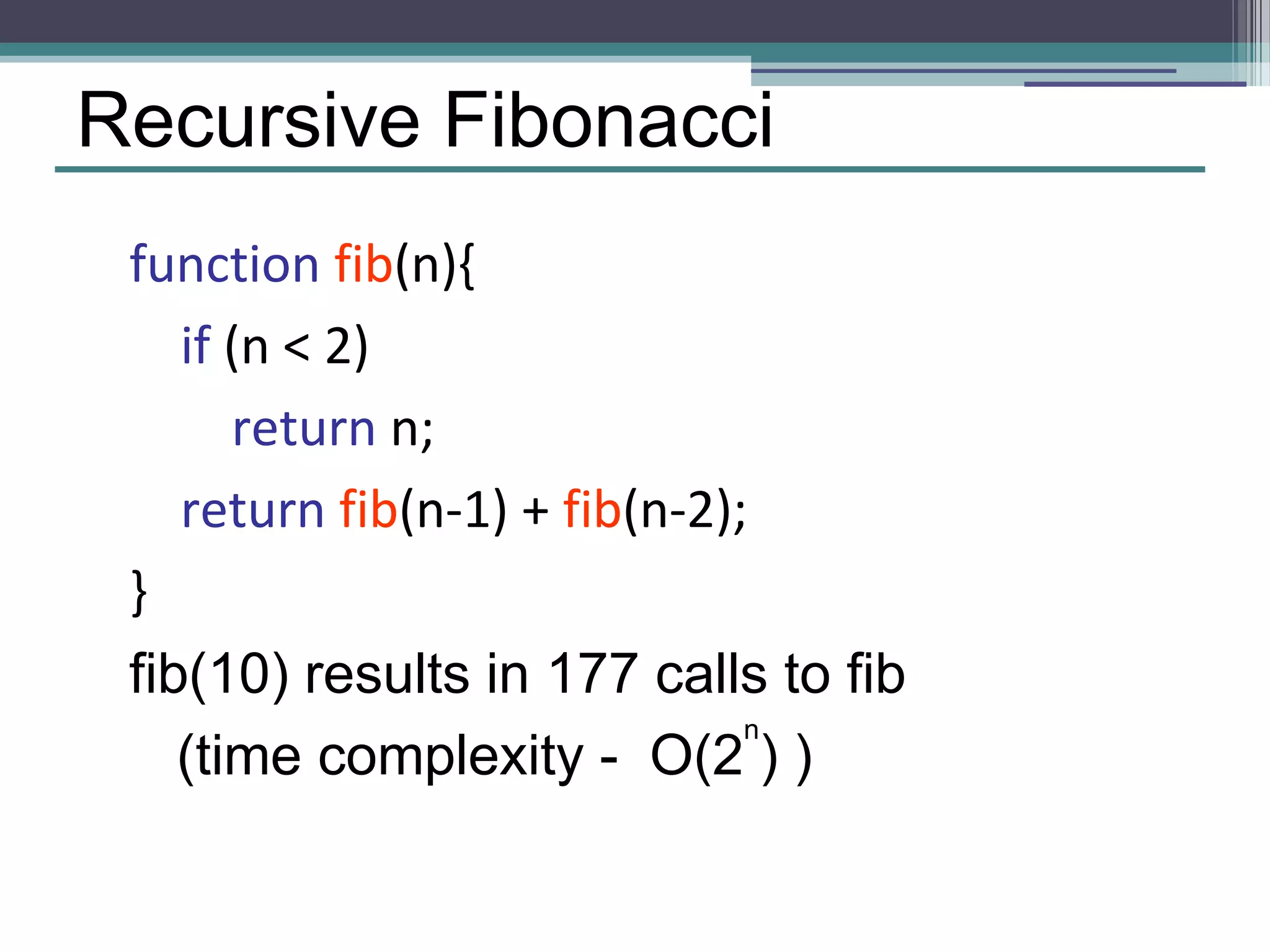
Recursive Fibonacci function fib(n){ if (n < 2) return n; return fib(n-1) + fib(n-2); } fib(10) results in 177 calls to fib n (time complexity - O(2 ) )
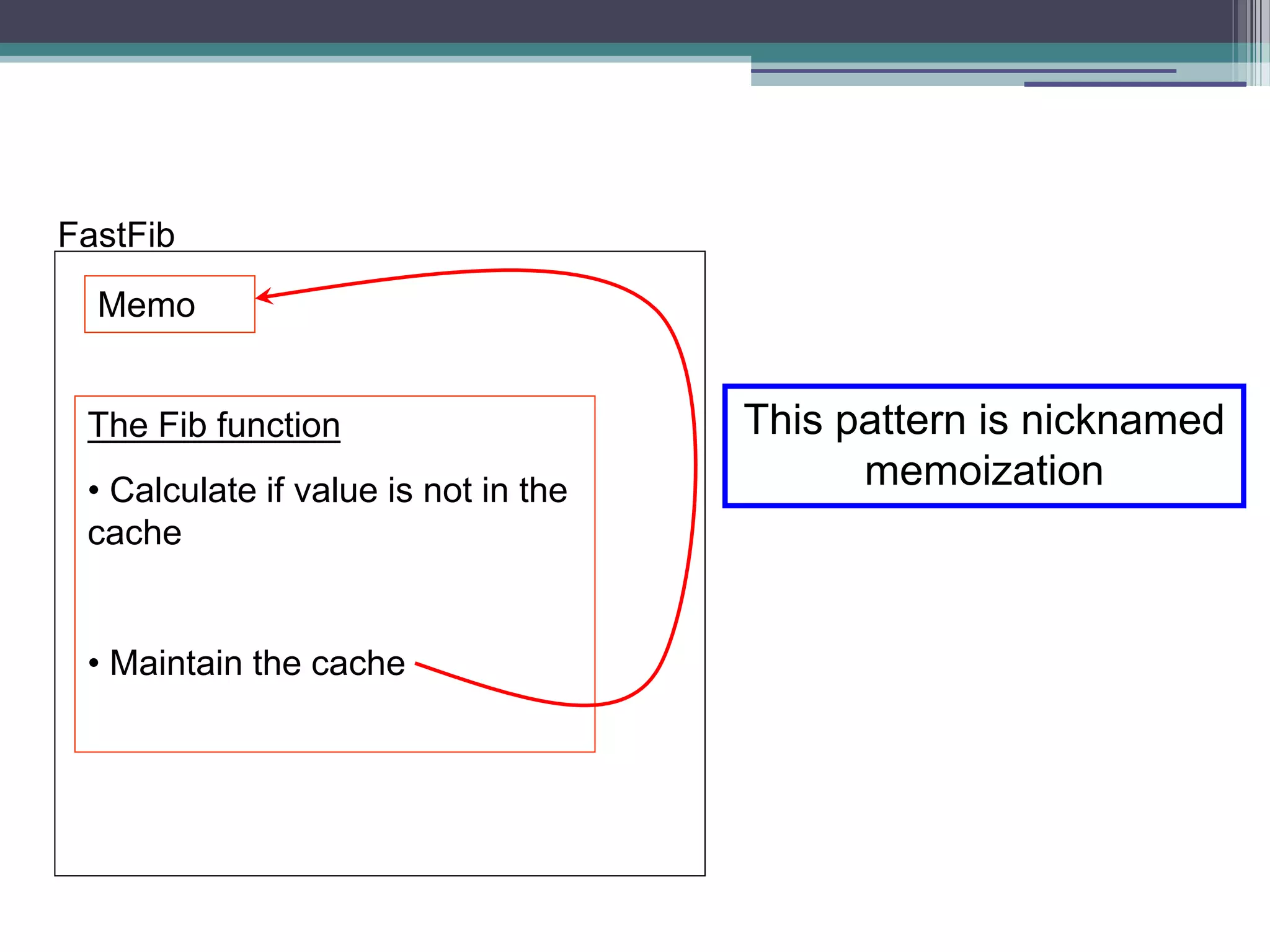
Fibonacci using inner function function fastFib(n){ var memo = [0,1]; var fib = function(n){ var result = memo[n]; if(result !== undefined) return result; result = fib(n-1) + fib(n-2); memo[n] = result; return result; } return fib(n); } fastFib(10) results in 19 calls to the fib function (time complexity - O(n)) An inner function
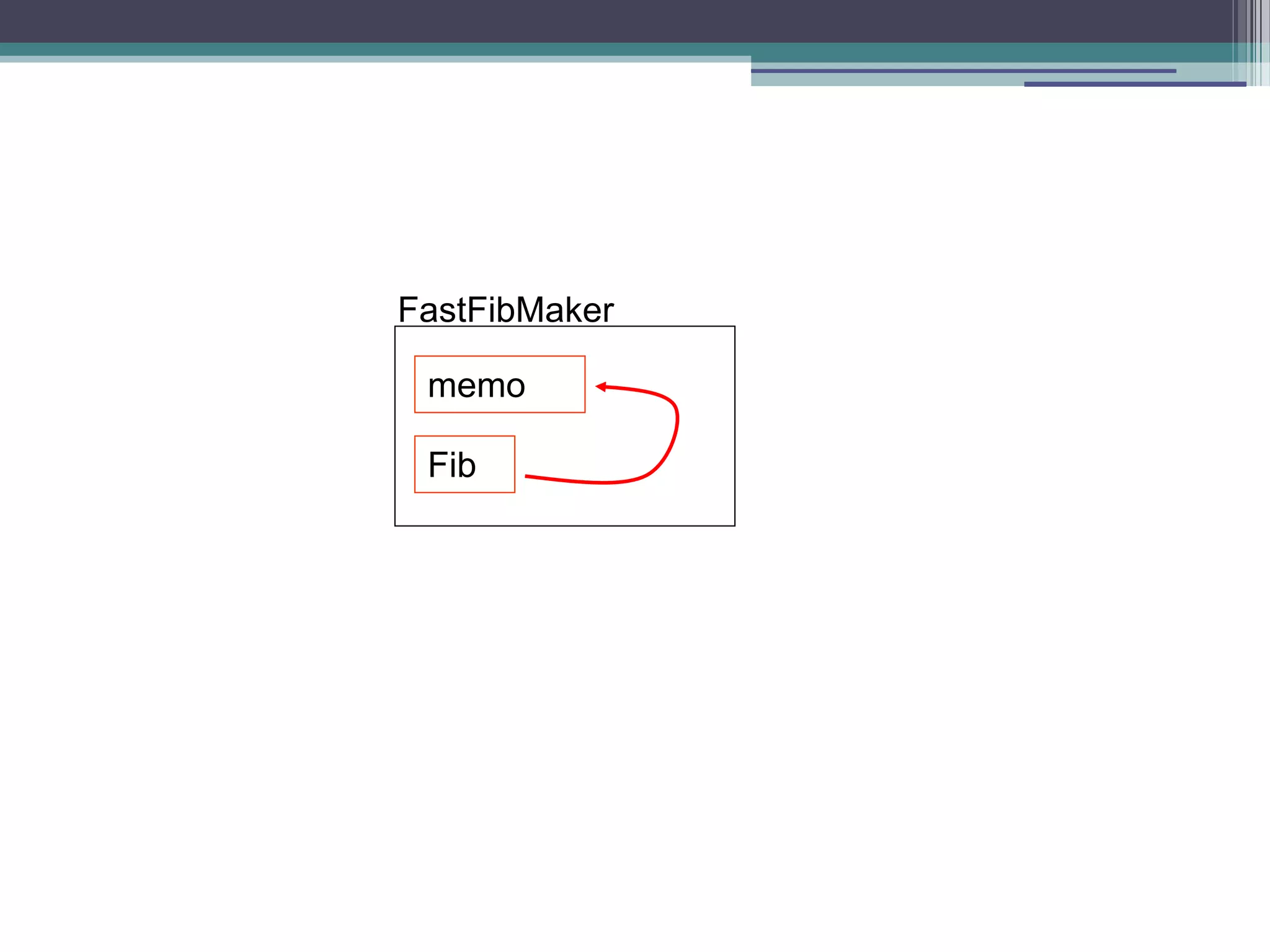
FastFib Memo The Fib function • Calculate if value is not in the cache • Maintain the cache This pattern is nicknamed memoization
Closure • Computation done in an inner function can access data found in the outer function • Such an access creates a construct called closure
Closures remain alive even when the execution of the outer function was finished
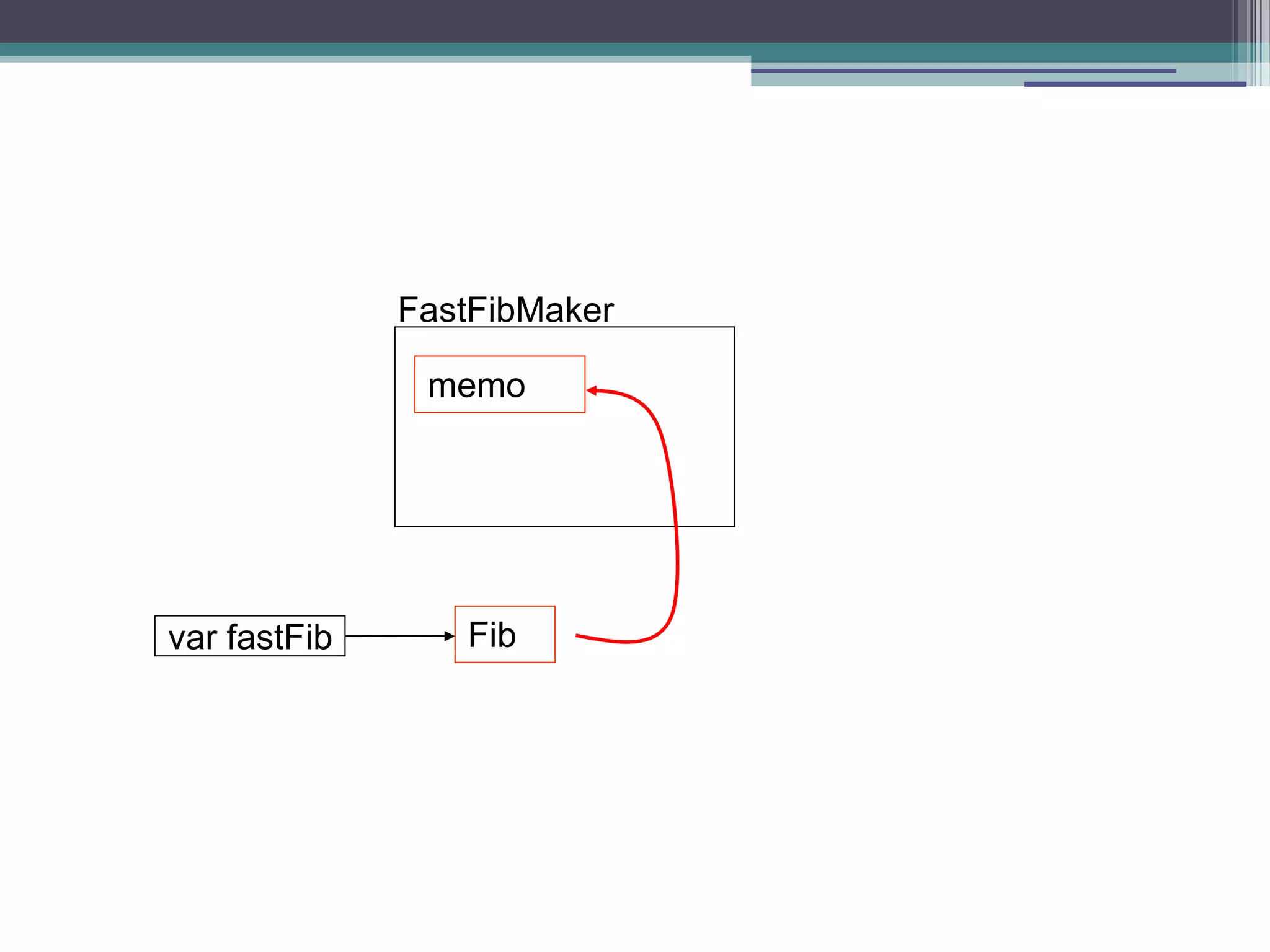
Fibonacci using closure function fastFibMaker(){ var memo = [0,1]; var fib = function(n){ var result = memo[n]; if (result !== undefined) return result; result = fib(n-1) + fib(n-2); memo[n] = result; return result; } return fib; } var theFib = fastFibMaker(); // returns a function theFib (10); // 19 calls to fib theFib (10); // 1 call to fib
FastFibMaker memo Fib
FastFibMaker memo Fib var fastFib
key1 value1 key2 value2 (…) {…} key3 key4 What gets executed { } { } X=… Y=…
Today • About functional programming • A little about Javascript • Deep dive into the combination of the two – Inner functions and closures – Higher order functions – Decomplecting calls patterns
Higher order functions • Receive function, return value • Receive value, return function
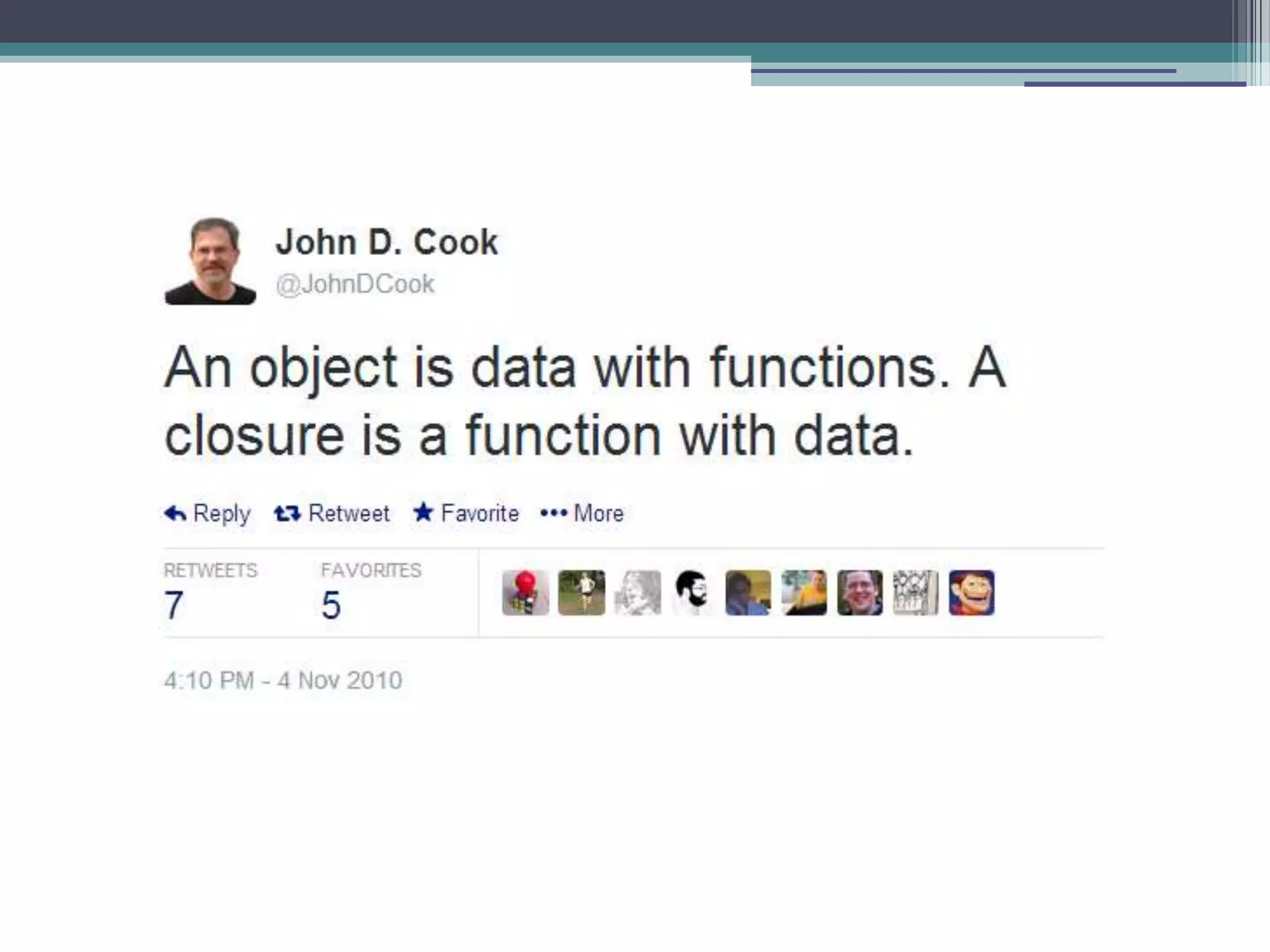
Receive function, return value • The receiving function provides the syntactic skeleton of the computation • The sent function provides the semantics for the calculation • Implementation of the “Strategy design pattern”
Where do we see it?
Working with arrays • One of the most common things we do in code • Especially, in conjunction with looping • The common looping patterns have equivalent higher order methods in arrays
Building a value out of an array var i, res = seed; for (i=0 ; i<arr.length ;i ++) res = someFunc(res, arr[i]);
Building a value out of an array var i, res = seed; for (i=0 ; i<arr.length ;i ++) res = someFunc(res, arr[i]); This is just the same as res = arr.reduce(someFunc, seed);
Creating an array out of an array var i, res = []; for (i=0 ; i<arr.length ;i ++) res.push(someFunc(arr[i]));
Creating an array out of an array var i, res = []; for (i=0 ; i<arr.length ;i ++) res.push(someFunc(arr[i])); This is just the same as res = arr.map(someFunc);
Selecting items from an array var i, res = []; for (i=0 ; i<arr.length ;i ++){ if (pred(arr[i])) res.push(arr[i]); } This is just the same as res = arr.filter(someFunc);
Selecting items from an array var i, res = []; for (i=0 ; i<arr.length ;i ++){ if (pred(arr[i])) res.push(arr[i]); } This is just the same as res = arr.filter(pred);
Few more variations • Array.forEach(someFunc) – To execute someFunc on every item in the array • Array.some(predFunc) – Checks whether at least one of the elements of the array fulfils predFunc • Array.every(predFunc) – Checks whether all of the elements of the array fulfils predFunc
And combination of these var i, tmp, res = seed; for(i=0;i<arr.length;i++){ if(pred(arr[i])){ tmp = mapFn(arr[i]); res = redFn(res, tmp); } } var res = arr.filter(pred).map(mapFn).reduce(redFunc);
And combination of these var i, tmp, res = seed; for(i=0;i<arr.length;i++){ if(pred(arr[i])){ tmp = mapFn(arr[i]); res = redFn(res, tmp); } } var res = arr.filter(pred).map(mapFn).reduce(redFn, seed);
Boilerplatting var i, tmp, res = seed; for(i=0;i<arr.length;i++){ if(pred(arr[i])){ tmp = mapFn(arr[i]); res = redFn(res, tmp); } } var res = arr.filter(pred).map(mapFn).reduce(redFn, seed); That’s just boilerplate code !!!
What can bite you here? var i, tmp, res = seed; for(i=0;i<arr.length;i++){ if(pred(arr[i])){ tmp = mapFn(arr[i]); res = redFn(res, tmp); } } What will happen if you copy & paste the loop’s code without copying the declaration of i ? var res = arr.filter(pred).map(mapFn).reduce(redFn, seed);
What can bite you here? var i, tmp, res = seed; for(i=0;i<arr.length;i++){ if(pred(arr[i])){ tmp = mapFn(arr[i]); res = redFn(res, tmp); } } Once in a while you’ll have an off by one error var res = arr.filter(pred).map(mapFn).reduce(redFn, seed);
What can bite you here? var i, tmp, res = seed; for(i=0;i<arr.length;i++){ if(pred(arr[i])){ tmp = mapFn(arr[i]); res = redFn(res, tmp); } } What if there’s a hole ? var res = arr.filter(pred).map(mapFn).reduce(redFn, seed);
Same same but different arr = [1,2,3] arr[4] = 4 var res = 0; for(var i=0;i<arr.length;i++){ res += arr[i]; } arr.reduce(add, 0) NaN 10
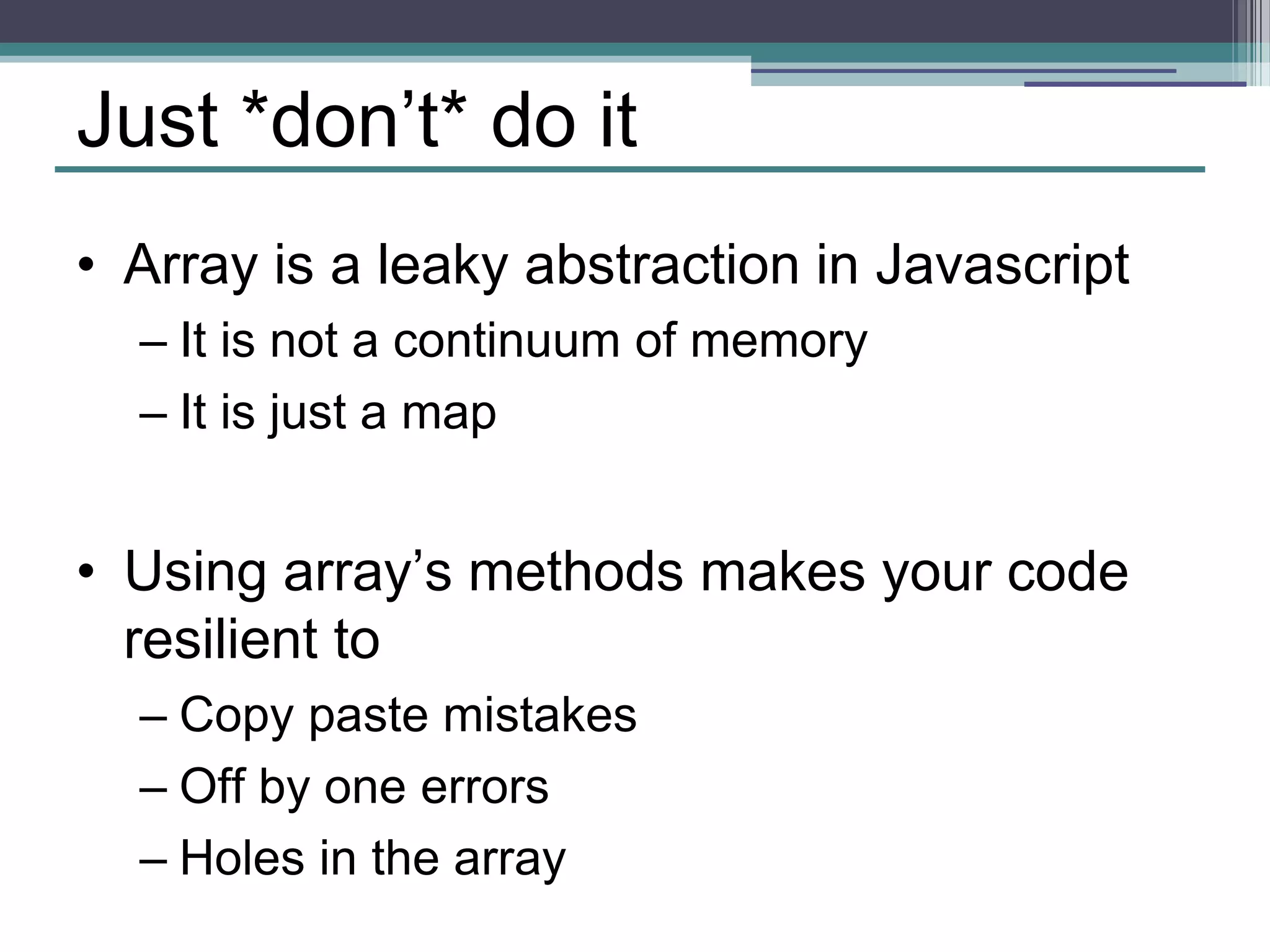
Just *don’t* do it • Array is a leaky abstraction in Javascript – It is not a continuum of memory – It is just a map • Using array’s methods makes your code resilient to – Copy paste mistakes – Off by one errors – Holes in the array
Looping over an array is a code smell in Javascript
Higher order functions • Receive function, return value • Receive value, return function
Receive value, return function • Composing a new function – Keep the received value in a closure – Return a new function that uses that value
Fanning out
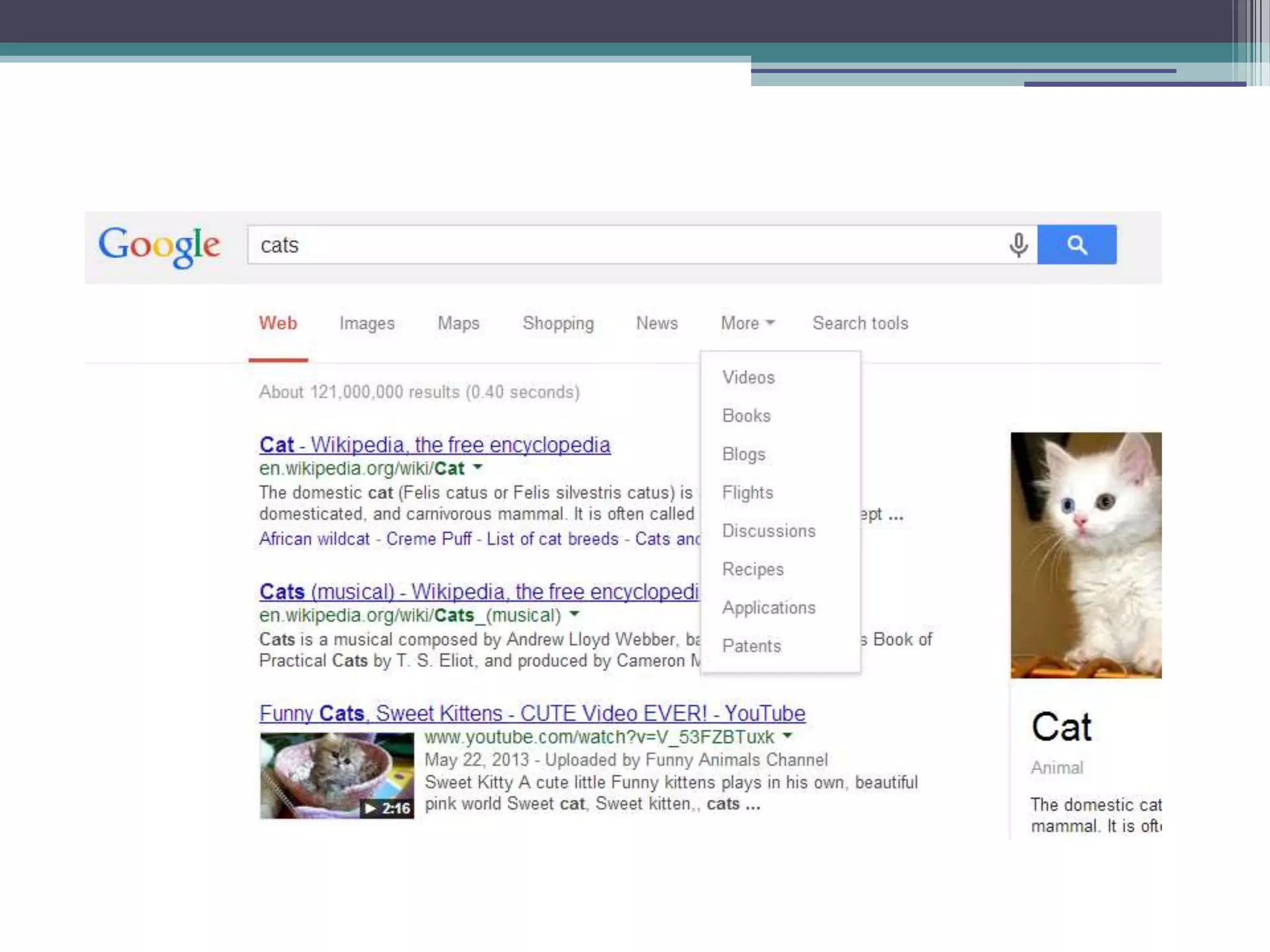
Fan out • Receives several functions • Return a fun-out function that – For a given input – Returns all the results of applying the previously given functions on that input
Fan out function fanOutMaker(/* fns*/){ var fns = arguments; return function(/* arguments */){ var res = []; for (var i=0,l=fns.length;i<l;i++){ res.push(fns[i].apply(null, arguments)); } return res; } }
Fan out function fanOutMaker(/* fns*/){ var fns = arguments; return function(/* arguments */){ var res = []; for (var i=0,l=fns.length;i<l;i++){ res.push(fns[i].apply(null, arguments)); } return res; } } Not the same
Fan out function fanOutMaker(/* fns*/){ var fns = arguments; return function(/* arguments */){ var res = []; for (var i=0,l=fns.length;i<l;i++){ res.push(fns[i].apply(null, arguments)); } return res; } } Call each of the closured fns with current argument
Today • About functional programming • A little about Javascript • Deep dive into the combination of the two – Inner functions and closures – Higher order functions – Decomplecting calls patterns
Decomplecting calls patterns
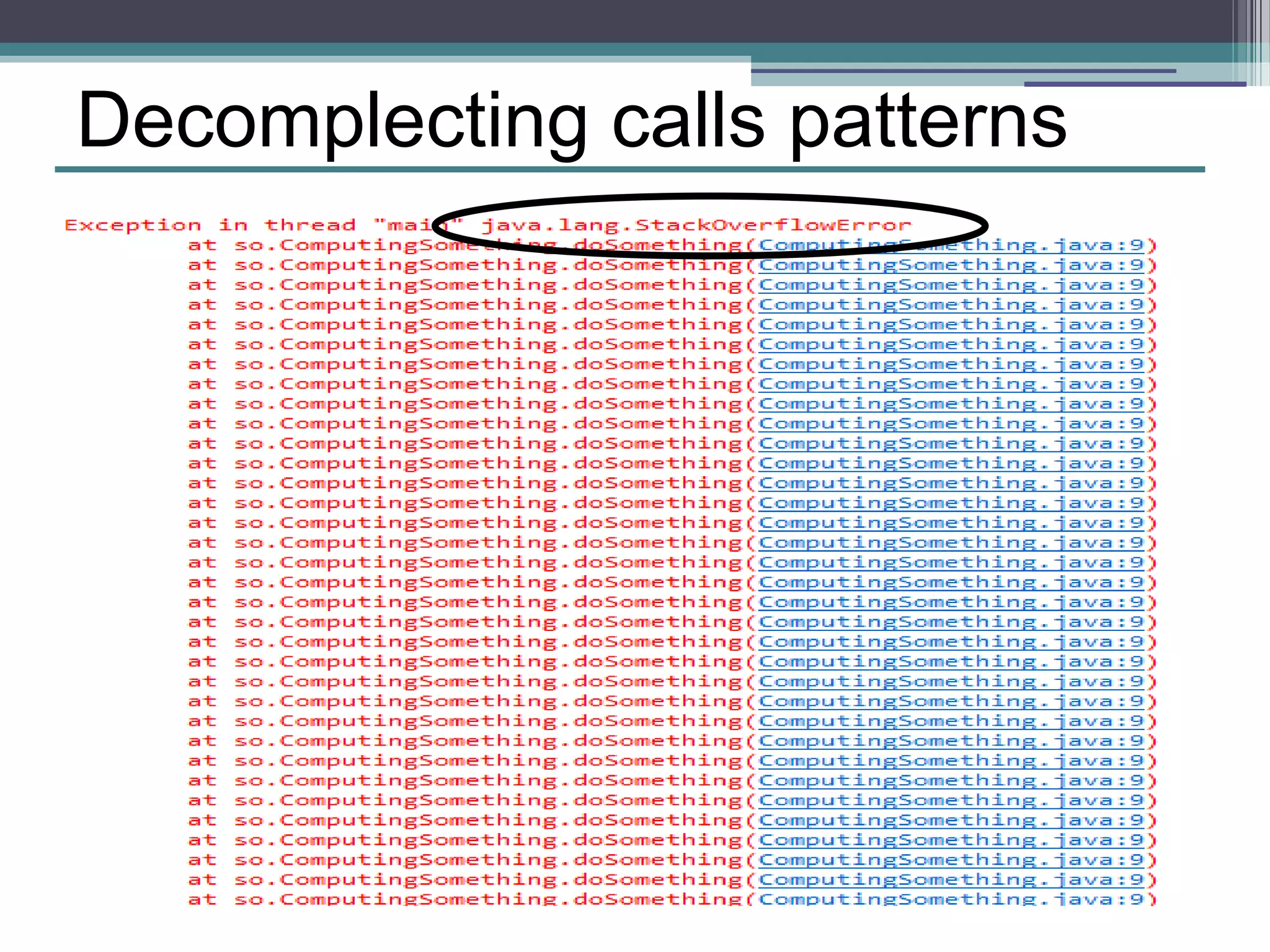
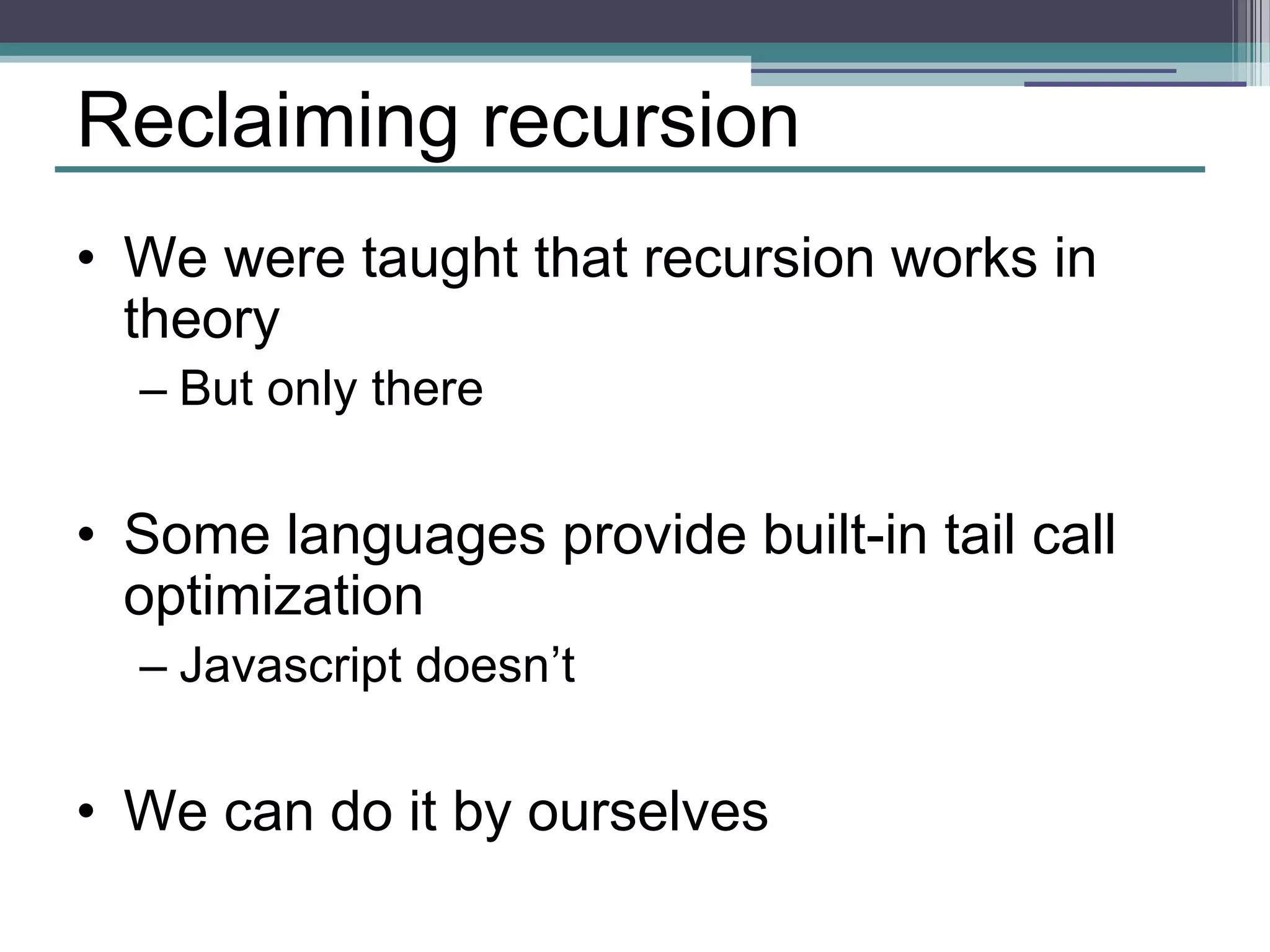
Reclaiming recursion • We were taught that recursion works in theory – But only there • Some languages provide built-in tail call optimization – Javascript doesn’t • We can do it by ourselves
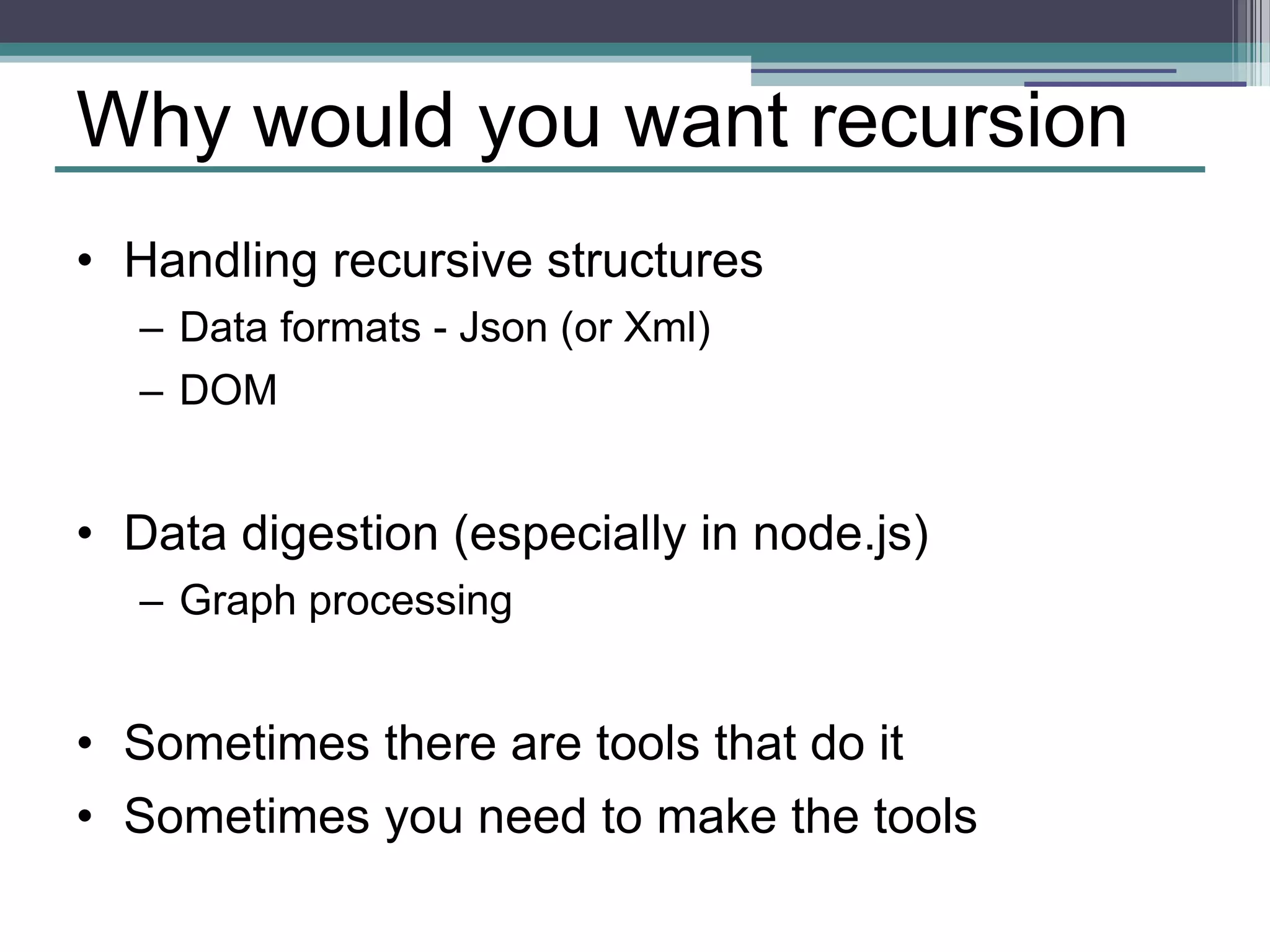
Why would you want recursion • Handling recursive structures – Data formats - Json (or Xml) – DOM • Data digestion (especially in node.js) – Graph processing • Sometimes there are tools that do it • Sometimes you need to make the tools
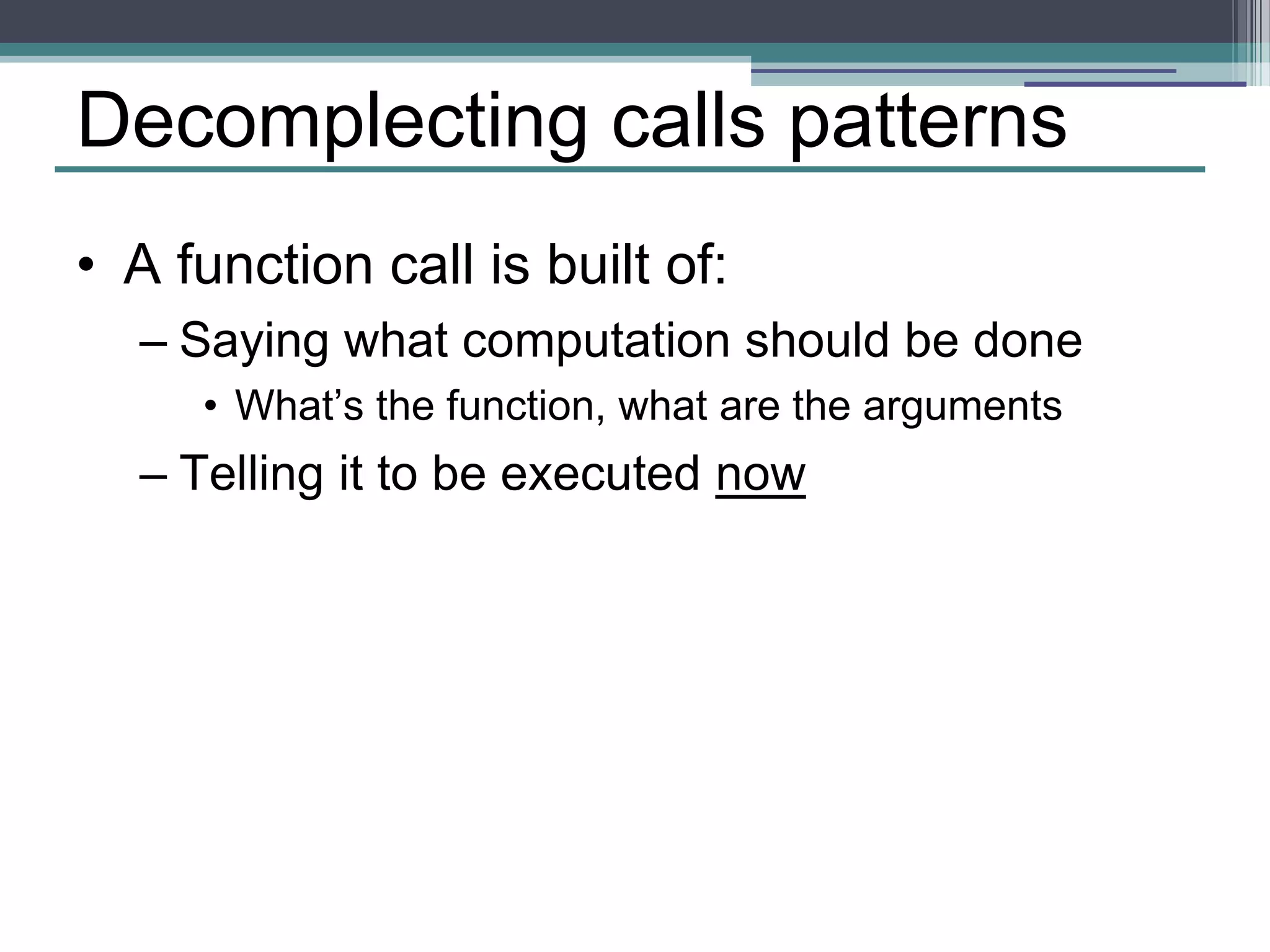
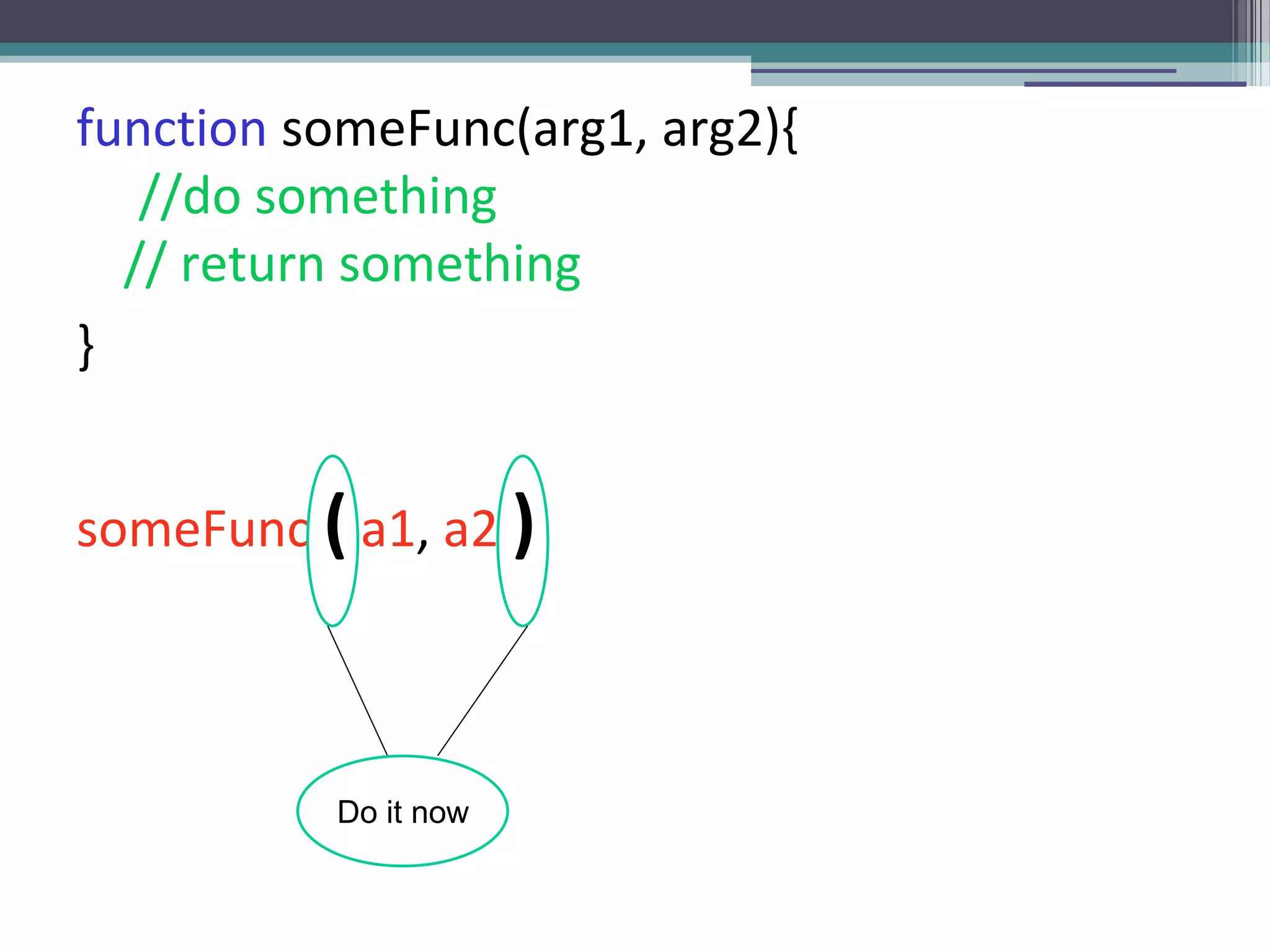
Decomplecting calls patterns • A function call is built of: – Saying what computation should be done • What’s the function, what are the arguments – Telling it to be executed now
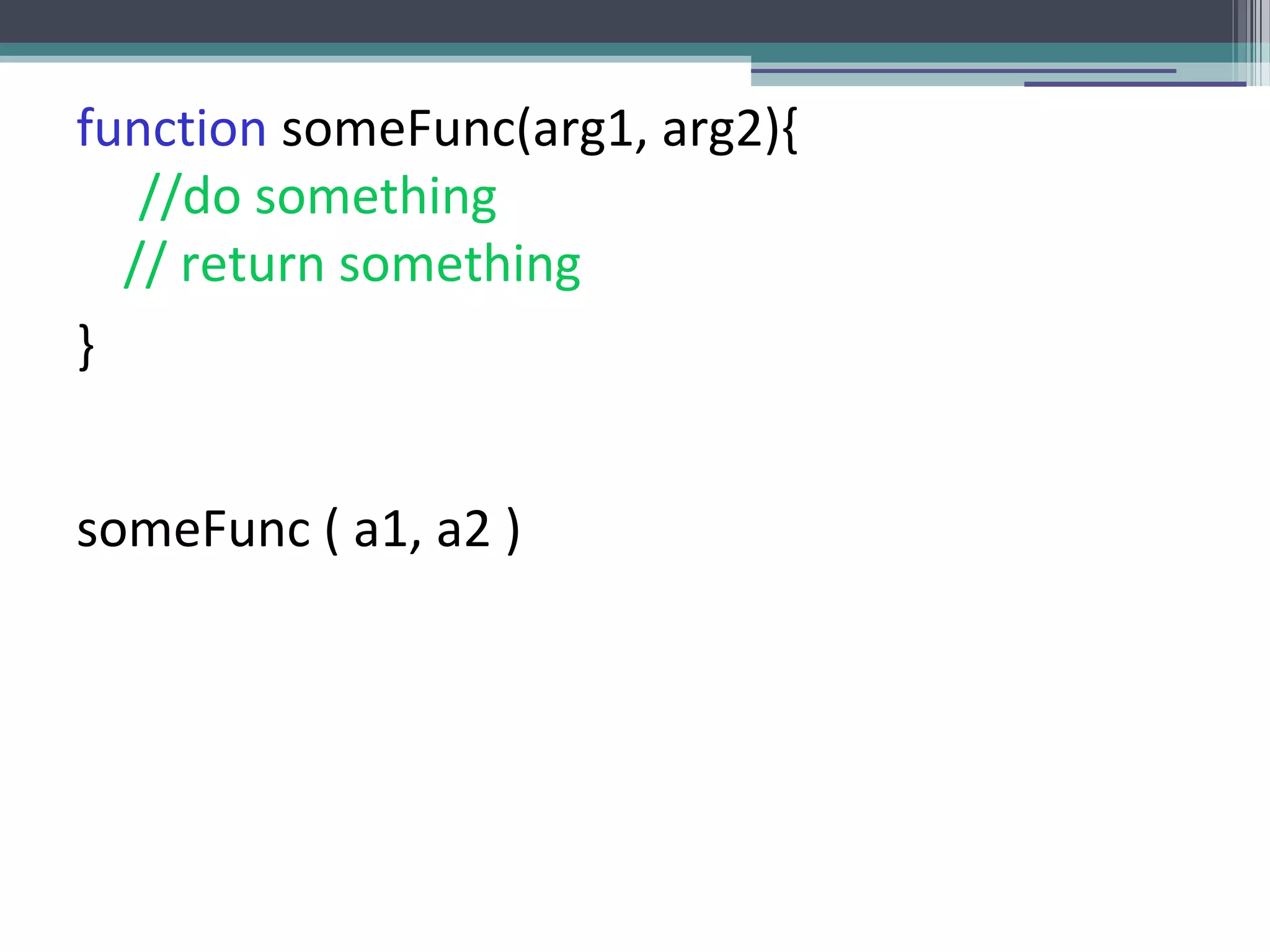
function someFunc(arg1, arg2){ //do something // return something } someFunc ( a1, a2 )
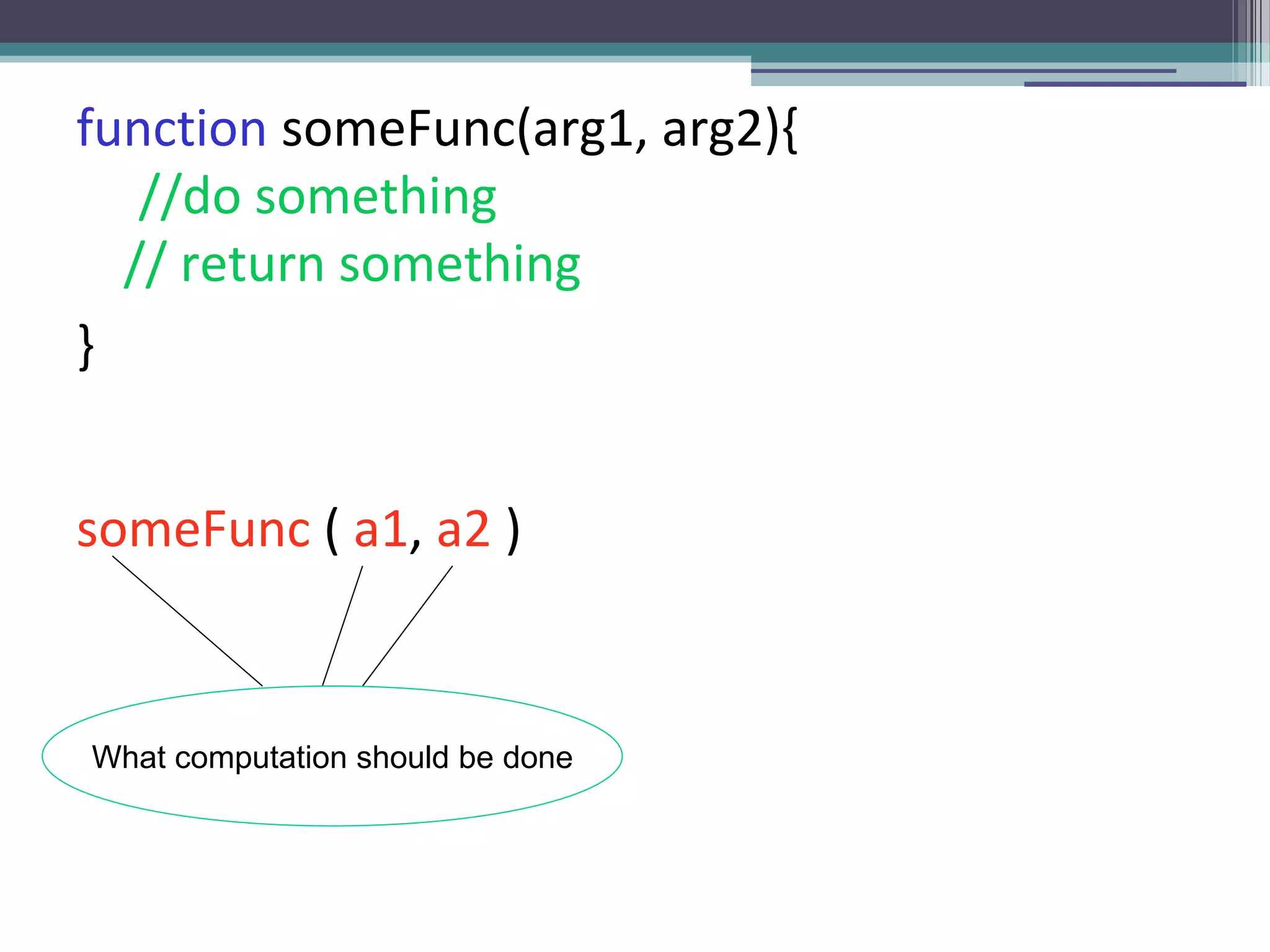
function someFunc(arg1, arg2){ //do something // return something } someFunc ( a1, a2 ) What computation should be done
function someFunc(arg1, arg2){ //do something // return something } someFunc ( a1, a2 ) Do it now
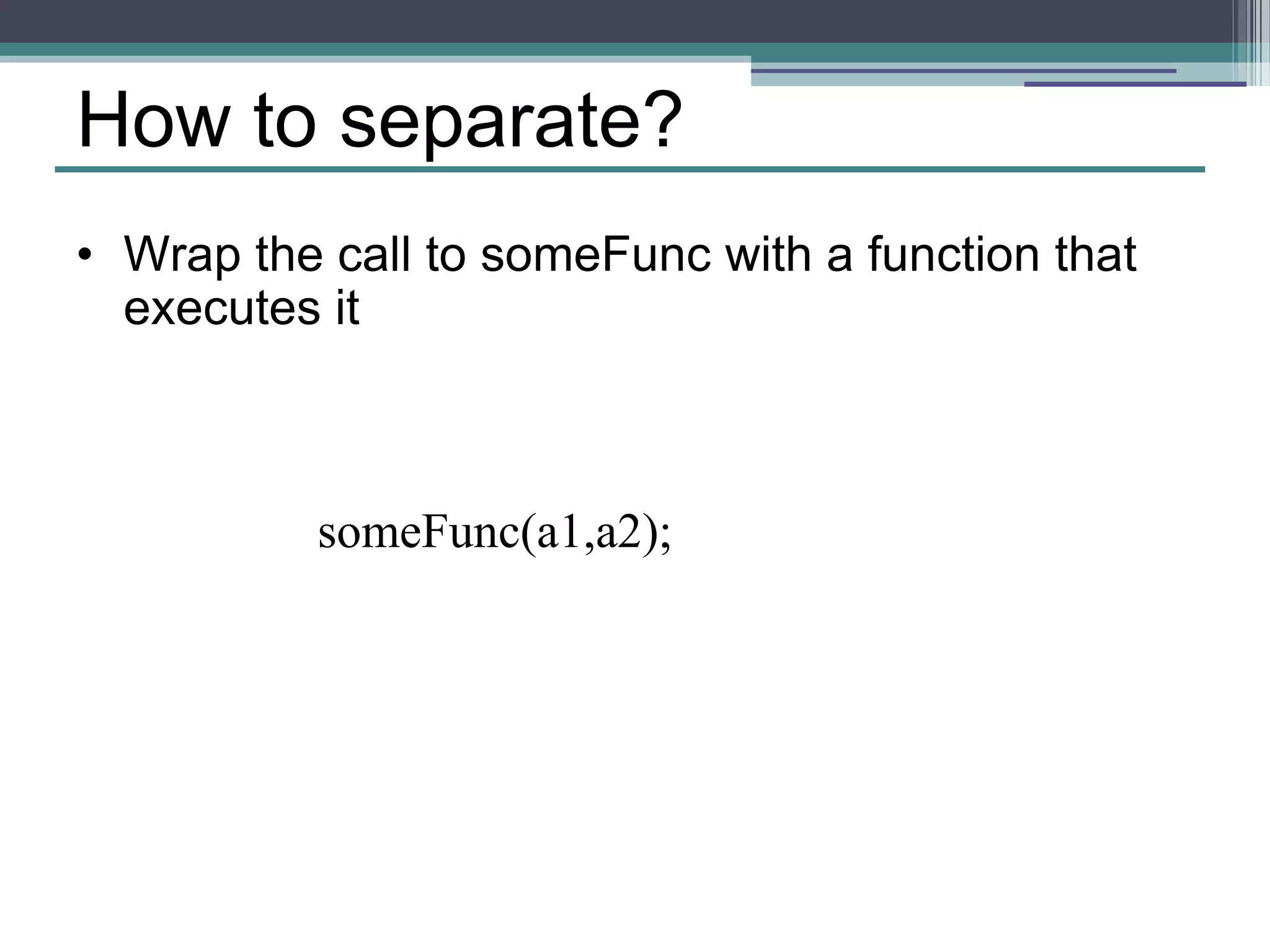
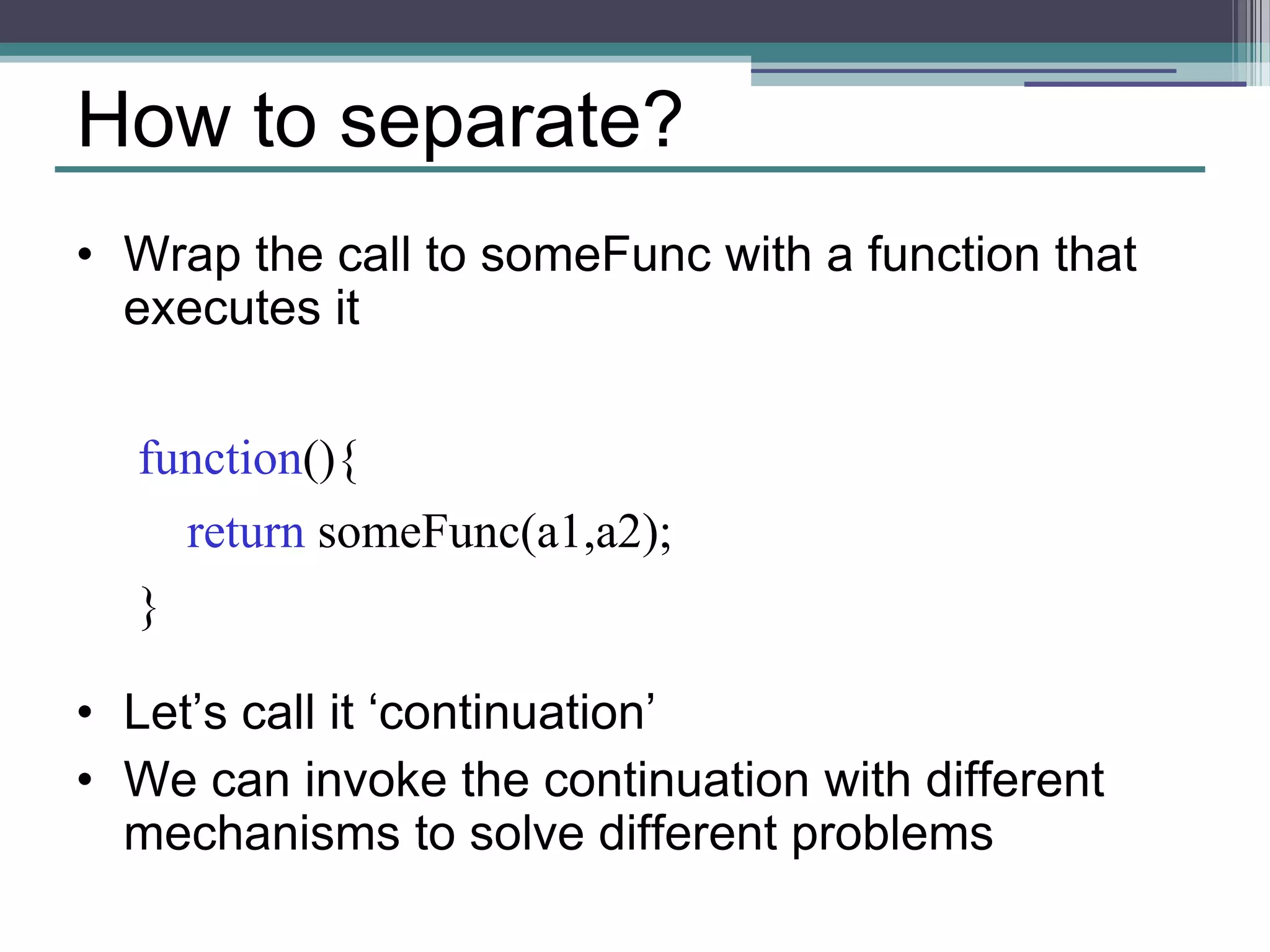
How to separate? • Wrap the call to someFunc with a function that executes it function(){ return someFunc(a1,a2); } Let’s call it ‘continuation’ We can invoke the continuation with different mechanisms
How to separate? • Wrap the call to someFunc with a function that executes it function(){ return someFunc(a1,a2); } • Let’s call it ‘continuation’ • We can invoke the continuation with different mechanisms to solve different problems
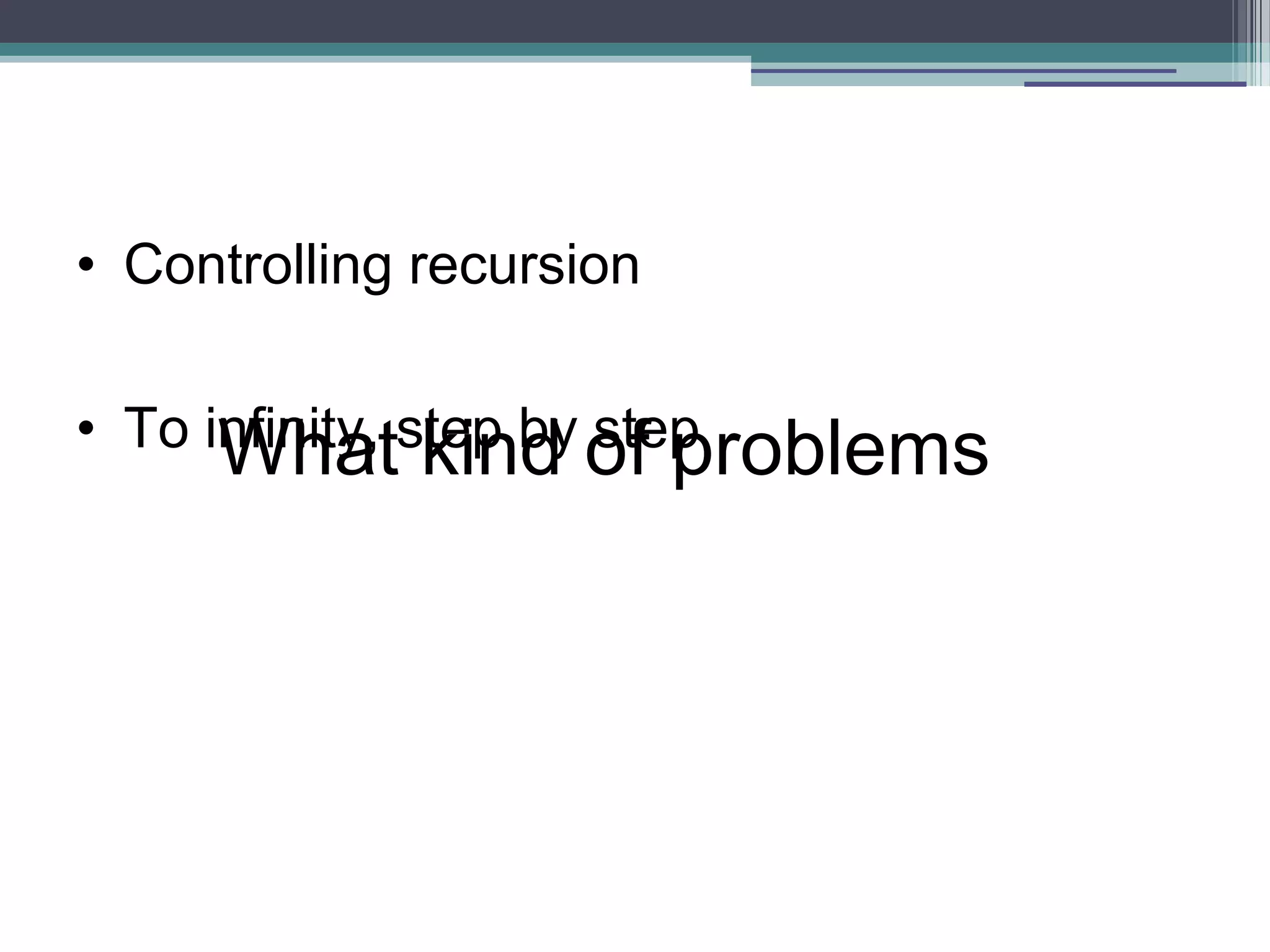
• Controlling recursion • To inWfinhitay,t s kteipn bdy ostfe pproblems
What kind of problems • Controlling recursion • To infinity, step by step
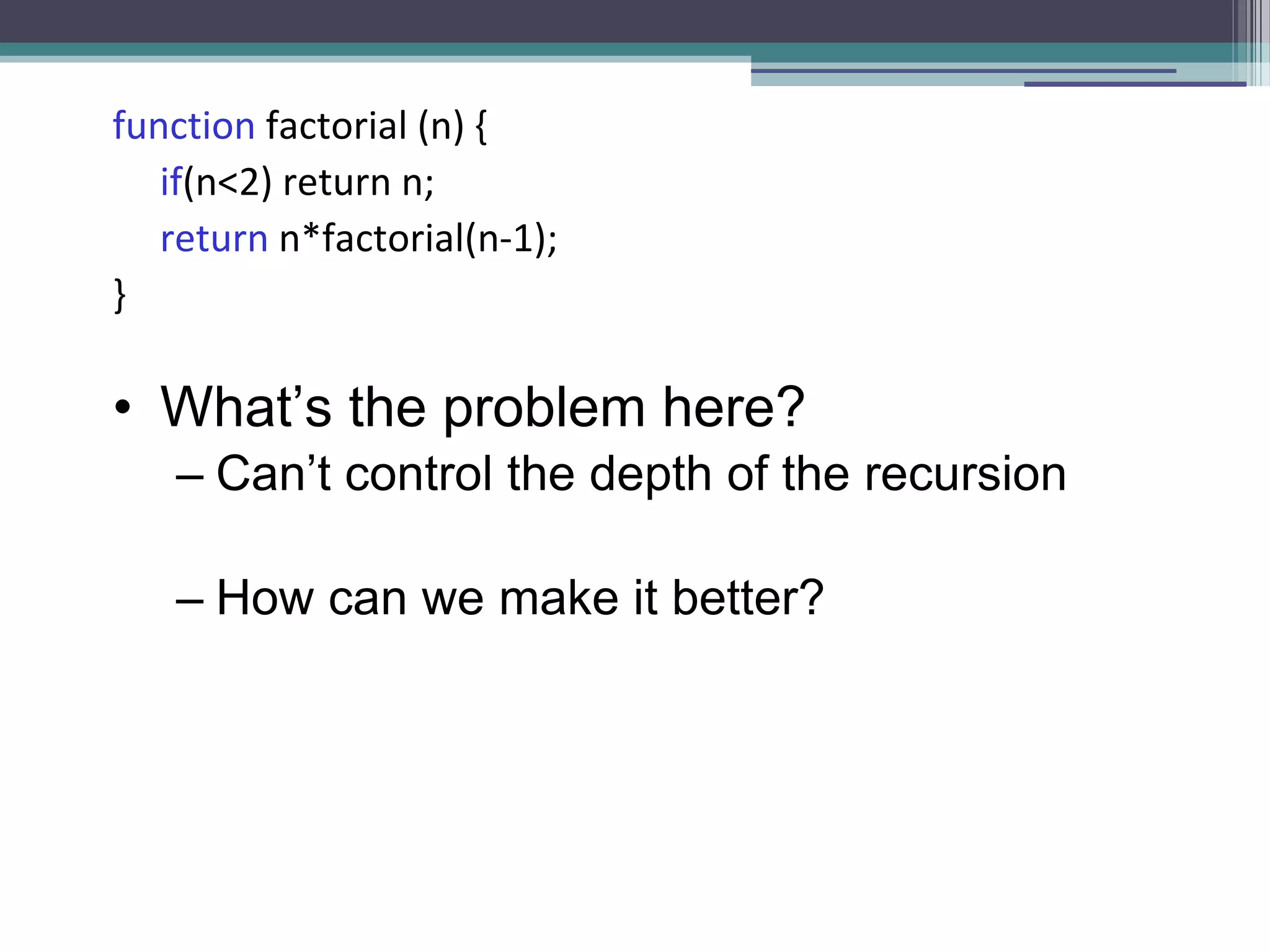
function factorial (n) { if(n<2) return n; return n*factorial(n-1); } • What’s the problem here? – Can’t control the depth of the recursion – How can we make it better?
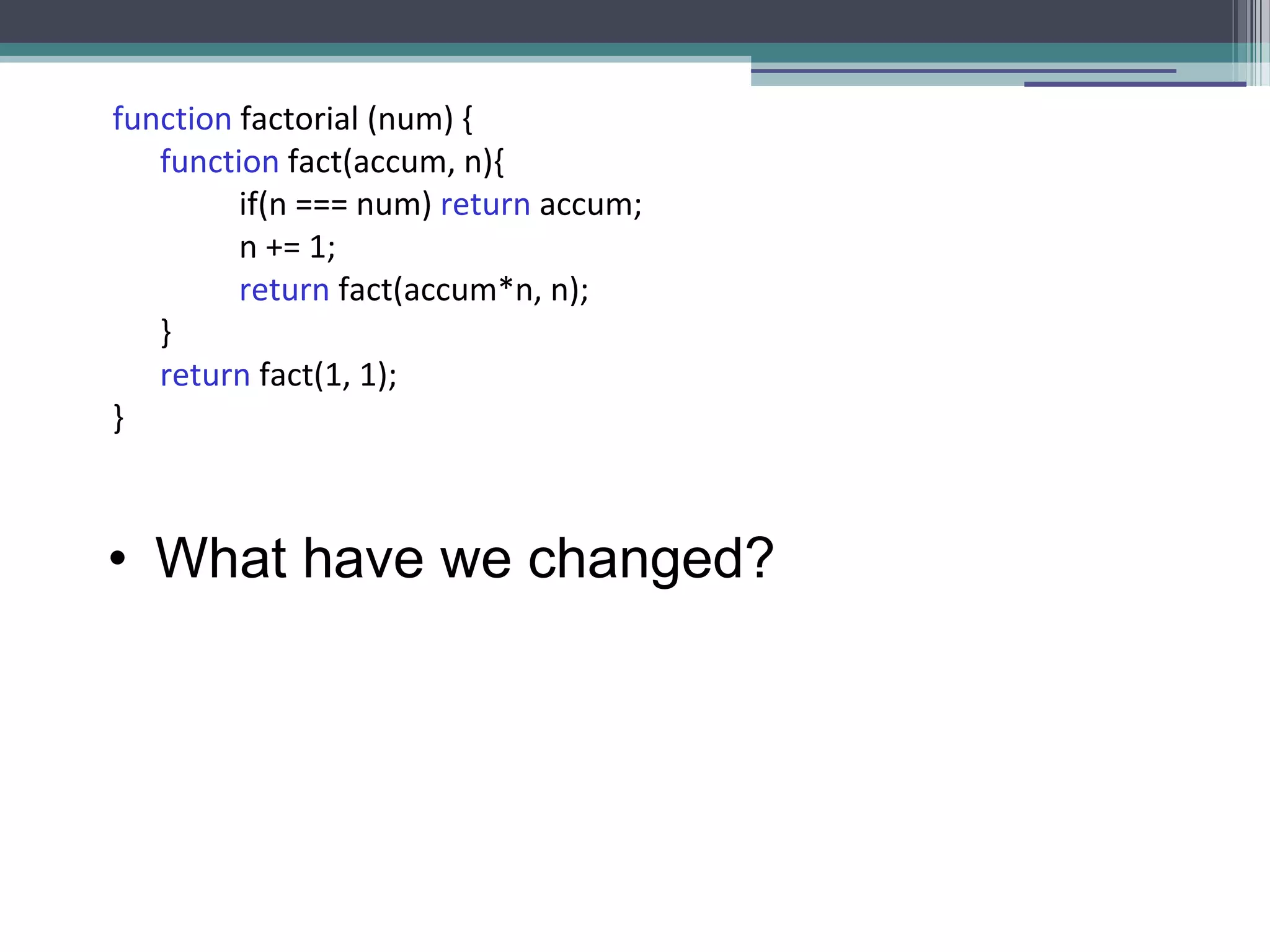
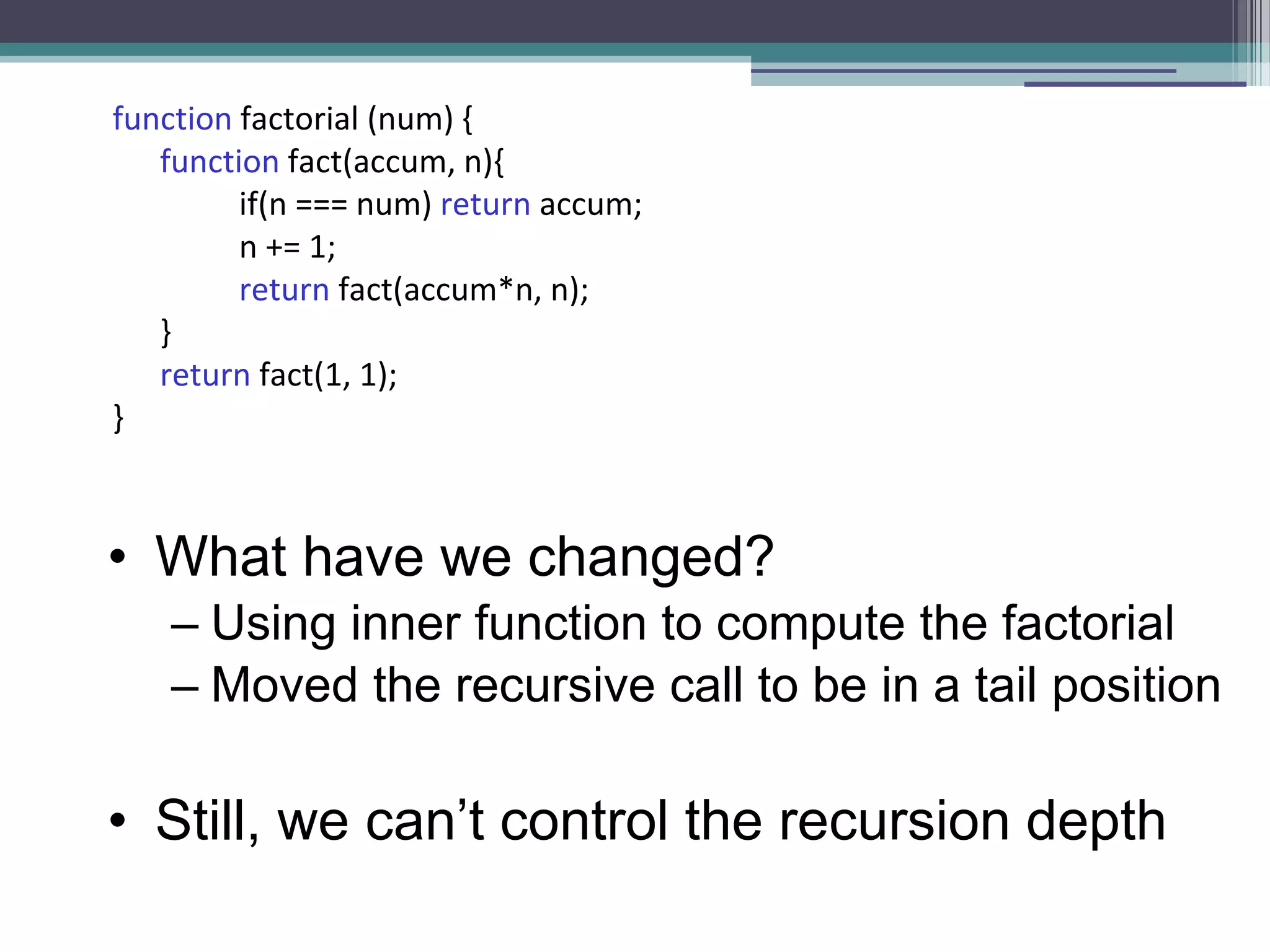
function factorial (num) { function fact(accum, n){ if(n === num) return accum; n += 1; return fact(accum*n, n); } return fact(1, 1); } • What have we changed?
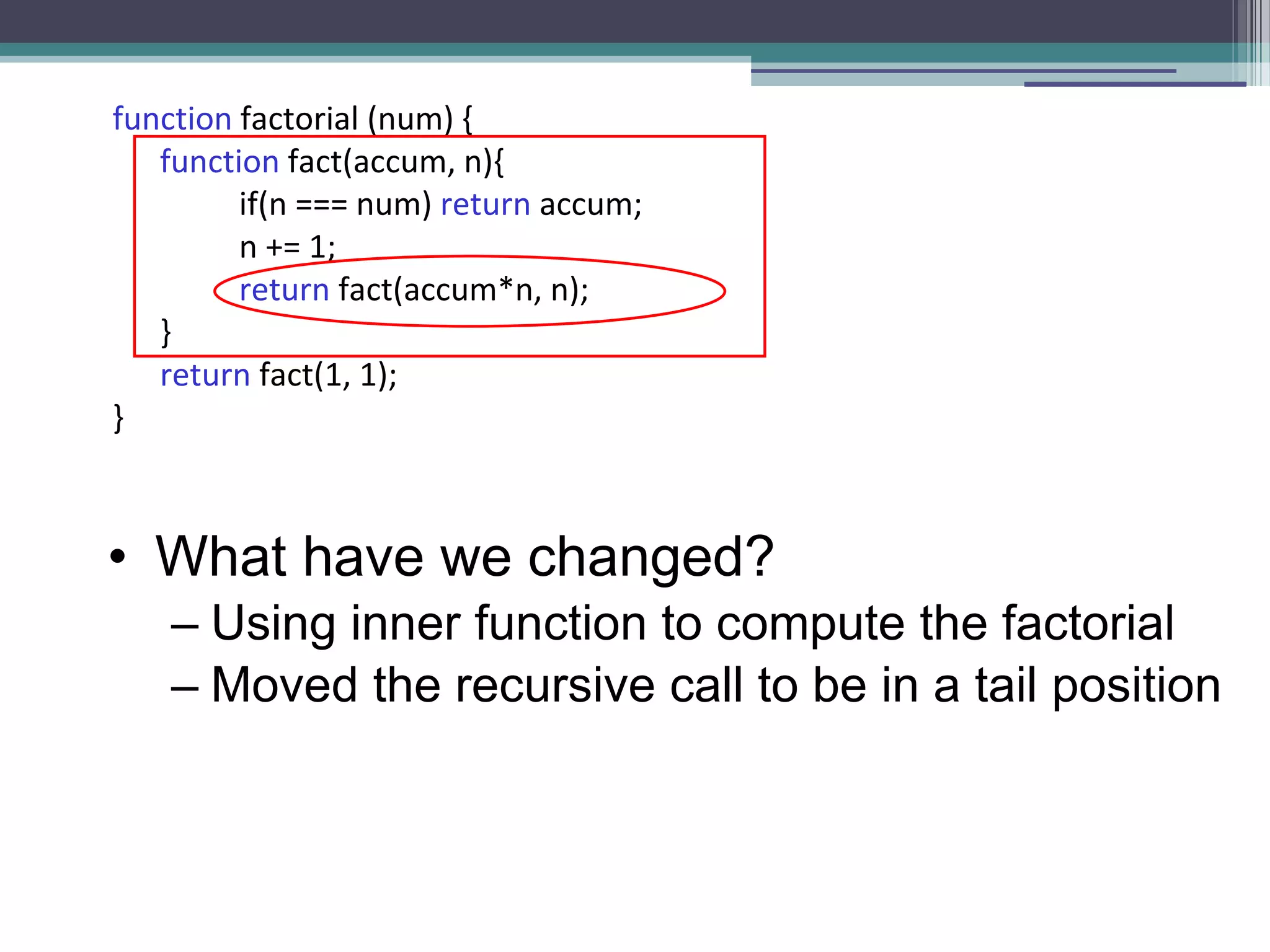
function factorial (num) { function fact(accum, n){ if(n === num) return accum; n += 1; return fact(accum*n, n); } return fact(1, 1); } • What have we changed? – Using inner function to compute the factorial – Moved the recursive call to be in a tail position
function factorial (num) { function fact(accum, n){ if(n === num) return accum; n += 1; return fact(accum*n, n); } return fact(1, 1); } • What have we changed? – Using inner function to compute the factorial – Moved the recursive call to be in a tail position • Still, we can’t control the recursion depth
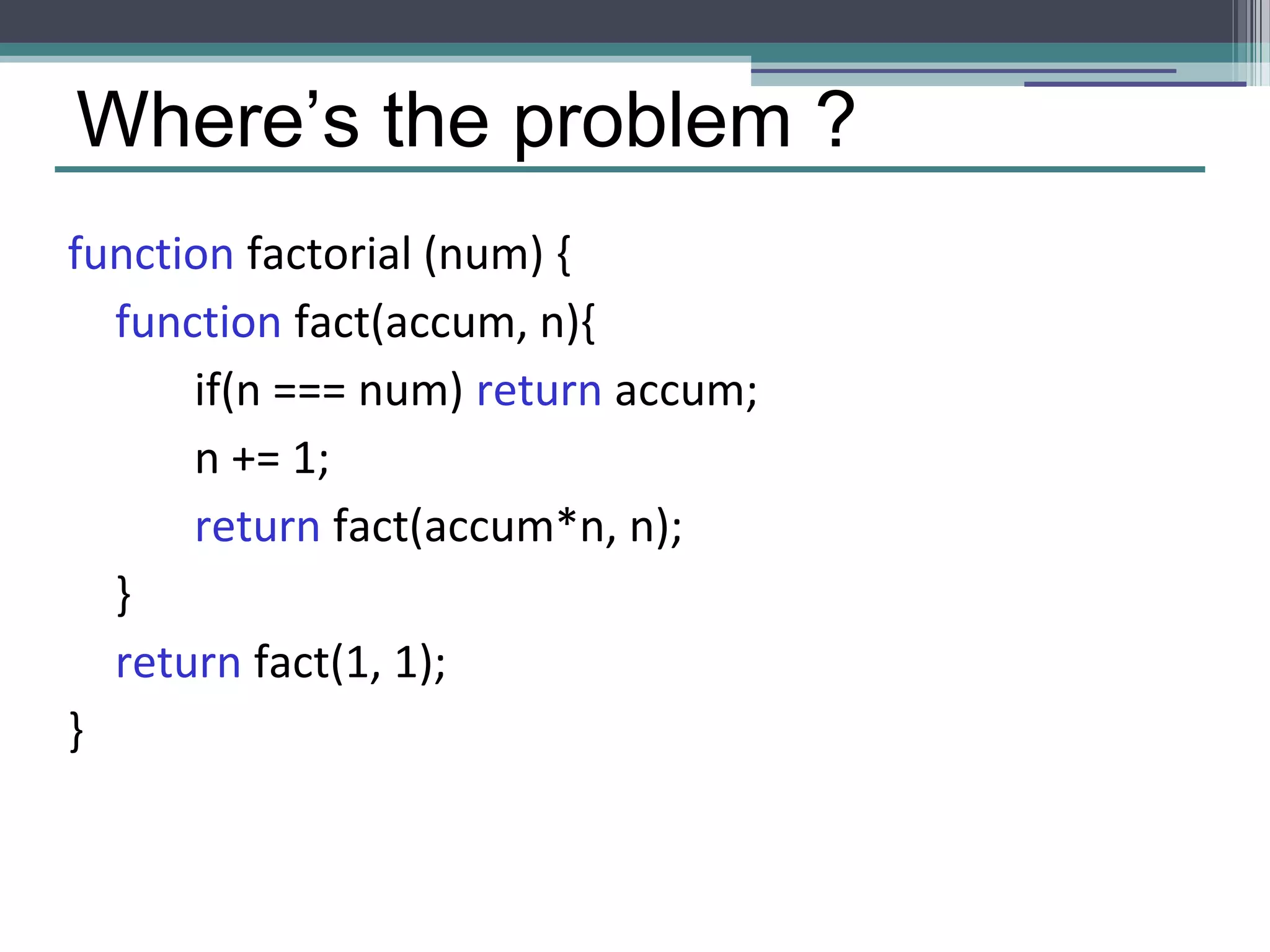
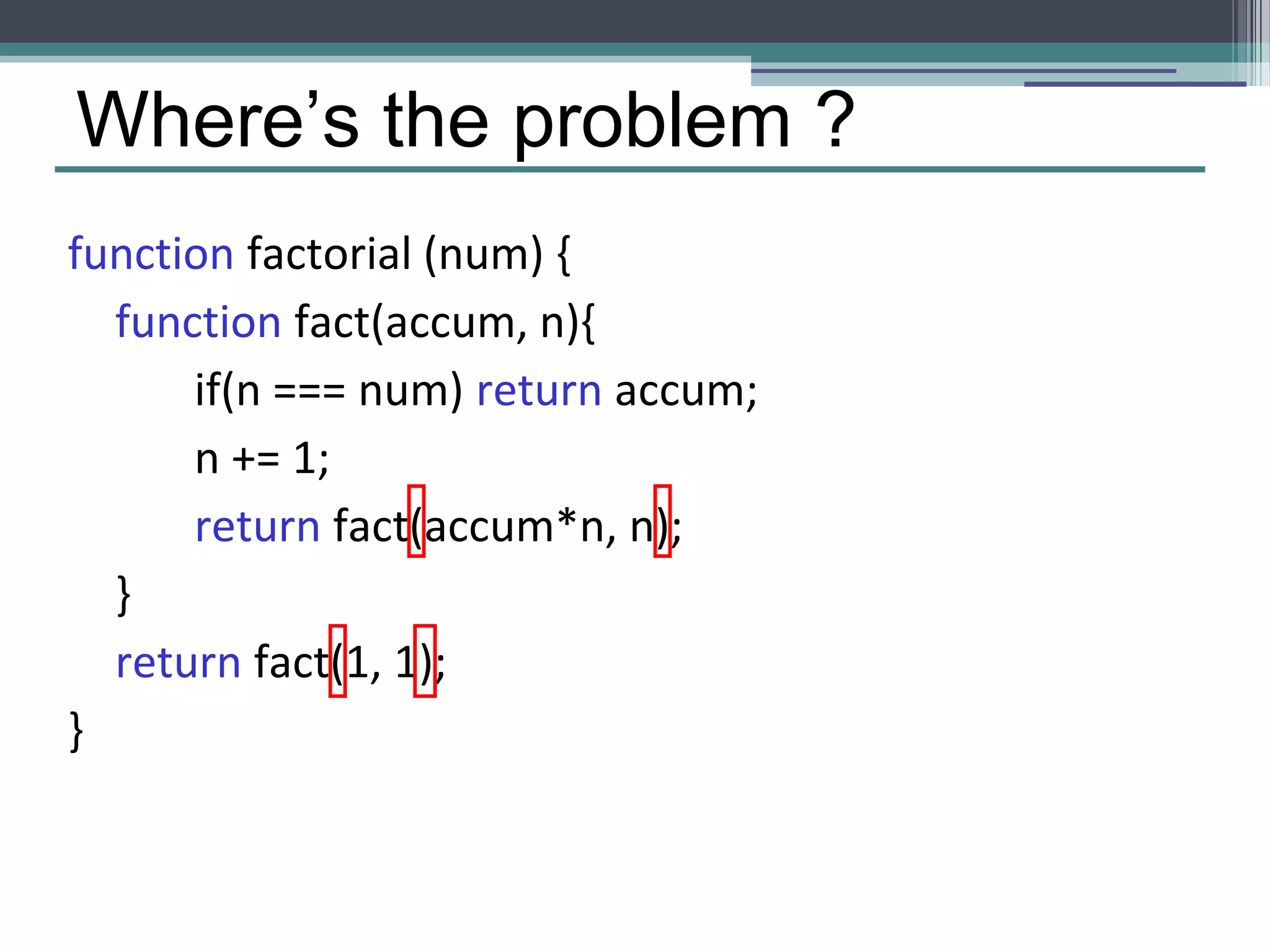
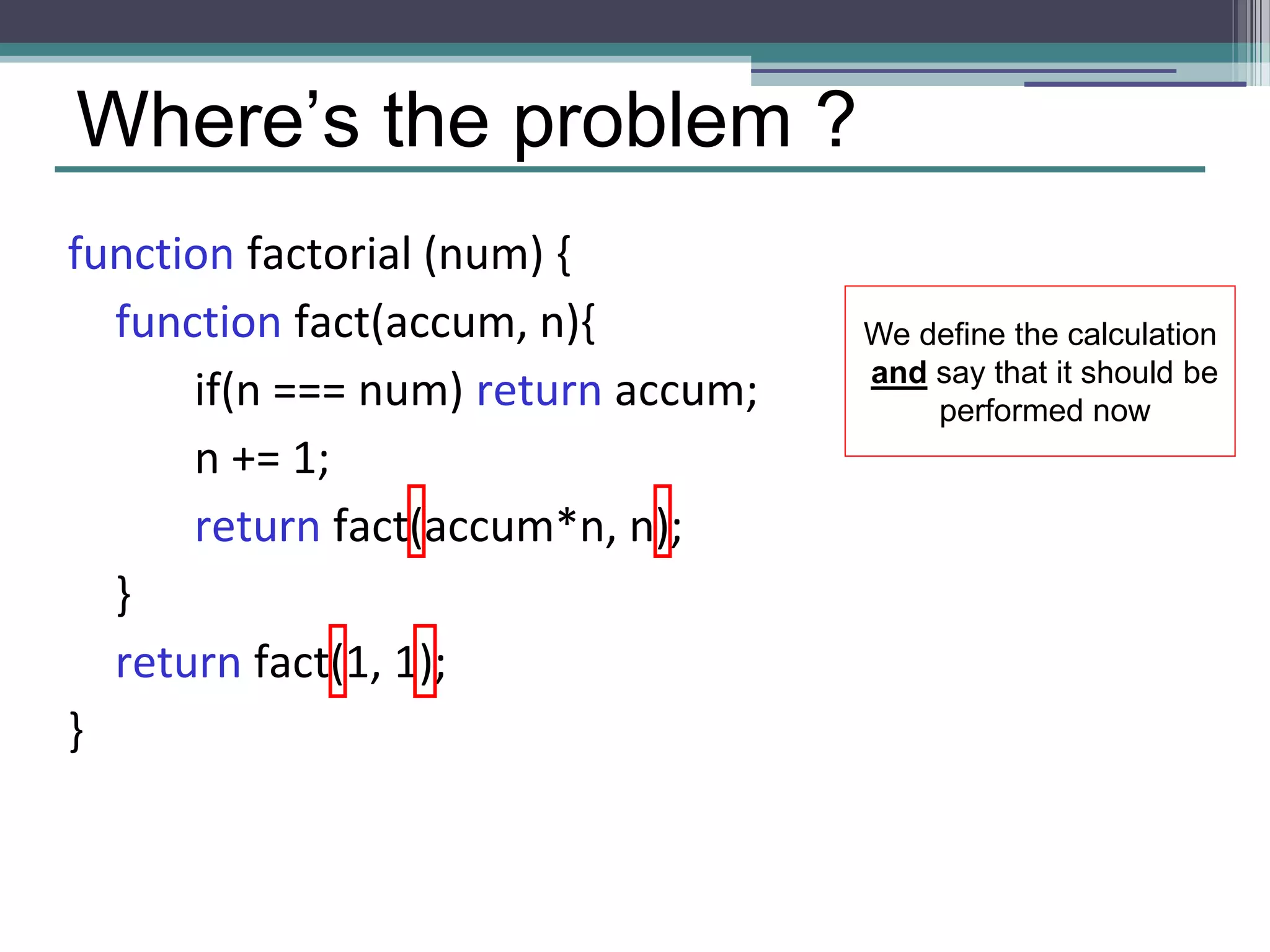
Where’s the problem ? function factorial (num) { function fact(accum, n){ if(n === num) return accum; n += 1; return fact(accum*n, n); } return fact(1, 1); }
Where’s the problem ? function factorial (num) { function fact(accum, n){ if(n === num) return accum; n += 1; return fact(accum*n, n); } return fact(1, 1); } We define the calculation and say that it should be performed now
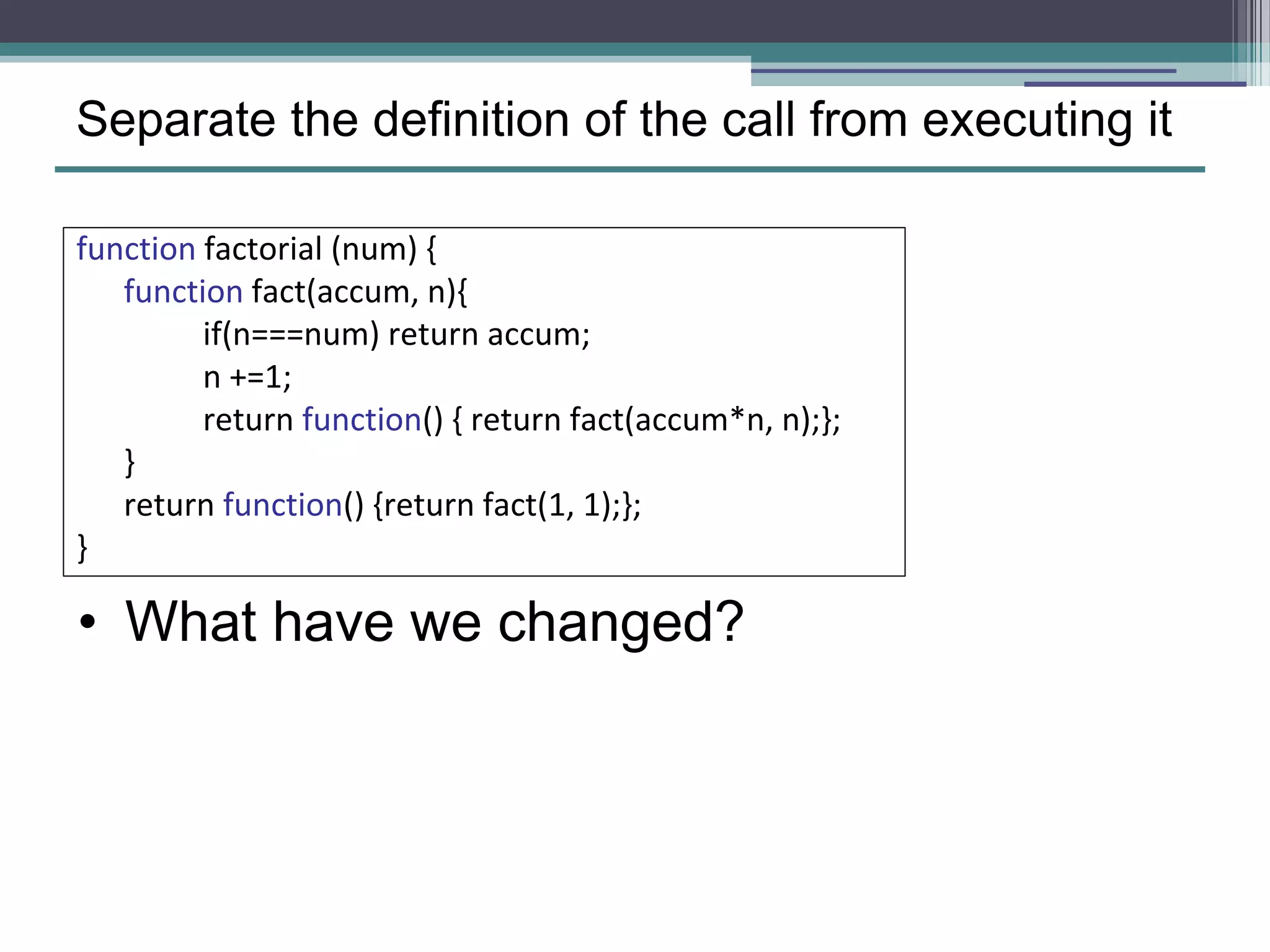
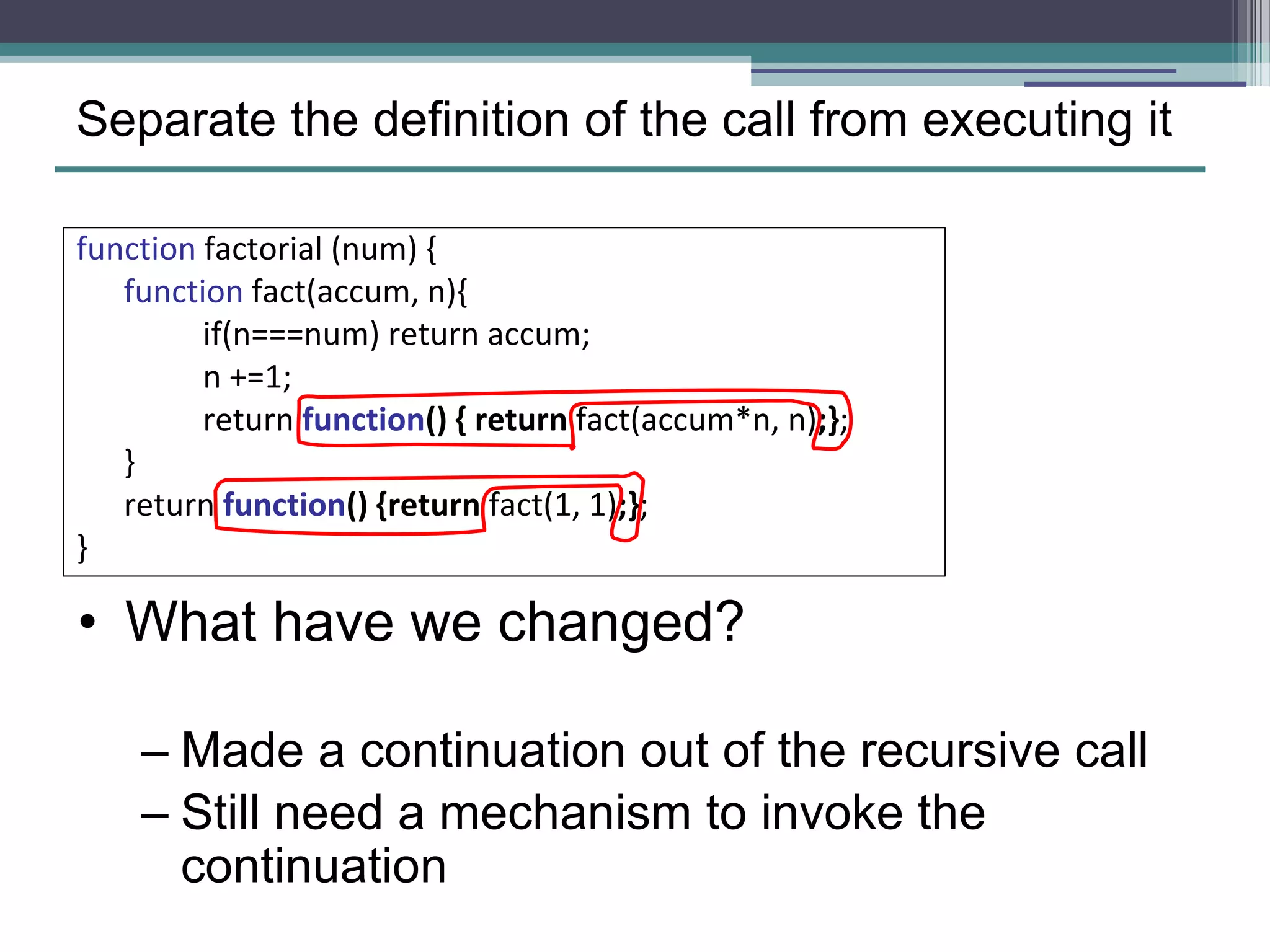
Separate the definition of the call from executing it function factorial (num) { function fact(accum, n){ if(n===num) return accum; n +=1; return function() { return fact(accum*n, n);}; } return function() {return fact(1, 1);}; } • What have we changed? Made a continuation out of the recursive call Still need a mechanism to invoke the continuation
Separate the definition of the call from executing it function factorial (num) { function fact(accum, n){ if(n===num) return accum; n +=1; return function() { return fact(accum*n, n);}; } return function() {return fact(1, 1);}; } • What have we changed? – Made a continuation out of the recursive call – Still need a mechanism to invoke the continuation
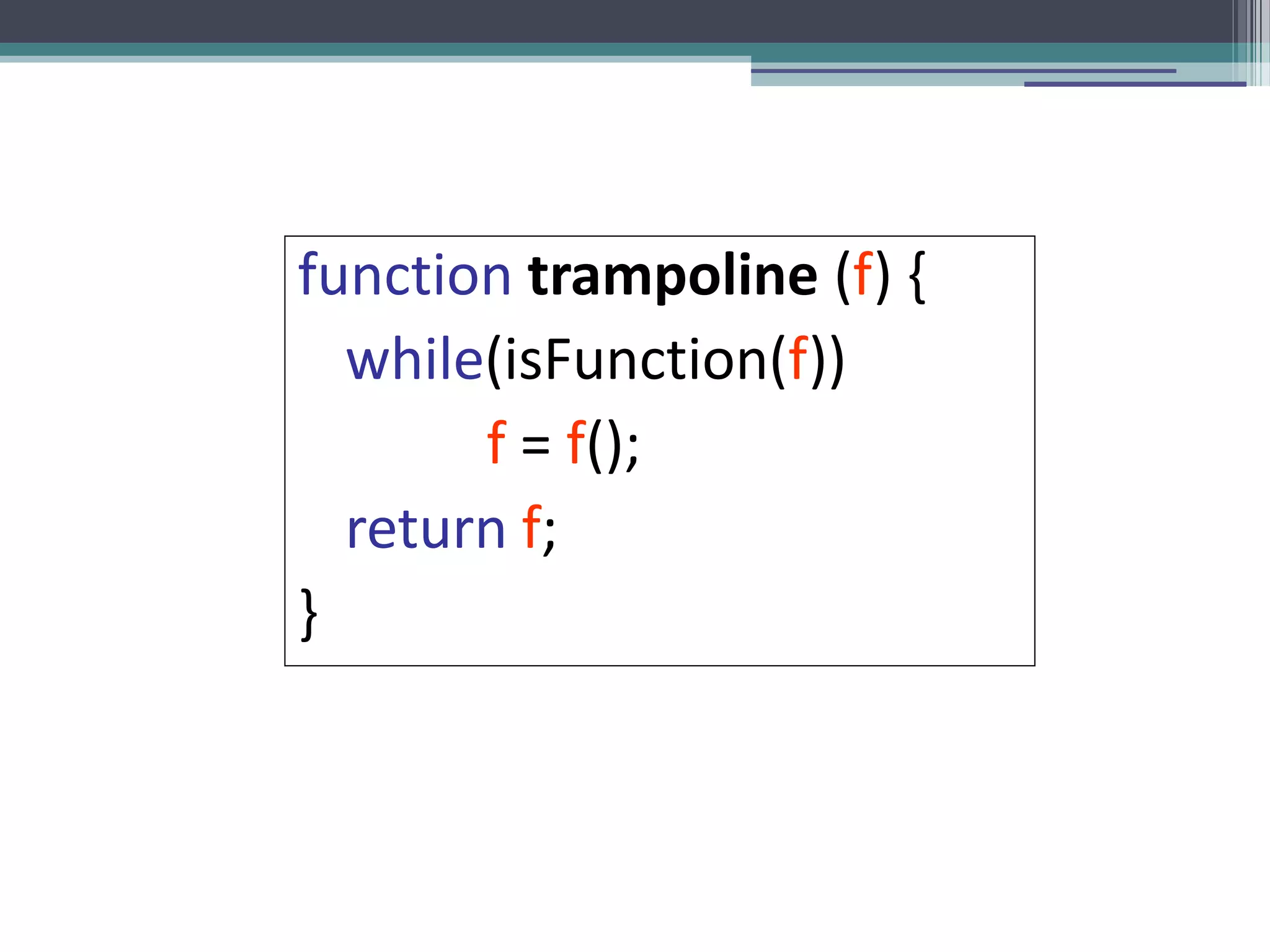
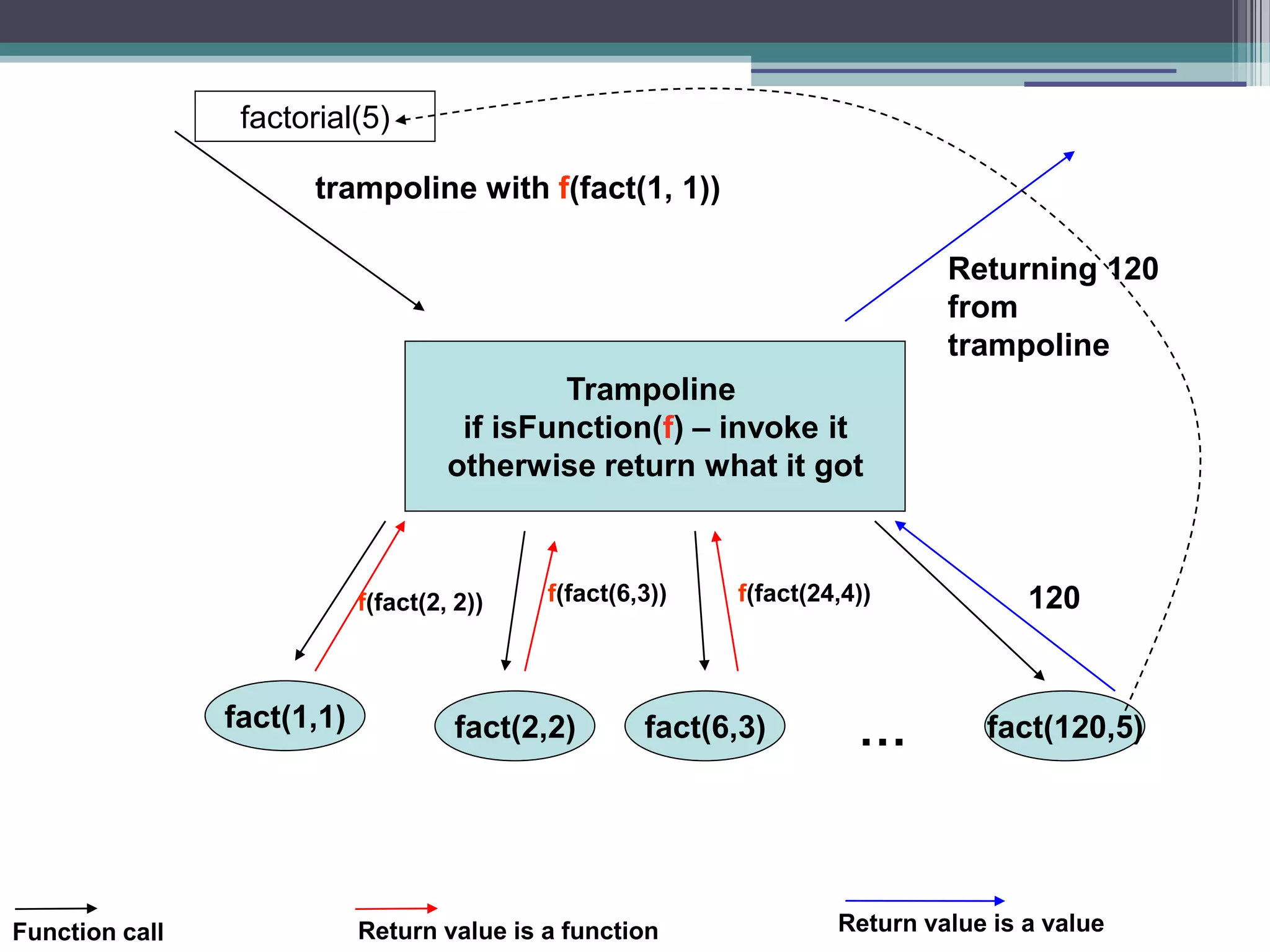
function trampoline (f) { while(isFunction(f)) f = f(); return f; }
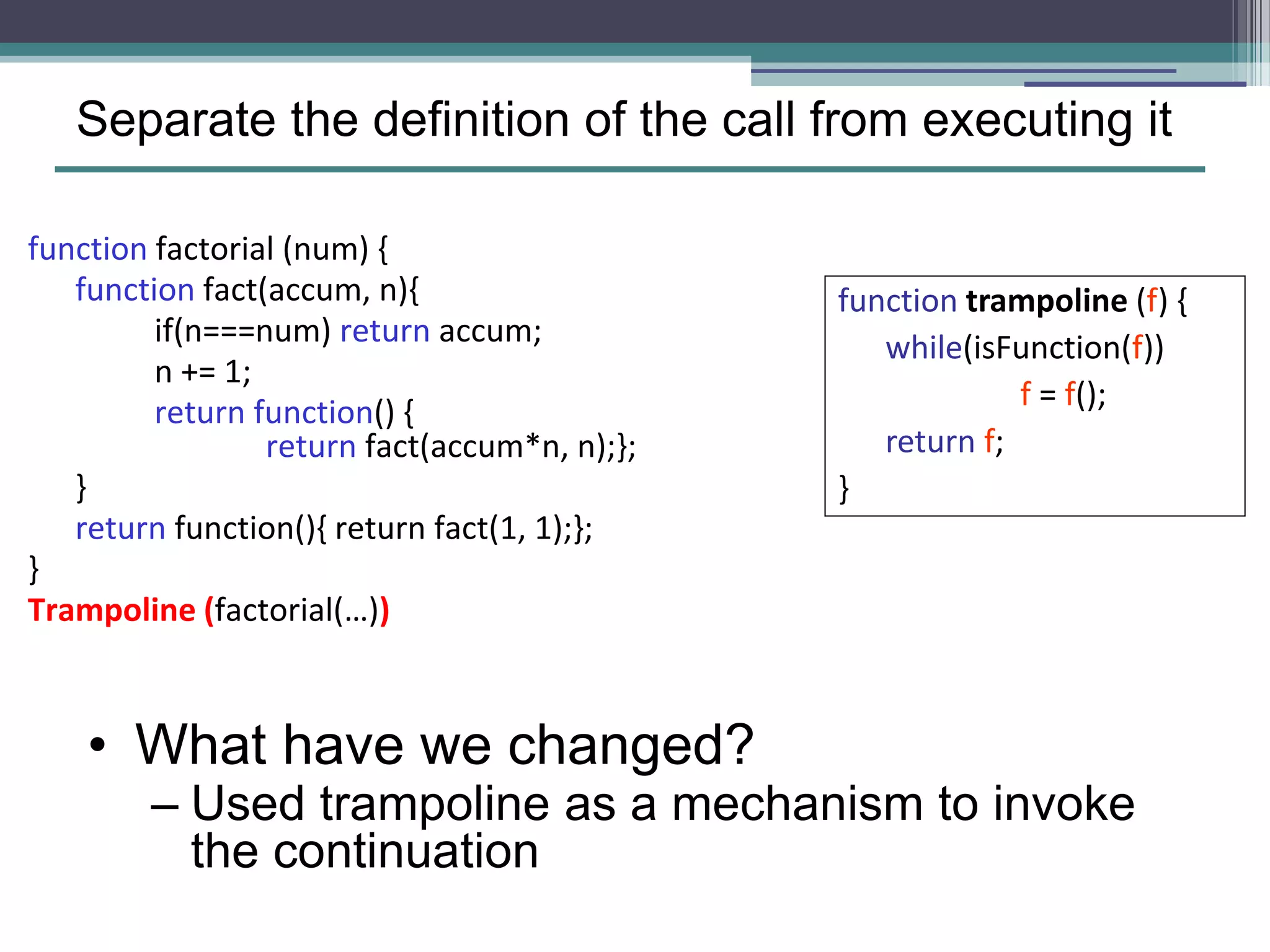
Separate the definition of the call from executing it function factorial (num) { function fact(accum, n){ if(n===num) return accum; n += 1; return function() { return fact(accum*n, n);}; } return function(){ return fact(1, 1);}; } Trampoline (factorial(…)) • What have we changed? function trampoline (f) { while(isFunction(f)) f = f(); return f; } – Used trampoline as a mechanism to invoke the continuation
factorial(5) trampoline with f(fact(1, 1)) Trampoline if isFunction(f) – invoke it otherwise return what it got f(fact(2, 2)) f(fact(6,3)) fact(1,1) fact(2,2) fact(6,3) … fact(120,5) Return value is a function Returning 120 from trampoline f(fact(24,4)) 120 Function call Return value is a value
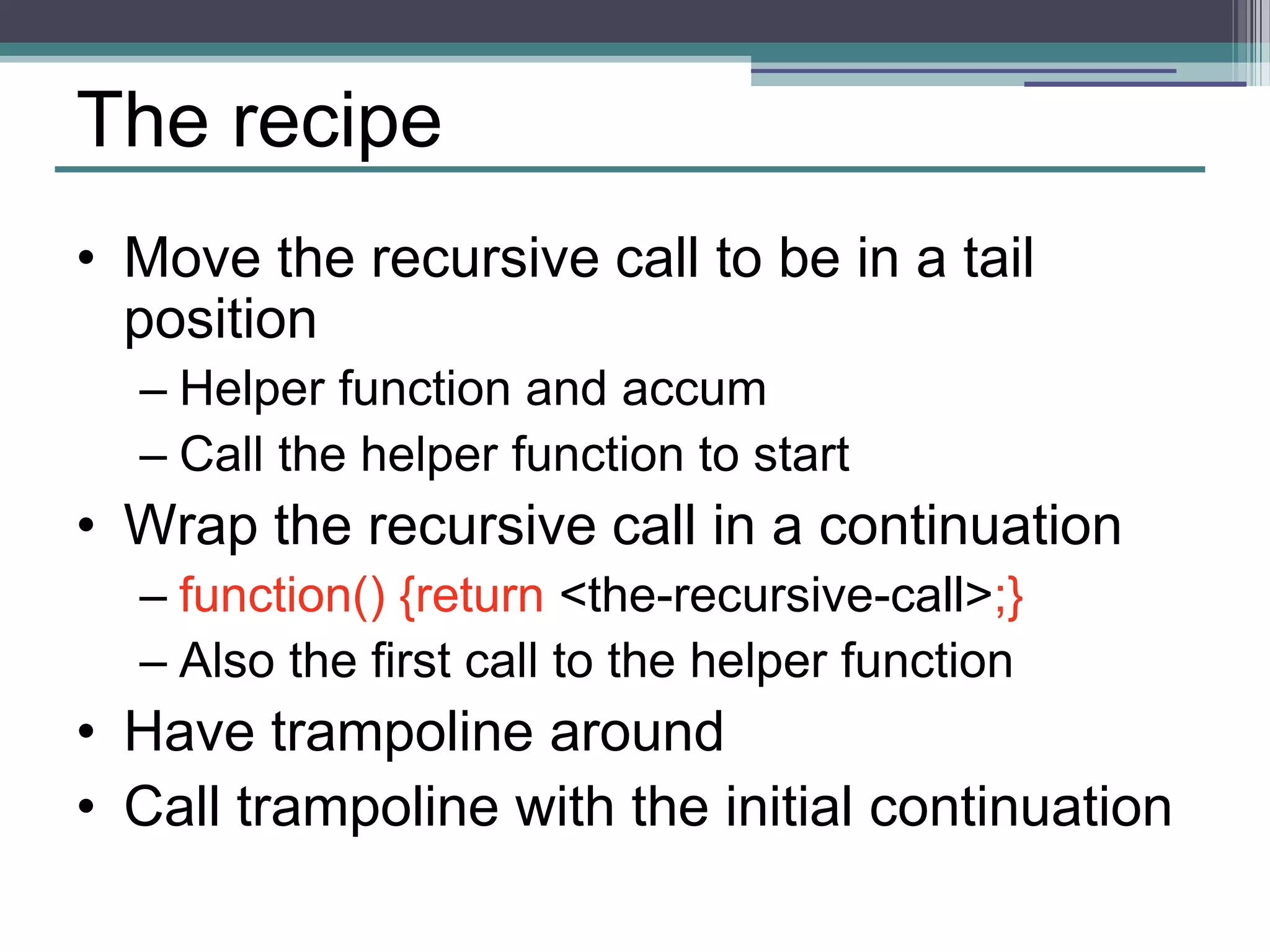
The recipe • Move the recursive call to be in a tail position – Helper function and accum – Call the helper function to start • Wrap the recursive call in a continuation – function() {return <the-recursive-call>;} – Also the first call to the helper function • Have trampoline around • Call trampoline with the initial continuation
What is it good for? • Controlling recursion • To infinity, step by step
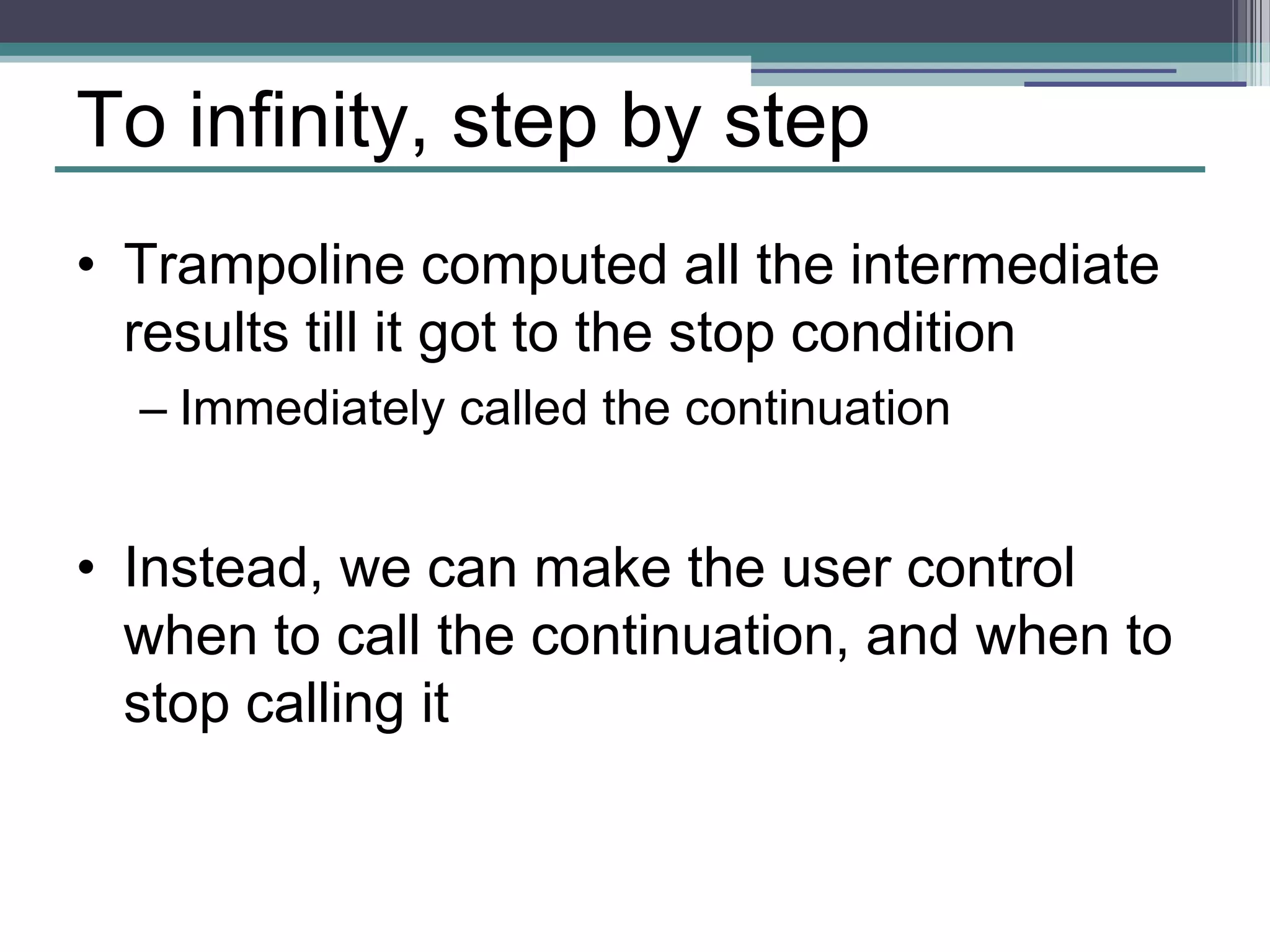
To infinity, step by step • Trampoline computed all the intermediate results till it got to the stop condition – Immediately called the continuation • Instead, we can make the user control when to call the continuation, and when to stop calling it
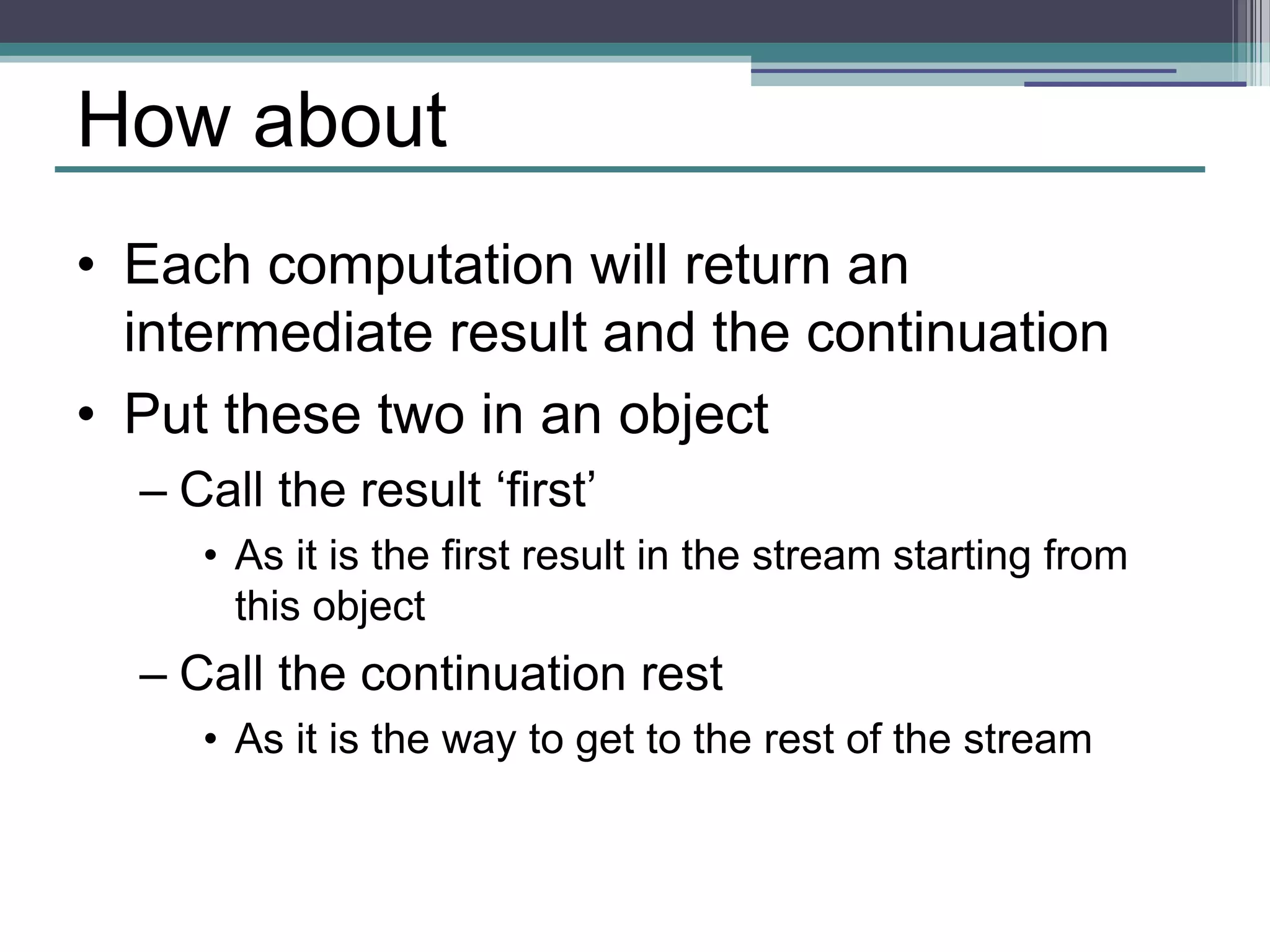
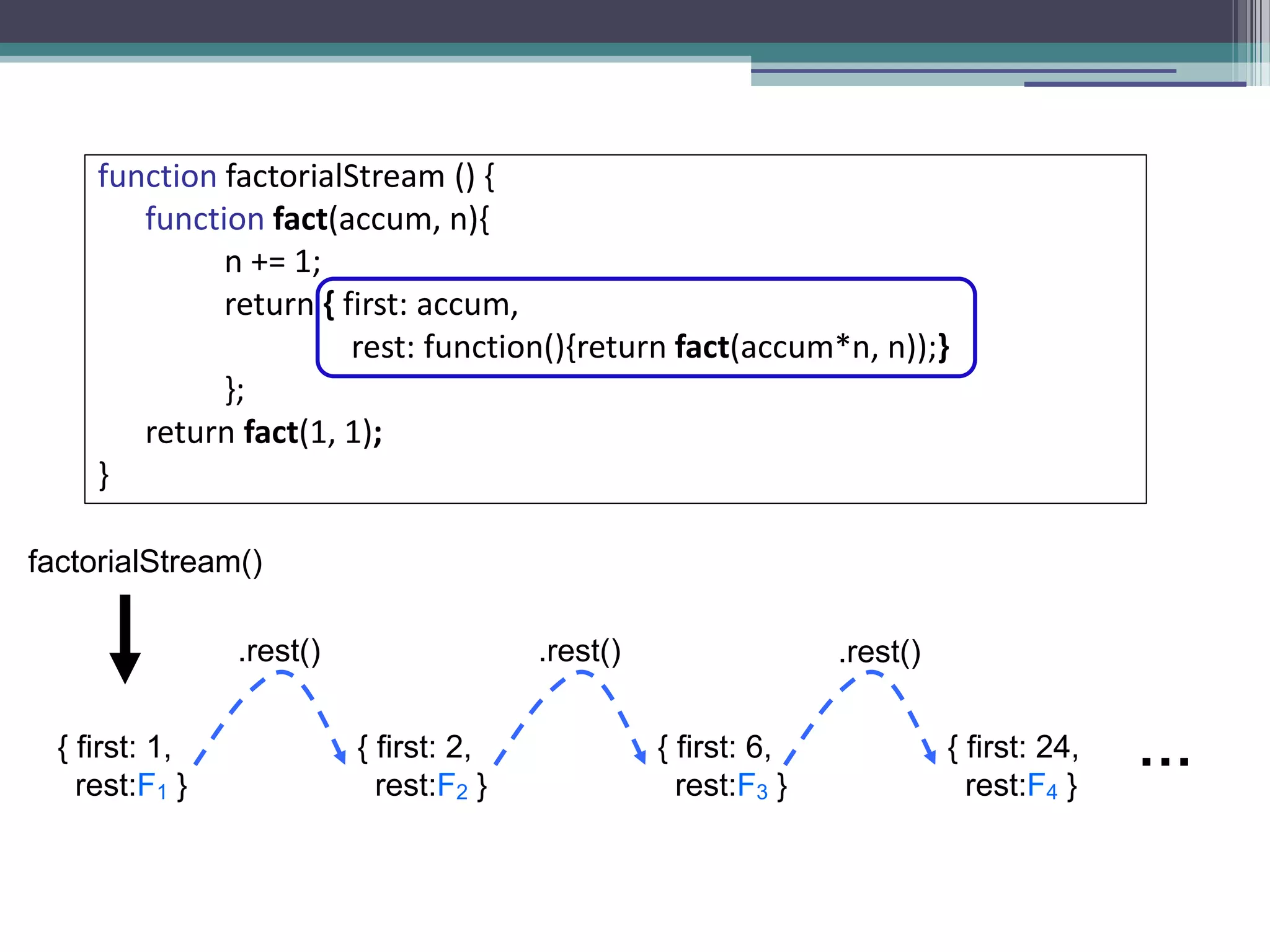
How about • Each computation will return an intermediate result and the continuation • Put these two in an object – Call the result ‘first’ • As it is the first result in the stream starting from this object – Call the continuation rest • As it is the way to get to the rest of the stream
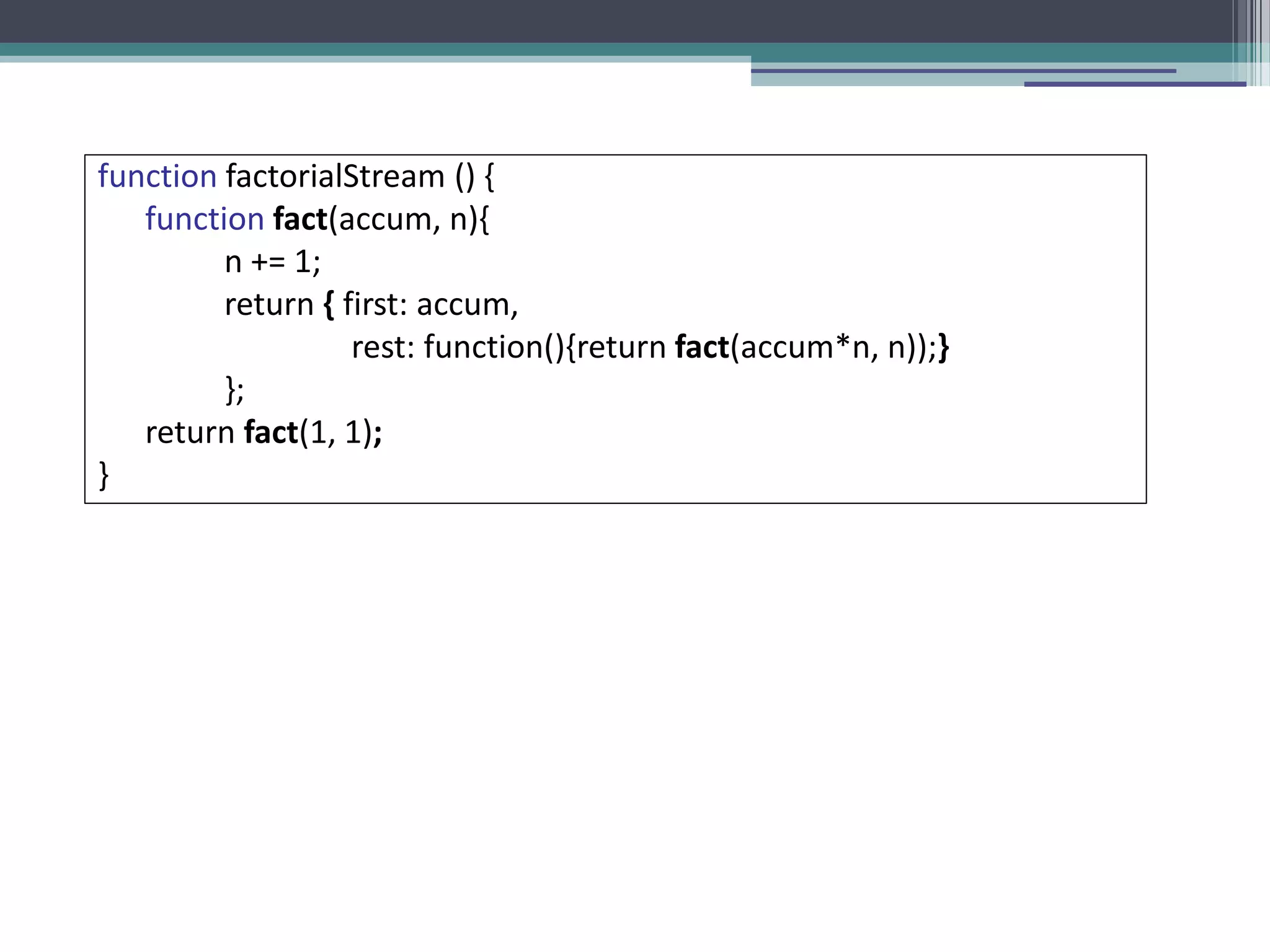
function factorialStream () { function fact(accum, n){ n += 1; return { first: accum, rest: function(){return fact(accum*n, n));} }; return fact(1, 1); }
function factorialStream () { function fact(accum, n){ n += 1; return { first: accum, rest: function(){return fact(accum*n, n));} }; return fact(1, 1); } .rest() { first: 2, { first: 6, { first: 24, … rest:F2 } rest:F3 } rest:F4 } .rest() .rest() factorialStream() { first: 1, rest:F1 }
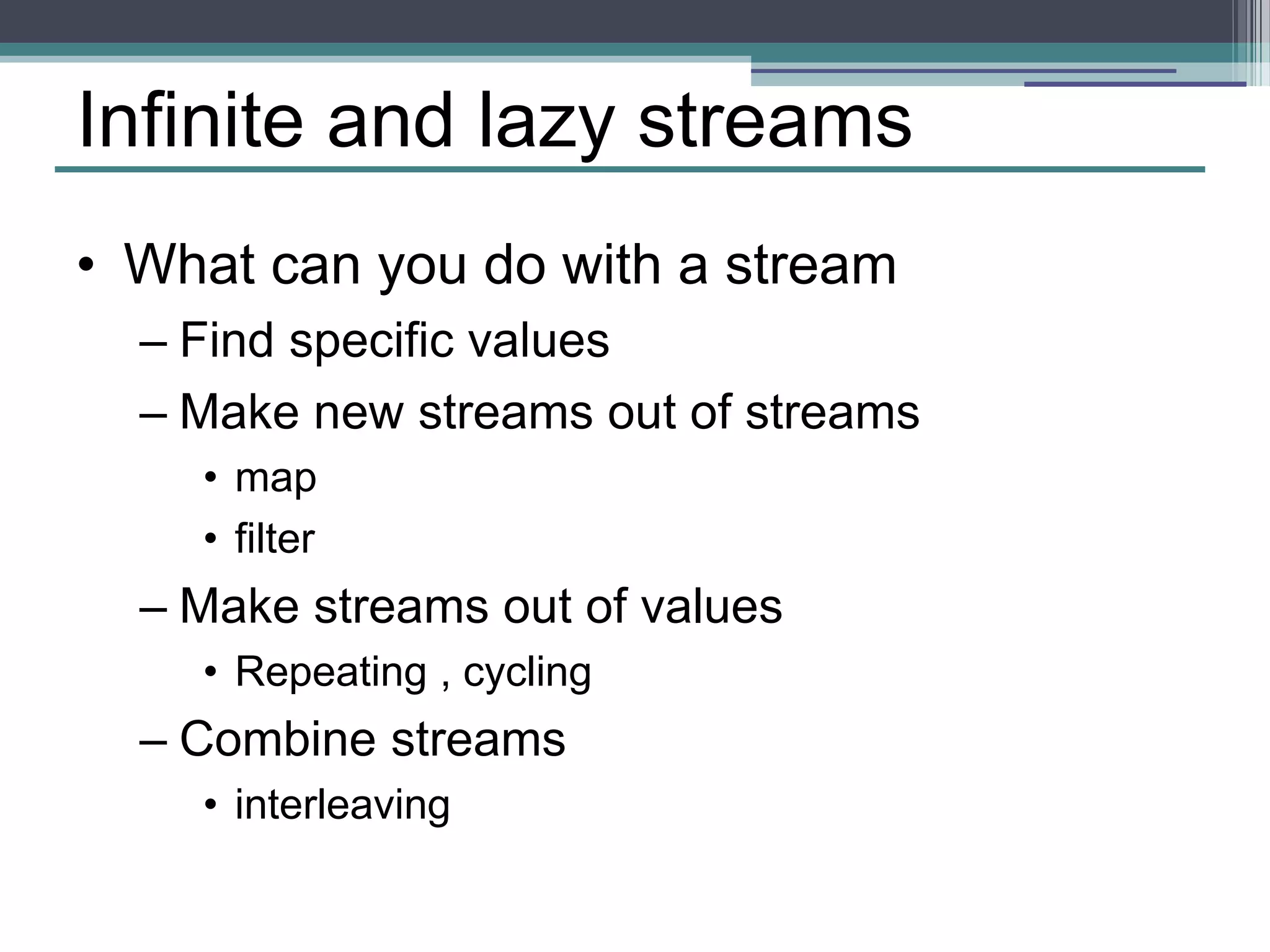
Infinite and lazy streams • What can you do with a stream – Find specific values – Make new streams out of streams • map • filter – Make streams out of values • Repeating , cycling – Combine streams • interleaving
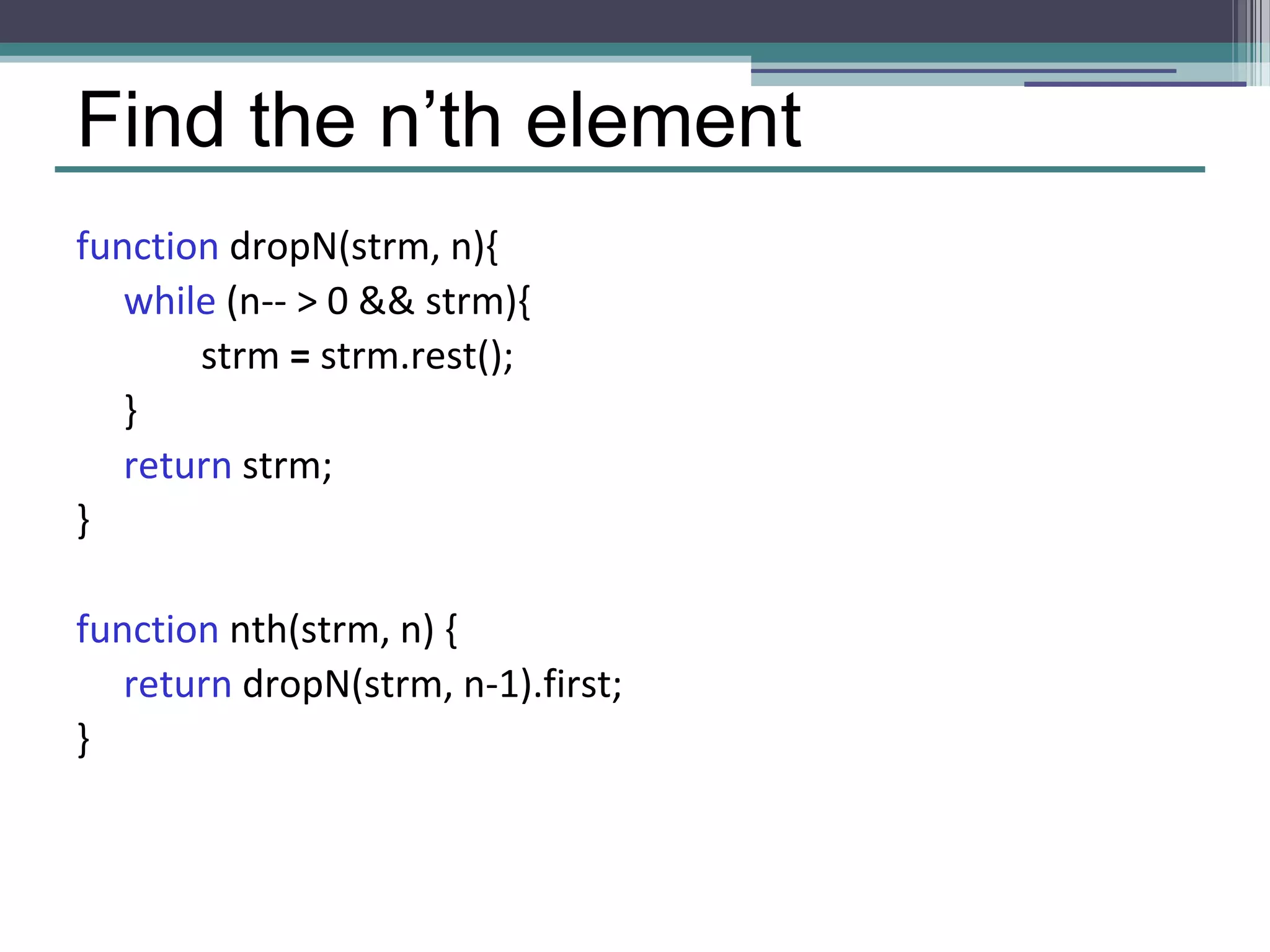
Find the n’th element function dropN(strm, n){ while (n-- > 0 && strm){ strm = strm.rest(); } return strm; } function nth(strm, n) { return dropN(strm, n-1).first; }
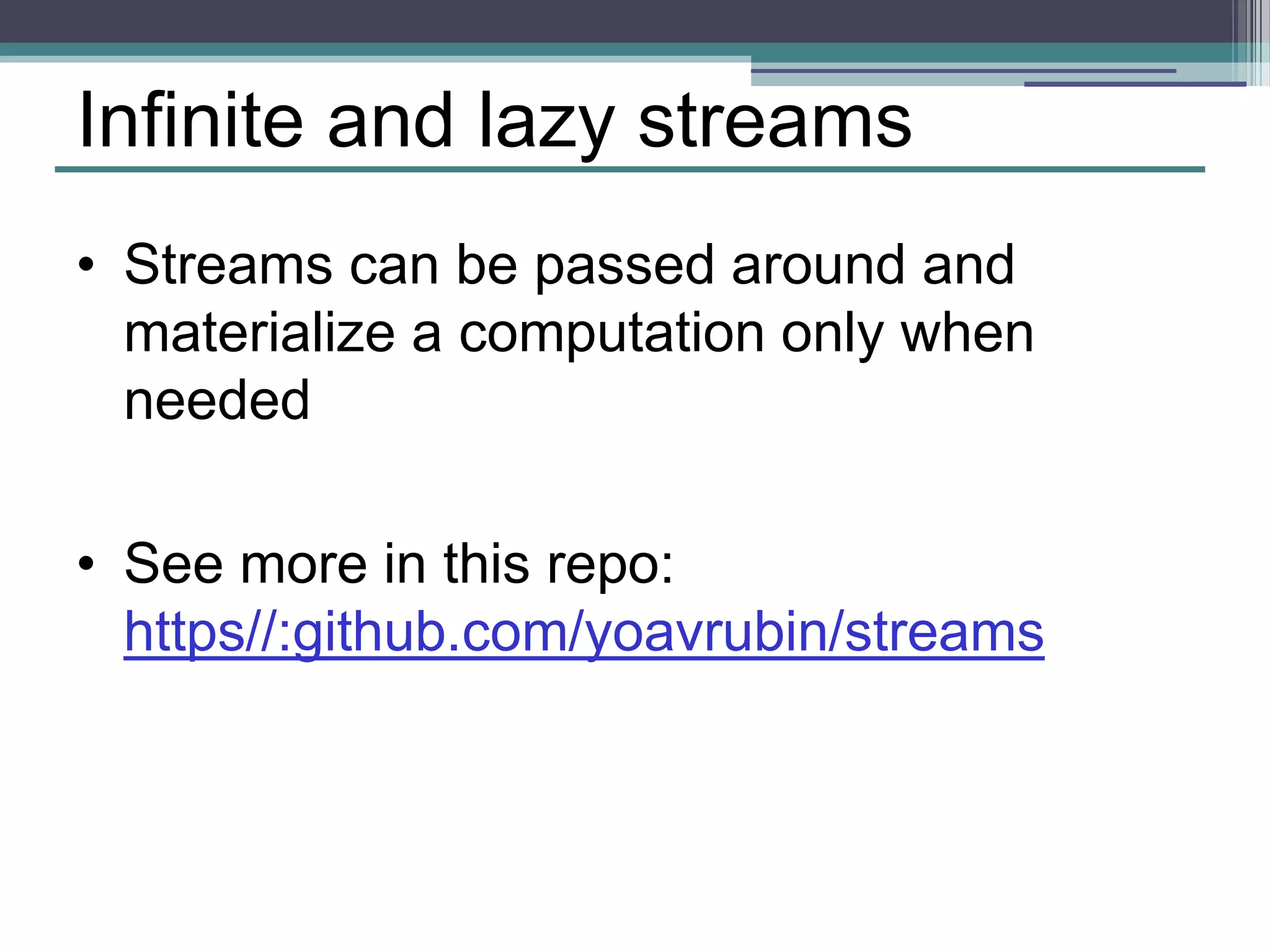
Infinite and lazy streams • Streams can be passed around and materialize a computation only when needed • See more in this repo: https//:github.com/yoavrubin/streams
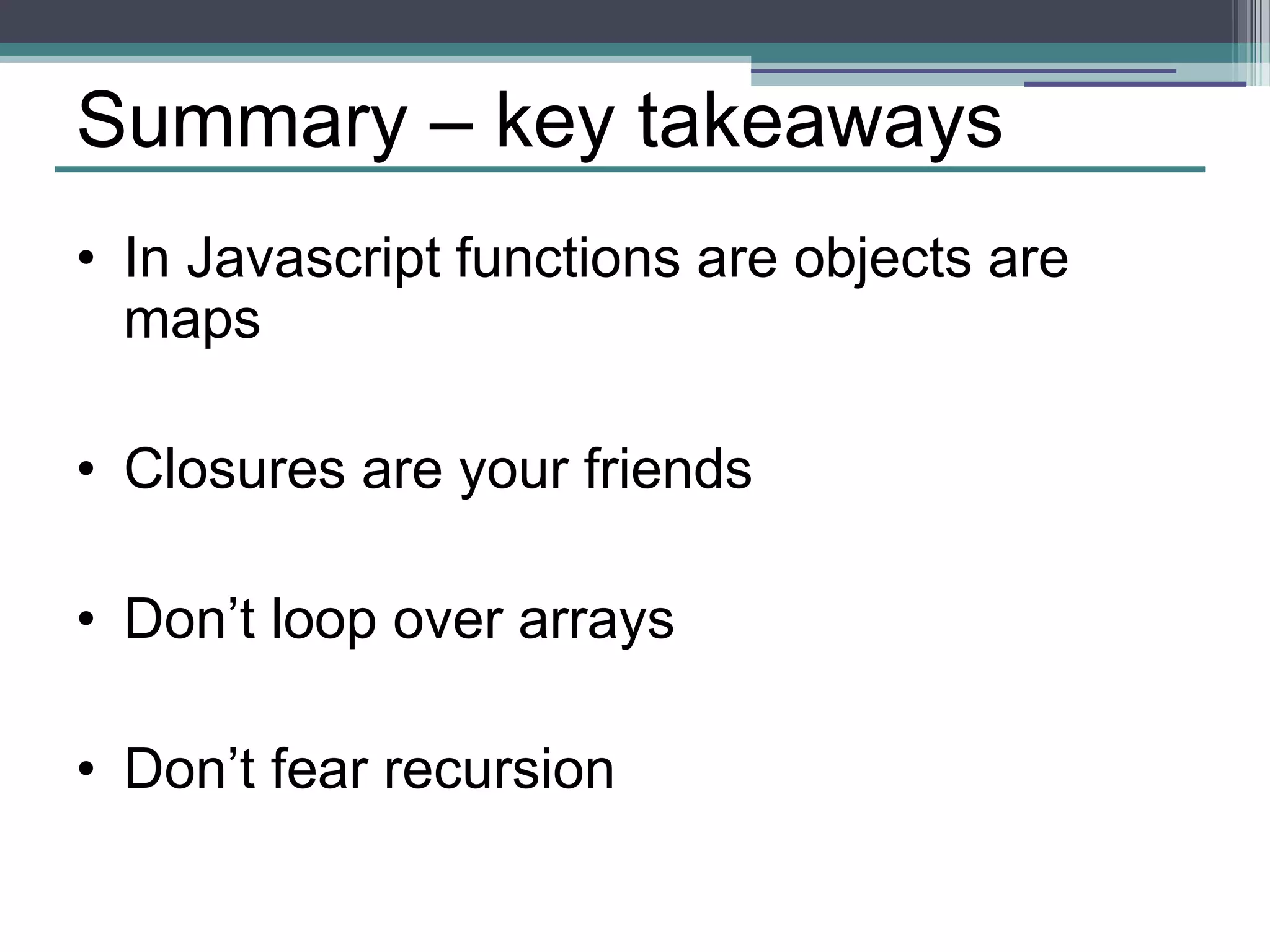
Summary – key takeaways • In Javascript functions are objects are maps • Closures are your friends • Don’t loop over arrays • Don’t fear recursion
Thank You @yoavrubin

Functional Programming in Javascript - IL Tech Talks week

  • 1.
    Functional Programming in Javascript Yoav Rubin @yoavrubin
  • 2.
    Today • Aboutfunctional programming • A little about Javascript • Deep dive into the combination of the two – Inner functions and closures – Higher order functions – Decomplecting calls patterns
  • 3.
    What will yougain? • Inner functions and closures – Improving performance via memoization – A different perspective on objects • Higher order functions – Avoiding mistakes due to the leaky abstraction of arrays – Composing functions from functions • Decomplecting calls patterns – Regaining the ability to use recursion – A look behind the scenes of streams
  • 4.
    Today • Aboutfunctional programming • A little about Javascript • Deep dive into the combination of the two – Inner functions and closures – Higher order functions – Decomplecting calls patterns
  • 5.
    About functional programming • All agree – it’s a programming paradigm • There’s no agreed upon definition – See Gilad Bracha’s talk: http://www.infoq.com/presentations/functional-pros-cons
  • 6.
    My definition •Thinking the software using data and functions – Analysis, modeling • Data and functions focused development – Data transformation instead of mutable object state • Core ideas – Data is immutable – Functions are first class citizens
  • 7.
    Why functional programming • Higher level of programming – Faster to develop – Simpler to test MUST • A good software person should know more then one paradigm – Because problems are getting tougher
  • 8.
    Today • Aboutfunctional programming • A little about Javascript • Deep dive into the combination of the two – Inner functions and closures – Higher order functions – Decomplecting calls patterns
  • 9.
    A little aboutJavascript
  • 10.
    Objects are maps • An object is a set of key-value pairs • Values can be anything and may change • Pairs can be added and removed
  • 11.
    key1 value1 key2 value2 key3 value3 key5 key4 { } { } { } key6
  • 12.
    key1 value1 key2 value2 key3 value3 key5 key4 { } { } { } key6 Keys whose values are members
  • 13.
    key1 value1 key2 value2 key3 value3 key5 key4 { } { } { } key6 Keys whose values are methods
  • 14.
    Arrays • Arraysare objects are maps • Fields whose keys are integers gain “special treatment”
  • 15.
    key1 value1 key2value2 Integer key2 value4 key3 key4 Integer key3 value5 Integer key1 value3 { } { }
  • 16.
    key1 value1 key2value2 Integer key2 value4 key3 key4 Fields whose values are members Integer key3 value5 Integer key1 value3 { } { }
  • 17.
    key1 value1 key2value2 Integer key2 value4 key3 key4 Integer key3 Fields whose values are methods value5 Integer key1 value3 { } { }
  • 18.
    key1 value1 key2value2 Integer key2 value4 key3 key4 Integer key3 value5 Integer key1 value3 { } { } Fields whose keys are integers
  • 19.
    Functions • Functionsare objects are maps • Can also be executed
  • 20.
    key1 value1 key2value2 (…) {…} key3 key4 Fields whose keys are members { } { }
  • 21.
    key1 value1 key2value2 (…) {…} key3 key4 Fields whose values are methods { } { }
  • 22.
    key1 value1 key2value2 (…) {…} key3 key4 { } { } What gets executed
  • 23.
    Functions are objects • Can be defined anywhere • Can be assigned to a variable – Or act as a value in an object (or in an array) • Can be sent as an argument to a function • Can be returned as a return value from a function
  • 24.
    Today • Aboutfunctional programming • A little about Javascript • Deep dive into the combination of the two – Inner functions and closures – Higher order functions – Decomplecting calls patterns
  • 25.
    Inner functions andclosures • A function can be defined inside another function • The inner function can access anything found at the outer function
  • 26.
    Recursive Fibonacci functionfib(n){ if (n < 2) return n; return fib(n-1) + fib(n-2); } fib(10) results in 177 calls to fib n (time complexity - O(2 ) )
  • 27.
    Fibonacci using innerfunction function fastFib(n){ var memo = [0,1]; var fib = function(n){ var result = memo[n]; if(result !== undefined) return result; result = fib(n-1) + fib(n-2); memo[n] = result; return result; } return fib(n); } fastFib(10) results in 19 calls to the fib function (time complexity - O(n)) An inner function
  • 28.
    FastFib Memo TheFib function • Calculate if value is not in the cache • Maintain the cache This pattern is nicknamed memoization
  • 29.
    Closure • Computationdone in an inner function can access data found in the outer function • Such an access creates a construct called closure
  • 30.
    Closures remain alive even when the execution of the outer function was finished
  • 31.
    Fibonacci using closure function fastFibMaker(){ var memo = [0,1]; var fib = function(n){ var result = memo[n]; if (result !== undefined) return result; result = fib(n-1) + fib(n-2); memo[n] = result; return result; } return fib; } var theFib = fastFibMaker(); // returns a function theFib (10); // 19 calls to fib theFib (10); // 1 call to fib
  • 32.
  • 33.
  • 34.
    key1 value1 key2value2 (…) {…} key3 key4 What gets executed { } { } X=… Y=…
  • 36.
    Today • Aboutfunctional programming • A little about Javascript • Deep dive into the combination of the two – Inner functions and closures – Higher order functions – Decomplecting calls patterns
  • 37.
    Higher order functions • Receive function, return value • Receive value, return function
  • 38.
    Higher order functions • Receive function, return value • Receive value, return function
  • 39.
    Receive function, returnvalue • The receiving function provides the syntactic skeleton of the computation • The sent function provides the semantics for the calculation • Implementation of the “Strategy design pattern”
  • 40.
    Where do wesee it?
  • 41.
    Working with arrays • One of the most common things we do in code • Especially, in conjunction with looping • The common looping patterns have equivalent higher order methods in arrays
  • 42.
    Building a valueout of an array var i, res = seed; for (i=0 ; i<arr.length ;i ++) res = someFunc(res, arr[i]);
  • 43.
    Building a valueout of an array var i, res = seed; for (i=0 ; i<arr.length ;i ++) res = someFunc(res, arr[i]); This is just the same as res = arr.reduce(someFunc, seed);
  • 44.
    Creating an arrayout of an array var i, res = []; for (i=0 ; i<arr.length ;i ++) res.push(someFunc(arr[i]));
  • 45.
    Creating an arrayout of an array var i, res = []; for (i=0 ; i<arr.length ;i ++) res.push(someFunc(arr[i])); This is just the same as res = arr.map(someFunc);
  • 46.
    Selecting items froman array var i, res = []; for (i=0 ; i<arr.length ;i ++){ if (pred(arr[i])) res.push(arr[i]); } This is just the same as res = arr.filter(someFunc);
  • 47.
    Selecting items froman array var i, res = []; for (i=0 ; i<arr.length ;i ++){ if (pred(arr[i])) res.push(arr[i]); } This is just the same as res = arr.filter(pred);
  • 48.
    Few more variations • Array.forEach(someFunc) – To execute someFunc on every item in the array • Array.some(predFunc) – Checks whether at least one of the elements of the array fulfils predFunc • Array.every(predFunc) – Checks whether all of the elements of the array fulfils predFunc
  • 49.
    And combination ofthese var i, tmp, res = seed; for(i=0;i<arr.length;i++){ if(pred(arr[i])){ tmp = mapFn(arr[i]); res = redFn(res, tmp); } } var res = arr.filter(pred).map(mapFn).reduce(redFunc);
  • 50.
    And combination ofthese var i, tmp, res = seed; for(i=0;i<arr.length;i++){ if(pred(arr[i])){ tmp = mapFn(arr[i]); res = redFn(res, tmp); } } var res = arr.filter(pred).map(mapFn).reduce(redFn, seed);
  • 51.
    Boilerplatting var i,tmp, res = seed; for(i=0;i<arr.length;i++){ if(pred(arr[i])){ tmp = mapFn(arr[i]); res = redFn(res, tmp); } } var res = arr.filter(pred).map(mapFn).reduce(redFn, seed); That’s just boilerplate code !!!
  • 52.
    What can biteyou here? var i, tmp, res = seed; for(i=0;i<arr.length;i++){ if(pred(arr[i])){ tmp = mapFn(arr[i]); res = redFn(res, tmp); } } What will happen if you copy & paste the loop’s code without copying the declaration of i ? var res = arr.filter(pred).map(mapFn).reduce(redFn, seed);
  • 53.
    What can biteyou here? var i, tmp, res = seed; for(i=0;i<arr.length;i++){ if(pred(arr[i])){ tmp = mapFn(arr[i]); res = redFn(res, tmp); } } Once in a while you’ll have an off by one error var res = arr.filter(pred).map(mapFn).reduce(redFn, seed);
  • 55.
    What can biteyou here? var i, tmp, res = seed; for(i=0;i<arr.length;i++){ if(pred(arr[i])){ tmp = mapFn(arr[i]); res = redFn(res, tmp); } } What if there’s a hole ? var res = arr.filter(pred).map(mapFn).reduce(redFn, seed);
  • 57.
    Same same butdifferent arr = [1,2,3] arr[4] = 4 var res = 0; for(var i=0;i<arr.length;i++){ res += arr[i]; } arr.reduce(add, 0) NaN 10
  • 58.
    Just *don’t* doit • Array is a leaky abstraction in Javascript – It is not a continuum of memory – It is just a map • Using array’s methods makes your code resilient to – Copy paste mistakes – Off by one errors – Holes in the array
  • 59.
    Looping over anarray is a code smell in Javascript
  • 60.
    Higher order functions • Receive function, return value • Receive value, return function
  • 61.
    Receive value, returnfunction • Composing a new function – Keep the received value in a closure – Return a new function that uses that value
  • 62.
  • 64.
    Fan out •Receives several functions • Return a fun-out function that – For a given input – Returns all the results of applying the previously given functions on that input
  • 65.
    Fan out functionfanOutMaker(/* fns*/){ var fns = arguments; return function(/* arguments */){ var res = []; for (var i=0,l=fns.length;i<l;i++){ res.push(fns[i].apply(null, arguments)); } return res; } }
  • 66.
    Fan out functionfanOutMaker(/* fns*/){ var fns = arguments; return function(/* arguments */){ var res = []; for (var i=0,l=fns.length;i<l;i++){ res.push(fns[i].apply(null, arguments)); } return res; } } Not the same
  • 67.
    Fan out functionfanOutMaker(/* fns*/){ var fns = arguments; return function(/* arguments */){ var res = []; for (var i=0,l=fns.length;i<l;i++){ res.push(fns[i].apply(null, arguments)); } return res; } } Call each of the closured fns with current argument
  • 68.
    Today • Aboutfunctional programming • A little about Javascript • Deep dive into the combination of the two – Inner functions and closures – Higher order functions – Decomplecting calls patterns
  • 69.
  • 70.
    Reclaiming recursion •We were taught that recursion works in theory – But only there • Some languages provide built-in tail call optimization – Javascript doesn’t • We can do it by ourselves
  • 71.
    Why would youwant recursion • Handling recursive structures – Data formats - Json (or Xml) – DOM • Data digestion (especially in node.js) – Graph processing • Sometimes there are tools that do it • Sometimes you need to make the tools
  • 72.
    Decomplecting calls patterns • A function call is built of: – Saying what computation should be done • What’s the function, what are the arguments – Telling it to be executed now
  • 73.
    function someFunc(arg1, arg2){ //do something // return something } someFunc ( a1, a2 )
  • 74.
    function someFunc(arg1, arg2){ //do something // return something } someFunc ( a1, a2 ) What computation should be done
  • 75.
    function someFunc(arg1, arg2){ //do something // return something } someFunc ( a1, a2 ) Do it now
  • 76.
    How to separate? • Wrap the call to someFunc with a function that executes it function(){ return someFunc(a1,a2); } Let’s call it ‘continuation’ We can invoke the continuation with different mechanisms
  • 77.
    How to separate? • Wrap the call to someFunc with a function that executes it function(){ return someFunc(a1,a2); } • Let’s call it ‘continuation’ • We can invoke the continuation with different mechanisms to solve different problems
  • 78.
    • Controlling recursion • To inWfinhitay,t s kteipn bdy ostfe pproblems
  • 79.
    What kind ofproblems • Controlling recursion • To infinity, step by step
  • 80.
    function factorial (n){ if(n<2) return n; return n*factorial(n-1); } • What’s the problem here? – Can’t control the depth of the recursion – How can we make it better?
  • 81.
    function factorial (num){ function fact(accum, n){ if(n === num) return accum; n += 1; return fact(accum*n, n); } return fact(1, 1); } • What have we changed?
  • 82.
    function factorial (num){ function fact(accum, n){ if(n === num) return accum; n += 1; return fact(accum*n, n); } return fact(1, 1); } • What have we changed? – Using inner function to compute the factorial – Moved the recursive call to be in a tail position
  • 83.
    function factorial (num){ function fact(accum, n){ if(n === num) return accum; n += 1; return fact(accum*n, n); } return fact(1, 1); } • What have we changed? – Using inner function to compute the factorial – Moved the recursive call to be in a tail position • Still, we can’t control the recursion depth
  • 84.
    Where’s the problem? function factorial (num) { function fact(accum, n){ if(n === num) return accum; n += 1; return fact(accum*n, n); } return fact(1, 1); }
  • 85.
    Where’s the problem? function factorial (num) { function fact(accum, n){ if(n === num) return accum; n += 1; return fact(accum*n, n); } return fact(1, 1); }
  • 86.
    Where’s the problem? function factorial (num) { function fact(accum, n){ if(n === num) return accum; n += 1; return fact(accum*n, n); } return fact(1, 1); } We define the calculation and say that it should be performed now
  • 87.
    Separate the definitionof the call from executing it function factorial (num) { function fact(accum, n){ if(n===num) return accum; n +=1; return function() { return fact(accum*n, n);}; } return function() {return fact(1, 1);}; } • What have we changed? Made a continuation out of the recursive call Still need a mechanism to invoke the continuation
  • 88.
    Separate the definitionof the call from executing it function factorial (num) { function fact(accum, n){ if(n===num) return accum; n +=1; return function() { return fact(accum*n, n);}; } return function() {return fact(1, 1);}; } • What have we changed? – Made a continuation out of the recursive call – Still need a mechanism to invoke the continuation
  • 89.
    function trampoline (f){ while(isFunction(f)) f = f(); return f; }
  • 90.
    Separate the definitionof the call from executing it function factorial (num) { function fact(accum, n){ if(n===num) return accum; n += 1; return function() { return fact(accum*n, n);}; } return function(){ return fact(1, 1);}; } Trampoline (factorial(…)) • What have we changed? function trampoline (f) { while(isFunction(f)) f = f(); return f; } – Used trampoline as a mechanism to invoke the continuation
  • 91.
    factorial(5) trampoline withf(fact(1, 1)) Trampoline if isFunction(f) – invoke it otherwise return what it got f(fact(2, 2)) f(fact(6,3)) fact(1,1) fact(2,2) fact(6,3) … fact(120,5) Return value is a function Returning 120 from trampoline f(fact(24,4)) 120 Function call Return value is a value
  • 92.
    The recipe •Move the recursive call to be in a tail position – Helper function and accum – Call the helper function to start • Wrap the recursive call in a continuation – function() {return <the-recursive-call>;} – Also the first call to the helper function • Have trampoline around • Call trampoline with the initial continuation
  • 93.
    What is itgood for? • Controlling recursion • To infinity, step by step
  • 94.
    To infinity, stepby step • Trampoline computed all the intermediate results till it got to the stop condition – Immediately called the continuation • Instead, we can make the user control when to call the continuation, and when to stop calling it
  • 95.
    How about •Each computation will return an intermediate result and the continuation • Put these two in an object – Call the result ‘first’ • As it is the first result in the stream starting from this object – Call the continuation rest • As it is the way to get to the rest of the stream
  • 96.
    function factorialStream (){ function fact(accum, n){ n += 1; return { first: accum, rest: function(){return fact(accum*n, n));} }; return fact(1, 1); }
  • 97.
    function factorialStream (){ function fact(accum, n){ n += 1; return { first: accum, rest: function(){return fact(accum*n, n));} }; return fact(1, 1); } .rest() { first: 2, { first: 6, { first: 24, … rest:F2 } rest:F3 } rest:F4 } .rest() .rest() factorialStream() { first: 1, rest:F1 }
  • 99.
    Infinite and lazystreams • What can you do with a stream – Find specific values – Make new streams out of streams • map • filter – Make streams out of values • Repeating , cycling – Combine streams • interleaving
  • 100.
    Find the n’thelement function dropN(strm, n){ while (n-- > 0 && strm){ strm = strm.rest(); } return strm; } function nth(strm, n) { return dropN(strm, n-1).first; }
  • 101.
    Infinite and lazystreams • Streams can be passed around and materialize a computation only when needed • See more in this repo: https//:github.com/yoavrubin/streams
  • 102.
    Summary – keytakeaways • In Javascript functions are objects are maps • Closures are your friends • Don’t loop over arrays • Don’t fear recursion
  • 103.