SAFEGUARDING AI-BASED FINANCIAL INFRASTRUCTURE Presented By: Yasir Naveed Riaz A FUTURISTIC DEEP-DIVE INTO SECURE DIGITAL PAYMENTS & DIGITAL ASSETS POWERED BY AI.
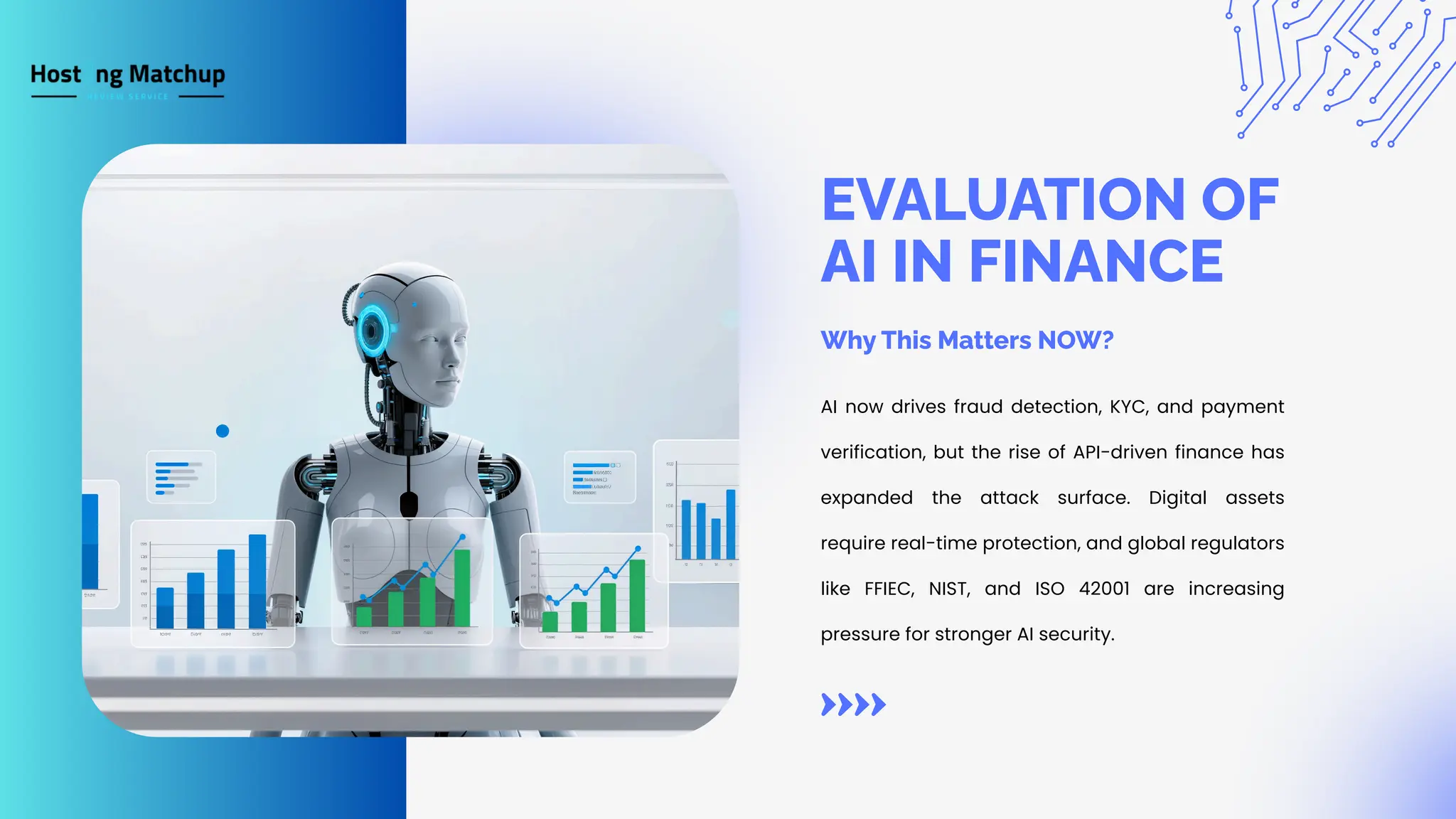
EVALUATION OF AI IN FINANCE Why This Matters NOW? AI now drives fraud detection, KYC, and payment verification, but the rise of API-driven finance has expanded the attack surface. Digital assets require real-time protection, and global regulators like FFIEC, NIST, and ISO 42001 are increasing pressure for stronger AI security.
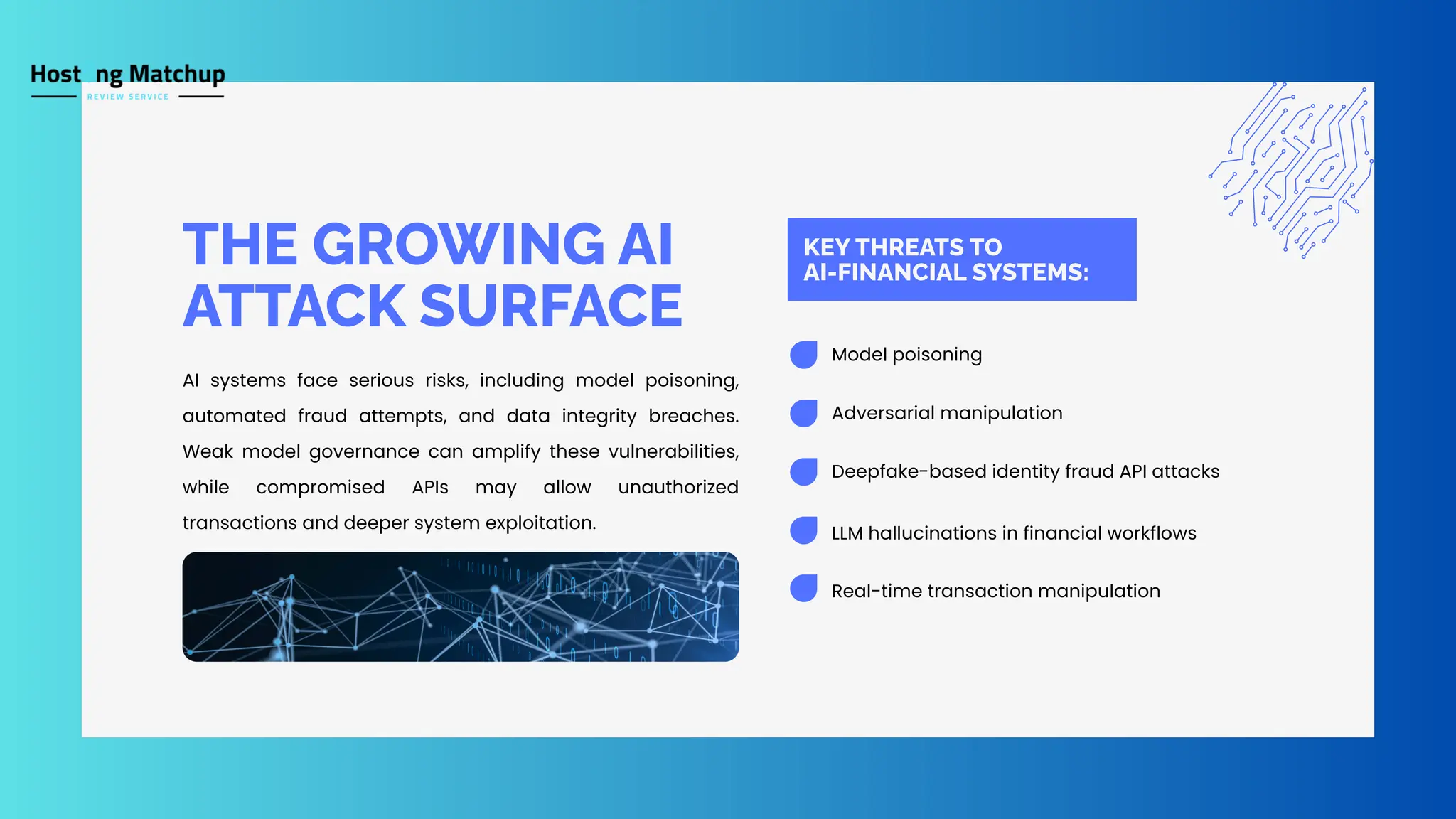
THE GROWING AI ATTACK SURFACE KEY THREATS TO AI-FINANCIAL SYSTEMS: AI systems face serious risks, including model poisoning, automated fraud attempts, and data integrity breaches. Weak model governance can amplify these vulnerabilities, while compromised APIs may allow unauthorized transactions and deeper system exploitation. Model poisoning Adversarial manipulation Deepfake-based identity fraud API attacks LLM hallucinations in financial workflows Real-time transaction manipulation
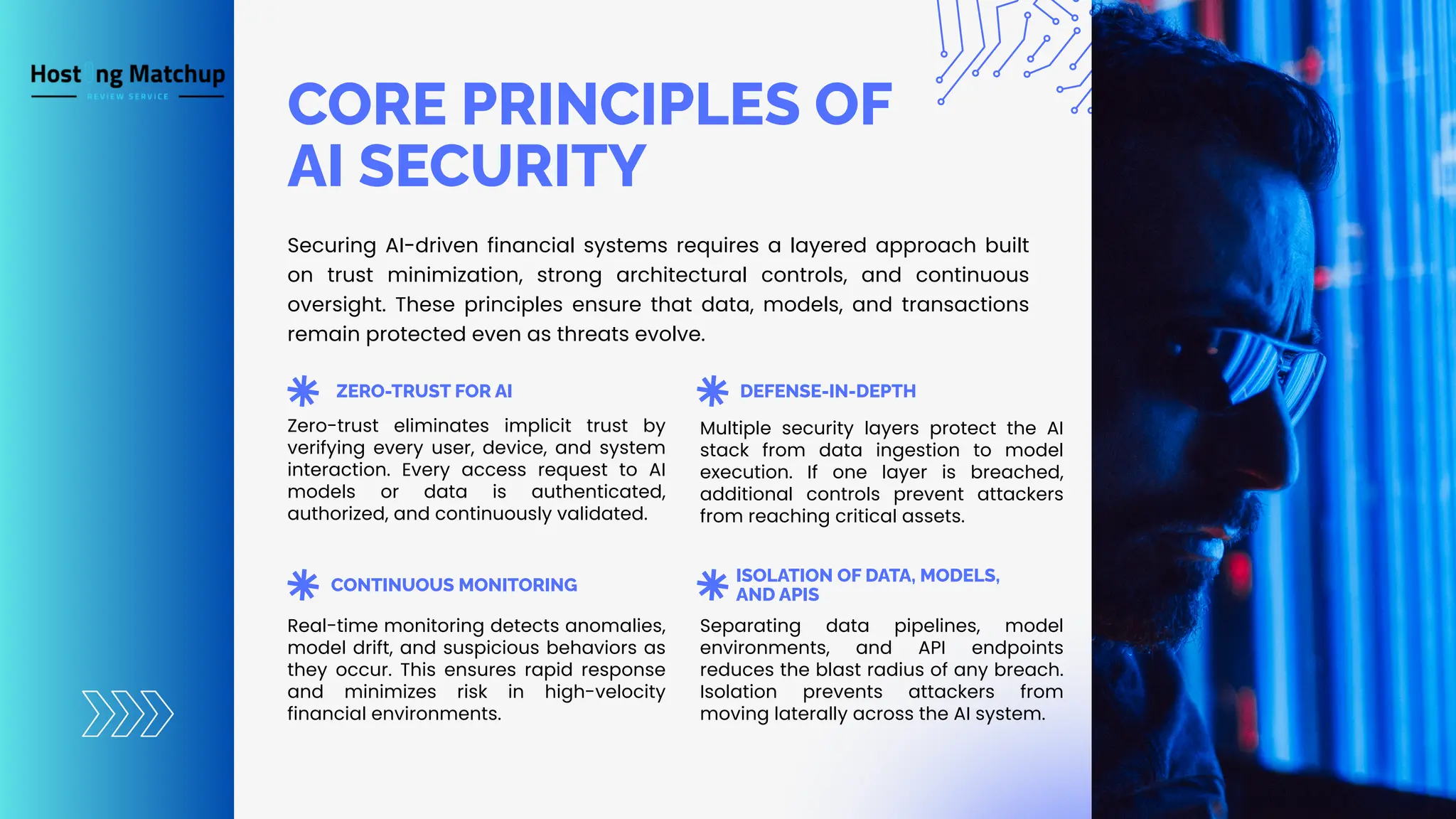
CORE PRINCIPLES OF AI SECURITY ZERO-TRUST FOR AI CONTINUOUS MONITORING DEFENSE-IN-DEPTH ISOLATION OF DATA, MODELS, AND APIS Securing AI-driven financial systems requires a layered approach built on trust minimization, strong architectural controls, and continuous oversight. These principles ensure that data, models, and transactions remain protected even as threats evolve. Zero-trust eliminates implicit trust by verifying every user, device, and system interaction. Every access request to AI models or data is authenticated, authorized, and continuously validated. Real-time monitoring detects anomalies, model drift, and suspicious behaviors as they occur. This ensures rapid response and minimizes risk in high-velocity financial environments. Multiple security layers protect the AI stack from data ingestion to model execution. If one layer is breached, additional controls prevent attackers from reaching critical assets. Separating data pipelines, model environments, and API endpoints reduces the blast radius of any breach. Isolation prevents attackers from moving laterally across the AI system.
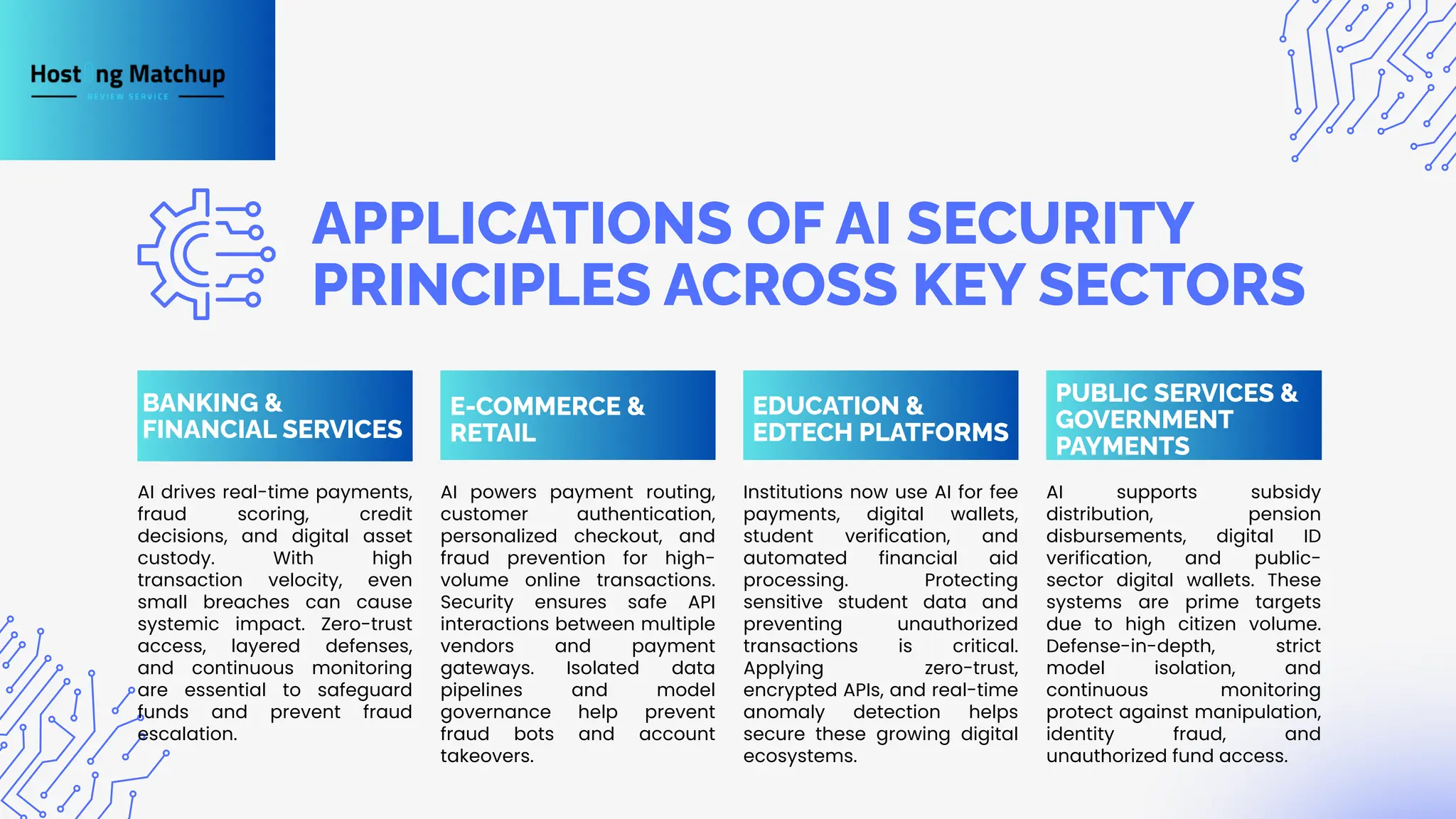
APPLICATIONS OF AI SECURITY PRINCIPLES ACROSS KEY SECTORS BANKING & FINANCIAL SERVICES E-COMMERCE & RETAIL AI drives real-time payments, fraud scoring, credit decisions, and digital asset custody. With high transaction velocity, even small breaches can cause systemic impact. Zero-trust access, layered defenses, and continuous monitoring are essential to safeguard funds and prevent fraud escalation. AI powers payment routing, customer authentication, personalized checkout, and fraud prevention for high- volume online transactions. Security ensures safe API interactions between multiple vendors and payment gateways. Isolated data pipelines and model governance help prevent fraud bots and account takeovers. Institutions now use AI for fee payments, digital wallets, student verification, and automated financial aid processing. Protecting sensitive student data and preventing unauthorized transactions is critical. Applying zero-trust, encrypted APIs, and real-time anomaly detection helps secure these growing digital ecosystems. AI supports subsidy distribution, pension disbursements, digital ID verification, and public- sector digital wallets. These systems are prime targets due to high citizen volume. Defense-in-depth, strict model isolation, and continuous monitoring protect against manipulation, identity fraud, and unauthorized fund access. EDUCATION & EDTECH PLATFORMS PUBLIC SERVICES & GOVERNMENT PAYMENTS
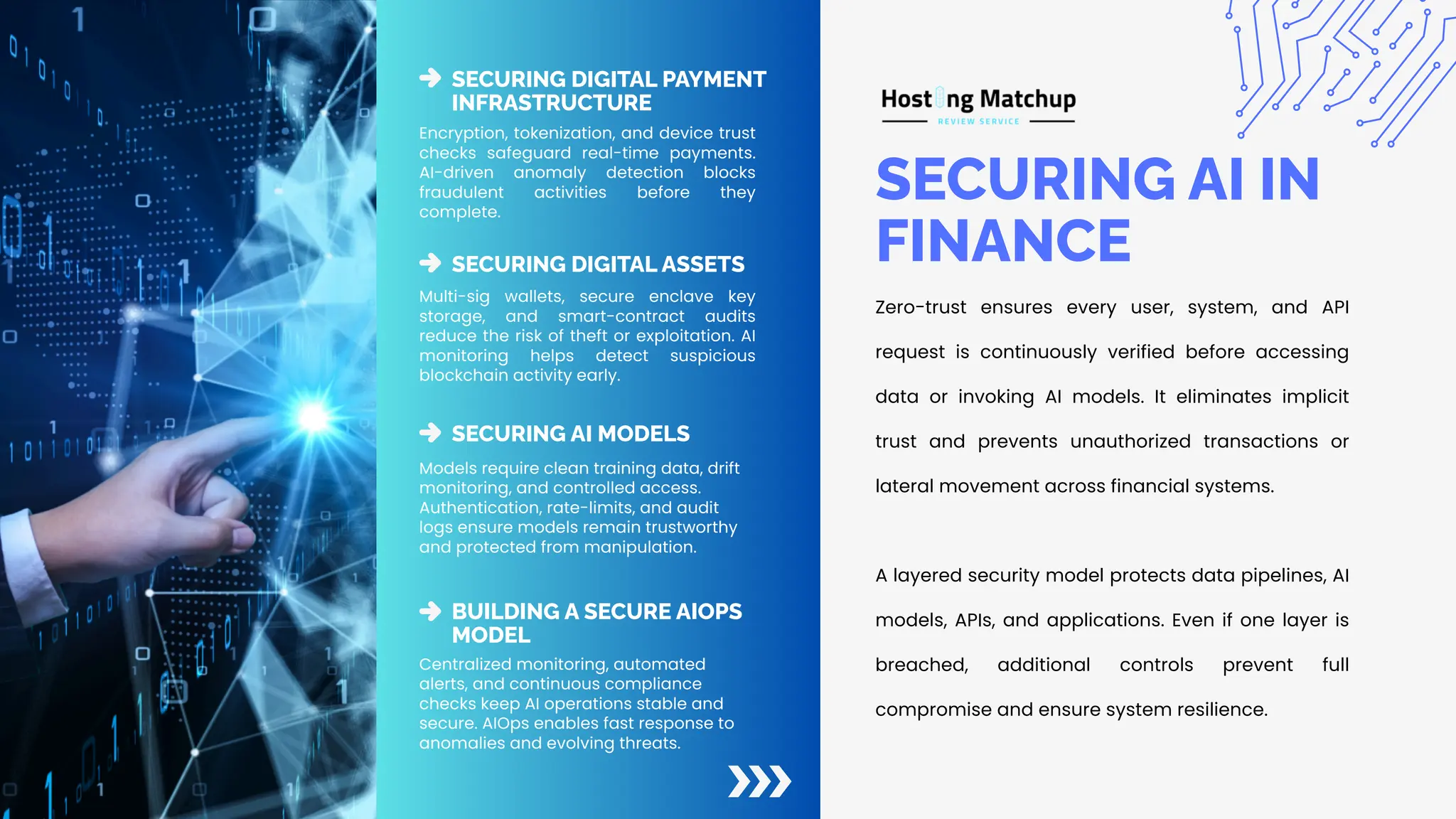
SECURING AI IN FINANCE Zero-trust ensures every user, system, and API request is continuously verified before accessing data or invoking AI models. It eliminates implicit trust and prevents unauthorized transactions or lateral movement across financial systems. A layered security model protects data pipelines, AI models, APIs, and applications. Even if one layer is breached, additional controls prevent full compromise and ensure system resilience. SECURING DIGITAL PAYMENT INFRASTRUCTURE SECURING DIGITAL ASSETS Encryption, tokenization, and device trust checks safeguard real-time payments. AI-driven anomaly detection blocks fraudulent activities before they complete. Multi-sig wallets, secure enclave key storage, and smart-contract audits reduce the risk of theft or exploitation. AI monitoring helps detect suspicious blockchain activity early. BUILDING A SECURE AIOPS MODEL Models require clean training data, drift monitoring, and controlled access. Authentication, rate-limits, and audit logs ensure models remain trustworthy and protected from manipulation. SECURING AI MODELS Centralized monitoring, automated alerts, and continuous compliance checks keep AI operations stable and secure. AIOps enables fast response to anomalies and evolving threats.
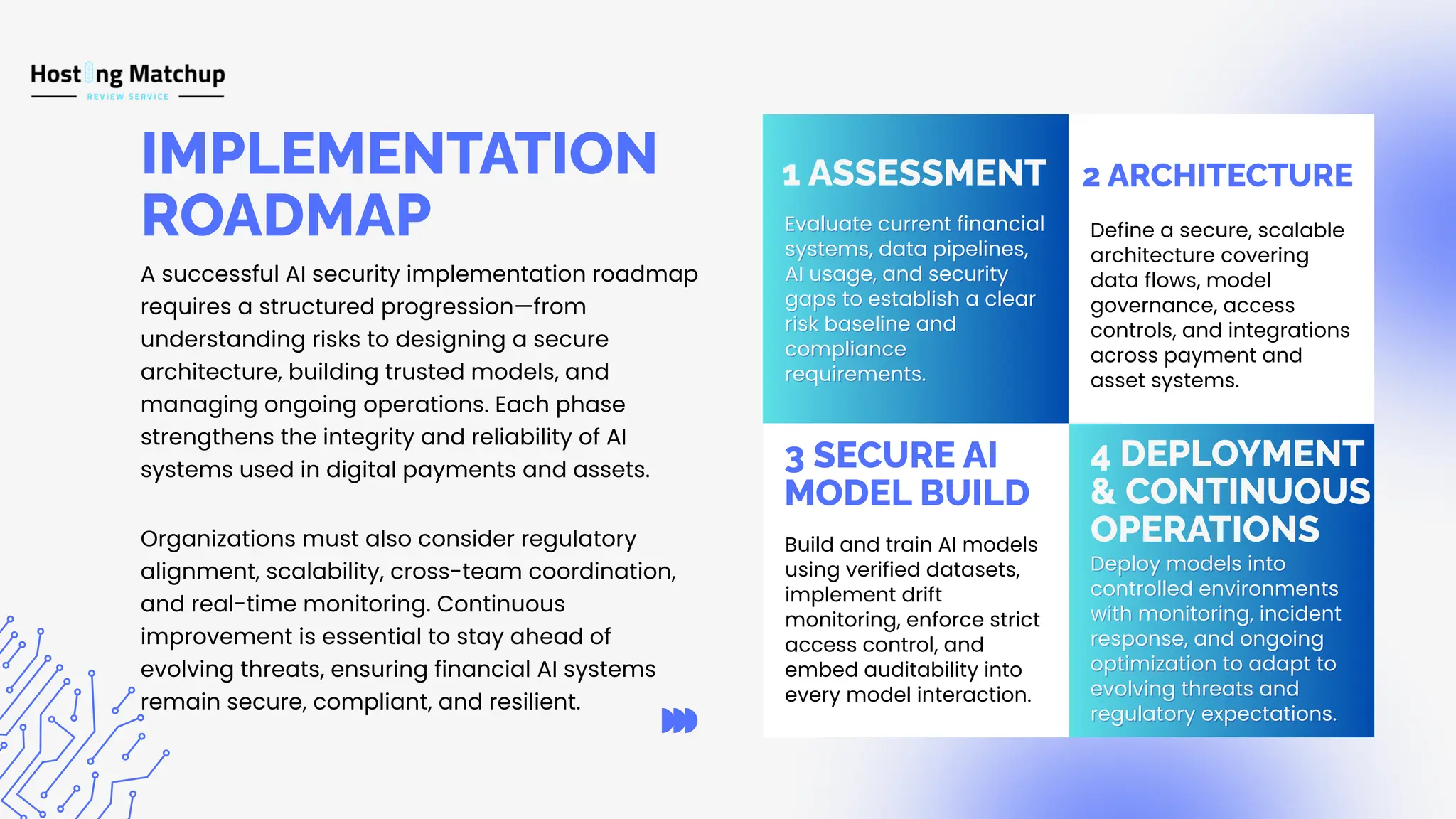
Organizations must also consider regulatory alignment, scalability, cross-team coordination, and real-time monitoring. Continuous improvement is essential to stay ahead of evolving threats, ensuring financial AI systems remain secure, compliant, and resilient. IMPLEMENTATION ROADMAP A successful AI security implementation roadmap requires a structured progression—from understanding risks to designing a secure architecture, building trusted models, and managing ongoing operations. Each phase strengthens the integrity and reliability of AI systems used in digital payments and assets. Define a secure, scalable architecture covering data flows, model governance, access controls, and integrations across payment and asset systems. Deploy models into controlled environments with monitoring, incident response, and ongoing optimization to adapt to evolving threats and regulatory expectations. Deploy models into controlled environments with monitoring, incident response, and ongoing optimization to adapt to evolving threats and regulatory expectations. Build and train AI models using verified datasets, implement drift monitoring, enforce strict access control, and embed auditability into every model interaction. Evaluate current financial systems, data pipelines, AI usage, and security gaps to establish a clear risk baseline and compliance requirements. Evaluate current financial systems, data pipelines, AI usage, and security gaps to establish a clear risk baseline and compliance requirements. 1 ASSESSMENT 2 ARCHITECTURE 3 SECURE AI MODEL BUILD 4 DEPLOYMENT & CONTINUOUS OPERATIONS
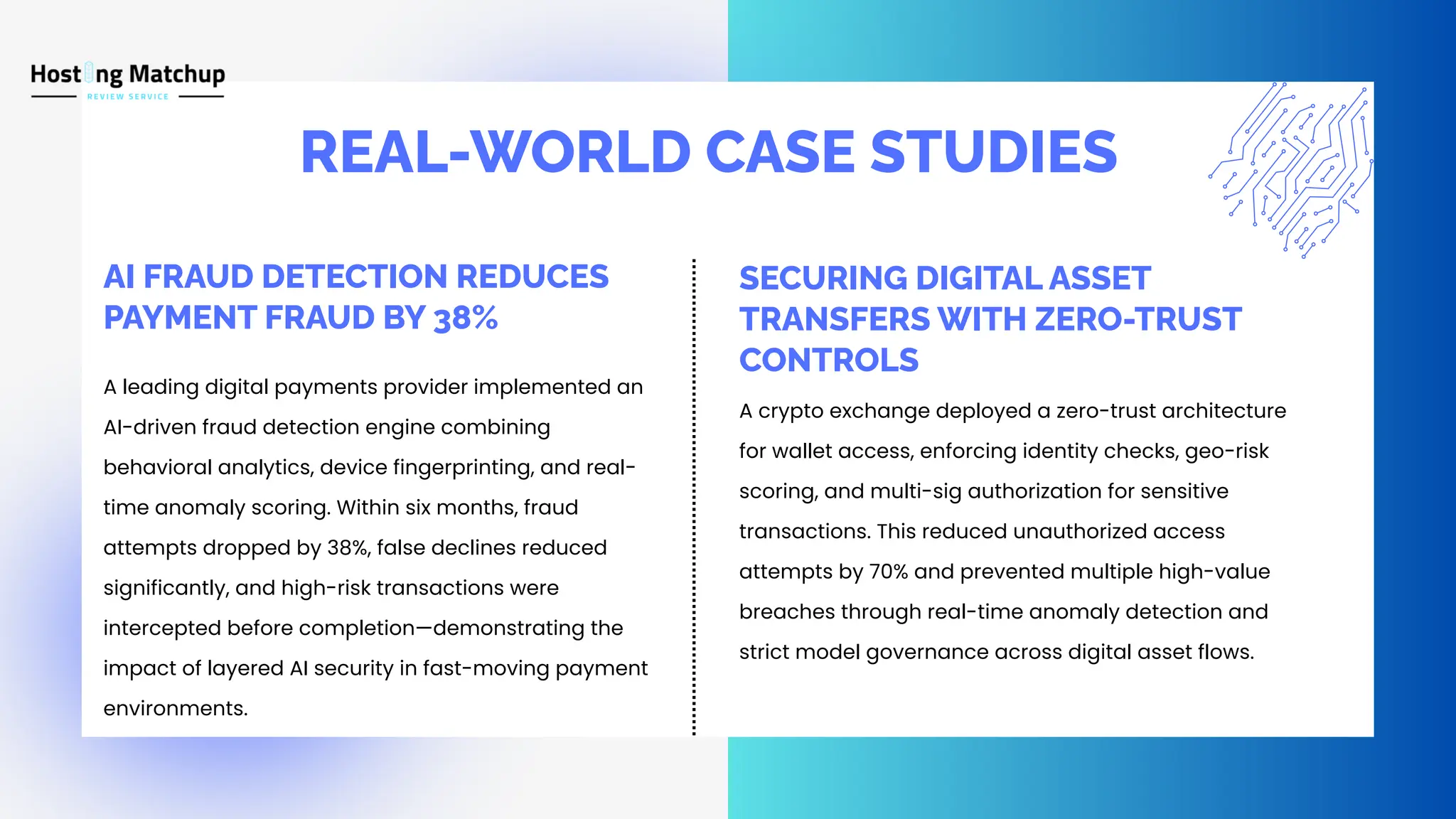
REAL-WORLD CASE STUDIES A leading digital payments provider implemented an AI-driven fraud detection engine combining behavioral analytics, device fingerprinting, and real- time anomaly scoring. Within six months, fraud attempts dropped by 38%, false declines reduced significantly, and high-risk transactions were intercepted before completion—demonstrating the impact of layered AI security in fast-moving payment environments. AI FRAUD DETECTION REDUCES PAYMENT FRAUD BY 38% A crypto exchange deployed a zero-trust architecture for wallet access, enforcing identity checks, geo-risk scoring, and multi-sig authorization for sensitive transactions. This reduced unauthorized access attempts by 70% and prevented multiple high-value breaches through real-time anomaly detection and strict model governance across digital asset flows. SECURING DIGITAL ASSET TRANSFERS WITH ZERO-TRUST CONTROLS
KEY TAKEAWAYS AI greatly enhances the speed, accuracy, and intelligence of modern financial systems—but it also introduces new risks across data pipelines, models, APIs, and digital assets. As financial ecosystems become more interconnected, the security impact of any weakness grows significantly. To stay protected, organizations must adopt a zero-trust mindset and a defense-in-depth approach, ensuring every component is verified, isolated, and continuously monitored. Strong governance and ongoing oversight are no longer optional—they are essential for long-term resilience and survival in the AI-driven financial landscape.
THANK YOU For more insights, tools, and resources, visit: HostingMatchup.com Yasir Naveed Riaz www.hostingmatchup.com yasir.naveed@gmail,com Let’s continue exploring the future of secure AI-driven financial systems together

Safeguarding AI-Based Financial Infrastructure

  • 1.
    SAFEGUARDING AI-BASED FINANCIAL INFRASTRUCTURE Presented By: YasirNaveed Riaz A FUTURISTIC DEEP-DIVE INTO SECURE DIGITAL PAYMENTS & DIGITAL ASSETS POWERED BY AI.
  • 2.
    EVALUATION OF AI INFINANCE Why This Matters NOW? AI now drives fraud detection, KYC, and payment verification, but the rise of API-driven finance has expanded the attack surface. Digital assets require real-time protection, and global regulators like FFIEC, NIST, and ISO 42001 are increasing pressure for stronger AI security.
  • 3.
    THE GROWING AI ATTACKSURFACE KEY THREATS TO AI-FINANCIAL SYSTEMS: AI systems face serious risks, including model poisoning, automated fraud attempts, and data integrity breaches. Weak model governance can amplify these vulnerabilities, while compromised APIs may allow unauthorized transactions and deeper system exploitation. Model poisoning Adversarial manipulation Deepfake-based identity fraud API attacks LLM hallucinations in financial workflows Real-time transaction manipulation
  • 4.
    CORE PRINCIPLES OF AISECURITY ZERO-TRUST FOR AI CONTINUOUS MONITORING DEFENSE-IN-DEPTH ISOLATION OF DATA, MODELS, AND APIS Securing AI-driven financial systems requires a layered approach built on trust minimization, strong architectural controls, and continuous oversight. These principles ensure that data, models, and transactions remain protected even as threats evolve. Zero-trust eliminates implicit trust by verifying every user, device, and system interaction. Every access request to AI models or data is authenticated, authorized, and continuously validated. Real-time monitoring detects anomalies, model drift, and suspicious behaviors as they occur. This ensures rapid response and minimizes risk in high-velocity financial environments. Multiple security layers protect the AI stack from data ingestion to model execution. If one layer is breached, additional controls prevent attackers from reaching critical assets. Separating data pipelines, model environments, and API endpoints reduces the blast radius of any breach. Isolation prevents attackers from moving laterally across the AI system.
  • 5.
    APPLICATIONS OF AISECURITY PRINCIPLES ACROSS KEY SECTORS BANKING & FINANCIAL SERVICES E-COMMERCE & RETAIL AI drives real-time payments, fraud scoring, credit decisions, and digital asset custody. With high transaction velocity, even small breaches can cause systemic impact. Zero-trust access, layered defenses, and continuous monitoring are essential to safeguard funds and prevent fraud escalation. AI powers payment routing, customer authentication, personalized checkout, and fraud prevention for high- volume online transactions. Security ensures safe API interactions between multiple vendors and payment gateways. Isolated data pipelines and model governance help prevent fraud bots and account takeovers. Institutions now use AI for fee payments, digital wallets, student verification, and automated financial aid processing. Protecting sensitive student data and preventing unauthorized transactions is critical. Applying zero-trust, encrypted APIs, and real-time anomaly detection helps secure these growing digital ecosystems. AI supports subsidy distribution, pension disbursements, digital ID verification, and public- sector digital wallets. These systems are prime targets due to high citizen volume. Defense-in-depth, strict model isolation, and continuous monitoring protect against manipulation, identity fraud, and unauthorized fund access. EDUCATION & EDTECH PLATFORMS PUBLIC SERVICES & GOVERNMENT PAYMENTS
  • 6.
    SECURING AI IN FINANCE Zero-trustensures every user, system, and API request is continuously verified before accessing data or invoking AI models. It eliminates implicit trust and prevents unauthorized transactions or lateral movement across financial systems. A layered security model protects data pipelines, AI models, APIs, and applications. Even if one layer is breached, additional controls prevent full compromise and ensure system resilience. SECURING DIGITAL PAYMENT INFRASTRUCTURE SECURING DIGITAL ASSETS Encryption, tokenization, and device trust checks safeguard real-time payments. AI-driven anomaly detection blocks fraudulent activities before they complete. Multi-sig wallets, secure enclave key storage, and smart-contract audits reduce the risk of theft or exploitation. AI monitoring helps detect suspicious blockchain activity early. BUILDING A SECURE AIOPS MODEL Models require clean training data, drift monitoring, and controlled access. Authentication, rate-limits, and audit logs ensure models remain trustworthy and protected from manipulation. SECURING AI MODELS Centralized monitoring, automated alerts, and continuous compliance checks keep AI operations stable and secure. AIOps enables fast response to anomalies and evolving threats.
  • 7.
    Organizations must alsoconsider regulatory alignment, scalability, cross-team coordination, and real-time monitoring. Continuous improvement is essential to stay ahead of evolving threats, ensuring financial AI systems remain secure, compliant, and resilient. IMPLEMENTATION ROADMAP A successful AI security implementation roadmap requires a structured progression—from understanding risks to designing a secure architecture, building trusted models, and managing ongoing operations. Each phase strengthens the integrity and reliability of AI systems used in digital payments and assets. Define a secure, scalable architecture covering data flows, model governance, access controls, and integrations across payment and asset systems. Deploy models into controlled environments with monitoring, incident response, and ongoing optimization to adapt to evolving threats and regulatory expectations. Deploy models into controlled environments with monitoring, incident response, and ongoing optimization to adapt to evolving threats and regulatory expectations. Build and train AI models using verified datasets, implement drift monitoring, enforce strict access control, and embed auditability into every model interaction. Evaluate current financial systems, data pipelines, AI usage, and security gaps to establish a clear risk baseline and compliance requirements. Evaluate current financial systems, data pipelines, AI usage, and security gaps to establish a clear risk baseline and compliance requirements. 1 ASSESSMENT 2 ARCHITECTURE 3 SECURE AI MODEL BUILD 4 DEPLOYMENT & CONTINUOUS OPERATIONS
  • 8.
    REAL-WORLD CASE STUDIES Aleading digital payments provider implemented an AI-driven fraud detection engine combining behavioral analytics, device fingerprinting, and real- time anomaly scoring. Within six months, fraud attempts dropped by 38%, false declines reduced significantly, and high-risk transactions were intercepted before completion—demonstrating the impact of layered AI security in fast-moving payment environments. AI FRAUD DETECTION REDUCES PAYMENT FRAUD BY 38% A crypto exchange deployed a zero-trust architecture for wallet access, enforcing identity checks, geo-risk scoring, and multi-sig authorization for sensitive transactions. This reduced unauthorized access attempts by 70% and prevented multiple high-value breaches through real-time anomaly detection and strict model governance across digital asset flows. SECURING DIGITAL ASSET TRANSFERS WITH ZERO-TRUST CONTROLS
  • 9.
    KEY TAKEAWAYS AI greatlyenhances the speed, accuracy, and intelligence of modern financial systems—but it also introduces new risks across data pipelines, models, APIs, and digital assets. As financial ecosystems become more interconnected, the security impact of any weakness grows significantly. To stay protected, organizations must adopt a zero-trust mindset and a defense-in-depth approach, ensuring every component is verified, isolated, and continuously monitored. Strong governance and ongoing oversight are no longer optional—they are essential for long-term resilience and survival in the AI-driven financial landscape.
  • 10.
    THANK YOU For more insights,tools, and resources, visit: HostingMatchup.com Yasir Naveed Riaz www.hostingmatchup.com yasir.naveed@gmail,com Let’s continue exploring the future of secure AI-driven financial systems together