Slide 1 of 58© People Strategists www.peoplestrategists.com Spring Framework -III
Slide 2 of 58© People Strategists www.peoplestrategists.com Objectives In this session, you will learn to: Introduce annotation based Configuration Identifying stereotypes Explore validation Introduce Spring DAO Support Identify advantages of spring over JDBC Identify Spring JPA Implement Spring JPA Integrate Spring with Hibernate
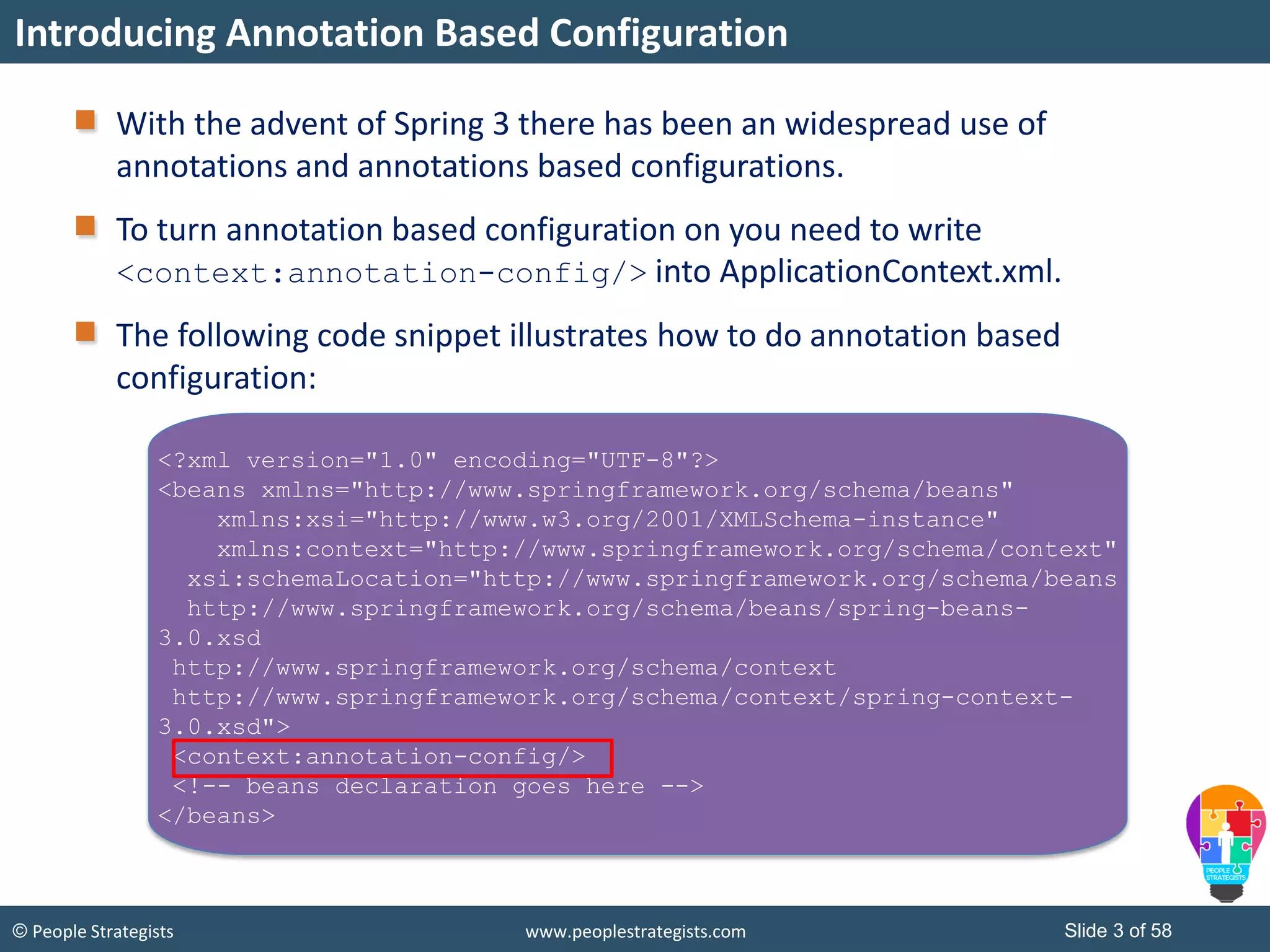
Slide 3 of 58© People Strategists www.peoplestrategists.com With the advent of Spring 3 there has been an widespread use of annotations and annotations based configurations. To turn annotation based configuration on you need to write <context:annotation-config/> into ApplicationContext.xml. The following code snippet illustrates how to do annotation based configuration: Introducing Annotation Based Configuration <?xml version="1.0" encoding="UTF-8"?> <beans xmlns="http://www.springframework.org/schema/beans" xmlns:xsi="http://www.w3.org/2001/XMLSchema-instance" xmlns:context="http://www.springframework.org/schema/context" xsi:schemaLocation="http://www.springframework.org/schema/beans http://www.springframework.org/schema/beans/spring-beans- 3.0.xsd http://www.springframework.org/schema/context http://www.springframework.org/schema/context/spring-context- 3.0.xsd"> <context:annotation-config/> <!-- beans declaration goes here --> </beans>
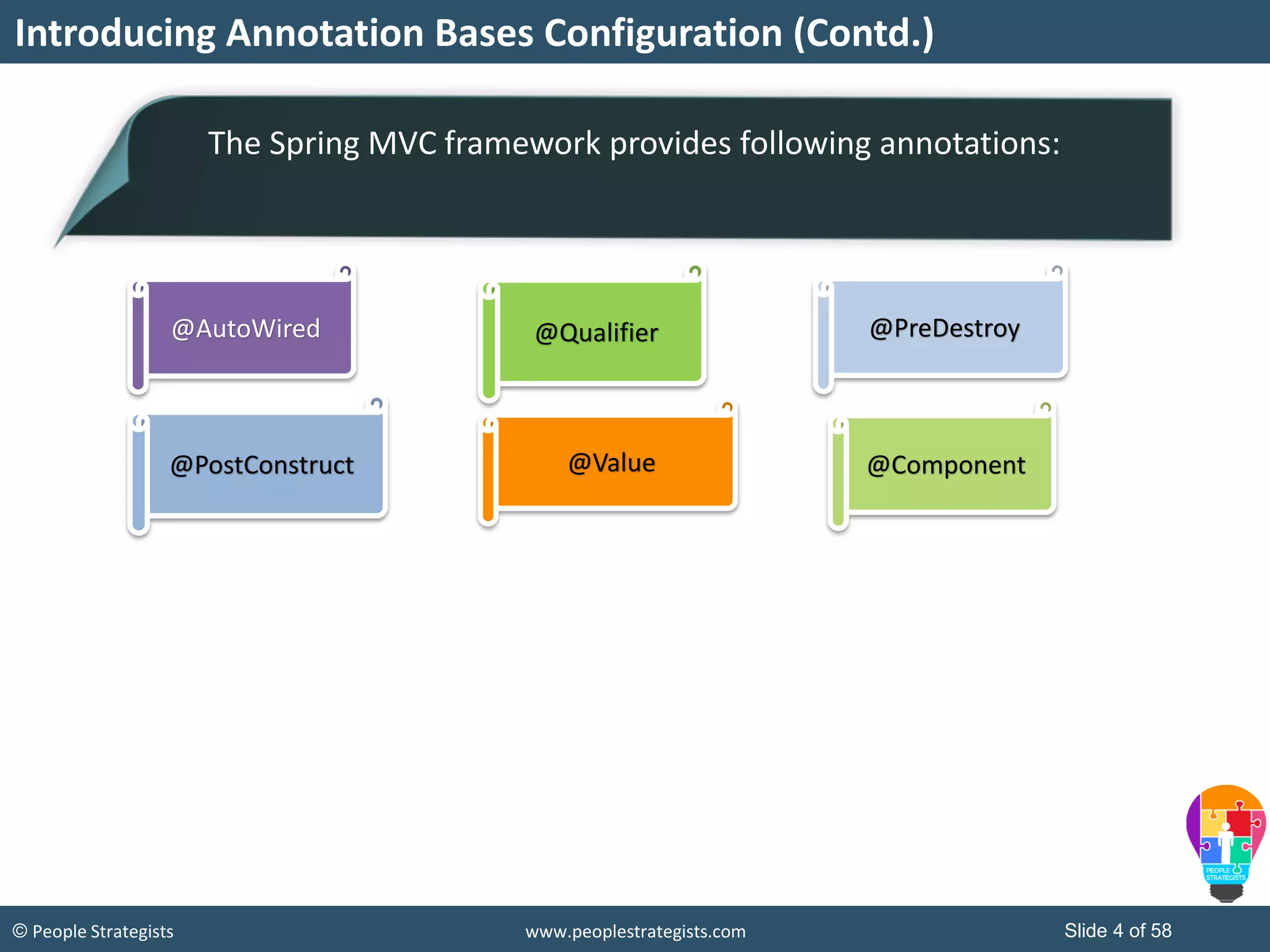
Slide 4 of 58© People Strategists www.peoplestrategists.com Introducing Annotation Bases Configuration (Contd.) @Value @PreDestroy@Qualifier @PostConstruct @Component @AutoWired The Spring MVC framework provides following annotations:
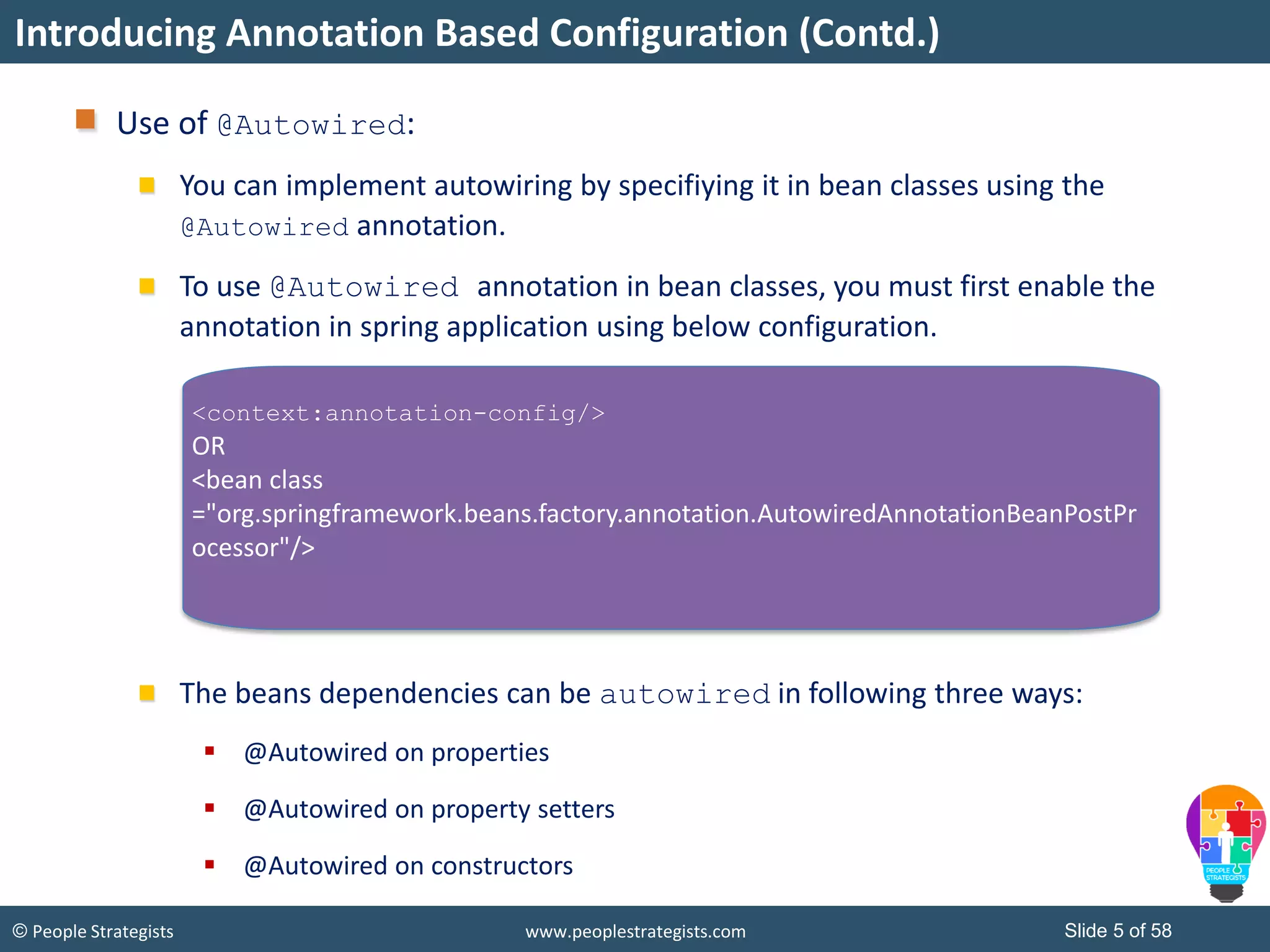
Slide 5 of 58© People Strategists www.peoplestrategists.com Use of @Autowired: You can implement autowiring by specifiying it in bean classes using the @Autowired annotation. To use @Autowired annotation in bean classes, you must first enable the annotation in spring application using below configuration. The beans dependencies can be autowired in following three ways:  @Autowired on properties  @Autowired on property setters  @Autowired on constructors Introducing Annotation Based Configuration (Contd.) <context:annotation-config/> OR <bean class ="org.springframework.beans.factory.annotation.AutowiredAnnotationBeanPostPr ocessor"/>
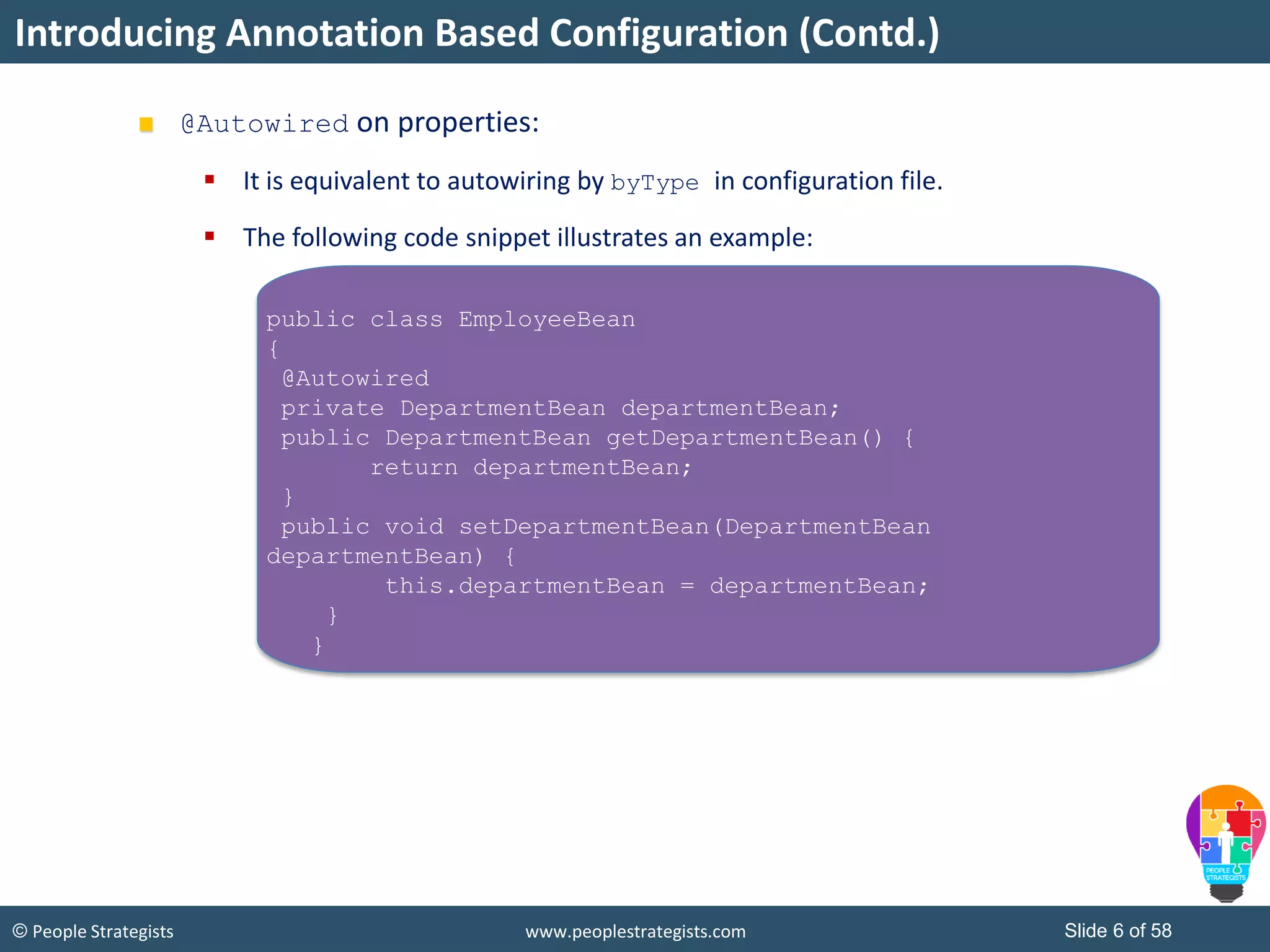
Slide 6 of 58© People Strategists www.peoplestrategists.com @Autowired on properties:  It is equivalent to autowiring by byType in configuration file.  The following code snippet illustrates an example: Introducing Annotation Based Configuration (Contd.) public class EmployeeBean { @Autowired private DepartmentBean departmentBean; public DepartmentBean getDepartmentBean() { return departmentBean; } public void setDepartmentBean(DepartmentBean departmentBean) { this.departmentBean = departmentBean; } }
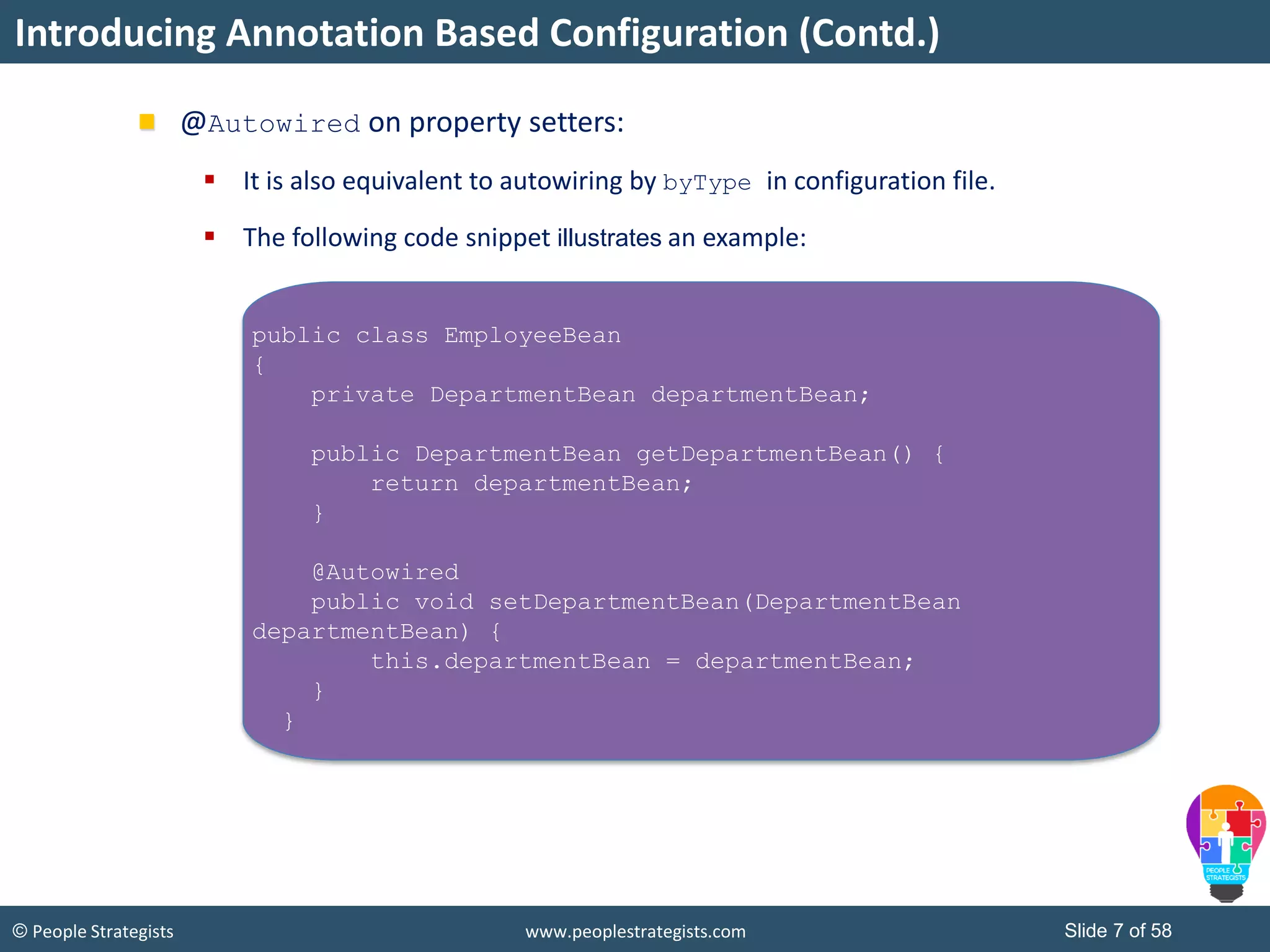
Slide 7 of 58© People Strategists www.peoplestrategists.com @Autowired on property setters:  It is also equivalent to autowiring by byType in configuration file.  The following code snippet illustrates an example: Introducing Annotation Based Configuration (Contd.) public class EmployeeBean { private DepartmentBean departmentBean; public DepartmentBean getDepartmentBean() { return departmentBean; } @Autowired public void setDepartmentBean(DepartmentBean departmentBean) { this.departmentBean = departmentBean; } }
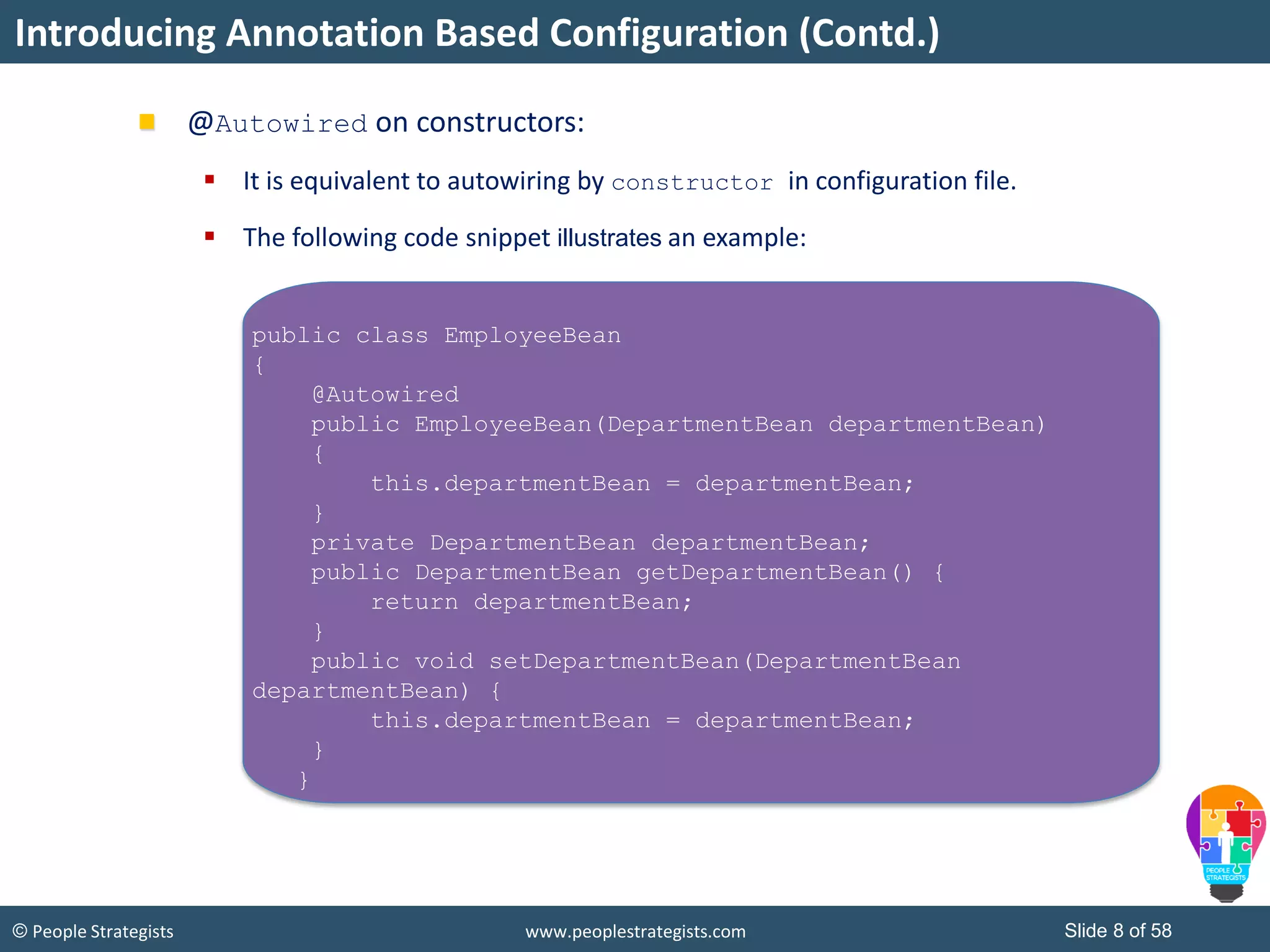
Slide 8 of 58© People Strategists www.peoplestrategists.com @Autowired on constructors:  It is equivalent to autowiring by constructor in configuration file.  The following code snippet illustrates an example: Introducing Annotation Based Configuration (Contd.) public class EmployeeBean { @Autowired public EmployeeBean(DepartmentBean departmentBean) { this.departmentBean = departmentBean; } private DepartmentBean departmentBean; public DepartmentBean getDepartmentBean() { return departmentBean; } public void setDepartmentBean(DepartmentBean departmentBean) { this.departmentBean = departmentBean; } }
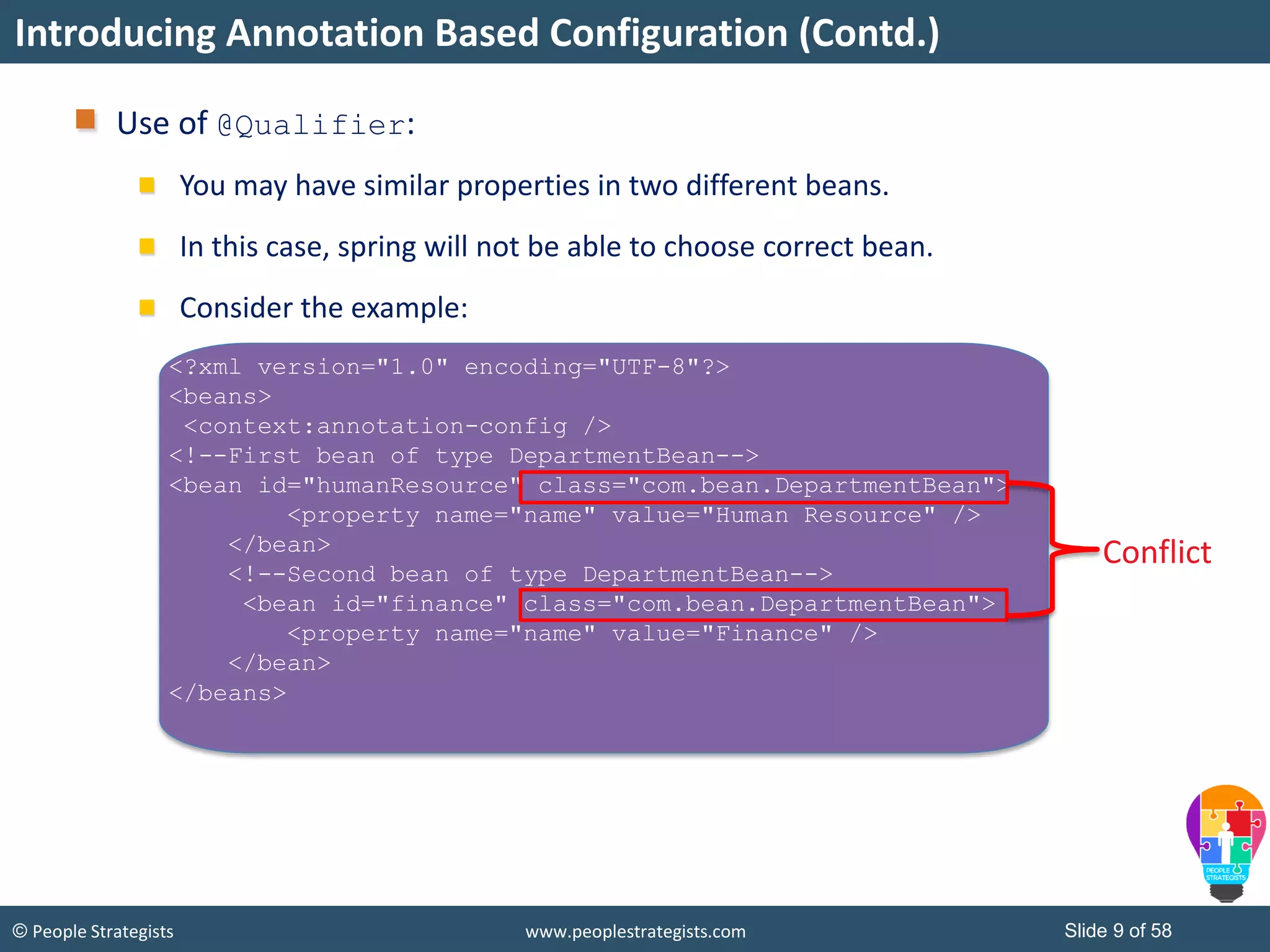
Slide 9 of 58© People Strategists www.peoplestrategists.com Use of @Qualifier: You may have similar properties in two different beans. In this case, spring will not be able to choose correct bean. Consider the example: Introducing Annotation Based Configuration (Contd.) <?xml version="1.0" encoding="UTF-8"?> <beans> <context:annotation-config /> <!--First bean of type DepartmentBean--> <bean id="humanResource" class="com.bean.DepartmentBean"> <property name="name" value="Human Resource" /> </bean> <!--Second bean of type DepartmentBean--> <bean id="finance" class="com.bean.DepartmentBean"> <property name="name" value="Finance" /> </bean> </beans> Conflict
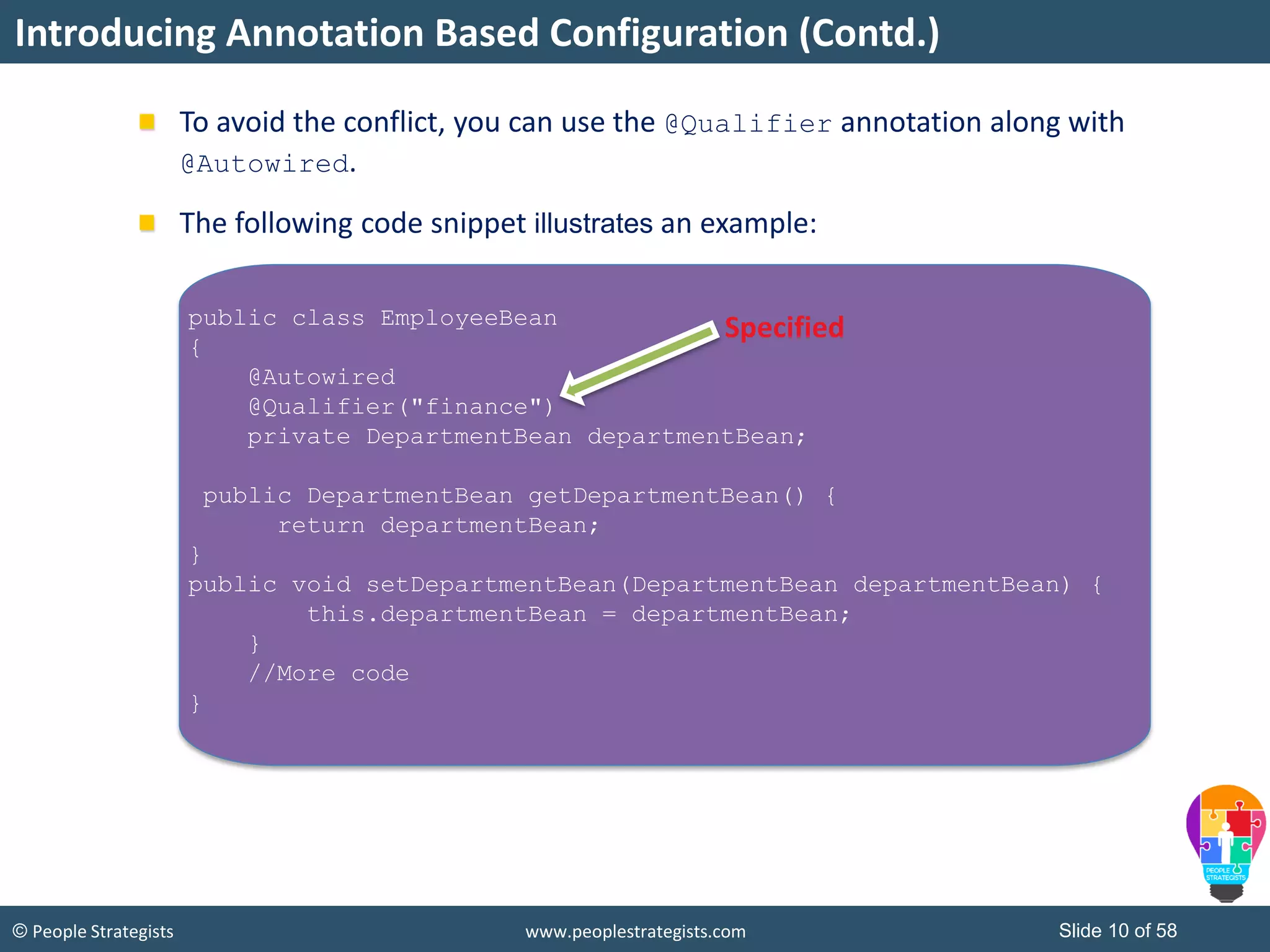
Slide 10 of 58© People Strategists www.peoplestrategists.com To avoid the conflict, you can use the @Qualifier annotation along with @Autowired. The following code snippet illustrates an example: Introducing Annotation Based Configuration (Contd.) public class EmployeeBean { @Autowired @Qualifier("finance") private DepartmentBean departmentBean; public DepartmentBean getDepartmentBean() { return departmentBean; } public void setDepartmentBean(DepartmentBean departmentBean) { this.departmentBean = departmentBean; } //More code } Specified
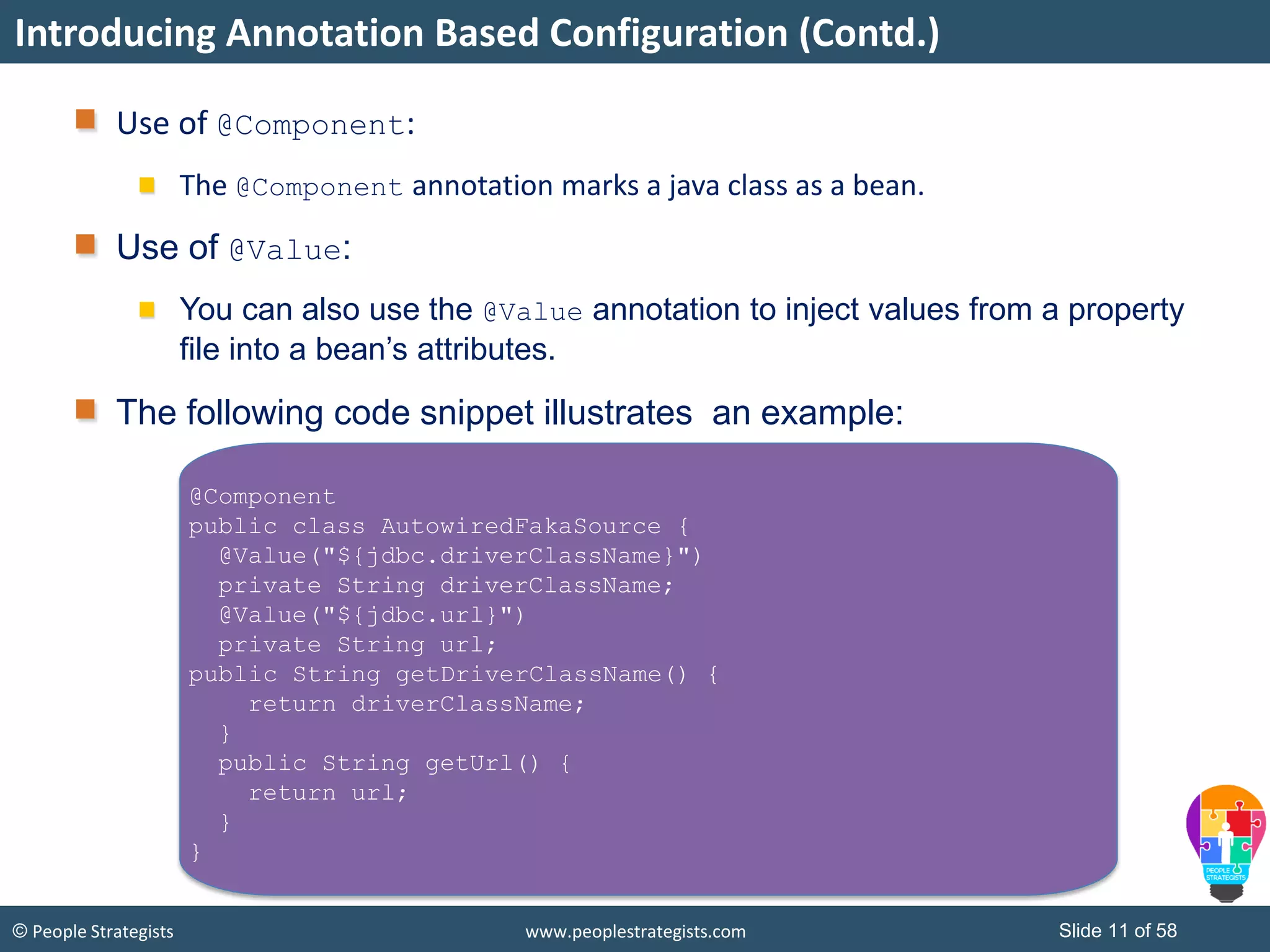
Slide 11 of 58© People Strategists www.peoplestrategists.com Use of @Component: The @Component annotation marks a java class as a bean. Use of @Value: You can also use the @Value annotation to inject values from a property file into a bean’s attributes. The following code snippet illustrates an example: Introducing Annotation Based Configuration (Contd.) @Component public class AutowiredFakaSource { @Value("${jdbc.driverClassName}") private String driverClassName; @Value("${jdbc.url}") private String url; public String getDriverClassName() { return driverClassName; } public String getUrl() { return url; } }
Slide 12 of 58© People Strategists www.peoplestrategists.com Activity: Implementing Autowiring Using byName Let us see how to implement @Autowired using byName by importing the embedded project in Eclipse.
Slide 13 of 58© People Strategists www.peoplestrategists.com Activity: Implementing Autowiring Using byType Let us see how to implement @Autowired using byType by importing the embedded project in Eclipse.
Slide 14 of 58© People Strategists www.peoplestrategists.com Activity: Implementing Autowiring Using Constructor Let us see how to implement @Autowired using constructor by importing the embedded project in Eclipse.
Slide 15 of 58© People Strategists www.peoplestrategists.com Use of @PostConstruct: @PostConstruct is used for a method in a bean. The annotated method gets called just after the invocation of constructor. It can be used perform operations that you need perform before executing any other method. Use of @PreDestroy: @PreDestroy is also used for a method in a bean. The annotated method gets called just before an object is garbage collected. It can be used to perform operations at the final moment. Introducing Annotation Based Configuration (Contd.)
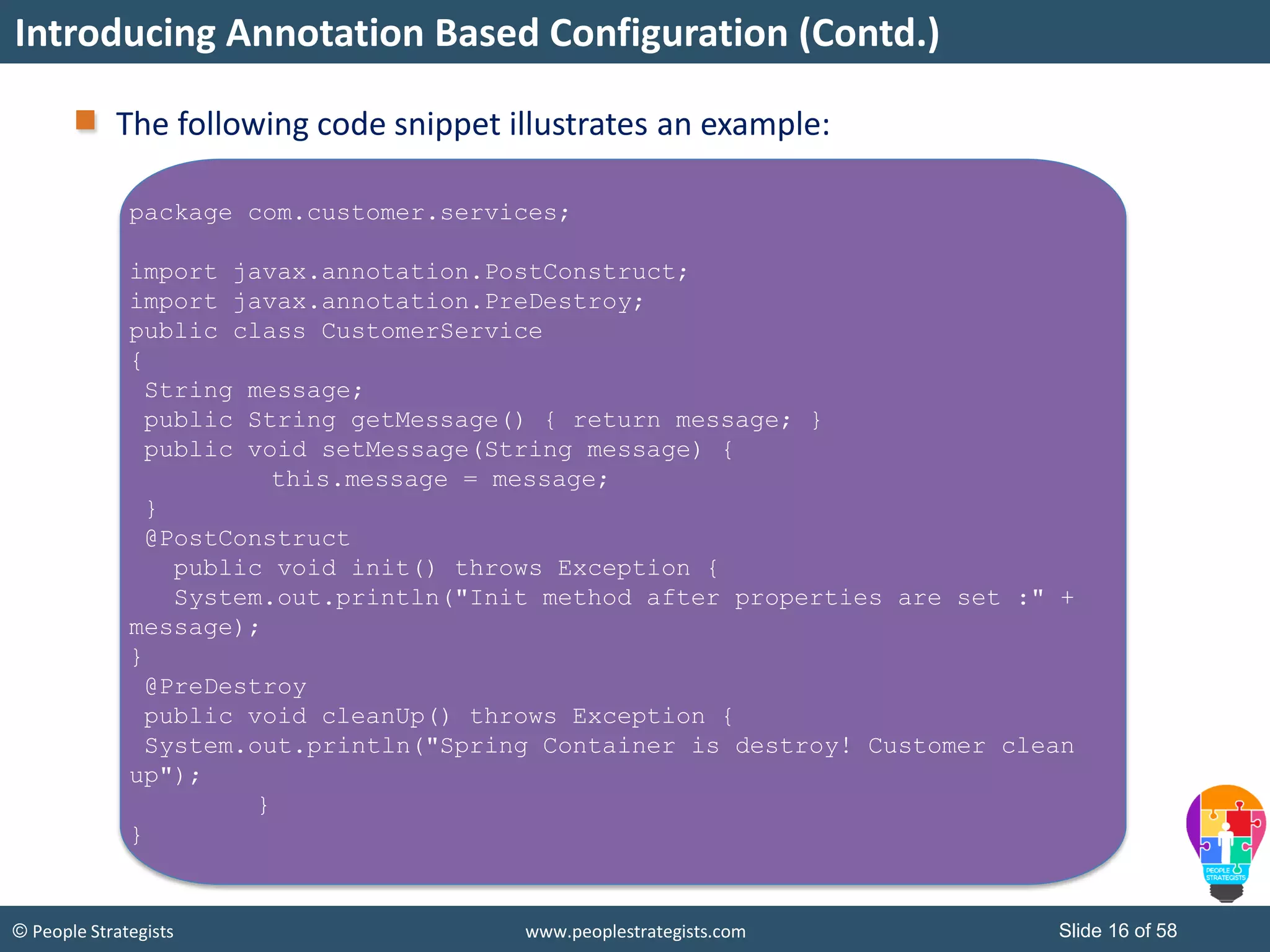
Slide 16 of 58© People Strategists www.peoplestrategists.com The following code snippet illustrates an example: Introducing Annotation Based Configuration (Contd.) package com.customer.services; import javax.annotation.PostConstruct; import javax.annotation.PreDestroy; public class CustomerService { String message; public String getMessage() { return message; } public void setMessage(String message) { this.message = message; } @PostConstruct public void init() throws Exception { System.out.println("Init method after properties are set :" + message); } @PreDestroy public void cleanUp() throws Exception { System.out.println("Spring Container is destroy! Customer clean up"); } }
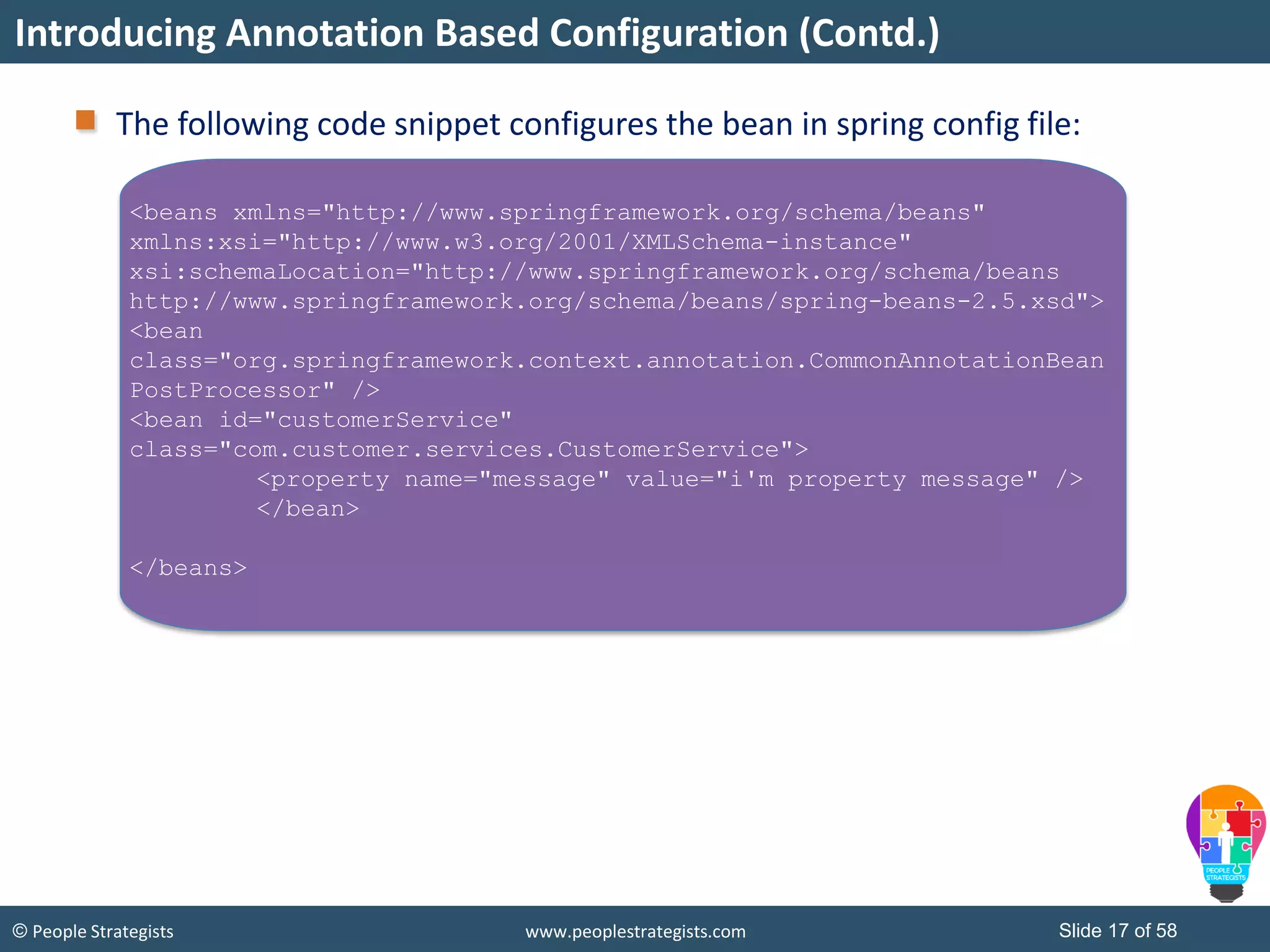
Slide 17 of 58© People Strategists www.peoplestrategists.com The following code snippet configures the bean in spring config file: Introducing Annotation Based Configuration (Contd.) <beans xmlns="http://www.springframework.org/schema/beans" xmlns:xsi="http://www.w3.org/2001/XMLSchema-instance" xsi:schemaLocation="http://www.springframework.org/schema/beans http://www.springframework.org/schema/beans/spring-beans-2.5.xsd"> <bean class="org.springframework.context.annotation.CommonAnnotationBean PostProcessor" /> <bean id="customerService" class="com.customer.services.CustomerService"> <property name="message" value="i'm property message" /> </bean> </beans>
Slide 18 of 58© People Strategists www.peoplestrategists.com Activity: Implementing @PreDestroy and @PostConstruct Let us see how to implement @PreDestroy and @PostConstruct.
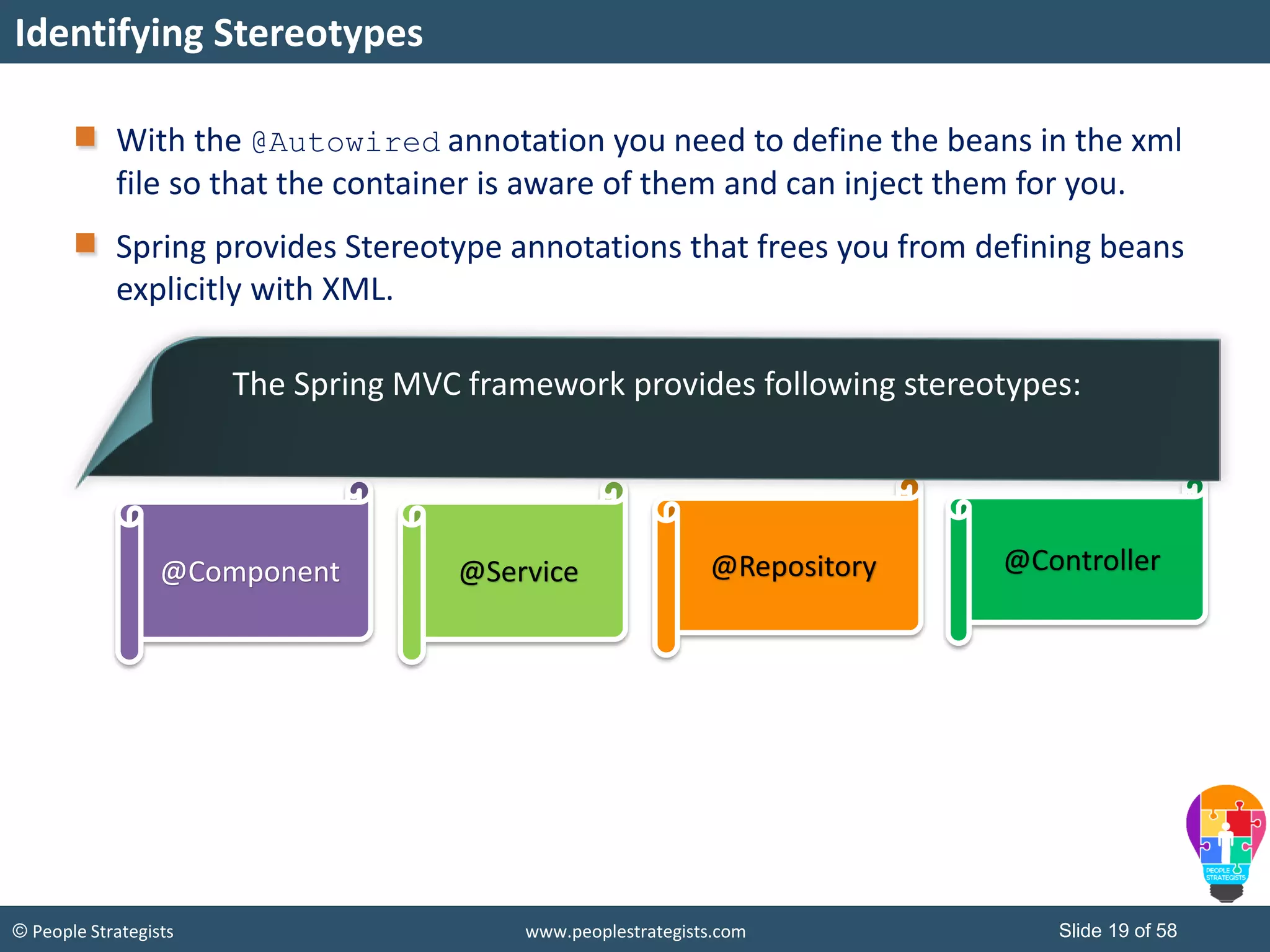
Slide 19 of 58© People Strategists www.peoplestrategists.com @Controller Identifying Stereotypes @Repository@Service@Component The Spring MVC framework provides following stereotypes: With the @Autowired annotation you need to define the beans in the xml file so that the container is aware of them and can inject them for you. Spring provides Stereotype annotations that frees you from defining beans explicitly with XML.
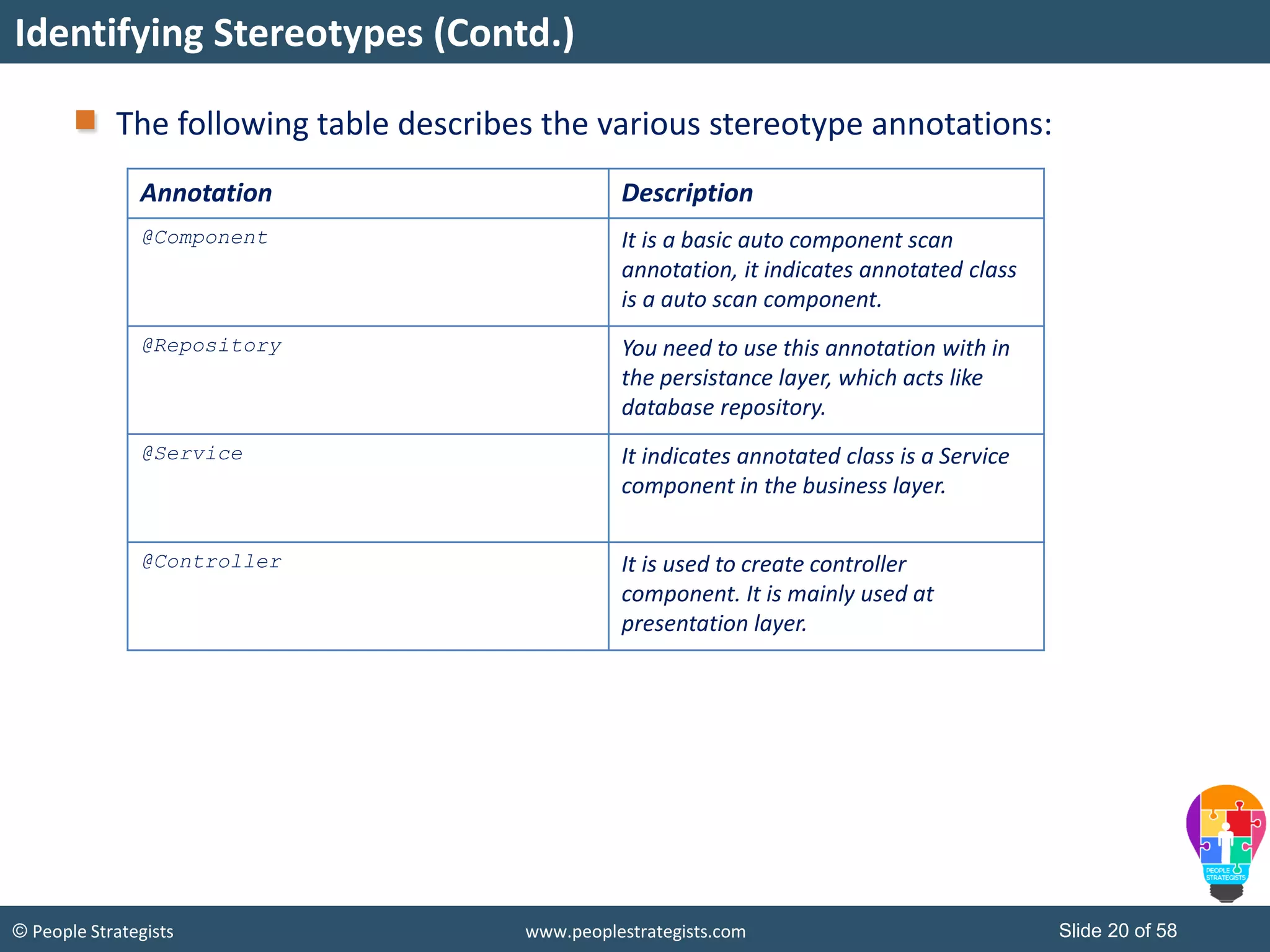
Slide 20 of 58© People Strategists www.peoplestrategists.com Identifying Stereotypes (Contd.) The following table describes the various stereotype annotations: Annotation Description @Component It is a basic auto component scan annotation, it indicates annotated class is a auto scan component. @Repository You need to use this annotation with in the persistance layer, which acts like database repository. @Service It indicates annotated class is a Service component in the business layer. @Controller It is used to create controller component. It is mainly used at presentation layer.
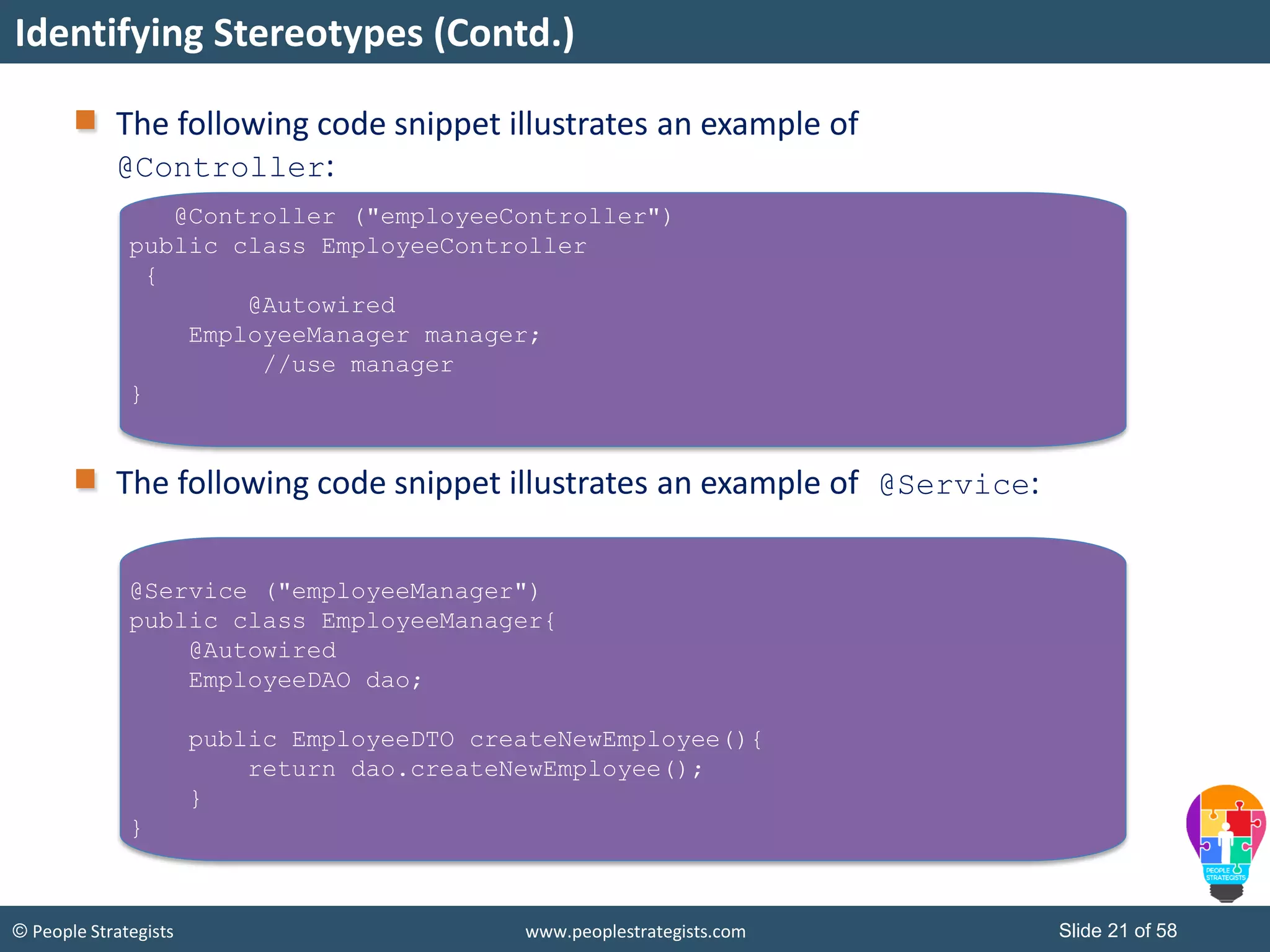
Slide 21 of 58© People Strategists www.peoplestrategists.com Identifying Stereotypes (Contd.) The following code snippet illustrates an example of @Controller: The following code snippet illustrates an example of @Service: @Controller ("employeeController") public class EmployeeController { @Autowired EmployeeManager manager; //use manager } @Service ("employeeManager") public class EmployeeManager{ @Autowired EmployeeDAO dao; public EmployeeDTO createNewEmployee(){ return dao.createNewEmployee(); } }
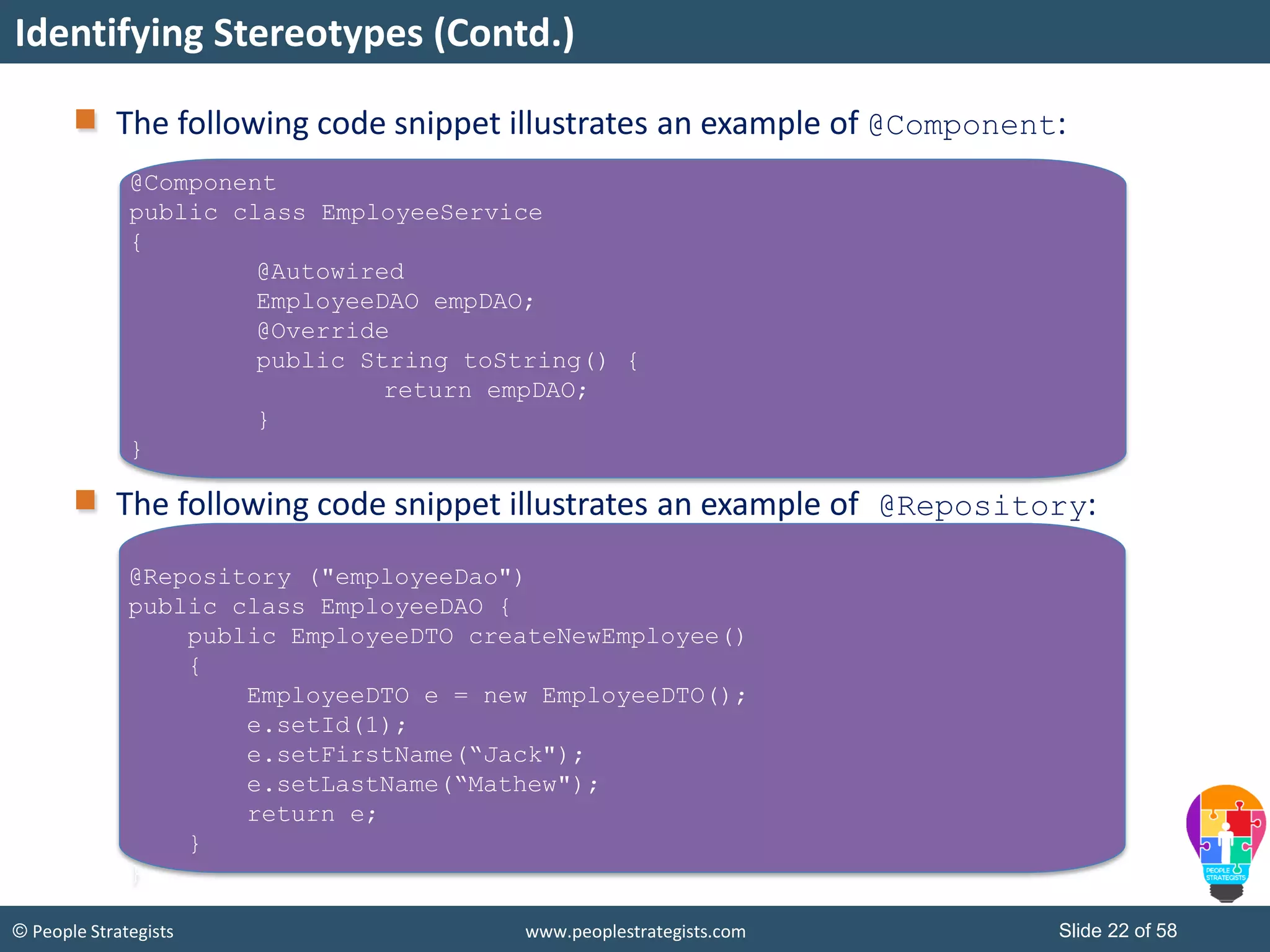
Slide 22 of 58© People Strategists www.peoplestrategists.com Identifying Stereotypes (Contd.) The following code snippet illustrates an example of @Component: The following code snippet illustrates an example of @Repository: @Component public class EmployeeService { @Autowired EmployeeDAO empDAO; @Override public String toString() { return empDAO; } } @Repository ("employeeDao") public class EmployeeDAO { public EmployeeDTO createNewEmployee() { EmployeeDTO e = new EmployeeDTO(); e.setId(1); e.setFirstName(“Jack"); e.setLastName(“Mathew"); return e; } }
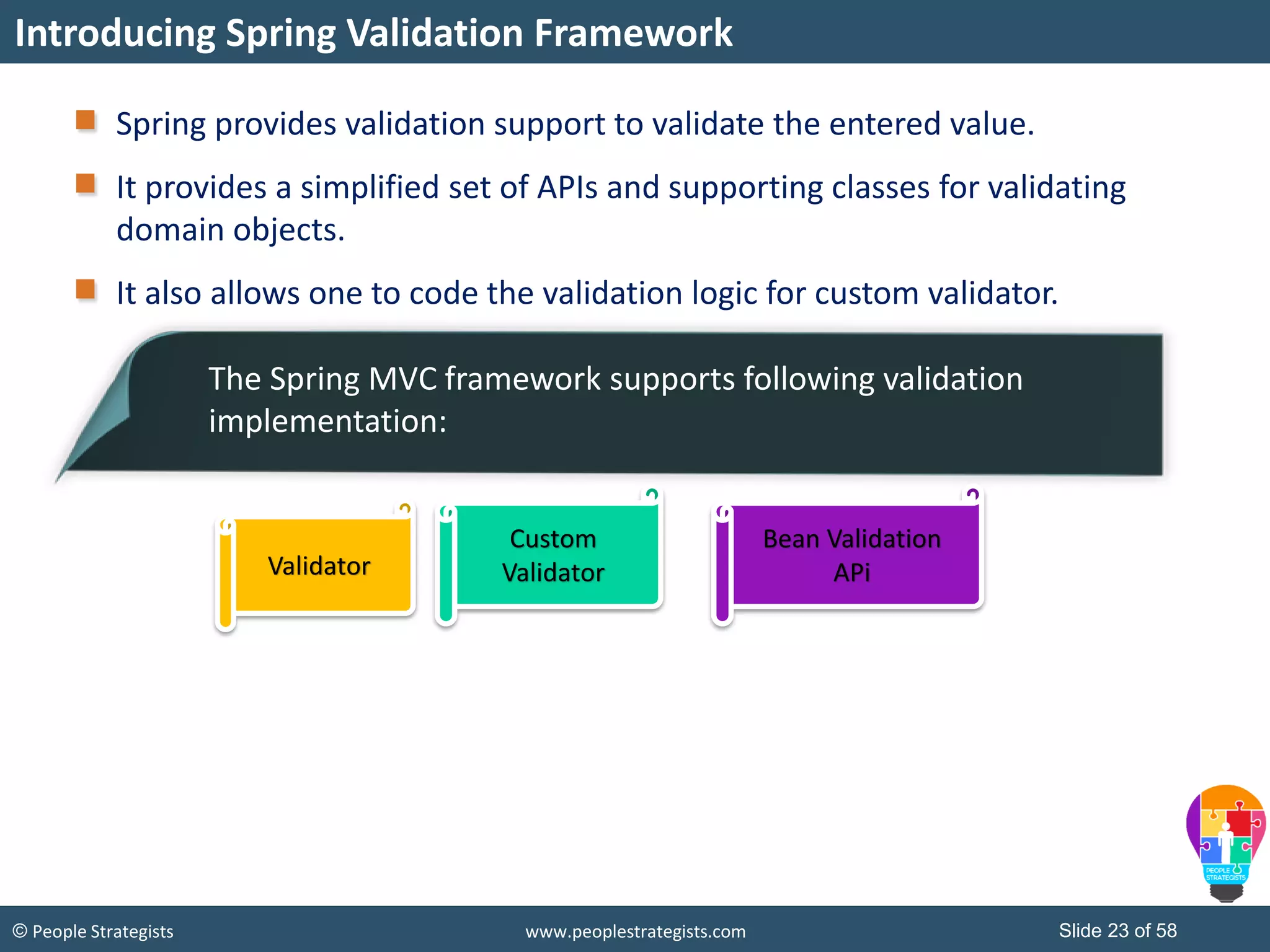
Slide 23 of 58© People Strategists www.peoplestrategists.com Spring provides validation support to validate the entered value. It provides a simplified set of APIs and supporting classes for validating domain objects. It also allows one to code the validation logic for custom validator. Introducing Spring Validation Framework The Spring MVC framework supports following validation implementation: Validator Custom Validator Bean Validation APi
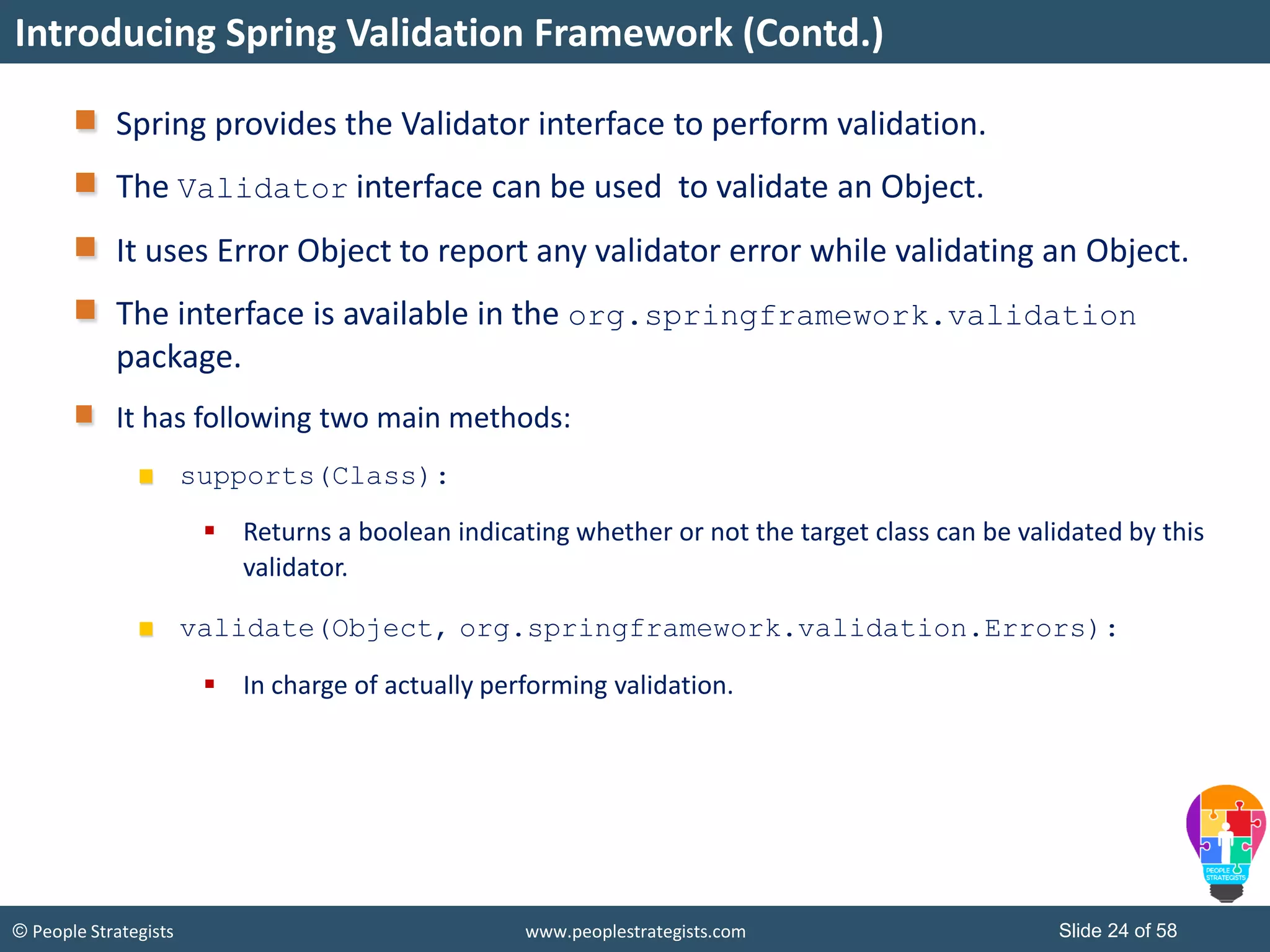
Slide 24 of 58© People Strategists www.peoplestrategists.com Spring provides the Validator interface to perform validation. The Validator interface can be used to validate an Object. It uses Error Object to report any validator error while validating an Object. The interface is available in the org.springframework.validation package. It has following two main methods: supports(Class):  Returns a boolean indicating whether or not the target class can be validated by this validator. validate(Object, org.springframework.validation.Errors):  In charge of actually performing validation. Introducing Spring Validation Framework (Contd.)
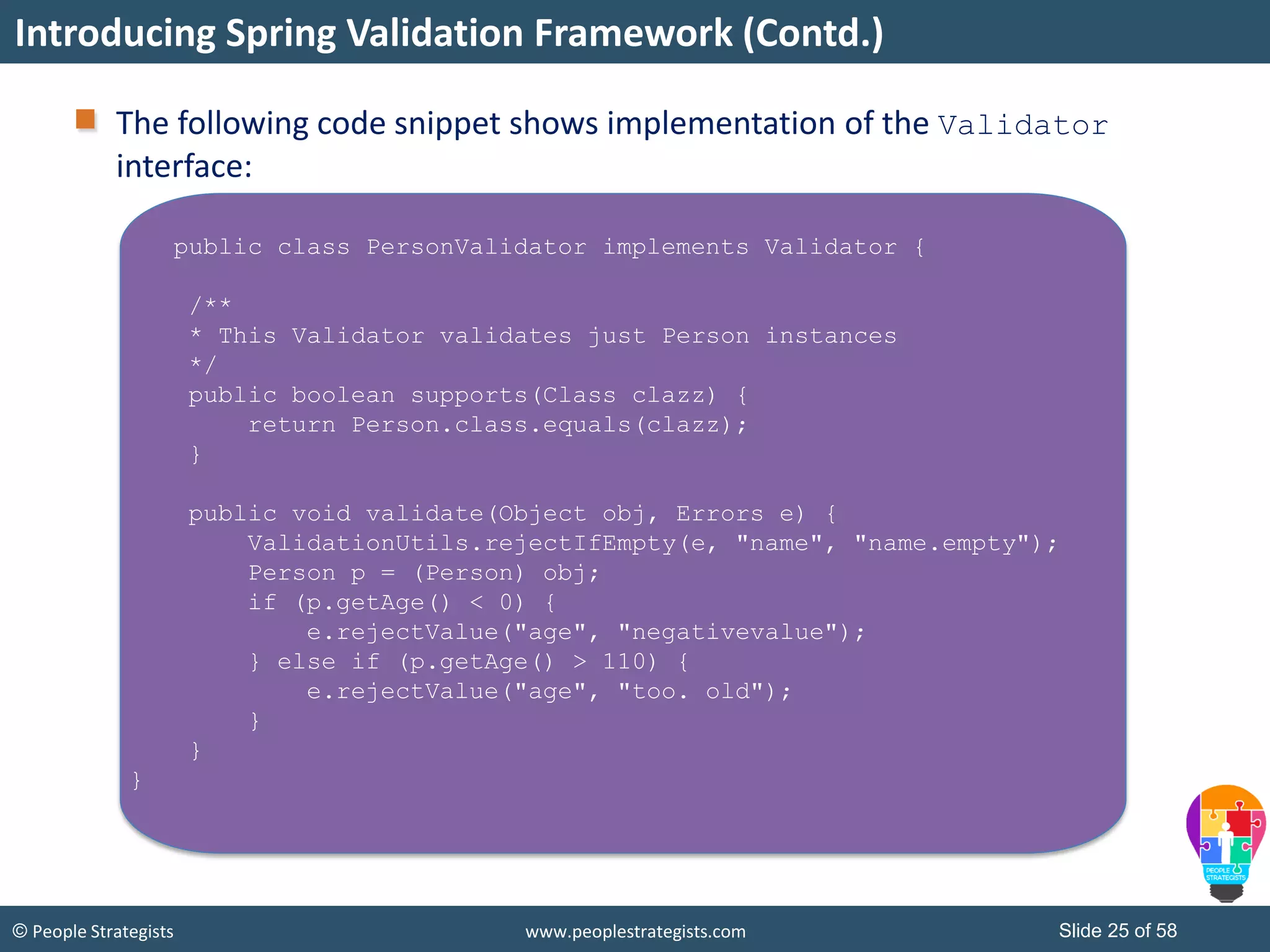
Slide 25 of 58© People Strategists www.peoplestrategists.com The following code snippet shows implementation of the Validator interface: Introducing Spring Validation Framework (Contd.) public class PersonValidator implements Validator { /** * This Validator validates just Person instances */ public boolean supports(Class clazz) { return Person.class.equals(clazz); } public void validate(Object obj, Errors e) { ValidationUtils.rejectIfEmpty(e, "name", "name.empty"); Person p = (Person) obj; if (p.getAge() < 0) { e.rejectValue("age", "negativevalue"); } else if (p.getAge() > 110) { e.rejectValue("age", "too. old"); } } }
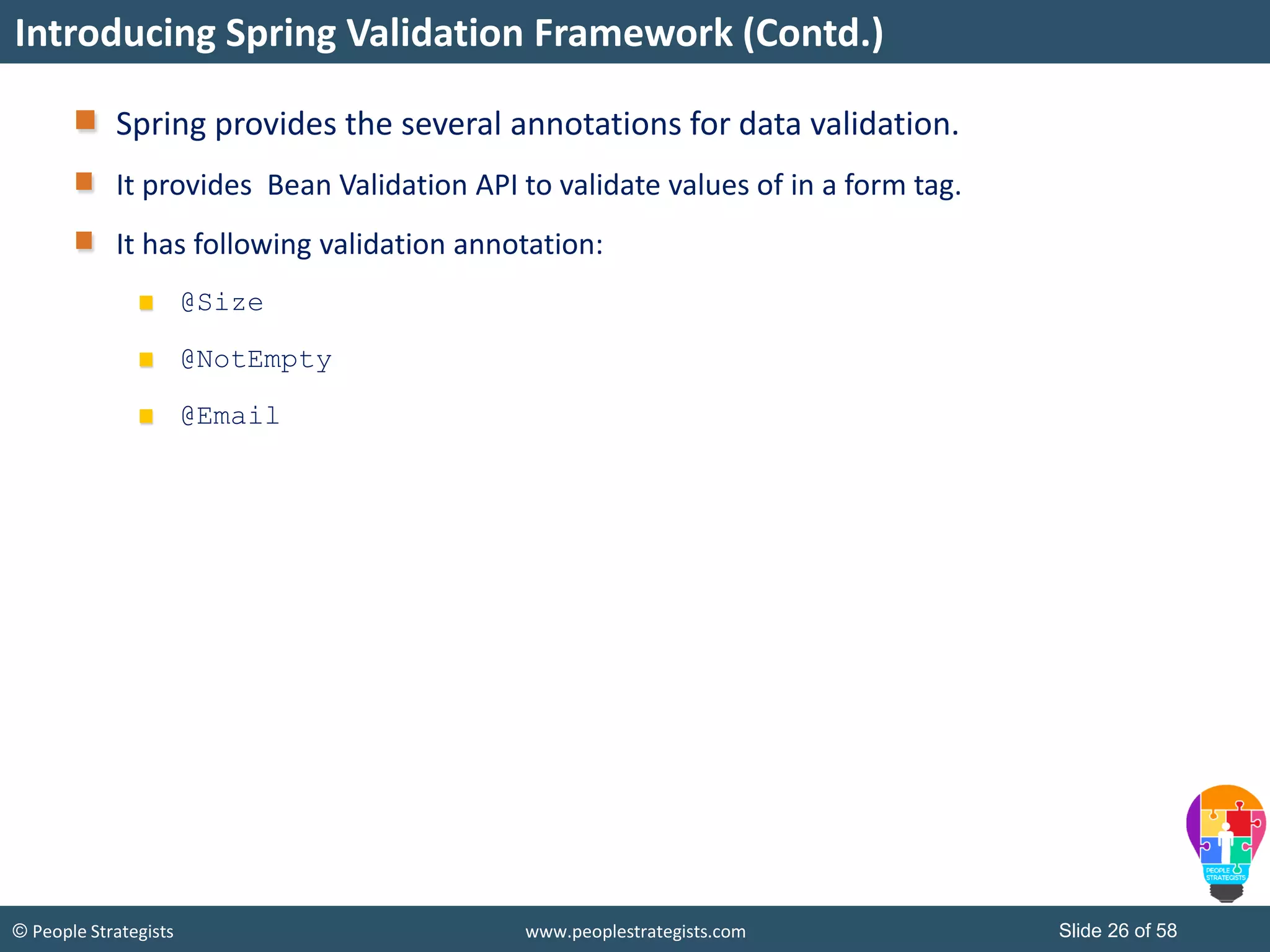
Slide 26 of 58© People Strategists www.peoplestrategists.com Spring provides the several annotations for data validation. It provides Bean Validation API to validate values of in a form tag. It has following validation annotation: @Size @NotEmpty @Email Introducing Spring Validation Framework (Contd.)
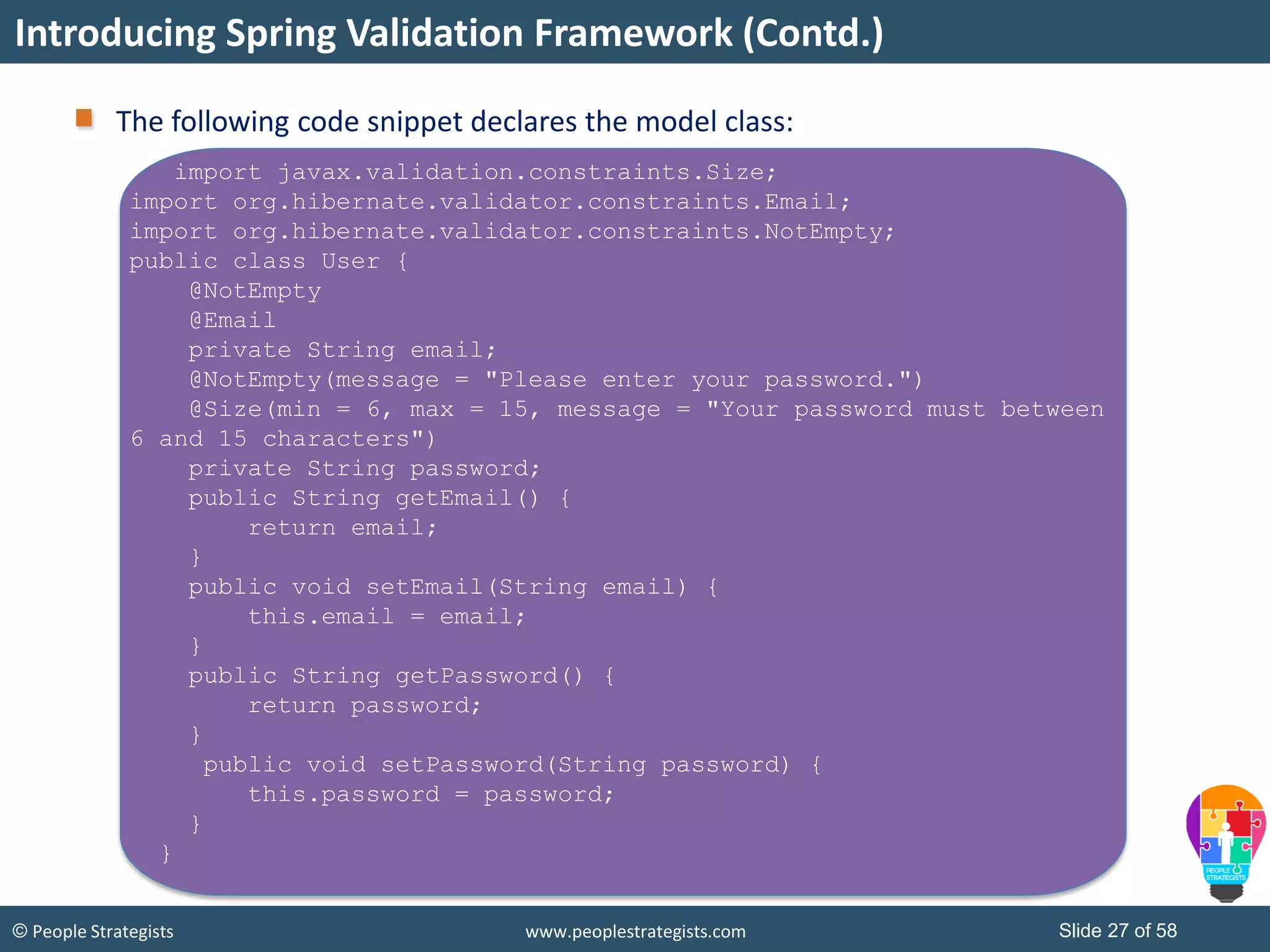
Slide 27 of 58© People Strategists www.peoplestrategists.com The following code snippet declares the model class: Introducing Spring Validation Framework (Contd.) import javax.validation.constraints.Size; import org.hibernate.validator.constraints.Email; import org.hibernate.validator.constraints.NotEmpty; public class User { @NotEmpty @Email private String email; @NotEmpty(message = "Please enter your password.") @Size(min = 6, max = 15, message = "Your password must between 6 and 15 characters") private String password; public String getEmail() { return email; } public void setEmail(String email) { this.email = email; } public String getPassword() { return password; } public void setPassword(String password) { this.password = password; } }
Slide 28 of 58© People Strategists www.peoplestrategists.com Activity: Implementing the Bean Validation API Let us see how to implement validation.
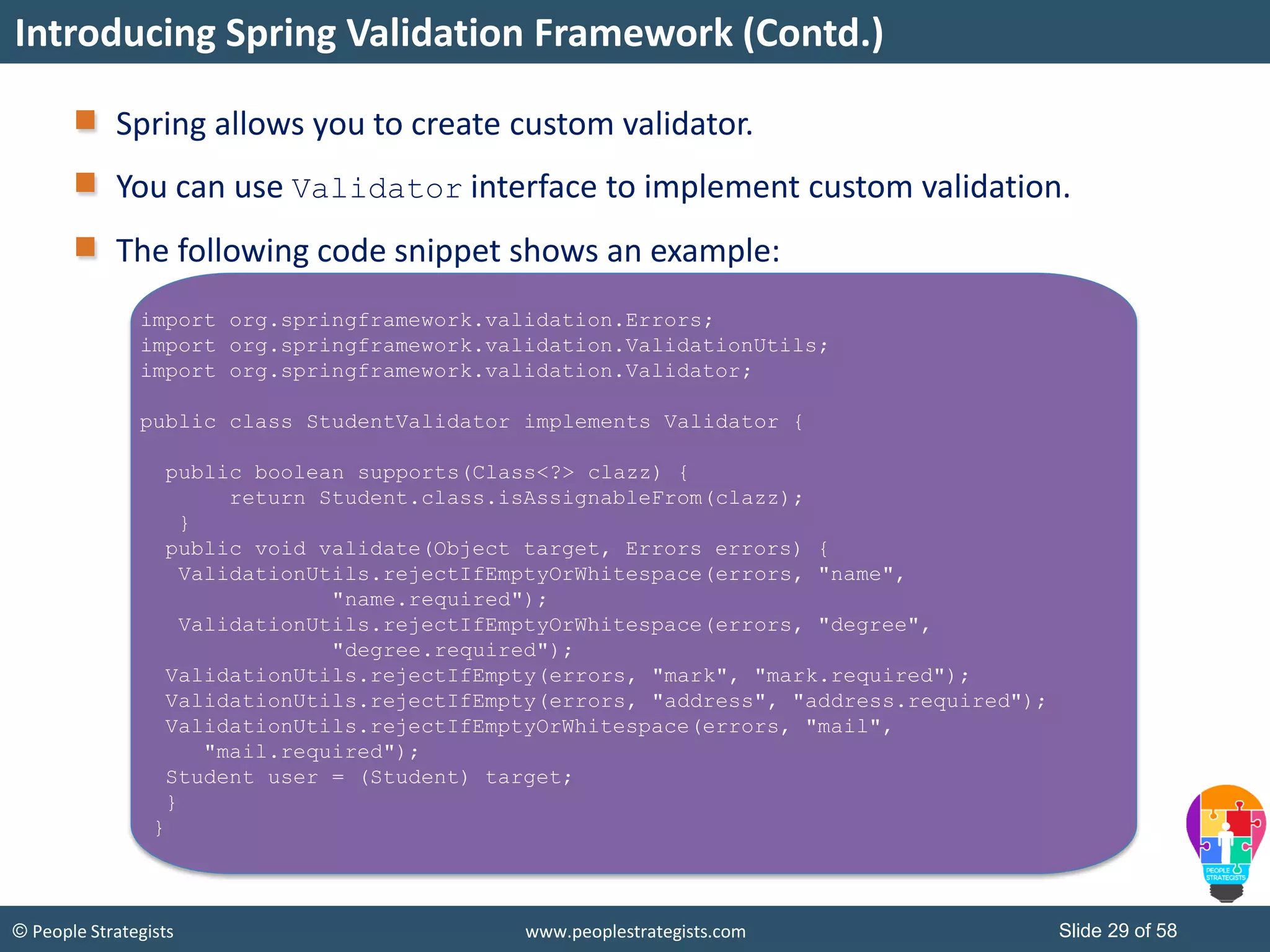
Slide 29 of 58© People Strategists www.peoplestrategists.com Spring allows you to create custom validator. You can use Validator interface to implement custom validation. The following code snippet shows an example: Introducing Spring Validation Framework (Contd.) import org.springframework.validation.Errors; import org.springframework.validation.ValidationUtils; import org.springframework.validation.Validator; public class StudentValidator implements Validator { public boolean supports(Class<?> clazz) { return Student.class.isAssignableFrom(clazz); } public void validate(Object target, Errors errors) { ValidationUtils.rejectIfEmptyOrWhitespace(errors, "name", "name.required"); ValidationUtils.rejectIfEmptyOrWhitespace(errors, "degree", "degree.required"); ValidationUtils.rejectIfEmpty(errors, "mark", "mark.required"); ValidationUtils.rejectIfEmpty(errors, "address", "address.required"); ValidationUtils.rejectIfEmptyOrWhitespace(errors, "mail", "mail.required"); Student user = (Student) target; } }
Slide 30 of 58© People Strategists www.peoplestrategists.com Activity: Implementing Custom Validation Let us see how to implement custom validation.
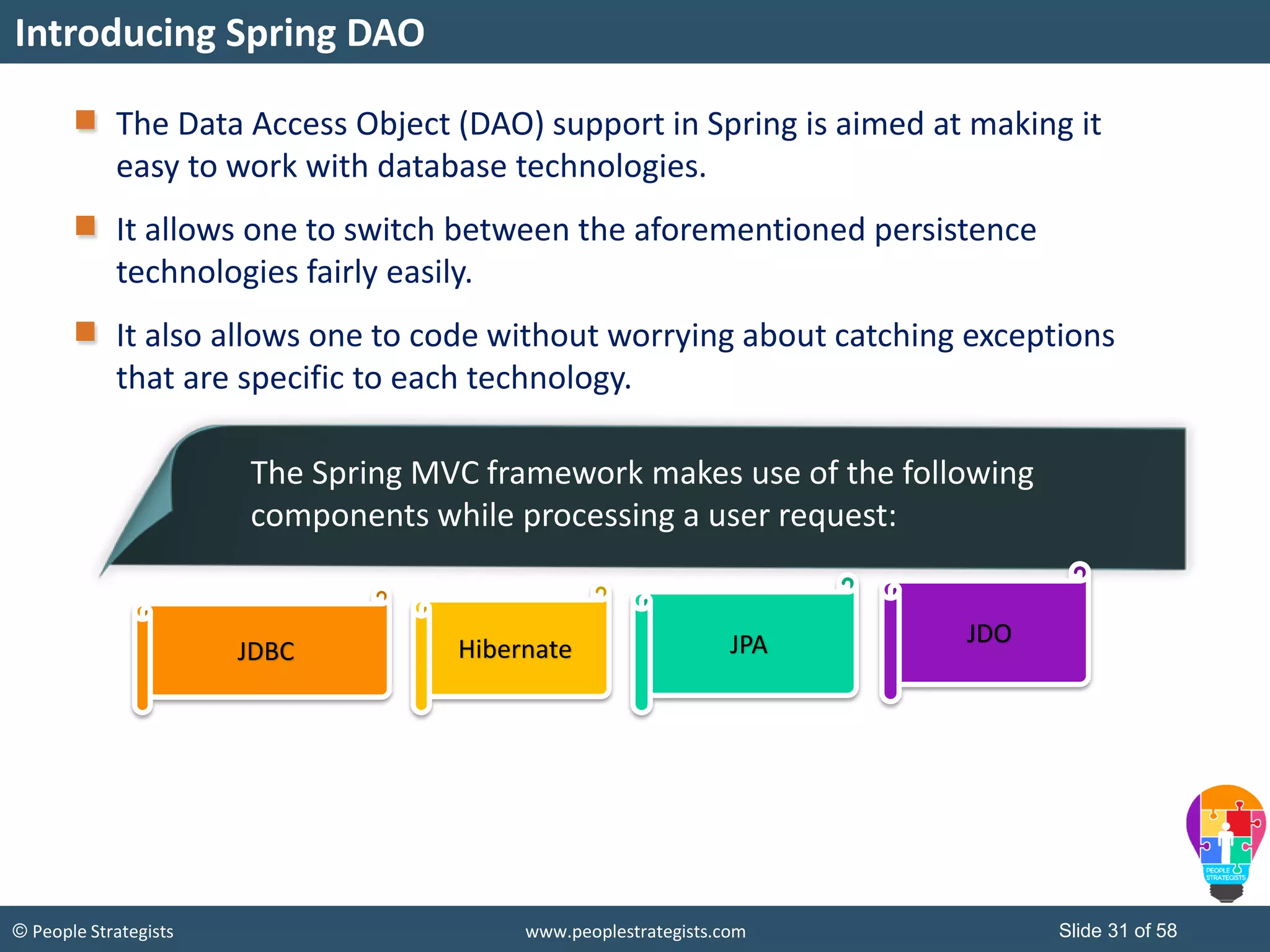
Slide 31 of 58© People Strategists www.peoplestrategists.com The Data Access Object (DAO) support in Spring is aimed at making it easy to work with database technologies. It allows one to switch between the aforementioned persistence technologies fairly easily. It also allows one to code without worrying about catching exceptions that are specific to each technology. Introducing Spring DAO The Spring MVC framework makes use of the following components while processing a user request: JDBC Hibernate JPA JDO
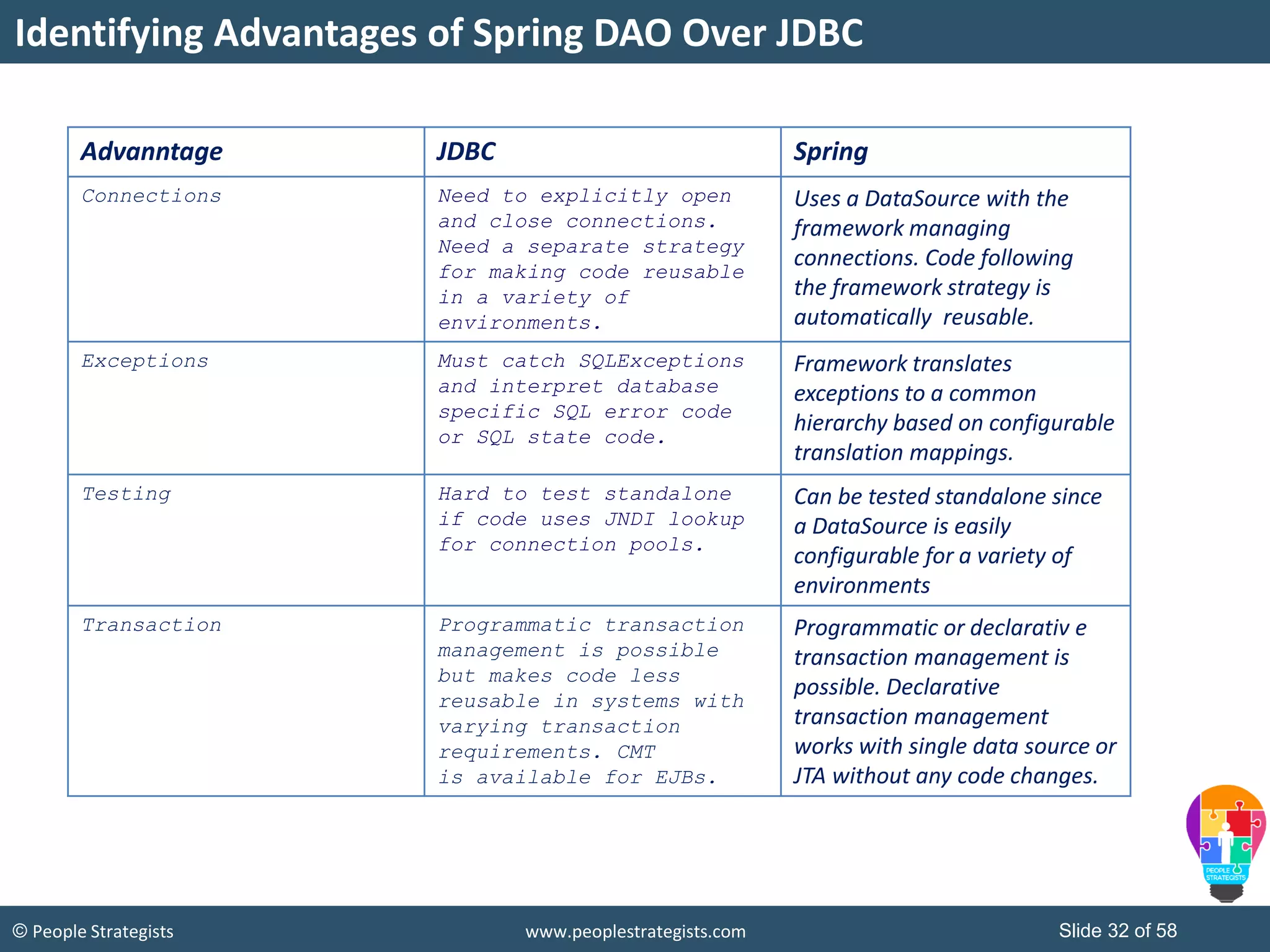
Slide 32 of 58© People Strategists www.peoplestrategists.com Identifying Advantages of Spring DAO Over JDBC Advanntage JDBC Spring Connections Need to explicitly open and close connections. Need a separate strategy for making code reusable in a variety of environments. Uses a DataSource with the framework managing connections. Code following the framework strategy is automatically reusable. Exceptions Must catch SQLExceptions and interpret database specific SQL error code or SQL state code. Framework translates exceptions to a common hierarchy based on configurable translation mappings. Testing Hard to test standalone if code uses JNDI lookup for connection pools. Can be tested standalone since a DataSource is easily configurable for a variety of environments Transaction Programmatic transaction management is possible but makes code less reusable in systems with varying transaction requirements. CMT is available for EJBs. Programmatic or declarativ e transaction management is possible. Declarative transaction management works with single data source or JTA without any code changes.
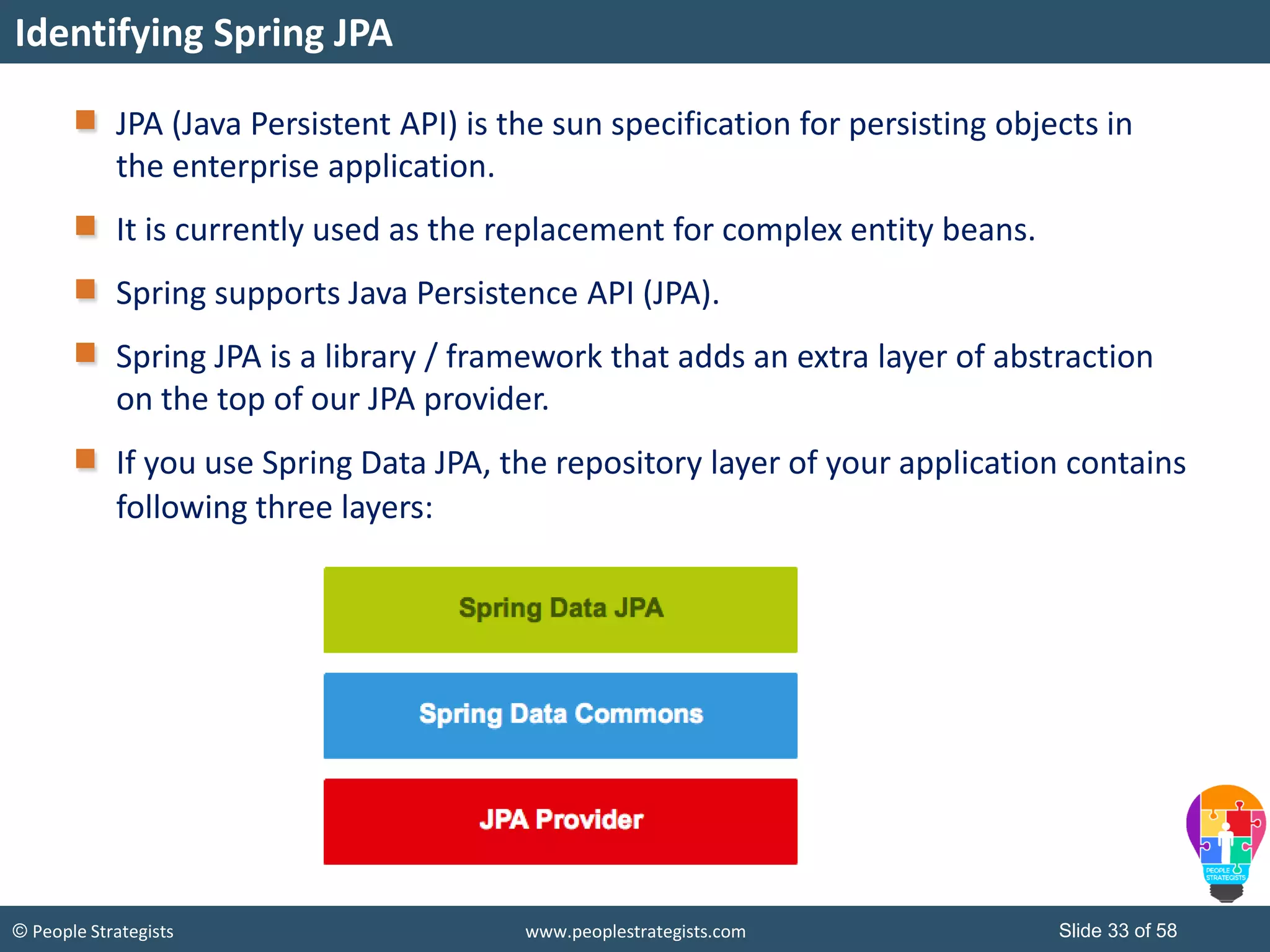
Slide 33 of 58© People Strategists www.peoplestrategists.com Identifying Spring JPA JPA (Java Persistent API) is the sun specification for persisting objects in the enterprise application. It is currently used as the replacement for complex entity beans. Spring supports Java Persistence API (JPA). Spring JPA is a library / framework that adds an extra layer of abstraction on the top of our JPA provider. If you use Spring Data JPA, the repository layer of your application contains following three layers:
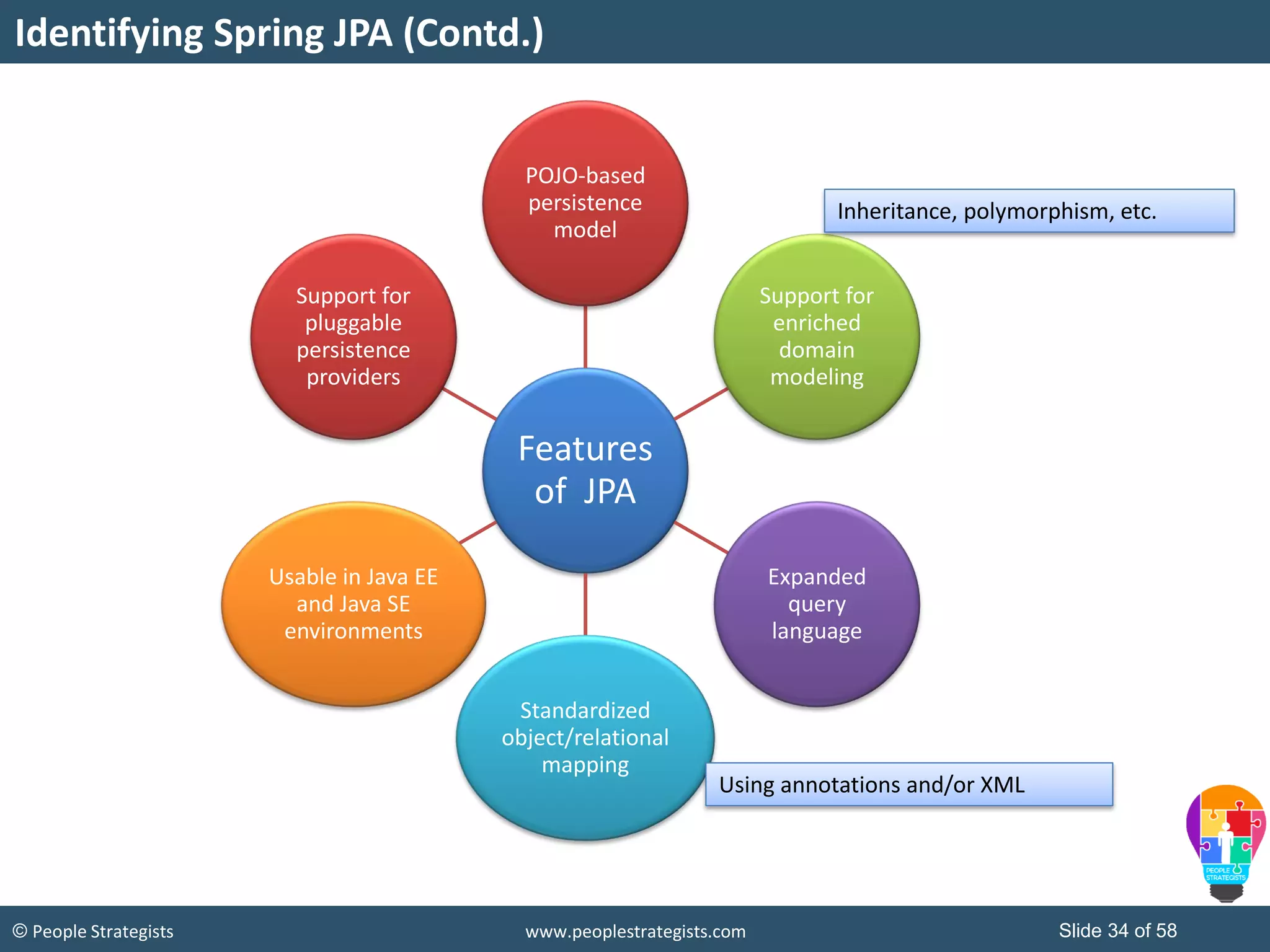
Slide 34 of 58© People Strategists www.peoplestrategists.com Identifying Spring JPA (Contd.) Features of JPA POJO-based persistence model Support for enriched domain modeling Expanded query language Standardized object/relational mapping Usable in Java EE and Java SE environments Support for pluggable persistence providers Inheritance, polymorphism, etc. Using annotations and/or XML
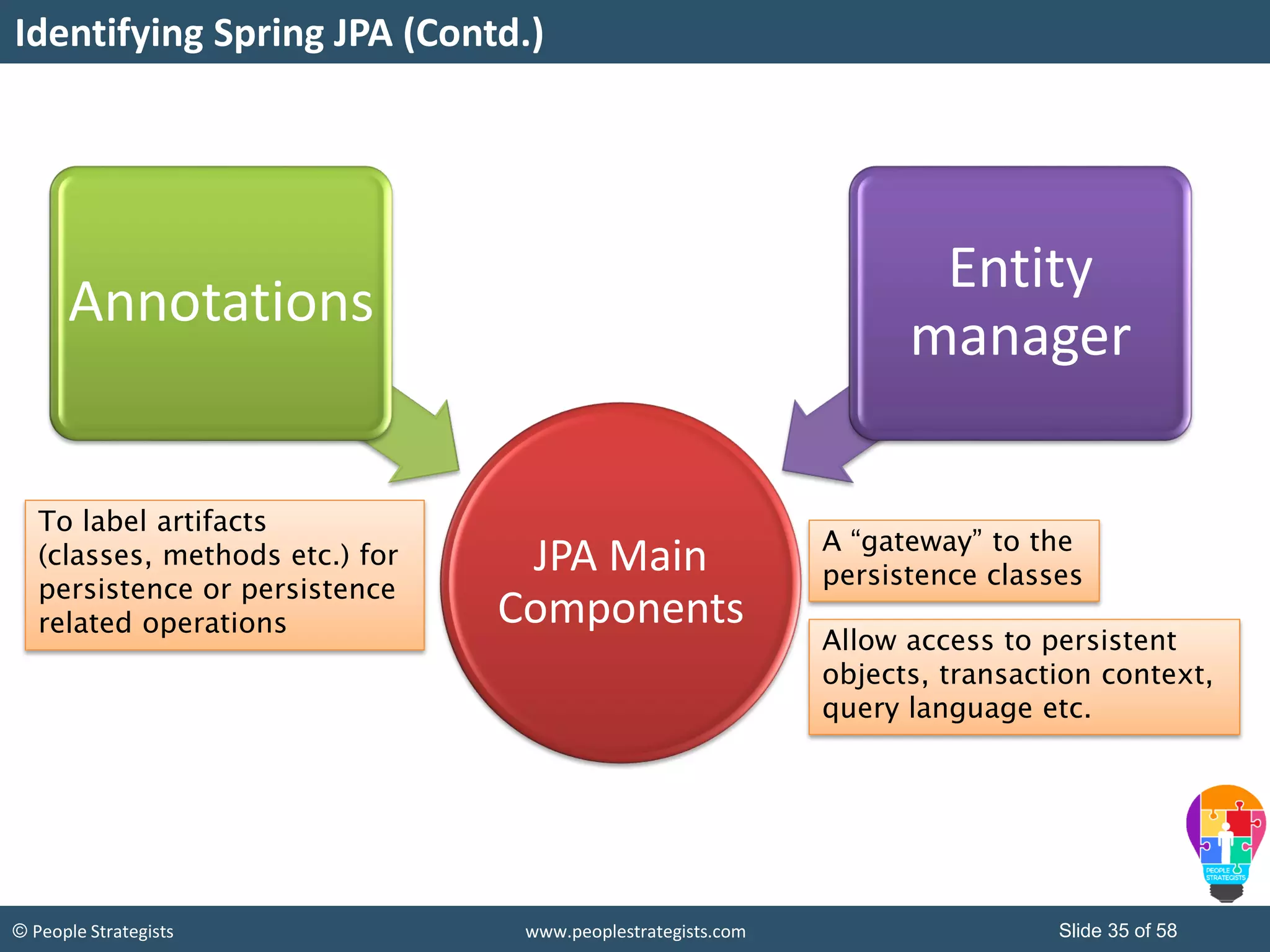
Slide 35 of 58© People Strategists www.peoplestrategists.com Identifying Spring JPA (Contd.) JPA Main Components Annotations Entity manager To label artifacts (classes, methods etc.) for persistence or persistence related operations A “gateway” to the persistence classes Allow access to persistent objects, transaction context, query language etc.
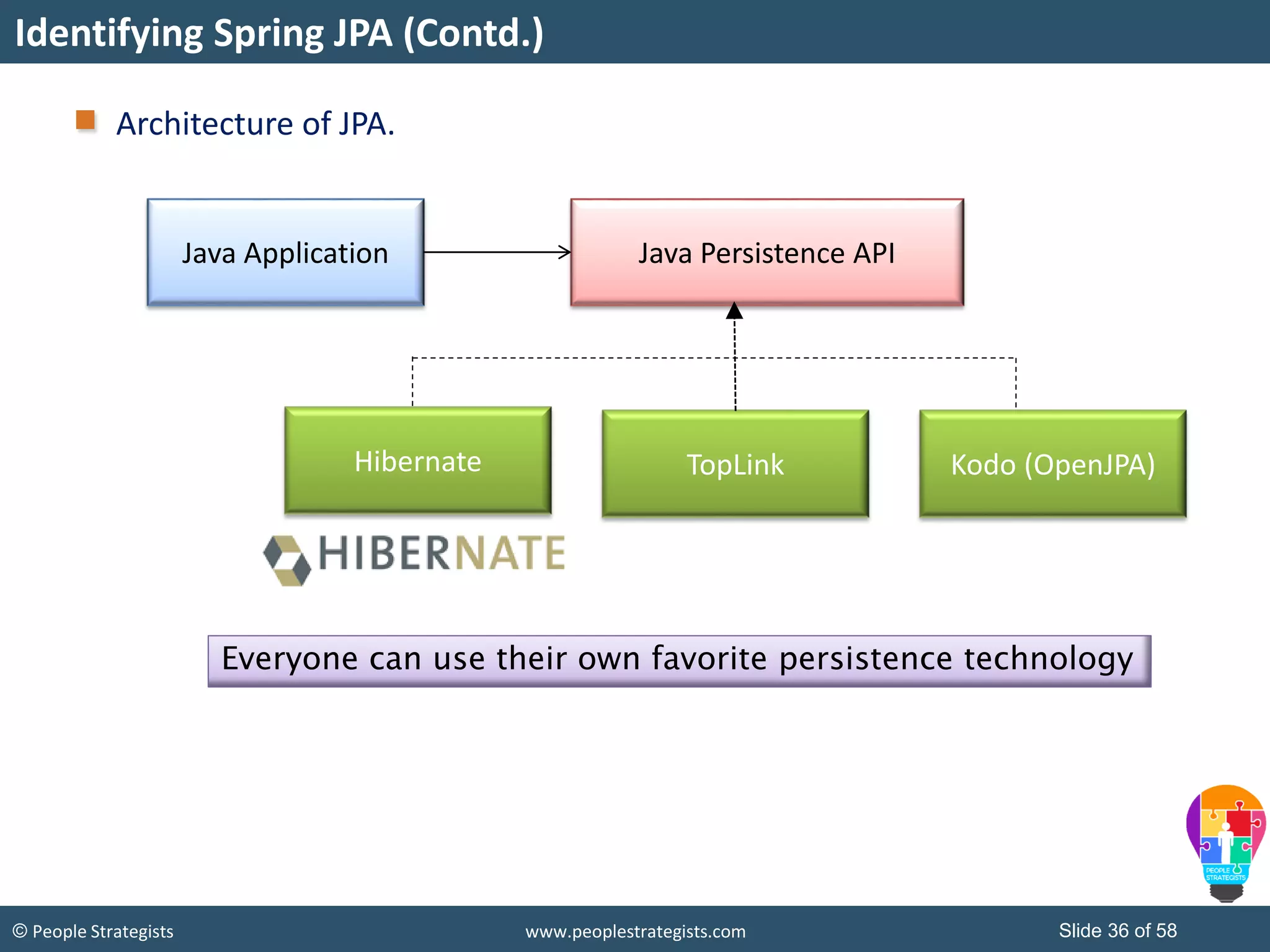
Slide 36 of 58© People Strategists www.peoplestrategists.com Identifying Spring JPA (Contd.) Java Application Java Persistence API Hibernate TopLink Kodo (OpenJPA) Everyone can use their own favorite persistence technology Architecture of JPA.
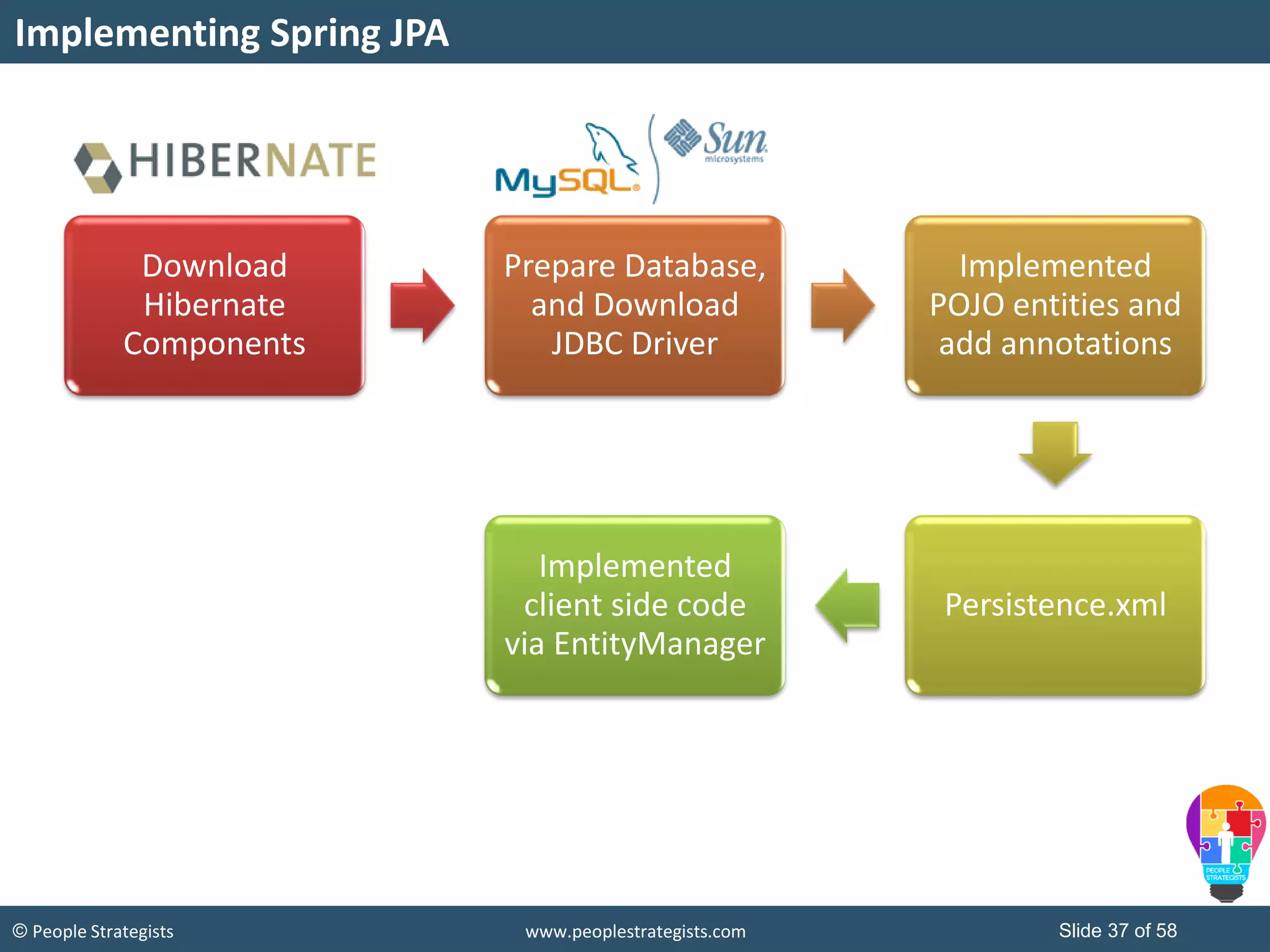
Slide 37 of 58© People Strategists www.peoplestrategists.com Implementing Spring JPA Download Hibernate Components Prepare Database, and Download JDBC Driver Implemented POJO entities and add annotations Persistence.xml Implemented client side code via EntityManager
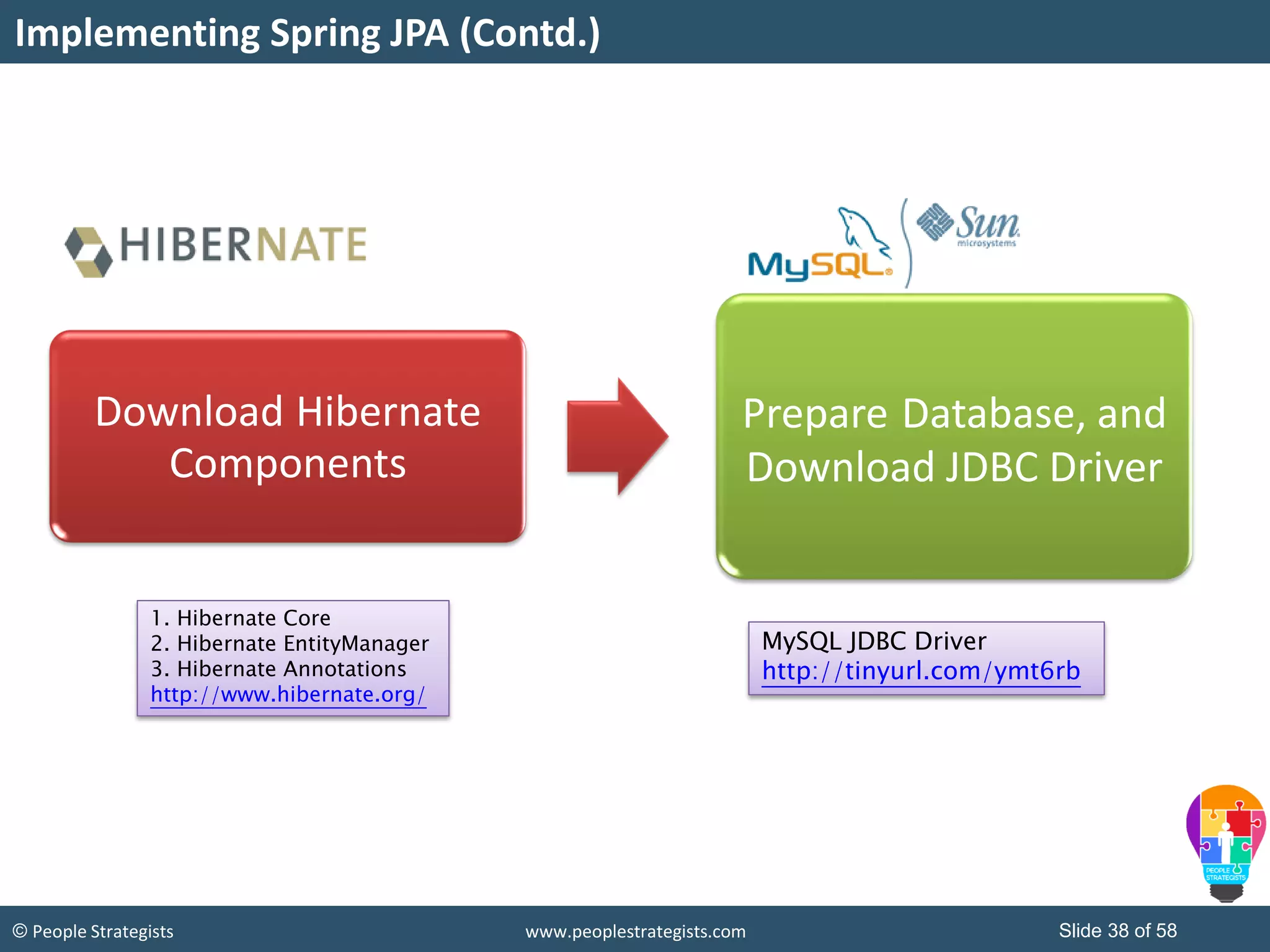
Slide 38 of 58© People Strategists www.peoplestrategists.com Implementing Spring JPA (Contd.) Download Hibernate Components Prepare Database, and Download JDBC Driver 1. Hibernate Core 2. Hibernate EntityManager 3. Hibernate Annotations http://www.hibernate.org/ MySQL JDBC Driver http://tinyurl.com/ymt6rb
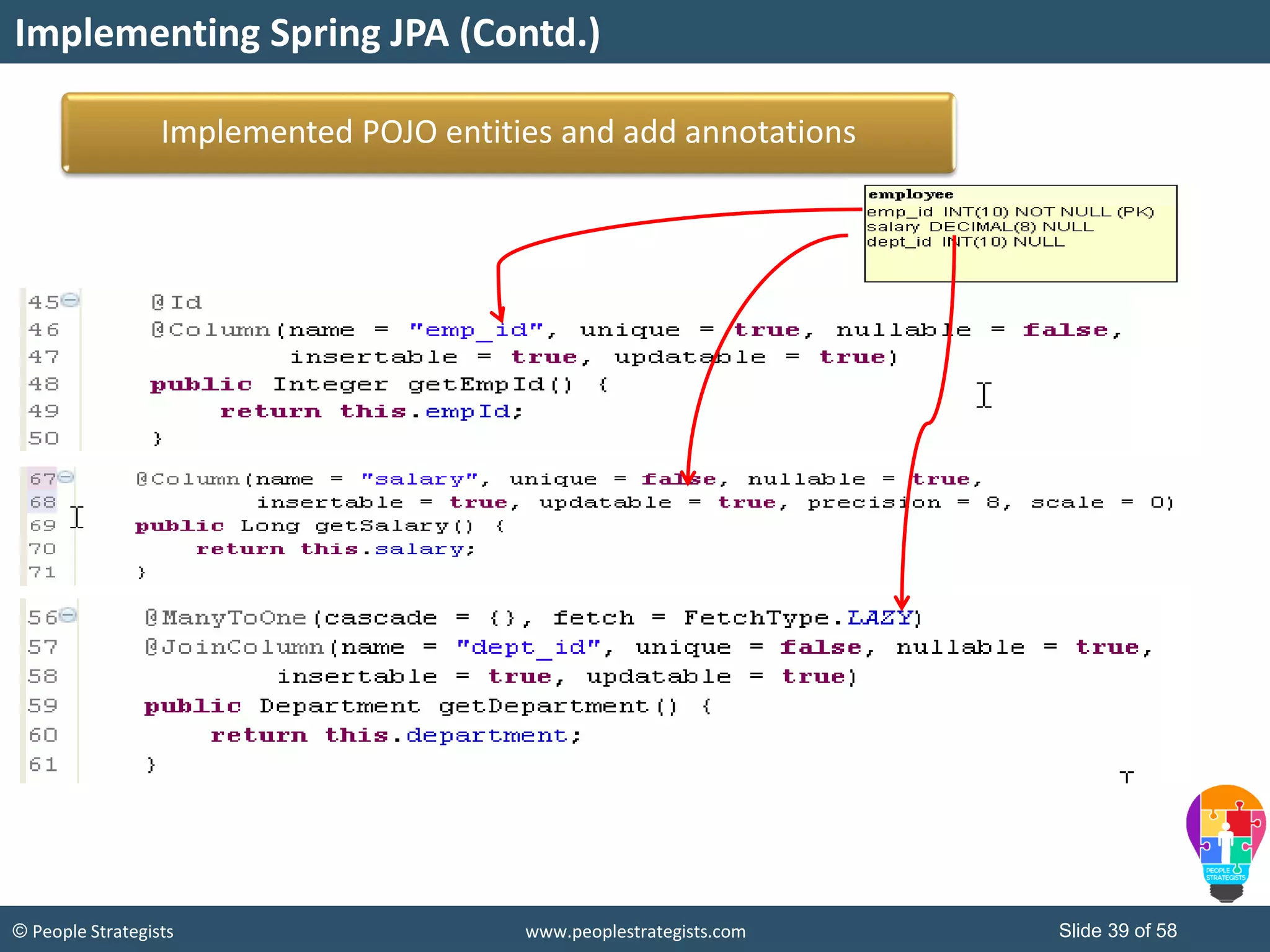
Slide 39 of 58© People Strategists www.peoplestrategists.com Implementing Spring JPA (Contd.) Implemented POJO entities and add annotations
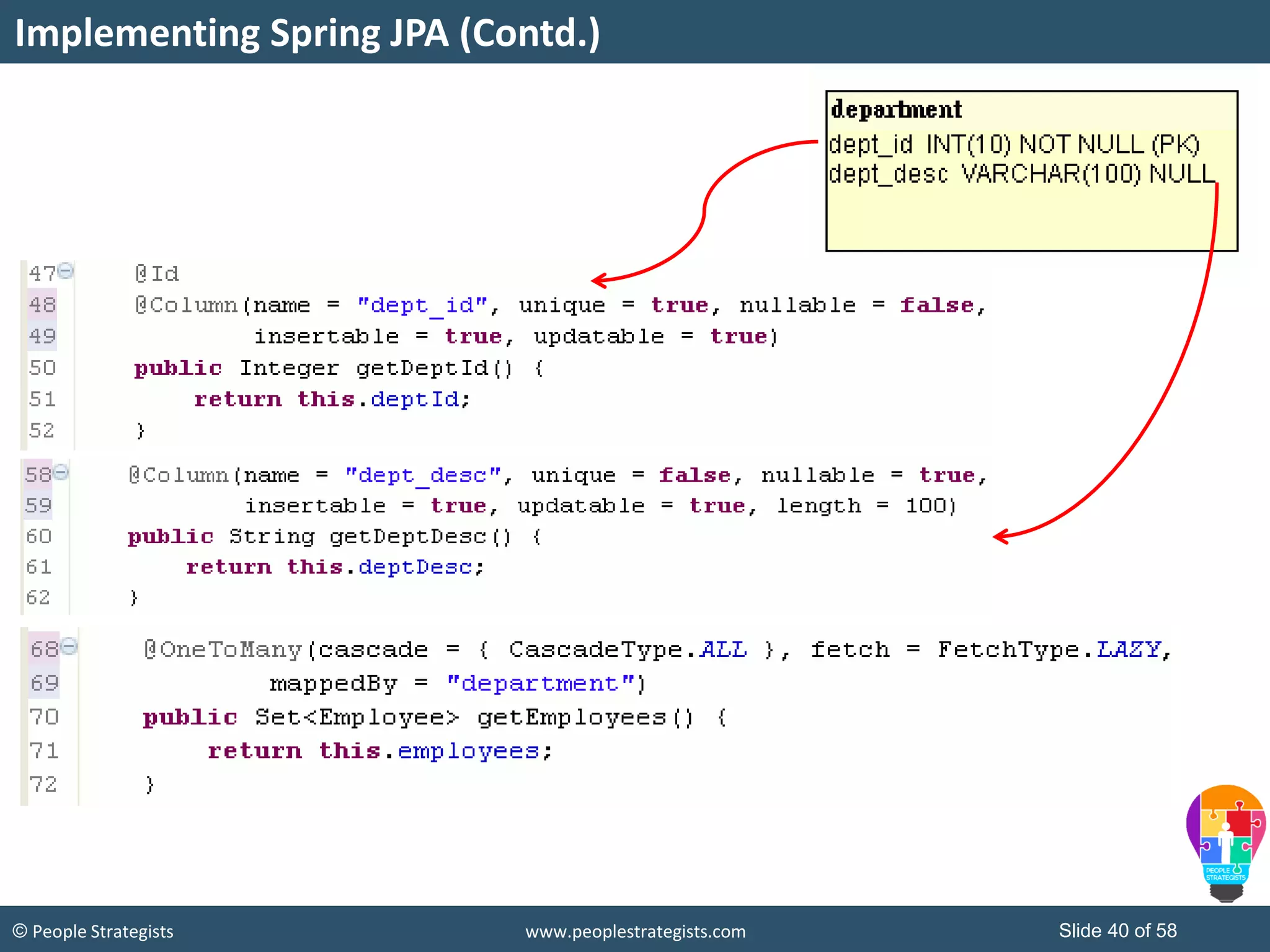
Slide 40 of 58© People Strategists www.peoplestrategists.com Implementing Spring JPA (Contd.)
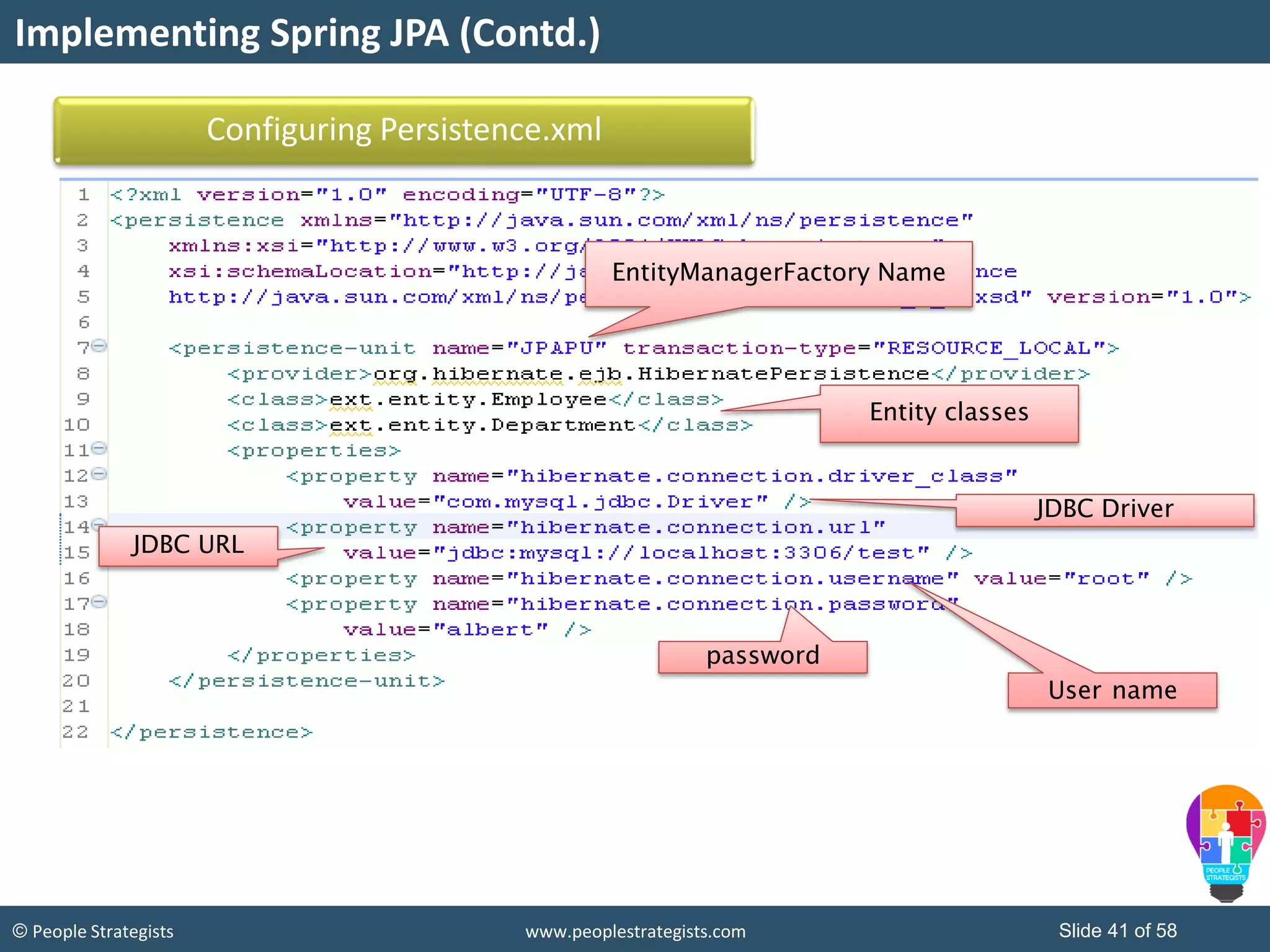
Slide 41 of 58© People Strategists www.peoplestrategists.com Implementing Spring JPA (Contd.) Configuring Persistence.xml Entity classes JDBC Driver JDBC URL User name password EntityManagerFactory Name
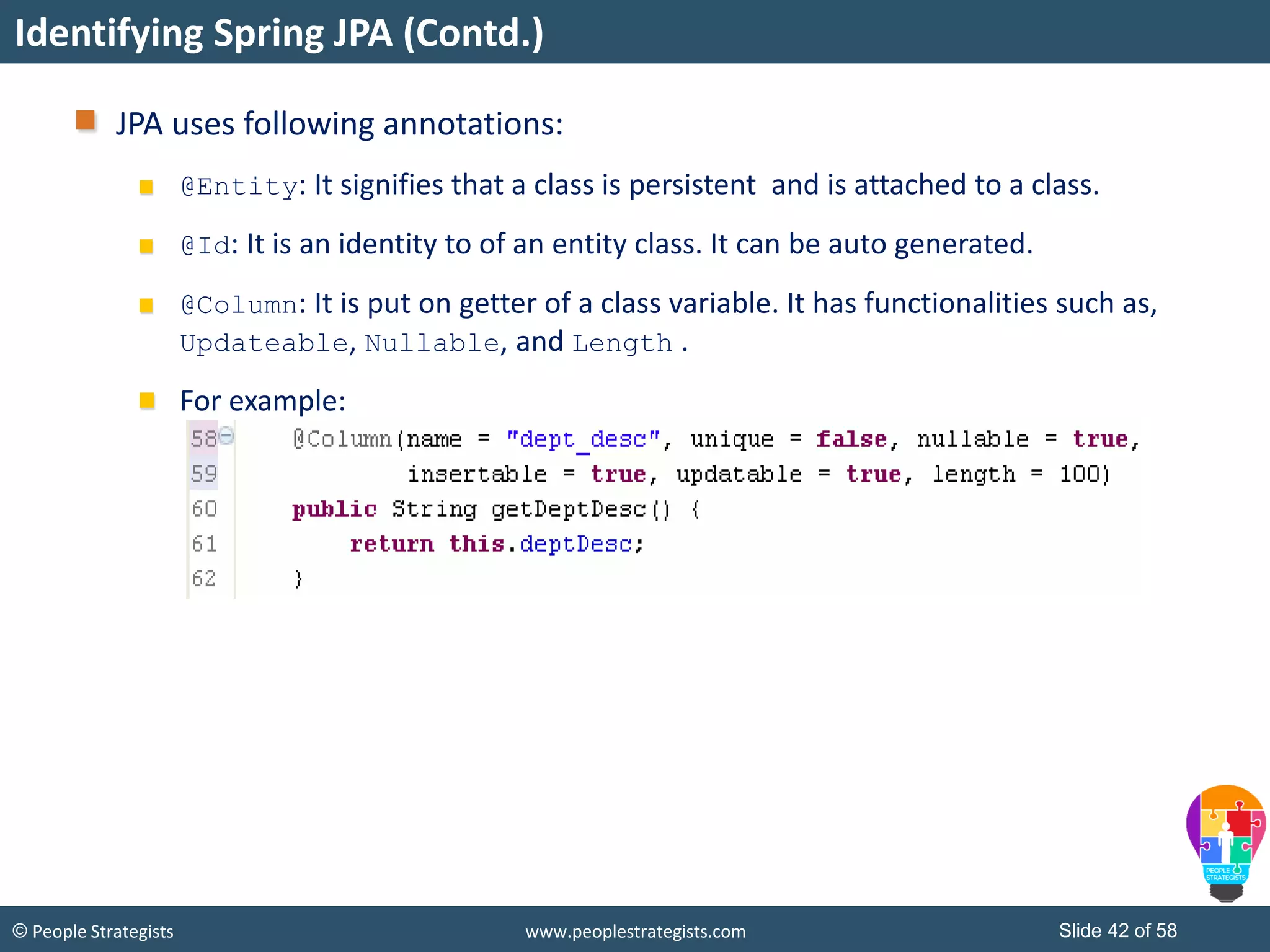
Slide 42 of 58© People Strategists www.peoplestrategists.com Identifying Spring JPA (Contd.) JPA uses following annotations: @Entity: It signifies that a class is persistent and is attached to a class. @Id: It is an identity to of an entity class. It can be auto generated. @Column: It is put on getter of a class variable. It has functionalities such as, Updateable, Nullable, and Length . For example:
Slide 43 of 58© People Strategists www.peoplestrategists.com Implementing Spring JPA (Contd.) Entity Manager: It is a gateway to persistent classes It enables queries to retrieve records. It provides transaction facility outside the session beans.
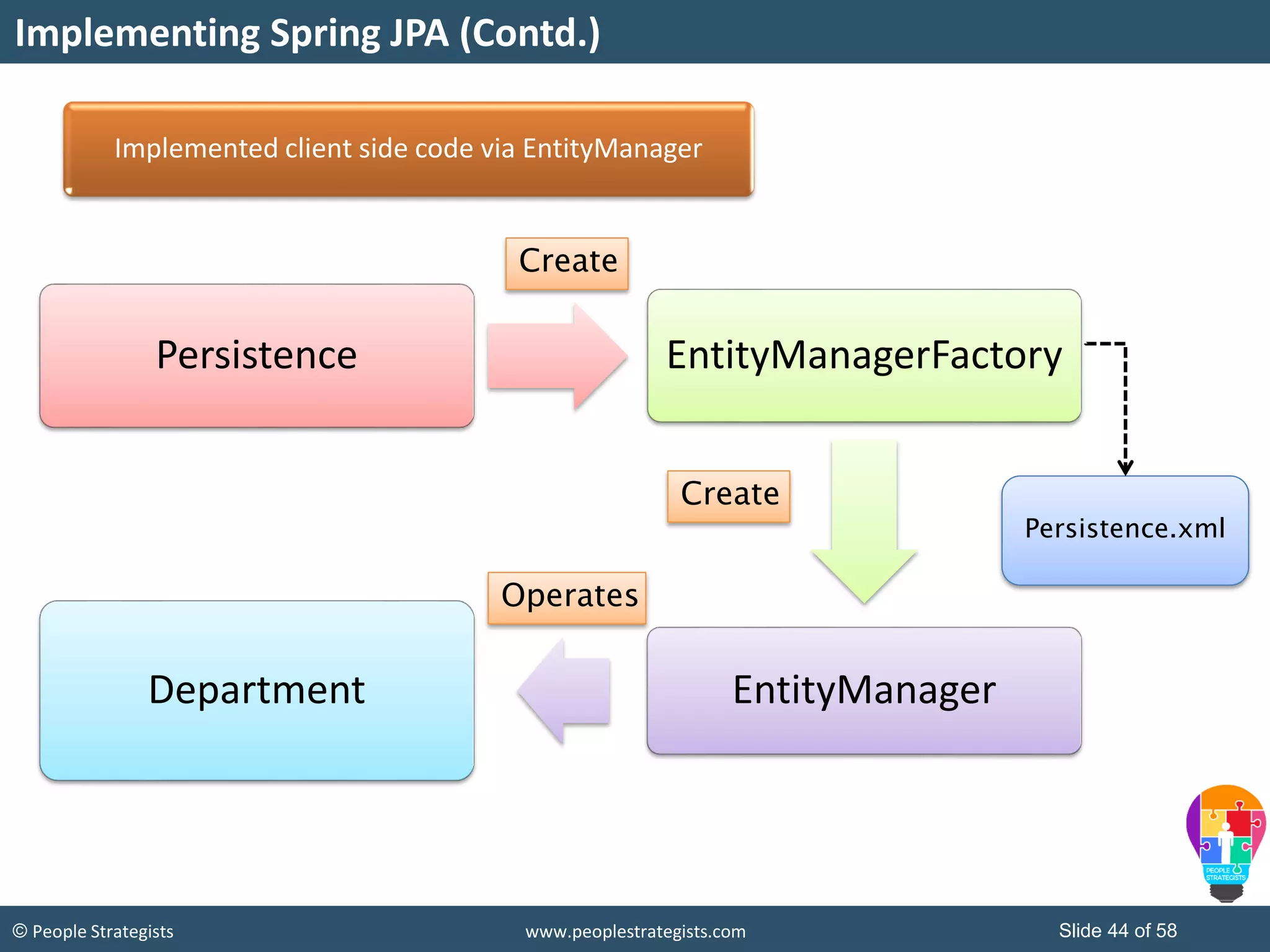
Slide 44 of 58© People Strategists www.peoplestrategists.com Implementing Spring JPA (Contd.) Implemented client side code via EntityManager Persistence EntityManagerFactory EntityManagerDepartment Create Create Operates Persistence.xml
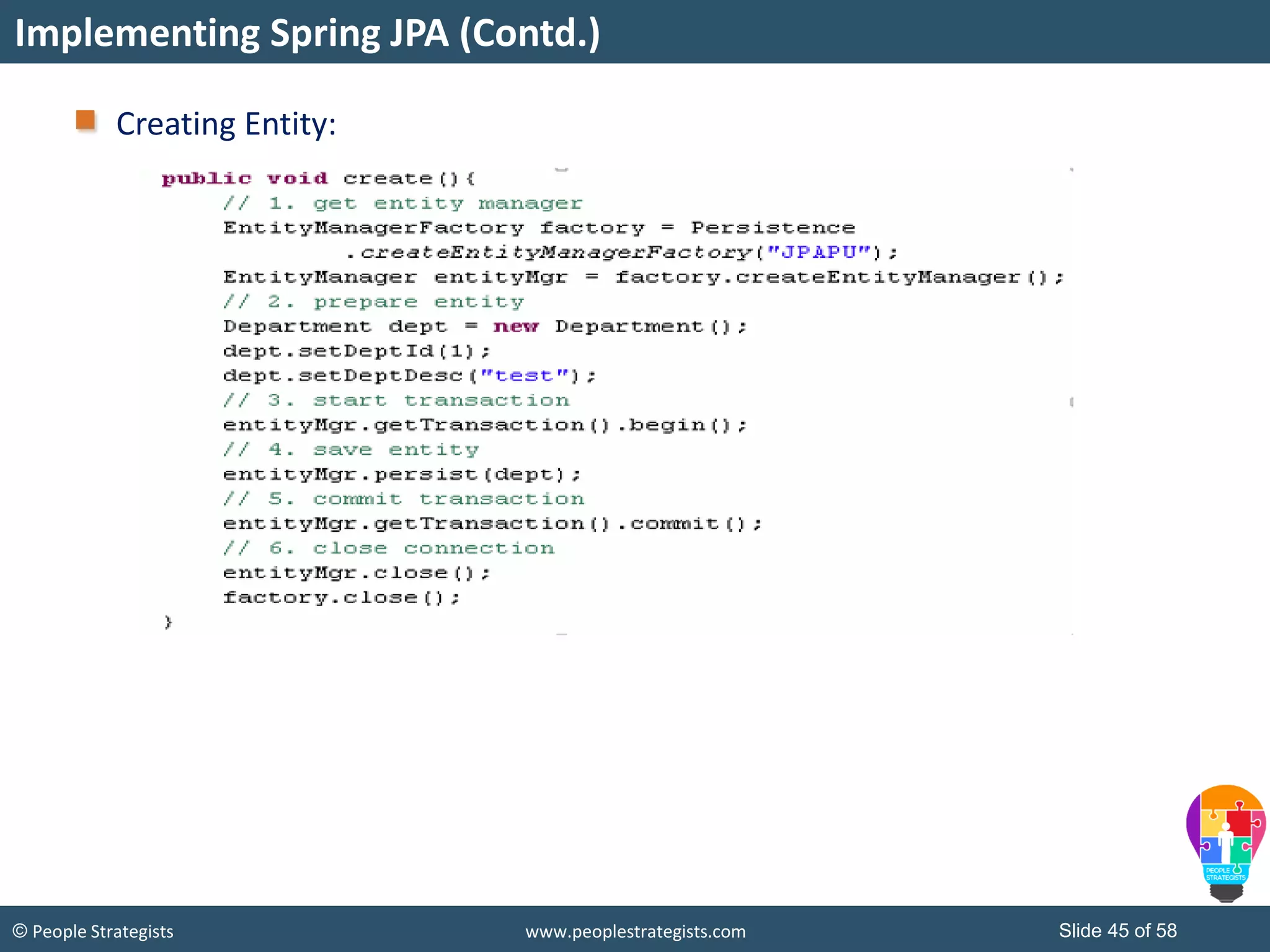
Slide 45 of 58© People Strategists www.peoplestrategists.com Implementing Spring JPA (Contd.) Creating Entity:
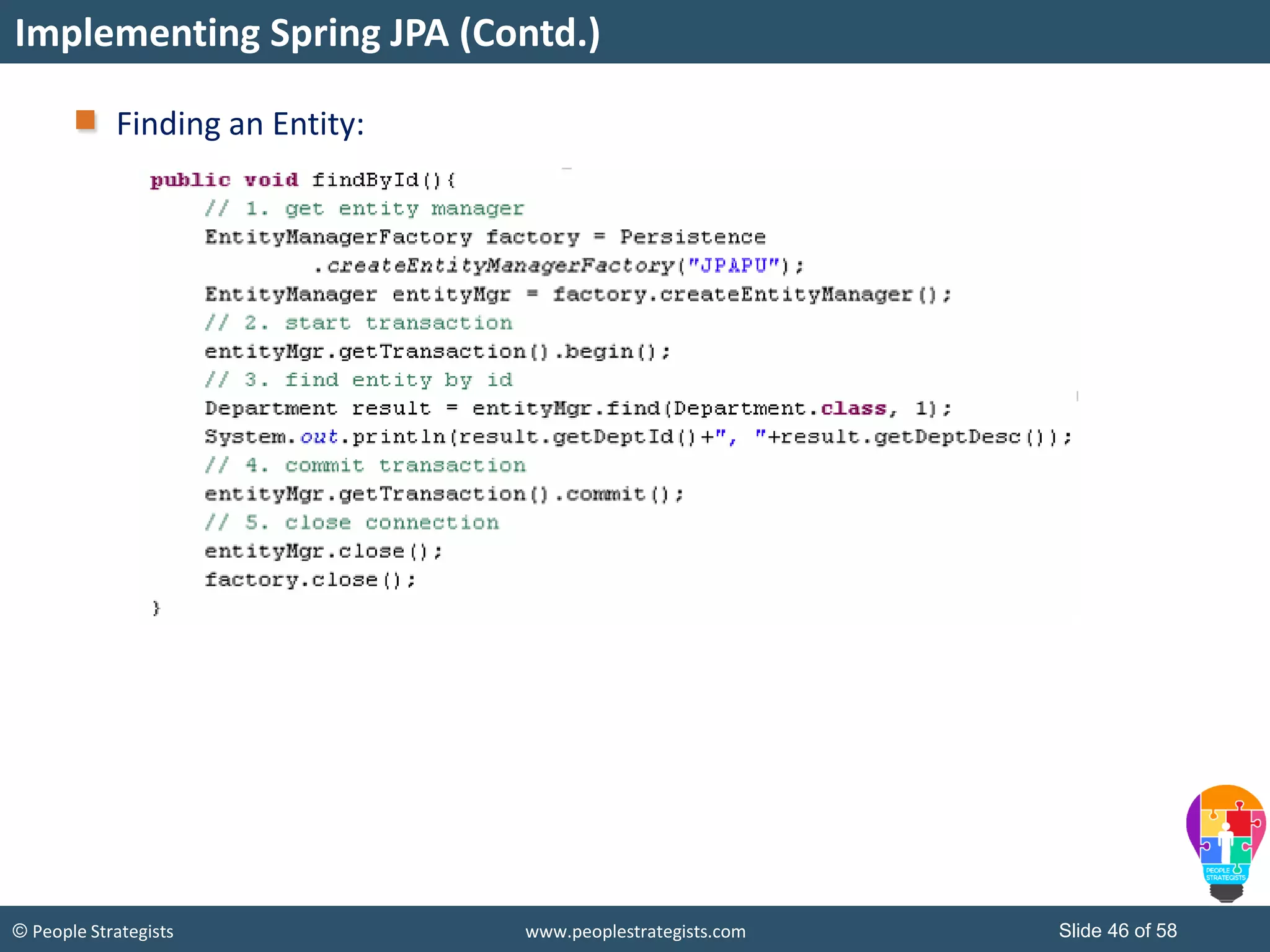
Slide 46 of 58© People Strategists www.peoplestrategists.com Implementing Spring JPA (Contd.) Finding an Entity:
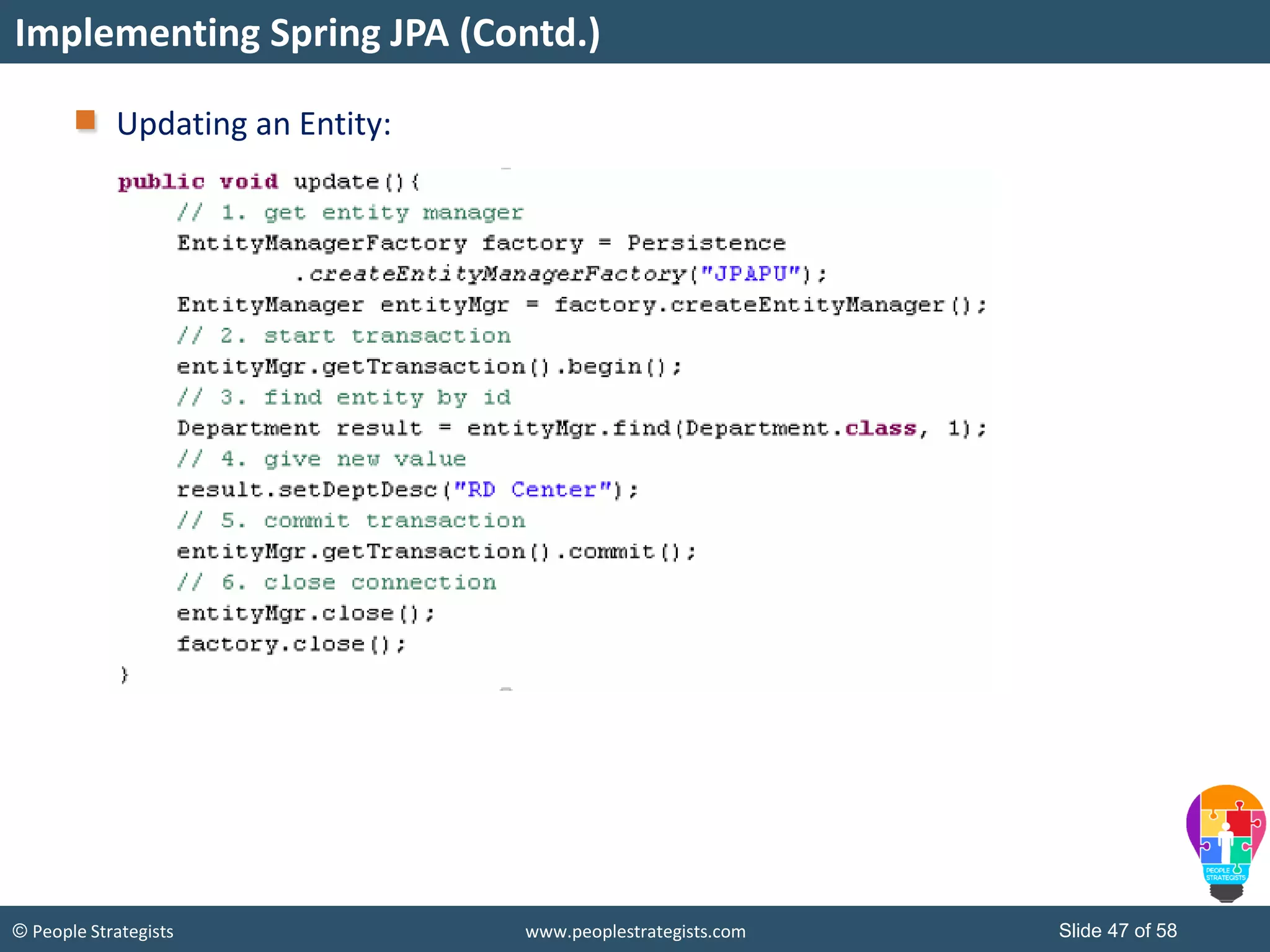
Slide 47 of 58© People Strategists www.peoplestrategists.com Implementing Spring JPA (Contd.) Updating an Entity:
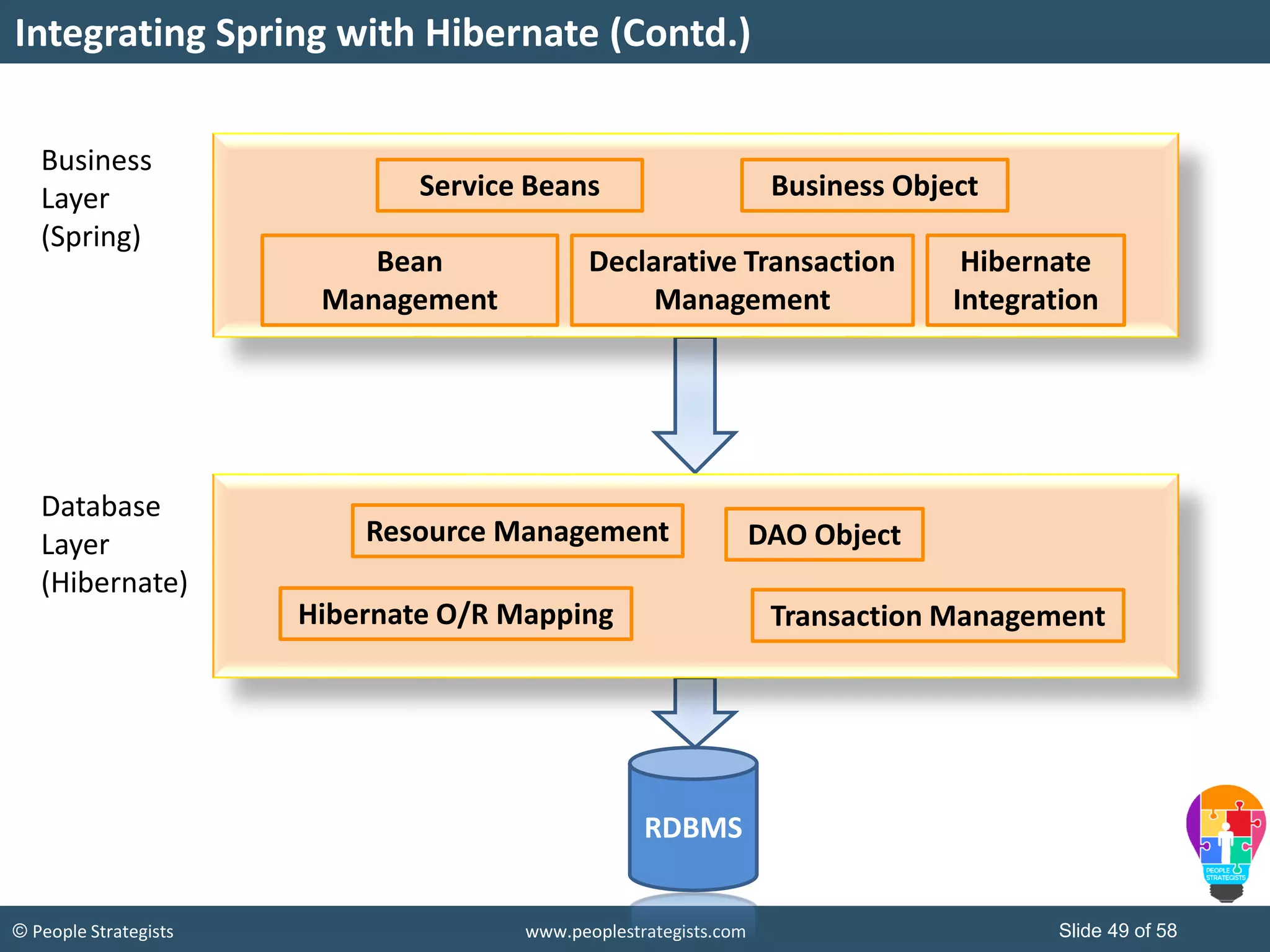
Slide 48 of 58© People Strategists www.peoplestrategists.com Integrating Spring with Hibernate The database layer is used to communicate with the relational database, and provides data persistence. To access data from a database, you need to implement a tool, such as Hibernate. Hibernate is a powerful Object Relation Mapping (ORM) tool that lies between the database layer and the business layer. It enables the application to access data from any database and provides data persistence. The Spring framework is placed between the application classes and the ORM tool. Spring enables you to use its features, such as DI and AOP, to configure objects in your application. Therefore, integration of Hibernate with Spring helps you use the Hibernate objects as Spring beans.
Slide 49 of 58© People Strategists www.peoplestrategists.com Integrating Spring with Hibernate (Contd.) RDBMS Business Layer (Spring) Database Layer (Hibernate) Bean Management Declarative Transaction Management Hibernate Integration Service Beans Business Object Resource Management DAO Object Hibernate O/R Mapping Transaction Management
Slide 50 of 58© People Strategists www.peoplestrategists.com Introducing ORM Most of the object-oriented applications use relational databases to store and manage the application data. The relational databases represent data in a tabular format, whereas data in object-oriented applications is encapsulated in a class. You can access a class by using its objects. However, to access the tabular data, you need to use a query language. Therefore, it is not possible to directly store the objects in a relational database. This difference between the object-oriented and relational database paradigms is called impedance mismatch. ORM is a process to map data representations in an object model having Java data types to a relational data model having SQL data type.
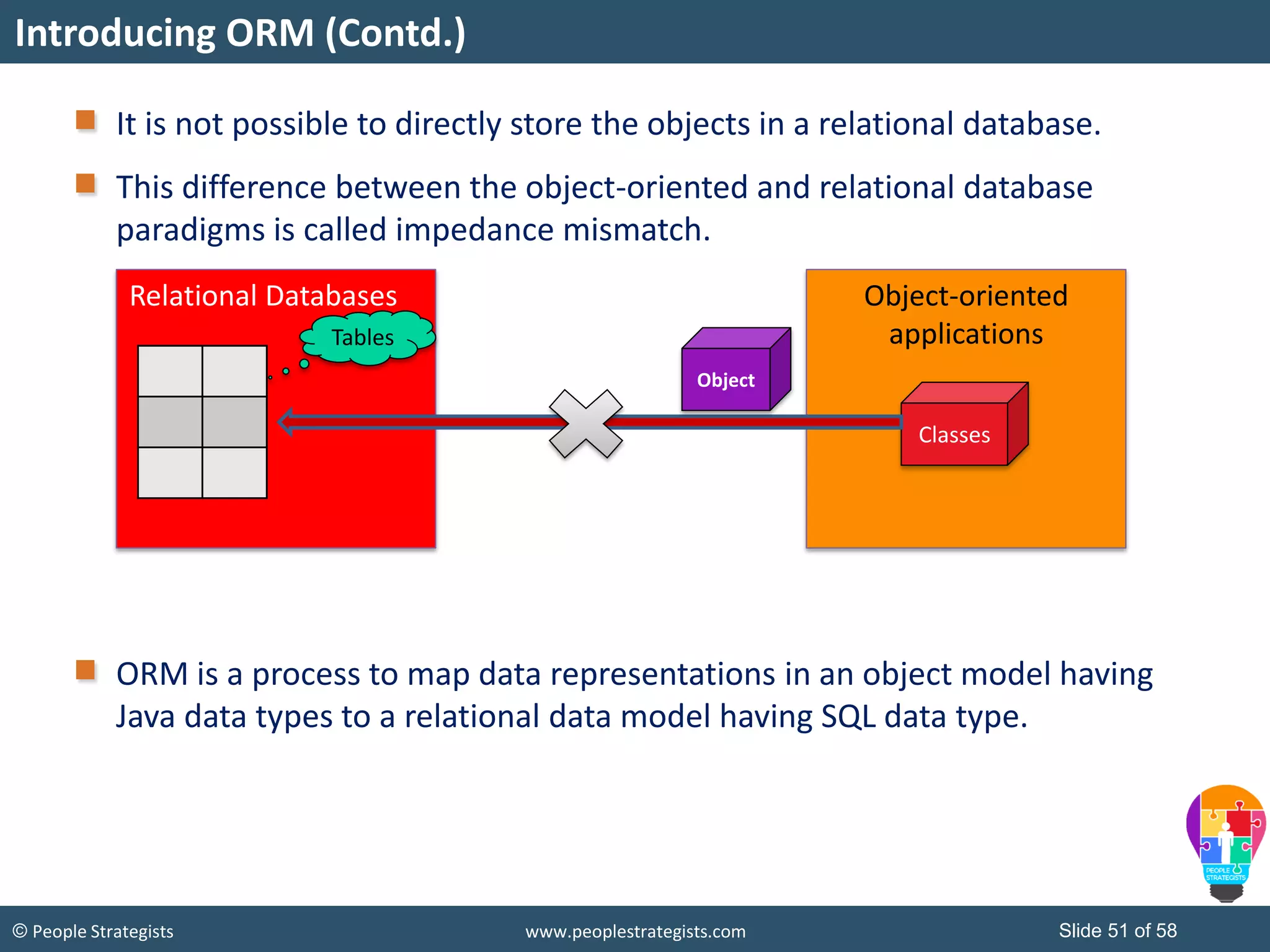
Slide 51 of 58© People Strategists www.peoplestrategists.com Introducing ORM (Contd.) It is not possible to directly store the objects in a relational database. This difference between the object-oriented and relational database paradigms is called impedance mismatch. ORM is a process to map data representations in an object model having Java data types to a relational data model having SQL data type. Relational Databases Object-oriented applications Classes Tables Object
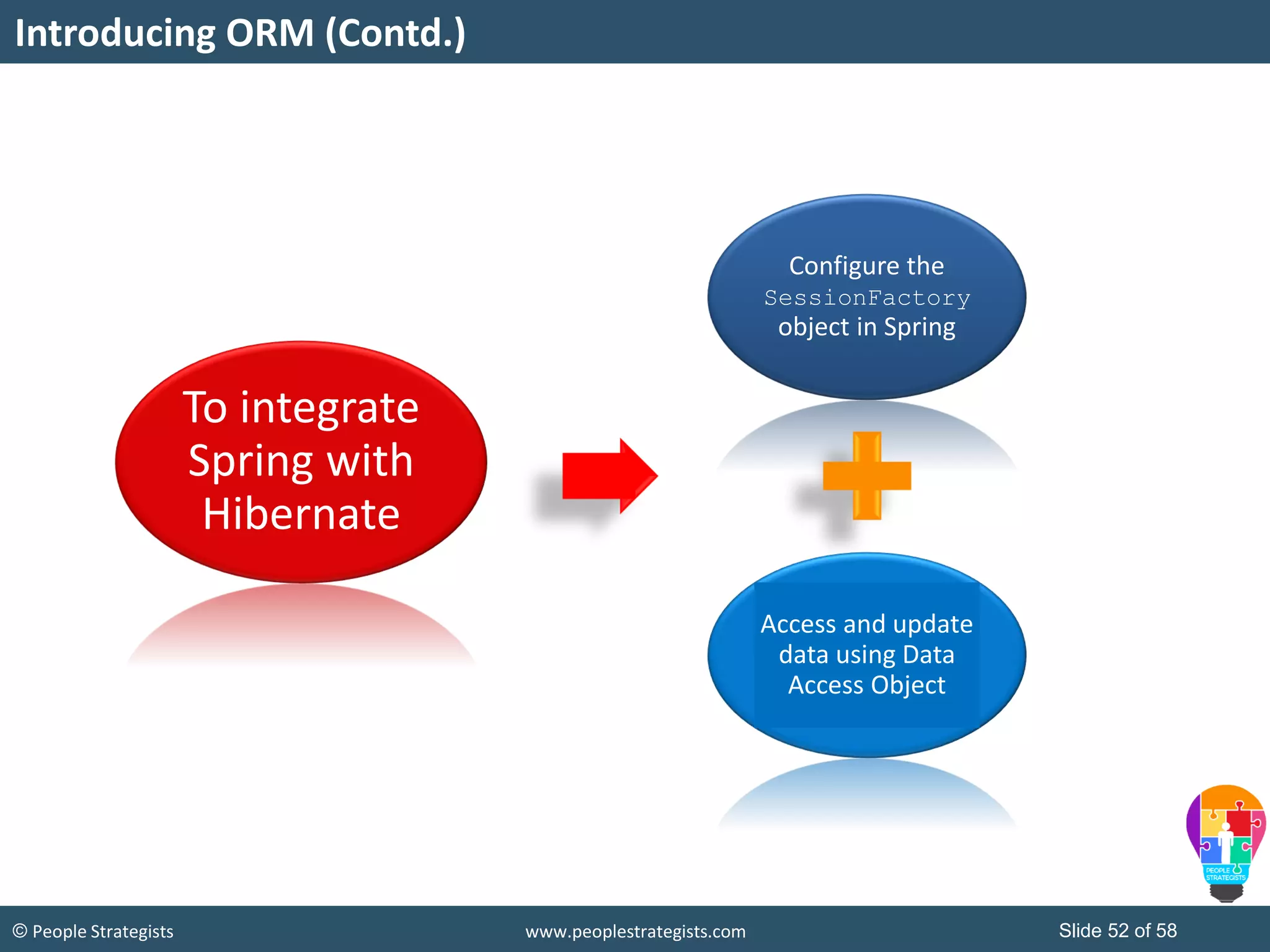
Slide 52 of 58© People Strategists www.peoplestrategists.com Introducing ORM (Contd.) Configure the SessionFactory object in Spring Access and update data using Data Access Object To integrate Spring with Hibernate
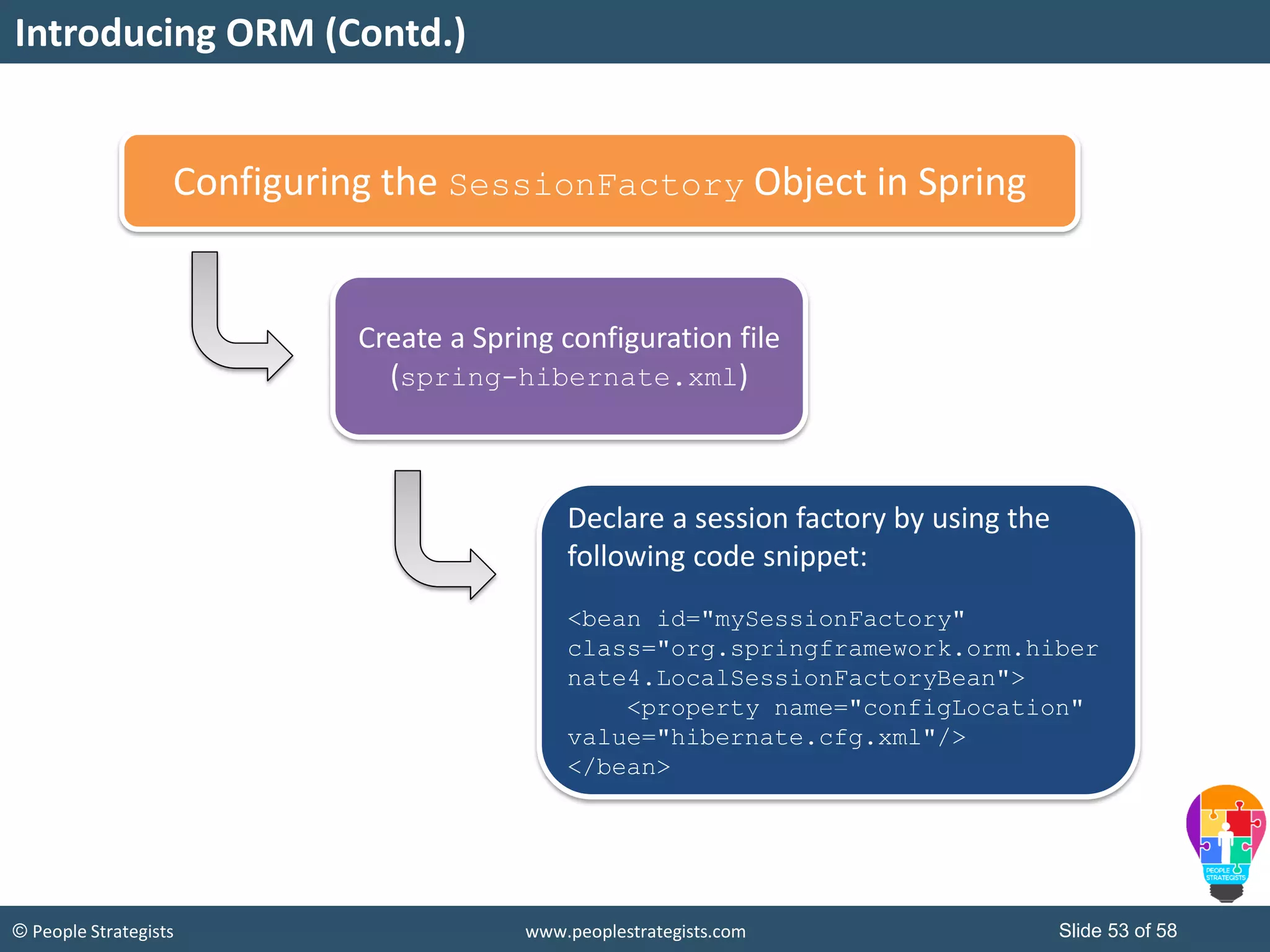
Slide 53 of 58© People Strategists www.peoplestrategists.com Introducing ORM (Contd.) Configuring the SessionFactory Object in Spring Create a Spring configuration file (spring-hibernate.xml) Declare a session factory by using the following code snippet: <bean id="mySessionFactory" class="org.springframework.orm.hiber nate4.LocalSessionFactoryBean"> <property name="configLocation" value="hibernate.cfg.xml"/> </bean>
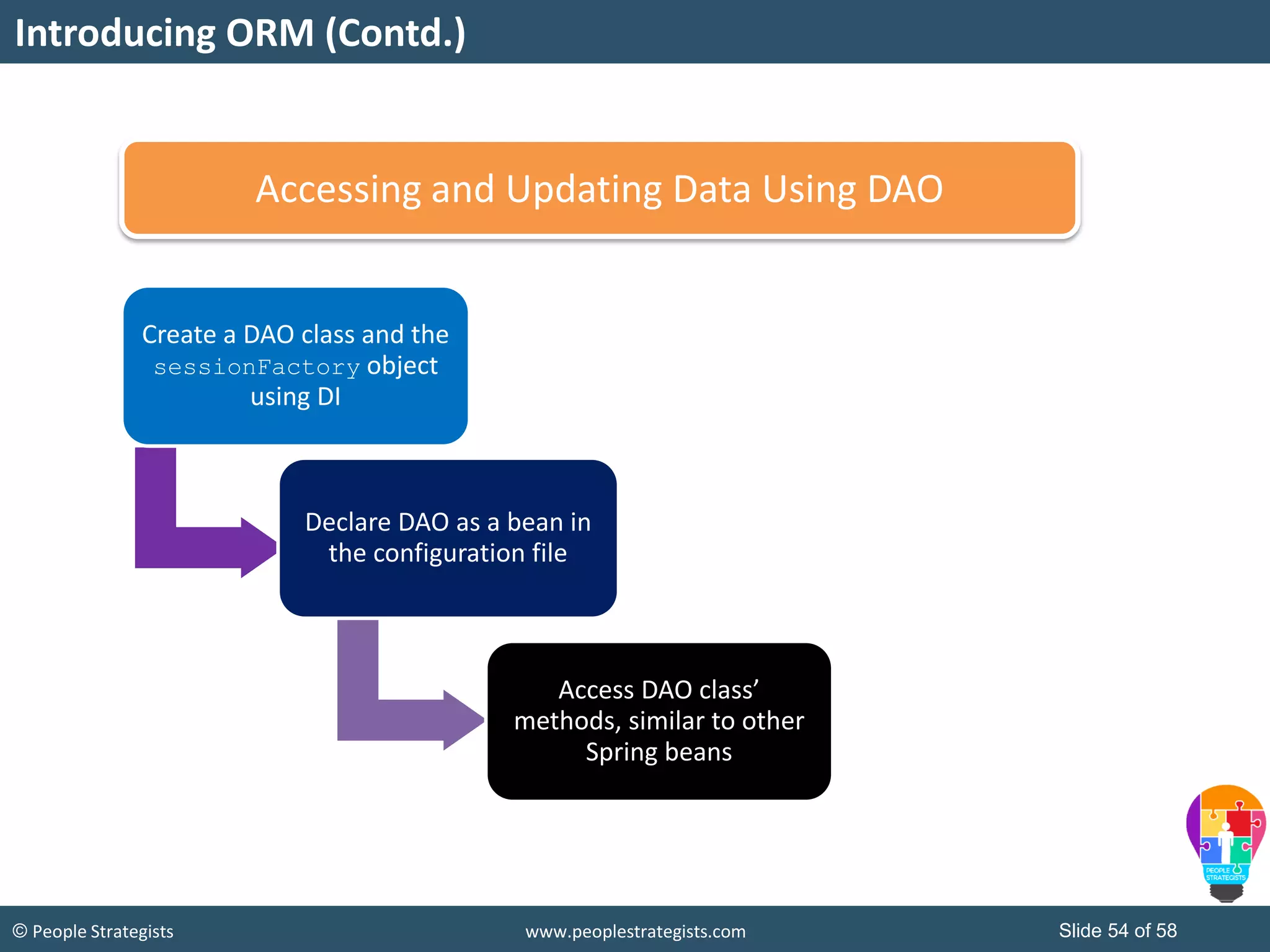
Slide 54 of 58© People Strategists www.peoplestrategists.com Introducing ORM (Contd.) Accessing and Updating Data Using DAO Create a DAO class and the sessionFactory object using DI Declare DAO as a bean in the configuration file Access DAO class’ methods, similar to other Spring beans
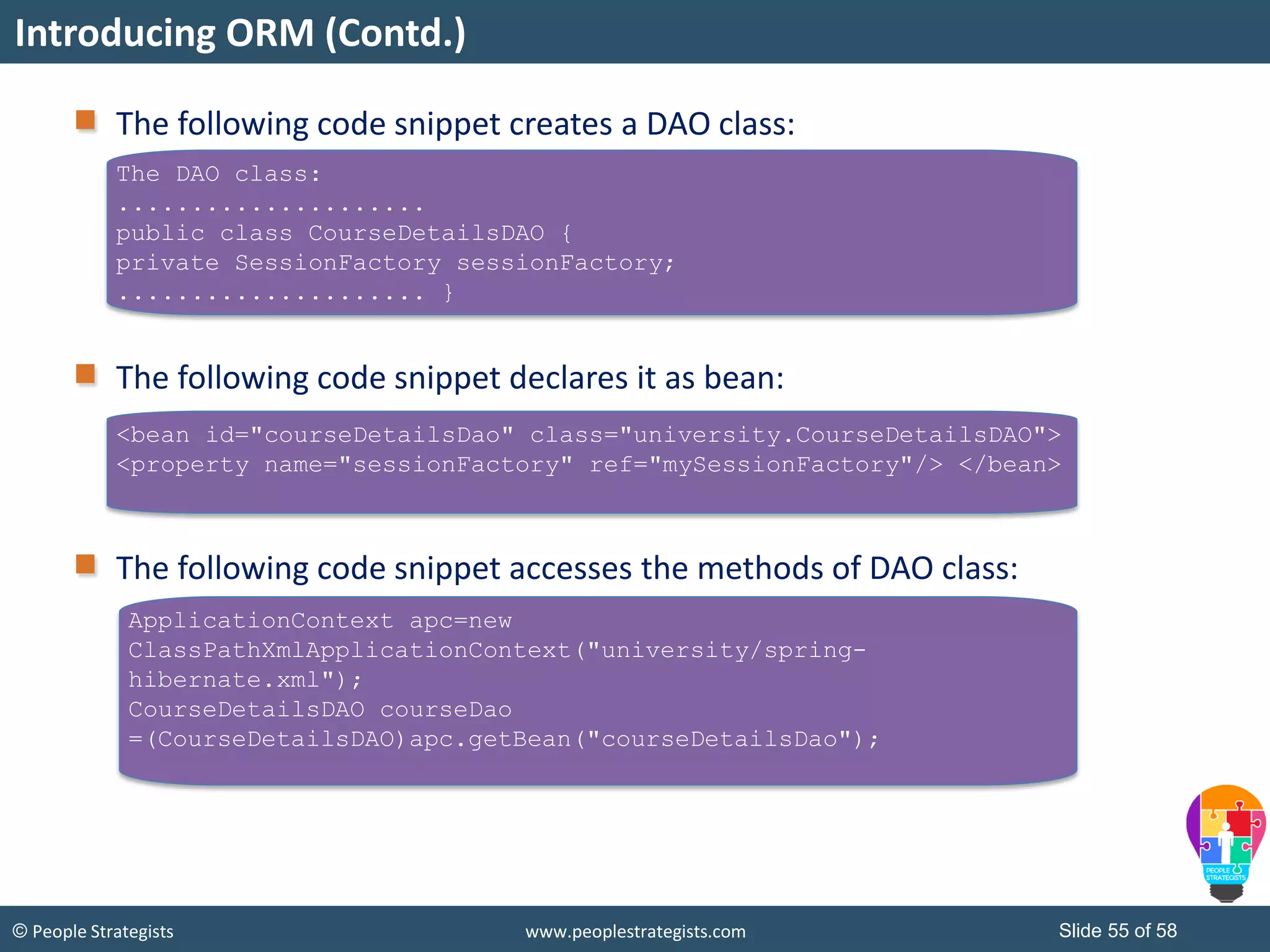
Slide 55 of 58© People Strategists www.peoplestrategists.com Introducing ORM (Contd.) The following code snippet creates a DAO class: The following code snippet declares it as bean: The following code snippet accesses the methods of DAO class: The DAO class: ..................... public class CourseDetailsDAO { private SessionFactory sessionFactory; ..................... } <bean id="courseDetailsDao" class="university.CourseDetailsDAO"> <property name="sessionFactory" ref="mySessionFactory"/> </bean> ApplicationContext apc=new ClassPathXmlApplicationContext("university/spring- hibernate.xml"); CourseDetailsDAO courseDao =(CourseDetailsDAO)apc.getBean("courseDetailsDao");
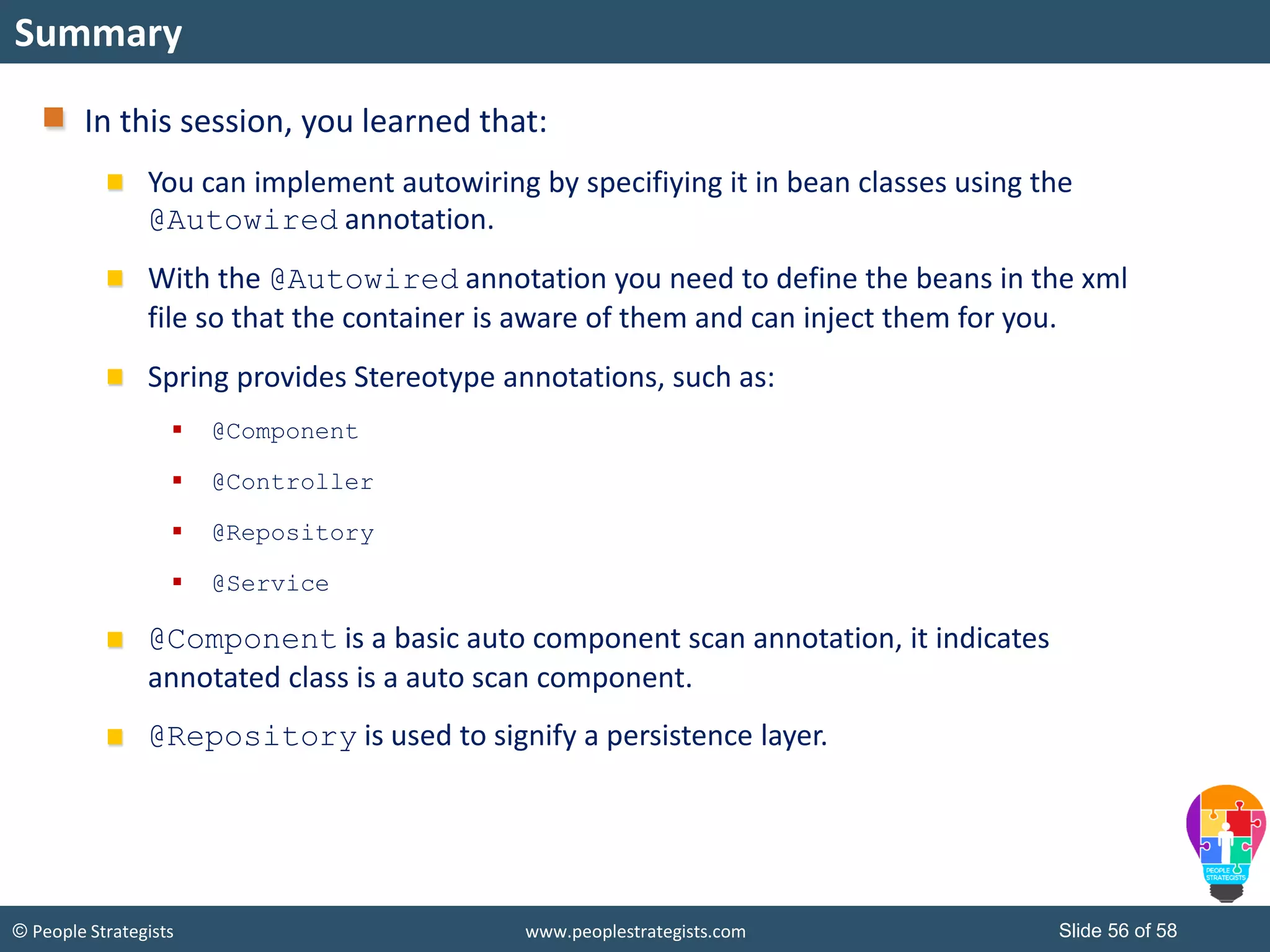
Slide 56 of 58© People Strategists www.peoplestrategists.com Summary In this session, you learned that: You can implement autowiring by specifiying it in bean classes using the @Autowired annotation. With the @Autowired annotation you need to define the beans in the xml file so that the container is aware of them and can inject them for you. Spring provides Stereotype annotations, such as:  @Component  @Controller  @Repository  @Service @Component is a basic auto component scan annotation, it indicates annotated class is a auto scan component. @Repository is used to signify a persistence layer.
Slide 57 of 58© People Strategists www.peoplestrategists.com Summary (Contd.) JPA is the sun specification for persisting objects in the enterprise application. It is currently used as the replacement for complex entity beans. If you use Spring Data JPA, the repository layer of your application contains following three layers:  Spring Data JPA  Spring Data Commons  JPA Provider The database layer is used to communicate with the relational database, and provides data persistence. To access data from a database, you need to implement a tool, such as Hibernate.
Slide 58 of 58© People Strategists www.peoplestrategists.com Summary (Contd.) Hibernate is a powerful Object Relation Mapping (ORM) tool that lies between the database layer and the business layer. The Spring framework is placed between the application classes and the ORM tool. Spring enables you to use its features, such as DI and AOP, to configure objects in your application.

Spring Framework - III

  • 1.
    Slide 1 of58© People Strategists www.peoplestrategists.com Spring Framework -III
  • 2.
    Slide 2 of58© People Strategists www.peoplestrategists.com Objectives In this session, you will learn to: Introduce annotation based Configuration Identifying stereotypes Explore validation Introduce Spring DAO Support Identify advantages of spring over JDBC Identify Spring JPA Implement Spring JPA Integrate Spring with Hibernate
  • 3.
    Slide 3 of58© People Strategists www.peoplestrategists.com With the advent of Spring 3 there has been an widespread use of annotations and annotations based configurations. To turn annotation based configuration on you need to write <context:annotation-config/> into ApplicationContext.xml. The following code snippet illustrates how to do annotation based configuration: Introducing Annotation Based Configuration <?xml version="1.0" encoding="UTF-8"?> <beans xmlns="http://www.springframework.org/schema/beans" xmlns:xsi="http://www.w3.org/2001/XMLSchema-instance" xmlns:context="http://www.springframework.org/schema/context" xsi:schemaLocation="http://www.springframework.org/schema/beans http://www.springframework.org/schema/beans/spring-beans- 3.0.xsd http://www.springframework.org/schema/context http://www.springframework.org/schema/context/spring-context- 3.0.xsd"> <context:annotation-config/> <!-- beans declaration goes here --> </beans>
  • 4.
    Slide 4 of58© People Strategists www.peoplestrategists.com Introducing Annotation Bases Configuration (Contd.) @Value @PreDestroy@Qualifier @PostConstruct @Component @AutoWired The Spring MVC framework provides following annotations:
  • 5.
    Slide 5 of58© People Strategists www.peoplestrategists.com Use of @Autowired: You can implement autowiring by specifiying it in bean classes using the @Autowired annotation. To use @Autowired annotation in bean classes, you must first enable the annotation in spring application using below configuration. The beans dependencies can be autowired in following three ways:  @Autowired on properties  @Autowired on property setters  @Autowired on constructors Introducing Annotation Based Configuration (Contd.) <context:annotation-config/> OR <bean class ="org.springframework.beans.factory.annotation.AutowiredAnnotationBeanPostPr ocessor"/>
  • 6.
    Slide 6 of58© People Strategists www.peoplestrategists.com @Autowired on properties:  It is equivalent to autowiring by byType in configuration file.  The following code snippet illustrates an example: Introducing Annotation Based Configuration (Contd.) public class EmployeeBean { @Autowired private DepartmentBean departmentBean; public DepartmentBean getDepartmentBean() { return departmentBean; } public void setDepartmentBean(DepartmentBean departmentBean) { this.departmentBean = departmentBean; } }
  • 7.
    Slide 7 of58© People Strategists www.peoplestrategists.com @Autowired on property setters:  It is also equivalent to autowiring by byType in configuration file.  The following code snippet illustrates an example: Introducing Annotation Based Configuration (Contd.) public class EmployeeBean { private DepartmentBean departmentBean; public DepartmentBean getDepartmentBean() { return departmentBean; } @Autowired public void setDepartmentBean(DepartmentBean departmentBean) { this.departmentBean = departmentBean; } }
  • 8.
    Slide 8 of58© People Strategists www.peoplestrategists.com @Autowired on constructors:  It is equivalent to autowiring by constructor in configuration file.  The following code snippet illustrates an example: Introducing Annotation Based Configuration (Contd.) public class EmployeeBean { @Autowired public EmployeeBean(DepartmentBean departmentBean) { this.departmentBean = departmentBean; } private DepartmentBean departmentBean; public DepartmentBean getDepartmentBean() { return departmentBean; } public void setDepartmentBean(DepartmentBean departmentBean) { this.departmentBean = departmentBean; } }
  • 9.
    Slide 9 of58© People Strategists www.peoplestrategists.com Use of @Qualifier: You may have similar properties in two different beans. In this case, spring will not be able to choose correct bean. Consider the example: Introducing Annotation Based Configuration (Contd.) <?xml version="1.0" encoding="UTF-8"?> <beans> <context:annotation-config /> <!--First bean of type DepartmentBean--> <bean id="humanResource" class="com.bean.DepartmentBean"> <property name="name" value="Human Resource" /> </bean> <!--Second bean of type DepartmentBean--> <bean id="finance" class="com.bean.DepartmentBean"> <property name="name" value="Finance" /> </bean> </beans> Conflict
  • 10.
    Slide 10 of58© People Strategists www.peoplestrategists.com To avoid the conflict, you can use the @Qualifier annotation along with @Autowired. The following code snippet illustrates an example: Introducing Annotation Based Configuration (Contd.) public class EmployeeBean { @Autowired @Qualifier("finance") private DepartmentBean departmentBean; public DepartmentBean getDepartmentBean() { return departmentBean; } public void setDepartmentBean(DepartmentBean departmentBean) { this.departmentBean = departmentBean; } //More code } Specified
  • 11.
    Slide 11 of58© People Strategists www.peoplestrategists.com Use of @Component: The @Component annotation marks a java class as a bean. Use of @Value: You can also use the @Value annotation to inject values from a property file into a bean’s attributes. The following code snippet illustrates an example: Introducing Annotation Based Configuration (Contd.) @Component public class AutowiredFakaSource { @Value("${jdbc.driverClassName}") private String driverClassName; @Value("${jdbc.url}") private String url; public String getDriverClassName() { return driverClassName; } public String getUrl() { return url; } }
  • 12.
    Slide 12 of58© People Strategists www.peoplestrategists.com Activity: Implementing Autowiring Using byName Let us see how to implement @Autowired using byName by importing the embedded project in Eclipse.
  • 13.
    Slide 13 of58© People Strategists www.peoplestrategists.com Activity: Implementing Autowiring Using byType Let us see how to implement @Autowired using byType by importing the embedded project in Eclipse.
  • 14.
    Slide 14 of58© People Strategists www.peoplestrategists.com Activity: Implementing Autowiring Using Constructor Let us see how to implement @Autowired using constructor by importing the embedded project in Eclipse.
  • 15.
    Slide 15 of58© People Strategists www.peoplestrategists.com Use of @PostConstruct: @PostConstruct is used for a method in a bean. The annotated method gets called just after the invocation of constructor. It can be used perform operations that you need perform before executing any other method. Use of @PreDestroy: @PreDestroy is also used for a method in a bean. The annotated method gets called just before an object is garbage collected. It can be used to perform operations at the final moment. Introducing Annotation Based Configuration (Contd.)
  • 16.
    Slide 16 of58© People Strategists www.peoplestrategists.com The following code snippet illustrates an example: Introducing Annotation Based Configuration (Contd.) package com.customer.services; import javax.annotation.PostConstruct; import javax.annotation.PreDestroy; public class CustomerService { String message; public String getMessage() { return message; } public void setMessage(String message) { this.message = message; } @PostConstruct public void init() throws Exception { System.out.println("Init method after properties are set :" + message); } @PreDestroy public void cleanUp() throws Exception { System.out.println("Spring Container is destroy! Customer clean up"); } }
  • 17.
    Slide 17 of58© People Strategists www.peoplestrategists.com The following code snippet configures the bean in spring config file: Introducing Annotation Based Configuration (Contd.) <beans xmlns="http://www.springframework.org/schema/beans" xmlns:xsi="http://www.w3.org/2001/XMLSchema-instance" xsi:schemaLocation="http://www.springframework.org/schema/beans http://www.springframework.org/schema/beans/spring-beans-2.5.xsd"> <bean class="org.springframework.context.annotation.CommonAnnotationBean PostProcessor" /> <bean id="customerService" class="com.customer.services.CustomerService"> <property name="message" value="i'm property message" /> </bean> </beans>
  • 18.
    Slide 18 of58© People Strategists www.peoplestrategists.com Activity: Implementing @PreDestroy and @PostConstruct Let us see how to implement @PreDestroy and @PostConstruct.
  • 19.
    Slide 19 of58© People Strategists www.peoplestrategists.com @Controller Identifying Stereotypes @Repository@Service@Component The Spring MVC framework provides following stereotypes: With the @Autowired annotation you need to define the beans in the xml file so that the container is aware of them and can inject them for you. Spring provides Stereotype annotations that frees you from defining beans explicitly with XML.
  • 20.
    Slide 20 of58© People Strategists www.peoplestrategists.com Identifying Stereotypes (Contd.) The following table describes the various stereotype annotations: Annotation Description @Component It is a basic auto component scan annotation, it indicates annotated class is a auto scan component. @Repository You need to use this annotation with in the persistance layer, which acts like database repository. @Service It indicates annotated class is a Service component in the business layer. @Controller It is used to create controller component. It is mainly used at presentation layer.
  • 21.
    Slide 21 of58© People Strategists www.peoplestrategists.com Identifying Stereotypes (Contd.) The following code snippet illustrates an example of @Controller: The following code snippet illustrates an example of @Service: @Controller ("employeeController") public class EmployeeController { @Autowired EmployeeManager manager; //use manager } @Service ("employeeManager") public class EmployeeManager{ @Autowired EmployeeDAO dao; public EmployeeDTO createNewEmployee(){ return dao.createNewEmployee(); } }
  • 22.
    Slide 22 of58© People Strategists www.peoplestrategists.com Identifying Stereotypes (Contd.) The following code snippet illustrates an example of @Component: The following code snippet illustrates an example of @Repository: @Component public class EmployeeService { @Autowired EmployeeDAO empDAO; @Override public String toString() { return empDAO; } } @Repository ("employeeDao") public class EmployeeDAO { public EmployeeDTO createNewEmployee() { EmployeeDTO e = new EmployeeDTO(); e.setId(1); e.setFirstName(“Jack"); e.setLastName(“Mathew"); return e; } }
  • 23.
    Slide 23 of58© People Strategists www.peoplestrategists.com Spring provides validation support to validate the entered value. It provides a simplified set of APIs and supporting classes for validating domain objects. It also allows one to code the validation logic for custom validator. Introducing Spring Validation Framework The Spring MVC framework supports following validation implementation: Validator Custom Validator Bean Validation APi
  • 24.
    Slide 24 of58© People Strategists www.peoplestrategists.com Spring provides the Validator interface to perform validation. The Validator interface can be used to validate an Object. It uses Error Object to report any validator error while validating an Object. The interface is available in the org.springframework.validation package. It has following two main methods: supports(Class):  Returns a boolean indicating whether or not the target class can be validated by this validator. validate(Object, org.springframework.validation.Errors):  In charge of actually performing validation. Introducing Spring Validation Framework (Contd.)
  • 25.
    Slide 25 of58© People Strategists www.peoplestrategists.com The following code snippet shows implementation of the Validator interface: Introducing Spring Validation Framework (Contd.) public class PersonValidator implements Validator { /** * This Validator validates just Person instances */ public boolean supports(Class clazz) { return Person.class.equals(clazz); } public void validate(Object obj, Errors e) { ValidationUtils.rejectIfEmpty(e, "name", "name.empty"); Person p = (Person) obj; if (p.getAge() < 0) { e.rejectValue("age", "negativevalue"); } else if (p.getAge() > 110) { e.rejectValue("age", "too. old"); } } }
  • 26.
    Slide 26 of58© People Strategists www.peoplestrategists.com Spring provides the several annotations for data validation. It provides Bean Validation API to validate values of in a form tag. It has following validation annotation: @Size @NotEmpty @Email Introducing Spring Validation Framework (Contd.)
  • 27.
    Slide 27 of58© People Strategists www.peoplestrategists.com The following code snippet declares the model class: Introducing Spring Validation Framework (Contd.) import javax.validation.constraints.Size; import org.hibernate.validator.constraints.Email; import org.hibernate.validator.constraints.NotEmpty; public class User { @NotEmpty @Email private String email; @NotEmpty(message = "Please enter your password.") @Size(min = 6, max = 15, message = "Your password must between 6 and 15 characters") private String password; public String getEmail() { return email; } public void setEmail(String email) { this.email = email; } public String getPassword() { return password; } public void setPassword(String password) { this.password = password; } }
  • 28.
    Slide 28 of58© People Strategists www.peoplestrategists.com Activity: Implementing the Bean Validation API Let us see how to implement validation.
  • 29.
    Slide 29 of58© People Strategists www.peoplestrategists.com Spring allows you to create custom validator. You can use Validator interface to implement custom validation. The following code snippet shows an example: Introducing Spring Validation Framework (Contd.) import org.springframework.validation.Errors; import org.springframework.validation.ValidationUtils; import org.springframework.validation.Validator; public class StudentValidator implements Validator { public boolean supports(Class<?> clazz) { return Student.class.isAssignableFrom(clazz); } public void validate(Object target, Errors errors) { ValidationUtils.rejectIfEmptyOrWhitespace(errors, "name", "name.required"); ValidationUtils.rejectIfEmptyOrWhitespace(errors, "degree", "degree.required"); ValidationUtils.rejectIfEmpty(errors, "mark", "mark.required"); ValidationUtils.rejectIfEmpty(errors, "address", "address.required"); ValidationUtils.rejectIfEmptyOrWhitespace(errors, "mail", "mail.required"); Student user = (Student) target; } }
  • 30.
    Slide 30 of58© People Strategists www.peoplestrategists.com Activity: Implementing Custom Validation Let us see how to implement custom validation.
  • 31.
    Slide 31 of58© People Strategists www.peoplestrategists.com The Data Access Object (DAO) support in Spring is aimed at making it easy to work with database technologies. It allows one to switch between the aforementioned persistence technologies fairly easily. It also allows one to code without worrying about catching exceptions that are specific to each technology. Introducing Spring DAO The Spring MVC framework makes use of the following components while processing a user request: JDBC Hibernate JPA JDO
  • 32.
    Slide 32 of58© People Strategists www.peoplestrategists.com Identifying Advantages of Spring DAO Over JDBC Advanntage JDBC Spring Connections Need to explicitly open and close connections. Need a separate strategy for making code reusable in a variety of environments. Uses a DataSource with the framework managing connections. Code following the framework strategy is automatically reusable. Exceptions Must catch SQLExceptions and interpret database specific SQL error code or SQL state code. Framework translates exceptions to a common hierarchy based on configurable translation mappings. Testing Hard to test standalone if code uses JNDI lookup for connection pools. Can be tested standalone since a DataSource is easily configurable for a variety of environments Transaction Programmatic transaction management is possible but makes code less reusable in systems with varying transaction requirements. CMT is available for EJBs. Programmatic or declarativ e transaction management is possible. Declarative transaction management works with single data source or JTA without any code changes.
  • 33.
    Slide 33 of58© People Strategists www.peoplestrategists.com Identifying Spring JPA JPA (Java Persistent API) is the sun specification for persisting objects in the enterprise application. It is currently used as the replacement for complex entity beans. Spring supports Java Persistence API (JPA). Spring JPA is a library / framework that adds an extra layer of abstraction on the top of our JPA provider. If you use Spring Data JPA, the repository layer of your application contains following three layers:
  • 34.
    Slide 34 of58© People Strategists www.peoplestrategists.com Identifying Spring JPA (Contd.) Features of JPA POJO-based persistence model Support for enriched domain modeling Expanded query language Standardized object/relational mapping Usable in Java EE and Java SE environments Support for pluggable persistence providers Inheritance, polymorphism, etc. Using annotations and/or XML
  • 35.
    Slide 35 of58© People Strategists www.peoplestrategists.com Identifying Spring JPA (Contd.) JPA Main Components Annotations Entity manager To label artifacts (classes, methods etc.) for persistence or persistence related operations A “gateway” to the persistence classes Allow access to persistent objects, transaction context, query language etc.
  • 36.
    Slide 36 of58© People Strategists www.peoplestrategists.com Identifying Spring JPA (Contd.) Java Application Java Persistence API Hibernate TopLink Kodo (OpenJPA) Everyone can use their own favorite persistence technology Architecture of JPA.
  • 37.
    Slide 37 of58© People Strategists www.peoplestrategists.com Implementing Spring JPA Download Hibernate Components Prepare Database, and Download JDBC Driver Implemented POJO entities and add annotations Persistence.xml Implemented client side code via EntityManager
  • 38.
    Slide 38 of58© People Strategists www.peoplestrategists.com Implementing Spring JPA (Contd.) Download Hibernate Components Prepare Database, and Download JDBC Driver 1. Hibernate Core 2. Hibernate EntityManager 3. Hibernate Annotations http://www.hibernate.org/ MySQL JDBC Driver http://tinyurl.com/ymt6rb
  • 39.
    Slide 39 of58© People Strategists www.peoplestrategists.com Implementing Spring JPA (Contd.) Implemented POJO entities and add annotations
  • 40.
    Slide 40 of58© People Strategists www.peoplestrategists.com Implementing Spring JPA (Contd.)
  • 41.
    Slide 41 of58© People Strategists www.peoplestrategists.com Implementing Spring JPA (Contd.) Configuring Persistence.xml Entity classes JDBC Driver JDBC URL User name password EntityManagerFactory Name
  • 42.
    Slide 42 of58© People Strategists www.peoplestrategists.com Identifying Spring JPA (Contd.) JPA uses following annotations: @Entity: It signifies that a class is persistent and is attached to a class. @Id: It is an identity to of an entity class. It can be auto generated. @Column: It is put on getter of a class variable. It has functionalities such as, Updateable, Nullable, and Length . For example:
  • 43.
    Slide 43 of58© People Strategists www.peoplestrategists.com Implementing Spring JPA (Contd.) Entity Manager: It is a gateway to persistent classes It enables queries to retrieve records. It provides transaction facility outside the session beans.
  • 44.
    Slide 44 of58© People Strategists www.peoplestrategists.com Implementing Spring JPA (Contd.) Implemented client side code via EntityManager Persistence EntityManagerFactory EntityManagerDepartment Create Create Operates Persistence.xml
  • 45.
    Slide 45 of58© People Strategists www.peoplestrategists.com Implementing Spring JPA (Contd.) Creating Entity:
  • 46.
    Slide 46 of58© People Strategists www.peoplestrategists.com Implementing Spring JPA (Contd.) Finding an Entity:
  • 47.
    Slide 47 of58© People Strategists www.peoplestrategists.com Implementing Spring JPA (Contd.) Updating an Entity:
  • 48.
    Slide 48 of58© People Strategists www.peoplestrategists.com Integrating Spring with Hibernate The database layer is used to communicate with the relational database, and provides data persistence. To access data from a database, you need to implement a tool, such as Hibernate. Hibernate is a powerful Object Relation Mapping (ORM) tool that lies between the database layer and the business layer. It enables the application to access data from any database and provides data persistence. The Spring framework is placed between the application classes and the ORM tool. Spring enables you to use its features, such as DI and AOP, to configure objects in your application. Therefore, integration of Hibernate with Spring helps you use the Hibernate objects as Spring beans.
  • 49.
    Slide 49 of58© People Strategists www.peoplestrategists.com Integrating Spring with Hibernate (Contd.) RDBMS Business Layer (Spring) Database Layer (Hibernate) Bean Management Declarative Transaction Management Hibernate Integration Service Beans Business Object Resource Management DAO Object Hibernate O/R Mapping Transaction Management
  • 50.
    Slide 50 of58© People Strategists www.peoplestrategists.com Introducing ORM Most of the object-oriented applications use relational databases to store and manage the application data. The relational databases represent data in a tabular format, whereas data in object-oriented applications is encapsulated in a class. You can access a class by using its objects. However, to access the tabular data, you need to use a query language. Therefore, it is not possible to directly store the objects in a relational database. This difference between the object-oriented and relational database paradigms is called impedance mismatch. ORM is a process to map data representations in an object model having Java data types to a relational data model having SQL data type.
  • 51.
    Slide 51 of58© People Strategists www.peoplestrategists.com Introducing ORM (Contd.) It is not possible to directly store the objects in a relational database. This difference between the object-oriented and relational database paradigms is called impedance mismatch. ORM is a process to map data representations in an object model having Java data types to a relational data model having SQL data type. Relational Databases Object-oriented applications Classes Tables Object
  • 52.
    Slide 52 of58© People Strategists www.peoplestrategists.com Introducing ORM (Contd.) Configure the SessionFactory object in Spring Access and update data using Data Access Object To integrate Spring with Hibernate
  • 53.
    Slide 53 of58© People Strategists www.peoplestrategists.com Introducing ORM (Contd.) Configuring the SessionFactory Object in Spring Create a Spring configuration file (spring-hibernate.xml) Declare a session factory by using the following code snippet: <bean id="mySessionFactory" class="org.springframework.orm.hiber nate4.LocalSessionFactoryBean"> <property name="configLocation" value="hibernate.cfg.xml"/> </bean>
  • 54.
    Slide 54 of58© People Strategists www.peoplestrategists.com Introducing ORM (Contd.) Accessing and Updating Data Using DAO Create a DAO class and the sessionFactory object using DI Declare DAO as a bean in the configuration file Access DAO class’ methods, similar to other Spring beans
  • 55.
    Slide 55 of58© People Strategists www.peoplestrategists.com Introducing ORM (Contd.) The following code snippet creates a DAO class: The following code snippet declares it as bean: The following code snippet accesses the methods of DAO class: The DAO class: ..................... public class CourseDetailsDAO { private SessionFactory sessionFactory; ..................... } <bean id="courseDetailsDao" class="university.CourseDetailsDAO"> <property name="sessionFactory" ref="mySessionFactory"/> </bean> ApplicationContext apc=new ClassPathXmlApplicationContext("university/spring- hibernate.xml"); CourseDetailsDAO courseDao =(CourseDetailsDAO)apc.getBean("courseDetailsDao");
  • 56.
    Slide 56 of58© People Strategists www.peoplestrategists.com Summary In this session, you learned that: You can implement autowiring by specifiying it in bean classes using the @Autowired annotation. With the @Autowired annotation you need to define the beans in the xml file so that the container is aware of them and can inject them for you. Spring provides Stereotype annotations, such as:  @Component  @Controller  @Repository  @Service @Component is a basic auto component scan annotation, it indicates annotated class is a auto scan component. @Repository is used to signify a persistence layer.
  • 57.
    Slide 57 of58© People Strategists www.peoplestrategists.com Summary (Contd.) JPA is the sun specification for persisting objects in the enterprise application. It is currently used as the replacement for complex entity beans. If you use Spring Data JPA, the repository layer of your application contains following three layers:  Spring Data JPA  Spring Data Commons  JPA Provider The database layer is used to communicate with the relational database, and provides data persistence. To access data from a database, you need to implement a tool, such as Hibernate.
  • 58.
    Slide 58 of58© People Strategists www.peoplestrategists.com Summary (Contd.) Hibernate is a powerful Object Relation Mapping (ORM) tool that lies between the database layer and the business layer. The Spring framework is placed between the application classes and the ORM tool. Spring enables you to use its features, such as DI and AOP, to configure objects in your application.