An Introduction into the Web API Brad Genereaux | @integratorbrad | about.me/integratorbrad | hcintegrations.ca Web Developers P2P : February 2014
Housekeeping • About Me - Brad Genereaux – Healthcare and API developer – Integration Architect at Agfa Healthcare – Blogger about all the API things • Discussion and questions – Ask anytime, or at the end
Topics • • • • • API REST Security Web Examples
The API Application Programming Interface
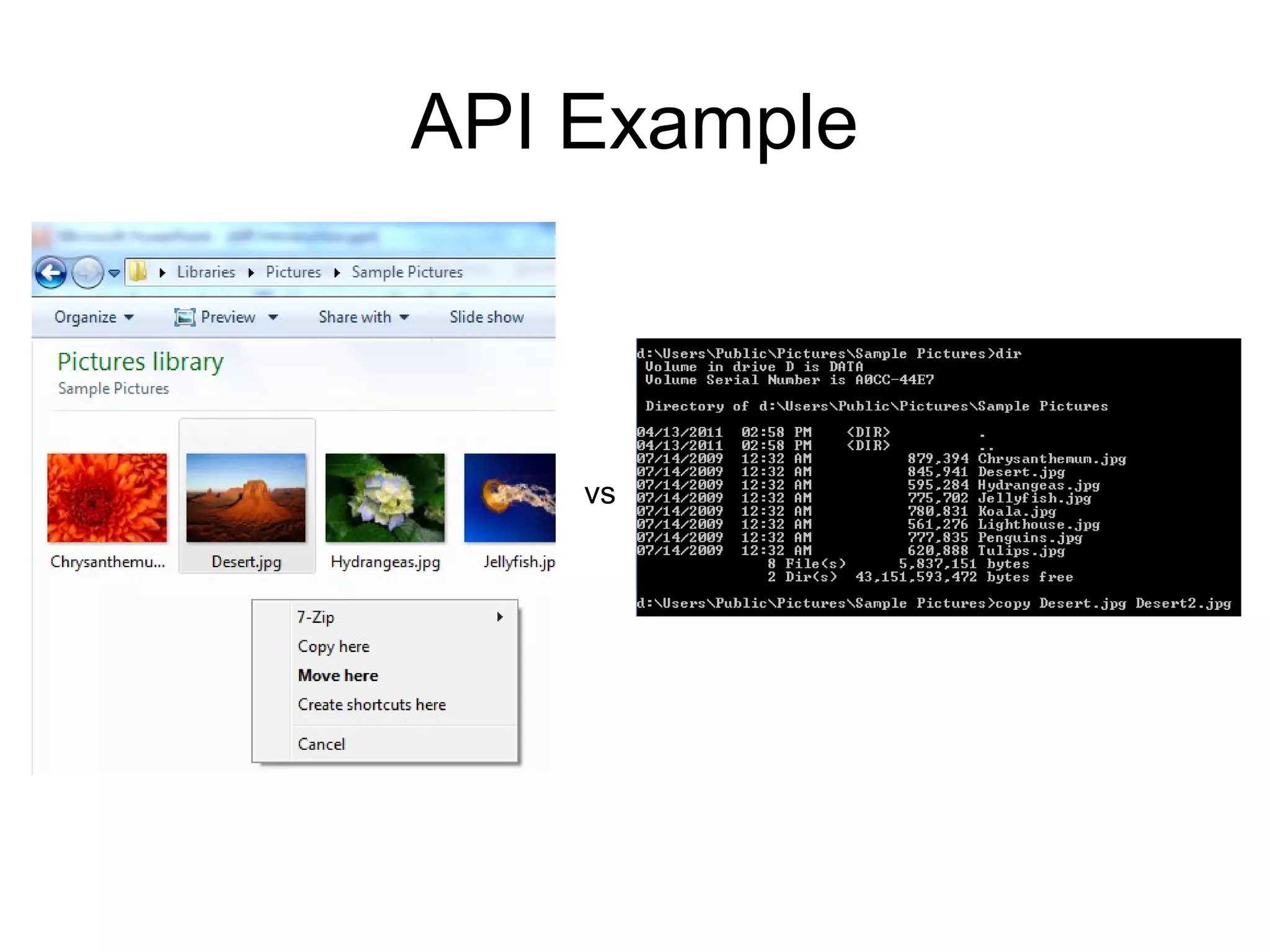
What is an API? • Methods to access data and workflow from an application without using the application itself
API Example vs
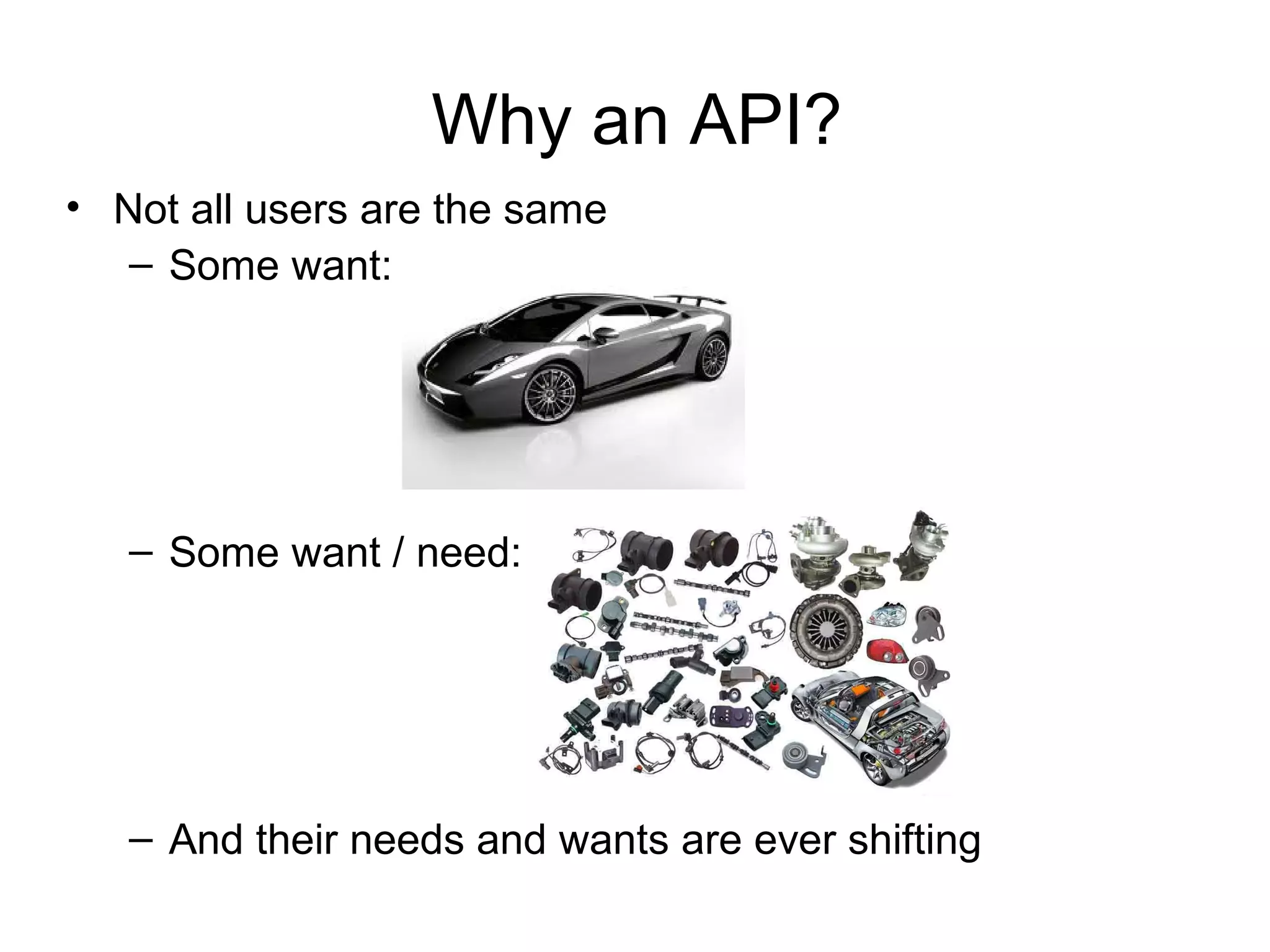
Why an API? • Not all users are the same – Some want: – Some want / need: – And their needs and wants are ever shifting
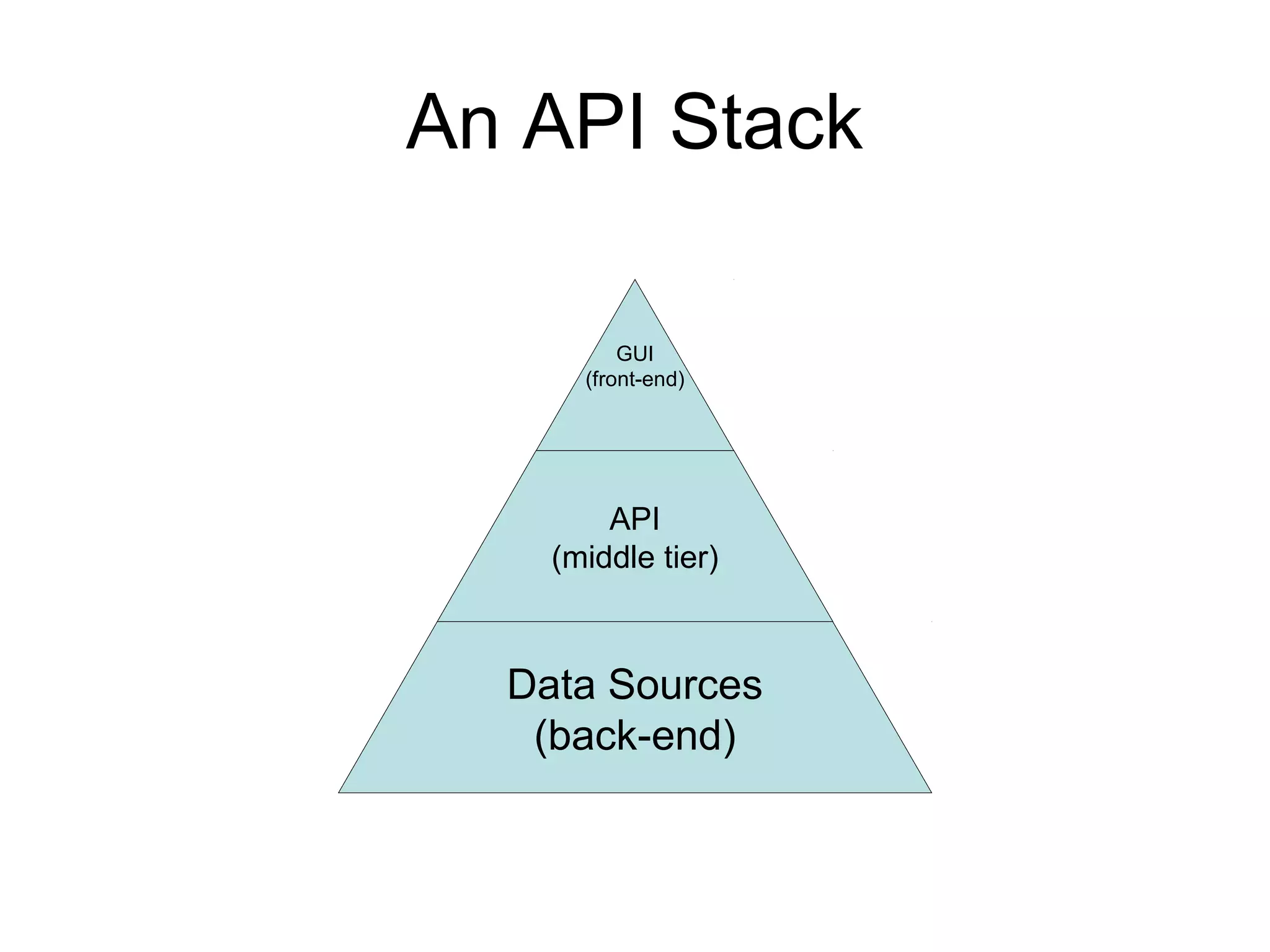
An API Stack GUI (front-end) API (middle tier) Data Sources (back-end)
… sounds like a good framework for Web …
The REST REpresentational State Transfer
What is REST? • Architectural style (not a standard!) • Client server model • Stateless – Idempotency • Cacheable • Layered System • Uniform interface
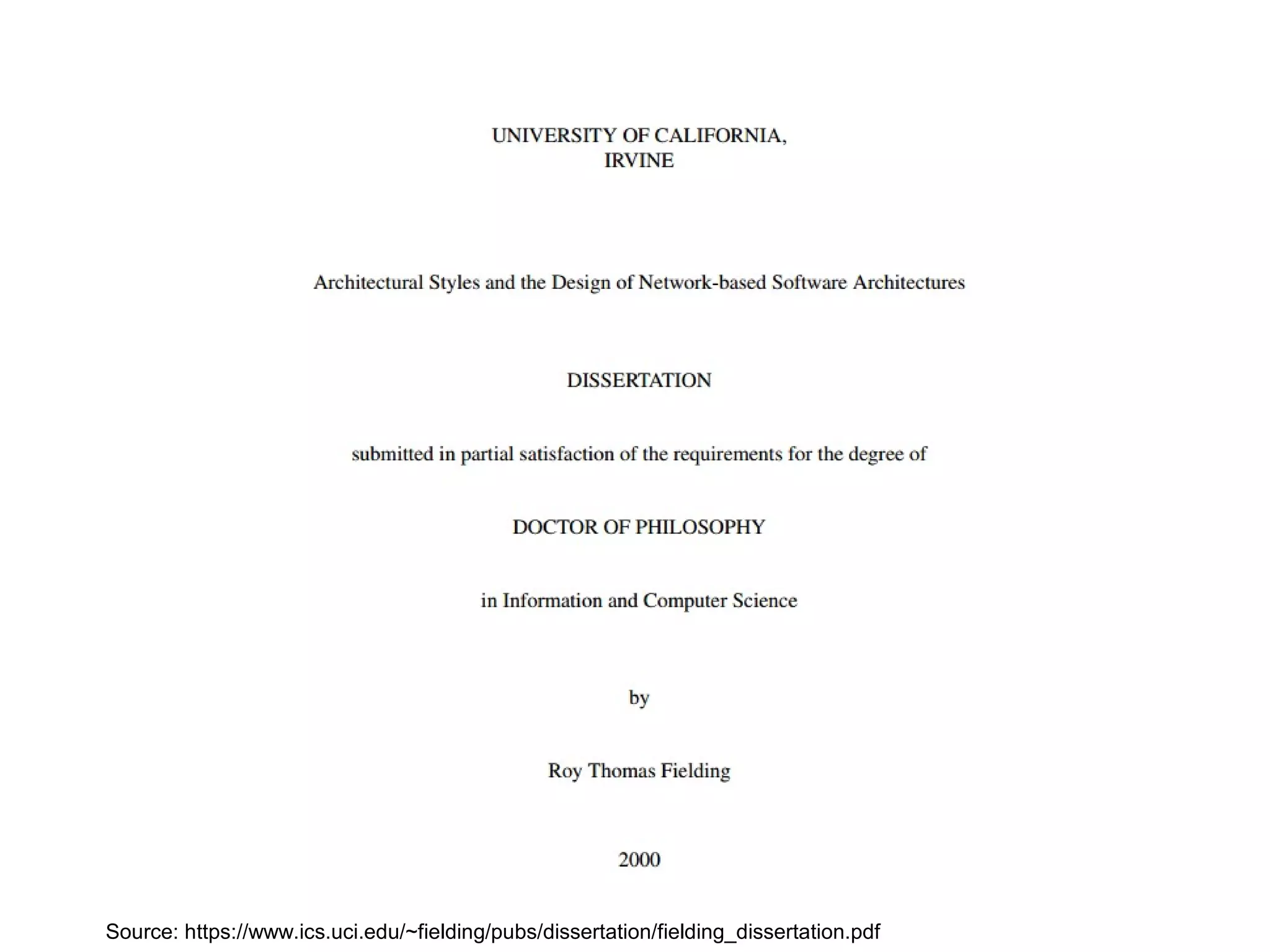
Source: https://www.ics.uci.edu/~fielding/pubs/dissertation/fielding_dissertation.pdf
Who RESTs? • • • • • • • Facebook Twitter Google LinkedIn Netflix Evernote Etc etc
Why REST? • • • • • Scalable Fault-tolerant Recoverable Secure Loosely coupled
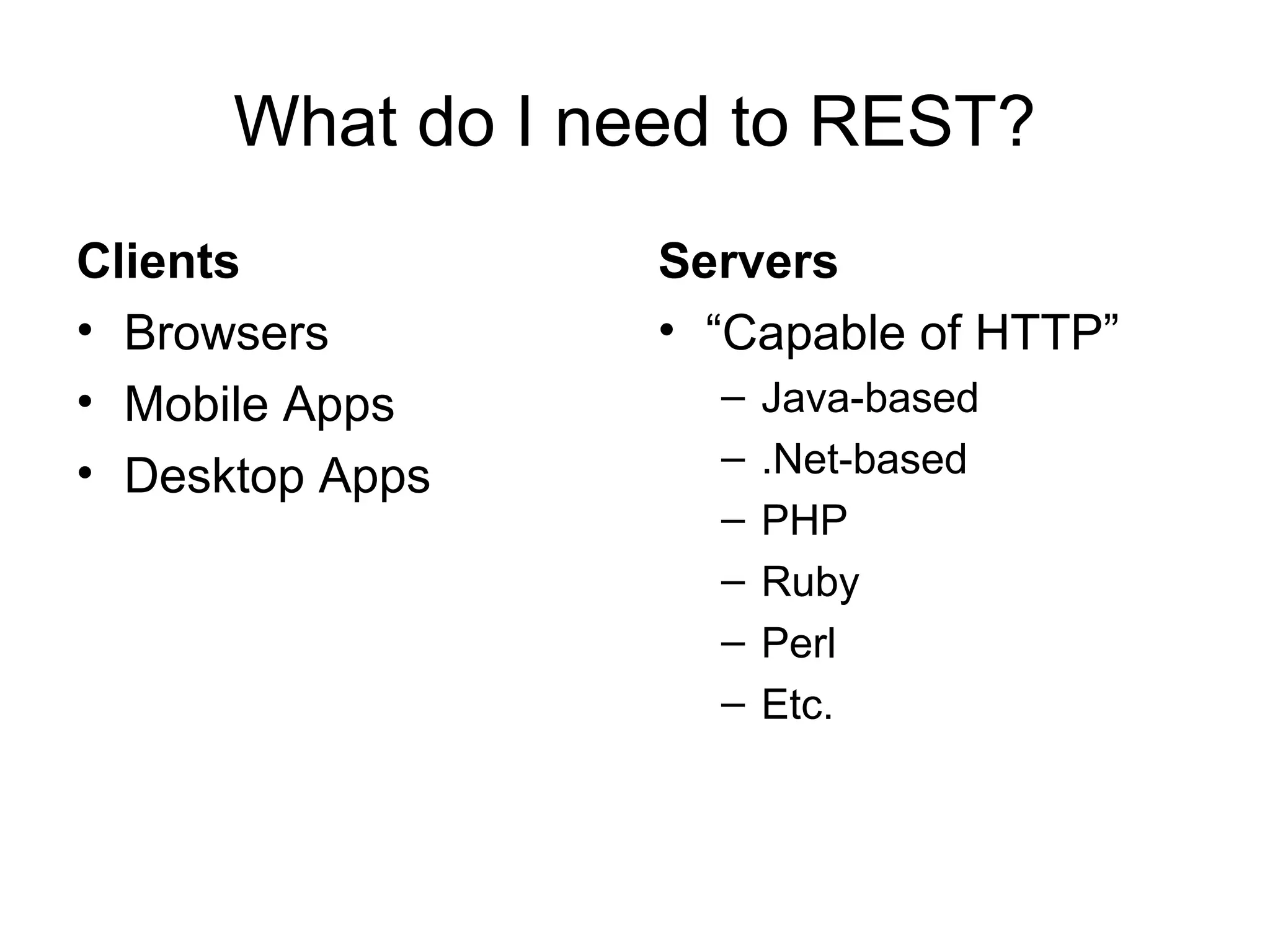
What do I need to REST? Clients • Browsers • Mobile Apps • Desktop Apps Servers • “Capable of HTTP” – – – – – – Java-based .Net-based PHP Ruby Perl Etc.
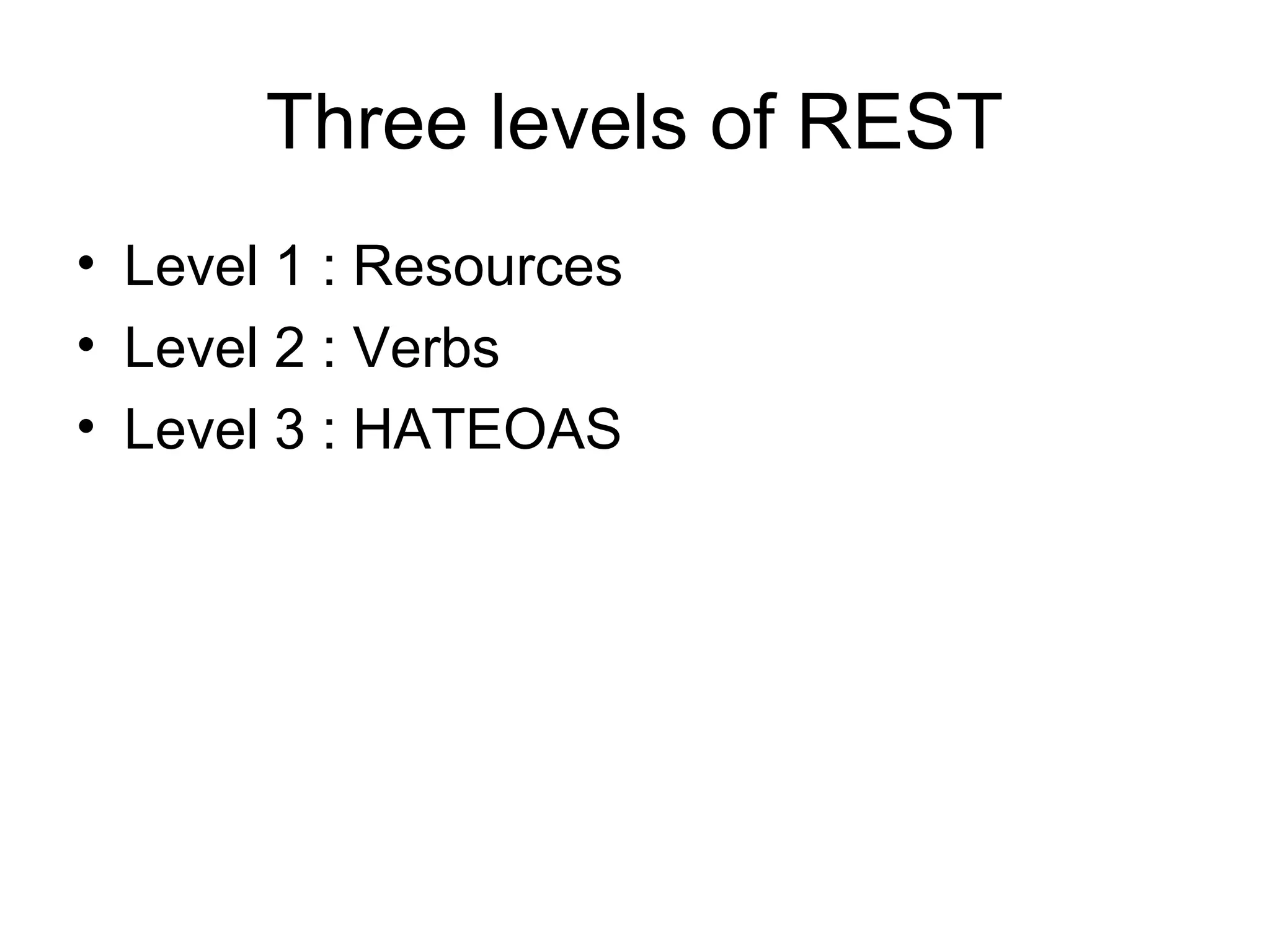
Three levels of REST • Level 1 : Resources • Level 2 : Verbs • Level 3 : HATEOAS
Resources, Level 1 REST • • • • /users /users/bob /users/bob/tweets /users/bob/tweets/1
Verbs, Level 2 REST • CRUD
What is CRUD? • Standard database operations: C reate R ead U pdate D elete
Verbs, Level 2 REST • CRUD • GET /tweets (as opposed to /givemethetweets) • POST /tweets (as opposed to /createnewtweet) • PUT /tweets/1 (as opposed to /updatetweet/1) • DELETE /tweets/1 (as opposed to /removetweet/1)
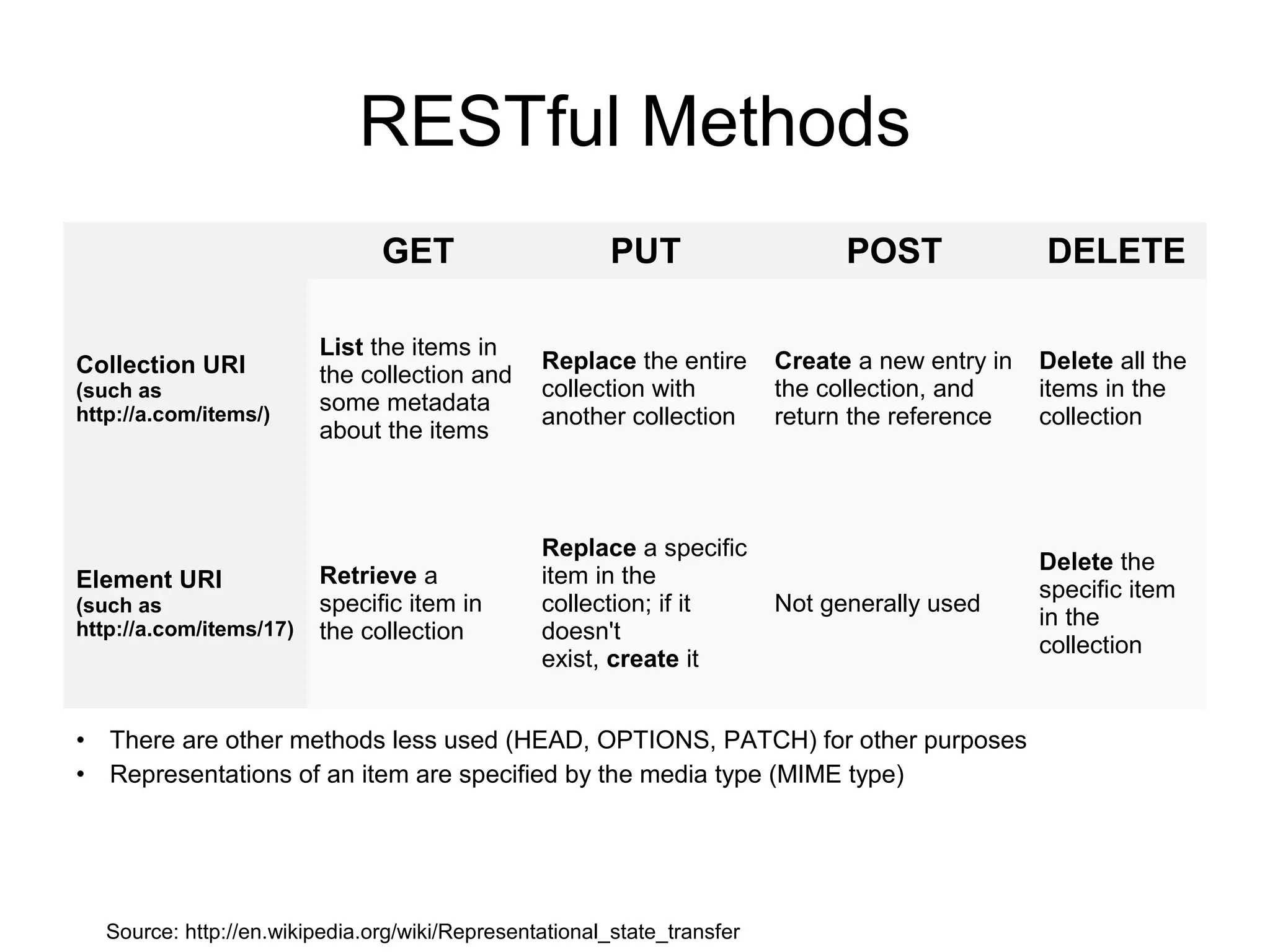
RESTful Methods GET Collection URI (such as http://a.com/items/) Element URI (such as http://a.com/items/17) PUT POST DELETE List the items in the collection and some metadata about the items Replace the entire collection with another collection Create a new entry in the collection, and return the reference Delete all the items in the collection Retrieve a specific item in the collection Replace a specific item in the collection; if it doesn't exist, create it Not generally used Delete the specific item in the collection • There are other methods less used (HEAD, OPTIONS, PATCH) for other purposes • Representations of an item are specified by the media type (MIME type) Source: http://en.wikipedia.org/wiki/Representational_state_transfer
HATEOAS, Level 3 REST • Hypermedia as the engine of application state "ids" : [ 12345678, 87654321, 11223344 ] "links": [ { "rel": "UserInfo", "href": "https://.../user/12345678" }, { "rel": "Tweets", "href": "https://.../tweet/87654321" }, { "rel": "Messages", "href": "https://.../msgs/11223344" } ]
Data Formats (XML and JSON)  XML (135 characters): <tweets> <tweet type="text" id="1"> <text>REST is great!</text> </tweet> <tweet type="text" id="2"> <text>APIs forever!</text> </tweet> </tweets>  JSON (109 characters): { "tweets": [ {"type": "text", "id": "1", "text": "REST is great!"}, {"type": "text", "id": "2", "text": "APIs forever!"} ] }  XML can be validated (XML Schema), stylized (XSL), traversed (XPath), queried (XQuery), transformed (XSLT), and namespaced  JSON is easier
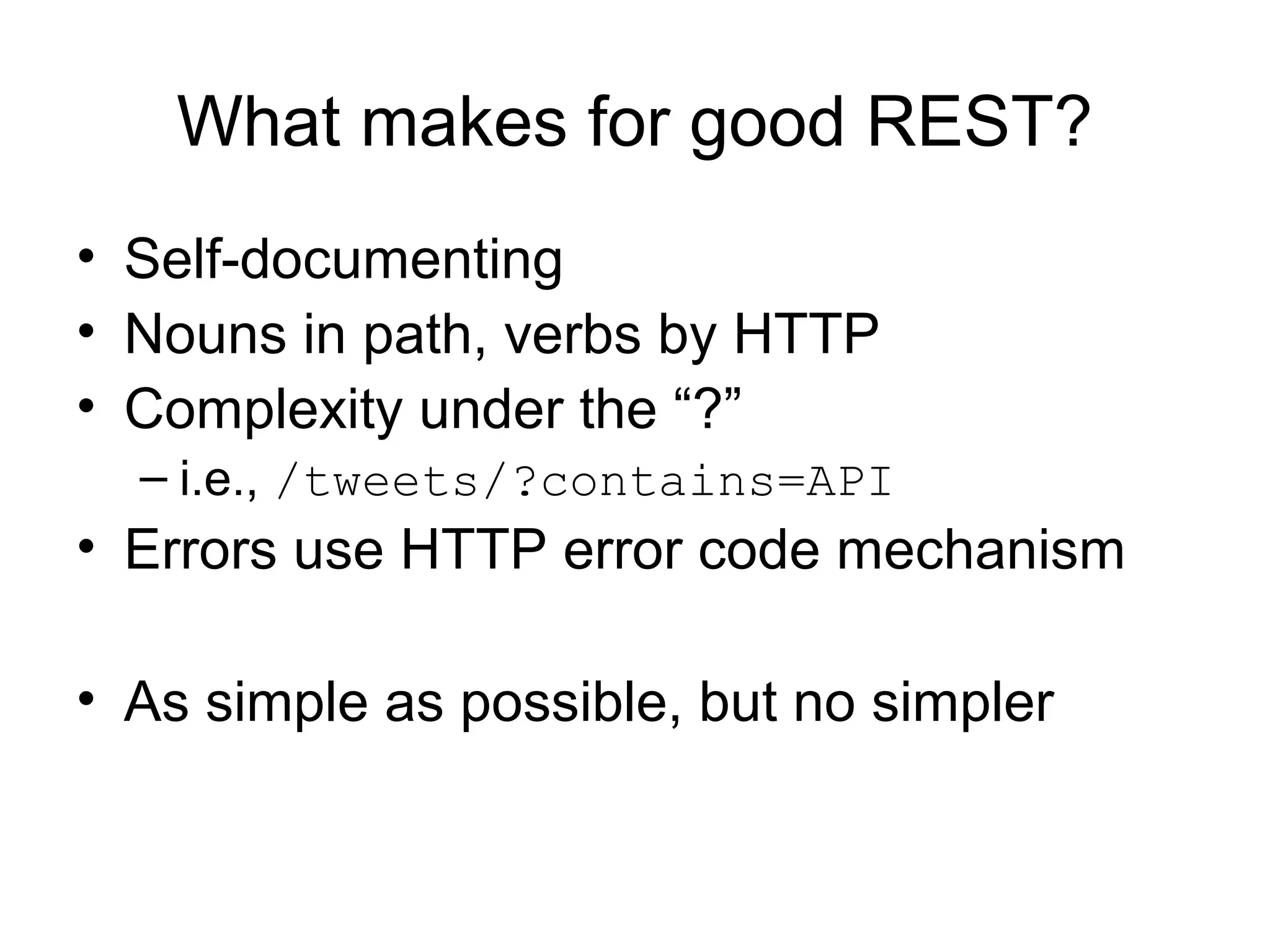
What makes for good REST? • Self-documenting • Nouns in path, verbs by HTTP • Complexity under the “?” – i.e., /tweets/?contains=API • Errors use HTTP error code mechanism • As simple as possible, but no simpler
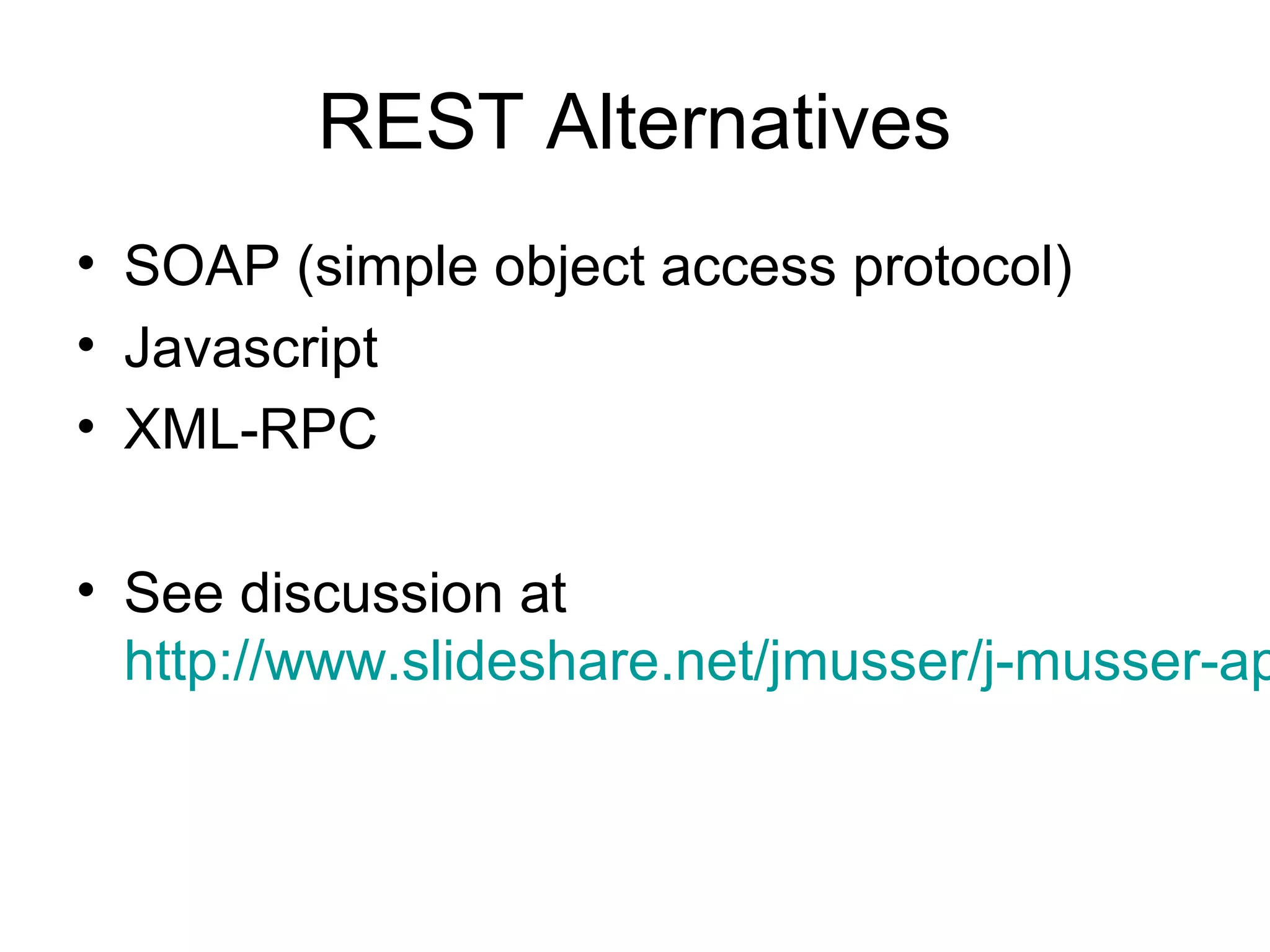
REST Alternatives • SOAP (simple object access protocol) • Javascript • XML-RPC • See discussion at http://www.slideshare.net/jmusser/j-musser-ap
Important : Know your TTFHW (Time to First Hello World) !
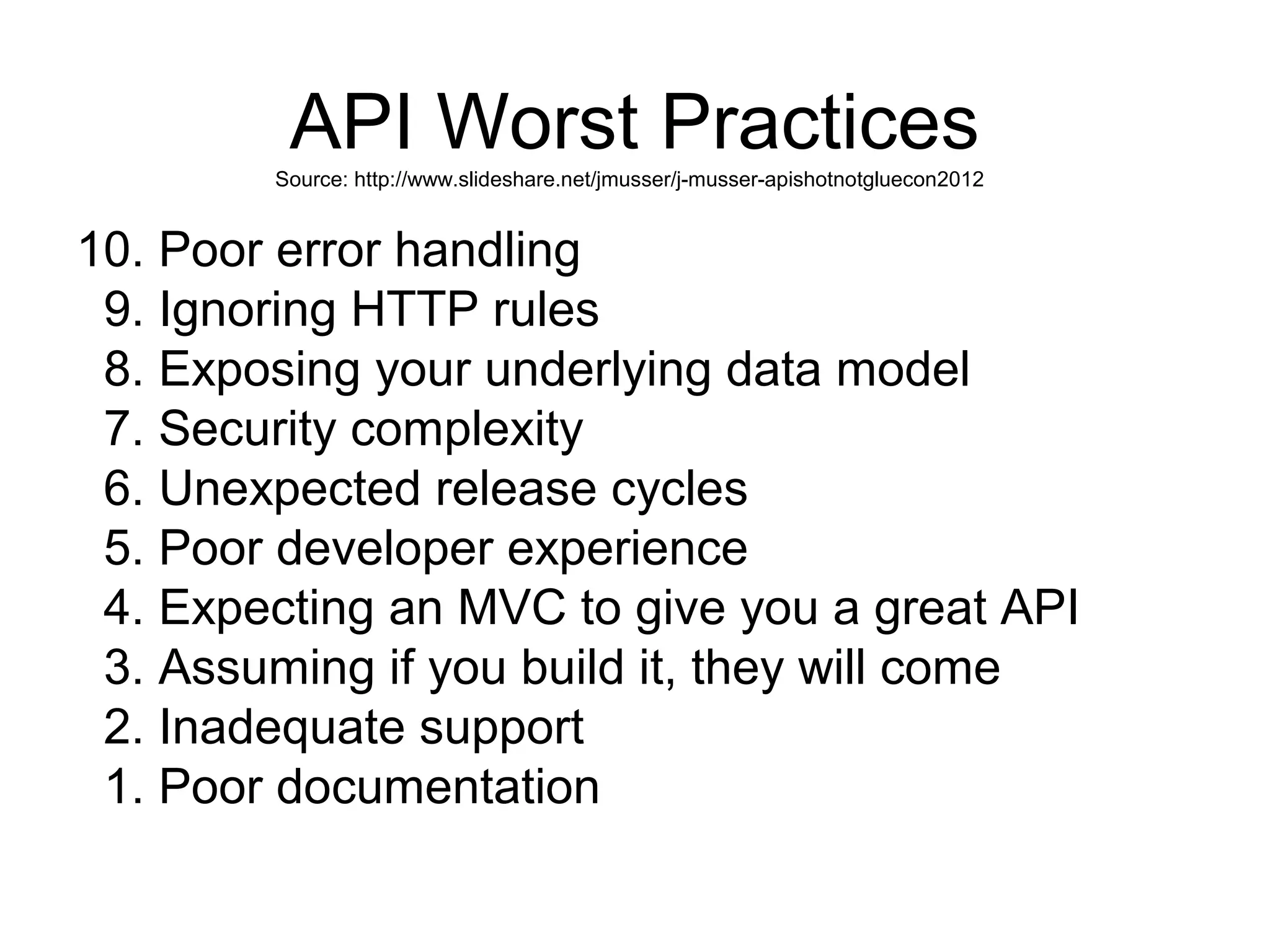
API Worst Practices Source: http://www.slideshare.net/jmusser/j-musser-apishotnotgluecon2012 10. Poor error handling 9. Ignoring HTTP rules 8. Exposing your underlying data model 7. Security complexity 6. Unexpected release cycles 5. Poor developer experience 4. Expecting an MVC to give you a great API 3. Assuming if you build it, they will come 2. Inadequate support 1. Poor documentation
The Security
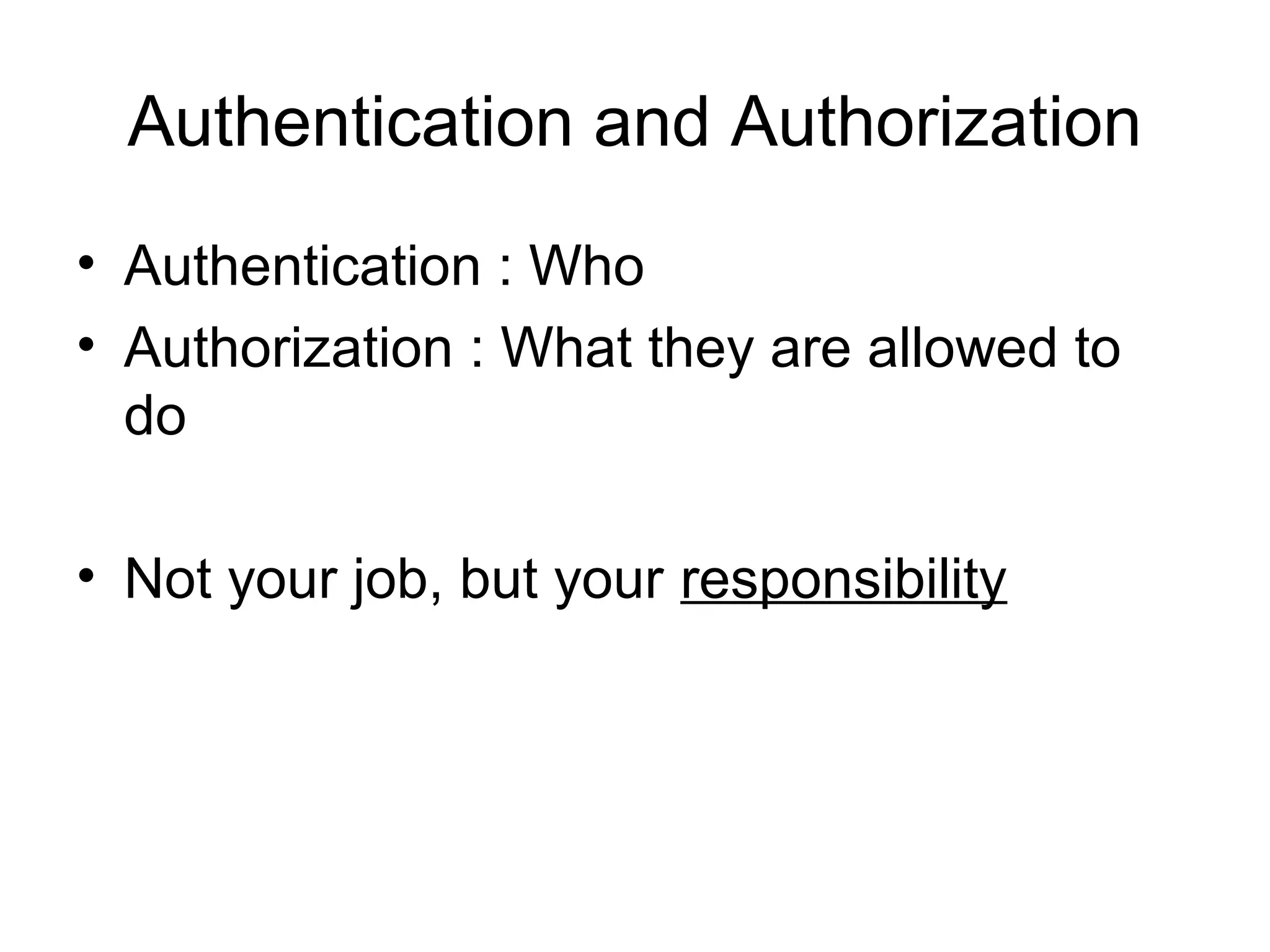
Authentication and Authorization • Authentication : Who • Authorization : What they are allowed to do • Not your job, but your responsibility
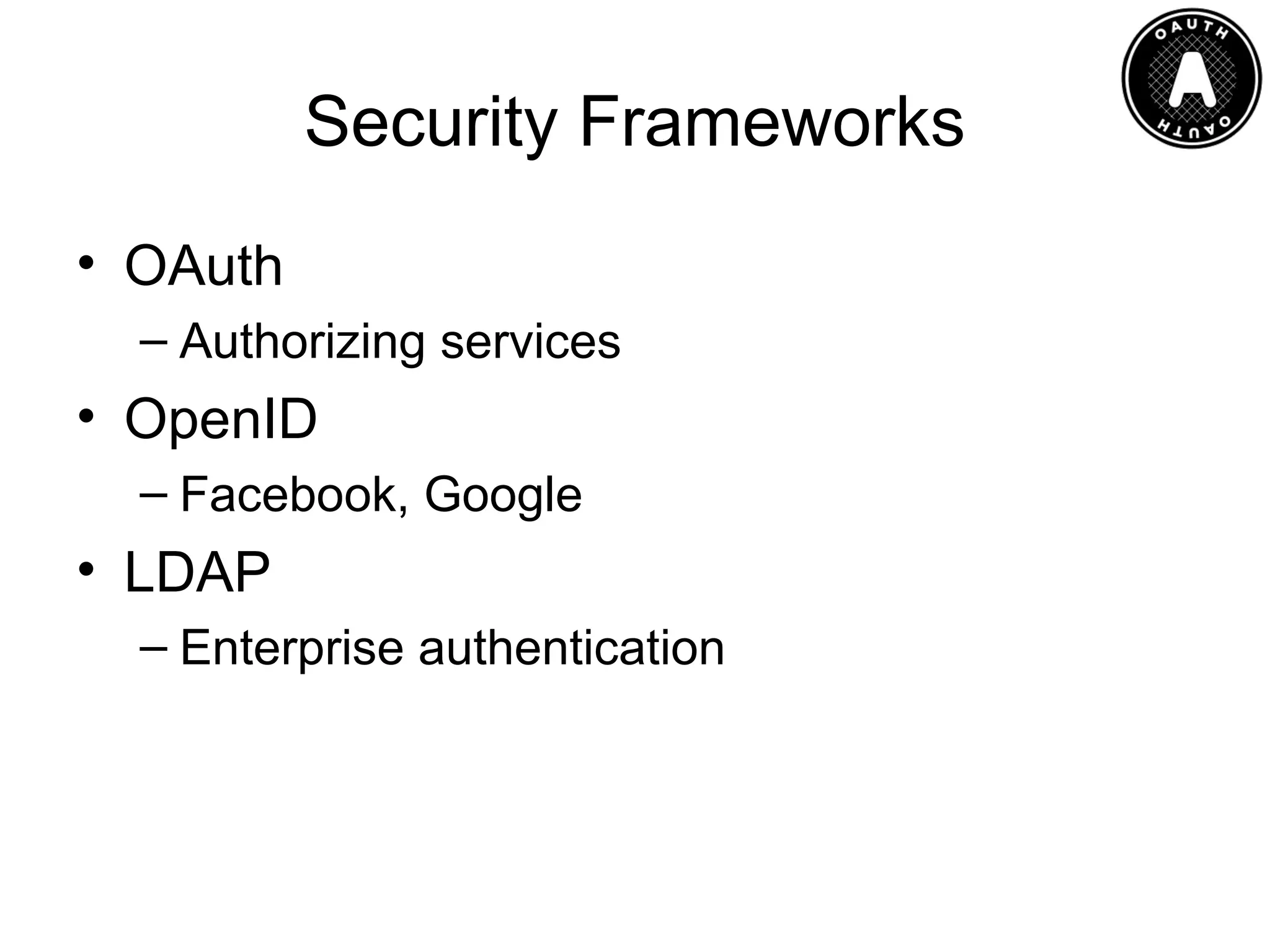
Security Frameworks • OAuth – Authorizing services • OpenID – Facebook, Google • LDAP – Enterprise authentication
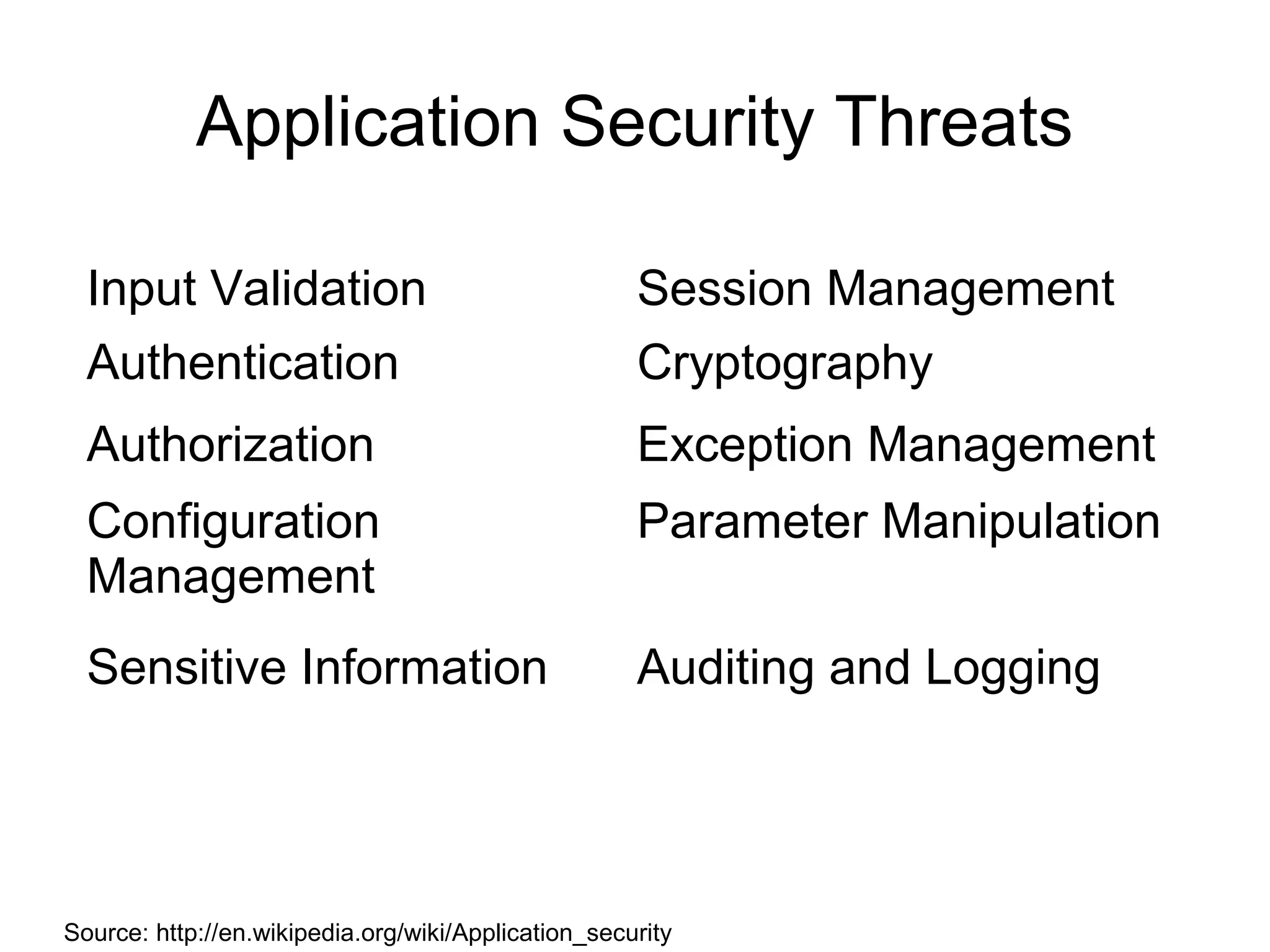
Application Security Threats Input Validation Authentication Session Management Cryptography Authorization Exception Management Configuration Management Parameter Manipulation Sensitive Information Auditing and Logging Source: http://en.wikipedia.org/wiki/Application_security
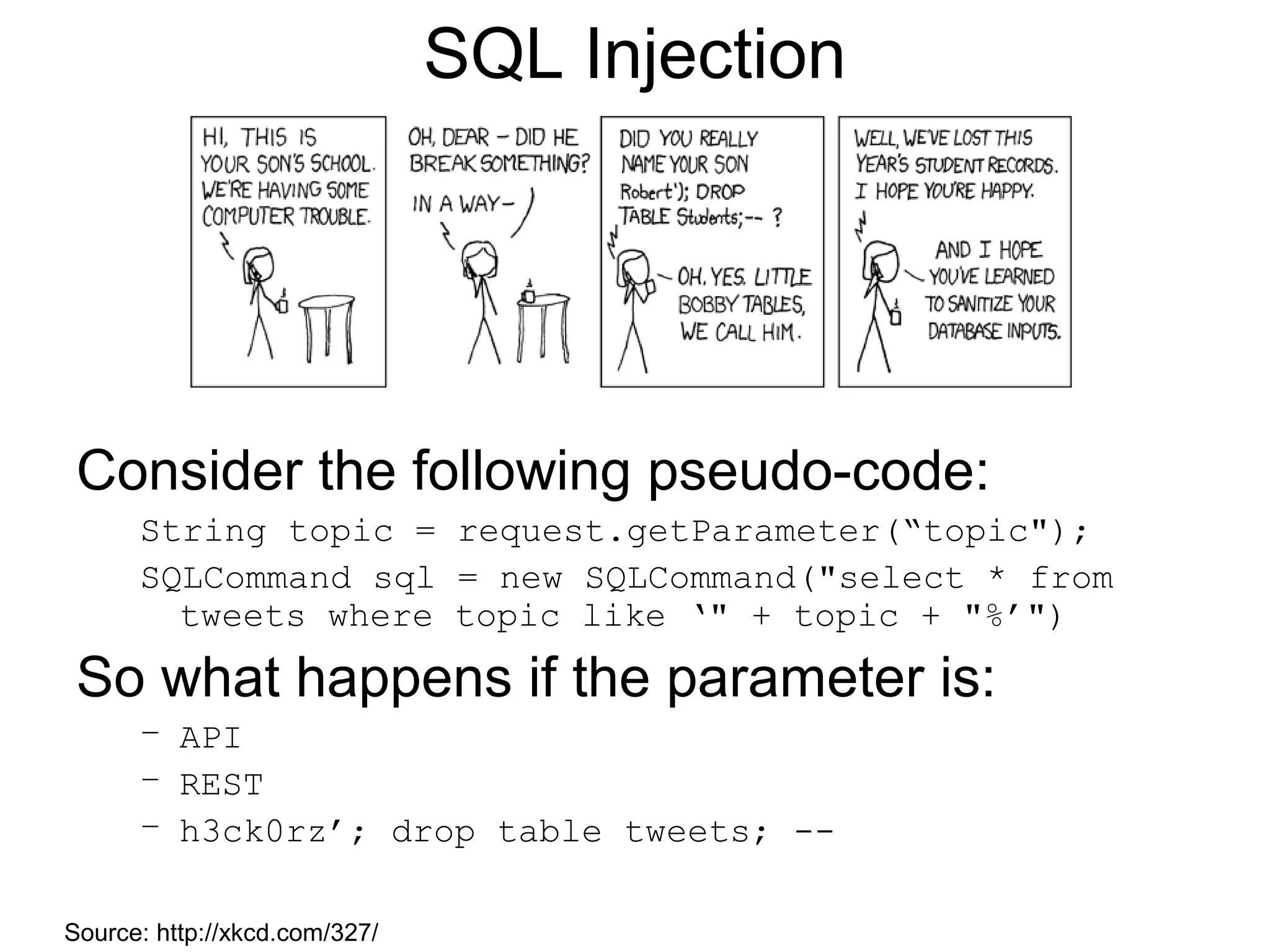
SQL Injection Consider the following pseudo-code: String topic = request.getParameter(“topic"); SQLCommand sql = new SQLCommand("select * from tweets where topic like ‘" + topic + "%’") So what happens if the parameter is: – API – REST – h3ck0rz’; drop table tweets; -Source: http://xkcd.com/327/
The Web Client-side Access to REST
HTML5 + CSS • “HyperText Markup Language” – Characterized by the DOM (document object model) Completely ubiquitous across the Internet <html> <body> <h1>Hello World</h1> </body> </html> • “Cascading Style Sheets” – Allows for advanced stylization of content – Example: .giant { font-size: 72px; color: blue; }
JavaScript • • • • Multi-paradigm weakly-typed scripting language Used most often hand-in-hand with HTML Not Java, at all (syntax based on C) Example: alert (“Hello World!”); • Able to manipulate the DOM and interact with the browser environment
AJAX • “Asynchronous JavaScript and XML” • Group of technologies that allow for robust client interactions without reloading web pages – HTML and CSS for presentation – DOM for display and interaction of data – XML for data interchange – XMLHttpRequest for asynchronous communication – JavaScript to bring these technologies together • AJAX is the key to consuming REST
jQuery • “jQuery is a fast and concise JavaScript Library that simplifies HTML document traversing, event handling, animating, and Ajax interactions for rapid web development.” • Example: $(“#h1”).html(“Hello World!”); • jQuery tests against many browser platforms and solves a lot of the problems that supporting many platforms introduces
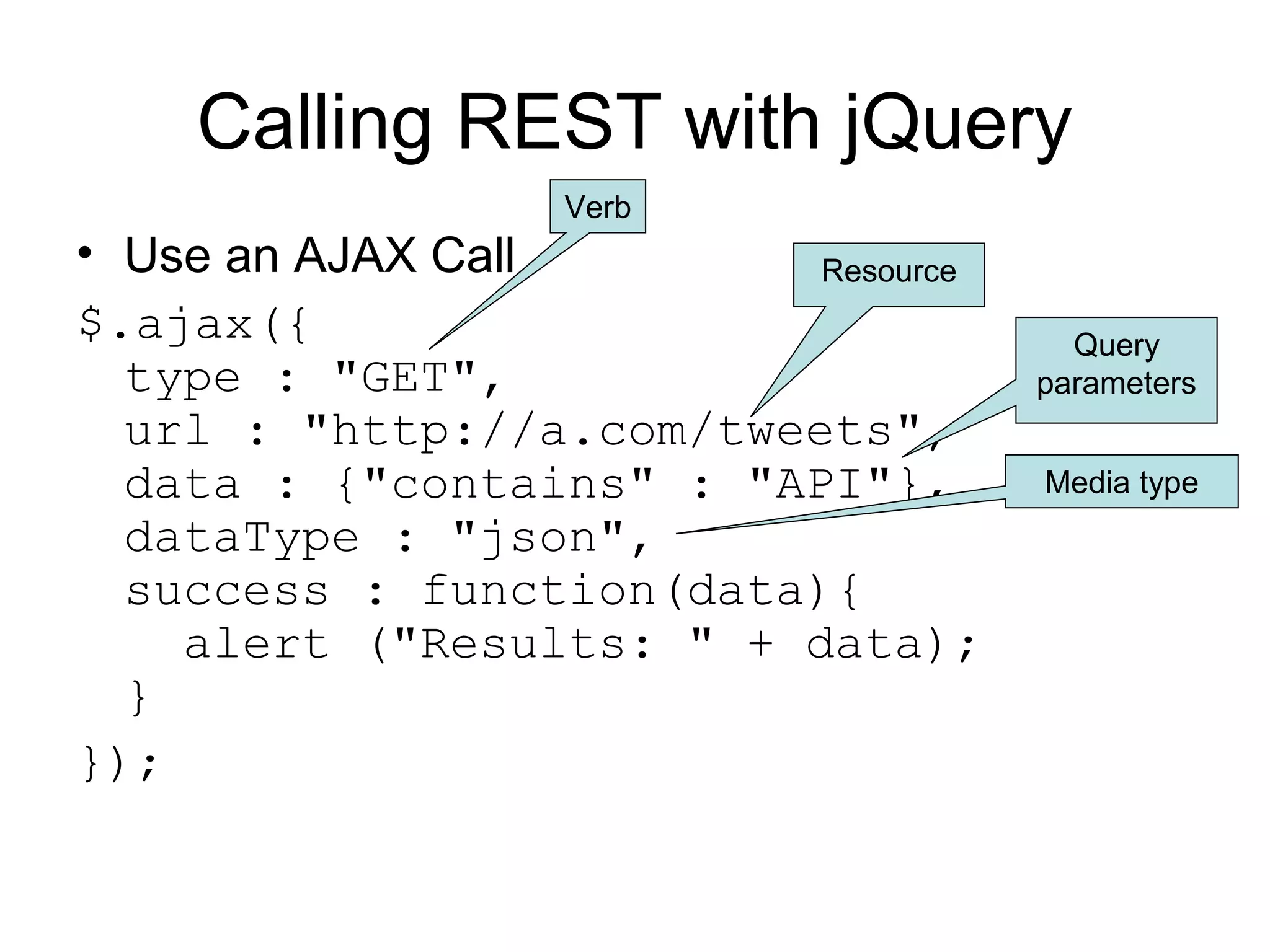
Calling REST with jQuery Verb • Use an AJAX Call Resource $.ajax({ type : "GET", url : "http://a.com/tweets", data : {"contains" : "API"}, dataType : "json", success : function(data){ alert ("Results: " + data); } }); Query parameters Media type
Tips • Use “curl” to simulate calls from your command line • Use Chrome debug tools or Firebug to watch traffic and test your Javascript • Use libraries – no need to reinvent the wheel
Other Frameworks • • • • UI Frameworks (Bootstrap, Foundation) MVC Frameworks (Angular, Backbone) Tooling (Yeoman, Lineman) Documentation (Apiary, Swagger) • No shortage of options
The Examples
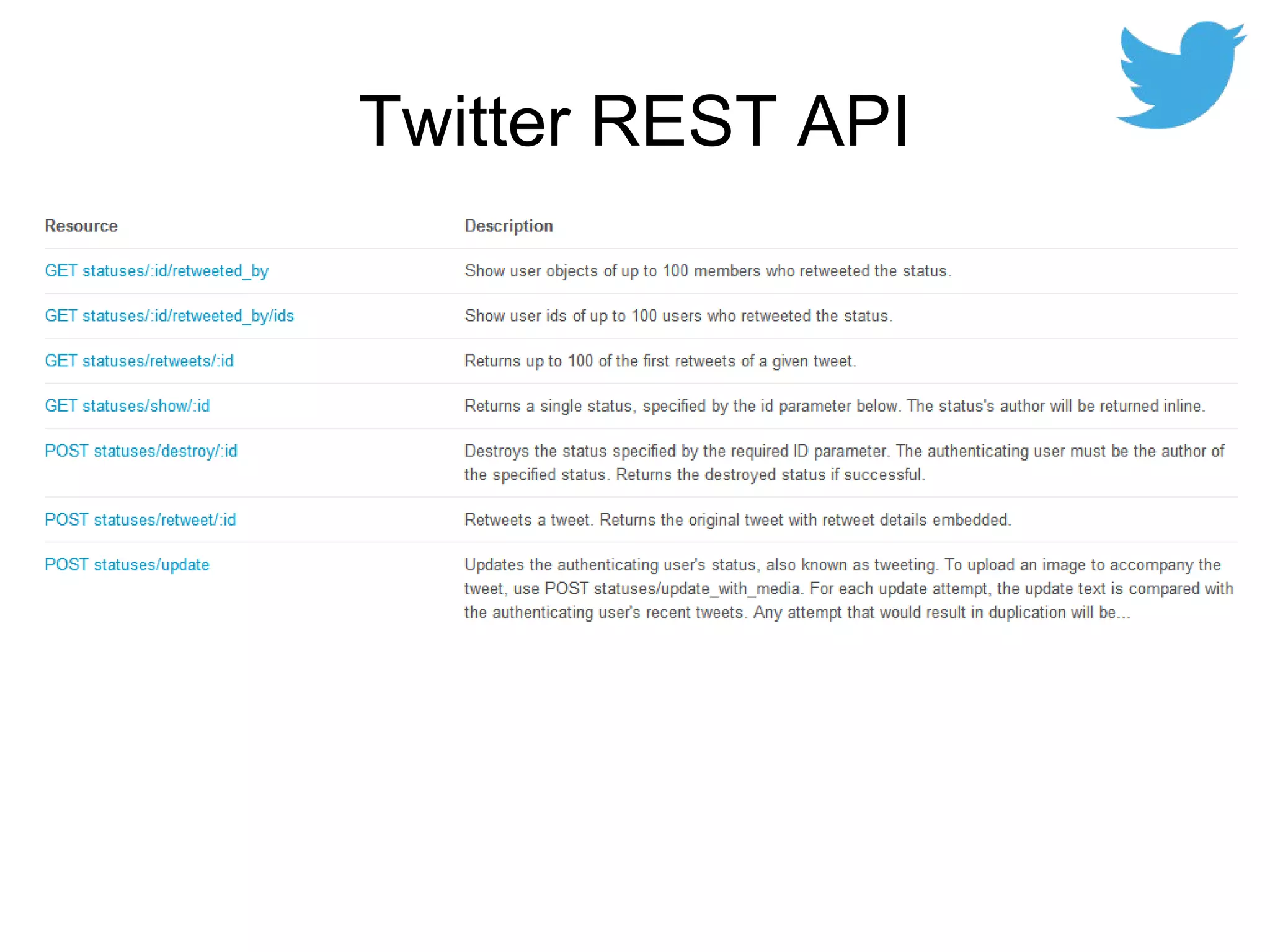
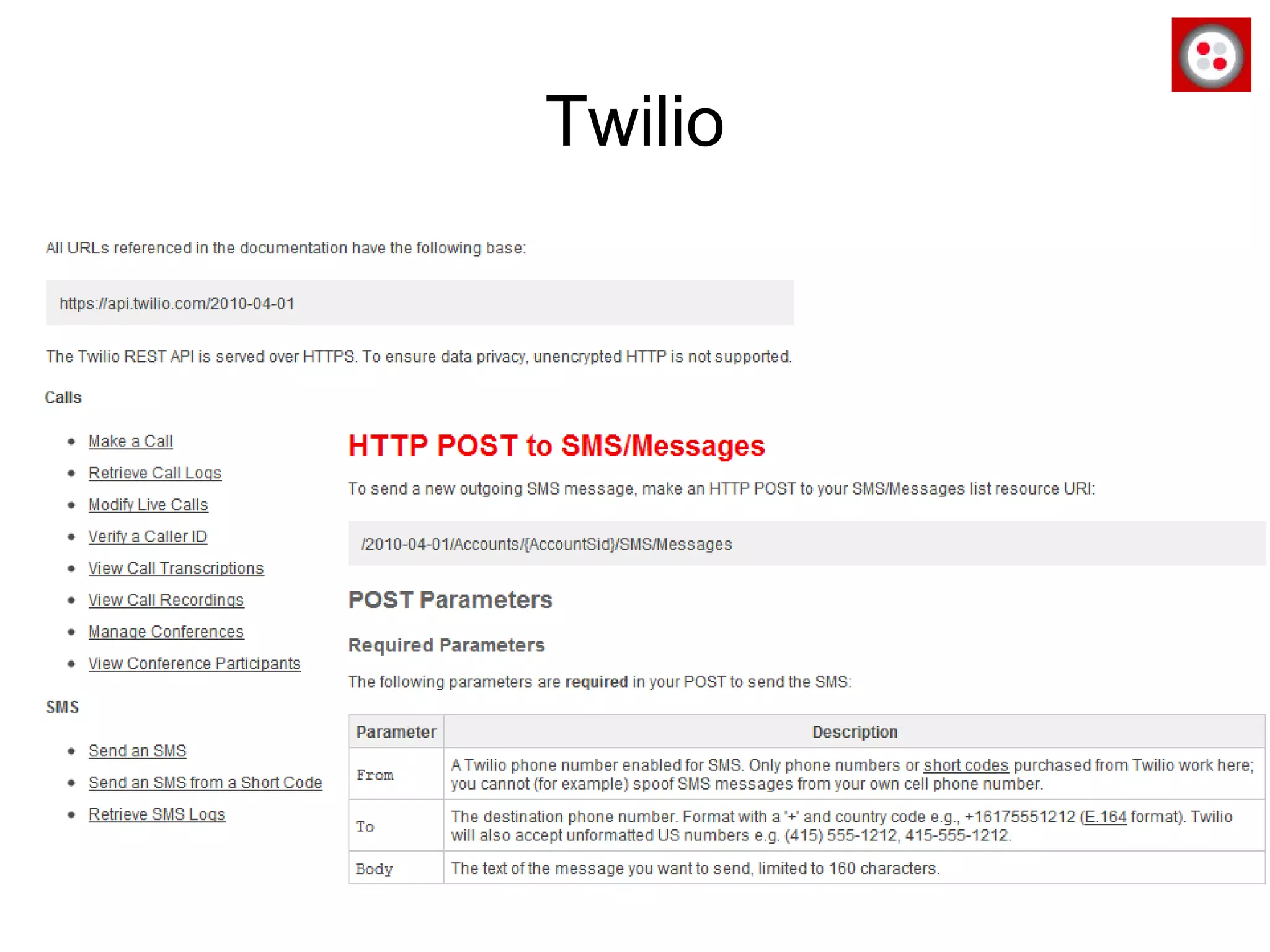
Some REST API Examples • • • • • Facebook Twitter If This, Than That Twilio Demo
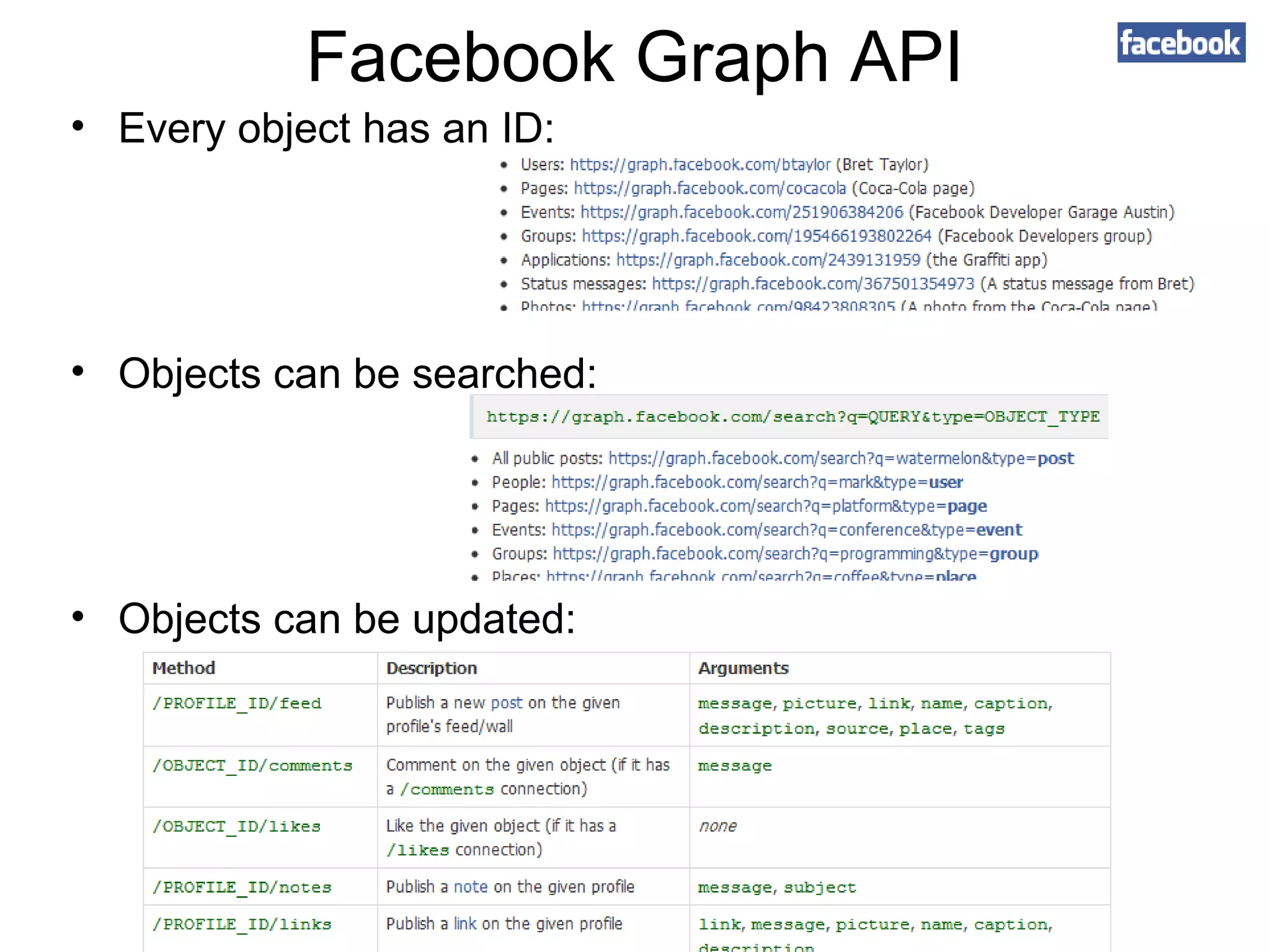
Facebook Graph API • Every object has an ID: • Objects can be searched: • Objects can be updated:
Twitter REST API
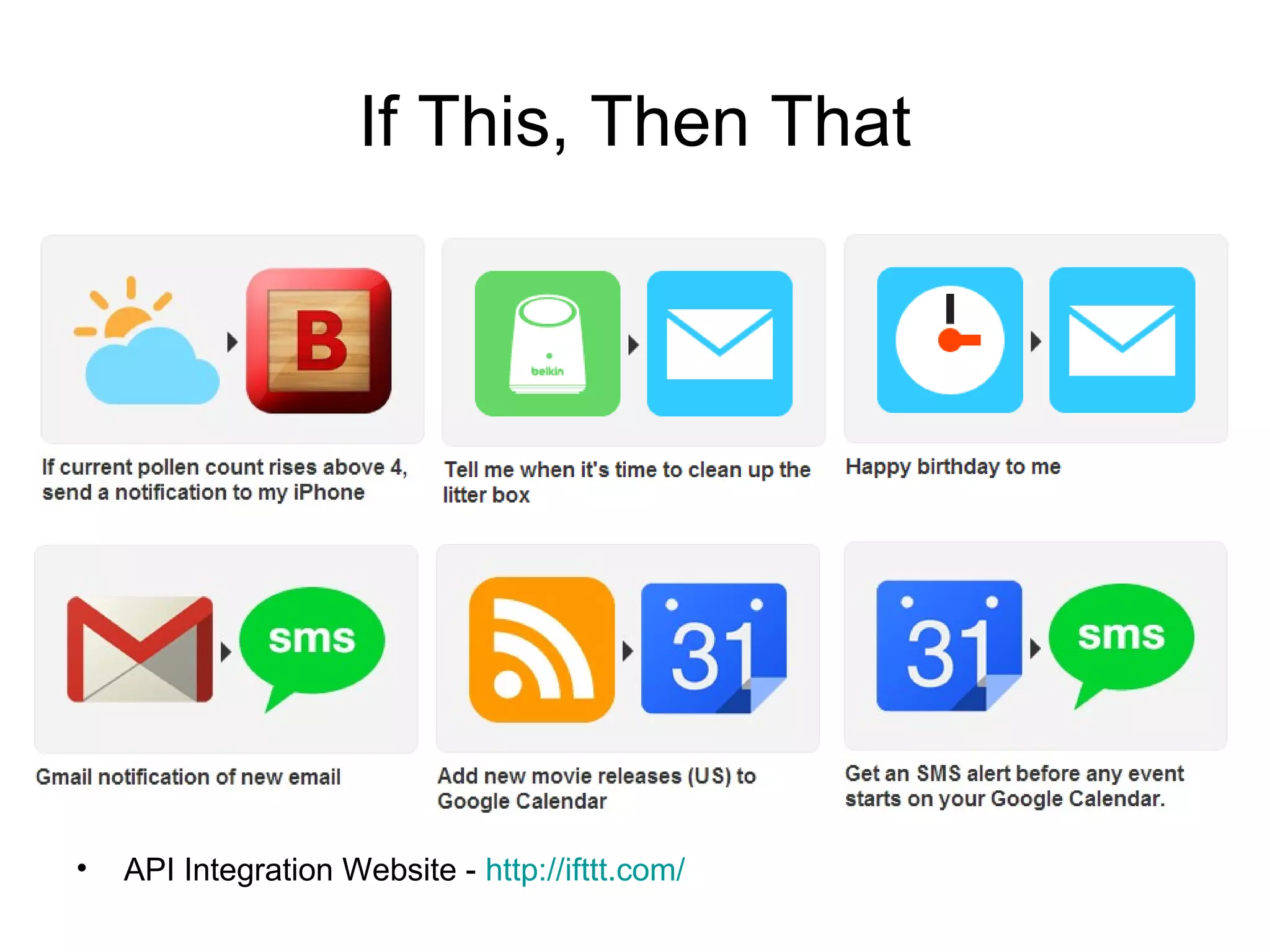
If This, Then That • API Integration Website - http://ifttt.com/
Twilio
Demo
Need more REST? • Programmable Web http://programmableweb.com John Musser’s presentations: http://www.slideshare.net/jmusser • Crafting Interfaces that Developers Love http://offers.apigee.com/api-design-ebook-rr/ • API Craft Google Group https:// groups.google.com/forum/#!forum/api-craft
Discussion - Questions

Introduction to the Web API

  • 1.
    An Introduction into theWeb API Brad Genereaux | @integratorbrad | about.me/integratorbrad | hcintegrations.ca Web Developers P2P : February 2014
  • 2.
    Housekeeping • About Me- Brad Genereaux – Healthcare and API developer – Integration Architect at Agfa Healthcare – Blogger about all the API things • Discussion and questions – Ask anytime, or at the end
  • 3.
  • 4.
  • 5.
    What is anAPI? • Methods to access data and workflow from an application without using the application itself
  • 6.
  • 7.
    Why an API? •Not all users are the same – Some want: – Some want / need: – And their needs and wants are ever shifting
  • 8.
    An API Stack GUI (front-end) API (middletier) Data Sources (back-end)
  • 9.
    … sounds likea good framework for Web …
  • 10.
  • 11.
    What is REST? •Architectural style (not a standard!) • Client server model • Stateless – Idempotency • Cacheable • Layered System • Uniform interface
  • 12.
  • 13.
  • 14.
  • 15.
    What do Ineed to REST? Clients • Browsers • Mobile Apps • Desktop Apps Servers • “Capable of HTTP” – – – – – – Java-based .Net-based PHP Ruby Perl Etc.
  • 16.
    Three levels ofREST • Level 1 : Resources • Level 2 : Verbs • Level 3 : HATEOAS
  • 17.
    Resources, Level 1REST • • • • /users /users/bob /users/bob/tweets /users/bob/tweets/1
  • 18.
    Verbs, Level 2REST • CRUD
  • 19.
    What is CRUD? •Standard database operations: C reate R ead U pdate D elete
  • 20.
    Verbs, Level 2REST • CRUD • GET /tweets (as opposed to /givemethetweets) • POST /tweets (as opposed to /createnewtweet) • PUT /tweets/1 (as opposed to /updatetweet/1) • DELETE /tweets/1 (as opposed to /removetweet/1)
  • 21.
    RESTful Methods GET Collection URI (suchas http://a.com/items/) Element URI (such as http://a.com/items/17) PUT POST DELETE List the items in the collection and some metadata about the items Replace the entire collection with another collection Create a new entry in the collection, and return the reference Delete all the items in the collection Retrieve a specific item in the collection Replace a specific item in the collection; if it doesn't exist, create it Not generally used Delete the specific item in the collection • There are other methods less used (HEAD, OPTIONS, PATCH) for other purposes • Representations of an item are specified by the media type (MIME type) Source: http://en.wikipedia.org/wiki/Representational_state_transfer
  • 22.
    HATEOAS, Level 3REST • Hypermedia as the engine of application state "ids" : [ 12345678, 87654321, 11223344 ] "links": [ { "rel": "UserInfo", "href": "https://.../user/12345678" }, { "rel": "Tweets", "href": "https://.../tweet/87654321" }, { "rel": "Messages", "href": "https://.../msgs/11223344" } ]
  • 23.
    Data Formats (XMLand JSON)  XML (135 characters): <tweets> <tweet type="text" id="1"> <text>REST is great!</text> </tweet> <tweet type="text" id="2"> <text>APIs forever!</text> </tweet> </tweets>  JSON (109 characters): { "tweets": [ {"type": "text", "id": "1", "text": "REST is great!"}, {"type": "text", "id": "2", "text": "APIs forever!"} ] }  XML can be validated (XML Schema), stylized (XSL), traversed (XPath), queried (XQuery), transformed (XSLT), and namespaced  JSON is easier
  • 24.
    What makes forgood REST? • Self-documenting • Nouns in path, verbs by HTTP • Complexity under the “?” – i.e., /tweets/?contains=API • Errors use HTTP error code mechanism • As simple as possible, but no simpler
  • 25.
    REST Alternatives • SOAP(simple object access protocol) • Javascript • XML-RPC • See discussion at http://www.slideshare.net/jmusser/j-musser-ap
  • 26.
    Important : Knowyour TTFHW (Time to First Hello World) !
  • 27.
    API Worst Practices Source:http://www.slideshare.net/jmusser/j-musser-apishotnotgluecon2012 10. Poor error handling 9. Ignoring HTTP rules 8. Exposing your underlying data model 7. Security complexity 6. Unexpected release cycles 5. Poor developer experience 4. Expecting an MVC to give you a great API 3. Assuming if you build it, they will come 2. Inadequate support 1. Poor documentation
  • 28.
  • 29.
    Authentication and Authorization •Authentication : Who • Authorization : What they are allowed to do • Not your job, but your responsibility
  • 30.
    Security Frameworks • OAuth –Authorizing services • OpenID – Facebook, Google • LDAP – Enterprise authentication
  • 31.
    Application Security Threats InputValidation Authentication Session Management Cryptography Authorization Exception Management Configuration Management Parameter Manipulation Sensitive Information Auditing and Logging Source: http://en.wikipedia.org/wiki/Application_security
  • 32.
    SQL Injection Consider thefollowing pseudo-code: String topic = request.getParameter(“topic"); SQLCommand sql = new SQLCommand("select * from tweets where topic like ‘" + topic + "%’") So what happens if the parameter is: – API – REST – h3ck0rz’; drop table tweets; -Source: http://xkcd.com/327/
  • 33.
  • 34.
    HTML5 + CSS •“HyperText Markup Language” – Characterized by the DOM (document object model) Completely ubiquitous across the Internet <html> <body> <h1>Hello World</h1> </body> </html> • “Cascading Style Sheets” – Allows for advanced stylization of content – Example: .giant { font-size: 72px; color: blue; }
  • 35.
    JavaScript • • • • Multi-paradigm weakly-typed scriptinglanguage Used most often hand-in-hand with HTML Not Java, at all (syntax based on C) Example: alert (“Hello World!”); • Able to manipulate the DOM and interact with the browser environment
  • 36.
    AJAX • “Asynchronous JavaScriptand XML” • Group of technologies that allow for robust client interactions without reloading web pages – HTML and CSS for presentation – DOM for display and interaction of data – XML for data interchange – XMLHttpRequest for asynchronous communication – JavaScript to bring these technologies together • AJAX is the key to consuming REST
  • 37.
    jQuery • “jQuery isa fast and concise JavaScript Library that simplifies HTML document traversing, event handling, animating, and Ajax interactions for rapid web development.” • Example: $(“#h1”).html(“Hello World!”); • jQuery tests against many browser platforms and solves a lot of the problems that supporting many platforms introduces
  • 38.
    Calling REST withjQuery Verb • Use an AJAX Call Resource $.ajax({ type : "GET", url : "http://a.com/tweets", data : {"contains" : "API"}, dataType : "json", success : function(data){ alert ("Results: " + data); } }); Query parameters Media type
  • 39.
    Tips • Use “curl”to simulate calls from your command line • Use Chrome debug tools or Firebug to watch traffic and test your Javascript • Use libraries – no need to reinvent the wheel
  • 40.
    Other Frameworks • • • • UI Frameworks(Bootstrap, Foundation) MVC Frameworks (Angular, Backbone) Tooling (Yeoman, Lineman) Documentation (Apiary, Swagger) • No shortage of options
  • 41.
  • 42.
    Some REST APIExamples • • • • • Facebook Twitter If This, Than That Twilio Demo
  • 43.
    Facebook Graph API •Every object has an ID: • Objects can be searched: • Objects can be updated:
  • 44.
  • 45.
    If This, ThenThat • API Integration Website - http://ifttt.com/
  • 46.
  • 47.
  • 48.
    Need more REST? •Programmable Web http://programmableweb.com John Musser’s presentations: http://www.slideshare.net/jmusser • Crafting Interfaces that Developers Love http://offers.apigee.com/api-design-ebook-rr/ • API Craft Google Group https:// groups.google.com/forum/#!forum/api-craft
  • 49.

Editor's Notes

  • #13 Describes a method for a client to communicate with a server If you ever access a website, you are already using REST When you access a page, you are GETting it.
  • #15 Easy to consume by many platforms Lightweight, payload is almost strictly content Self-documenting Flexible for many environments, including firewalls and load-balancers Just “works” for security and identity frameworks Server and consumer agnostic
  • #24 Both represent the same data, albeit in different ways JSON is smaller, but with compression, they are ~equivalent XML can be validated (XML Schema), stylized (XSL), traversed (XPath), queried (XQuery), transformed (XSLT), and namespaced JSON has no formally recognized equivalents, which isn’t necessarily a bad thing
  • #25 I can reasonably guess functionality without needing documentation TTFHW – Time to first hello world