I N TR O D U CTI O N T OP Y T H O N P R O G R A M M I N G
Google (Youtube) Facebook (Tornado) Dropbox Yahoo NASA IBM Mozilla Quora Instagram (Django) Reddit
Search algorithms Log analysis Google Data Python Client Library Google APIs Client Library for Python Google AdWords API Python Client Library Machine Learning Robotics projects
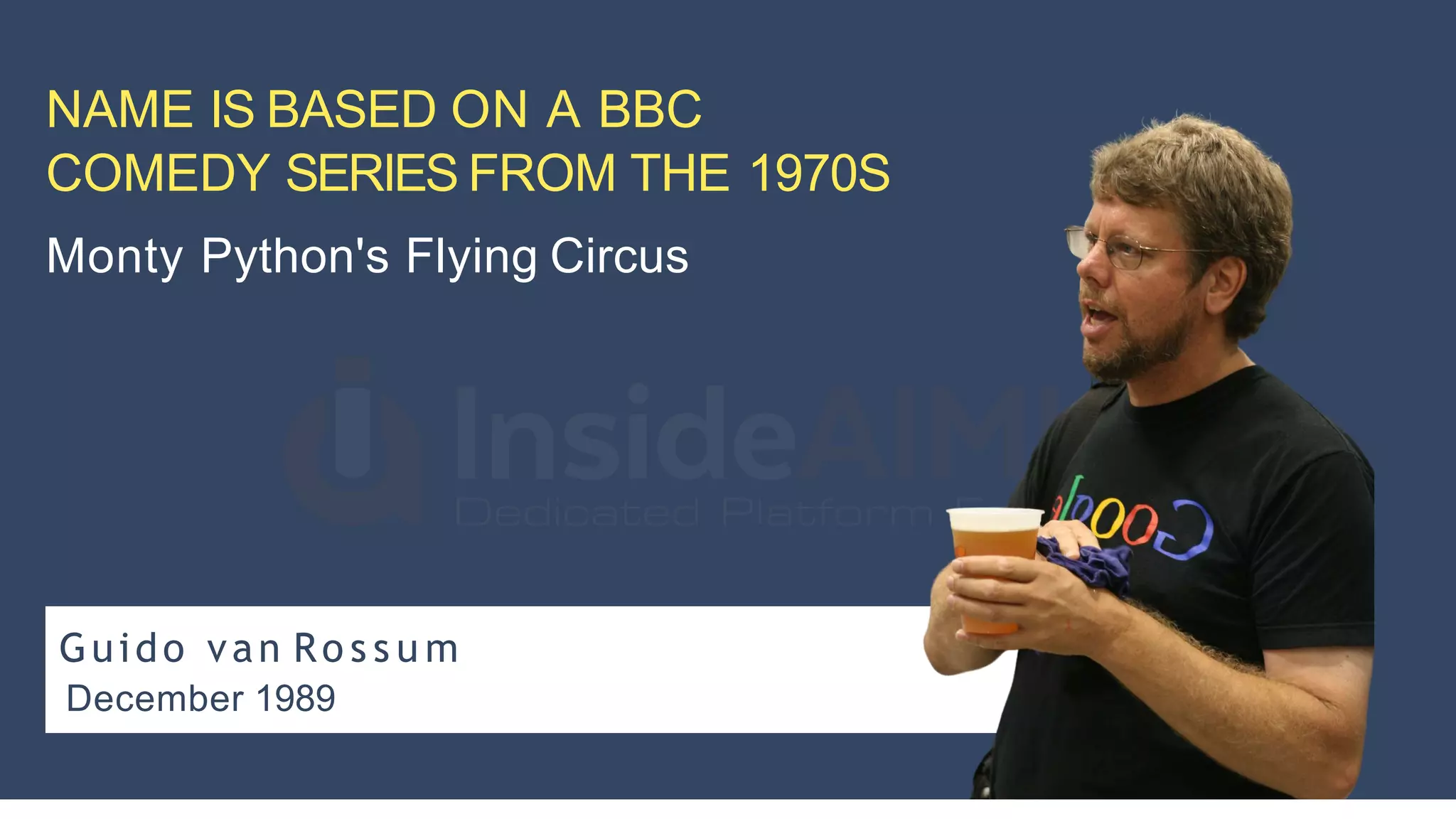
NAME IS BASED ON A BBC COMEDY SERIES FROM THE 1970S Monty Python's Flying Circus Guido van Ro s s u m December 1989
Python is used across domains such as: Scripting Testing Web Development IoT Programming Data Science
Programming is error-prone! Programming errors are called bugs The process of tracking them down is called debugging
Easy-to-learn: Python has few keywords, a simple structure, and a clearly defined syntax. Easy-to-read: Python code is more clearly defined and visible to the eyes. Easy-to-maintain: Python's source code is fairly easy to maintain. A broad standard library: Python's bulk of the library is very portable and cross-platform compatible on UNIX, Windows, and Macintosh. Interactive Mode: Python has support for an interactive mode that allows interactive testing and debugging of snippets of code. Portable: Python can run on a wide variety of hardware platforms and has the same interface on all platforms.
Extendable: You can add low-level modules to the Python interpreter. These modules enable programmers to add to or customize their tools to be more efficient. Databases: Python provides interfaces to all major commercial databases. GUI Programming: Python supports GUI applications that can be created and ported to many system calls, libraries, and windows systems, such as Windows MFC, Macintosh, and the X Window system of Unix. Scalable: Python provides a better structure and support for large programs than shell scripting.
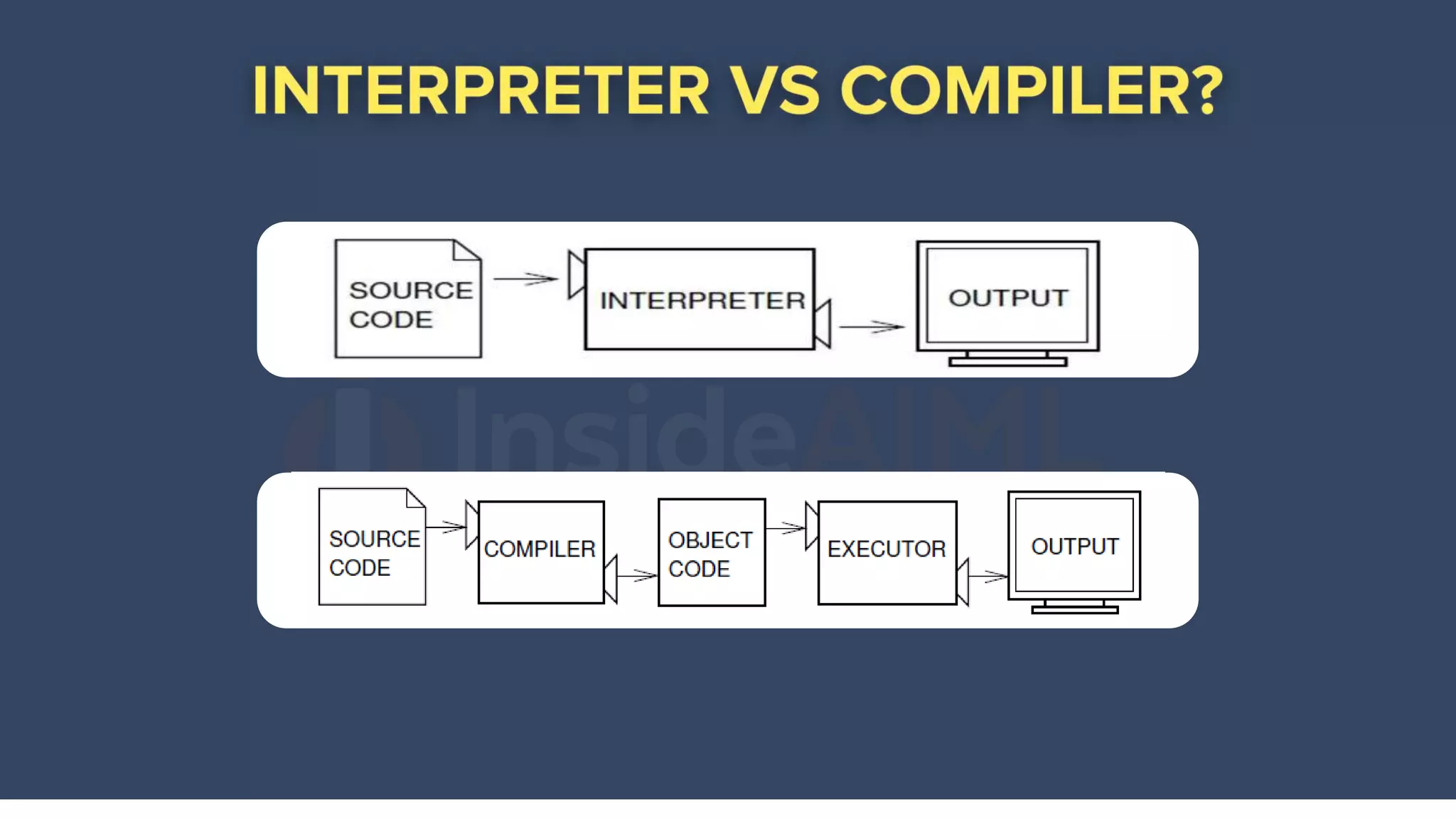
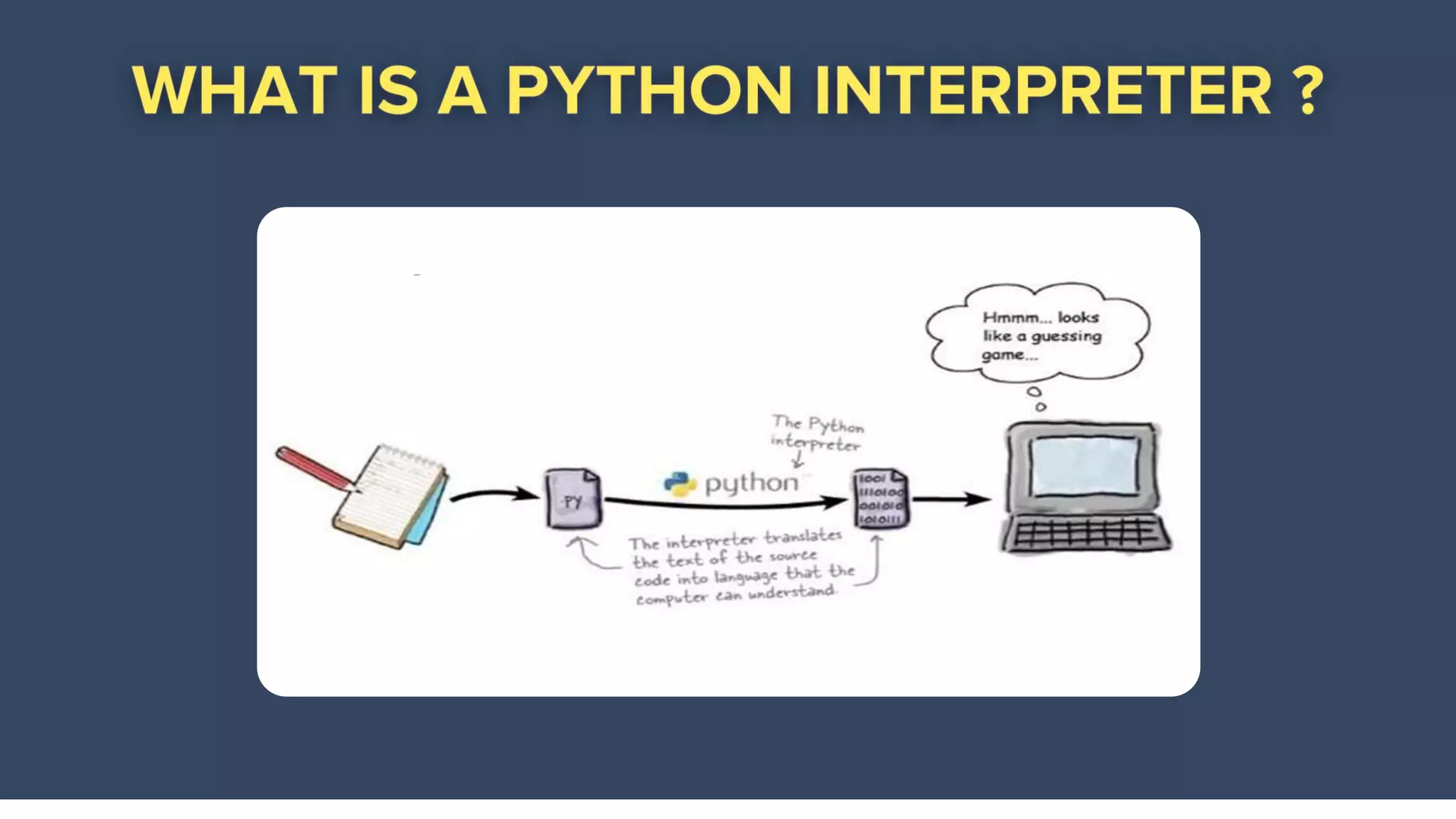
Portability: A property of a program that can run on more than one kind of computer. Interpret: To execute a program in a high-level language by translating it one line at a time. Compile: To translate a program written in a high-level language into a low-level language all at once, in preparation for later execution.
A program is a sequence of instructions that specifies how to perform a computation. Input: Get data from the keyboard, a file, or some other device. Output: Display data on the screen or send data to a file or other device. Process: 1.Math: Perform basic mathematical operations like addition and multiplication. 2.Conditional execution: Check for certain conditions andexecute the appropriate code. 3.Repetition: Perform some action repeatedly, usually with some variation.
HTTPS://REPO.ANACONDA.COM/ARCHIVE/
Num bers 1.int (signed integers): They are often called just integers or int, are positive or negative whole numbers with no decimal point. 2. long (long integers ): Also called long, they are integers of unlimited size, written like integers and followed by an uppercase or lowercaseL. 3. float (floating point real values): Also called floats, they represent real numbers and are written with a decimal point dividing the integer and fractional parts. Floats may also be in scientific notation, with Eor e indicating the power of 10 (2.5e2 = 2.5 x 102= 250). 4. complex (complex numbers): Are of the form a + bJ, where a and b are floats and J (or j) represents the square root of -1 (which is an imaginary number). The real part of the number is a, and the imaginary part is b.
1.Variables are reserved memory locations that are used to store values and are referenced by a name. Example: Assigning a contact number and referencing it by a contact name 2.Syntax to define a variable is asfollows: variableName = value Example: phoneNumber = 12345
Variable name should start with an alphabet orunderscore (‘_’) followed by any number of alphabets, digits andunderscores Variable names are case sensitive. Example: phoneNumber is different from PhoneNumber and phonenumber Variable name cannot be a reserved name Example: print, if, for, etc Variable name cannot contain any special character other thanunderscore
Int Float Boolean String
List , List comprehension Tuple Dictionary
Syntax error Semantic Error Runtime Error
While loop – syntax-while(condition): For loop – syntax – for i in range(0,n):
A collection of built-in modules, each providing different functionality beyond what is included in the corePython. import math math.sqrt(16) math.factorial(10) These are called as fruitful functions in python.
Functions are created to make calculations easy toreuse The general form of a function call is <<function_name>>(<<arguments>>) An argument is an expression that appears between the parenthesis of a function call. The number within parenthesis in the below function call is argument.
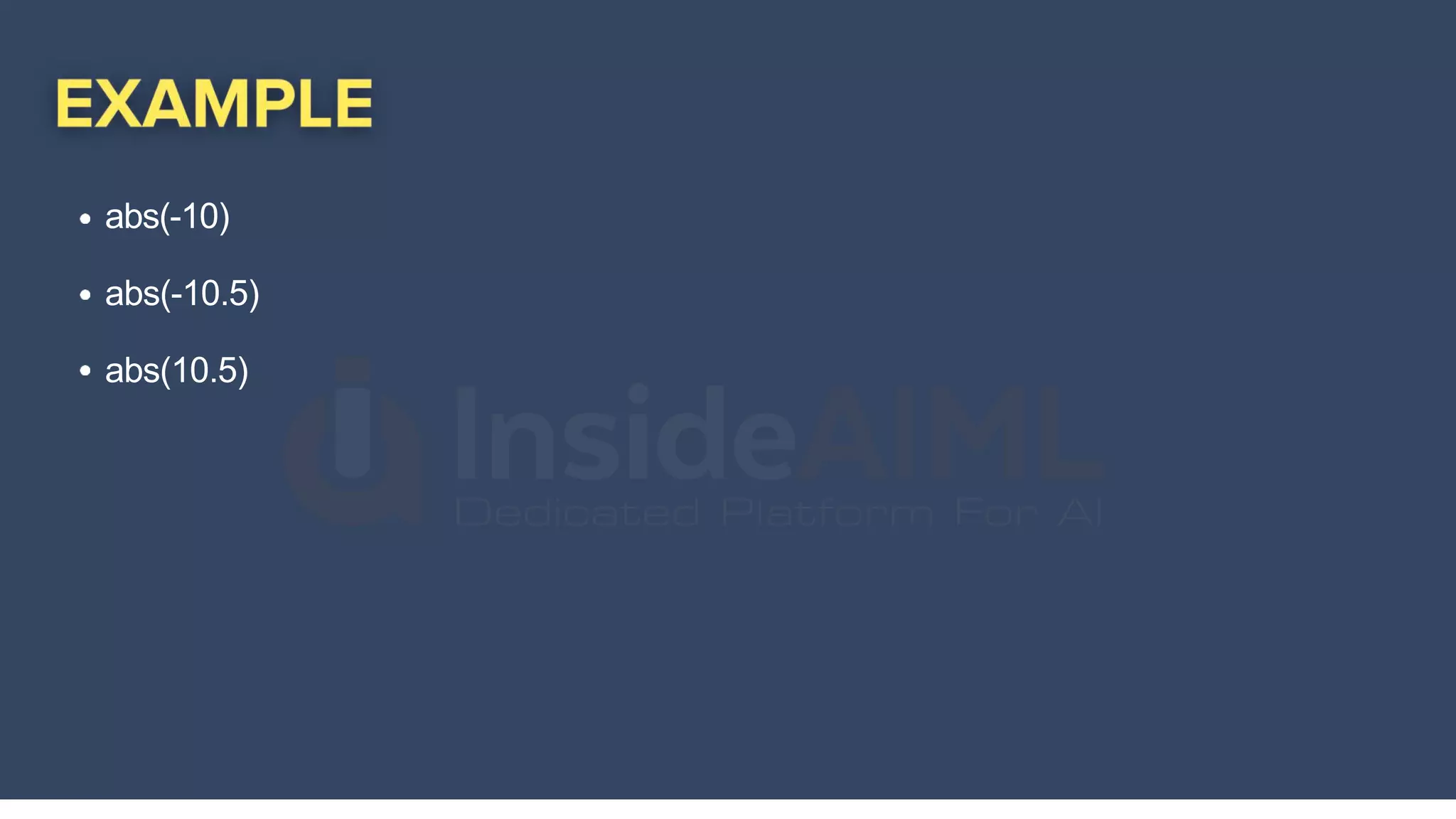
abs(-10) abs(-10.5) abs(10.5)
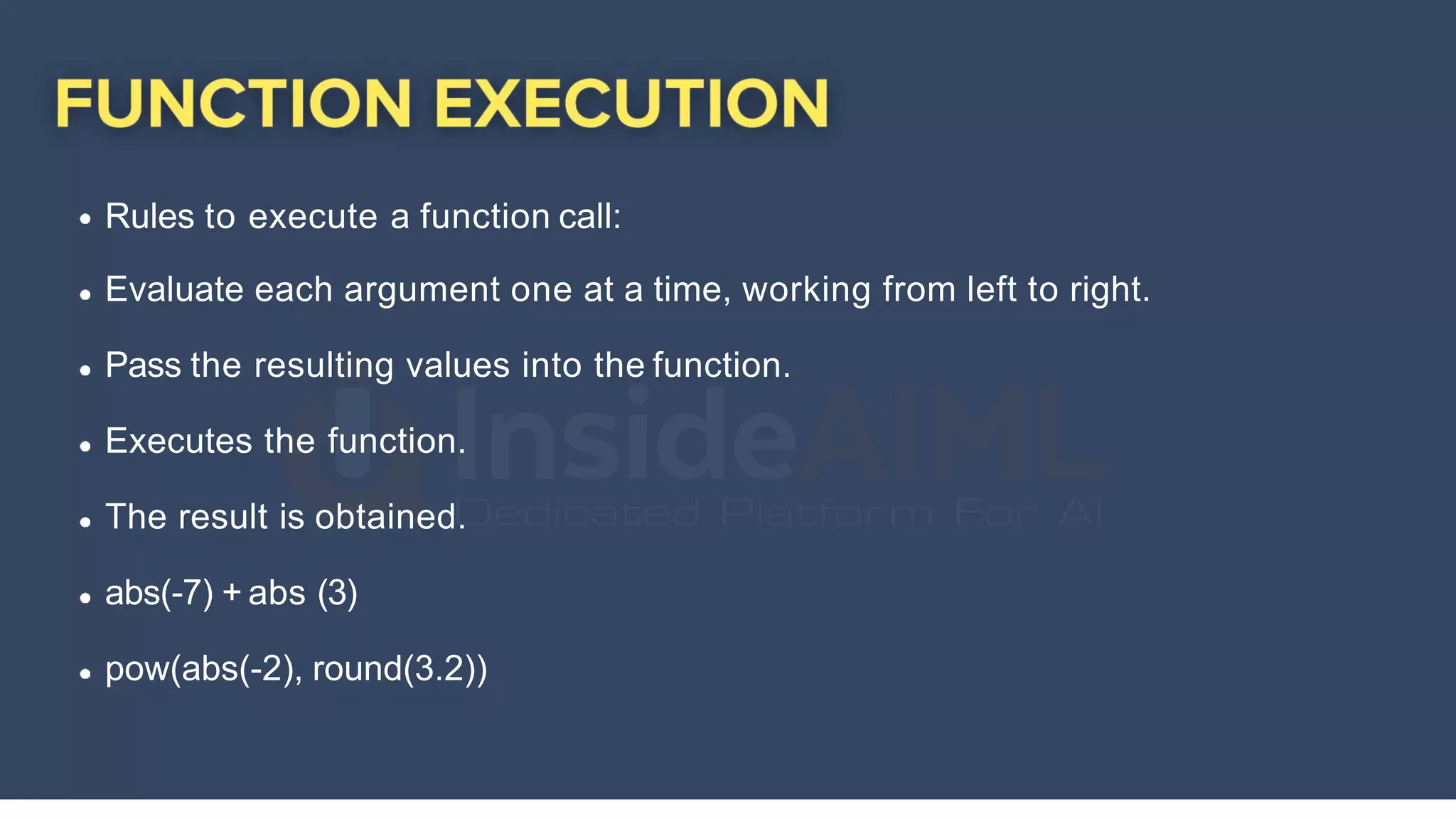
Rules to execute a function call: Evaluate each argument one at a time, working from left to right. Pass the resulting values into the function. Executes the function. The result is obtained. abs(-7) + abs (3) pow(abs(-2), round(3.2))
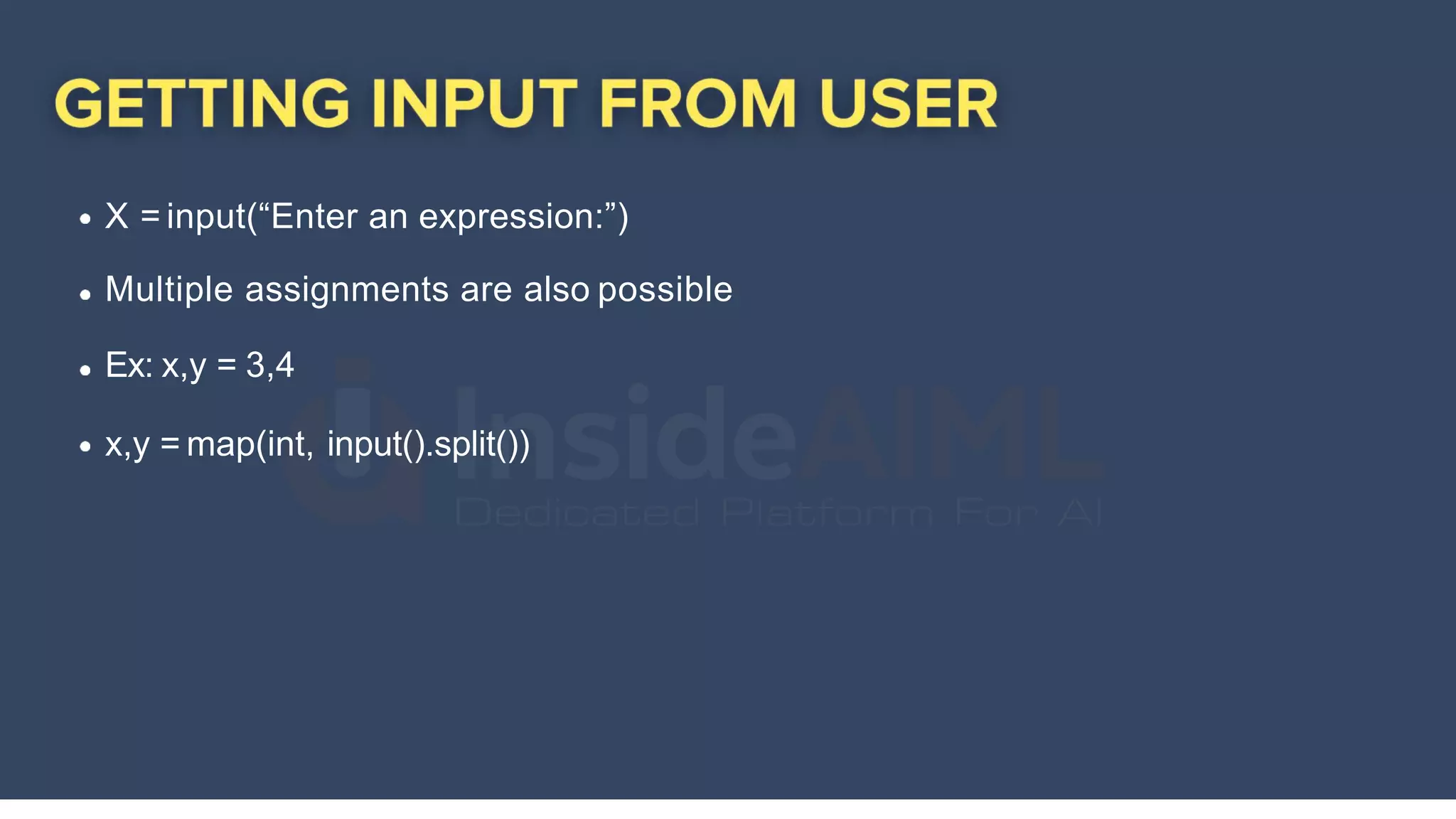
X = input(“Enter an expression:”) Multiple assignments are also possible Ex: x,y = 3,4 x,y = map(int, input().split())
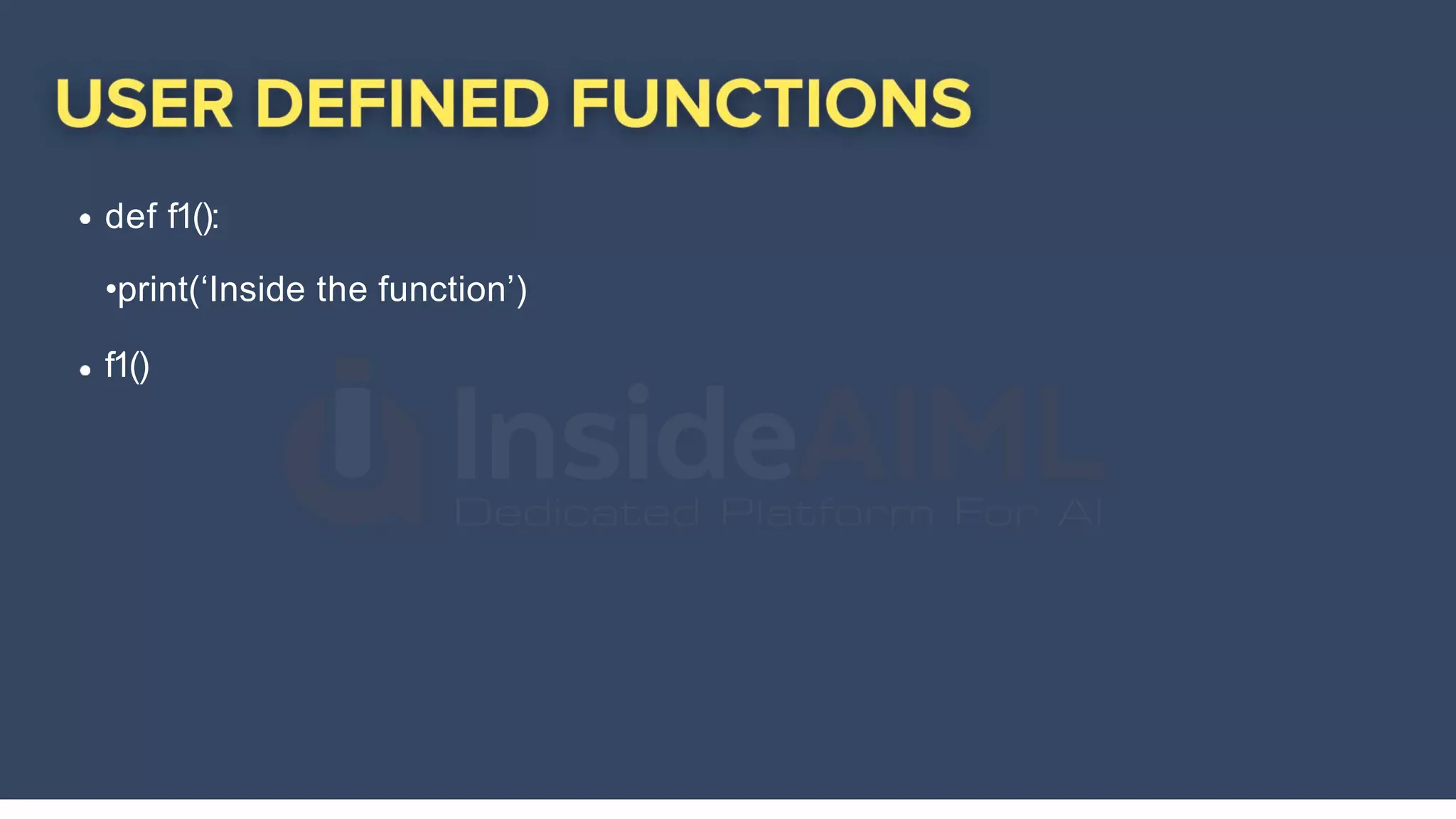
def f1(): •print(‘Inside the function’) f1()
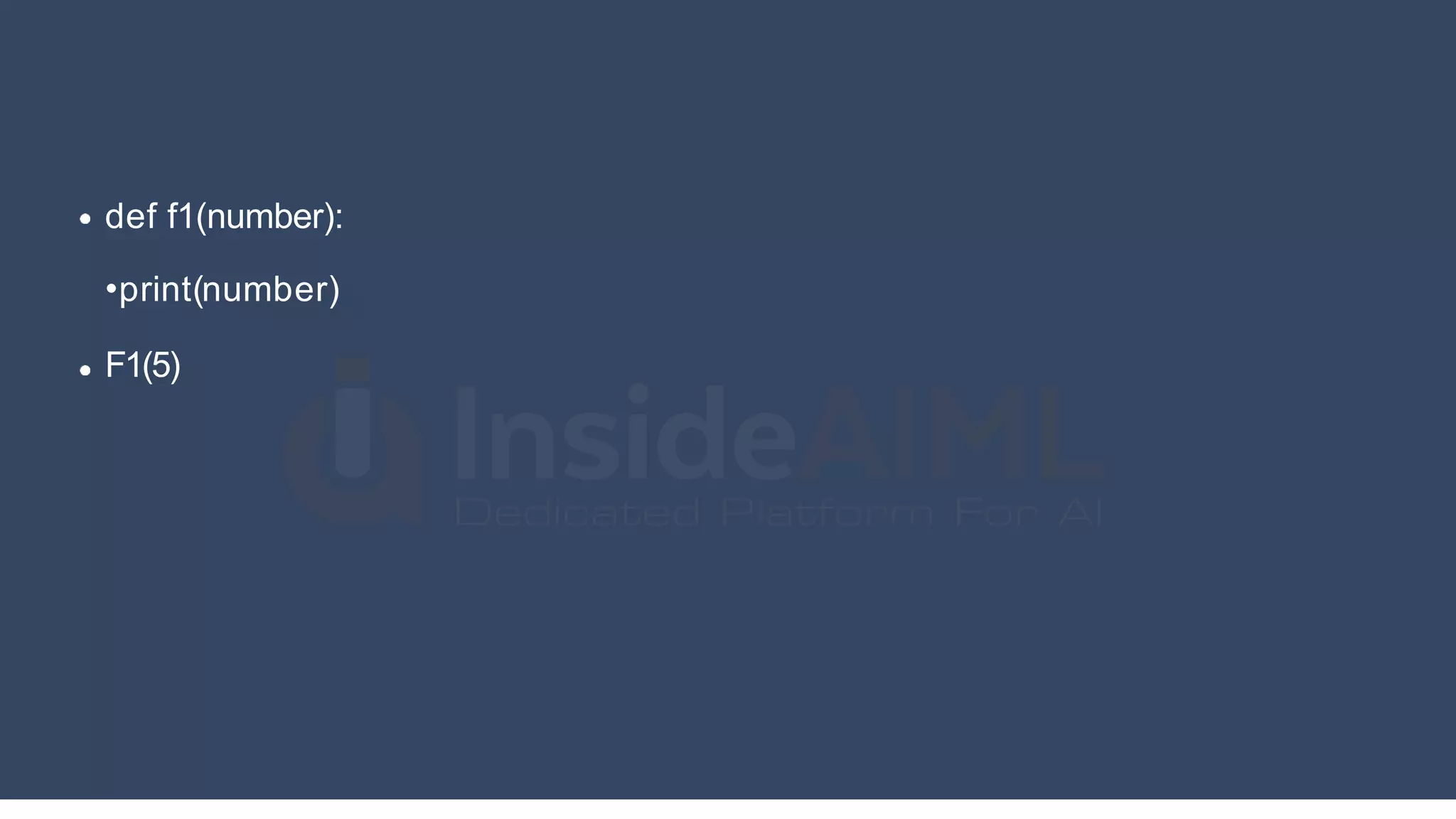
def f1(number): •print(number) F1(5)
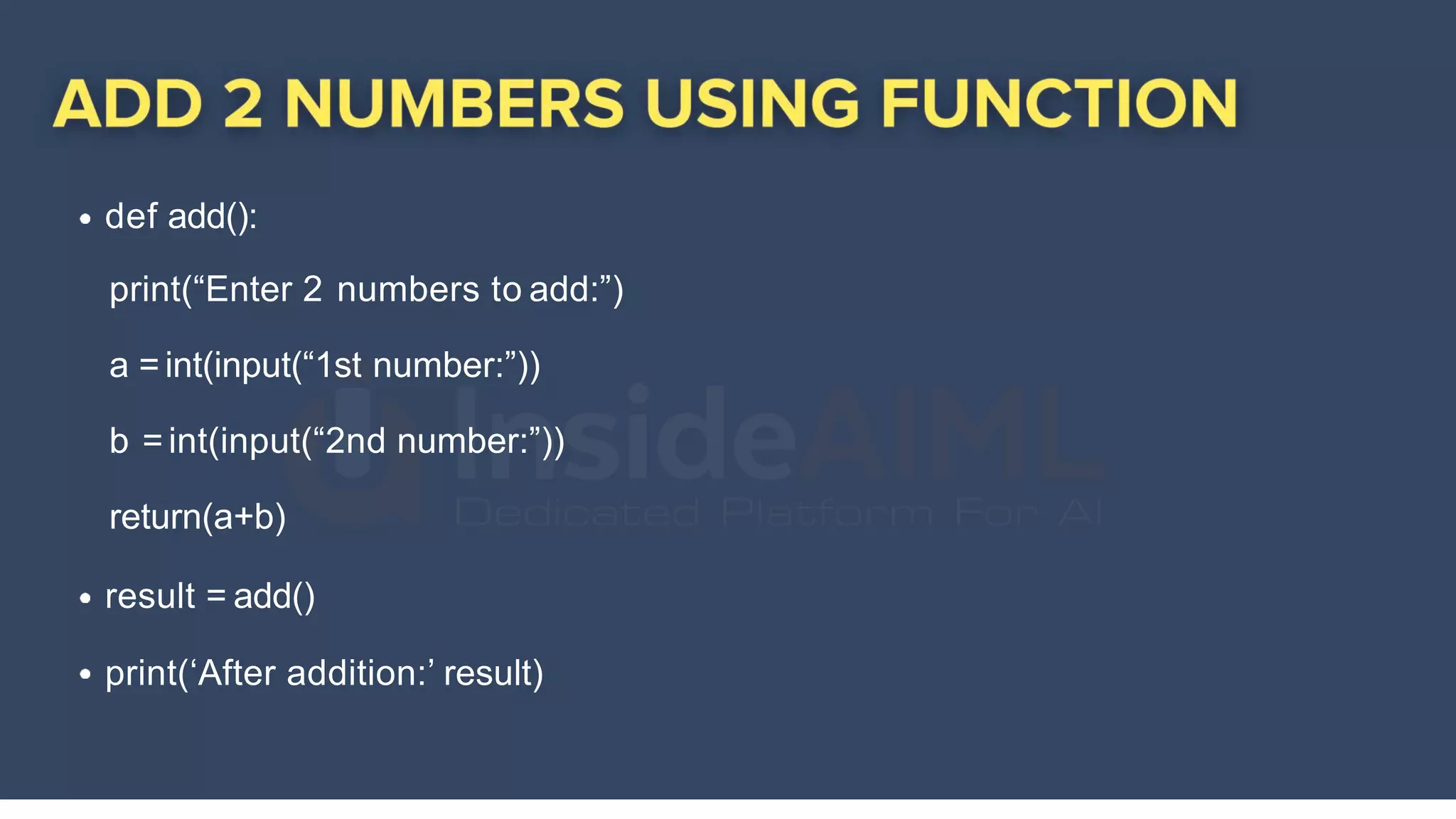
def add(): print(“Enter 2 numbers to add:”) a =int(input(“1st number:”)) b =int(input(“2nd number:”)) return(a+b) result = add() print(‘After addition:’ result)
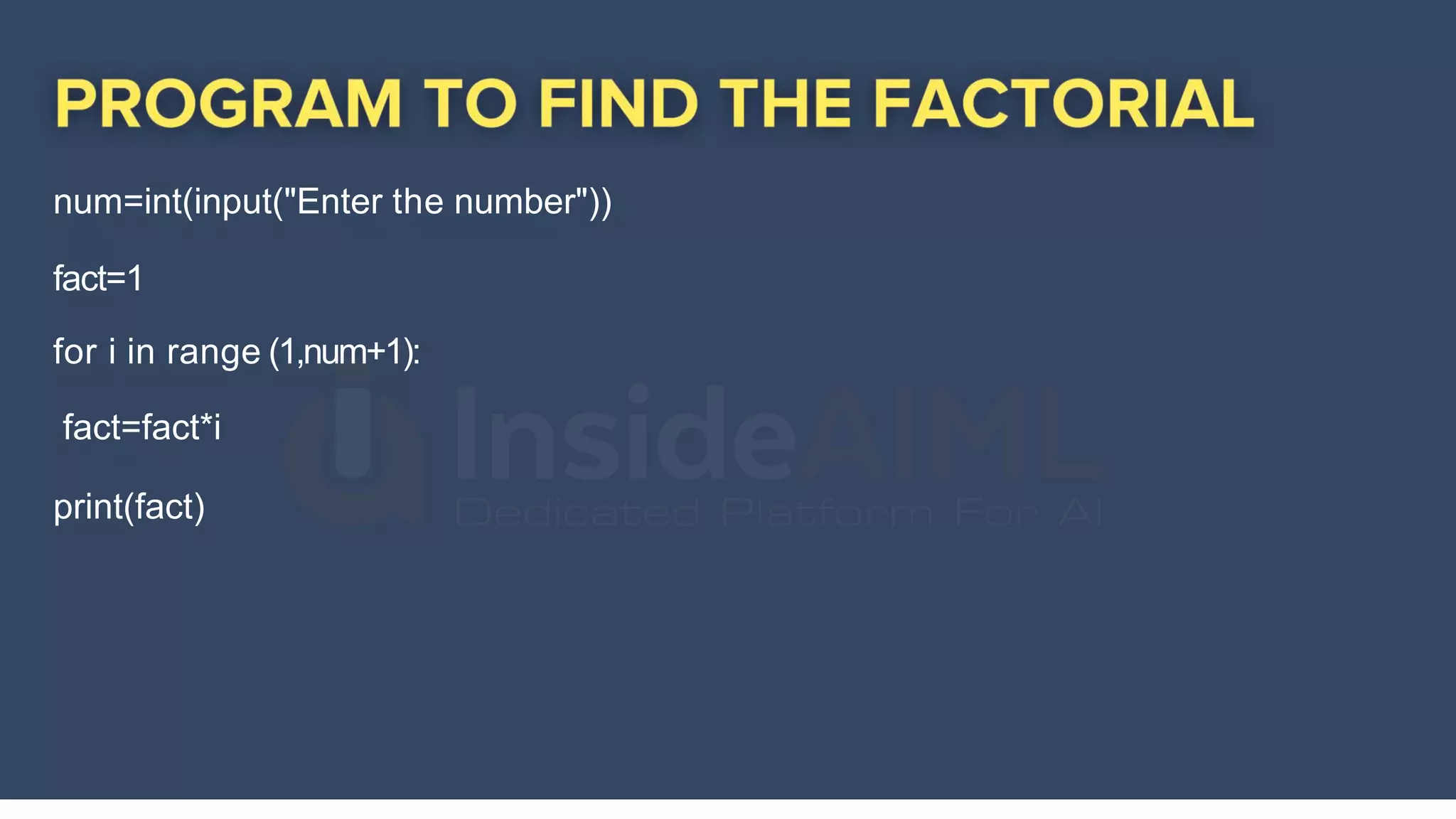
num=int(input("Enter the number")) fact=1 for i in range (1,num+1): fact=fact*i print(fact)
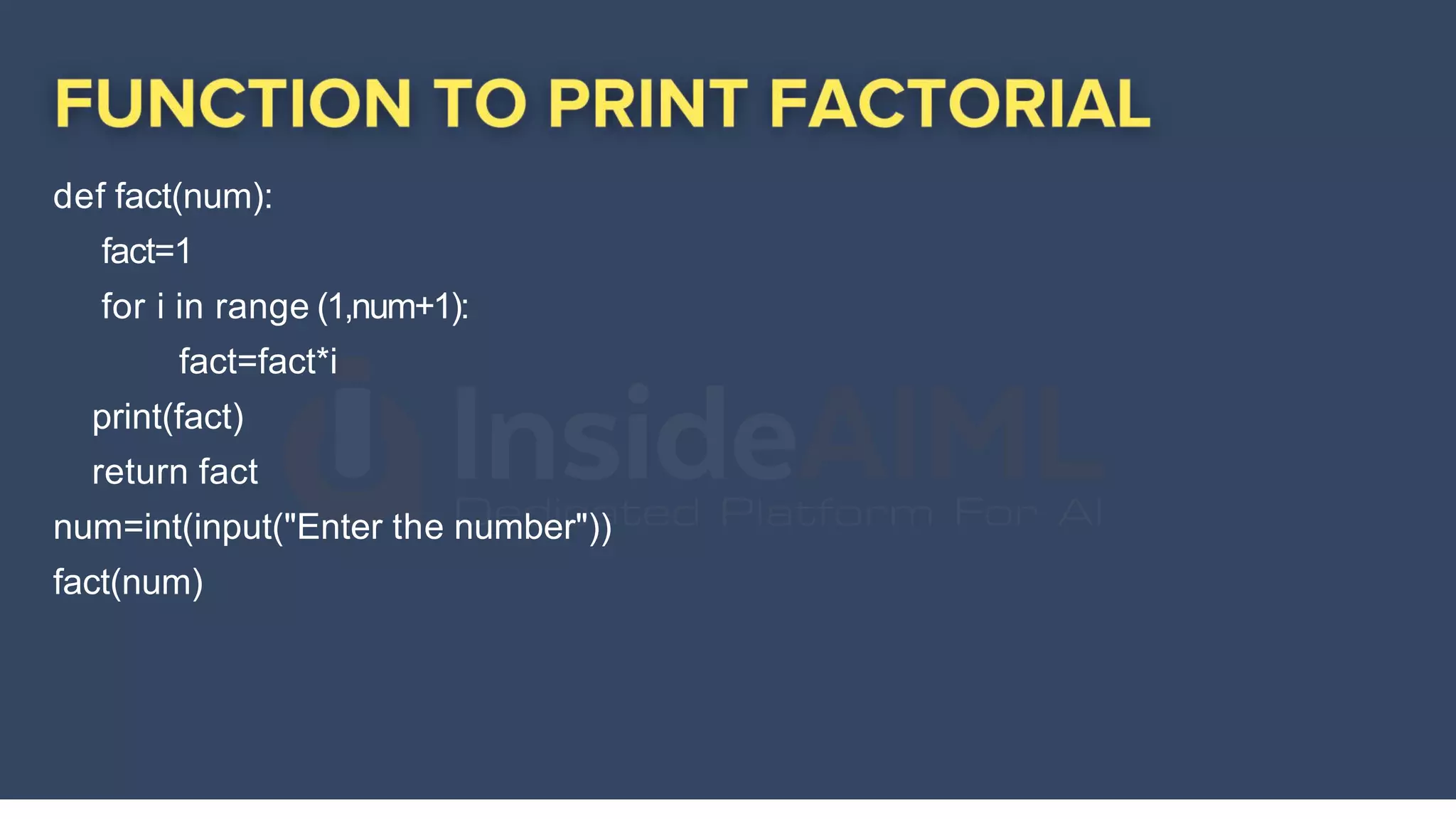
def fact(num): fact=1 for i in range (1,num+1): fact=fact*i print(fact) return fact num=int(input("Enter the number")) fact(num)
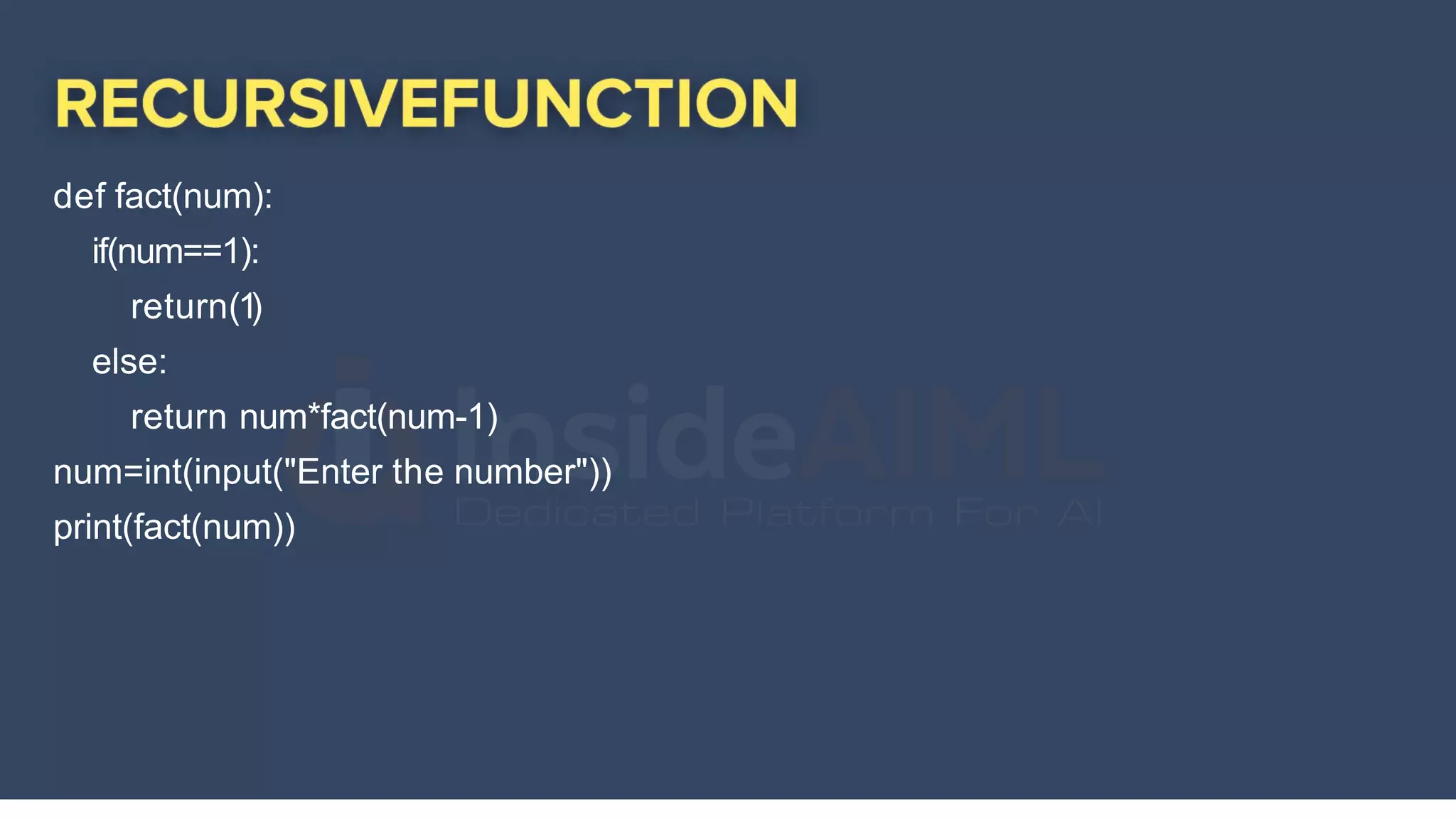
def fact(num): if(num==1): return(1 ) else: return num*fact(num-1) num=int(input("Enter the number")) print(fact(num))
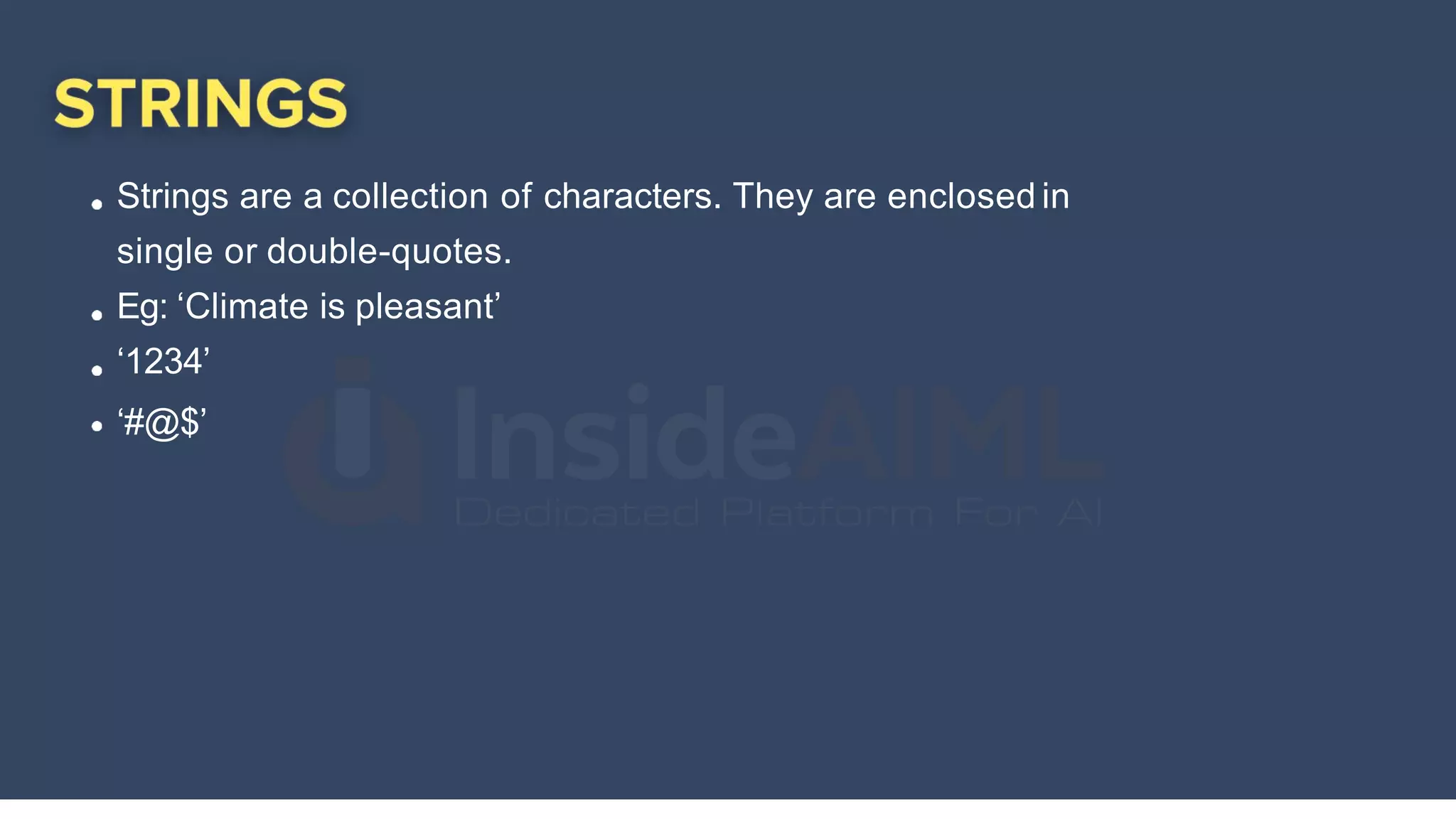
Strings are a collection of characters. They are enclosed in single or double-quotes. Eg: ‘Climate is pleasant’ ‘1234’ ‘#@$’
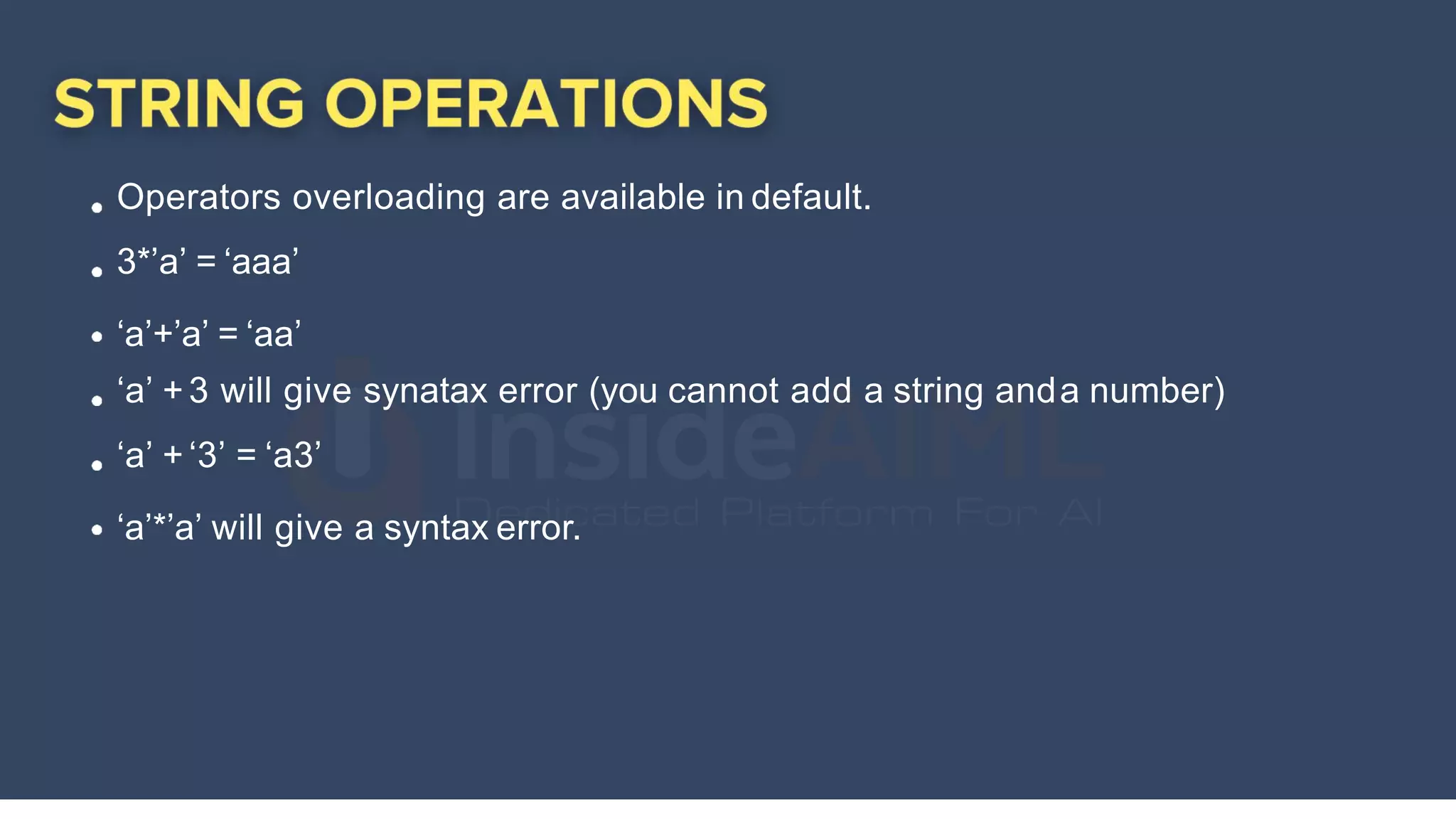
Operators overloading are available in default. 3*’a’ = ‘aaa’ ‘a’+’a’ = ‘aa’ ‘a’ +3 will give synatax error (you cannot add a string anda number) ‘a’ +‘3’ = ‘a3’ ‘a’*’a’ will give a syntax error.
Indexing is used to extract individual characters from astring Indexing in python starts from 0. S =‘welcome’ S[0] = ‘w’ S[1]=‘e’ ….
Slicing is taking subsets from a string. Lower limit is inclusive where as Upper limit isexclusive. S=‘welcome’ S[0:2] ?? S[0:] ?? S[:3] ?? S[:] ??? S[0:4]??
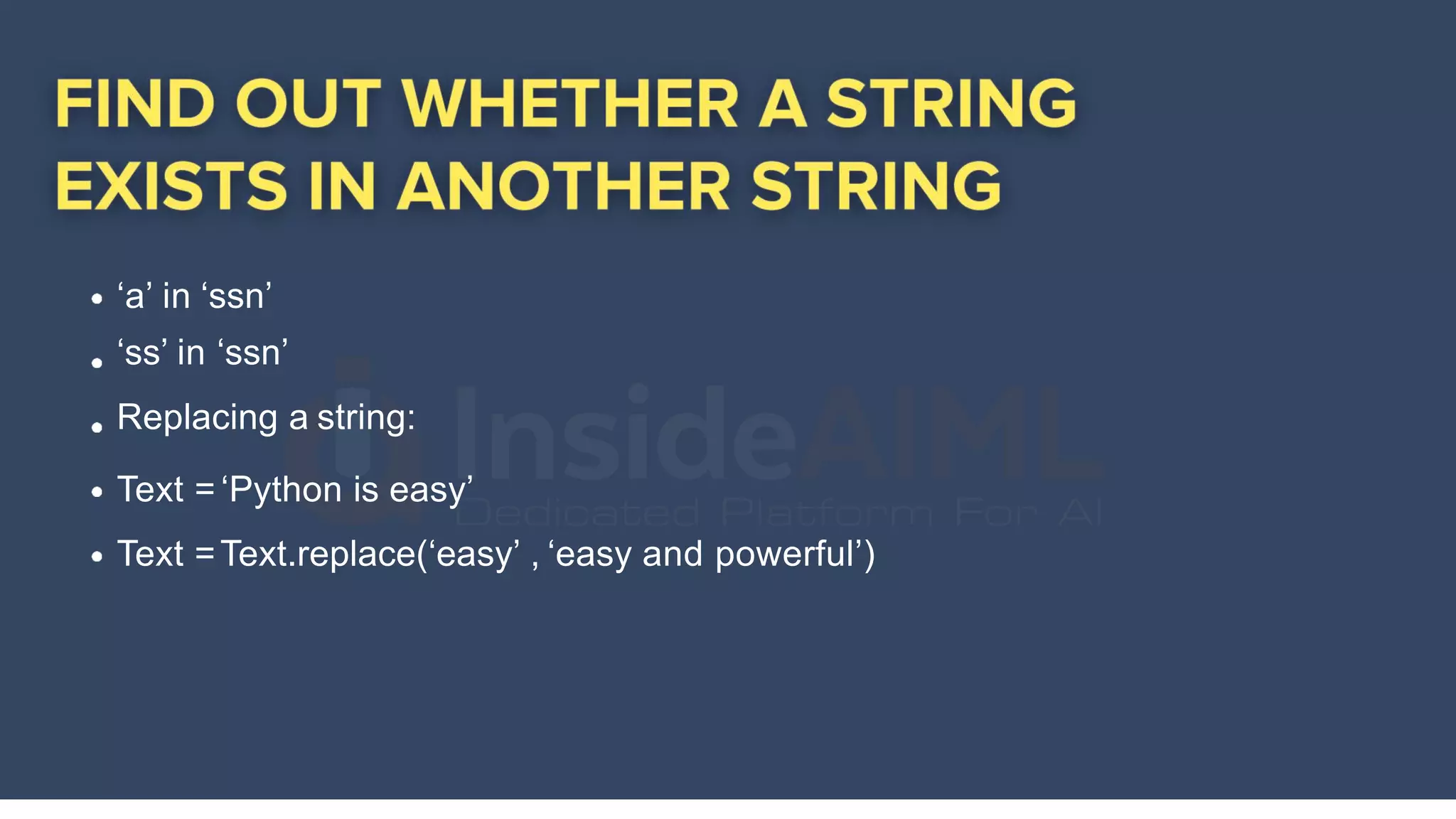
‘a’ in ‘ssn’ ‘ss’ in ‘ssn’ Replacing a string: Text =‘Python is easy’ Text =Text.replace(‘easy’ , ‘easy and powerful’)
Explore the other functions -Assignment
Write a python function to find the max of 3 numbers Check whether a number is palindrome using function Check whether a string is palindrome using function
Write a Python function that accepts a string and calculatethe number of upper case letters and lower case letters

Introduction to Python Programming

  • 1.
  • 2.
  • 3.
    Search algorithms Log analysis GoogleData Python Client Library Google APIs Client Library for Python Google AdWords API Python Client Library Machine Learning Robotics projects
  • 5.
    NAME IS BASEDON A BBC COMEDY SERIES FROM THE 1970S Monty Python's Flying Circus Guido van Ro s s u m December 1989
  • 6.
    Python is usedacross domains such as: Scripting Testing Web Development IoT Programming Data Science
  • 7.
    Programming is error-prone! Programmingerrors are called bugs The process of tracking them down is called debugging
  • 8.
    Easy-to-learn: Python has fewkeywords, a simple structure, and a clearly defined syntax. Easy-to-read: Python code is more clearly defined and visible to the eyes. Easy-to-maintain: Python's source code is fairly easy to maintain. A broad standard library: Python's bulk of the library is very portable and cross-platform compatible on UNIX, Windows, and Macintosh. Interactive Mode: Python has support for an interactive mode that allows interactive testing and debugging of snippets of code. Portable: Python can run on a wide variety of hardware platforms and has the same interface on all platforms.
  • 9.
    Extendable: You can addlow-level modules to the Python interpreter. These modules enable programmers to add to or customize their tools to be more efficient. Databases: Python provides interfaces to all major commercial databases. GUI Programming: Python supports GUI applications that can be created and ported to many system calls, libraries, and windows systems, such as Windows MFC, Macintosh, and the X Window system of Unix. Scalable: Python provides a better structure and support for large programs than shell scripting.
  • 10.
    Portability: A property ofa program that can run on more than one kind of computer. Interpret: To execute a program in a high-level language by translating it one line at a time. Compile: To translate a program written in a high-level language into a low-level language all at once, in preparation for later execution.
  • 13.
    A program isa sequence of instructions that specifies how to perform a computation. Input: Get data from the keyboard, a file, or some other device. Output: Display data on the screen or send data to a file or other device. Process: 1.Math: Perform basic mathematical operations like addition and multiplication. 2.Conditional execution: Check for certain conditions andexecute the appropriate code. 3.Repetition: Perform some action repeatedly, usually with some variation.
  • 16.
  • 17.
    Num bers 1.int (signedintegers): They are often called just integers or int, are positive or negative whole numbers with no decimal point. 2. long (long integers ): Also called long, they are integers of unlimited size, written like integers and followed by an uppercase or lowercaseL. 3. float (floating point real values): Also called floats, they represent real numbers and are written with a decimal point dividing the integer and fractional parts. Floats may also be in scientific notation, with Eor e indicating the power of 10 (2.5e2 = 2.5 x 102= 250). 4. complex (complex numbers): Are of the form a + bJ, where a and b are floats and J (or j) represents the square root of -1 (which is an imaginary number). The real part of the number is a, and the imaginary part is b.
  • 18.
    1.Variables are reservedmemory locations that are used to store values and are referenced by a name. Example: Assigning a contact number and referencing it by a contact name 2.Syntax to define a variable is asfollows: variableName = value Example: phoneNumber = 12345
  • 19.
    Variable name shouldstart with an alphabet orunderscore (‘_’) followed by any number of alphabets, digits andunderscores Variable names are case sensitive. Example: phoneNumber is different from PhoneNumber and phonenumber Variable name cannot be a reserved name Example: print, if, for, etc Variable name cannot contain any special character other thanunderscore
  • 20.
  • 21.
    List , Listcomprehension Tuple Dictionary
  • 22.
  • 23.
    While loop –syntax-while(condition): For loop – syntax – for i in range(0,n):
  • 24.
    A collection ofbuilt-in modules, each providing different functionality beyond what is included in the corePython. import math math.sqrt(16) math.factorial(10) These are called as fruitful functions in python.
  • 25.
    Functions are createdto make calculations easy toreuse The general form of a function call is <<function_name>>(<<arguments>>) An argument is an expression that appears between the parenthesis of a function call. The number within parenthesis in the below function call is argument.
  • 26.
  • 27.
    Rules to executea function call: Evaluate each argument one at a time, working from left to right. Pass the resulting values into the function. Executes the function. The result is obtained. abs(-7) + abs (3) pow(abs(-2), round(3.2))
  • 28.
    X = input(“Enteran expression:”) Multiple assignments are also possible Ex: x,y = 3,4 x,y = map(int, input().split())
  • 29.
  • 30.
  • 31.
    def add(): print(“Enter 2numbers to add:”) a =int(input(“1st number:”)) b =int(input(“2nd number:”)) return(a+b) result = add() print(‘After addition:’ result)
  • 32.
    num=int(input("Enter the number")) fact=1 fori in range (1,num+1): fact=fact*i print(fact)
  • 33.
    def fact(num): fact=1 for iin range (1,num+1): fact=fact*i print(fact) return fact num=int(input("Enter the number")) fact(num)
  • 34.
  • 35.
    Strings are acollection of characters. They are enclosed in single or double-quotes. Eg: ‘Climate is pleasant’ ‘1234’ ‘#@$’
  • 36.
    Operators overloading areavailable in default. 3*’a’ = ‘aaa’ ‘a’+’a’ = ‘aa’ ‘a’ +3 will give synatax error (you cannot add a string anda number) ‘a’ +‘3’ = ‘a3’ ‘a’*’a’ will give a syntax error.
  • 37.
    Indexing is usedto extract individual characters from astring Indexing in python starts from 0. S =‘welcome’ S[0] = ‘w’ S[1]=‘e’ ….
  • 38.
    Slicing is takingsubsets from a string. Lower limit is inclusive where as Upper limit isexclusive. S=‘welcome’ S[0:2] ?? S[0:] ?? S[:3] ?? S[:] ??? S[0:4]??
  • 39.
    ‘a’ in ‘ssn’ ‘ss’in ‘ssn’ Replacing a string: Text =‘Python is easy’ Text =Text.replace(‘easy’ , ‘easy and powerful’)
  • 40.
    Explore the otherfunctions -Assignment
  • 41.
    Write a pythonfunction to find the max of 3 numbers Check whether a number is palindrome using function Check whether a string is palindrome using function
  • 42.
    Write a Pythonfunction that accepts a string and calculatethe number of upper case letters and lower case letters