The document outlines key public policy issues in Kenya, emphasizing priorities such as equity in health and education, economic competitiveness, and infrastructure expansion. It details the policy process, including problem definition, evaluation criteria, policy alternatives, and implementation strategies, highlighting the importance of stakeholder engagement and risk management. The text also acknowledges that real-world policy-making is often messier than theoretical models suggest, with decisions impacted by various organizational and political dynamics.
Kenya’s key publicpolicy issues • In a recent World Bank Study (2013) entitled Achieving Shared Prosperity for All, nine priorities are outlined for the new Kenyan government under three main categories: • Realising the potential of every Kenyan • Achieving equity: Establishing a more equitable distribution for example, in health and education. • Improving quality: This entails, for example, in education improving learning attainment by reducing teacher absenteeism and increasing teaching hours in the classroom. • Mitigating vulnerability, for example, improving the management and use of water resources to expand irrigation, and establish a unified and scalable social protection programme, to help respond to disaster. 2
3.
Kenya’s key publicpolicy issues • Creating a competitive economy • Maintaining stability and consistency: maintaining macroeconomic and political stability will be fundamental. • Expanding infrastructure: the new government will need to maintain investments in key sectors such as energy and roads. Structural change, including the port of Mombasa and rail services will be a key determinant of the future quality of Kenya’s infrastructure. • Reforming agriculture: A turnaround in agriculture is vital, especially in the maize sector. 3
4.
Completing institutional transformation •Making devolution accountable: The functioning of the new counties will determine the quality of service delivery in the next few years. • Implementing judicial reform: there is a need to improve access to courts and establish an automated system for reducing backlog, delays and opportunities for corruption. • Managing the people’s money well: Public finances should be well managed. 4
5.
The Policy process-Step1- The problem • How the problem is defined will influence the policy alternatives considered. • A certain level of specificity will likely lead to better results. • If the problem is, for example, defined as high unemployment, a broad array of policy options could be offered as a solution. • The danger of this approach is that overly ambitious plans often end up as no more than lofty and unfulfilled goals. 5
6.
Step 1: Theproblem • A broad problem definition can lead to interventions that really do not fit the problem. • An example is the problem of youth unemployment in Kenya which is a common problem in many states. 6
7.
Step 1: Theproblem • Collecting good information and determining who is most affected by the problem is key to effectively framing the issue. • Examples of information or data that needs to be collected include: • Who is affected by this problem? • Is the problem growing? • What is currently being done to address the problem? • Is it working? • Analyse these questions in the context of youth unemployment in Kenya. 7
8.
Step 1: Goodsources of data about the problem • Good sources of information include government statistics, reports from universities, policy organisations, or business associations, recent media coverage, and interviews with experts and others. • The data collected does not need to be exhaustive but it should reflect a solid understanding of the issue. 8
9.
Step 1: Keepre-defining the problem • As you collect information and work through the policy process, the problem definition can be changed or refined. • Keep coming back to this definition and make certain that it reflects the growing understanding of the problem. 9
10.
Is the problempart of a larger problem? • What part of your problem is appropriate for your level of government or department to solve? • Many social and economic problems are multi-faceted and affect a number of different sectors, regions, or groups of people. • In defining the problem, it is important to identify the part of the problem that could be effectively addressed by your organisation or level of government. • The more specific you are in the definition of the problem, the more likely it is that your policy will have a meaningful impact. 10
11.
Who is concernedabout the problem? • Many public problems affect a number of persons in a variety of different ways. • Rarely are there solutions or resources to satisfy all stakeholders or interested parties. • For example, citizens have an interest in cleaner air and water, while industry is likely to oppose efforts to restrict or tax their pollution output. • Policymakers need to find a balance that protects citizens yet does not squeeze industry to the point that its net revenues decline, workers are laid off, or factories move to regions with more liberal policies. 11
12.
Who is concernedabout the problem? • Understanding who is affected by the problem or any proposed policy change is a critical part of defining the problem. • This is because a problem can have many dimensions that can only be fully understood from the perspective of different stakeholders. • Important questions are: • Will be a proposed solution hurt the vested interests of some groups? • Will the solution change the behaviour (positively or negatively) of some other group? • Stakeholder analysis helps to identify the interests and influences of all stakeholders and develop a strategy of how to productively engage the various stakeholders in implementing a proposed solution? 12
13.
Establish the evaluationcriteria • Evaluation criteria help to clarify the programme’s goals and objectives and are the basis on which proposed solutions will be judged. • Criteria are often established by the major decisionmakers and may be explicit or implicit. • The key criteria are include: Efficiency; Cost; Political acceptability; Net benefit; Equity; Uncertainty; Administrative ease; Legal issues. 13
14.
Evaluation criteria • Cost:What is the cost of the programme to taxpayers? For example, the cost of implementing the programme in terms of staff, equipment, operating expenses, benefits paid, and so on. • Net benefit: What is the net benefit from the point of the beneficiary? Participants should receive some benefit, but how do these relate to the costs involved? 14
15.
Evaluation criteria • Efficiency:What is the programme’s efficiency? Is it the least costly way to produce the desired good or service? • Equity: Many social programmes redistribute money from taxpayers to the unemployed or poor with the goal of creating more equity. Another important equity consideration is the distribution of benefits among programme participants and between programme participants and other poor families. 15
16.
Evaluation criteria • Administrativeease: How easily can the solutions be implemented? Will the solution require a new structure, staff, or other resources? • Legal issues: Does the proposed solution require a new law or approval from other government departments or levels of governments? Does your client or agency have the legal authority to implement the proposed solution? 16
17.
Evaluation criteria • Politicalacceptability: Will the proposed solution be acceptable to political leaders or be popular among general citizens? • Extent of uncertainty: How much uncertainty is there in implementing the policy (especially if it is a new programme)? 17
18.
Step 3: Identifyalternative policies • Often there is a limited number of truly applicable policy options. • However, in developing a short-list of potential solutions, it is worth considering the full range of options. • Brainstorming, talking to experts, and consulting other agencies or regions that may have faced similar problems are good ways to generate policy ideas. 18
19.
Identify alternative policies •Different policy options will often tackle different aspects of the problem. • As one works through the policy options it may be worthwhile revisiting the definition of the problem. • Sometimes the final policy will actually be a combination of approaches. 19
20.
Identify alternative policies •Governments have a number of different ways that they can accomplish their goals. • The most obvious is to provide the particular goods and services. • Other interventions use the market to achieve policy goals by providing private sector players with certain incentives, such as subsidizing real estate development to foster the creation of new housing or commercial space. 20
21.
Identify alternative policies •Governments can use their “police authority,” for example, to pass laws to prohibit the sale of drugs or to require the use of seat belts. • And governments or community groups can use moral persuasion to achieve objectives, such as mounting campaigns to educate the public about the dangers of smoking or inform the public about an upcoming election. 21
22.
Types of policyactions • The main public policy options in terms of the level of intervention and resources required are as follows: • Direct/monetary: Direct government action using public funds to provide police force and protection or to purchase utility services from a private contractor. • Direct/nonmonetary: Direct government action that does not require direct budget outlays (though enforcing laws and regulations do have real costs) such as prohibiting driving under the influence of alcohol or requiring licenses for emitting pollutants. 22
23.
Types of policyactions • Indirect/monetary: The use of government funds to encourage others to act in a specific manner by, for example, taxing corporate profits or subsidizing hospitals to provide health care. • Indirect/nonmonetary: The use of information to encourage others to act in a specific manner by, for example, informing small business owners about services tailored to their needs, or by using a public relations campaign to encourage citizens not to litter. 23
24.
Types of policyactions • Not all problems lend themselves to all of these approaches. • For example, a new tax would not be introduced simply to fund an after-school programme for youth, nor would it be appropriate to merely implore citizens not to murder one another. • However, in addressing a policy problem it is a good exercise to consider these various types of policy actions. Too often policy makers or analysts become accustomed to approaching all problems with the same basic tool such as always providing new services. 24
25.
Evaluate and comparethe options • After generating as many policy ideas as possible, it is necessary to narrow the options to a few key strategies based on evaluation criteria. • It is always good to include ‘do nothing’ option. Sometimes the options are likely to be so ineffective, and resources or stakeholder interest is so limited that doing nothing (at least for the time being is the best option). 25
26.
Evaluate and comparethe options • Draw up possible policy scenarios, including impact on stakeholders. • Once the main policy options have been selected, the next step is to distinguish among the options based on the evaluation criteria established for this particular policy problem. • It is important to note any important constraints. Constraints are generally related to the weighing of criteria. If, for example, budget constraints are very severe, then the programme cost will be a critical factor. 26
27.
Evaluate and comparethe options • The involvement of different actors (participants, various parts of government, NGOs, private firms, interest groups) may also be discussed in the evaluation criteria as a constraint of an opportunity. • A table or matrix is an effective way to compare the alternative policies. • The options may perform differently on many of the criteria. This is true with many policy problems and rarely does a solution satisfy all the evaluation criteria. 27
28.
Evaluate and comparethe options • Evaluating the alternatives is the core of the analysis. • After constructing such a table, most analysts write a narrative that describes how the options compare, highlights the most important criteria, and explains any conclusions that might be drawn. • The analysis should be well structured and as objective as possible. • A policy maker should be able to see how each option measures against the relevant criteria. The policy maker may question the analyst on some of the assumptions made in the analysis. For example, costs may assume too high an interest rate. 28
29.
Select the preferredoption • This is the time for a reality check. Although a certain option may look good on paper, it may not be feasible given the present constraints (such as limited time, budget, political will and so on). • A technically superior alternative may not be a politically viable one. • Don’t rush to the preferred option before considering the alternatives. • Check the preferred option with the stakeholders. 29
30.
Select the preferredoption • Policy recommendations must be justified. • A strong analysis will likely point toward a particular policy recommendation, but is important that a policy recommendation be accompanied by a clear justification. • The justification can be a conclusion of sorts. 30
31.
Implementation, monitoring andevaluation • Implementation plan as important as policy choice • Monitoring the short term, evaluation the long term • Data sources and procedures for monitoring and evaluation to be established at the beginning 31
Implementation during policydevelopment • Was implementation planned when the policy was worked out? • Do the priorities of this policy coincide with others? • Are proposed commitments checked for delivery implications? 33
34.
Implementation during policydevelopment • Is the timeframe consistent with resources available? • Are contingency measures planned? • Are there uncertainties that will affect implementation? • Are record keeping and accountability in place? 34
35.
Governance • Is asingle officer accountable for delivery, and do they have authority? • Are governance arrangements built in? • Does the policy have high-level support? • Clarity of purpose and relationships? 35
36.
Governance • Are whole-of-governmentimplications worked out? • Do governance arrangements include reporting and review? • Has sufficient attention been given to conflicts of interest? 36
37.
Risk management • Haveimplementation risks been identified and minimised? • Does the responsible officer have access to risk management resources? • Is the government aware of the risks? • Are risks appropriately shared? 37
38.
Risk management • Arerisk treatments followed through systematically? • Are there contingency plans? • Will implementation problems be identified and reported? • When mistakes occur will they be admitted and corrected? 38
39.
Planning for implementation •Implementation plan? • Is implementation owned by senior staff? • Has implementation been tested? • Does planning cover organisational change, procurement? • Is third party action in the plan? • Is there a single plan? 39
40.
Planning for implementation •Are timelines realistic? • Is implementation broken into small steps? • Adequate review points in the plan? • Is managing change part of the plan? 40
41.
Procurement and contractmanagement • Are procurement and contracts built into the plan? • Is the procurement strategy right for long- term service delivery? • Does the supply industry understand the requirements? • Will the responsible officer have access to contract management skills? 41
42.
Procurement and contractmanagement • Does evaluation measure long-term value for money or just short-term price? • Have ethical and probity issues been taken into account? • Are risks shared correctly in the contract? • Is there long-term contract management? 42
43.
Stakeholder management • Isthe purpose of stakeholder engagement clear? • Have the right stakeholders been engaged? • How will stakeholder engagement be managed during implementation? • How will the contribution of stakeholders be used? 43
44.
Stakeholder management • Willengagement with stakeholders inform the communication strategy? • Are there plans to manage conflicts of interest that arise from stakeholder involvement? 44
45.
Resources • Implementation skillsavailable and valued? • Adequate resources for implementation? • Adequate attention to cultural and change management issues? • Adequate measures for estimating, monitoring and controlling spending? • Are information systems adequate for implementation? 45
46.
Communication • Has communicationbeen considered, including obstacles? • Is communication strategy structured around the success criteria of the policy? • Does the comms. strategy address proactive and reactive elements? 46
47.
Communication • Is theimplementation clear about the comms. strategy? • Are communications targeted to each stakeholder group? • Is communication lined up with roll-out plan? • Is there an overall communication strategy? 47
48.
Monitoring and review •Is there monitoring and review of key deliverables? • Are data sufficient? • Are implementation reports submitted? • Are risks reported to senior management? • Are lessons learned before moving on to the next stage? 48
49.
Monitoring and review •Is there willingness to intervene, or stop the policy if it is not delivering? • Have reporting requirements of all parties been agreed? • Is the lead agency’s role supported by other partners? • Is there feedback to learn from implementation? 49
50.
Alternative models The policyprocess in the real world can be much messier than suggested by the rational model: • solutions may precede problem definition • important players may have reasons for their solution that have nothing to do with the declared policy outcomes • some outside agency (a Ministry of Finance, a donor agency) may impose a policy process (likely to be less successful. • no single programme or policy can solve the problem without reference to one or more other agencies.
51.
The ‘garbage can’ •Organisations discover their preferences through actions, rather than acting on the basis of preferences. This is counter to the view that organisations have preferences that are essentially the aggregation of individual preferences. • Organisations operate through trial and error rather than deliberative action. • The people making decisions and the audiences for decisions change while the processes of decision-making occur – people move jobs, get posted to other work or the personnel in the decision team simply gets changed. • Decisions are sometimes made when the goals are unknown to the participants. • Decision makers have limited time to spend on making decisions.
52.
Policy making inthe garbage can • problem resolution is not the most likely outcome of decision making • specialised access structure and unsegmented decision structures produce quick decisions
53.
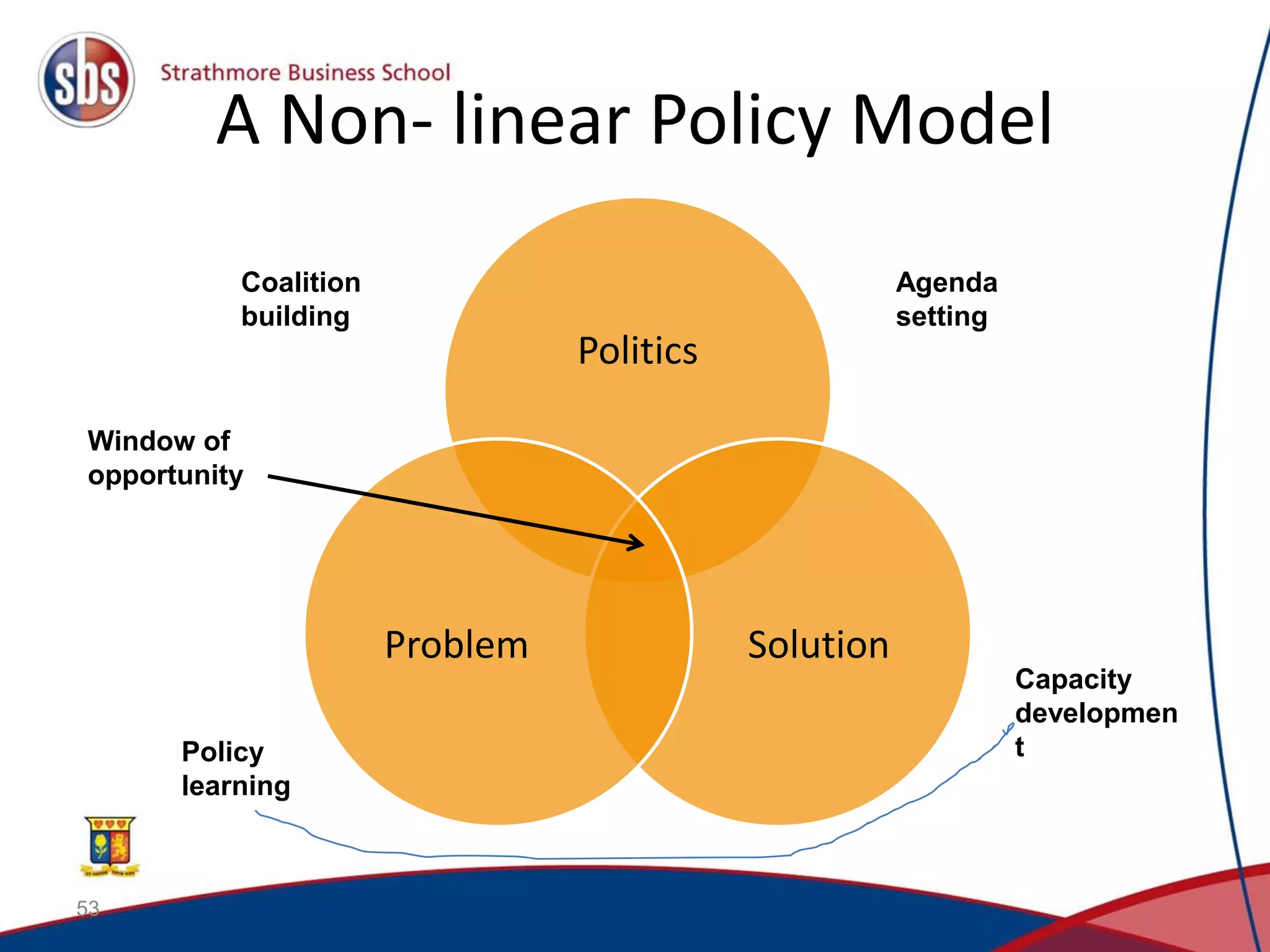
A Non- linearPolicy Model 53 Politics SolutionProblem Coalition building Agenda setting Capacity developmen tPolicy learning Window of opportunity