„WHAT IS COMPARATIVE POLITICS ANALYSIS ABOUT?“ by Ahmad Rashid Jamal in „Comparative Politics“ of Dr. Jale Tosun
STRUCTURE  1. Characteristics and patterns of public policies  2. Problem Definition  3. Agenda Setting  4. Decision Making  5. Implementation  6. Conclusion  7. Discussion
1. Characteristics and patterns of public policies  1.1 What is policy analysis?  Policy analysis is finding out what governments do, why they do it and what difference it makes.  I.2 What is public policy?  An attempt by the government to address a public issue which should change the behaviour of the target groups.
 I.3 The three major analytical dimensions of political science  Polities: Institutional arrangements which characterise a political system  Politics: Patterns of the decision making process  Policies: Concret output of a political system  1.4 The three dimensions of public policies  Policy Output: Formalised contents of a public policy as defined by legal acts  Policy Outcome: Effects of a public policy in terms of the changes in the behaviour of the target groups  Policy Impact: Effects of a public policy in terms of problem resolution
1.4 Lowi’s policy typology Type of policy Definition Examples Distributive policies Policies distributing new (state) resources Farm subsidies; local infrastructure such as highways and schools Redistributive policies Policies modifying the distribution of existing resources Welfare; land reform; progressive taxation Regulatory policies Policies specifying conditions and constraints for individual and collective behaviour Environmental protection; migration policy; consumer protection Constituent policies Policies creating or modifying the states’ institutions Changes of procedural rules of parliaments; creation of new agencies Source: Knill, Tosun (2012), p. 11
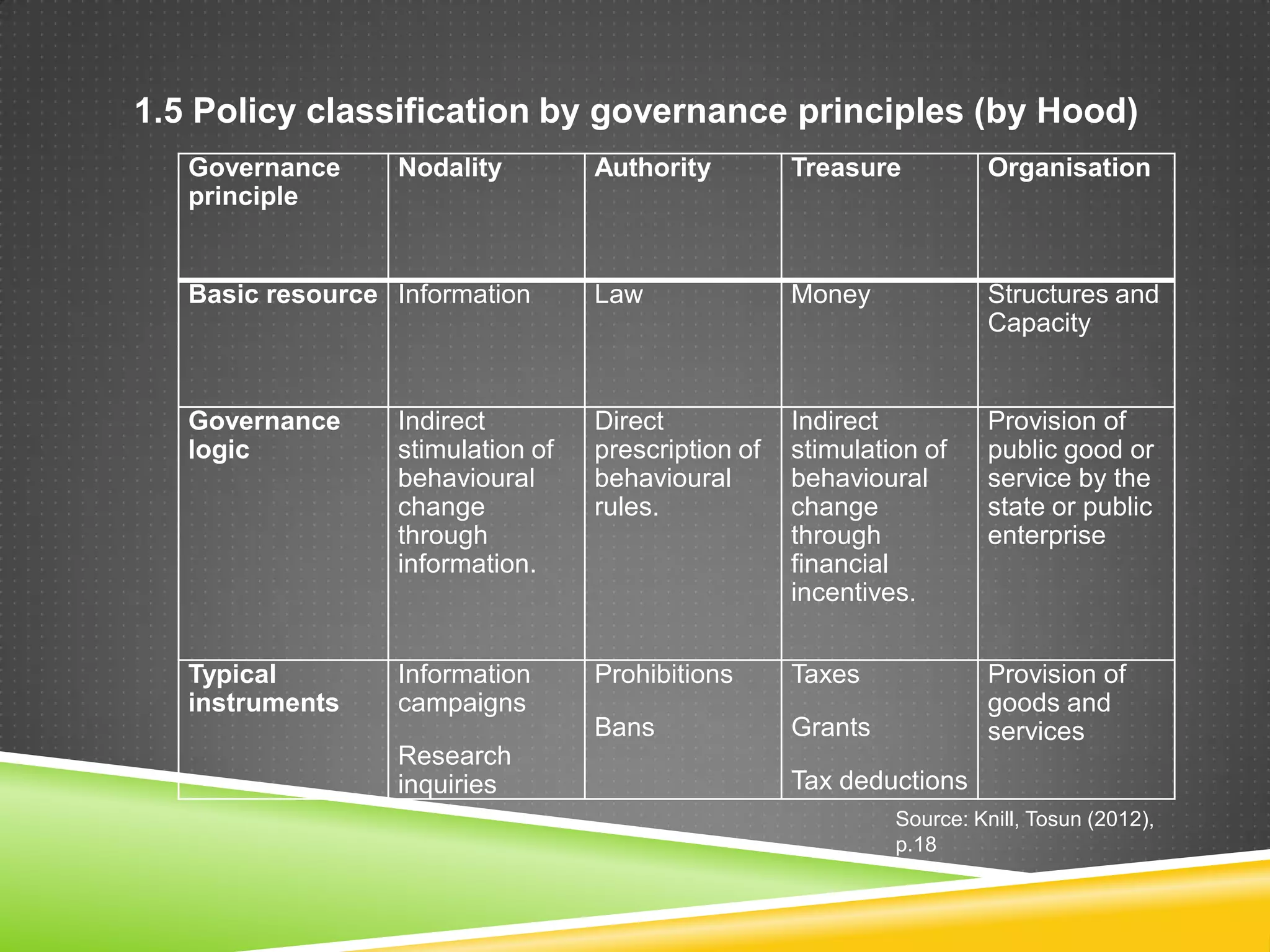
1.5 Policy classification by governance principles (by Hood) Governance principle Nodality Authority Treasure Organisation Basic resource Information Law Money Structures and Capacity Governance logic Indirect stimulation of behavioural change through information. Direct prescription of behavioural rules. Indirect stimulation of behavioural change through financial incentives. Provision of public good or service by the state or public enterprise Typical instruments Information campaigns Research inquiries Prohibitions Bans Taxes Grants Tax deductions Provision of goods and services Source: Knill, Tosun (2012), p.18
The Policy Cycle Agenda setting Decision making Impleme ntation Evaluation Problem definition Source: Own illustration based on Knill and Tosun (2012).
2. Problem Definition  Problem definition sets the stage for the other components of the decision process,. It is a key aspect of decision making.  The way in which a problem is first defined is consequential for all subsequent policy stages.  “A problem is a problem only if something can be done about it“.  Public attention can be increased or decreased by framing, which can refer to the causality, severity, proximity, crises, incidence, novelty, and problem populations for any particular policy problem.
3. Agenda Setting  It is a selection process, because not every political problem can make it on the agenda.  Four different agenda types:  Systemic agenda: All societal problems that demand public attention where a precise definition is still missing.  Institutional agenda: A set of problems that are up for the serious consideration of decision makers.  Drafting agenda: Is a list of subjects that are getting attention within government.  Decision agenda: Is based on those issues for which the government has agreed on a draft proposal.
 Actors in the agenda setting process  Elected public officials and judges  Bureaucracy  Mass Media  Interest Groups  International Organisations
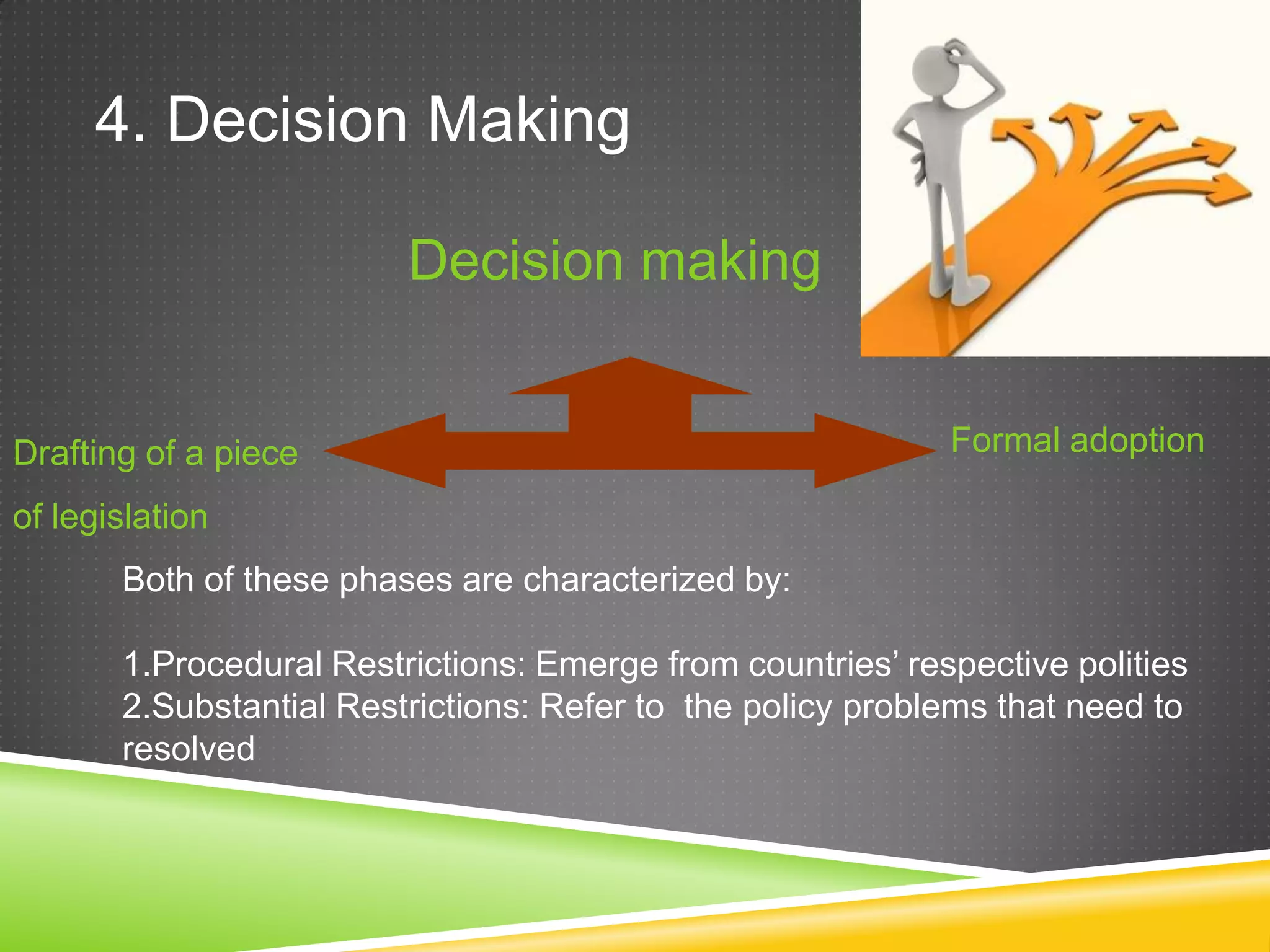
4. Decision Making Decision making Drafting of a piece of legislation Formal adoption Both of these phases are characterized by: 1.Procedural Restrictions: Emerge from countries’ respective polities 2.Substantial Restrictions: Refer to the policy problems that need to resolved
Decision making/ Policy formulation Policy formulation Central to policy formulation Executive Actors Ministerial Bureaucracy 1.External expertise 2. International Organization 3. Interest groups 4.Partisan Ideology 1. Involvement of IOs in policy drafting can be also a coercive character. When governments turn to IOs Such as IMF and WB for financial help these organizations make very specific recommendations
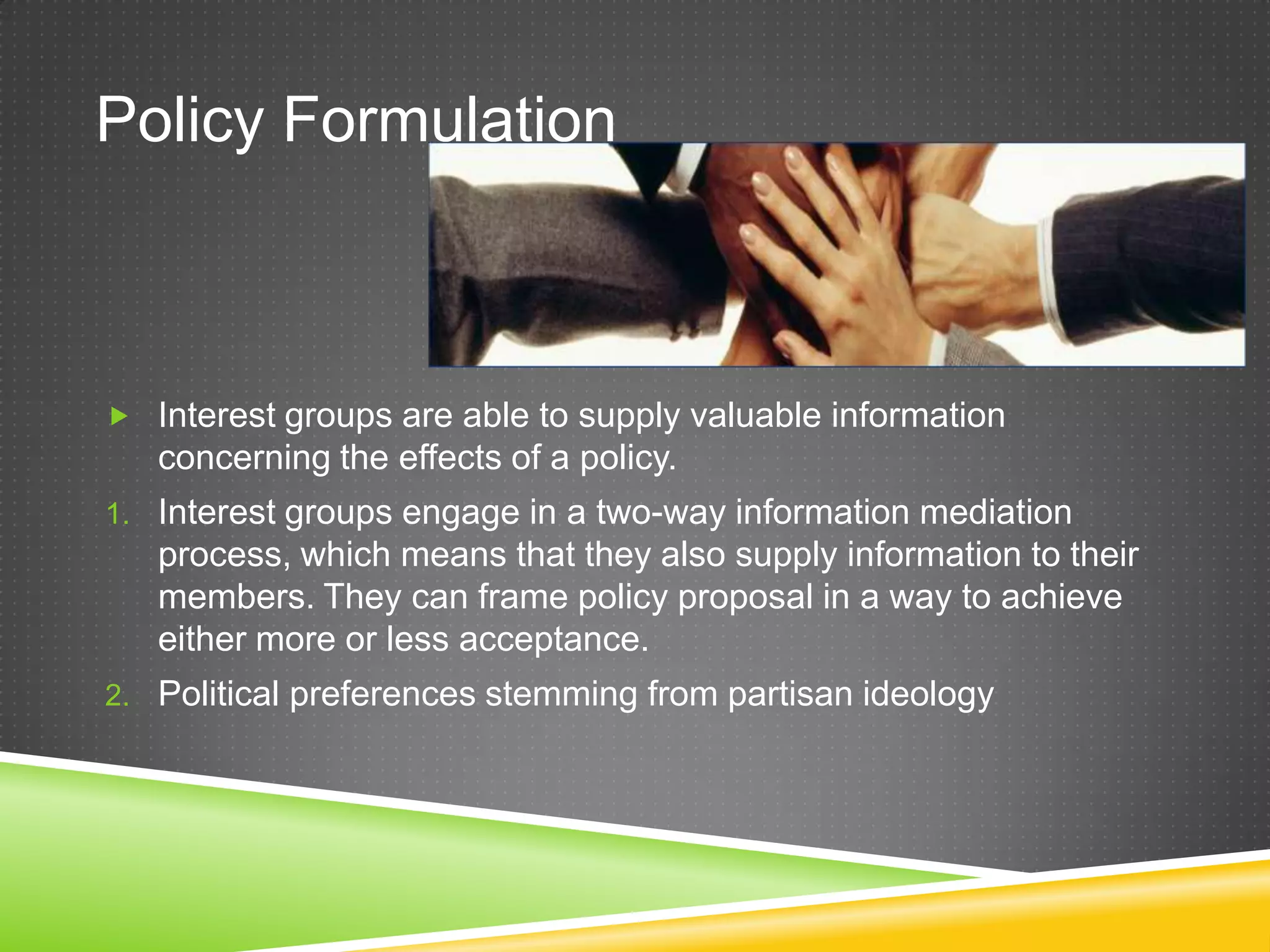
Policy Formulation  Interest groups are able to supply valuable information concerning the effects of a policy. 1. Interest groups engage in a two-way information mediation process, which means that they also supply information to their members. They can frame policy proposal in a way to achieve either more or less acceptance. 2. Political preferences stemming from partisan ideology
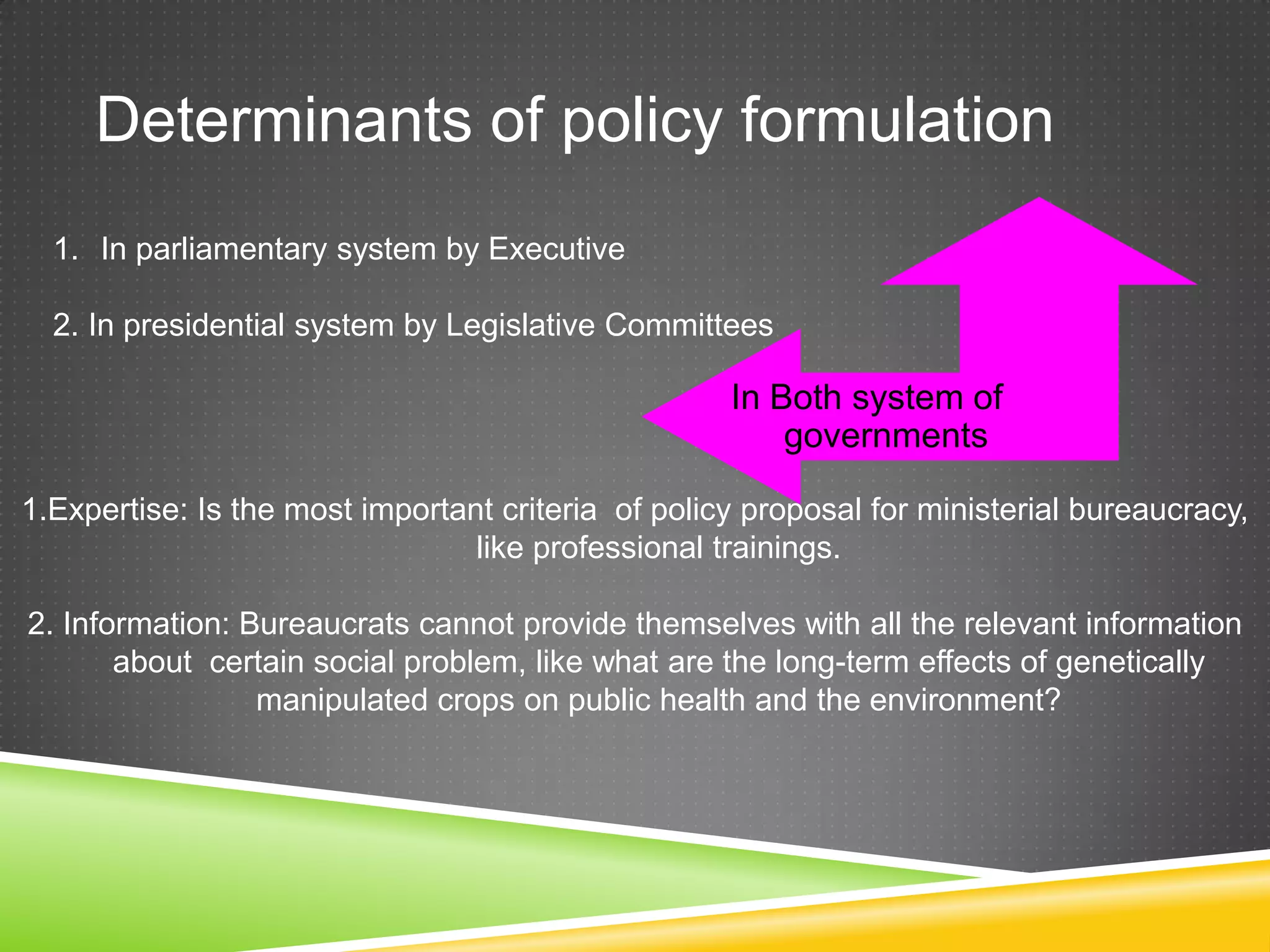
Determinants of policy formulation In Both system of governments 1. In parliamentary system by Executive 2. In presidential system by Legislative Committees 1.Expertise: Is the most important criteria of policy proposal for ministerial bureaucracy, like professional trainings. 2. Information: Bureaucrats cannot provide themselves with all the relevant information about certain social problem, like what are the long-term effects of genetically manipulated crops on public health and the environment?
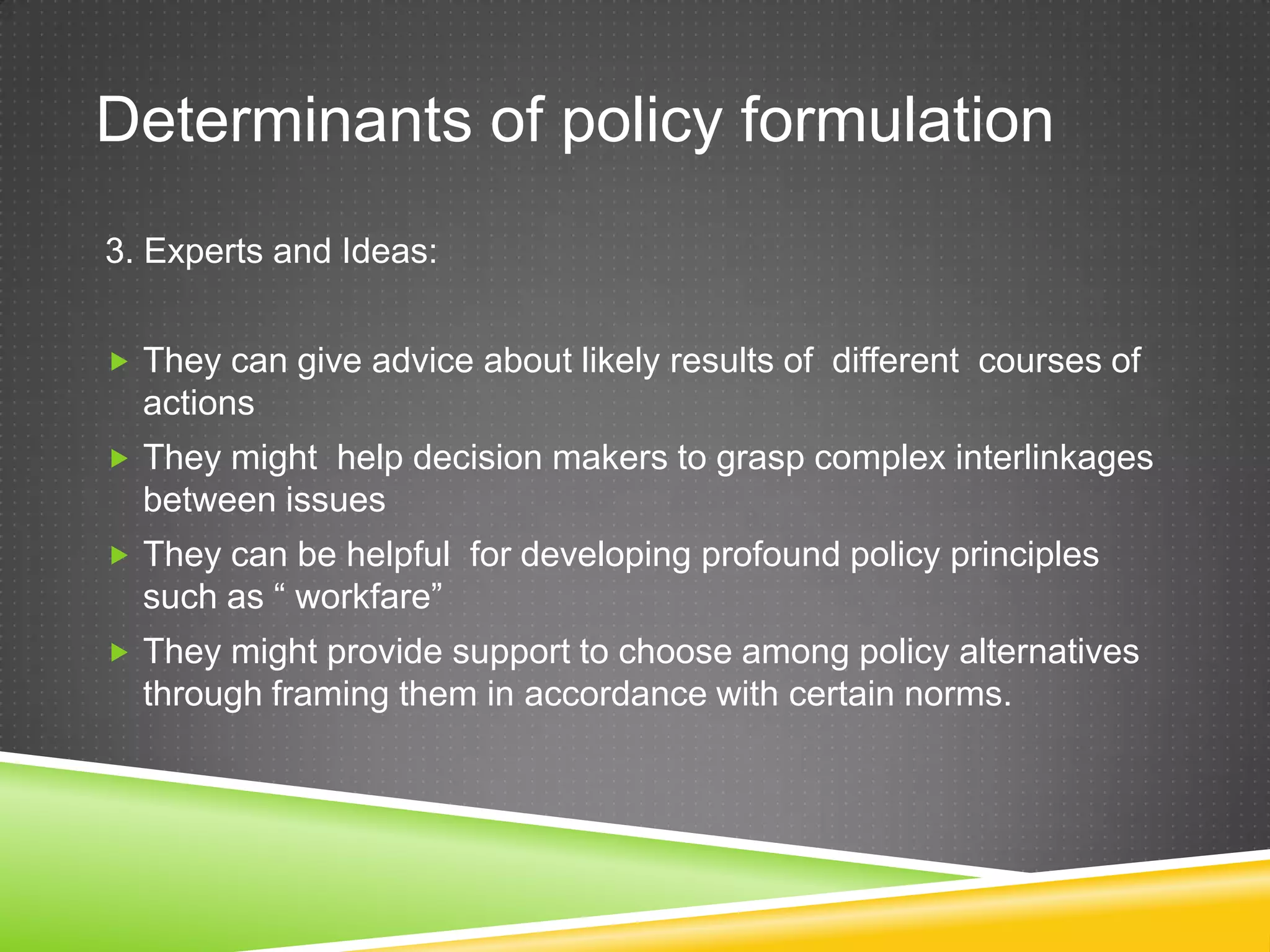
Determinants of policy formulation 3. Experts and Ideas:  They can give advice about likely results of different courses of actions  They might help decision makers to grasp complex interlinkages between issues  They can be helpful for developing profound policy principles such as “ workfare”  They might provide support to choose among policy alternatives through framing them in accordance with certain norms.
Institutional and procedural Dimensions of decision making  How policy preferences are transformed into actual polices? 1. Institutional and procedural arrangements (Veto Points) Veto points refer to the fact that policy decisions need the agreement of several, constitutionally generated, institutional points in a chain of decision.  The more veto points in a given political system, the more difficult it is to gain approval for policy adoption  Veto players are defined as “individual or collective actors whose agreement is necessary for a change of status quo and they are two types: 1. Institutional players 2. Partisan veto players.
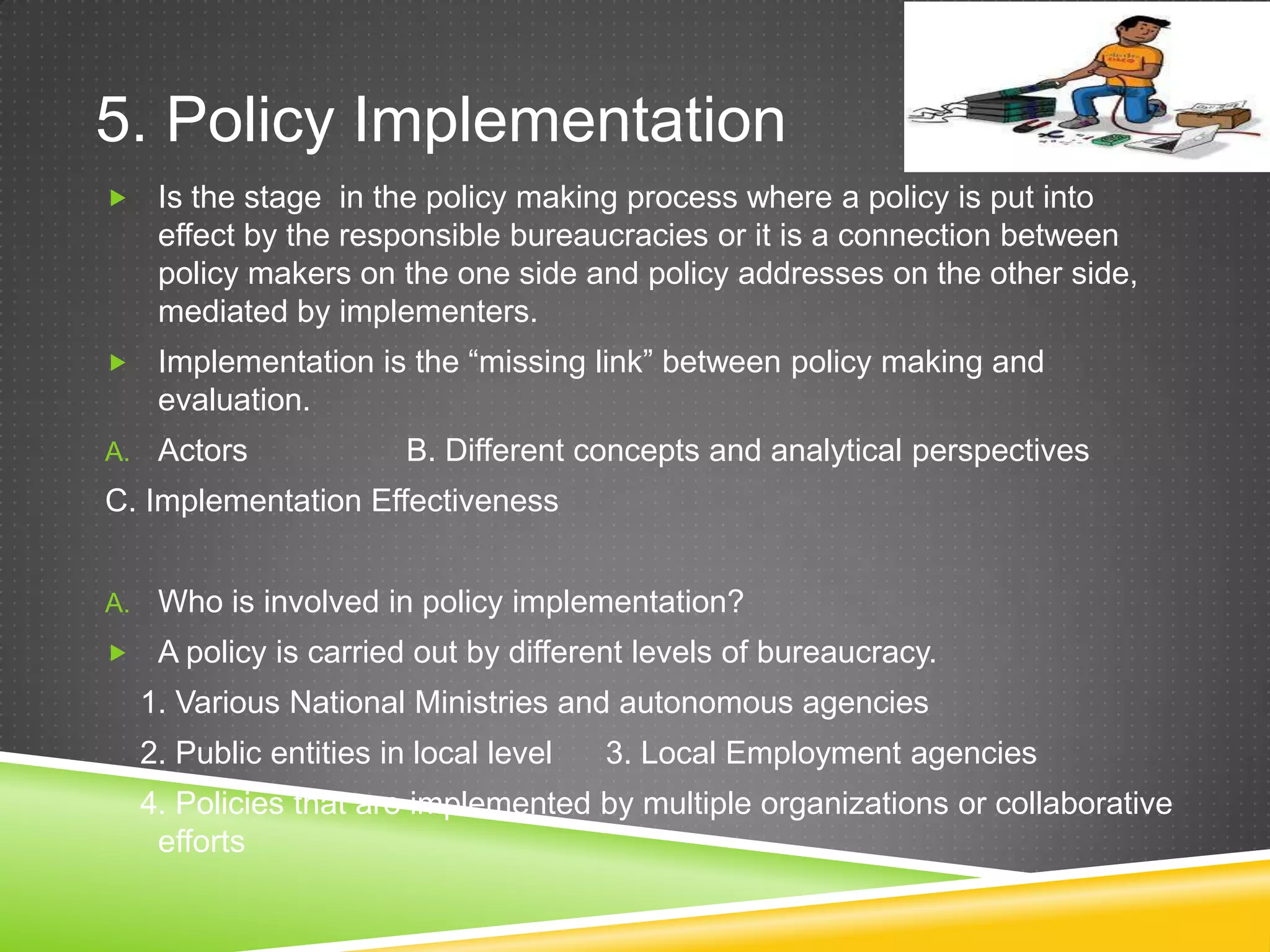
5. Policy Implementation  Is the stage in the policy making process where a policy is put into effect by the responsible bureaucracies or it is a connection between policy makers on the one side and policy addresses on the other side, mediated by implementers.  Implementation is the “missing link” between policy making and evaluation. A. Actors B. Different concepts and analytical perspectives C. Implementation Effectiveness A. Who is involved in policy implementation?  A policy is carried out by different levels of bureaucracy. 1. Various National Ministries and autonomous agencies 2. Public entities in local level 3. Local Employment agencies 4. Policies that are implemented by multiple organizations or collaborative efforts
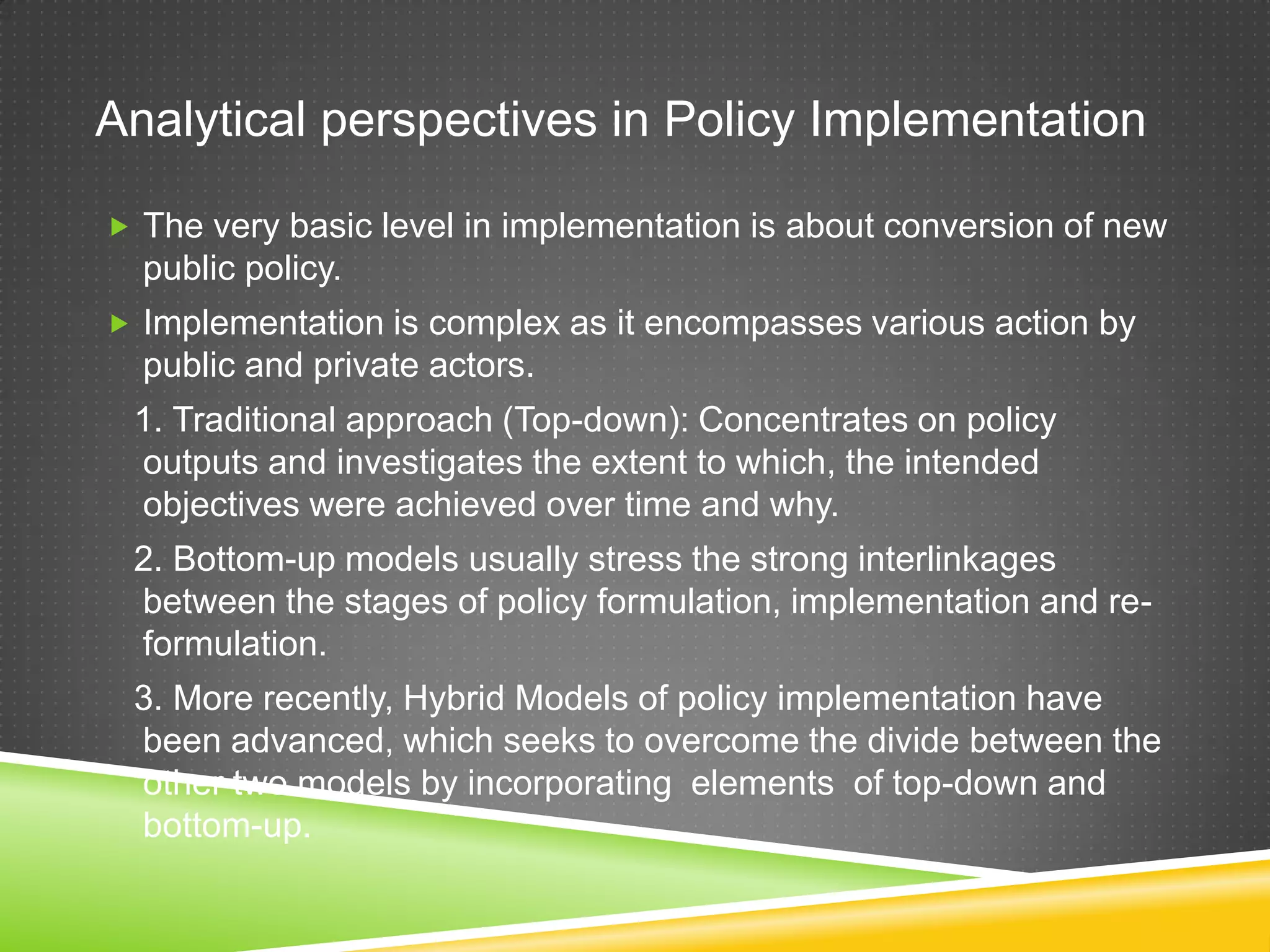
Analytical perspectives in Policy Implementation  The very basic level in implementation is about conversion of new public policy.  Implementation is complex as it encompasses various action by public and private actors. 1. Traditional approach (Top-down): Concentrates on policy outputs and investigates the extent to which, the intended objectives were achieved over time and why. 2. Bottom-up models usually stress the strong interlinkages between the stages of policy formulation, implementation and re- formulation. 3. More recently, Hybrid Models of policy implementation have been advanced, which seeks to overcome the divide between the other two models by incorporating elements of top-down and bottom-up.
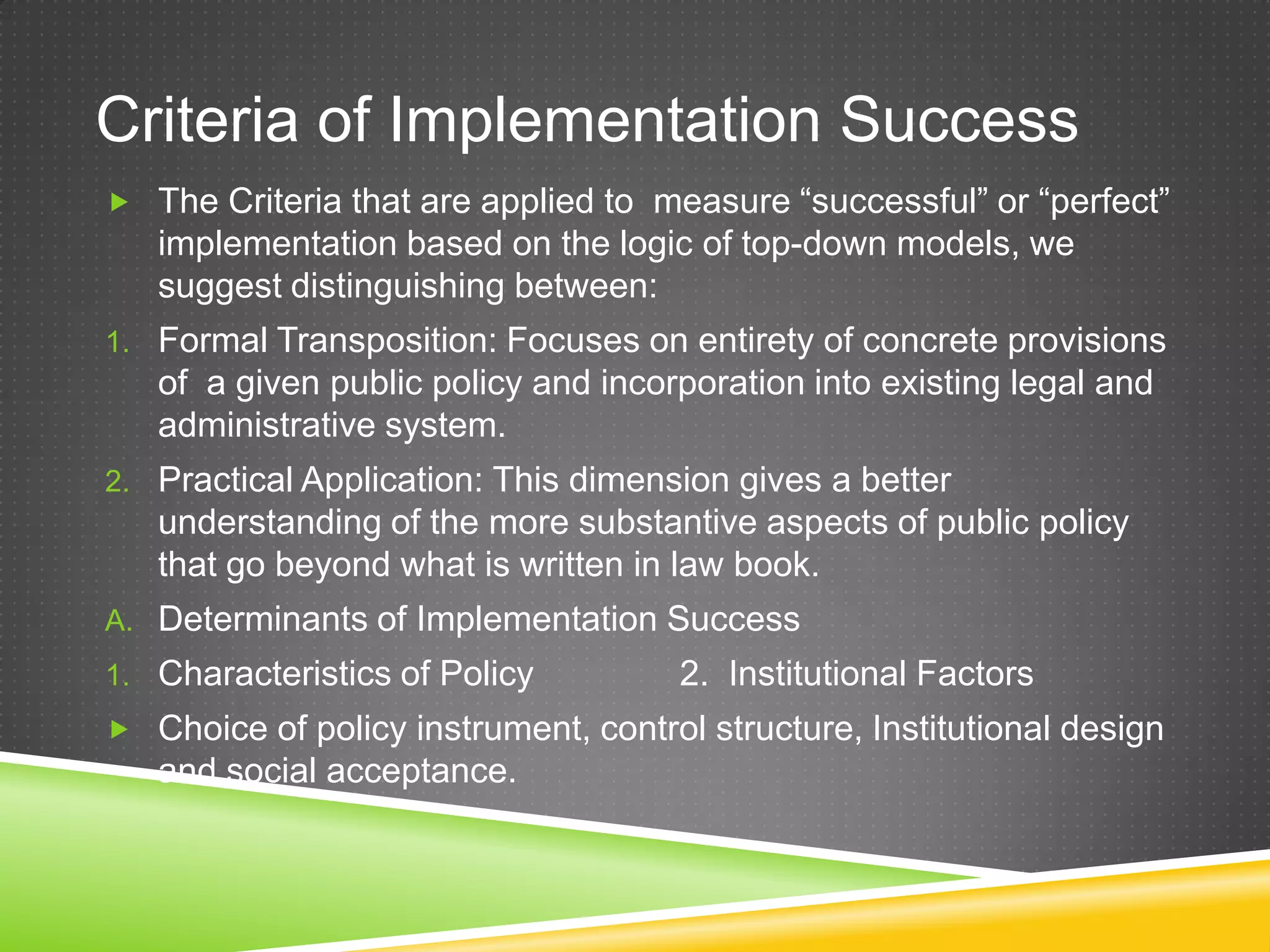
Criteria of Implementation Success  The Criteria that are applied to measure “successful” or “perfect” implementation based on the logic of top-down models, we suggest distinguishing between: 1. Formal Transposition: Focuses on entirety of concrete provisions of a given public policy and incorporation into existing legal and administrative system. 2. Practical Application: This dimension gives a better understanding of the more substantive aspects of public policy that go beyond what is written in law book. A. Determinants of Implementation Success 1. Characteristics of Policy 2. Institutional Factors  Choice of policy instrument, control structure, Institutional design and social acceptance.
6. Conclusion  The relationship between the executive and the legislature is central to understanding decision making. Yet, this relationship changes substantially from one country to another.  Ministerial bureaucracies are heavily involved in policy drafting; depending on the political system in which they act.  For effectively assessing implementation success, both Formal Transposition and Practical application can be employed.  Implementation is a complex and it encompasses various action by Public and Private actors.
7. Discussion  1. Group discussion on recent decision of some of the UK parliament member regarding joining of UK to EU….  Do mass media act as a policy taker or as a policy maker?  Why are the chances of a specific policy proposal being adopted are higher than for another one?  Why policy implementation is multi-faceted and demanding both empirical and theoretical research?
References  Knill, C. and J. Tosun (2012). Public Policy: A New Introduction. Basingstoke: Palgrave Macmillan (chapters 2, 5, 6 and 7).

Ahmad rashid jamal final presentation

  • 1.
    „WHAT IS COMPARATIVE POLITICS ANALYSIS ABOUT?“ by AhmadRashid Jamal in „Comparative Politics“ of Dr. Jale Tosun
  • 2.
    STRUCTURE  1. Characteristicsand patterns of public policies  2. Problem Definition  3. Agenda Setting  4. Decision Making  5. Implementation  6. Conclusion  7. Discussion
  • 3.
    1. Characteristics andpatterns of public policies  1.1 What is policy analysis?  Policy analysis is finding out what governments do, why they do it and what difference it makes.  I.2 What is public policy?  An attempt by the government to address a public issue which should change the behaviour of the target groups.
  • 4.
     I.3 Thethree major analytical dimensions of political science  Polities: Institutional arrangements which characterise a political system  Politics: Patterns of the decision making process  Policies: Concret output of a political system  1.4 The three dimensions of public policies  Policy Output: Formalised contents of a public policy as defined by legal acts  Policy Outcome: Effects of a public policy in terms of the changes in the behaviour of the target groups  Policy Impact: Effects of a public policy in terms of problem resolution
  • 5.
    1.4 Lowi’s policytypology Type of policy Definition Examples Distributive policies Policies distributing new (state) resources Farm subsidies; local infrastructure such as highways and schools Redistributive policies Policies modifying the distribution of existing resources Welfare; land reform; progressive taxation Regulatory policies Policies specifying conditions and constraints for individual and collective behaviour Environmental protection; migration policy; consumer protection Constituent policies Policies creating or modifying the states’ institutions Changes of procedural rules of parliaments; creation of new agencies Source: Knill, Tosun (2012), p. 11
  • 6.
    1.5 Policy classificationby governance principles (by Hood) Governance principle Nodality Authority Treasure Organisation Basic resource Information Law Money Structures and Capacity Governance logic Indirect stimulation of behavioural change through information. Direct prescription of behavioural rules. Indirect stimulation of behavioural change through financial incentives. Provision of public good or service by the state or public enterprise Typical instruments Information campaigns Research inquiries Prohibitions Bans Taxes Grants Tax deductions Provision of goods and services Source: Knill, Tosun (2012), p.18
  • 7.
  • 8.
    2. Problem Definition Problem definition sets the stage for the other components of the decision process,. It is a key aspect of decision making.  The way in which a problem is first defined is consequential for all subsequent policy stages.  “A problem is a problem only if something can be done about it“.  Public attention can be increased or decreased by framing, which can refer to the causality, severity, proximity, crises, incidence, novelty, and problem populations for any particular policy problem.
  • 9.
    3. Agenda Setting It is a selection process, because not every political problem can make it on the agenda.  Four different agenda types:  Systemic agenda: All societal problems that demand public attention where a precise definition is still missing.  Institutional agenda: A set of problems that are up for the serious consideration of decision makers.  Drafting agenda: Is a list of subjects that are getting attention within government.  Decision agenda: Is based on those issues for which the government has agreed on a draft proposal.
  • 10.
     Actors inthe agenda setting process  Elected public officials and judges  Bureaucracy  Mass Media  Interest Groups  International Organisations
  • 12.
    4. Decision Making Decisionmaking Drafting of a piece of legislation Formal adoption Both of these phases are characterized by: 1.Procedural Restrictions: Emerge from countries’ respective polities 2.Substantial Restrictions: Refer to the policy problems that need to resolved
  • 13.
    Decision making/ Policyformulation Policy formulation Central to policy formulation Executive Actors Ministerial Bureaucracy 1.External expertise 2. International Organization 3. Interest groups 4.Partisan Ideology 1. Involvement of IOs in policy drafting can be also a coercive character. When governments turn to IOs Such as IMF and WB for financial help these organizations make very specific recommendations
  • 14.
    Policy Formulation  Interestgroups are able to supply valuable information concerning the effects of a policy. 1. Interest groups engage in a two-way information mediation process, which means that they also supply information to their members. They can frame policy proposal in a way to achieve either more or less acceptance. 2. Political preferences stemming from partisan ideology
  • 15.
    Determinants of policyformulation In Both system of governments 1. In parliamentary system by Executive 2. In presidential system by Legislative Committees 1.Expertise: Is the most important criteria of policy proposal for ministerial bureaucracy, like professional trainings. 2. Information: Bureaucrats cannot provide themselves with all the relevant information about certain social problem, like what are the long-term effects of genetically manipulated crops on public health and the environment?
  • 16.
    Determinants of policyformulation 3. Experts and Ideas:  They can give advice about likely results of different courses of actions  They might help decision makers to grasp complex interlinkages between issues  They can be helpful for developing profound policy principles such as “ workfare”  They might provide support to choose among policy alternatives through framing them in accordance with certain norms.
  • 17.
    Institutional and proceduralDimensions of decision making  How policy preferences are transformed into actual polices? 1. Institutional and procedural arrangements (Veto Points) Veto points refer to the fact that policy decisions need the agreement of several, constitutionally generated, institutional points in a chain of decision.  The more veto points in a given political system, the more difficult it is to gain approval for policy adoption  Veto players are defined as “individual or collective actors whose agreement is necessary for a change of status quo and they are two types: 1. Institutional players 2. Partisan veto players.
  • 18.
    5. Policy Implementation Is the stage in the policy making process where a policy is put into effect by the responsible bureaucracies or it is a connection between policy makers on the one side and policy addresses on the other side, mediated by implementers.  Implementation is the “missing link” between policy making and evaluation. A. Actors B. Different concepts and analytical perspectives C. Implementation Effectiveness A. Who is involved in policy implementation?  A policy is carried out by different levels of bureaucracy. 1. Various National Ministries and autonomous agencies 2. Public entities in local level 3. Local Employment agencies 4. Policies that are implemented by multiple organizations or collaborative efforts
  • 19.
    Analytical perspectives inPolicy Implementation  The very basic level in implementation is about conversion of new public policy.  Implementation is complex as it encompasses various action by public and private actors. 1. Traditional approach (Top-down): Concentrates on policy outputs and investigates the extent to which, the intended objectives were achieved over time and why. 2. Bottom-up models usually stress the strong interlinkages between the stages of policy formulation, implementation and re- formulation. 3. More recently, Hybrid Models of policy implementation have been advanced, which seeks to overcome the divide between the other two models by incorporating elements of top-down and bottom-up.
  • 20.
    Criteria of ImplementationSuccess  The Criteria that are applied to measure “successful” or “perfect” implementation based on the logic of top-down models, we suggest distinguishing between: 1. Formal Transposition: Focuses on entirety of concrete provisions of a given public policy and incorporation into existing legal and administrative system. 2. Practical Application: This dimension gives a better understanding of the more substantive aspects of public policy that go beyond what is written in law book. A. Determinants of Implementation Success 1. Characteristics of Policy 2. Institutional Factors  Choice of policy instrument, control structure, Institutional design and social acceptance.
  • 21.
    6. Conclusion  Therelationship between the executive and the legislature is central to understanding decision making. Yet, this relationship changes substantially from one country to another.  Ministerial bureaucracies are heavily involved in policy drafting; depending on the political system in which they act.  For effectively assessing implementation success, both Formal Transposition and Practical application can be employed.  Implementation is a complex and it encompasses various action by Public and Private actors.
  • 22.
    7. Discussion  1.Group discussion on recent decision of some of the UK parliament member regarding joining of UK to EU….  Do mass media act as a policy taker or as a policy maker?  Why are the chances of a specific policy proposal being adopted are higher than for another one?  Why policy implementation is multi-faceted and demanding both empirical and theoretical research?
  • 23.
    References  Knill, C.and J. Tosun (2012). Public Policy: A New Introduction. Basingstoke: Palgrave Macmillan (chapters 2, 5, 6 and 7).