Shahid Hussain Raja Author/Trainer/Consultant Cambridge.UK www.shahidhussainraja.com 21/10/2021 1
 Introduction  National Interest, Good Governance & Public Policy  What is Public Policy  Components of Policy  Importance of Public Policies  Sources and Types of Policy Formulation  Stages of Policy Formulation  Challenges in Public Policy Formulation  Facilitating Public Participation in Policy Formulation  Conclusion 21/10/2021 2
 This is part 1 of the 3-part Course on Public Policy Formulation  This course explains the way policies are formulated, the steps involved and the activities to be performed in the various steps  It also explains the main features of a good public policy and discusses it with reference to policy formulation in Pakistan  In this presentation, we will be discussing the features of public policy, six stages of public policy formulation, & challenges faced 21/10/2021 3
 Retired as Federal Secretary, Govt. of Pakistan, held senior positions  Ex.Chief Instructor, National School of Public Policy, Lahore (Pakistan)  M.A. (Economics), M.A. (Political Science)-Punjab University, Lahore  M.Sc.(Defence and Strategic Studies)-National Defence College  Post Graduate Diploma (Development Studies)-Cambridge University  Executive Development Program-JFK School of Government, Harvard  Author of 12 books on various public policy, national/global issues.  Conducts courses online and offline
21/10/2021 5 Public Policy Formulation
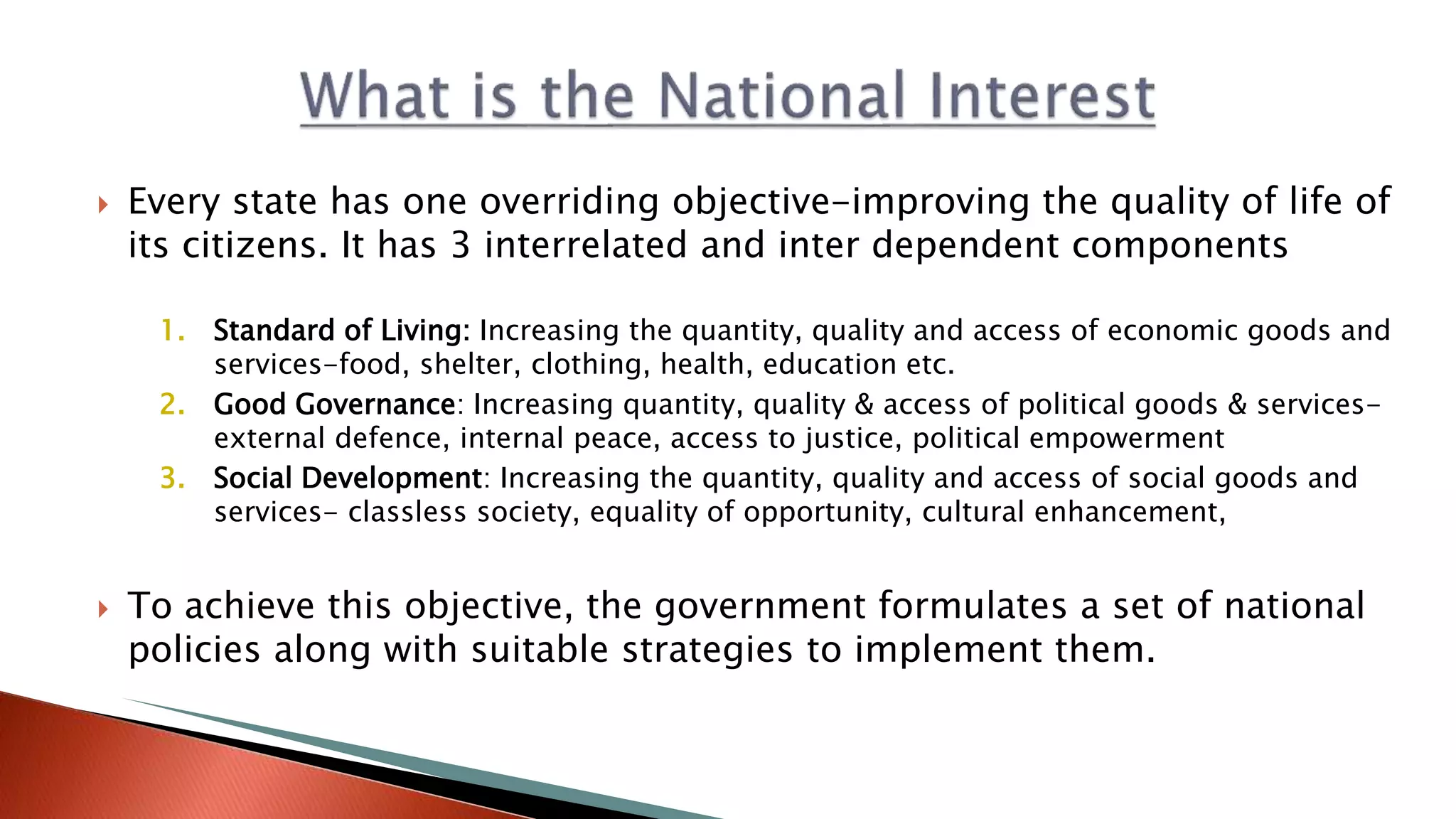
 Every state has one overriding objective-improving the quality of life of its citizens. It has 3 interrelated and inter dependent components 1. Standard of Living: Increasing the quantity, quality and access of economic goods and services-food, shelter, clothing, health, education etc. 2. Good Governance: Increasing quantity, quality & access of political goods & services- external defence, internal peace, access to justice, political empowerment 3. Social Development: Increasing the quantity, quality and access of social goods and services- classless society, equality of opportunity, cultural enhancement,  To achieve this objective, the government formulates a set of national policies along with suitable strategies to implement them.
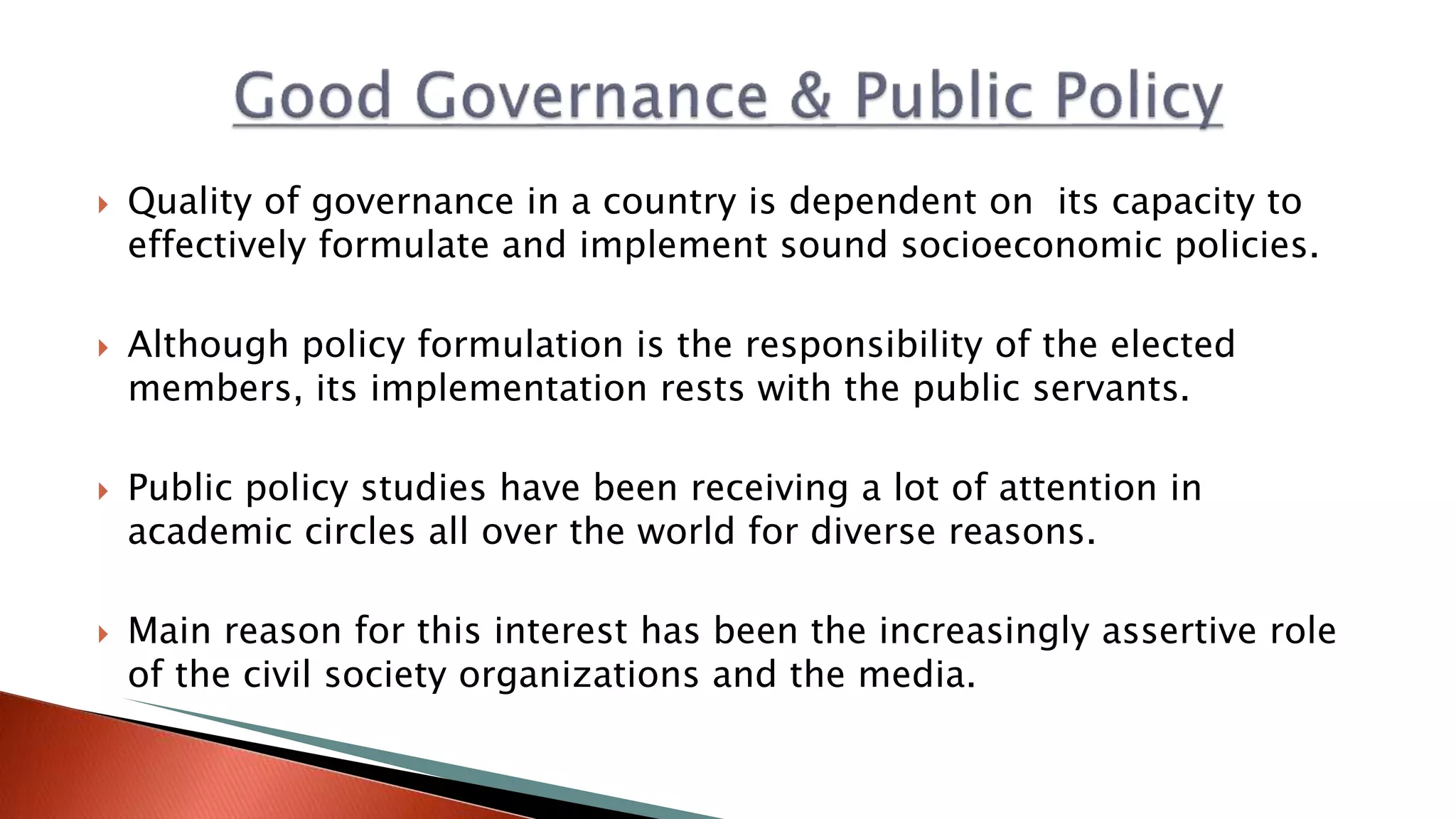
 Quality of governance in a country is dependent on its capacity to effectively formulate and implement sound socioeconomic policies.  Although policy formulation is the responsibility of the elected members, its implementation rests with the public servants.  Public policy studies have been receiving a lot of attention in academic circles all over the world for diverse reasons.  Main reason for this interest has been the increasingly assertive role of the civil society organizations and the media.
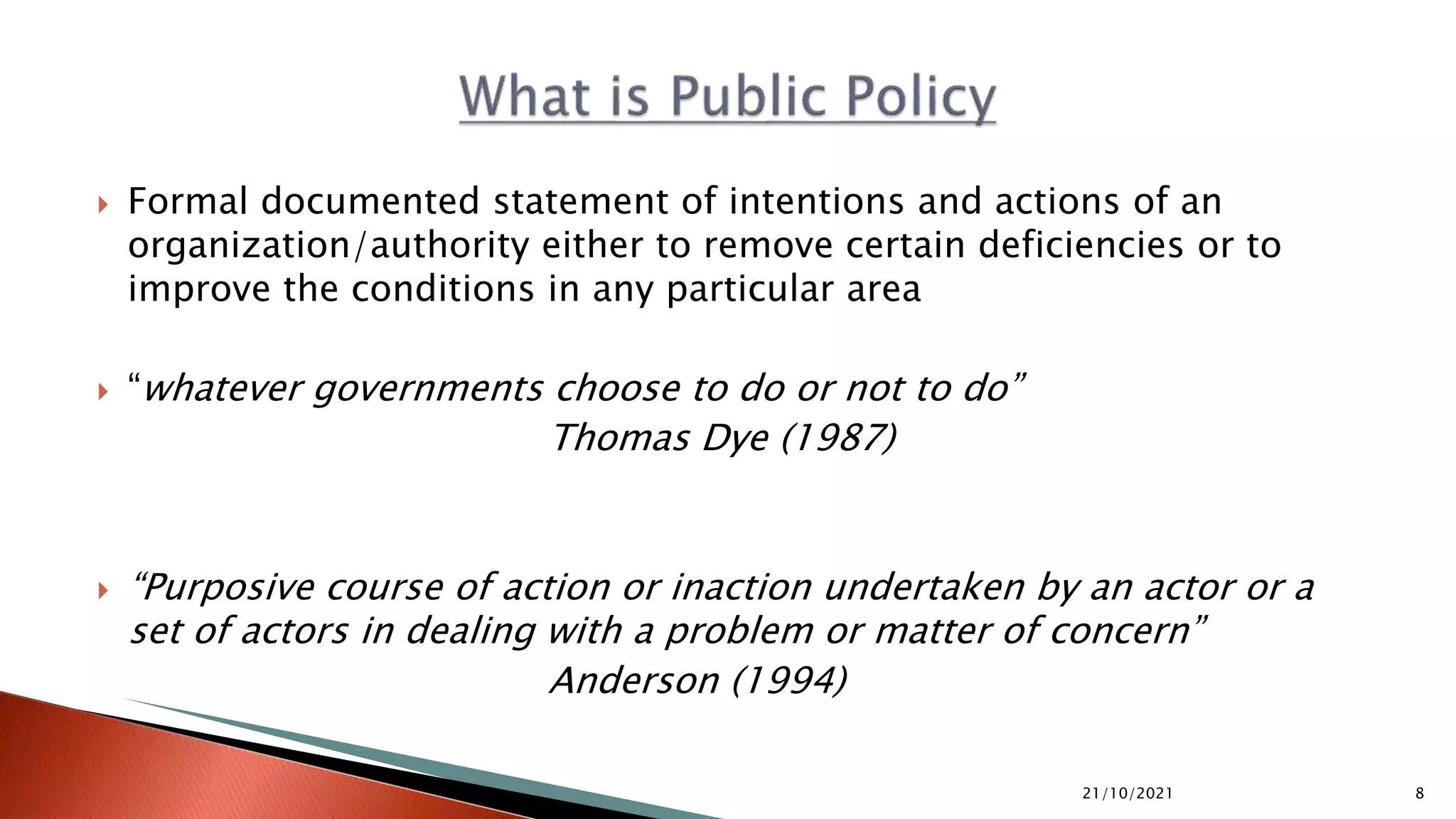
 Formal documented statement of intentions and actions of an organization/authority either to remove certain deficiencies or to improve the conditions in any particular area  “whatever governments choose to do or not to do” Thomas Dye (1987)  “Purposive course of action or inaction undertaken by an actor or a set of actors in dealing with a problem or matter of concern” Anderson (1994) 21/10/2021 8
 Not a random act, rather a deliberate action  Approved by public representatives  Not a piece of legislation but has its own sanctity  Distinct from strategy to implement it by state apparatus  It could be a part of an overall development policy i.e. Food Security as objective of National Development Strategy or it  Could be a specific departmental policy i.e. Food Security Policy 21/10/2021 9
 Preamble: Statement of Facts-why need for this policy  Definitions: General Clauses- definitions of terms used  Scope: Broad outlines of what to do in which areas  Policy Directions: Specific actions to be taken, their priority  Institutional Mechanism: Which are responsible authorities  Date of Application: When it will be applicable  Repeal Clauses: Which previous policy/clauses it repeals/replaces 21/10/2021 10
 Big Picture: Only state has big picture of its overall aims and objectives, can give clear guidelines to solve a problem.  Public Awareness: Get public support by informing them about state sincerity and seriousness to address their greivances/publicity  Synergy: To ensure clarity about the respective domains of different policies, have synergistic, not divisive effect  Transparency: By informing public bout government's intentions, actions, and priorities, people should know who is getting what 21/10/2021 11
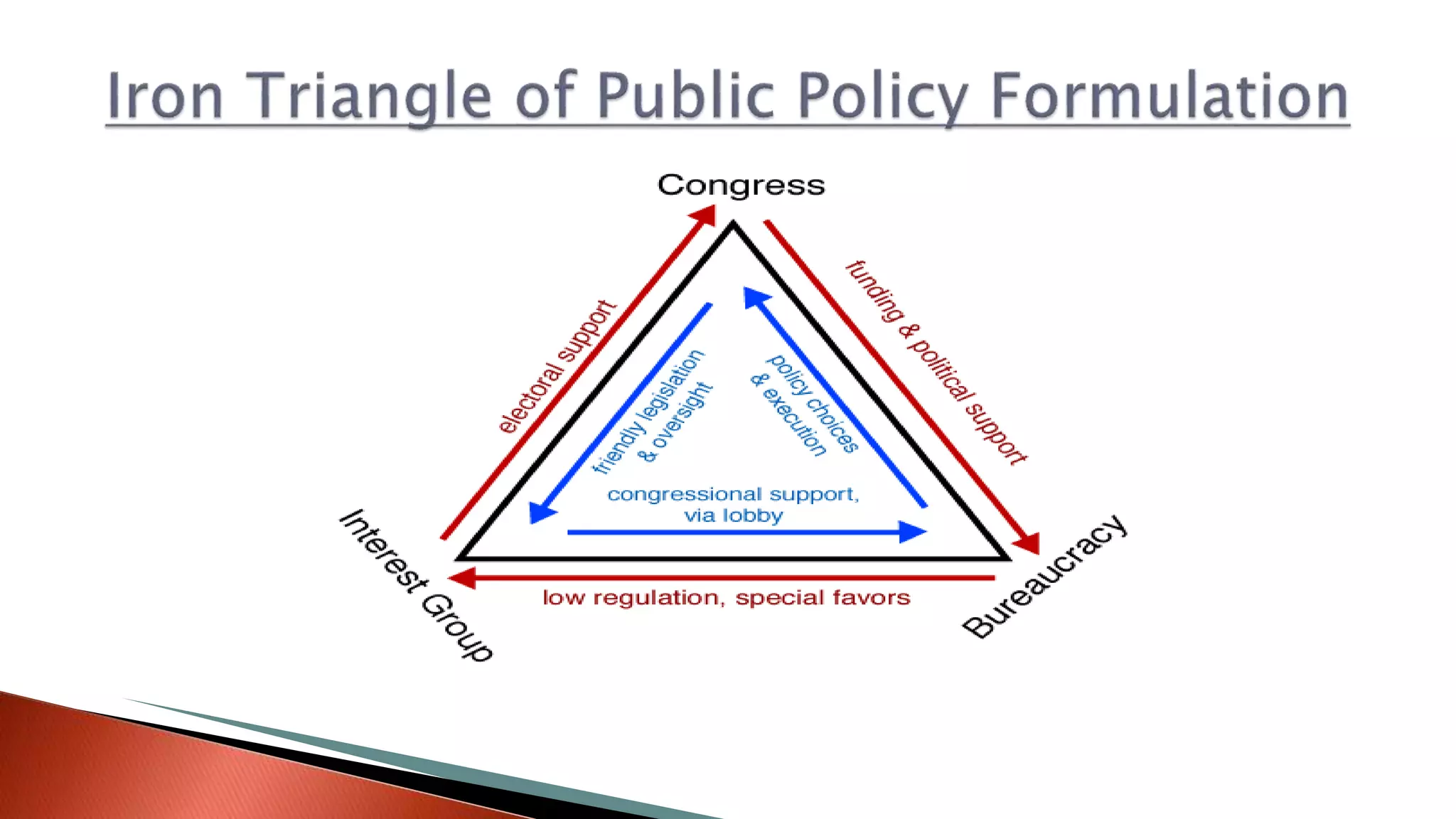
 There is a complex relationship among the institutions responsible for formulating and implementing the public policies in a country.  These actors could be grouped into 3 distinct categories namely political elites, bureaucracy, & private sector (firms as well as NGOs)  Every entity in these categories strives hard to safeguard its respective vested corporate interests more than the stated welfare objectives  Gordon Adams calls it "iron triangle of Public Policy", because of its inherent strength based on mutually beneficial cooperation of all
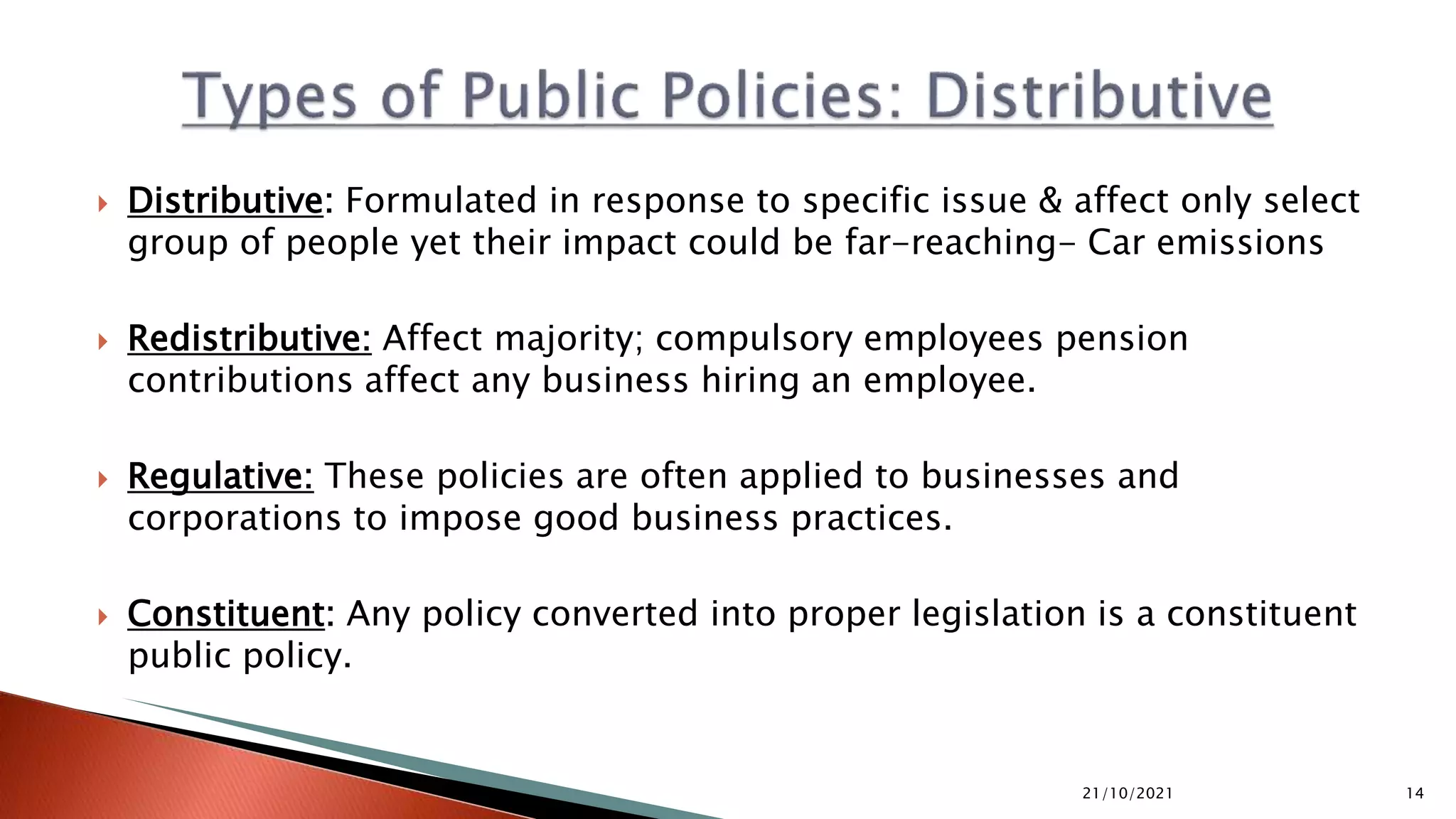
 Distributive: Formulated in response to specific issue & affect only select group of people yet their impact could be far-reaching- Car emissions  Redistributive: Affect majority; compulsory employees pension contributions affect any business hiring an employee.  Regulative: These policies are often applied to businesses and corporations to impose good business practices.  Constituent: Any policy converted into proper legislation is a constituent public policy. 21/10/2021 14
21/10/2021 15 Stages of Policy Formulation
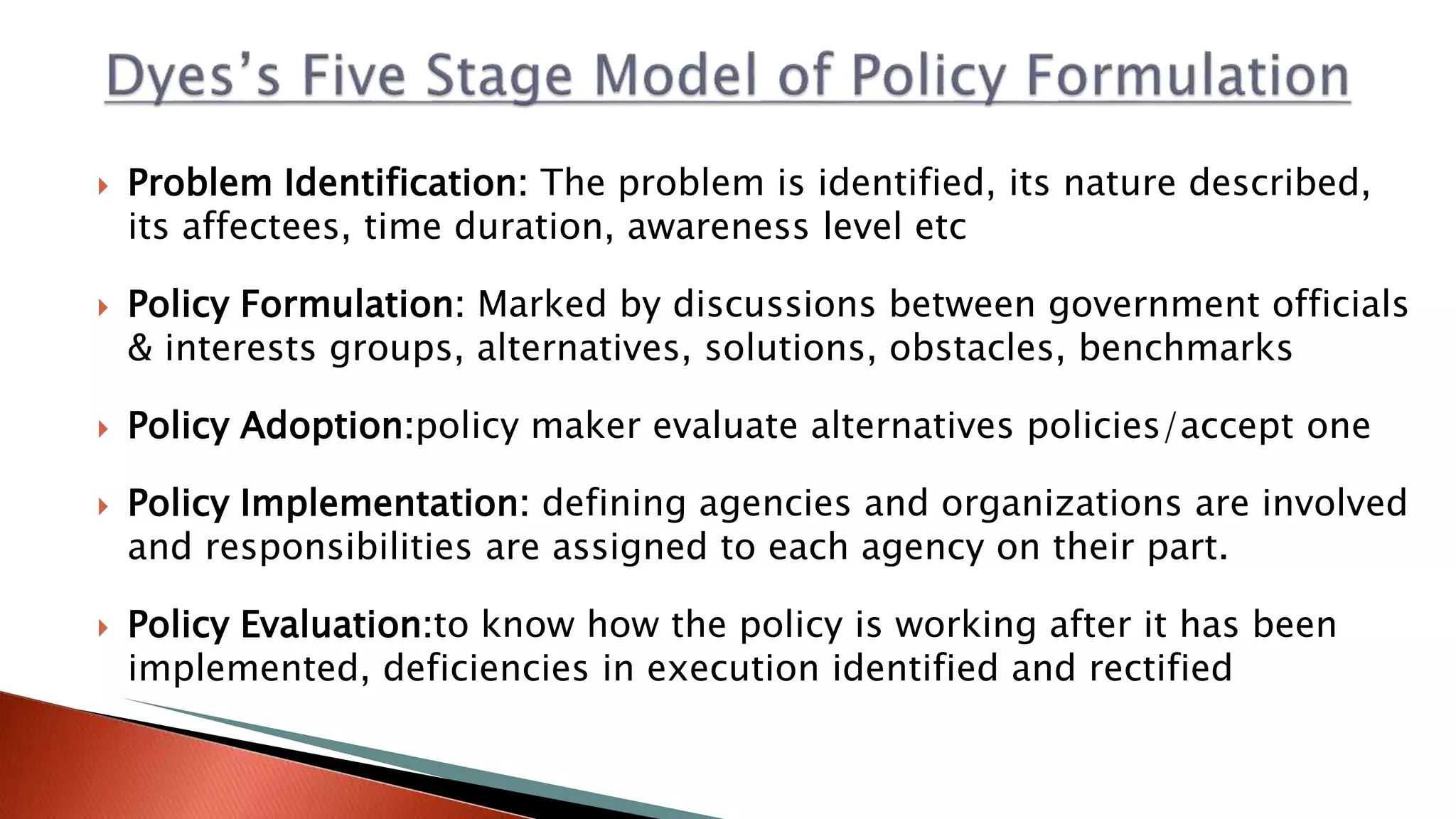
 Problem Identification: The problem is identified, its nature described, its affectees, time duration, awareness level etc  Policy Formulation: Marked by discussions between government officials & interests groups, alternatives, solutions, obstacles, benchmarks  Policy Adoption:policy maker evaluate alternatives policies/accept one  Policy Implementation: defining agencies and organizations are involved and responsibilities are assigned to each agency on their part.  Policy Evaluation:to know how the policy is working after it has been implemented, deficiencies in execution identified and rectified
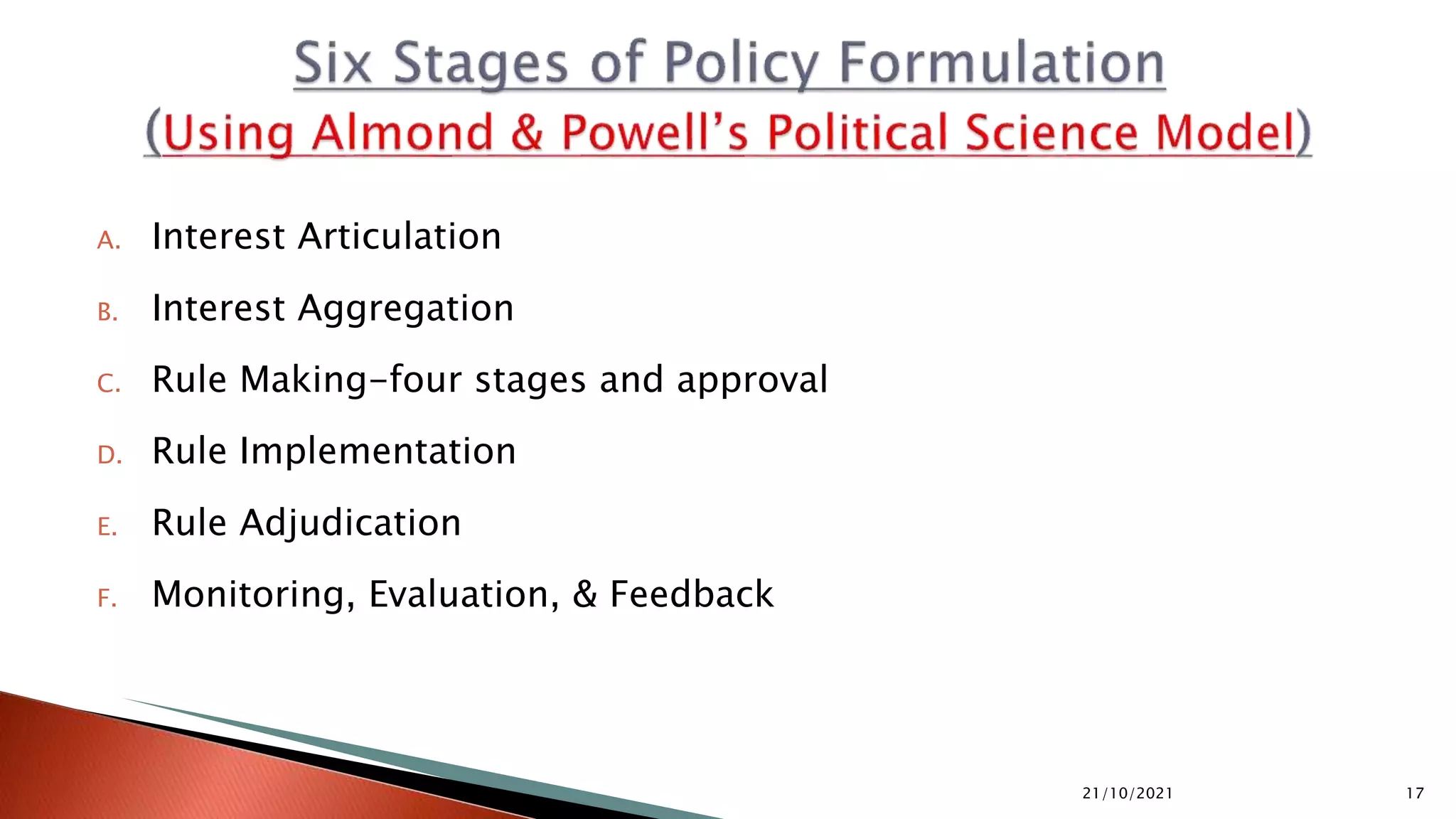
A. Interest Articulation B. Interest Aggregation C. Rule Making-four stages and approval D. Rule Implementation E. Rule Adjudication F. Monitoring, Evaluation, & Feedback 21/10/2021 17
 Demand for public policy formulation starts from a group of people facing a problem who use different media to air their grievances  Different interest groups having sets of demands are involved in alliance building with other groups on give and take agreements.  Media is important vehicle for airing their demands to ensure their interests are reflected in the manifestos of the political parties  They also engage lobbyists not only at this stage but also at the other stages. This is Interest Articulation-first stage of policy formulation
 Societal Structural Changes: demographic transition, economic transformation, Urbanisation, Technology Change  Regime Change: new political elite may have new vision, mission and agenda for which it needs new sets of public policies  Donors/World institutions: their aid may be contingent upon certain policy changes, structural changes 21/10/2021 19
 Global Commitments: state enters into international conventions which normally need local policy formulation  Pressure Groups: industrial ,agricultural lobbies, social causes advocacy groups can force state for this  Court Orders: Superior courts orders for formulating clear policies or review an existing policy while hearing any case 21/10/2021 20
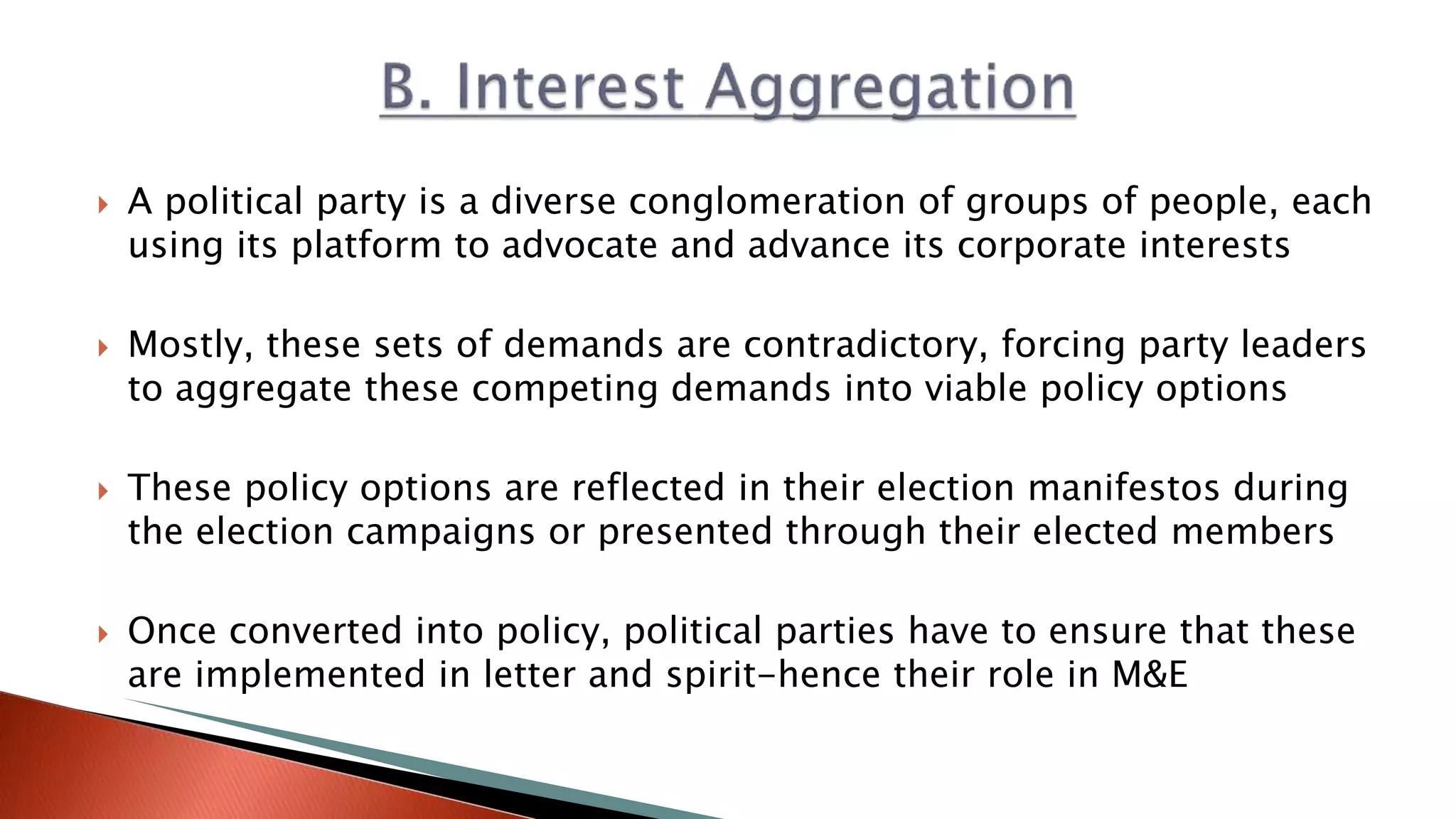
 A political party is a diverse conglomeration of groups of people, each using its platform to advocate and advance its corporate interests  Mostly, these sets of demands are contradictory, forcing party leaders to aggregate these competing demands into viable policy options  These policy options are reflected in their election manifestos during the election campaigns or presented through their elected members  Once converted into policy, political parties have to ensure that these are implemented in letter and spirit-hence their role in M&E
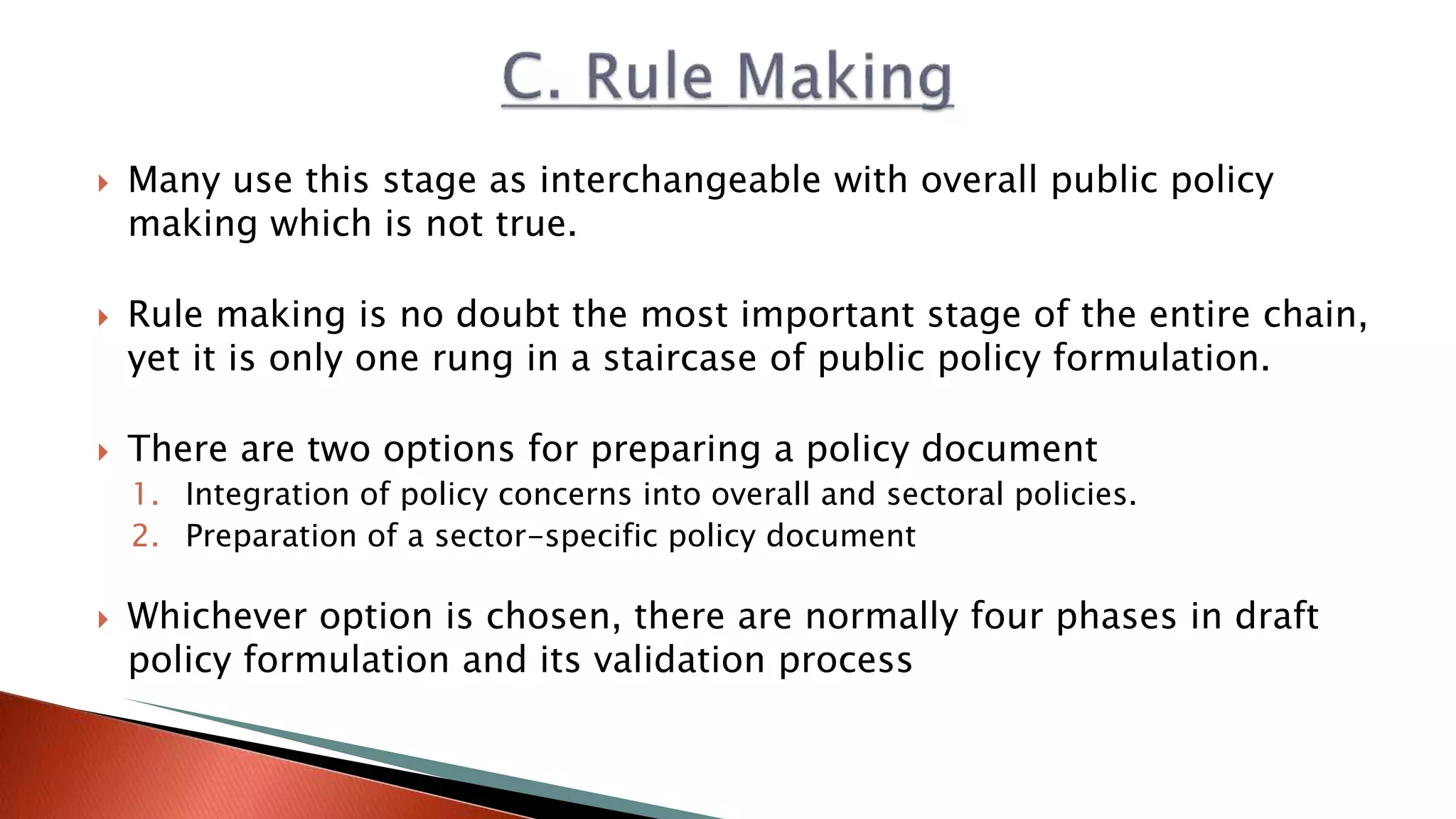
 Many use this stage as interchangeable with overall public policy making which is not true.  Rule making is no doubt the most important stage of the entire chain, yet it is only one rung in a staircase of public policy formulation.  There are two options for preparing a policy document 1. Integration of policy concerns into overall and sectoral policies. 2. Preparation of a sector-specific policy document  Whichever option is chosen, there are normally four phases in draft policy formulation and its validation process
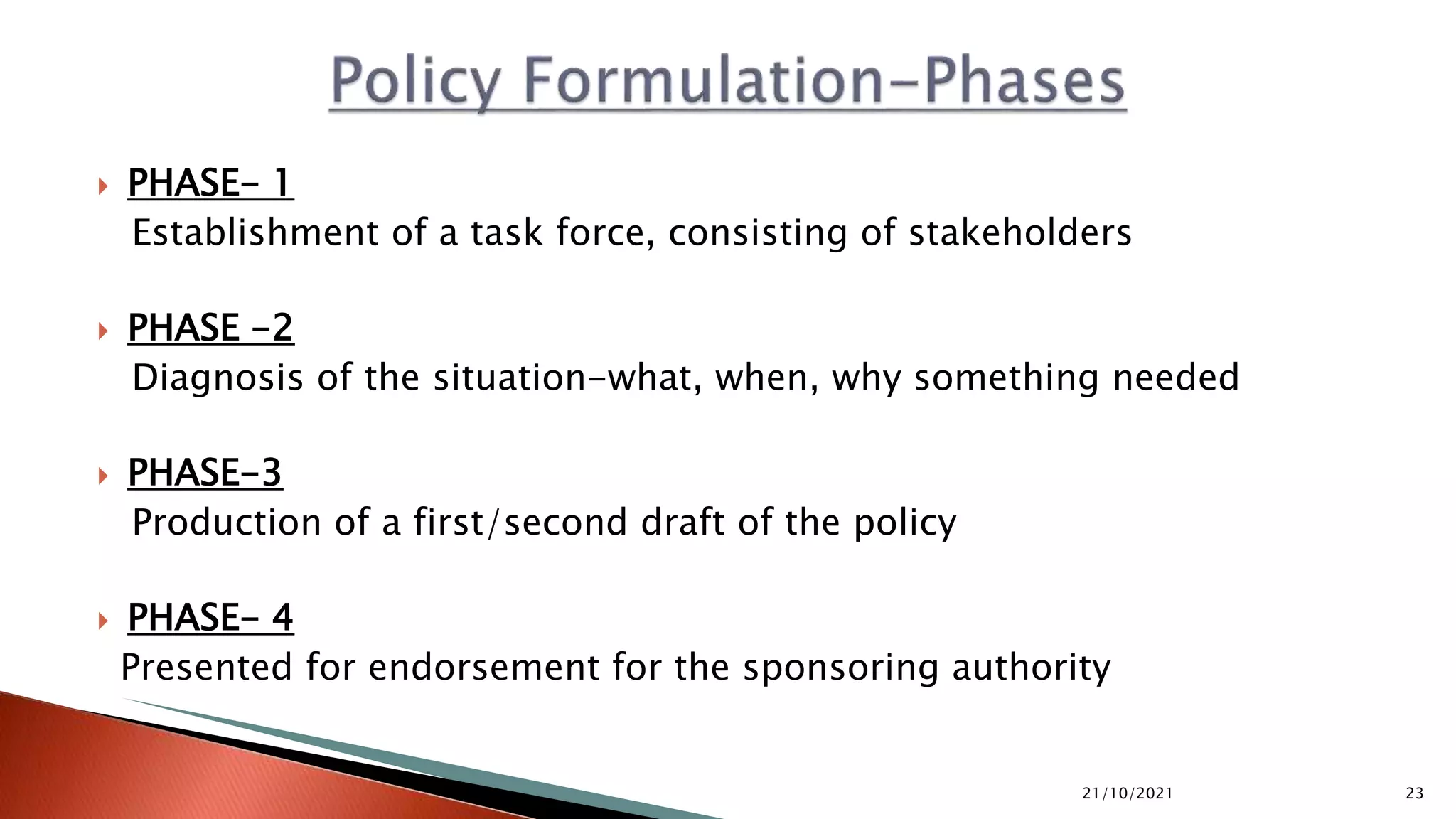
 PHASE- 1 Establishment of a task force, consisting of stakeholders  PHASE -2 Diagnosis of the situation-what, when, why something needed  PHASE-3 Production of a first/second draft of the policy  PHASE- 4 Presented for endorsement for the sponsoring authority 21/10/2021 23
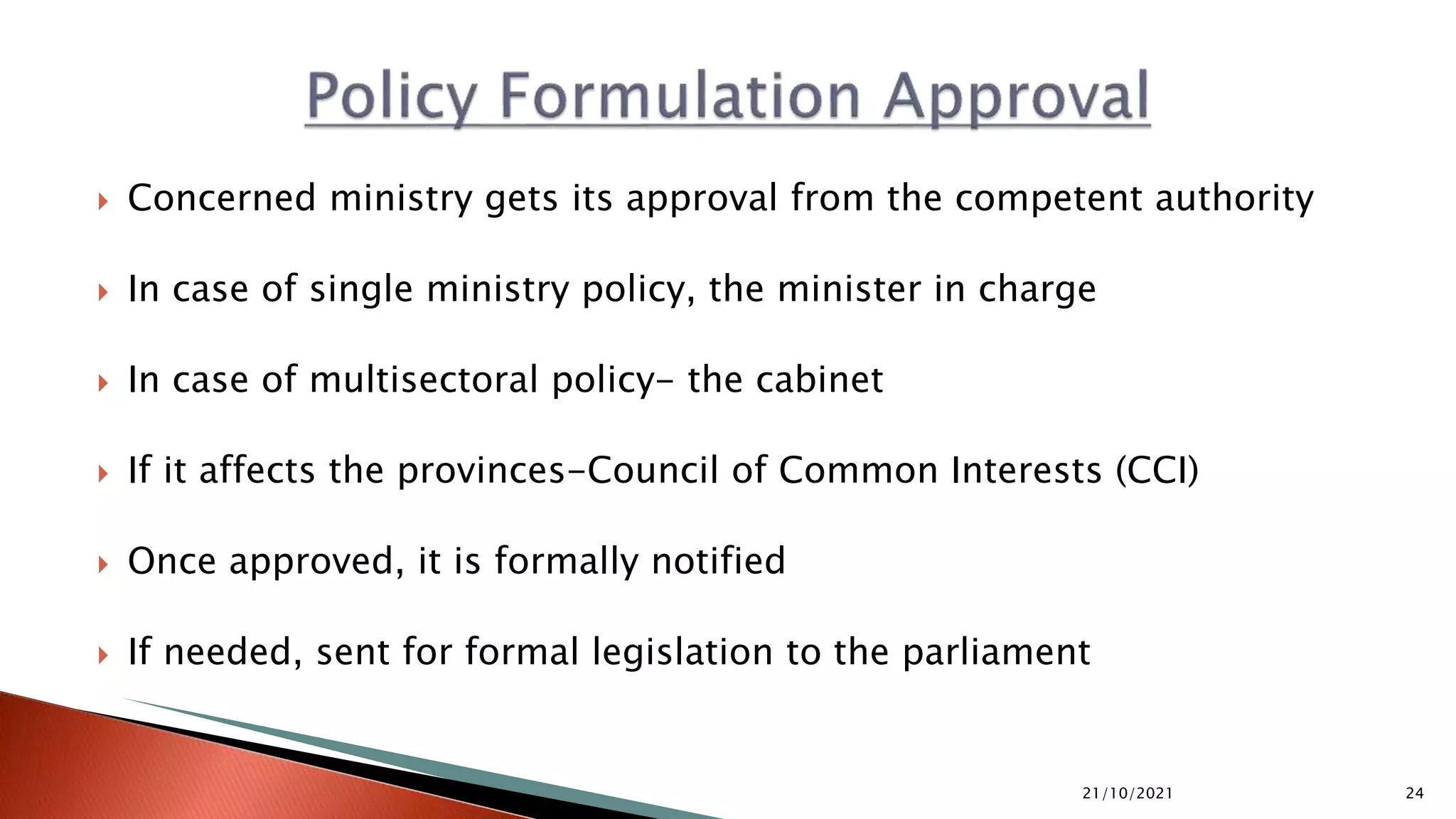
 Concerned ministry gets its approval from the competent authority  In case of single ministry policy, the minister in charge  In case of multisectoral policy- the cabinet  If it affects the provinces-Council of Common Interests (CCI)  Once approved, it is formally notified  If needed, sent for formal legislation to the parliament 21/10/2021 24
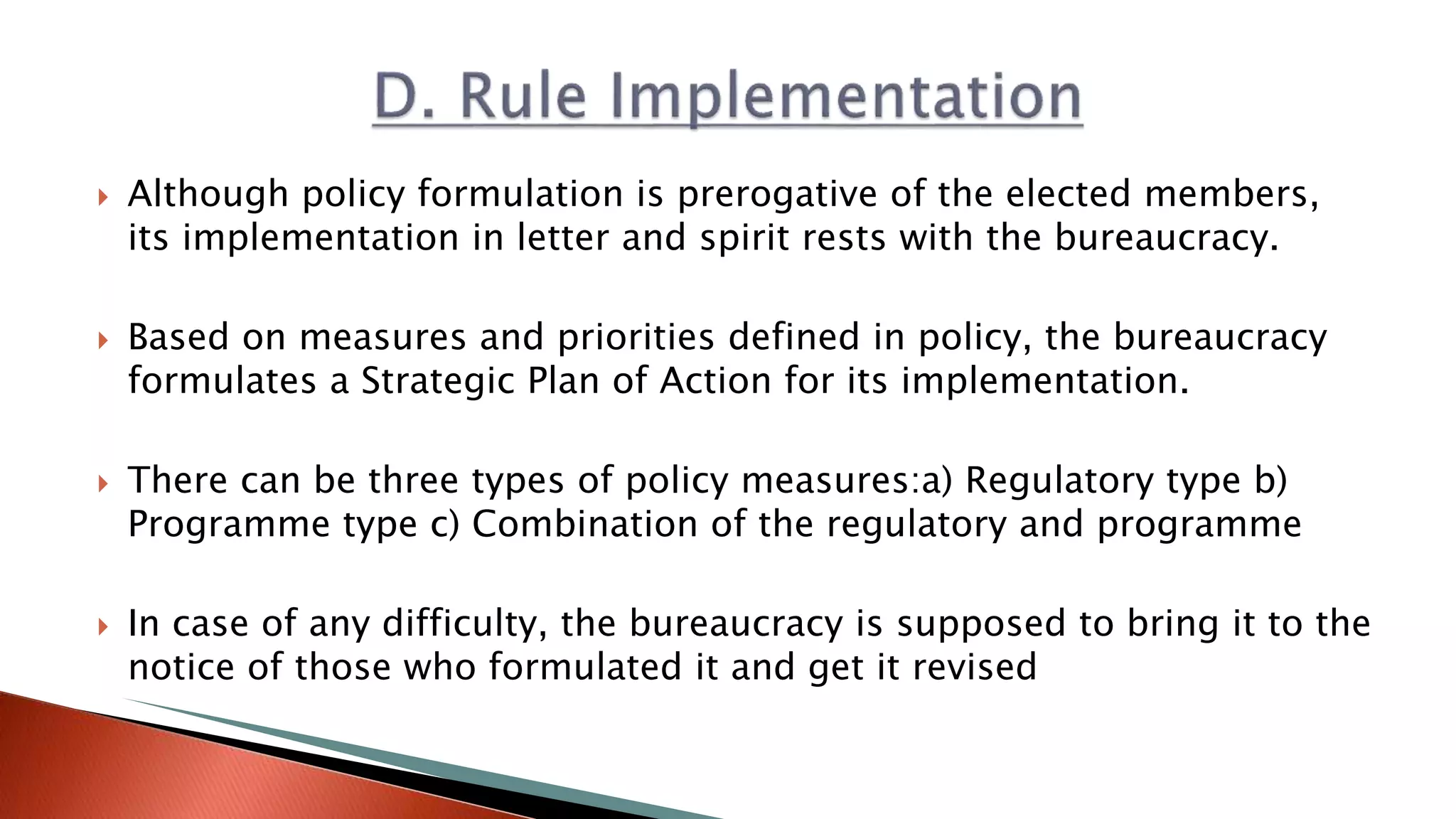
 Although policy formulation is prerogative of the elected members, its implementation in letter and spirit rests with the bureaucracy.  Based on measures and priorities defined in policy, the bureaucracy formulates a Strategic Plan of Action for its implementation.  There can be three types of policy measures:a) Regulatory type b) Programme type c) Combination of the regulatory and programme  In case of any difficulty, the bureaucracy is supposed to bring it to the notice of those who formulated it and get it revised
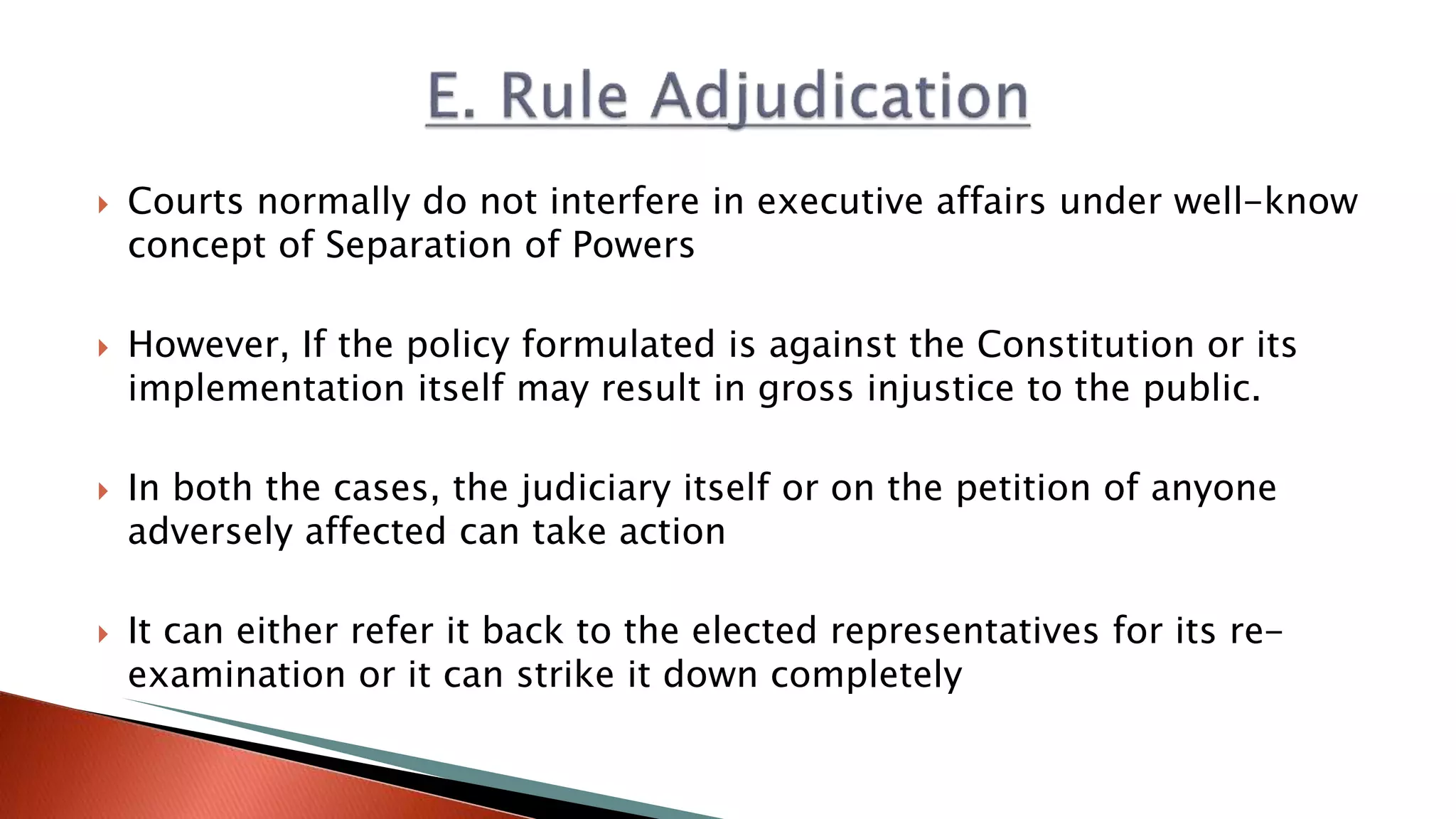
 Courts normally do not interfere in executive affairs under well-know concept of Separation of Powers  However, If the policy formulated is against the Constitution or its implementation itself may result in gross injustice to the public.  In both the cases, the judiciary itself or on the petition of anyone adversely affected can take action  It can either refer it back to the elected representatives for its re- examination or it can strike it down completely
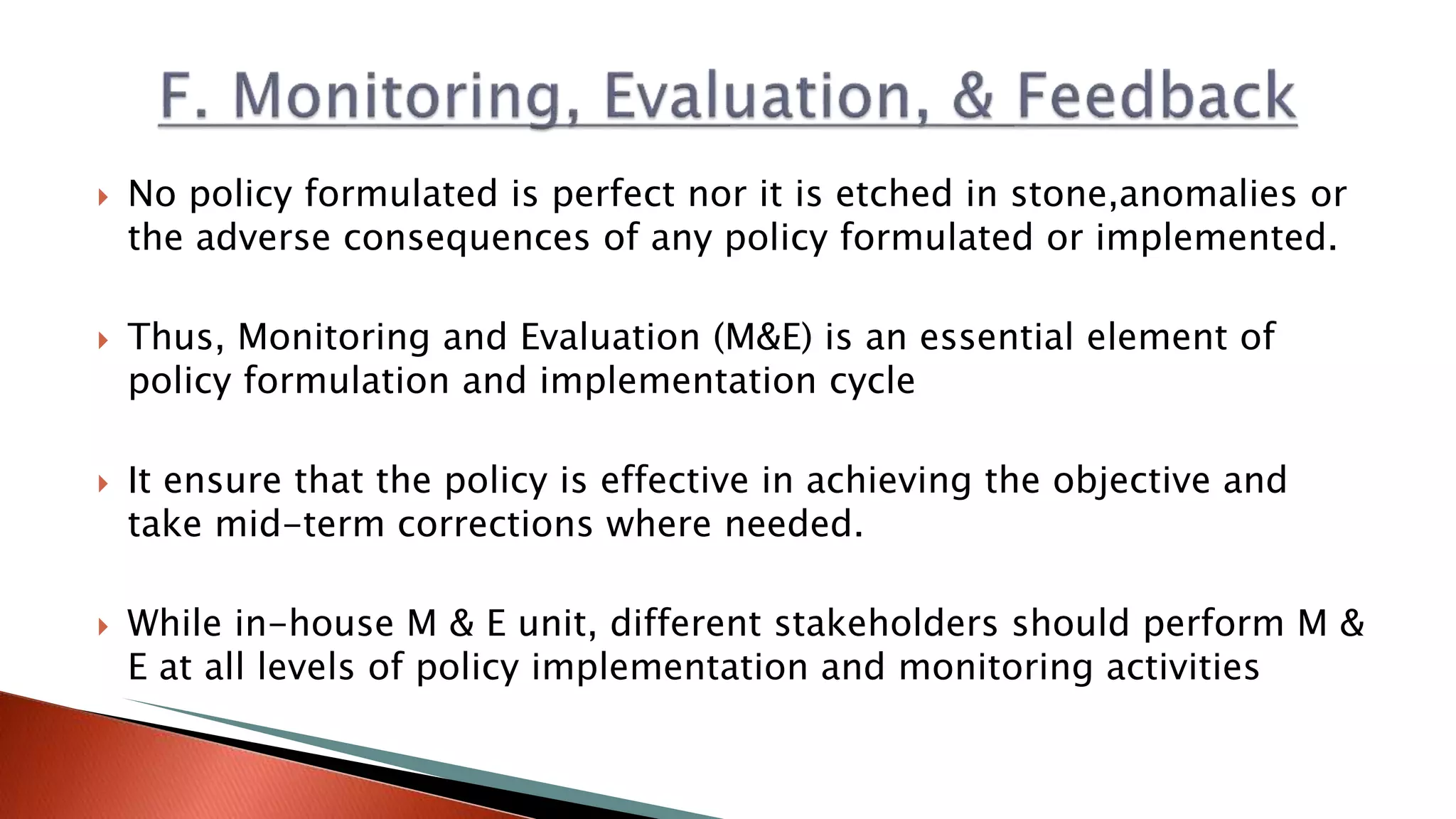
 No policy formulated is perfect nor it is etched in stone,anomalies or the adverse consequences of any policy formulated or implemented.  Thus, Monitoring and Evaluation (M&E) is an essential element of policy formulation and implementation cycle  It ensure that the policy is effective in achieving the objective and take mid-term corrections where needed.  While in-house M & E unit, different stakeholders should perform M & E at all levels of policy implementation and monitoring activities
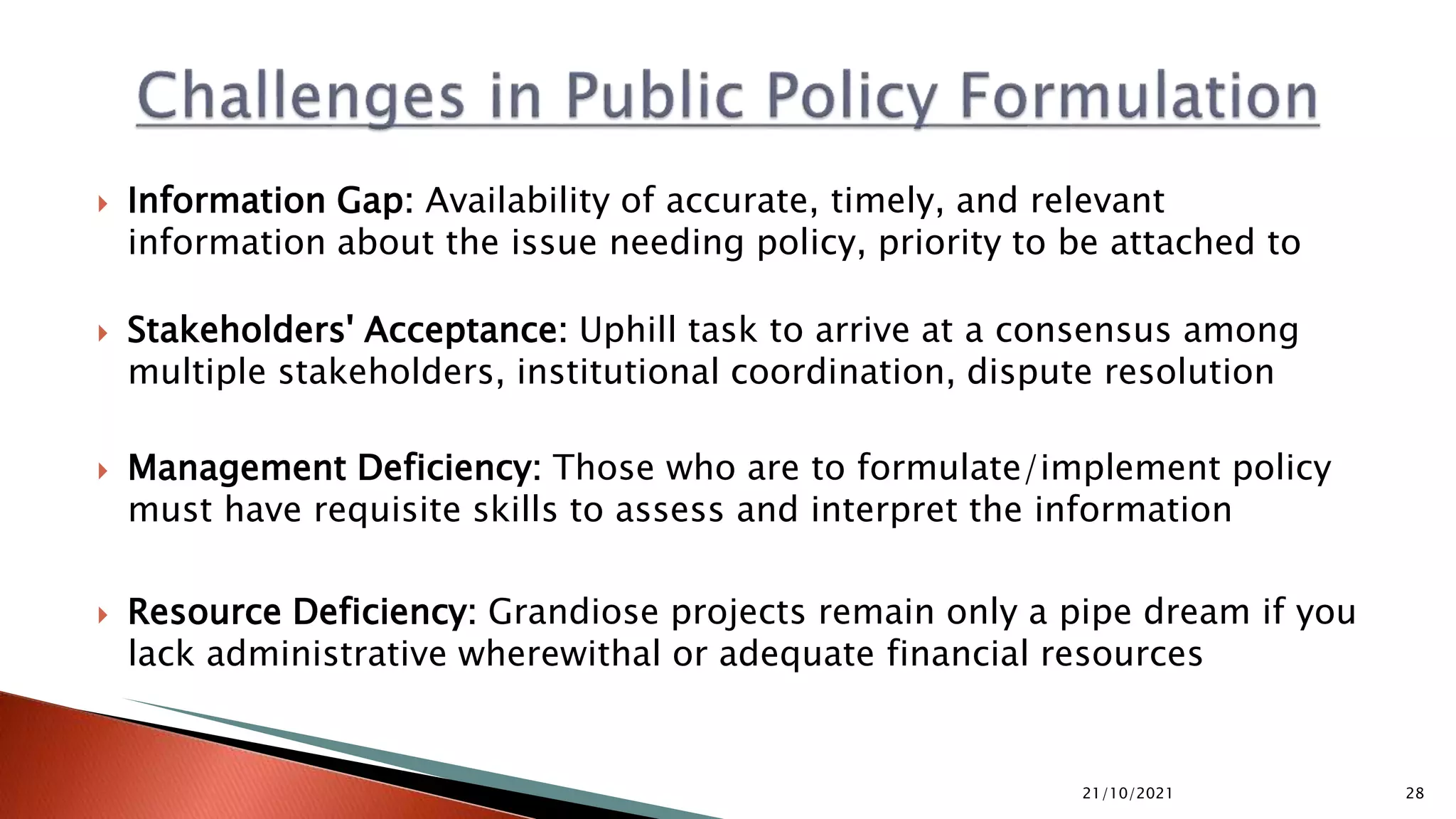
 Information Gap: Availability of accurate, timely, and relevant information about the issue needing policy, priority to be attached to  Stakeholders' Acceptance: Uphill task to arrive at a consensus among multiple stakeholders, institutional coordination, dispute resolution  Management Deficiency: Those who are to formulate/implement policy must have requisite skills to assess and interpret the information  Resource Deficiency: Grandiose projects remain only a pipe dream if you lack administrative wherewithal or adequate financial resources 21/10/2021 28
 Fundamental Rights: Any restriction on these rights like freedom of speech and association will adversely affect meaningful participation  Free Media: If there are restrictions on media by design or by default. it would again hinder public participation in policy formulation  Independent Judiciary: Courts take notice on the petition of any individual if they feel that there are restrictions on public participation  Fair Elections: Fair and free elections at regular intervals provides the best opportunity to the public to influence the government policies
 Public policy formulation is not a random act, rather a formally documented statement of intentions and sets of actions of a state  Exclusive domain of the elected representatives of the county; it is implemented by the state apparatus and has the sanctity of its own  Besides creating awareness about state intentions, it helps in creating confidence among public, and garner their support for those actions  There are many sources and drivers of public policy formulation which differs from country to country due to multiple reasons
 This presentation has been prepared by using the material contained in the author's book “Public Policy Formulation and Analysis”  It has been published as an ebook by Amazon and is available at https://www.amazon.com/dp/B01672SU10  This book has been translated into Spanish, French, and Portuguese also  Although written primarily for the managers, this handbook is equally useful for the senior executives belonging to the public or private sector
 If you like the presentation , kindly click the icon  For any question, kindly email me at shahidraja@hotmail.com  To download the presentation or its word version, please visit my website www.shahidhussainraja.com This website contains large number of articles on diverse issues. Some of these are presented in the next few slides
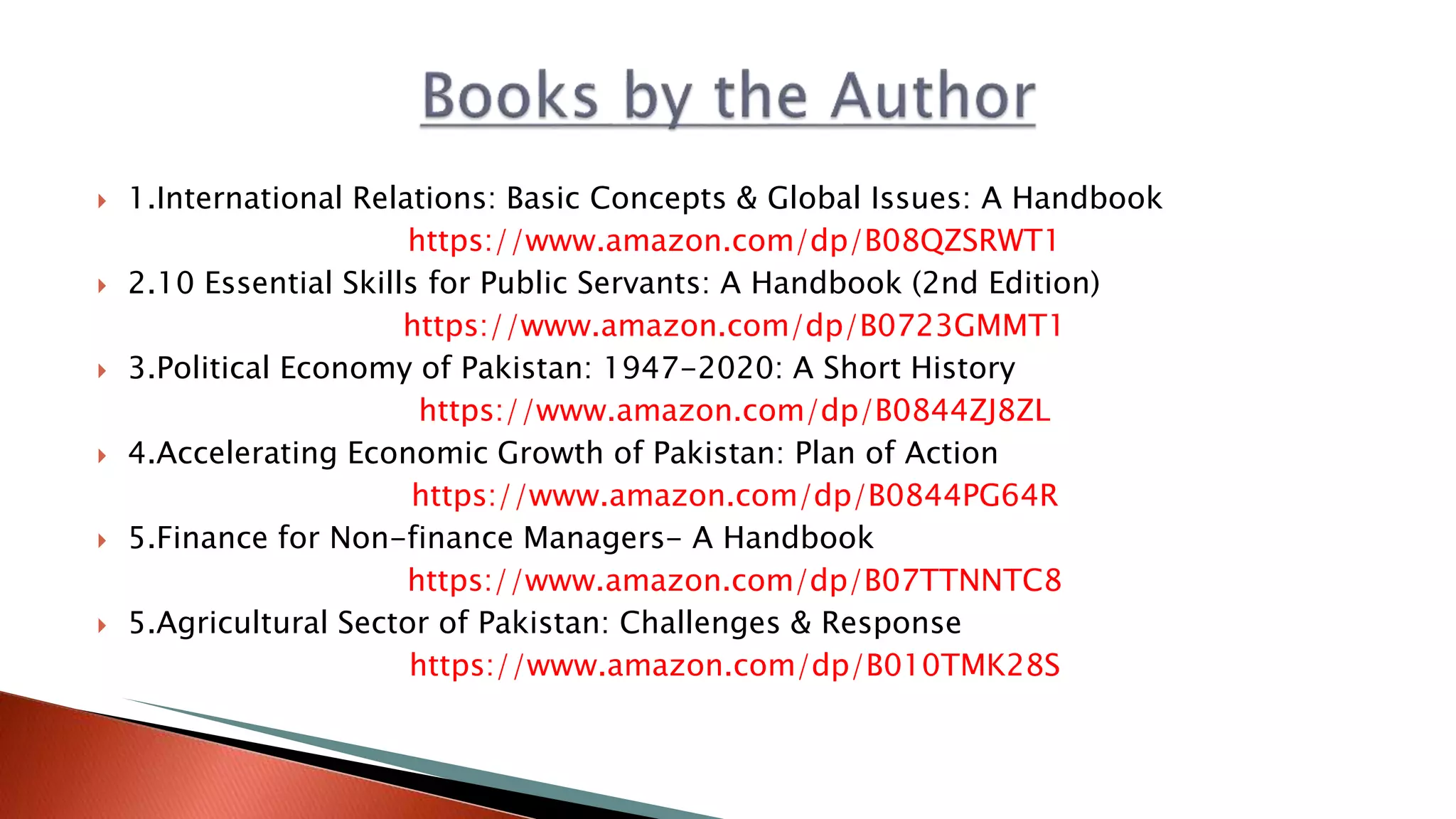
 1.International Relations: Basic Concepts & Global Issues: A Handbook https://www.amazon.com/dp/B08QZSRWT1  2.10 Essential Skills for Public Servants: A Handbook (2nd Edition) https://www.amazon.com/dp/B0723GMMT1  3.Political Economy of Pakistan: 1947-2020: A Short History https://www.amazon.com/dp/B0844ZJ8ZL  4.Accelerating Economic Growth of Pakistan: Plan of Action https://www.amazon.com/dp/B0844PG64R  5.Finance for Non-finance Managers- A Handbook https://www.amazon.com/dp/B07TTNNTC8  5.Agricultural Sector of Pakistan: Challenges & Response https://www.amazon.com/dp/B010TMK28S
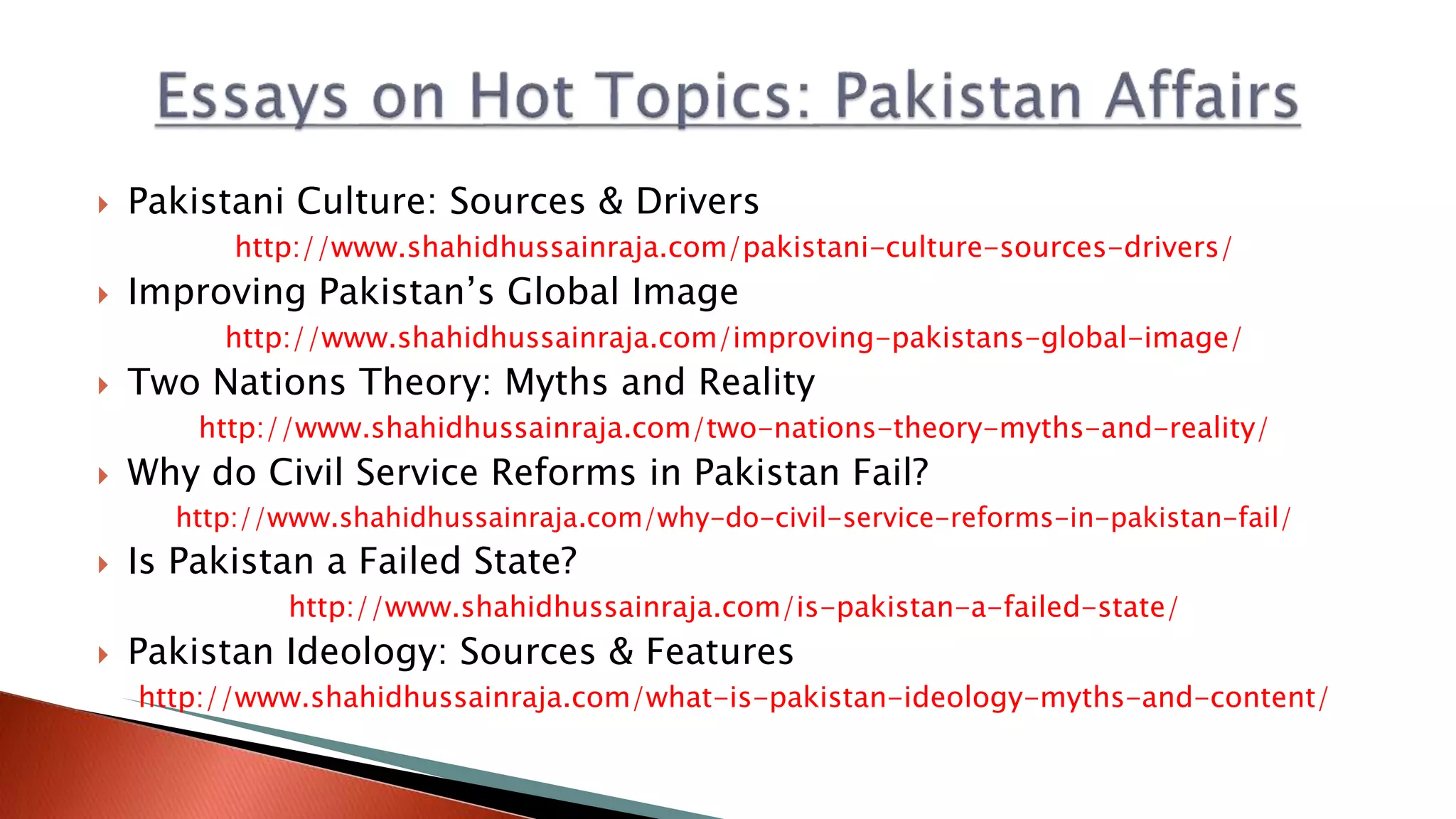
 Pakistani Culture: Sources & Drivers http://www.shahidhussainraja.com/pakistani-culture-sources-drivers/  Improving Pakistan’s Global Image http://www.shahidhussainraja.com/improving-pakistans-global-image/  Two Nations Theory: Myths and Reality http://www.shahidhussainraja.com/two-nations-theory-myths-and-reality/  Why do Civil Service Reforms in Pakistan Fail? http://www.shahidhussainraja.com/why-do-civil-service-reforms-in-pakistan-fail/  Is Pakistan a Failed State? http://www.shahidhussainraja.com/is-pakistan-a-failed-state/  Pakistan Ideology: Sources & Features http://www.shahidhussainraja.com/what-is-pakistan-ideology-myths-and-content/
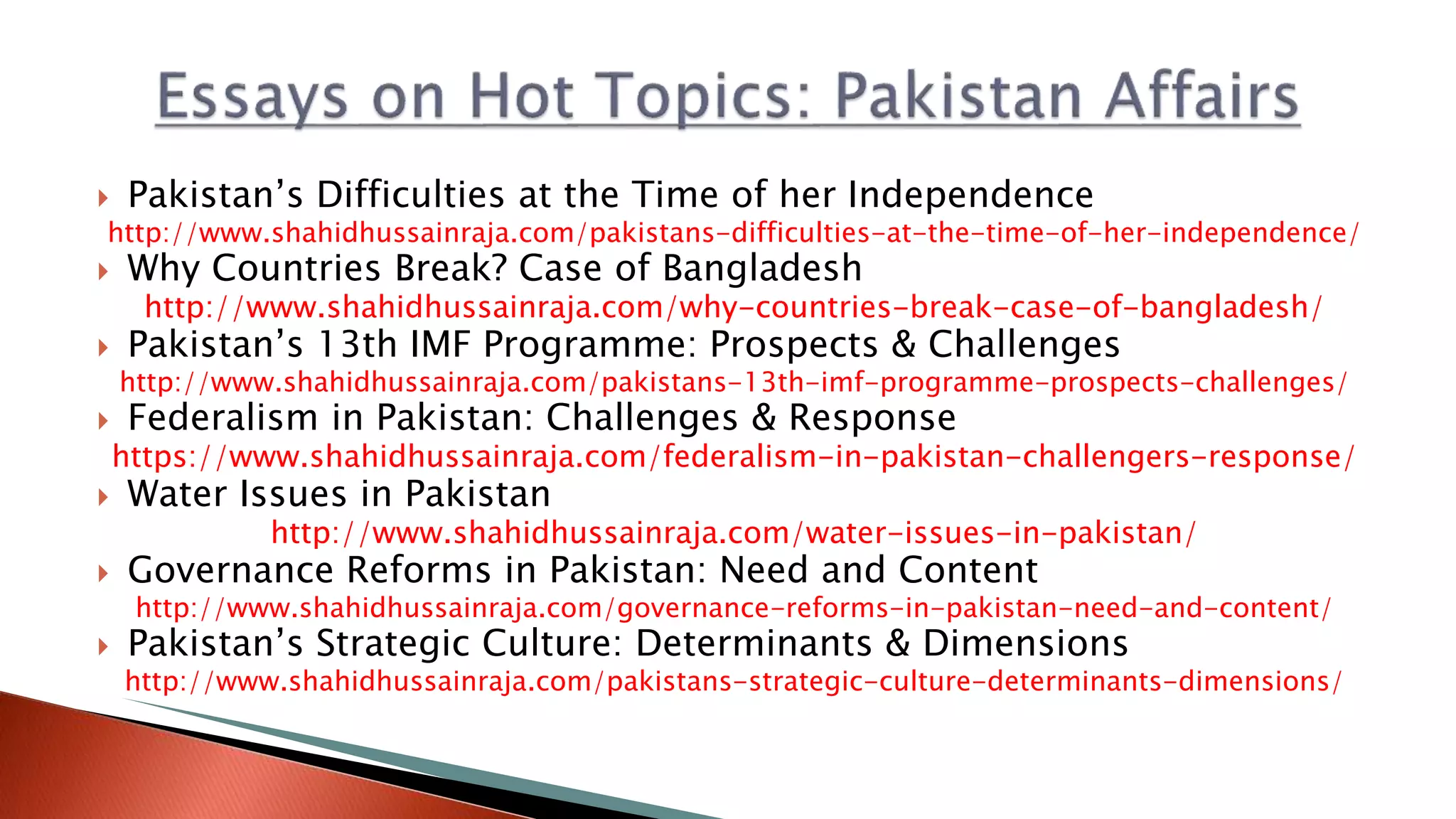
 Pakistan’s Difficulties at the Time of her Independence http://www.shahidhussainraja.com/pakistans-difficulties-at-the-time-of-her-independence/  Why Countries Break? Case of Bangladesh http://www.shahidhussainraja.com/why-countries-break-case-of-bangladesh/  Pakistan’s 13th IMF Programme: Prospects & Challenges http://www.shahidhussainraja.com/pakistans-13th-imf-programme-prospects-challenges/  Federalism in Pakistan: Challenges & Response https://www.shahidhussainraja.com/federalism-in-pakistan-challengers-response/  Water Issues in Pakistan http://www.shahidhussainraja.com/water-issues-in-pakistan/  Governance Reforms in Pakistan: Need and Content http://www.shahidhussainraja.com/governance-reforms-in-pakistan-need-and-content/  Pakistan’s Strategic Culture: Determinants & Dimensions http://www.shahidhussainraja.com/pakistans-strategic-culture-determinants-dimensions/
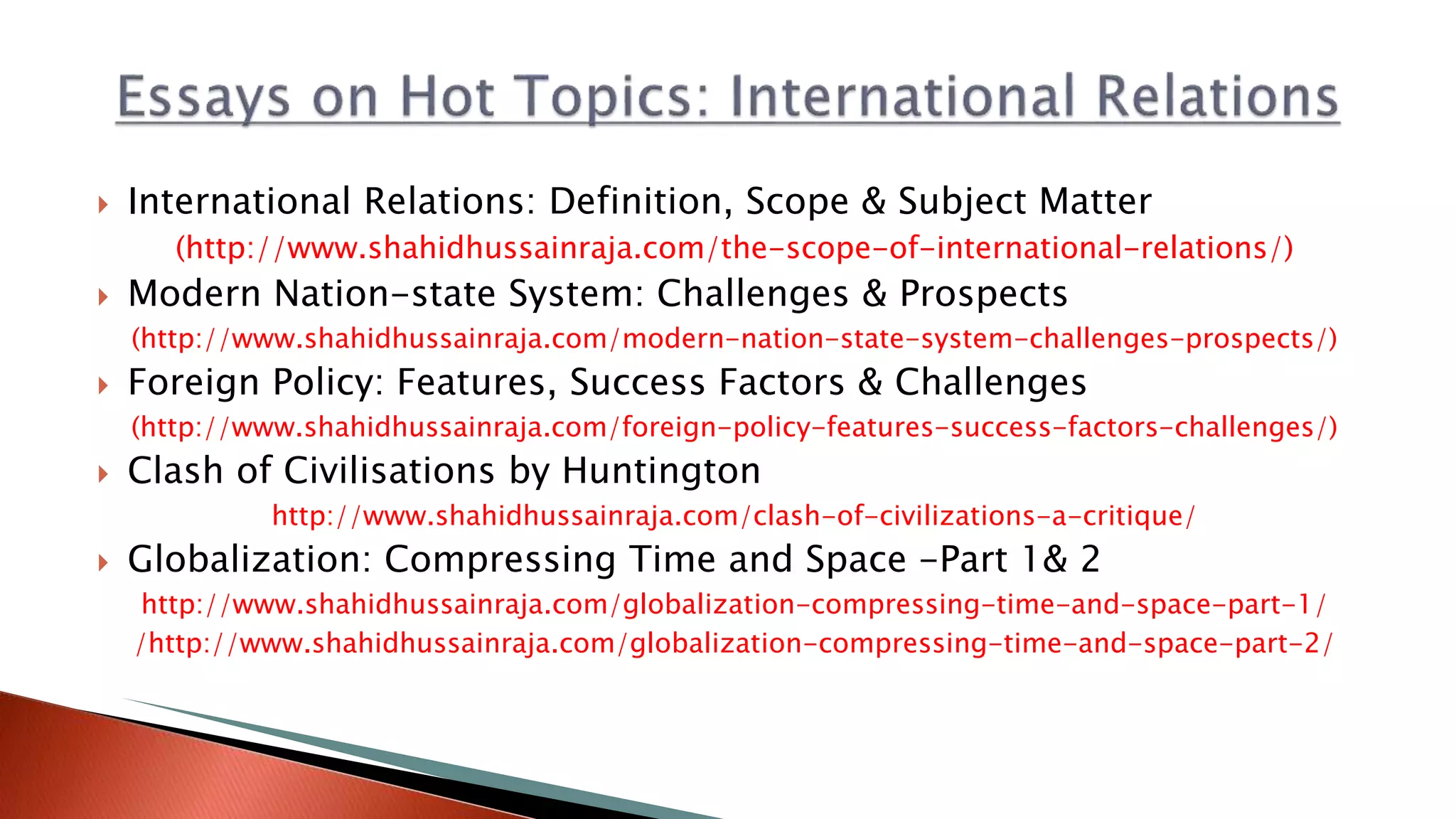
 International Relations: Definition, Scope & Subject Matter (http://www.shahidhussainraja.com/the-scope-of-international-relations/)  Modern Nation-state System: Challenges & Prospects (http://www.shahidhussainraja.com/modern-nation-state-system-challenges-prospects/)  Foreign Policy: Features, Success Factors & Challenges (http://www.shahidhussainraja.com/foreign-policy-features-success-factors-challenges/)  Clash of Civilisations by Huntington http://www.shahidhussainraja.com/clash-of-civilizations-a-critique/  Globalization: Compressing Time and Space -Part 1& 2 http://www.shahidhussainraja.com/globalization-compressing-time-and-space-part-1/ /http://www.shahidhussainraja.com/globalization-compressing-time-and-space-part-2/
 Determinants of Foreign Policy http://www.shahidhussainraja.com/determinants-of-foreign-policy/  Foreign Policy: Tools & Implements http://www.shahidhussainraja.com/foreign-policy-tools-instruments/  National Interest: Meaning & Components http://www.shahidhussainraja.com/national-interest-meaning-components/  World Peace: A Norm or an Aberration? http://www.shahidhussainraja.com/world-peace-a-norm-or-an-aberration/  End of History by Francis Fukuyama http://www.shahidhussainraja.com/end-of-history-by-francis-fukuyama-a-critique/  Breakup of Soviet Union: Causes & Consequences http://www.shahidhussainraja.com/breakup-of-the-soviet-union-causes-consequences/
 Global Terrorism: Challenges & Response – Part 1 & 2 http://www.shahidhussainraja.com/global-terrorism-challenges-response/ http://www.shahidhussainraja.com/global-terrorism-challenges-response-part-2/  War on Terror: Causes, Course, Costs and Consequences Part 1 & 2 http://www.shahidhussainraja.com/war-on-terror-causes-course-costs-and-consequences-part-1/ http://www.shahidhussainraja.com/war-on-terror-causes-course-costs-and-consequences-part-2/  Arab Spring: Genesis, Causes of Failure & Lessons Learnt http://www.shahidhussainraja.com/arab-spring-genesis-causes-of-failure-lessons-learnt/  Islamophobia: Genesis, Challenges & Response http://www.shahidhussainraja.com/islamophobia-genesis-challenges-response/  Vietnam War: Causes & Consequences http://www.shahidhussainraja.com/vietnam-war-causes-course-and-consequences/
 Nine Drivers of Sino-American Cold War http://www.shahidhussainraja.com/9-drivers-of-america-china-cold-war/  IMF Programmes: Do they help Developing Countries? http://www.shahidhussainraja.com/imf-programme-does-it-help-a-developing-country/  American Interests in Afghanistan http://www.shahidhussainraja.com/american-interests-in-afghanistan/  Reasons for Soviet Invasion of Afghanistan in 1979 http://www.shahidhussainraja.com/why-did-soviet-union-enter-afghanistan-in-1979/  The Middle East Crises: Genesis and Dimensions http://www.shahidhussainraja.com/the-middle-east-crises-genesis-and-dimensions/  China Iran Relations: Past, Present & Future http://www.shahidhussainraja.com/china-iran-relations-past-present-future/
Thanks

Public Policy Formulation and Analysis-1: Definition, Process,& Challenges

  • 1.
  • 2.
     Introduction  NationalInterest, Good Governance & Public Policy  What is Public Policy  Components of Policy  Importance of Public Policies  Sources and Types of Policy Formulation  Stages of Policy Formulation  Challenges in Public Policy Formulation  Facilitating Public Participation in Policy Formulation  Conclusion 21/10/2021 2
  • 3.
     This ispart 1 of the 3-part Course on Public Policy Formulation  This course explains the way policies are formulated, the steps involved and the activities to be performed in the various steps  It also explains the main features of a good public policy and discusses it with reference to policy formulation in Pakistan  In this presentation, we will be discussing the features of public policy, six stages of public policy formulation, & challenges faced 21/10/2021 3
  • 4.
     Retired asFederal Secretary, Govt. of Pakistan, held senior positions  Ex.Chief Instructor, National School of Public Policy, Lahore (Pakistan)  M.A. (Economics), M.A. (Political Science)-Punjab University, Lahore  M.Sc.(Defence and Strategic Studies)-National Defence College  Post Graduate Diploma (Development Studies)-Cambridge University  Executive Development Program-JFK School of Government, Harvard  Author of 12 books on various public policy, national/global issues.  Conducts courses online and offline
  • 5.
  • 6.
     Every statehas one overriding objective-improving the quality of life of its citizens. It has 3 interrelated and inter dependent components 1. Standard of Living: Increasing the quantity, quality and access of economic goods and services-food, shelter, clothing, health, education etc. 2. Good Governance: Increasing quantity, quality & access of political goods & services- external defence, internal peace, access to justice, political empowerment 3. Social Development: Increasing the quantity, quality and access of social goods and services- classless society, equality of opportunity, cultural enhancement,  To achieve this objective, the government formulates a set of national policies along with suitable strategies to implement them.
  • 7.
     Quality ofgovernance in a country is dependent on its capacity to effectively formulate and implement sound socioeconomic policies.  Although policy formulation is the responsibility of the elected members, its implementation rests with the public servants.  Public policy studies have been receiving a lot of attention in academic circles all over the world for diverse reasons.  Main reason for this interest has been the increasingly assertive role of the civil society organizations and the media.
  • 8.
     Formal documentedstatement of intentions and actions of an organization/authority either to remove certain deficiencies or to improve the conditions in any particular area  “whatever governments choose to do or not to do” Thomas Dye (1987)  “Purposive course of action or inaction undertaken by an actor or a set of actors in dealing with a problem or matter of concern” Anderson (1994) 21/10/2021 8
  • 9.
     Not arandom act, rather a deliberate action  Approved by public representatives  Not a piece of legislation but has its own sanctity  Distinct from strategy to implement it by state apparatus  It could be a part of an overall development policy i.e. Food Security as objective of National Development Strategy or it  Could be a specific departmental policy i.e. Food Security Policy 21/10/2021 9
  • 10.
     Preamble: Statementof Facts-why need for this policy  Definitions: General Clauses- definitions of terms used  Scope: Broad outlines of what to do in which areas  Policy Directions: Specific actions to be taken, their priority  Institutional Mechanism: Which are responsible authorities  Date of Application: When it will be applicable  Repeal Clauses: Which previous policy/clauses it repeals/replaces 21/10/2021 10
  • 11.
     Big Picture:Only state has big picture of its overall aims and objectives, can give clear guidelines to solve a problem.  Public Awareness: Get public support by informing them about state sincerity and seriousness to address their greivances/publicity  Synergy: To ensure clarity about the respective domains of different policies, have synergistic, not divisive effect  Transparency: By informing public bout government's intentions, actions, and priorities, people should know who is getting what 21/10/2021 11
  • 12.
     There isa complex relationship among the institutions responsible for formulating and implementing the public policies in a country.  These actors could be grouped into 3 distinct categories namely political elites, bureaucracy, & private sector (firms as well as NGOs)  Every entity in these categories strives hard to safeguard its respective vested corporate interests more than the stated welfare objectives  Gordon Adams calls it "iron triangle of Public Policy", because of its inherent strength based on mutually beneficial cooperation of all
  • 14.
     Distributive: Formulatedin response to specific issue & affect only select group of people yet their impact could be far-reaching- Car emissions  Redistributive: Affect majority; compulsory employees pension contributions affect any business hiring an employee.  Regulative: These policies are often applied to businesses and corporations to impose good business practices.  Constituent: Any policy converted into proper legislation is a constituent public policy. 21/10/2021 14
  • 15.
    21/10/2021 15 Stages ofPolicy Formulation
  • 16.
     Problem Identification:The problem is identified, its nature described, its affectees, time duration, awareness level etc  Policy Formulation: Marked by discussions between government officials & interests groups, alternatives, solutions, obstacles, benchmarks  Policy Adoption:policy maker evaluate alternatives policies/accept one  Policy Implementation: defining agencies and organizations are involved and responsibilities are assigned to each agency on their part.  Policy Evaluation:to know how the policy is working after it has been implemented, deficiencies in execution identified and rectified
  • 17.
    A. Interest Articulation B.Interest Aggregation C. Rule Making-four stages and approval D. Rule Implementation E. Rule Adjudication F. Monitoring, Evaluation, & Feedback 21/10/2021 17
  • 18.
     Demand forpublic policy formulation starts from a group of people facing a problem who use different media to air their grievances  Different interest groups having sets of demands are involved in alliance building with other groups on give and take agreements.  Media is important vehicle for airing their demands to ensure their interests are reflected in the manifestos of the political parties  They also engage lobbyists not only at this stage but also at the other stages. This is Interest Articulation-first stage of policy formulation
  • 19.
     Societal StructuralChanges: demographic transition, economic transformation, Urbanisation, Technology Change  Regime Change: new political elite may have new vision, mission and agenda for which it needs new sets of public policies  Donors/World institutions: their aid may be contingent upon certain policy changes, structural changes 21/10/2021 19
  • 20.
     Global Commitments:state enters into international conventions which normally need local policy formulation  Pressure Groups: industrial ,agricultural lobbies, social causes advocacy groups can force state for this  Court Orders: Superior courts orders for formulating clear policies or review an existing policy while hearing any case 21/10/2021 20
  • 21.
     A politicalparty is a diverse conglomeration of groups of people, each using its platform to advocate and advance its corporate interests  Mostly, these sets of demands are contradictory, forcing party leaders to aggregate these competing demands into viable policy options  These policy options are reflected in their election manifestos during the election campaigns or presented through their elected members  Once converted into policy, political parties have to ensure that these are implemented in letter and spirit-hence their role in M&E
  • 22.
     Many usethis stage as interchangeable with overall public policy making which is not true.  Rule making is no doubt the most important stage of the entire chain, yet it is only one rung in a staircase of public policy formulation.  There are two options for preparing a policy document 1. Integration of policy concerns into overall and sectoral policies. 2. Preparation of a sector-specific policy document  Whichever option is chosen, there are normally four phases in draft policy formulation and its validation process
  • 23.
     PHASE- 1 Establishmentof a task force, consisting of stakeholders  PHASE -2 Diagnosis of the situation-what, when, why something needed  PHASE-3 Production of a first/second draft of the policy  PHASE- 4 Presented for endorsement for the sponsoring authority 21/10/2021 23
  • 24.
     Concerned ministrygets its approval from the competent authority  In case of single ministry policy, the minister in charge  In case of multisectoral policy- the cabinet  If it affects the provinces-Council of Common Interests (CCI)  Once approved, it is formally notified  If needed, sent for formal legislation to the parliament 21/10/2021 24
  • 25.
     Although policyformulation is prerogative of the elected members, its implementation in letter and spirit rests with the bureaucracy.  Based on measures and priorities defined in policy, the bureaucracy formulates a Strategic Plan of Action for its implementation.  There can be three types of policy measures:a) Regulatory type b) Programme type c) Combination of the regulatory and programme  In case of any difficulty, the bureaucracy is supposed to bring it to the notice of those who formulated it and get it revised
  • 26.
     Courts normallydo not interfere in executive affairs under well-know concept of Separation of Powers  However, If the policy formulated is against the Constitution or its implementation itself may result in gross injustice to the public.  In both the cases, the judiciary itself or on the petition of anyone adversely affected can take action  It can either refer it back to the elected representatives for its re- examination or it can strike it down completely
  • 27.
     No policyformulated is perfect nor it is etched in stone,anomalies or the adverse consequences of any policy formulated or implemented.  Thus, Monitoring and Evaluation (M&E) is an essential element of policy formulation and implementation cycle  It ensure that the policy is effective in achieving the objective and take mid-term corrections where needed.  While in-house M & E unit, different stakeholders should perform M & E at all levels of policy implementation and monitoring activities
  • 28.
     Information Gap:Availability of accurate, timely, and relevant information about the issue needing policy, priority to be attached to  Stakeholders' Acceptance: Uphill task to arrive at a consensus among multiple stakeholders, institutional coordination, dispute resolution  Management Deficiency: Those who are to formulate/implement policy must have requisite skills to assess and interpret the information  Resource Deficiency: Grandiose projects remain only a pipe dream if you lack administrative wherewithal or adequate financial resources 21/10/2021 28
  • 29.
     Fundamental Rights:Any restriction on these rights like freedom of speech and association will adversely affect meaningful participation  Free Media: If there are restrictions on media by design or by default. it would again hinder public participation in policy formulation  Independent Judiciary: Courts take notice on the petition of any individual if they feel that there are restrictions on public participation  Fair Elections: Fair and free elections at regular intervals provides the best opportunity to the public to influence the government policies
  • 30.
     Public policyformulation is not a random act, rather a formally documented statement of intentions and sets of actions of a state  Exclusive domain of the elected representatives of the county; it is implemented by the state apparatus and has the sanctity of its own  Besides creating awareness about state intentions, it helps in creating confidence among public, and garner their support for those actions  There are many sources and drivers of public policy formulation which differs from country to country due to multiple reasons
  • 31.
     This presentationhas been prepared by using the material contained in the author's book “Public Policy Formulation and Analysis”  It has been published as an ebook by Amazon and is available at https://www.amazon.com/dp/B01672SU10  This book has been translated into Spanish, French, and Portuguese also  Although written primarily for the managers, this handbook is equally useful for the senior executives belonging to the public or private sector
  • 32.
     If youlike the presentation , kindly click the icon  For any question, kindly email me at shahidraja@hotmail.com  To download the presentation or its word version, please visit my website www.shahidhussainraja.com This website contains large number of articles on diverse issues. Some of these are presented in the next few slides
  • 33.
     1.International Relations:Basic Concepts & Global Issues: A Handbook https://www.amazon.com/dp/B08QZSRWT1  2.10 Essential Skills for Public Servants: A Handbook (2nd Edition) https://www.amazon.com/dp/B0723GMMT1  3.Political Economy of Pakistan: 1947-2020: A Short History https://www.amazon.com/dp/B0844ZJ8ZL  4.Accelerating Economic Growth of Pakistan: Plan of Action https://www.amazon.com/dp/B0844PG64R  5.Finance for Non-finance Managers- A Handbook https://www.amazon.com/dp/B07TTNNTC8  5.Agricultural Sector of Pakistan: Challenges & Response https://www.amazon.com/dp/B010TMK28S
  • 34.
     Pakistani Culture:Sources & Drivers http://www.shahidhussainraja.com/pakistani-culture-sources-drivers/  Improving Pakistan’s Global Image http://www.shahidhussainraja.com/improving-pakistans-global-image/  Two Nations Theory: Myths and Reality http://www.shahidhussainraja.com/two-nations-theory-myths-and-reality/  Why do Civil Service Reforms in Pakistan Fail? http://www.shahidhussainraja.com/why-do-civil-service-reforms-in-pakistan-fail/  Is Pakistan a Failed State? http://www.shahidhussainraja.com/is-pakistan-a-failed-state/  Pakistan Ideology: Sources & Features http://www.shahidhussainraja.com/what-is-pakistan-ideology-myths-and-content/
  • 35.
     Pakistan’s Difficultiesat the Time of her Independence http://www.shahidhussainraja.com/pakistans-difficulties-at-the-time-of-her-independence/  Why Countries Break? Case of Bangladesh http://www.shahidhussainraja.com/why-countries-break-case-of-bangladesh/  Pakistan’s 13th IMF Programme: Prospects & Challenges http://www.shahidhussainraja.com/pakistans-13th-imf-programme-prospects-challenges/  Federalism in Pakistan: Challenges & Response https://www.shahidhussainraja.com/federalism-in-pakistan-challengers-response/  Water Issues in Pakistan http://www.shahidhussainraja.com/water-issues-in-pakistan/  Governance Reforms in Pakistan: Need and Content http://www.shahidhussainraja.com/governance-reforms-in-pakistan-need-and-content/  Pakistan’s Strategic Culture: Determinants & Dimensions http://www.shahidhussainraja.com/pakistans-strategic-culture-determinants-dimensions/
  • 36.
     International Relations:Definition, Scope & Subject Matter (http://www.shahidhussainraja.com/the-scope-of-international-relations/)  Modern Nation-state System: Challenges & Prospects (http://www.shahidhussainraja.com/modern-nation-state-system-challenges-prospects/)  Foreign Policy: Features, Success Factors & Challenges (http://www.shahidhussainraja.com/foreign-policy-features-success-factors-challenges/)  Clash of Civilisations by Huntington http://www.shahidhussainraja.com/clash-of-civilizations-a-critique/  Globalization: Compressing Time and Space -Part 1& 2 http://www.shahidhussainraja.com/globalization-compressing-time-and-space-part-1/ /http://www.shahidhussainraja.com/globalization-compressing-time-and-space-part-2/
  • 37.
     Determinants ofForeign Policy http://www.shahidhussainraja.com/determinants-of-foreign-policy/  Foreign Policy: Tools & Implements http://www.shahidhussainraja.com/foreign-policy-tools-instruments/  National Interest: Meaning & Components http://www.shahidhussainraja.com/national-interest-meaning-components/  World Peace: A Norm or an Aberration? http://www.shahidhussainraja.com/world-peace-a-norm-or-an-aberration/  End of History by Francis Fukuyama http://www.shahidhussainraja.com/end-of-history-by-francis-fukuyama-a-critique/  Breakup of Soviet Union: Causes & Consequences http://www.shahidhussainraja.com/breakup-of-the-soviet-union-causes-consequences/
  • 38.
     Global Terrorism:Challenges & Response – Part 1 & 2 http://www.shahidhussainraja.com/global-terrorism-challenges-response/ http://www.shahidhussainraja.com/global-terrorism-challenges-response-part-2/  War on Terror: Causes, Course, Costs and Consequences Part 1 & 2 http://www.shahidhussainraja.com/war-on-terror-causes-course-costs-and-consequences-part-1/ http://www.shahidhussainraja.com/war-on-terror-causes-course-costs-and-consequences-part-2/  Arab Spring: Genesis, Causes of Failure & Lessons Learnt http://www.shahidhussainraja.com/arab-spring-genesis-causes-of-failure-lessons-learnt/  Islamophobia: Genesis, Challenges & Response http://www.shahidhussainraja.com/islamophobia-genesis-challenges-response/  Vietnam War: Causes & Consequences http://www.shahidhussainraja.com/vietnam-war-causes-course-and-consequences/
  • 39.
     Nine Driversof Sino-American Cold War http://www.shahidhussainraja.com/9-drivers-of-america-china-cold-war/  IMF Programmes: Do they help Developing Countries? http://www.shahidhussainraja.com/imf-programme-does-it-help-a-developing-country/  American Interests in Afghanistan http://www.shahidhussainraja.com/american-interests-in-afghanistan/  Reasons for Soviet Invasion of Afghanistan in 1979 http://www.shahidhussainraja.com/why-did-soviet-union-enter-afghanistan-in-1979/  The Middle East Crises: Genesis and Dimensions http://www.shahidhussainraja.com/the-middle-east-crises-genesis-and-dimensions/  China Iran Relations: Past, Present & Future http://www.shahidhussainraja.com/china-iran-relations-past-present-future/
  • 40.