Policy making models - approaches 1 M. E. (II) Town and Country Planning Semester – III Prof. Bhasker V. Bhatt PG In-charge (ME-TCP) Civil Engineering Department SCET, Surat Politics & Public Policy Planning (2734804) Major Elective IV Public Policy Models by Bhasker V. Bhatt is licensed under a Creative Commons Attribution- NonCommercial-ShareAlike 4.0 International License.
Key difference of Public and Private sectors 05:52# # # KEEP TAKING NOTES # # #2  Faces more complex and ambiguous tasks  Has more problems in implementing its decisions  Employs more people with a wide range of motivations  Is more concerned with securing opportunities or capacities  Engages in activities with greater symbolic significance  Is held to stricter standards of commitment and legality  Has a greater opportunity to respond to issues of fairness  Must operate or appear to operate in public interest
Idea of Policy 05:52# # # KEEP TAKING NOTES # # #3 Policy denotes “Guidance for action” may be in a form of:  Authoritative decision  Principle or a rule  Purposive course of action  System of governance  Manifestation of considered judgment  Expression of political rationality  Declaration of common goals Policy is the base of POWER.
Uses of the term “Policy” 05:52# # # KEEP TAKING NOTES # # #4 (1984) Hogwood and Gunn specifies the use of term Policy as for:  A label for the field of activity  An expression of desired state of affairs  Specific proposals  Decision of government  Formal authorization  A programme  Output  Outcome  A theory or Model  A process.
Typologies of policy 05:52# # # KEEP TAKING NOTES # # #5 Distributive policies Redistributive policies Regulatory policies
Distributive Policies 05:52# # # KEEP TAKING NOTES # # #6  Policies concerned with the distribution of new resources are distributive policies  Includes grants, subsidies, adult education programme, food relief, social insurance, scholarship to EWS students  Legislation will be quite specific in the case  Key decision as “who has to receive benefits and how much one is to receive” are made by legislators
Redistributive Policies 05:52# # # KEEP TAKING NOTES # # #7  Concerned with changing the distribution of existing resources, and with the rearrangement of policies which are related to bringing about basic social and economic changes in the economy of society.  Include actions that affect credit and supply of money, taxes, social security and payment transfers.  Policies are ideological – raising basic issues about proper role of Govt. in societal and economic matters  Some require considerable administrative expertise and discretion in implementation others are clearly defined by law and require only routine
Regulatory Policies 05:52# # # KEEP TAKING NOTES # # #8  Concerned with regulation and control of activities.  Seek to alter individual behavior directly by imposing standards on regulated industries (likely to arouse controversy)  Interest groups are likely to be formed around regulatory issues  UGC, AICTE, CBSE perform both promotional and regulatory activities in education.  Medical council of India, Bar Council of India, Pharmacy Council of India, Nursing Council of India – protects standards  TRAI, RBI, SEBI engaged in regulatory activities
Conflict of policy issues 05:52# # # KEEP TAKING NOTES # # #9 Cobb and Elder contributions:  Conflict may arise between two or more groups over issues relating to distribution of positions or resource created by situations as:  Unfairness or bias in the distribution of positions or resources  Framing of an issue for personal or group gain  Unanticipated human events, natural disasters, international conflict, war and technological changes  Such issues constitute agenda for policy.
Nature of Public Policy 05:52# # # KEEP TAKING NOTES # # #10  A policy may be:  General of specific  Broad or narrow  Simple or complex  Public or private  Written or unwritten  Explicit or implicit  Discretionary or detailed  Qualitative or quantitative  Understanding public policy is an art as well as craft.
Nature of Public Policy… 05:52# # # KEEP TAKING NOTES # # #11  Art required insight and creativity in identifying social problems  leading to better quality of life  It is craft as various tasks often require some knowledge of social sciences.  Policy is “guidance for action” for government.  Activities of government can be put broadly in two categories:  Definite or specific policies  General, vague and inconsistent policies.
Nature of Public Policy… 05:52# # # KEEP TAKING NOTES # # #12  Possibility of  An action without a policy or to have a policy without an action.  Governmental nature of policy – mostly adopted by government authorities, due to their power, give them legal authority.  Public policies embodied in a set of practices and precedents – the unwritten constitution of UK
Nature of Public Policy… 05:52# # # KEEP TAKING NOTES # # #13  The British Constitution is unwritten in one single document, unlike the constitution in America or the proposed European Constitution, and as such, is referred to as an un-codified constitution in the sense that there is no single document that can be classed as Britain's constitution. (http://www.historylearningsite.co.uk/british_constitu tion1.htm)
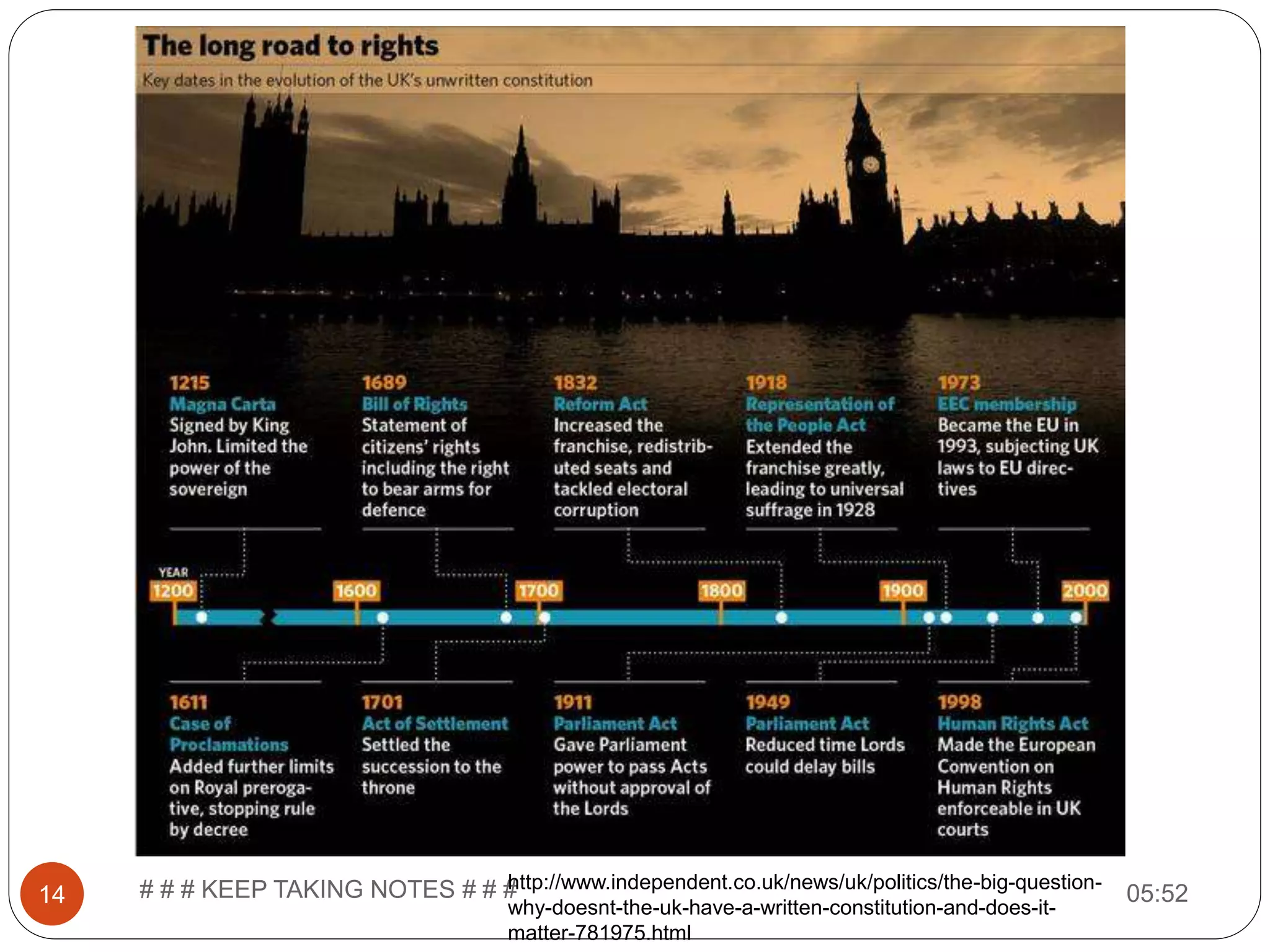
05:52# # # KEEP TAKING NOTES # # #14 http://www.independent.co.uk/news/uk/politics/the-big-question- why-doesnt-the-uk-have-a-written-constitution-and-does-it- matter-781975.html
Nature of Public Policy… 05:52# # # KEEP TAKING NOTES # # #15  A public policy may cover major portion of its activities such as a development policy.  Socio-economic development  Economic growth  Social justice  Equality  Self-resilience  Broad principles of guidance for action adopted for national goal
Nature of Public Policy… 05:52# # # KEEP TAKING NOTES # # #16  Narrow in nature…  Family planning restrained to a section of the people  Child labour (factories not to employ child below age of 18)  Megapolicies (defined by Dror)  General guidelines to be followed by all specific policies  Master policy distinct from discrete policies  Establishes overall goals to serve as guidelines  Expression of national goals  Purposeful and goal oriented.
Nature of Public Policy… 05:52# # # KEEP TAKING NOTES # # #17  Democratic form of government  many pressure groups or political parties  deliberate adoption of vague, inconsistent or contradictory policies in order to SATISFY all pressure groups. Positive / Negative form of policy.  towards certain action Legally coercive nature  citizens to accept as legitimate (taxes must be paid unless one wants to run the risk of fines or imprisonment)
Policies and Decisions 05:52# # # KEEP TAKING NOTES # # #18  Policy-making involve decision, but a decision does not necessarily constitute a policy.  Decision making often involve identification of a problem, careful analysis of possible alternatives, selection of one alternatives for action.  Policy decisions taken thus provide a sense of direction to the course of an administrative action.  Issue executive orders  Promulgate administrative rules  Make important judicial interpretation of laws
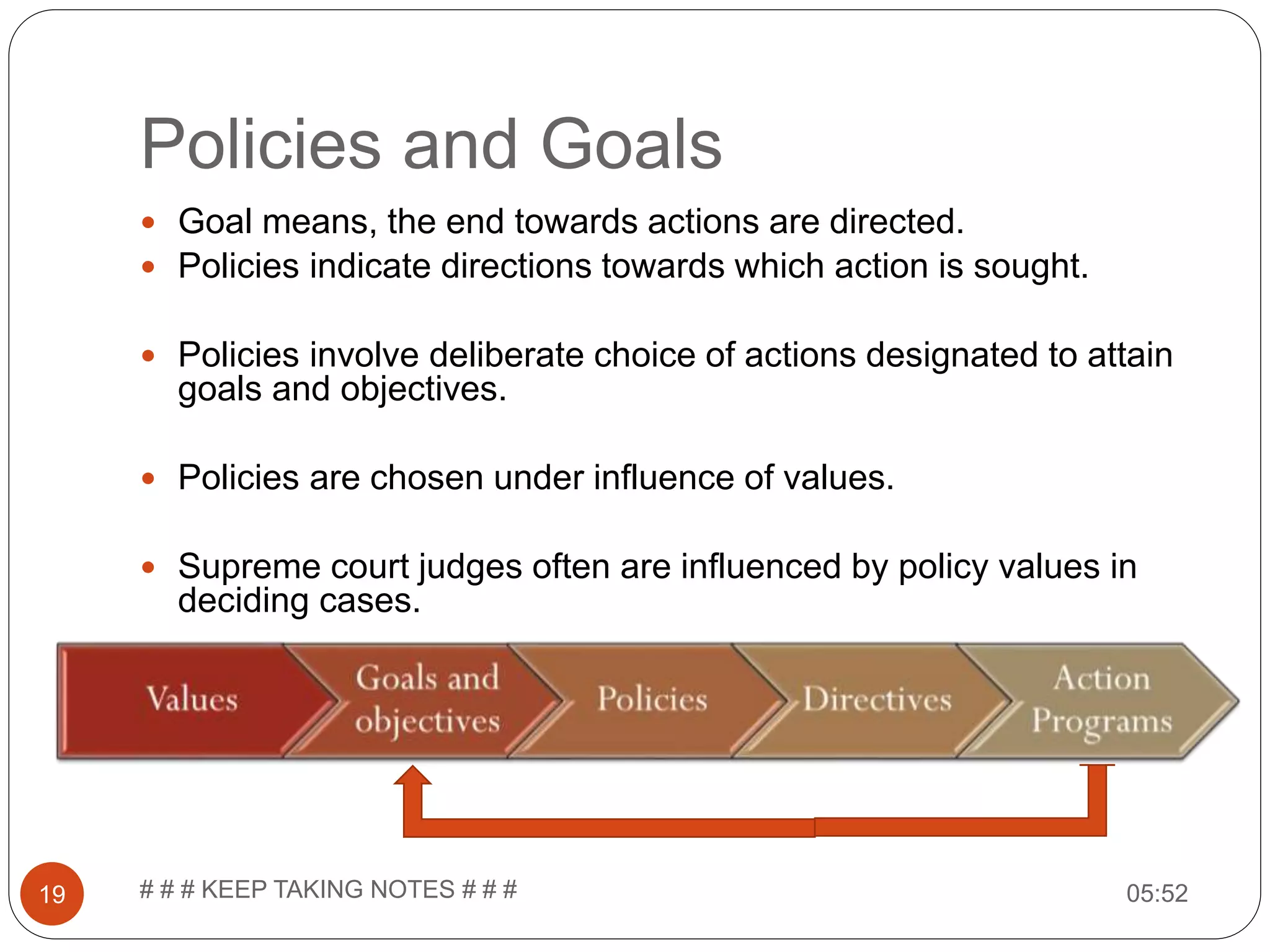
Policies and Goals 05:52# # # KEEP TAKING NOTES # # #19  Goal means, the end towards actions are directed.  Policies indicate directions towards which action is sought.  Policies involve deliberate choice of actions designated to attain goals and objectives.  Policies are chosen under influence of values.  Supreme court judges often are influenced by policy values in deciding cases.
Policy-making and Planning 05:52# # # KEEP TAKING NOTES # # #20  Policy-making not only involves deciding on a program structure but also the ends and means of a plan or a program.  It also involves issues related to administration and plan to implement a policy.  Plan is a program of action for attaining definite goals or objectives.  Plan is a policy statement, planning implies, policy- making.  Generally, a national development plan is a collection of targets or individual projects, which when put together, may not constitute an integrated scheme. (internal inconsistency / contradictions)
Policy-making and Planning 05:52# # # KEEP TAKING NOTES # # #21  Core of planning:  Allocation of resources for investment  Showing of targets in different sectors of the economy  A plan needs a proper policy framework.  Successful policies make for successful plans and administration.  Targets cannot be achieved just because investments are provided for, they have to be drawn within the framework of policies.
Policy and Politics 05:52# # # KEEP TAKING NOTES # # #22  Governmental activity has expanded  the structure of public policies has an important influence on patterns of political change.  Little attempt to develop more general hypotheses about the conditions under which policies produce politics.  Drawing on recent research, an article suggests that feedback occurs through two main mechanisms.  Policies generate resources and incentives for political actors, and they provide those actors with information and cues that encourage particular interpretations of the political world.  These mechanisms operate in a variety of ways, but have significant effects on government elites, interest groups, and mass publics. Paul Pierson World Politics / Volume 45 / Issue 04 / July 1993, pp 595 - 628
Policy analysis and Policy Advocacy 05:52# # # KEEP TAKING NOTES # # #23 Ralf et al suggests  Policy analysis is a systematic and data-based alternative to intuitive judgments about the effects of policy or policy options. It is used:  For problem assessment and monitoring  As a ‘before the fact’ decision tool  For evaluation  Advocacy involves research and arguments  influence the policy agenda inside or outside the government.  Systematic inquiry of impacts
Policy analysis and Policy Management 05:52# # # KEEP TAKING NOTES # # #24  Terms are overlapping to some extent  Interrelated aspects of policy-making  Policy management deals with  Management of policy making  Policy preparation process  Assuring to produce high-quality policies Treat the terms in Unison.
Policy inputs, policy outputs and policy outcomes. 05:52# # # KEEP TAKING NOTES # # #25  Policy inputs are the demands made on the political systems by individuals and groups for action or interaction about some perceived problems.  Policy Outputs are actual decision of the implementers. What government does, as distinguished from what it says it is going to do.  Policy outcomes are the real results whether intended or unintended by a policy.  Labour Welfare Policy – amounts collected by taxation Vs. number of persons benefitted Vs. Amount of benefits paid.
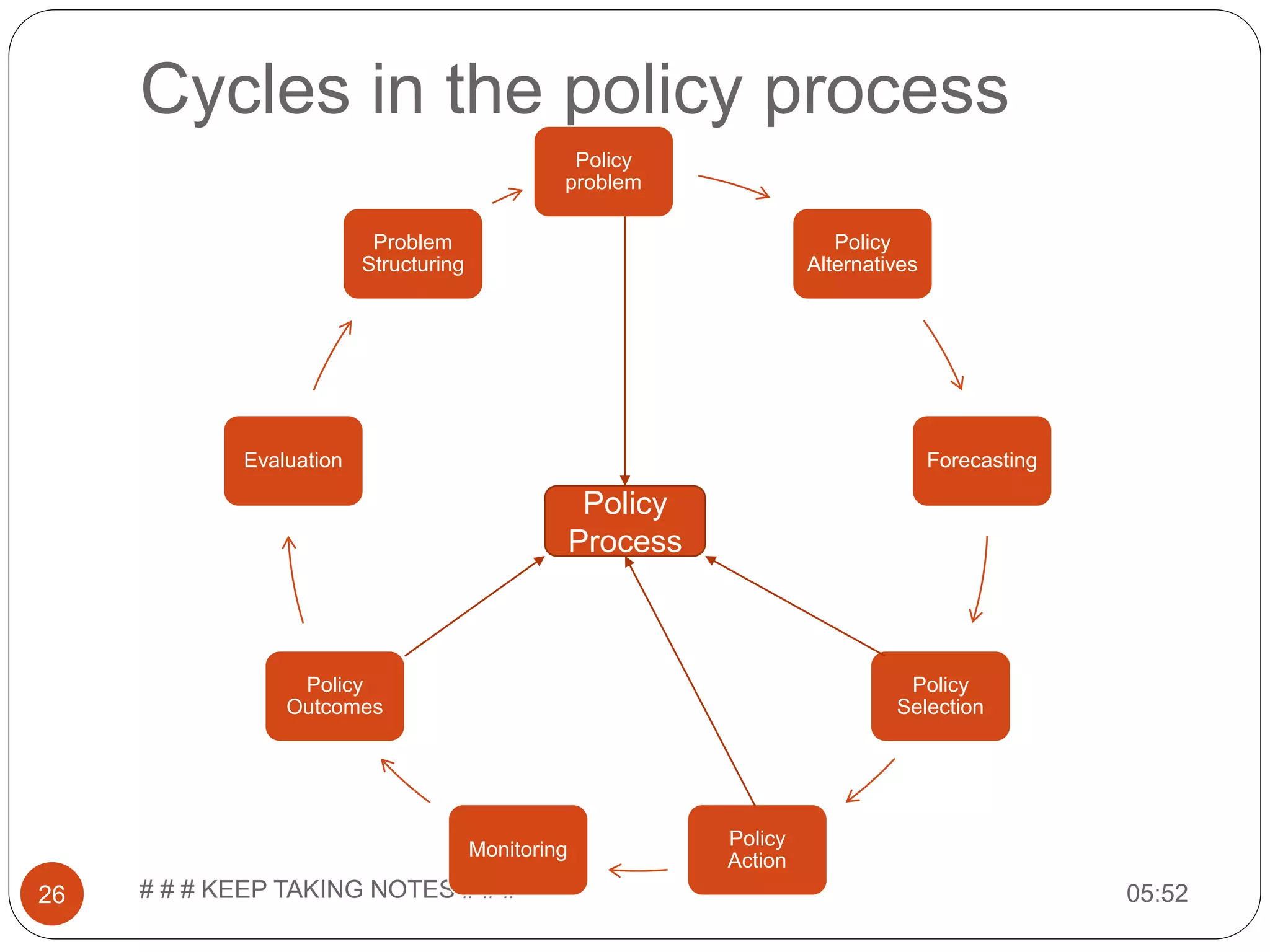
Cycles in the policy process 05:52# # # KEEP TAKING NOTES # # #26 Policy problem Policy Alternatives Forecasting Policy Selection Policy Action Monitoring Policy Outcomes Evaluation Problem Structuring Policy Process
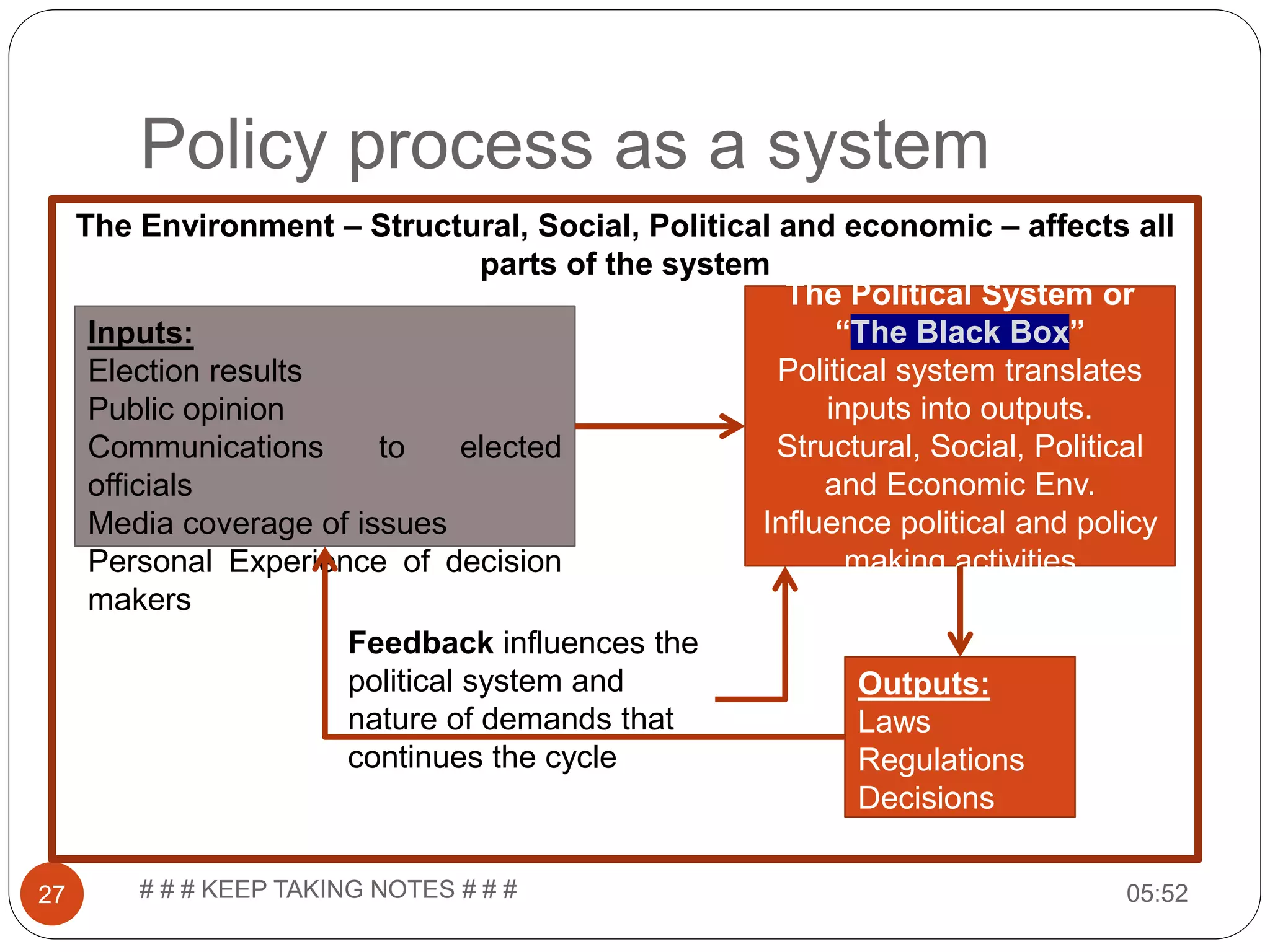
Policy process as a system 05:52# # # KEEP TAKING NOTES # # #27 The Environment – Structural, Social, Political and economic – affects all parts of the system Inputs: Election results Public opinion Communications to elected officials Media coverage of issues Personal Experience of decision makers Outputs: Laws Regulations Decisions The Political System or “The Black Box” Political system translates inputs into outputs. Structural, Social, Political and Economic Env. Influence political and policy making activities Feedback influences the political system and nature of demands that continues the cycle
The Structural Environment 05:52# # # KEEP TAKING NOTES # # #28  Separation of powers  Federalism  Open Public meeting laws  Administrative procedure act
The Social Environment 05:52# # # KEEP TAKING NOTES # # #29  A Growing, but Aging Population  Race and Ethnicity  Gender and Labor Force Participation  Policy implications of Demographic changes
The Political Environment 05:52# # # KEEP TAKING NOTES # # #30  Approval on projects  Financial Planning  Vision and Agenda
The Economic Environment 05:52# # # KEEP TAKING NOTES # # #31  Gross Domestic Product (Total value of all goods and services produced in a country)  Budget deficits and Govt. spending during recession  Tax revenues and Debt payment  Transfer payments (subsidies, disaster reliefs, social welfare programs)  Unemployment rate
Approaches 05:52# # # KEEP TAKING NOTES # # #32
Comparative Public Policy 05:52# # # KEEP TAKING NOTES # # #33  Comparative Public Policy is the study of how, why and to what effect different governments pursue a particular course of action or inaction.  Comparative approach uses mainly following methods:  Single case studies of one policy area in one country (like, education in India)  Statistical analysis of several case studies and countries  A comparison of policy area between a selected number of comparable countries.
Incremental policy making  It relies on interaction rather than complete analysis of situation for developing plan for solution  The approach is based on the following assumptions:  Policy options are based on highly uncertain and fluid knowledge, and are in response to a dynamic situation (ever-changing problems, and evolving contexts);  No 'correct' solution can therefore be found, or technically derived from a diagnosis of the situation. Thus, no sweeping or drastic reforms should be attempted;  Only incremental and limited policy adjustments can be made; and  Policy adjustments are expected to remedy an experienced dissatisfaction with past policies, improving the existing situation or relieving an urgent problem. 05:5234 # # # KEEP TAKING NOTES # # #
Lasswell’s Approach 05:52# # # KEEP TAKING NOTES # # #35  Suggested Seven stages in policy processes:  Intelligence  Promotion  Prescription  Invocation  Application  Termination  Appraisal  Idea of knowledge ‘of the policy process’ and ‘in the policy process’
Lasswell’s Approach 05:52# # # KEEP TAKING NOTES # # #36  Outlook of policy sciences are:  Problem-oriented  contextual  Multi-disciplinary  multi-method  Ideas and techniques  Lasswell’s Systematic approach in stages = More dynamic modeling of policy = formation of basis of understanding policy
Easton’s model  Model is originated from the studies of a developed country like the United States…  Interactive stages of policy making are  Input-throughput-output-feedback which are quite practical…  It is highly variable in developing countries  Not necessary that always developed nations follow the chain of actions  Presence of feedback mechanisms is very infrequent in policy making in developing nations  Policies of developing countries are less responsive to the demands of the environment 05:5237 # # # KEEP TAKING NOTES # # #
Easton’s model  Also, in developing countries, support from the society as input for decision making is also less significant…  Walt (1994) rightly observes that in developing countries, there exist huge examples of retaining power by the governments without popular support. ..  Thus, without studying the particular policy context, it cannot be argued that the policy making process, particularly in developing countries, always follows the stages suggested by Easton. 05:5238 # # # KEEP TAKING NOTES # # #
Unitary rational policy  G . T. Allison (1971) developed two alternative models to the commonly assumed model of the Unitary rational policy-maker:  (a) The Organizational process model, and  (b) The Governmental politics model. 05:5239 # # # KEEP TAKING NOTES # # #
The Organizational process model  The first model assumes a complex government consisting of a conglomerate of semi-feudal, loosely allied organizations, each with a substantial life of its own.  Decisions are based on  the output of the several entities,  functioning independently according to standard patterns of behavior but partially co-ordinated by government leaders. 05:5240 # # # KEEP TAKING NOTES # # #
The Governmental politics model  The second model carries the earlier concept further.  While it also assumes an organizational approach to decision making, the Governmental Politics model plays up the part of individuals in the process.  Government decisions are not made by a monolithic state based on rational choice, but rather are negotiated by various leaders who sit on top of the organizations involved in that particular decision-making process.  Each leader is compelled by his own conception of the problem as well as by the imperatives of his organization and his own personal goals. 05:5241 # # # KEEP TAKING NOTES # # #
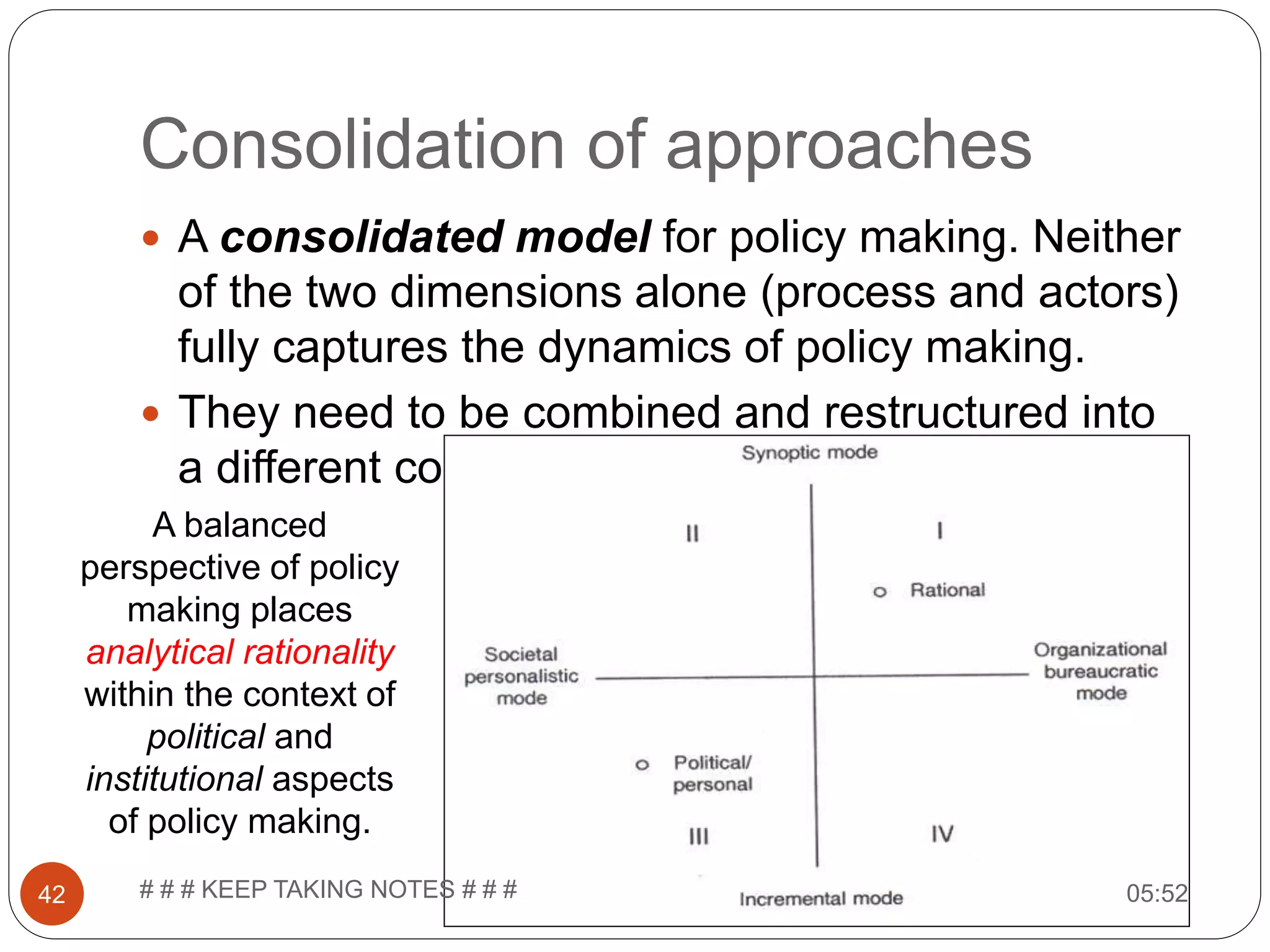
Consolidation of approaches  A consolidated model for policy making. Neither of the two dimensions alone (process and actors) fully captures the dynamics of policy making.  They need to be combined and restructured into a different configuration. A balanced perspective of policy making places analytical rationality within the context of political and institutional aspects of policy making. 05:5242 # # # KEEP TAKING NOTES # # #

02 Policy making models - Approaches

  • 1.
    Policy making models- approaches 1 M. E. (II) Town and Country Planning Semester – III Prof. Bhasker V. Bhatt PG In-charge (ME-TCP) Civil Engineering Department SCET, Surat Politics & Public Policy Planning (2734804) Major Elective IV Public Policy Models by Bhasker V. Bhatt is licensed under a Creative Commons Attribution- NonCommercial-ShareAlike 4.0 International License.
  • 2.
    Key difference ofPublic and Private sectors 05:52# # # KEEP TAKING NOTES # # #2  Faces more complex and ambiguous tasks  Has more problems in implementing its decisions  Employs more people with a wide range of motivations  Is more concerned with securing opportunities or capacities  Engages in activities with greater symbolic significance  Is held to stricter standards of commitment and legality  Has a greater opportunity to respond to issues of fairness  Must operate or appear to operate in public interest
  • 3.
    Idea of Policy 05:52## # KEEP TAKING NOTES # # #3 Policy denotes “Guidance for action” may be in a form of:  Authoritative decision  Principle or a rule  Purposive course of action  System of governance  Manifestation of considered judgment  Expression of political rationality  Declaration of common goals Policy is the base of POWER.
  • 4.
    Uses of theterm “Policy” 05:52# # # KEEP TAKING NOTES # # #4 (1984) Hogwood and Gunn specifies the use of term Policy as for:  A label for the field of activity  An expression of desired state of affairs  Specific proposals  Decision of government  Formal authorization  A programme  Output  Outcome  A theory or Model  A process.
  • 5.
    Typologies of policy 05:52## # KEEP TAKING NOTES # # #5 Distributive policies Redistributive policies Regulatory policies
  • 6.
    Distributive Policies 05:52# ## KEEP TAKING NOTES # # #6  Policies concerned with the distribution of new resources are distributive policies  Includes grants, subsidies, adult education programme, food relief, social insurance, scholarship to EWS students  Legislation will be quite specific in the case  Key decision as “who has to receive benefits and how much one is to receive” are made by legislators
  • 7.
    Redistributive Policies 05:52# ## KEEP TAKING NOTES # # #7  Concerned with changing the distribution of existing resources, and with the rearrangement of policies which are related to bringing about basic social and economic changes in the economy of society.  Include actions that affect credit and supply of money, taxes, social security and payment transfers.  Policies are ideological – raising basic issues about proper role of Govt. in societal and economic matters  Some require considerable administrative expertise and discretion in implementation others are clearly defined by law and require only routine
  • 8.
    Regulatory Policies 05:52# ## KEEP TAKING NOTES # # #8  Concerned with regulation and control of activities.  Seek to alter individual behavior directly by imposing standards on regulated industries (likely to arouse controversy)  Interest groups are likely to be formed around regulatory issues  UGC, AICTE, CBSE perform both promotional and regulatory activities in education.  Medical council of India, Bar Council of India, Pharmacy Council of India, Nursing Council of India – protects standards  TRAI, RBI, SEBI engaged in regulatory activities
  • 9.
    Conflict of policyissues 05:52# # # KEEP TAKING NOTES # # #9 Cobb and Elder contributions:  Conflict may arise between two or more groups over issues relating to distribution of positions or resource created by situations as:  Unfairness or bias in the distribution of positions or resources  Framing of an issue for personal or group gain  Unanticipated human events, natural disasters, international conflict, war and technological changes  Such issues constitute agenda for policy.
  • 10.
    Nature of PublicPolicy 05:52# # # KEEP TAKING NOTES # # #10  A policy may be:  General of specific  Broad or narrow  Simple or complex  Public or private  Written or unwritten  Explicit or implicit  Discretionary or detailed  Qualitative or quantitative  Understanding public policy is an art as well as craft.
  • 11.
    Nature of PublicPolicy… 05:52# # # KEEP TAKING NOTES # # #11  Art required insight and creativity in identifying social problems  leading to better quality of life  It is craft as various tasks often require some knowledge of social sciences.  Policy is “guidance for action” for government.  Activities of government can be put broadly in two categories:  Definite or specific policies  General, vague and inconsistent policies.
  • 12.
    Nature of PublicPolicy… 05:52# # # KEEP TAKING NOTES # # #12  Possibility of  An action without a policy or to have a policy without an action.  Governmental nature of policy – mostly adopted by government authorities, due to their power, give them legal authority.  Public policies embodied in a set of practices and precedents – the unwritten constitution of UK
  • 13.
    Nature of PublicPolicy… 05:52# # # KEEP TAKING NOTES # # #13  The British Constitution is unwritten in one single document, unlike the constitution in America or the proposed European Constitution, and as such, is referred to as an un-codified constitution in the sense that there is no single document that can be classed as Britain's constitution. (http://www.historylearningsite.co.uk/british_constitu tion1.htm)
  • 14.
    05:52# # #KEEP TAKING NOTES # # #14 http://www.independent.co.uk/news/uk/politics/the-big-question- why-doesnt-the-uk-have-a-written-constitution-and-does-it- matter-781975.html
  • 15.
    Nature of PublicPolicy… 05:52# # # KEEP TAKING NOTES # # #15  A public policy may cover major portion of its activities such as a development policy.  Socio-economic development  Economic growth  Social justice  Equality  Self-resilience  Broad principles of guidance for action adopted for national goal
  • 16.
    Nature of PublicPolicy… 05:52# # # KEEP TAKING NOTES # # #16  Narrow in nature…  Family planning restrained to a section of the people  Child labour (factories not to employ child below age of 18)  Megapolicies (defined by Dror)  General guidelines to be followed by all specific policies  Master policy distinct from discrete policies  Establishes overall goals to serve as guidelines  Expression of national goals  Purposeful and goal oriented.
  • 17.
    Nature of PublicPolicy… 05:52# # # KEEP TAKING NOTES # # #17  Democratic form of government  many pressure groups or political parties  deliberate adoption of vague, inconsistent or contradictory policies in order to SATISFY all pressure groups. Positive / Negative form of policy.  towards certain action Legally coercive nature  citizens to accept as legitimate (taxes must be paid unless one wants to run the risk of fines or imprisonment)
  • 18.
    Policies and Decisions 05:52## # KEEP TAKING NOTES # # #18  Policy-making involve decision, but a decision does not necessarily constitute a policy.  Decision making often involve identification of a problem, careful analysis of possible alternatives, selection of one alternatives for action.  Policy decisions taken thus provide a sense of direction to the course of an administrative action.  Issue executive orders  Promulgate administrative rules  Make important judicial interpretation of laws
  • 19.
    Policies and Goals 05:52## # KEEP TAKING NOTES # # #19  Goal means, the end towards actions are directed.  Policies indicate directions towards which action is sought.  Policies involve deliberate choice of actions designated to attain goals and objectives.  Policies are chosen under influence of values.  Supreme court judges often are influenced by policy values in deciding cases.
  • 20.
    Policy-making and Planning 05:52## # KEEP TAKING NOTES # # #20  Policy-making not only involves deciding on a program structure but also the ends and means of a plan or a program.  It also involves issues related to administration and plan to implement a policy.  Plan is a program of action for attaining definite goals or objectives.  Plan is a policy statement, planning implies, policy- making.  Generally, a national development plan is a collection of targets or individual projects, which when put together, may not constitute an integrated scheme. (internal inconsistency / contradictions)
  • 21.
    Policy-making and Planning 05:52## # KEEP TAKING NOTES # # #21  Core of planning:  Allocation of resources for investment  Showing of targets in different sectors of the economy  A plan needs a proper policy framework.  Successful policies make for successful plans and administration.  Targets cannot be achieved just because investments are provided for, they have to be drawn within the framework of policies.
  • 22.
    Policy and Politics 05:52## # KEEP TAKING NOTES # # #22  Governmental activity has expanded  the structure of public policies has an important influence on patterns of political change.  Little attempt to develop more general hypotheses about the conditions under which policies produce politics.  Drawing on recent research, an article suggests that feedback occurs through two main mechanisms.  Policies generate resources and incentives for political actors, and they provide those actors with information and cues that encourage particular interpretations of the political world.  These mechanisms operate in a variety of ways, but have significant effects on government elites, interest groups, and mass publics. Paul Pierson World Politics / Volume 45 / Issue 04 / July 1993, pp 595 - 628
  • 23.
    Policy analysis andPolicy Advocacy 05:52# # # KEEP TAKING NOTES # # #23 Ralf et al suggests  Policy analysis is a systematic and data-based alternative to intuitive judgments about the effects of policy or policy options. It is used:  For problem assessment and monitoring  As a ‘before the fact’ decision tool  For evaluation  Advocacy involves research and arguments  influence the policy agenda inside or outside the government.  Systematic inquiry of impacts
  • 24.
    Policy analysis andPolicy Management 05:52# # # KEEP TAKING NOTES # # #24  Terms are overlapping to some extent  Interrelated aspects of policy-making  Policy management deals with  Management of policy making  Policy preparation process  Assuring to produce high-quality policies Treat the terms in Unison.
  • 25.
    Policy inputs, policyoutputs and policy outcomes. 05:52# # # KEEP TAKING NOTES # # #25  Policy inputs are the demands made on the political systems by individuals and groups for action or interaction about some perceived problems.  Policy Outputs are actual decision of the implementers. What government does, as distinguished from what it says it is going to do.  Policy outcomes are the real results whether intended or unintended by a policy.  Labour Welfare Policy – amounts collected by taxation Vs. number of persons benefitted Vs. Amount of benefits paid.
  • 26.
    Cycles in thepolicy process 05:52# # # KEEP TAKING NOTES # # #26 Policy problem Policy Alternatives Forecasting Policy Selection Policy Action Monitoring Policy Outcomes Evaluation Problem Structuring Policy Process
  • 27.
    Policy process asa system 05:52# # # KEEP TAKING NOTES # # #27 The Environment – Structural, Social, Political and economic – affects all parts of the system Inputs: Election results Public opinion Communications to elected officials Media coverage of issues Personal Experience of decision makers Outputs: Laws Regulations Decisions The Political System or “The Black Box” Political system translates inputs into outputs. Structural, Social, Political and Economic Env. Influence political and policy making activities Feedback influences the political system and nature of demands that continues the cycle
  • 28.
    The Structural Environment 05:52## # KEEP TAKING NOTES # # #28  Separation of powers  Federalism  Open Public meeting laws  Administrative procedure act
  • 29.
    The Social Environment 05:52## # KEEP TAKING NOTES # # #29  A Growing, but Aging Population  Race and Ethnicity  Gender and Labor Force Participation  Policy implications of Demographic changes
  • 30.
    The Political Environment 05:52## # KEEP TAKING NOTES # # #30  Approval on projects  Financial Planning  Vision and Agenda
  • 31.
    The Economic Environment 05:52## # KEEP TAKING NOTES # # #31  Gross Domestic Product (Total value of all goods and services produced in a country)  Budget deficits and Govt. spending during recession  Tax revenues and Debt payment  Transfer payments (subsidies, disaster reliefs, social welfare programs)  Unemployment rate
  • 32.
    Approaches 05:52# # #KEEP TAKING NOTES # # #32
  • 33.
    Comparative Public Policy 05:52## # KEEP TAKING NOTES # # #33  Comparative Public Policy is the study of how, why and to what effect different governments pursue a particular course of action or inaction.  Comparative approach uses mainly following methods:  Single case studies of one policy area in one country (like, education in India)  Statistical analysis of several case studies and countries  A comparison of policy area between a selected number of comparable countries.
  • 34.
    Incremental policy making It relies on interaction rather than complete analysis of situation for developing plan for solution  The approach is based on the following assumptions:  Policy options are based on highly uncertain and fluid knowledge, and are in response to a dynamic situation (ever-changing problems, and evolving contexts);  No 'correct' solution can therefore be found, or technically derived from a diagnosis of the situation. Thus, no sweeping or drastic reforms should be attempted;  Only incremental and limited policy adjustments can be made; and  Policy adjustments are expected to remedy an experienced dissatisfaction with past policies, improving the existing situation or relieving an urgent problem. 05:5234 # # # KEEP TAKING NOTES # # #
  • 35.
    Lasswell’s Approach 05:52# ## KEEP TAKING NOTES # # #35  Suggested Seven stages in policy processes:  Intelligence  Promotion  Prescription  Invocation  Application  Termination  Appraisal  Idea of knowledge ‘of the policy process’ and ‘in the policy process’
  • 36.
    Lasswell’s Approach 05:52# ## KEEP TAKING NOTES # # #36  Outlook of policy sciences are:  Problem-oriented  contextual  Multi-disciplinary  multi-method  Ideas and techniques  Lasswell’s Systematic approach in stages = More dynamic modeling of policy = formation of basis of understanding policy
  • 37.
    Easton’s model  Modelis originated from the studies of a developed country like the United States…  Interactive stages of policy making are  Input-throughput-output-feedback which are quite practical…  It is highly variable in developing countries  Not necessary that always developed nations follow the chain of actions  Presence of feedback mechanisms is very infrequent in policy making in developing nations  Policies of developing countries are less responsive to the demands of the environment 05:5237 # # # KEEP TAKING NOTES # # #
  • 38.
    Easton’s model  Also,in developing countries, support from the society as input for decision making is also less significant…  Walt (1994) rightly observes that in developing countries, there exist huge examples of retaining power by the governments without popular support. ..  Thus, without studying the particular policy context, it cannot be argued that the policy making process, particularly in developing countries, always follows the stages suggested by Easton. 05:5238 # # # KEEP TAKING NOTES # # #
  • 39.
    Unitary rational policy G . T. Allison (1971) developed two alternative models to the commonly assumed model of the Unitary rational policy-maker:  (a) The Organizational process model, and  (b) The Governmental politics model. 05:5239 # # # KEEP TAKING NOTES # # #
  • 40.
    The Organizational process model The first model assumes a complex government consisting of a conglomerate of semi-feudal, loosely allied organizations, each with a substantial life of its own.  Decisions are based on  the output of the several entities,  functioning independently according to standard patterns of behavior but partially co-ordinated by government leaders. 05:5240 # # # KEEP TAKING NOTES # # #
  • 41.
    The Governmental politicsmodel  The second model carries the earlier concept further.  While it also assumes an organizational approach to decision making, the Governmental Politics model plays up the part of individuals in the process.  Government decisions are not made by a monolithic state based on rational choice, but rather are negotiated by various leaders who sit on top of the organizations involved in that particular decision-making process.  Each leader is compelled by his own conception of the problem as well as by the imperatives of his organization and his own personal goals. 05:5241 # # # KEEP TAKING NOTES # # #
  • 42.
    Consolidation of approaches A consolidated model for policy making. Neither of the two dimensions alone (process and actors) fully captures the dynamics of policy making.  They need to be combined and restructured into a different configuration. A balanced perspective of policy making places analytical rationality within the context of political and institutional aspects of policy making. 05:5242 # # # KEEP TAKING NOTES # # #