•React vs. Angular vs. Vue •Hosein Mansouri •Qom Open Source Community
Basic Question? – Which framework should is choose? – Is angular than better than react? – Vue is better? – What I should learn? – I try to answer some of these question…
Advanced Question? • What are the basic programming concepts of the frameworks? • How easy is it to use the frameworks for small or large applications? • What does the learning curve look like for each framework? • What kind of performance can you expect from the frameworks? • Ready, set, GO!
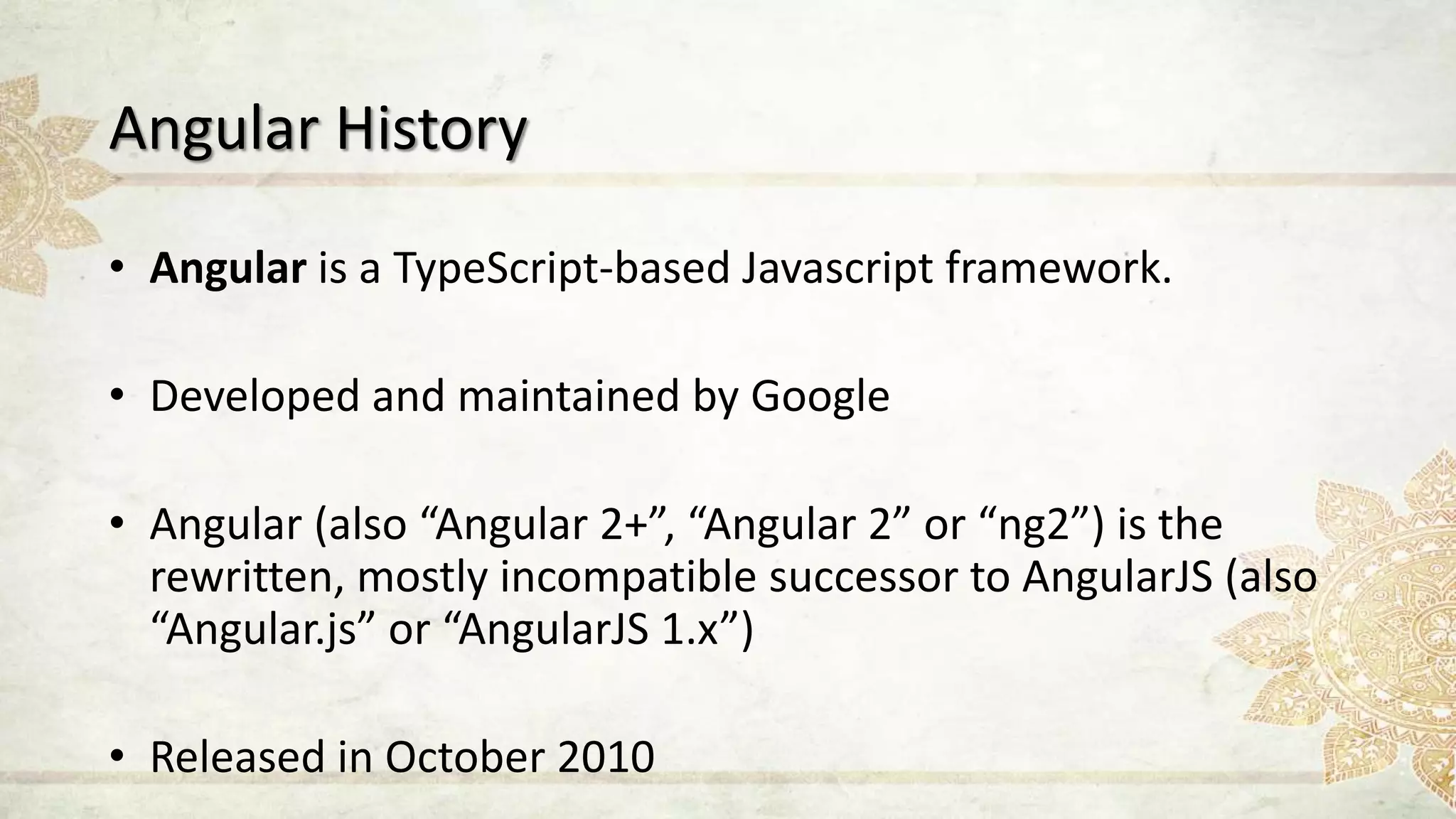
Angular History • Angular is a TypeScript-based Javascript framework. • Developed and maintained by Google • Angular (also “Angular 2+”, “Angular 2” or “ng2”) is the rewritten, mostly incompatible successor to AngularJS (also “Angular.js” or “AngularJS 1.x”) • Released in October 2010
Angular History • The newest major release is version 5, Older version is 4 and version 3 was skipped. • Angular is used by Google, Wix, weather.com, healthcare.gov and Forbes
Angular 2 or above • Benefit – Modularity – Dependency Injection – Routing – Validation – TypeScript(like C#, like Java) – Clear separation between HTML an TypeScript
Angular 2 or above • Disadvantages – Angular feature can confusing for newcomers – Backward Compatibility (new release breaking change) – TypeScript (for java script background)
React History • React is described as “a JavaScript library for building user interfaces”. • Initially released in March 2013 • React was developed and is maintained by Facebook • React components on several pages
React History • React is also used by Airbnb, Uber, Netflix, Twitter, Pinterest, Reddit, Udemy, Wix, Paypal, Imgur, Feedly, Stripe, Tumblr, Walmart and others • React Fiber was released with React 16 in September 2017.
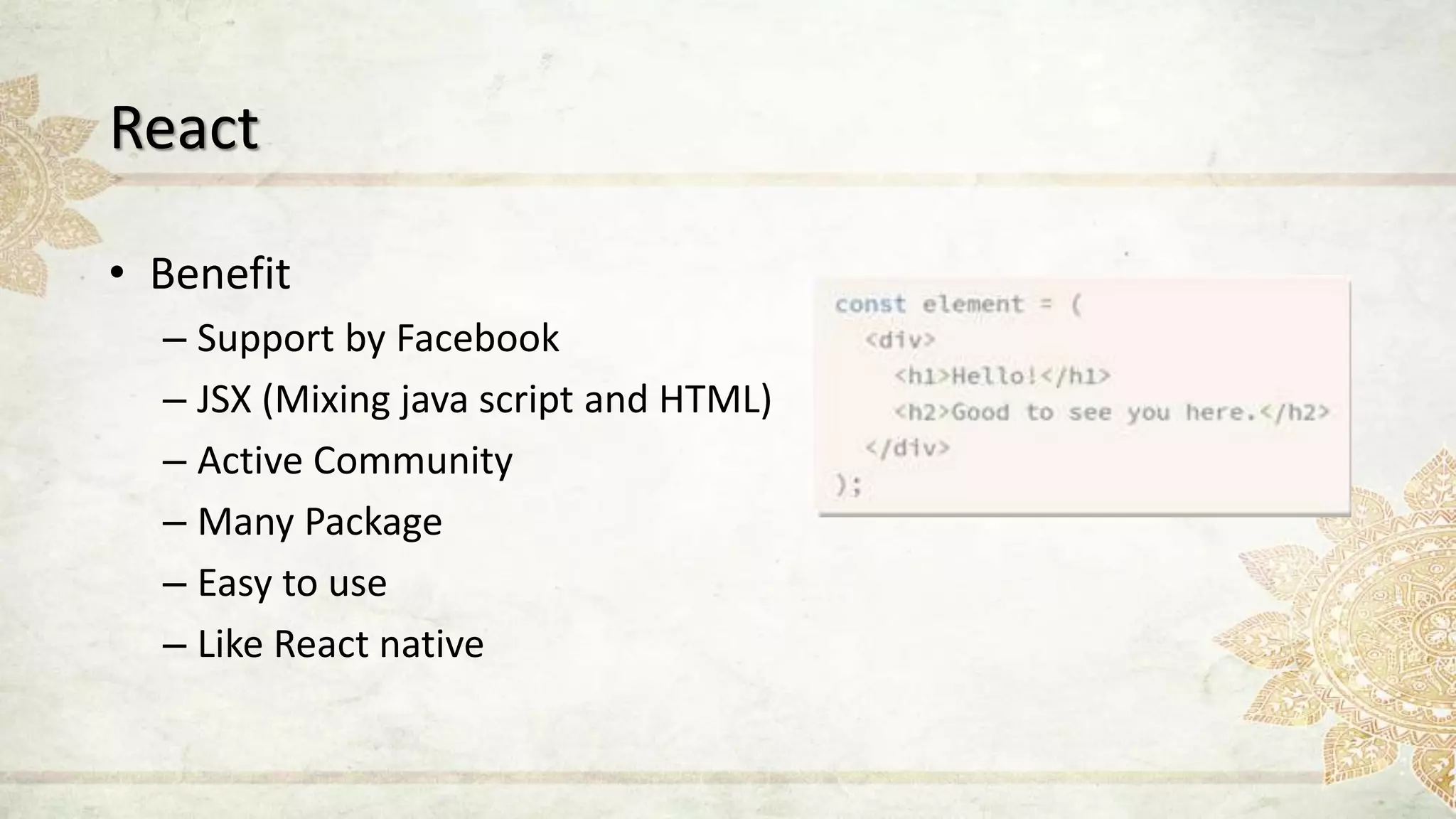
React • Benefit – Support by Facebook – JSX (Mixing java script and HTML) – Active Community – Many Package – Easy to use – Like React native
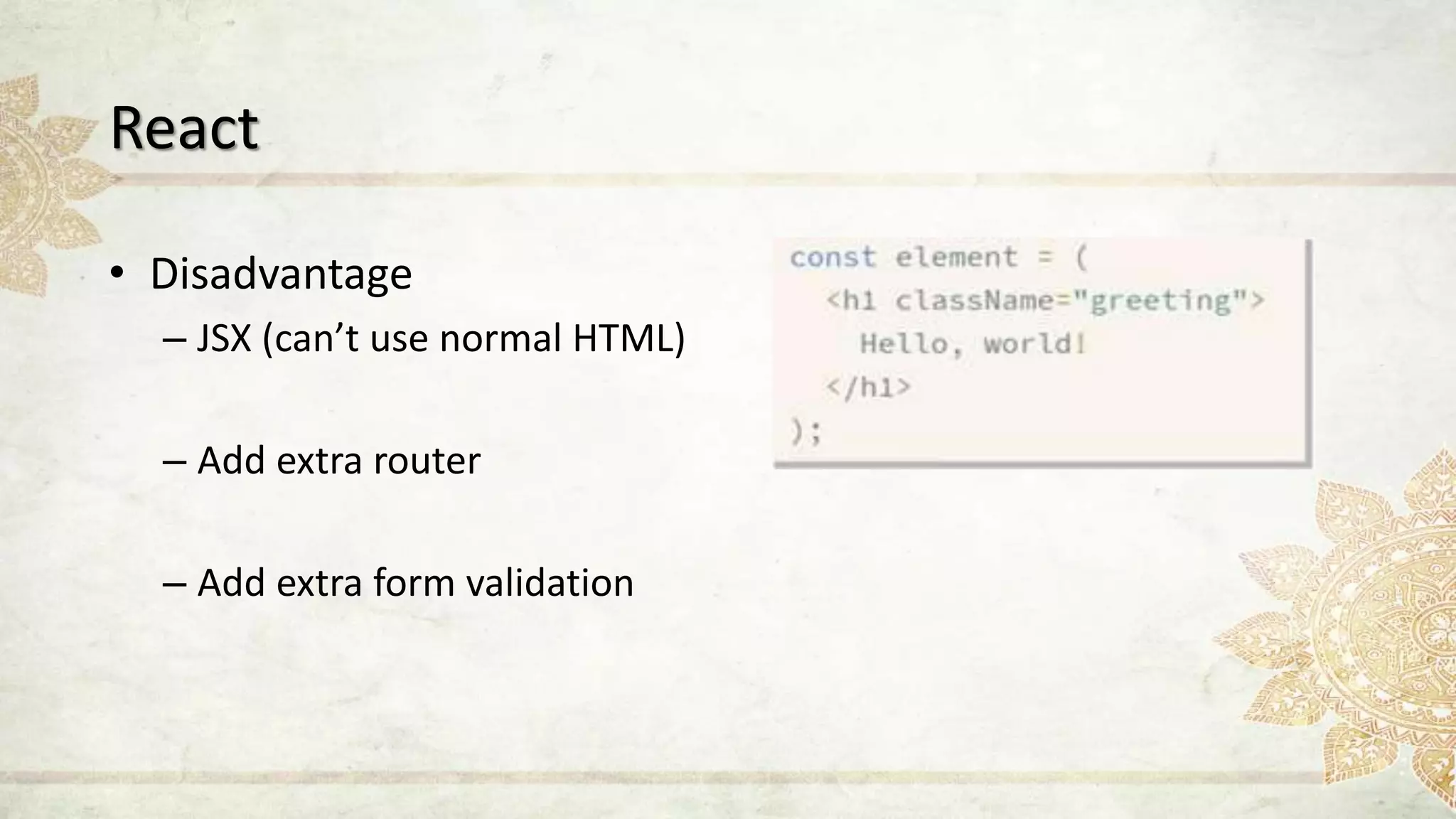
React • Disadvantage – JSX (can’t use normal HTML) – Add extra router – Add extra form validation
Vue History • Vue describes itself as a “Intuitive, Fast and Composable MVVM for building interactive interfaces.” • Vue is one of the most rapidly growing JS frameworks in 2016. • It was first released in February 2014 by ex-Google- employee Evan You
Vue History • It’s been quite a success, especially given that Vue is getting so much traction as a one-man show without the backing of a big company. • In 2016, version 2 was released. • Vue is used by Alibaba, Baidu, Expedia, Nintendo, GitLab
Vue • Benefit – Great Idea from angular and react – Use ES5 and ES6 – Separation template and java script code – Normal HTML and Normal CSS – Easy to learn, Easy to use – Router is provided – Great Communication – A Great Documentation
Vue • Disadvantage – Is New – Lack dependency injection – Don’t use by a great company – Less job
Comparison of React, Angular & Vue
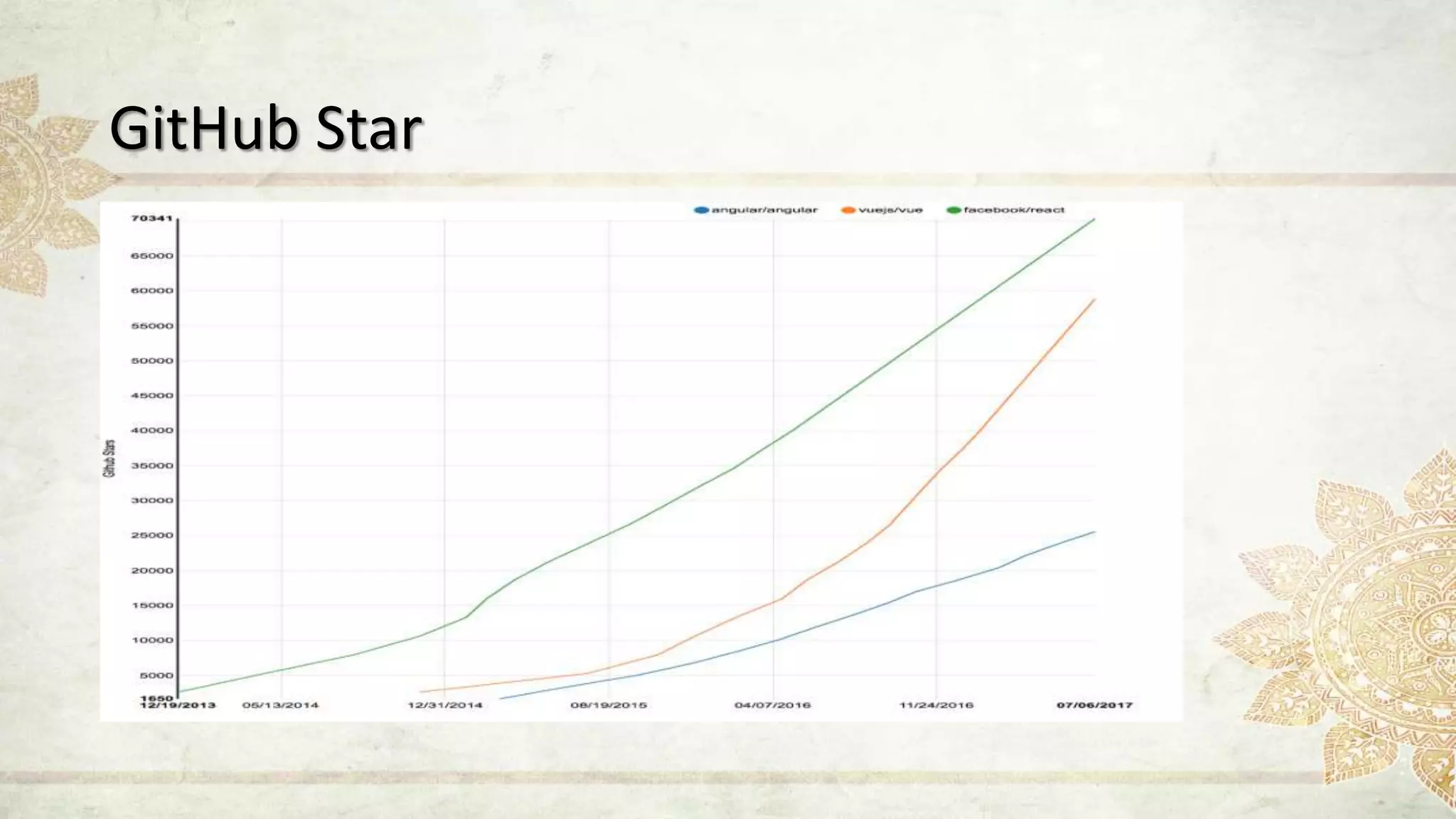
GitHub Star
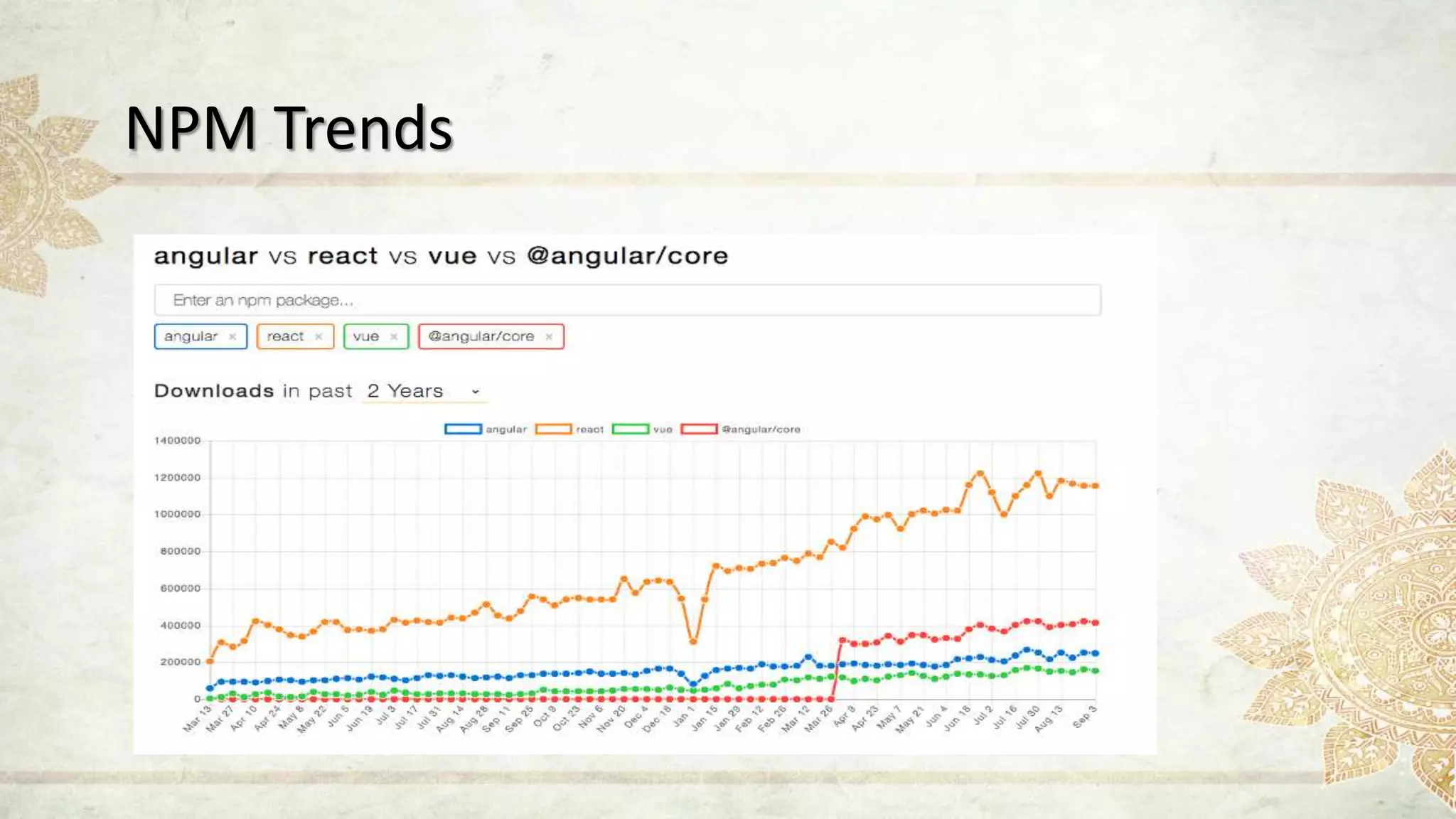
NPM Trends
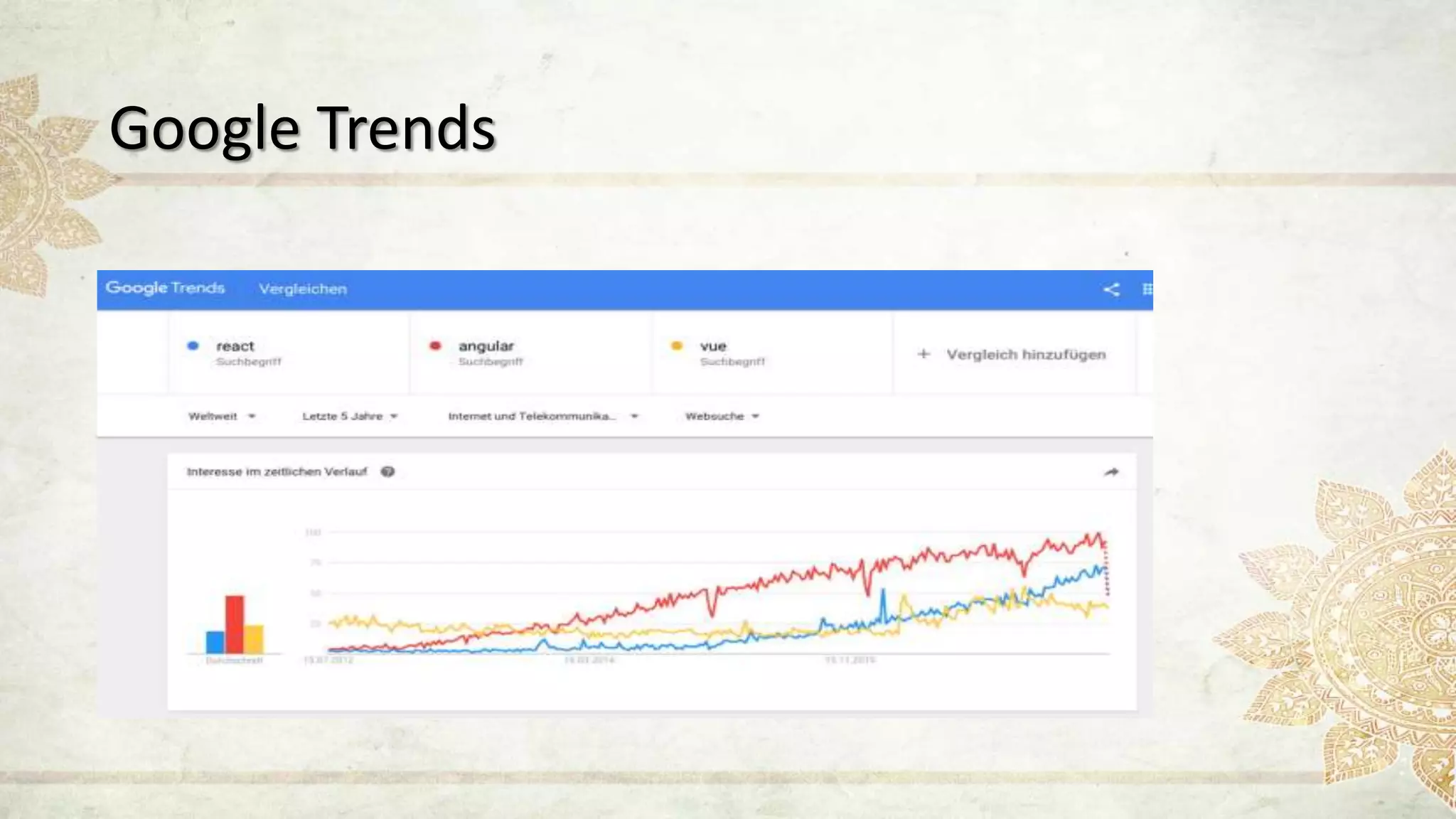
Google Trends
Components • The frameworks in question are all component-based. • The defined components should be easy to reuse on the webpage or within other components.
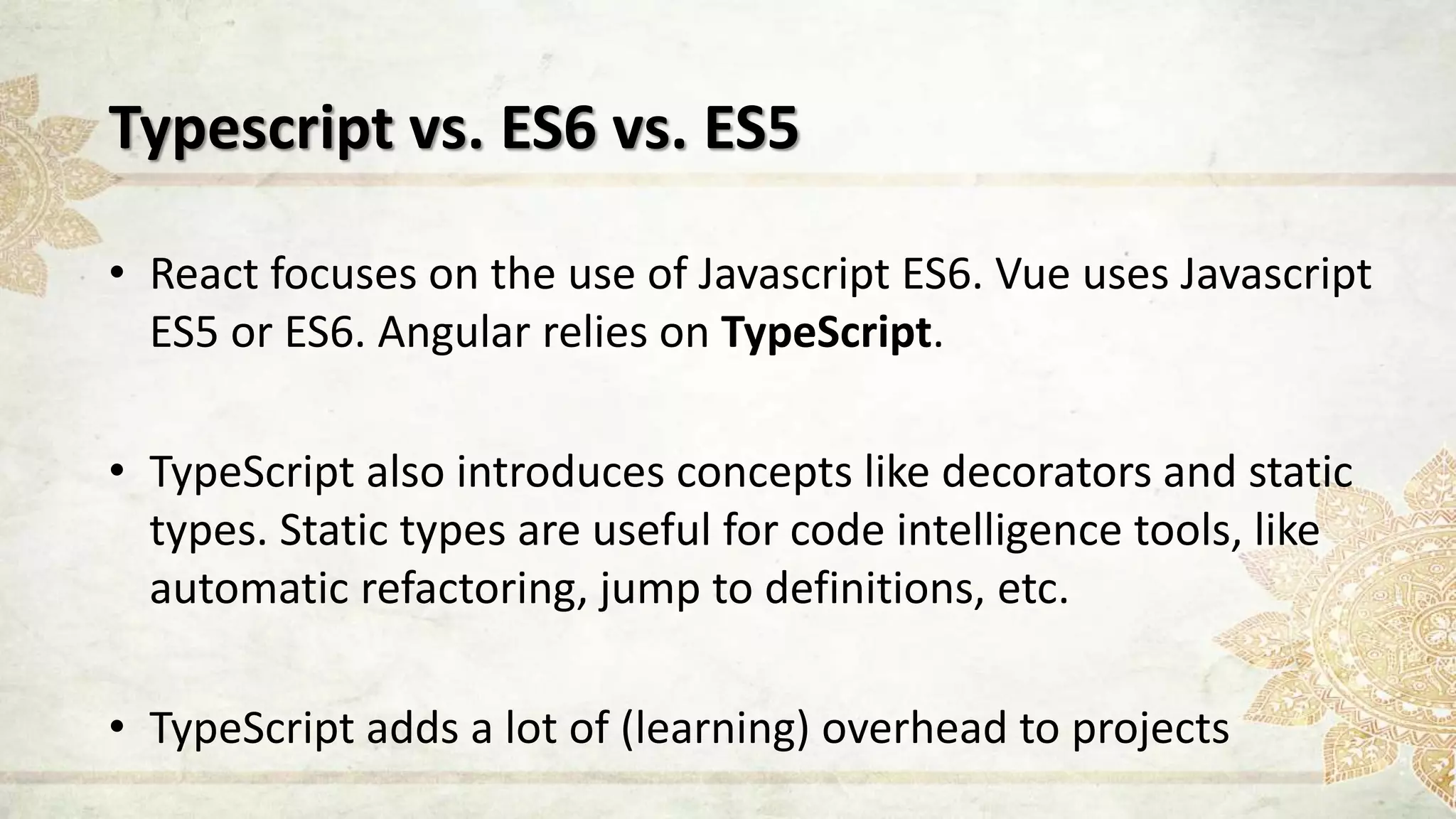
Typescript vs. ES6 vs. ES5 • React focuses on the use of Javascript ES6. Vue uses Javascript ES5 or ES6. Angular relies on TypeScript. • TypeScript also introduces concepts like decorators and static types. Static types are useful for code intelligence tools, like automatic refactoring, jump to definitions, etc. • TypeScript adds a lot of (learning) overhead to projects
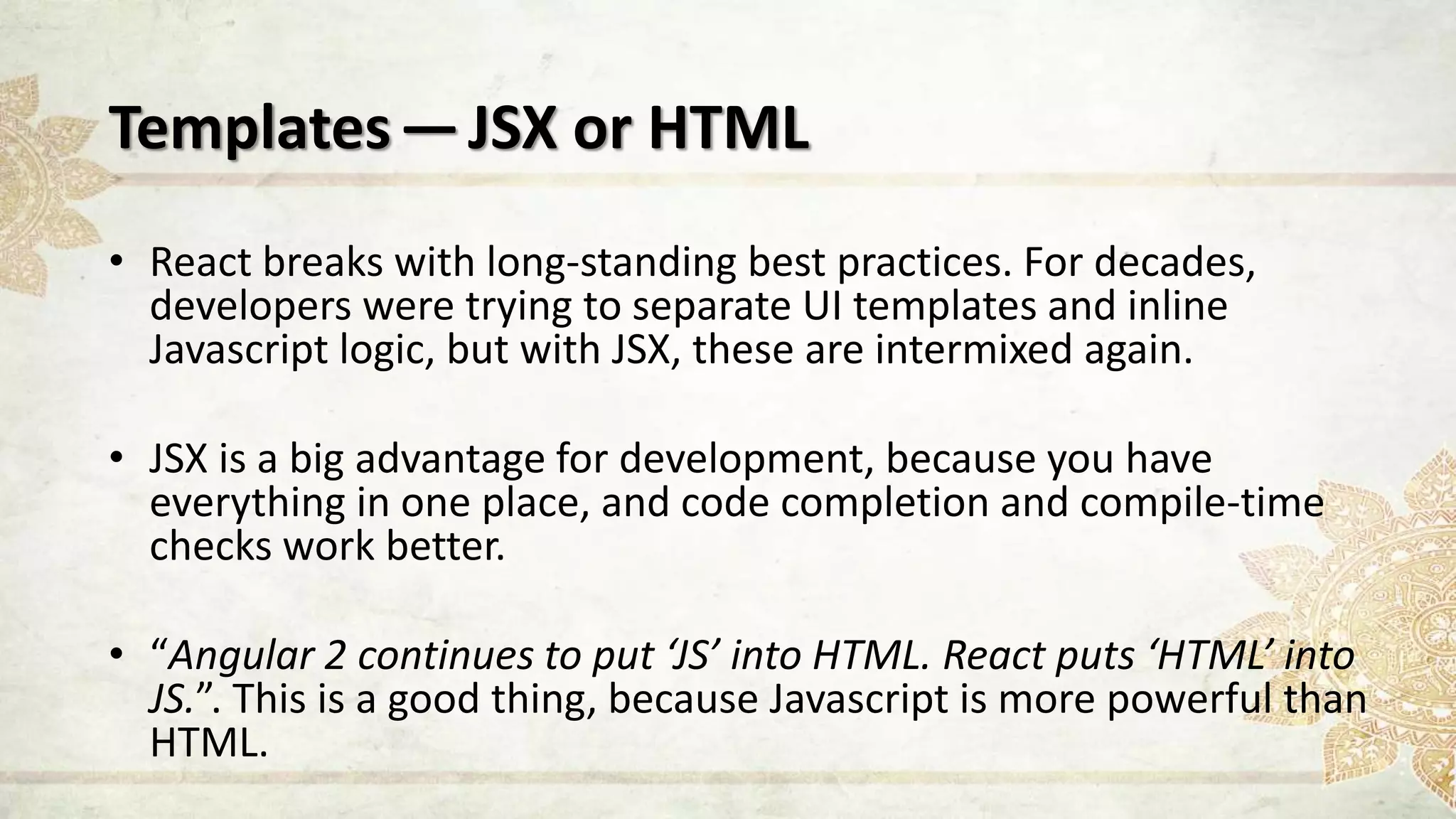
Templates —JSX or HTML • React breaks with long-standing best practices. For decades, developers were trying to separate UI templates and inline Javascript logic, but with JSX, these are intermixed again. • JSX is a big advantage for development, because you have everything in one place, and code completion and compile-time checks work better. • “Angular 2 continues to put ‘JS’ into HTML. React puts ‘HTML’ into JS.”. This is a good thing, because Javascript is more powerful than HTML.
Framework vs. library • Angular is a framework rather than a library because it provides strong opinions as to how your application should be structured and also has more functionality out of the box. Angular is a “complete solution. • React and Vue, on the other hand, are universally flexible. Their libraries can be paired to all kinds of packages.
Other programming concepts • The model-view-controller pattern (MVC) splits a project into three components: model, view and controller. Angular as an MVC-framework has MVC out of the box. React only has the V — you need to solve the M and C on your own.
Flexibility & downsizing to microservices • You can work with React or Vue by simply adding the Javascript library to the source code. This is not possible with Angular because of its use of TypeScript. • Angular work best for SPA, as it is probably too bloated to be used for microservices.
Long-term support & migrations- React • React APIs are quite stable, as Facebook states in their design principles. There are also some scripts to help you move from your current API to a newer one. • Migrations are quite easy and there is no such thing (needed) as a long-term-support version. • When they add a deprecation warning, they keep it for the rest of the current release version before the behavior is changed in the next major version.
Long-term support & migrations - Angular • There will be one major update every six months, and there will be a deprecation period of at least six months (two major releases). • Angular team has announced long-term-support versions starting with Angular 4. • This means Angular 4 will be supported until at least September 2018 with bug-fixes and important patches.
Long-term support & migrations - Vue • The update process for Vue 1.x to 2.0 should be easy for a small app —the developer team has asserted that 90% of the APIs stayed the same. • There is no clear (public) roadmap about the next major version or information on plans for LTS versions.
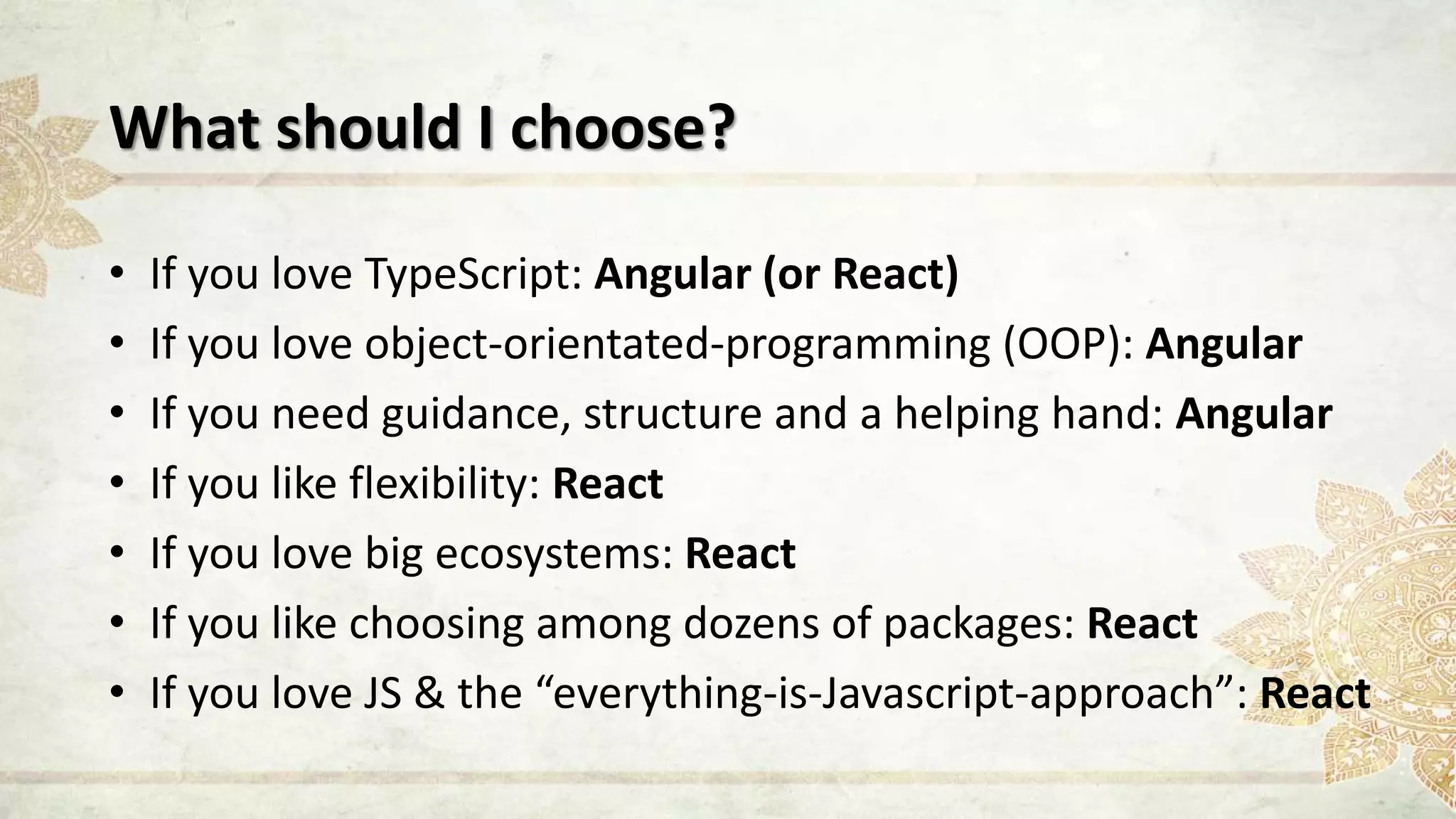
What should I choose? • If you love TypeScript: Angular (or React) • If you love object-orientated-programming (OOP): Angular • If you need guidance, structure and a helping hand: Angular • If you like flexibility: React • If you love big ecosystems: React • If you like choosing among dozens of packages: React • If you love JS & the “everything-is-Javascript-approach”: React
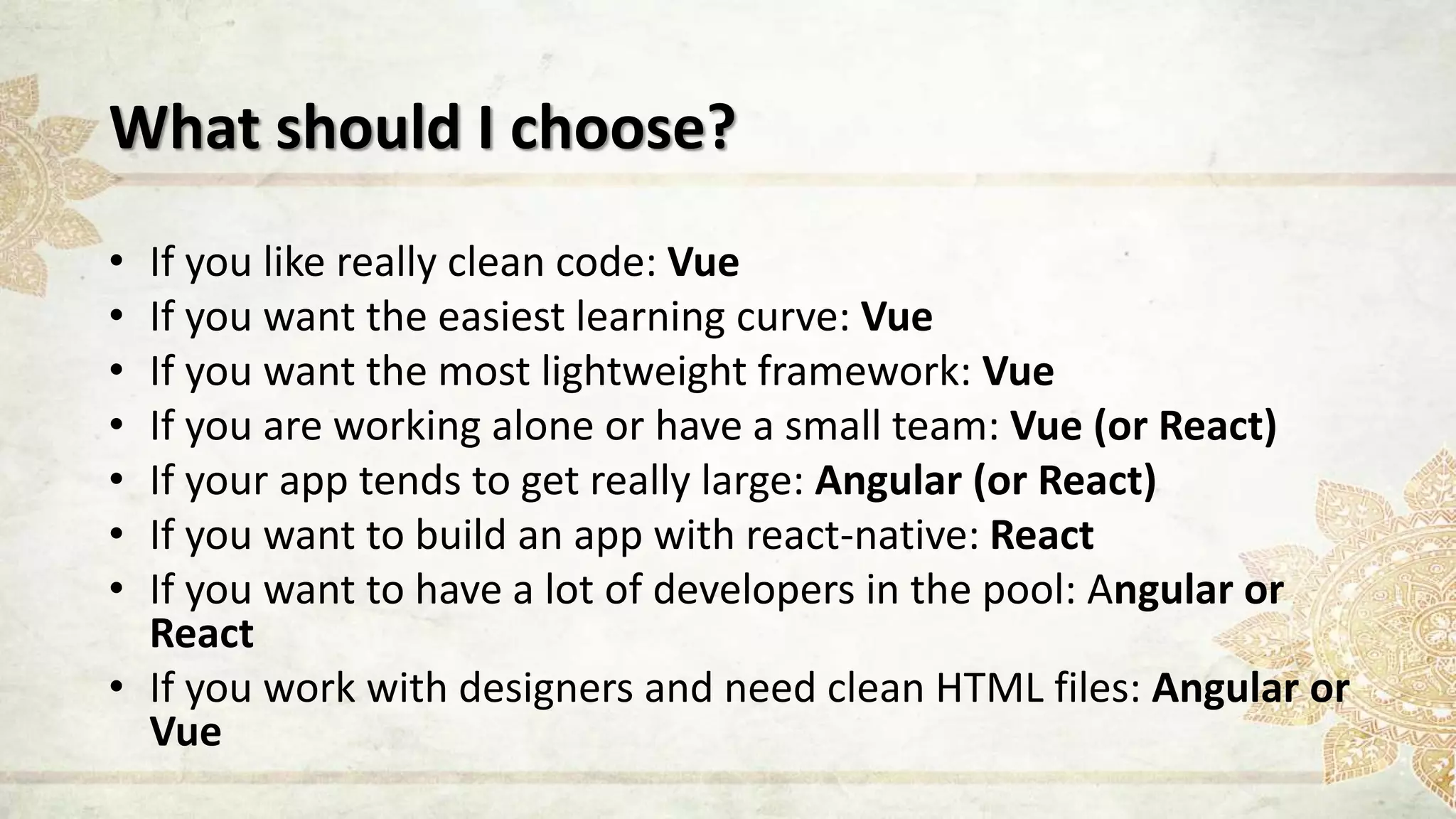
What should I choose? • If you like really clean code: Vue • If you want the easiest learning curve: Vue • If you want the most lightweight framework: Vue • If you are working alone or have a small team: Vue (or React) • If your app tends to get really large: Angular (or React) • If you want to build an app with react-native: React • If you want to have a lot of developers in the pool: Angular or React • If you work with designers and need clean HTML files: Angular or Vue
THE END & Thanks.

Angular vs React vs Vue

  • 1.
    •React vs. Angularvs. Vue •Hosein Mansouri •Qom Open Source Community
  • 2.
    Basic Question? – Whichframework should is choose? – Is angular than better than react? – Vue is better? – What I should learn? – I try to answer some of these question…
  • 3.
    Advanced Question? • Whatare the basic programming concepts of the frameworks? • How easy is it to use the frameworks for small or large applications? • What does the learning curve look like for each framework? • What kind of performance can you expect from the frameworks? • Ready, set, GO!
  • 4.
    Angular History • Angularis a TypeScript-based Javascript framework. • Developed and maintained by Google • Angular (also “Angular 2+”, “Angular 2” or “ng2”) is the rewritten, mostly incompatible successor to AngularJS (also “Angular.js” or “AngularJS 1.x”) • Released in October 2010
  • 5.
    Angular History • Thenewest major release is version 5, Older version is 4 and version 3 was skipped. • Angular is used by Google, Wix, weather.com, healthcare.gov and Forbes
  • 6.
    Angular 2 orabove • Benefit – Modularity – Dependency Injection – Routing – Validation – TypeScript(like C#, like Java) – Clear separation between HTML an TypeScript
  • 7.
    Angular 2 orabove • Disadvantages – Angular feature can confusing for newcomers – Backward Compatibility (new release breaking change) – TypeScript (for java script background)
  • 8.
    React History • Reactis described as “a JavaScript library for building user interfaces”. • Initially released in March 2013 • React was developed and is maintained by Facebook • React components on several pages
  • 9.
    React History • Reactis also used by Airbnb, Uber, Netflix, Twitter, Pinterest, Reddit, Udemy, Wix, Paypal, Imgur, Feedly, Stripe, Tumblr, Walmart and others • React Fiber was released with React 16 in September 2017.
  • 10.
    React • Benefit – Supportby Facebook – JSX (Mixing java script and HTML) – Active Community – Many Package – Easy to use – Like React native
  • 11.
    React • Disadvantage – JSX(can’t use normal HTML) – Add extra router – Add extra form validation
  • 12.
    Vue History • Vuedescribes itself as a “Intuitive, Fast and Composable MVVM for building interactive interfaces.” • Vue is one of the most rapidly growing JS frameworks in 2016. • It was first released in February 2014 by ex-Google- employee Evan You
  • 13.
    Vue History • It’sbeen quite a success, especially given that Vue is getting so much traction as a one-man show without the backing of a big company. • In 2016, version 2 was released. • Vue is used by Alibaba, Baidu, Expedia, Nintendo, GitLab
  • 14.
    Vue • Benefit – GreatIdea from angular and react – Use ES5 and ES6 – Separation template and java script code – Normal HTML and Normal CSS – Easy to learn, Easy to use – Router is provided – Great Communication – A Great Documentation
  • 15.
    Vue • Disadvantage – IsNew – Lack dependency injection – Don’t use by a great company – Less job
  • 16.
    Comparison of React,Angular & Vue
  • 17.
  • 18.
  • 19.
  • 20.
    Components • The frameworksin question are all component-based. • The defined components should be easy to reuse on the webpage or within other components.
  • 21.
    Typescript vs. ES6vs. ES5 • React focuses on the use of Javascript ES6. Vue uses Javascript ES5 or ES6. Angular relies on TypeScript. • TypeScript also introduces concepts like decorators and static types. Static types are useful for code intelligence tools, like automatic refactoring, jump to definitions, etc. • TypeScript adds a lot of (learning) overhead to projects
  • 22.
    Templates —JSX or HTML •React breaks with long-standing best practices. For decades, developers were trying to separate UI templates and inline Javascript logic, but with JSX, these are intermixed again. • JSX is a big advantage for development, because you have everything in one place, and code completion and compile-time checks work better. • “Angular 2 continues to put ‘JS’ into HTML. React puts ‘HTML’ into JS.”. This is a good thing, because Javascript is more powerful than HTML.
  • 23.
    Framework vs. library •Angular is a framework rather than a library because it provides strong opinions as to how your application should be structured and also has more functionality out of the box. Angular is a “complete solution. • React and Vue, on the other hand, are universally flexible. Their libraries can be paired to all kinds of packages.
  • 24.
    Other programming concepts •The model-view-controller pattern (MVC) splits a project into three components: model, view and controller. Angular as an MVC-framework has MVC out of the box. React only has the V — you need to solve the M and C on your own.
  • 25.
    Flexibility & downsizingto microservices • You can work with React or Vue by simply adding the Javascript library to the source code. This is not possible with Angular because of its use of TypeScript. • Angular work best for SPA, as it is probably too bloated to be used for microservices.
  • 26.
    Long-term support &migrations- React • React APIs are quite stable, as Facebook states in their design principles. There are also some scripts to help you move from your current API to a newer one. • Migrations are quite easy and there is no such thing (needed) as a long-term-support version. • When they add a deprecation warning, they keep it for the rest of the current release version before the behavior is changed in the next major version.
  • 27.
    Long-term support &migrations - Angular • There will be one major update every six months, and there will be a deprecation period of at least six months (two major releases). • Angular team has announced long-term-support versions starting with Angular 4. • This means Angular 4 will be supported until at least September 2018 with bug-fixes and important patches.
  • 28.
    Long-term support &migrations - Vue • The update process for Vue 1.x to 2.0 should be easy for a small app —the developer team has asserted that 90% of the APIs stayed the same. • There is no clear (public) roadmap about the next major version or information on plans for LTS versions.
  • 29.
    What should Ichoose? • If you love TypeScript: Angular (or React) • If you love object-orientated-programming (OOP): Angular • If you need guidance, structure and a helping hand: Angular • If you like flexibility: React • If you love big ecosystems: React • If you like choosing among dozens of packages: React • If you love JS & the “everything-is-Javascript-approach”: React
  • 30.
    What should Ichoose? • If you like really clean code: Vue • If you want the easiest learning curve: Vue • If you want the most lightweight framework: Vue • If you are working alone or have a small team: Vue (or React) • If your app tends to get really large: Angular (or React) • If you want to build an app with react-native: React • If you want to have a lot of developers in the pool: Angular or React • If you work with designers and need clean HTML files: Angular or Vue
  • 31.
    THE END &Thanks.