Scalability, Availability & Stability Patterns Jonas Bonér CTO Typesafe twitter: @jboner
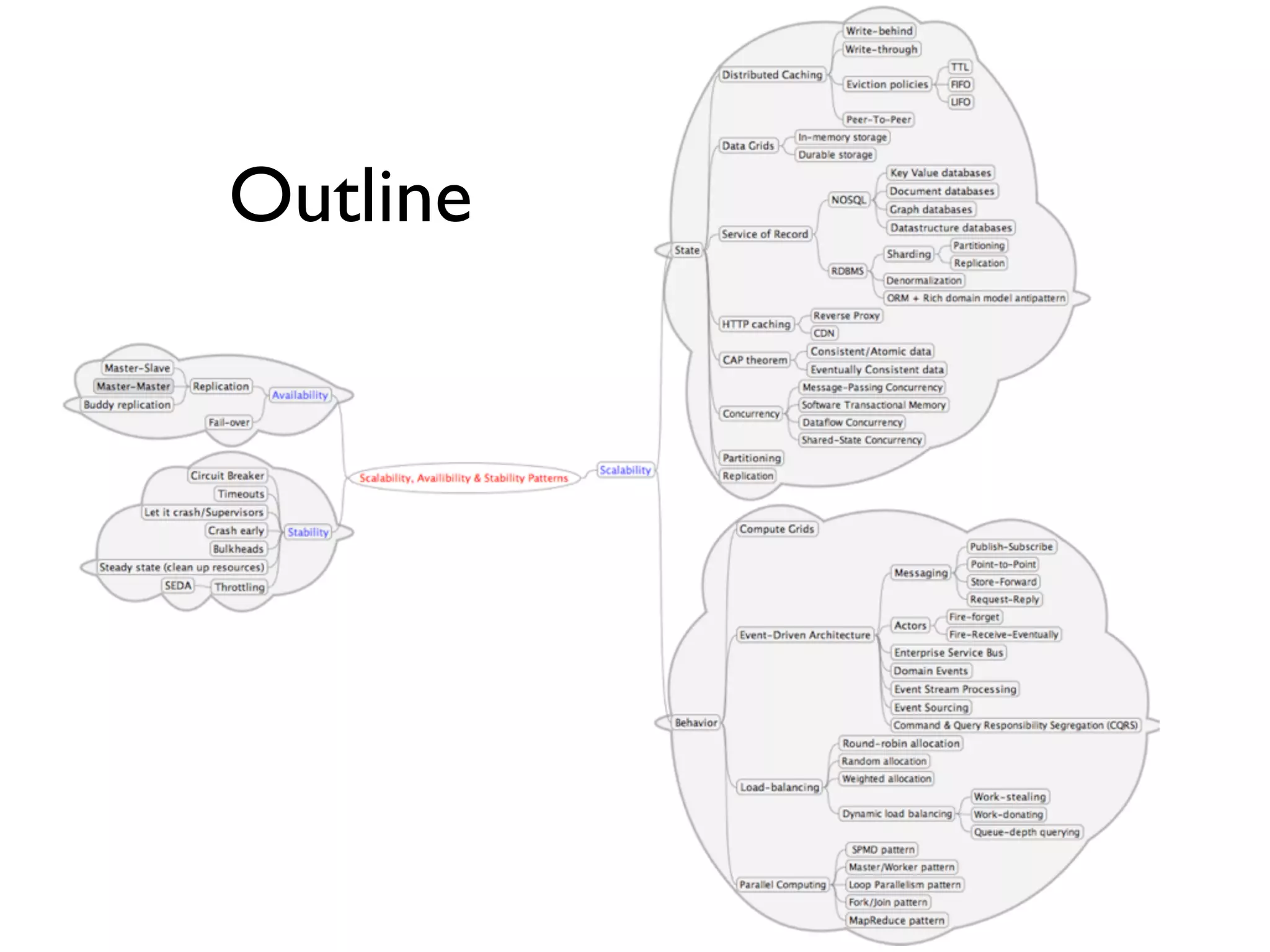
Outline
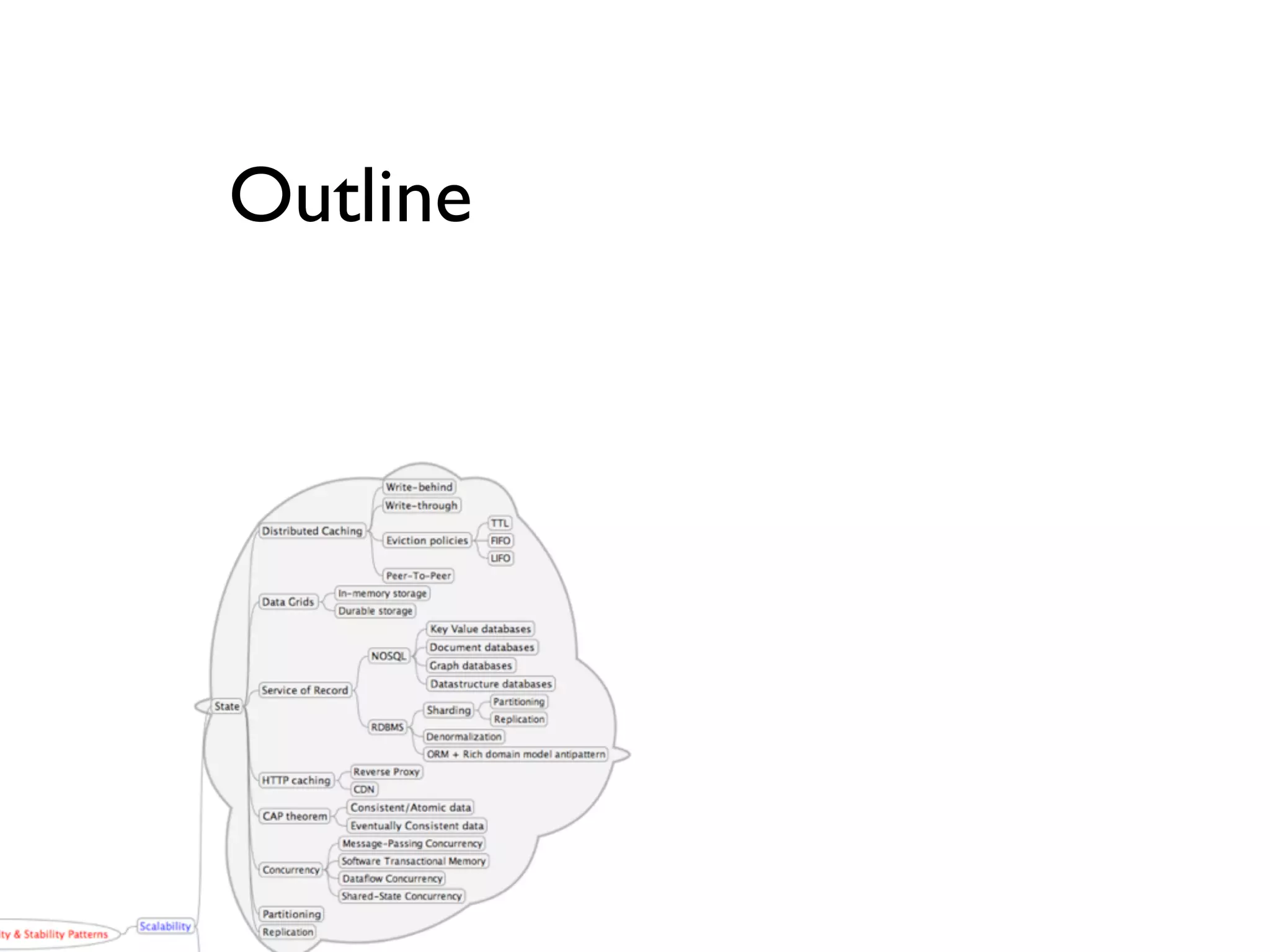
Outline
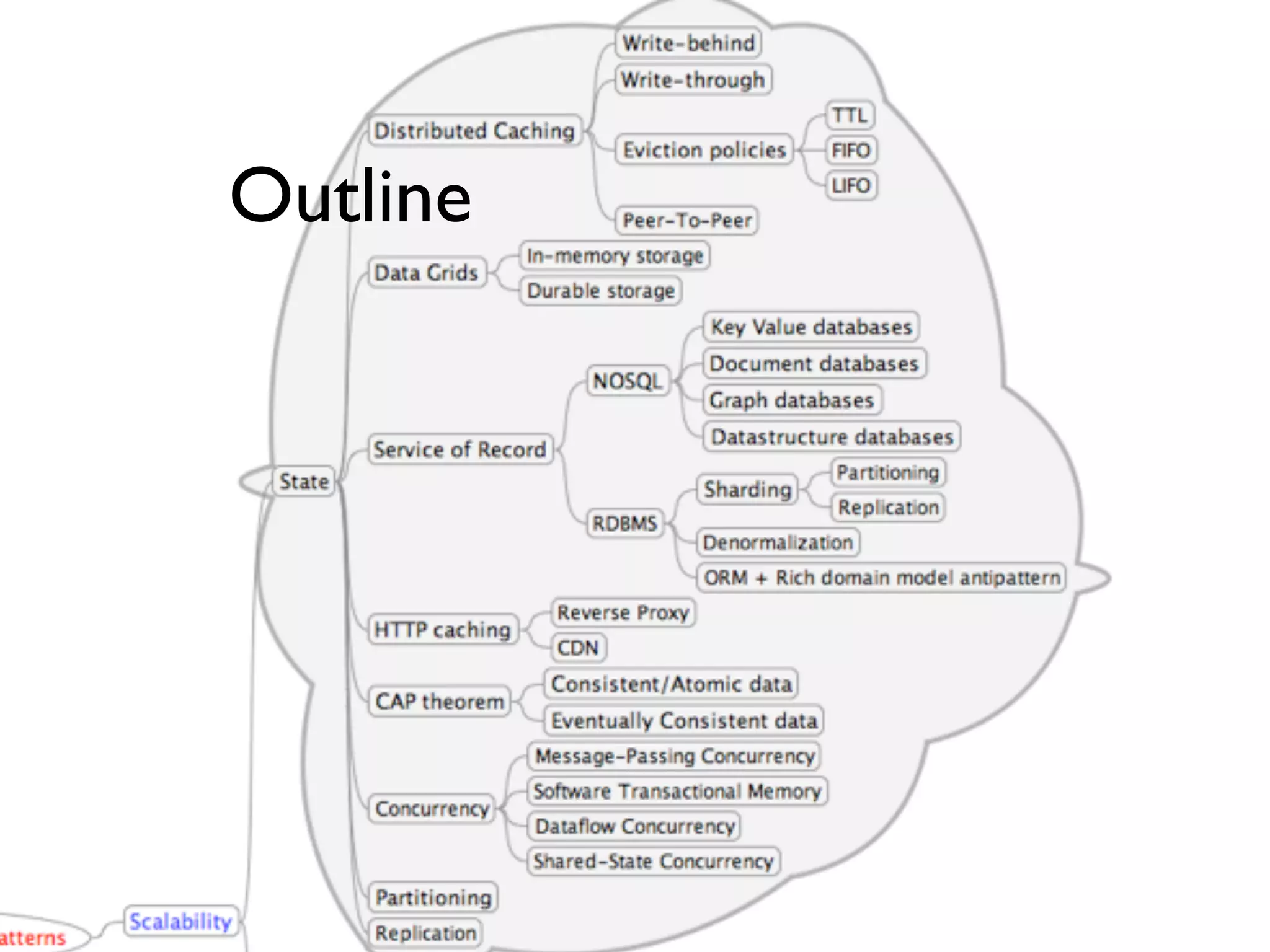
Outline
Outline
Outline
Introduction
Scalability Patterns
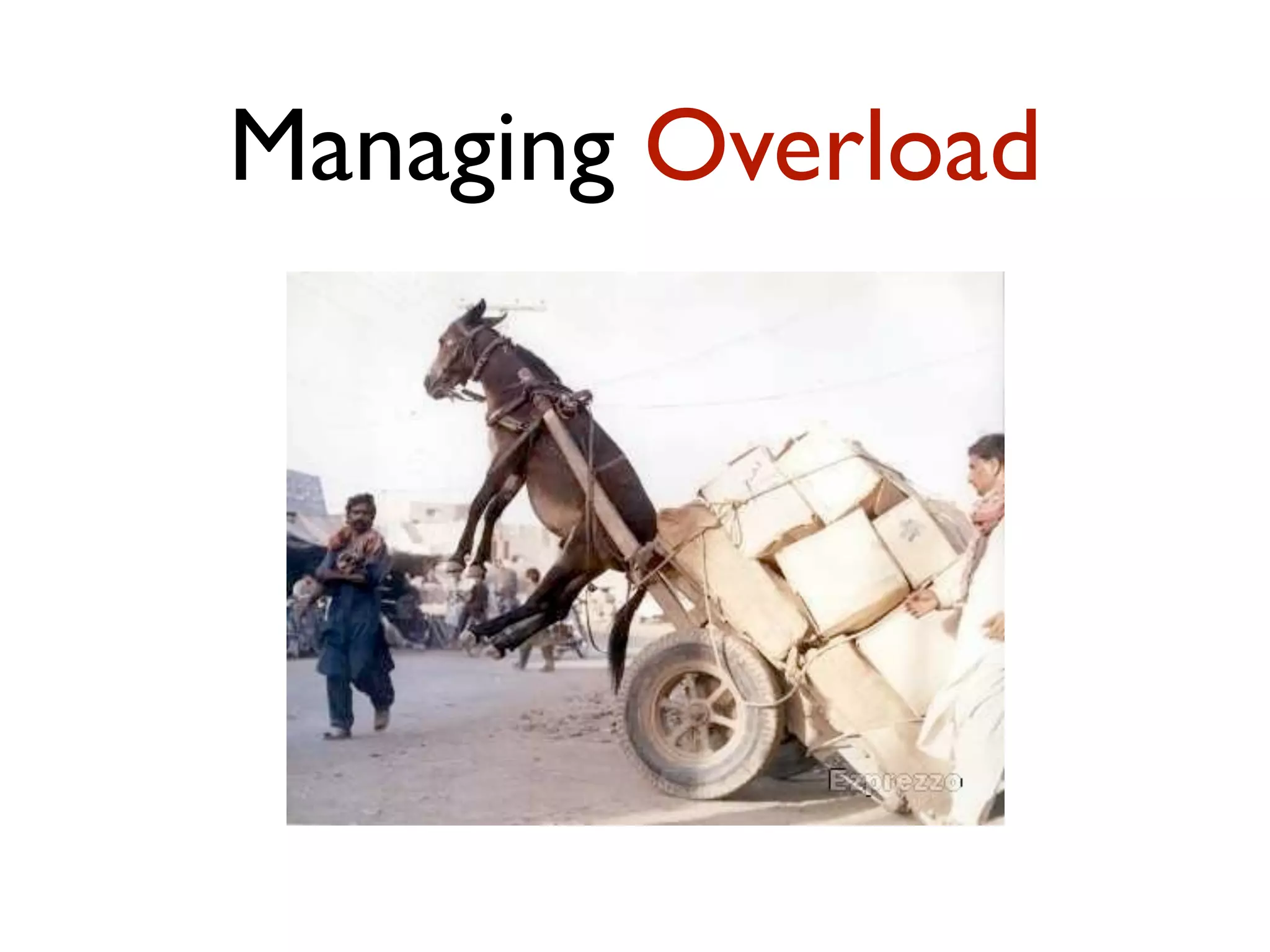
Managing Overload
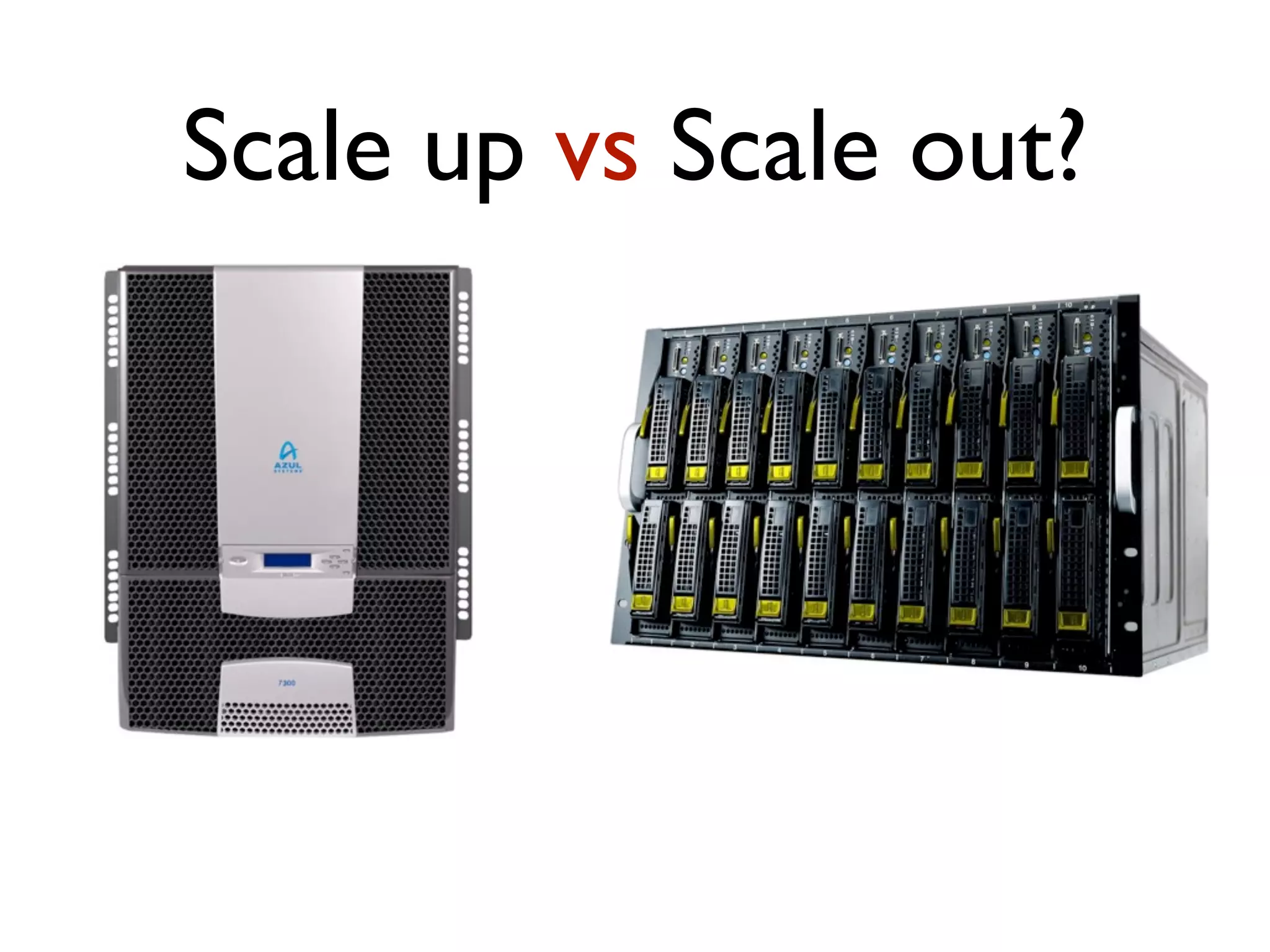
Scale up vs Scale out?
General recommendations • Immutability as the default • Referential Transparency (FP) • Laziness • Think about your data: • Different data need different guarantees
Scalability Trade-offs
Trade-offs •Performance vs Scalability •Latency vs Throughput •Availability vs Consistency
Performance vs Scalability
How do I know if I have a performance problem?
How do I know if I have a performance problem? If your system is slow for a single user
How do I know if I have a scalability problem?
How do I know if I have a scalability problem? If your system is fast for a single user but slow under heavy load
Latency vs Throughput
You should strive for maximal throughput with acceptable latency
Availability vs Consistency
Brewer’s CAPtheorem
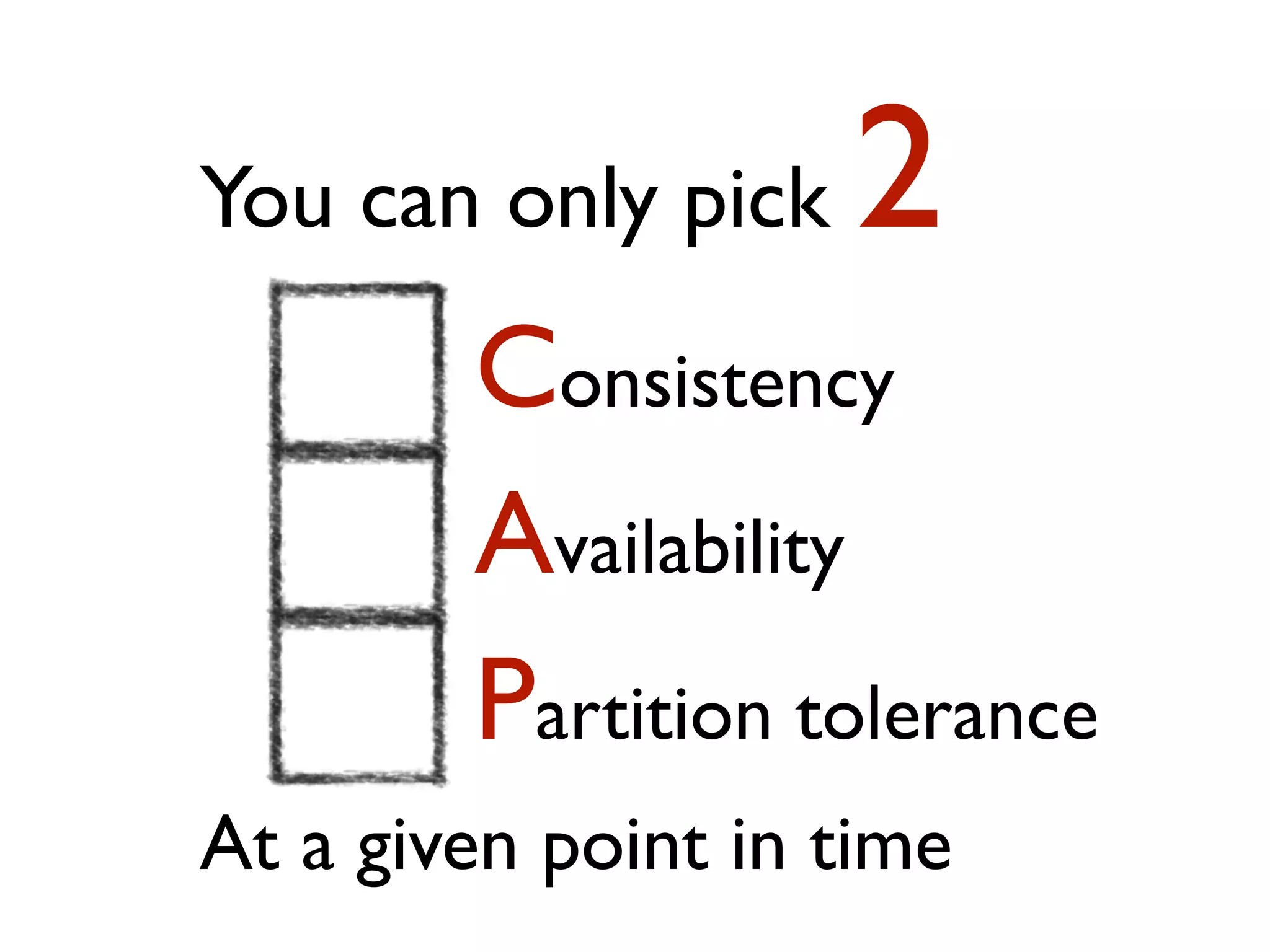
You can only pick 2 Consistency Availability Partition tolerance At a given point in time
Centralized system • In a centralized system (RDBMS etc.) we don’t have network partitions, e.g. P in CAP • So you get both: •Availability •Consistency
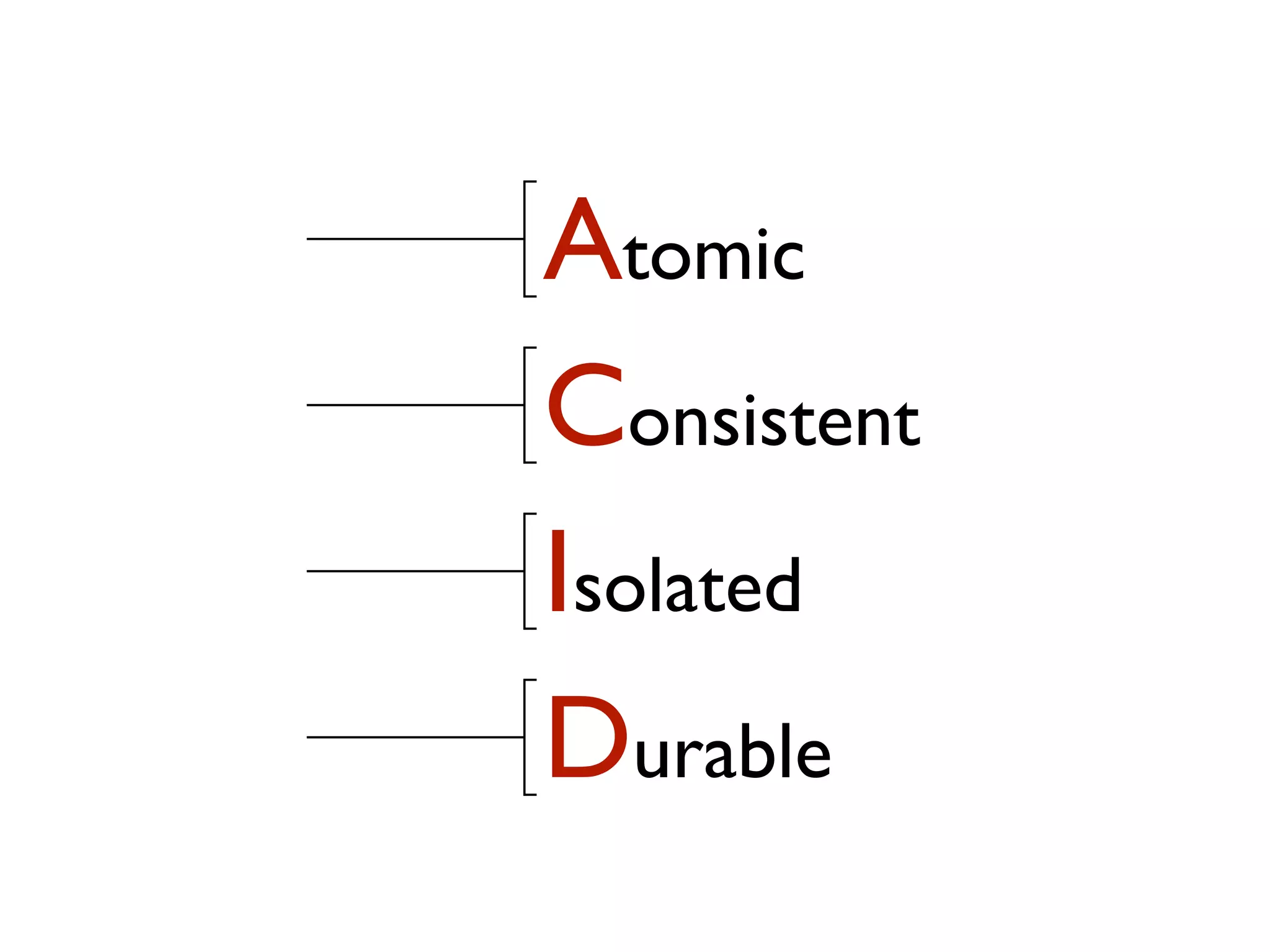
Atomic Consistent Isolated Durable
Distributed system • In a distributed system we (will) have network partitions, e.g. P in CAP • So you get to only pick one: •Availability •Consistency
CAP in practice: • ...there are only two types of systems: 1. CP 2. AP • ...there is only one choice to make. In case of a network partition, what do you sacrifice? 1. C: Consistency 2. A:Availability
Basically Available Soft state Eventually consistent
Eventual Consistency ...is an interesting trade-off
Eventual Consistency ...is an interesting trade-off But let’s get back to that later
Availability Patterns
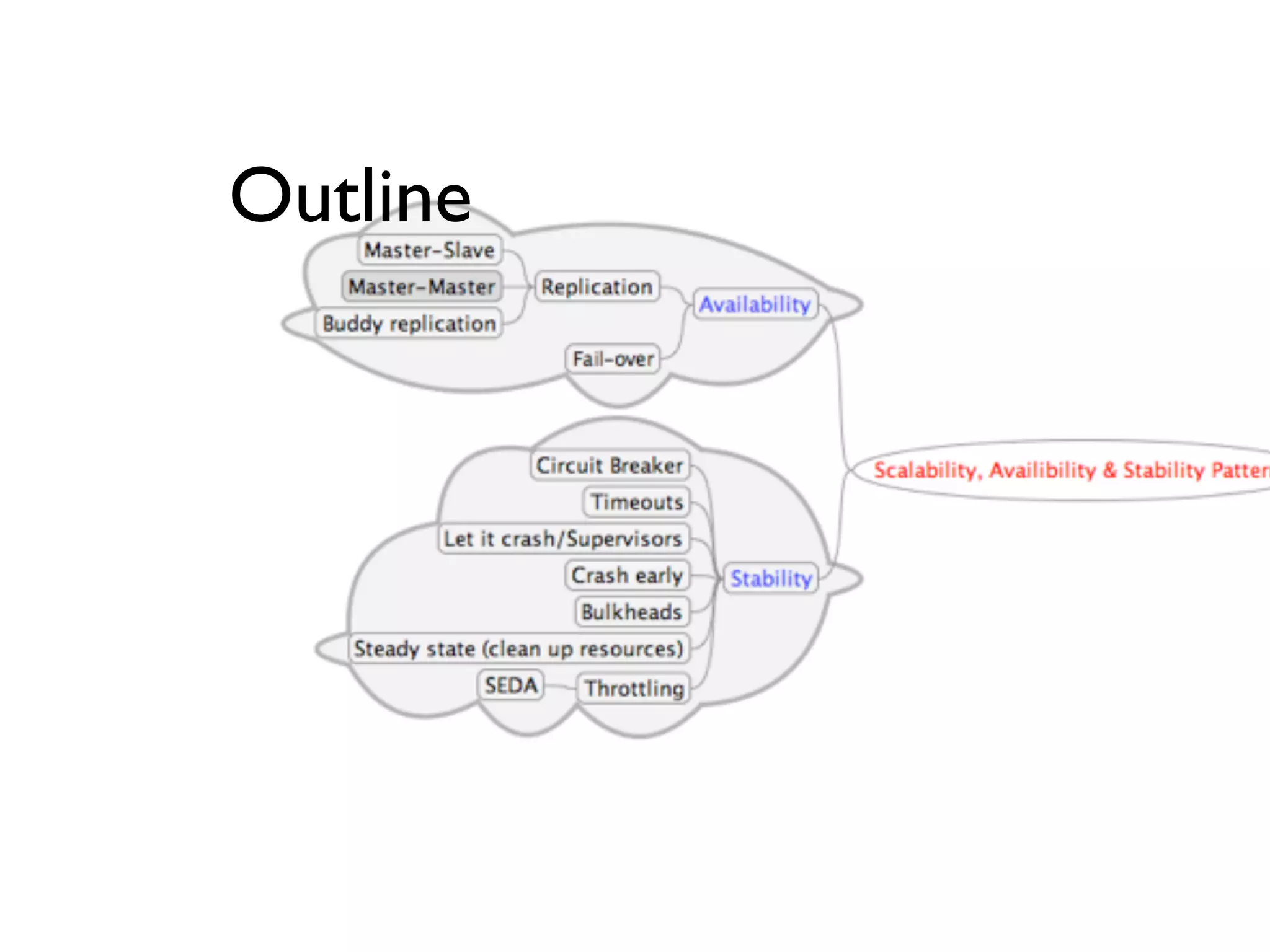
•Fail-over •Replication • Master-Slave • Tree replication • Master-Master • Buddy Replication Availability Patterns
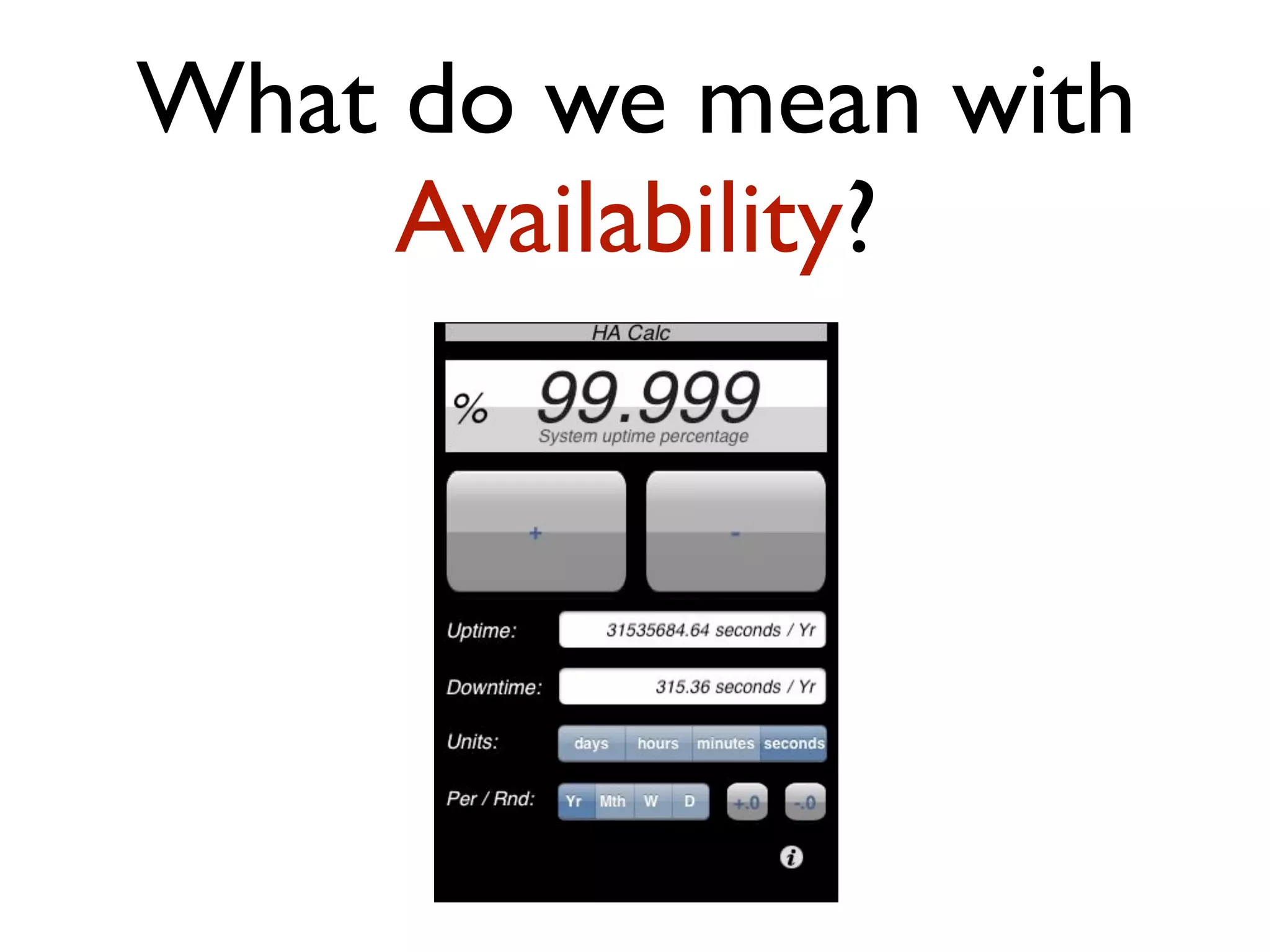
What do we mean with Availability?
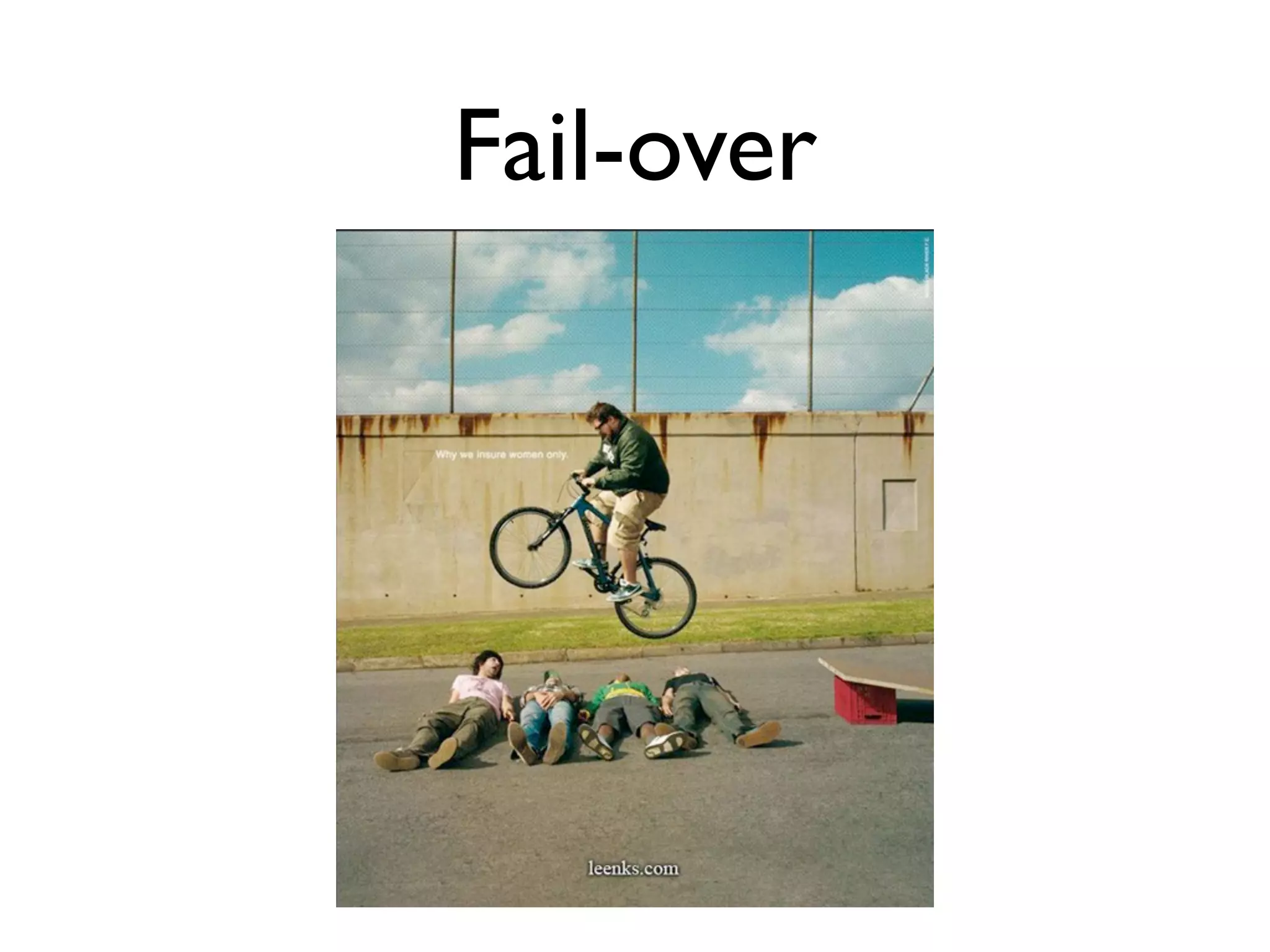
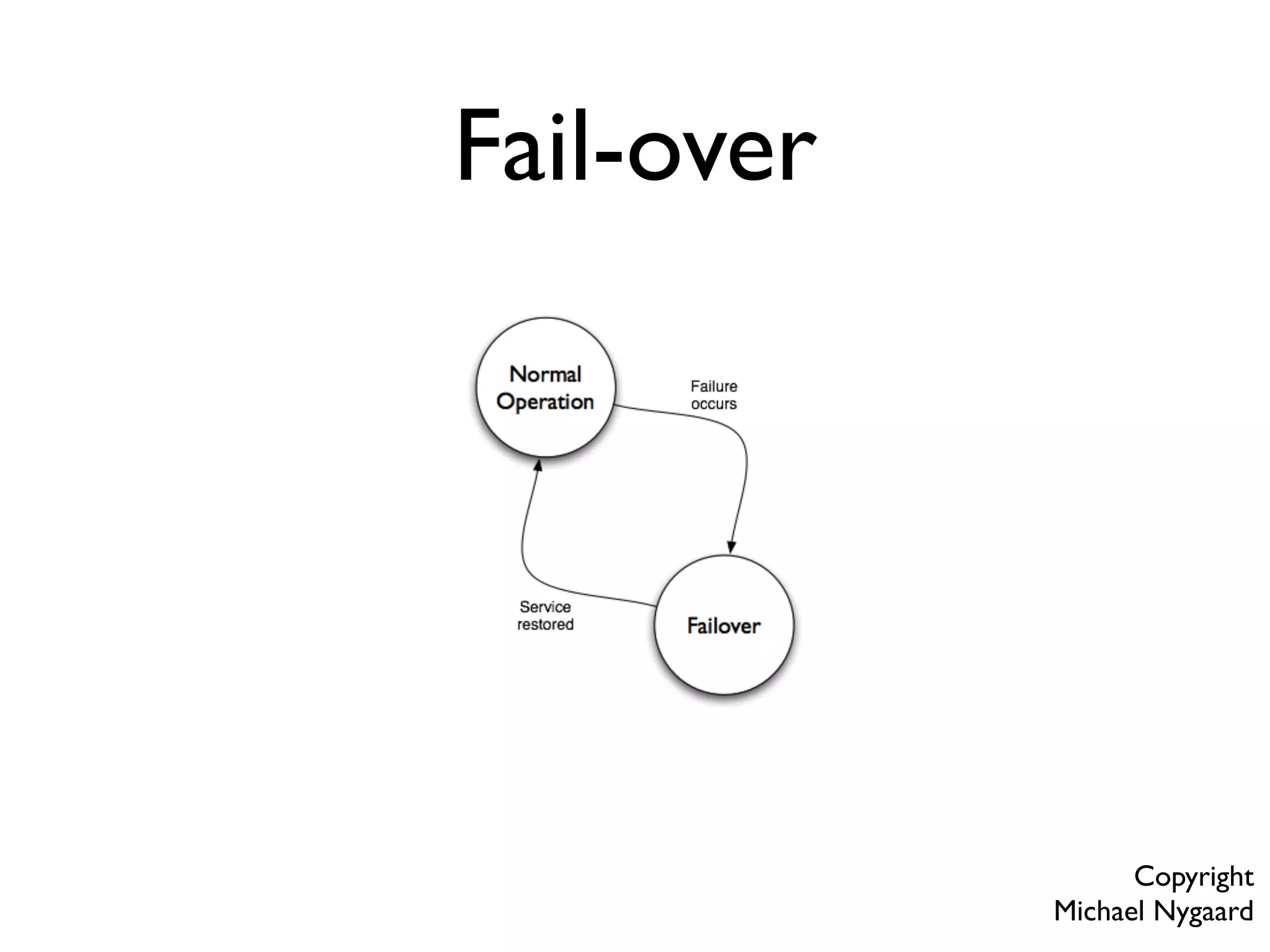
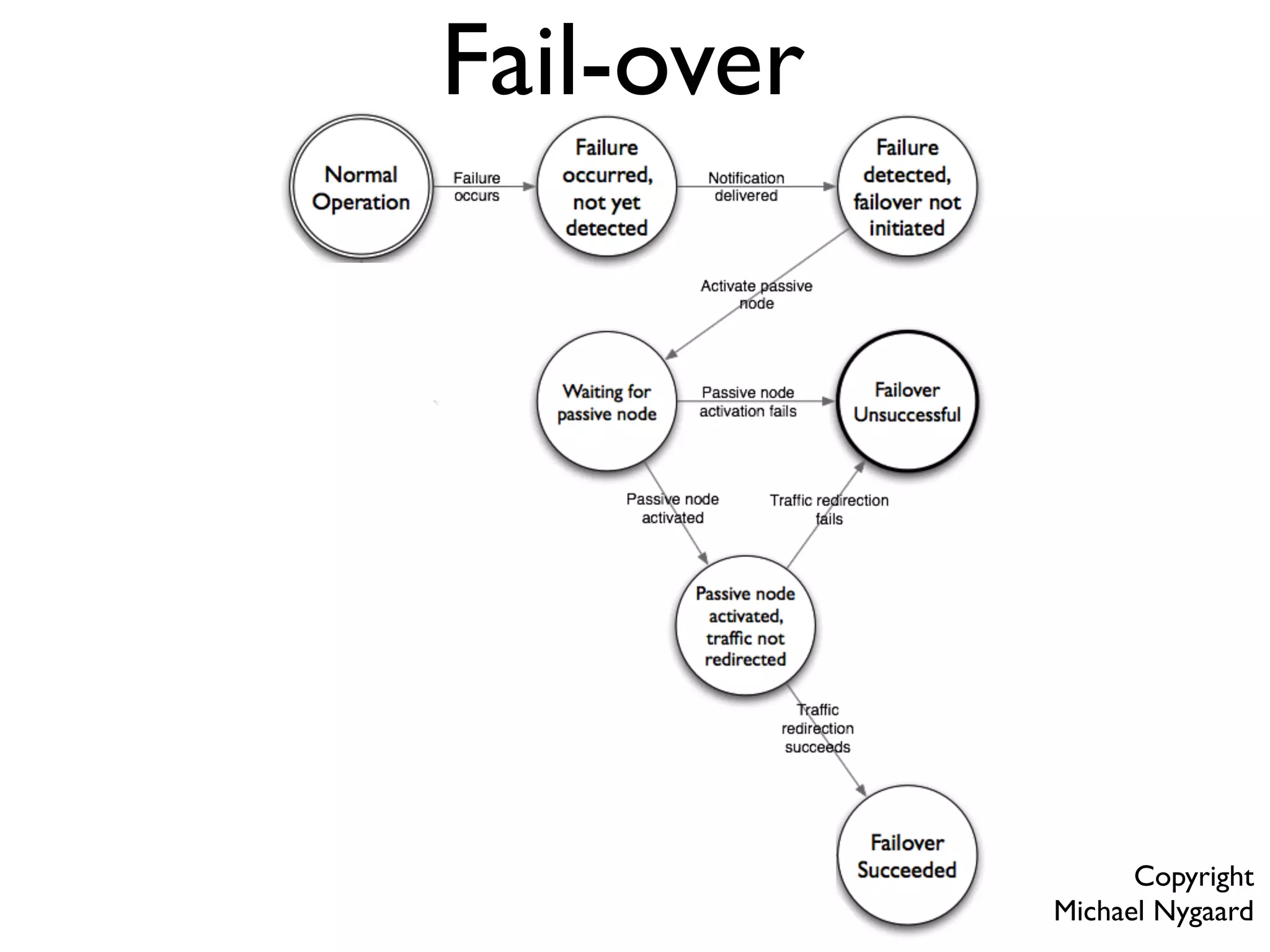
Fail-over
Fail-over Copyright Michael Nygaard
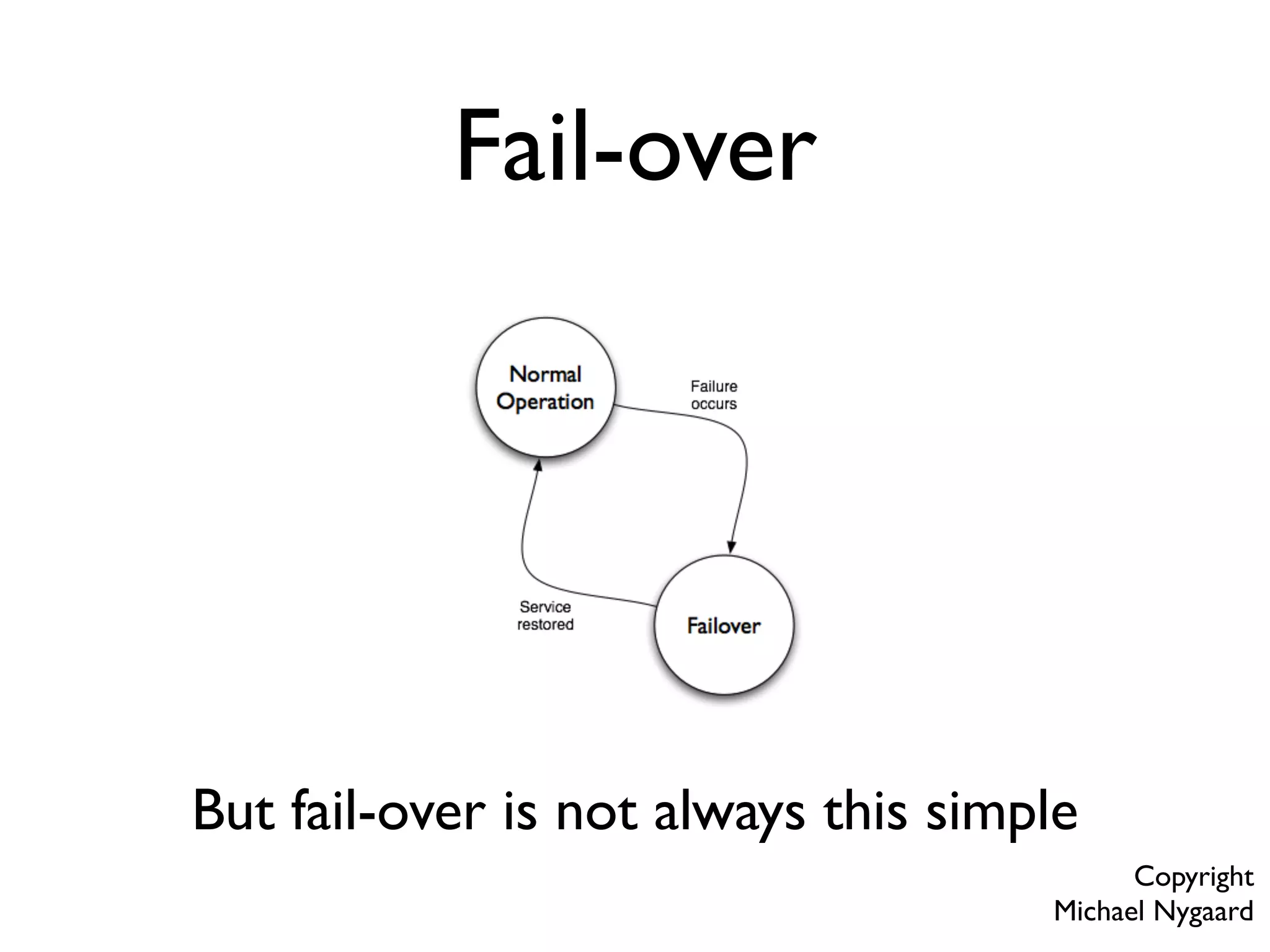
Fail-over But fail-over is not always this simple Copyright Michael Nygaard
Fail-over Copyright Michael Nygaard
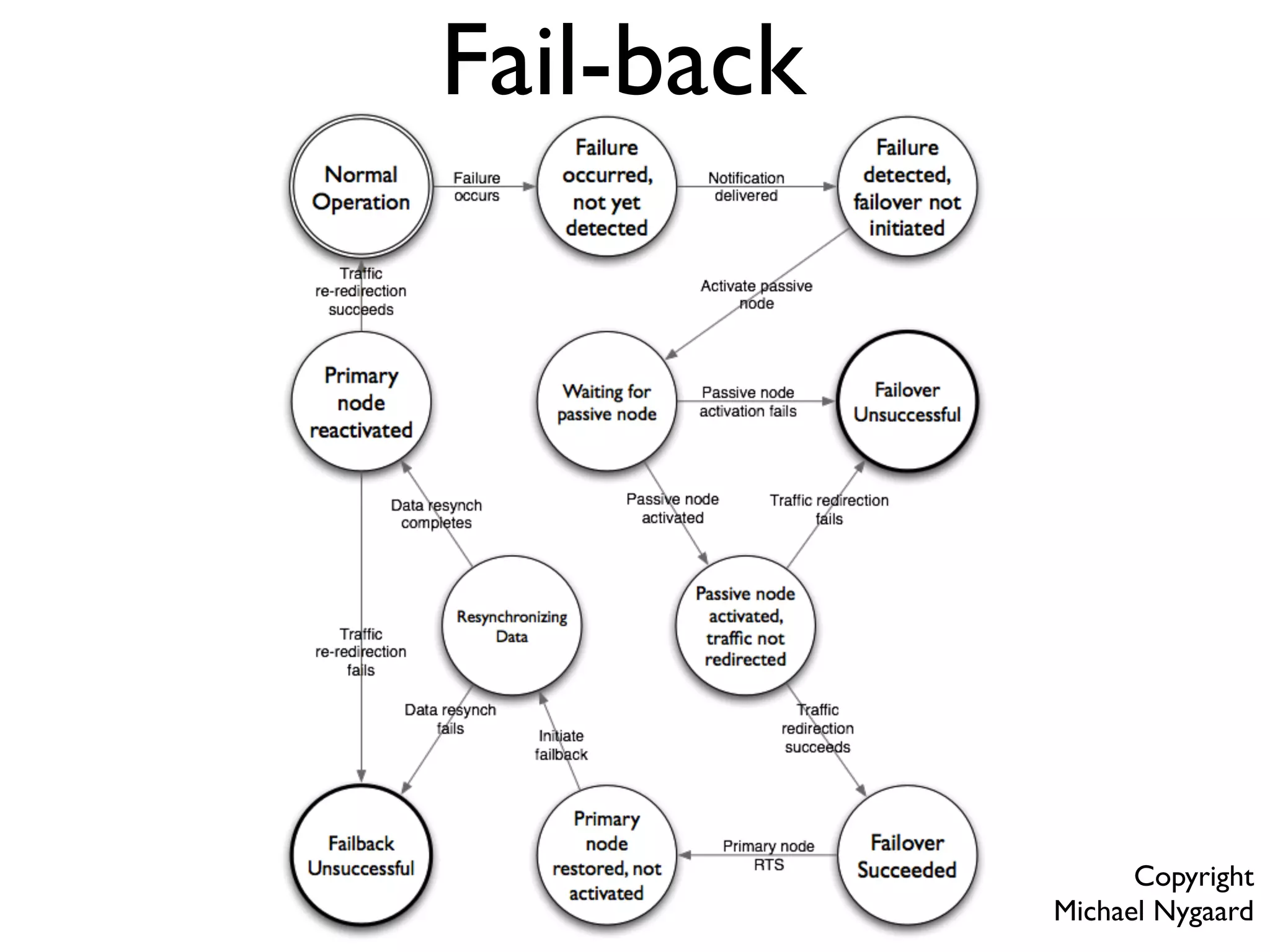
Fail-back Copyright Michael Nygaard
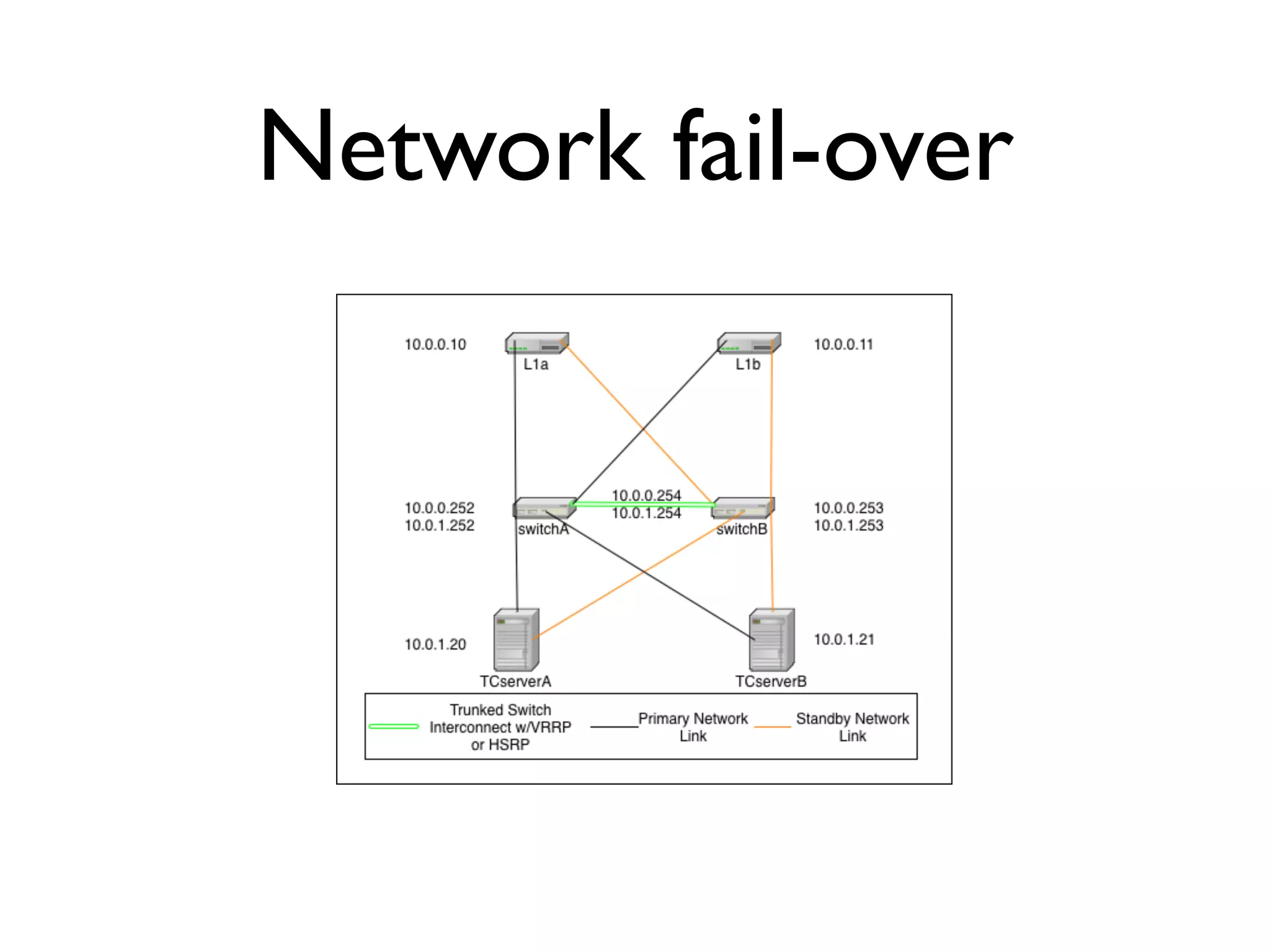
Network fail-over
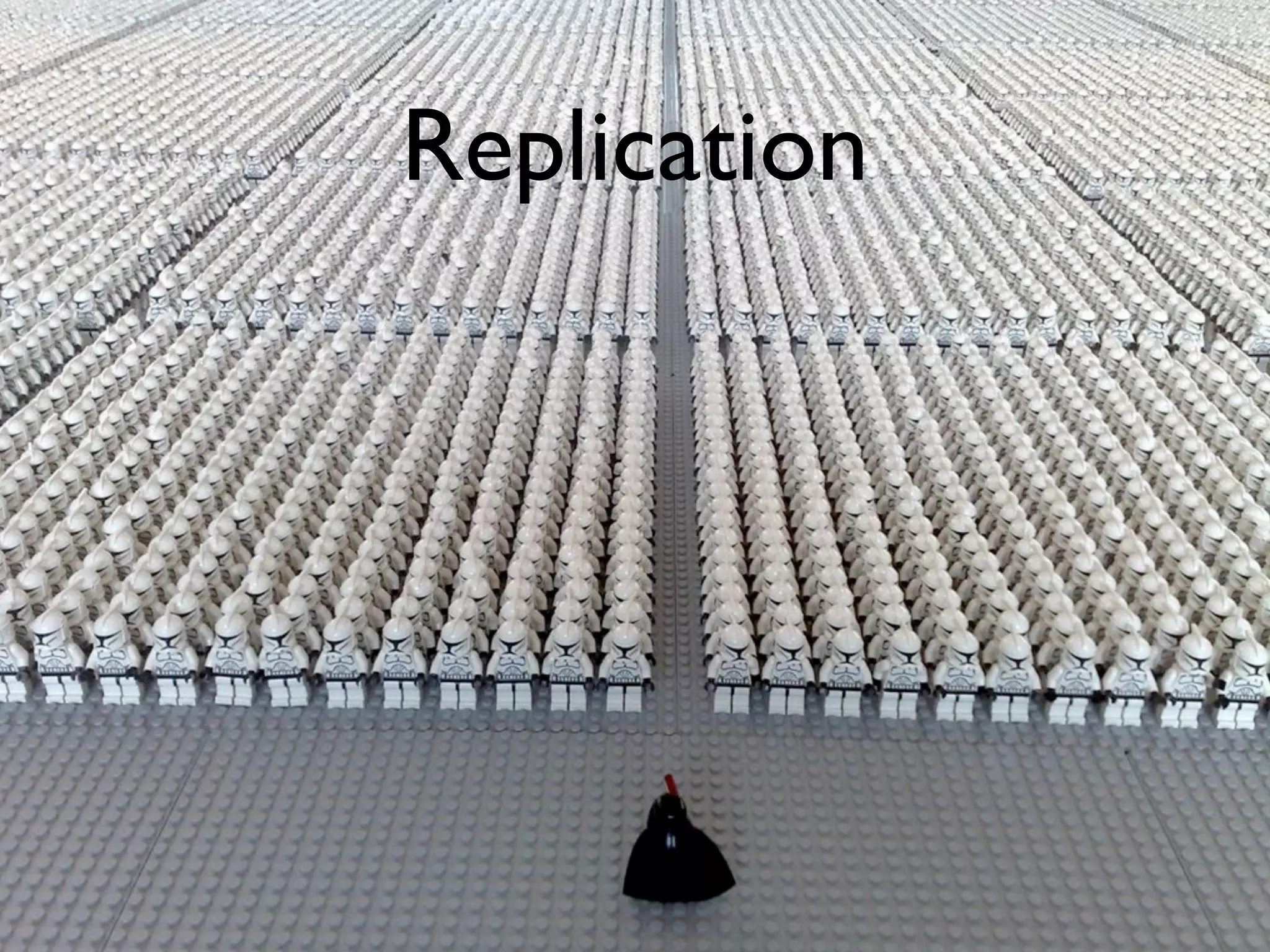
Replication
• Active replication - Push • Passive replication - Pull • Data not available, read from peer, then store it locally • Works well with timeout-based caches Replication
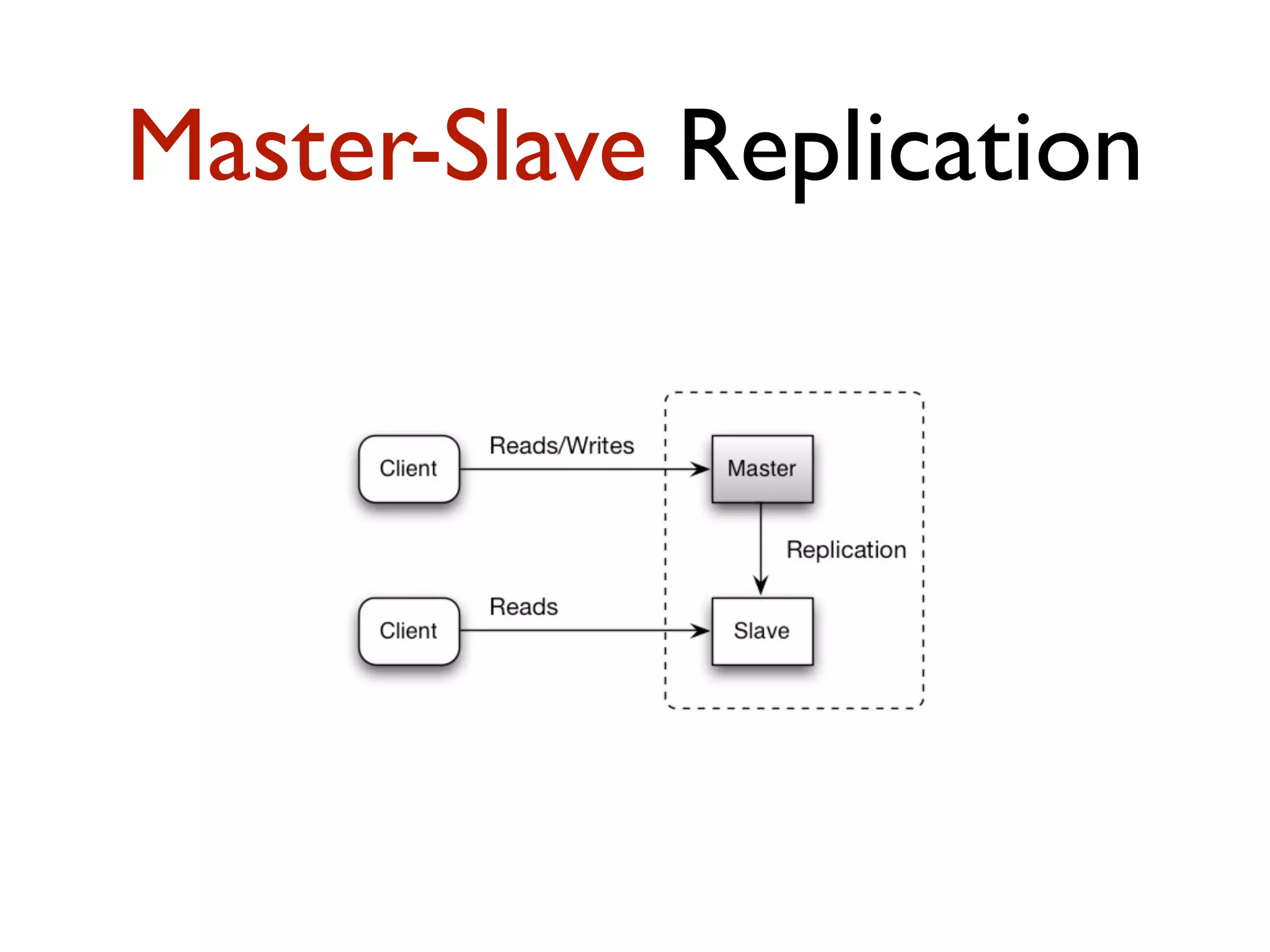
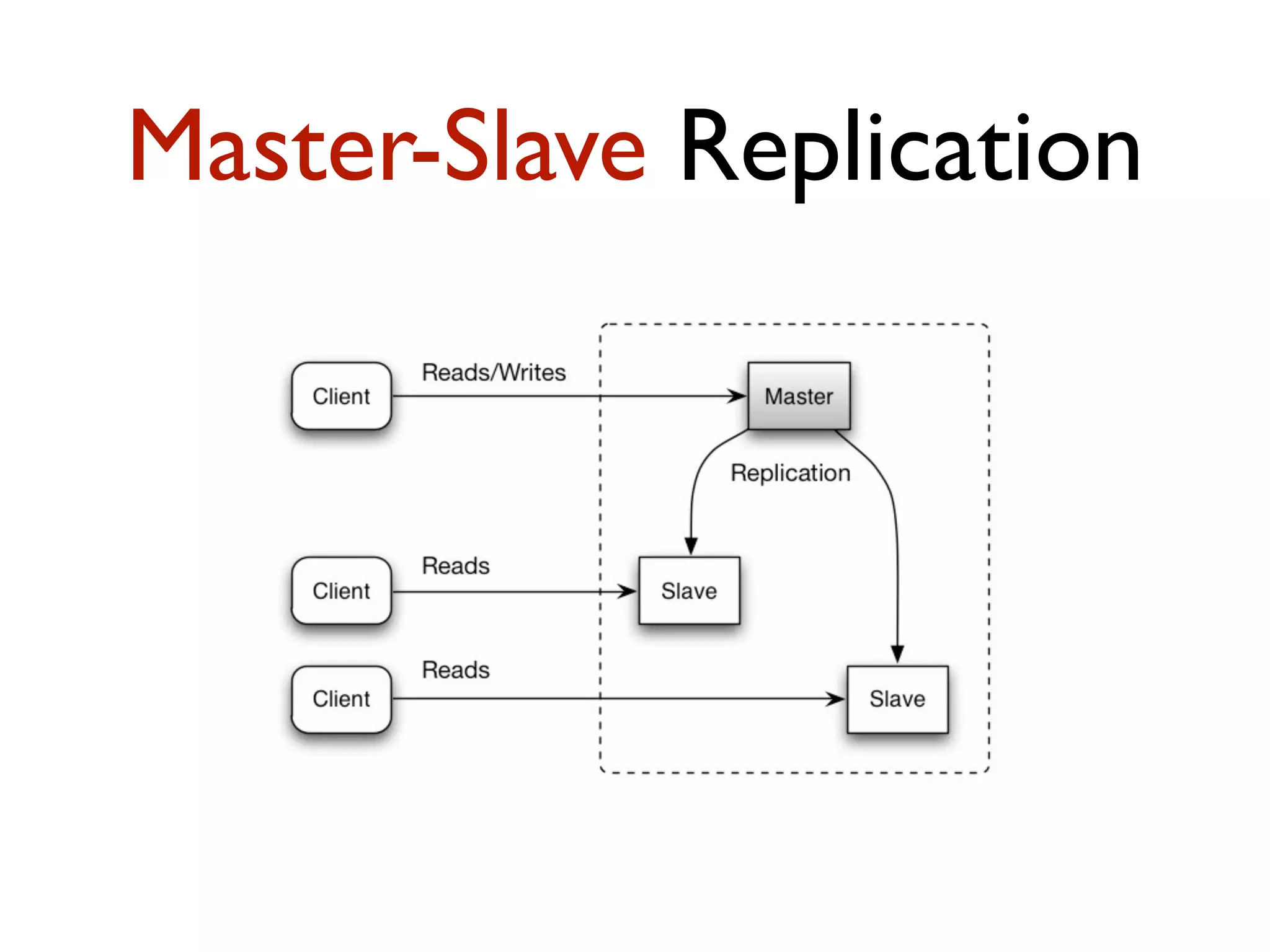
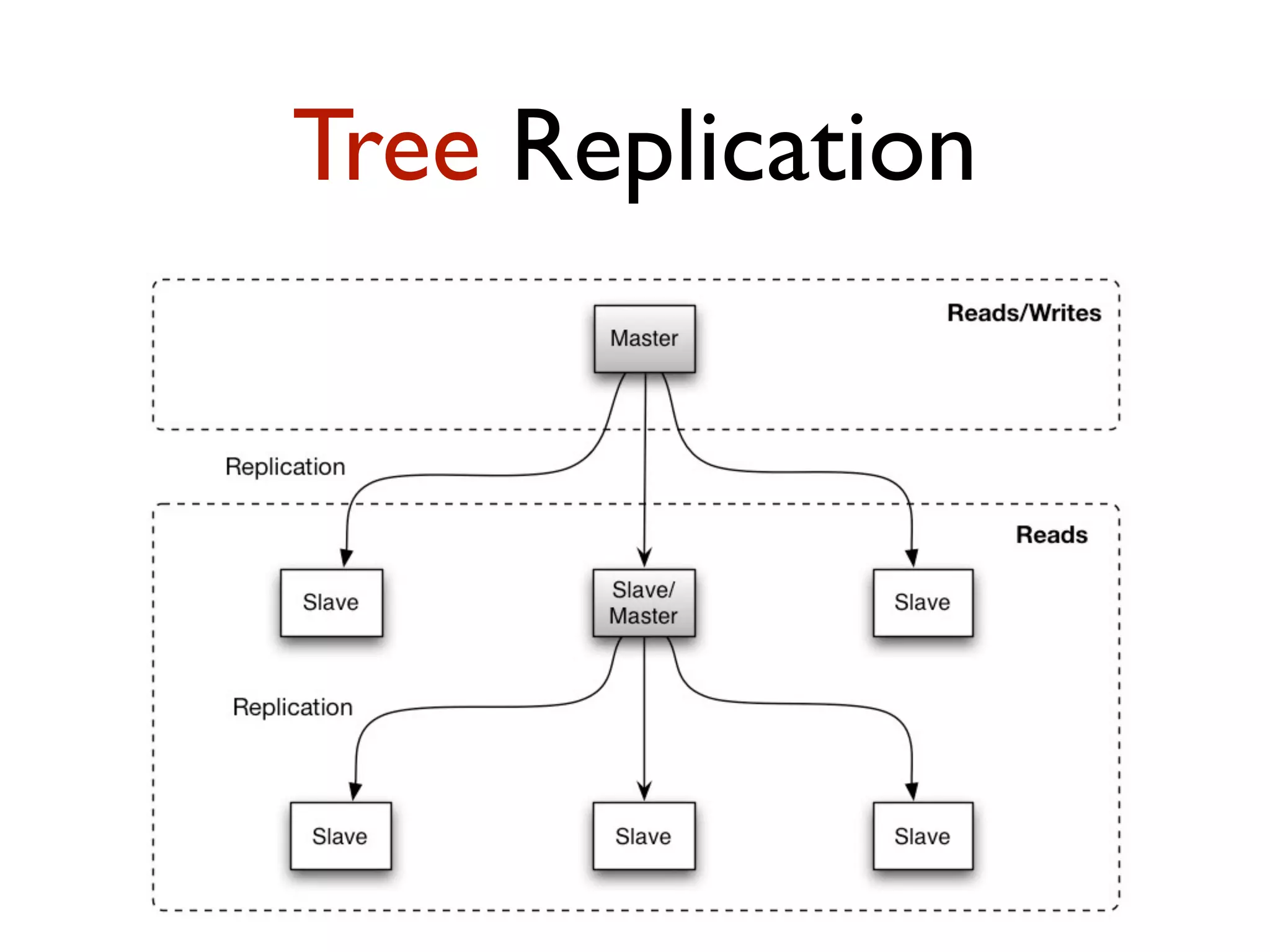
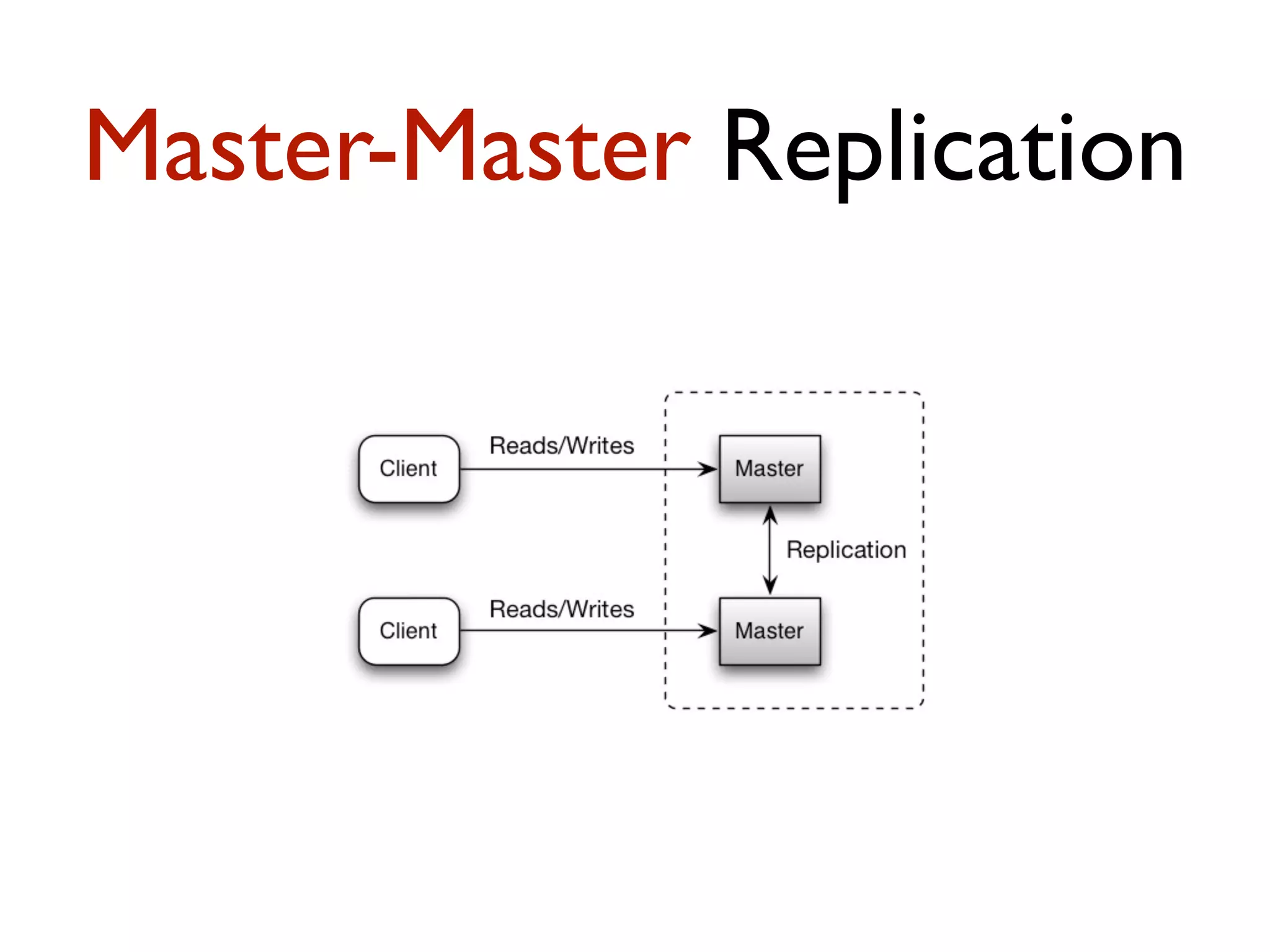
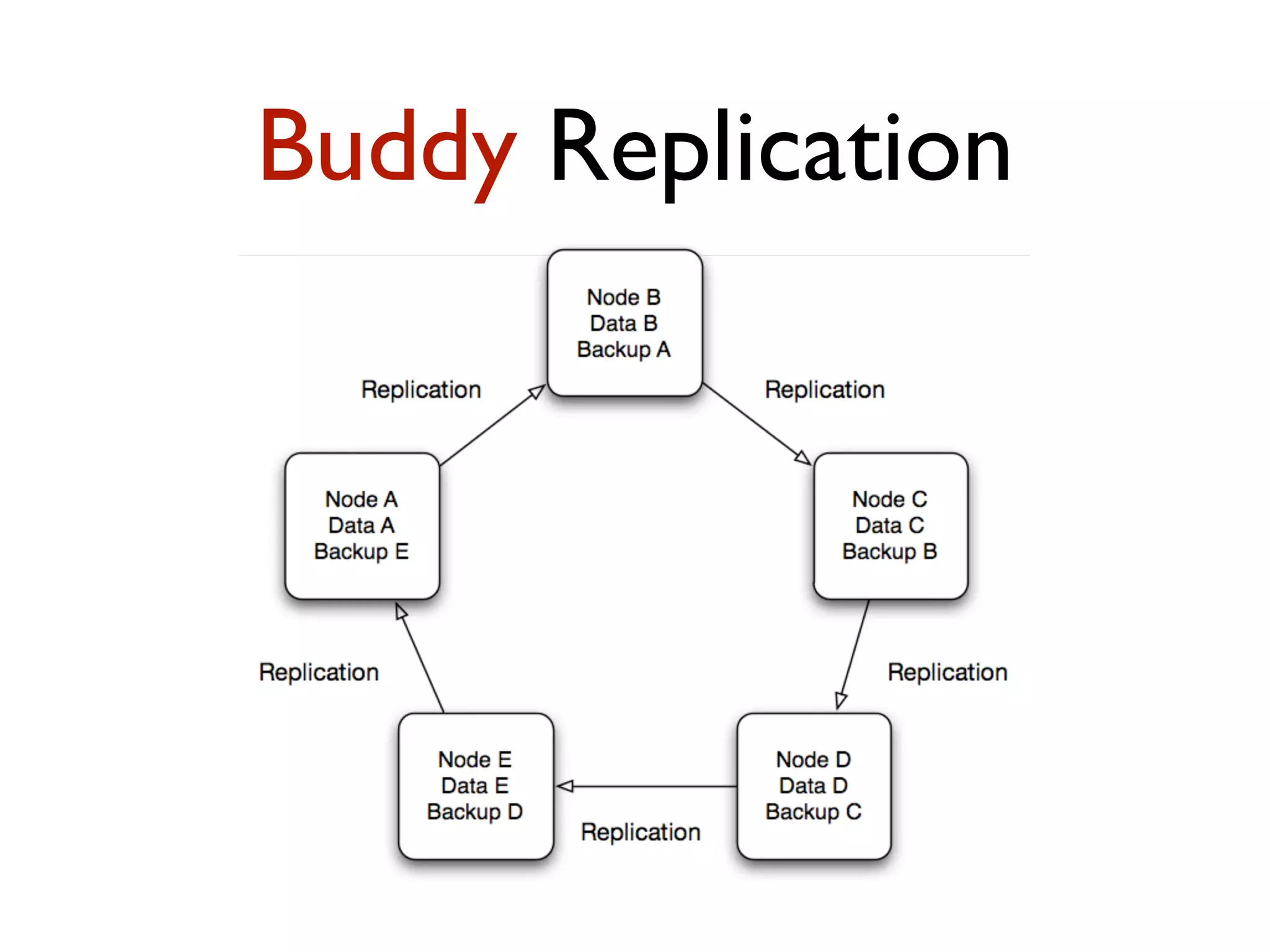
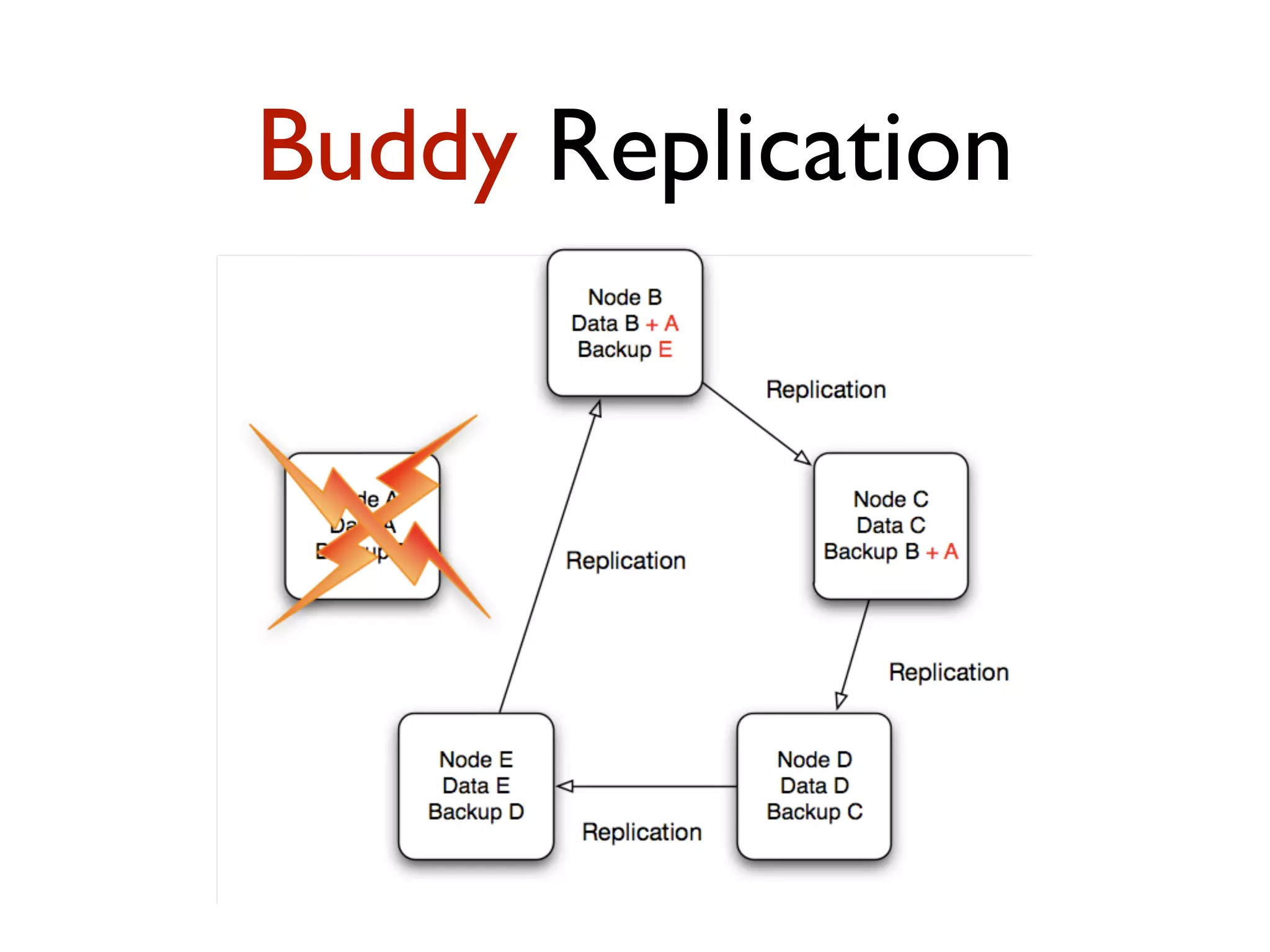
• Master-Slave replication • Tree Replication • Master-Master replication • Buddy replication Replication
Master-Slave Replication
Tree Replication
Master-Master Replication
Buddy Replication
Buddy Replication
Scalability Patterns: State
•Partitioning •HTTP Caching •RDBMS Sharding •NOSQL •Distributed Caching •Data Grids •Concurrency Scalability Patterns: State
Partitioning
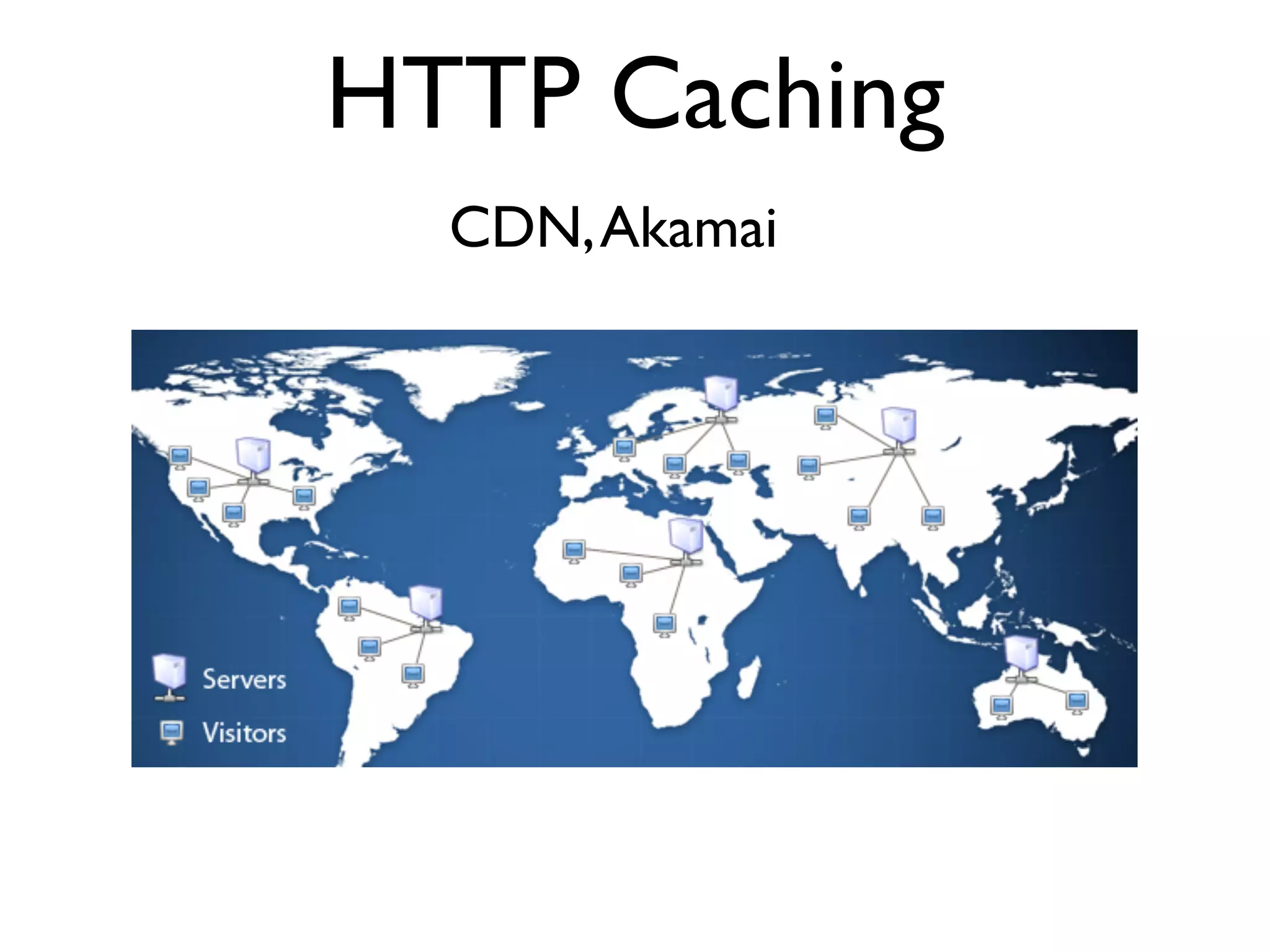
HTTP Caching Reverse Proxy • Varnish • Squid • rack-cache • Pound • Nginx • Apache mod_proxy • Traffic Server
HTTP Caching CDN,Akamai
Generate Static Content Precompute content • Homegrown + cron or Quartz • Spring Batch • Gearman • Hadoop • Google Data Protocol • Amazon Elastic MapReduce
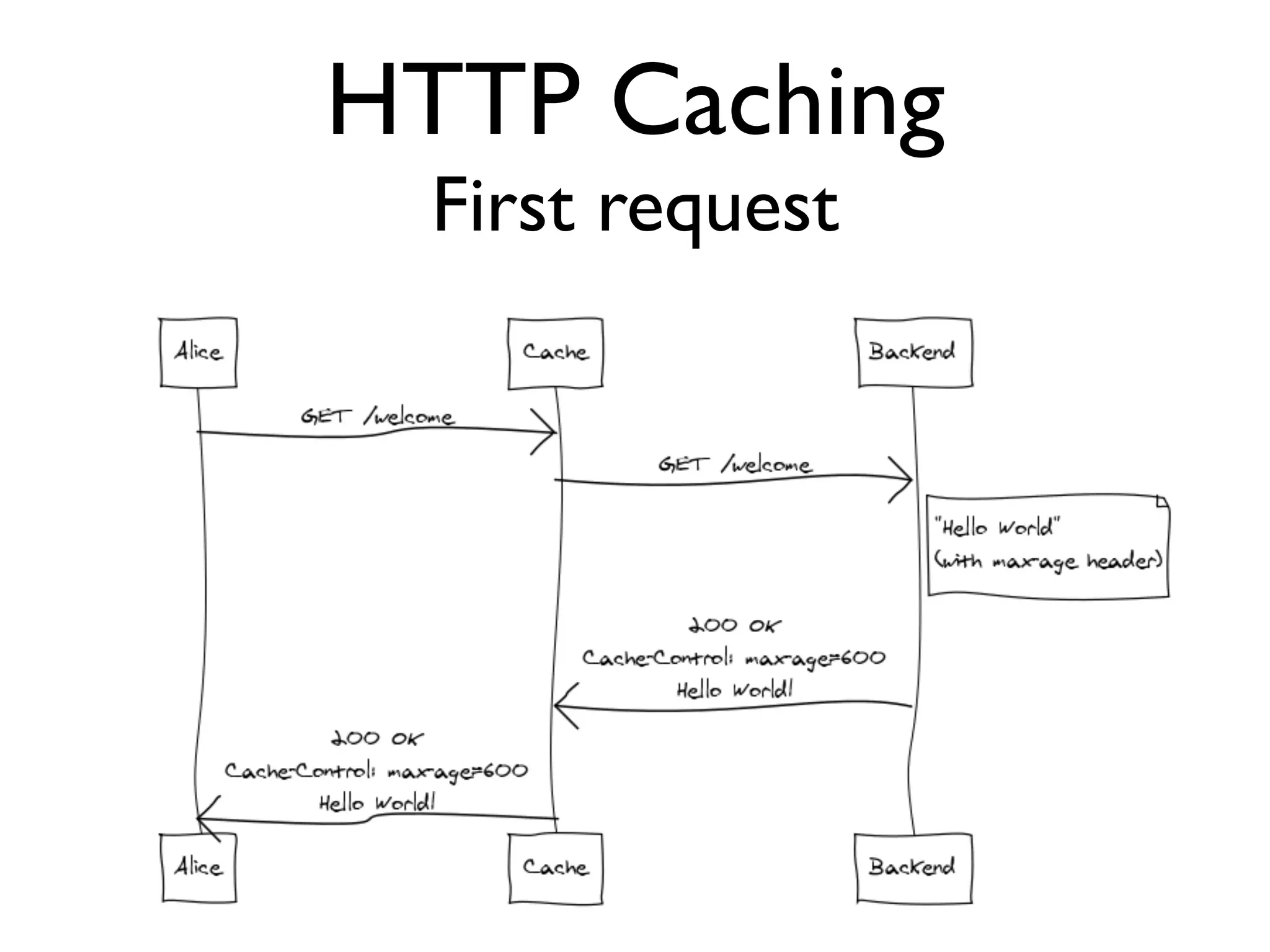
HTTP Caching First request
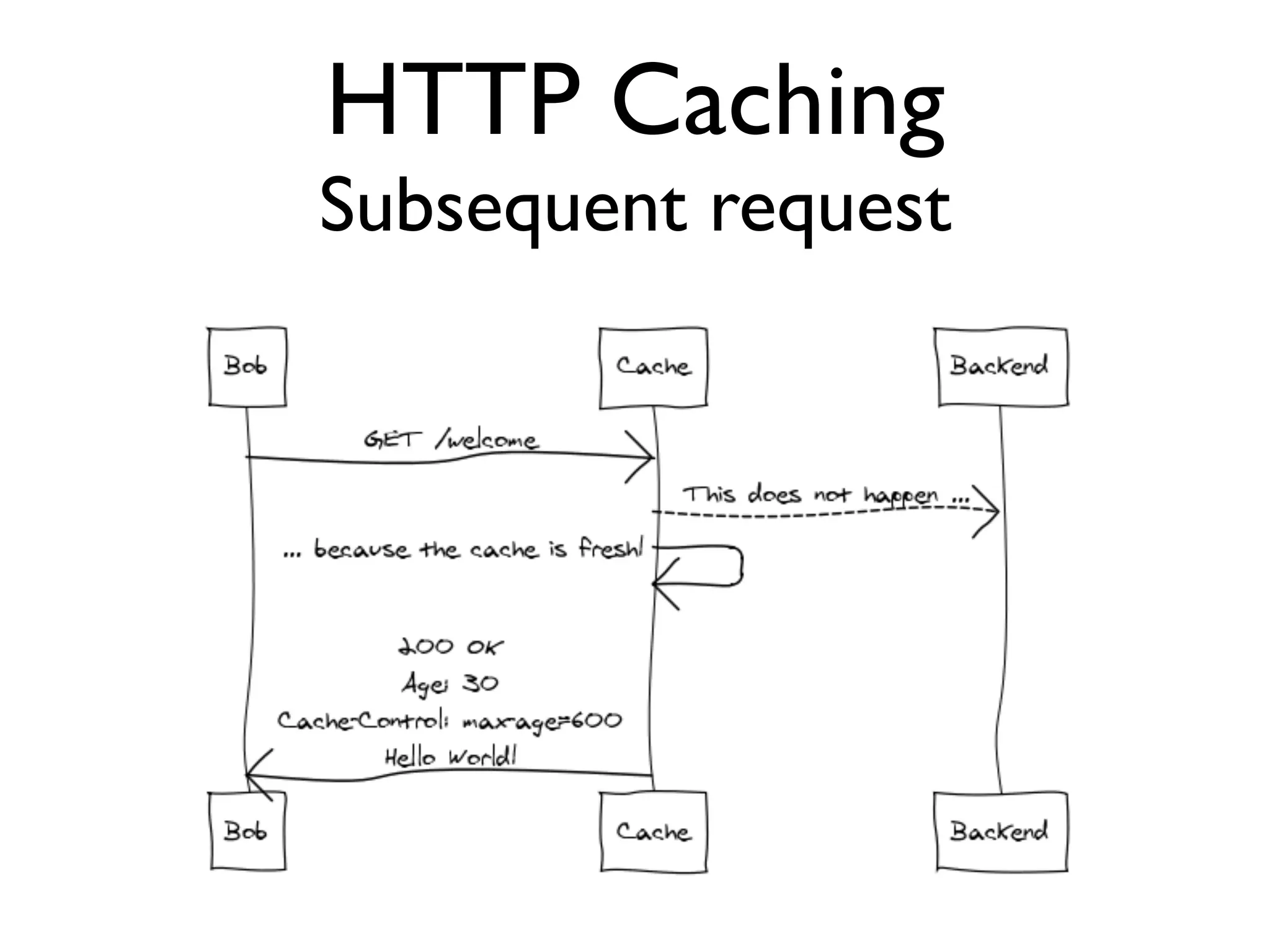
HTTP Caching Subsequent request
Service of Record SoR
Service of Record •Relational Databases (RDBMS) •NOSQL Databases
How to scale out RDBMS?
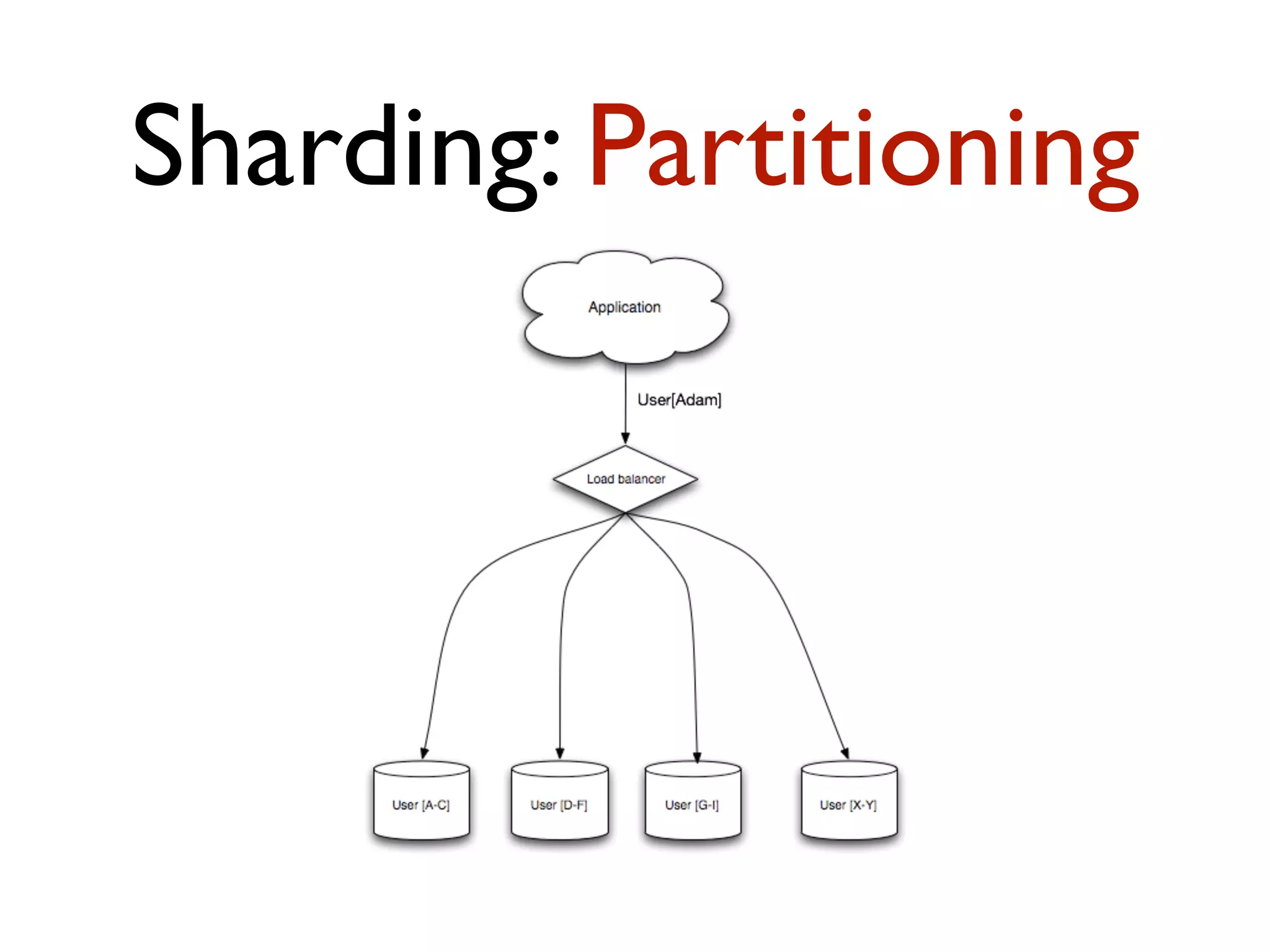
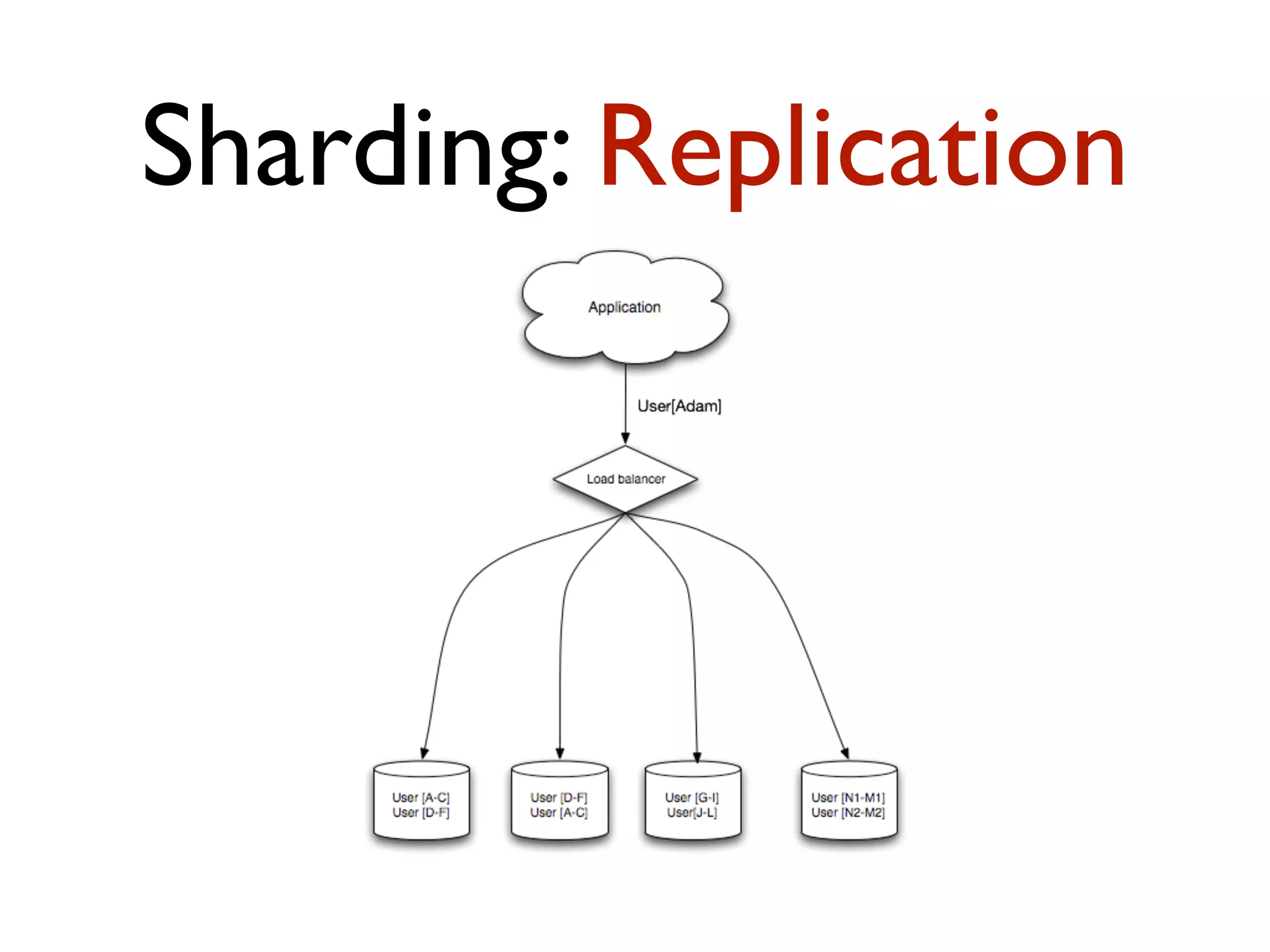
Sharding •Partitioning •Replication
Sharding: Partitioning
Sharding: Replication
ORM + rich domain model anti-pattern •Attempt: • Read an object from DB •Result: • You sit with your whole database in your lap
Think about your data • When do you need ACID? • When is Eventually Consistent a better fit? • Different kinds of data has different needs Think again
When is a RDBMS not good enough?
Scaling reads to a RDBMS is hard
Scaling writes to a RDBMS is impossible
Do we really need a RDBMS?
Do we really need a RDBMS? Sometimes...
Do we really need a RDBMS?
Do we really need a RDBMS? But many times we don’t
NOSQL (Not Only SQL)
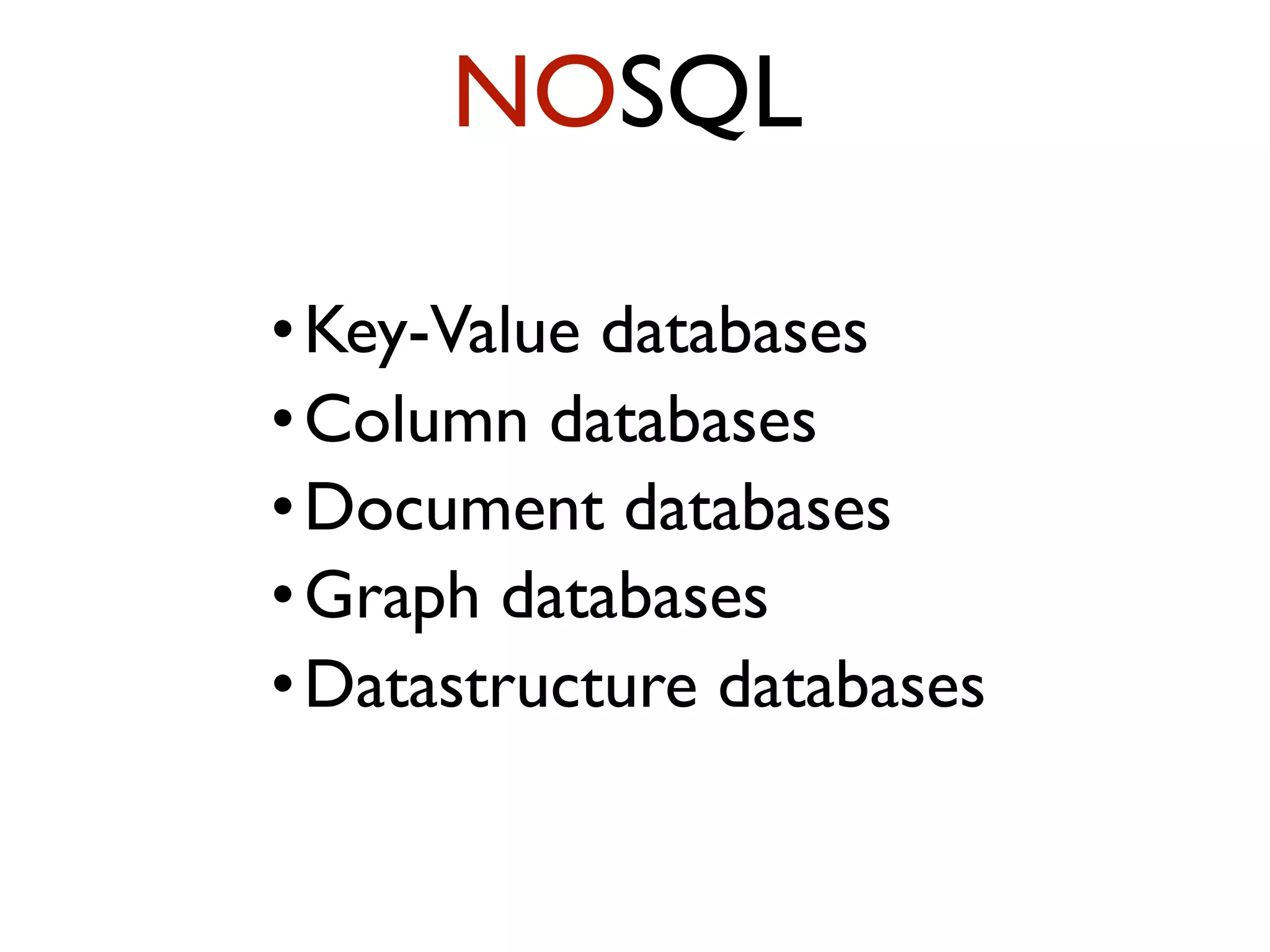
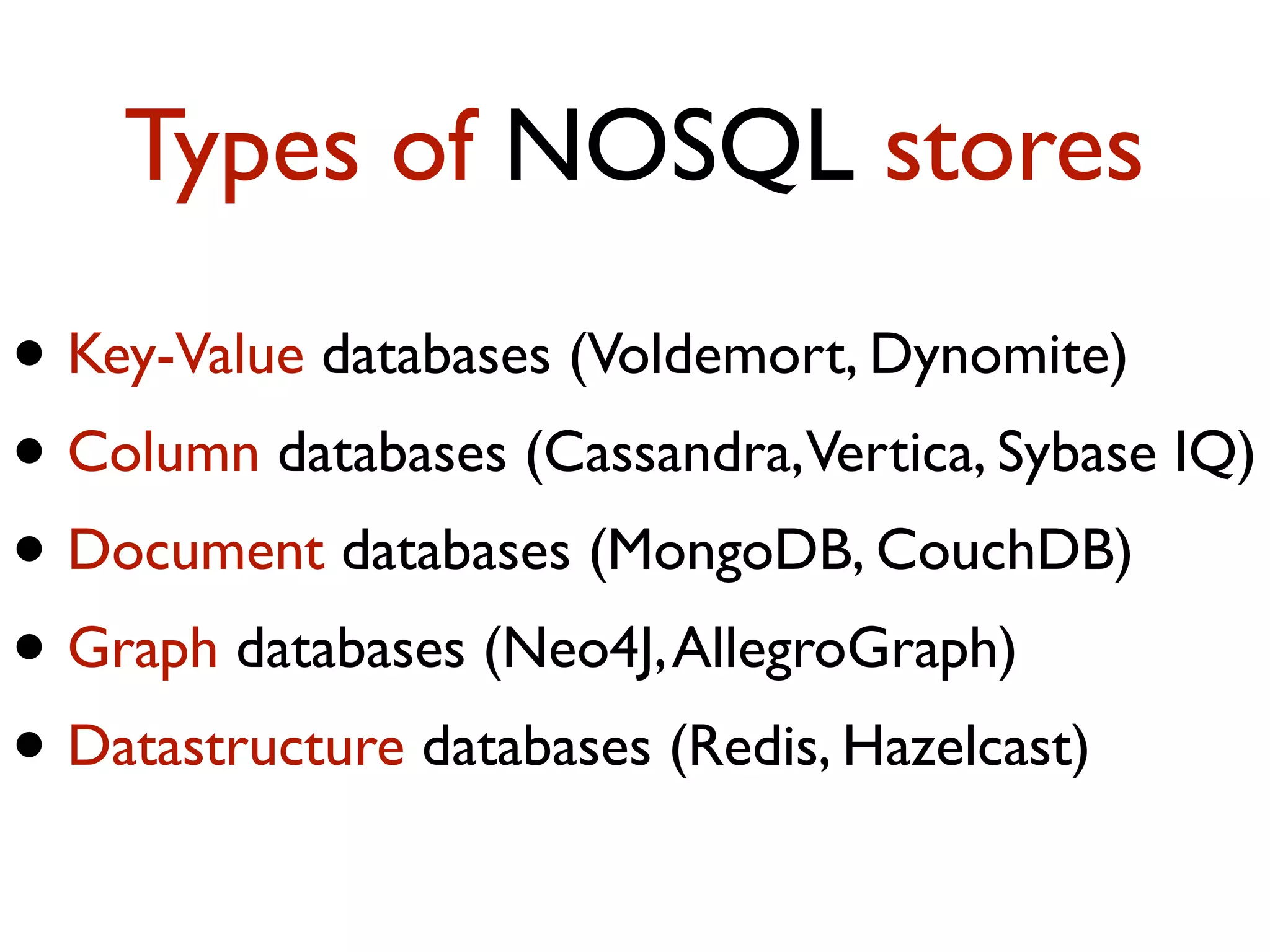
•Key-Value databases •Column databases •Document databases •Graph databases •Datastructure databases NOSQL
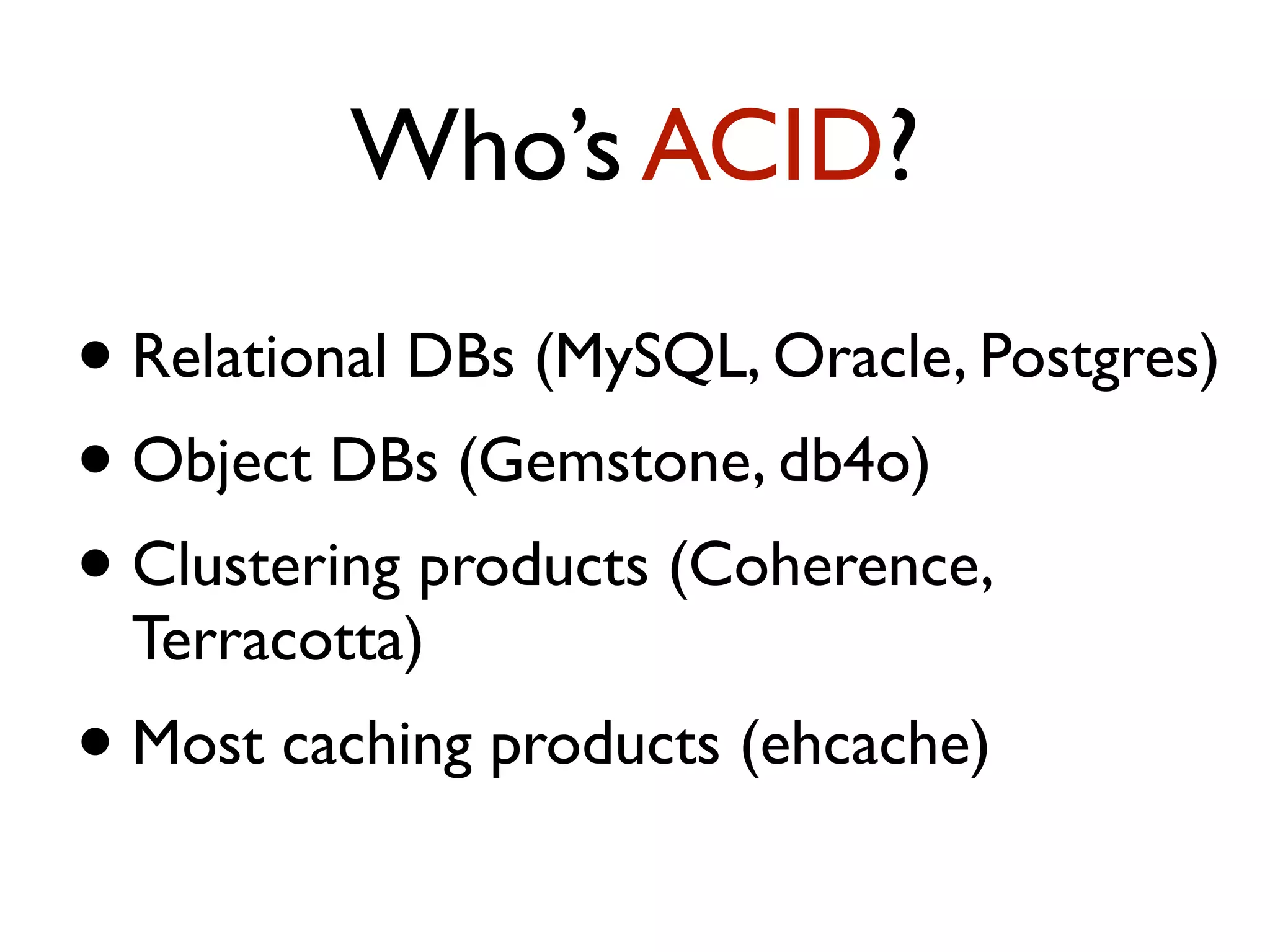
Who’s ACID? • Relational DBs (MySQL, Oracle, Postgres) • Object DBs (Gemstone, db4o) • Clustering products (Coherence, Terracotta) • Most caching products (ehcache)
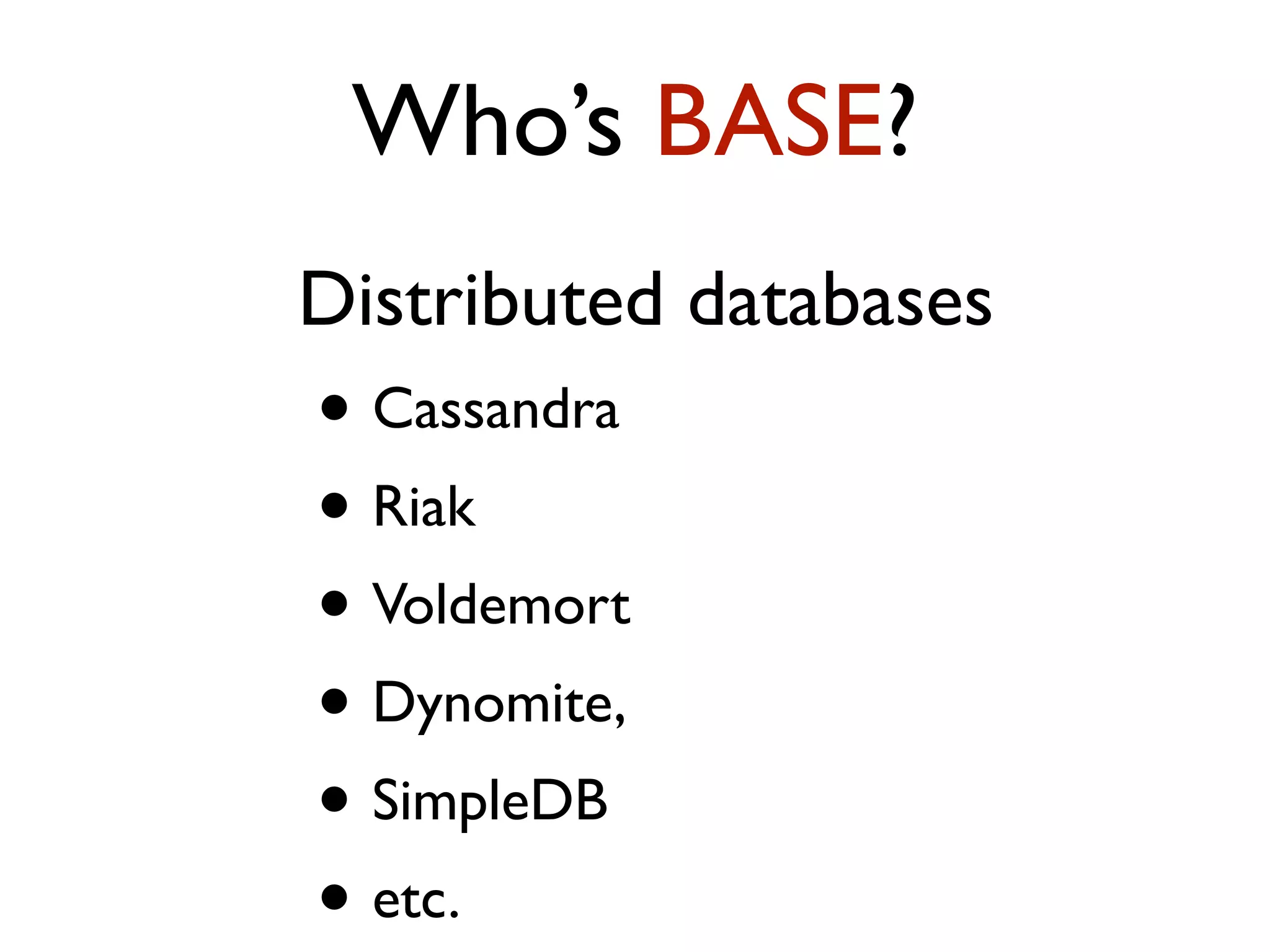
Who’s BASE? Distributed databases • Cassandra • Riak • Voldemort • Dynomite, • SimpleDB • etc.
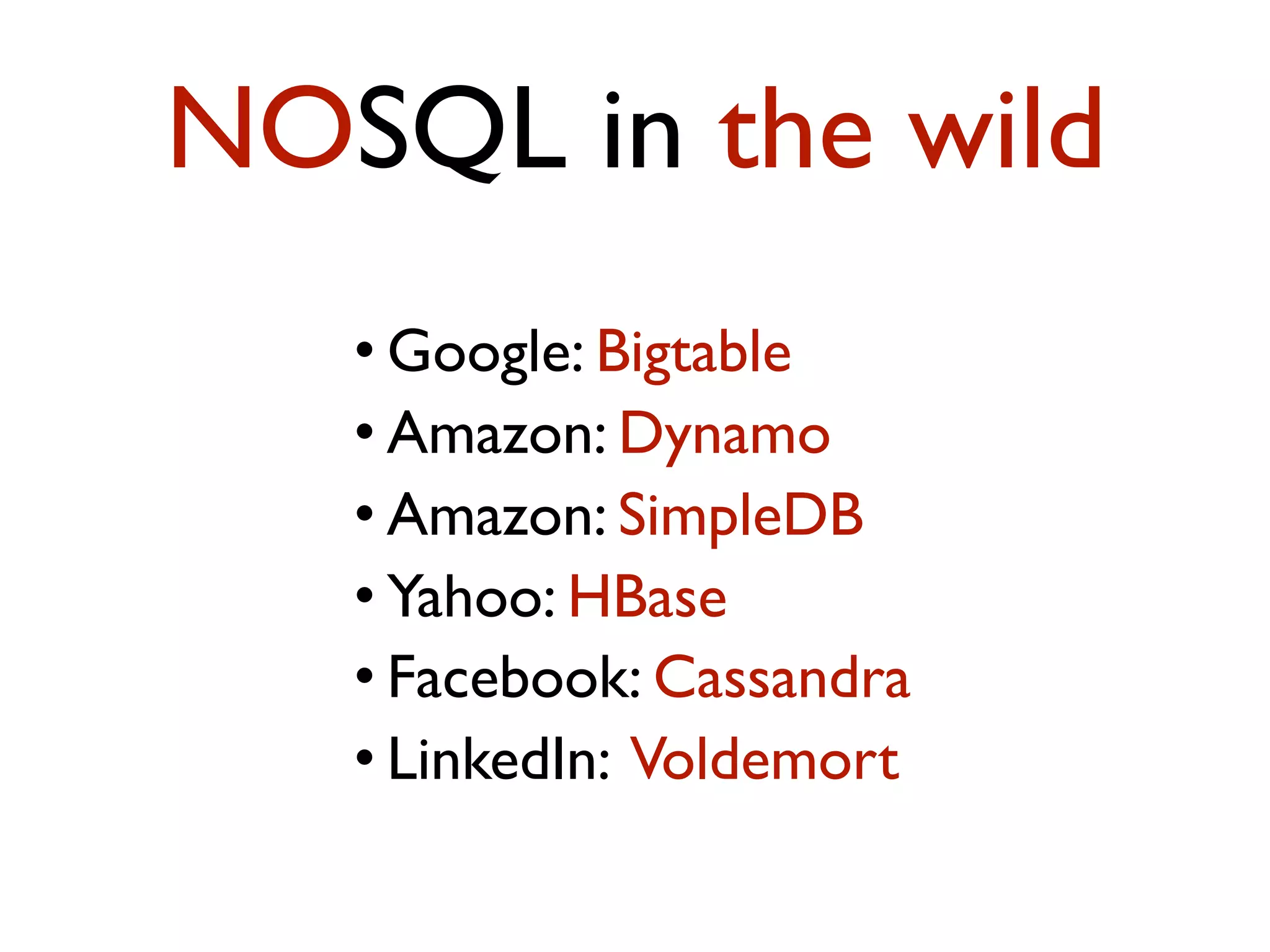
• Google: Bigtable • Amazon: Dynamo • Amazon: SimpleDB • Yahoo: HBase • Facebook: Cassandra • LinkedIn: Voldemort NOSQL in the wild
But first some background...
• Distributed Hash Tables (DHT) • Scalable • Partitioned • Fault-tolerant • Decentralized • Peer to peer • Popularized • Node ring • Consistent Hashing Chord & Pastry
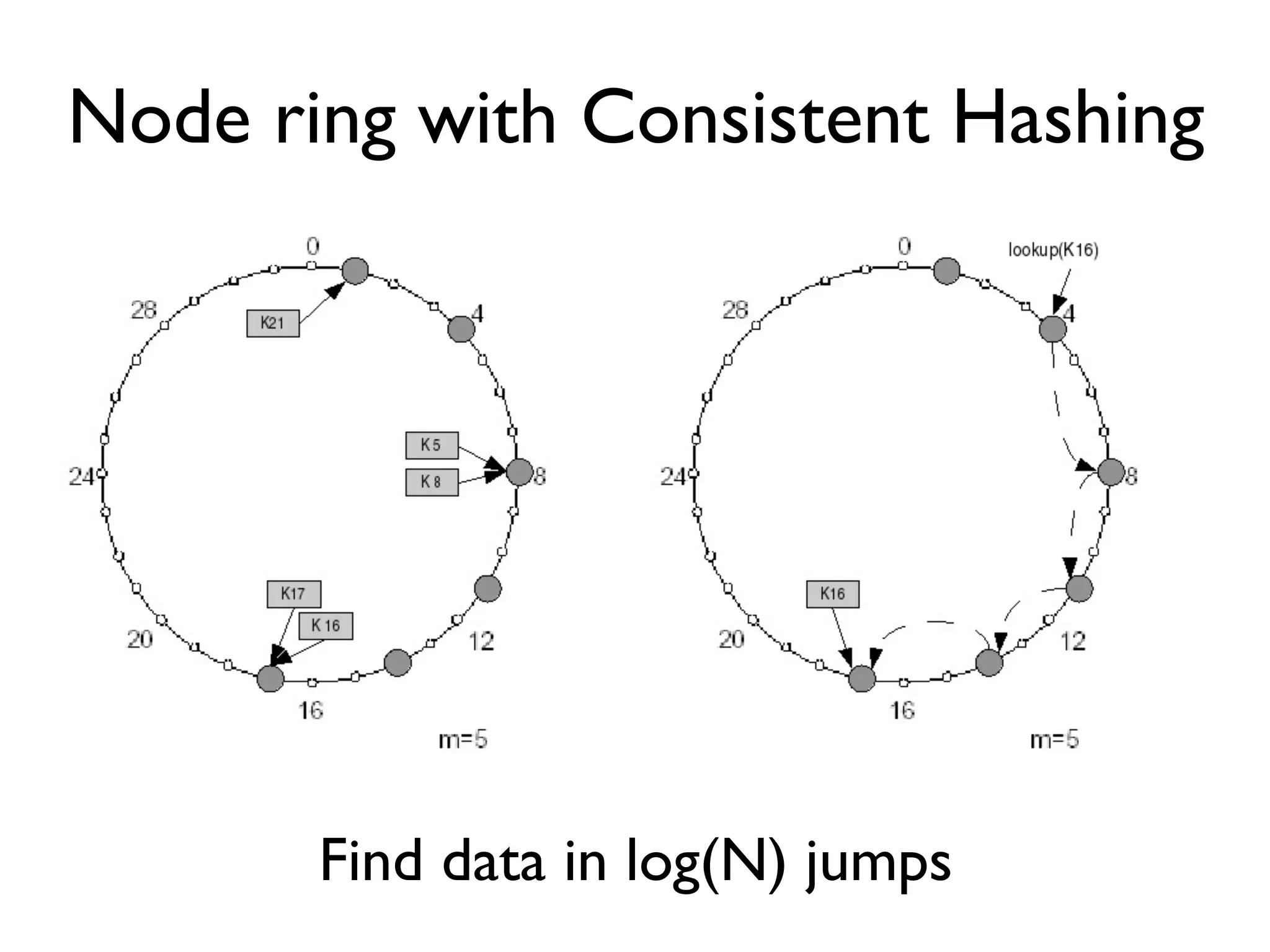
Node ring with Consistent Hashing Find data in log(N) jumps
“How can we build a DB on top of Google File System?” • Paper: Bigtable:A distributed storage system for structured data, 2006 • Rich data-model, structured storage • Clones: HBase Hypertable Neptune Bigtable
“How can we build a distributed hash table for the data center?” • Paper: Dynamo:Amazon’s highly available key- value store, 2007 • Focus: partitioning, replication and availability • Eventually Consistent • Clones: Voldemort Dynomite Dynamo
Types of NOSQL stores • Key-Value databases (Voldemort, Dynomite) • Column databases (Cassandra,Vertica, Sybase IQ) • Document databases (MongoDB, CouchDB) • Graph databases (Neo4J,AllegroGraph) • Datastructure databases (Redis, Hazelcast)
Distributed Caching
•Write-through •Write-behind •Eviction Policies •Replication •Peer-To-Peer (P2P) Distributed Caching
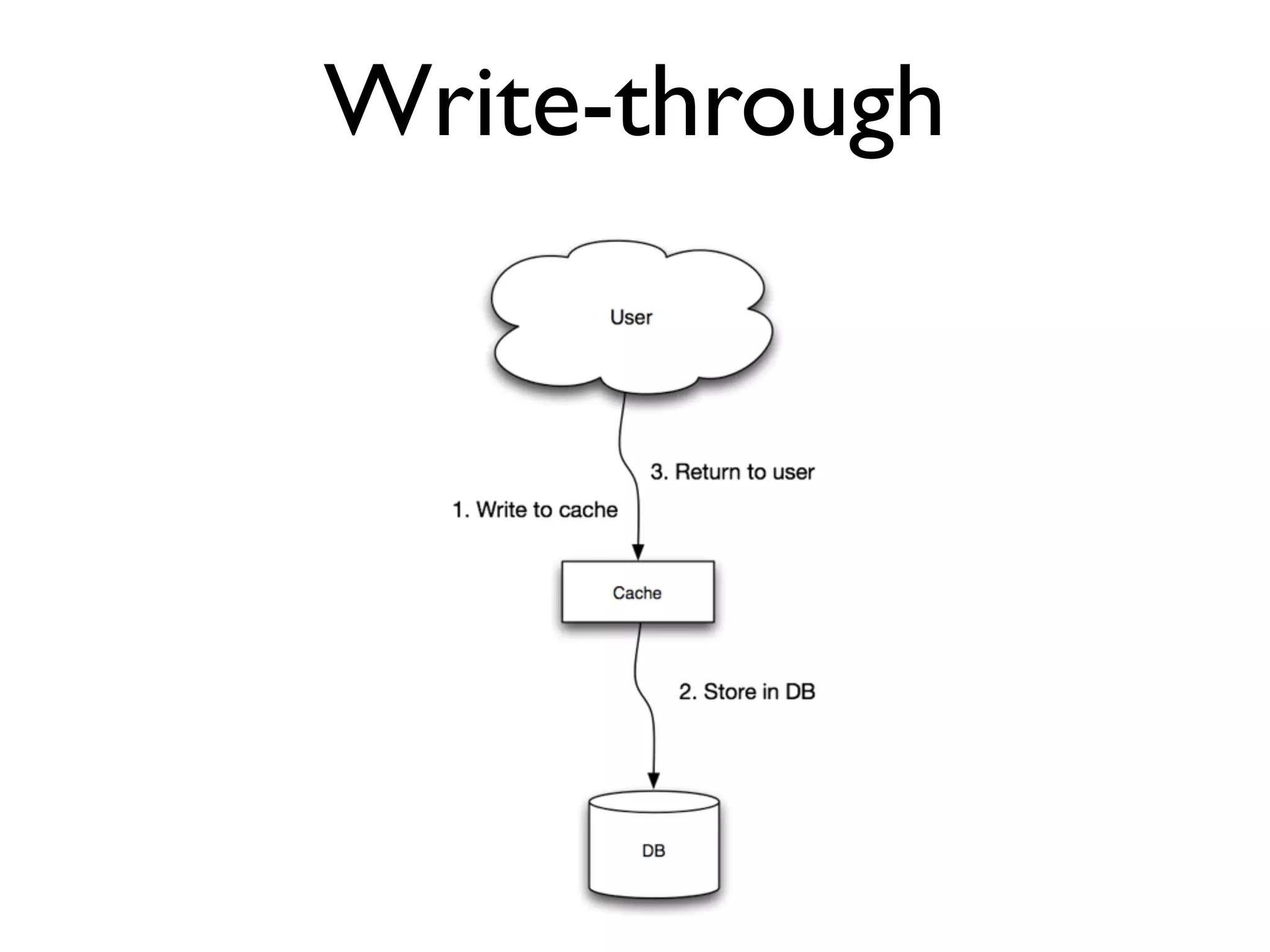
Write-through
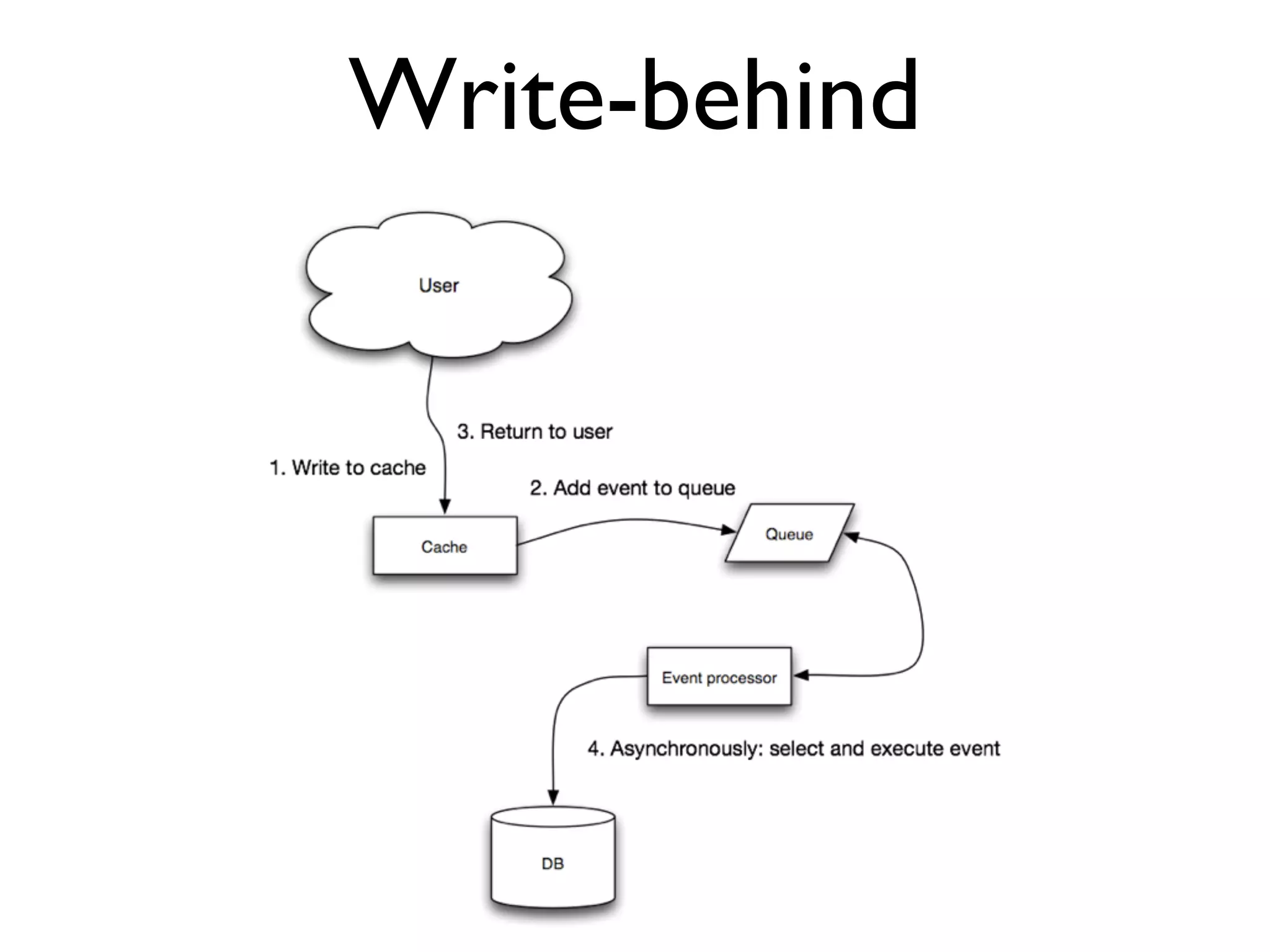
Write-behind
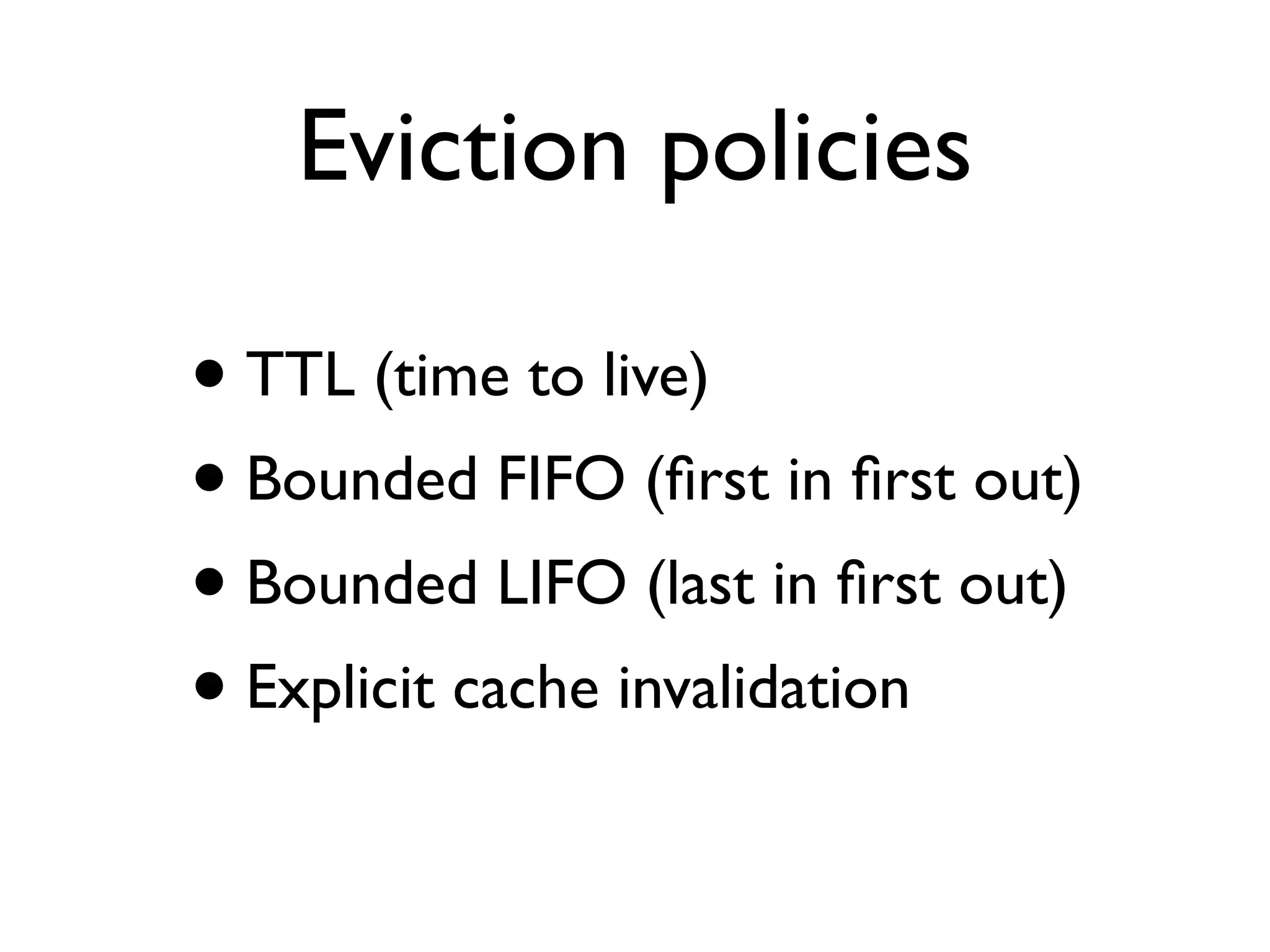
Eviction policies • TTL (time to live) • Bounded FIFO (first in first out) • Bounded LIFO (last in first out) • Explicit cache invalidation
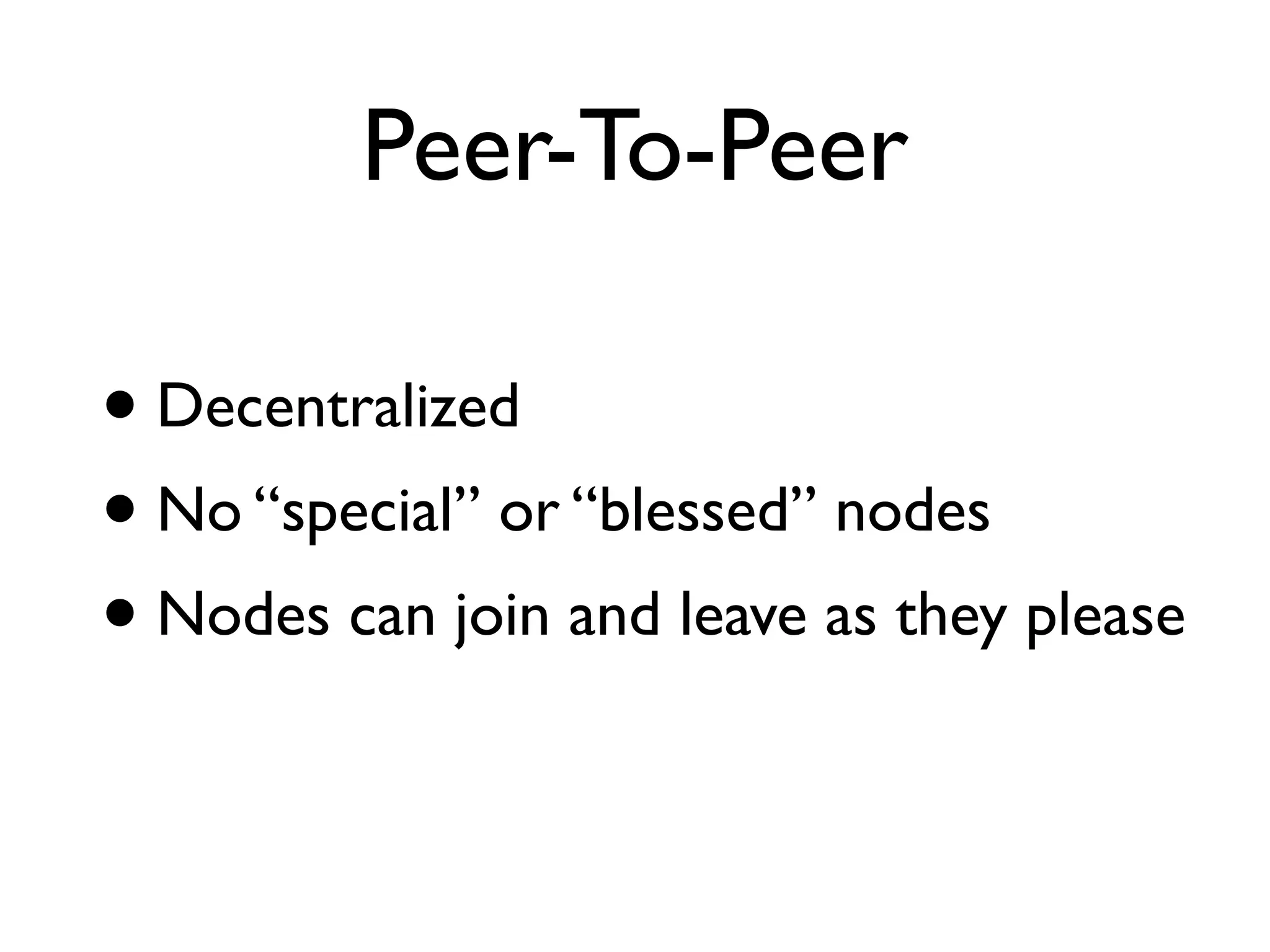
Peer-To-Peer • Decentralized • No “special” or “blessed” nodes • Nodes can join and leave as they please
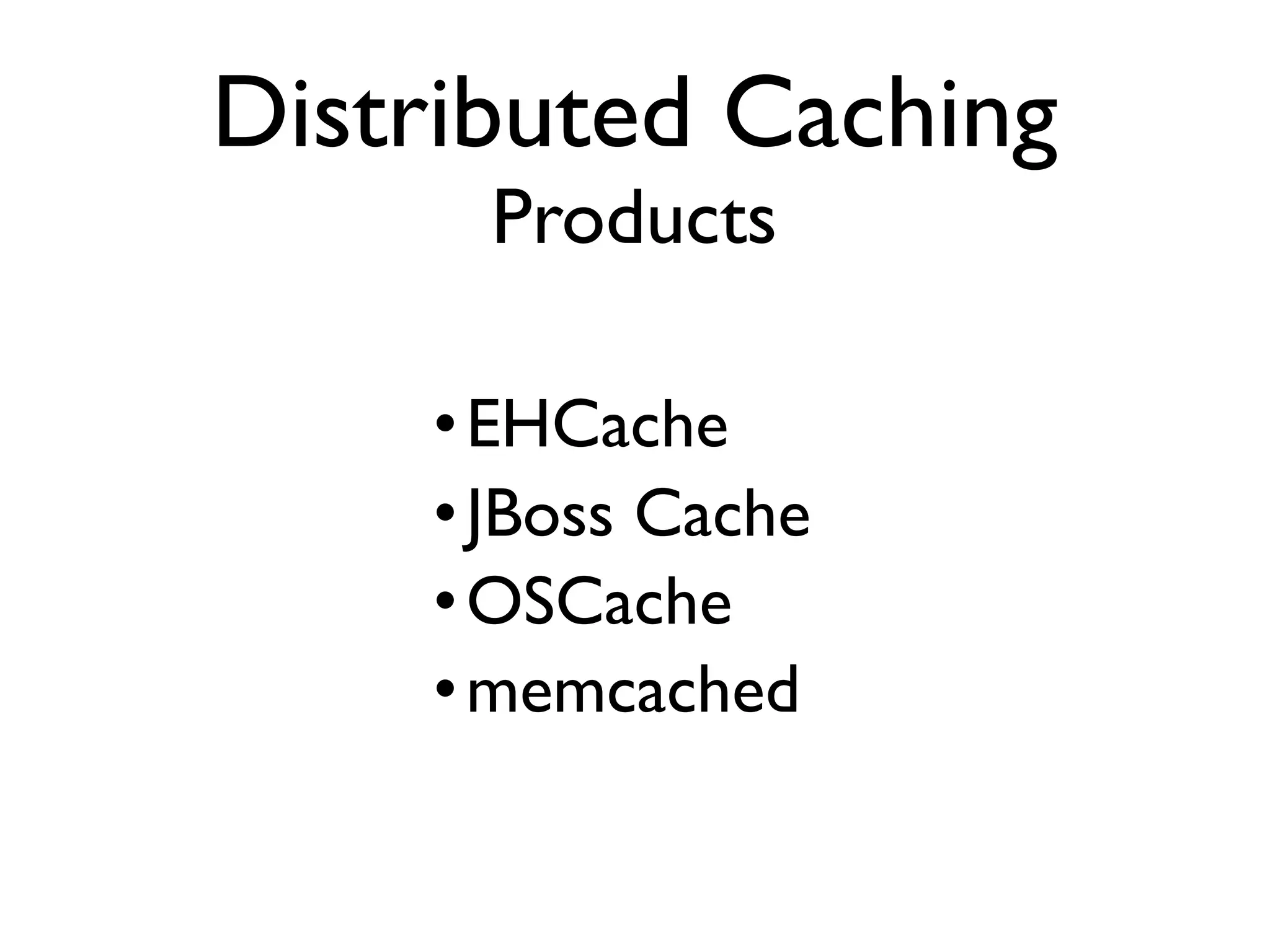
•EHCache •JBoss Cache •OSCache •memcached Distributed Caching Products
memcached • Very fast • Simple • Key-Value (string -­‐>  binary) • Clients for most languages • Distributed • Not replicated - so 1/N chance for local access in cluster
Data Grids / Clustering
Data Grids/Clustering Parallel data storage • Data replication • Data partitioning • Continuous availability • Data invalidation • Fail-over • C + P in CAP
Data Grids/Clustering Products • Coherence • Terracotta • GigaSpaces • GemStone • Tibco Active Matrix • Hazelcast
Concurrency
•Shared-State Concurrency •Message-Passing Concurrency •Dataflow Concurrency •Software Transactional Memory Concurrency
Shared-State Concurrency
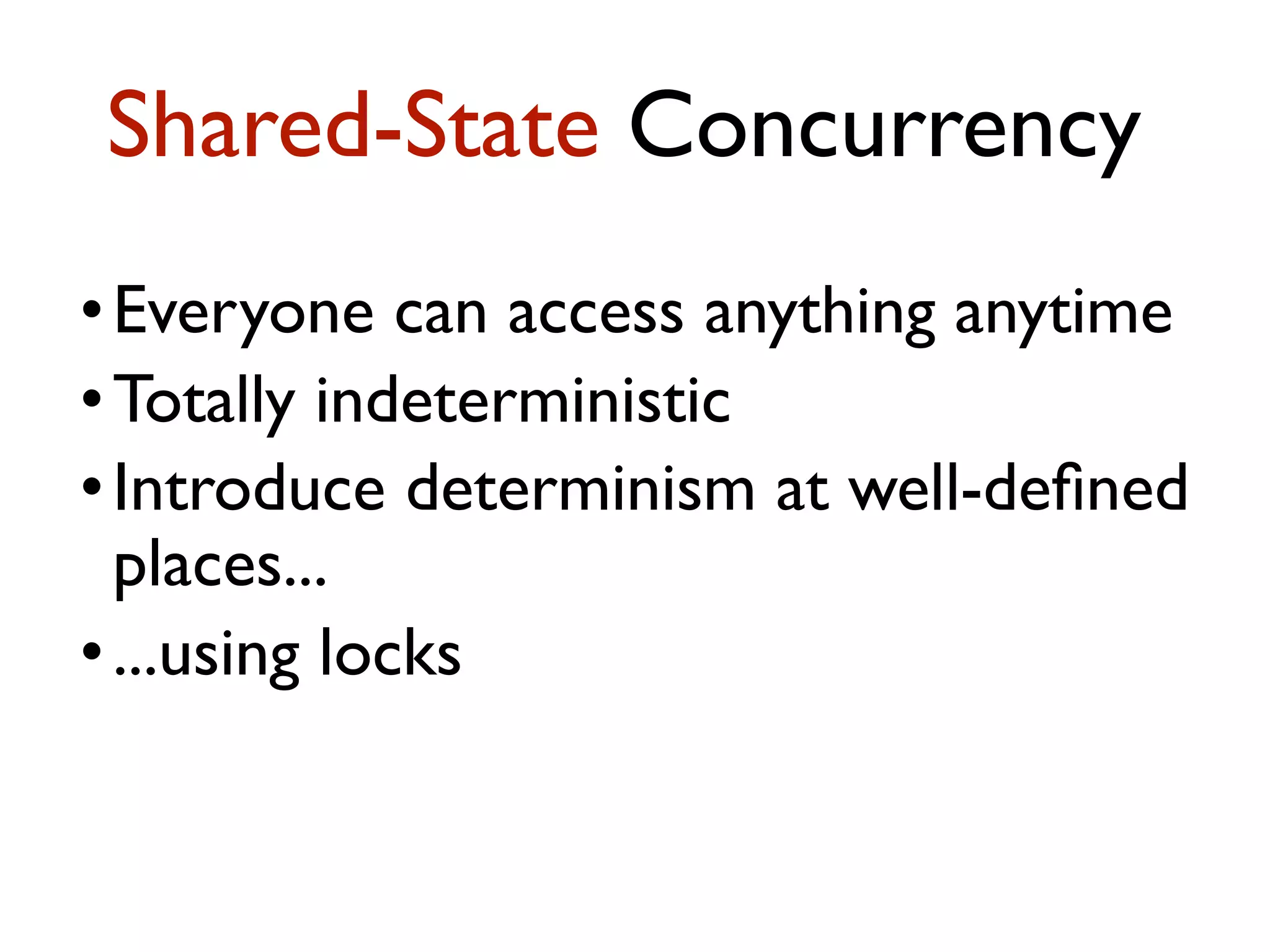
•Everyone can access anything anytime •Totally indeterministic •Introduce determinism at well-defined places... •...using locks Shared-State Concurrency
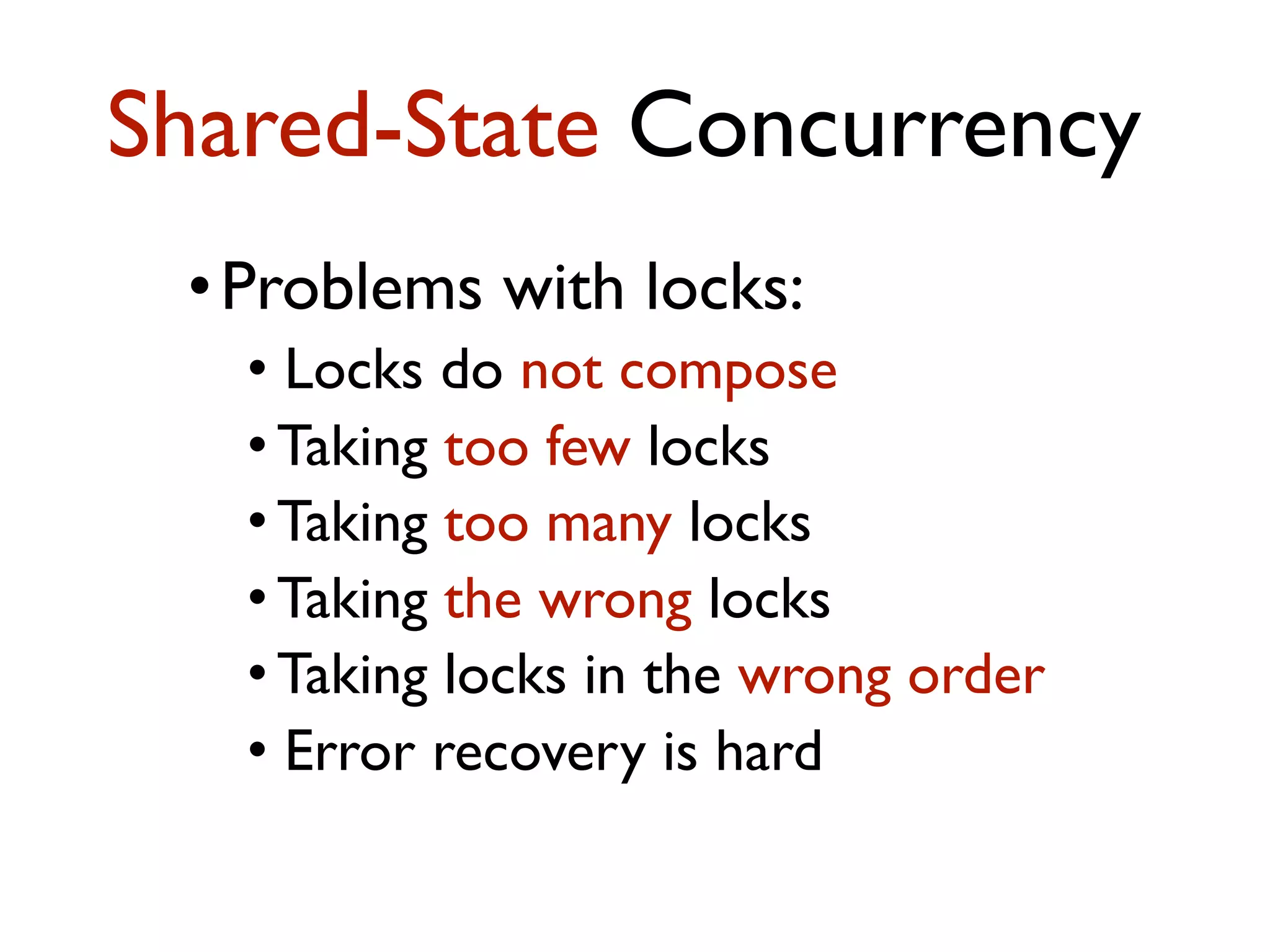
•Problems with locks: • Locks do not compose • Taking too few locks • Taking too many locks • Taking the wrong locks • Taking locks in the wrong order • Error recovery is hard Shared-State Concurrency
Please use java.util.concurrent.* • ConcurrentHashMap • BlockingQueue • ConcurrentQueue   • ExecutorService • ReentrantReadWriteLock • CountDownLatch • ParallelArray • and  much  much  more.. Shared-State Concurrency
Message-Passing Concurrency
•Originates in a 1973 paper by Carl Hewitt •Implemented in Erlang, Occam, Oz •Encapsulates state and behavior •Closer to the definition of OO than classes Actors
Actors • Share NOTHING • Isolated lightweight processes • Communicates through messages • Asynchronous and non-blocking • No shared state … hence, nothing to synchronize. • Each actor has a mailbox (message queue)
• Easier to reason about • Raised abstraction level • Easier to avoid –Race conditions –Deadlocks –Starvation –Live locks Actors
• Akka (Java/Scala) • scalaz actors (Scala) • Lift Actors (Scala) • Scala Actors (Scala) • Kilim (Java) • Jetlang (Java) • Actor’s Guild (Java) • Actorom (Java) • FunctionalJava (Java) • GPars (Groovy) Actor libs for the JVM
Dataflow Concurrency
• Declarative • No observable non-determinism • Data-driven – threads block until data is available • On-demand, lazy • No difference between: • Concurrent & • Sequential code • Limitations: can’t have side-effects Dataflow Concurrency
STM: Software Transactional Memory
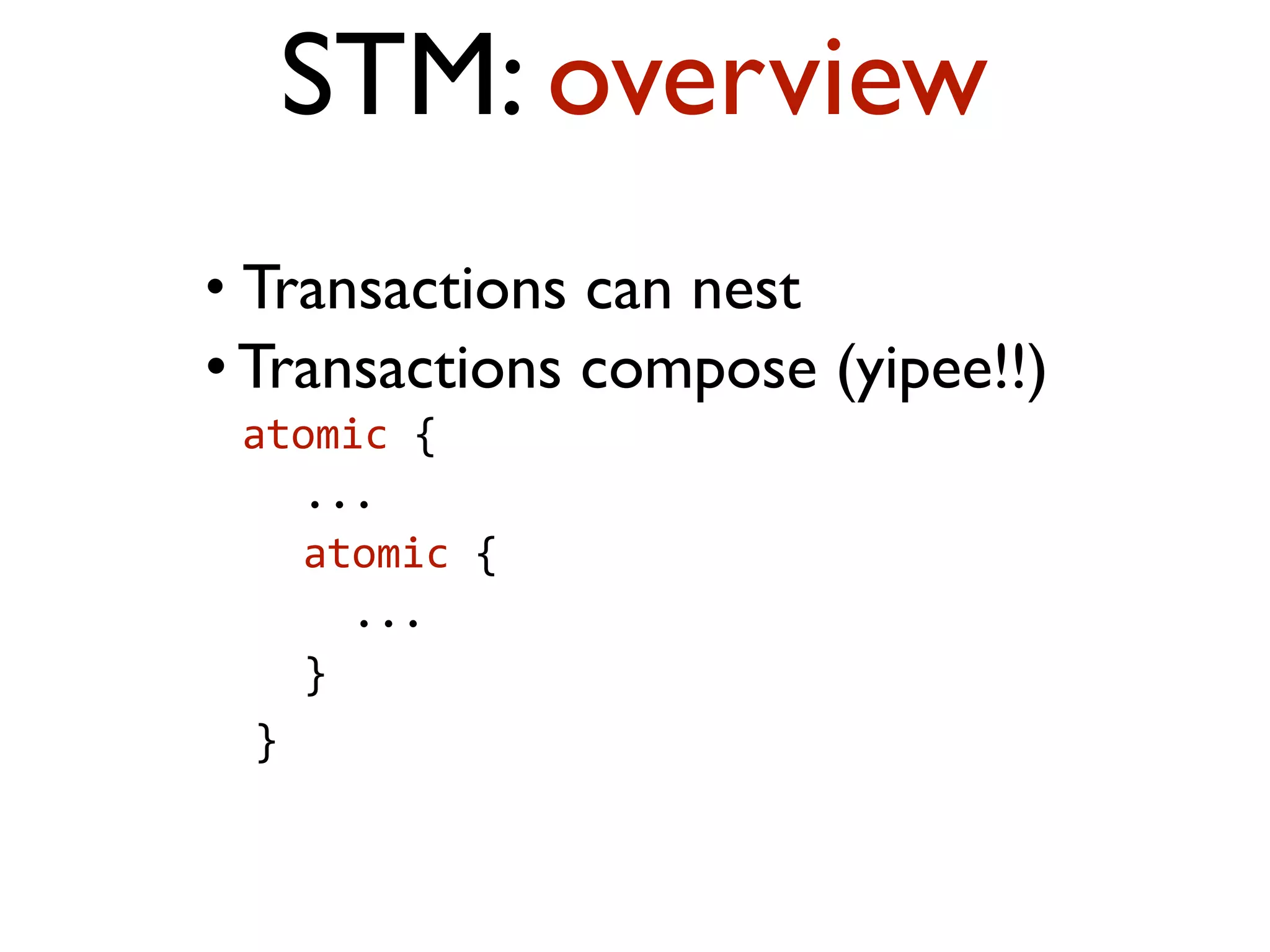
STM: overview • See the memory (heap and stack) as a transactional dataset • Similar to a database • begin • commit • abort/rollback •Transactions are retried automatically upon collision • Rolls back the memory on abort
• Transactions can nest • Transactions compose (yipee!!) atomic  {              ...              atomic  {                    ...                }        }   STM: overview
All operations in scope of a transaction: l Need to be idempotent STM: restrictions
• Akka (Java/Scala) • Multiverse (Java) • Clojure STM (Clojure) • CCSTM (Scala) • Deuce STM (Java) STM libs for the JVM
Scalability Patterns: Behavior
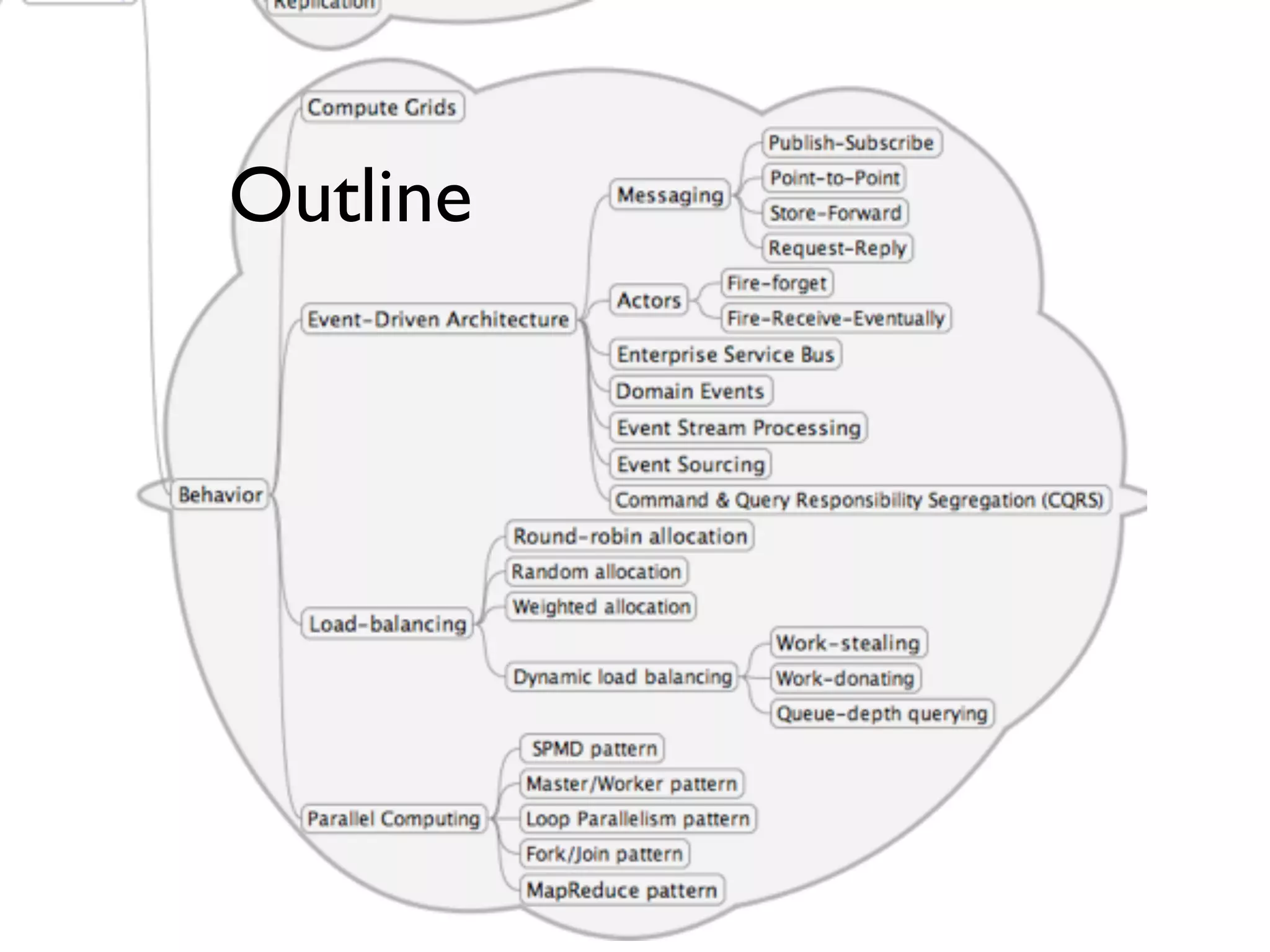
•Event-Driven Architecture •Compute Grids •Load-balancing •Parallel Computing Scalability Patterns: Behavior
Event-Driven Architecture “Four years from now,‘mere mortals’ will begin to adopt an event-driven architecture (EDA) for the sort of complex event processing that has been attempted only by software gurus [until now]” --Roy Schulte (Gartner), 2003
• Domain Events • Event Sourcing • Command and Query Responsibility Segregation (CQRS) pattern • Event Stream Processing • Messaging • Enterprise Service Bus • Actors • Enterprise Integration Architecture (EIA) Event-Driven Architecture
Domain Events “It's really become clear to me in the last couple of years that we need a new building block and that is the Domain Events” -- Eric Evans, 2009
Domain Events “Domain Events represent the state of entities at a given time when an important event occurred and decouple subsystems with event streams. Domain Events give us clearer, more expressive models in those cases.” -- Eric Evans, 2009
Domain Events “State transitions are an important part of our problem space and should be modeled within our domain.” -- GregYoung, 2008
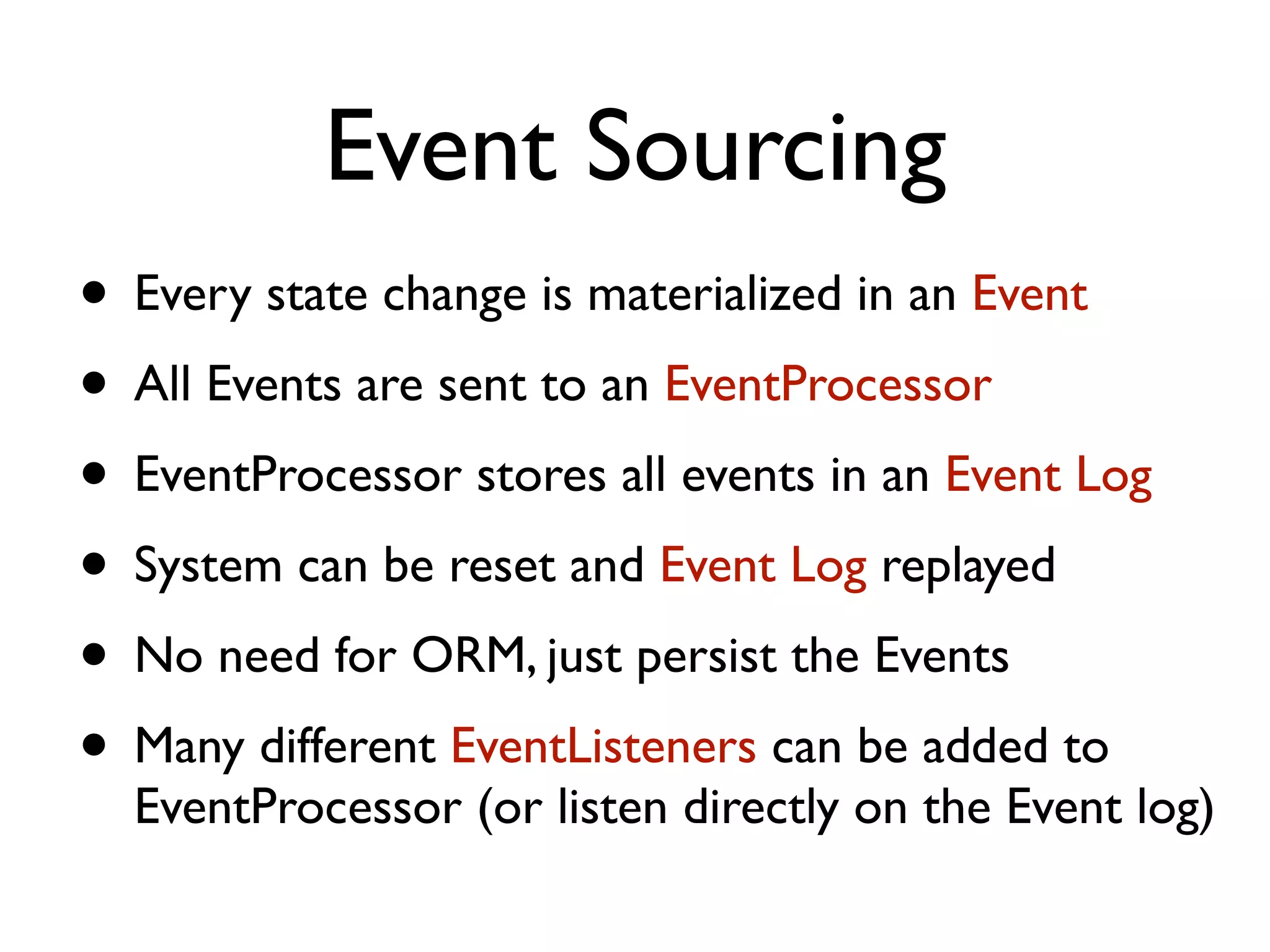
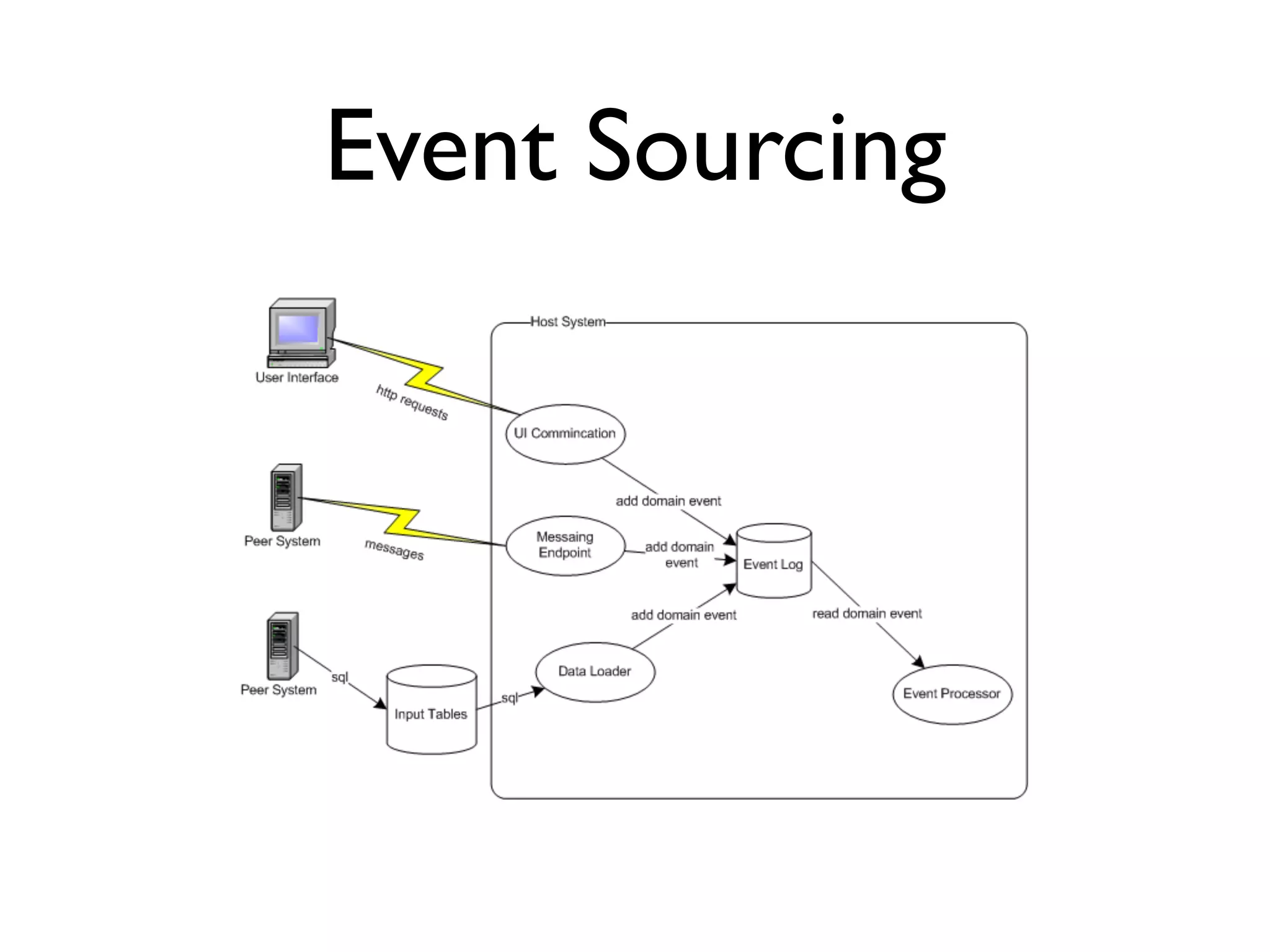
Event Sourcing • Every state change is materialized in an Event • All Events are sent to an EventProcessor • EventProcessor stores all events in an Event Log • System can be reset and Event Log replayed • No need for ORM, just persist the Events • Many different EventListeners can be added to EventProcessor (or listen directly on the Event log)

Event Sourcing
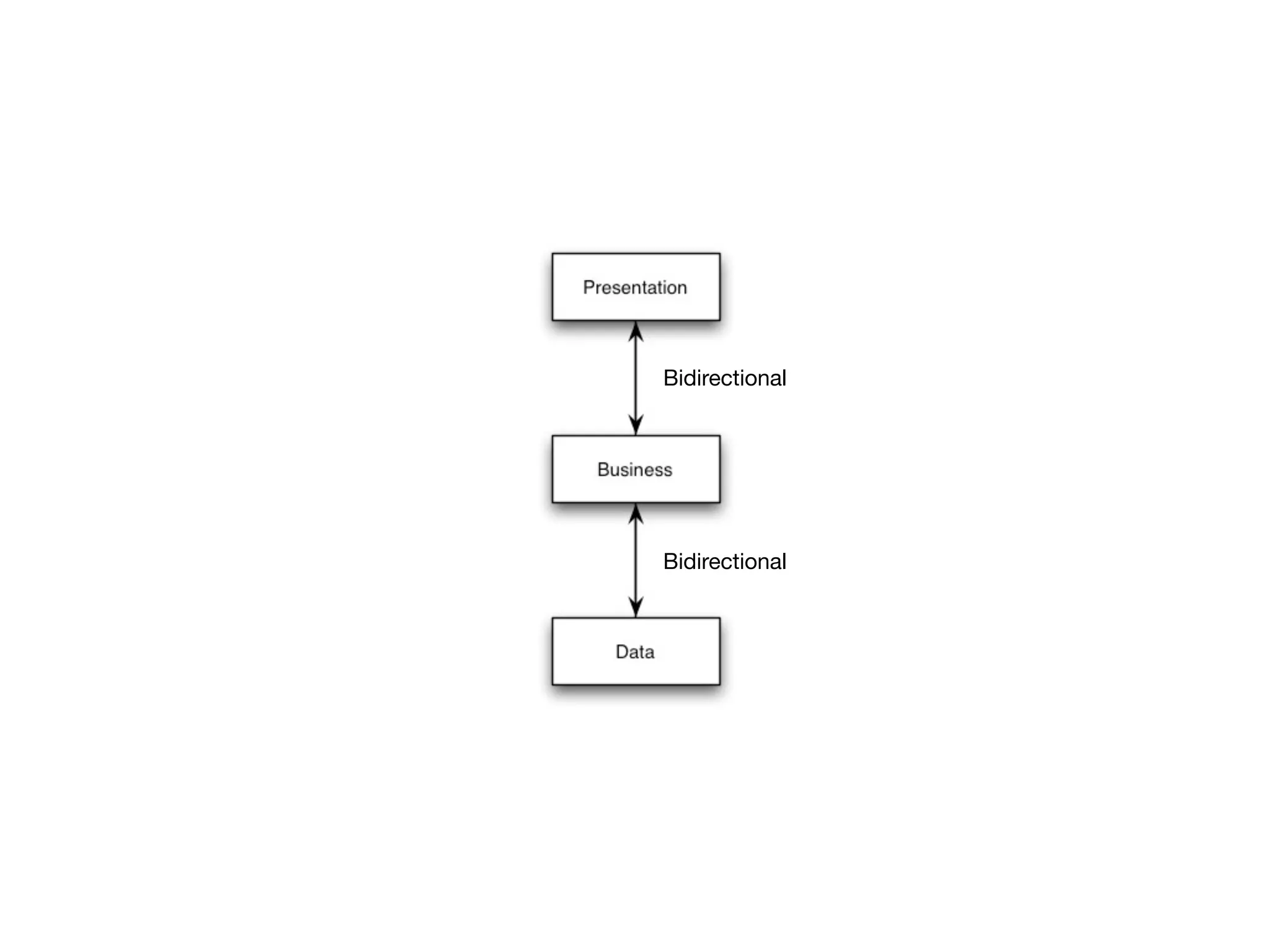
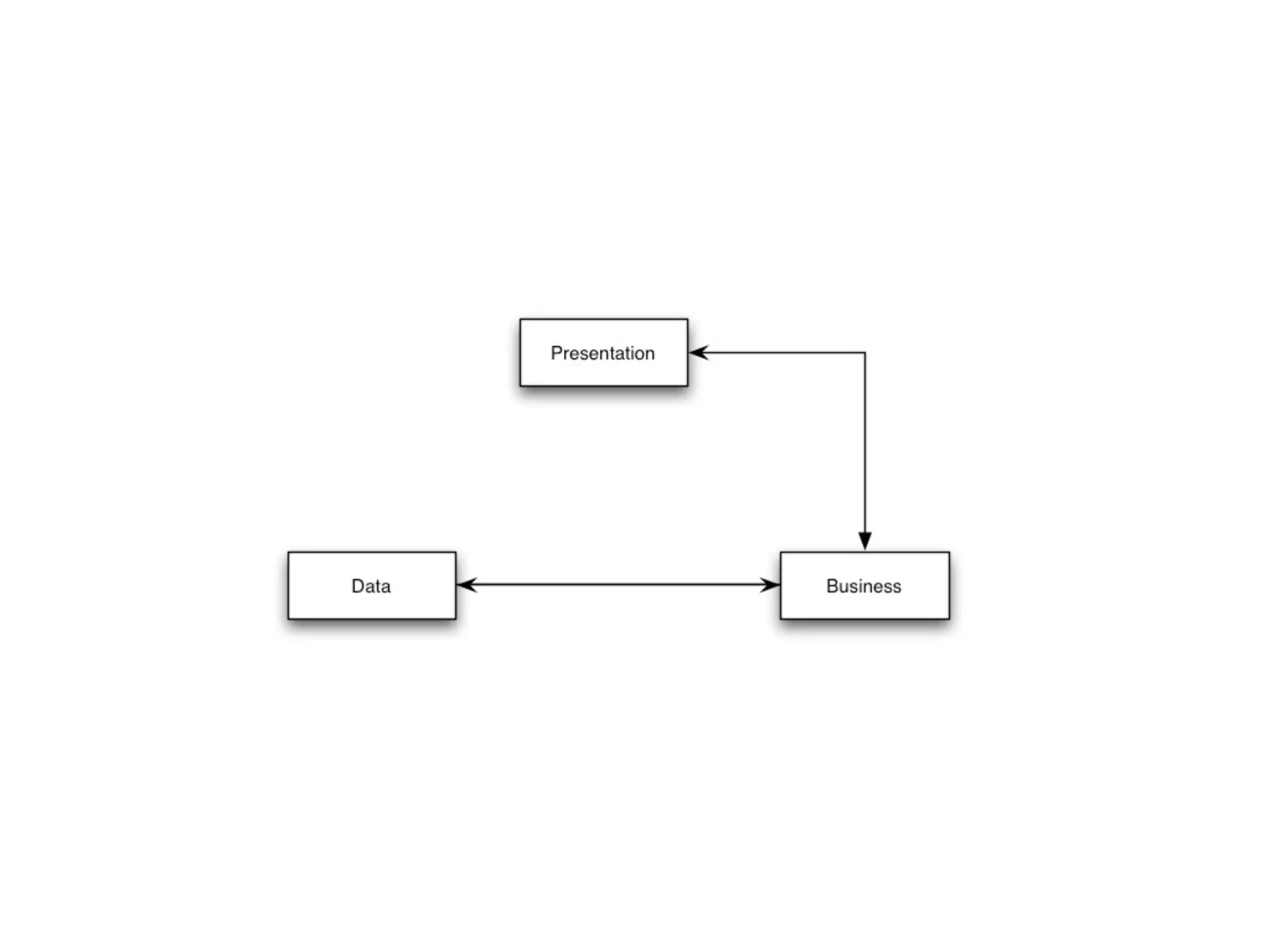
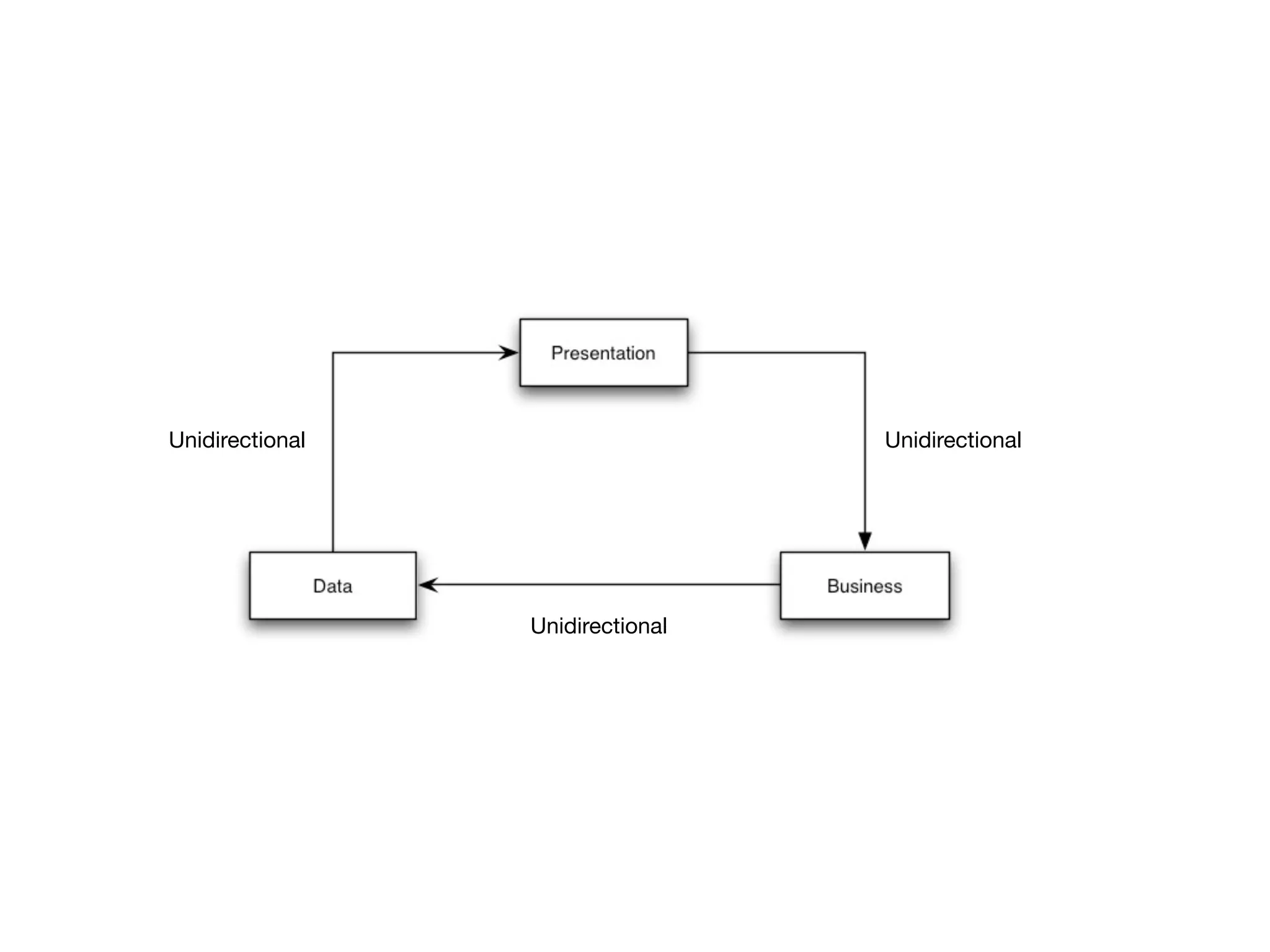
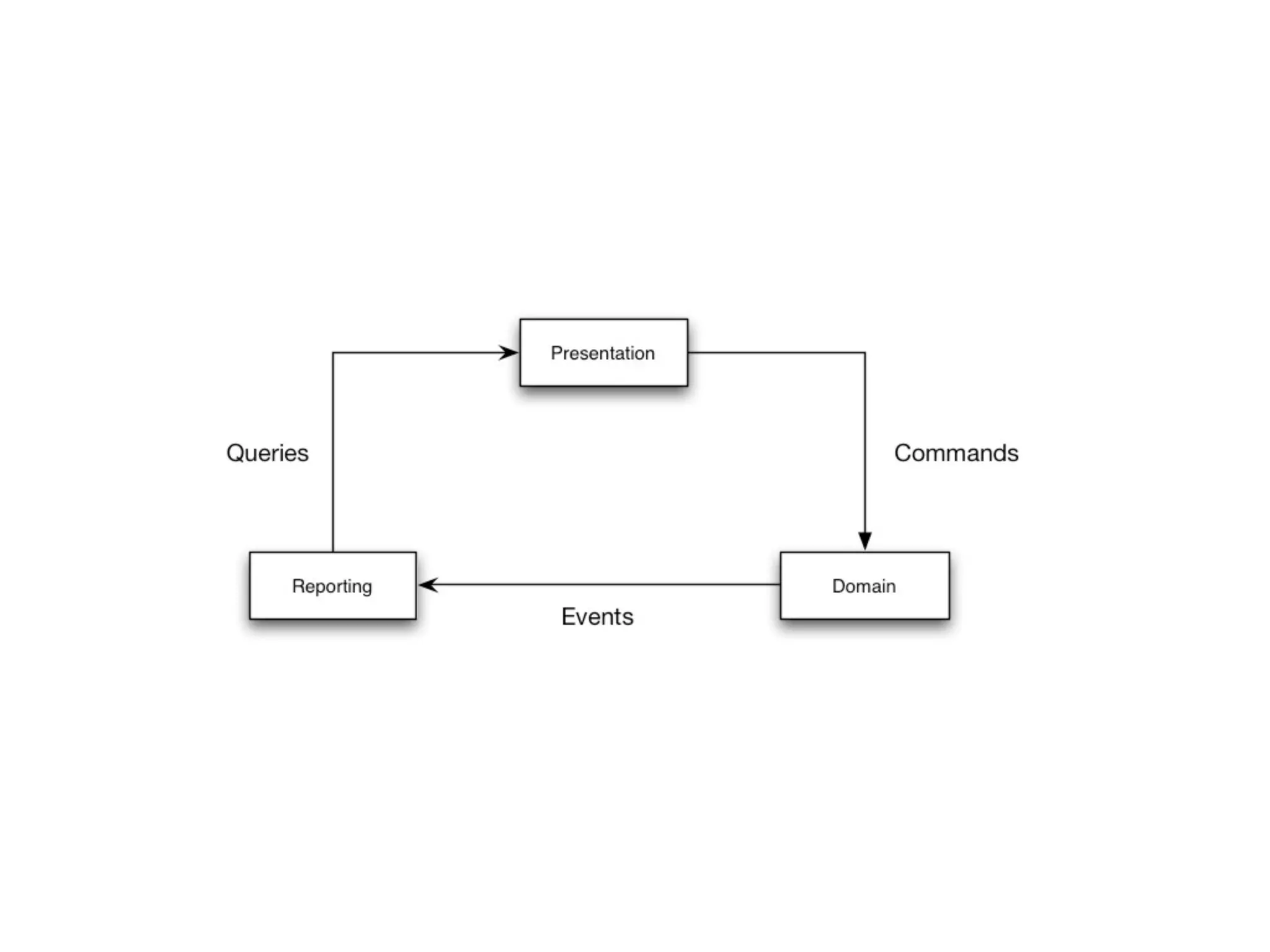
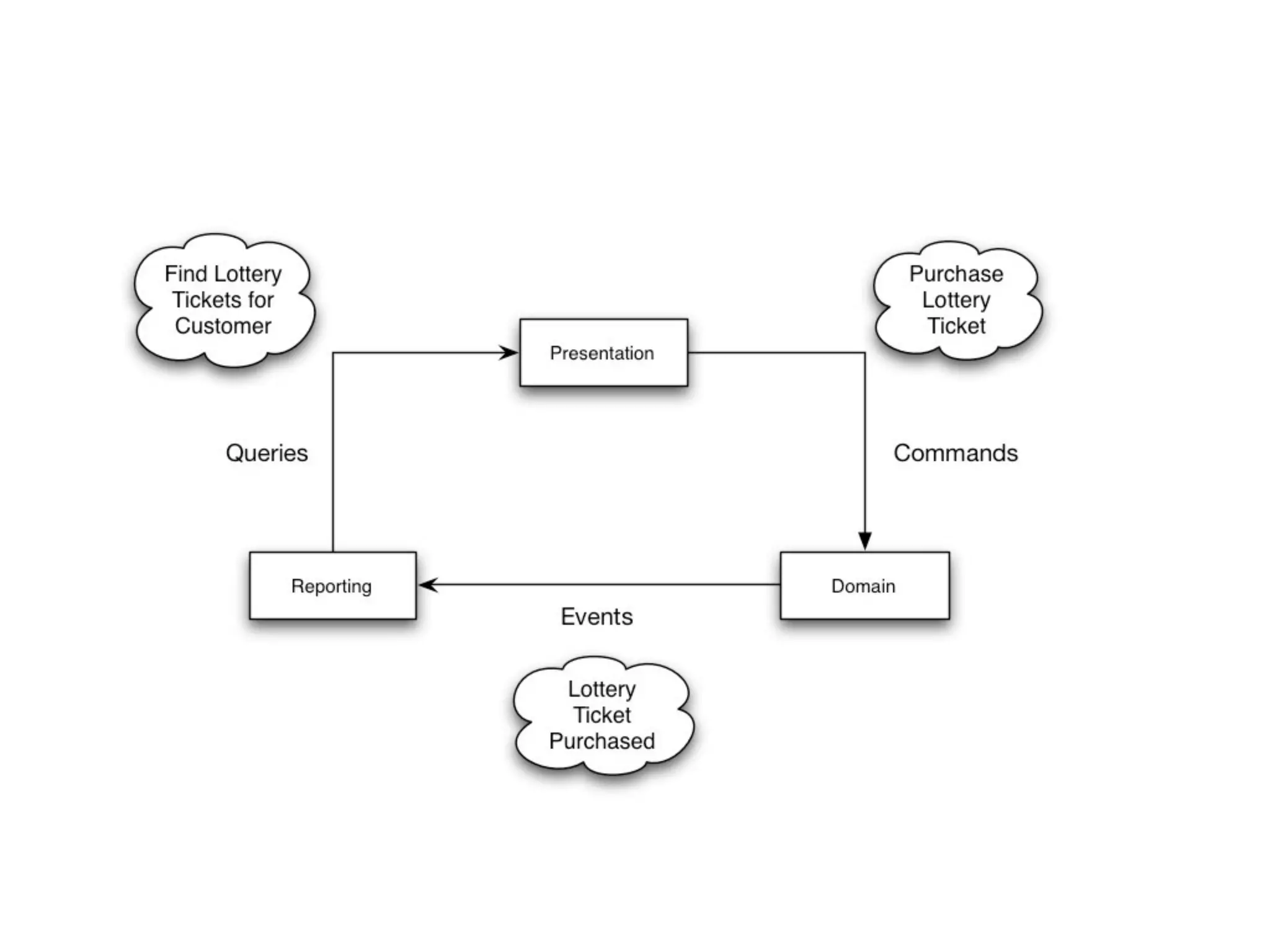
“A single model cannot be appropriate for reporting, searching and transactional behavior.” -- GregYoung, 2008 Command and Query Responsibility Segregation (CQRS) pattern
Bidirectional Bidirectional
UnidirectionalUnidirectional Unidirectional
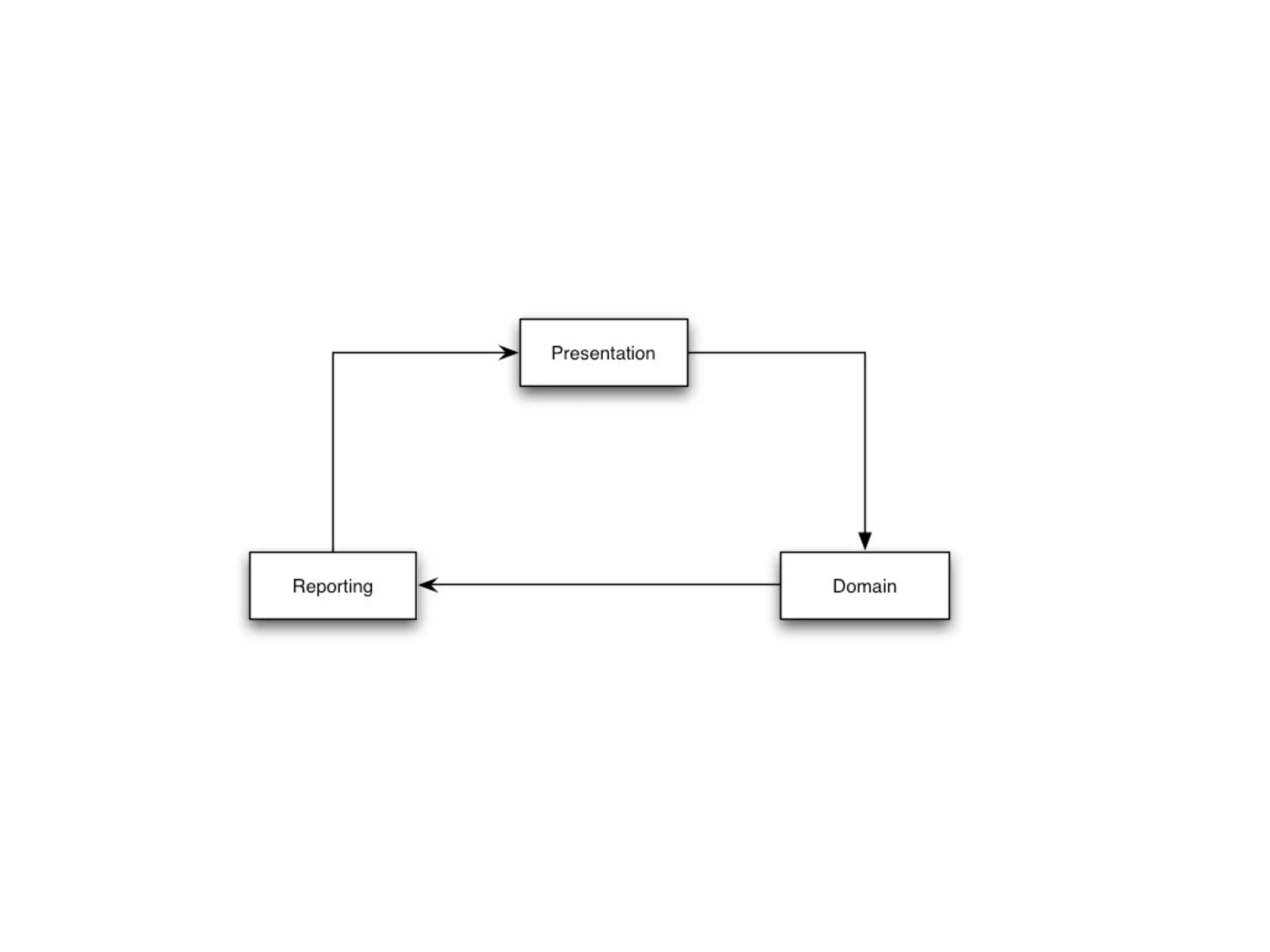
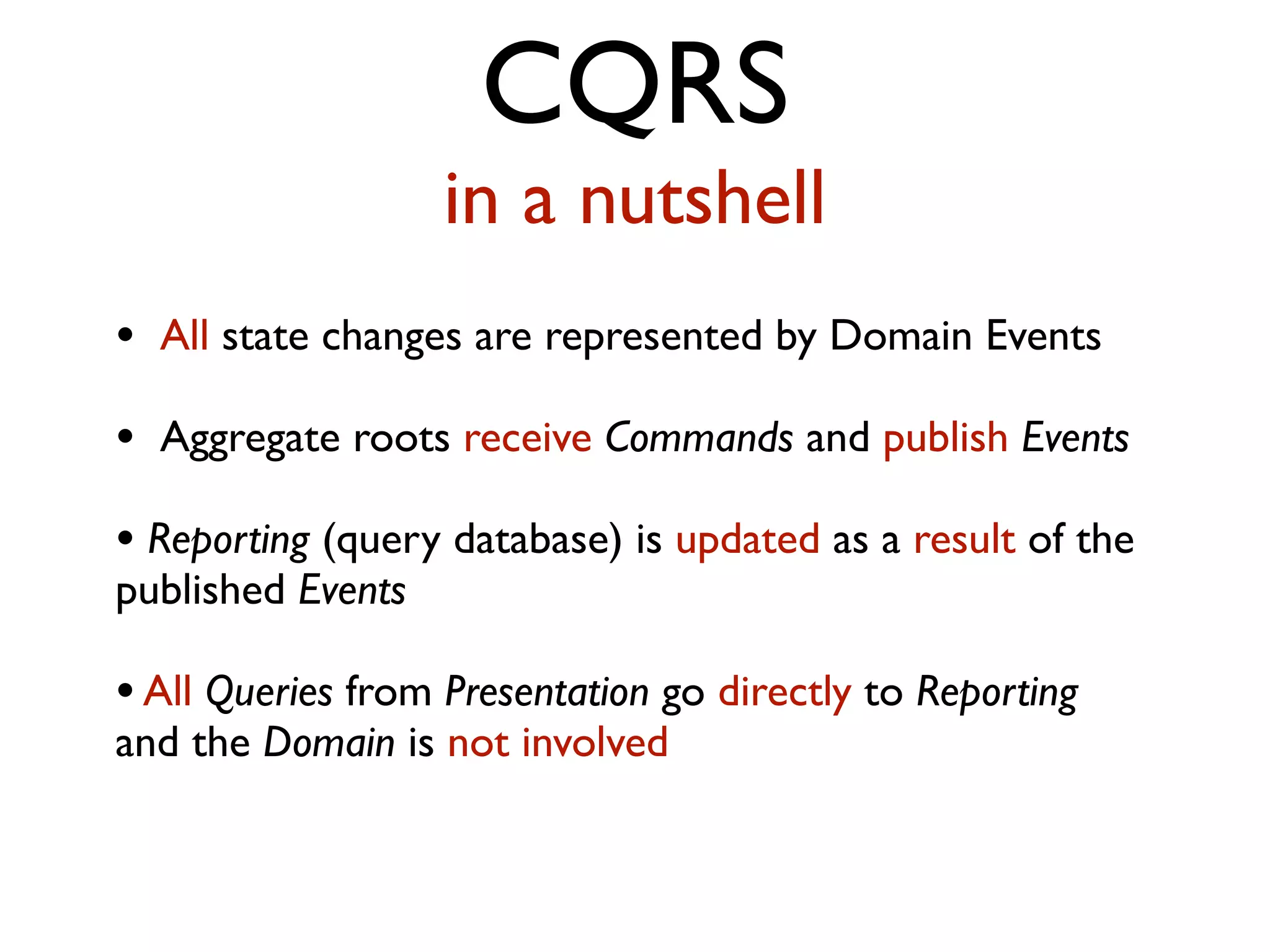
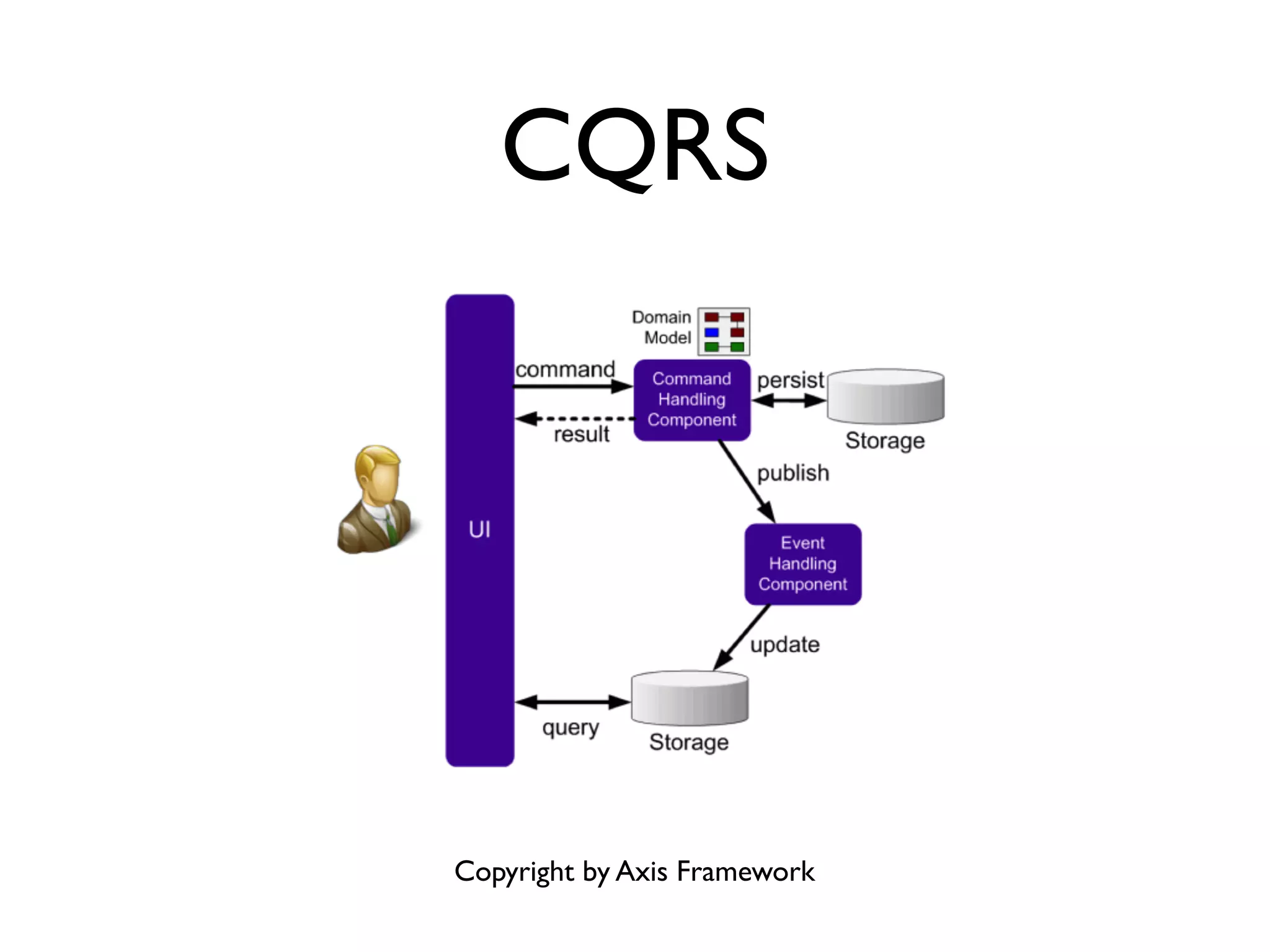
CQRS in a nutshell • All state changes are represented by Domain Events • Aggregate roots receive Commands and publish Events • Reporting (query database) is updated as a result of the published Events •All Queries from Presentation go directly to Reporting and the Domain is not involved
CQRS Copyright by Axis Framework
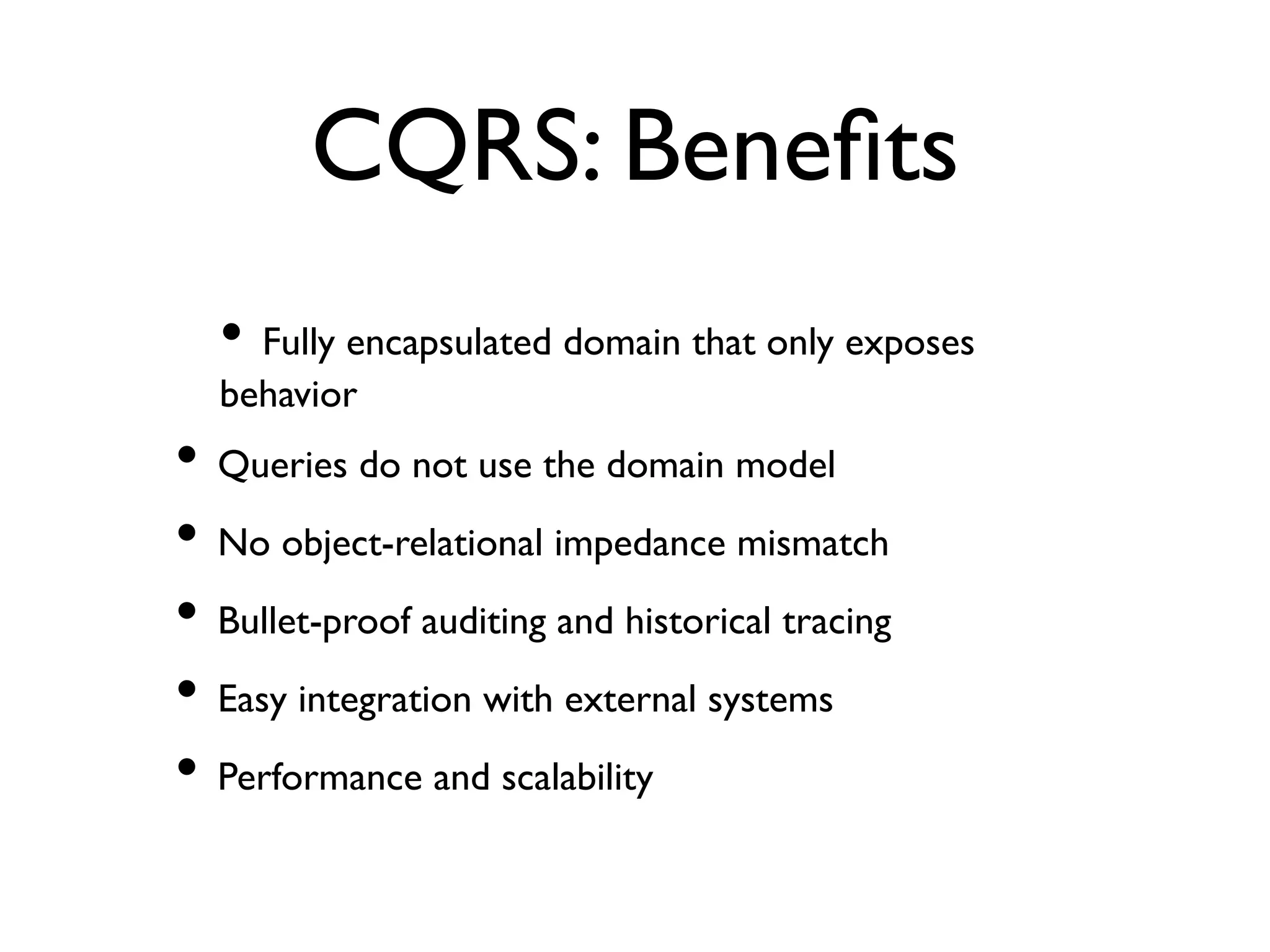
CQRS: Benefits • Fully encapsulated domain that only exposes behavior • Queries do not use the domain model • No object-relational impedance mismatch • Bullet-proof auditing and historical tracing • Easy integration with external systems • Performance and scalability
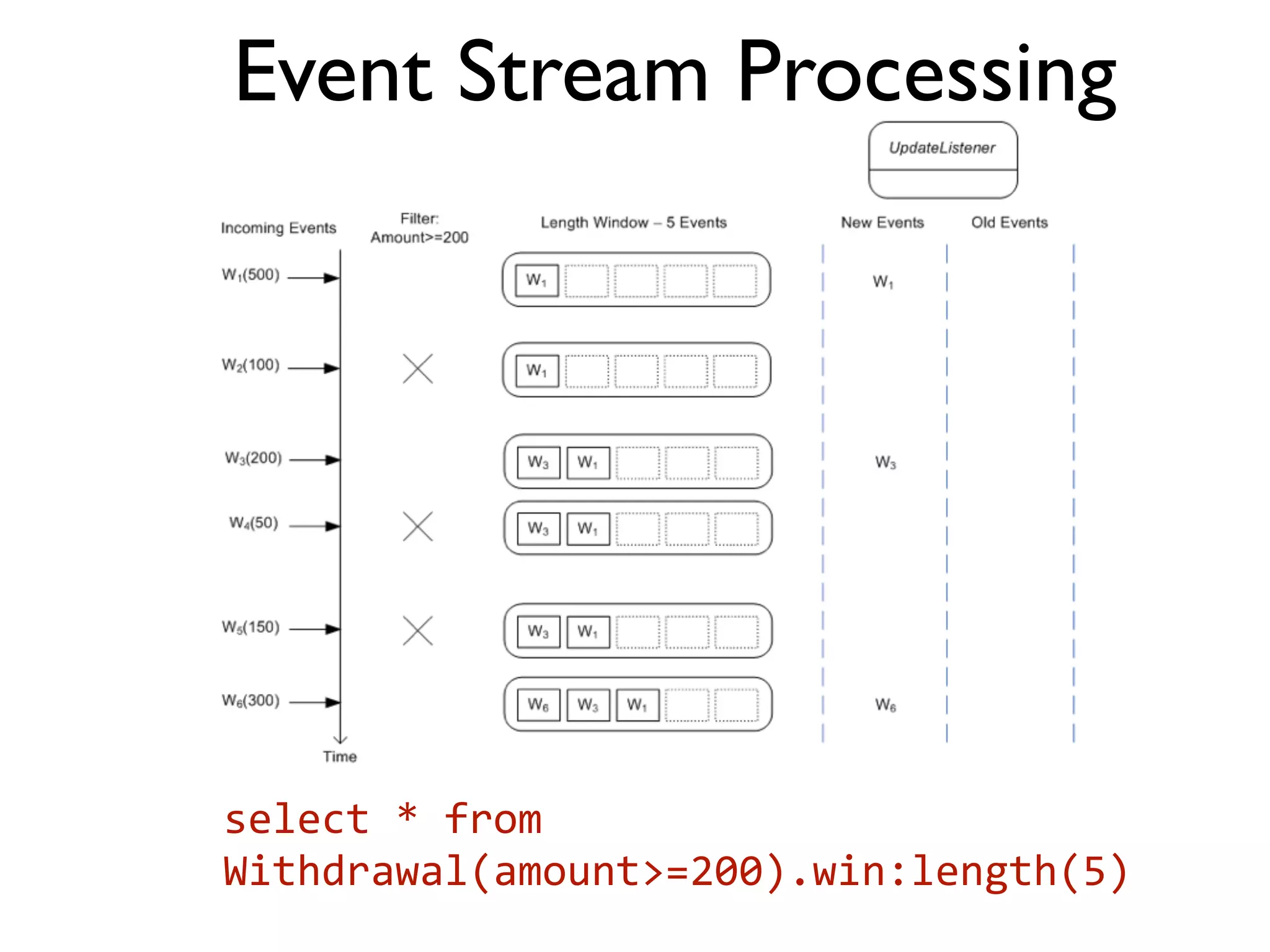
Event Stream Processing select  *  from   Withdrawal(amount>=200).win:length(5)
Event Stream Processing Products • Esper (Open Source) • StreamBase • RuleCast
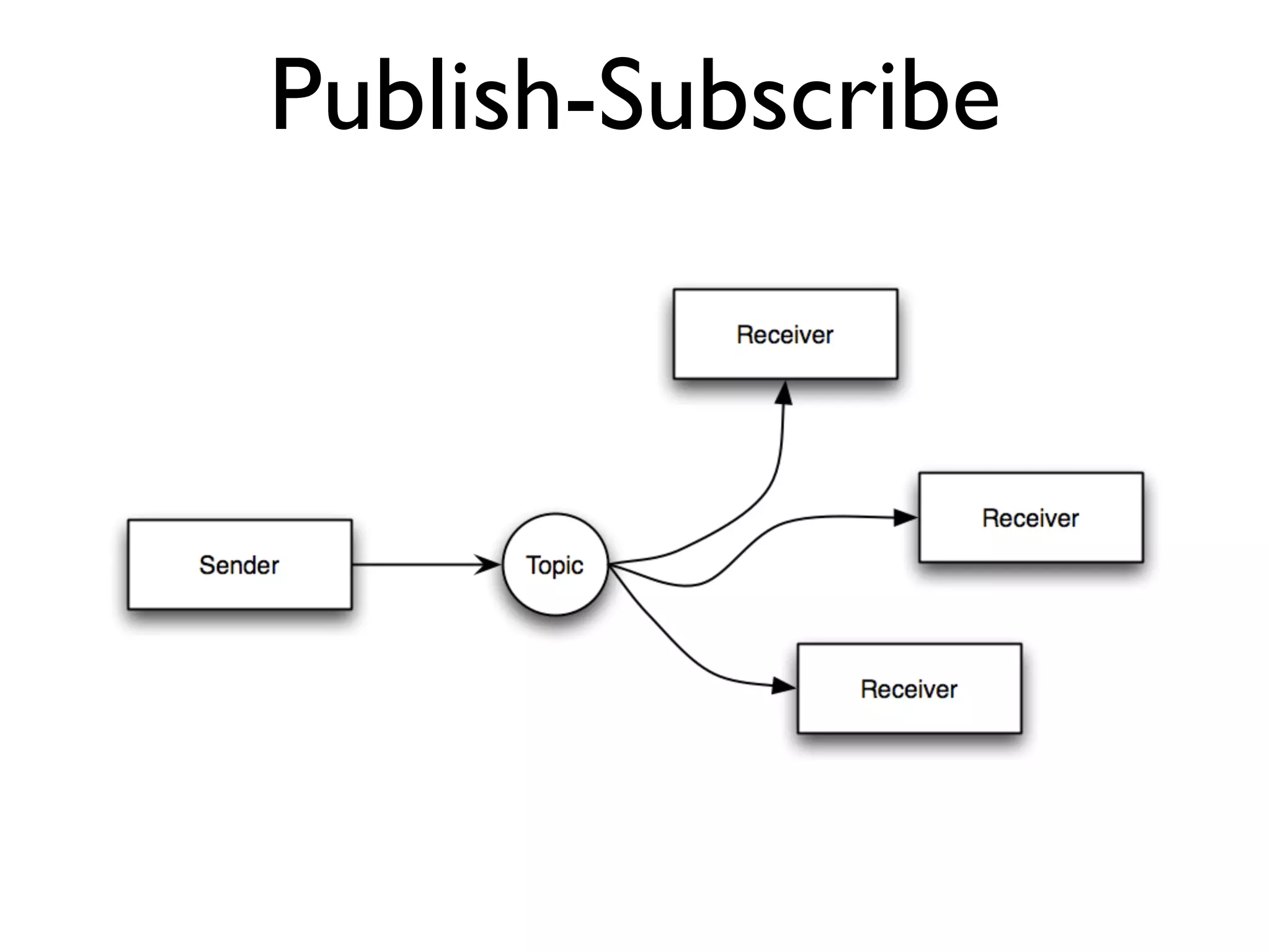
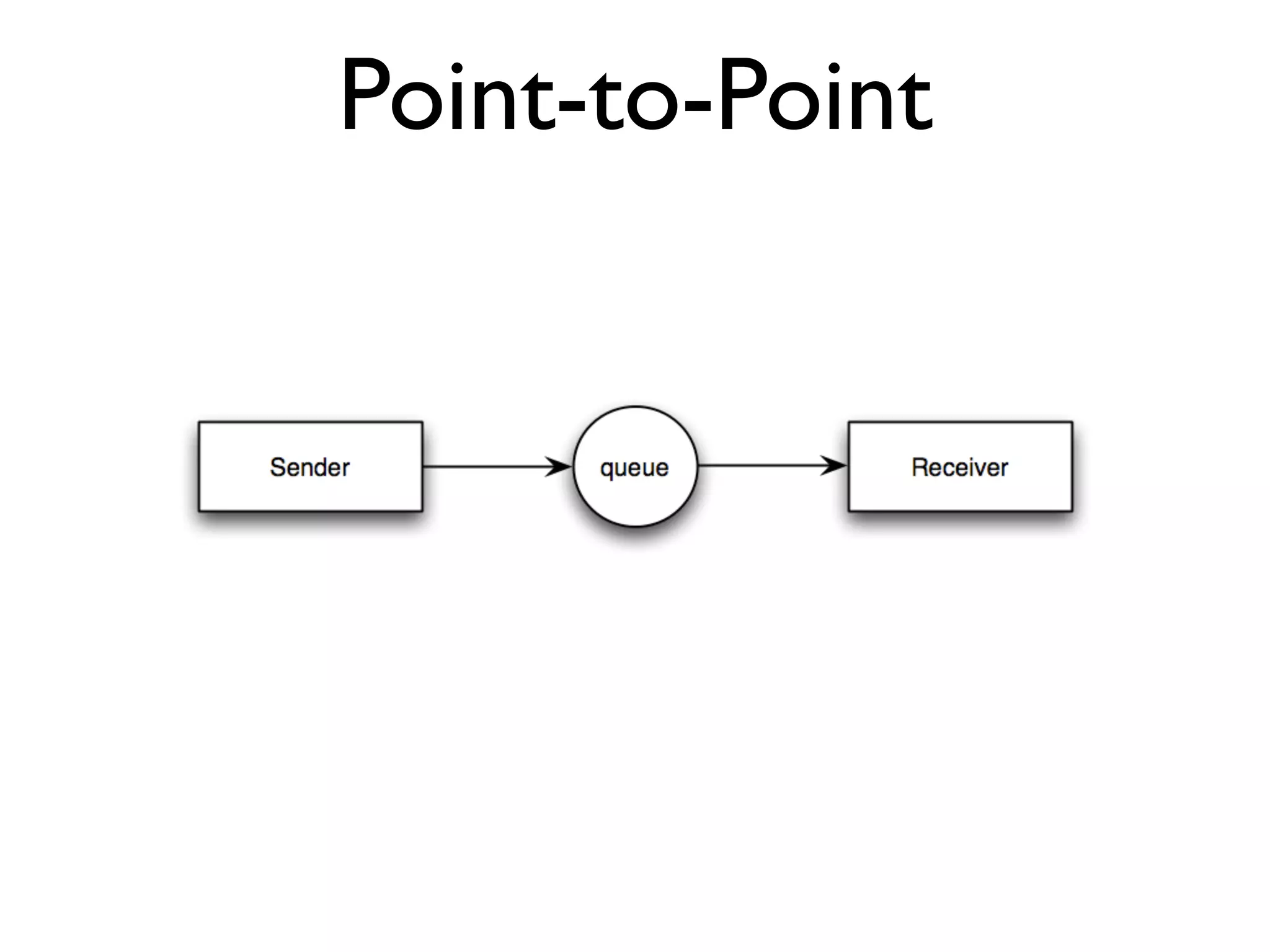
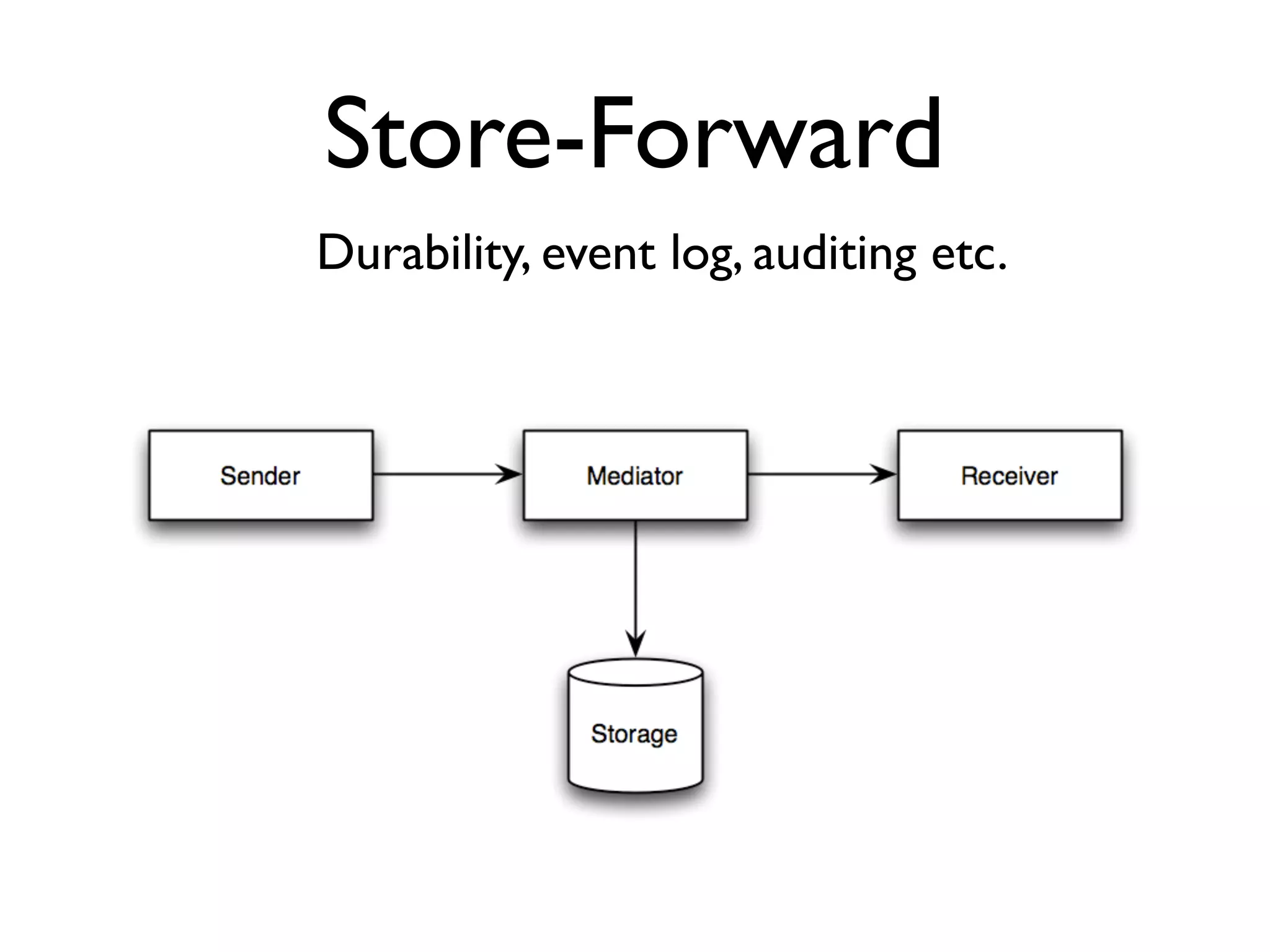
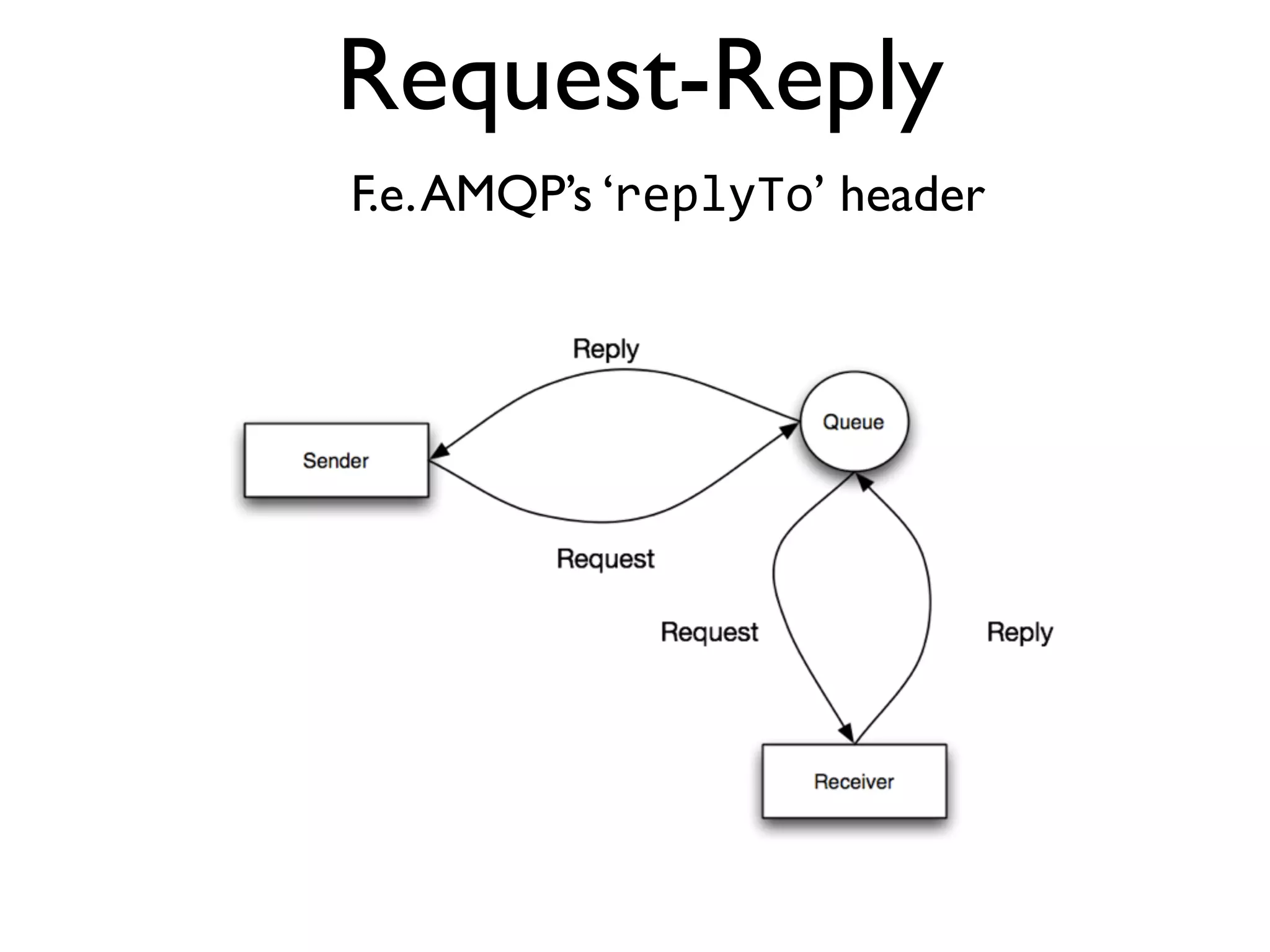
Messaging • Publish-Subscribe • Point-to-Point • Store-forward • Request-Reply
Publish-Subscribe
Point-to-Point
Store-Forward Durability, event log, auditing etc.
Request-Reply F.e.AMQP’s ‘replyTo’ header
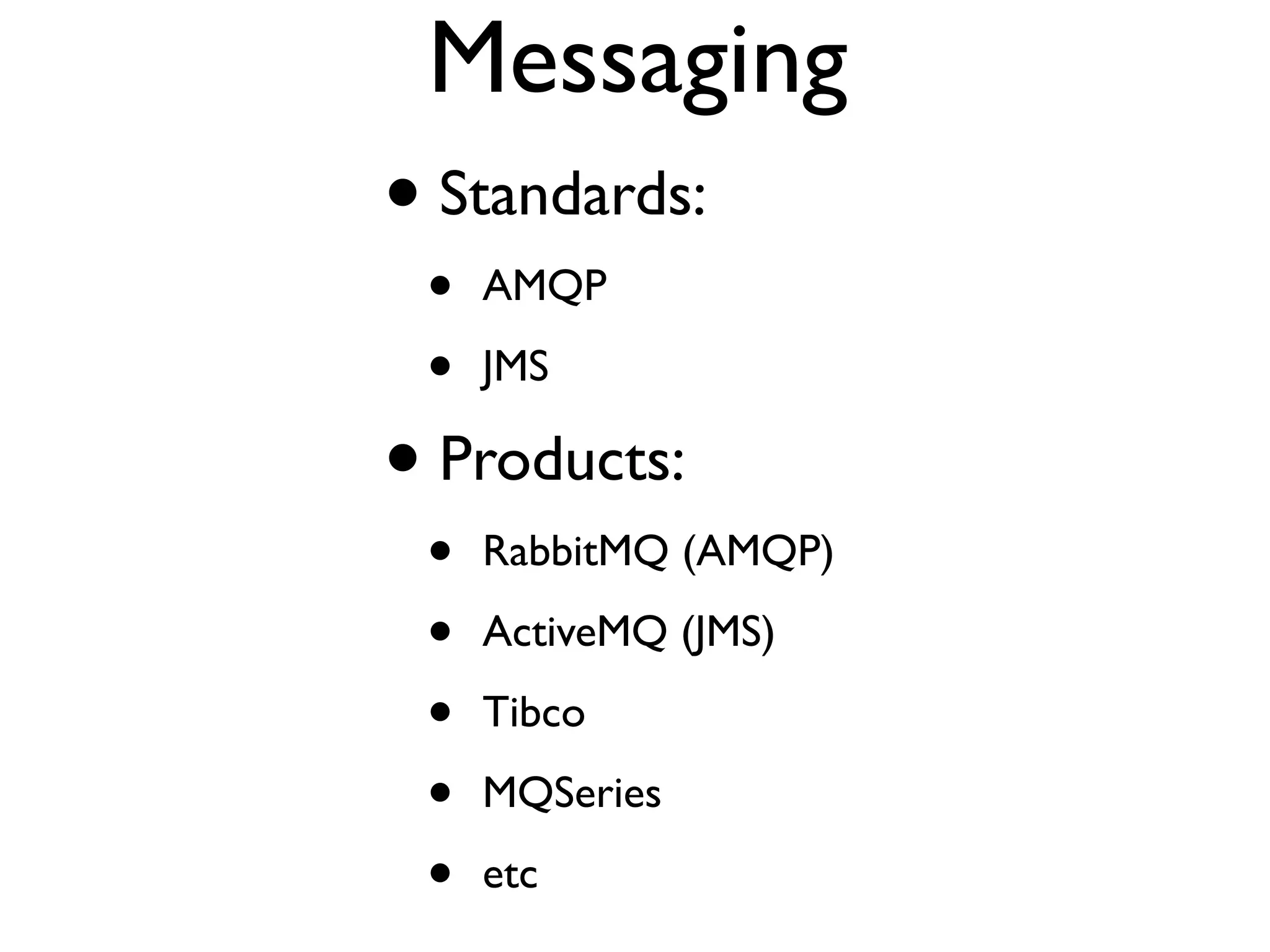
Messaging • Standards: • AMQP • JMS • Products: • RabbitMQ (AMQP) • ActiveMQ (JMS) • Tibco • MQSeries • etc
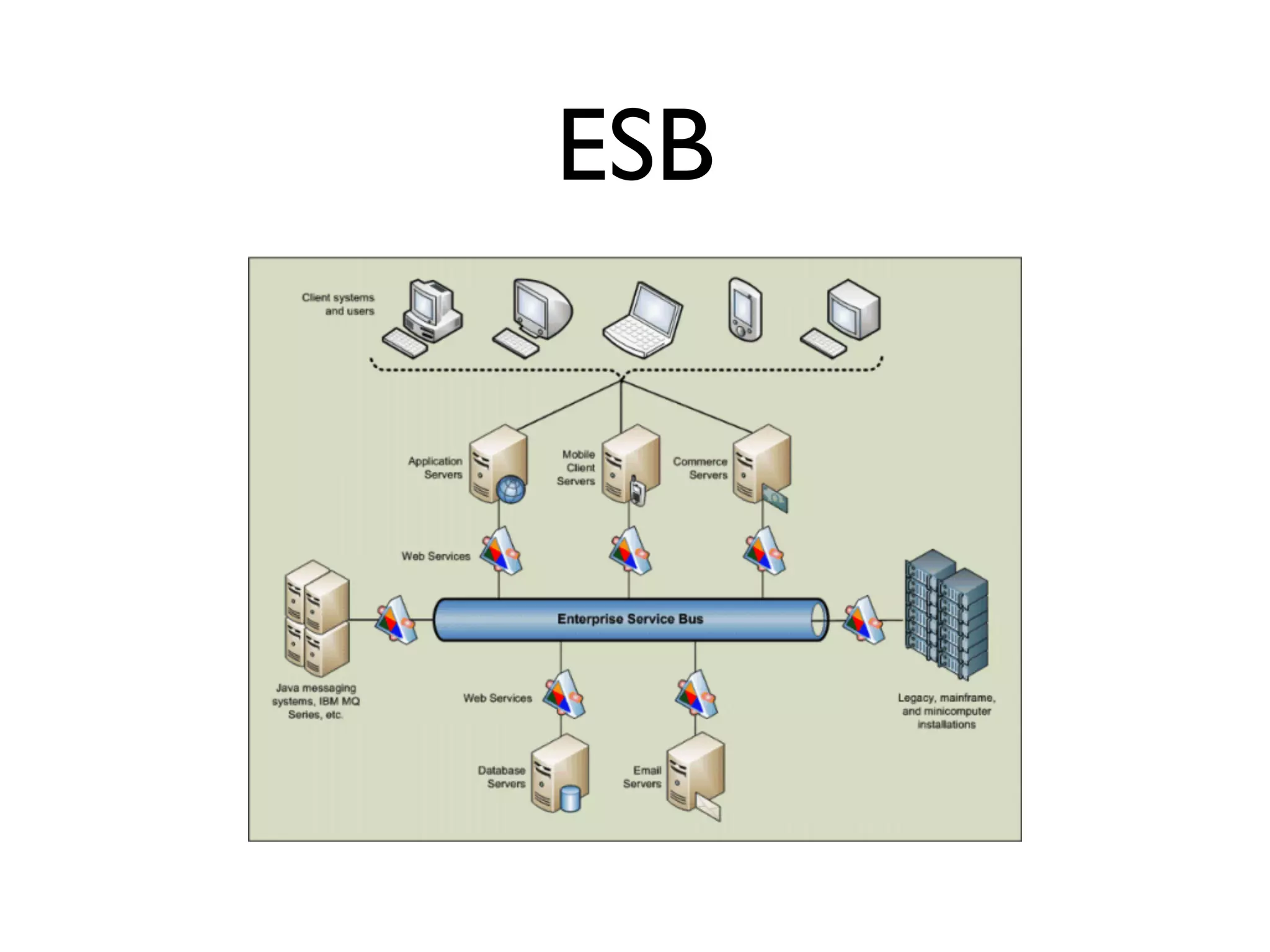
ESB
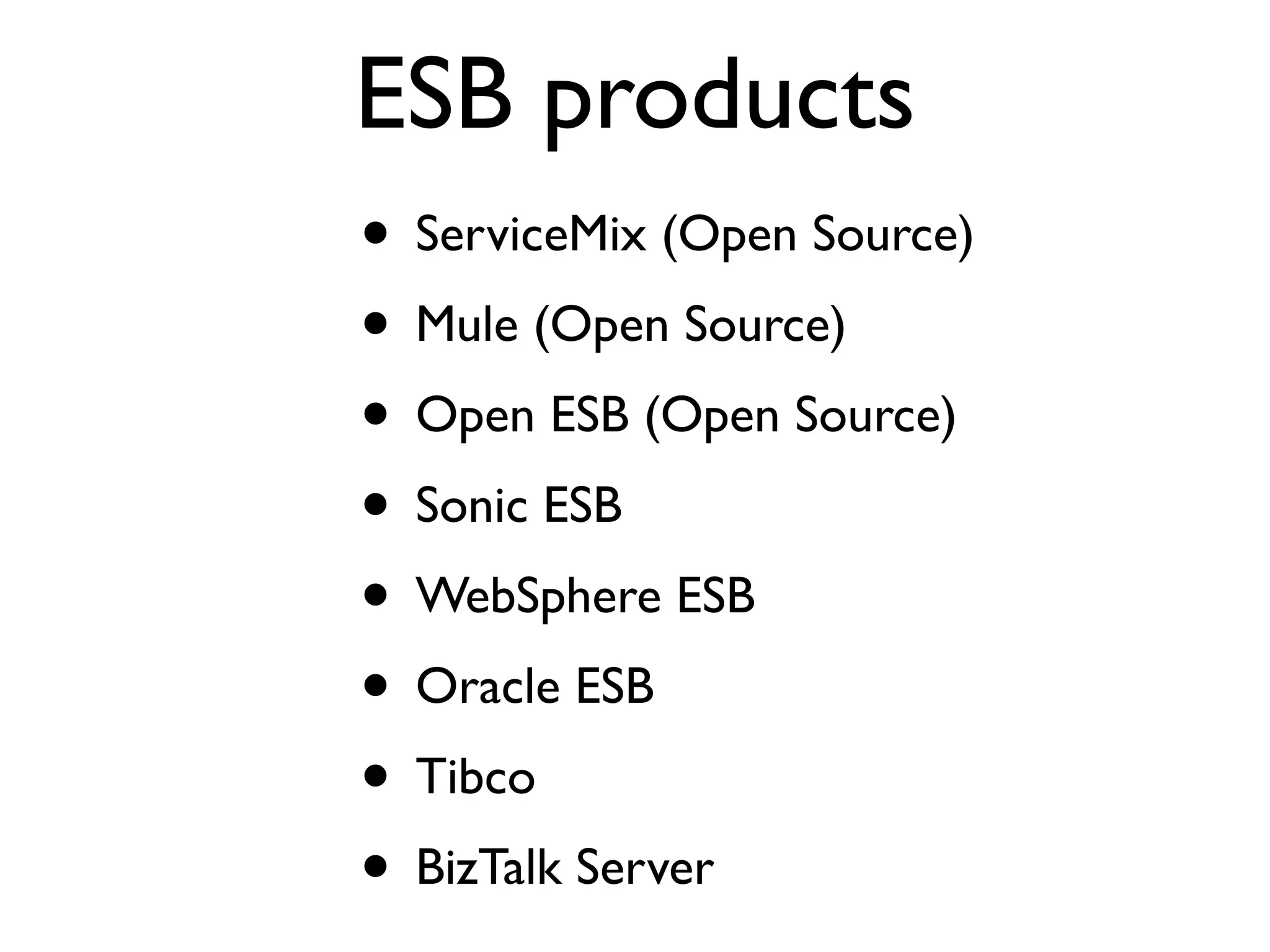
ESB products • ServiceMix (Open Source) • Mule (Open Source) • Open ESB (Open Source) • Sonic ESB • WebSphere ESB • Oracle ESB • Tibco • BizTalk Server
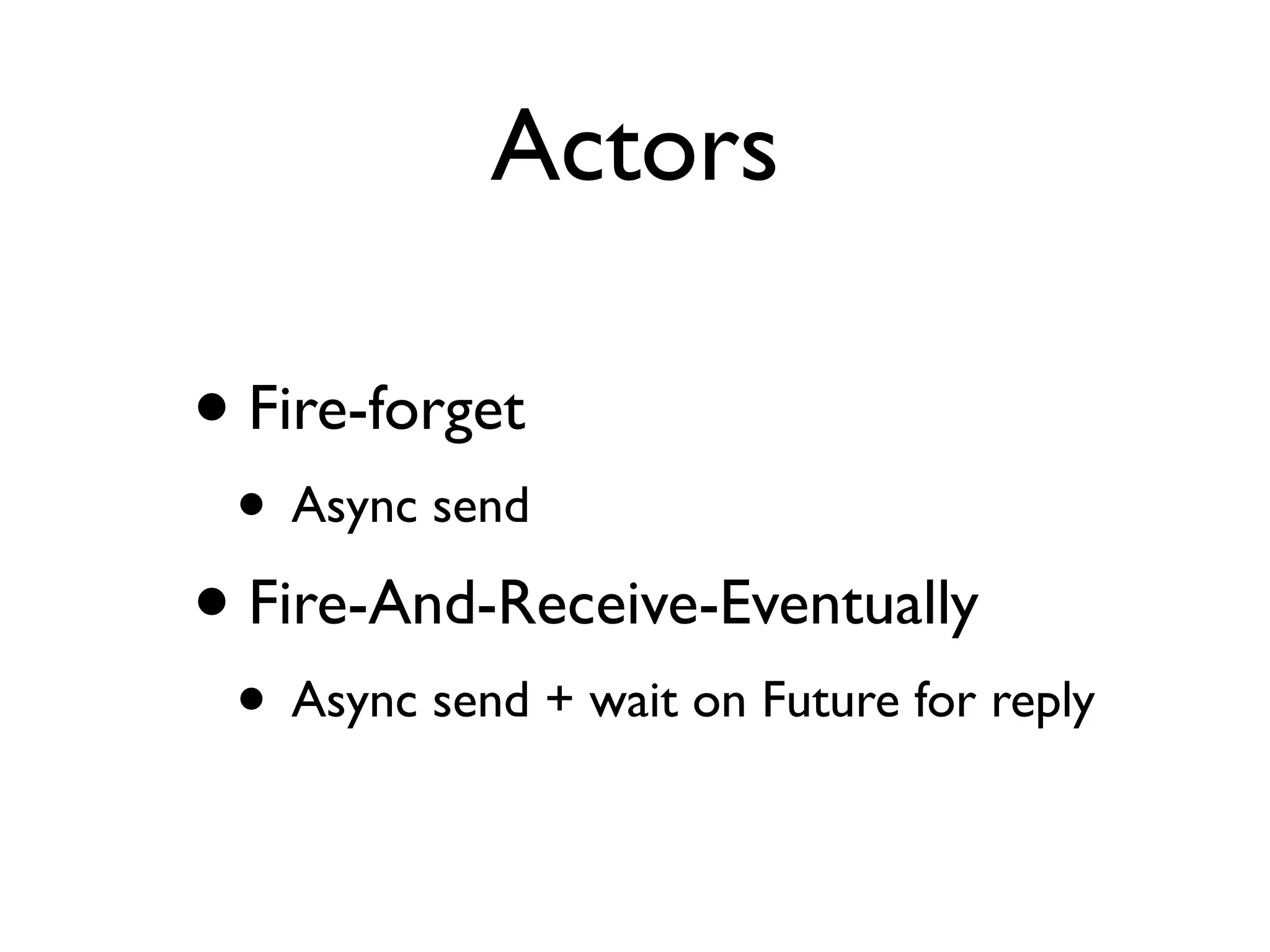
Actors • Fire-forget • Async send • Fire-And-Receive-Eventually • Async send + wait on Future for reply
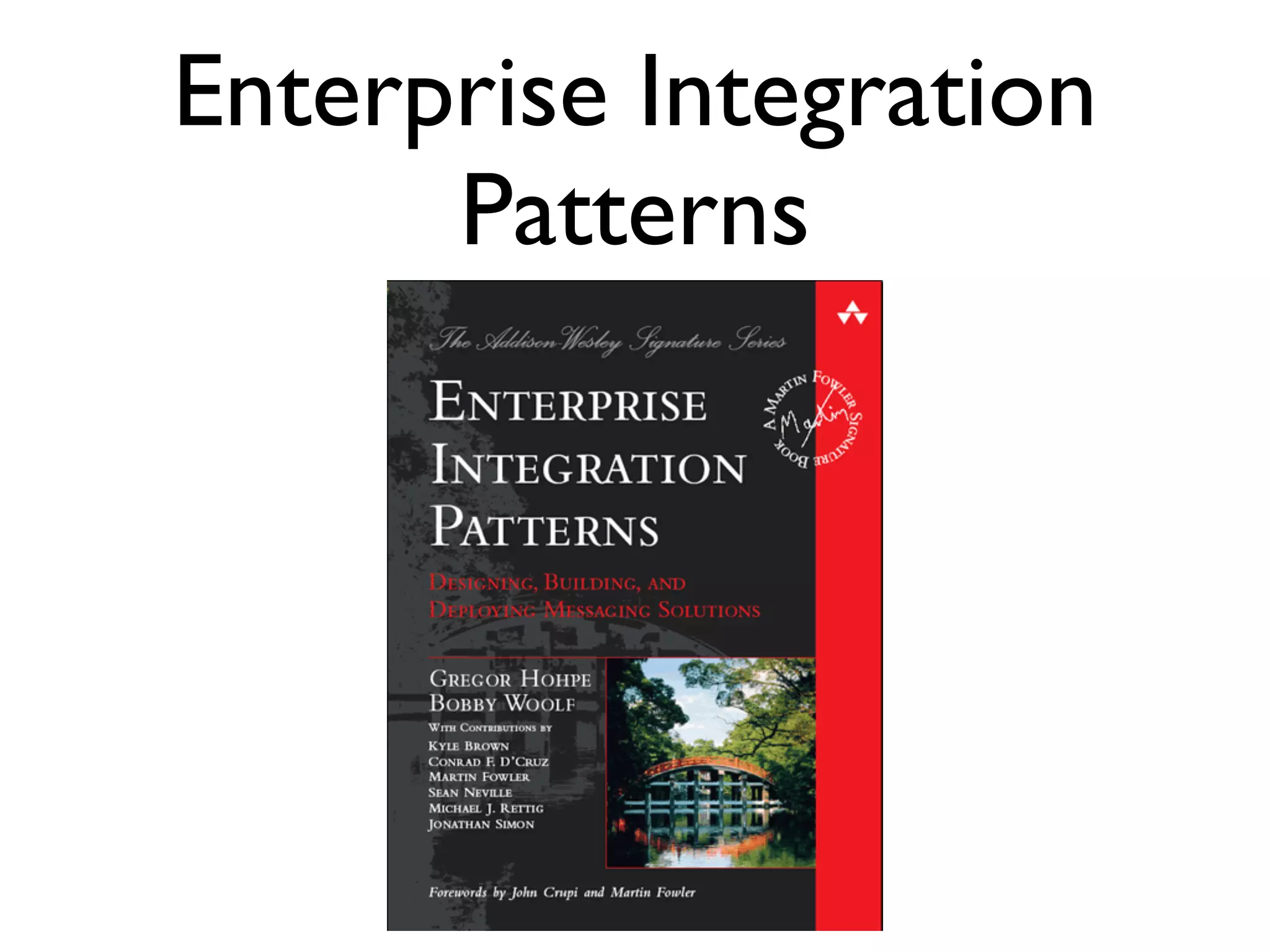
Enterprise Integration Patterns
Enterprise Integration Patterns Apache Camel • More than 80 endpoints • XML (Spring) DSL • Scala DSL
Compute Grids
Compute Grids Parallel execution • Divide and conquer 1. Split up job in independent tasks 2. Execute tasks in parallel 3. Aggregate and return result • MapReduce - Master/Worker
Compute Grids Parallel execution • Automatic provisioning • Load balancing • Fail-over • Topology resolution
Compute Grids Products • Platform • DataSynapse • Google MapReduce • Hadoop • GigaSpaces • GridGain
Load balancing
• Random allocation • Round robin allocation • Weighted allocation • Dynamic load balancing • Least connections • Least server CPU • etc. Load balancing
Load balancing • DNS Round Robin (simplest) • Ask DNS for IP for host • Get a new IP every time • Reverse Proxy (better) • Hardware Load Balancing
Load balancing products • Reverse Proxies: • Apache mod_proxy (OSS) • HAProxy (OSS) • Squid (OSS) • Nginx (OSS) • Hardware Load Balancers: • BIG-IP • Cisco
Parallel Computing
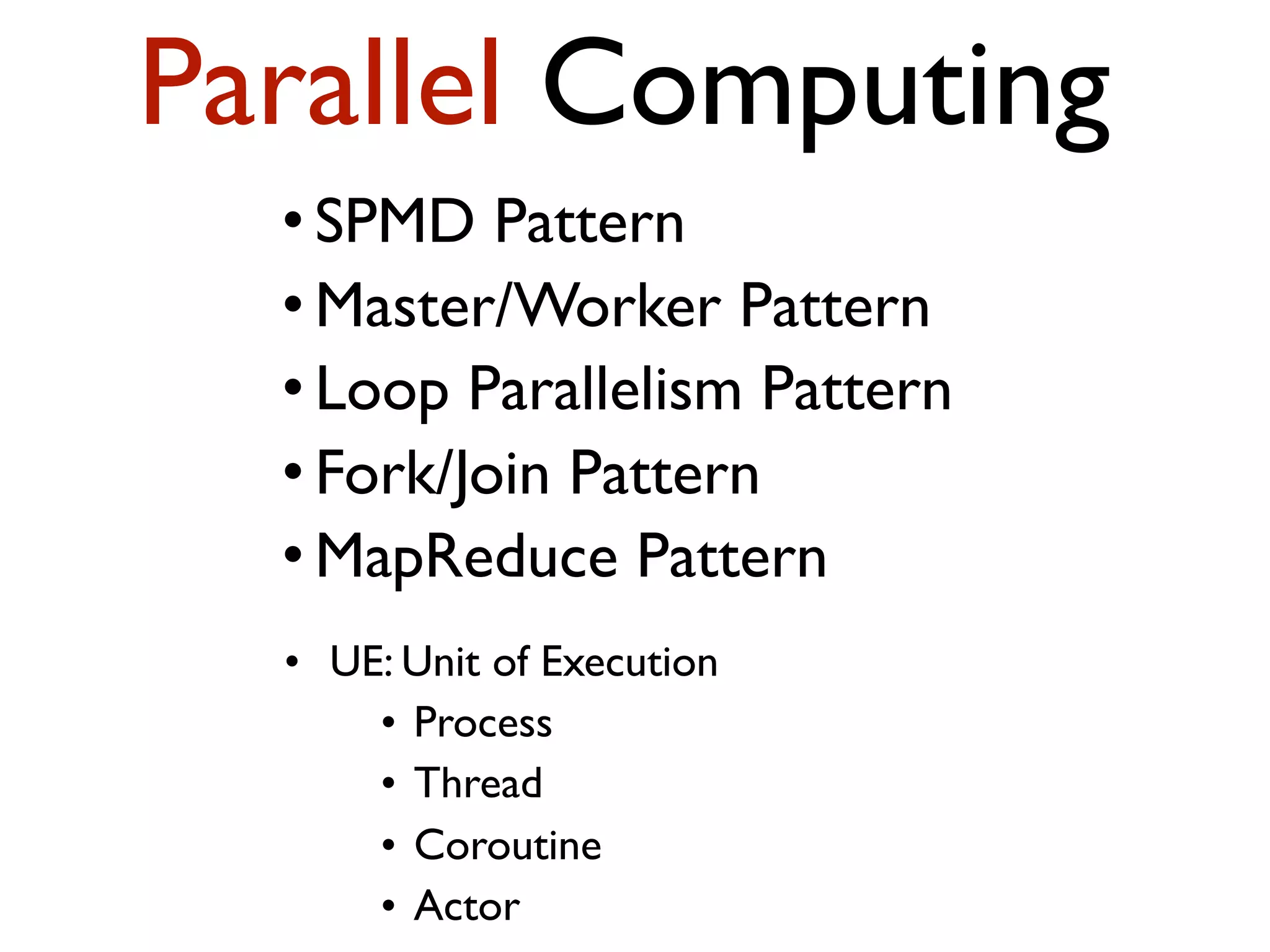
• UE: Unit of Execution • Process • Thread • Coroutine • Actor Parallel Computing • SPMD Pattern • Master/Worker Pattern • Loop Parallelism Pattern • Fork/Join Pattern • MapReduce Pattern
SPMD Pattern • Single Program Multiple Data • Very generic pattern, used in many other patterns • Use a single program for all the UEs • Use the UE’s ID to select different pathways through the program. F.e: • Branching on ID • Use ID in loop index to split loops • Keep interactions between UEs explicit
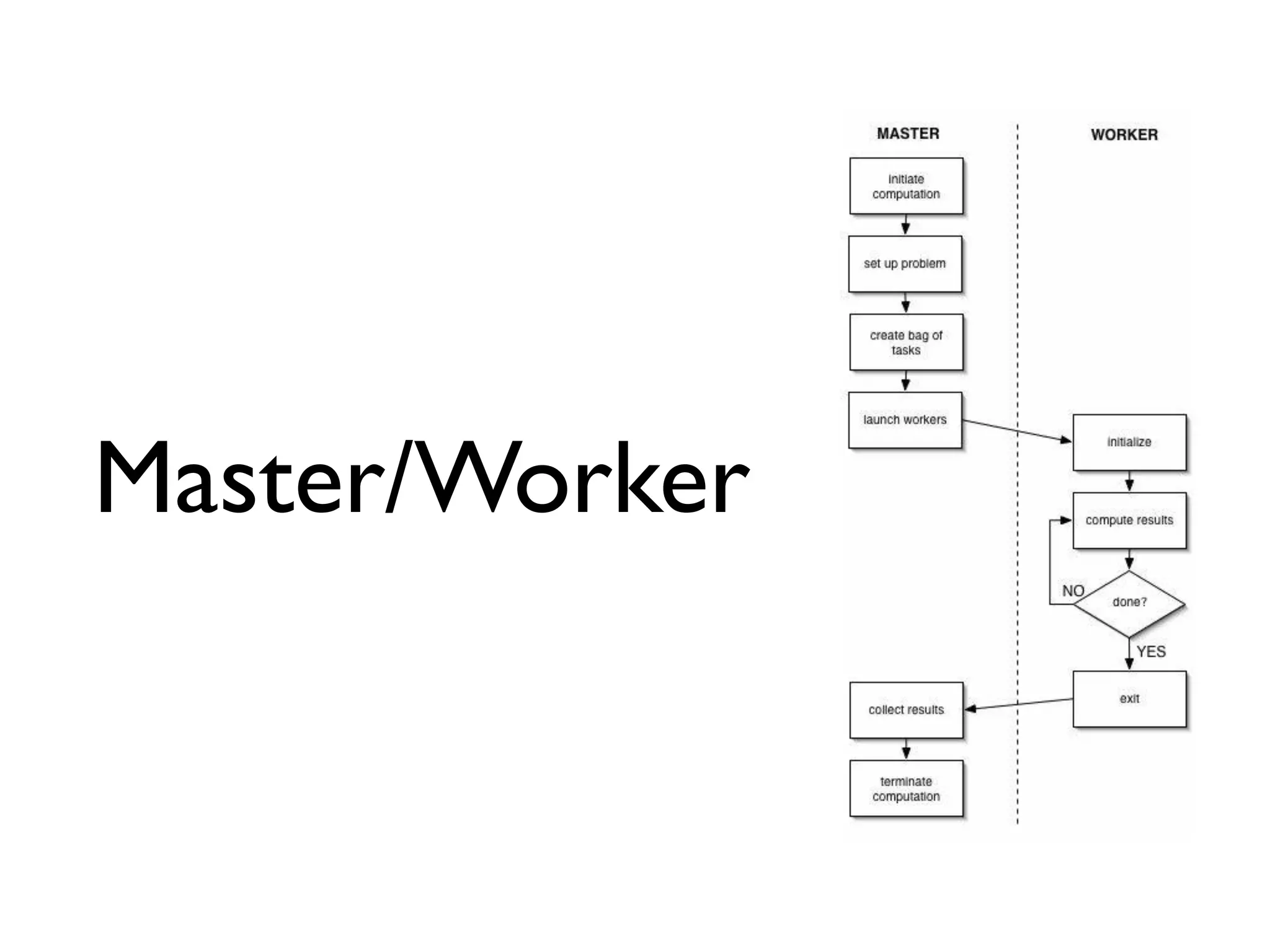
Master/Worker
Master/Worker • Good scalability • Automatic load-balancing • How to detect termination? • Bag of tasks is empty • Poison pill • If we bottleneck on single queue? • Use multiple work queues • Work stealing • What about fault tolerance? • Use “in-progress” queue
Loop Parallelism •Workflow 1.Find the loops that are bottlenecks 2.Eliminate coupling between loop iterations 3.Parallelize the loop •If too few iterations to pull its weight • Merge loops • Coalesce nested loops •OpenMP • omp  parallel  for
What if task creation can’t be handled by: • parallelizing loops (Loop Parallelism) • putting them on work queues (Master/Worker)
What if task creation can’t be handled by: • parallelizing loops (Loop Parallelism) • putting them on work queues (Master/Worker) Enter Fork/Join
•Use when relationship between tasks is simple •Good for recursive data processing •Can use work-stealing 1. Fork:Tasks are dynamically created 2. Join:Tasks are later terminated and data aggregated Fork/Join
Fork/Join •Direct task/UE mapping • 1-1 mapping between Task/UE • Problem: Dynamic UE creation is expensive •Indirect task/UE mapping • Pool the UE • Control (constrain) the resource allocation • Automatic load balancing
Java 7 ParallelArray (Fork/Join DSL) Fork/Join
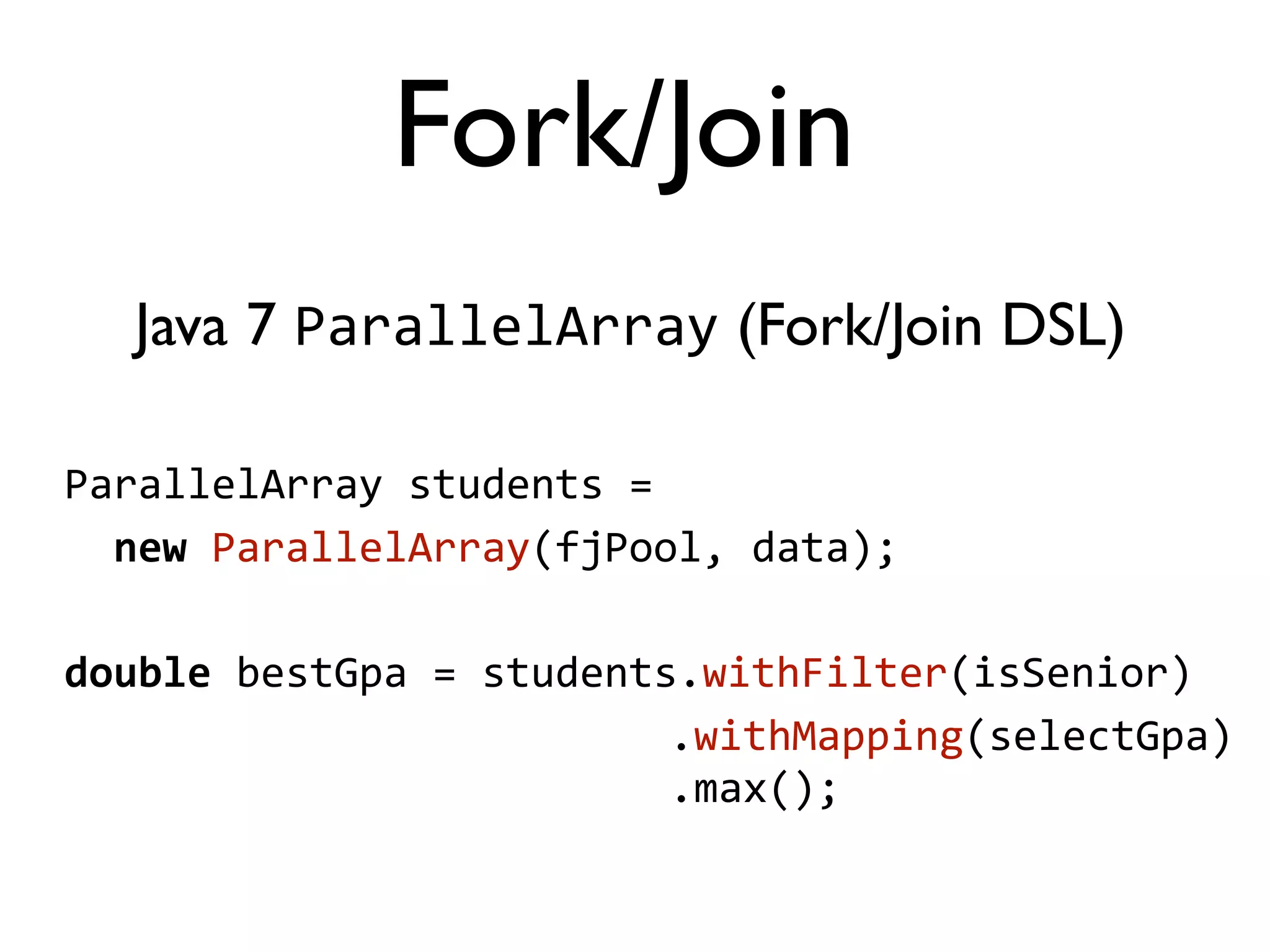
Java 7 ParallelArray (Fork/Join DSL) ParallelArray  students  =      new  ParallelArray(fjPool,  data); double  bestGpa  =  students.withFilter(isSenior)                                                    .withMapping(selectGpa)                                                    .max(); Fork/Join
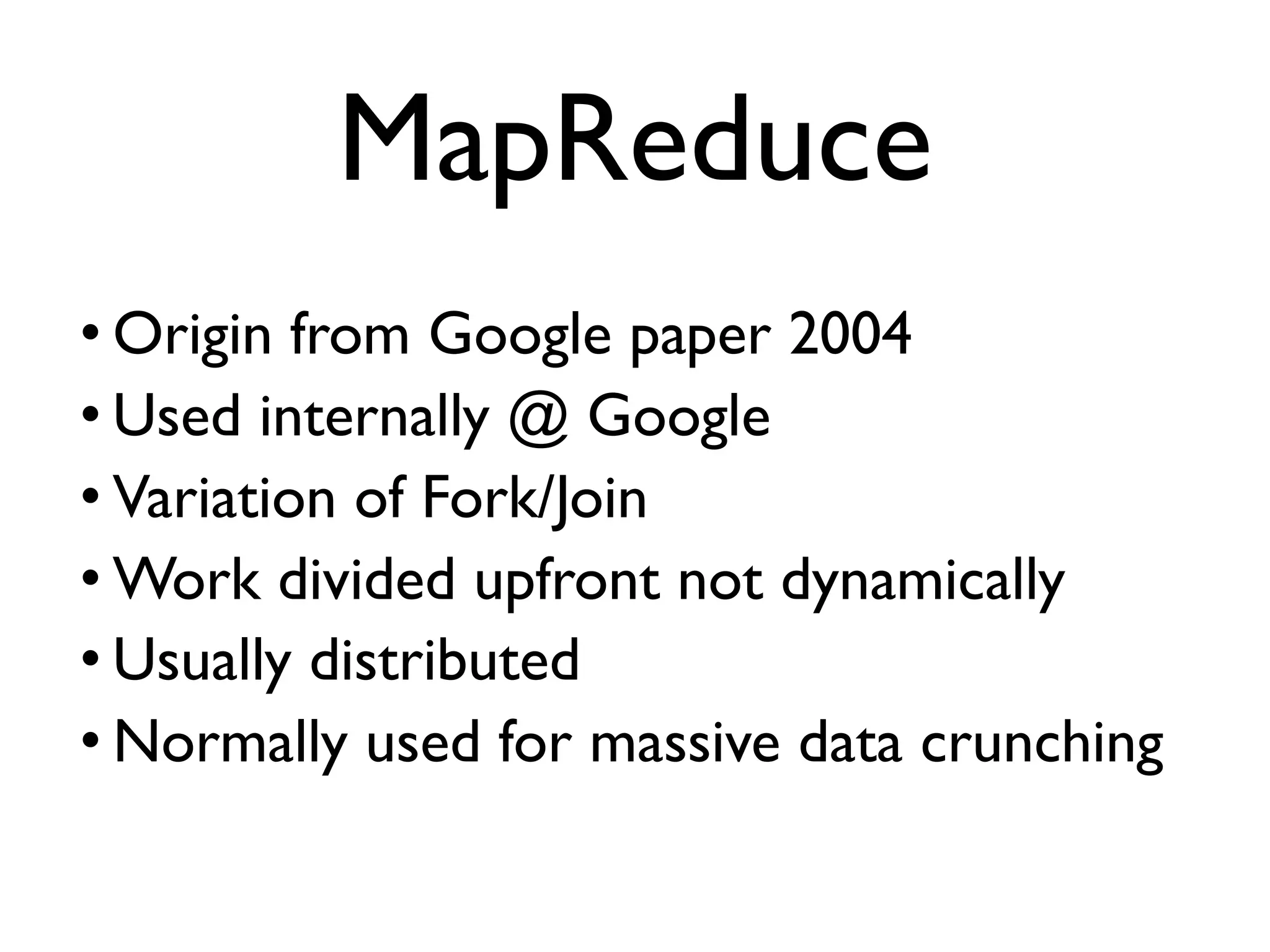
• Origin from Google paper 2004 • Used internally @ Google • Variation of Fork/Join • Work divided upfront not dynamically • Usually distributed • Normally used for massive data crunching MapReduce
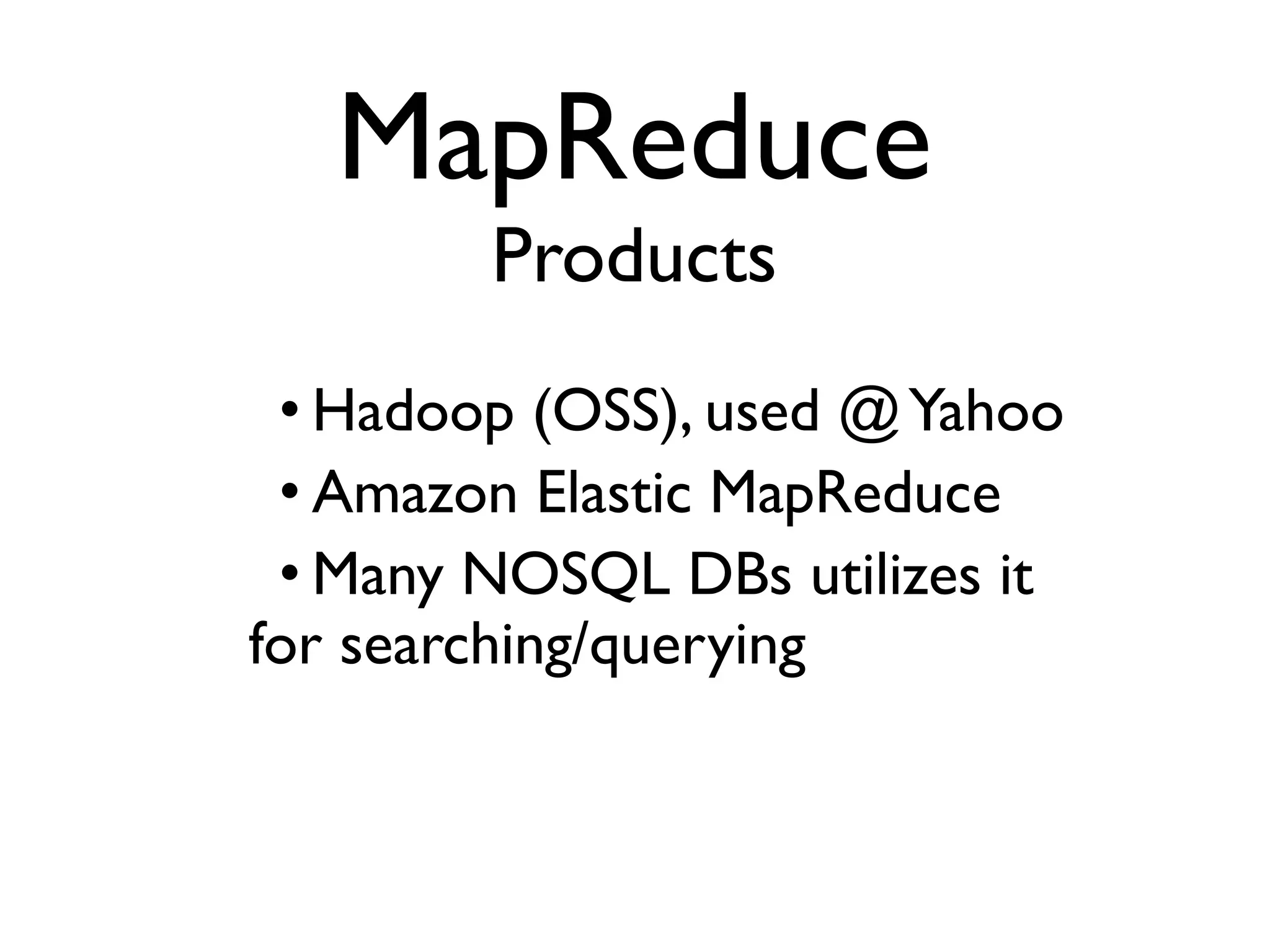
• Hadoop (OSS), used @Yahoo • Amazon Elastic MapReduce • Many NOSQL DBs utilizes it for searching/querying MapReduce Products
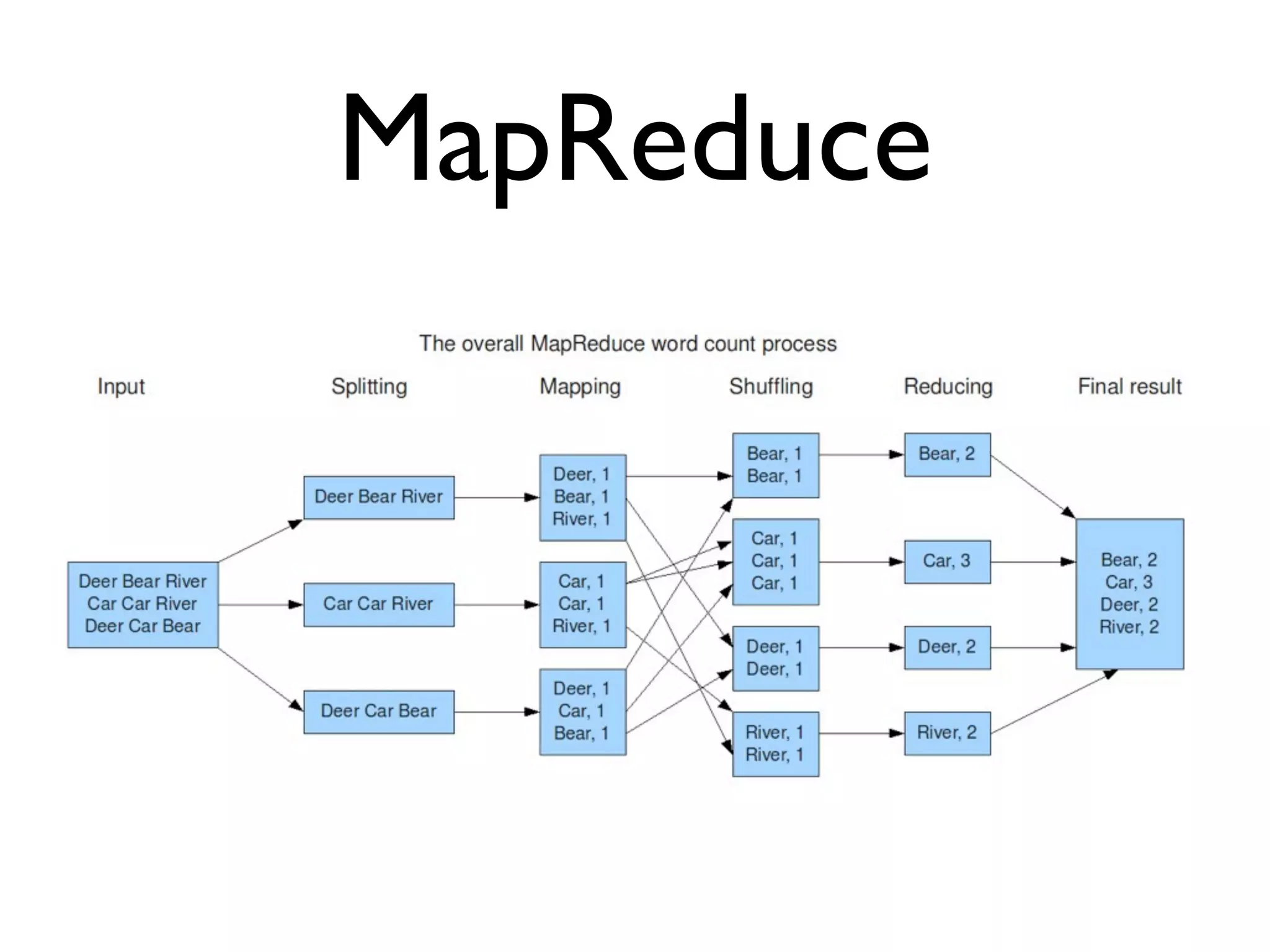
MapReduce
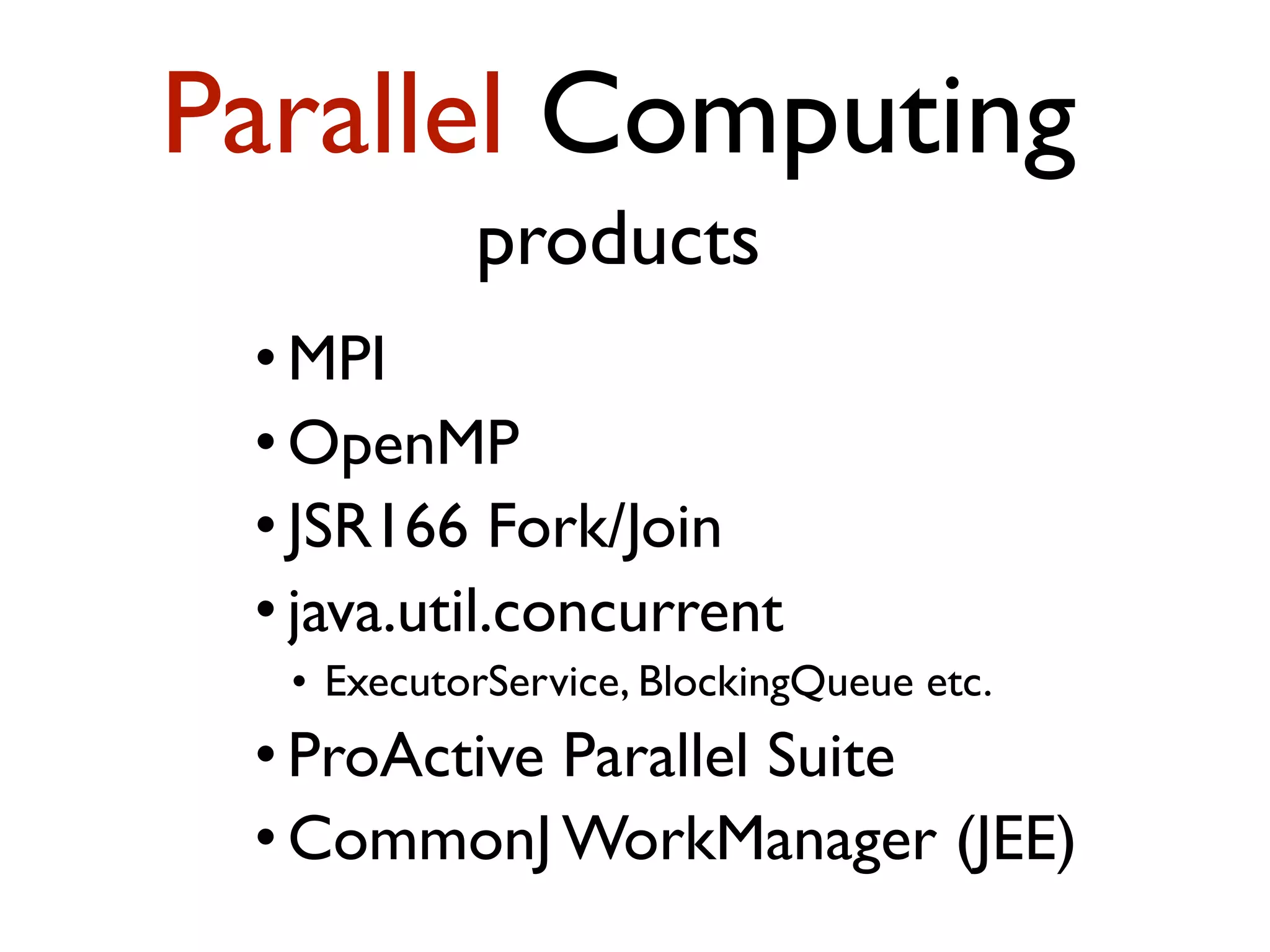
Parallel Computing products • MPI • OpenMP • JSR166 Fork/Join • java.util.concurrent • ExecutorService, BlockingQueue etc. • ProActive Parallel Suite • CommonJ WorkManager (JEE)
Stability Patterns
•Timeouts •Circuit Breaker •Let-it-crash •Fail fast •Bulkheads •Steady State •Throttling Stability Patterns
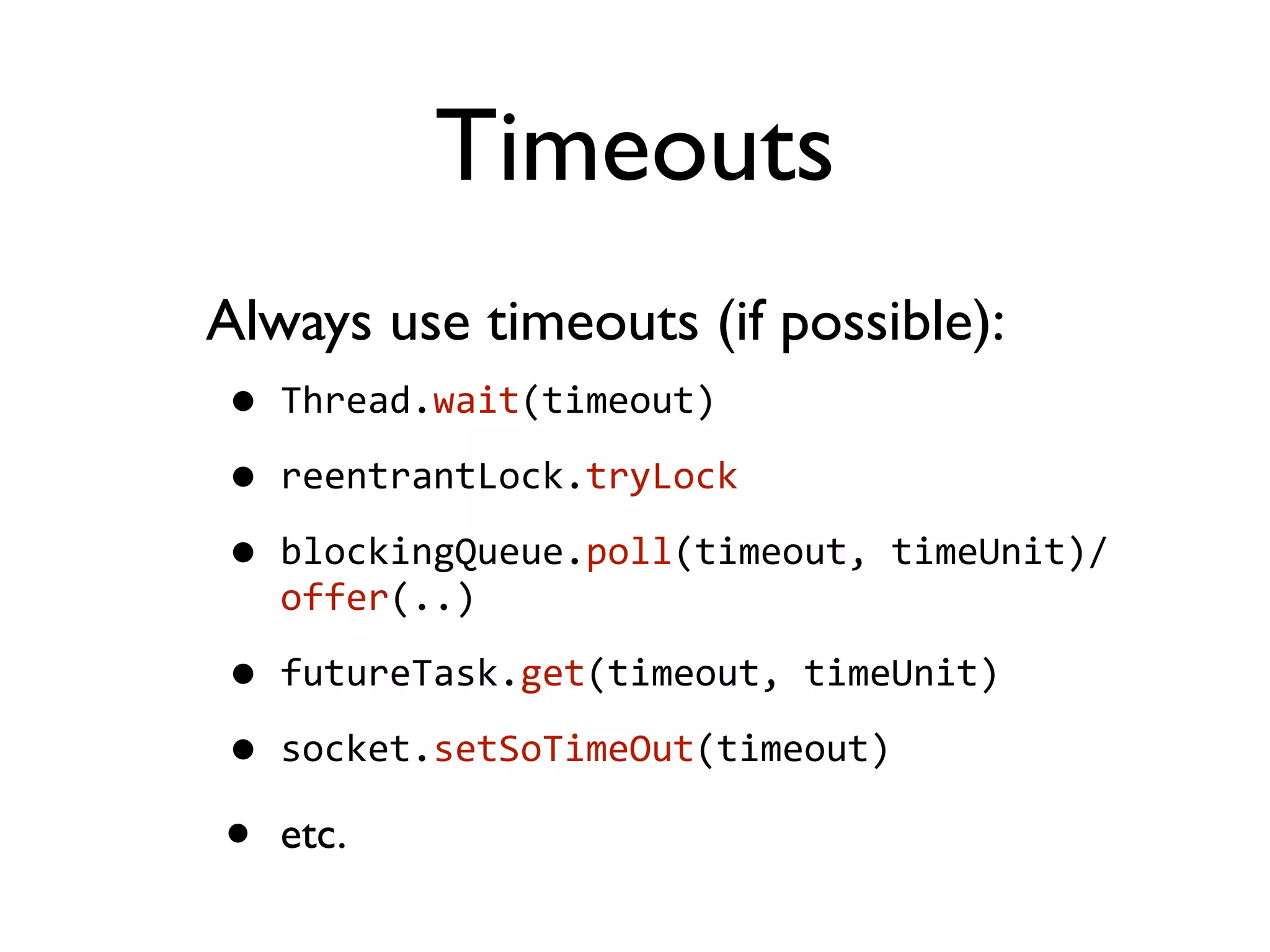
Timeouts Always use timeouts (if possible): • Thread.wait(timeout) • reentrantLock.tryLock • blockingQueue.poll(timeout,  timeUnit)/ offer(..) • futureTask.get(timeout,  timeUnit) • socket.setSoTimeOut(timeout) • etc.
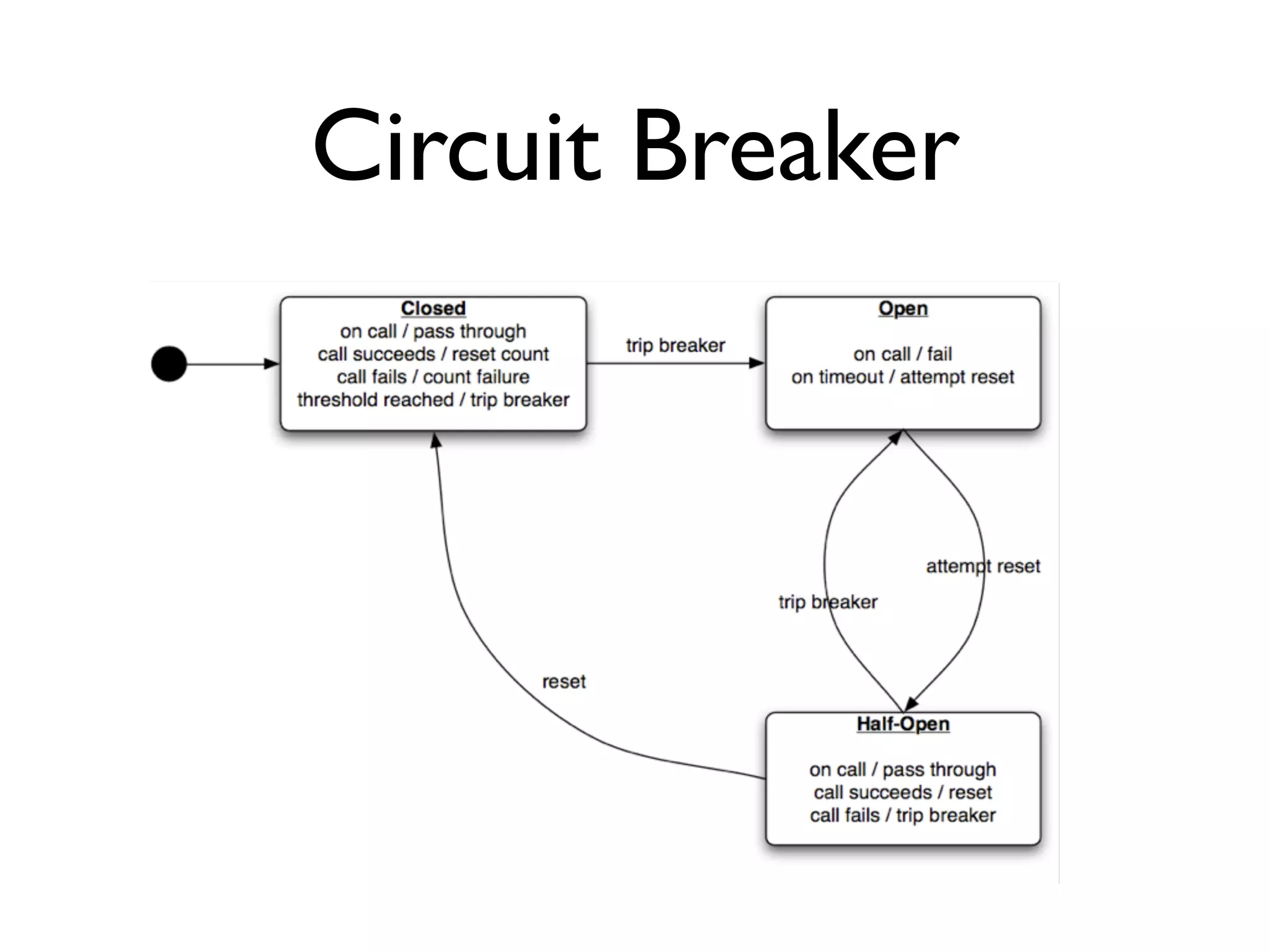
Circuit Breaker
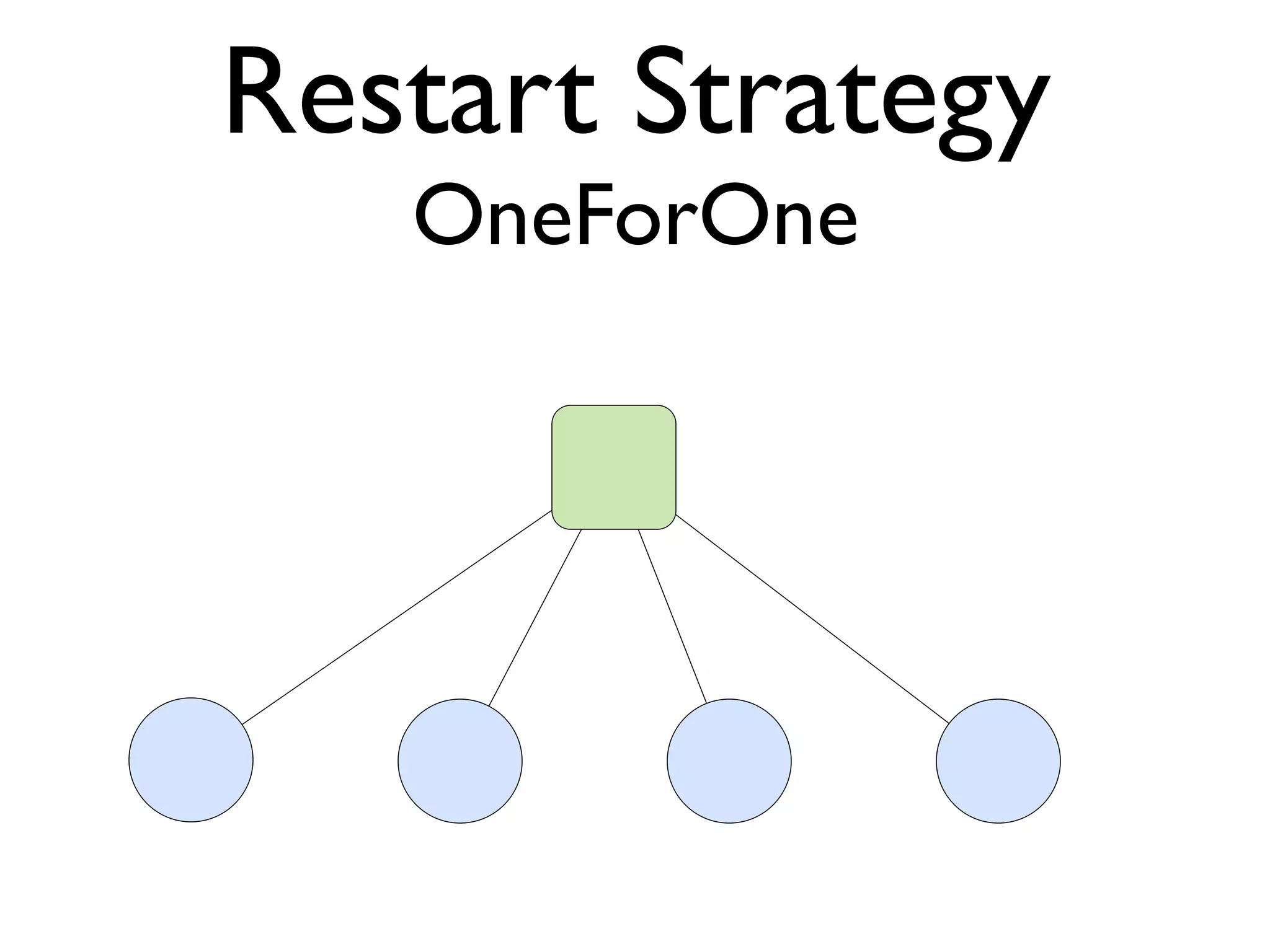
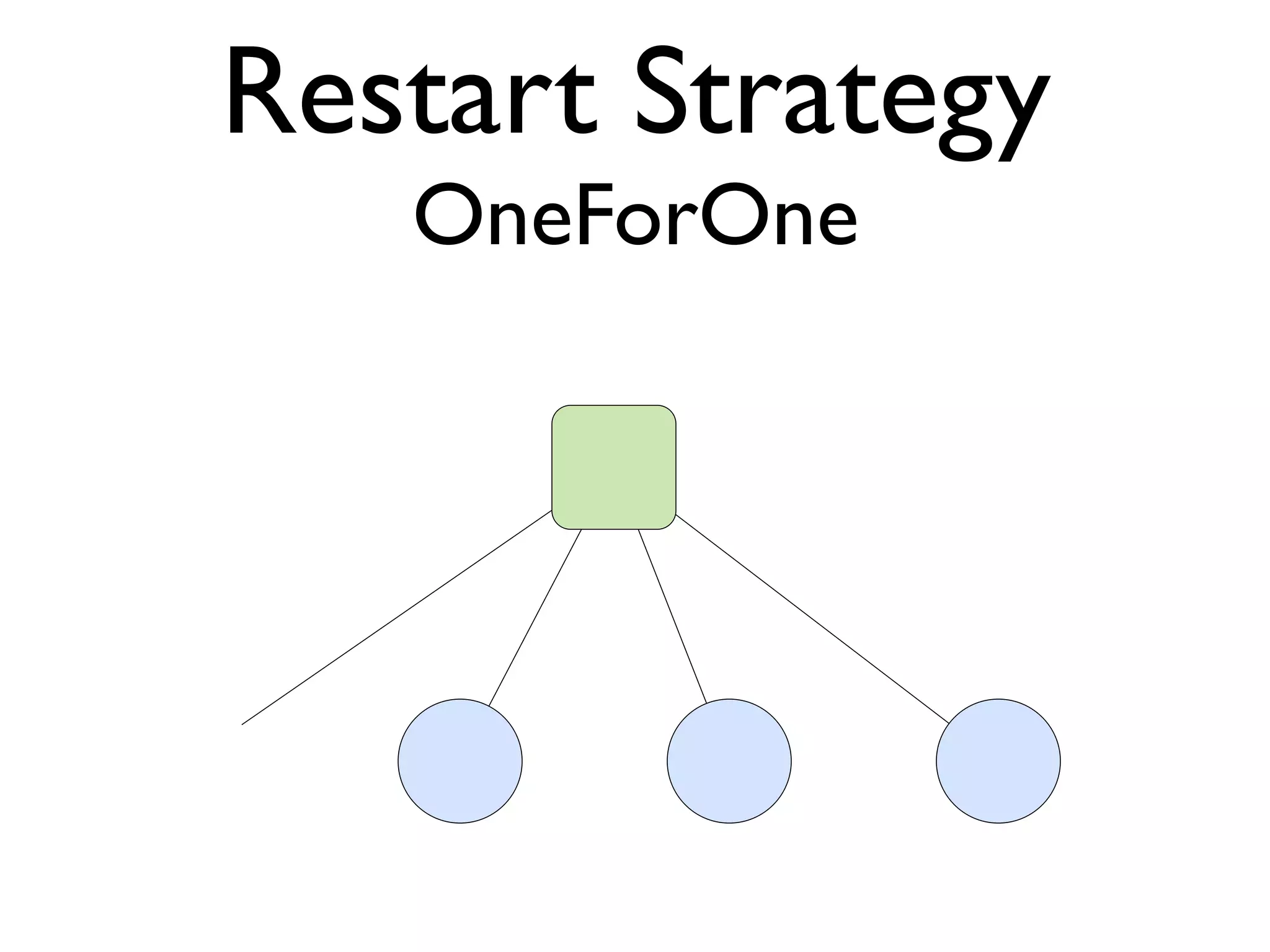
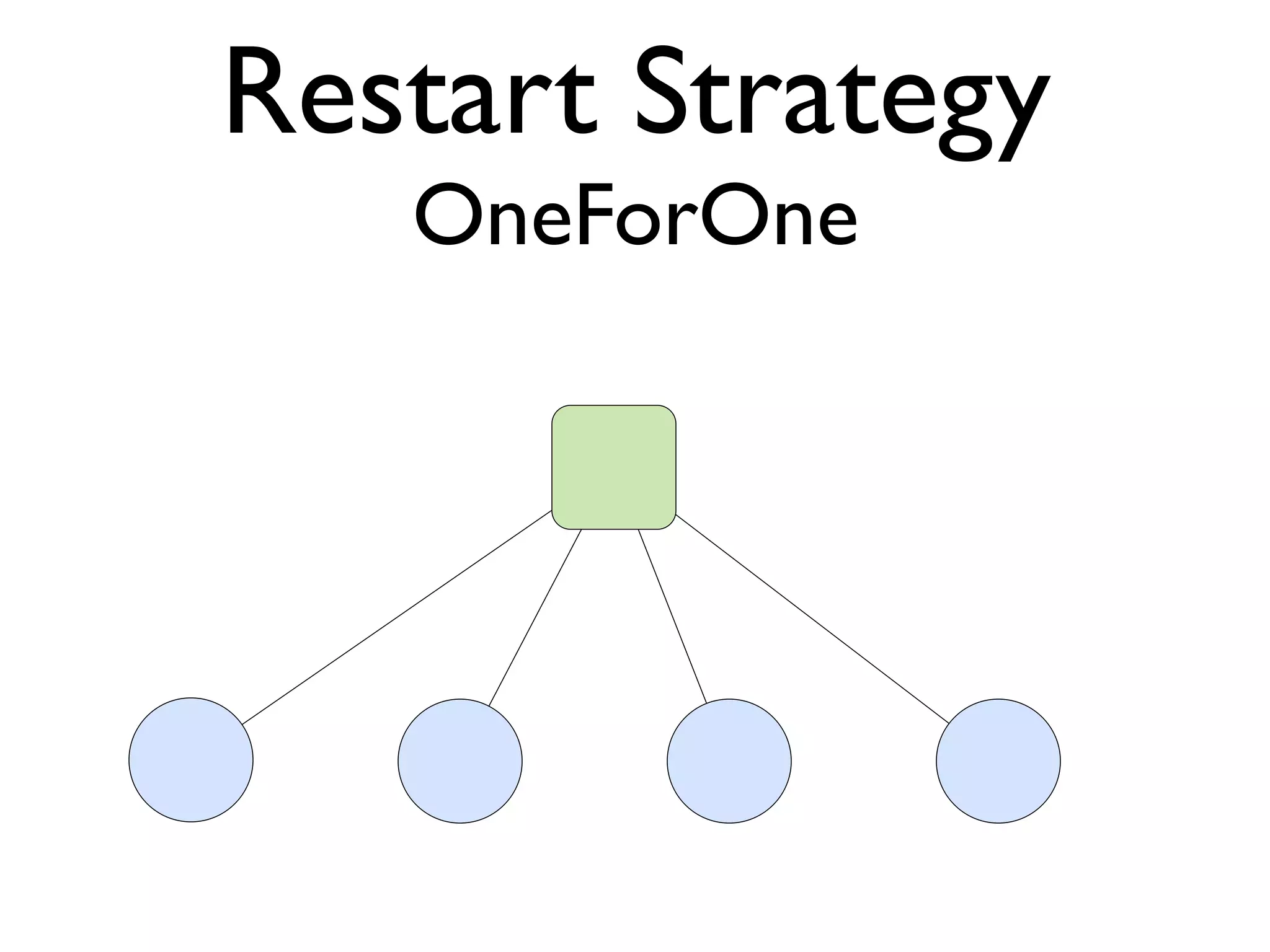
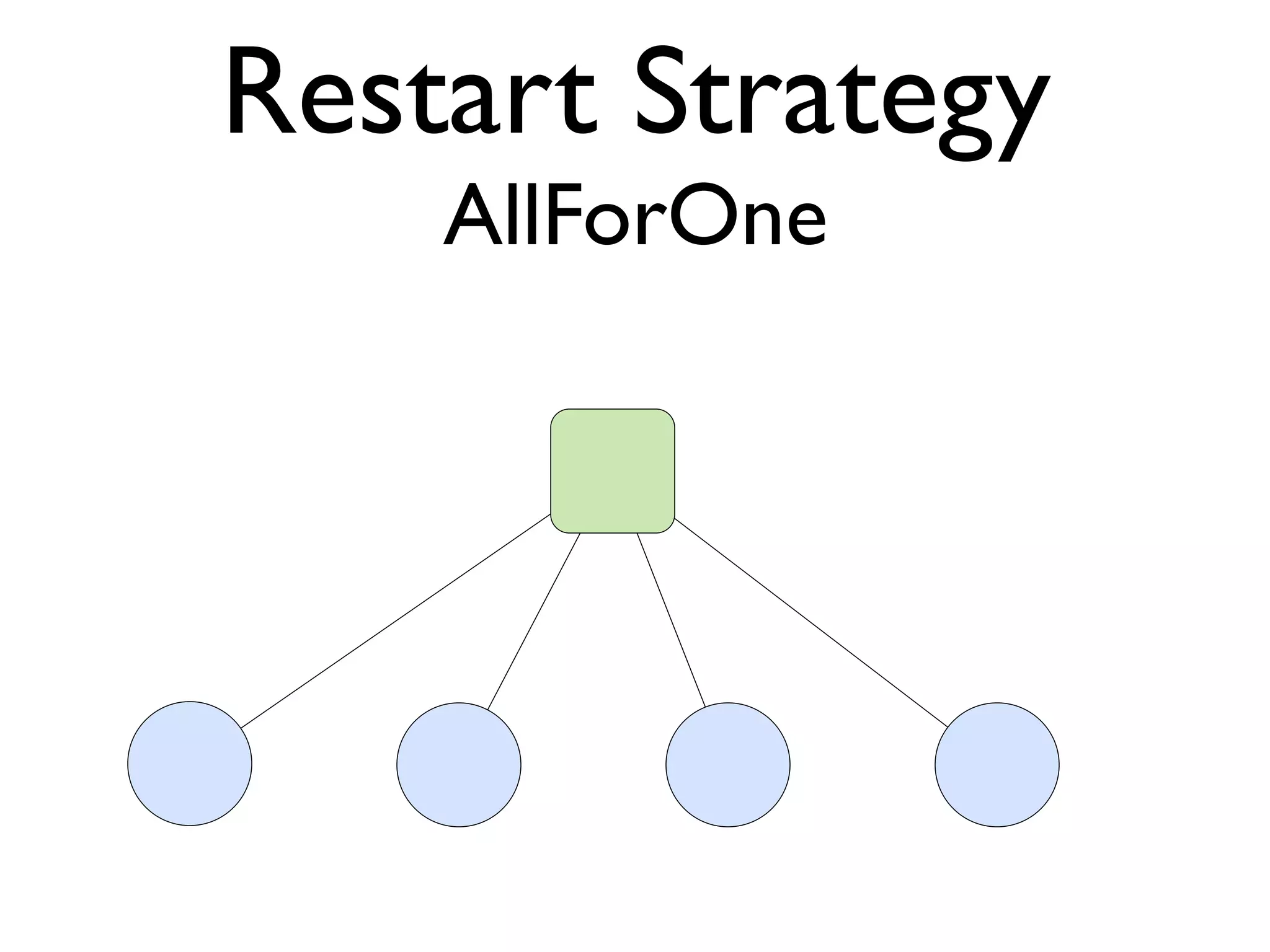
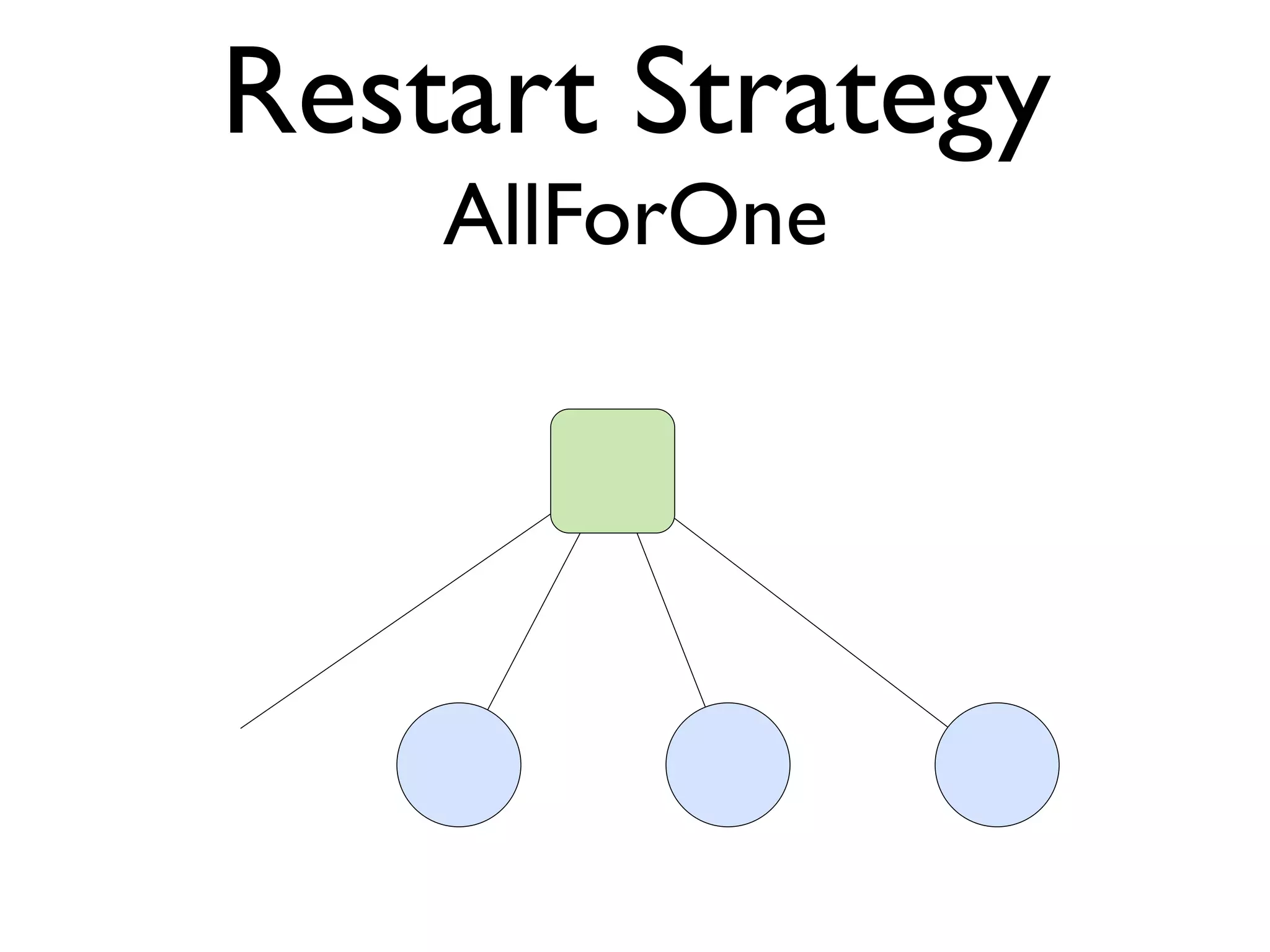
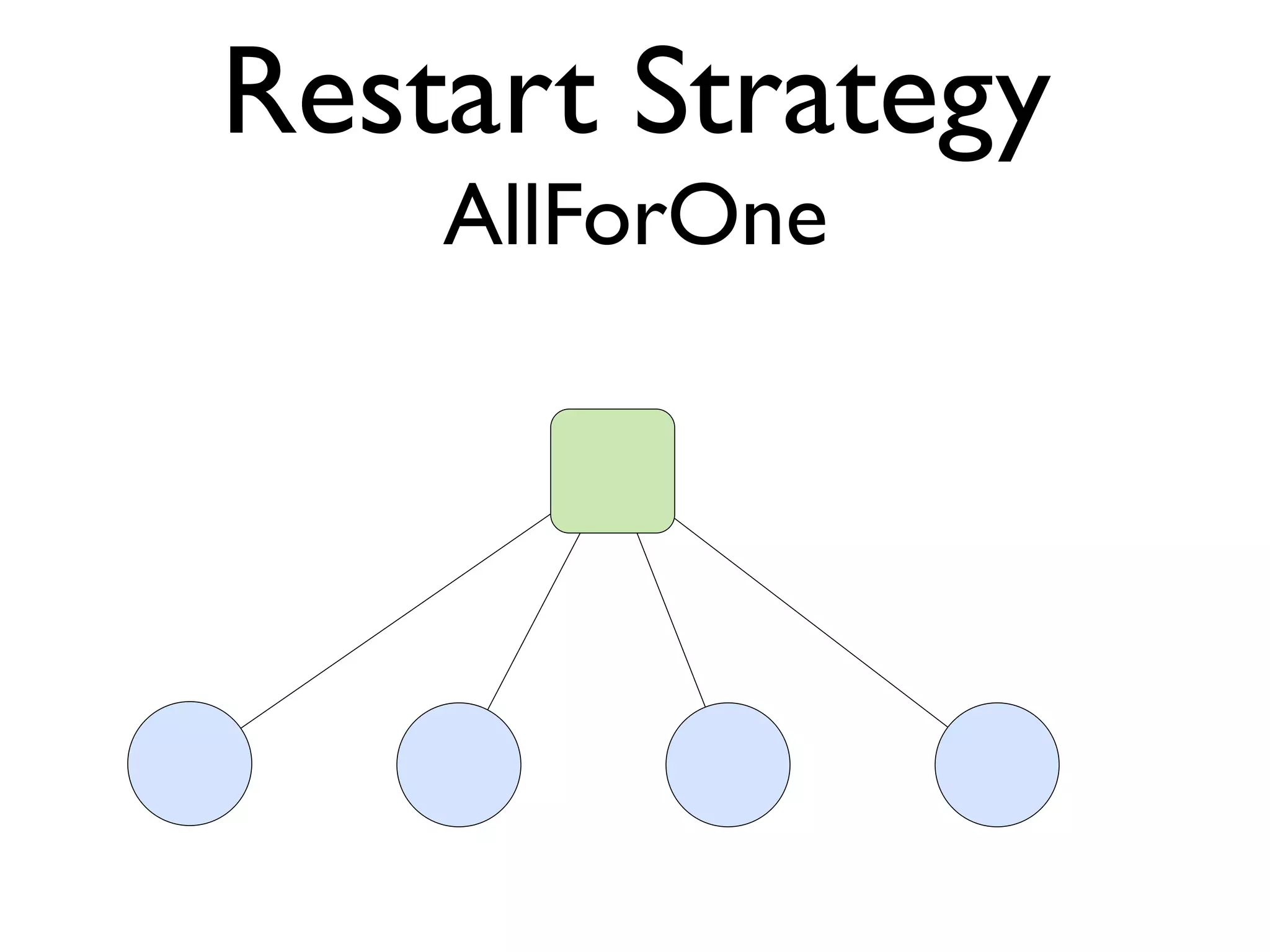
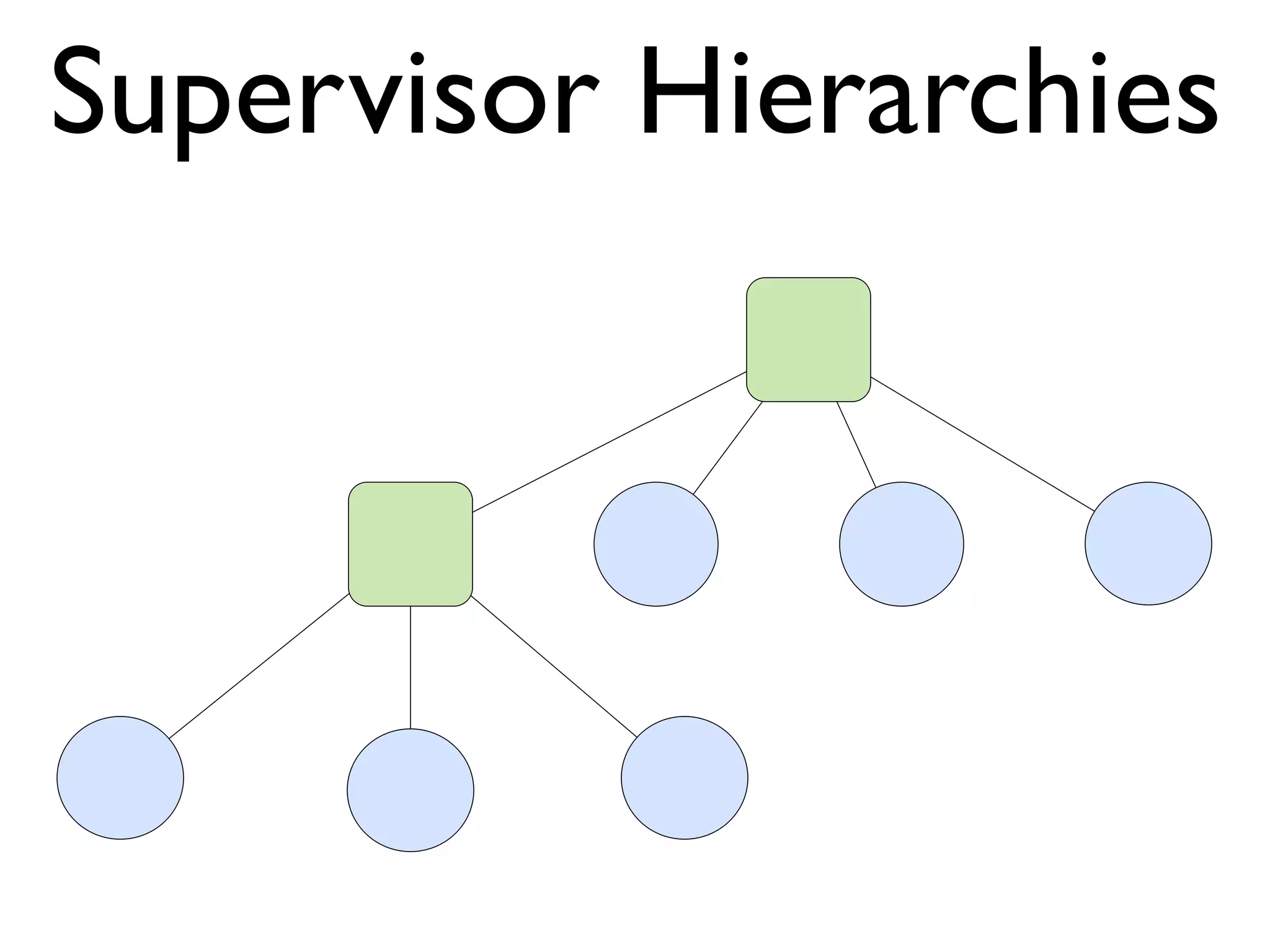
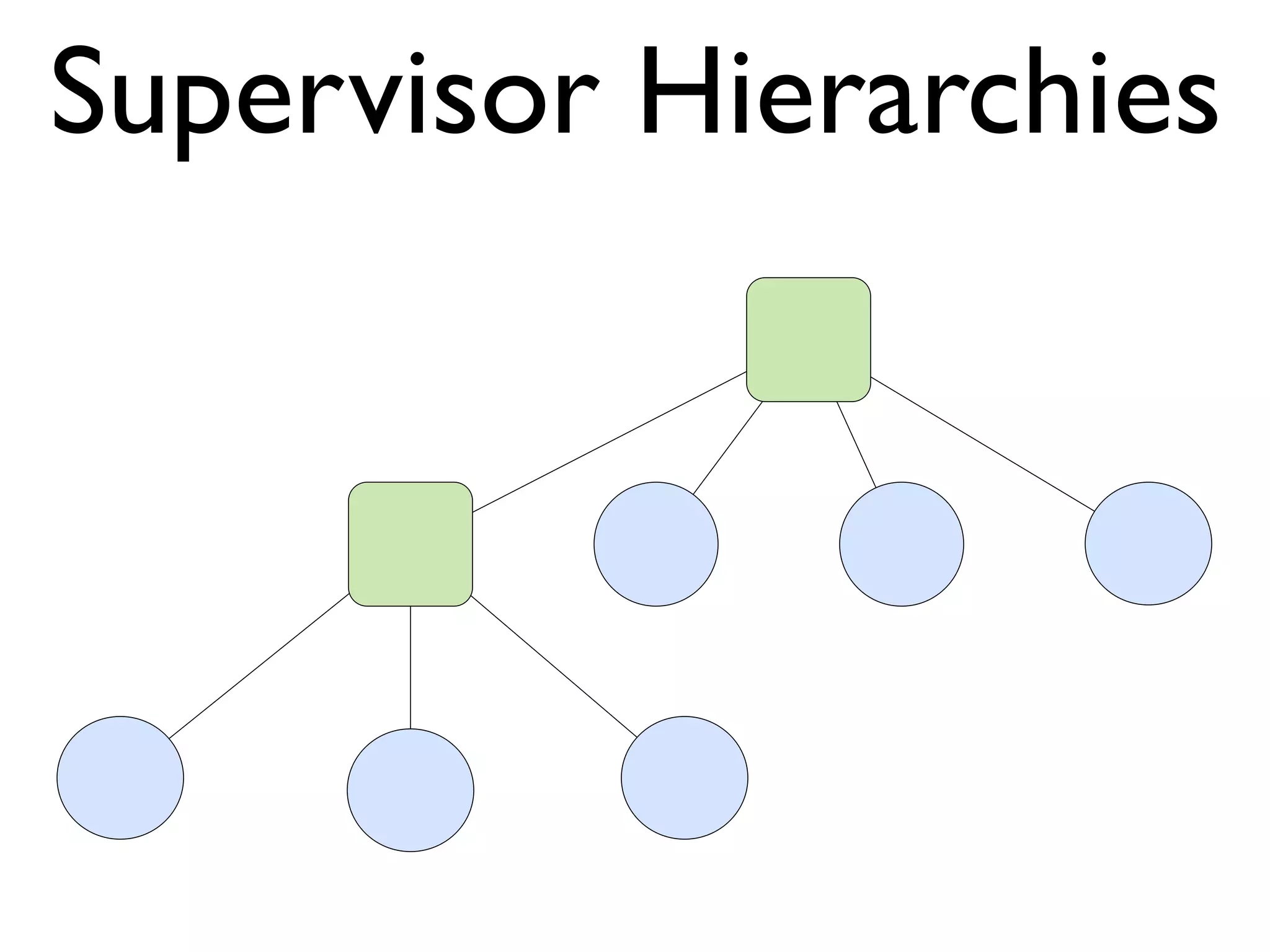
Let it crash • Embrace failure as a natural state in the life-cycle of the application • Instead of trying to prevent it; manage it • Process supervision • Supervisor hierarchies (from Erlang)
Restart Strategy OneForOne
Restart Strategy AllForOne
Supervisor Hierarchies
Fail fast • Avoid “slow responses” • Separate: • SystemError - resources not available • ApplicationError - bad user input etc • Verify resource availability before starting expensive task • Input validation immediately
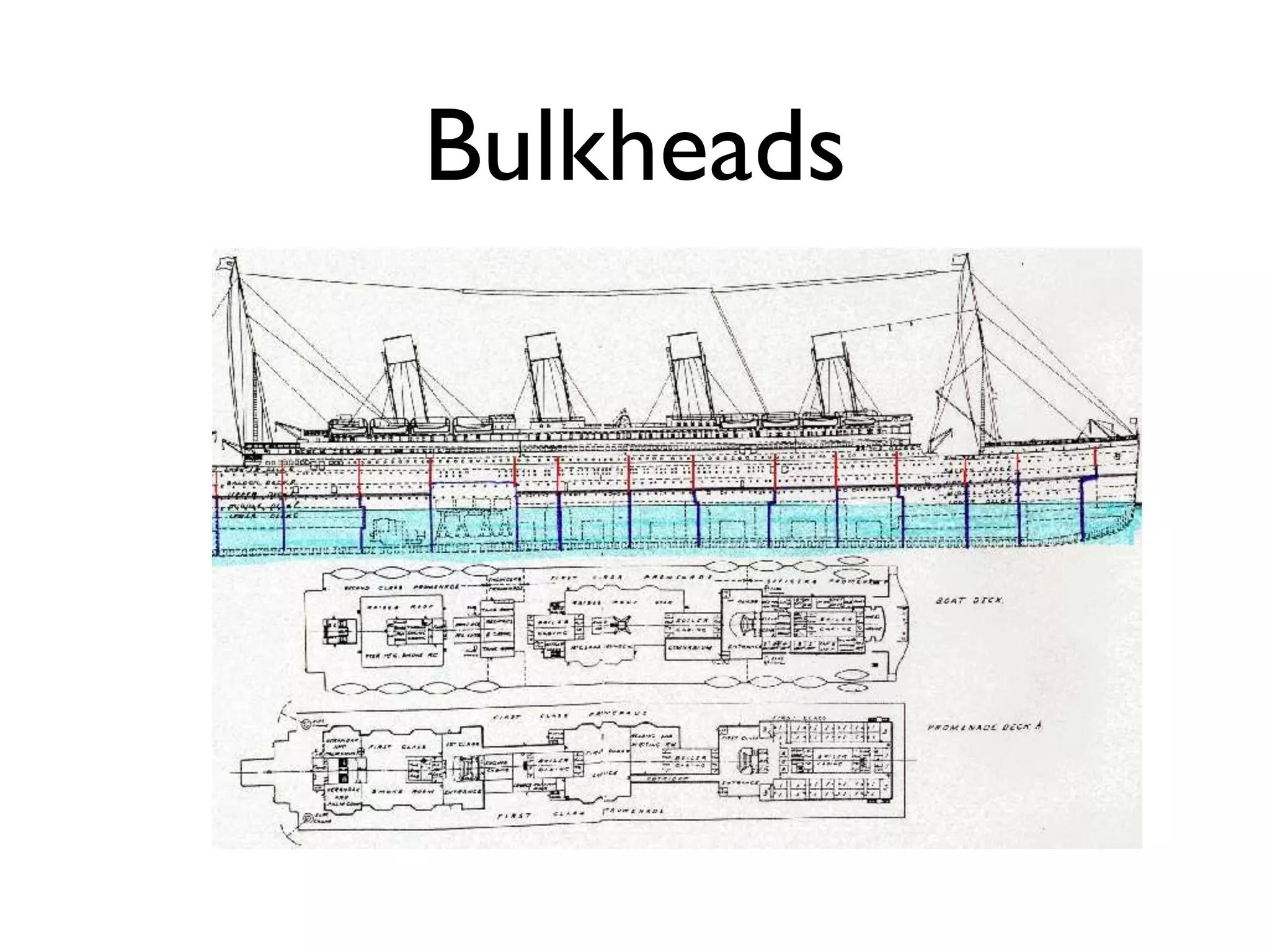
Bulkheads
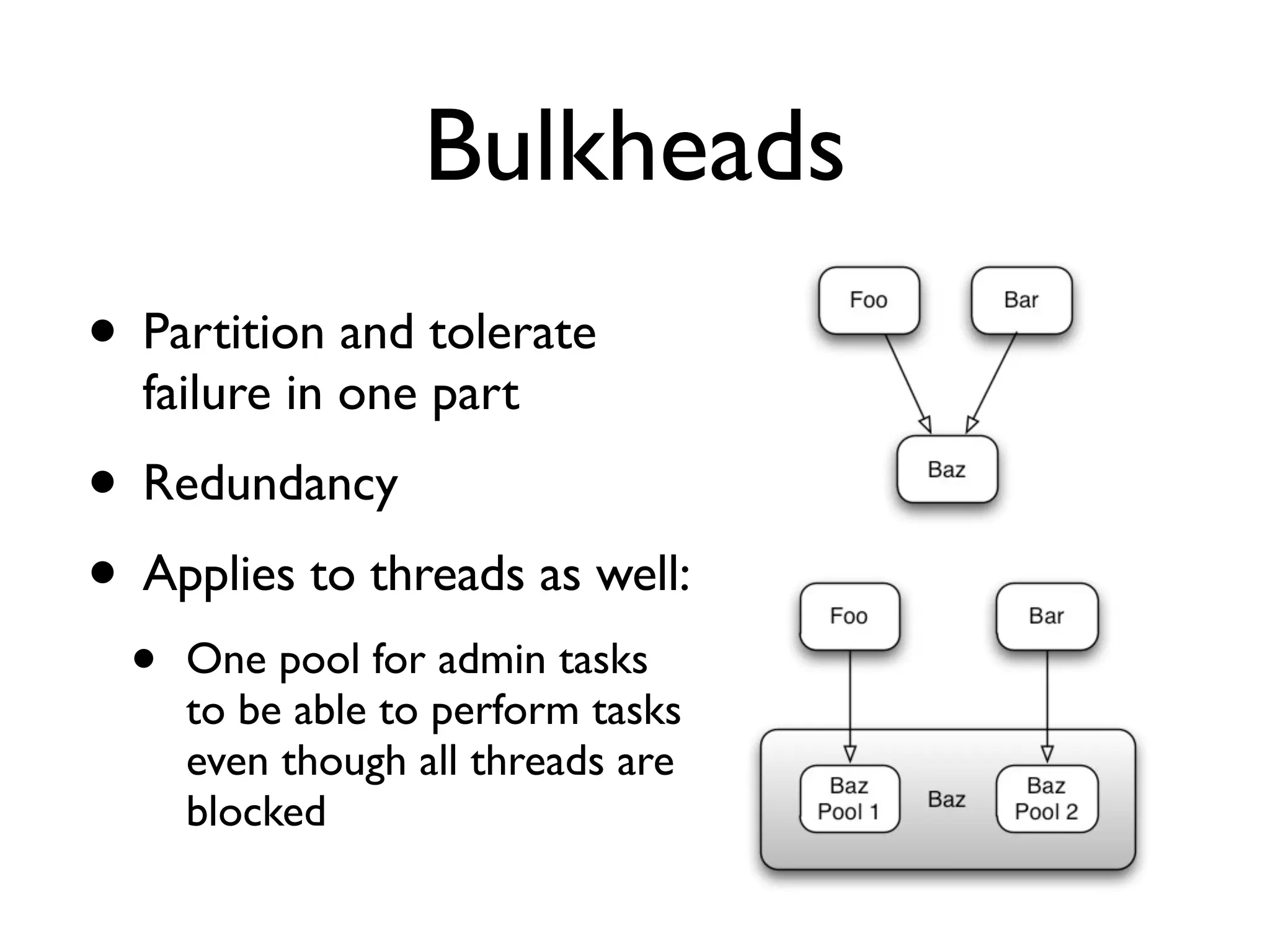
Bulkheads • Partition and tolerate failure in one part • Redundancy • Applies to threads as well: • One pool for admin tasks to be able to perform tasks even though all threads are blocked
Steady State • Clean up after you • Logging: • RollingFileAppender (log4j) • logrotate (Unix) • Scribe - server for aggregating streaming log data • Always put logs on separate disk
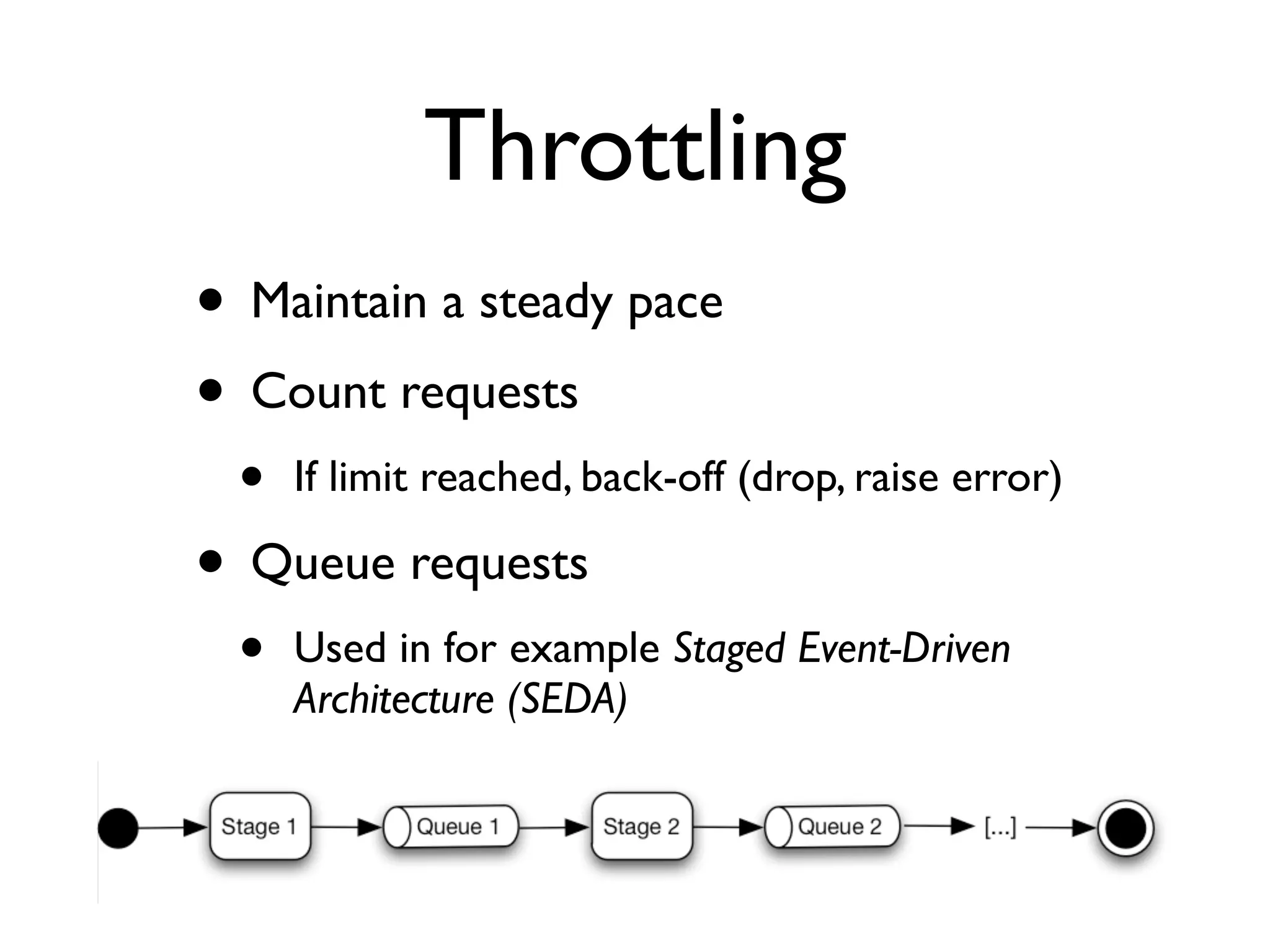
Throttling • Maintain a steady pace • Count requests • If limit reached, back-off (drop, raise error) • Queue requests • Used in for example Staged Event-Driven Architecture (SEDA)
?
thanks for listening
Extra material
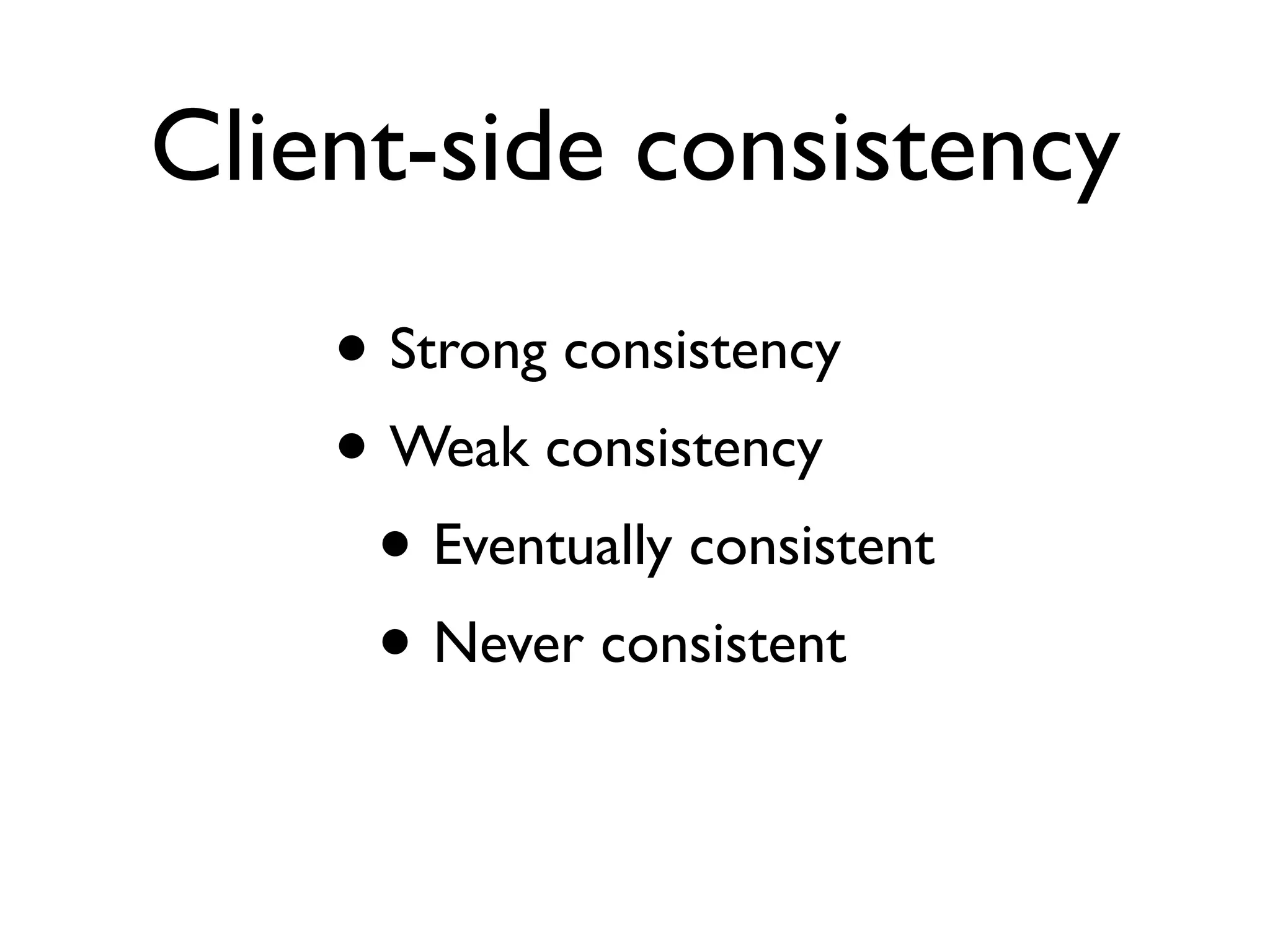
Client-side consistency • Strong consistency • Weak consistency • Eventually consistent • Never consistent
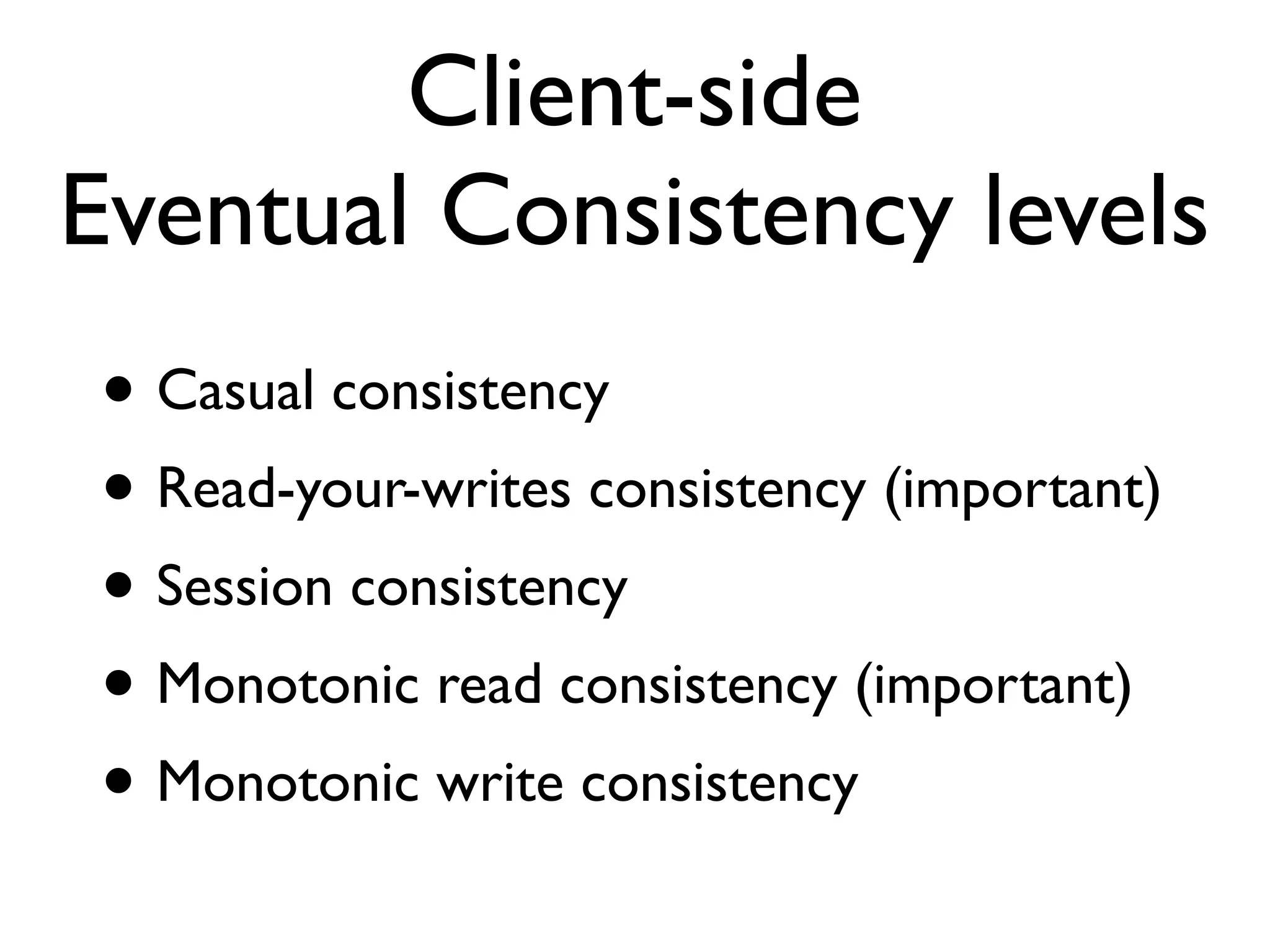
Client-side Eventual Consistency levels • Casual consistency • Read-your-writes consistency (important) • Session consistency • Monotonic read consistency (important) • Monotonic write consistency
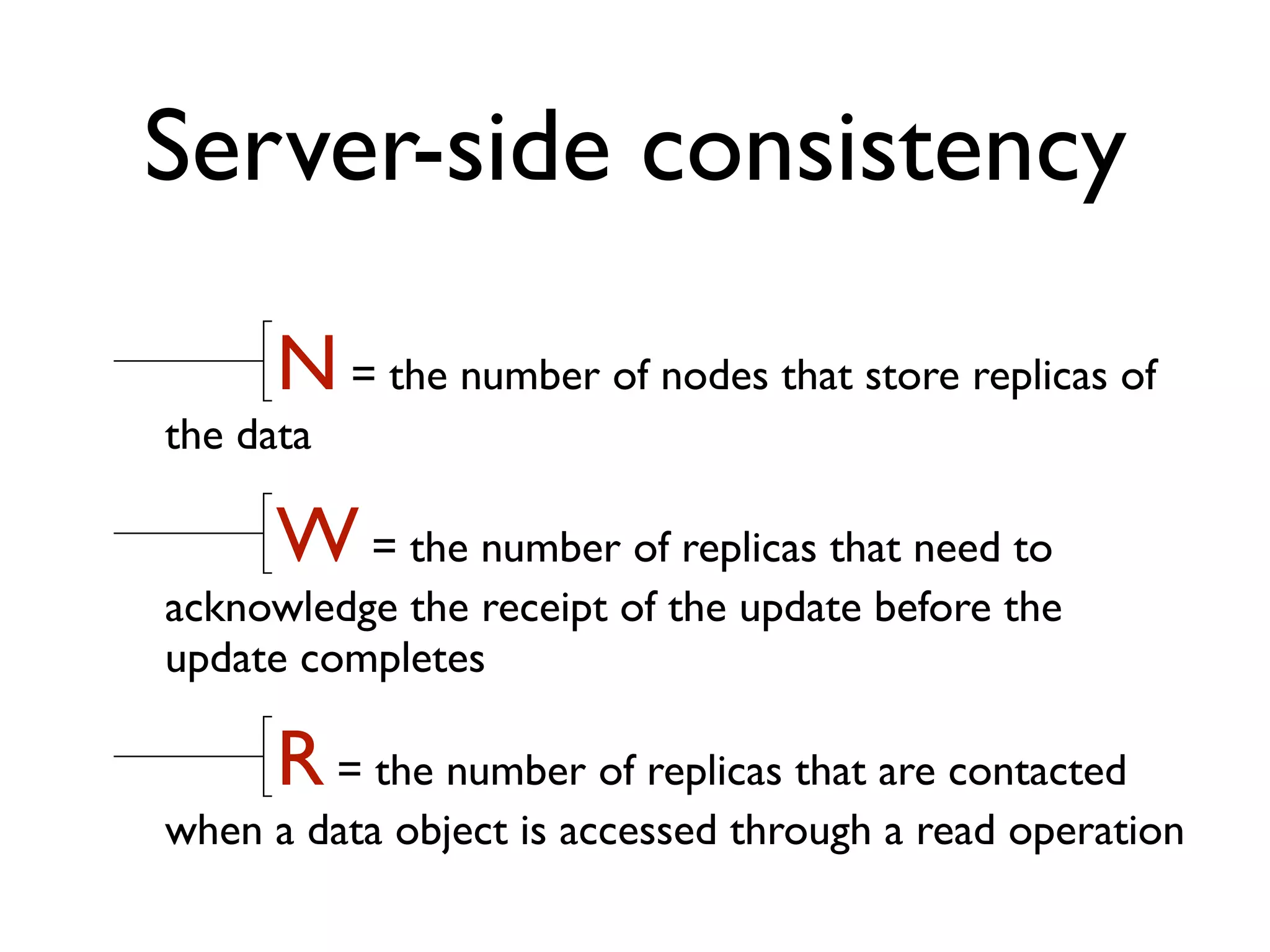
Server-side consistency N = the number of nodes that store replicas of the data W = the number of replicas that need to acknowledge the receipt of the update before the update completes R = the number of replicas that are contacted when a data object is accessed through a read operation
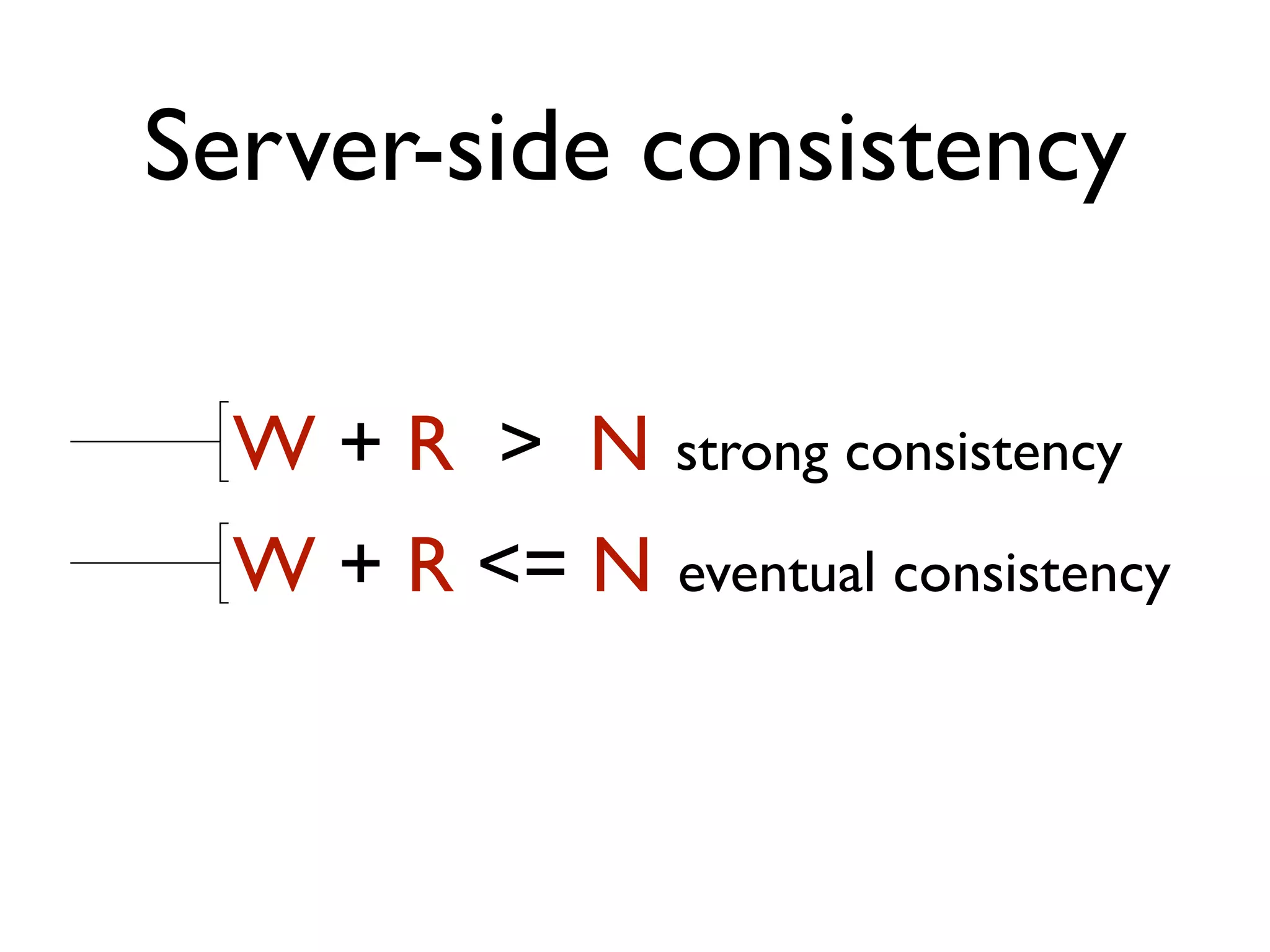
Server-side consistency W + R > N strong consistency W + R <= N eventual consistency

Scalability, Availability & Stability Patterns