D.SHANMUGAPRIYA I- M.Sc(IT) OPERATOR OVERLOADING AND TYPE CONVERSION
OPERATOR OVERLOADING AND TYPE CONVERSION  INTRODUCTION  DEFINING OPERATOR OVERLOADING  OVERLOADING UNARY OPERATORS  OVERLOADI NG BINARY OPERATORS  OVERLOADING BINARY OPERATORS USING FRIENDS  SOME OTHER OPERATOR OVERLOADING EXAMPLES  RULES FOR OVERLOADING OPERATORS  TYPE CONVERSION
INTRODUCTION Operator overloading is one of the many exciting features of the C++ language. Operator overloading provides a flexible option for the creation of new definition for most of the C++ operators. Class member access operator(.,.*) Scope resolution operator(::) Size operator(size of) Conditional operator(?:)
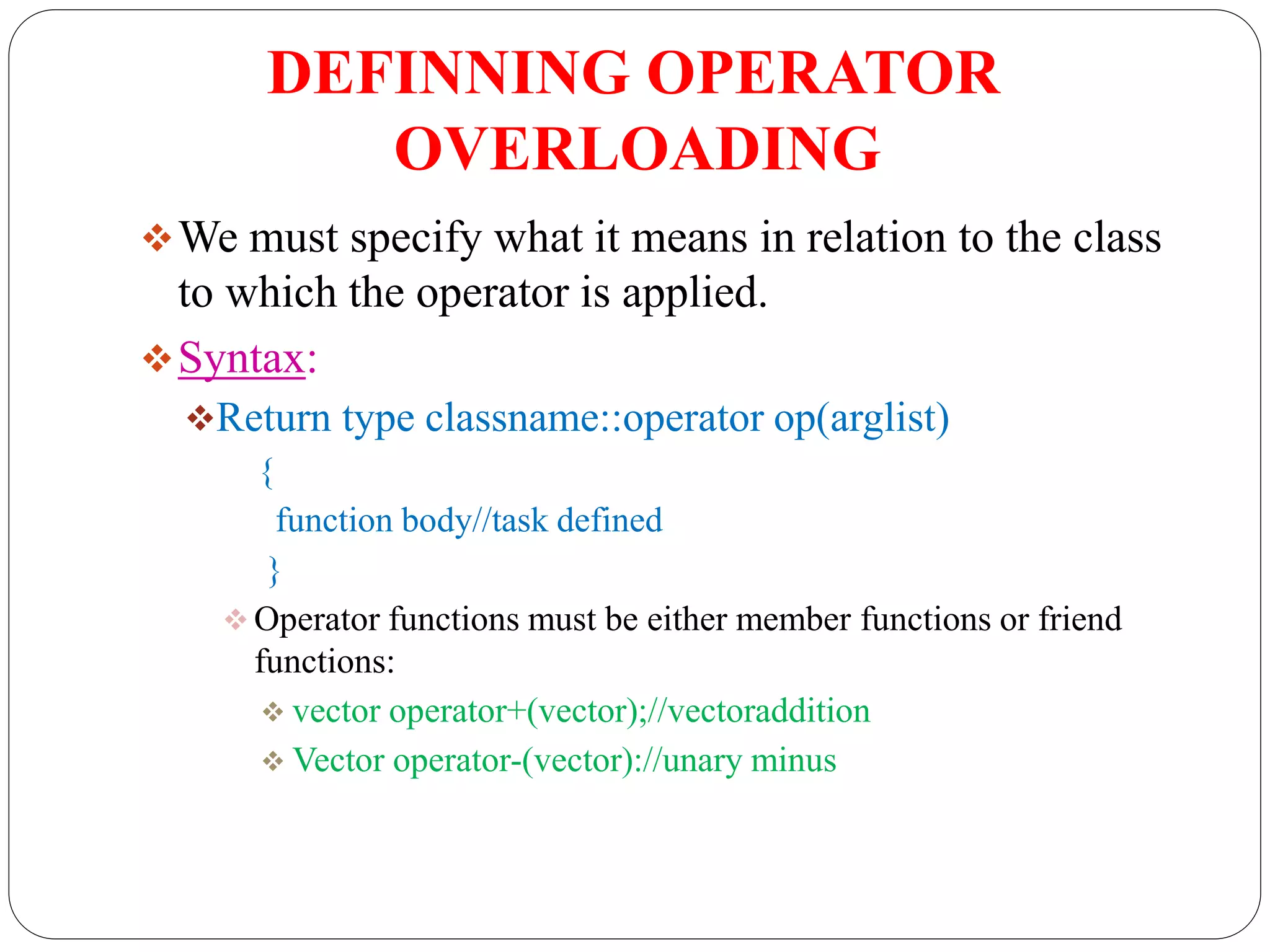
DEFINNING OPERATOR OVERLOADING We must specify what it means in relation to the class to which the operator is applied. Syntax: Return type classname::operator op(arglist) { function body//task defined }  Operator functions must be either member functions or friend functions:  vector operator+(vector);//vectoraddition  Vector operator-(vector)://unary minus
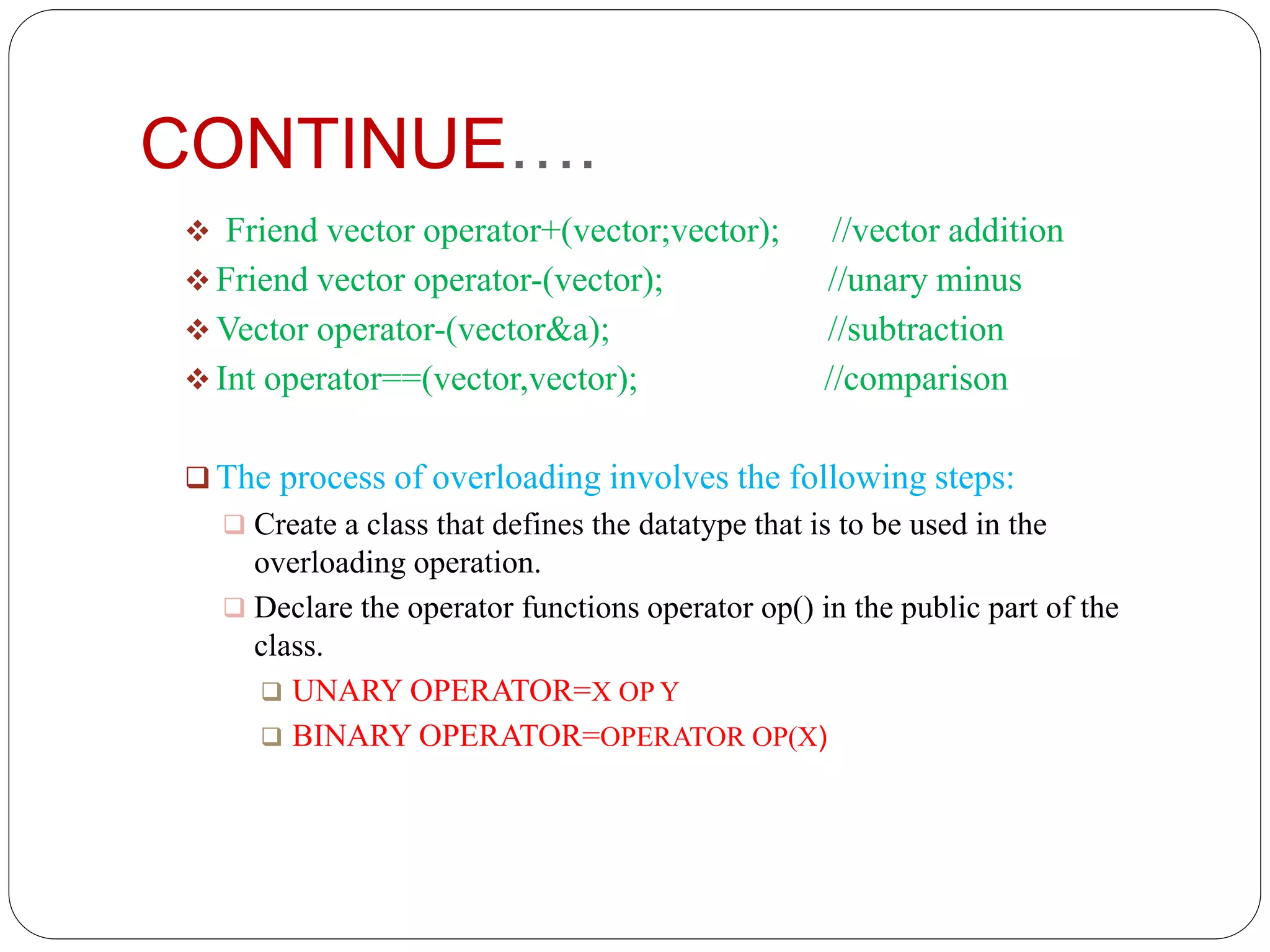
CONTINUE….  Friend vector operator+(vector;vector); //vector addition  Friend vector operator-(vector); //unary minus  Vector operator-(vector&a); //subtraction  Int operator==(vector,vector); //comparison  The process of overloading involves the following steps:  Create a class that defines the datatype that is to be used in the overloading operation.  Declare the operator functions operator op() in the public part of the class.  UNARY OPERATOR=X OP Y  BINARY OPERATOR=OPERATOR OP(X)
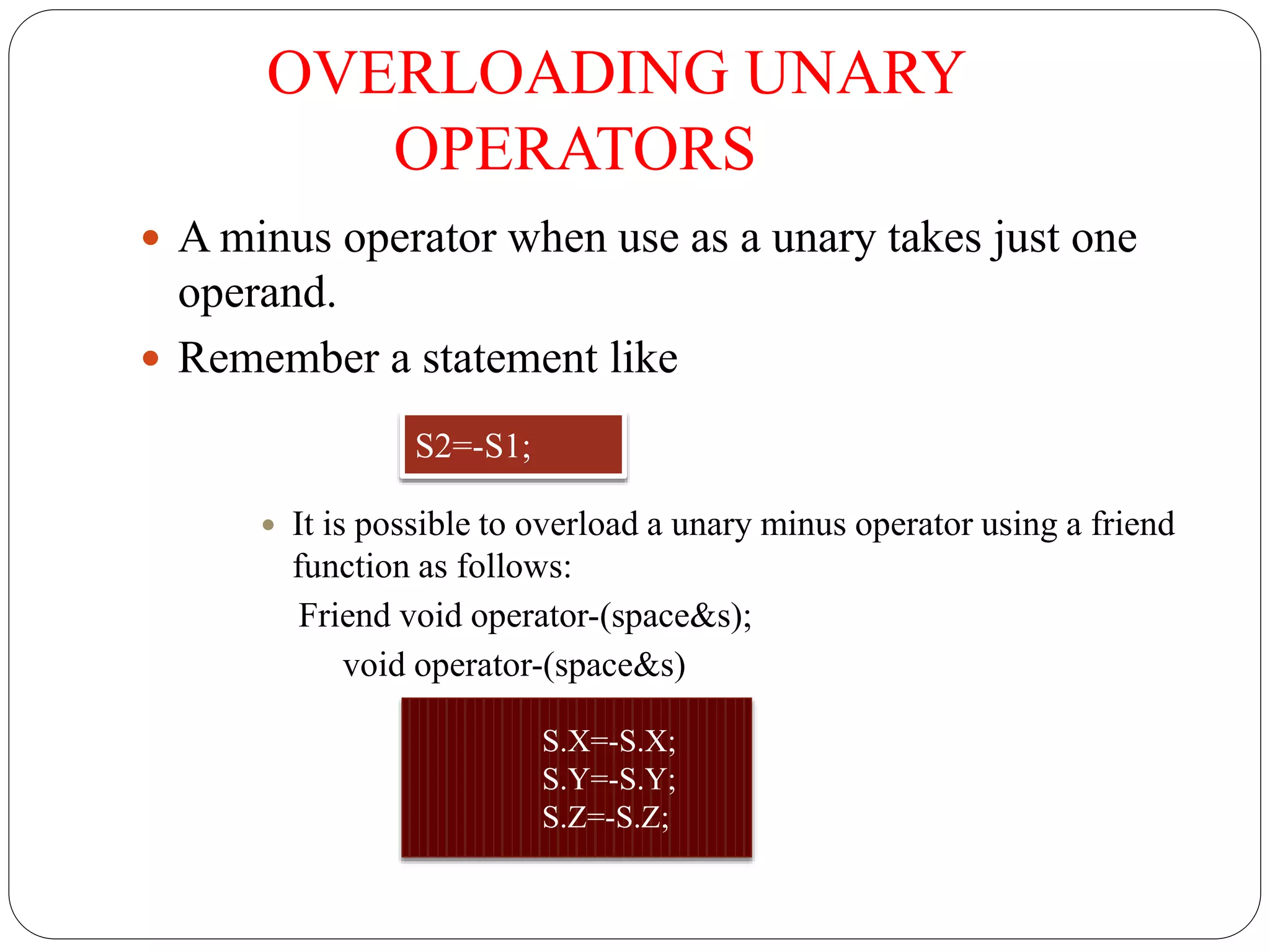
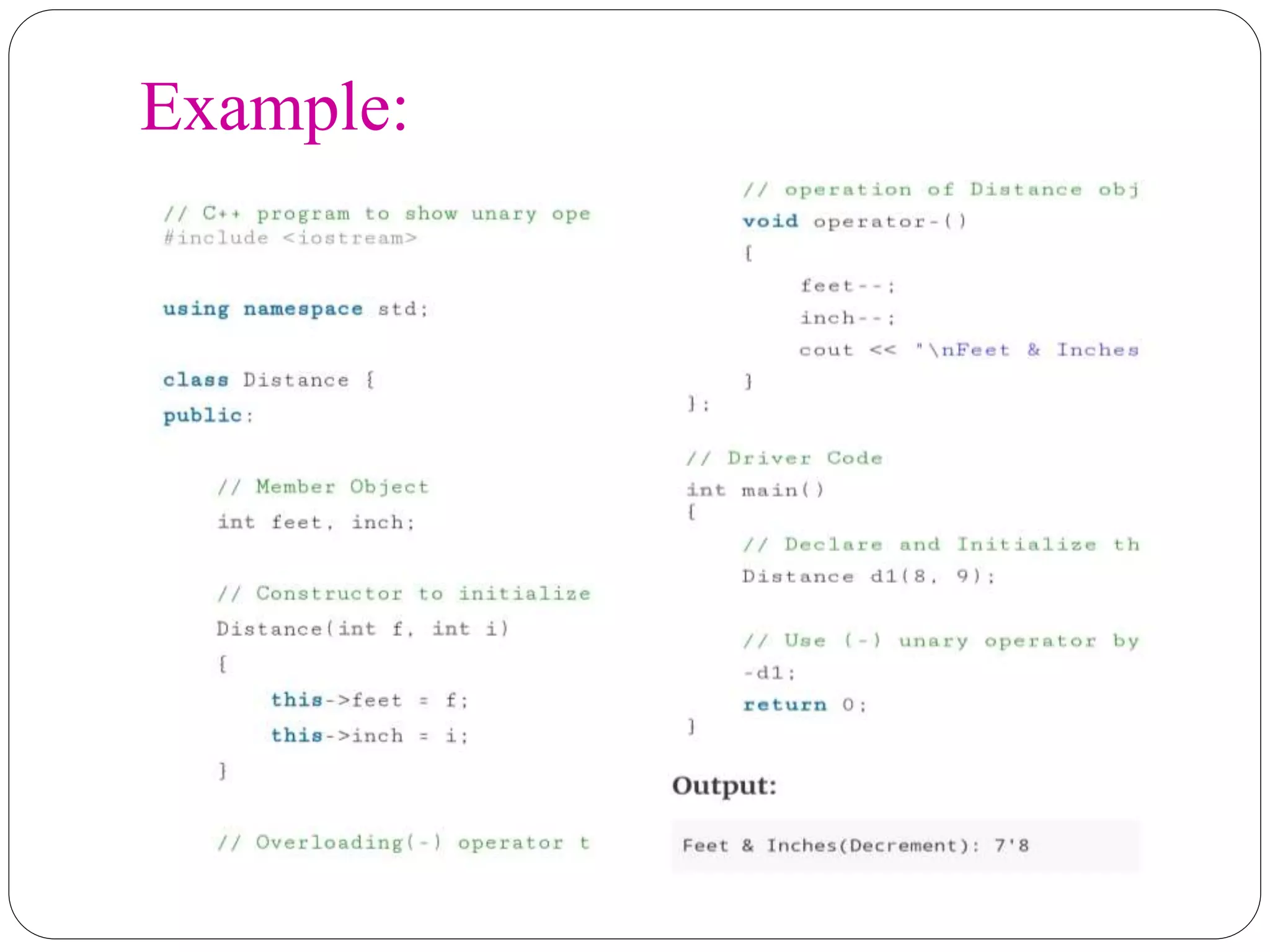
OVERLOADING UNARY OPERATORS  A minus operator when use as a unary takes just one operand.  Remember a statement like  It is possible to overload a unary minus operator using a friend function as follows: Friend void operator-(space&s); void operator-(space&s) S2=-S1; S.X=-S.X; S.Y=-S.Y; S.Z=-S.Z;
Example:
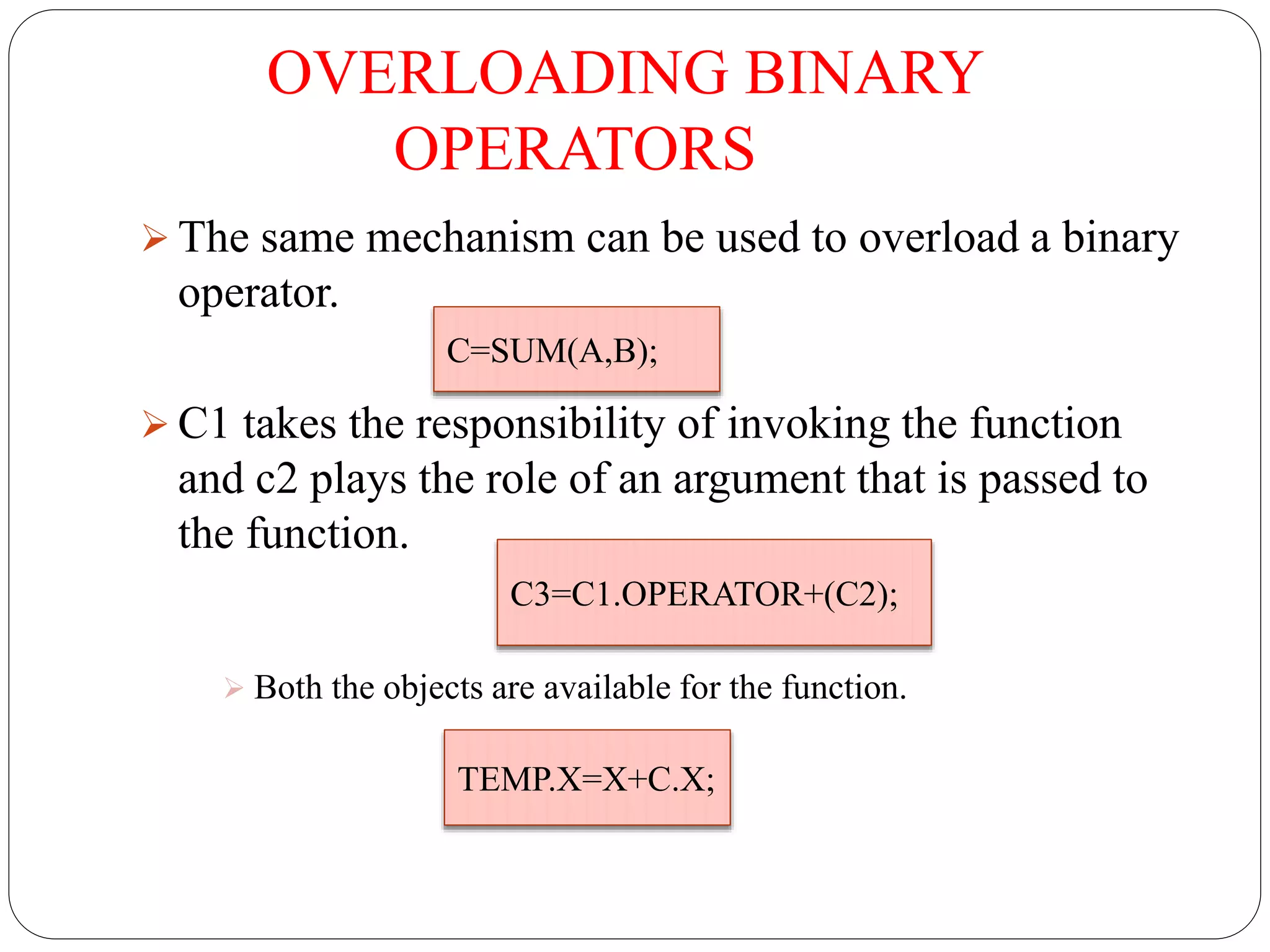
OVERLOADING BINARY OPERATORS  The same mechanism can be used to overload a binary operator.  C1 takes the responsibility of invoking the function and c2 plays the role of an argument that is passed to the function.  Both the objects are available for the function. C=SUM(A,B); C3=C1.OPERATOR+(C2); TEMP.X=X+C.X;
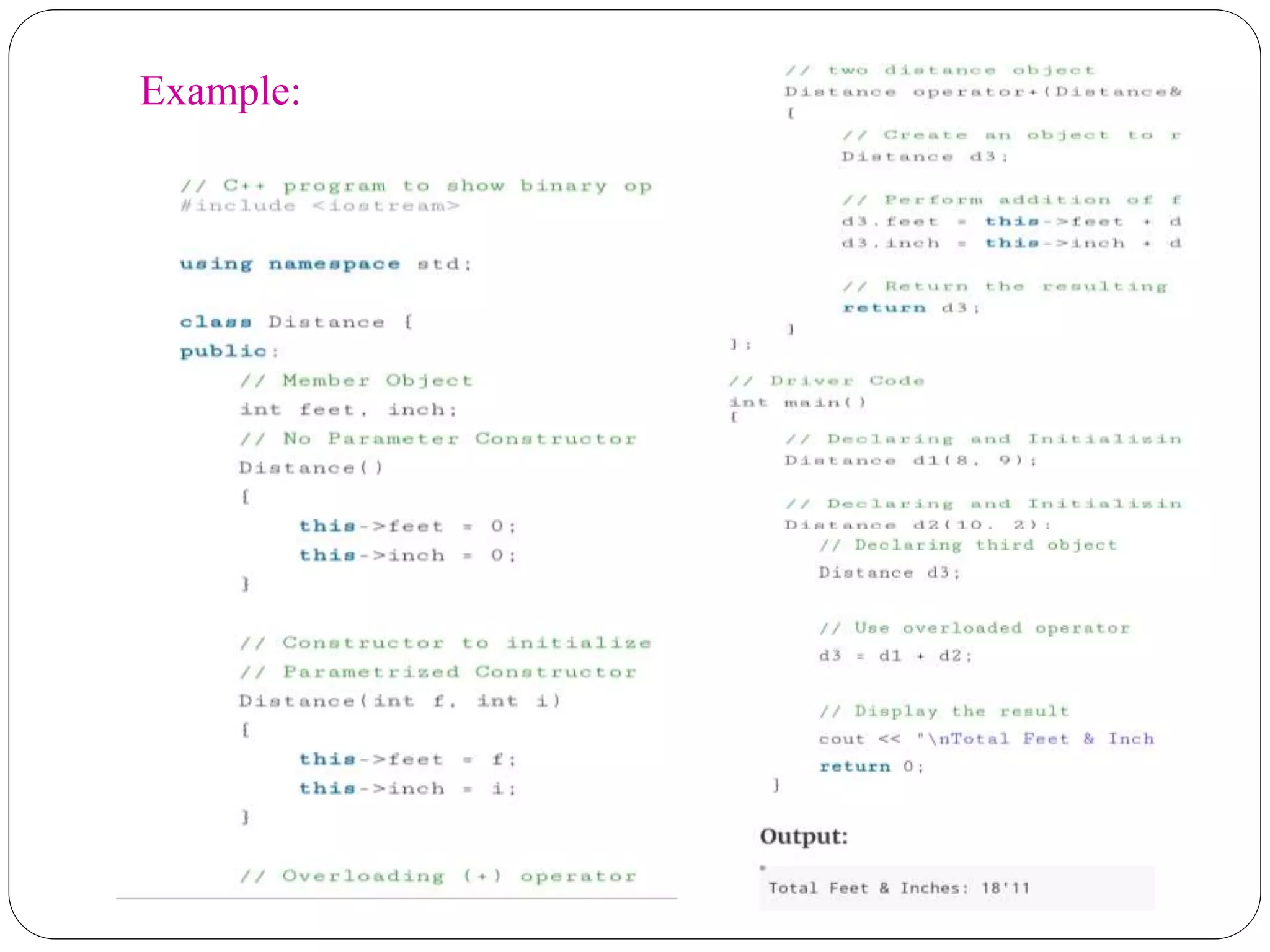
Example:
IMPLEMENTED OF THE OVERLOAD BINARY OPERATOR:
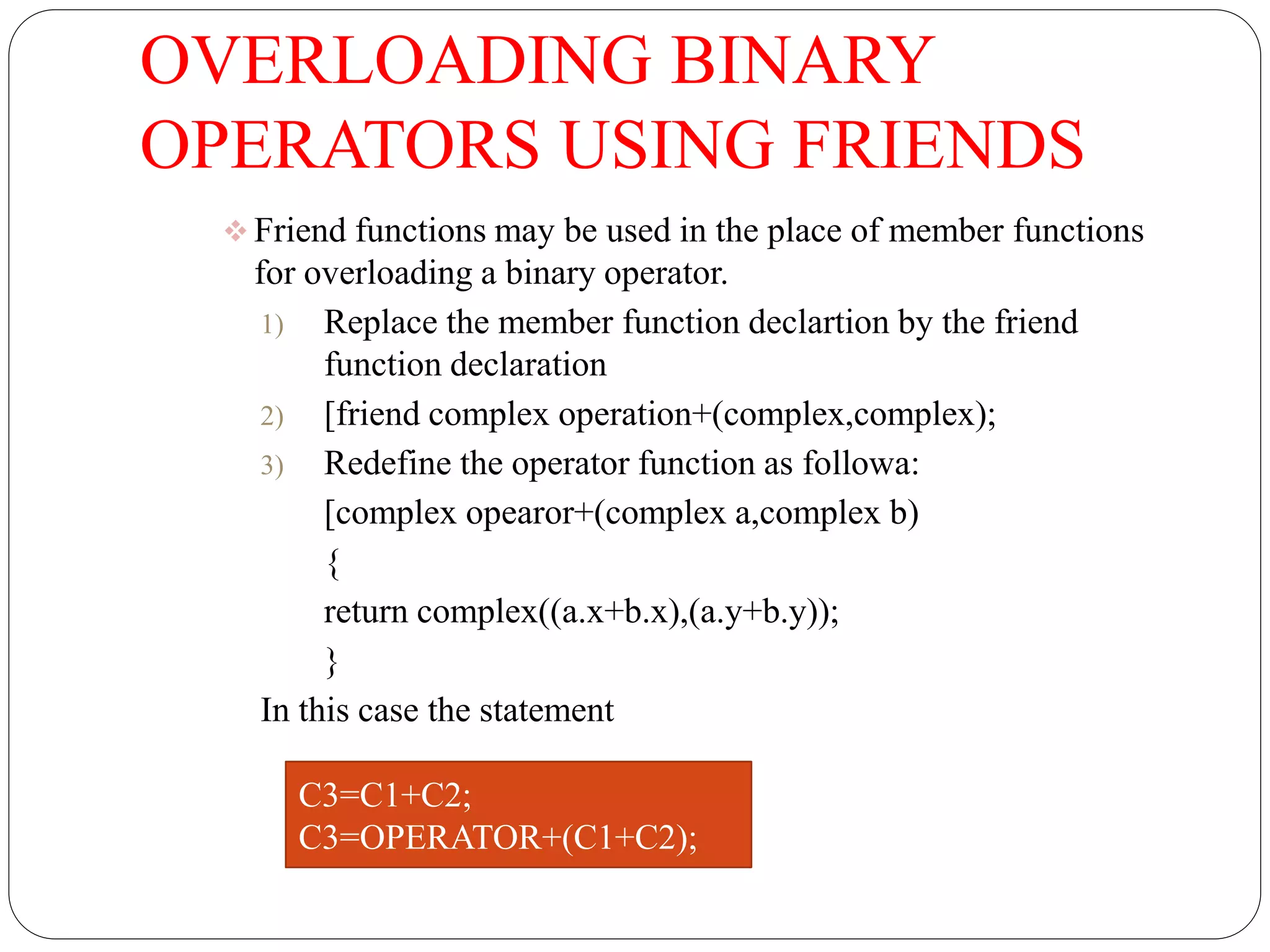
OVERLOADING BINARY OPERATORS USING FRIENDS  Friend functions may be used in the place of member functions for overloading a binary operator. 1) Replace the member function declartion by the friend function declaration 2) [friend complex operation+(complex,complex); 3) Redefine the operator function as followa: [complex opearor+(complex a,complex b) { return complex((a.x+b.x),(a.y+b.y)); } In this case the statement C3=C1+C2; C3=OPERATOR+(C1+C2);
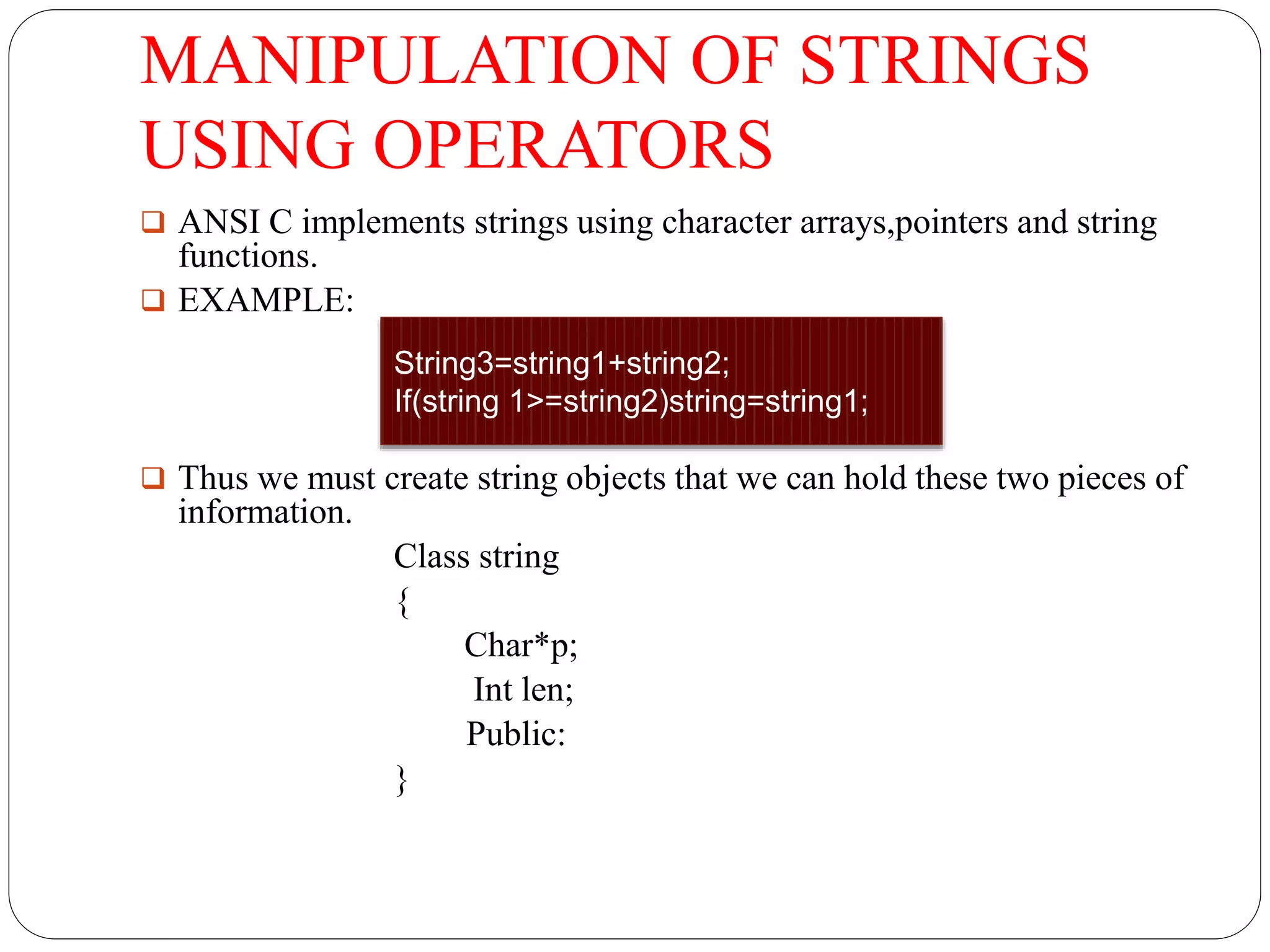
MANIPULATION OF STRINGS USING OPERATORS  ANSI C implements strings using character arrays,pointers and string functions.  EXAMPLE:  Thus we must create string objects that we can hold these two pieces of information. Class string { Char*p; Int len; Public: } String3=string1+string2; If(string 1>=string2)string=string1;
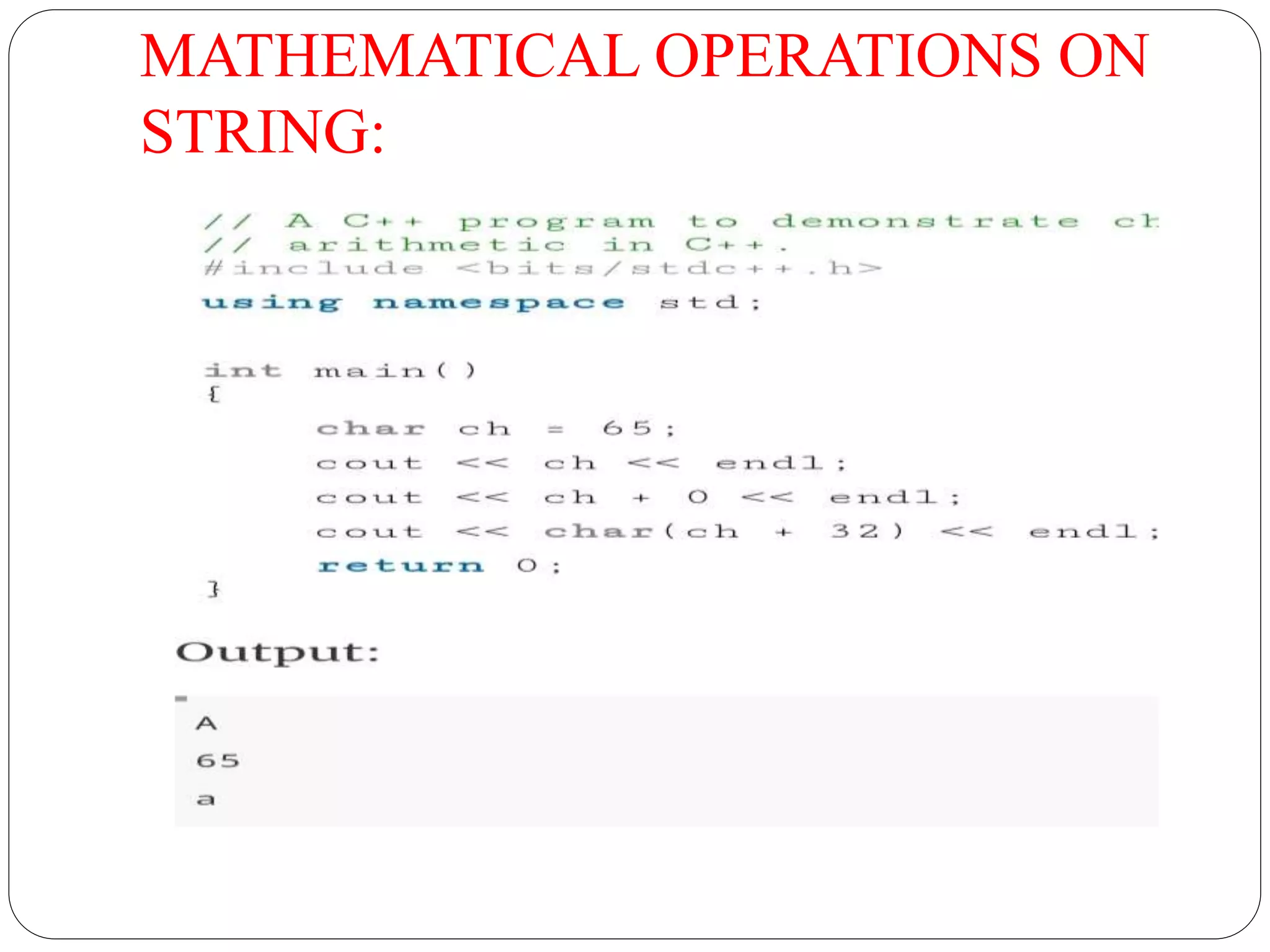
MATHEMATICAL OPERATIONS ON STRING:
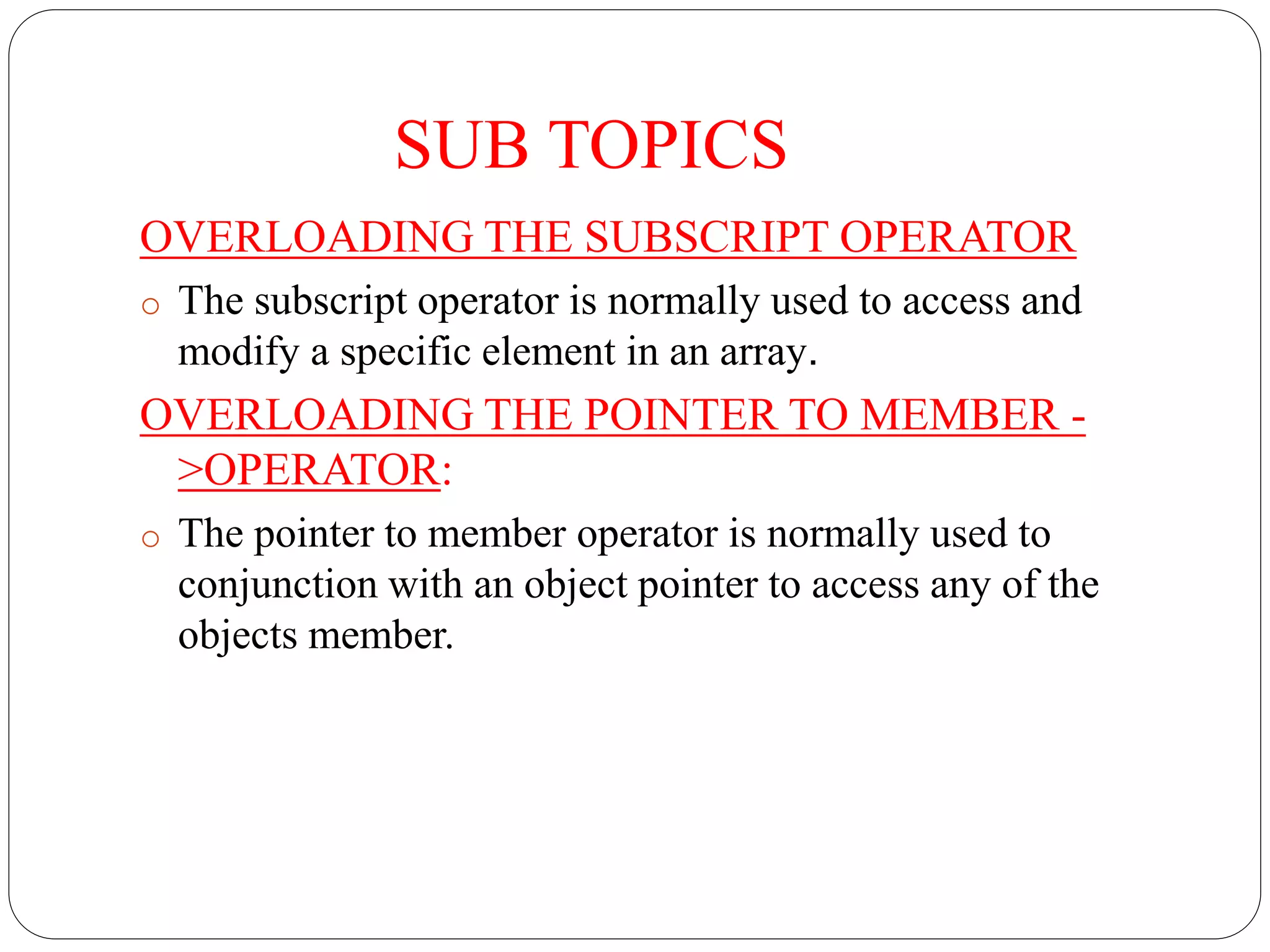
SUB TOPICS OVERLOADING THE SUBSCRIPT OPERATOR o The subscript operator is normally used to access and modify a specific element in an array. OVERLOADING THE POINTER TO MEMBER - >OPERATOR: o The pointer to member operator is normally used to conjunction with an object pointer to access any of the objects member.
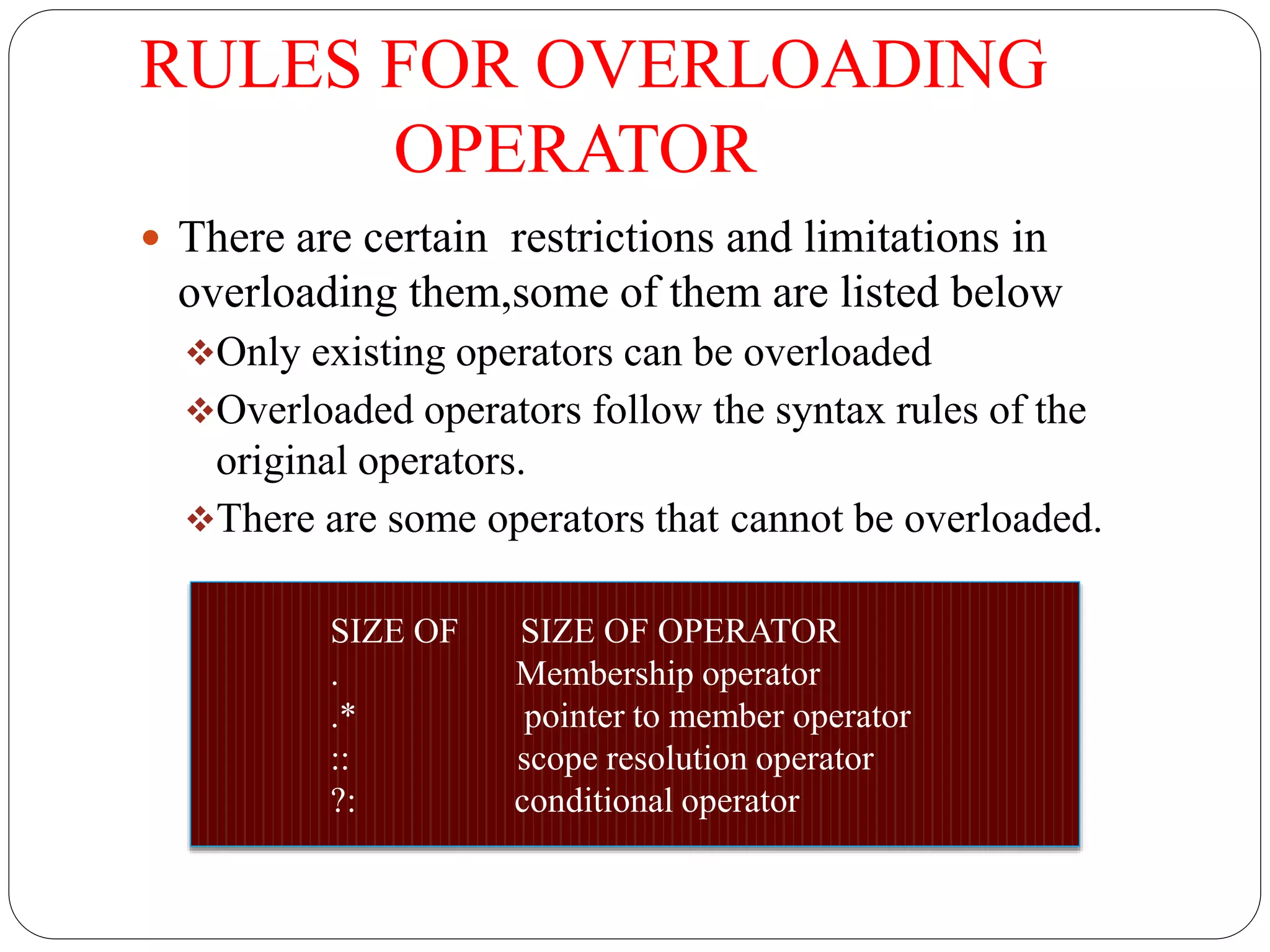
RULES FOR OVERLOADING OPERATOR  There are certain restrictions and limitations in overloading them,some of them are listed below Only existing operators can be overloaded Overloaded operators follow the syntax rules of the original operators. There are some operators that cannot be overloaded. SIZE OF SIZE OF OPERATOR . Membership operator .* pointer to member operator :: scope resolution operator ?: conditional operator
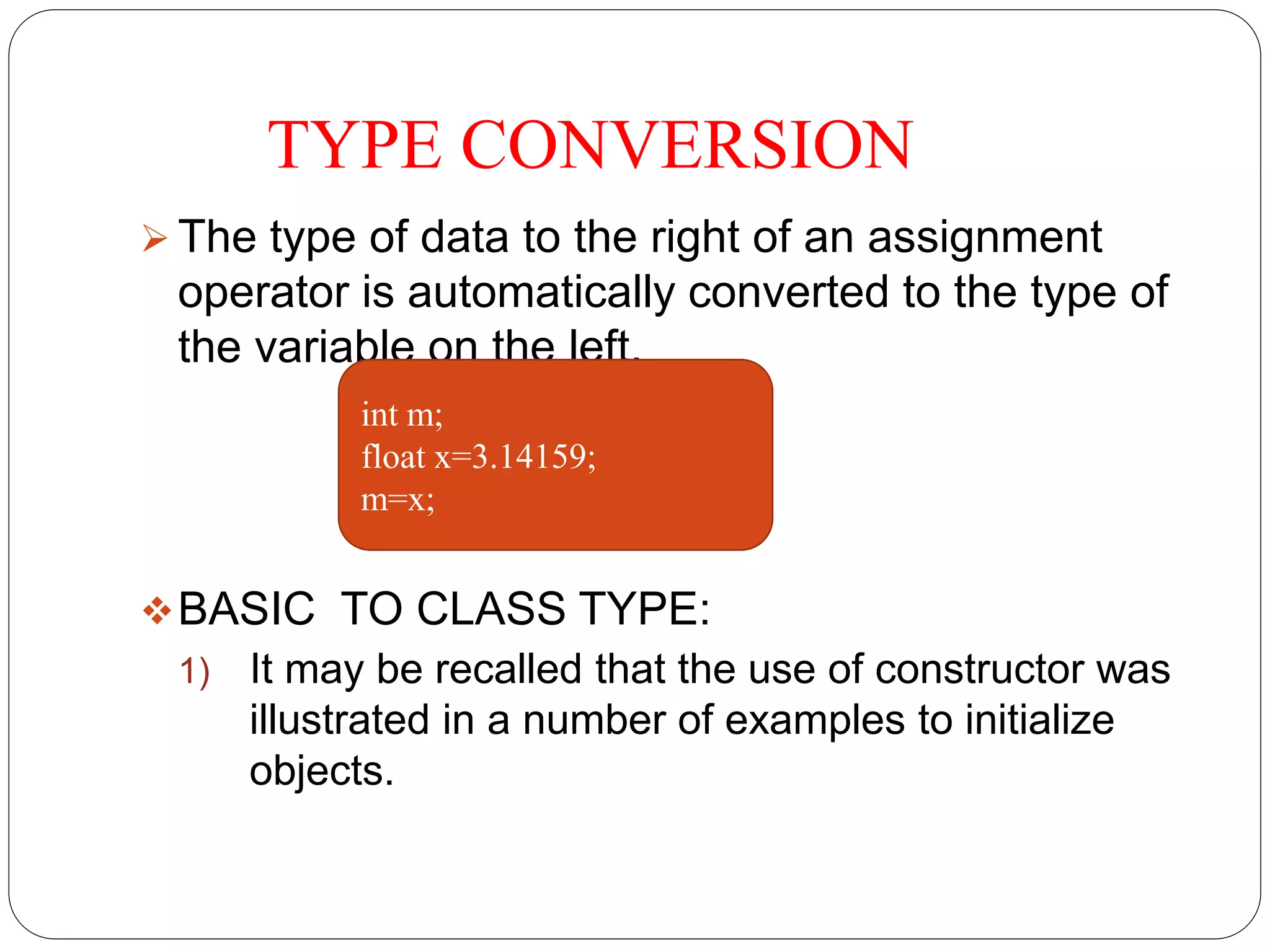
TYPE CONVERSION  The type of data to the right of an assignment operator is automatically converted to the type of the variable on the left. BASIC TO CLASS TYPE: 1) It may be recalled that the use of constructor was illustrated in a number of examples to initialize objects. int m; float x=3.14159; m=x;
Continue…  Following constructor: string::string(char*a) { length=strlength(a); p=new char[length+1]; strcpy(p,a); } The statement s1=string(name 1); First converts name1 from char* type and then values the assign the strings type values to the objects S1 S2=Name 2;
T H A N K y O U

Operator overloading and type conversion in cpp

  • 1.
  • 2.
    OPERATOR OVERLOADING AND TYPECONVERSION  INTRODUCTION  DEFINING OPERATOR OVERLOADING  OVERLOADING UNARY OPERATORS  OVERLOADI NG BINARY OPERATORS  OVERLOADING BINARY OPERATORS USING FRIENDS  SOME OTHER OPERATOR OVERLOADING EXAMPLES  RULES FOR OVERLOADING OPERATORS  TYPE CONVERSION
  • 3.
    INTRODUCTION Operator overloading isone of the many exciting features of the C++ language. Operator overloading provides a flexible option for the creation of new definition for most of the C++ operators. Class member access operator(.,.*) Scope resolution operator(::) Size operator(size of) Conditional operator(?:)
  • 4.
    DEFINNING OPERATOR OVERLOADING We mustspecify what it means in relation to the class to which the operator is applied. Syntax: Return type classname::operator op(arglist) { function body//task defined }  Operator functions must be either member functions or friend functions:  vector operator+(vector);//vectoraddition  Vector operator-(vector)://unary minus
  • 5.
    CONTINUE….  Friend vectoroperator+(vector;vector); //vector addition  Friend vector operator-(vector); //unary minus  Vector operator-(vector&a); //subtraction  Int operator==(vector,vector); //comparison  The process of overloading involves the following steps:  Create a class that defines the datatype that is to be used in the overloading operation.  Declare the operator functions operator op() in the public part of the class.  UNARY OPERATOR=X OP Y  BINARY OPERATOR=OPERATOR OP(X)
  • 6.
    OVERLOADING UNARY OPERATORS  Aminus operator when use as a unary takes just one operand.  Remember a statement like  It is possible to overload a unary minus operator using a friend function as follows: Friend void operator-(space&s); void operator-(space&s) S2=-S1; S.X=-S.X; S.Y=-S.Y; S.Z=-S.Z;
  • 7.
  • 8.
    OVERLOADING BINARY OPERATORS  Thesame mechanism can be used to overload a binary operator.  C1 takes the responsibility of invoking the function and c2 plays the role of an argument that is passed to the function.  Both the objects are available for the function. C=SUM(A,B); C3=C1.OPERATOR+(C2); TEMP.X=X+C.X;
  • 9.
  • 10.
    IMPLEMENTED OF THEOVERLOAD BINARY OPERATOR:
  • 11.
    OVERLOADING BINARY OPERATORS USINGFRIENDS  Friend functions may be used in the place of member functions for overloading a binary operator. 1) Replace the member function declartion by the friend function declaration 2) [friend complex operation+(complex,complex); 3) Redefine the operator function as followa: [complex opearor+(complex a,complex b) { return complex((a.x+b.x),(a.y+b.y)); } In this case the statement C3=C1+C2; C3=OPERATOR+(C1+C2);
  • 12.
    MANIPULATION OF STRINGS USINGOPERATORS  ANSI C implements strings using character arrays,pointers and string functions.  EXAMPLE:  Thus we must create string objects that we can hold these two pieces of information. Class string { Char*p; Int len; Public: } String3=string1+string2; If(string 1>=string2)string=string1;
  • 13.
  • 14.
    SUB TOPICS OVERLOADING THESUBSCRIPT OPERATOR o The subscript operator is normally used to access and modify a specific element in an array. OVERLOADING THE POINTER TO MEMBER - >OPERATOR: o The pointer to member operator is normally used to conjunction with an object pointer to access any of the objects member.
  • 15.
    RULES FOR OVERLOADING OPERATOR There are certain restrictions and limitations in overloading them,some of them are listed below Only existing operators can be overloaded Overloaded operators follow the syntax rules of the original operators. There are some operators that cannot be overloaded. SIZE OF SIZE OF OPERATOR . Membership operator .* pointer to member operator :: scope resolution operator ?: conditional operator
  • 16.
    TYPE CONVERSION  Thetype of data to the right of an assignment operator is automatically converted to the type of the variable on the left. BASIC TO CLASS TYPE: 1) It may be recalled that the use of constructor was illustrated in a number of examples to initialize objects. int m; float x=3.14159; m=x;
  • 17.
    Continue…  Following constructor: string::string(char*a) { length=strlength(a); p=newchar[length+1]; strcpy(p,a); } The statement s1=string(name 1); First converts name1 from char* type and then values the assign the strings type values to the objects S1 S2=Name 2;
  • 18.