
HPC Python Tutorial: Introduction to MPI4Py 4/23/2012 Instructor: Yaakoub El Khamra, Research Associate, TACC yaakoub@tacc.utexas.edu
What is MPI • Message Passing Interface • Most useful on distributed memory machines • Many implementations, interfaces in C/C++/Fortran • Why python? – Great for prototyping – Small to medium codes • Can I use it for production? – Yes, if the communication is not very frequent and performance is not the primary concern 2
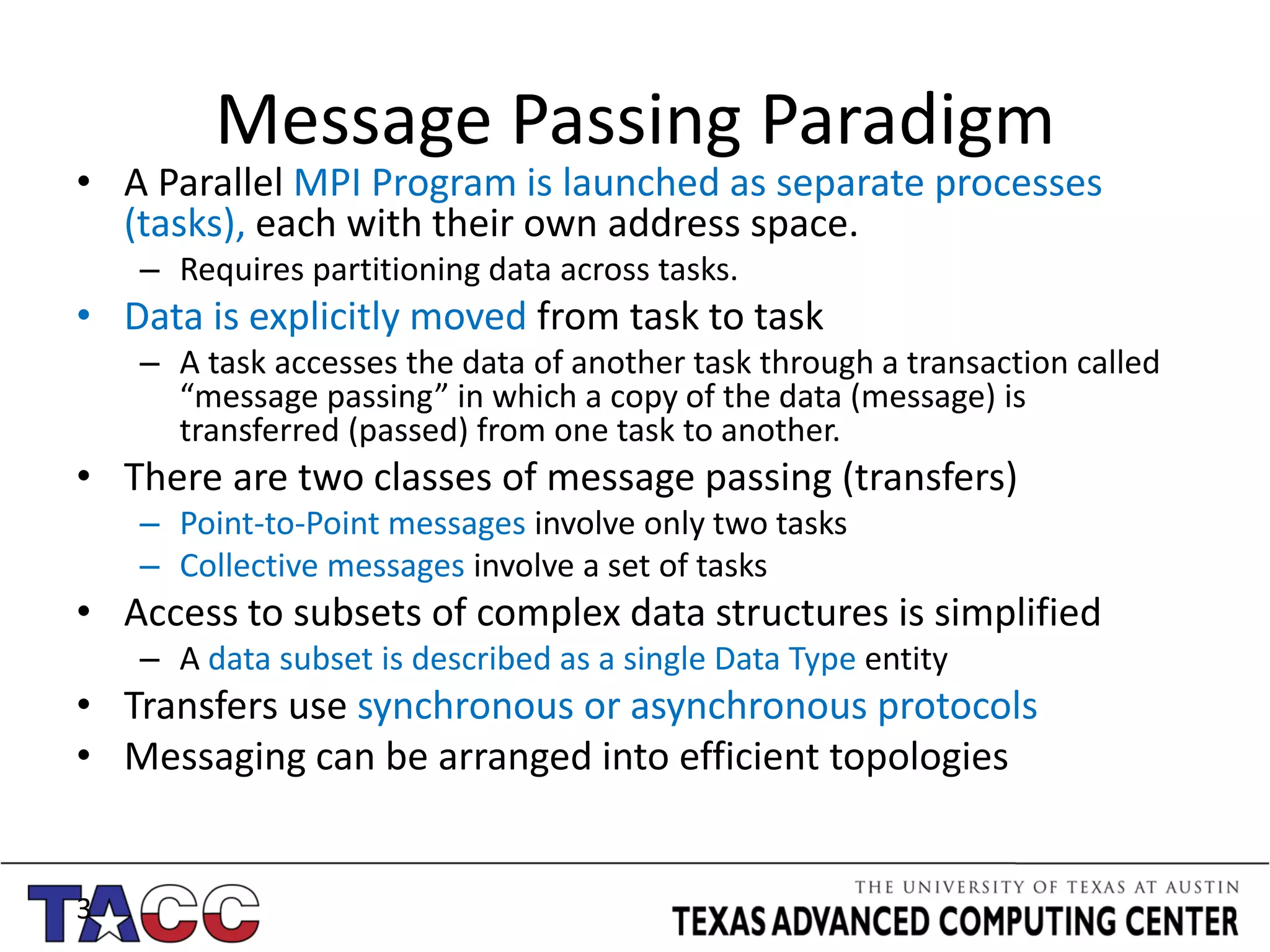
Message Passing Paradigm • A Parallel MPI Program is launched as separate processes (tasks), each with their own address space. – Requires partitioning data across tasks. • Data is explicitly moved from task to task – A task accesses the data of another task through a transaction called “message passing” in which a copy of the data (message) is transferred (passed) from one task to another. • There are two classes of message passing (transfers) – Point-to-Point messages involve only two tasks – Collective messages involve a set of tasks • Access to subsets of complex data structures is simplified – A data subset is described as a single Data Type entity • Transfers use synchronous or asynchronous protocols • Messaging can be arranged into efficient topologies 3
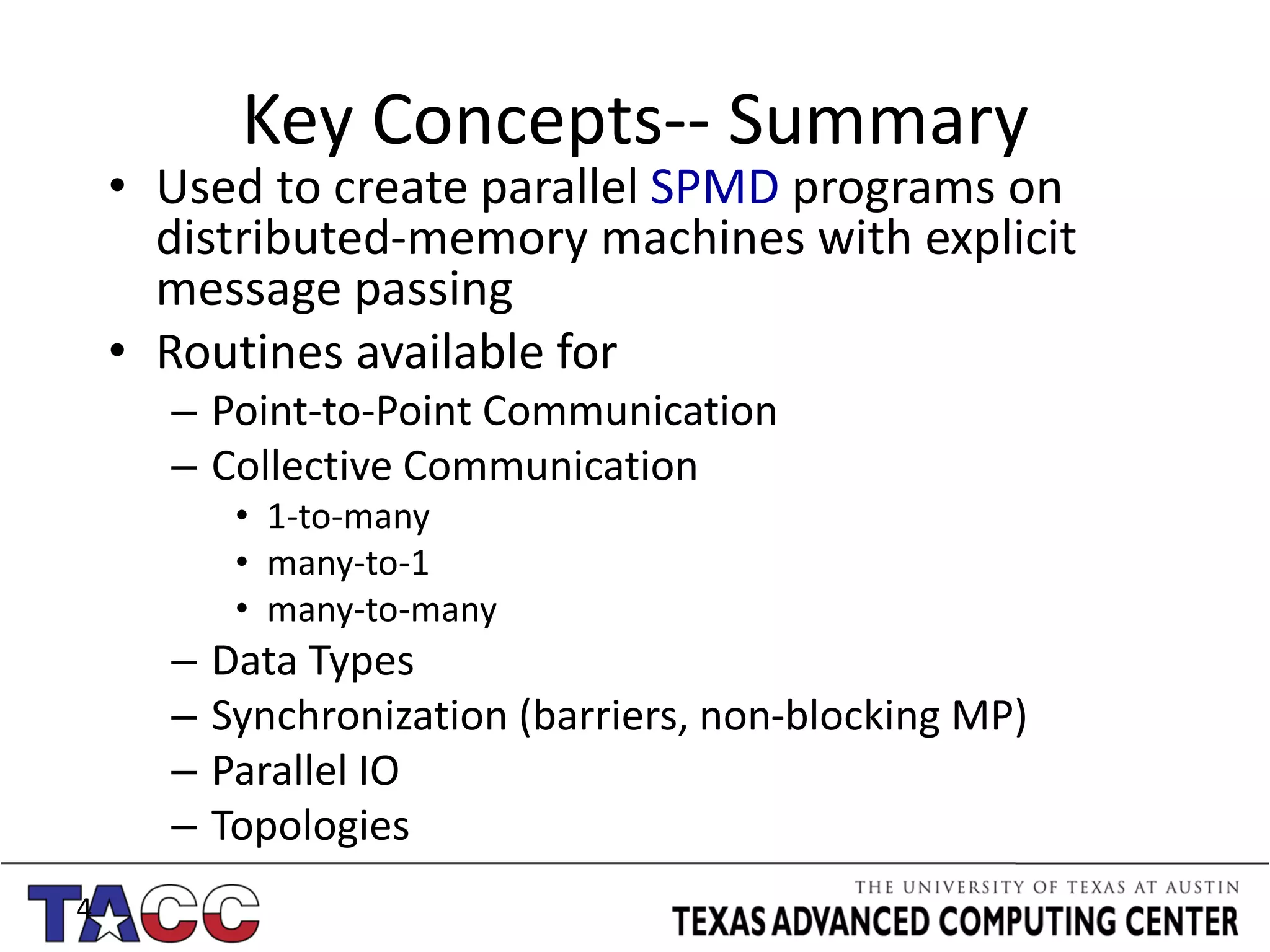
Key Concepts-- Summary • Used to create parallel SPMD programs on distributed-memory machines with explicit message passing • Routines available for – Point-to-Point Communication – Collective Communication • 1-to-many • many-to-1 • many-to-many – Data Types – Synchronization (barriers, non-blocking MP) – Parallel IO – Topologies 4
Advantages of Message Passing • Universality – Message passing model works on separate processors connected by any network (and even on shared memory systems) – matches the hardware of most of today’s parallel supercomputers as well as ad hoc networks of computers • Performance/Scalability – Scalability is the most compelling reason why message passing will remain a permanent component of HPC (High Performance Computing) – As modern systems increase core counts, management of the memory hierarchy (including distributed memory) is the key to extracting the highest performance – Each message passing process only directly uses its local data, avoiding complexities of process-shared data, and allowing compilers and cache management hardware to function without contention. 5
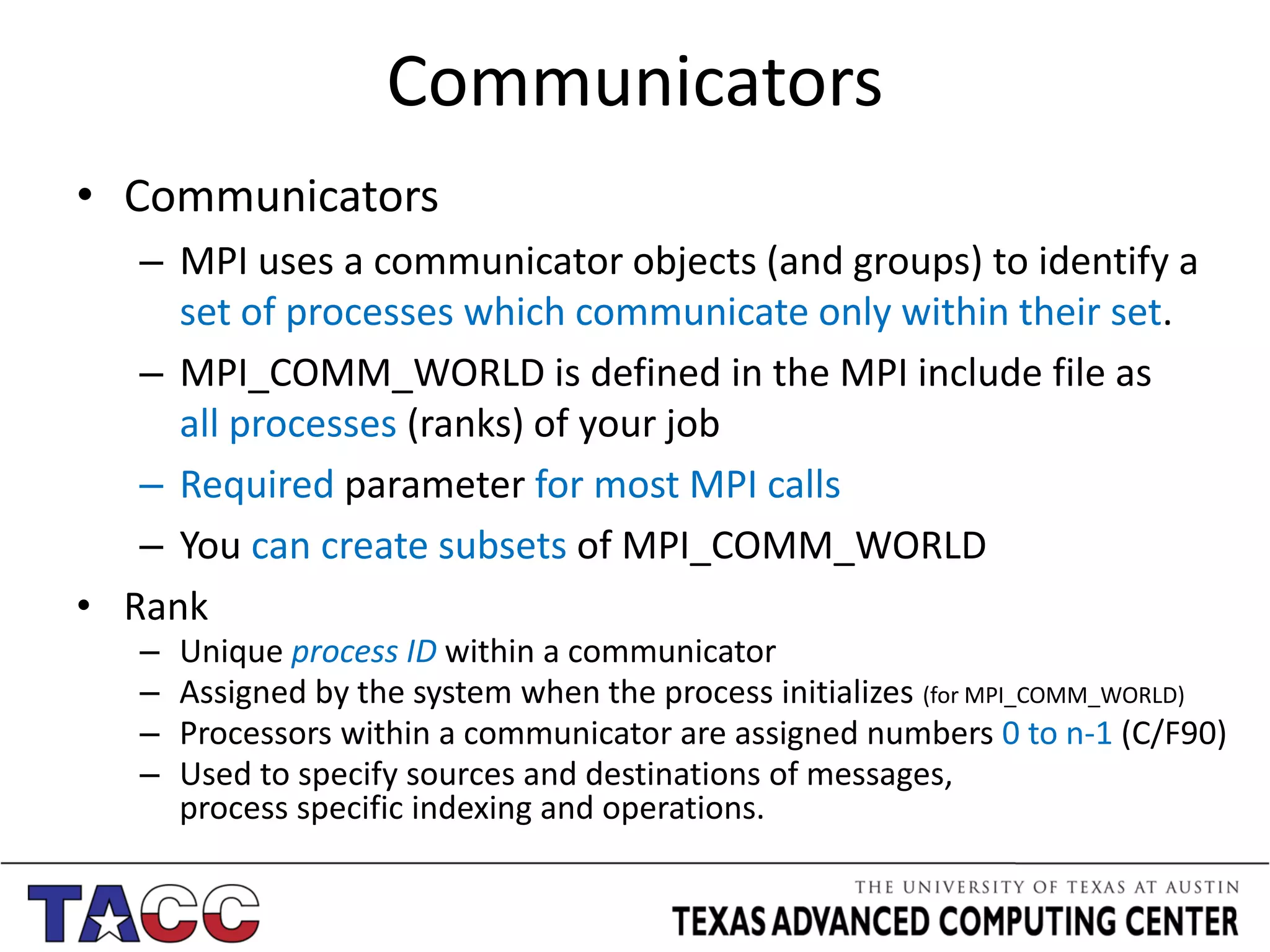
Communicators • Communicators – MPI uses a communicator objects (and groups) to identify a set of processes which communicate only within their set. – MPI_COMM_WORLD is defined in the MPI include file as all processes (ranks) of your job – Required parameter for most MPI calls – You can create subsets of MPI_COMM_WORLD • Rank – Unique process ID within a communicator – Assigned by the system when the process initializes (for MPI_COMM_WORLD) – Processors within a communicator are assigned numbers 0 to n-1 (C/F90) – Used to specify sources and destinations of messages, process specific indexing and operations.
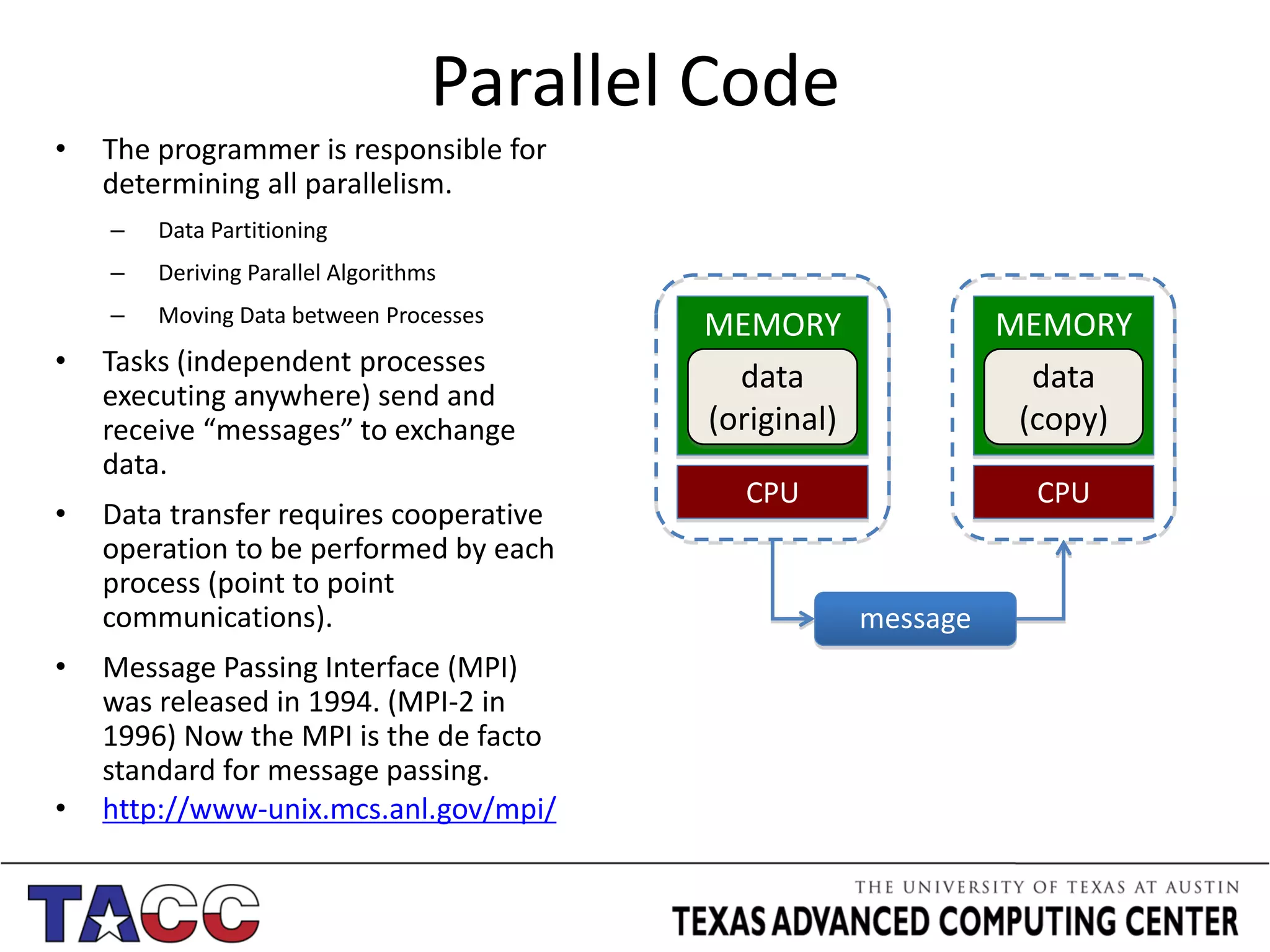
Parallel Code • The programmer is responsible for determining all parallelism. – Data Partitioning – Deriving Parallel Algorithms – Moving Data between Processes MEMORY MEMORY • Tasks (independent processes data data data data executing anywhere) send and receive “messages” to exchange (original) (copy) data. CPU CPU • Data transfer requires cooperative operation to be performed by each process (point to point communications). message • Message Passing Interface (MPI) was released in 1994. (MPI-2 in 1996) Now the MPI is the de facto standard for message passing. • http://www-unix.mcs.anl.gov/mpi/
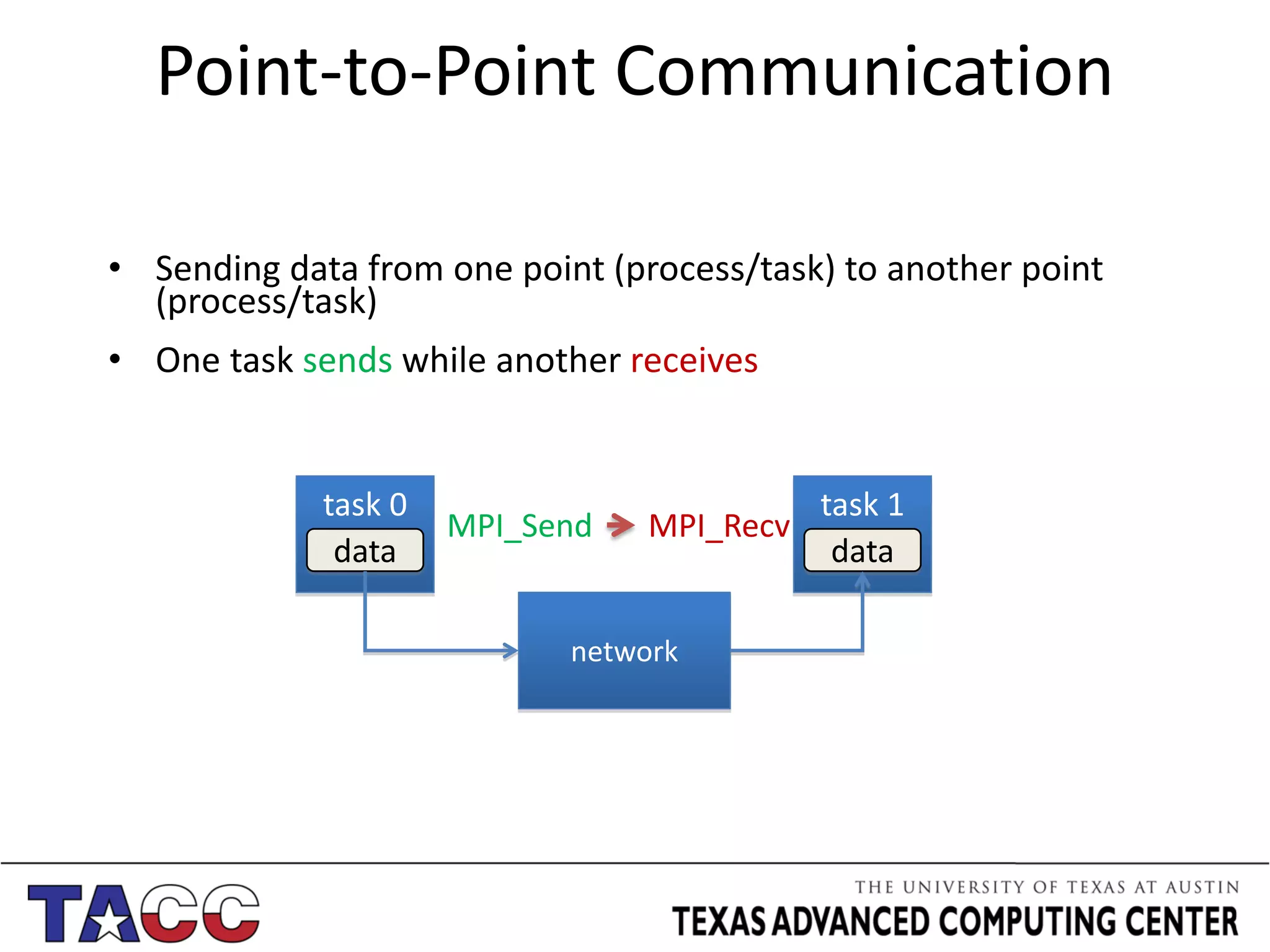
Point-to-Point Communication • Sending data from one point (process/task) to another point (process/task) • One task sends while another receives task 0 task 1 MPI_Send MPI_Recv data data network
Basic Communications in MPI • Standard MPI_Send/MPI_Recv routines – Used for basic messaging Modes of Operation • Blocking – Call does not return until the data area is safe to use • Non-blocking – Initiates send or receive operation, returns immediately – Can check or wait for completion of the operation – Data area is not safe to used until completion. • Synchronous and Buffered (later)
What is available… • Pypar – Its interface is rather minimal. There is no support for communicators or process topologies. – It does not require the Python interpreter to be modified or recompiled, but does not permit interactive parallel runs. – General (picklable) Python objects of any type can be communicated. There is good support for numeric arrays, practically full MPI bandwidth can be achieved. • pyMPI – It rebuilds the Python interpreter providing a built-in module for message passing. It does permit interactive parallel runs, which are useful for learning and debugging. – It provides an interface suitable for basic parallel programing. There is not full support for defining new communicators or process topologies. – General (picklable) Python objects can be messaged between processors. There is not support for numeric arrays. • Scientific Python – It provides a collection of Python modules that are useful for scientific computing. – There is an interface to MPI and BSP (Bulk Synchronous Parallel programming). – The interface is simple but incomplete and does not resemble the MPI specification. There is support for numeric arrays. 10
MPI4Py • MPI4Py provides an interface very similar to the MPI-2 standard C++ Interface • Focus is in translating MPI syntax and semantics: If you know MPI, MPI4Py is “obvious” • You can communicate Python objects!! • What you lose in performance, you gain in shorter development time 11
Functionality • There are hundreds of functions in the MPI standard, not all of them are necessarily available in MPI4Py, most commonly used are • No need to call MPI_Init() or MPI_Finalize() – MPI_Init() is called when you import the module – MPI_Finalize() is called before the Python process ends • To launch: mpirun –np <number of process> -machinefile <hostlist> python <my MPI4Py python script> 12
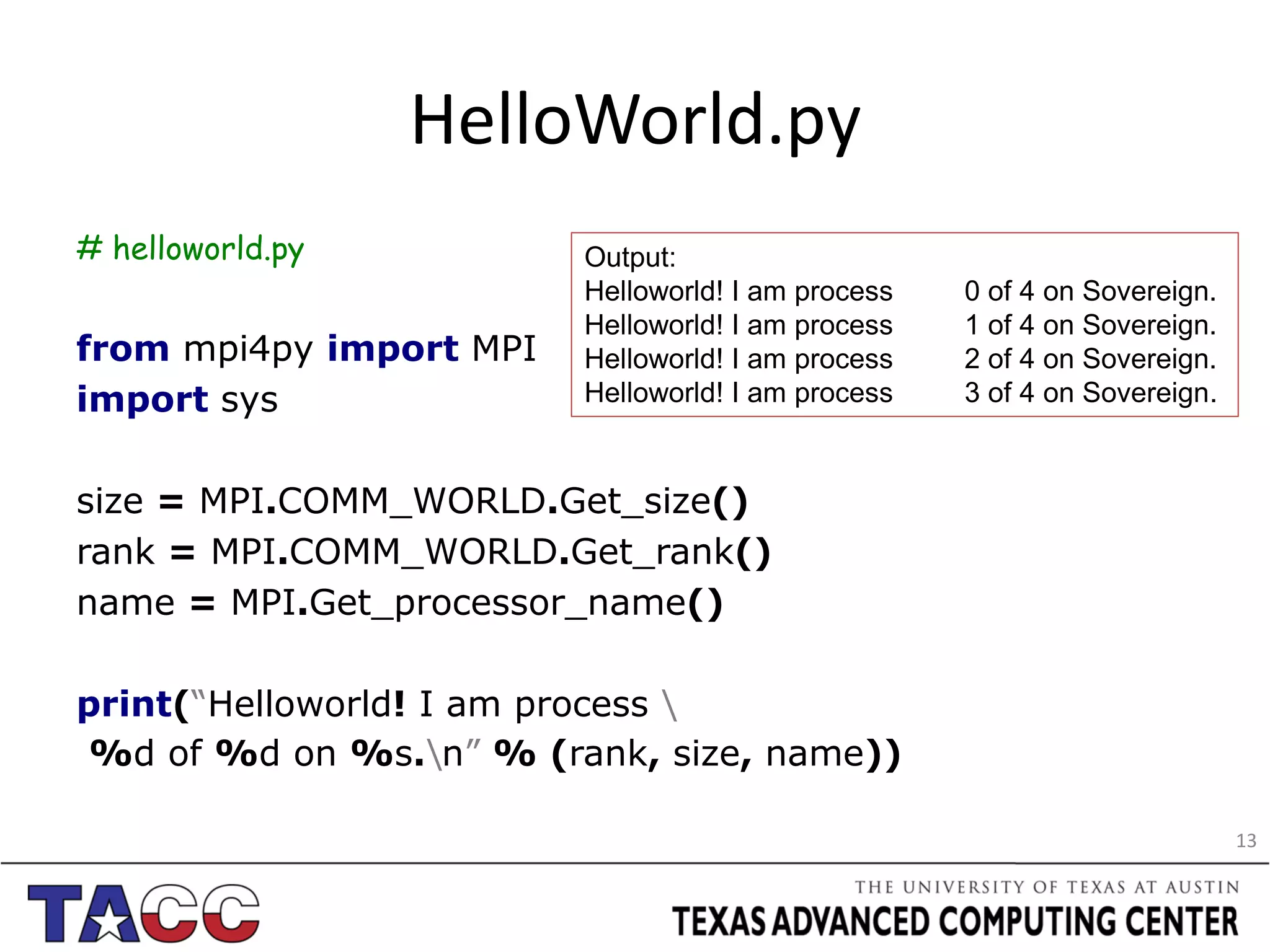
HelloWorld.py # helloworld.py Output: Helloworld! I am process 0 of 4 on Sovereign. Helloworld! I am process 1 of 4 on Sovereign. from mpi4py import MPI Helloworld! I am process 2 of 4 on Sovereign. import sys Helloworld! I am process 3 of 4 on Sovereign. size = MPI.COMM_WORLD.Get_size() rank = MPI.COMM_WORLD.Get_rank() name = MPI.Get_processor_name() print(“Helloworld! I am process %d of %d on %s.n” % (rank, size, name)) 13
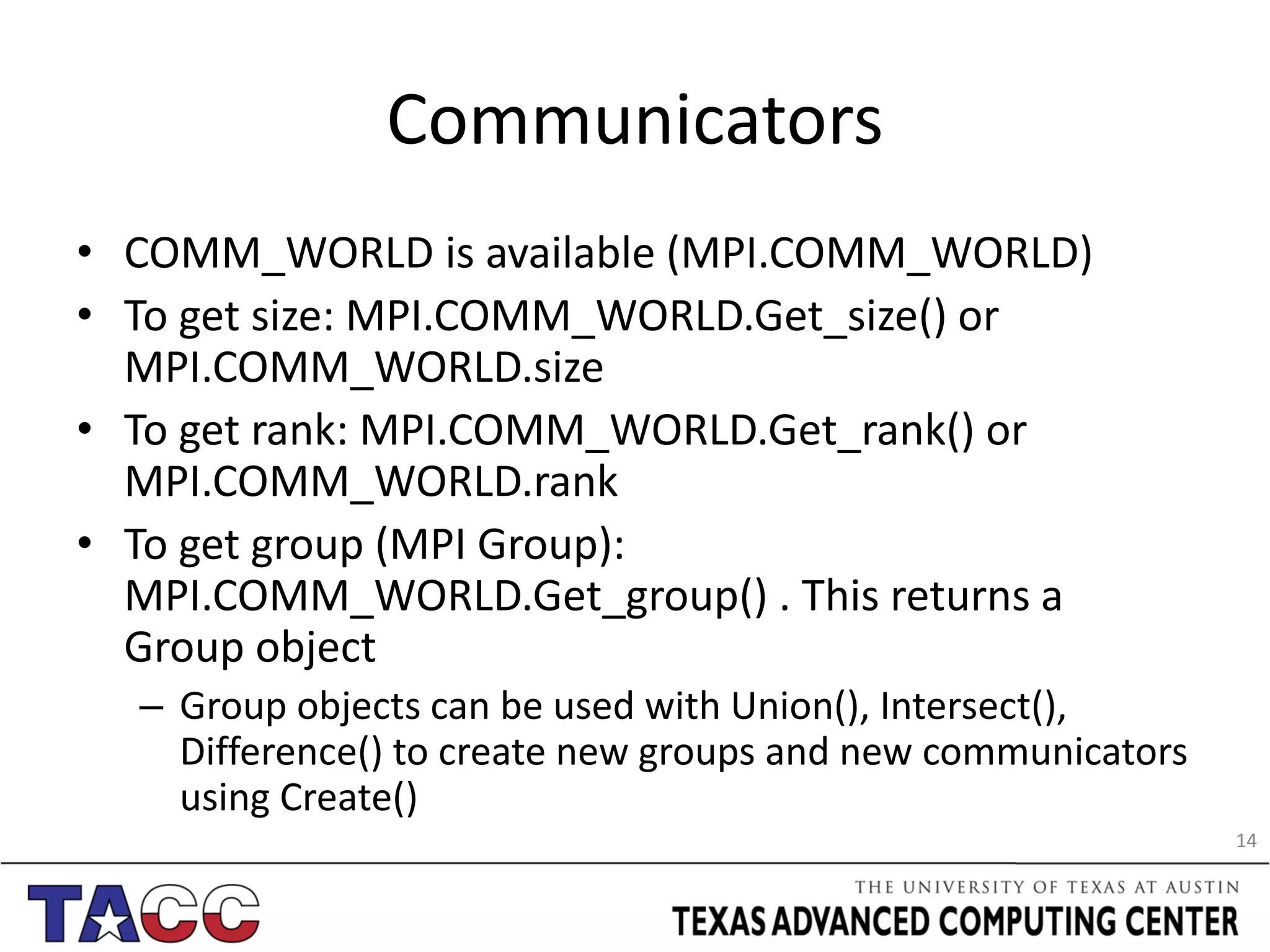
Communicators • COMM_WORLD is available (MPI.COMM_WORLD) • To get size: MPI.COMM_WORLD.Get_size() or MPI.COMM_WORLD.size • To get rank: MPI.COMM_WORLD.Get_rank() or MPI.COMM_WORLD.rank • To get group (MPI Group): MPI.COMM_WORLD.Get_group() . This returns a Group object – Group objects can be used with Union(), Intersect(), Difference() to create new groups and new communicators using Create() 14
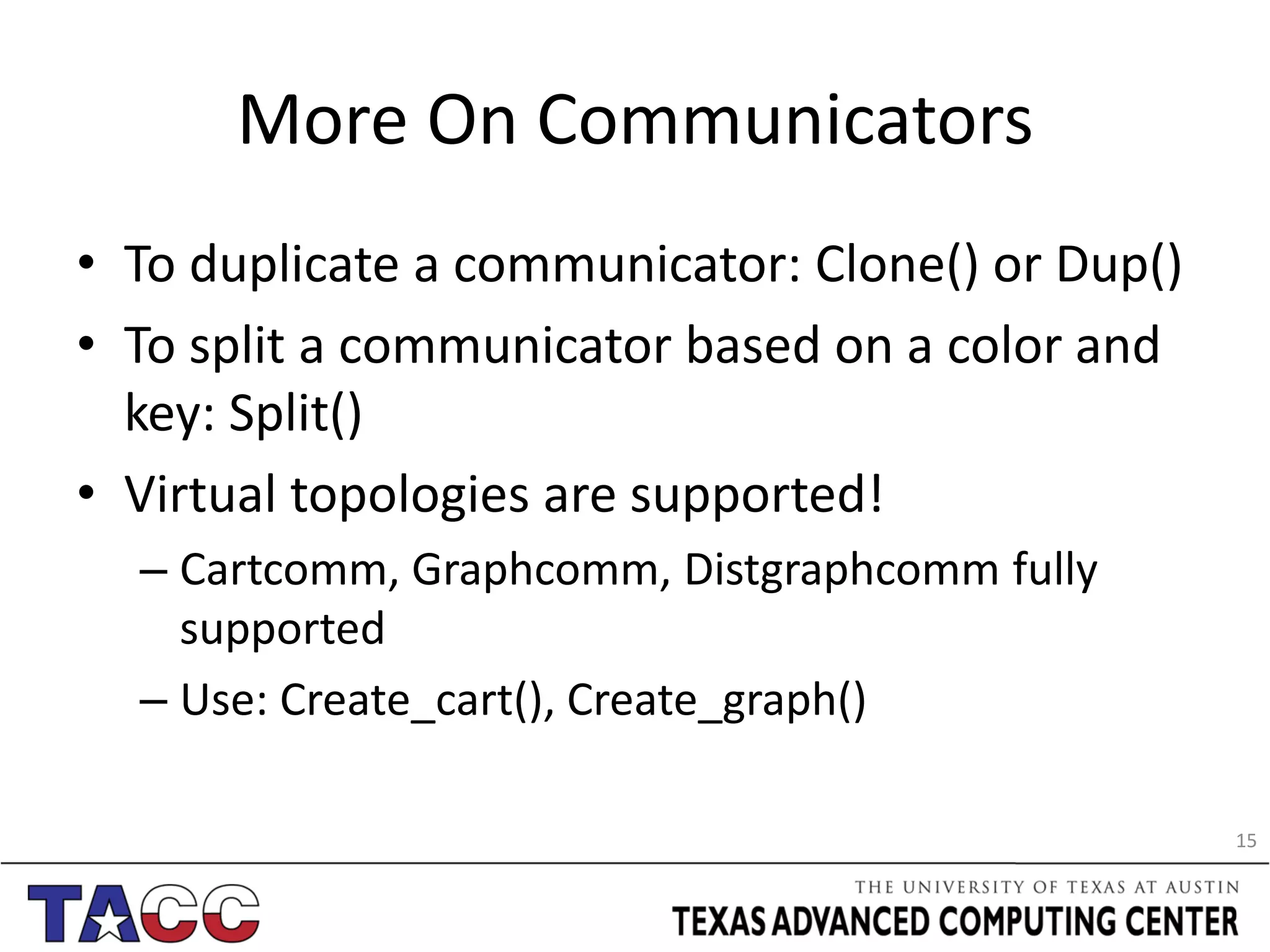
More On Communicators • To duplicate a communicator: Clone() or Dup() • To split a communicator based on a color and key: Split() • Virtual topologies are supported! – Cartcomm, Graphcomm, Distgraphcomm fully supported – Use: Create_cart(), Create_graph() 15
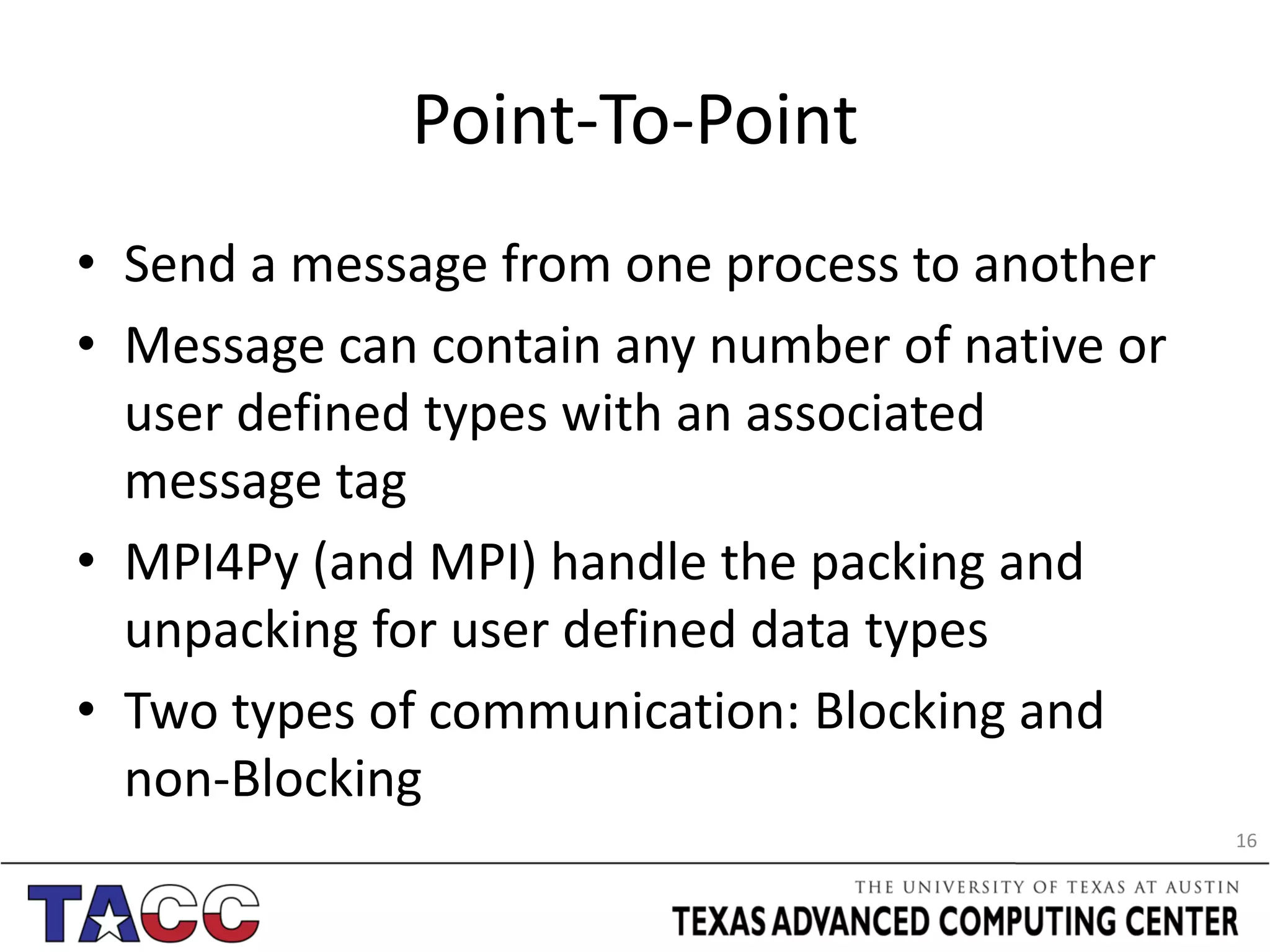
Point-To-Point • Send a message from one process to another • Message can contain any number of native or user defined types with an associated message tag • MPI4Py (and MPI) handle the packing and unpacking for user defined data types • Two types of communication: Blocking and non-Blocking 16
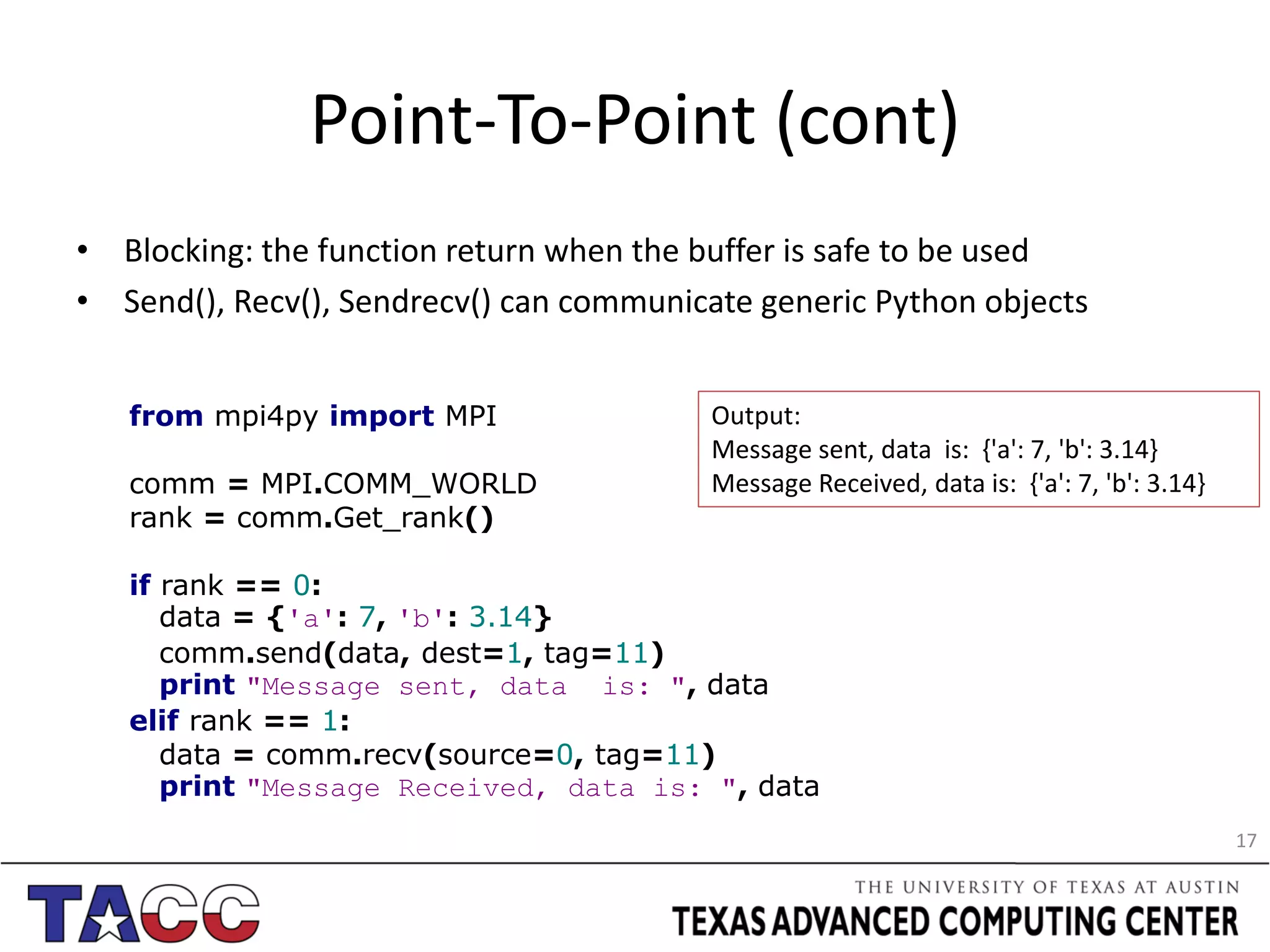
Point-To-Point (cont) • Blocking: the function return when the buffer is safe to be used • Send(), Recv(), Sendrecv() can communicate generic Python objects from mpi4py import MPI Output: Message sent, data is: {'a': 7, 'b': 3.14} comm = MPI.COMM_WORLD Message Received, data is: {'a': 7, 'b': 3.14} rank = comm.Get_rank() if rank == 0: data = {'a': 7, 'b': 3.14} comm.send(data, dest=1, tag=11) print "Message sent, data is: ", data elif rank == 1: data = comm.recv(source=0, tag=11) print "Message Received, data is: ", data 17
Point-To-Point with Numpy from mpi4py import MPI import numpy comm = MPI.COMM_WORLD rank = comm.Get_rank() # pass explicit MPI datatypes if rank == 0: data = numpy.arange(1000, dtype='i') comm.Send([data, MPI.INT], dest=1, tag=77) elif rank == 1: data = numpy.empty(1000, dtype='i') comm.Recv([data, MPI.INT], source=0, tag=77) # automatic MPI datatype discovery if rank == 0: data = numpy.arange(100, dtype=numpy.float64) comm.Send(data, dest=1, tag=13) elif rank == 1: data = numpy.empty(100, dtype=numpy.float64) comm.Recv(data, source=0, tag=13) 18
Point-To-Point (cont) • You can use nonblocking communication to overlap communication with computation • These functions: Isend() and Irecv() return immediately: the buffers are NOT SAFE for reuse • You have to Test() or Wait() for the communication to finish • Optionally you can Cancel() the communication • Test(), Wait(), Cancel() Operate on the Request object used in the nonblocking function 19
Collective Communications • Collective Communications allow multiple processes within the same communicator to exchange messages and possibly perform operations • Collective Communications are always blocking, there are no tags (organized by calling order) • Functions perform typical operations such as Broadcast, Scatter, Gather, Reduction and so on 20
Collective Communication: Summary 21
Collective Communications (cont) • Bcast(), Scatter(), Gather(), Allgather(), Alltoall() can communicate generic Python objects • Scatterv(), Gatherv(), Allgatherv() and Alltoallv() can only communicate explicit memory buffers • No Alltoallw() and no Reduce_scatter() 22
Bcast() Example from mpi4py import MPI Output: comm = MPI.COMM_WORLD bcast finished and data on rank 0 is: {'key2': rank = comm.Get_rank() ('abc', 'xyz'), 'key1': [7, 2.72, (2+3j)]} bcast finished and data on rank 2 is: {'key2': ('abc', 'xyz'), 'key1': [7, 2.72, (2+3j)]} if rank == 0: bcast finished and data on rank 3 is: {'key2': data = {'key1' : [7, 2.72, 2+3j], ('abc', 'xyz'), 'key1': [7, 2.72, (2+3j)]} 'key2' : ( 'abc', 'xyz')} bcast finished and data on rank 1 is: {'key2': else: ('abc', 'xyz'), 'key1': [7, 2.72, (2+3j)]} data = None data = comm.bcast(data, root=0) print "bcast finished and data on rank %d is: "%comm.rank, data 23
Scatter() example from mpi4py import MPI Output: comm = MPI.COMM_WORLD data on rank 0 is: 1 size = comm.Get_size() data on rank 1 is: 4 rank = comm.Get_rank() data on rank 2 is: 9 data on rank 3 is: 16 if rank == 0: data = [(i+1)**2 for i in range(size)] else: data = None data = comm.scatter(data, root=0) assert data == (rank+1)**2 print "data on rank %d is: "%comm.rank, data 24
Gather() & Barrier() from mpi4py import MPI comm = MPI.COMM_WORLD size = comm.Get_size() Output: rank = comm.Get_rank() before gather, data on rank 3 is: 16 before gather, data on rank 0 is: 1 data = (rank+1)**2 before gather, data on rank 1 is: 4 print "before gather, data on rank %d is: "%rank, data before gather, data on rank 2 is: 9 data on rank: 1 is: None comm.Barrier() data on rank: 3 is: None data = comm.gather(data, root=0) data on rank: 2 is: None if rank == 0: data on rank: 0 is: [1, 4, 9, 16] for i in range(size): assert data[i] == (i+1)**2 else: assert data is None print "data on rank: %d is: "%rank, data 25
Advanced Capabilities • MPI4Py supports dynamic processes through spawning: Spawning(), Connect() and Disconnect() • MPI4PY supports one sided communication Put(), Get(), Accumulate() • MPI4Py supports MPI-IO: Open(), Close(), Get_view() and Set_view() 26
Spawn() and Disconnect() Pi.py Cpi.py from mpi4py import MPI #!/usr/bin/env python import numpy from mpi4py import MPI import numpy import sys comm = MPI.Comm.Get_parent() print "Spawning MPI processes" size = comm.Get_size() comm = rank = comm.Get_rank() MPI.COMM_SELF.Spawn(sys.executable, args=[‘Cpi.py'], N = numpy.array(0, dtype='i') maxprocs=8) comm.Bcast([N, MPI.INT], root=0) h = 1.0 / N; s = 0.0 for i in range(rank, N, size): N = numpy.array(100, 'i') x = h * (i + 0.5) comm.Bcast([N, MPI.INT], root=MPI.ROOT) s += 4.0 / (1.0 + x**2) PI = numpy.array(0.0, 'd') PI = numpy.array(s * h, dtype='d') comm.Reduce(None, [PI, MPI.DOUBLE], comm.Reduce([PI, MPI.DOUBLE], None, op=MPI.SUM, root=0) op=MPI.SUM, root=MPI.ROOT) print "Disconnecting from rank %d"%rank comm.Barrier() print "Calculated value of PI is: %f16" %PI comm.Disconnect() 27
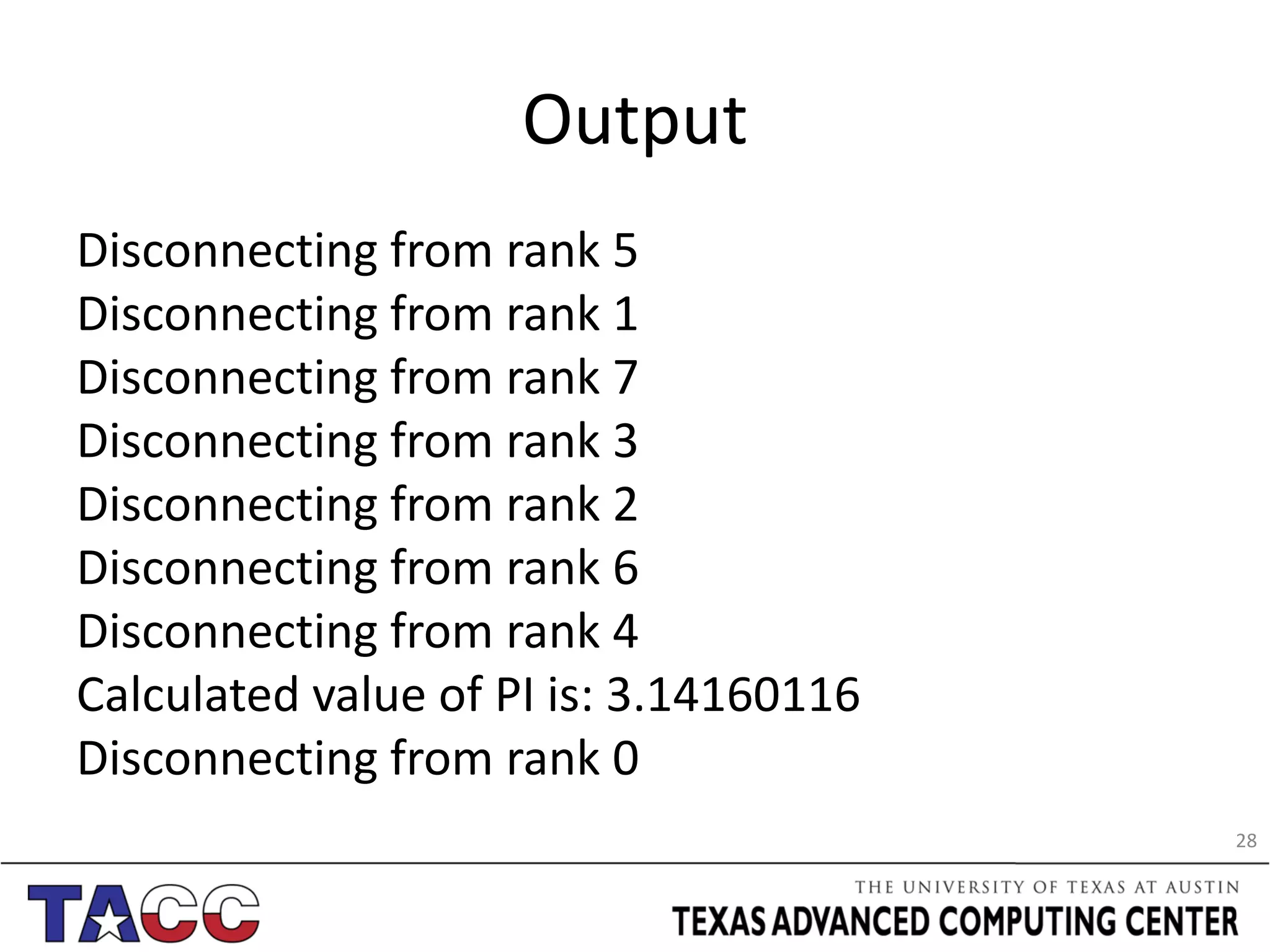
Output Disconnecting from rank 5 Disconnecting from rank 1 Disconnecting from rank 7 Disconnecting from rank 3 Disconnecting from rank 2 Disconnecting from rank 6 Disconnecting from rank 4 Calculated value of PI is: 3.14160116 Disconnecting from rank 0 28

More mpi4py

  • 1.
    HPC Python Tutorial: Introduction to MPI4Py 4/23/2012 Instructor: Yaakoub El Khamra, Research Associate, TACC yaakoub@tacc.utexas.edu
  • 2.
    What is MPI •Message Passing Interface • Most useful on distributed memory machines • Many implementations, interfaces in C/C++/Fortran • Why python? – Great for prototyping – Small to medium codes • Can I use it for production? – Yes, if the communication is not very frequent and performance is not the primary concern 2
  • 3.
    Message Passing Paradigm •A Parallel MPI Program is launched as separate processes (tasks), each with their own address space. – Requires partitioning data across tasks. • Data is explicitly moved from task to task – A task accesses the data of another task through a transaction called “message passing” in which a copy of the data (message) is transferred (passed) from one task to another. • There are two classes of message passing (transfers) – Point-to-Point messages involve only two tasks – Collective messages involve a set of tasks • Access to subsets of complex data structures is simplified – A data subset is described as a single Data Type entity • Transfers use synchronous or asynchronous protocols • Messaging can be arranged into efficient topologies 3
  • 4.
    Key Concepts-- Summary • Used to create parallel SPMD programs on distributed-memory machines with explicit message passing • Routines available for – Point-to-Point Communication – Collective Communication • 1-to-many • many-to-1 • many-to-many – Data Types – Synchronization (barriers, non-blocking MP) – Parallel IO – Topologies 4
  • 5.
    Advantages of MessagePassing • Universality – Message passing model works on separate processors connected by any network (and even on shared memory systems) – matches the hardware of most of today’s parallel supercomputers as well as ad hoc networks of computers • Performance/Scalability – Scalability is the most compelling reason why message passing will remain a permanent component of HPC (High Performance Computing) – As modern systems increase core counts, management of the memory hierarchy (including distributed memory) is the key to extracting the highest performance – Each message passing process only directly uses its local data, avoiding complexities of process-shared data, and allowing compilers and cache management hardware to function without contention. 5
  • 6.
    Communicators • Communicators – MPI uses a communicator objects (and groups) to identify a set of processes which communicate only within their set. – MPI_COMM_WORLD is defined in the MPI include file as all processes (ranks) of your job – Required parameter for most MPI calls – You can create subsets of MPI_COMM_WORLD • Rank – Unique process ID within a communicator – Assigned by the system when the process initializes (for MPI_COMM_WORLD) – Processors within a communicator are assigned numbers 0 to n-1 (C/F90) – Used to specify sources and destinations of messages, process specific indexing and operations.
  • 7.
    Parallel Code • The programmer is responsible for determining all parallelism. – Data Partitioning – Deriving Parallel Algorithms – Moving Data between Processes MEMORY MEMORY • Tasks (independent processes data data data data executing anywhere) send and receive “messages” to exchange (original) (copy) data. CPU CPU • Data transfer requires cooperative operation to be performed by each process (point to point communications). message • Message Passing Interface (MPI) was released in 1994. (MPI-2 in 1996) Now the MPI is the de facto standard for message passing. • http://www-unix.mcs.anl.gov/mpi/
  • 8.
    Point-to-Point Communication • Sendingdata from one point (process/task) to another point (process/task) • One task sends while another receives task 0 task 1 MPI_Send MPI_Recv data data network
  • 9.
    Basic Communications inMPI • Standard MPI_Send/MPI_Recv routines – Used for basic messaging Modes of Operation • Blocking – Call does not return until the data area is safe to use • Non-blocking – Initiates send or receive operation, returns immediately – Can check or wait for completion of the operation – Data area is not safe to used until completion. • Synchronous and Buffered (later)
  • 10.
    What is available… • Pypar – Its interface is rather minimal. There is no support for communicators or process topologies. – It does not require the Python interpreter to be modified or recompiled, but does not permit interactive parallel runs. – General (picklable) Python objects of any type can be communicated. There is good support for numeric arrays, practically full MPI bandwidth can be achieved. • pyMPI – It rebuilds the Python interpreter providing a built-in module for message passing. It does permit interactive parallel runs, which are useful for learning and debugging. – It provides an interface suitable for basic parallel programing. There is not full support for defining new communicators or process topologies. – General (picklable) Python objects can be messaged between processors. There is not support for numeric arrays. • Scientific Python – It provides a collection of Python modules that are useful for scientific computing. – There is an interface to MPI and BSP (Bulk Synchronous Parallel programming). – The interface is simple but incomplete and does not resemble the MPI specification. There is support for numeric arrays. 10
  • 11.
    MPI4Py • MPI4Py providesan interface very similar to the MPI-2 standard C++ Interface • Focus is in translating MPI syntax and semantics: If you know MPI, MPI4Py is “obvious” • You can communicate Python objects!! • What you lose in performance, you gain in shorter development time 11
  • 12.
    Functionality • There arehundreds of functions in the MPI standard, not all of them are necessarily available in MPI4Py, most commonly used are • No need to call MPI_Init() or MPI_Finalize() – MPI_Init() is called when you import the module – MPI_Finalize() is called before the Python process ends • To launch: mpirun –np <number of process> -machinefile <hostlist> python <my MPI4Py python script> 12
  • 13.
    HelloWorld.py # helloworld.py Output: Helloworld! I am process 0 of 4 on Sovereign. Helloworld! I am process 1 of 4 on Sovereign. from mpi4py import MPI Helloworld! I am process 2 of 4 on Sovereign. import sys Helloworld! I am process 3 of 4 on Sovereign. size = MPI.COMM_WORLD.Get_size() rank = MPI.COMM_WORLD.Get_rank() name = MPI.Get_processor_name() print(“Helloworld! I am process %d of %d on %s.n” % (rank, size, name)) 13
  • 14.
    Communicators • COMM_WORLD isavailable (MPI.COMM_WORLD) • To get size: MPI.COMM_WORLD.Get_size() or MPI.COMM_WORLD.size • To get rank: MPI.COMM_WORLD.Get_rank() or MPI.COMM_WORLD.rank • To get group (MPI Group): MPI.COMM_WORLD.Get_group() . This returns a Group object – Group objects can be used with Union(), Intersect(), Difference() to create new groups and new communicators using Create() 14
  • 15.
    More On Communicators •To duplicate a communicator: Clone() or Dup() • To split a communicator based on a color and key: Split() • Virtual topologies are supported! – Cartcomm, Graphcomm, Distgraphcomm fully supported – Use: Create_cart(), Create_graph() 15
  • 16.
    Point-To-Point • Send amessage from one process to another • Message can contain any number of native or user defined types with an associated message tag • MPI4Py (and MPI) handle the packing and unpacking for user defined data types • Two types of communication: Blocking and non-Blocking 16
  • 17.
    Point-To-Point (cont) • Blocking:the function return when the buffer is safe to be used • Send(), Recv(), Sendrecv() can communicate generic Python objects from mpi4py import MPI Output: Message sent, data is: {'a': 7, 'b': 3.14} comm = MPI.COMM_WORLD Message Received, data is: {'a': 7, 'b': 3.14} rank = comm.Get_rank() if rank == 0: data = {'a': 7, 'b': 3.14} comm.send(data, dest=1, tag=11) print "Message sent, data is: ", data elif rank == 1: data = comm.recv(source=0, tag=11) print "Message Received, data is: ", data 17
  • 18.
    Point-To-Point with Numpy frommpi4py import MPI import numpy comm = MPI.COMM_WORLD rank = comm.Get_rank() # pass explicit MPI datatypes if rank == 0: data = numpy.arange(1000, dtype='i') comm.Send([data, MPI.INT], dest=1, tag=77) elif rank == 1: data = numpy.empty(1000, dtype='i') comm.Recv([data, MPI.INT], source=0, tag=77) # automatic MPI datatype discovery if rank == 0: data = numpy.arange(100, dtype=numpy.float64) comm.Send(data, dest=1, tag=13) elif rank == 1: data = numpy.empty(100, dtype=numpy.float64) comm.Recv(data, source=0, tag=13) 18
  • 19.
    Point-To-Point (cont) • Youcan use nonblocking communication to overlap communication with computation • These functions: Isend() and Irecv() return immediately: the buffers are NOT SAFE for reuse • You have to Test() or Wait() for the communication to finish • Optionally you can Cancel() the communication • Test(), Wait(), Cancel() Operate on the Request object used in the nonblocking function 19
  • 20.
    Collective Communications • CollectiveCommunications allow multiple processes within the same communicator to exchange messages and possibly perform operations • Collective Communications are always blocking, there are no tags (organized by calling order) • Functions perform typical operations such as Broadcast, Scatter, Gather, Reduction and so on 20
  • 21.
  • 22.
    Collective Communications (cont) •Bcast(), Scatter(), Gather(), Allgather(), Alltoall() can communicate generic Python objects • Scatterv(), Gatherv(), Allgatherv() and Alltoallv() can only communicate explicit memory buffers • No Alltoallw() and no Reduce_scatter() 22
  • 23.
    Bcast() Example from mpi4pyimport MPI Output: comm = MPI.COMM_WORLD bcast finished and data on rank 0 is: {'key2': rank = comm.Get_rank() ('abc', 'xyz'), 'key1': [7, 2.72, (2+3j)]} bcast finished and data on rank 2 is: {'key2': ('abc', 'xyz'), 'key1': [7, 2.72, (2+3j)]} if rank == 0: bcast finished and data on rank 3 is: {'key2': data = {'key1' : [7, 2.72, 2+3j], ('abc', 'xyz'), 'key1': [7, 2.72, (2+3j)]} 'key2' : ( 'abc', 'xyz')} bcast finished and data on rank 1 is: {'key2': else: ('abc', 'xyz'), 'key1': [7, 2.72, (2+3j)]} data = None data = comm.bcast(data, root=0) print "bcast finished and data on rank %d is: "%comm.rank, data 23
  • 24.
    Scatter() example from mpi4pyimport MPI Output: comm = MPI.COMM_WORLD data on rank 0 is: 1 size = comm.Get_size() data on rank 1 is: 4 rank = comm.Get_rank() data on rank 2 is: 9 data on rank 3 is: 16 if rank == 0: data = [(i+1)**2 for i in range(size)] else: data = None data = comm.scatter(data, root=0) assert data == (rank+1)**2 print "data on rank %d is: "%comm.rank, data 24
  • 25.
    Gather() & Barrier() frommpi4py import MPI comm = MPI.COMM_WORLD size = comm.Get_size() Output: rank = comm.Get_rank() before gather, data on rank 3 is: 16 before gather, data on rank 0 is: 1 data = (rank+1)**2 before gather, data on rank 1 is: 4 print "before gather, data on rank %d is: "%rank, data before gather, data on rank 2 is: 9 data on rank: 1 is: None comm.Barrier() data on rank: 3 is: None data = comm.gather(data, root=0) data on rank: 2 is: None if rank == 0: data on rank: 0 is: [1, 4, 9, 16] for i in range(size): assert data[i] == (i+1)**2 else: assert data is None print "data on rank: %d is: "%rank, data 25
  • 26.
    Advanced Capabilities • MPI4Pysupports dynamic processes through spawning: Spawning(), Connect() and Disconnect() • MPI4PY supports one sided communication Put(), Get(), Accumulate() • MPI4Py supports MPI-IO: Open(), Close(), Get_view() and Set_view() 26
  • 27.
    Spawn() and Disconnect() Pi.py Cpi.py from mpi4py import MPI #!/usr/bin/env python import numpy from mpi4py import MPI import numpy import sys comm = MPI.Comm.Get_parent() print "Spawning MPI processes" size = comm.Get_size() comm = rank = comm.Get_rank() MPI.COMM_SELF.Spawn(sys.executable, args=[‘Cpi.py'], N = numpy.array(0, dtype='i') maxprocs=8) comm.Bcast([N, MPI.INT], root=0) h = 1.0 / N; s = 0.0 for i in range(rank, N, size): N = numpy.array(100, 'i') x = h * (i + 0.5) comm.Bcast([N, MPI.INT], root=MPI.ROOT) s += 4.0 / (1.0 + x**2) PI = numpy.array(0.0, 'd') PI = numpy.array(s * h, dtype='d') comm.Reduce(None, [PI, MPI.DOUBLE], comm.Reduce([PI, MPI.DOUBLE], None, op=MPI.SUM, root=0) op=MPI.SUM, root=MPI.ROOT) print "Disconnecting from rank %d"%rank comm.Barrier() print "Calculated value of PI is: %f16" %PI comm.Disconnect() 27
  • 28.
    Output Disconnecting from rank5 Disconnecting from rank 1 Disconnecting from rank 7 Disconnecting from rank 3 Disconnecting from rank 2 Disconnecting from rank 6 Disconnecting from rank 4 Calculated value of PI is: 3.14160116 Disconnecting from rank 0 28