Group Members Hamza Zahid (131391) Fahad Nadeem khan Abdual Hannan AIR UNIVERSITY MULTAN CAMPUS
Shared memory VS Message passing
Topics • Message passing • Shared memory • Difference b/w message passing and shared memory
Message Passing
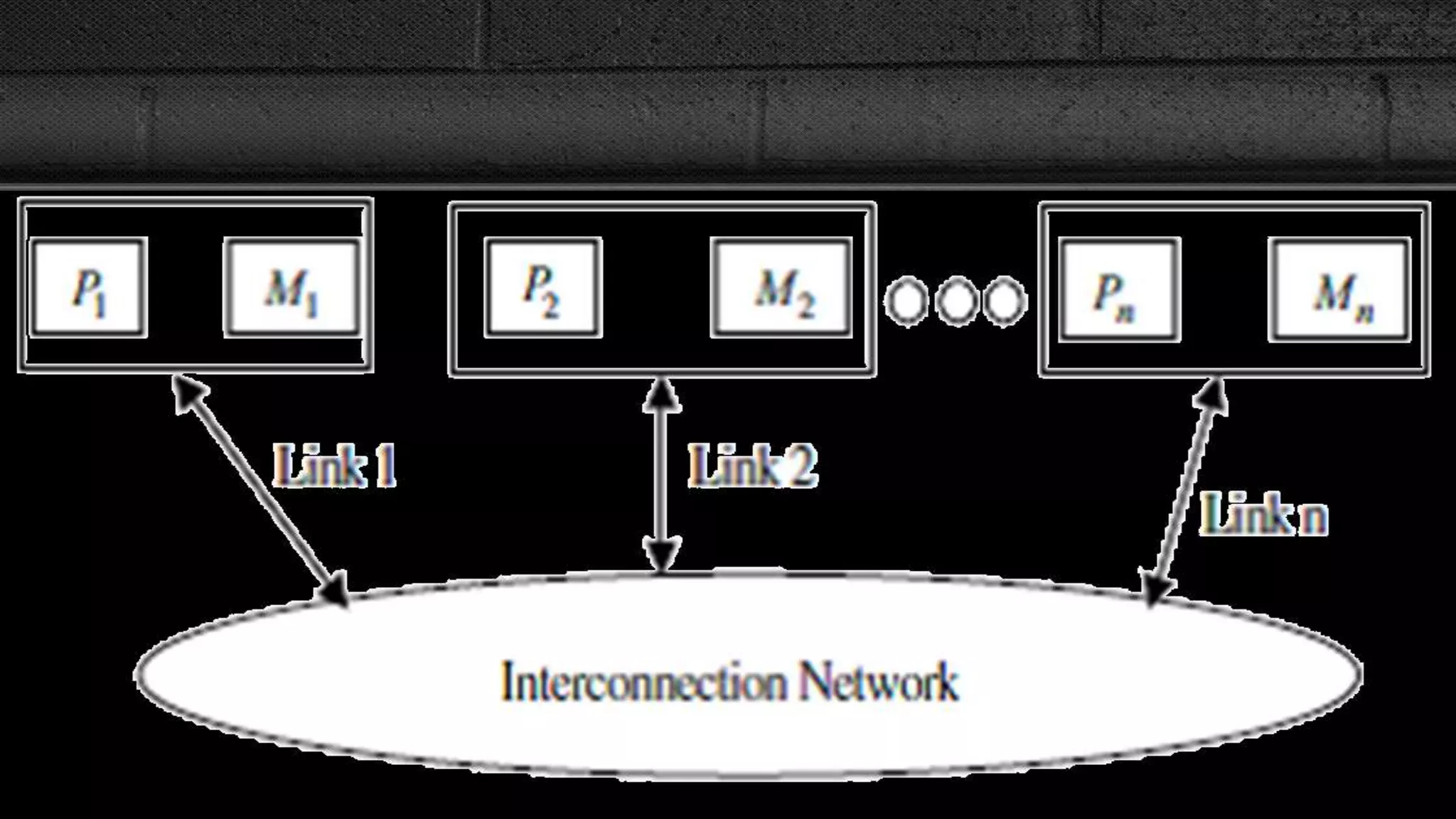
INTRODUCTION • The architecture is used to communicate data among a set of processors without the need for a global memory • Each PE has its own local memory and communicates with other PE using message
MP network Two important factors must be considered;  Link bandwidth –the number of bits that can be transmitted per unit of times(bits/s)  Message transfer through the network
Process communication Processes running on a given processor use what is called internal channels to exchange messages among themselves Processes running on different processors use the external channesls to exchange messages
Data exchanged Data exchanged among processors cannot be shared; it is rather copied (using send/ receive messages) An important advantage of this form of data exchange is the elimination of the need for synchronization constructs , such as semaphores , which results in performance improvement
Message-Passing Interface – MPI Standardization  MPI is the only message passing library which can be considered a standard. It is supported on virtually all HPC platforms. Practically, it has replaced all previous message passing libraries. Portability There is no need to modify your source code when you port your application to a different platform that supports the MPI standard
Message-Passing Interface – MPI Performance Opportunities  Vendor implementations should be able to exploit native hardware features to optimize performance. Functionality  Over 115 routines are defined. Availability  A variety of implementations are available, both vendor and public domain.
MPI basics Start Processes Send Messages Receive Messages Synchronize With these four capabilities, you can construct any program. MPI offers over 125 functions.
Shared memory
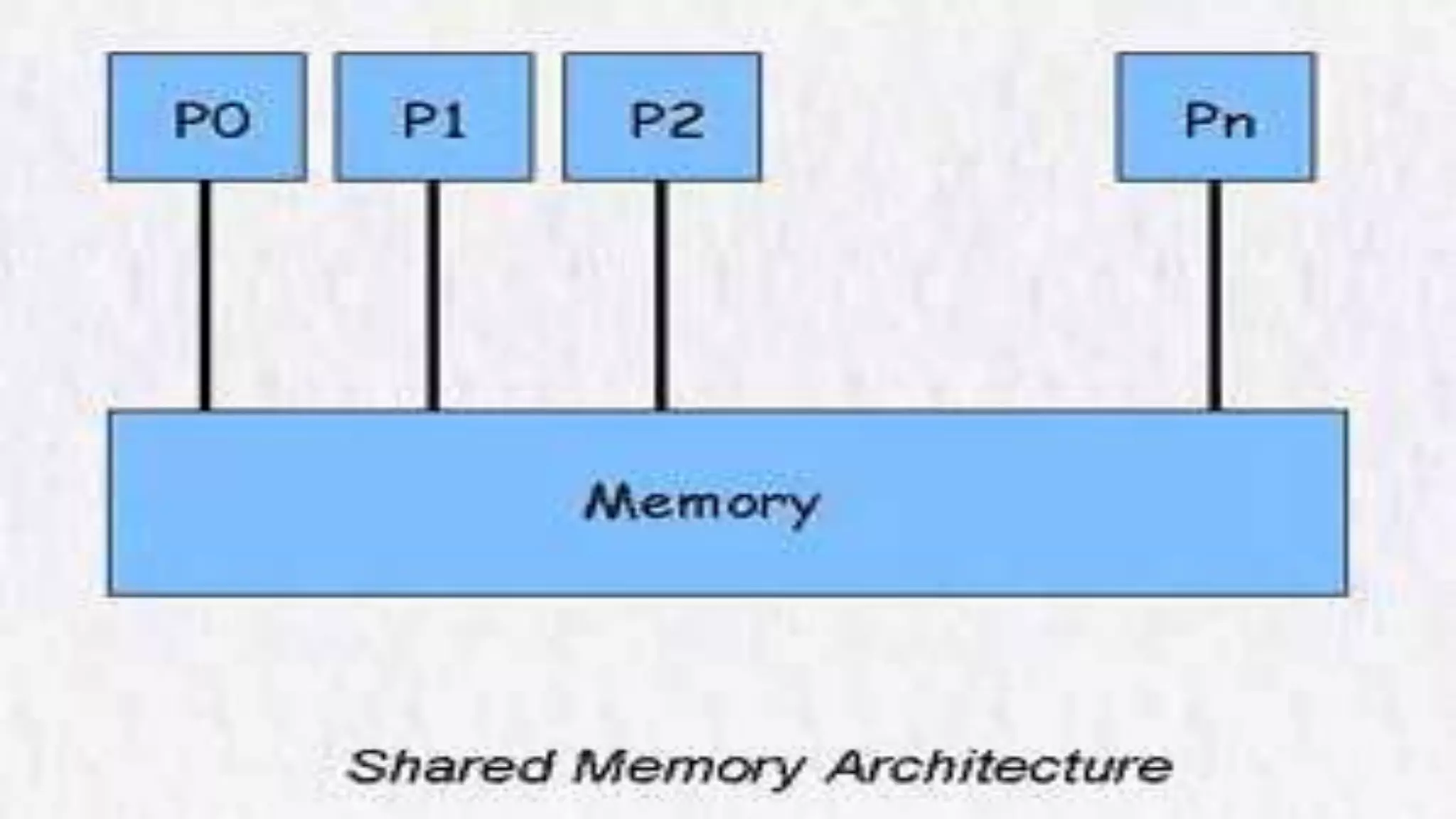
Introduction  Processors communicate with shared address space  Easy on small-scale machines  Shared memory allows multiple processes to share virtual memory space.  This is the fastest but not necessarily the easiest (synchronization- wise) way for processes to communicate with one another.  In general, one process creates or allocates the shared memory segment.  The size and access permissions for the segment are set when it is created.
Uniform Memory Access (UMA)  Most commonly represented today by Symmetric Multiprocessor (SMP) machines  Identical processors  Equal access and access times to memory  Sometimes called CC-UMA - Cache Coherent UMA. Cache coherent means if one processor updates a location in shared memory, all the other processors know about the update. Cache coherency is accomplished at the hardware level.
Shared Memory (UMA)
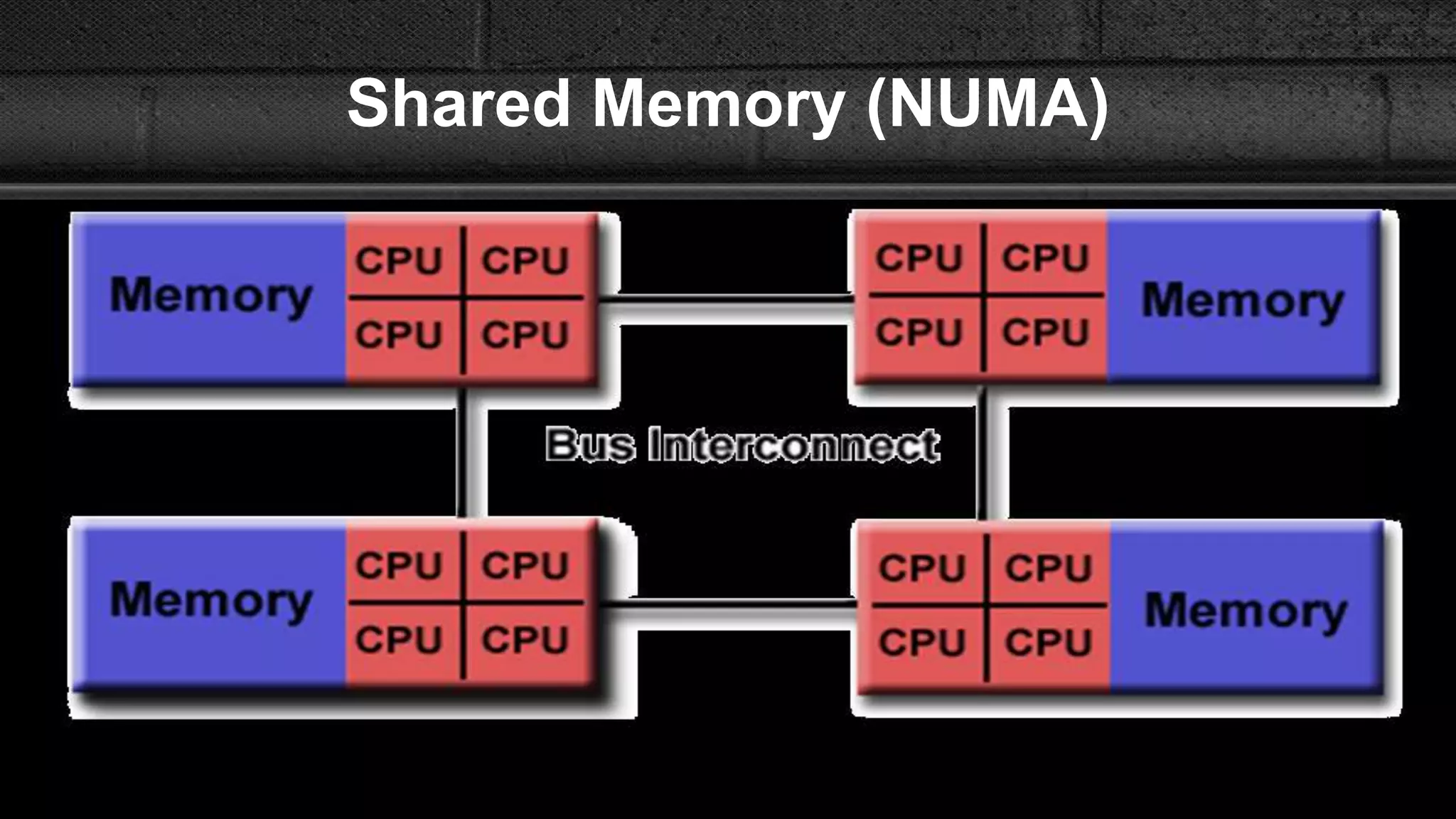
Non-Uniform Memory Access (NUMA)  Often made by physically linking two or more SMPs  One SMP can directly access memory of another SMP  Not all processors have equal access time to all memories  Memory access across link is slower  If cache coherency is maintained, then may also be called CC- NUMA - Cache Coherent NUMA
Shared Memory (NUMA)
Advantages  Global address space provides a user-friendly programming perspective to memory  Model of choice for uniprocessors, small-scale MPs  Ease of programming  Lower latency  Easier to use hardware controlled caching  Data sharing between tasks is both fast and uniform due to the proximity of memory to CPUs
Disadvantages  Primary disadvantage is the lack of scalability between memory and CPUs. Adding more CPUs can geometrically increases traffic on the shared memory-CPU path, and for cache coherent systems, geometrically increase traffic associated with cache/memory management.  Programmer responsibility for synchronization constructs that ensure "correct" access of global memory.  Expense: it becomes increasingly difficult and expensive to design and produce shared memory machines with ever increasing numbers of processors.
Difference
Message Passing vs. Shared Memory • Difference: how communication is achieved between tasks  Message passing programming model – Explicit communication via messages – Loose coupling of program components – Analogy: telephone call or letter, no shared location accessible to all  Shared memory programming model – Implicit communication via memory operations (load/store) – Tight coupling of program components – Analogy: bulletin board, post information at a shared space • Suitability of the programming model depends on the problem to be solved. Issues affected by the model include:  Overhead, scalability, ease of programming
Message Passing vs. Shared Memory Hardware • Difference: how task communication is supported in hardware  Shared memory hardware (or machine model) – All processors see a global shared address space • Ability to access all memory from each processor – A write to a location is visible to the reads of other processors  Message passing hardware (machine model) – No global shared address space – Send and receive variants are the only method of communication between processors (much like networks of workstations today, i.e. clusters) • Suitability of the hardware depends on the problem to be solved as well as the programming model.
Programming Model vs. Architecture • Machine  Programming Model – Join at network, so program with message passing model – Join at memory, so program with shared memory model – Join at processor, so program with SIMD or data parallel • Programming Model  Machine – Message-passing programs on message-passing machine – Shared-memory programs on shared-memory machine – SIMD/data-parallel programs on SIMD/data-parallel machine
Separation of Model and Architecture  Shared Memory – Single shared address space – Communicate, synchronize using load / store – Can support message passing  Message Passing – Send / Receive – Communication + synchronization – Can support shared memory
message passing vs shared memory

message passing vs shared memory

  • 2.
    Group Members Hamza Zahid(131391) Fahad Nadeem khan Abdual Hannan AIR UNIVERSITY MULTAN CAMPUS
  • 3.
    Shared memory VSMessage passing
  • 4.
    Topics • Message passing •Shared memory • Difference b/w message passing and shared memory
  • 5.
  • 6.
    INTRODUCTION • The architectureis used to communicate data among a set of processors without the need for a global memory • Each PE has its own local memory and communicates with other PE using message
  • 8.
    MP network Two importantfactors must be considered;  Link bandwidth –the number of bits that can be transmitted per unit of times(bits/s)  Message transfer through the network
  • 9.
    Process communication Processes runningon a given processor use what is called internal channels to exchange messages among themselves Processes running on different processors use the external channesls to exchange messages
  • 10.
    Data exchanged Data exchangedamong processors cannot be shared; it is rather copied (using send/ receive messages) An important advantage of this form of data exchange is the elimination of the need for synchronization constructs , such as semaphores , which results in performance improvement
  • 11.
    Message-Passing Interface –MPI Standardization  MPI is the only message passing library which can be considered a standard. It is supported on virtually all HPC platforms. Practically, it has replaced all previous message passing libraries. Portability There is no need to modify your source code when you port your application to a different platform that supports the MPI standard
  • 12.
    Message-Passing Interface –MPI Performance Opportunities  Vendor implementations should be able to exploit native hardware features to optimize performance. Functionality  Over 115 routines are defined. Availability  A variety of implementations are available, both vendor and public domain.
  • 13.
    MPI basics Start Processes SendMessages Receive Messages Synchronize With these four capabilities, you can construct any program. MPI offers over 125 functions.
  • 14.
  • 15.
    Introduction  Processors communicatewith shared address space  Easy on small-scale machines  Shared memory allows multiple processes to share virtual memory space.  This is the fastest but not necessarily the easiest (synchronization- wise) way for processes to communicate with one another.  In general, one process creates or allocates the shared memory segment.  The size and access permissions for the segment are set when it is created.
  • 17.
    Uniform Memory Access(UMA)  Most commonly represented today by Symmetric Multiprocessor (SMP) machines  Identical processors  Equal access and access times to memory  Sometimes called CC-UMA - Cache Coherent UMA. Cache coherent means if one processor updates a location in shared memory, all the other processors know about the update. Cache coherency is accomplished at the hardware level.
  • 18.
  • 19.
    Non-Uniform Memory Access(NUMA)  Often made by physically linking two or more SMPs  One SMP can directly access memory of another SMP  Not all processors have equal access time to all memories  Memory access across link is slower  If cache coherency is maintained, then may also be called CC- NUMA - Cache Coherent NUMA
  • 20.
  • 21.
    Advantages  Global addressspace provides a user-friendly programming perspective to memory  Model of choice for uniprocessors, small-scale MPs  Ease of programming  Lower latency  Easier to use hardware controlled caching  Data sharing between tasks is both fast and uniform due to the proximity of memory to CPUs
  • 22.
    Disadvantages  Primary disadvantageis the lack of scalability between memory and CPUs. Adding more CPUs can geometrically increases traffic on the shared memory-CPU path, and for cache coherent systems, geometrically increase traffic associated with cache/memory management.  Programmer responsibility for synchronization constructs that ensure "correct" access of global memory.  Expense: it becomes increasingly difficult and expensive to design and produce shared memory machines with ever increasing numbers of processors.
  • 23.
  • 24.
    Message Passing vs.Shared Memory • Difference: how communication is achieved between tasks  Message passing programming model – Explicit communication via messages – Loose coupling of program components – Analogy: telephone call or letter, no shared location accessible to all  Shared memory programming model – Implicit communication via memory operations (load/store) – Tight coupling of program components – Analogy: bulletin board, post information at a shared space • Suitability of the programming model depends on the problem to be solved. Issues affected by the model include:  Overhead, scalability, ease of programming
  • 25.
    Message Passing vs.Shared Memory Hardware • Difference: how task communication is supported in hardware  Shared memory hardware (or machine model) – All processors see a global shared address space • Ability to access all memory from each processor – A write to a location is visible to the reads of other processors  Message passing hardware (machine model) – No global shared address space – Send and receive variants are the only method of communication between processors (much like networks of workstations today, i.e. clusters) • Suitability of the hardware depends on the problem to be solved as well as the programming model.
  • 26.
    Programming Model vs.Architecture • Machine  Programming Model – Join at network, so program with message passing model – Join at memory, so program with shared memory model – Join at processor, so program with SIMD or data parallel • Programming Model  Machine – Message-passing programs on message-passing machine – Shared-memory programs on shared-memory machine – SIMD/data-parallel programs on SIMD/data-parallel machine
  • 27.
    Separation of Modeland Architecture  Shared Memory – Single shared address space – Communicate, synchronize using load / store – Can support message passing  Message Passing – Send / Receive – Communication + synchronization – Can support shared memory