Module 6: MVC Thanisa Kruawaisayawan Thanachart Numnonda www.imcinstitute.com
Objectives  Introduction of MVC pattern  Evolution of Web Application design architecture  Model 1  Model 2  Application frameworks 2
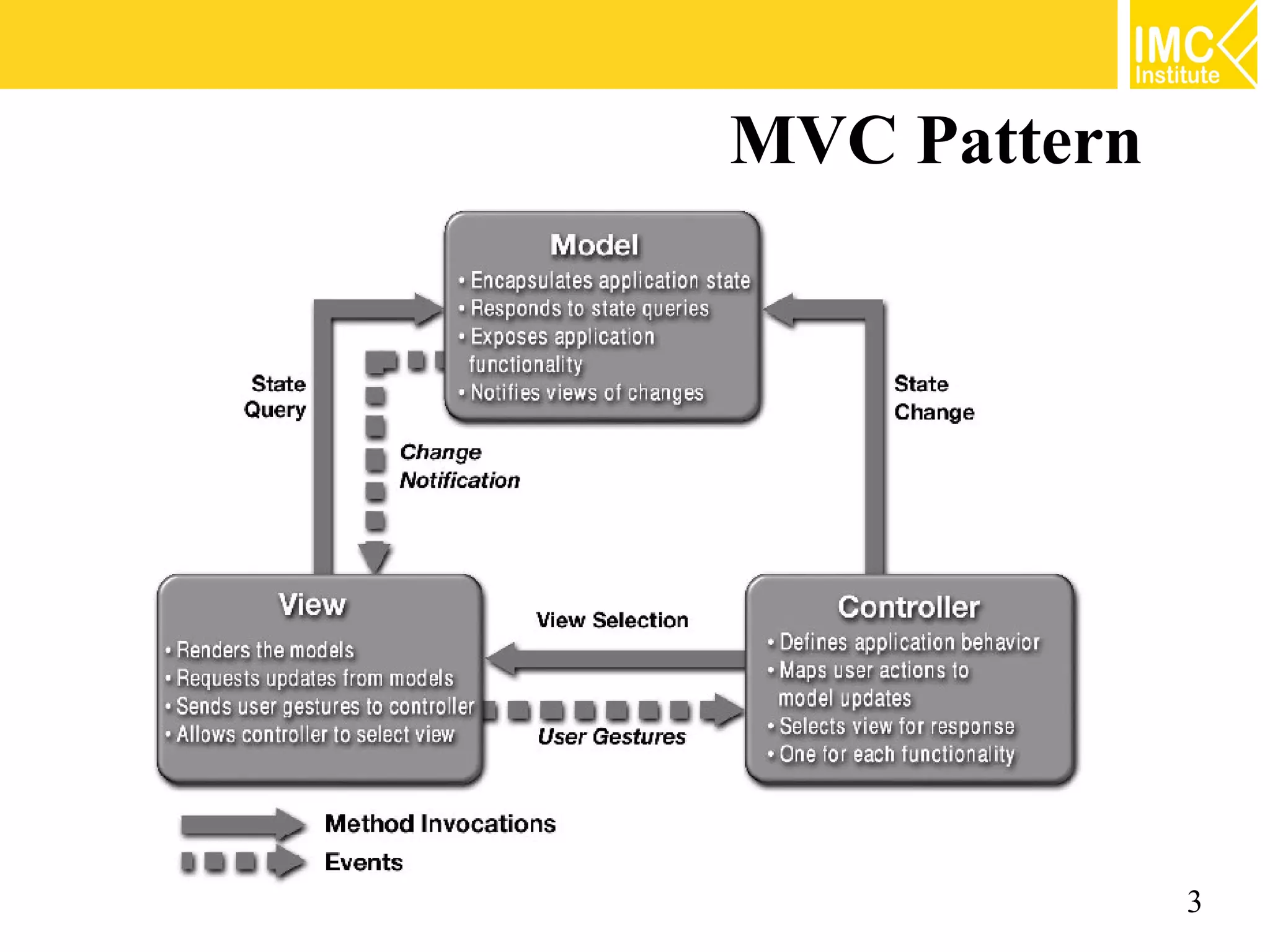
MVC Pattern 3
Three Logical Layers in a Web Application: Model  Model (Business process layer)  Models the data and behavior behind the business process  Responsible for actually doing  Performing DB queries  Calculating the business process  Processing orders  Encapsulate of data and behavior which are independent of presentation 4
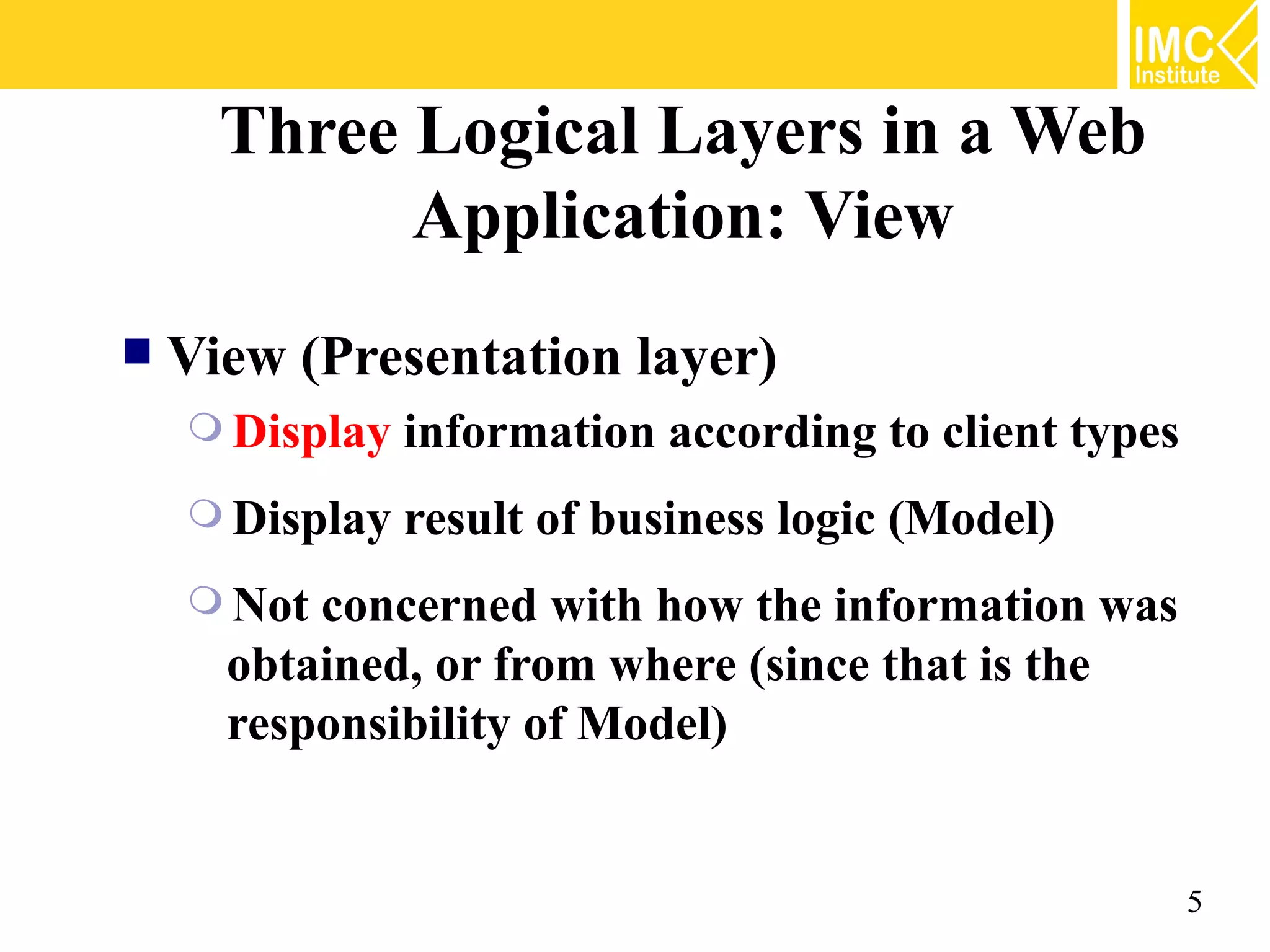
Three Logical Layers in a Web Application: View  View (Presentation layer)  Display information according to client types  Display result of business logic (Model)  Not concerned with how the information was obtained, or from where (since that is the responsibility of Model) 5
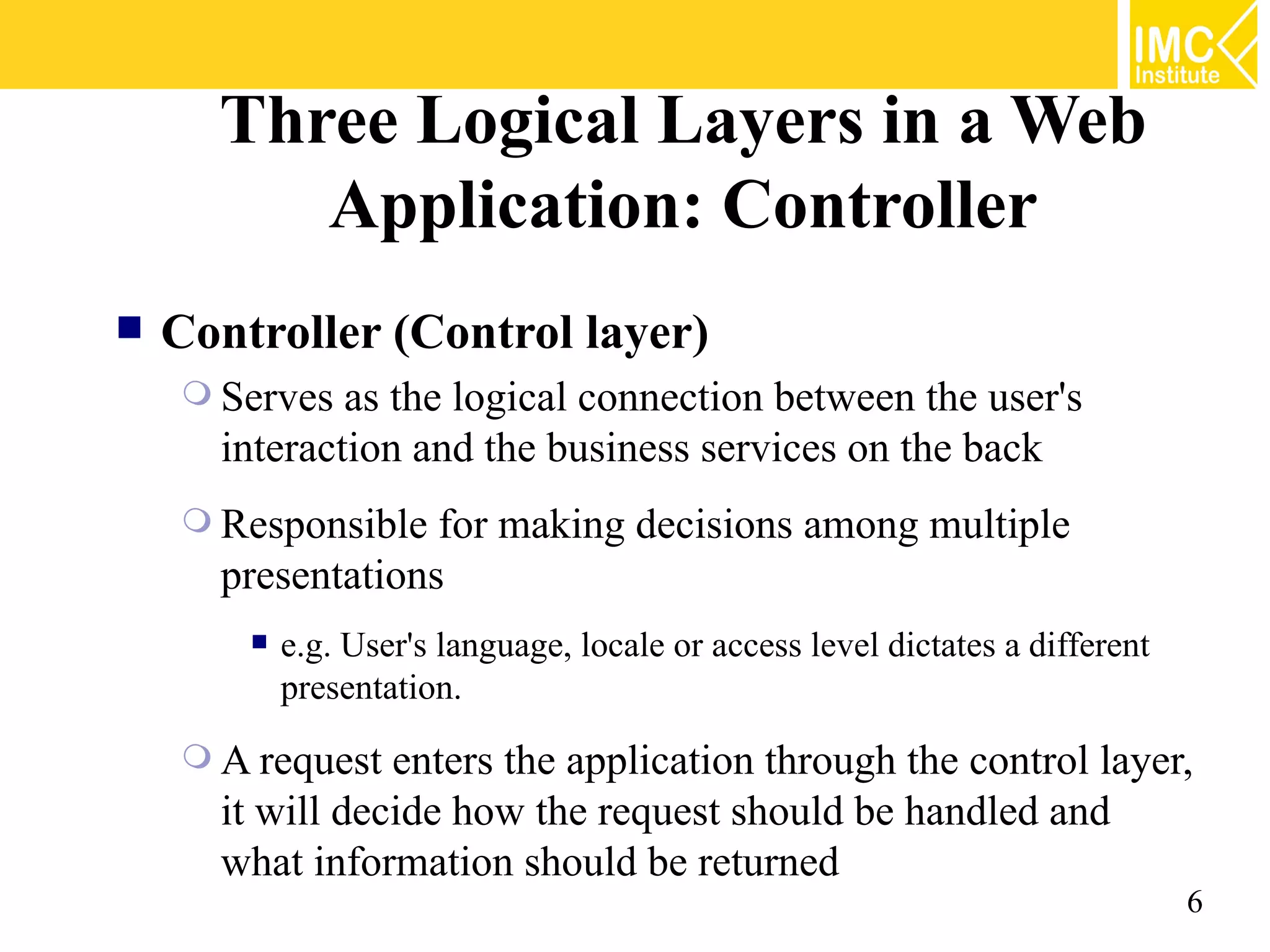
Three Logical Layers in a Web Application: Controller  Controller (Control layer)  Serves as the logical connection between the user's interaction and the business services on the back  Responsible for making decisions among multiple presentations  e.g. User's language, locale or access level dictates a different presentation.  A request enters the application through the control layer, it will decide how the request should be handled and what information should be returned 6
Web Applications  It is often advantageous to treat each layer as an independent portion of your application  Do not confuse logical separation of responsibilities with actual separation of components  Some or of the layers can be combined into single components to reduce application complexity 7
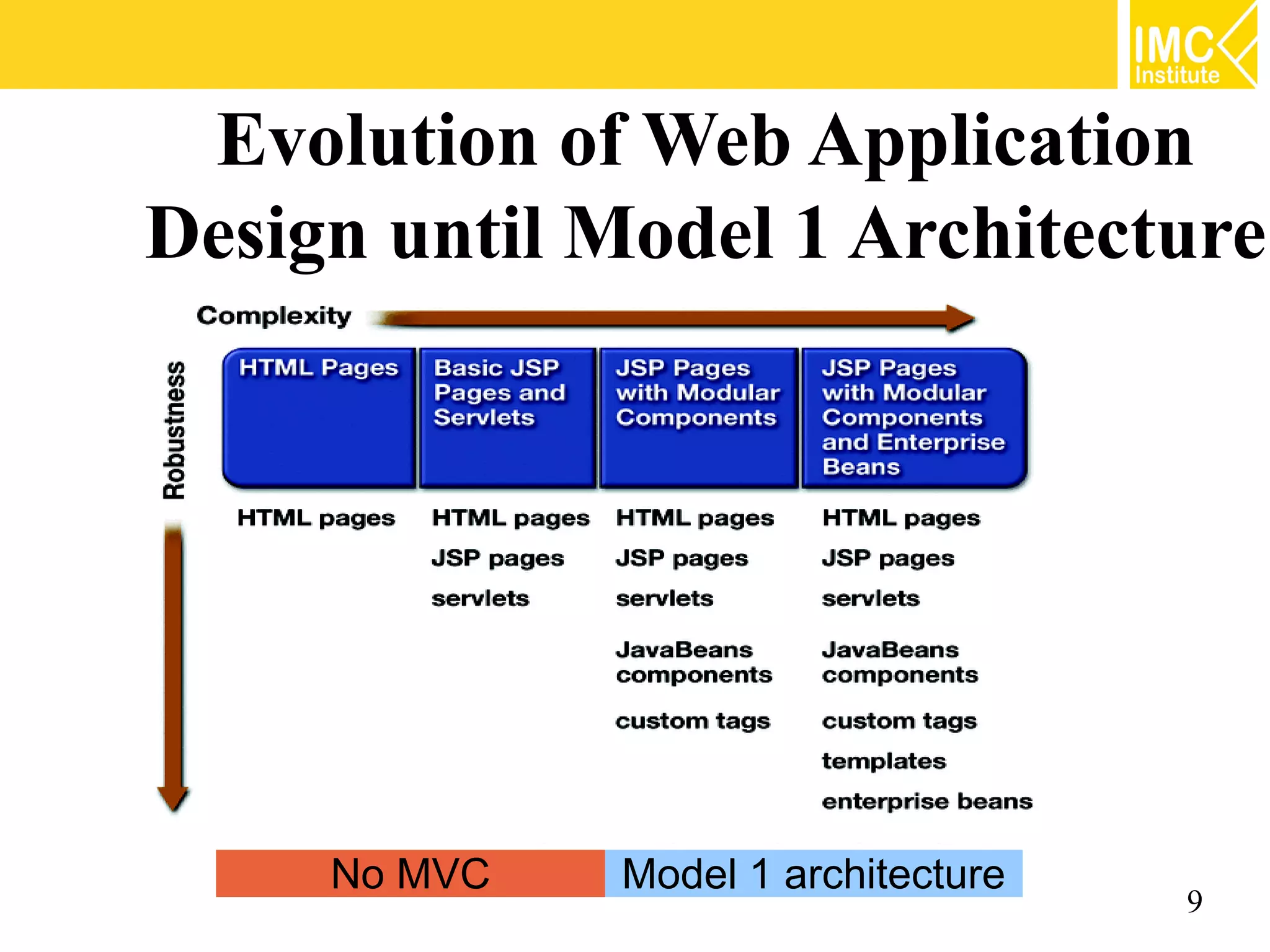
Evolution of MVC Architecture 1.No MVC 2.MVC Model 1 (Page-centric) 3.MVC Model 2 (Servlet-centric) 4.Web application frameworks  Struts 1.Standard-based Web application framework  JavaServer Faces (JSR-127) 8
Evolution of Web Application Design until Model 1 Architecture No MVC Model 1 architecture 9
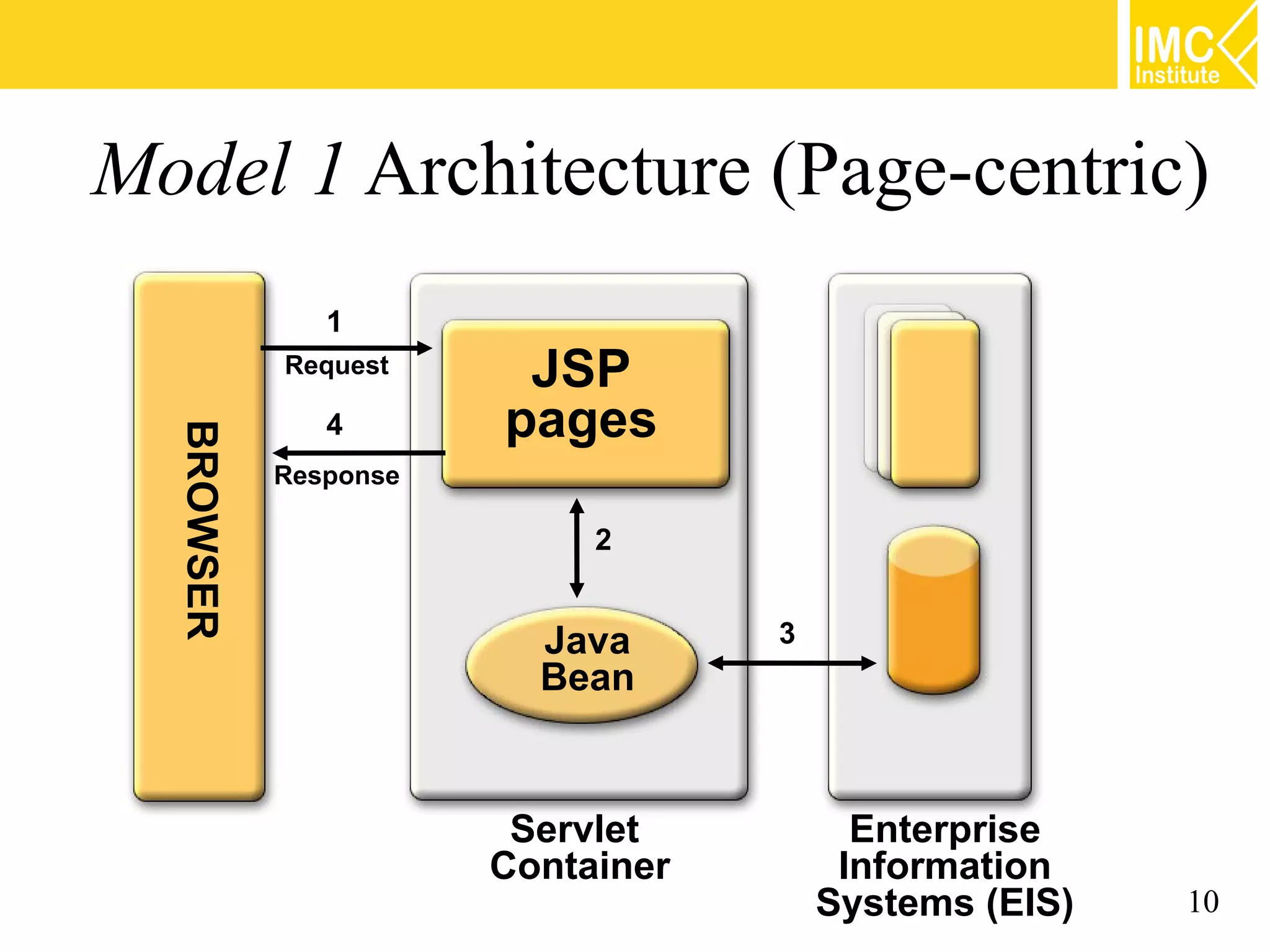
Model 1 Architecture (Page-centric) 1 Request JSP 4 pages BROWSER Response 2 Java 3 Bean Servlet Enterprise Container Information Systems (EIS) 10
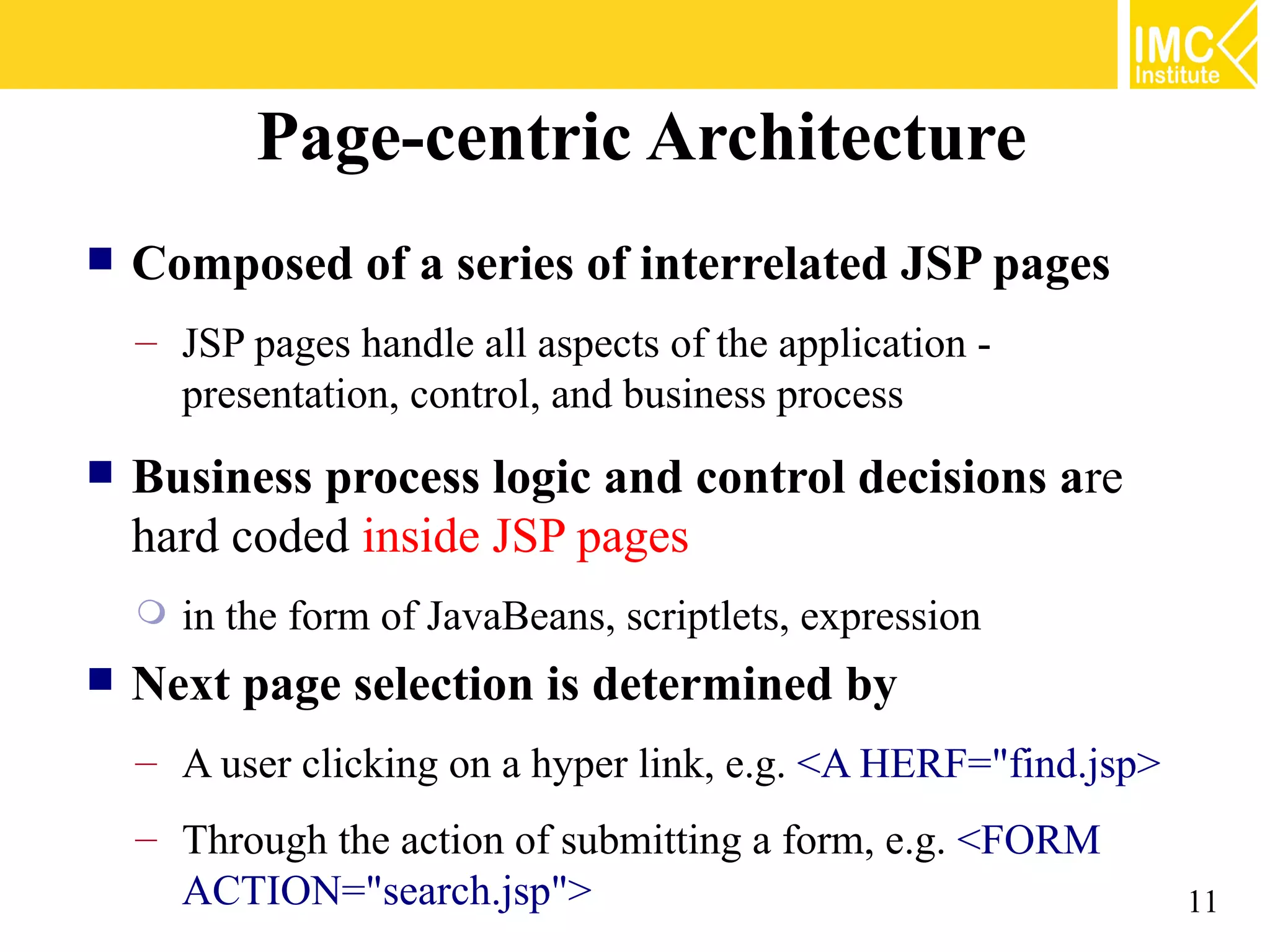
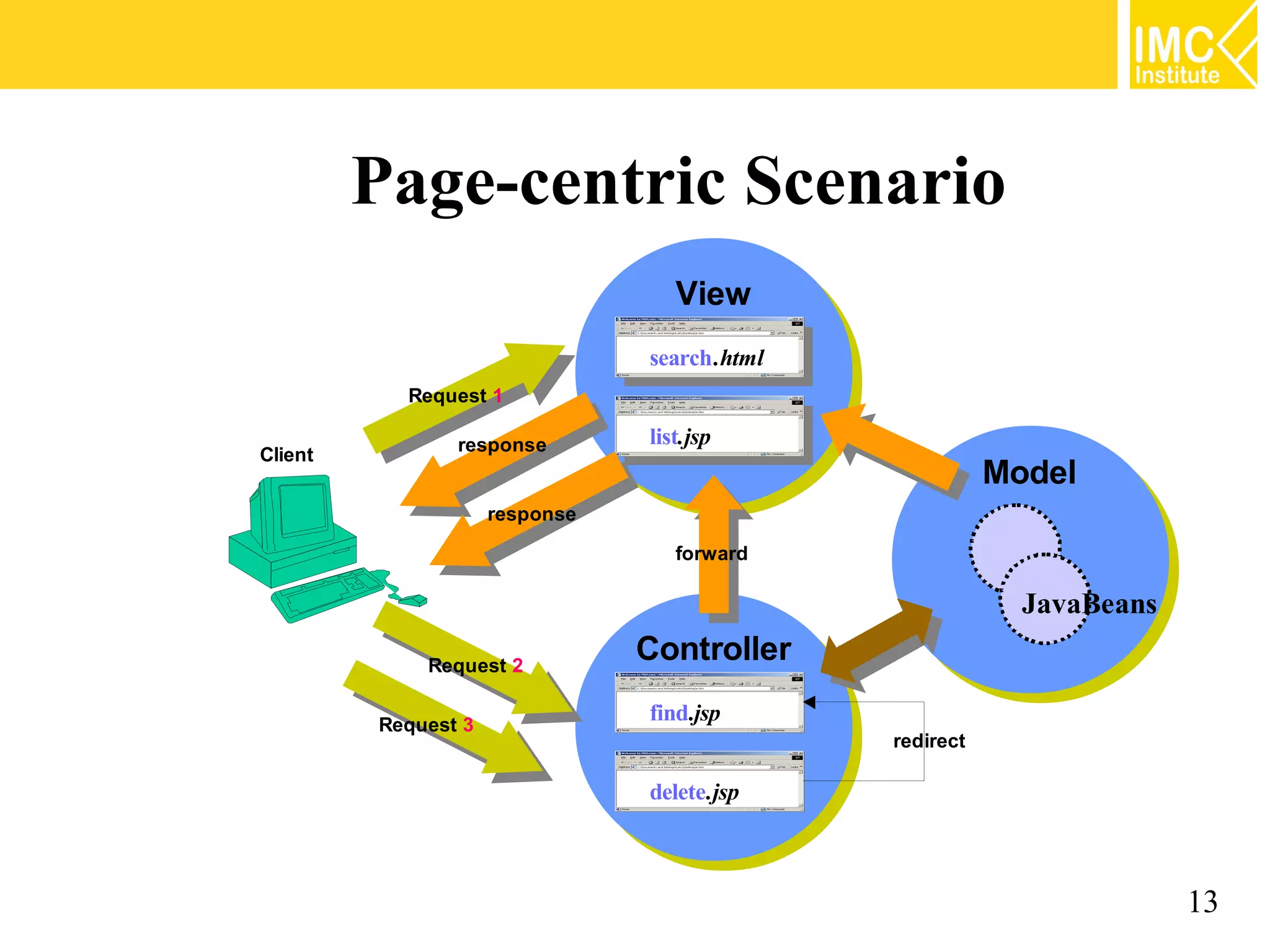
Page-centric Architecture  Composed of a series of interrelated JSP pages – JSP pages handle all aspects of the application - presentation, control, and business process  Business process logic and control decisions are hard coded inside JSP pages  in the form of JavaBeans, scriptlets, expression  Next page selection is determined by – A user clicking on a hyper link, e.g. <A HERF="find.jsp> – Through the action of submitting a form, e.g. <FORM ACTION="search.jsp"> 11
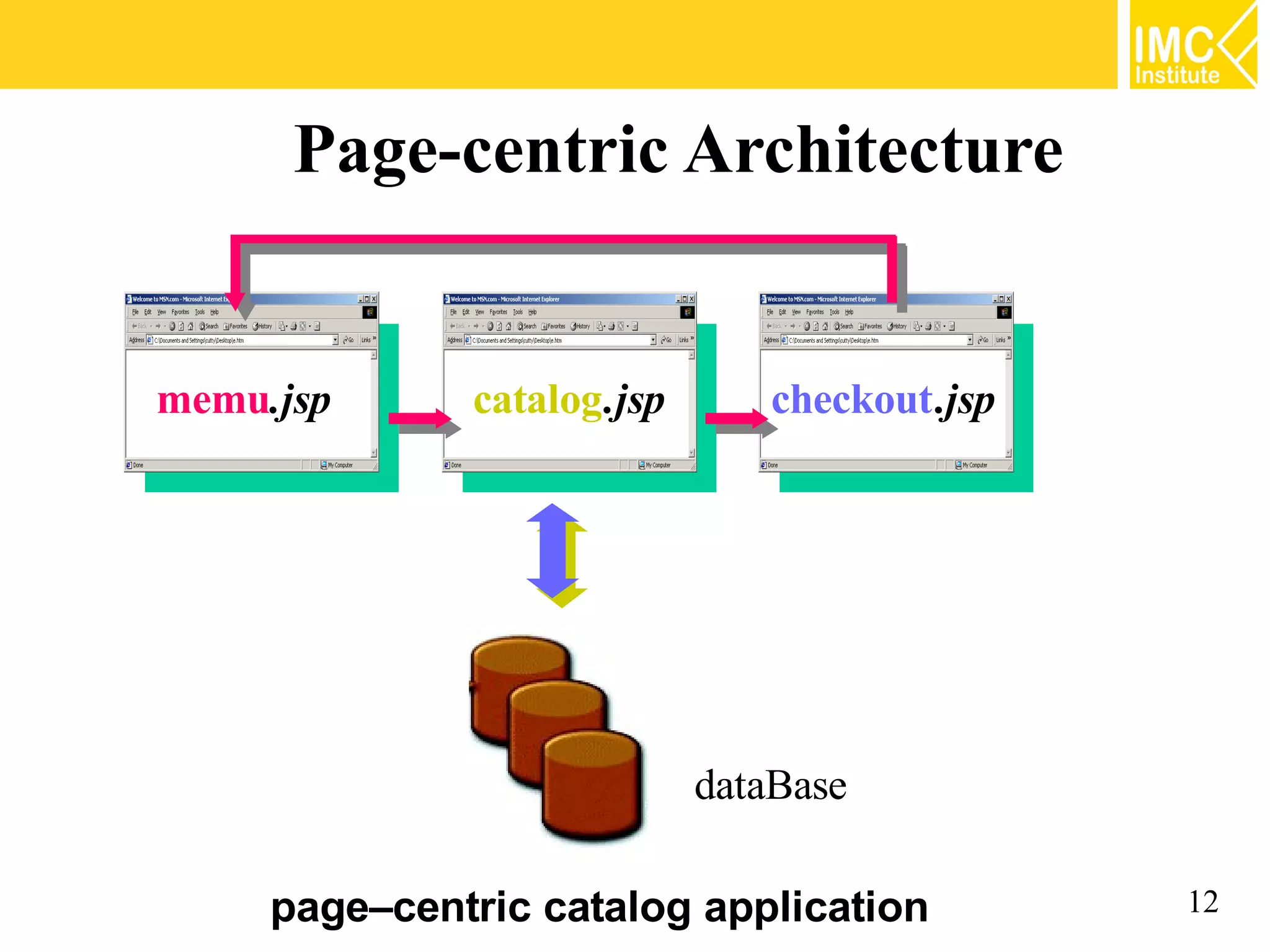
Page-centric Architecture memu.jsp catalog.jsp checkout.jsp dataBase page–centric catalog application 12
Page-centric Scenario View search.html Request 1 response list.jsp Client Model response forward JavaBeans Request 2 Controller Request 3 find.jsp redirect delete.jsp 13
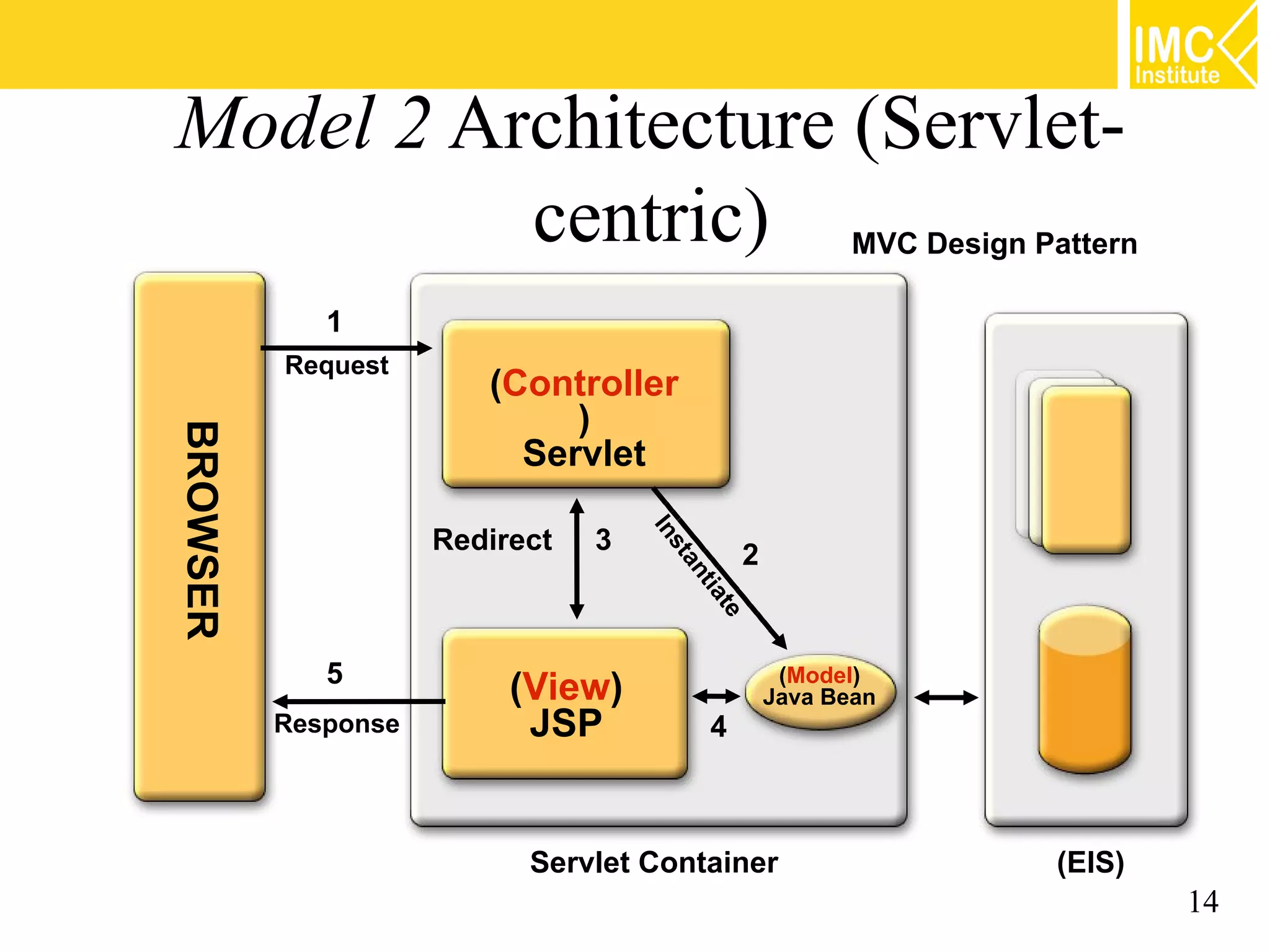
Model 2 Architecture (Servlet- centric) MVC Design Pattern 1 Request (Controller ) BROWSER Servlet Redirect 3 In 2 st an tia te 5 (Model) (View) Java Bean Response JSP 4 Servlet Container (EIS) 14
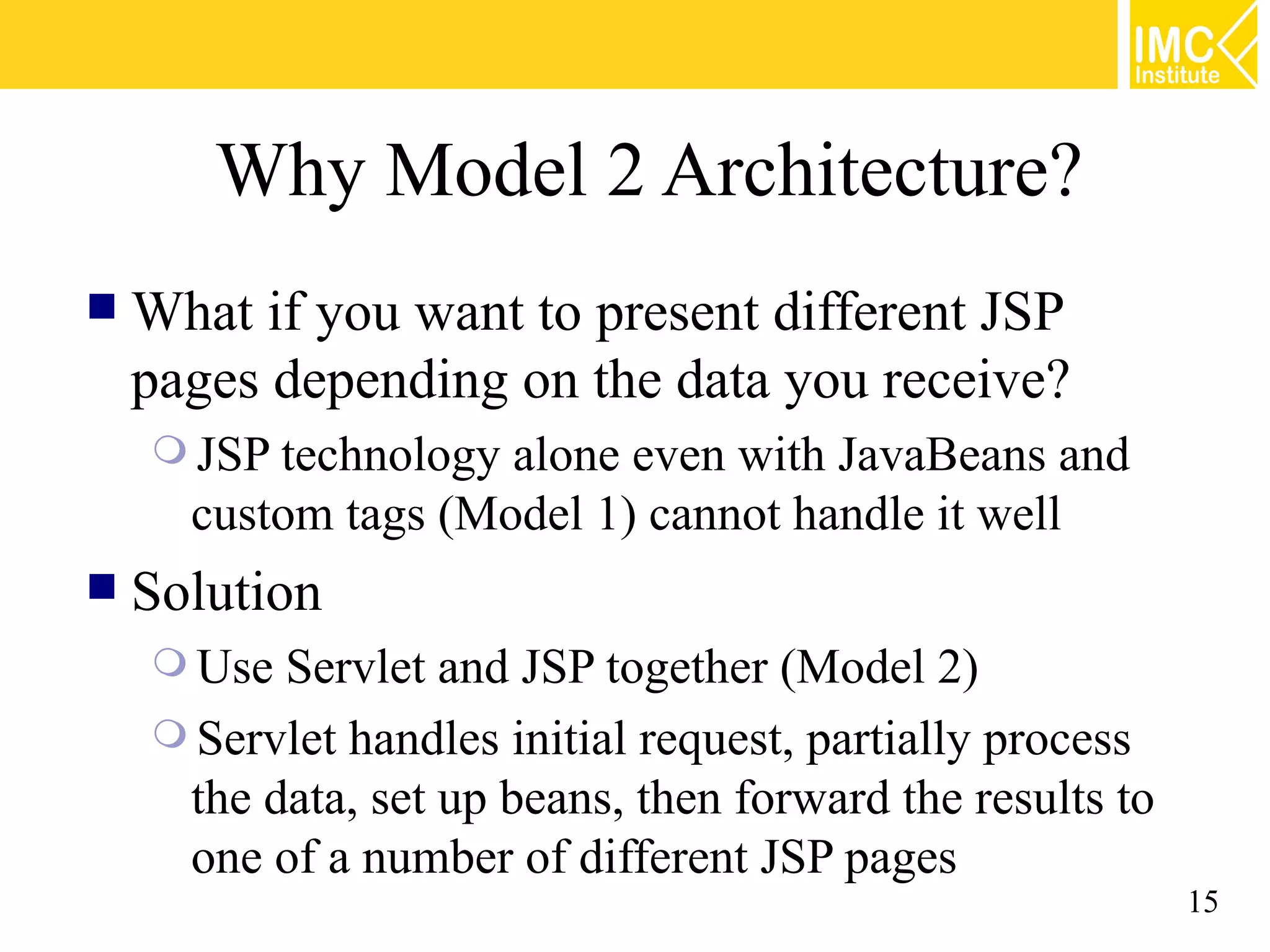
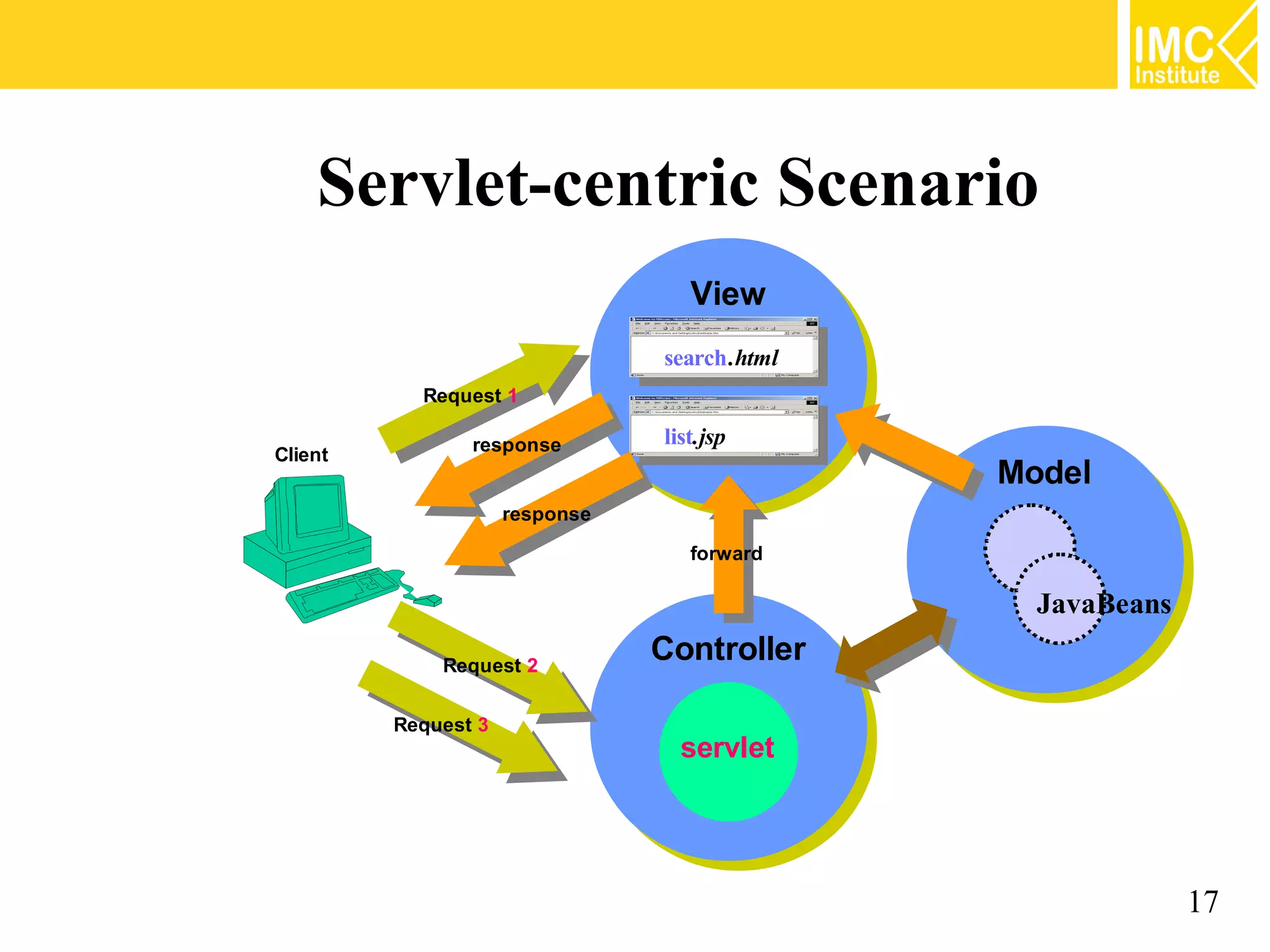
Why Model 2 Architecture?  What if you want to present different JSP pages depending on the data you receive?  JSP technology alone even with JavaBeans and custom tags (Model 1) cannot handle it well  Solution  Use Servlet and JSP together (Model 2)  Servlet handles initial request, partially process the data, set up beans, then forward the results to one of a number of different JSP pages 15
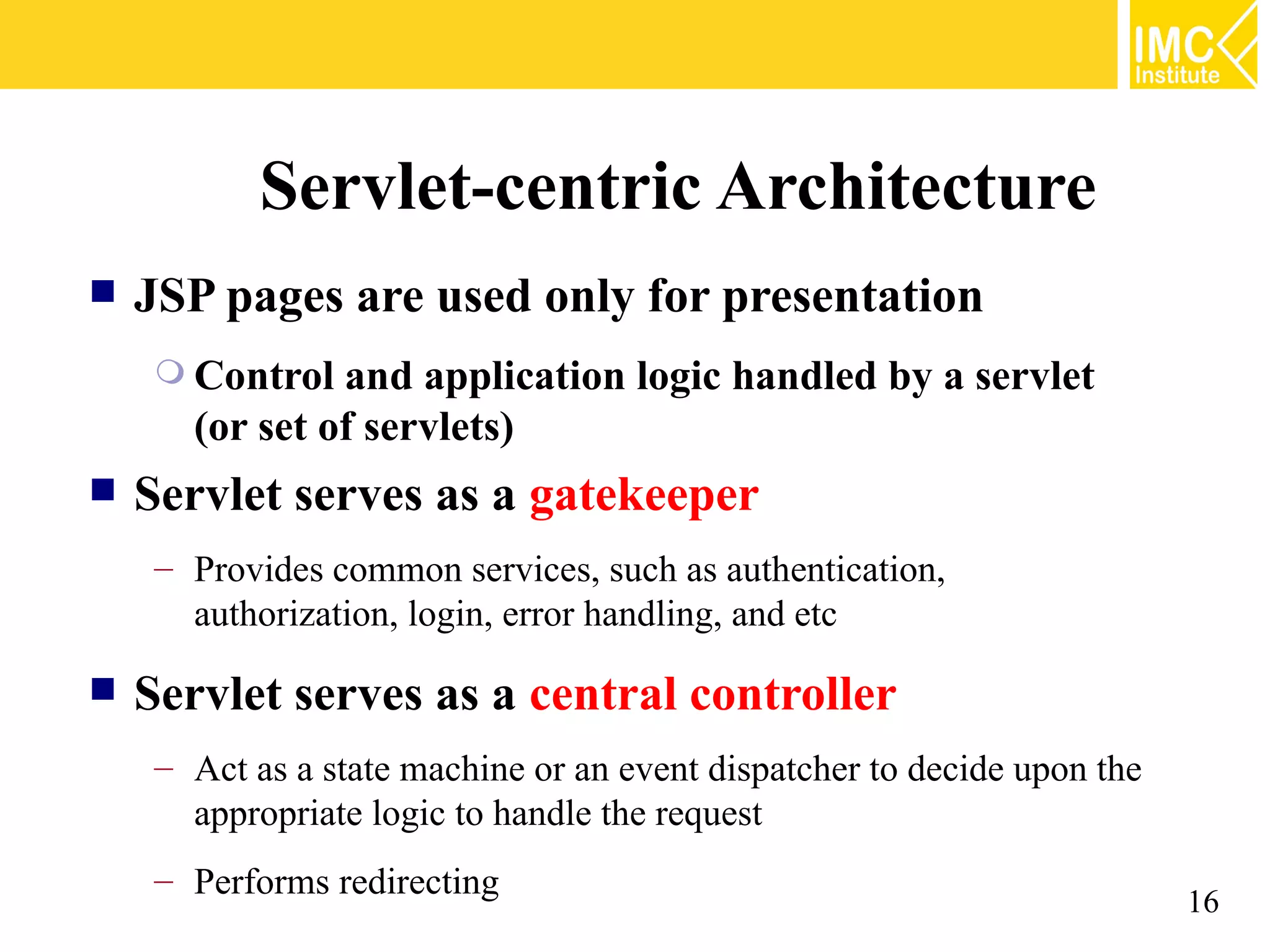
Servlet-centric Architecture  JSP pages are used only for presentation  Control and application logic handled by a servlet (or set of servlets)  Servlet serves as a gatekeeper – Provides common services, such as authentication, authorization, login, error handling, and etc  Servlet serves as a central controller – Act as a state machine or an event dispatcher to decide upon the appropriate logic to handle the request – Performs redirecting 16
Servlet-centric Scenario View search.html Request 1 response list.jsp Client Model response forward JavaBeans Request 2 Controller Request 3 servlet 17
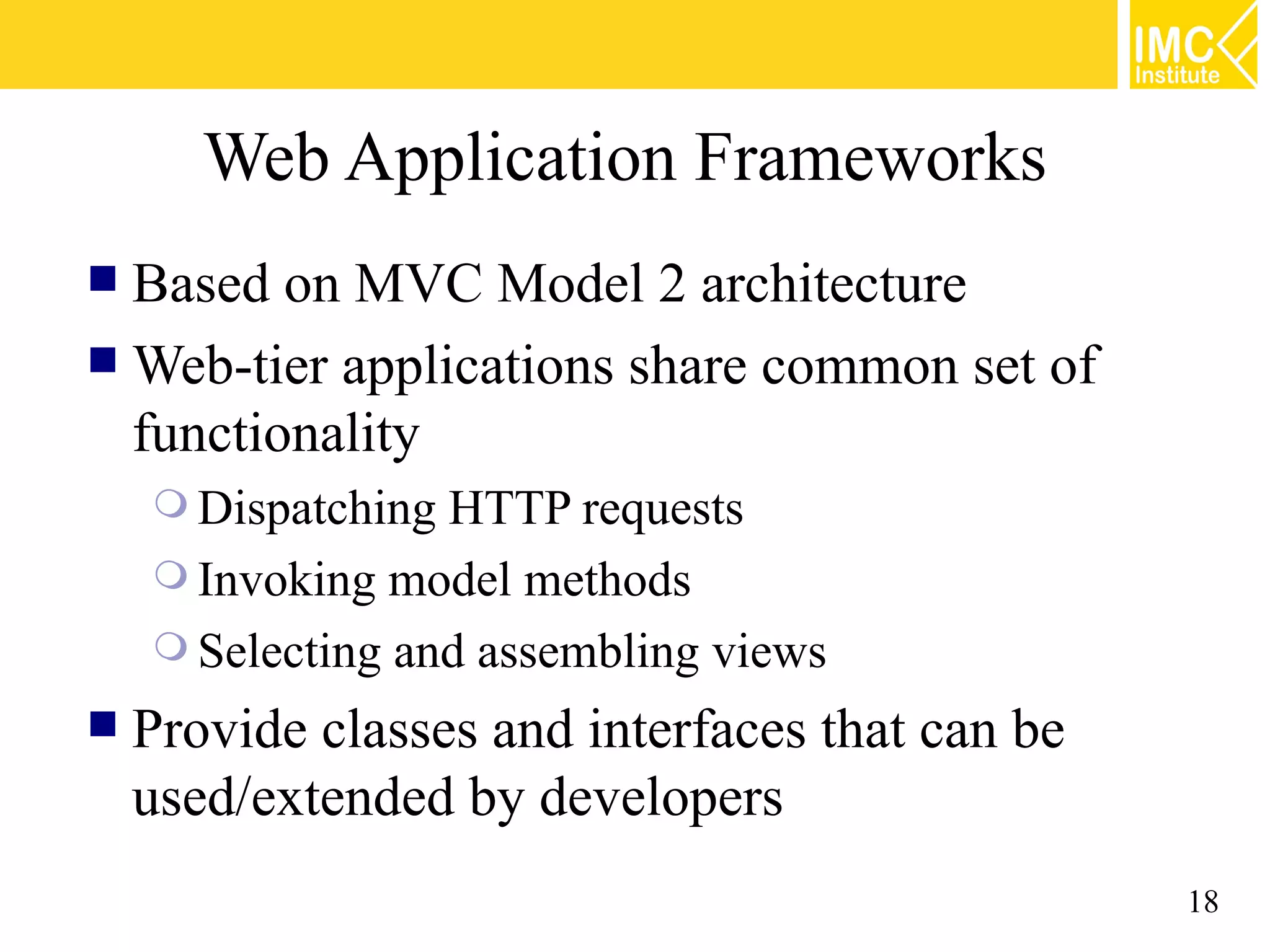
Web Application Frameworks  Based on MVC Model 2 architecture  Web-tier applications share common set of functionality  Dispatching HTTP requests  Invoking model methods  Selecting and assembling views  Provide classes and interfaces that can be used/extended by developers 18
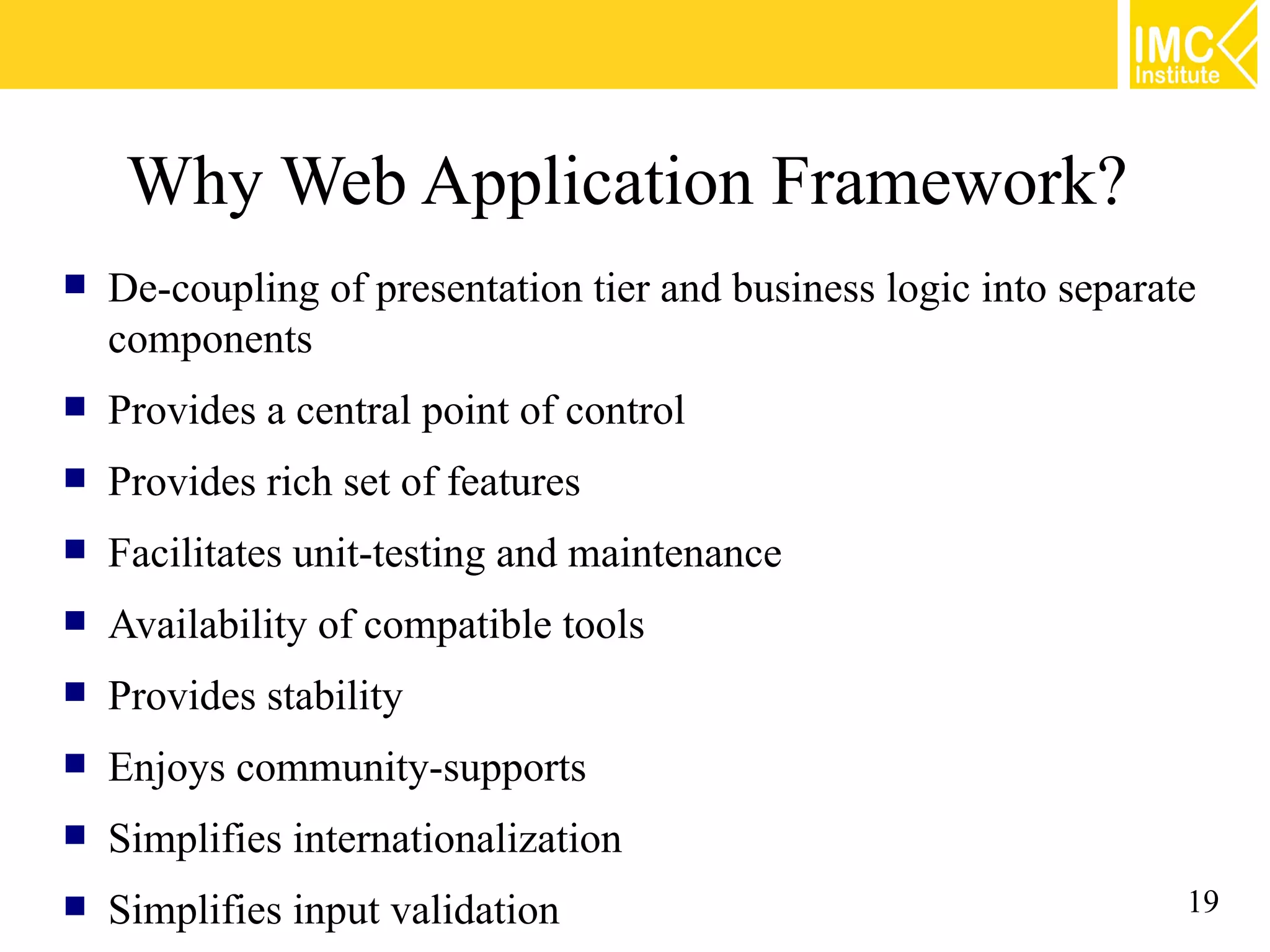
Why Web Application Framework?  De-coupling of presentation tier and business logic into separate components  Provides a central point of control  Provides rich set of features  Facilitates unit-testing and maintenance  Availability of compatible tools  Provides stability  Enjoys community-supports  Simplifies internationalization  Simplifies input validation 19
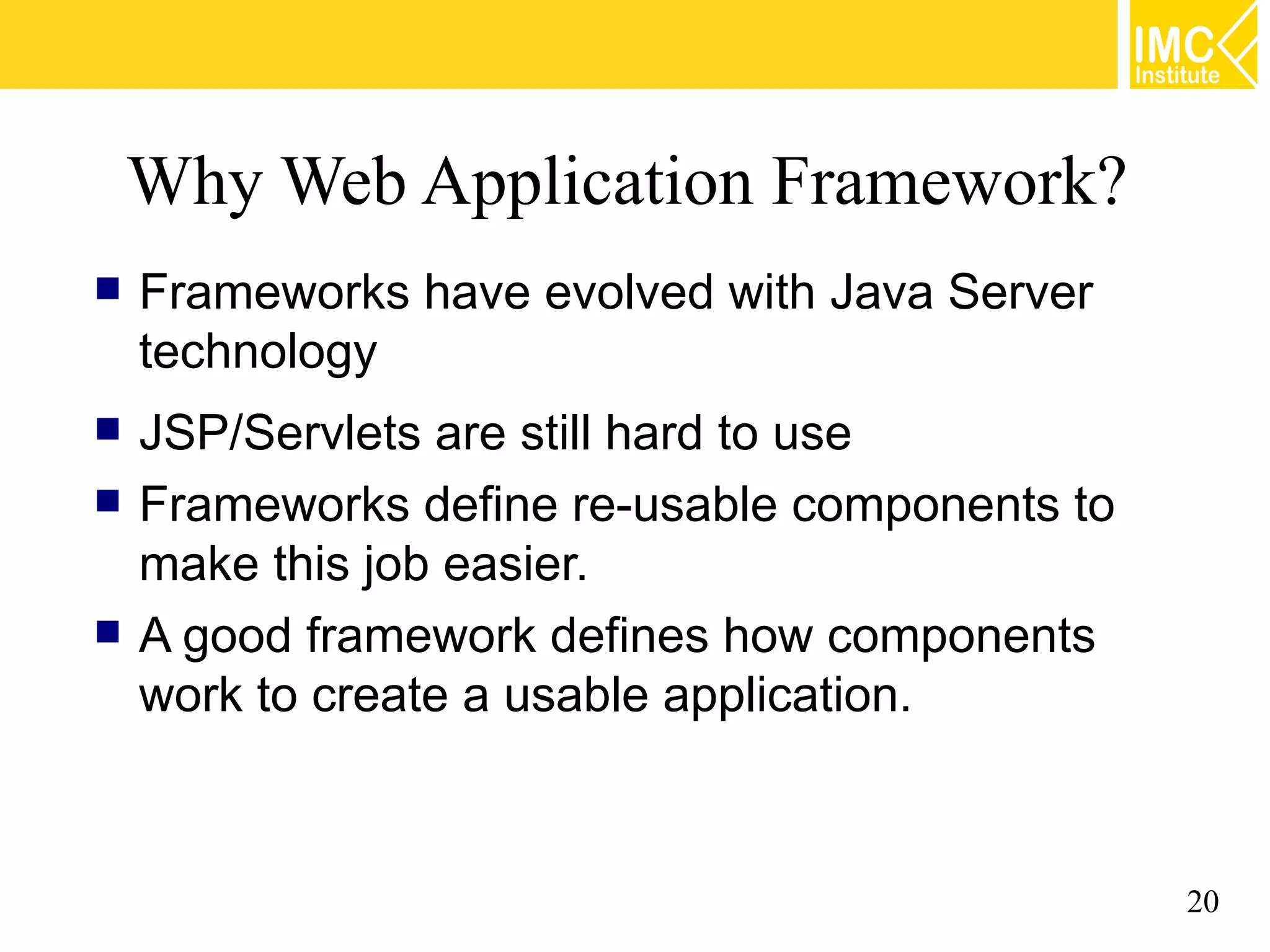
Why Web Application Framework?  Frameworks have evolved with Java Server technology  JSP/Servlets are still hard to use  Frameworks define re-usable components to make this job easier.  A good framework defines how components work to create a usable application. 20
Web Application Frameworks  Apache Struts  JavaServer Faces (JSR-127)  A server side user interface component framework for JavaTM technology-based web applications  Echo  Tapestry 21
Acknowledgement Most contents are borrowed from the presentation slides of Sang Shin, Java™ Technology Evangelist, Sun Microsystems, Inc. 22
Thank you thananum@gmail.com www.facebook.com/imcinstitute www.imcinstitute.com 23

Java Web Programming [6/9] : MVC

  • 1.
    Module 6: MVC ThanisaKruawaisayawan Thanachart Numnonda www.imcinstitute.com
  • 2.
    Objectives  Introduction ofMVC pattern  Evolution of Web Application design architecture  Model 1  Model 2  Application frameworks 2
  • 3.
  • 4.
    Three Logical Layersin a Web Application: Model  Model (Business process layer)  Models the data and behavior behind the business process  Responsible for actually doing  Performing DB queries  Calculating the business process  Processing orders  Encapsulate of data and behavior which are independent of presentation 4
  • 5.
    Three Logical Layersin a Web Application: View  View (Presentation layer)  Display information according to client types  Display result of business logic (Model)  Not concerned with how the information was obtained, or from where (since that is the responsibility of Model) 5
  • 6.
    Three Logical Layersin a Web Application: Controller  Controller (Control layer)  Serves as the logical connection between the user's interaction and the business services on the back  Responsible for making decisions among multiple presentations  e.g. User's language, locale or access level dictates a different presentation.  A request enters the application through the control layer, it will decide how the request should be handled and what information should be returned 6
  • 7.
    Web Applications  Itis often advantageous to treat each layer as an independent portion of your application  Do not confuse logical separation of responsibilities with actual separation of components  Some or of the layers can be combined into single components to reduce application complexity 7
  • 8.
    Evolution of MVCArchitecture 1.No MVC 2.MVC Model 1 (Page-centric) 3.MVC Model 2 (Servlet-centric) 4.Web application frameworks  Struts 1.Standard-based Web application framework  JavaServer Faces (JSR-127) 8
  • 9.
    Evolution of WebApplication Design until Model 1 Architecture No MVC Model 1 architecture 9
  • 10.
    Model 1 Architecture(Page-centric) 1 Request JSP 4 pages BROWSER Response 2 Java 3 Bean Servlet Enterprise Container Information Systems (EIS) 10
  • 11.
    Page-centric Architecture  Composed of a series of interrelated JSP pages – JSP pages handle all aspects of the application - presentation, control, and business process  Business process logic and control decisions are hard coded inside JSP pages  in the form of JavaBeans, scriptlets, expression  Next page selection is determined by – A user clicking on a hyper link, e.g. <A HERF="find.jsp> – Through the action of submitting a form, e.g. <FORM ACTION="search.jsp"> 11
  • 12.
    Page-centric Architecture memu.jsp catalog.jsp checkout.jsp dataBase page–centric catalog application 12
  • 13.
    Page-centric Scenario View search.html Request 1 response list.jsp Client Model response forward JavaBeans Request 2 Controller Request 3 find.jsp redirect delete.jsp 13
  • 14.
    Model 2 Architecture(Servlet- centric) MVC Design Pattern 1 Request (Controller ) BROWSER Servlet Redirect 3 In 2 st an tia te 5 (Model) (View) Java Bean Response JSP 4 Servlet Container (EIS) 14
  • 15.
    Why Model 2Architecture?  What if you want to present different JSP pages depending on the data you receive?  JSP technology alone even with JavaBeans and custom tags (Model 1) cannot handle it well  Solution  Use Servlet and JSP together (Model 2)  Servlet handles initial request, partially process the data, set up beans, then forward the results to one of a number of different JSP pages 15
  • 16.
    Servlet-centric Architecture  JSP pages are used only for presentation  Control and application logic handled by a servlet (or set of servlets)  Servlet serves as a gatekeeper – Provides common services, such as authentication, authorization, login, error handling, and etc  Servlet serves as a central controller – Act as a state machine or an event dispatcher to decide upon the appropriate logic to handle the request – Performs redirecting 16
  • 17.
    Servlet-centric Scenario View search.html Request 1 response list.jsp Client Model response forward JavaBeans Request 2 Controller Request 3 servlet 17
  • 18.
    Web Application Frameworks Based on MVC Model 2 architecture  Web-tier applications share common set of functionality  Dispatching HTTP requests  Invoking model methods  Selecting and assembling views  Provide classes and interfaces that can be used/extended by developers 18
  • 19.
    Why Web ApplicationFramework?  De-coupling of presentation tier and business logic into separate components  Provides a central point of control  Provides rich set of features  Facilitates unit-testing and maintenance  Availability of compatible tools  Provides stability  Enjoys community-supports  Simplifies internationalization  Simplifies input validation 19
  • 20.
    Why Web ApplicationFramework?  Frameworks have evolved with Java Server technology  JSP/Servlets are still hard to use  Frameworks define re-usable components to make this job easier.  A good framework defines how components work to create a usable application. 20
  • 21.
    Web Application Frameworks Apache Struts  JavaServer Faces (JSR-127)  A server side user interface component framework for JavaTM technology-based web applications  Echo  Tapestry 21
  • 22.
    Acknowledgement Most contentsare borrowed from the presentation slides of Sang Shin, Java™ Technology Evangelist, Sun Microsystems, Inc. 22
  • 23.
    Thank you thananum@gmail.com www.facebook.com/imcinstitute www.imcinstitute.com 23