2016 Winter LAB #5 Prepared by: Berk Soysal
2016 Winter
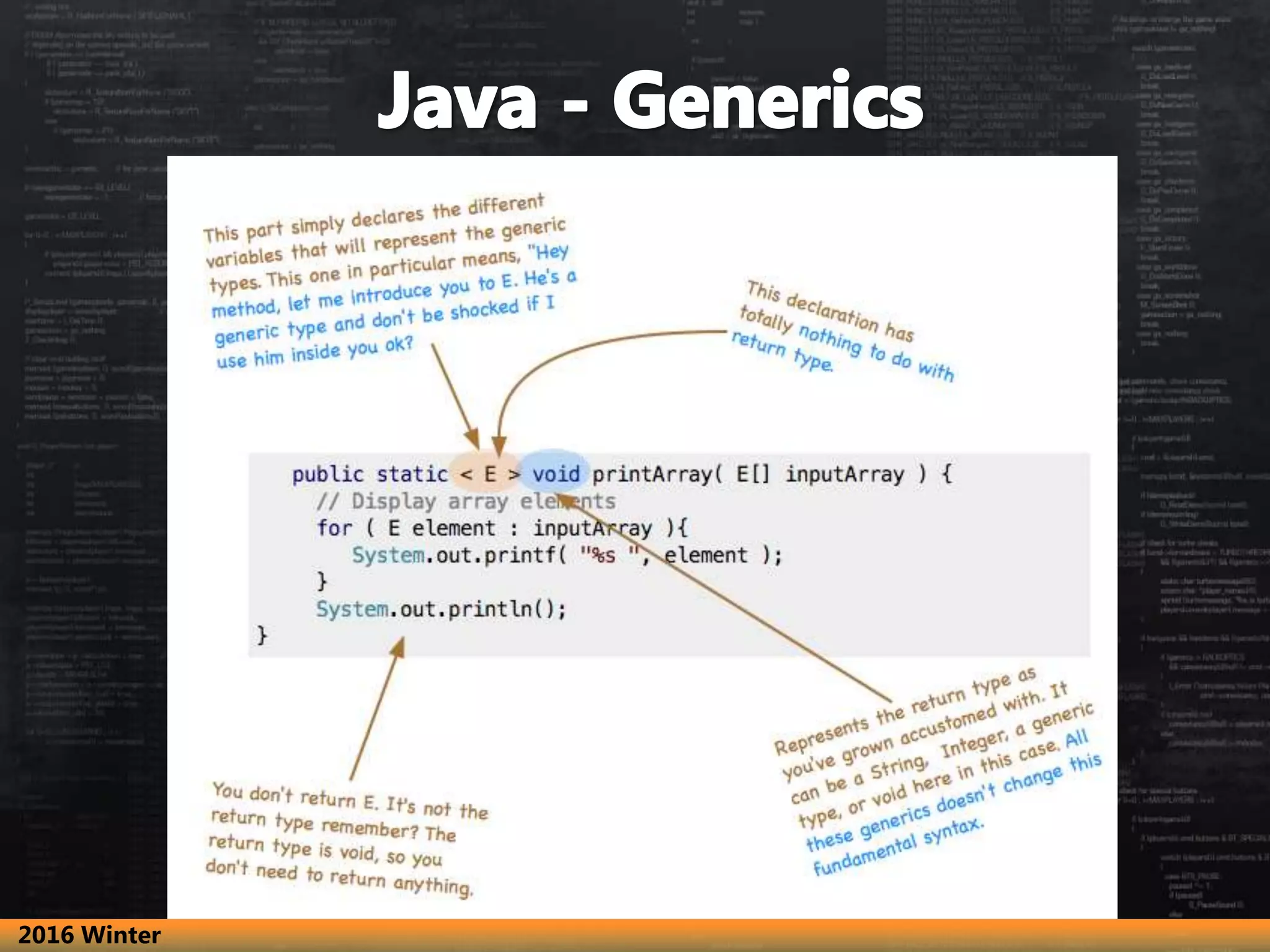
Java Generic methods and generic classes enable programmers to specify, with a single method declaration, a set of related methods or, with a single class declaration, a set of related types, respectively. public class GenericMethodTest { public static < E > void printArray( E[] inputArray ) { for ( E element : inputArray ){ System.out.print( "%s ", element ); } } public static void main( String args[] ) { Integer[] intArray = { 1, 2, 3, 4, 5 }; Character[] charArray = { 'H', 'E', 'L', 'L', 'O' }; printArray( intArray ); // pass an Integer array printArray(charArray); // pass a Character array } } E becomes Integer and then Character 2016 Winter
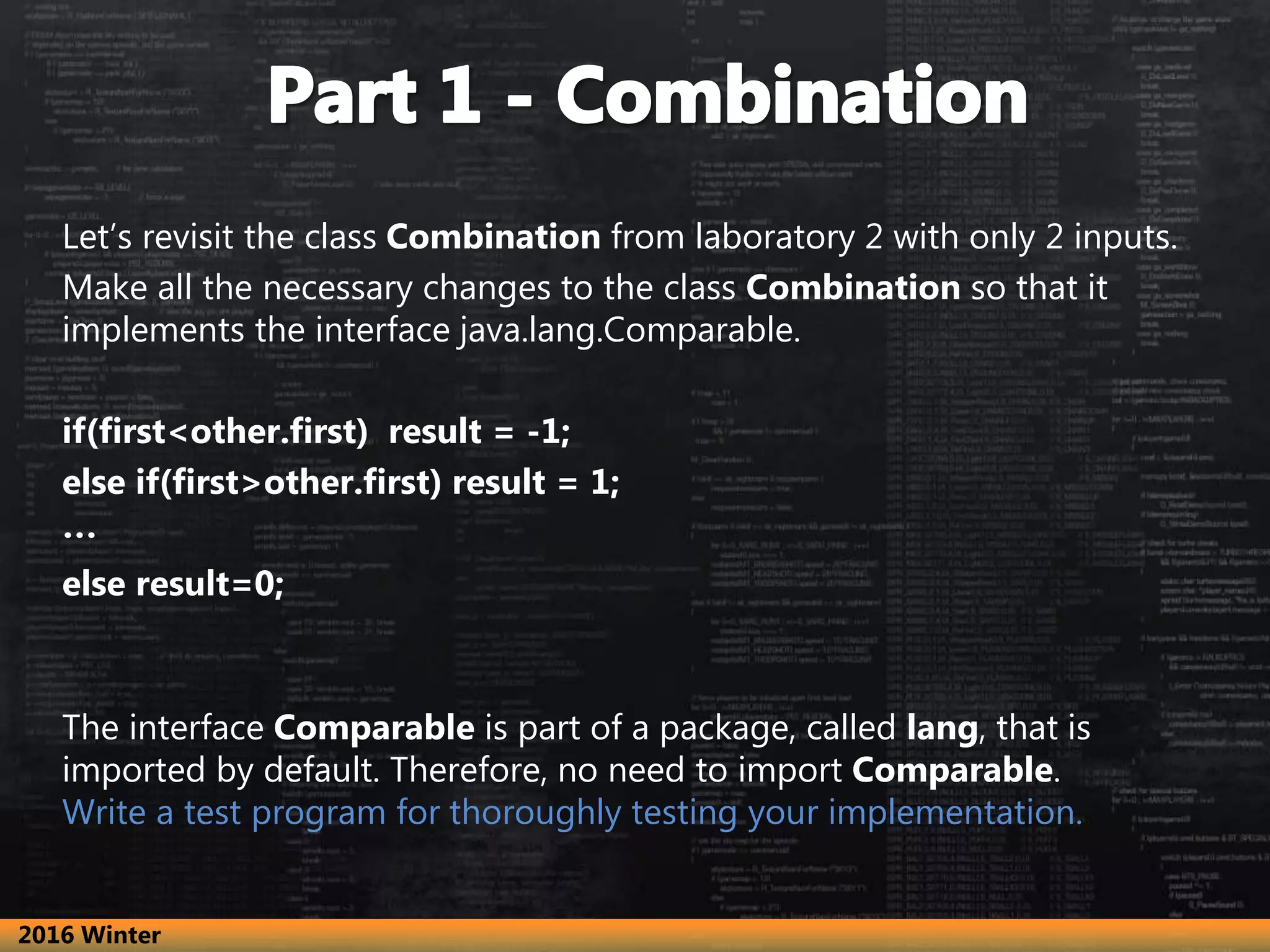
Let’s revisit the class Combination from laboratory 2 with only 2 inputs. Make all the necessary changes to the class Combination so that it implements the interface java.lang.Comparable. if(first<other.first) result = -1; else if(first>other.first) result = 1; … else result=0; The interface Comparable is part of a package, called lang, that is imported by default. Therefore, no need to import Comparable. Write a test program for thoroughly testing your implementation. 2016 Winter
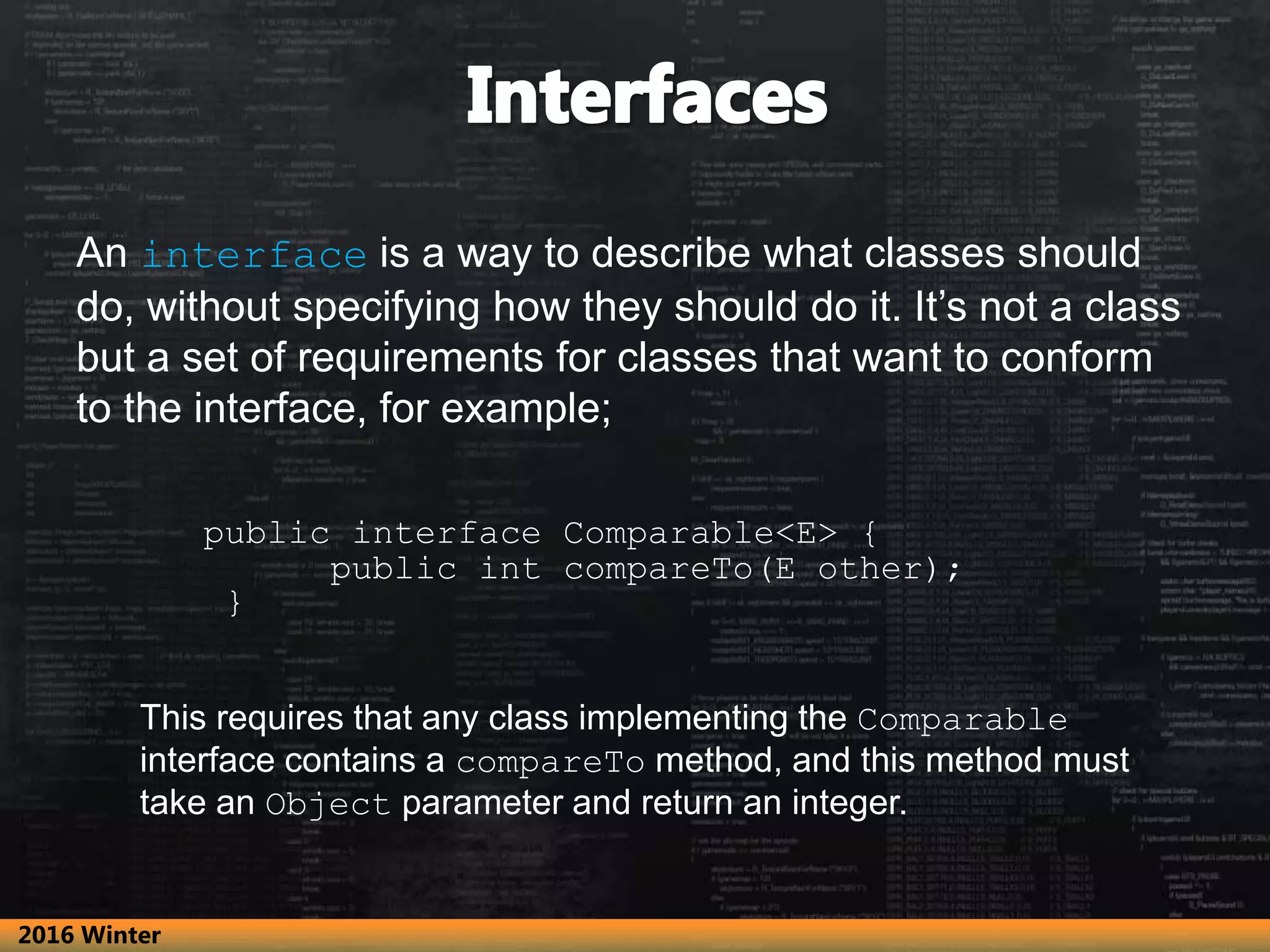
An interface is a way to describe what classes should do, without specifying how they should do it. It’s not a class but a set of requirements for classes that want to conform to the interface, for example; public interface Comparable<E> { public int compareTo(E other); } This requires that any class implementing the Comparable interface contains a compareTo method, and this method must take an Object parameter and return an integer. 2016 Winter
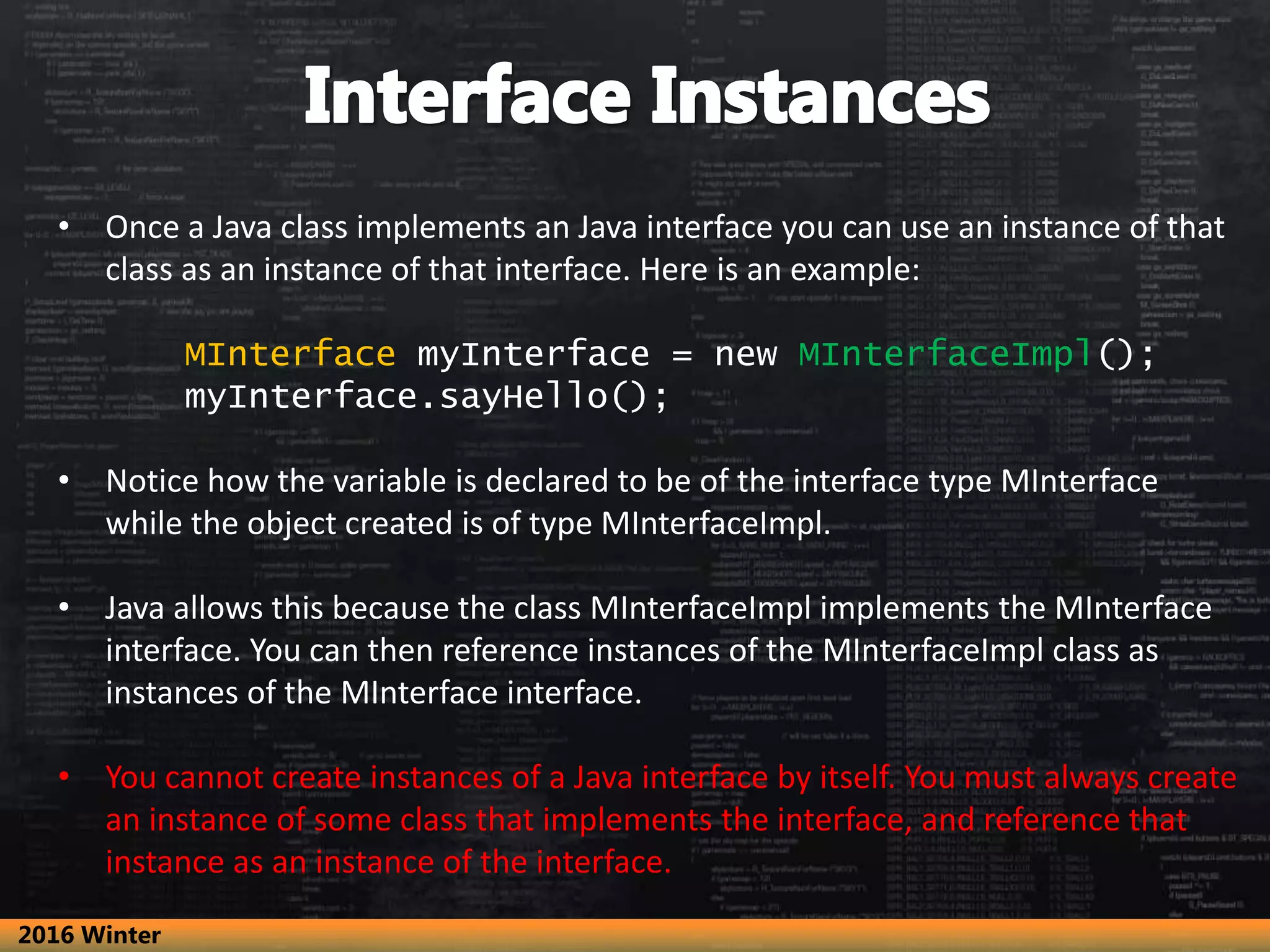
• Once a Java class implements an Java interface you can use an instance of that class as an instance of that interface. Here is an example: MInterface myInterface = new MInterfaceImpl(); myInterface.sayHello(); • Notice how the variable is declared to be of the interface type MInterface while the object created is of type MInterfaceImpl. • Java allows this because the class MInterfaceImpl implements the MInterface interface. You can then reference instances of the MInterfaceImpl class as instances of the MInterface interface. • You cannot create instances of a Java interface by itself. You must always create an instance of some class that implements the interface, and reference that instance as an instance of the interface. 2016 Winter
A stack is a data structure that allows data to be inserted (a 'push' operation), and removed (a 'pop' operation). Are Stacks LIFO or FIFO ? - They are Last In First Out 2016 Winter
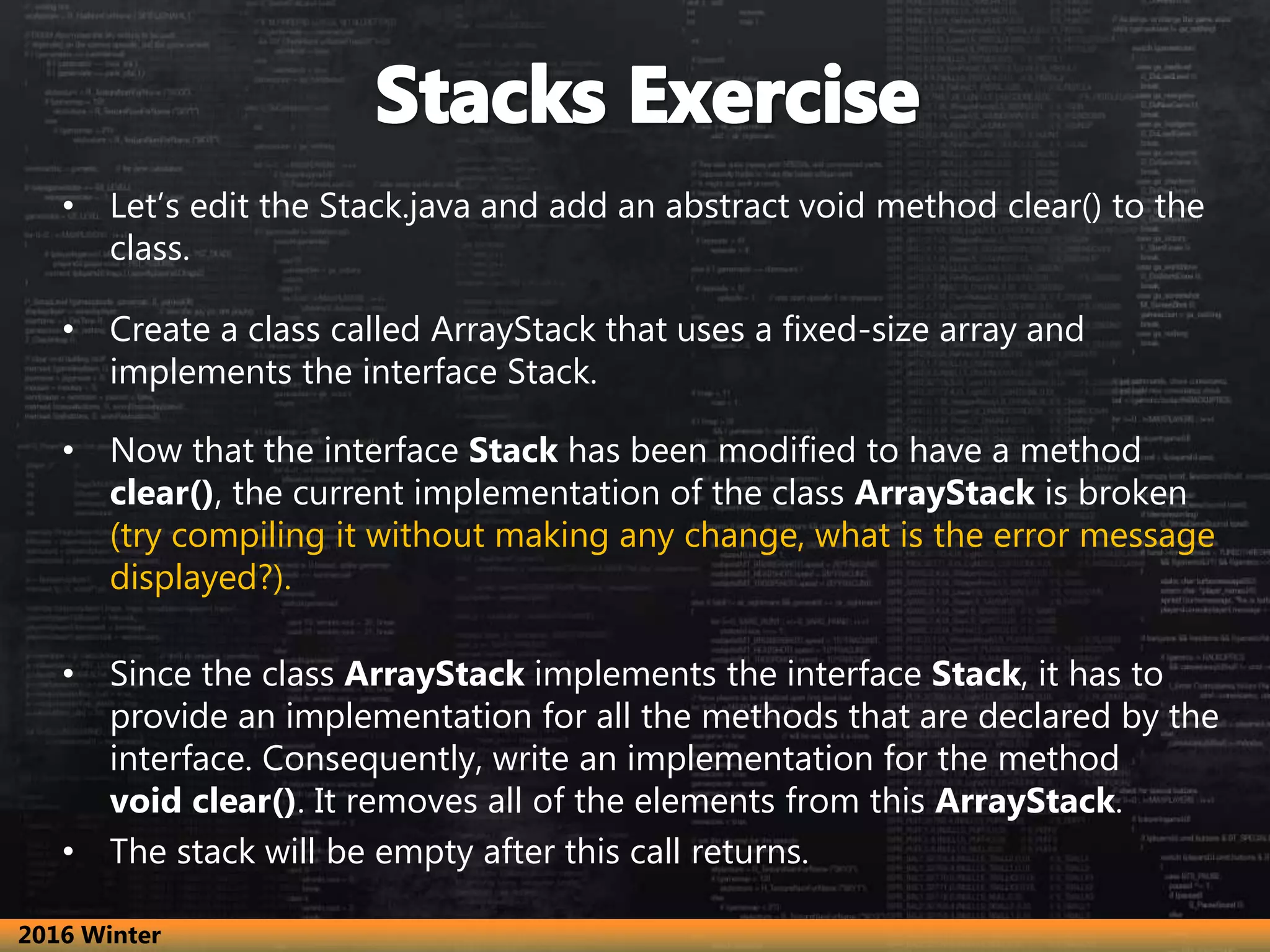
• Let’s edit the Stack.java and add an abstract void method clear() to the class. • Create a class called ArrayStack that uses a fixed-size array and implements the interface Stack. • Now that the interface Stack has been modified to have a method clear(), the current implementation of the class ArrayStack is broken (try compiling it without making any change, what is the error message displayed?). • Since the class ArrayStack implements the interface Stack, it has to provide an implementation for all the methods that are declared by the interface. Consequently, write an implementation for the method void clear(). It removes all of the elements from this ArrayStack. • The stack will be empty after this call returns. 2016 Winter
• The class Balanced contains a simple algorithm to validate expressions. • Observation: for an expression consisting of well balanced parentheses the number of opening ones is the same as the closing ones. > run Balanced {[()]} algo1( "{[()]}" ) -> true 2016 Winter
• Perform the same operation using the ArrayStack.java and Stack.java > run Balanced {[()]} algo1( "{[()]}" ) -> true algo2( "{[()]}" ) -> true 2016 Winter
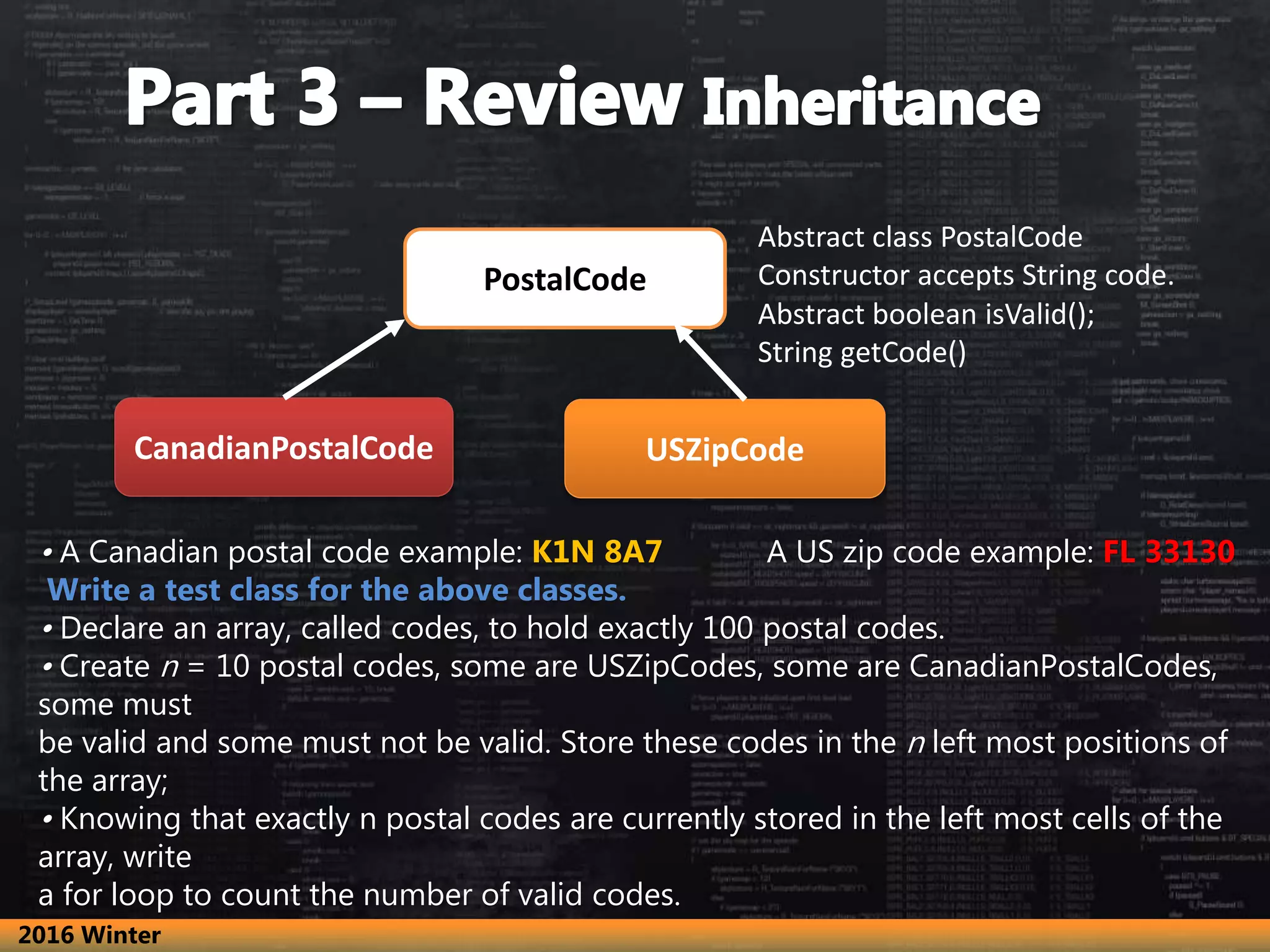
• A Canadian postal code example: K1N 8A7 A US zip code example: FL 33130 Write a test class for the above classes. • Declare an array, called codes, to hold exactly 100 postal codes. • Create n = 10 postal codes, some are USZipCodes, some are CanadianPostalCodes, some must be valid and some must not be valid. Store these codes in the n left most positions of the array; • Knowing that exactly n postal codes are currently stored in the left most cells of the array, write a for loop to count the number of valid codes. PostalCode CanadianPostalCode USZipCode Abstract class PostalCode Constructor accepts String code. Abstract boolean isValid(); String getCode() 2016 Winter
Java Tutorial Lab 5

Java Tutorial Lab 5

  • 1.
  • 2.
  • 3.
    Java Generic methodsand generic classes enable programmers to specify, with a single method declaration, a set of related methods or, with a single class declaration, a set of related types, respectively. public class GenericMethodTest { public static < E > void printArray( E[] inputArray ) { for ( E element : inputArray ){ System.out.print( "%s ", element ); } } public static void main( String args[] ) { Integer[] intArray = { 1, 2, 3, 4, 5 }; Character[] charArray = { 'H', 'E', 'L', 'L', 'O' }; printArray( intArray ); // pass an Integer array printArray(charArray); // pass a Character array } } E becomes Integer and then Character 2016 Winter
  • 4.
    Let’s revisit theclass Combination from laboratory 2 with only 2 inputs. Make all the necessary changes to the class Combination so that it implements the interface java.lang.Comparable. if(first<other.first) result = -1; else if(first>other.first) result = 1; … else result=0; The interface Comparable is part of a package, called lang, that is imported by default. Therefore, no need to import Comparable. Write a test program for thoroughly testing your implementation. 2016 Winter
  • 5.
    An interface isa way to describe what classes should do, without specifying how they should do it. It’s not a class but a set of requirements for classes that want to conform to the interface, for example; public interface Comparable<E> { public int compareTo(E other); } This requires that any class implementing the Comparable interface contains a compareTo method, and this method must take an Object parameter and return an integer. 2016 Winter
  • 6.
    • Once aJava class implements an Java interface you can use an instance of that class as an instance of that interface. Here is an example: MInterface myInterface = new MInterfaceImpl(); myInterface.sayHello(); • Notice how the variable is declared to be of the interface type MInterface while the object created is of type MInterfaceImpl. • Java allows this because the class MInterfaceImpl implements the MInterface interface. You can then reference instances of the MInterfaceImpl class as instances of the MInterface interface. • You cannot create instances of a Java interface by itself. You must always create an instance of some class that implements the interface, and reference that instance as an instance of the interface. 2016 Winter
  • 7.
    A stack isa data structure that allows data to be inserted (a 'push' operation), and removed (a 'pop' operation). Are Stacks LIFO or FIFO ? - They are Last In First Out 2016 Winter
  • 8.
    • Let’s editthe Stack.java and add an abstract void method clear() to the class. • Create a class called ArrayStack that uses a fixed-size array and implements the interface Stack. • Now that the interface Stack has been modified to have a method clear(), the current implementation of the class ArrayStack is broken (try compiling it without making any change, what is the error message displayed?). • Since the class ArrayStack implements the interface Stack, it has to provide an implementation for all the methods that are declared by the interface. Consequently, write an implementation for the method void clear(). It removes all of the elements from this ArrayStack. • The stack will be empty after this call returns. 2016 Winter
  • 9.
    • The classBalanced contains a simple algorithm to validate expressions. • Observation: for an expression consisting of well balanced parentheses the number of opening ones is the same as the closing ones. > run Balanced {[()]} algo1( "{[()]}" ) -> true 2016 Winter
  • 10.
    • Perform thesame operation using the ArrayStack.java and Stack.java > run Balanced {[()]} algo1( "{[()]}" ) -> true algo2( "{[()]}" ) -> true 2016 Winter
  • 11.
    • A Canadianpostal code example: K1N 8A7 A US zip code example: FL 33130 Write a test class for the above classes. • Declare an array, called codes, to hold exactly 100 postal codes. • Create n = 10 postal codes, some are USZipCodes, some are CanadianPostalCodes, some must be valid and some must not be valid. Store these codes in the n left most positions of the array; • Knowing that exactly n postal codes are currently stored in the left most cells of the array, write a for loop to count the number of valid codes. PostalCode CanadianPostalCode USZipCode Abstract class PostalCode Constructor accepts String code. Abstract boolean isValid(); String getCode() 2016 Winter