Diving into Byte-code optimization in Python SciPy India, IIT Bombay Dec 05th 2011 Chetan Giridhar and Vishal Kanaujia
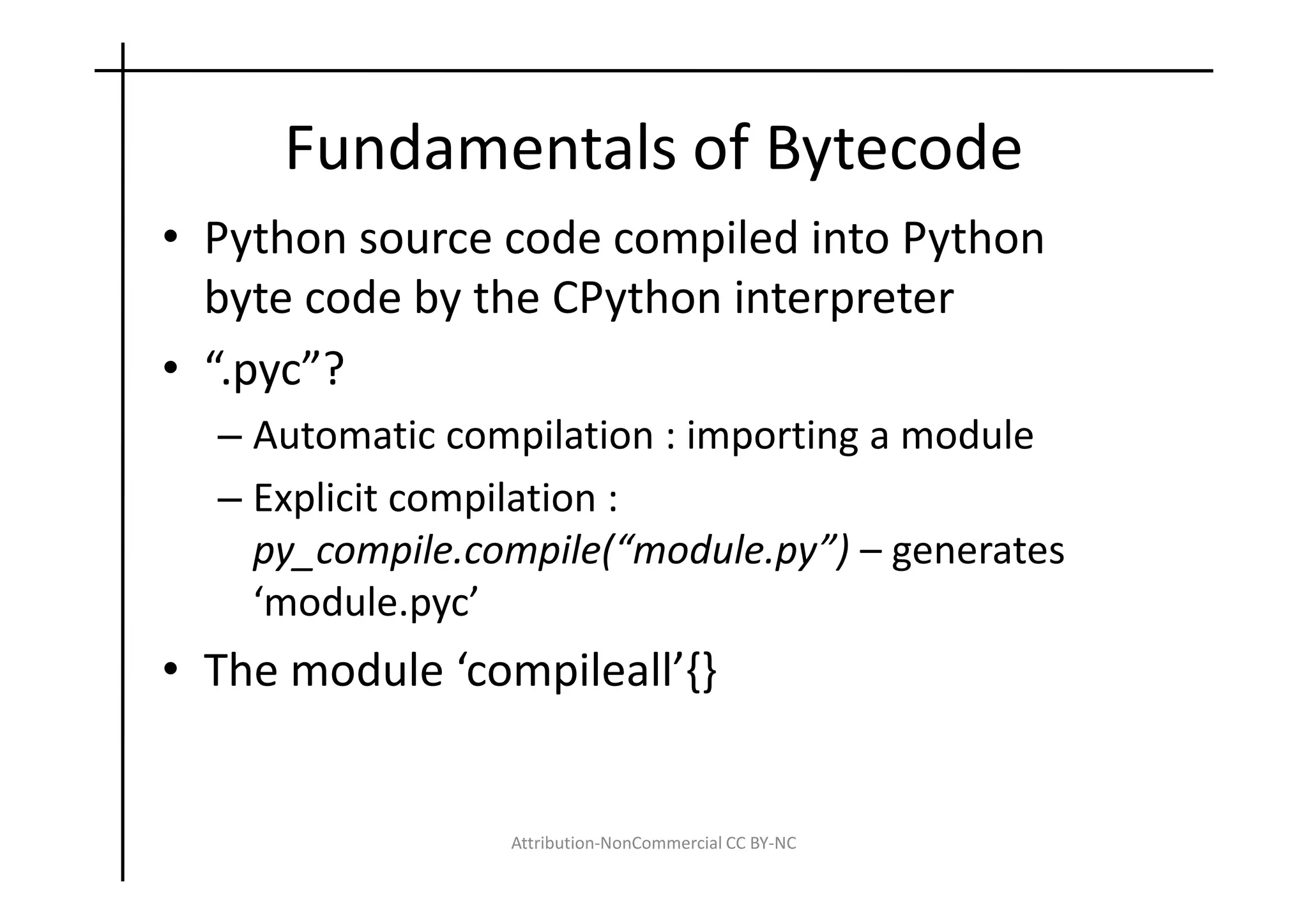
Fundamentals of Bytecode • Python source code compiled into Python byte code by the CPython interpreter • “.pyc”? – Automatic compilation : importing a module – Explicit compilation : py_compile.compile(“module.py”) – generates ‘module.pyc’ • The module ‘compileall’{} Attribution-NonCommercial CC BY-NC
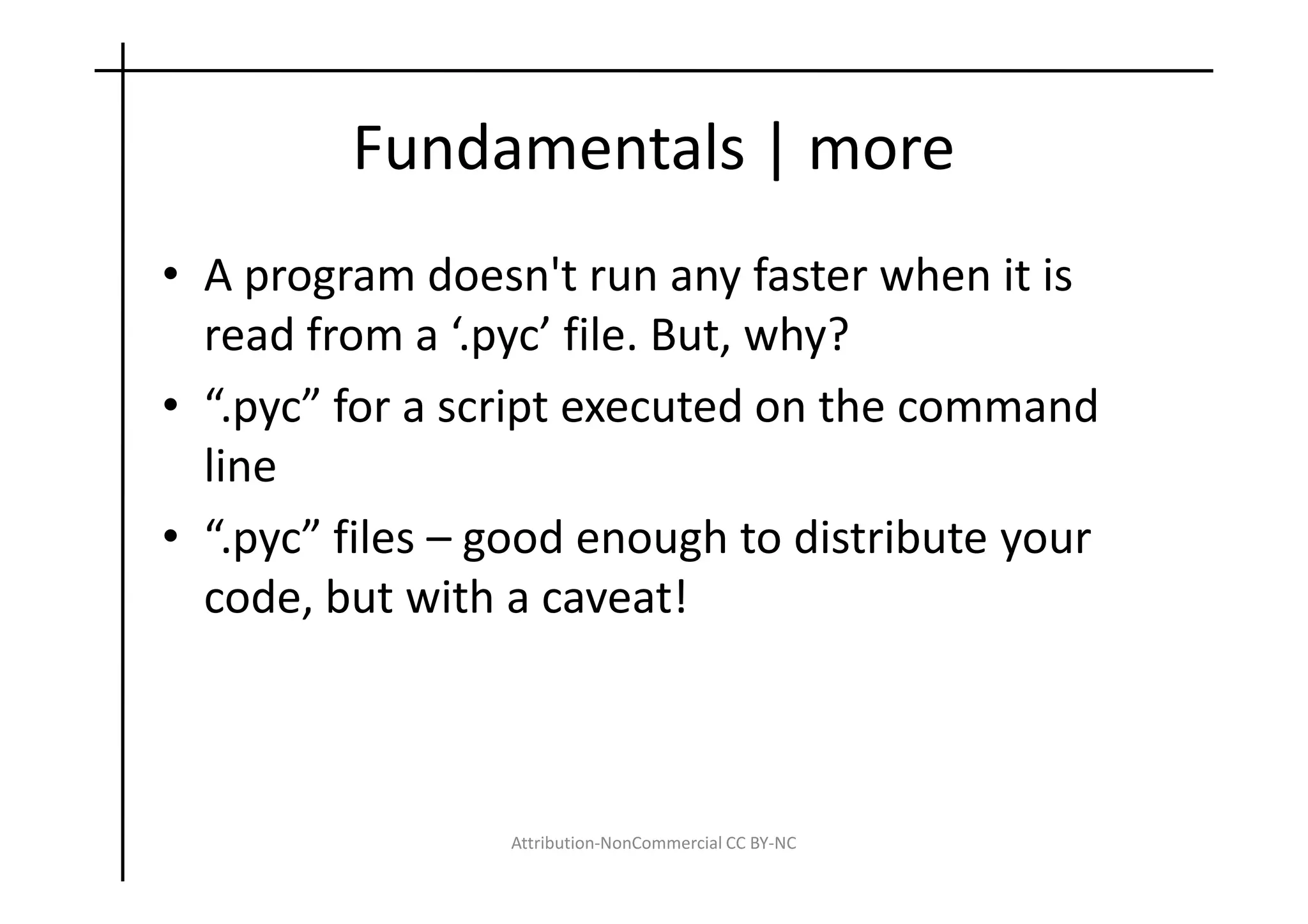
Fundamentals | more • A program doesn't run any faster when it is read from a ‘.pyc’ file. But, why? • “.pyc” for a script executed on the command line • “.pyc” files – good enough to distribute your code, but with a caveat! Attribution-NonCommercial CC BY-NC
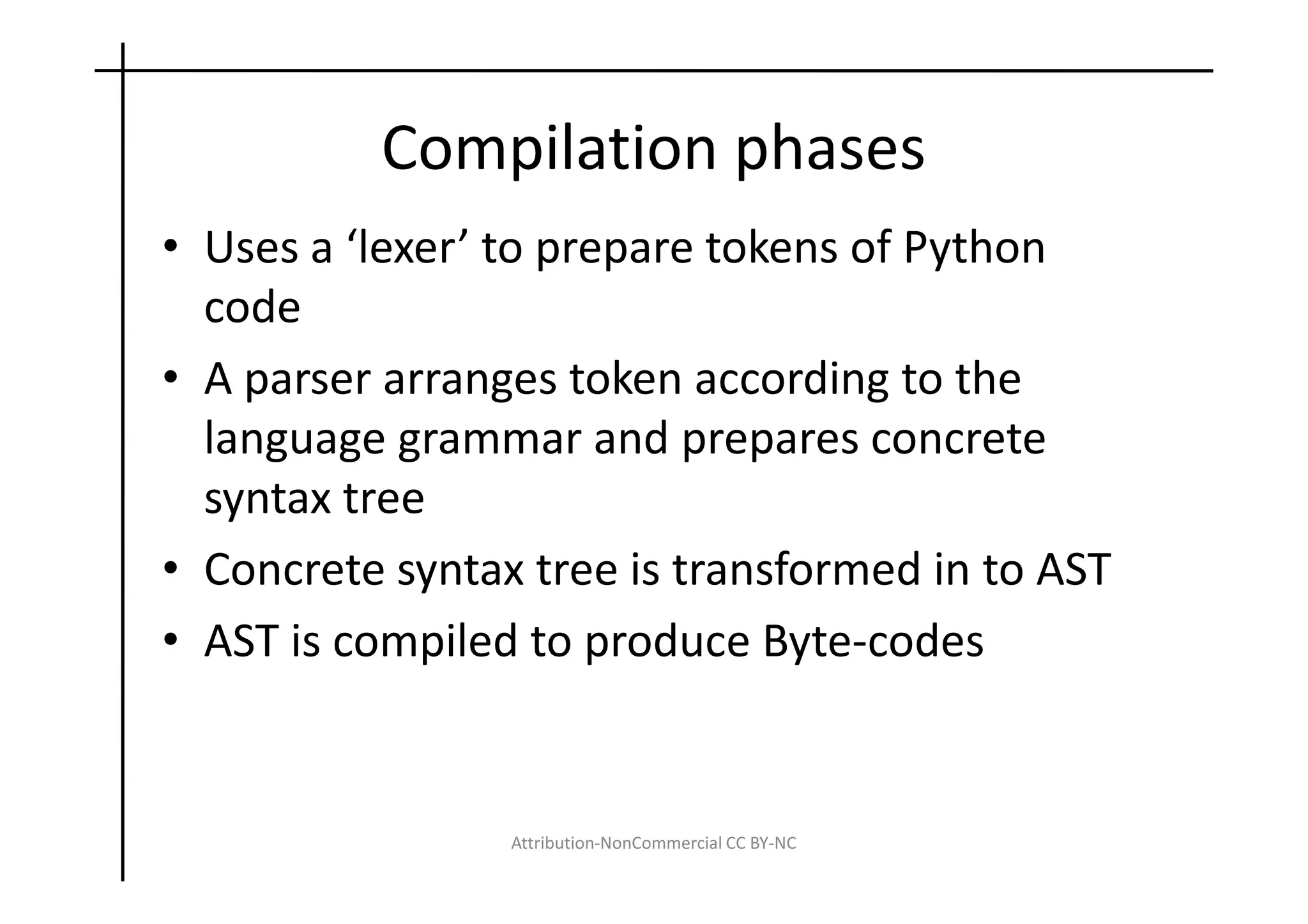
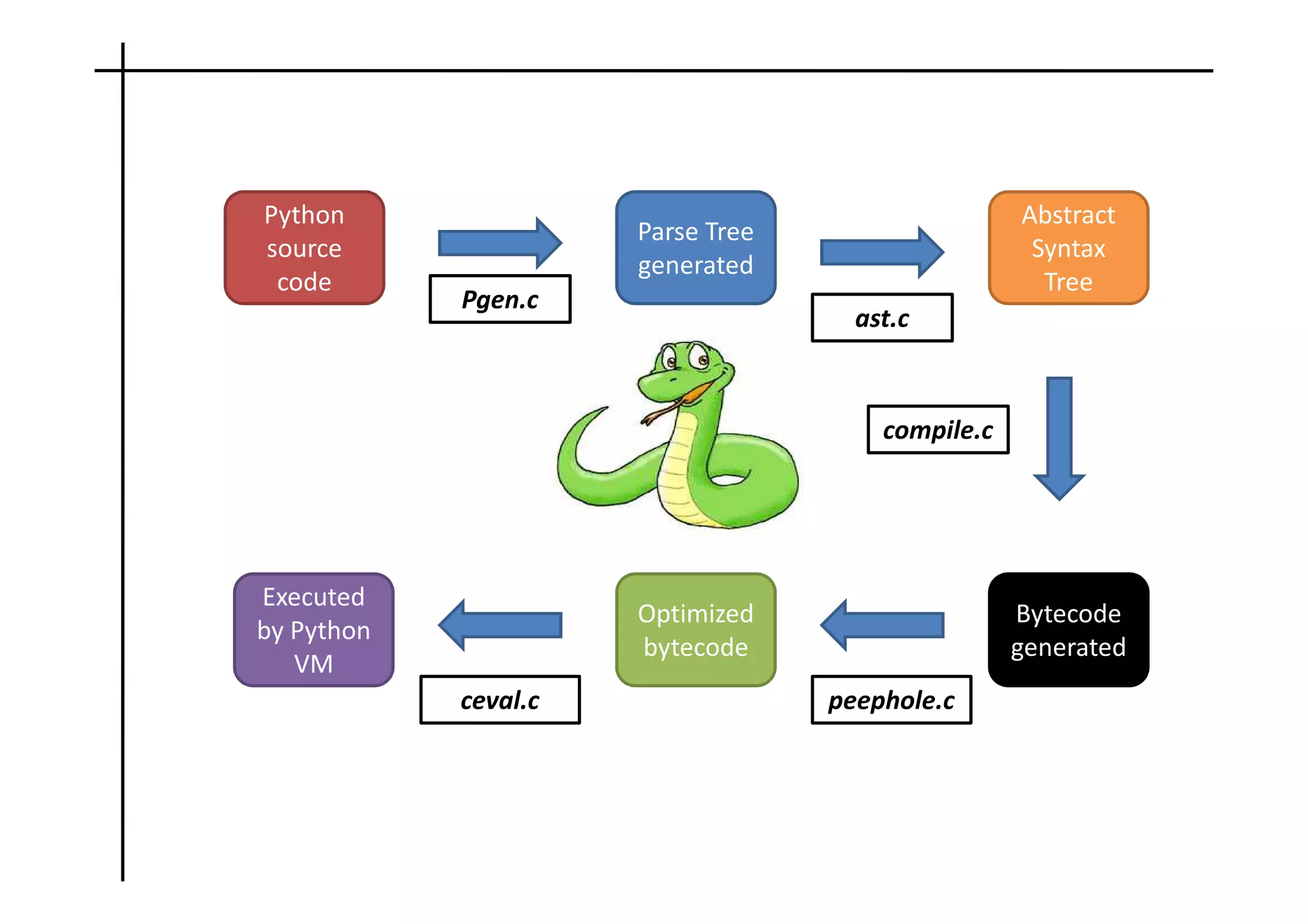
Compilation phases • Uses a ‘lexer’ to prepare tokens of Python code • A parser arranges token according to the language grammar and prepares concrete syntax tree • Concrete syntax tree is transformed in to AST • AST is compiled to produce Byte-codes Attribution-NonCommercial CC BY-NC
Python Abstract Parse Tree source Syntax generated code Tree Pgen.c ast.c compile.c Executed Optimized Bytecode by Python bytecode generated VM ceval.c peephole.c
Python “ast” module $ cat myast.py $python myast.py <generator object walk at 0xb784c8ec> import ast Module(body=[Expr(value=BinOp nod = ast.parse('a +2') (left=Name(id='a', ctx=Load()), print ast.walk(nod) op=Add(), right=Num(n=2)))]) print ast.dump(nod) •Convenient for analysis, code transformations and generation •ASTs are compiled to code objects Attribution-NonCommercial CC BY-NC
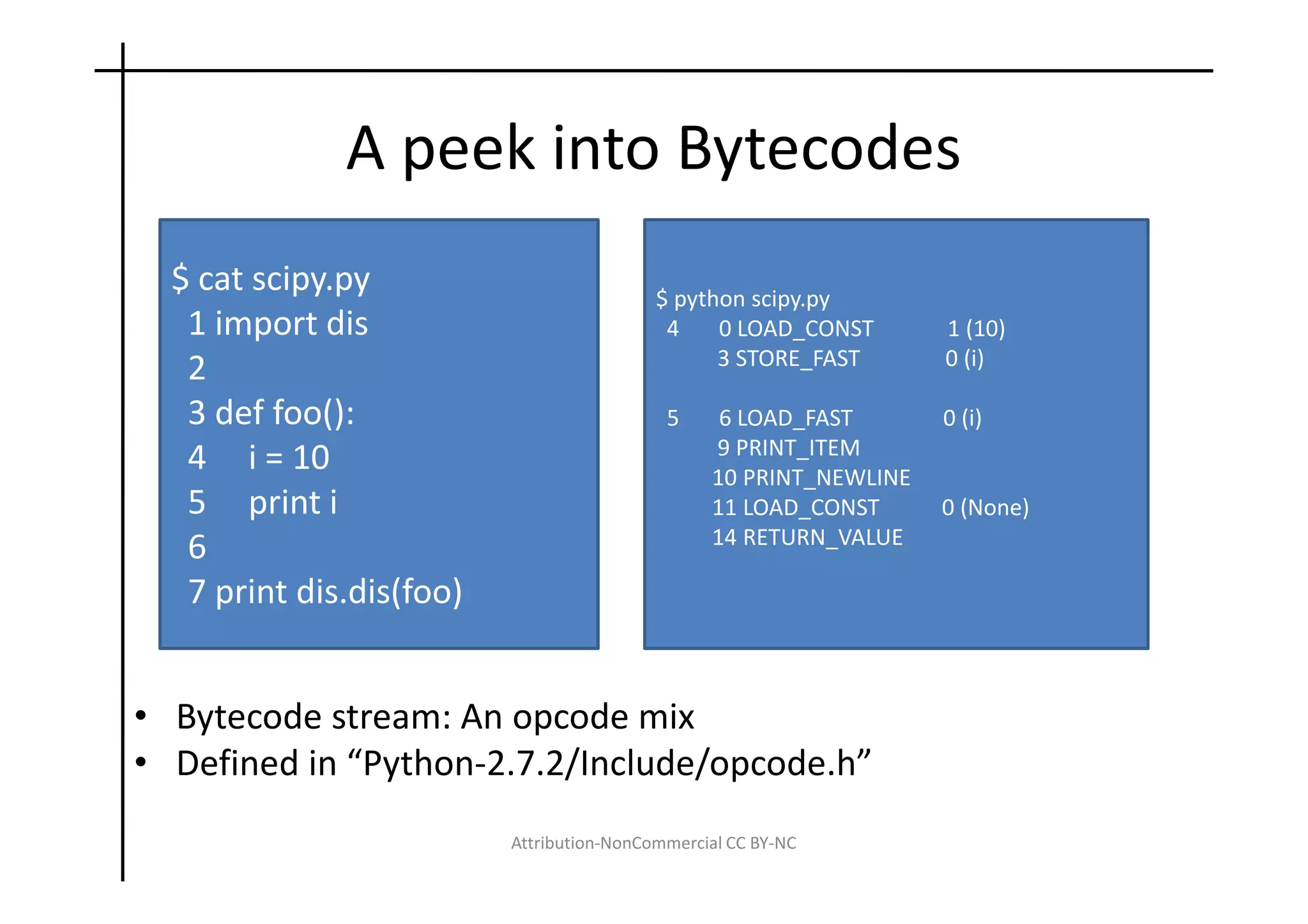
A peek into Bytecodes $ cat scipy.py $ python scipy.py 1 import dis 4 0 LOAD_CONST 1 (10) 3 STORE_FAST 0 (i) 2 3 def foo(): 5 6 LOAD_FAST 0 (i) 9 PRINT_ITEM 4 i = 10 10 PRINT_NEWLINE 5 print i 11 LOAD_CONST 0 (None) 14 RETURN_VALUE 6 7 print dis.dis(foo) • Bytecode stream: An opcode mix • Defined in “Python-2.7.2/Include/opcode.h” Attribution-NonCommercial CC BY-NC
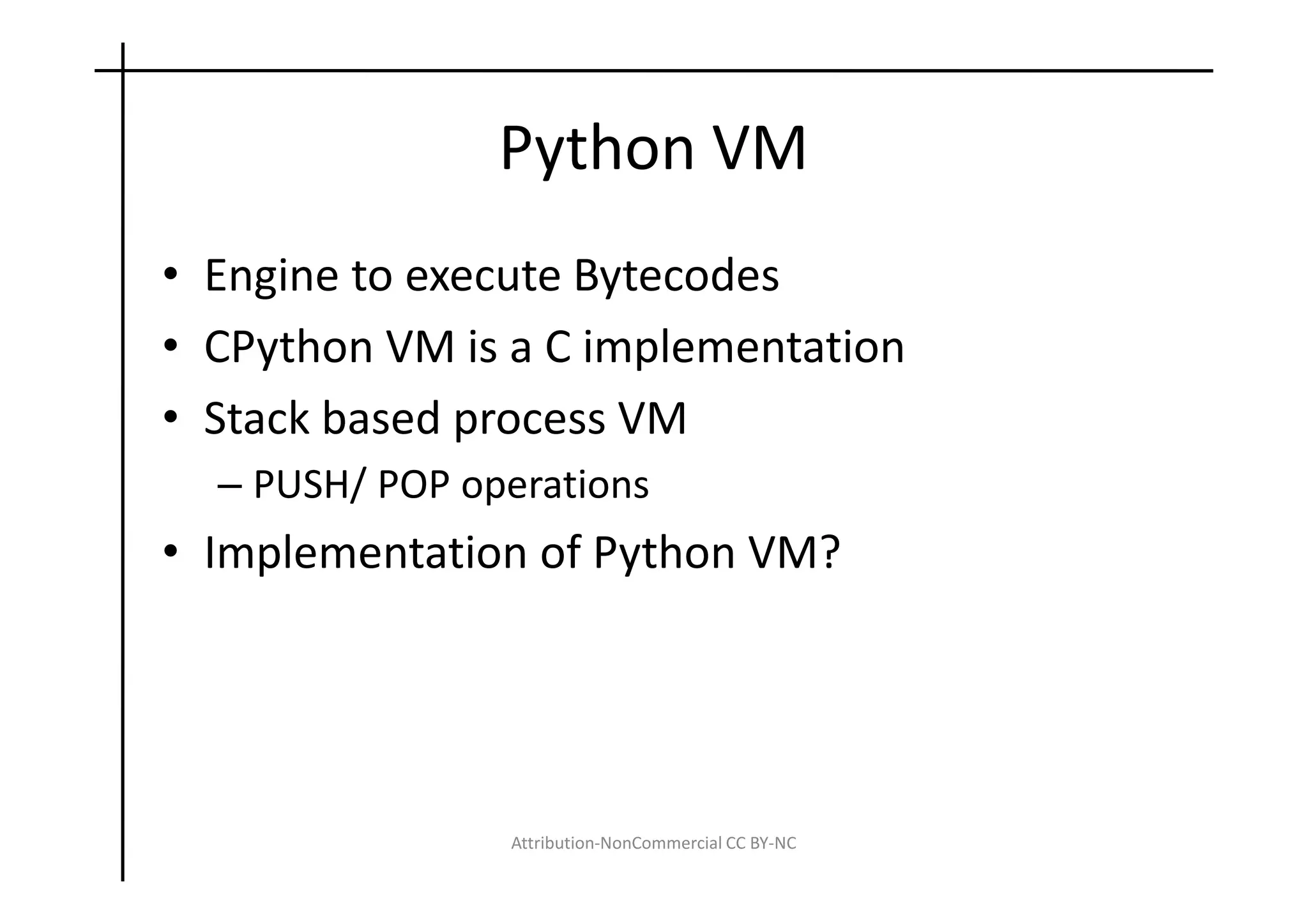
Python VM • Engine to execute Bytecodes • CPython VM is a C implementation • Stack based process VM – PUSH/ POP operations • Implementation of Python VM? Attribution-NonCommercial CC BY-NC
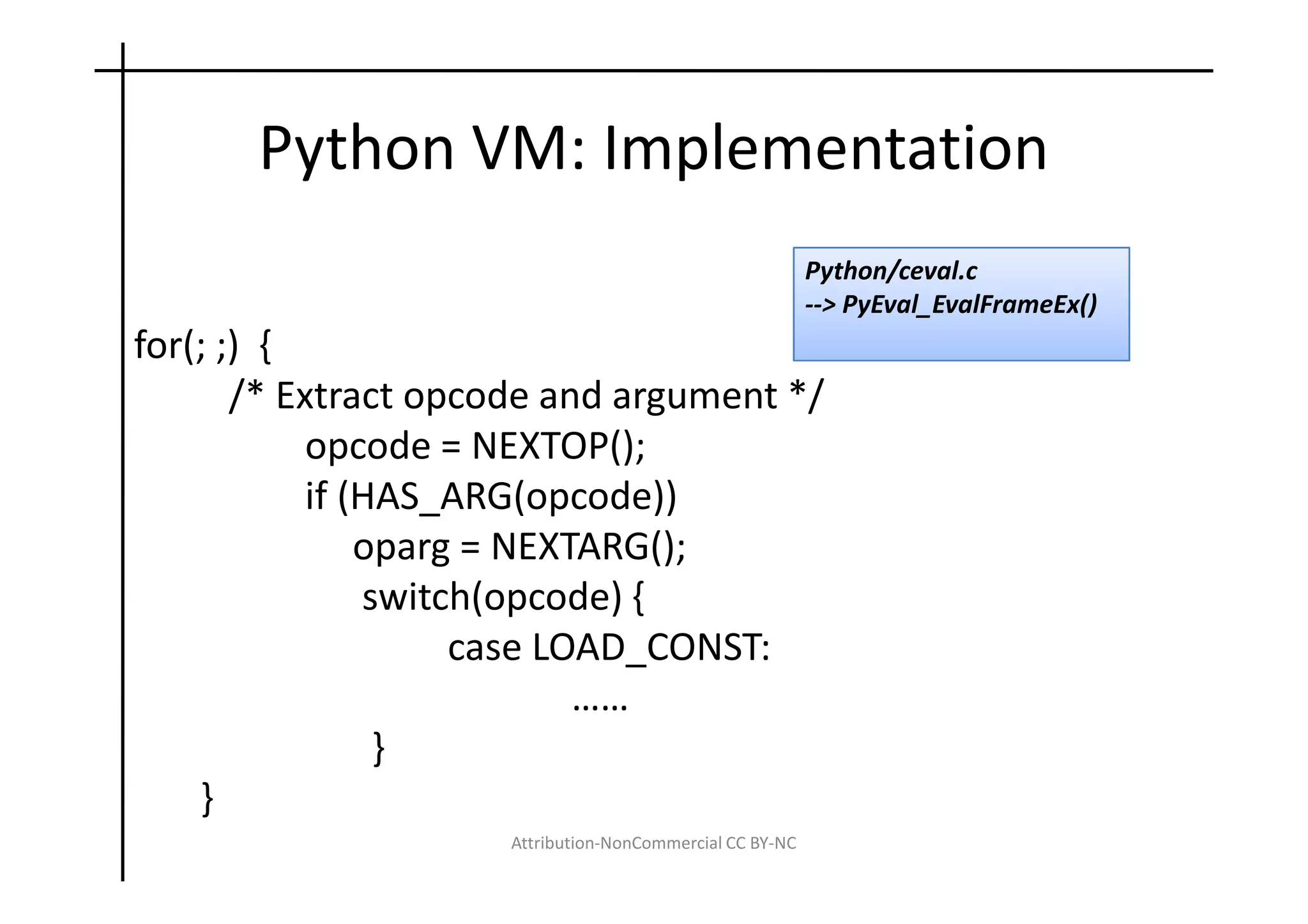
Python VM: Implementation Python/ceval.c --> PyEval_EvalFrameEx() for(; ;) { /* Extract opcode and argument */ opcode = NEXTOP(); if (HAS_ARG(opcode)) oparg = NEXTARG(); switch(opcode) { case LOAD_CONST: …… } } Attribution-NonCommercial CC BY-NC
Optimizations Tools Getting in to the Problem Space!! Attribution-NonCommercial CC BY-NC
Pyrex • Python like language to create C module for Python • Create your “pyx” files and compile them in “.c” files • Import them as modules in your applications • Pyrex used as: – speed up the execution of Python code – Python interface to existing C modules/libraries • Lot of work for developer – .py to .pyx? – thinking in C Attribution-NonCommercial CC BY-NC
Psyco • An intelligent option – JIT compilation • Profiles dynamically an application for hot- spots • “in-memory” prepares C extension and hook them appropriately • Solves “duck” typing • Memory footprint? • Support till CPython 2.5 Attribution-NonCommercial CC BY-NC
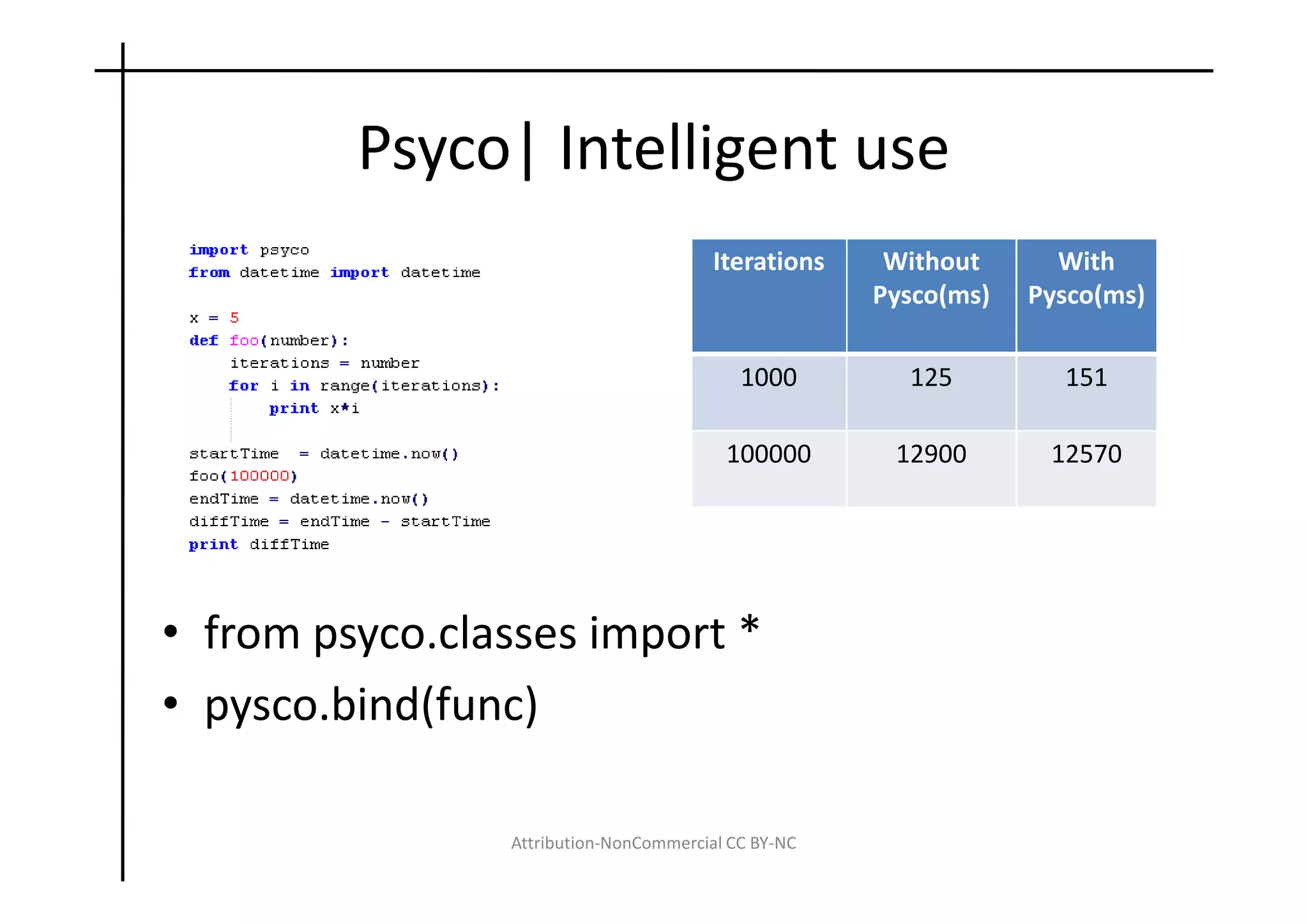
Psyco| Intelligent use Iterations Without With Pysco(ms) Pysco(ms) 1000 125 151 100000 12900 12570 • from psyco.classes import * • pysco.bind(func) Attribution-NonCommercial CC BY-NC
Optimizations Bytecode level Getting in to the Problem Space!! Attribution-NonCommercial CC BY-NC
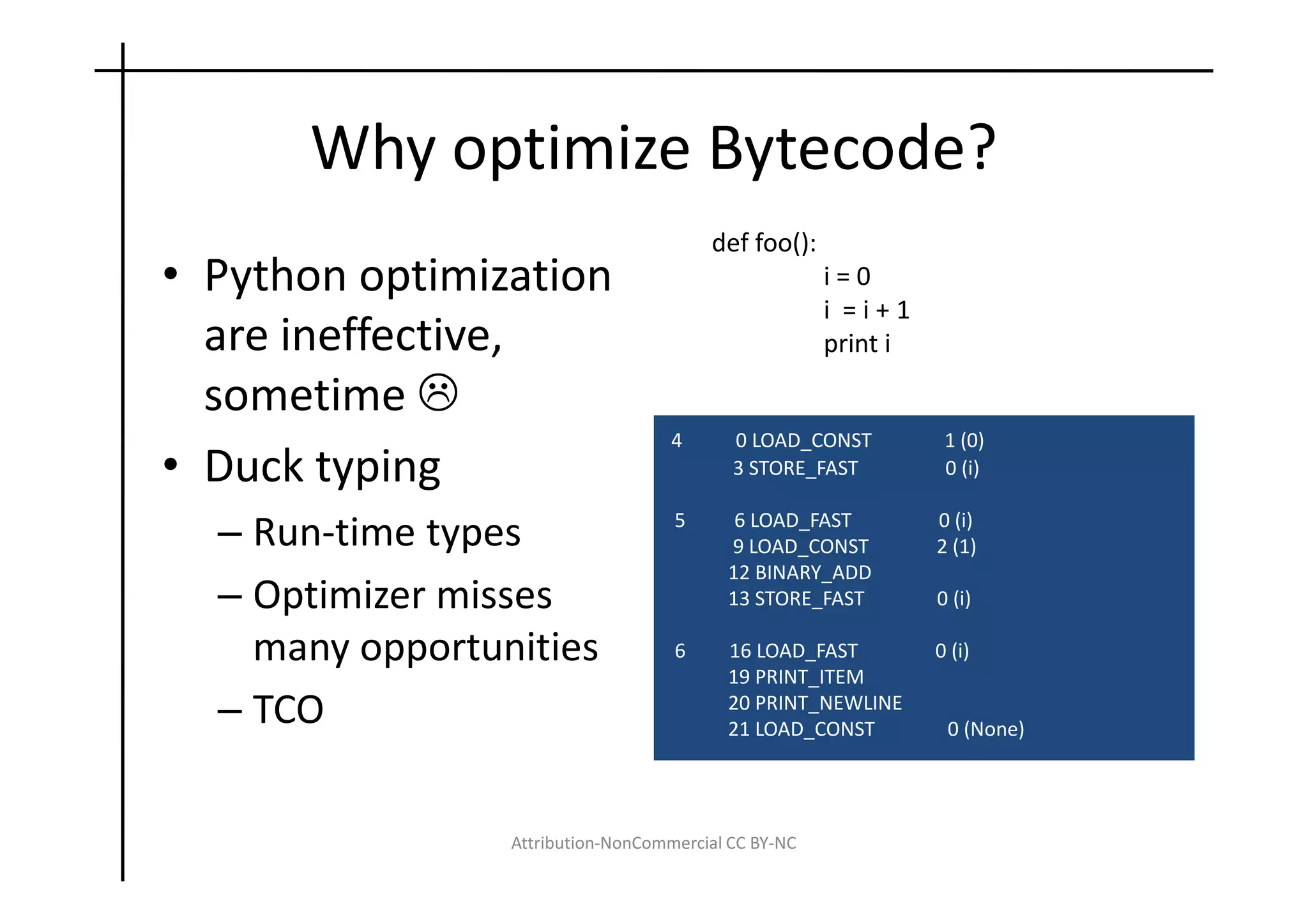
Why optimize Bytecode? def foo(): • Python optimization i=0 i =i+1 are ineffective, print i sometime 4 0 LOAD_CONST 1 (0) • Duck typing 3 STORE_FAST 0 (i) 5 6 LOAD_FAST 0 (i) – Run-time types 9 LOAD_CONST 2 (1) 12 BINARY_ADD – Optimizer misses 13 STORE_FAST 0 (i) many opportunities 6 16 LOAD_FAST 0 (i) 19 PRINT_ITEM – TCO 20 PRINT_NEWLINE 21 LOAD_CONST 0 (None) Attribution-NonCommercial CC BY-NC
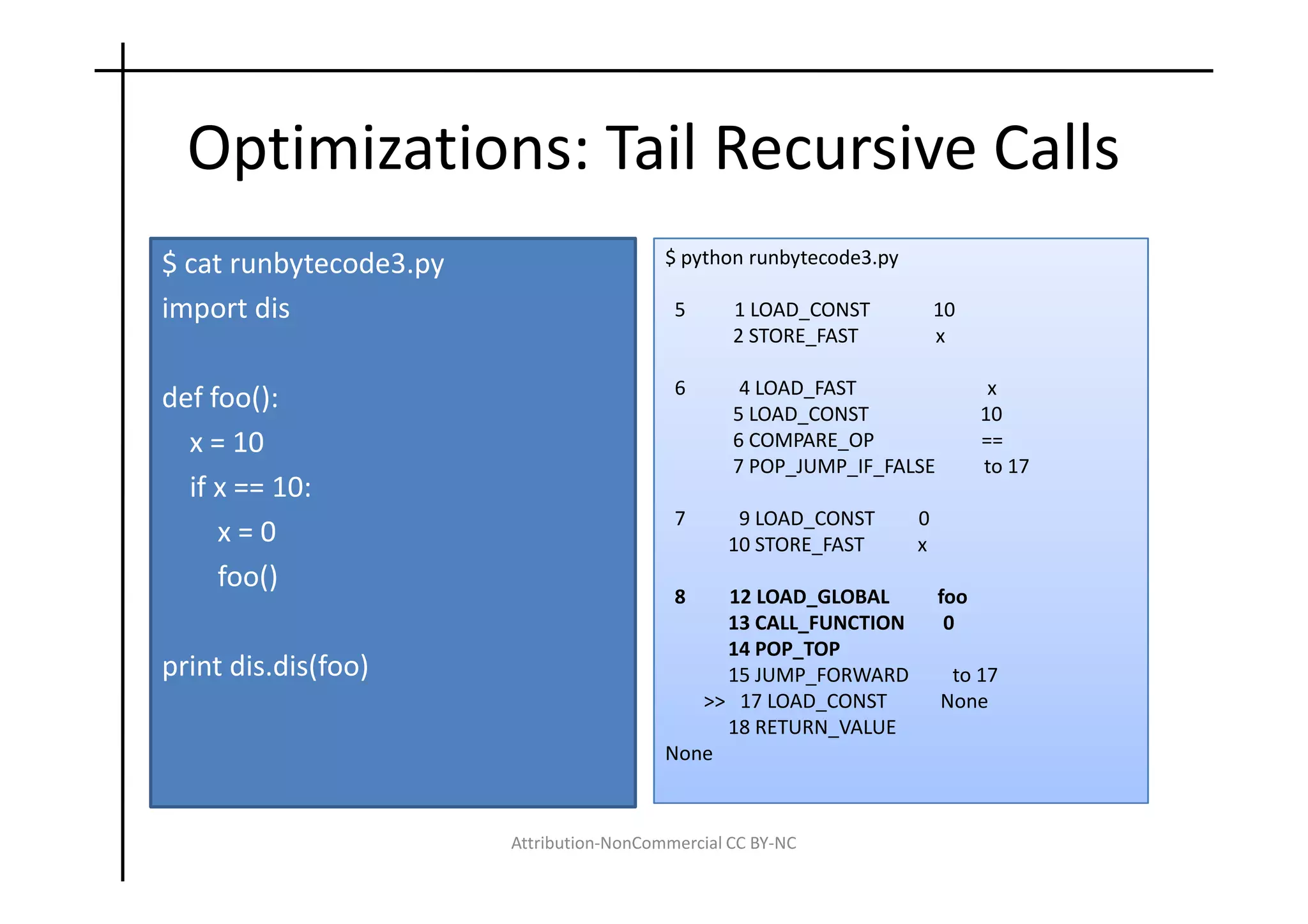
Optimizations: Tail Recursive Calls $ cat runbytecode3.py $ python runbytecode3.py import dis 5 1 LOAD_CONST 10 2 STORE_FAST x 6 4 LOAD_FAST x def foo(): 5 LOAD_CONST 10 x = 10 6 COMPARE_OP == 7 POP_JUMP_IF_FALSE to 17 if x == 10: 7 9 LOAD_CONST 0 x=0 10 STORE_FAST x foo() 8 12 LOAD_GLOBAL foo 13 CALL_FUNCTION 0 14 POP_TOP print dis.dis(foo) 15 JUMP_FORWARD to 17 >> 17 LOAD_CONST None 18 RETURN_VALUE None Attribution-NonCommercial CC BY-NC
BytePlay: Do it yourself! • Experiment with Bytecodes • Generates, recompiles and runs code on-the- fly • Very useful to evaluate different code optimizations • Example Attribution-NonCommercial CC BY-NC
Playing with Bytecode $cat runbytecode2.py $ python runbytecode2.py reassembled ‘byteplay.py' imported. from byteplay import * from pprint import pprint 5 1 LOAD_CONST 10 <<<------------------------- 2 STORE_FAST x def foo(): x = 10 6 4 LOAD_FAST x 5 PRINT_ITEM print x 6 PRINT_NEWLINE 7 LOAD_CONST None c = Code.from_code(foo.func_code) 8 RETURN_VALUE print printcodelist(c.code) None # Modify the byte code 5 1 LOAD_CONST 1000 <<<--------------------------- c.code[0] = (LOAD_CONST, 1000) 2 STORE_FAST x foo.func_code = c.to_code() 6 4 LOAD_FAST x 5 PRINT_ITEM print printcodelist(c.code) 6 PRINT_NEWLINE 7 LOAD_CONST None 8 RETURN_VALUE # Call the modified function None foo() 1000 Attribution-NonCommercial CC BY-NC
Going forward PyPy Getting in to the Problem Space!! Attribution-NonCommercial CC BY-NC
Does PyPy help? • Python interpreter in Python itself • A target function needs to be written with subset of Python (Restricted Python) • PyPy can translate this function to runtime of your choice ☺ – Options: C/POSIX, CLI/.NET and Java/JVM • Seamless and transparent Attribution-NonCommercial CC BY-NC
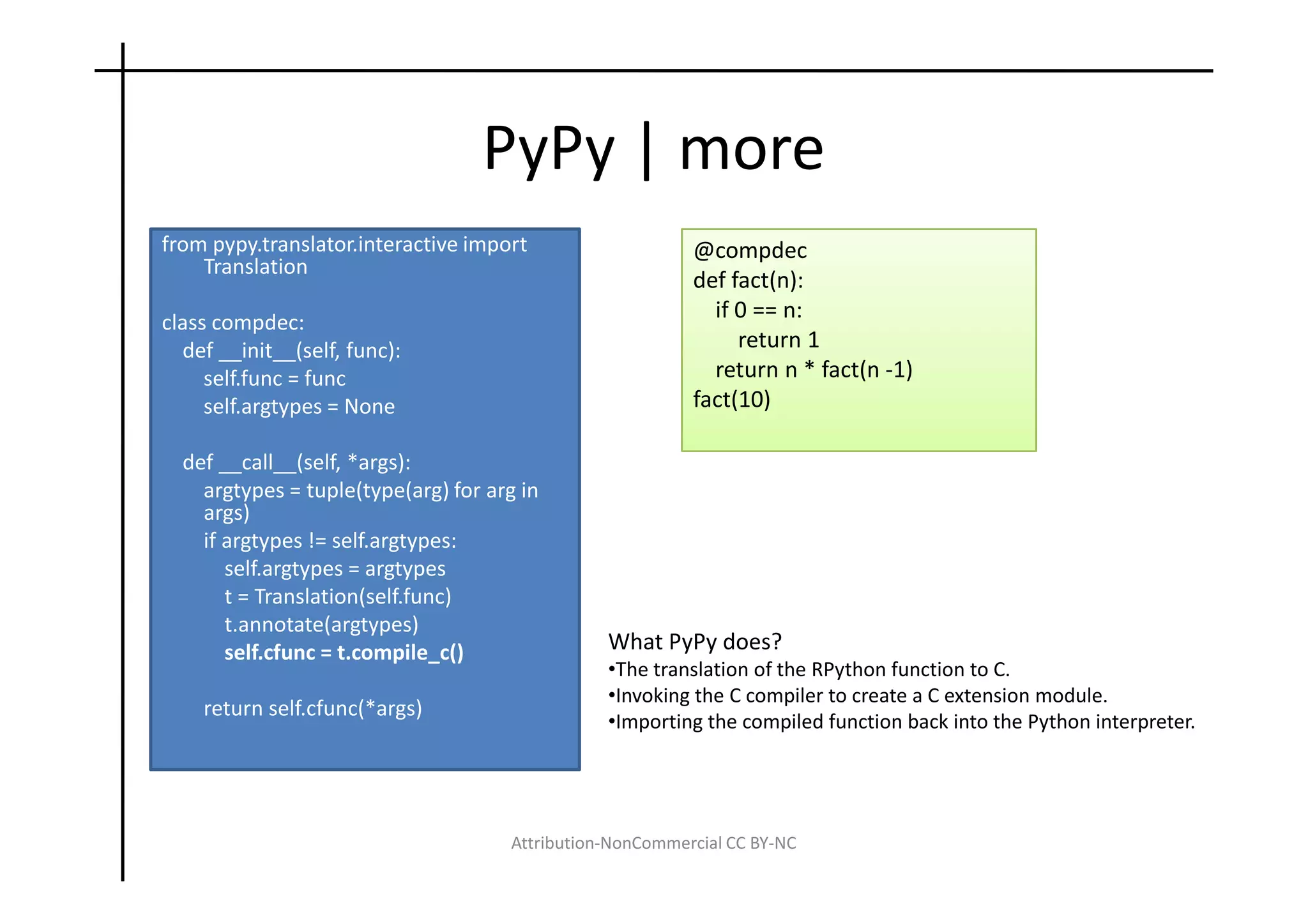
PyPy | more from pypy.translator.interactive import @compdec Translation def fact(n): class compdec: if 0 == n: def __init__(self, func): return 1 self.func = func return n * fact(n -1) self.argtypes = None fact(10) def __call__(self, *args): argtypes = tuple(type(arg) for arg in args) if argtypes != self.argtypes: self.argtypes = argtypes t = Translation(self.func) t.annotate(argtypes) self.cfunc = t.compile_c() What PyPy does? •The translation of the RPython function to C. •Invoking the C compiler to create a C extension module. return self.cfunc(*args) •Importing the compiled function back into the Python interpreter. Attribution-NonCommercial CC BY-NC
Recommendations • Always profile your applications • 90/10 rule of performance gain • Performance critical portion could be written as C extensions – Wrappers like SWIG could be used to bridge Python/C applications – Pyrex, Psyco, and PyPy – Tuning Bytecodes manually • Evaluate and use ☺ Attribution-NonCommercial CC BY-NC
References • http://docs.python.org/release/2.5.2/lib/module-dis.html • http://www.cosc.canterbury.ac.nz/greg.ewing/python/Pyre x/ • http://www.dalkescientific.com/writings/diary/archive/201 0/02/22/instrumenting_the_ast.html • http://cs.utsa.edu/~danlo/teaching/cs4713/lecture/node7. html • http://www.devshed.com/c/a/Python/How-Python-Runs- Programs/4/ • http://www.enthought.com/~ischnell/paper.html • http://codespeak.net/pypy/dist/pypy/doc/translation.html • http://effbot.org/pyref/type-code.htm Attribution-NonCommercial CC BY-NC
Questions Thank you for your time and attention ☺ • Please share your feedback/ comments/ suggestions to us at: • cjgiridhar@gmail.com , http://technobeans.com • vishalkanaujia@gmail.com, http://freethreads.wordpress.com Attribution-NonCommercial CC BY-NC
Backup slides Attribution-NonCommercial CC BY-NC
Bytecodes | more • Atomic unit of execution (thread safe) • A Python module is compiled and saved in form of a “pyc” file • An optimization; avoid compilation phase for future uses of a module • If source file is changed, pyc is recompiled • “pyc” file is coded in bytecode! Attribution-NonCommercial CC BY-NC
Code Objects • Bytecode representation • Immutable objects (No ref to mutable objects) • Function object (Code objects that reference global variables) • “co_code” = Bytecodes Attribution-NonCommercial CC BY-NC
Benefits of using Bytecode • Architecture neutral code • Portability • Simple optimizations Attribution-NonCommercial CC BY-NC

Diving into byte code optimization in python

  • 1.
    Diving into Byte-code optimization in Python SciPy India, IIT Bombay Dec 05th 2011 Chetan Giridhar and Vishal Kanaujia
  • 2.
    Fundamentals of Bytecode •Python source code compiled into Python byte code by the CPython interpreter • “.pyc”? – Automatic compilation : importing a module – Explicit compilation : py_compile.compile(“module.py”) – generates ‘module.pyc’ • The module ‘compileall’{} Attribution-NonCommercial CC BY-NC
  • 3.
    Fundamentals | more •A program doesn't run any faster when it is read from a ‘.pyc’ file. But, why? • “.pyc” for a script executed on the command line • “.pyc” files – good enough to distribute your code, but with a caveat! Attribution-NonCommercial CC BY-NC
  • 4.
    Compilation phases • Usesa ‘lexer’ to prepare tokens of Python code • A parser arranges token according to the language grammar and prepares concrete syntax tree • Concrete syntax tree is transformed in to AST • AST is compiled to produce Byte-codes Attribution-NonCommercial CC BY-NC
  • 5.
    Python Abstract Parse Tree source Syntax generated code Tree Pgen.c ast.c compile.c Executed Optimized Bytecode by Python bytecode generated VM ceval.c peephole.c
  • 6.
    Python “ast” module $cat myast.py $python myast.py <generator object walk at 0xb784c8ec> import ast Module(body=[Expr(value=BinOp nod = ast.parse('a +2') (left=Name(id='a', ctx=Load()), print ast.walk(nod) op=Add(), right=Num(n=2)))]) print ast.dump(nod) •Convenient for analysis, code transformations and generation •ASTs are compiled to code objects Attribution-NonCommercial CC BY-NC
  • 7.
    A peek intoBytecodes $ cat scipy.py $ python scipy.py 1 import dis 4 0 LOAD_CONST 1 (10) 3 STORE_FAST 0 (i) 2 3 def foo(): 5 6 LOAD_FAST 0 (i) 9 PRINT_ITEM 4 i = 10 10 PRINT_NEWLINE 5 print i 11 LOAD_CONST 0 (None) 14 RETURN_VALUE 6 7 print dis.dis(foo) • Bytecode stream: An opcode mix • Defined in “Python-2.7.2/Include/opcode.h” Attribution-NonCommercial CC BY-NC
  • 8.
    Python VM • Engineto execute Bytecodes • CPython VM is a C implementation • Stack based process VM – PUSH/ POP operations • Implementation of Python VM? Attribution-NonCommercial CC BY-NC
  • 9.
    Python VM: Implementation Python/ceval.c --> PyEval_EvalFrameEx() for(; ;) { /* Extract opcode and argument */ opcode = NEXTOP(); if (HAS_ARG(opcode)) oparg = NEXTARG(); switch(opcode) { case LOAD_CONST: …… } } Attribution-NonCommercial CC BY-NC
  • 10.
    Optimizations Tools Getting in to the Problem Space!! Attribution-NonCommercial CC BY-NC
  • 11.
    Pyrex • Python likelanguage to create C module for Python • Create your “pyx” files and compile them in “.c” files • Import them as modules in your applications • Pyrex used as: – speed up the execution of Python code – Python interface to existing C modules/libraries • Lot of work for developer – .py to .pyx? – thinking in C Attribution-NonCommercial CC BY-NC
  • 12.
    Psyco • An intelligentoption – JIT compilation • Profiles dynamically an application for hot- spots • “in-memory” prepares C extension and hook them appropriately • Solves “duck” typing • Memory footprint? • Support till CPython 2.5 Attribution-NonCommercial CC BY-NC
  • 13.
    Psyco| Intelligent use Iterations Without With Pysco(ms) Pysco(ms) 1000 125 151 100000 12900 12570 • from psyco.classes import * • pysco.bind(func) Attribution-NonCommercial CC BY-NC
  • 14.
    Optimizations Bytecode level Getting in to the Problem Space!! Attribution-NonCommercial CC BY-NC
  • 15.
    Why optimize Bytecode? def foo(): • Python optimization i=0 i =i+1 are ineffective, print i sometime 4 0 LOAD_CONST 1 (0) • Duck typing 3 STORE_FAST 0 (i) 5 6 LOAD_FAST 0 (i) – Run-time types 9 LOAD_CONST 2 (1) 12 BINARY_ADD – Optimizer misses 13 STORE_FAST 0 (i) many opportunities 6 16 LOAD_FAST 0 (i) 19 PRINT_ITEM – TCO 20 PRINT_NEWLINE 21 LOAD_CONST 0 (None) Attribution-NonCommercial CC BY-NC
  • 16.
    Optimizations: Tail RecursiveCalls $ cat runbytecode3.py $ python runbytecode3.py import dis 5 1 LOAD_CONST 10 2 STORE_FAST x 6 4 LOAD_FAST x def foo(): 5 LOAD_CONST 10 x = 10 6 COMPARE_OP == 7 POP_JUMP_IF_FALSE to 17 if x == 10: 7 9 LOAD_CONST 0 x=0 10 STORE_FAST x foo() 8 12 LOAD_GLOBAL foo 13 CALL_FUNCTION 0 14 POP_TOP print dis.dis(foo) 15 JUMP_FORWARD to 17 >> 17 LOAD_CONST None 18 RETURN_VALUE None Attribution-NonCommercial CC BY-NC
  • 17.
    BytePlay: Do ityourself! • Experiment with Bytecodes • Generates, recompiles and runs code on-the- fly • Very useful to evaluate different code optimizations • Example Attribution-NonCommercial CC BY-NC
  • 18.
    Playing with Bytecode $catrunbytecode2.py $ python runbytecode2.py reassembled ‘byteplay.py' imported. from byteplay import * from pprint import pprint 5 1 LOAD_CONST 10 <<<------------------------- 2 STORE_FAST x def foo(): x = 10 6 4 LOAD_FAST x 5 PRINT_ITEM print x 6 PRINT_NEWLINE 7 LOAD_CONST None c = Code.from_code(foo.func_code) 8 RETURN_VALUE print printcodelist(c.code) None # Modify the byte code 5 1 LOAD_CONST 1000 <<<--------------------------- c.code[0] = (LOAD_CONST, 1000) 2 STORE_FAST x foo.func_code = c.to_code() 6 4 LOAD_FAST x 5 PRINT_ITEM print printcodelist(c.code) 6 PRINT_NEWLINE 7 LOAD_CONST None 8 RETURN_VALUE # Call the modified function None foo() 1000 Attribution-NonCommercial CC BY-NC
  • 19.
    Going forward PyPy Getting in to the Problem Space!! Attribution-NonCommercial CC BY-NC
  • 20.
    Does PyPy help? •Python interpreter in Python itself • A target function needs to be written with subset of Python (Restricted Python) • PyPy can translate this function to runtime of your choice ☺ – Options: C/POSIX, CLI/.NET and Java/JVM • Seamless and transparent Attribution-NonCommercial CC BY-NC
  • 21.
    PyPy | more frompypy.translator.interactive import @compdec Translation def fact(n): class compdec: if 0 == n: def __init__(self, func): return 1 self.func = func return n * fact(n -1) self.argtypes = None fact(10) def __call__(self, *args): argtypes = tuple(type(arg) for arg in args) if argtypes != self.argtypes: self.argtypes = argtypes t = Translation(self.func) t.annotate(argtypes) self.cfunc = t.compile_c() What PyPy does? •The translation of the RPython function to C. •Invoking the C compiler to create a C extension module. return self.cfunc(*args) •Importing the compiled function back into the Python interpreter. Attribution-NonCommercial CC BY-NC
  • 22.
    Recommendations • Always profileyour applications • 90/10 rule of performance gain • Performance critical portion could be written as C extensions – Wrappers like SWIG could be used to bridge Python/C applications – Pyrex, Psyco, and PyPy – Tuning Bytecodes manually • Evaluate and use ☺ Attribution-NonCommercial CC BY-NC
  • 23.
    References • http://docs.python.org/release/2.5.2/lib/module-dis.html • http://www.cosc.canterbury.ac.nz/greg.ewing/python/Pyre x/ • http://www.dalkescientific.com/writings/diary/archive/201 0/02/22/instrumenting_the_ast.html • http://cs.utsa.edu/~danlo/teaching/cs4713/lecture/node7. html • http://www.devshed.com/c/a/Python/How-Python-Runs- Programs/4/ • http://www.enthought.com/~ischnell/paper.html • http://codespeak.net/pypy/dist/pypy/doc/translation.html • http://effbot.org/pyref/type-code.htm Attribution-NonCommercial CC BY-NC
  • 24.
    Questions Thankyou for your time and attention ☺ • Please share your feedback/ comments/ suggestions to us at: • cjgiridhar@gmail.com , http://technobeans.com • vishalkanaujia@gmail.com, http://freethreads.wordpress.com Attribution-NonCommercial CC BY-NC
  • 25.
  • 26.
    Bytecodes | more •Atomic unit of execution (thread safe) • A Python module is compiled and saved in form of a “pyc” file • An optimization; avoid compilation phase for future uses of a module • If source file is changed, pyc is recompiled • “pyc” file is coded in bytecode! Attribution-NonCommercial CC BY-NC
  • 27.
    Code Objects • Bytecoderepresentation • Immutable objects (No ref to mutable objects) • Function object (Code objects that reference global variables) • “co_code” = Bytecodes Attribution-NonCommercial CC BY-NC
  • 28.
    Benefits of usingBytecode • Architecture neutral code • Portability • Simple optimizations Attribution-NonCommercial CC BY-NC