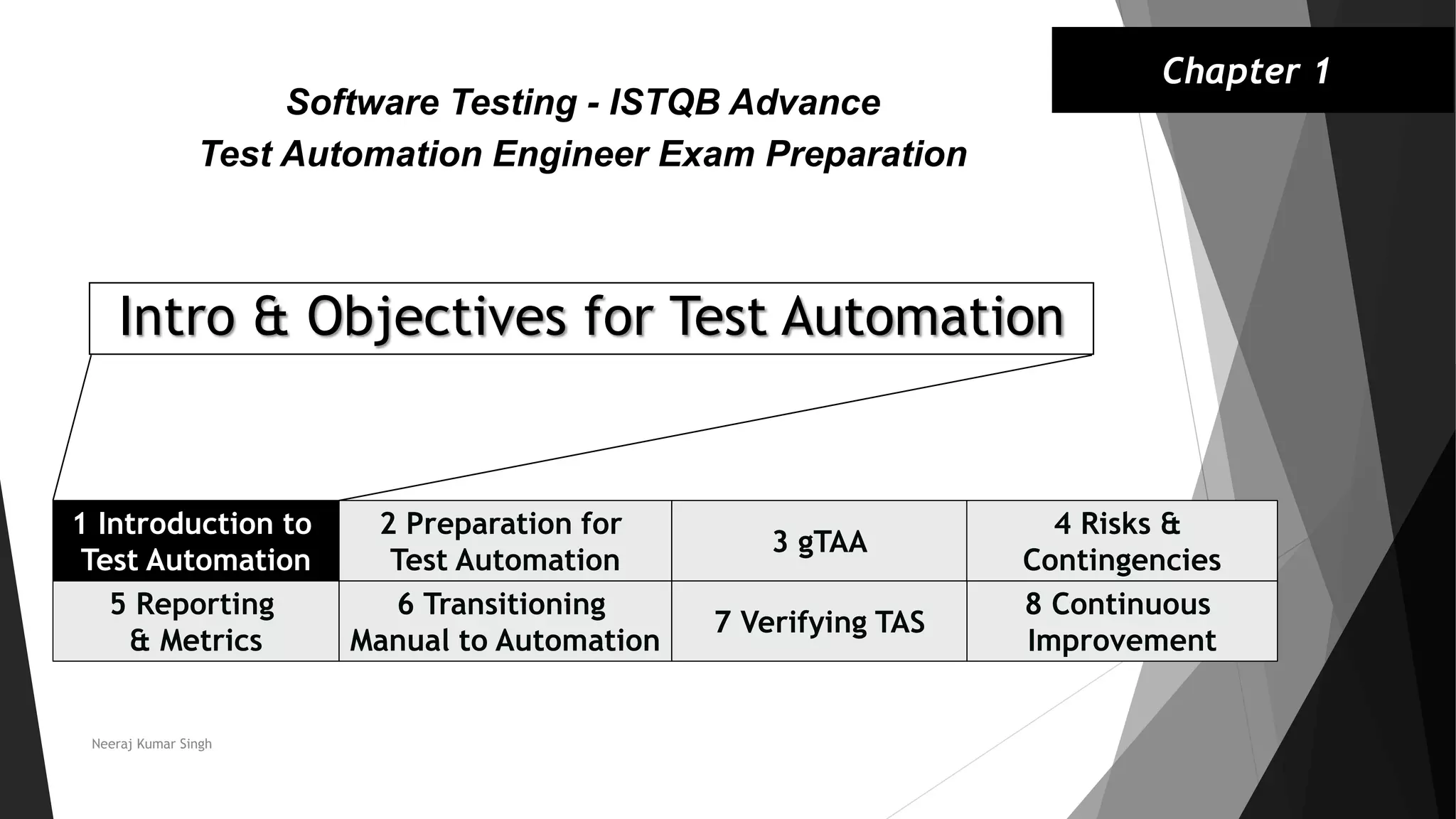












Intro & Objectives for Test Automation 1 Introduction to Test Automation 2 Preparation for Test Automation 3 gTAA Software Testing - ISTQB Advance Test Automation Engineer Exam Preparation Chapter 1 Neeraj Kumar Singh 5 Reporting & Metrics 6 Transitioning Manual to Automation 7 Verifying TAS 8 Continuous Improvement 4 Risks & Contingencies
Introduction & Objectives for Test Automation Contents 1.1 Purpose of Test Automation 1.2 Success Factors in Test Automation Neeraj Kumar Singh
Introduction & Objectives for Test Automation Purpose of Test Automation Test automation is expected to help run many test cases consistently and repeatedly on different versions of the SUT and/or environments. But test automation is more than a mechanism for running a test suite without human interaction. It involves a process of designing the testware, including:  Software  Documentation  Test cases  Test environments  Test data Testware is necessary for the testing activities that include:  Implementing automated test cases  Monitoring and controlling the execution of automated tests  Interpreting, reporting and logging the automated test results Neeraj Kumar Singh
Introduction & Objectives for Test Automation Purpose of Test Automation Test automation has different approaches for interacting with a SUT:  Testing through the public interfaces to classes, modules or libraries of the SUT (API testing)  Testing through the user interface of the SUT (e.g., GUI testing or CLI testing)  Testing through a service or protocol Objectives of test automation include:  Improving test efficiency  Providing wider function coverage  Reducing the total test cost  Performing tests that manual testers cannot  Shortening the test execution period  Increasing the test frequency/reducing the time required for test cycles Neeraj Kumar Singh
Introduction & Objectives for Test Automation Purpose of Test Automation Advantages of test automation include:  More tests can be run per build  The possibility to create tests that cannot be done manually (real-time, remote, parallel tests)  Tests can be more complex  Tests run faster  Tests are less subject to operator error  More effective and efficient use of testing resources  Quicker feedback regarding software quality  Improved system reliability(e.g., repeatability, consistency)  Improved consistency of tests Neeraj Kumar Singh
Introduction & Objectives for Test Automation Purpose of Test Automation Disadvantages of test automation include:  Additional costs are involved  Initial investment to setup TAS  Requires additional technologies  Team needs to have development and automation skills  On-going TAS maintenance requirement  Can distract from testing objectives, e.g., focusing on automating tests cases at the expense of executing tests  Tests can become more complex  Additional errors may be introduced by automation Limitations of test automation include:  Not all manual tests can be automated  The automation can only check machine-interpretable results  The automation can only check actual results that can be verified by an automated test oracle  Not a replacement for exploratory testing Neeraj Kumar Singh
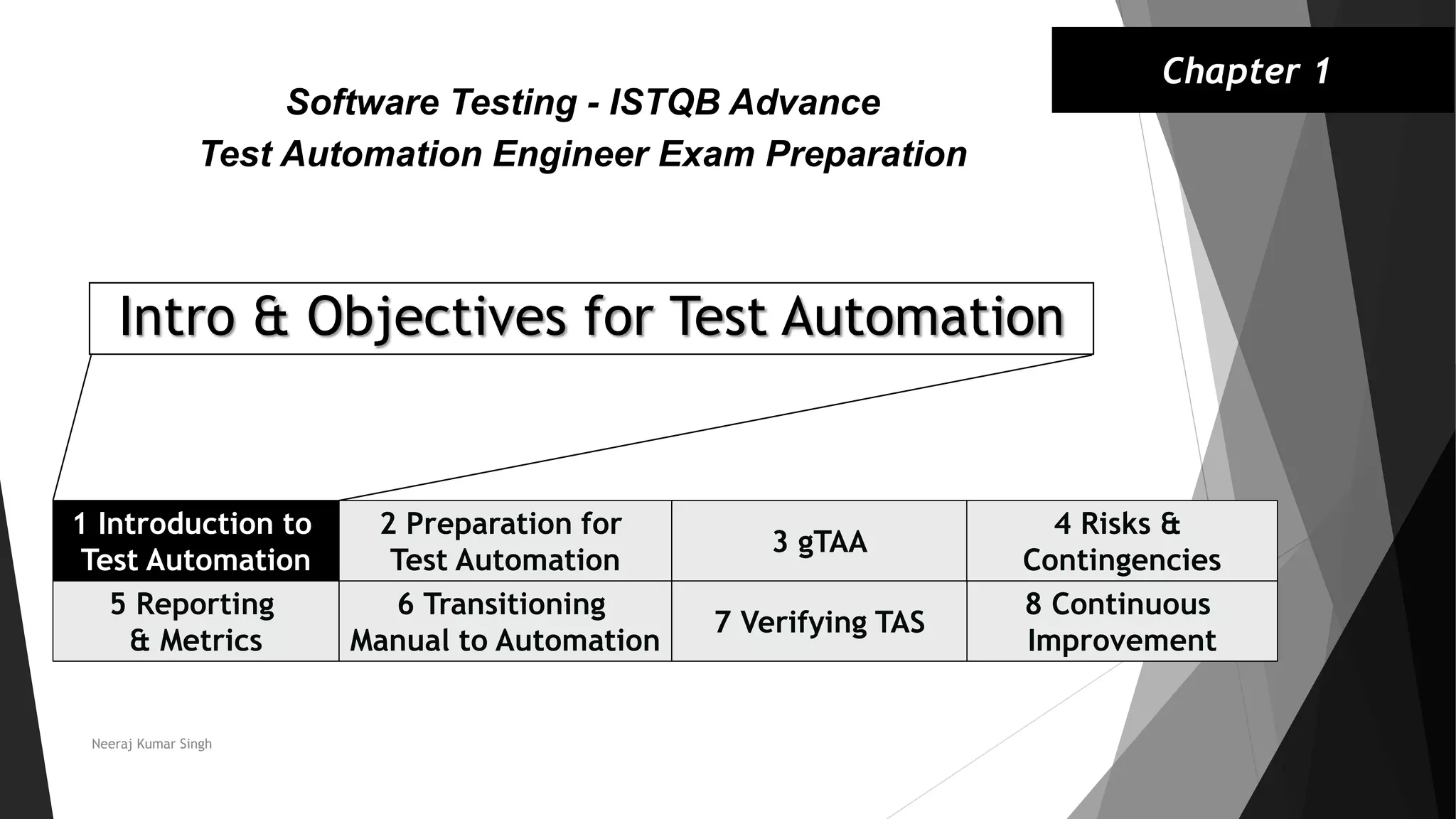
Intro & Objectives for Test Automation 1 Introduction to Test Automation 2 Preparation for Test Automation 3 gTAA Software Testing - ISTQB Advance Test Automation Engineer Exam Preparation Chapter 1 Neeraj Kumar Singh 5 Reporting & Metrics 6 Transitioning Manual to Automation 7 Verifying TAS 8 Continuous Improvement 4 Risks & Contingencies
Introduction & Objectives for Test Automation Contents 1.1 Purpose of Test Automation 1.2 Success Factors in Test Automation Neeraj Kumar Singh
Introduction & Objectives for Test Automation Success Factors in Test Automation Test Automation Architecture (TAA)  The Test Automation Architecture (TAA) is very closely aligned with the architecture of a software product. It should be clear which functional and non-functional requirements the architecture is to support. Typically this will be the most important requirements.  Often TAA is designed for maintainability, performance and learnability. It is helpful to involve software engineers who understand the architecture of the SUT. SUT Testability  The SUT needs to be designed for testability that supports automated testing. In the case of GUI testing, this could mean that the SUT should decouple as much as possible the GUI interaction and data from the appearance of the graphical interface.  In the case of API testing, this could mean that more classes, modules or the command-line interface need to be exposed as public so that they can be tested.  The testable parts of the SUT should be targeted first. Generally, a key factor in the success of test automation lies in the ease of implementing automated test scripts. Neeraj Kumar Singh
Introduction & Objectives for Test Automation Success Factors in Test Automation Test Automation Strategy  A practical and consistent test automation strategy that addresses maintainability and consistency of the SUT.  It may not be possible to apply the test automation strategy in the same way to both old and new parts of the SUT. When creating the automation strategy, consider the costs, benefits and risks of applying it to different parts of the code.  Consideration should be given to testing both the user interface and the API with automated test cases to check the consistency of the results. Neeraj Kumar Singh
Introduction & Objectives for Test Automation Success Factors in Test Automation Test Automation Framework (TAF) A test automation framework (TAF) that is easy to use, well documented and maintainable, supports a consistent approach to automating tests. In order to establish an easy to use and maintainable TAF, the following must be done:  Implement reporting facilities  Enable easy troubleshooting  Address the test environment appropriately  Document the automated test cases  Trace the automated test  Enable easy maintenance  Keep the automated tests up-to-date  Plan for deployment  Retire tests as needed  Monitor and restore the SUT Neeraj Kumar Singh
Introduction & Objectives for Test Automation Success Factors in Test Automation  The test automation code can be complex to maintain. It is not unusual to have as much code for testing as the code for the SUT. This is why it is of utmost importance that the test code be maintainable. This is due to the different test tools being used, the different types of verification that are used and the different testware artifacts that have to be maintained.  With these maintenance considerations in mind, in addition to the important items that should be done, there are a few that should not be done, as follows:  Do not create code that is sensitive to the interface (i.e., it would be affected by changes in the graphical interface or in non-essential parts of the API).  Do not create test automation that is sensitive to data changes or has a high dependency on particular data values (e.g., test input depending on other test outputs).  Do not create an automation environment that is sensitive to the context (e.g., operating system date and time, operating system localization parameters or the contents of another application). In this case, it is better to use test stubs as necessary so the environment can be controlled. Neeraj Kumar Singh
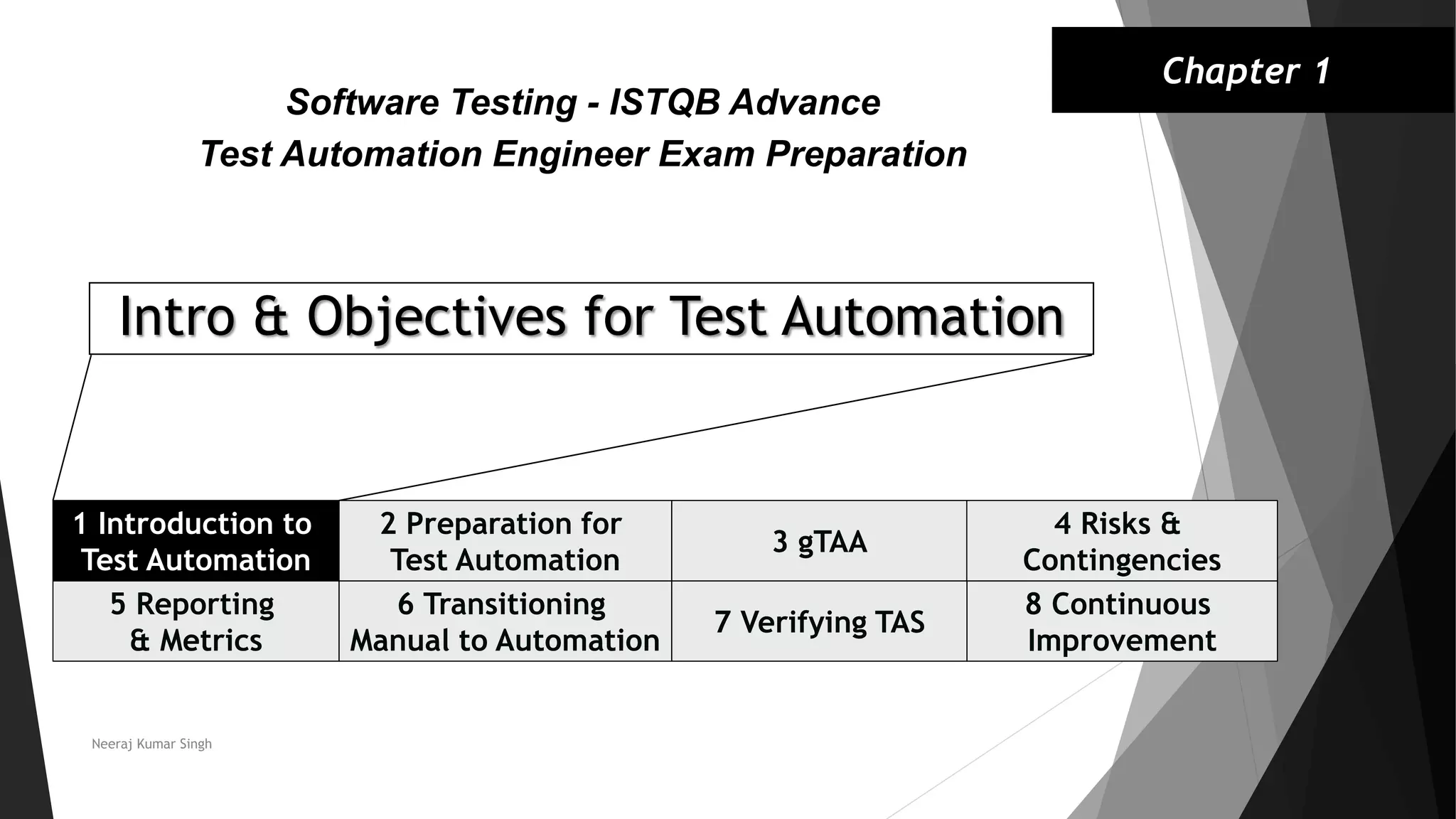
Intro & Objectives for Test Automation 1 Introduction to Test Automation 2 Preparation for Test Automation 3 gTAA Software Testing - ISTQB Advance Test Automation Engineer Exam Preparation Chapter 1 Neeraj Kumar Singh 5 Reporting & Metrics 6 Transitioning Manual to Automation 7 Verifying TAS 8 Continuous Improvement 4 Risks & Contingencies
Intro & Objectives for Test Automation Sample Questions 1. Which of the following is considered to be an advantage of test automation over manual testing? Answer Set a. The time required for test execution is lengthened and the coverage is increased b. The time required for test execution is shortened and the coverage is increased c. The time required for test execution is lengthened and the coverage is reduced d. The time required for test execution is shortened and the coverage is reduced Neeraj Kumar Singh
Intro & Objectives for Test Automation Sample Questions 2. Which of the following is an important technical success factor for any significant automation project? Answer Set a. The TAA must be designed for learnability b. The TAA must support the ability to automate all manual tests c. The SUT must be self-documenting d. The GUI interaction and data must be coupled with the graphical interface Neeraj Kumar Singh

Chapter 1 - Introduction and Objectives for Test Automation

  • 1.
    Intro & Objectivesfor Test Automation 1 Introduction to Test Automation 2 Preparation for Test Automation 3 gTAA Software Testing - ISTQB Advance Test Automation Engineer Exam Preparation Chapter 1 Neeraj Kumar Singh 5 Reporting & Metrics 6 Transitioning Manual to Automation 7 Verifying TAS 8 Continuous Improvement 4 Risks & Contingencies
  • 2.
    Introduction & Objectivesfor Test Automation Contents 1.1 Purpose of Test Automation 1.2 Success Factors in Test Automation Neeraj Kumar Singh
  • 3.
    Introduction & Objectivesfor Test Automation Purpose of Test Automation Test automation is expected to help run many test cases consistently and repeatedly on different versions of the SUT and/or environments. But test automation is more than a mechanism for running a test suite without human interaction. It involves a process of designing the testware, including:  Software  Documentation  Test cases  Test environments  Test data Testware is necessary for the testing activities that include:  Implementing automated test cases  Monitoring and controlling the execution of automated tests  Interpreting, reporting and logging the automated test results Neeraj Kumar Singh
  • 4.
    Introduction & Objectivesfor Test Automation Purpose of Test Automation Test automation has different approaches for interacting with a SUT:  Testing through the public interfaces to classes, modules or libraries of the SUT (API testing)  Testing through the user interface of the SUT (e.g., GUI testing or CLI testing)  Testing through a service or protocol Objectives of test automation include:  Improving test efficiency  Providing wider function coverage  Reducing the total test cost  Performing tests that manual testers cannot  Shortening the test execution period  Increasing the test frequency/reducing the time required for test cycles Neeraj Kumar Singh
  • 5.
    Introduction & Objectivesfor Test Automation Purpose of Test Automation Advantages of test automation include:  More tests can be run per build  The possibility to create tests that cannot be done manually (real-time, remote, parallel tests)  Tests can be more complex  Tests run faster  Tests are less subject to operator error  More effective and efficient use of testing resources  Quicker feedback regarding software quality  Improved system reliability(e.g., repeatability, consistency)  Improved consistency of tests Neeraj Kumar Singh
  • 6.
    Introduction & Objectivesfor Test Automation Purpose of Test Automation Disadvantages of test automation include:  Additional costs are involved  Initial investment to setup TAS  Requires additional technologies  Team needs to have development and automation skills  On-going TAS maintenance requirement  Can distract from testing objectives, e.g., focusing on automating tests cases at the expense of executing tests  Tests can become more complex  Additional errors may be introduced by automation Limitations of test automation include:  Not all manual tests can be automated  The automation can only check machine-interpretable results  The automation can only check actual results that can be verified by an automated test oracle  Not a replacement for exploratory testing Neeraj Kumar Singh
  • 7.
    Intro & Objectivesfor Test Automation 1 Introduction to Test Automation 2 Preparation for Test Automation 3 gTAA Software Testing - ISTQB Advance Test Automation Engineer Exam Preparation Chapter 1 Neeraj Kumar Singh 5 Reporting & Metrics 6 Transitioning Manual to Automation 7 Verifying TAS 8 Continuous Improvement 4 Risks & Contingencies
  • 8.
    Introduction & Objectivesfor Test Automation Contents 1.1 Purpose of Test Automation 1.2 Success Factors in Test Automation Neeraj Kumar Singh
  • 9.
    Introduction & Objectivesfor Test Automation Success Factors in Test Automation Test Automation Architecture (TAA)  The Test Automation Architecture (TAA) is very closely aligned with the architecture of a software product. It should be clear which functional and non-functional requirements the architecture is to support. Typically this will be the most important requirements.  Often TAA is designed for maintainability, performance and learnability. It is helpful to involve software engineers who understand the architecture of the SUT. SUT Testability  The SUT needs to be designed for testability that supports automated testing. In the case of GUI testing, this could mean that the SUT should decouple as much as possible the GUI interaction and data from the appearance of the graphical interface.  In the case of API testing, this could mean that more classes, modules or the command-line interface need to be exposed as public so that they can be tested.  The testable parts of the SUT should be targeted first. Generally, a key factor in the success of test automation lies in the ease of implementing automated test scripts. Neeraj Kumar Singh
  • 10.
    Introduction & Objectivesfor Test Automation Success Factors in Test Automation Test Automation Strategy  A practical and consistent test automation strategy that addresses maintainability and consistency of the SUT.  It may not be possible to apply the test automation strategy in the same way to both old and new parts of the SUT. When creating the automation strategy, consider the costs, benefits and risks of applying it to different parts of the code.  Consideration should be given to testing both the user interface and the API with automated test cases to check the consistency of the results. Neeraj Kumar Singh
  • 11.
    Introduction & Objectivesfor Test Automation Success Factors in Test Automation Test Automation Framework (TAF) A test automation framework (TAF) that is easy to use, well documented and maintainable, supports a consistent approach to automating tests. In order to establish an easy to use and maintainable TAF, the following must be done:  Implement reporting facilities  Enable easy troubleshooting  Address the test environment appropriately  Document the automated test cases  Trace the automated test  Enable easy maintenance  Keep the automated tests up-to-date  Plan for deployment  Retire tests as needed  Monitor and restore the SUT Neeraj Kumar Singh
  • 12.
    Introduction & Objectivesfor Test Automation Success Factors in Test Automation  The test automation code can be complex to maintain. It is not unusual to have as much code for testing as the code for the SUT. This is why it is of utmost importance that the test code be maintainable. This is due to the different test tools being used, the different types of verification that are used and the different testware artifacts that have to be maintained.  With these maintenance considerations in mind, in addition to the important items that should be done, there are a few that should not be done, as follows:  Do not create code that is sensitive to the interface (i.e., it would be affected by changes in the graphical interface or in non-essential parts of the API).  Do not create test automation that is sensitive to data changes or has a high dependency on particular data values (e.g., test input depending on other test outputs).  Do not create an automation environment that is sensitive to the context (e.g., operating system date and time, operating system localization parameters or the contents of another application). In this case, it is better to use test stubs as necessary so the environment can be controlled. Neeraj Kumar Singh
  • 13.
    Intro & Objectivesfor Test Automation 1 Introduction to Test Automation 2 Preparation for Test Automation 3 gTAA Software Testing - ISTQB Advance Test Automation Engineer Exam Preparation Chapter 1 Neeraj Kumar Singh 5 Reporting & Metrics 6 Transitioning Manual to Automation 7 Verifying TAS 8 Continuous Improvement 4 Risks & Contingencies
  • 14.
    Intro & Objectivesfor Test Automation Sample Questions 1. Which of the following is considered to be an advantage of test automation over manual testing? Answer Set a. The time required for test execution is lengthened and the coverage is increased b. The time required for test execution is shortened and the coverage is increased c. The time required for test execution is lengthened and the coverage is reduced d. The time required for test execution is shortened and the coverage is reduced Neeraj Kumar Singh
  • 15.
    Intro & Objectivesfor Test Automation Sample Questions 2. Which of the following is an important technical success factor for any significant automation project? Answer Set a. The TAA must be designed for learnability b. The TAA must support the ability to automate all manual tests c. The SUT must be self-documenting d. The GUI interaction and data must be coupled with the graphical interface Neeraj Kumar Singh

Editor's Notes

  • #12 Enable easy troubleshooting: In addition to the test execution and logging, the TAF has to provide an easy way to troubleshoot failing tests. The test can fail due to o failures found in the SUT o failures found in the TAS o problem with the tests themselves or the test environment