


Building applications with MongoDB – An introduction Roger Bodamer roger@10gen.com @rogerb http://mongodb.org http://10gen.com
Today’s Talk • Developing your first Web Application with MongoDB • What is MongoDB, Platforms and availability • Data Modeling, queries and geospatial queries • Location bases App • Example uses MongoDB Javascript shell
Why MongoDB • Intrinsic support for agile development • Super low latency access to your data – Very little CPU overhead • No Additional caching layer required • Built in Replication and Horizontal Scaling support
MongoDB • Document Oriented Database – Data is stored in documents, not tables / relations • MongoDB is Implemented in C++ for best performance • Platforms 32/64 bit Windows Linux, Mac OS-X, FreeBSD, Solaris • Language drivers for: – Ruby / Ruby-on-Rails – Java – C# – JavaScript – C / C++ – Erlang Python, Perl others..... and much more ! ..
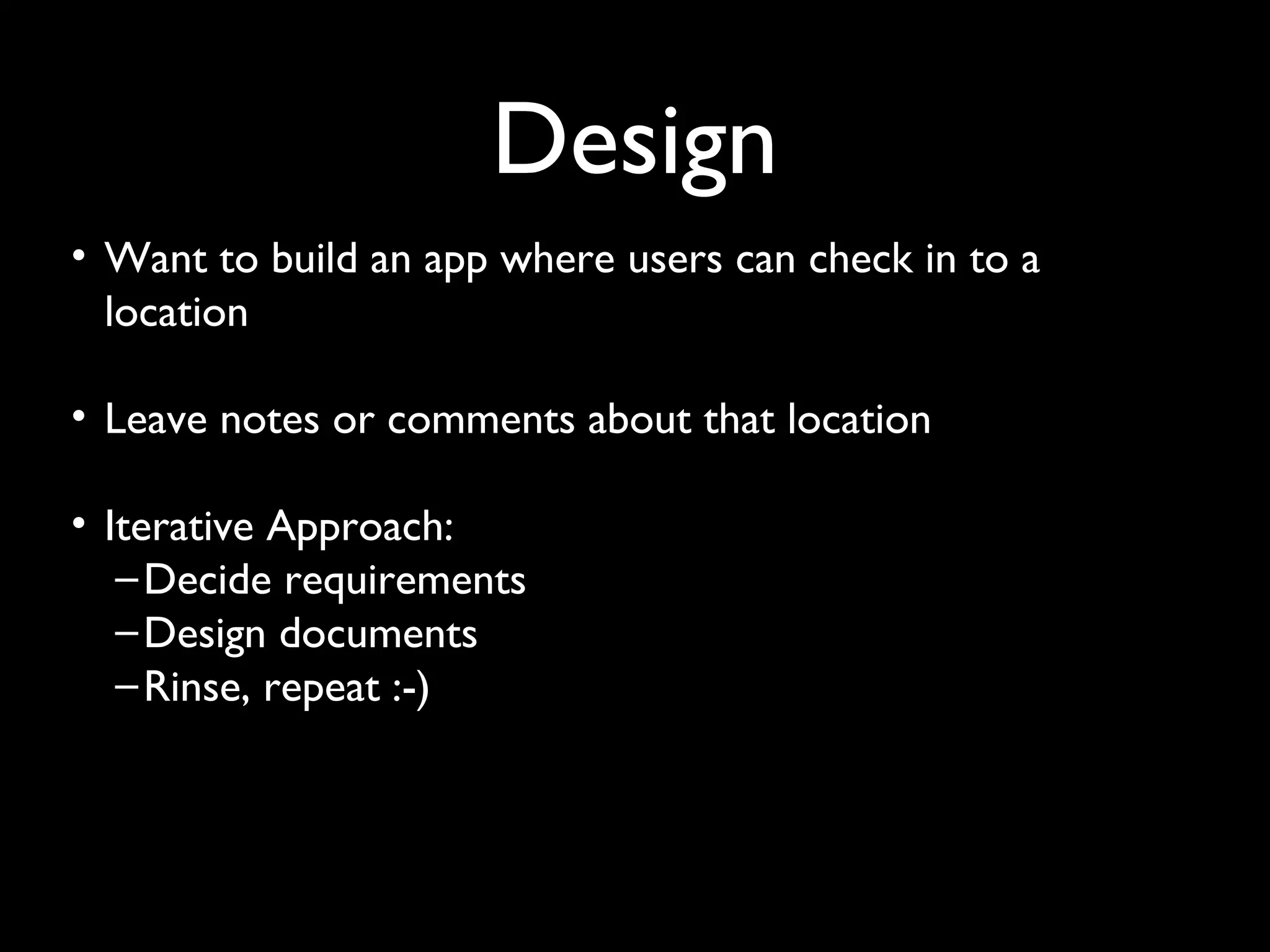
Design • Want to build an app where users can check in to a location • Leave notes or comments about that location • Iterative Approach: – Decide requirements – Design documents – Rinse, repeat :-)
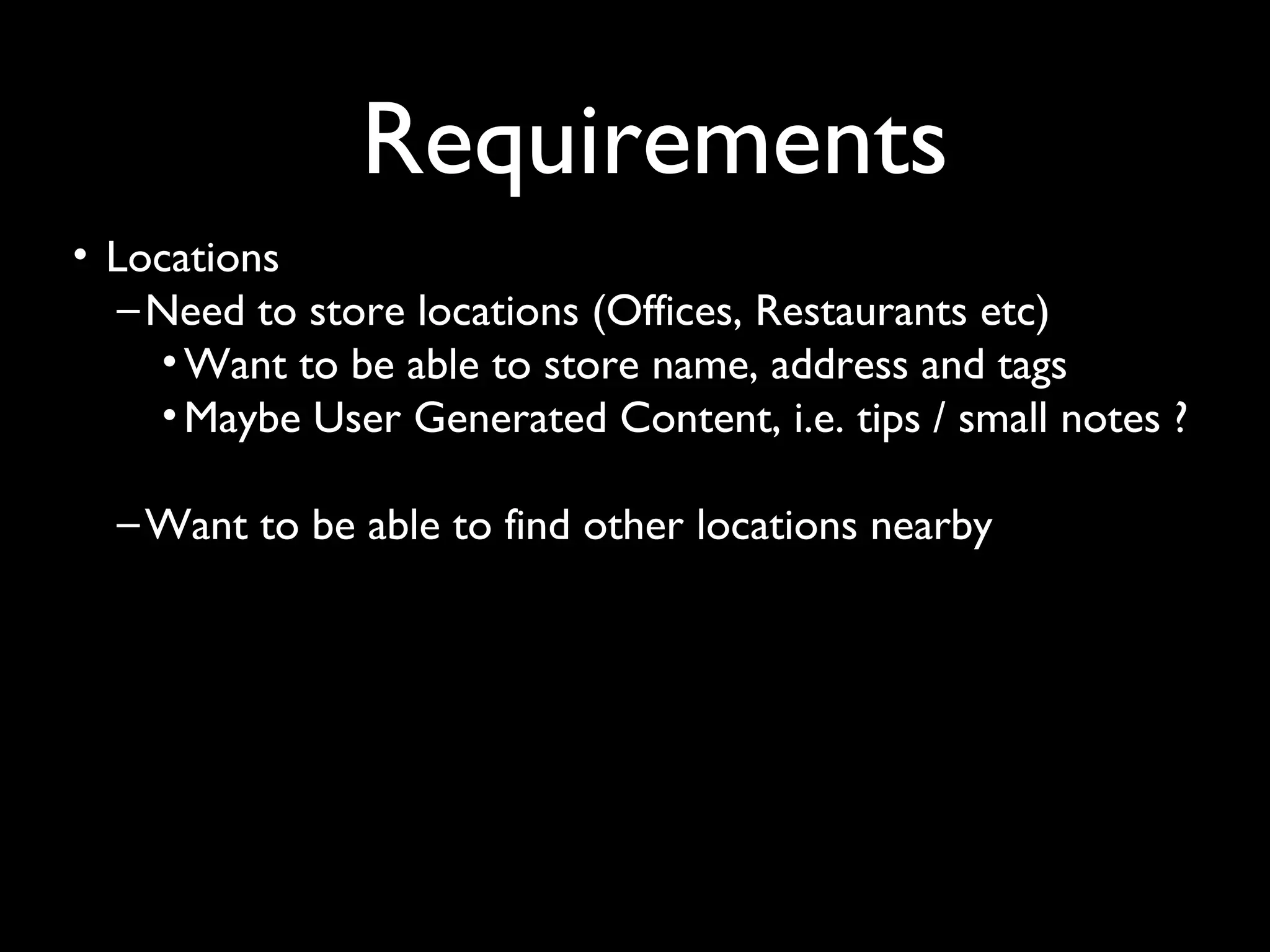
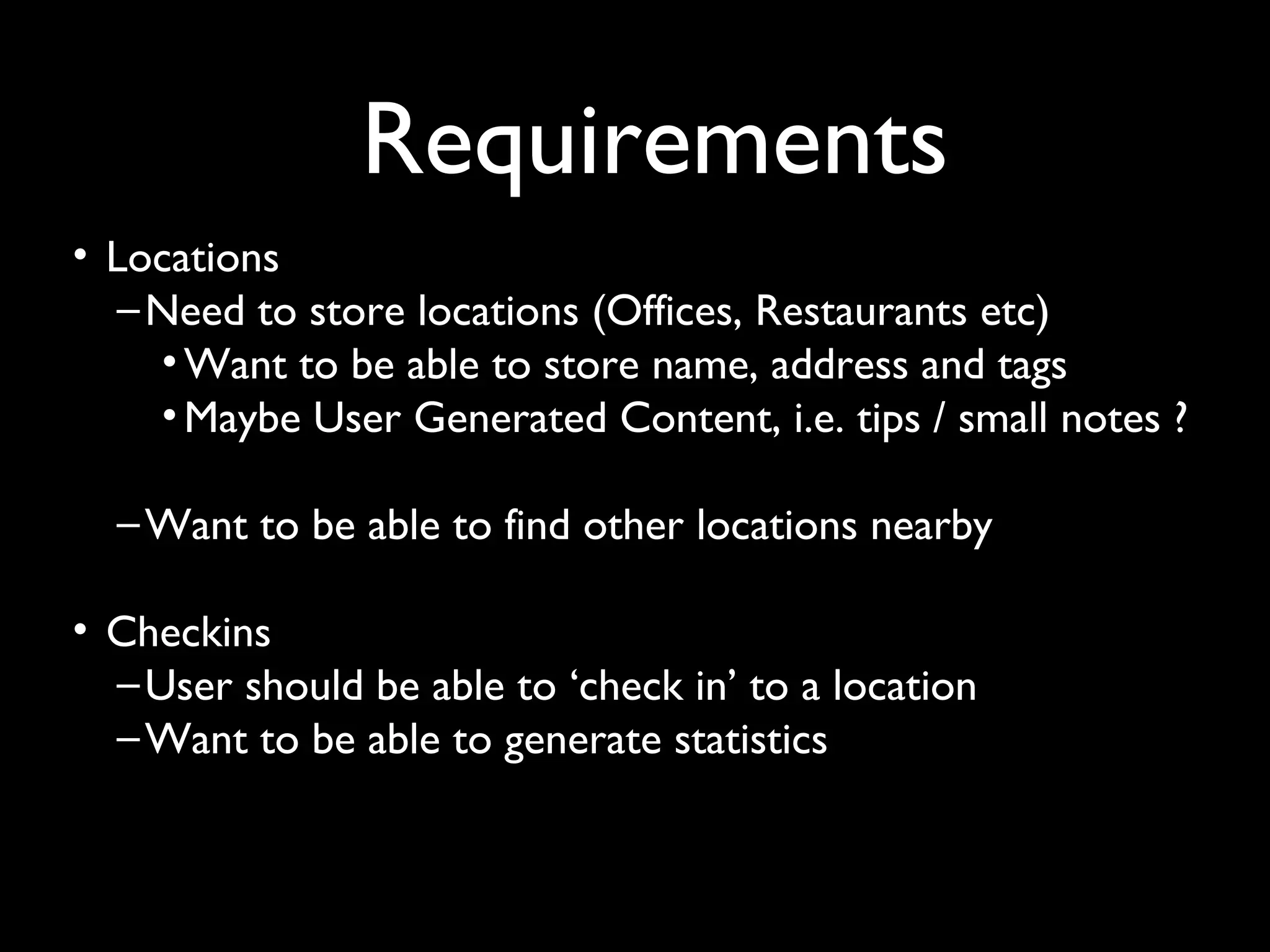
Requirements • Locations – Need to store locations (Offices, Restaurants etc) • Want to be able to store name, address and tags • Maybe User Generated Content, i.e. tips / small notes ? – Want to be able to find other locations nearby
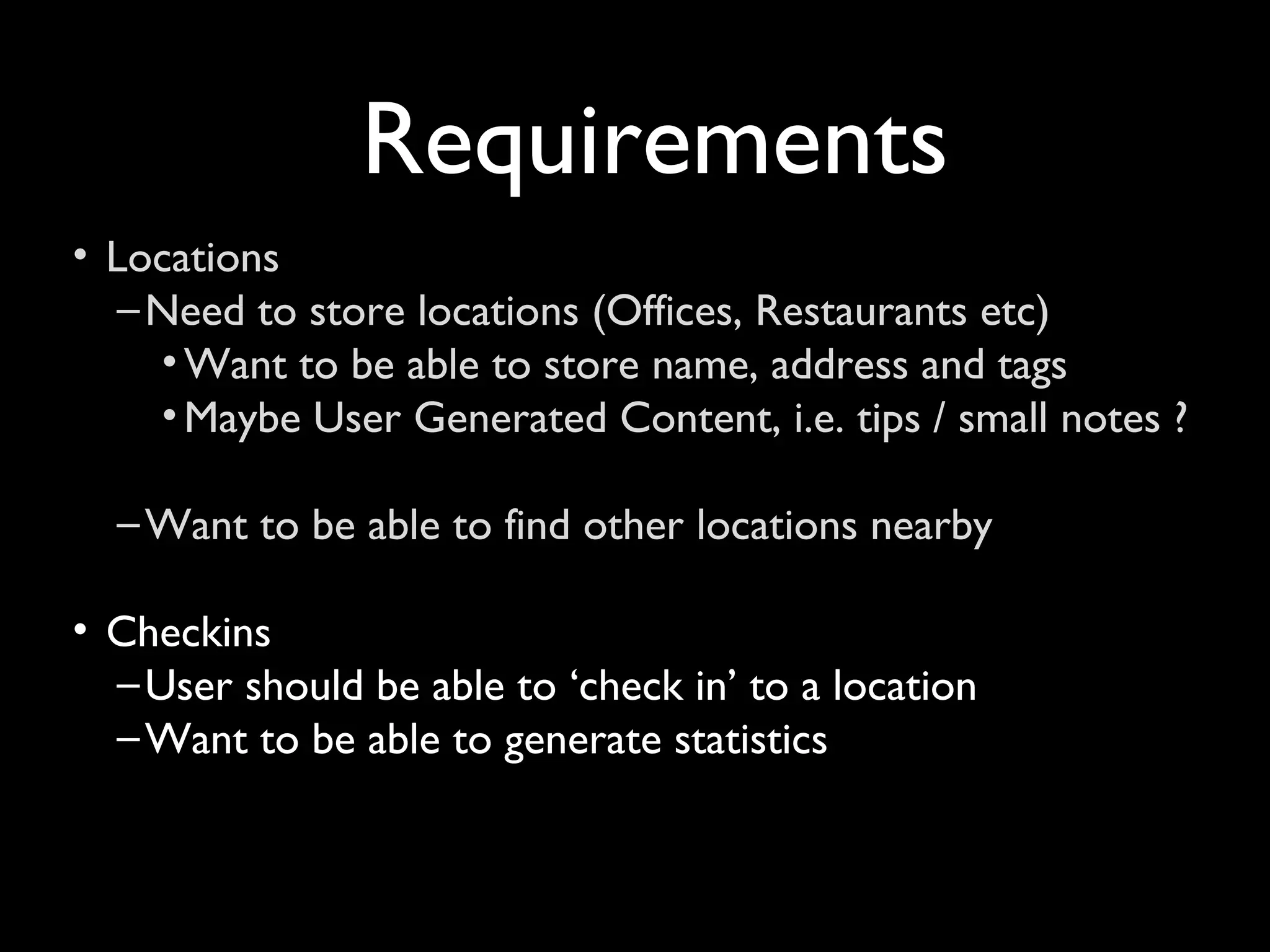
Requirements • Locations – Need to store locations (Offices, Restaurants etc) • Want to be able to store name, address and tags • Maybe User Generated Content, i.e. tips / small notes ? – Want to be able to find other locations nearby • Checkins – User should be able to ‘check in’ to a location – Want to be able to generate statistics
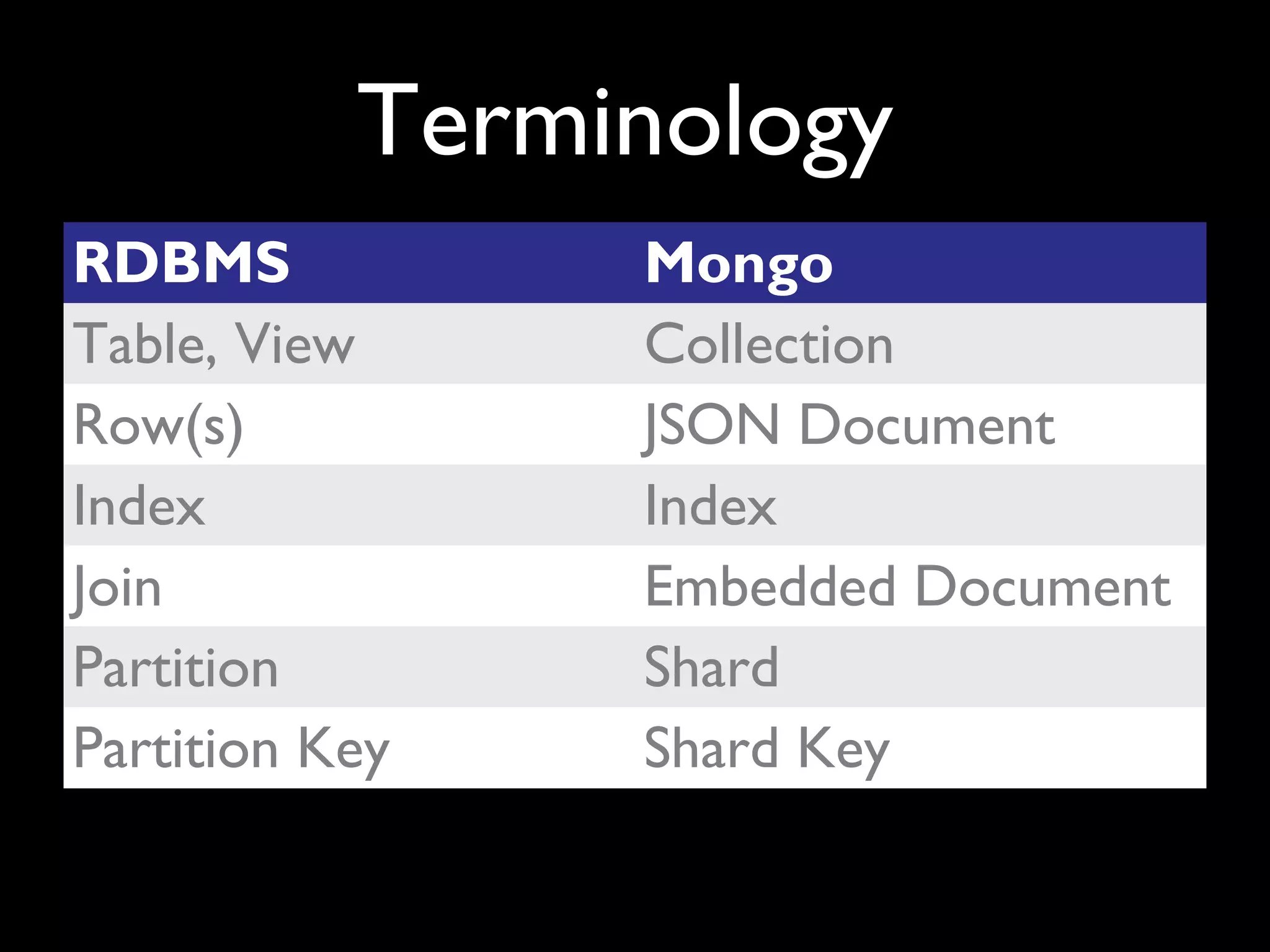
Terminology RDBMS Mongo Table, View Collection Row(s) JSON Document Index Index Join Embedded Document Partition Shard Partition Key Shard Key
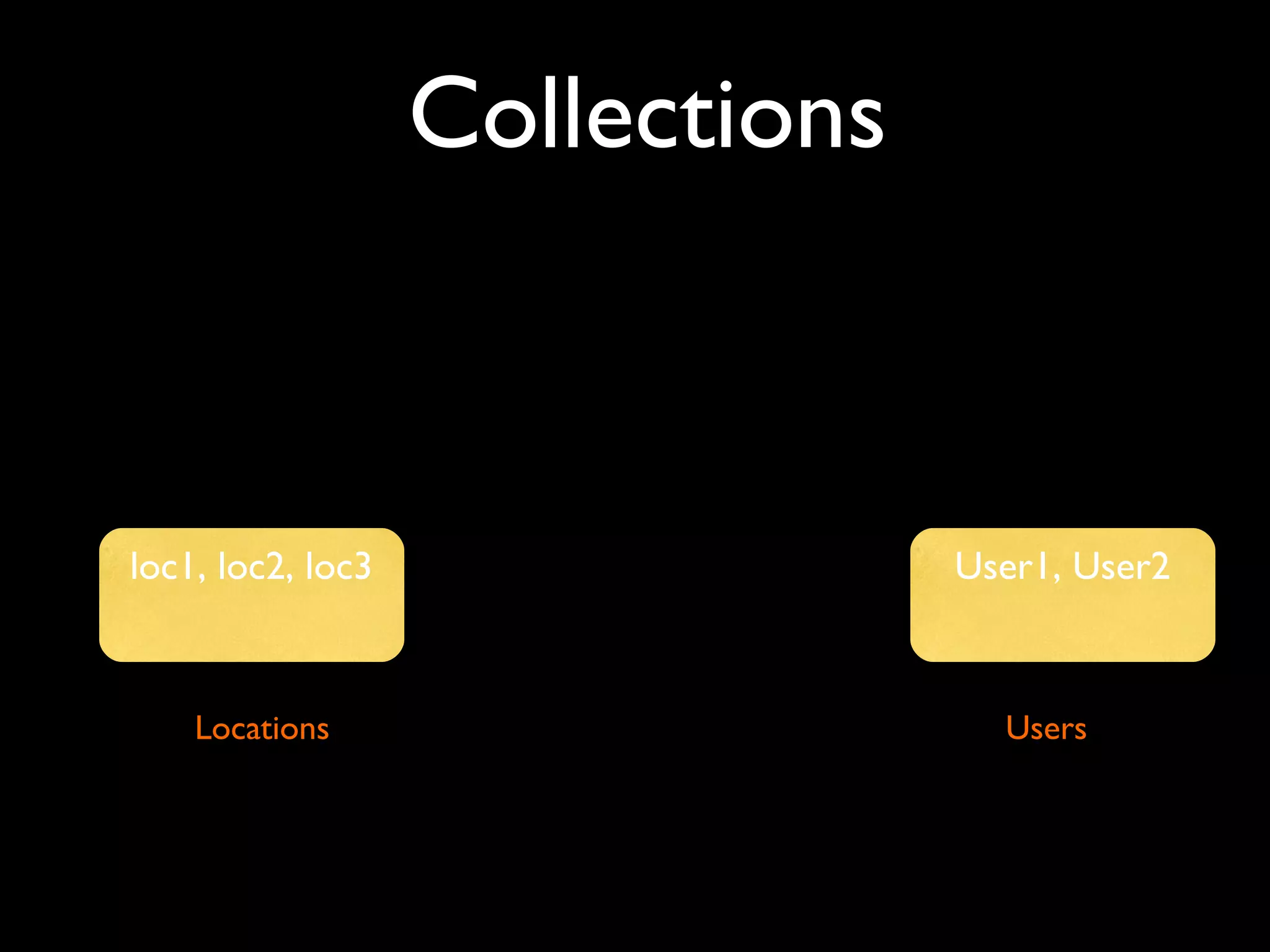
Collections loc1, loc2, loc3 User1, User2 Locations Users
JSON Sample Doc { _id : ObjectId("4c4ba5c0672c685e5e8aabf3"), author : "roger", date : "Sat Jul 24 2010 19:47:11 GMT-0700 (PDT)", text : ”MongoSF", tags : [ ”San Francisco", ”MongoDB" ] } Notes: - _id is unique, but can be anything you’d like
BSON • JSON has powerful, but limited set of datatypes – Mongo extends datypes with Date, Int types, Id, … • MongoDB stores data in BSON • BSON is a binary representation of JSON – Optimized for performance and navigational abilities – Also compression – See bsonspec.org
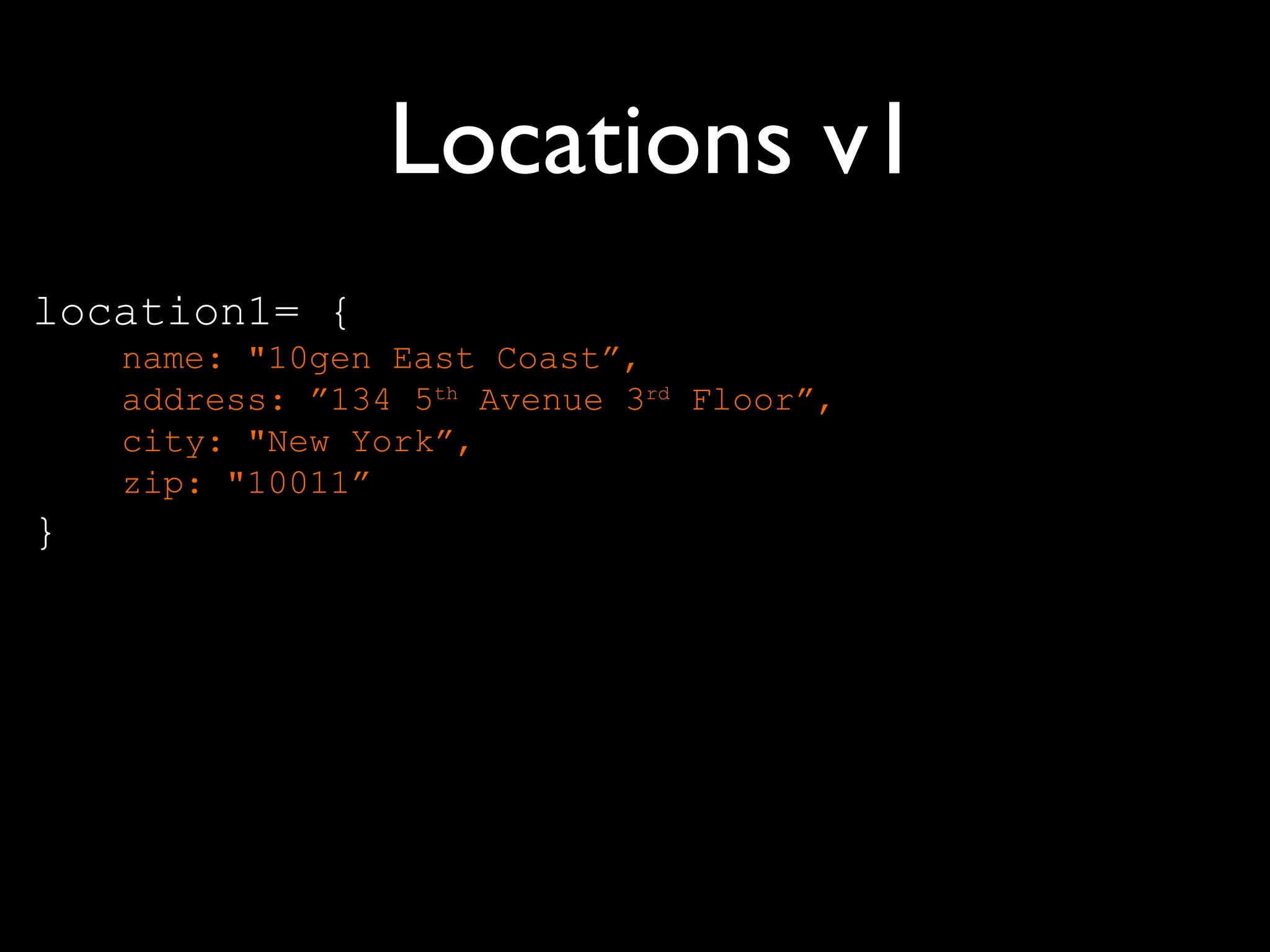
Locations v1 location1= { name: "10gen East Coast”, address: ”134 5th Avenue 3rd Floor”, city: "New York”, zip: "10011” }
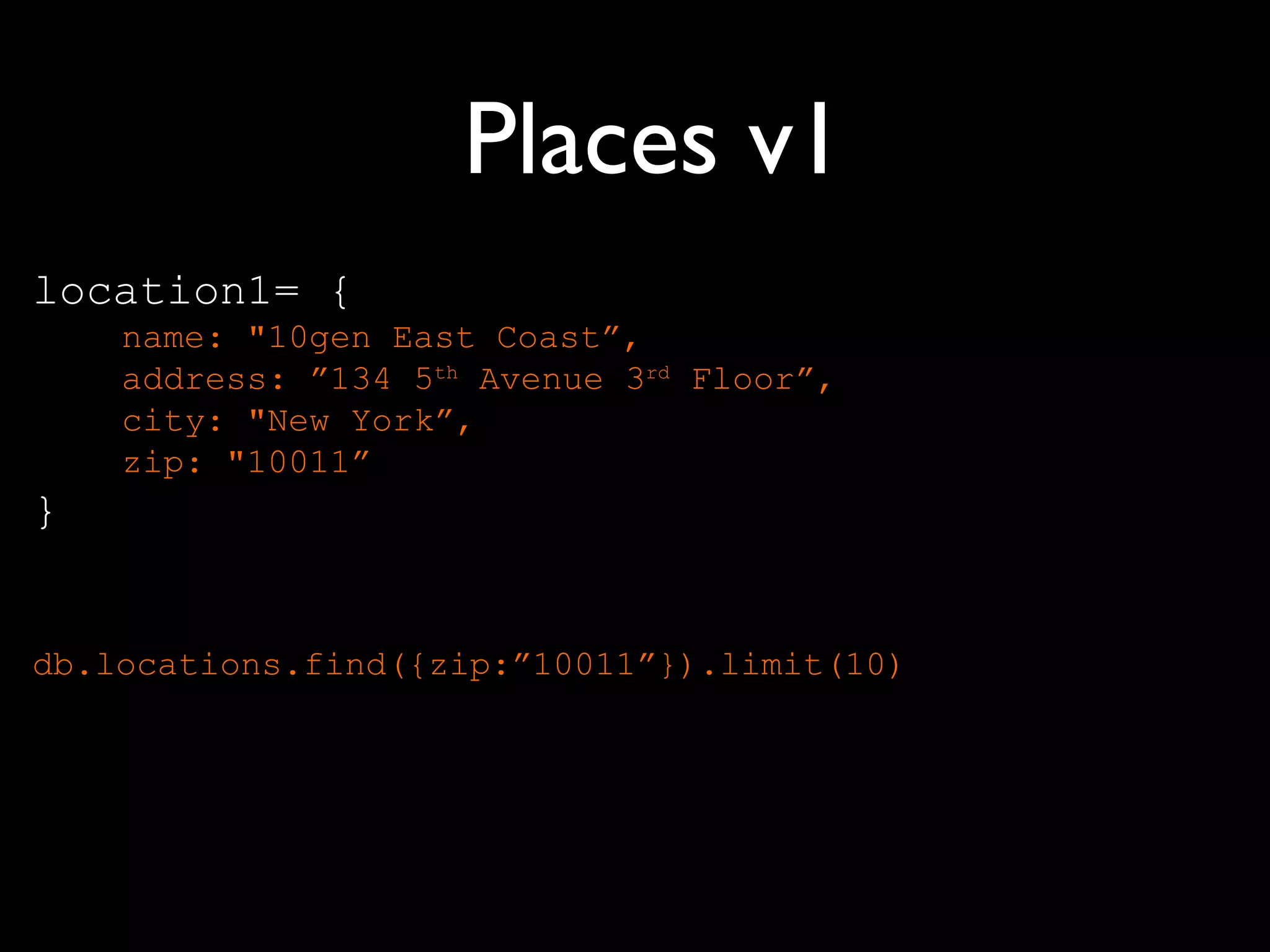
Places v1 location1= { name: "10gen East Coast”, address: ”134 5th Avenue 3rd Floor”, city: "New York”, zip: "10011” } db.locations.find({zip:”10011”}).limit(10)
Places v2 location1 = { name: "10gen East Coast”, address: "17 West 18th Street 8th Floor”, city: "New York”, zip: "10011”, tags: [“business”, “mongodb”] }
Places v2 location1 = { name: "10gen East Coast”, address: "17 West 18th Street 8th Floor”, city: "New York”, zip: "10011”, tags: [“business”, “mongodb”] } db.locations.find({zip:”10011”, tags:”business”})
Places v3 location1 = { name: "10gen East Coast”, address: "17 West 18th Street 8th Floor”, city: "New York”, zip: "10011”, tags: [“business”, “mongodb”], latlong: [40.0,72.0] }
Places v3 location1 = { name: "10gen East Coast”, address: "17 West 18th Street 8th Floor”, city: "New York”, zip: "10011”, tags: [“business”, “cool place”], latlong: [40.0,72.0] } db.locations.ensureIndex({latlong:”2d”})
location1 = { Places v3 name: "10gen HQ”, address: "17 West 18th Street 8th Floor”, city: "New York”, zip: "10011”, tags: [“business”, “cool place”], latlong: [40.0,72.0] } db.locations.ensureIndex({latlong:”2d”}) db.locations.find({latlong:{$near:[40,70]}})
location1 = { Places v4 name: "10gen HQ”, address: "17 West 18th Street 8th Floor”, city: "New York”, zip: "10011”, latlong: [40.0,72.0], tags: [“business”, “cool place”], tips: [ {user:"nosh", time:6/26/2010, tip:"stop by for office hours on Wednesdays from 4-6pm"}, {.....}, ] }
Querying your Places Creating your indexes db.locations.ensureIndex({tags:1}) db.locations.ensureIndex({name:1}) db.locations.ensureIndex({latlong:”2d”}) Finding places: db.locations.find({latlong:{$near:[40,70]}}) With regular expressions: db.locations.find({name: /^typeaheadstring/) By tag: db.locations.find({tags: “business”})
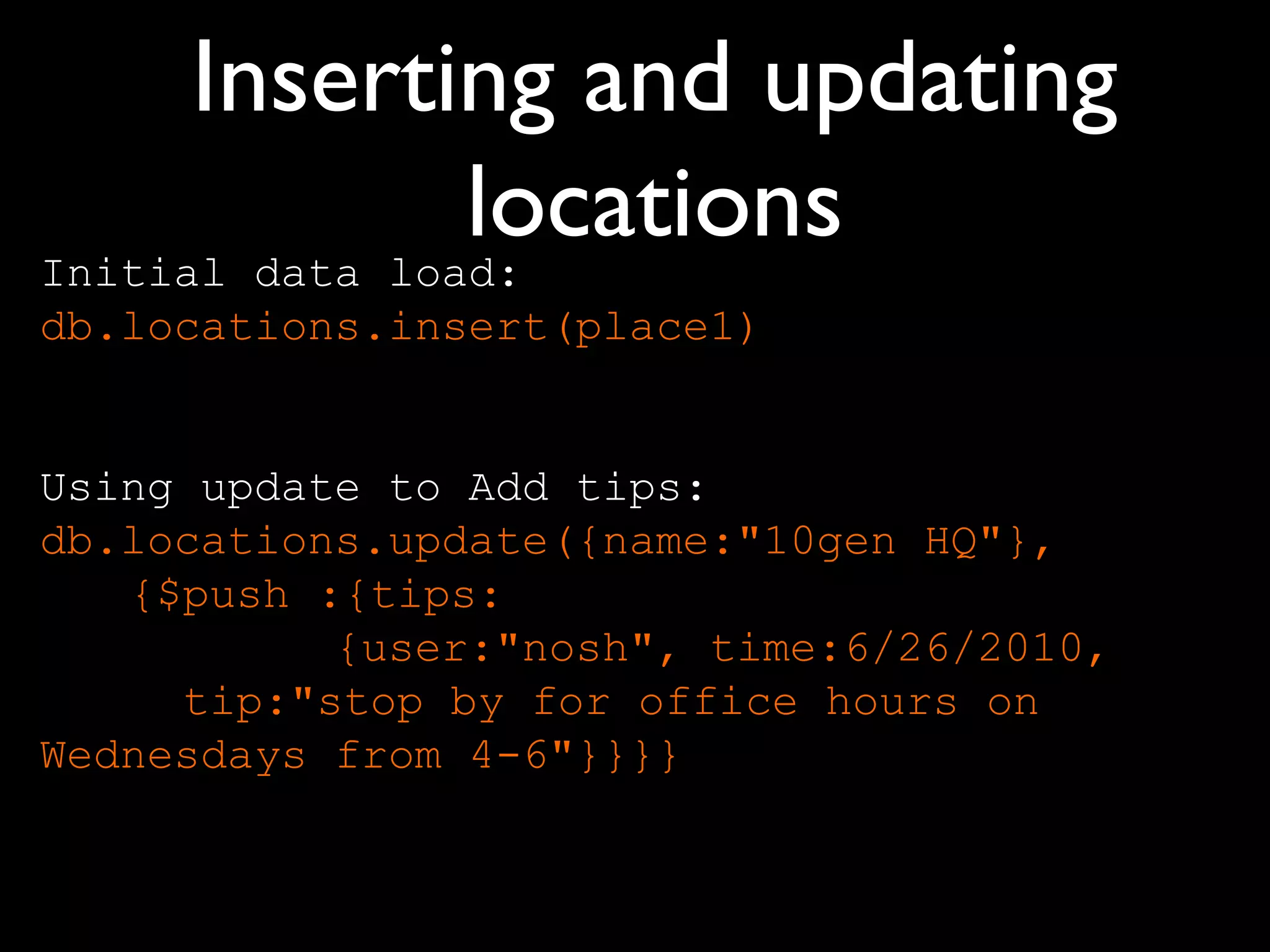
Inserting and updating locations Initial data load: db.locations.insert(place1) Using update to Add tips: db.locations.update({name:"10gen HQ"}, {$push :{tips: {user:"nosh", time:6/26/2010, tip:"stop by for office hours on Wednesdays from 4-6"}}}}
Requirements • Locations – Need to store locations (Offices, Restaurants etc) • Want to be able to store name, address and tags • Maybe User Generated Content, i.e. tips / small notes ? – Want to be able to find other locations nearby • Checkins – User should be able to ‘check in’ to a location – Want to be able to generate statistics
Users user1 = { name: “nosh” email: “nosh@10gen.com”, . . . checkins: [{ location: “10gen HQ”, ts: 9/20/2010 10:12:00, …}, … ] }
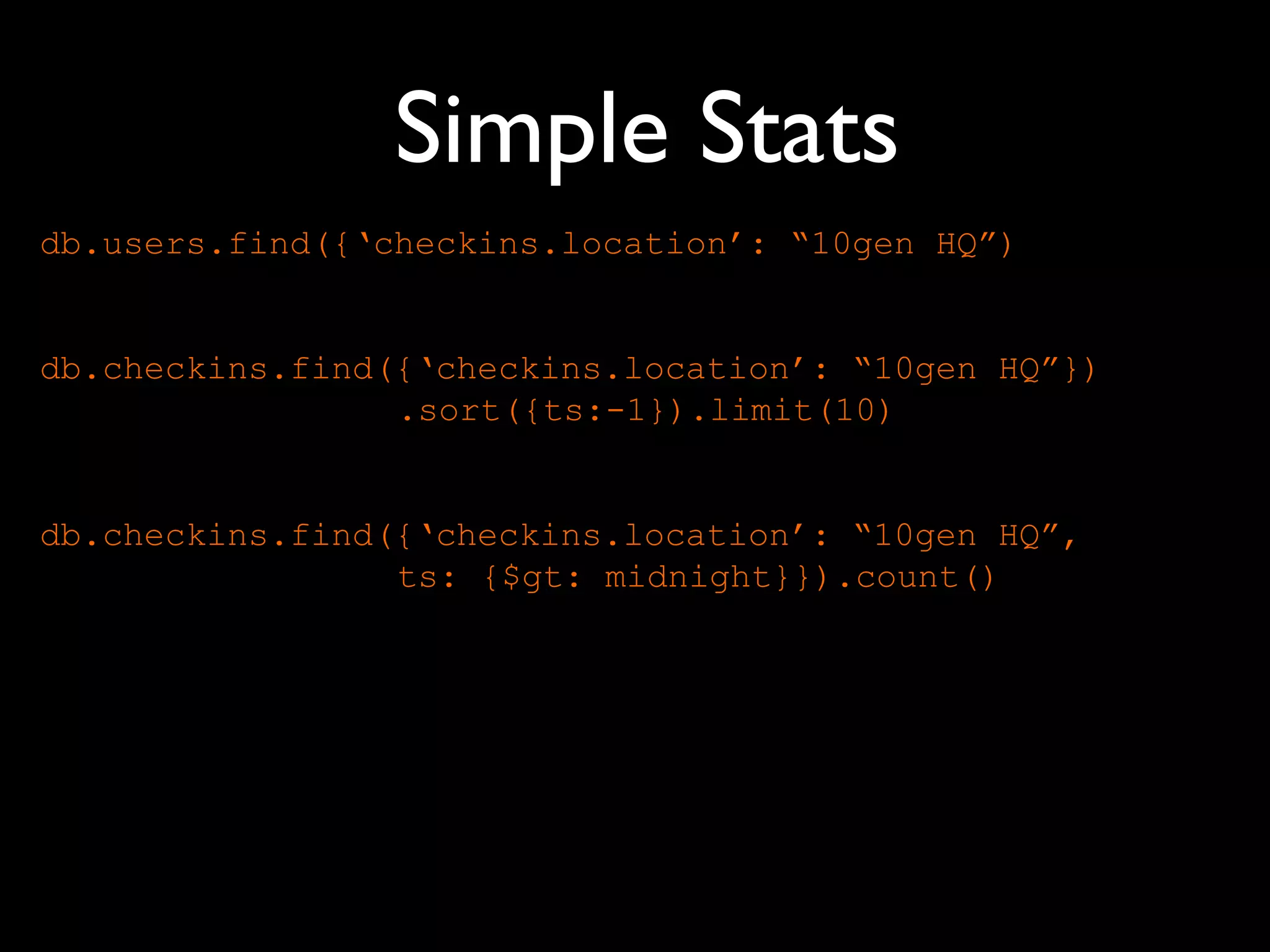
Simple Stats db.users.find({‘checkins.location’: “10gen HQ”) db.checkins.find({‘checkins.location’: “10gen HQ”}) .sort({ts:-1}).limit(10) db.checkins.find({‘checkins.location’: “10gen HQ”, ts: {$gt: midnight}}).count()
Alternative user1 = { name: “nosh” email: “nosh@10gen.com”, . . . checkins: [4b97e62bf1d8c7152c9ccb74, 5a20e62bf1d8c736ab] } checkins [] = ObjectId reference to locations collection
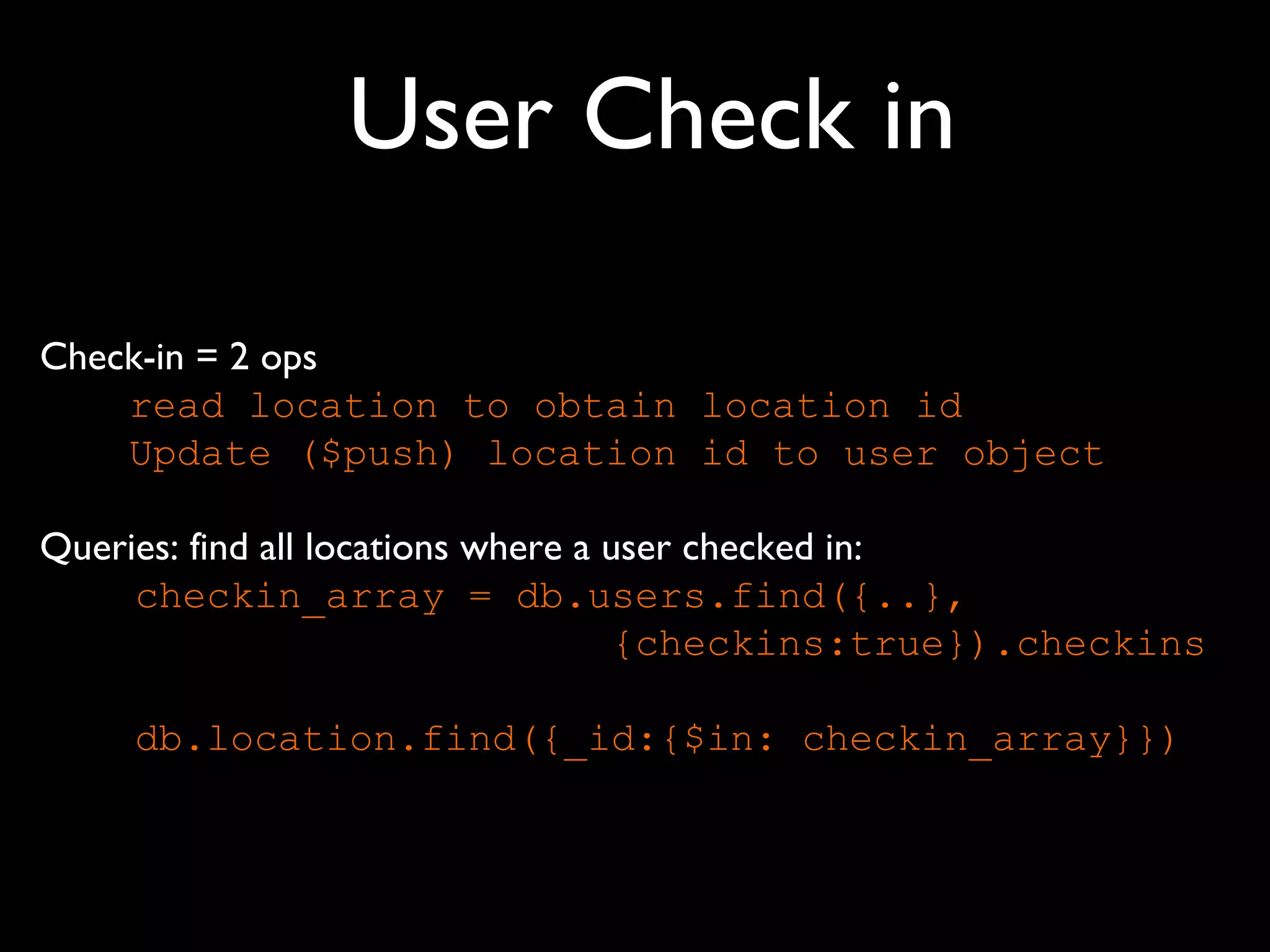
User Check in Check-in = 2 ops read location to obtain location id Update ($push) location id to user object Queries: find all locations where a user checked in: checkin_array = db.users.find({..}, {checkins:true}).checkins db.location.find({_id:{$in: checkin_array}})
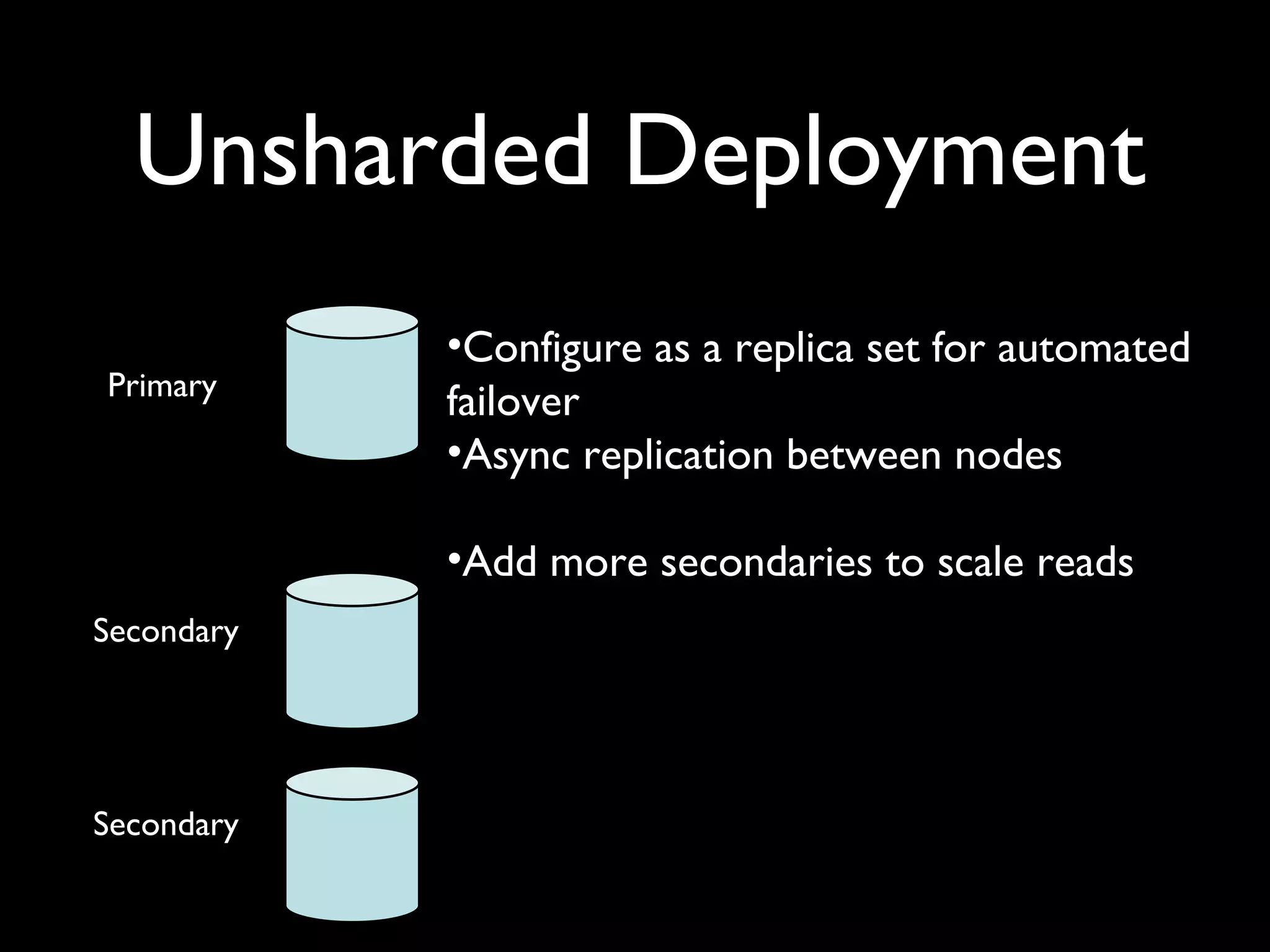
Unsharded Deployment •Configure as a replica set for automated Primary failover •Async replication between nodes •Add more secondaries to scale reads Secondary Secondary
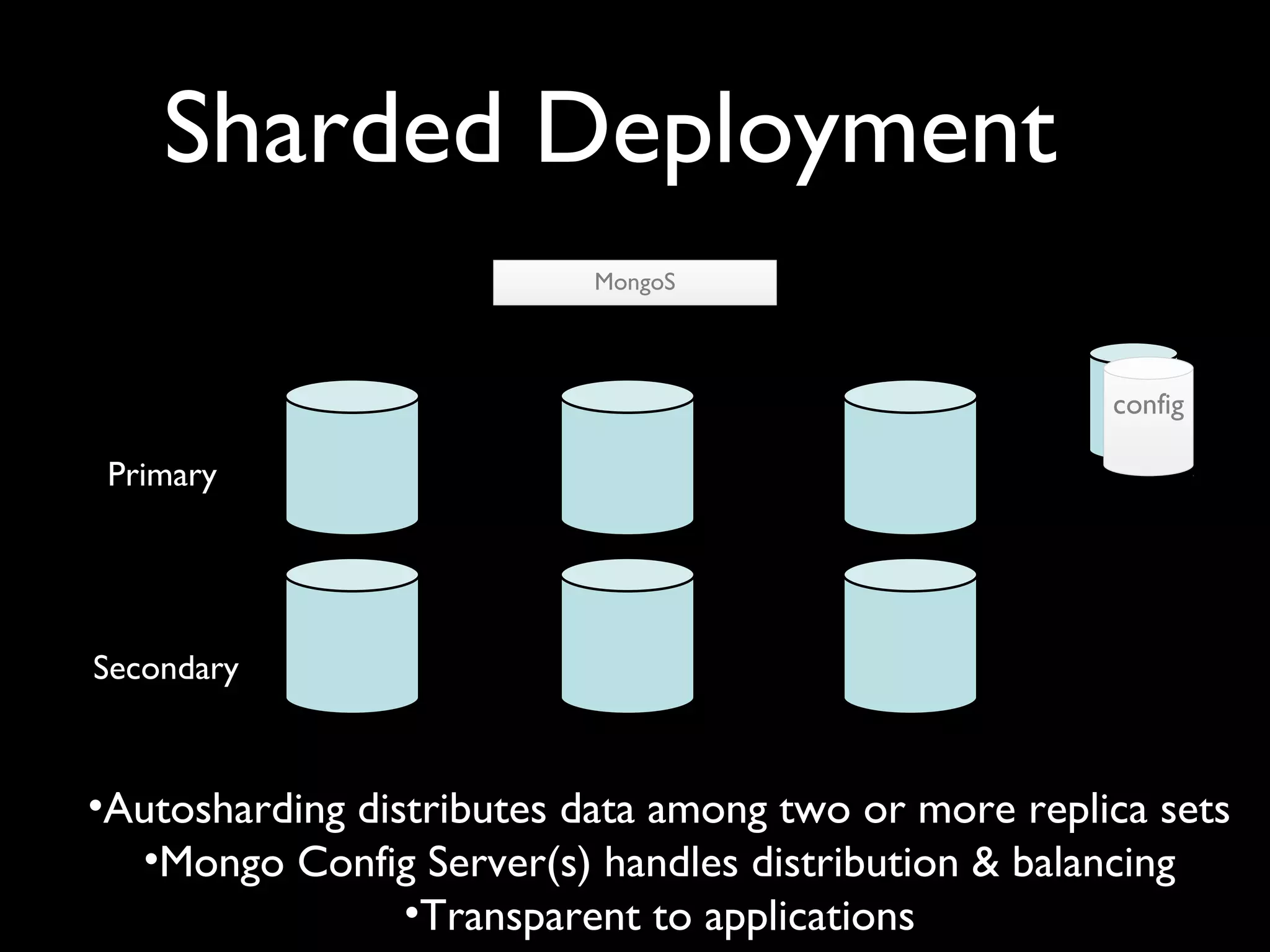
Sharded Deployment MongoS config Primary Secondary •Autosharding distributes data among two or more replica sets •Mongo Config Server(s) handles distribution & balancing •Transparent to applications
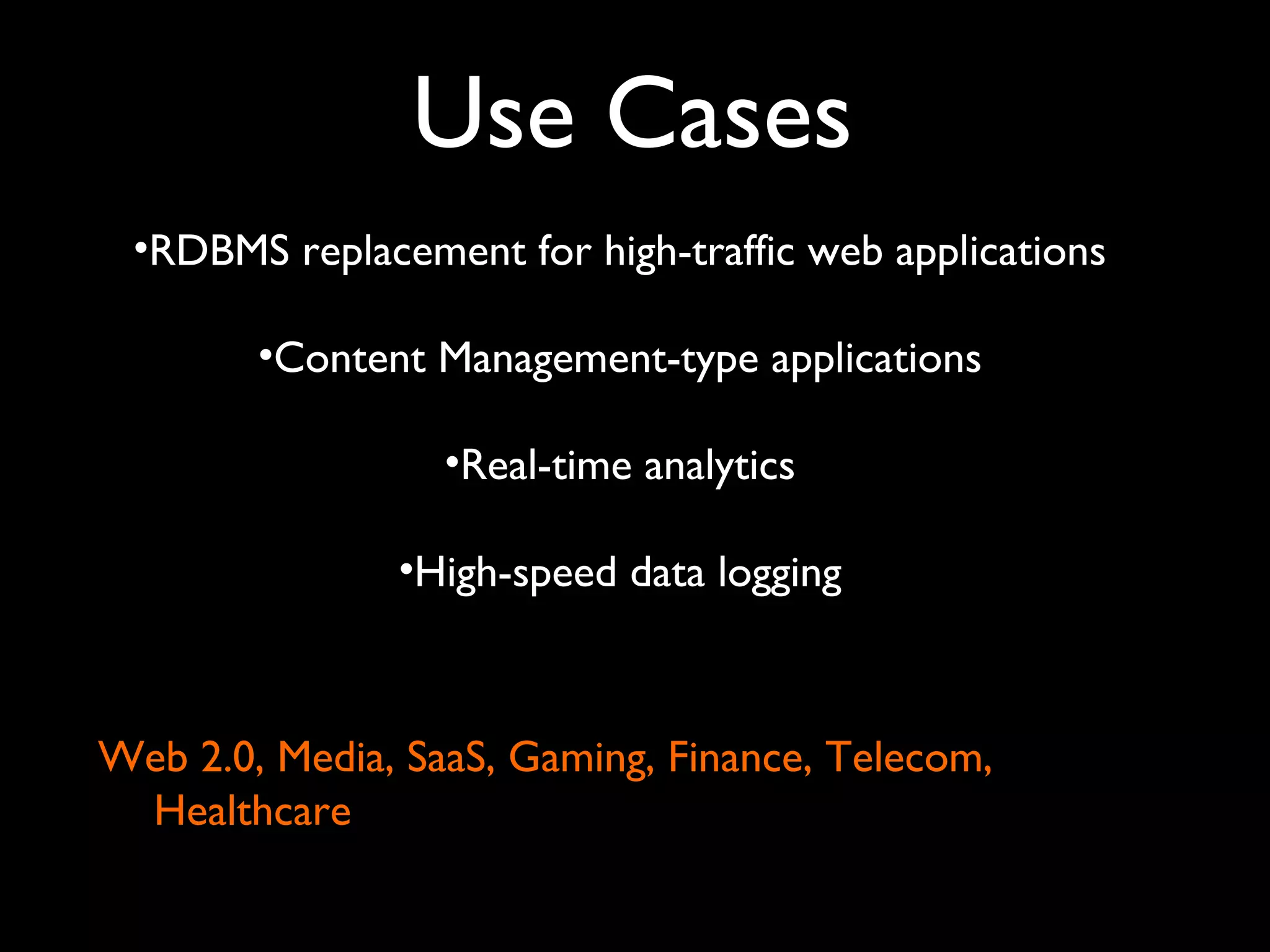
Use Cases •RDBMS replacement for high-traffic web applications •Content Management-type applications •Real-time analytics •High-speed data logging Web 2.0, Media, SaaS, Gaming, Finance, Telecom, Healthcare
10Gen is hiring! @mongodb roger@10gen.com @rogerb http://mongodb.org http://10gen.com

Building web applications with mongo db presentation

  • 1.
    Building applications withMongoDB – An introduction Roger Bodamer roger@10gen.com @rogerb http://mongodb.org http://10gen.com
  • 2.
    Today’s Talk • Developingyour first Web Application with MongoDB • What is MongoDB, Platforms and availability • Data Modeling, queries and geospatial queries • Location bases App • Example uses MongoDB Javascript shell
  • 3.
    Why MongoDB • Intrinsicsupport for agile development • Super low latency access to your data – Very little CPU overhead • No Additional caching layer required • Built in Replication and Horizontal Scaling support
  • 4.
    MongoDB • Document OrientedDatabase – Data is stored in documents, not tables / relations • MongoDB is Implemented in C++ for best performance • Platforms 32/64 bit Windows Linux, Mac OS-X, FreeBSD, Solaris • Language drivers for: – Ruby / Ruby-on-Rails – Java – C# – JavaScript – C / C++ – Erlang Python, Perl others..... and much more ! ..
  • 5.
    Design • Want tobuild an app where users can check in to a location • Leave notes or comments about that location • Iterative Approach: – Decide requirements – Design documents – Rinse, repeat :-)
  • 6.
    Requirements • Locations – Need to store locations (Offices, Restaurants etc) • Want to be able to store name, address and tags • Maybe User Generated Content, i.e. tips / small notes ? – Want to be able to find other locations nearby
  • 7.
    Requirements • Locations – Need to store locations (Offices, Restaurants etc) • Want to be able to store name, address and tags • Maybe User Generated Content, i.e. tips / small notes ? – Want to be able to find other locations nearby • Checkins – User should be able to ‘check in’ to a location – Want to be able to generate statistics
  • 8.
    Terminology RDBMS Mongo Table, View Collection Row(s) JSON Document Index Index Join Embedded Document Partition Shard Partition Key Shard Key
  • 9.
    Collections loc1, loc2, loc3 User1, User2 Locations Users
  • 10.
    JSON Sample Doc { _id : ObjectId("4c4ba5c0672c685e5e8aabf3"), author : "roger", date : "Sat Jul 24 2010 19:47:11 GMT-0700 (PDT)", text : ”MongoSF", tags : [ ”San Francisco", ”MongoDB" ] } Notes: - _id is unique, but can be anything you’d like
  • 11.
    BSON • JSON haspowerful, but limited set of datatypes – Mongo extends datypes with Date, Int types, Id, … • MongoDB stores data in BSON • BSON is a binary representation of JSON – Optimized for performance and navigational abilities – Also compression – See bsonspec.org
  • 12.
    Locations v1 location1= { name: "10gen East Coast”, address: ”134 5th Avenue 3rd Floor”, city: "New York”, zip: "10011” }
  • 13.
    Places v1 location1= { name: "10gen East Coast”, address: ”134 5th Avenue 3rd Floor”, city: "New York”, zip: "10011” } db.locations.find({zip:”10011”}).limit(10)
  • 14.
    Places v2 location1 ={ name: "10gen East Coast”, address: "17 West 18th Street 8th Floor”, city: "New York”, zip: "10011”, tags: [“business”, “mongodb”] }
  • 15.
    Places v2 location1 ={ name: "10gen East Coast”, address: "17 West 18th Street 8th Floor”, city: "New York”, zip: "10011”, tags: [“business”, “mongodb”] } db.locations.find({zip:”10011”, tags:”business”})
  • 16.
    Places v3 location1 ={ name: "10gen East Coast”, address: "17 West 18th Street 8th Floor”, city: "New York”, zip: "10011”, tags: [“business”, “mongodb”], latlong: [40.0,72.0] }
  • 17.
    Places v3 location1 ={ name: "10gen East Coast”, address: "17 West 18th Street 8th Floor”, city: "New York”, zip: "10011”, tags: [“business”, “cool place”], latlong: [40.0,72.0] } db.locations.ensureIndex({latlong:”2d”})
  • 18.
    location1 = { Places v3 name: "10gen HQ”, address: "17 West 18th Street 8th Floor”, city: "New York”, zip: "10011”, tags: [“business”, “cool place”], latlong: [40.0,72.0] } db.locations.ensureIndex({latlong:”2d”}) db.locations.find({latlong:{$near:[40,70]}})
  • 19.
    location1 = { Places v4 name: "10gen HQ”, address: "17 West 18th Street 8th Floor”, city: "New York”, zip: "10011”, latlong: [40.0,72.0], tags: [“business”, “cool place”], tips: [ {user:"nosh", time:6/26/2010, tip:"stop by for office hours on Wednesdays from 4-6pm"}, {.....}, ] }
  • 20.
    Querying your Places Creatingyour indexes db.locations.ensureIndex({tags:1}) db.locations.ensureIndex({name:1}) db.locations.ensureIndex({latlong:”2d”}) Finding places: db.locations.find({latlong:{$near:[40,70]}}) With regular expressions: db.locations.find({name: /^typeaheadstring/) By tag: db.locations.find({tags: “business”})
  • 21.
    Inserting and updating locations Initial data load: db.locations.insert(place1) Using update to Add tips: db.locations.update({name:"10gen HQ"}, {$push :{tips: {user:"nosh", time:6/26/2010, tip:"stop by for office hours on Wednesdays from 4-6"}}}}
  • 22.
    Requirements • Locations – Need to store locations (Offices, Restaurants etc) • Want to be able to store name, address and tags • Maybe User Generated Content, i.e. tips / small notes ? – Want to be able to find other locations nearby • Checkins – User should be able to ‘check in’ to a location – Want to be able to generate statistics
  • 23.
    Users user1 = { name: “nosh” email: “nosh@10gen.com”, . . . checkins: [{ location: “10gen HQ”, ts: 9/20/2010 10:12:00, …}, … ] }
  • 24.
    Simple Stats db.users.find({‘checkins.location’: “10genHQ”) db.checkins.find({‘checkins.location’: “10gen HQ”}) .sort({ts:-1}).limit(10) db.checkins.find({‘checkins.location’: “10gen HQ”, ts: {$gt: midnight}}).count()
  • 25.
    Alternative user1 = { name: “nosh” email: “nosh@10gen.com”, . . . checkins: [4b97e62bf1d8c7152c9ccb74, 5a20e62bf1d8c736ab] } checkins [] = ObjectId reference to locations collection
  • 26.
    User Check in Check-in= 2 ops read location to obtain location id Update ($push) location id to user object Queries: find all locations where a user checked in: checkin_array = db.users.find({..}, {checkins:true}).checkins db.location.find({_id:{$in: checkin_array}})
  • 27.
    Unsharded Deployment •Configure as a replica set for automated Primary failover •Async replication between nodes •Add more secondaries to scale reads Secondary Secondary
  • 28.
    Sharded Deployment MongoS config Primary Secondary •Autosharding distributes data among two or more replica sets •Mongo Config Server(s) handles distribution & balancing •Transparent to applications
  • 29.
    Use Cases •RDBMSreplacement for high-traffic web applications •Content Management-type applications •Real-time analytics •High-speed data logging Web 2.0, Media, SaaS, Gaming, Finance, Telecom, Healthcare
  • 30.
    10Gen is hiring! @mongodb roger@10gen.com @rogerb http://mongodb.org http://10gen.com