


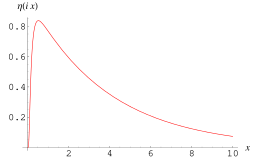
The Dedekind eta function is defined over the upper half-plane ![H={tau:I[tau]>0}](https://mathworld.wolfram.com/images/equations/DedekindEtaFunction/Inline1.svg) by
by
 |  |  | (1) |
 |  | 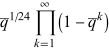 | (2) |
 |  | 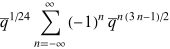 | (3) |
 |  | 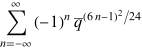 | (4) |
 |  | ![q^_^(1/24){1+sum_(n=1)^(infty)(-1)^n[q^_^(n(3n-1)/2)+q^_^(n(3n+1)/2)]}](https://mathworld.wolfram.com/images/equations/DedekindEtaFunction/Inline16.svg) | (5) |
 |  |  | (6) |
(OEIS A010815), where  is the square of the nome
  ,
,  is the half-period ratio, and
  is a q-series (Weber 1902, pp. 85 and 112; Atkin and Morain 1993; Berndt 1994, p. 139).
The Dedekind eta function is implemented in the Wolfram Language as DedekindEta[tau].
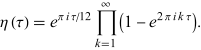
Rewriting the definition in terms of  explicitly in terms of the half-period ratio
  gives the product
 | (7) |
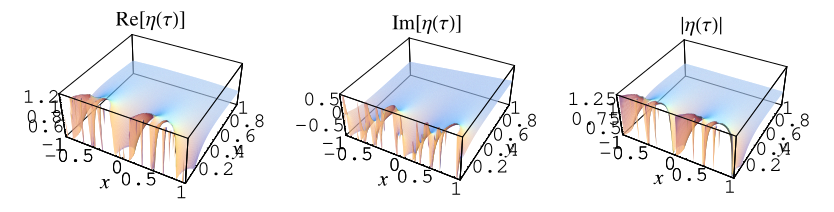
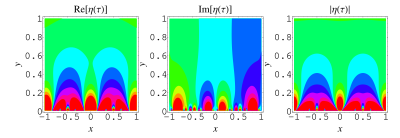
It is illustrated above in the complex plane.
 is a modular form first introduced by Dedekind in 1877, and is related to the modular discriminant of the Weierstrass elliptic function by
![Delta(tau)=(2pi)^(12)[eta(tau)]^(24)](https://mathworld.wolfram.com/images/equations/DedekindEtaFunction/NumberedEquation2.svg) | (8) |
(Apostol 1997, p. 47).
A compact closed form for the derivative is given by
 | (9) |
where  is the Weierstrass zeta function and
  and
and  are the invariants corresponding to the half-periods
  . The derivative of
  satisfies
![-4piid/(dtau)ln[eta(tau)]=G_2(tau),](https://mathworld.wolfram.com/images/equations/DedekindEtaFunction/NumberedEquation4.svg) | (10) |
where  is an Eisenstein series, and
![d/(dtau)ln[eta(-1/tau)]=d/(dtau)ln[eta(tau)]+1/2d/(dtau)ln(-itau).](https://mathworld.wolfram.com/images/equations/DedekindEtaFunction/NumberedEquation5.svg) | (11) |
A special value is given by
 |  |  | (12) |
 |  |  | (13) |
(OEIS A091343), where  is the gamma function. Another special case is
 |  |  | (14) |
 |  |  | (15) |
 |  |  | (16) |
where  is the plastic constant,
  denotes a polynomial root, and
  .
.
Letting  be a root of unity,
  satisfies
 |  |  | (17) |
 |  |  | (18) |
 |  |  | (19) |
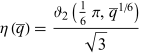
where  is an integer (Weber 1902, p. 113; Atkin and Morain 1993; Apostol 1997, p. 47). The Dedekind eta function is related to the Jacobi theta function
  by
by
 | (20) |
(Weber 1902, Vol. 3, p. 112) and
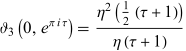 | (21) |
(Apostol 1997, p. 91).
Macdonald (1972) has related most expansions of the form  to affine root systems. Exceptions not included in Macdonald's treatment include
  , found by Hecke and Rogers,
  , found by Ramanujan, and
  , found by Atkin (Leininger and Milne 1999). Using the Dedekind eta function, the Jacobi triple product identity
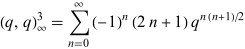 | (22) |
can be written
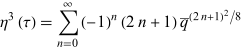 | (23) |
(Jacobi 1829, Hardy and Wright 1979, Hirschhorn 1999, Leininger and Milne 1999).
Dedekind's functional equation states that if ![[a b; c d] in Gamma](https://mathworld.wolfram.com/images/equations/DedekindEtaFunction/Inline69.svg) , where
, where  is the modular group Gamma,
  , and
, and  (where
  is the upper half-plane), then
![eta((atau+b)/(ctau+d))=epsilon(a,b,c,d)[sqrt(-i(ctau+d))]eta(tau),](https://mathworld.wolfram.com/images/equations/DedekindEtaFunction/NumberedEquation10.svg) | (24) |
where
![epsilon(a,b,c,d)=exp[pii((a+d)/(12c)+s(-d,c))],](https://mathworld.wolfram.com/images/equations/DedekindEtaFunction/NumberedEquation11.svg) | (25) |
and
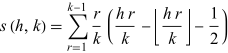 | (26) |
is a Dedekind sum (Apostol 1997, pp. 52-57), with  the floor function.

 Summation." J. Math. Anal. Appl. 176, 554-560, 1993.Hardy, G. H. and Wright, E. M.
  and Basic Hypergeometric Series in
  ." Discr. Math. 204, 281-317, 1999a.Leininger, V. E. and Milne, S. C. "Some New Infinite Families of
  -Function Identities." Methods Appl. Anal. 6, 225-248, 1999b.Köhler, G. "Some Eta-Identities Arising from Theta Series." Math. Scand. 66, 147-154, 1990.Macdonald, I. G. "Affine Root Systems and Dedekind's
  -Function." Invent. Math. 15, 91-143, 1972.Ramanujan, S. "On Certain Arithmetical Functions." Trans. Cambridge Philos. Soc. 22, 159-184, 1916.Siegel, C. L. "A Simple Proof of
  ." Mathematika 1, 4, 1954.Sloane, N. J. A. Sequences