Apache Cassandra is an open-source, distributed, decentralized, and highly available database characterized by elastic scalability and tunable consistency, originally developed at Facebook. Key features include a column-oriented key-value store, a SQL-like query interface (CQL), and optimized high performance suitable for large-scale applications. Notable users like eBay employ Cassandra for various applications, including fraud detection and real-time insights.
Cassandra Introduction & KeyFeatures Meetup Vienna Cassandra Users 13th of January 2014 philipp.potisk@geroba.com
2.
Definition Apache Cassandra isan open source, distributed, decentralized, elastically scalable, highly available, fault-tolerant, tuneably consistent, column-oriented database that bases its distribution design on Amazon’s Dynamo and its data model on Google’s Bigtable. Created at Facebook, it is now used at some of the most popular sites on the Web [The Definitive Guide, Eben Hewitt, 2010] 13/01/2014 Cassandra Introduction & Key Features by Philipp Potisk 2
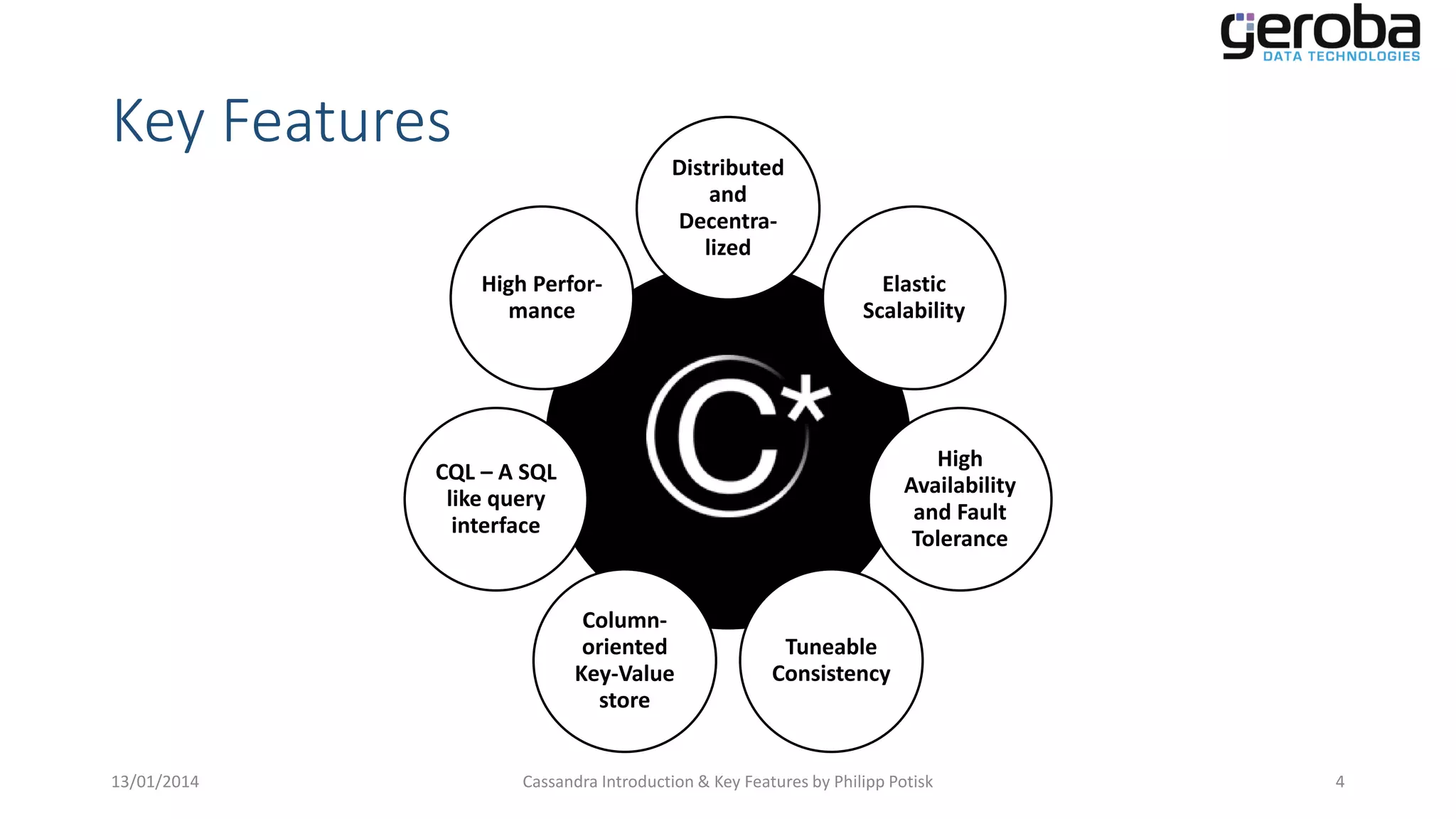
Key Features Distributed and Decentralized High Performance CQL– A SQL like query interface Elastic Scalability Cassandra Columnoriented Key-Value store 13/01/2014 High Availability and Fault Tolerance Tuneable Consistency Cassandra Introduction & Key Features by Philipp Potisk 4
5.
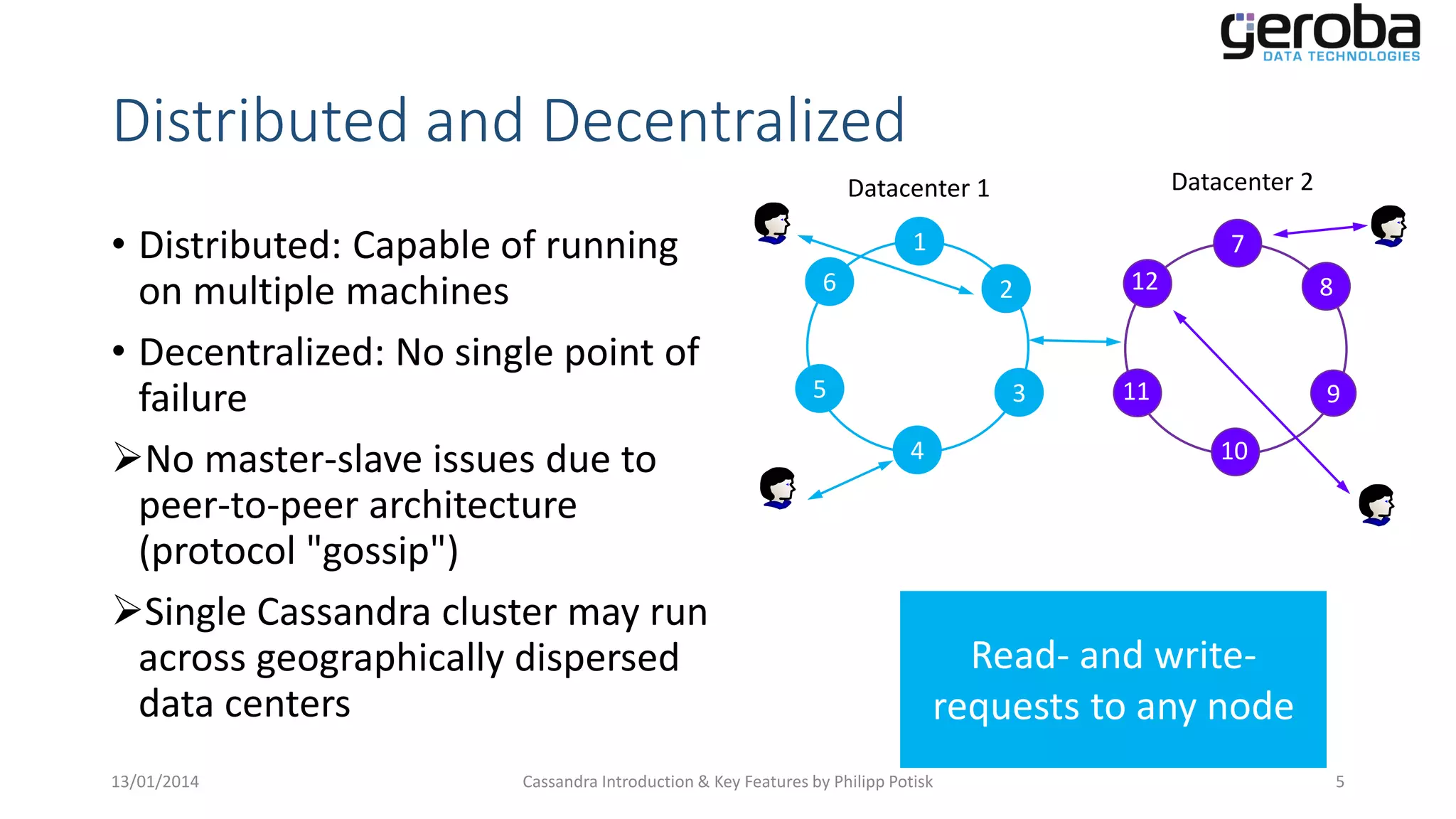
Distributed and Decentralized Datacenter1 • Distributed: Capable of running on multiple machines • Decentralized: No single point of failure No master-slave issues due to peer-to-peer architecture (protocol "gossip") Single Cassandra cluster may run across geographically dispersed data centers 13/01/2014 Datacenter 2 1 7 6 2 5 3 4 12 8 11 9 10 Read- and writerequests to any node Cassandra Introduction & Key Features by Philipp Potisk 5
6.
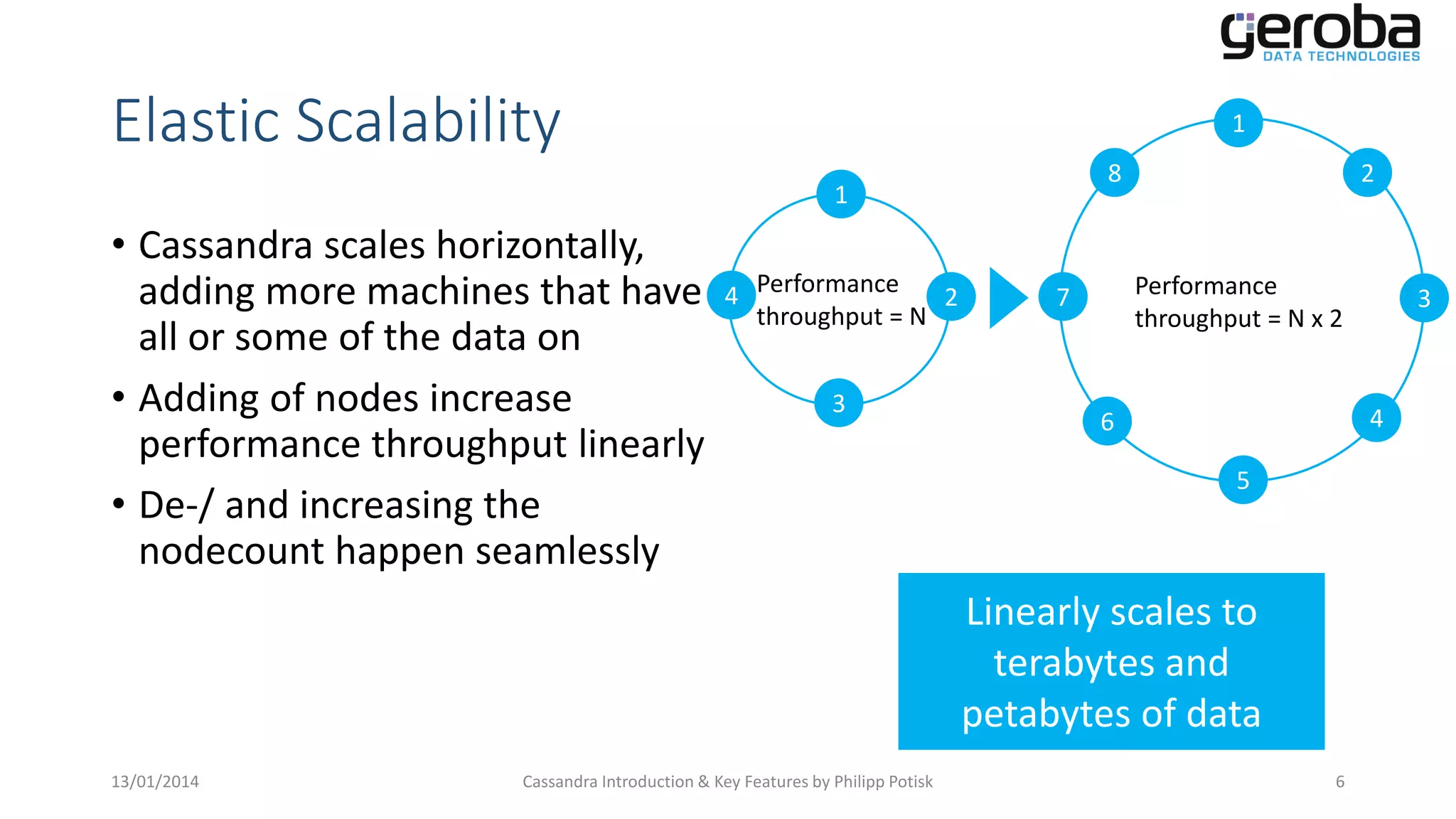
Elastic Scalability 1 8 1 • Cassandrascales horizontally, adding more machines that have all or some of the data on • Adding of nodes increase performance throughput linearly • De-/ and increasing the nodecount happen seamlessly 4 Performance 2 throughput = N 3 2 Performance throughput = N x 2 7 4 6 5 Linearly scales to terabytes and petabytes of data 13/01/2014 Cassandra Introduction & Key Features by Philipp Potisk 3 6
7.
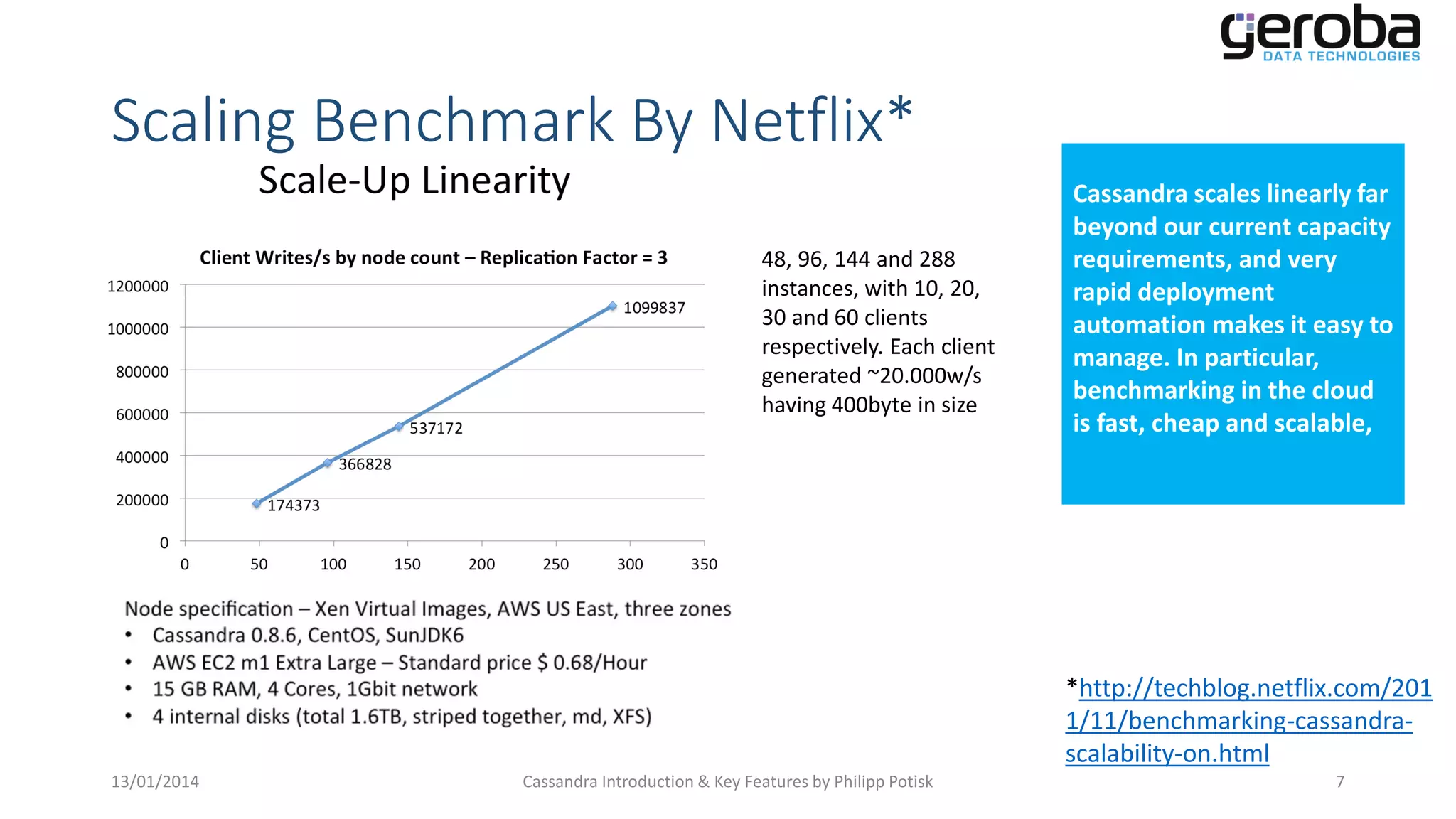
Scaling Benchmark ByNetflix* 48, 96, 144 and 288 instances, with 10, 20, 30 and 60 clients respectively. Each client generated ~20.000w/s having 400byte in size Cassandra scales linearly far beyond our current capacity requirements, and very rapid deployment automation makes it easy to manage. In particular, benchmarking in the cloud is fast, cheap and scalable, *http://techblog.netflix.com/201 1/11/benchmarking-cassandrascalability-on.html 13/01/2014 Cassandra Introduction & Key Features by Philipp Potisk 7
8.
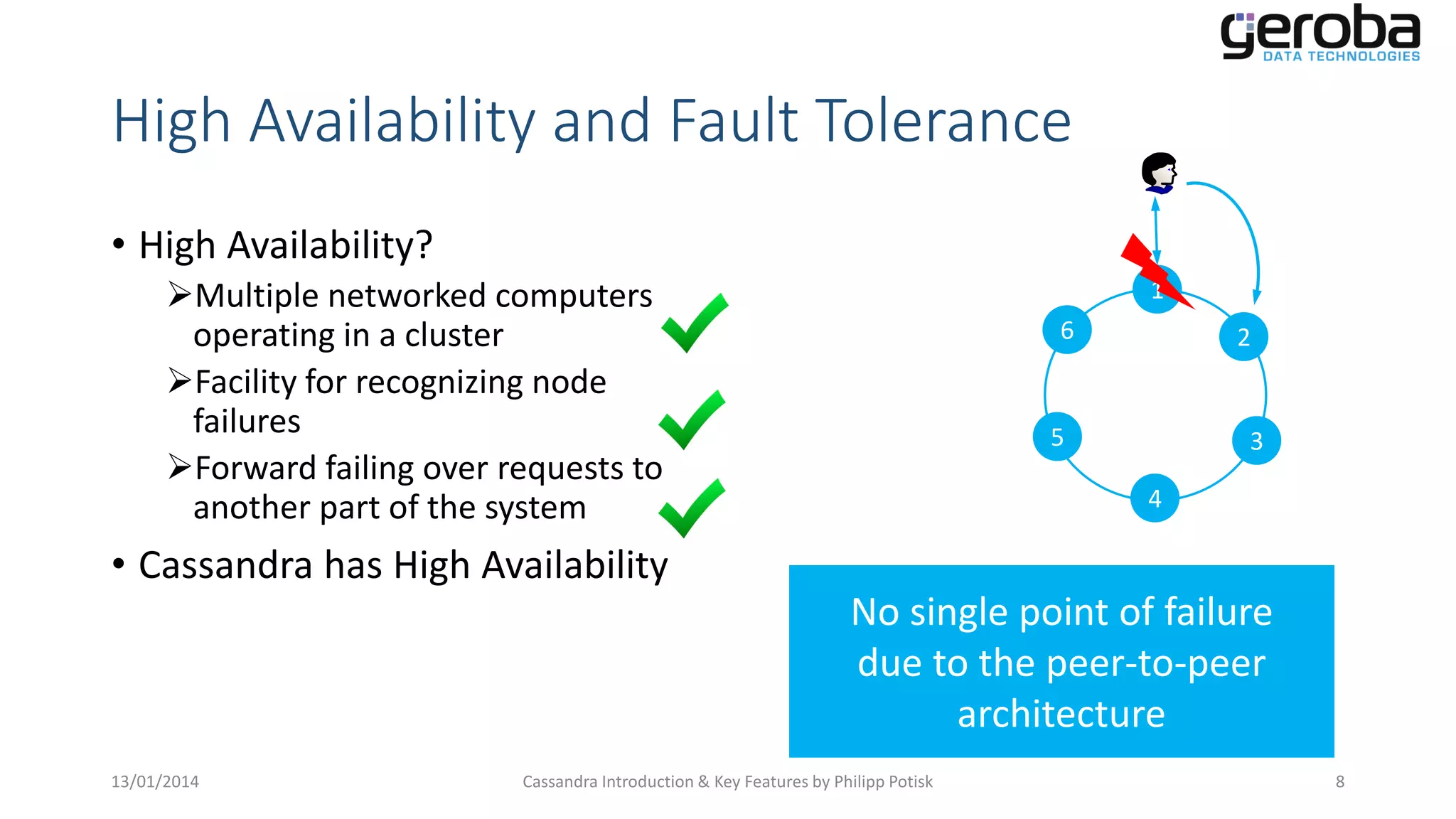
High Availability andFault Tolerance • High Availability? Multiple networked computers operating in a cluster Facility for recognizing node failures Forward failing over requests to another part of the system 1 6 2 5 3 4 • Cassandra has High Availability No single point of failure due to the peer-to-peer architecture 13/01/2014 Cassandra Introduction & Key Features by Philipp Potisk 8
9.
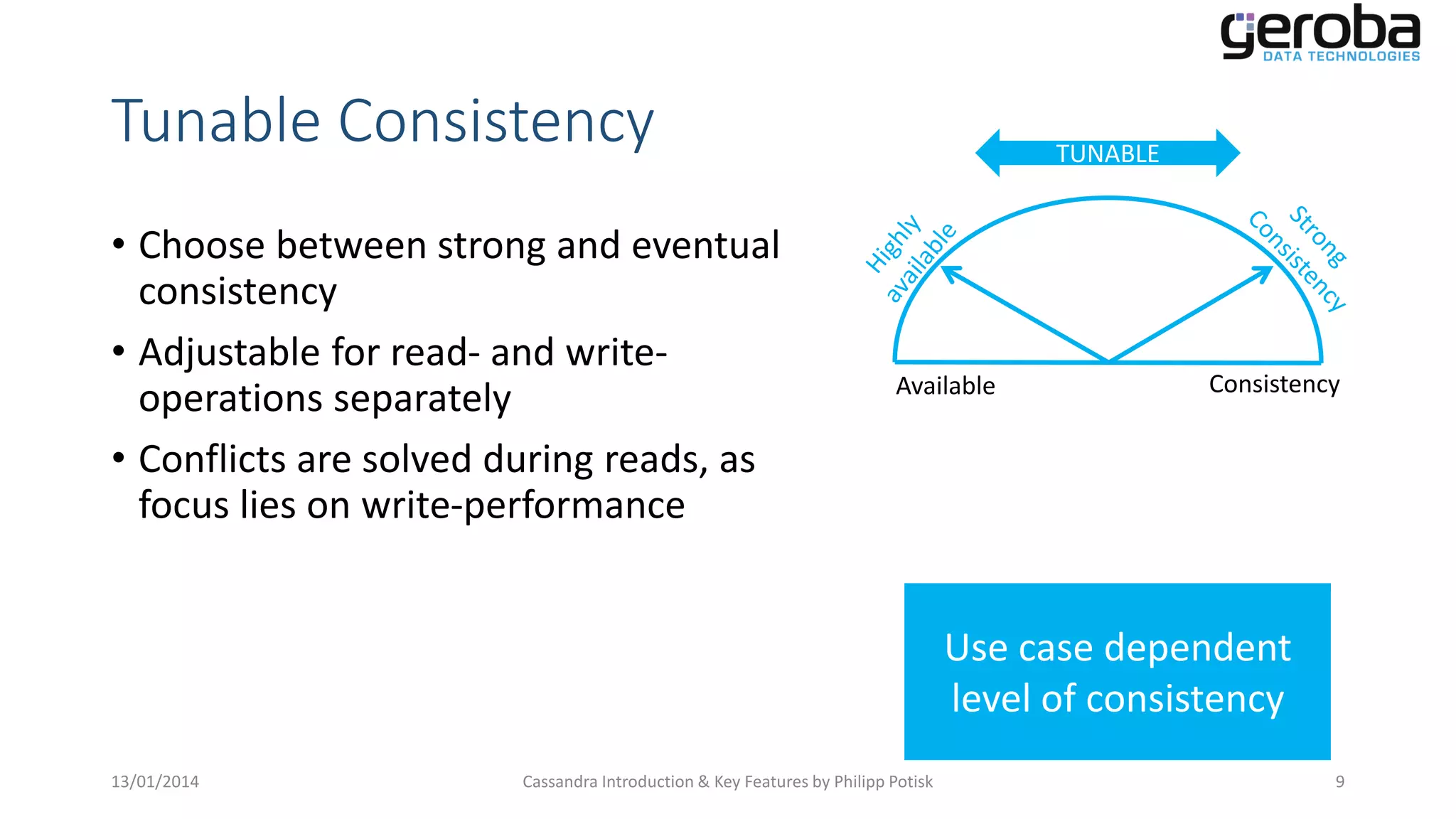
Tunable Consistency • Choosebetween strong and eventual consistency • Adjustable for read- and writeoperations separately • Conflicts are solved during reads, as focus lies on write-performance TUNABLE Available Consistency Use case dependent level of consistency 13/01/2014 Cassandra Introduction & Key Features by Philipp Potisk 9
10.
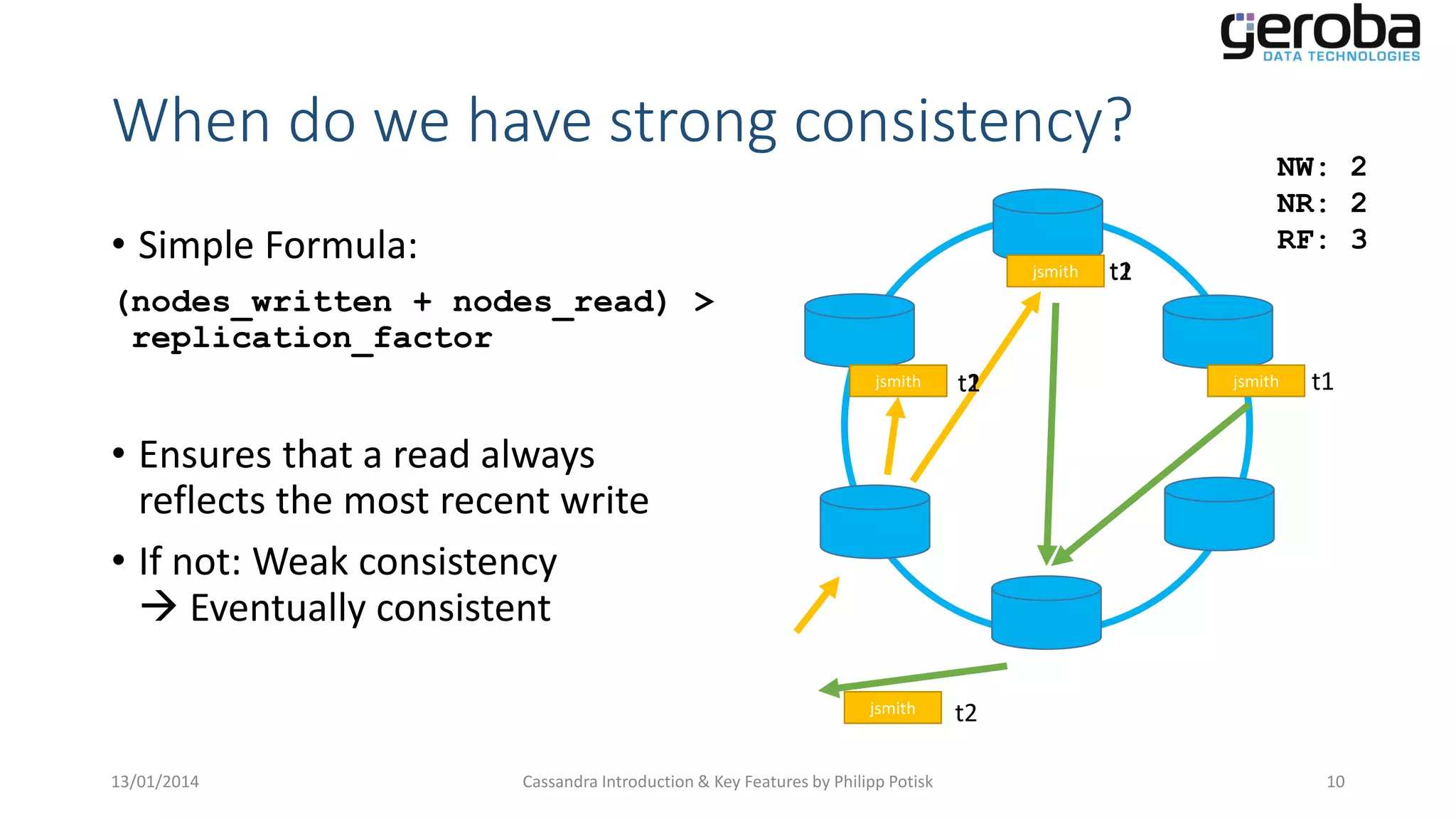
When do wehave strong consistency? • Simple Formula: jsmith (nodes_written + nodes_read) > replication_factor jsmith t1 t2 NW: 2 NR: 2 RF: 3 t1 t2 jsmith t1 • Ensures that a read always reflects the most recent write • If not: Weak consistency Eventually consistent jsmith 13/01/2014 Cassandra Introduction & Key Features by Philipp Potisk t2 10
11.
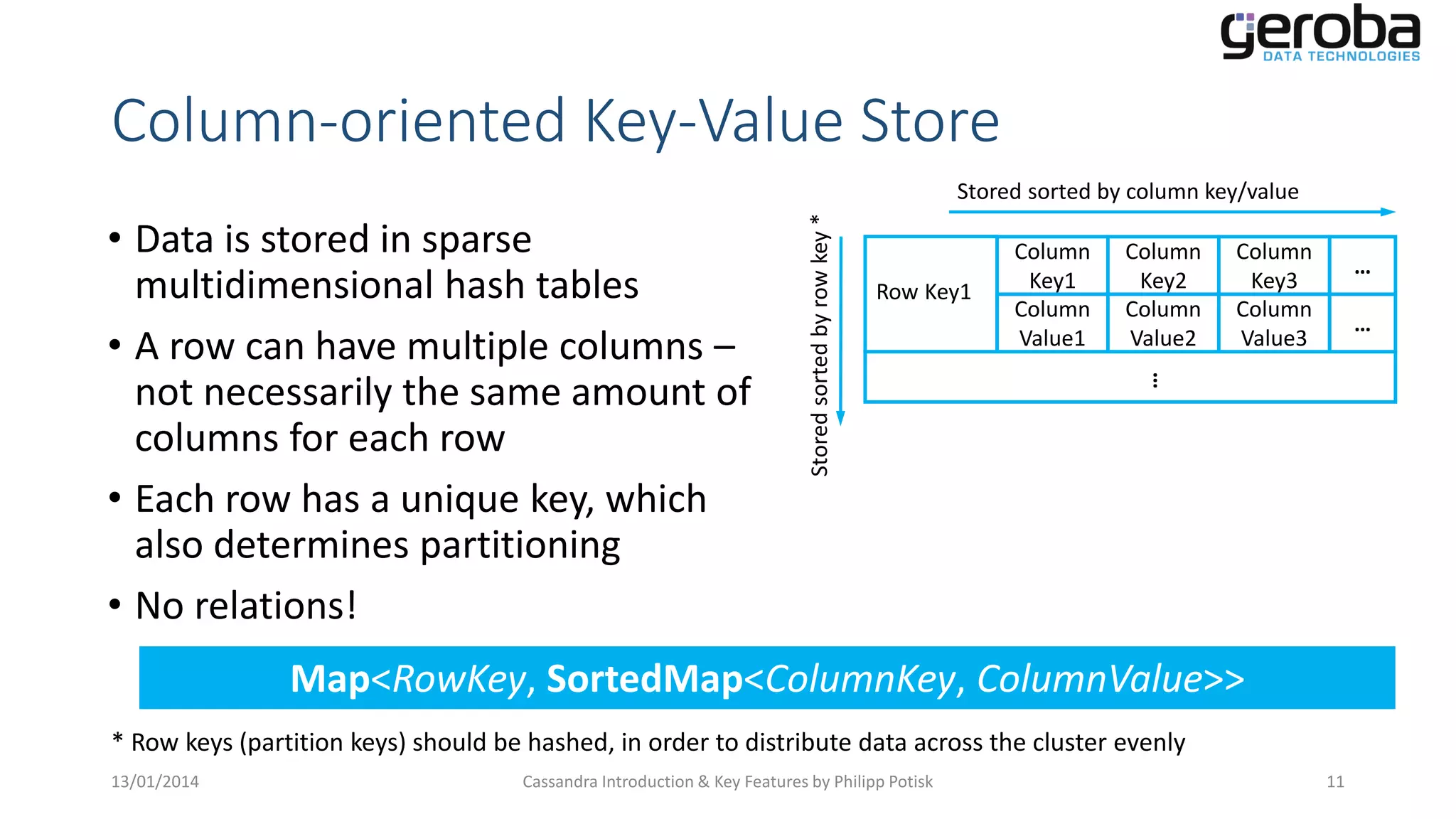
Column-oriented Key-Value Store RowKey1 Column Key1 Column Value1 Column Key2 Column Value2 Column Key3 Column Value3 … … … • Data is stored in sparse multidimensional hash tables • A row can have multiple columns – not necessarily the same amount of columns for each row • Each row has a unique key, which also determines partitioning • No relations! Stored sorted by row key * Stored sorted by column key/value Map<RowKey, SortedMap<ColumnKey, ColumnValue>> * Row keys (partition keys) should be hashed, in order to distribute data across the cluster evenly 13/01/2014 Cassandra Introduction & Key Features by Philipp Potisk 11
12.
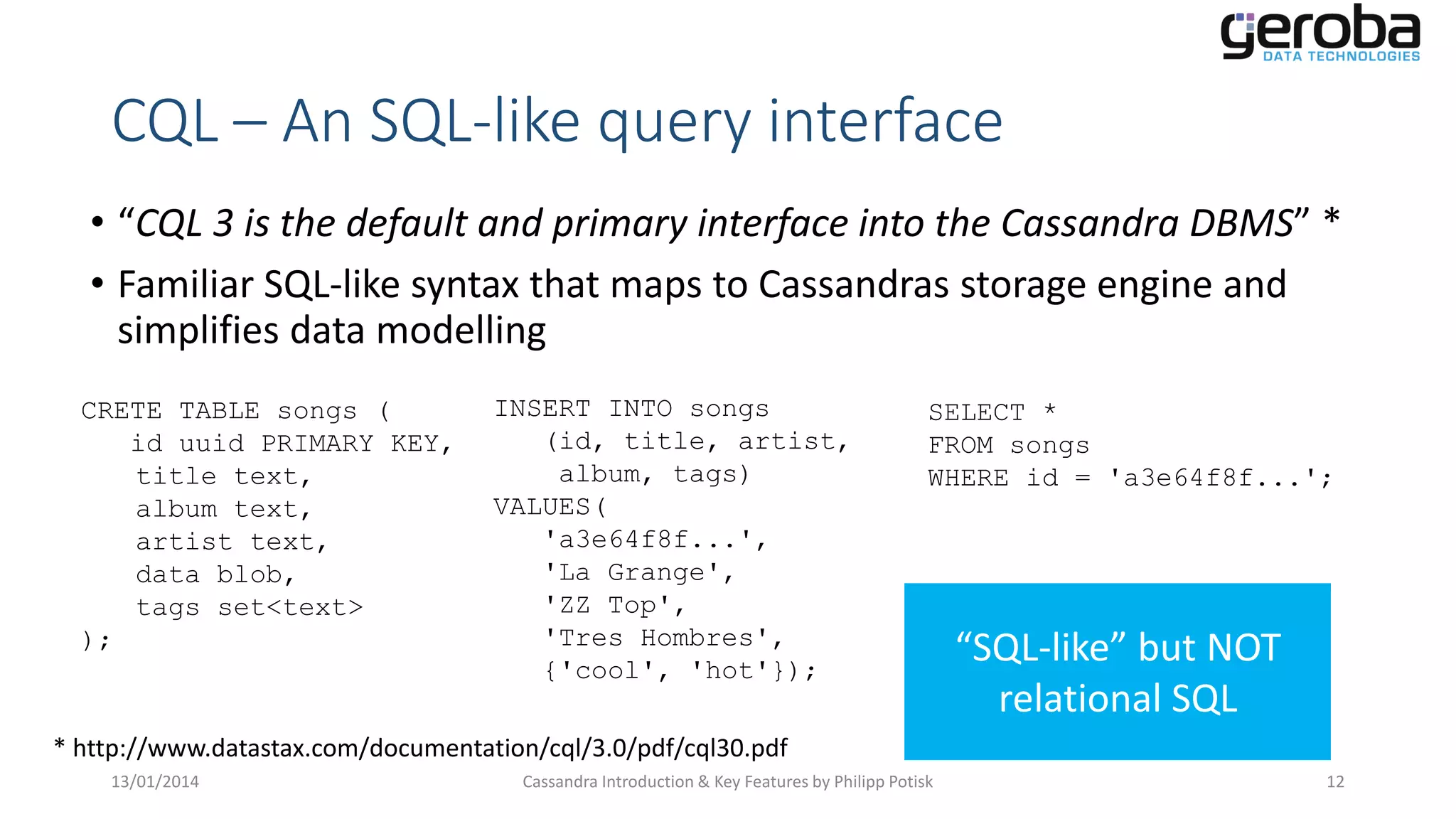
CQL – AnSQL-like query interface • “CQL 3 is the default and primary interface into the Cassandra DBMS” * • Familiar SQL-like syntax that maps to Cassandras storage engine and simplifies data modelling CRETE TABLE songs ( id uuid PRIMARY KEY, title text, album text, artist text, data blob, tags set<text> ); INSERT INTO songs (id, title, artist, album, tags) VALUES( 'a3e64f8f...', 'La Grange', 'ZZ Top', 'Tres Hombres'‚ {'cool', 'hot'}); SELECT * FROM songs WHERE id = 'a3e64f8f...'; “SQL-like” but NOT relational SQL * http://www.datastax.com/documentation/cql/3.0/pdf/cql30.pdf 13/01/2014 Cassandra Introduction & Key Features by Philipp Potisk 12
13.
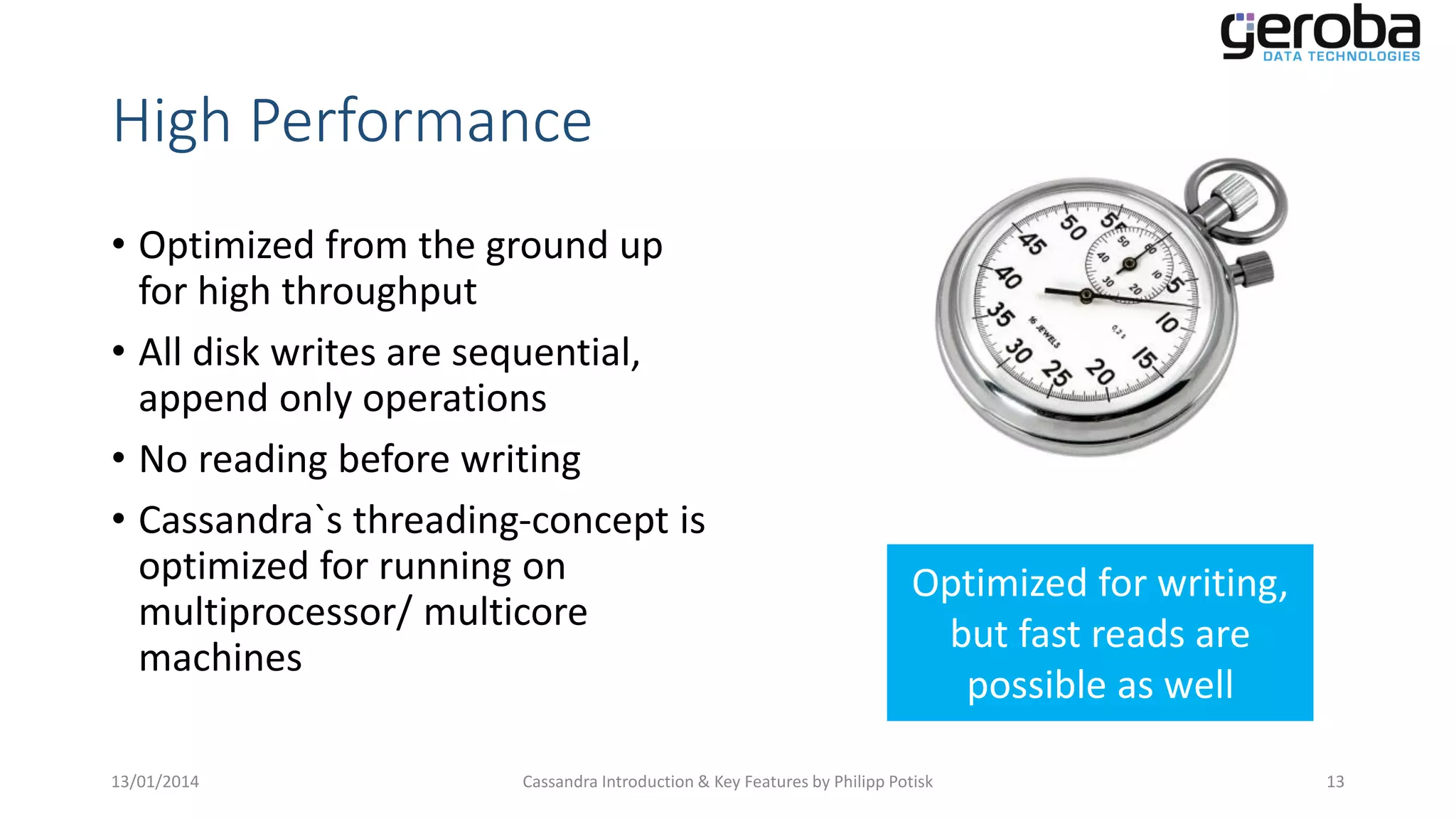
High Performance • Optimizedfrom the ground up for high throughput • All disk writes are sequential, append only operations • No reading before writing • Cassandra`s threading-concept is optimized for running on multiprocessor/ multicore machines 13/01/2014 Optimized for writing, but fast reads are possible as well Cassandra Introduction & Key Features by Philipp Potisk 13
14.
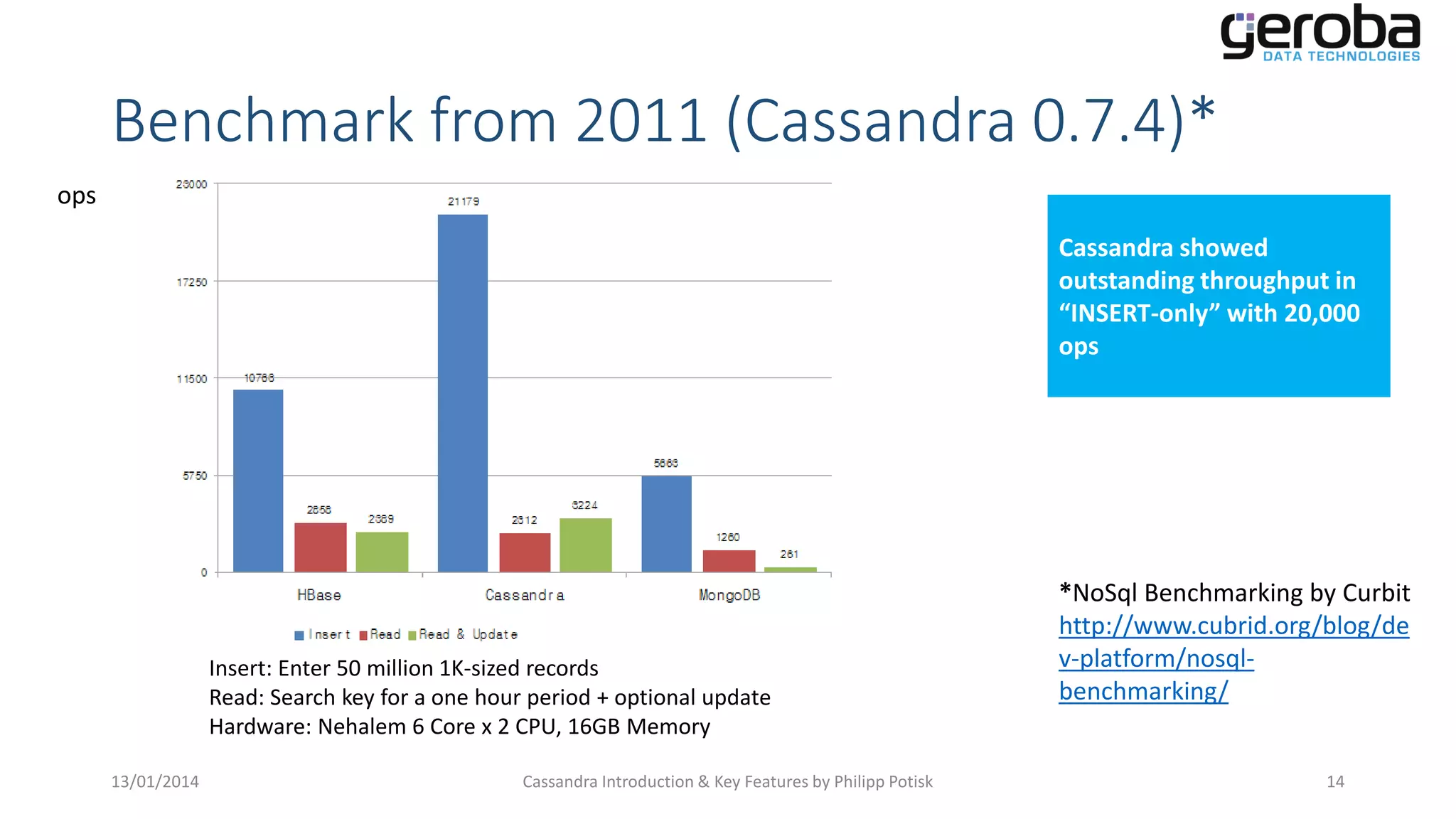
Benchmark from 2011(Cassandra 0.7.4)* ops Cassandra showed outstanding throughput in “INSERT-only” with 20,000 ops Insert: Enter 50 million 1K-sized records Read: Search key for a one hour period + optional update Hardware: Nehalem 6 Core x 2 CPU, 16GB Memory 13/01/2014 Cassandra Introduction & Key Features by Philipp Potisk *NoSql Benchmarking by Curbit http://www.cubrid.org/blog/de v-platform/nosqlbenchmarking/ 14
15.
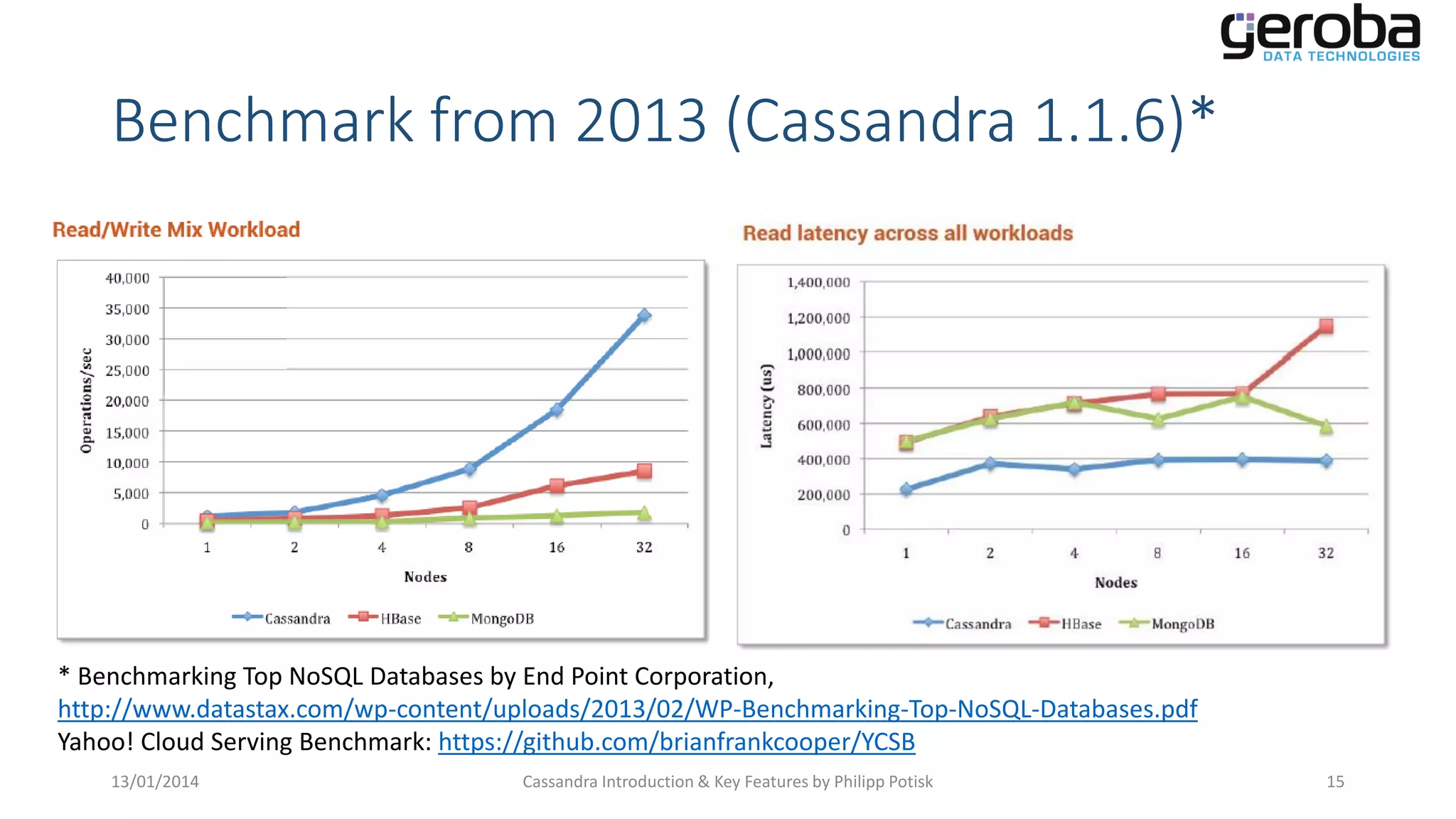
Benchmark from 2013(Cassandra 1.1.6)* * Benchmarking Top NoSQL Databases by End Point Corporation, http://www.datastax.com/wp-content/uploads/2013/02/WP-Benchmarking-Top-NoSQL-Databases.pdf Yahoo! Cloud Serving Benchmark: https://github.com/brianfrankcooper/YCSB 13/01/2014 Cassandra Introduction & Key Features by Philipp Potisk 15
16.
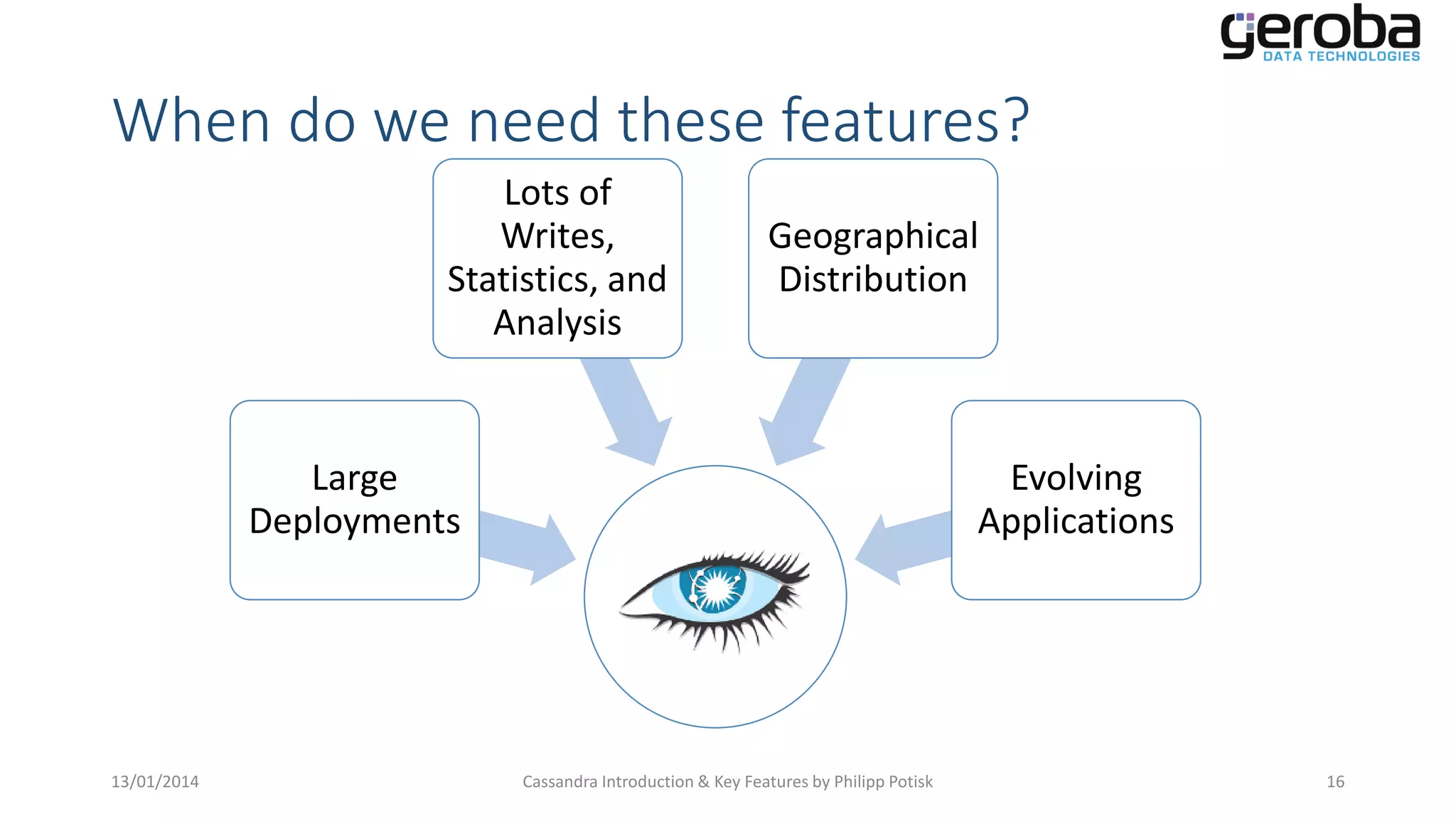
When do weneed these features? Lots of Writes, Statistics, and Analysis Geographical Distribution Large Deployments 13/01/2014 Evolving Applications Cassandra Introduction & Key Features by Philipp Potisk 16
17.
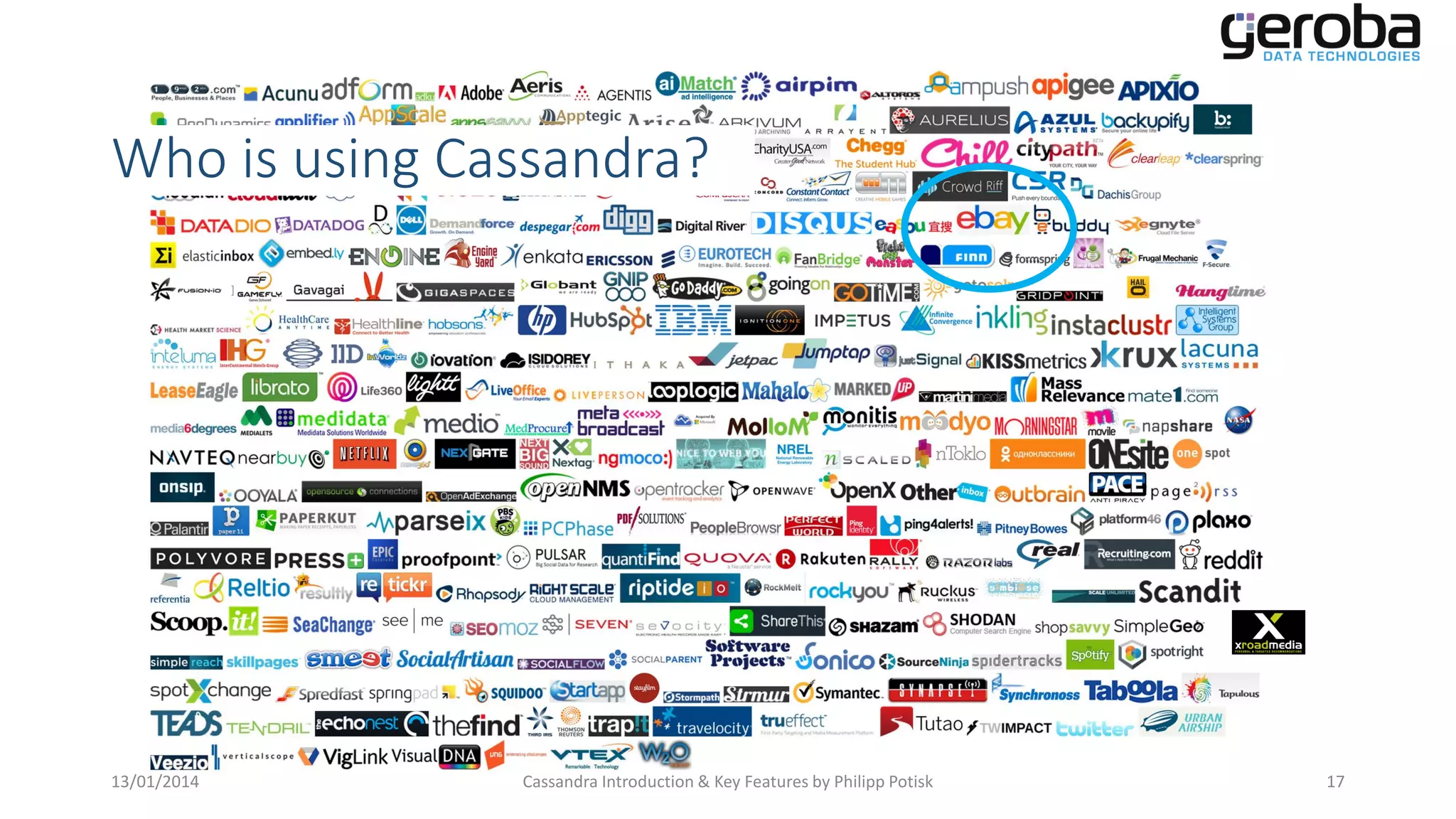
Who is usingCassandra? 13/01/2014 Cassandra Introduction & Key Features by Philipp Potisk 17
18.
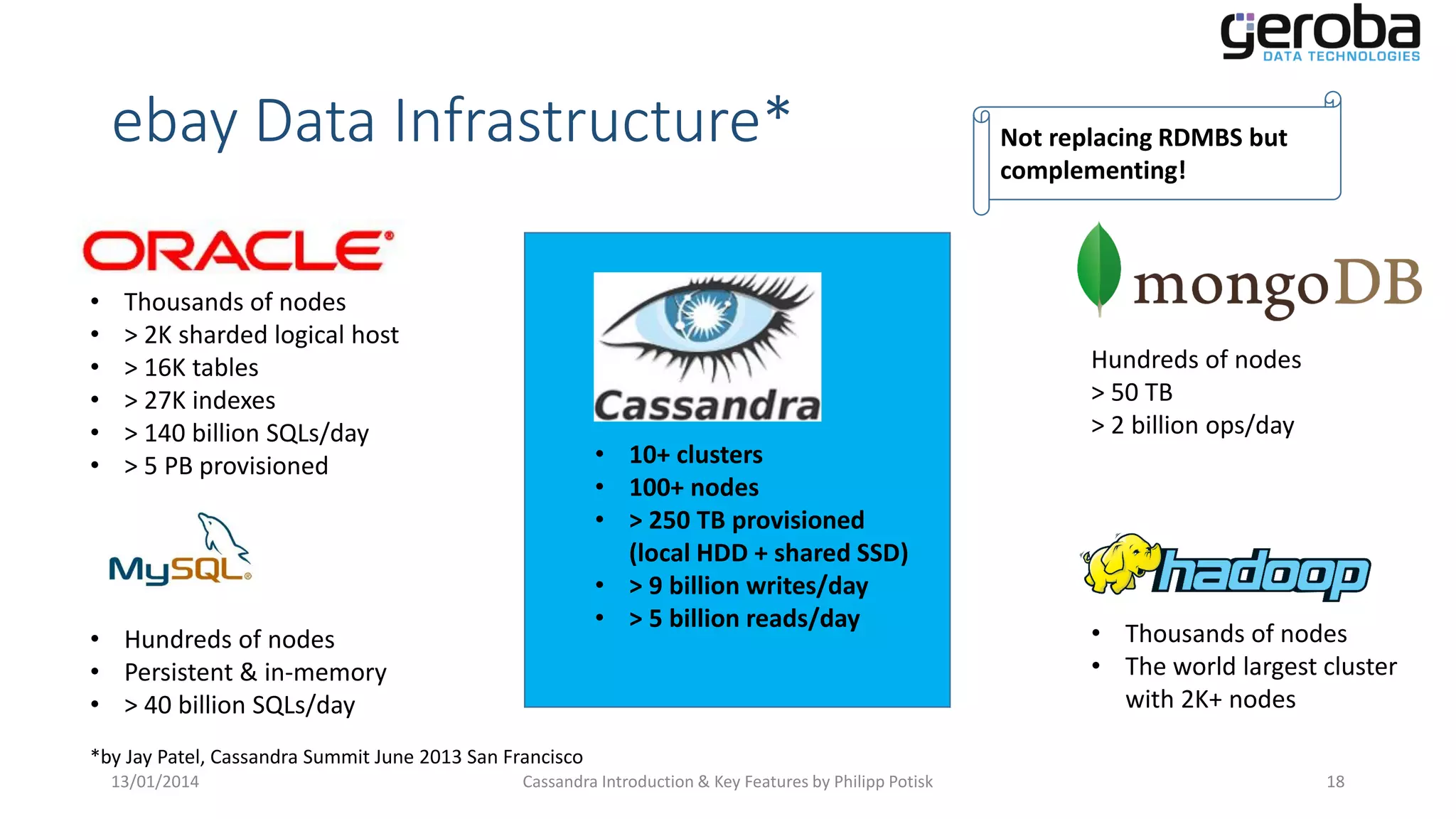
ebay Data Infrastructure* • • • • • • Thousandsof nodes > 2K sharded logical host > 16K tables > 27K indexes > 140 billion SQLs/day > 5 PB provisioned • 10+ clusters • 100+ nodes • > 250 TB provisioned (local HDD + shared SSD) • > 9 billion writes/day • > 5 billion reads/day • Hundreds of nodes • Persistent & in-memory • > 40 billion SQLs/day Not replacing RDMBS but complementing! Hundreds of nodes > 50 TB > 2 billion ops/day • Thousands of nodes • The world largest cluster with 2K+ nodes *by Jay Patel, Cassandra Summit June 2013 San Francisco 13/01/2014 Cassandra Introduction & Key Features by Philipp Potisk 18
19.
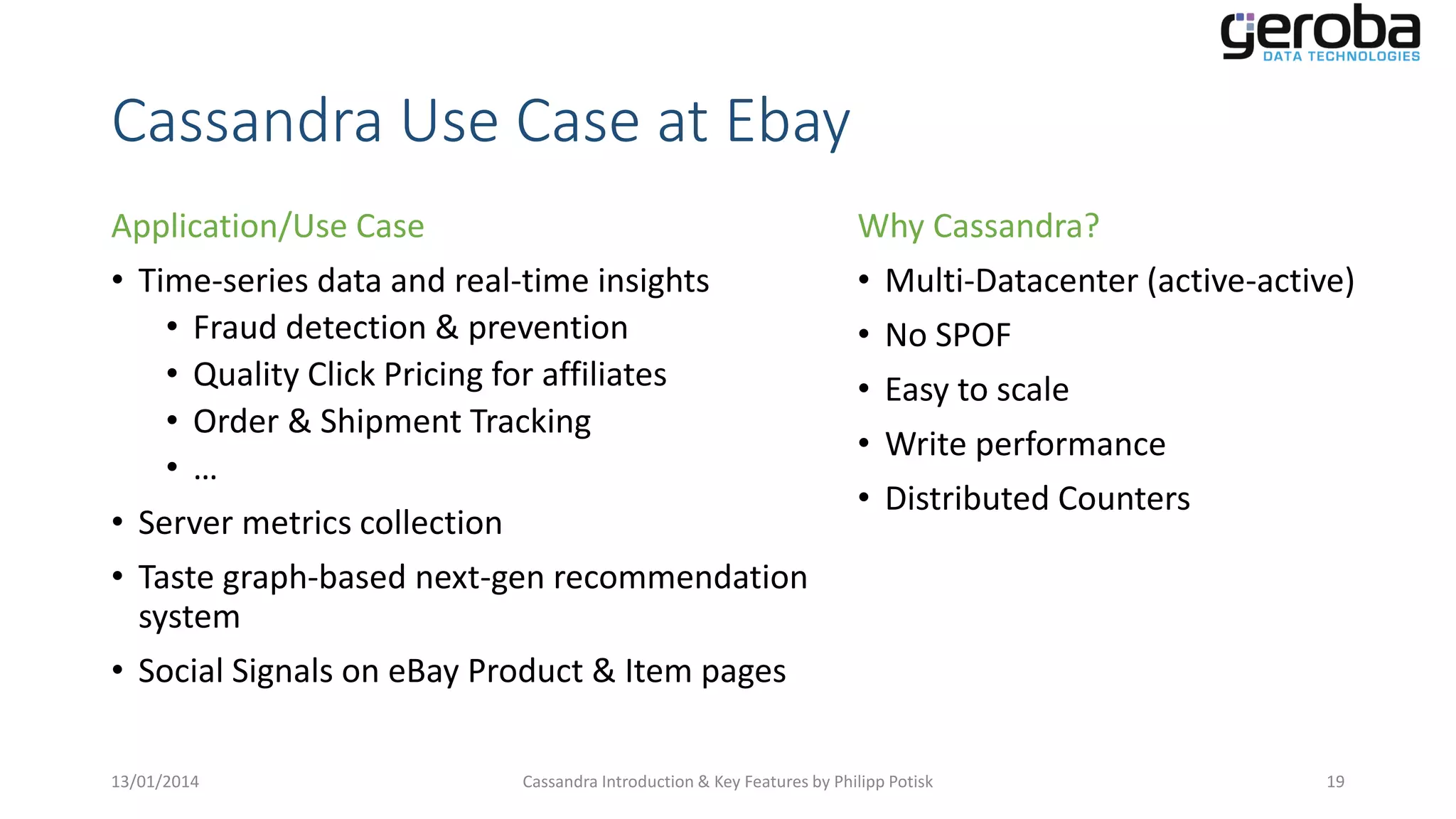
Cassandra Use Caseat Ebay Application/Use Case • Time-series data and real-time insights • Fraud detection & prevention • Quality Click Pricing for affiliates • Order & Shipment Tracking •… • Server metrics collection • Taste graph-based next-gen recommendation system • Social Signals on eBay Product & Item pages 13/01/2014 Why Cassandra? • Multi-Datacenter (active-active) • No SPOF • Easy to scale • Write performance • Distributed Counters Cassandra Introduction & Key Features by Philipp Potisk 19
Summary • History • Keyfeatures of Cassandra • • • • • • • Distributed and Decentralized Elastic Scalability High Availability and Fault Tolerance Tunable Consistency Column-oriented key-value store CQL interface High Performance • Ebay Use Case 13/01/2014 Apache project: http://cassandra.apache.org Community portal: http://planetcassandra.org Documentation: http://www.datastax.com/docs Cassandra Introduction & Key Features by Philipp Potisk 21