Ruby Object Model This is a game of object for Ruby
Ruby is a game but Syntax is not game.
This Theory helps to solve two biggest Questions Which Class does any method come from ? What happen when we include any specific module?
Ruby Objective Key points : Classes are Object. Closed to modifications and Open to extend.
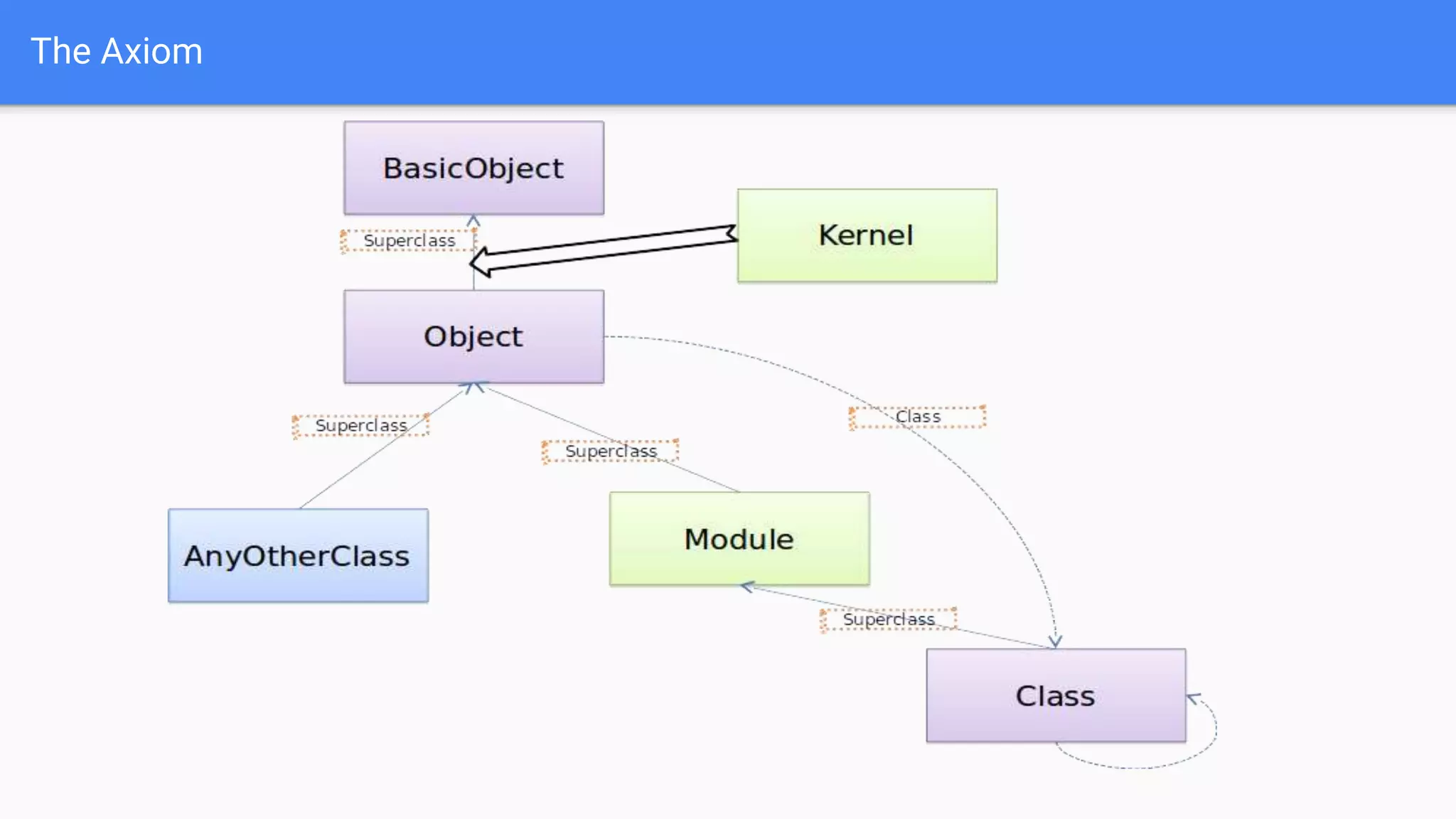
The Axiom
What is Kernel??? Kernel is a module which is included in the Object. Where These Method can be Call Without the receiver and functional Form. Eg. Array(1..5) Hash([1,2,3])
Classes ● Approach in Ruby is different having all the classes are open. ● Overview Problem: Make a method for all the type of string which convert it to alphanumeric string includes special character etc ? How To Do that ??????? Does Open Class will Help ?????????? If Yes then How ???????
Solution : Yes We can do it via Open Class of Ruby class String def to_alphanumeric gsub /[^ws]/, '' end end “Sys@@#tango”.to_alphanumeric => “Systango” Open Class Problem -> Revised method problem
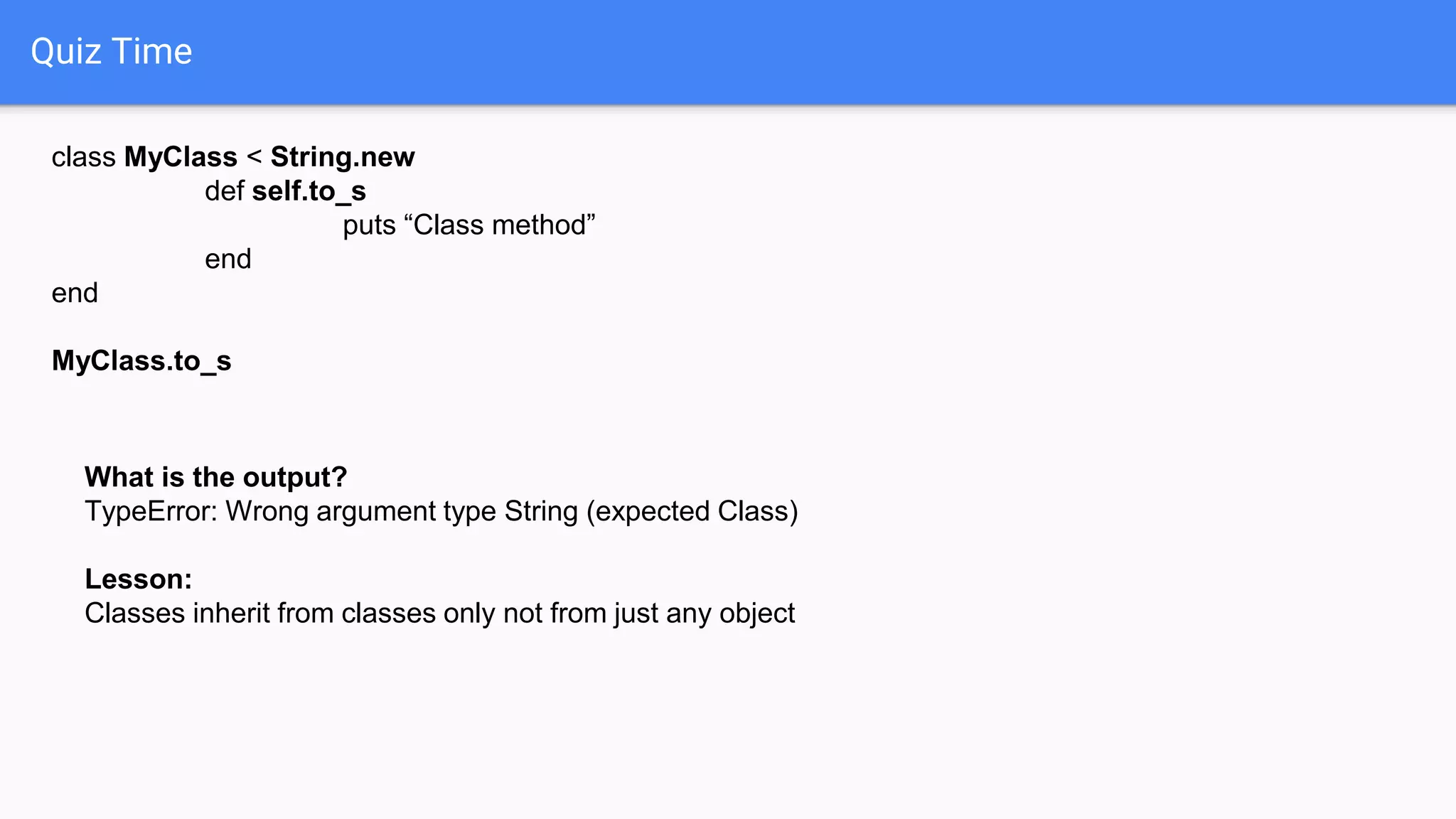
Quiz Time class MyClass < String.new def self.to_s puts “Class method” end end MyClass.to_s What is the output? TypeError: Wrong argument type String (expected Class) Lesson: Classes inherit from classes only not from just any object
Points to Remember: ● Class inherit from the Type Class only not by the Type Object. ● Any Creating a New Class then it goes to the object because Class is a Object. ● Objects that share the same class also share the same methods, so the methods must be stored in the class, not the object. ● An object’s instance variables live in the object itself,and an object’s methods live in the object’s class. That’s why objects of the same class share methods but don’t share instance variables String.instance_methods == "abc".methods # => true String.methods == "abc".methods # => false
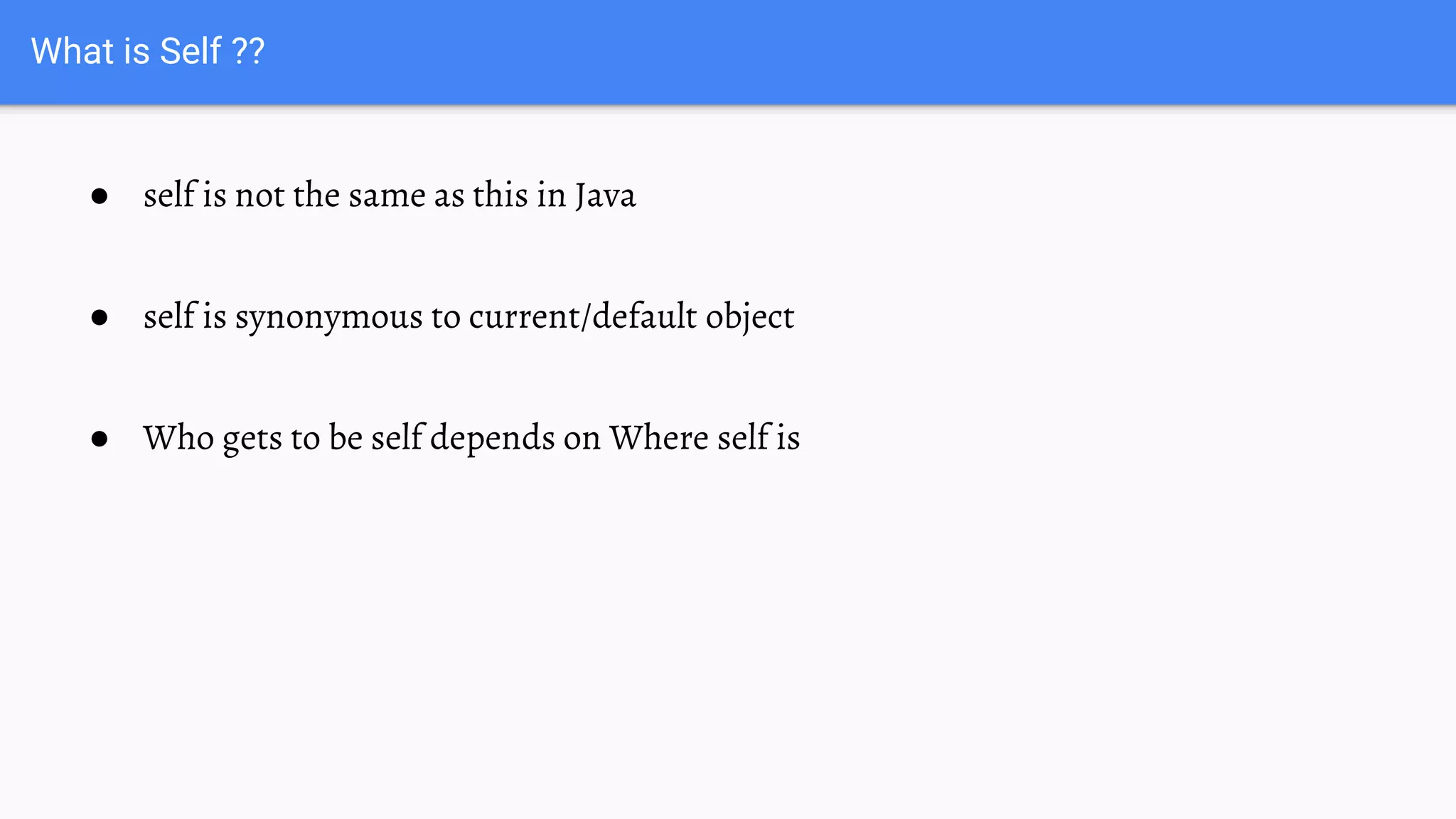
What is Self ?? ● self is not the same as this in Java ● self is synonymous to current/default object ● Who gets to be self depends on Where self is
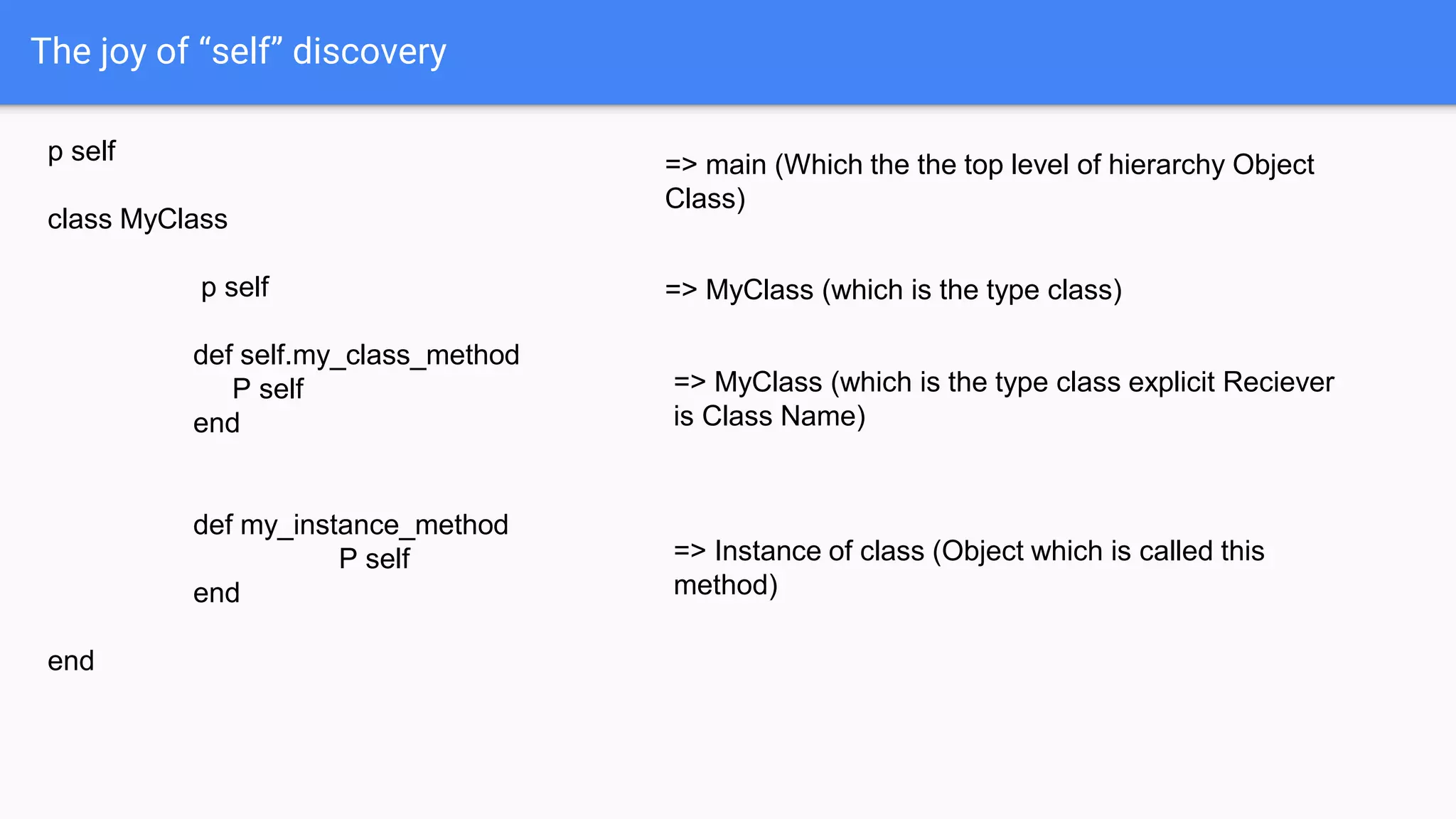
The joy of “self” discovery p self class MyClass p self def self.my_class_method P self end def my_instance_method P self end end => main (Which the the top level of hierarchy Object Class) => MyClass (which is the type class) => MyClass (which is the type class explicit Reciever is Class Name) => Instance of class (Object which is called this method)
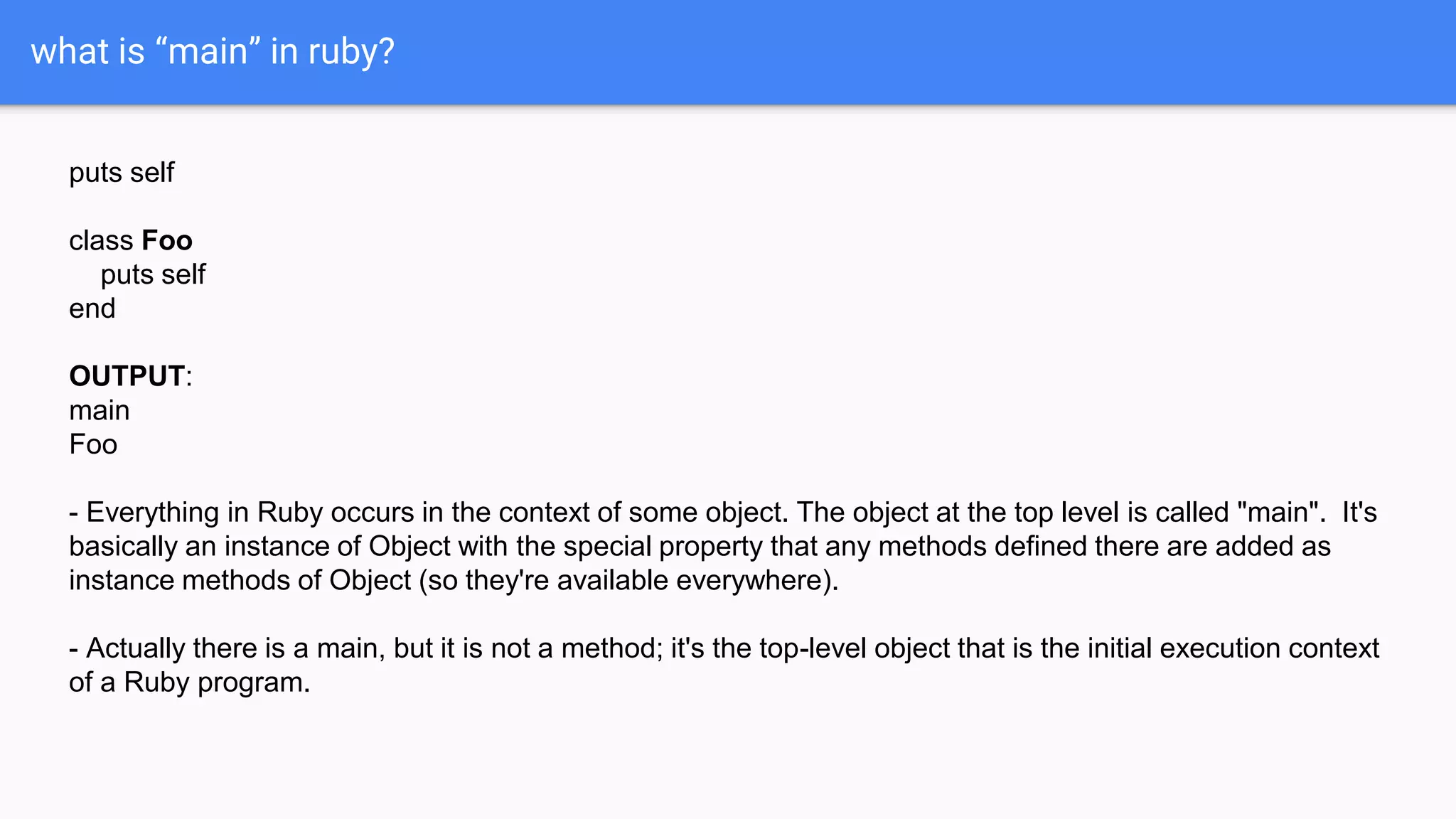
what is “main” in ruby? puts self class Foo puts self end OUTPUT: main Foo - Everything in Ruby occurs in the context of some object. The object at the top level is called "main". It's basically an instance of Object with the special property that any methods defined there are added as instance methods of Object (so they're available everywhere). - Actually there is a main, but it is not a method; it's the top-level object that is the initial execution context of a Ruby program.
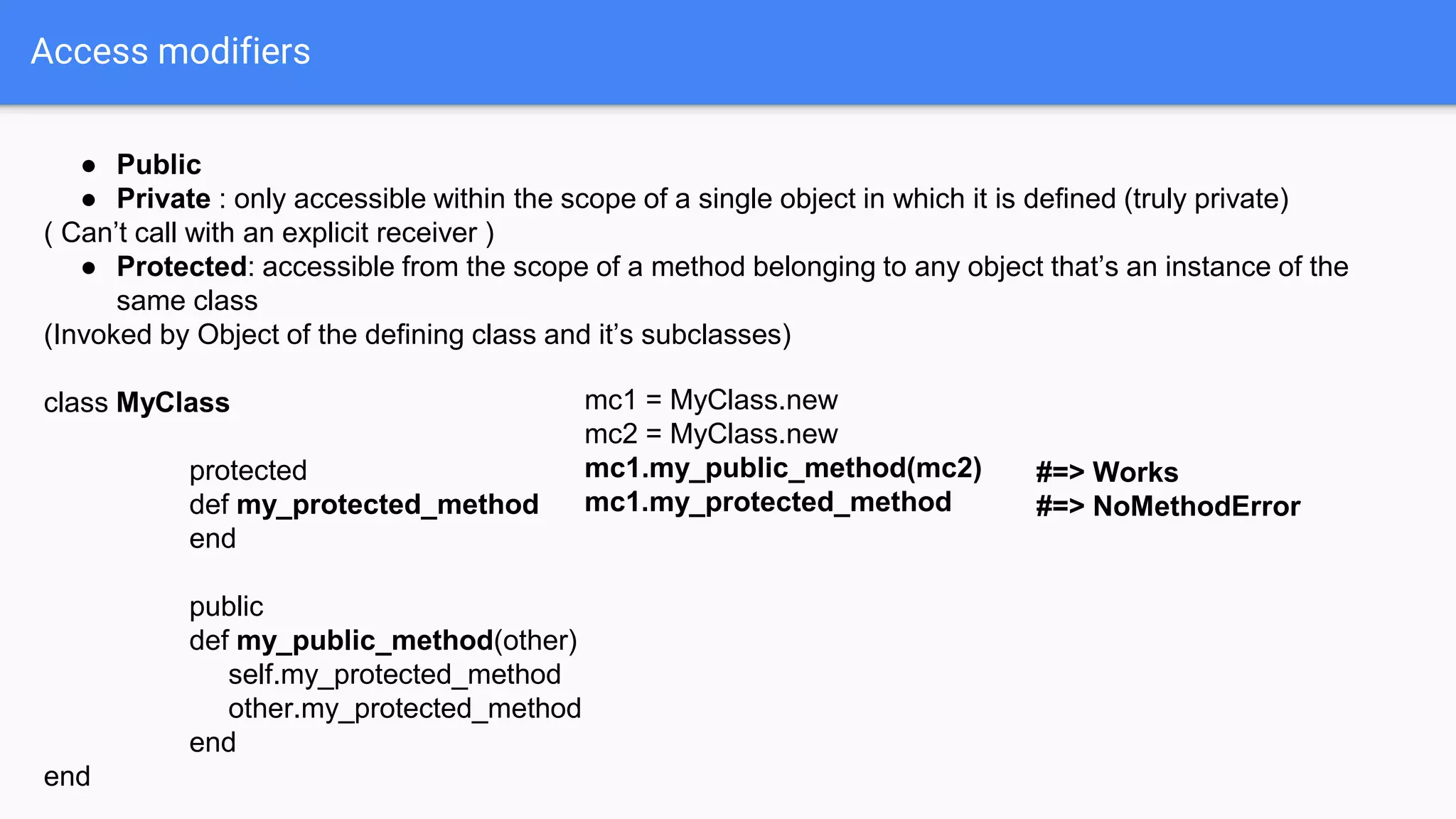
Access modifiers ● Public ● Private : only accessible within the scope of a single object in which it is defined (truly private) ( Can’t call with an explicit receiver ) ● Protected: accessible from the scope of a method belonging to any object that’s an instance of the same class (Invoked by Object of the defining class and it’s subclasses) class MyClass protected def my_protected_method end public def my_public_method(other) self.my_protected_method other.my_protected_method end end #=> Works #=> NoMethodError mc1 = MyClass.new mc2 = MyClass.new mc1.my_public_method(mc2) mc1.my_protected_method
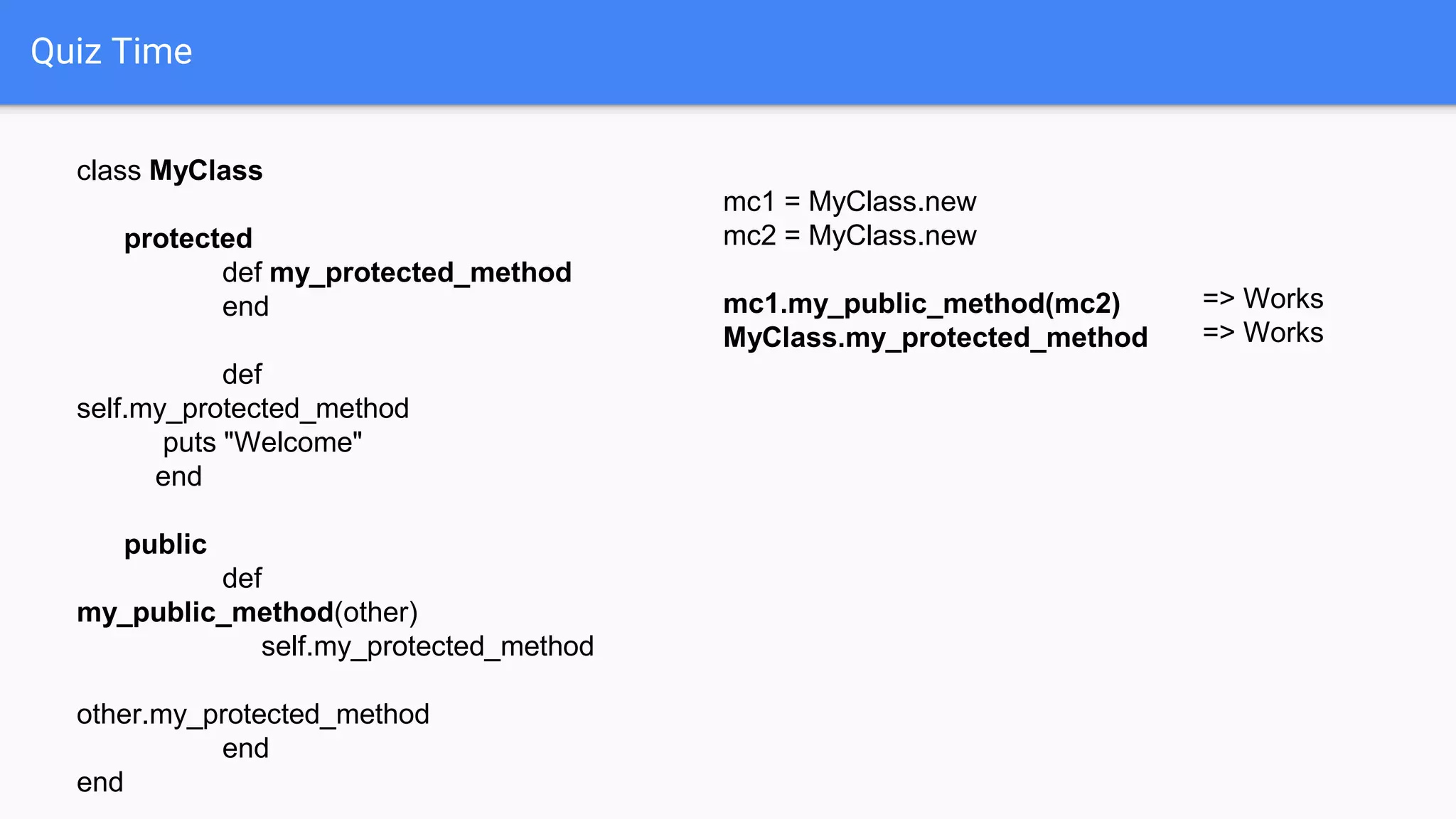
Quiz Time class MyClass protected def my_protected_method end def self.my_protected_method puts "Welcome" end public def my_public_method(other) self.my_protected_method other.my_protected_method end end mc1 = MyClass.new mc2 = MyClass.new mc1.my_public_method(mc2) MyClass.my_protected_method => Works => Works
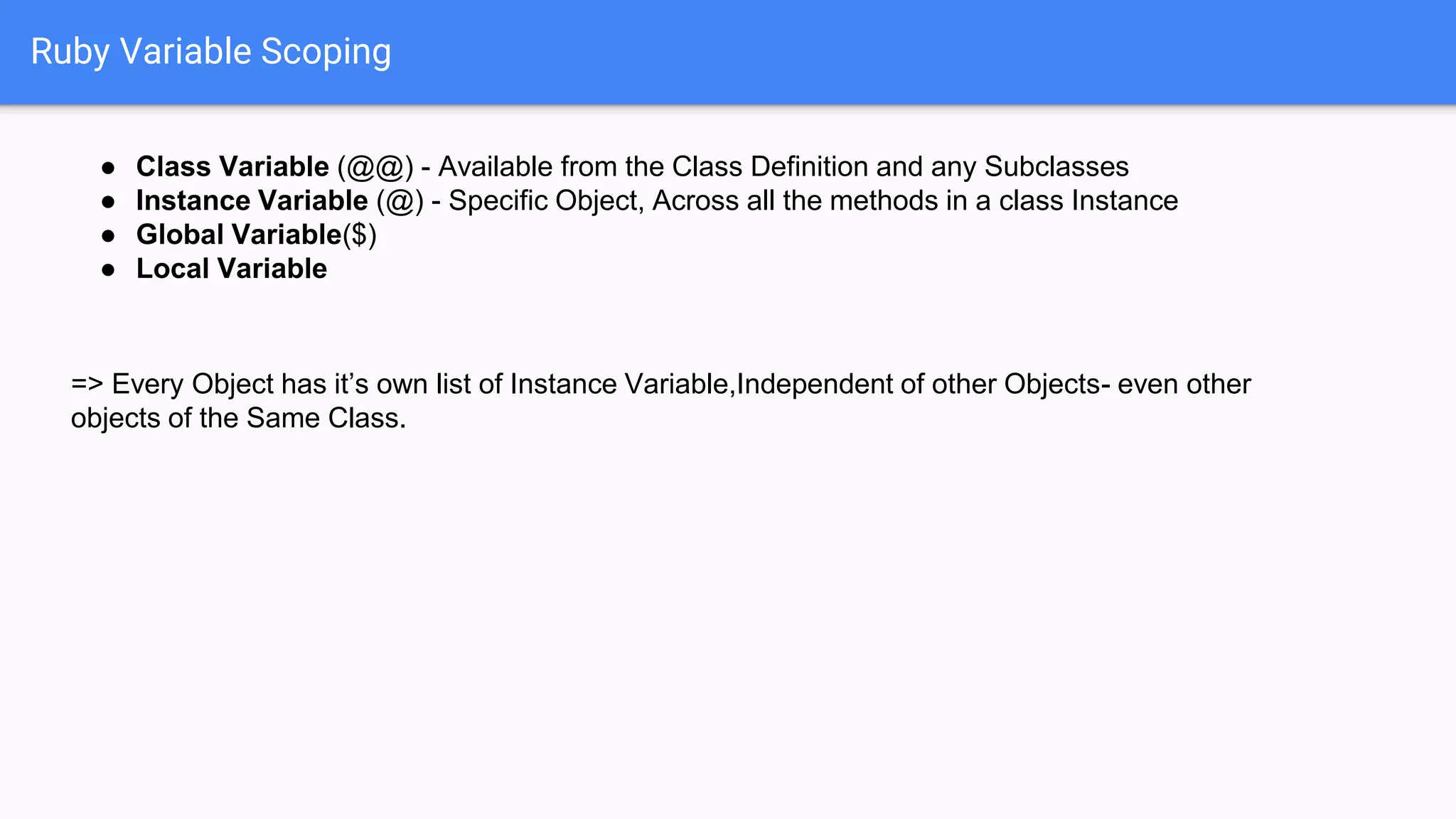
Ruby Variable Scoping ● Class Variable (@@) - Available from the Class Definition and any Subclasses ● Instance Variable (@) - Specific Object, Across all the methods in a class Instance ● Global Variable($) ● Local Variable => Every Object has it’s own list of Instance Variable,Independent of other Objects- even other objects of the Same Class.
Quiz Time class A y=1 @p = 2 @q @@r = 2 def initialize @@t=3 @s = 2 end def welcome @indore = 1 @bhopal = 2 @jabalpur = 3 @@dhar = 3 end end p A.instance_variables p A.class_variables a = A.new b = A.new p a.instance_variables p A.class_variables p b.welcome p b.instance_variables => [:@p] => [:@@r] => [:@s] => [:@@r, :@@t] => [:@s, :@indore, :@bhopal, :@jabalpur]
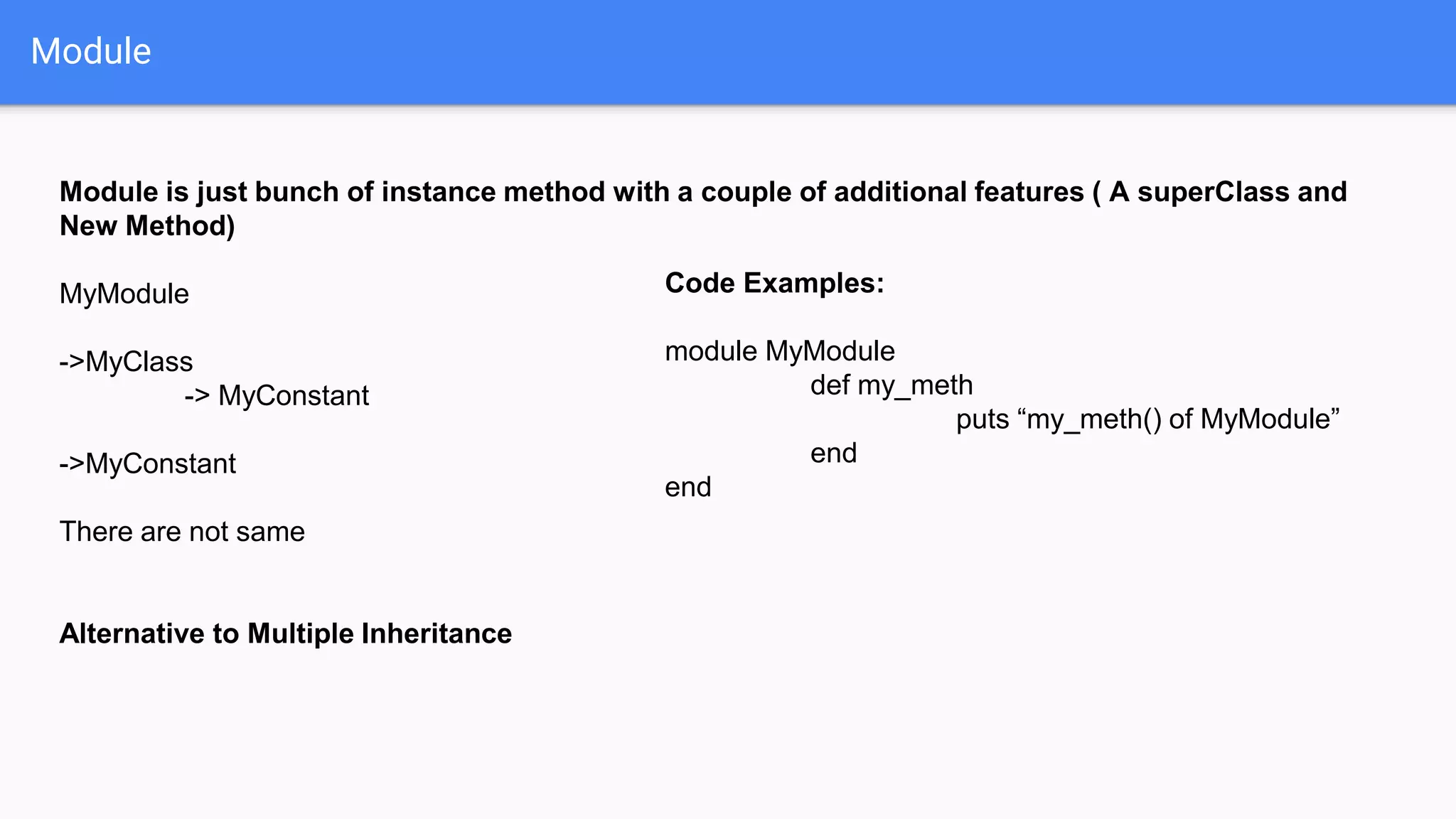
Module Module is just bunch of instance method with a couple of additional features ( A superClass and New Method) MyModule ->MyClass -> MyConstant ->MyConstant There are not same Alternative to Multiple Inheritance Code Examples: module MyModule def my_meth puts “my_meth() of MyModule” end end
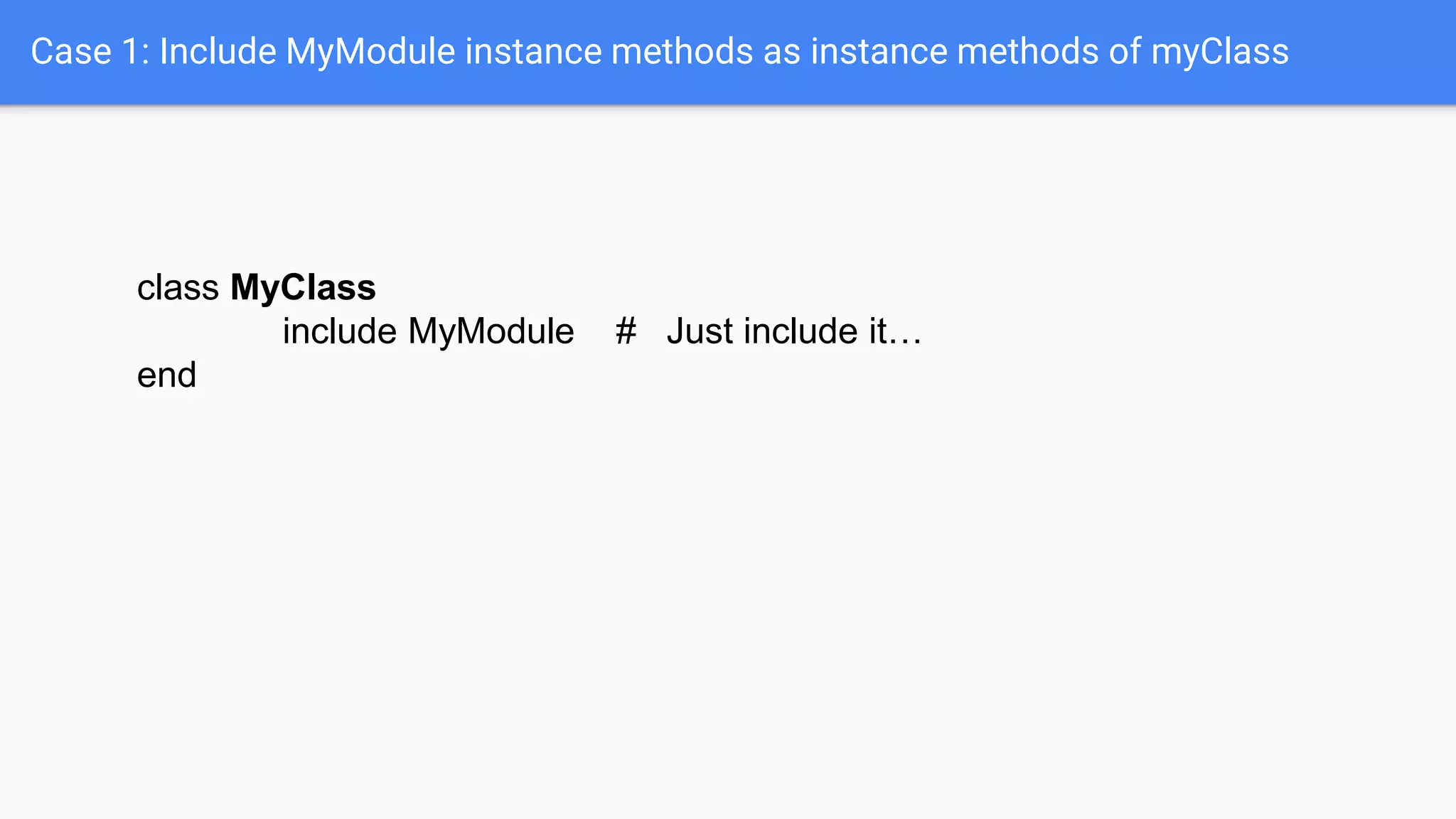
Case 1: Include MyModule instance methods as instance methods of myClass class MyClass include MyModule # Just include it… end
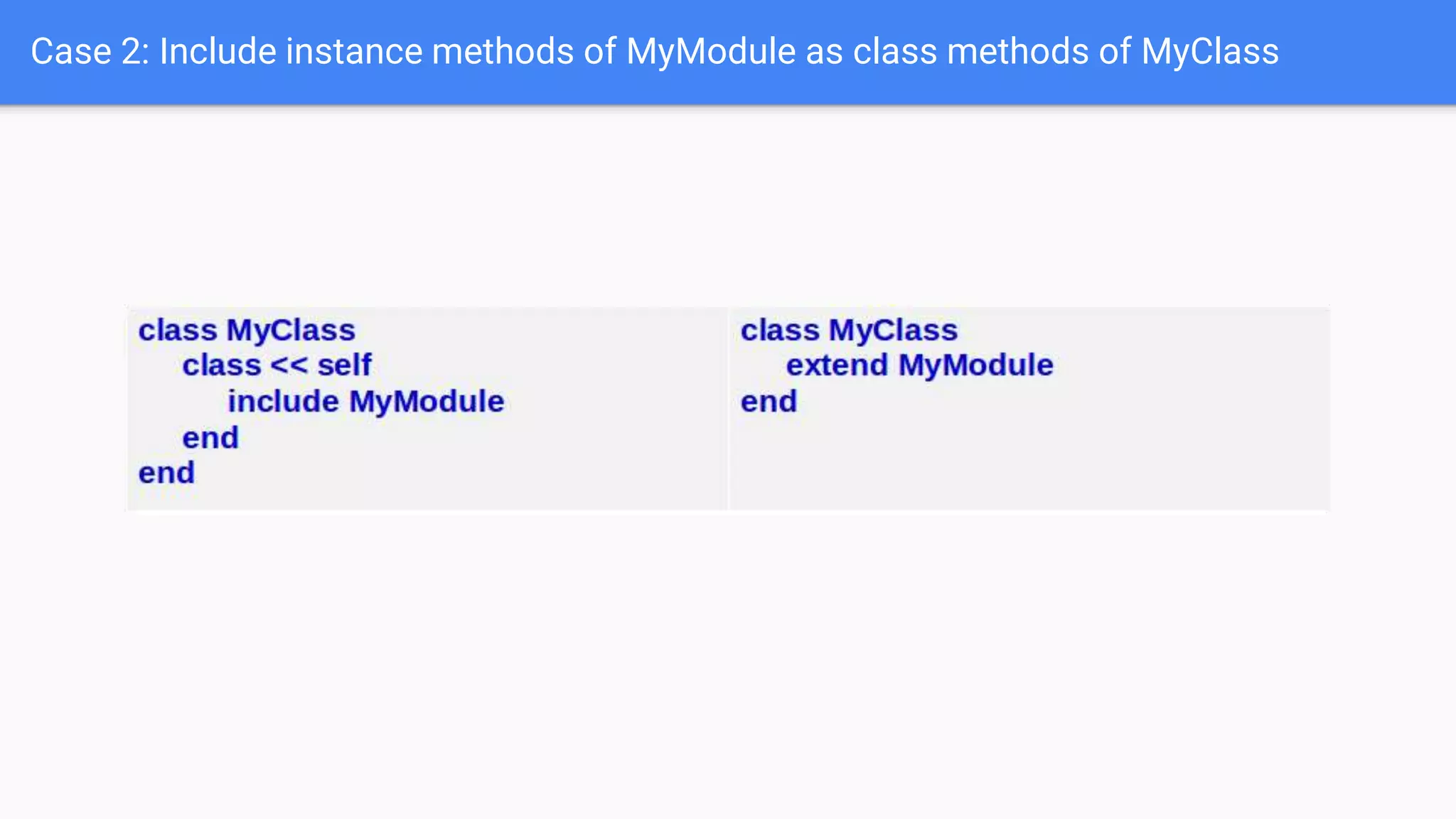
Case 2: Include instance methods of MyModule as class methods of MyClass
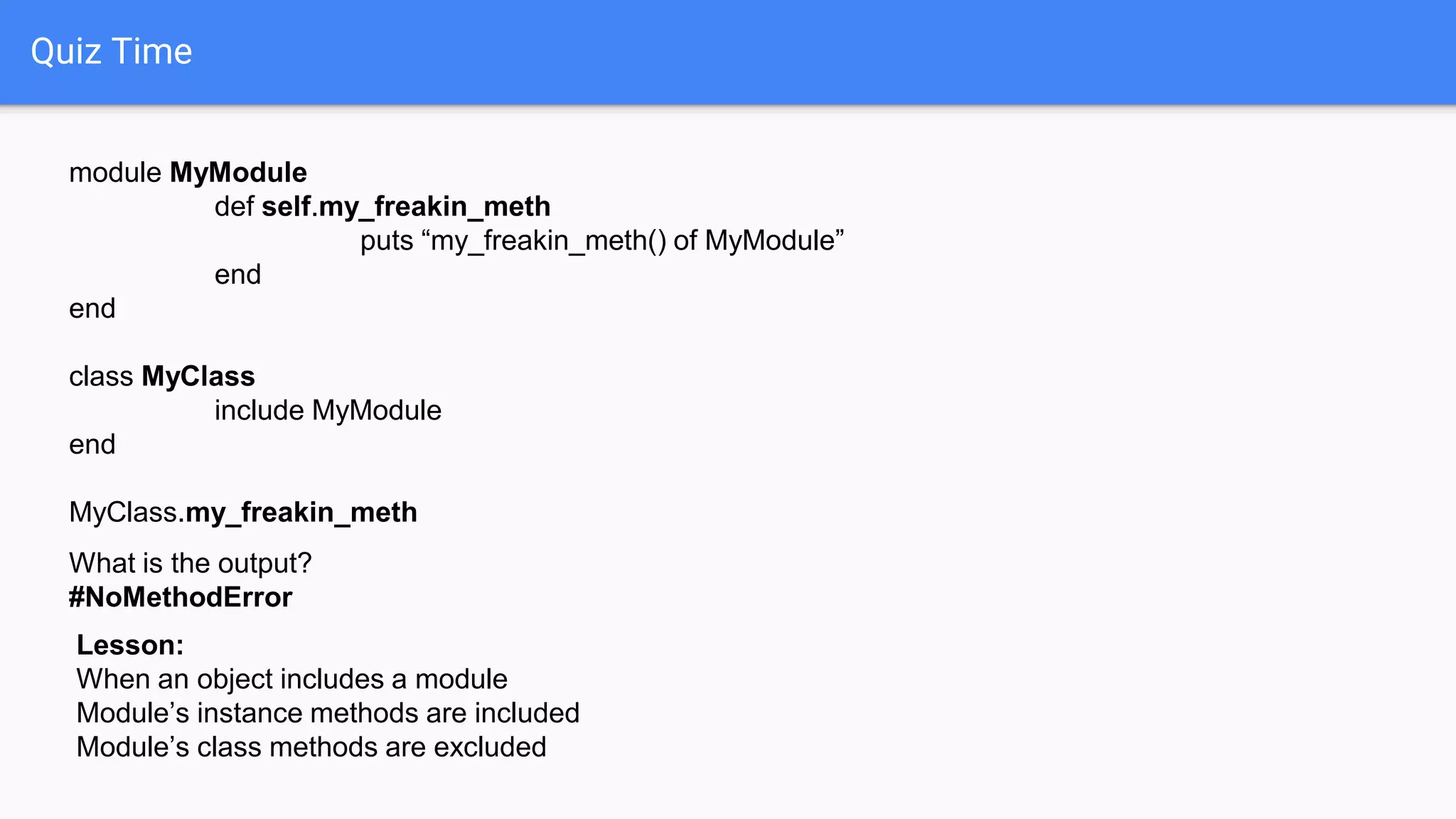
Quiz Time module MyModule def self.my_freakin_meth puts “my_freakin_meth() of MyModule” end end class MyClass include MyModule end MyClass.my_freakin_meth What is the output? #NoMethodError Lesson: When an object includes a module Module’s instance methods are included Module’s class methods are excluded
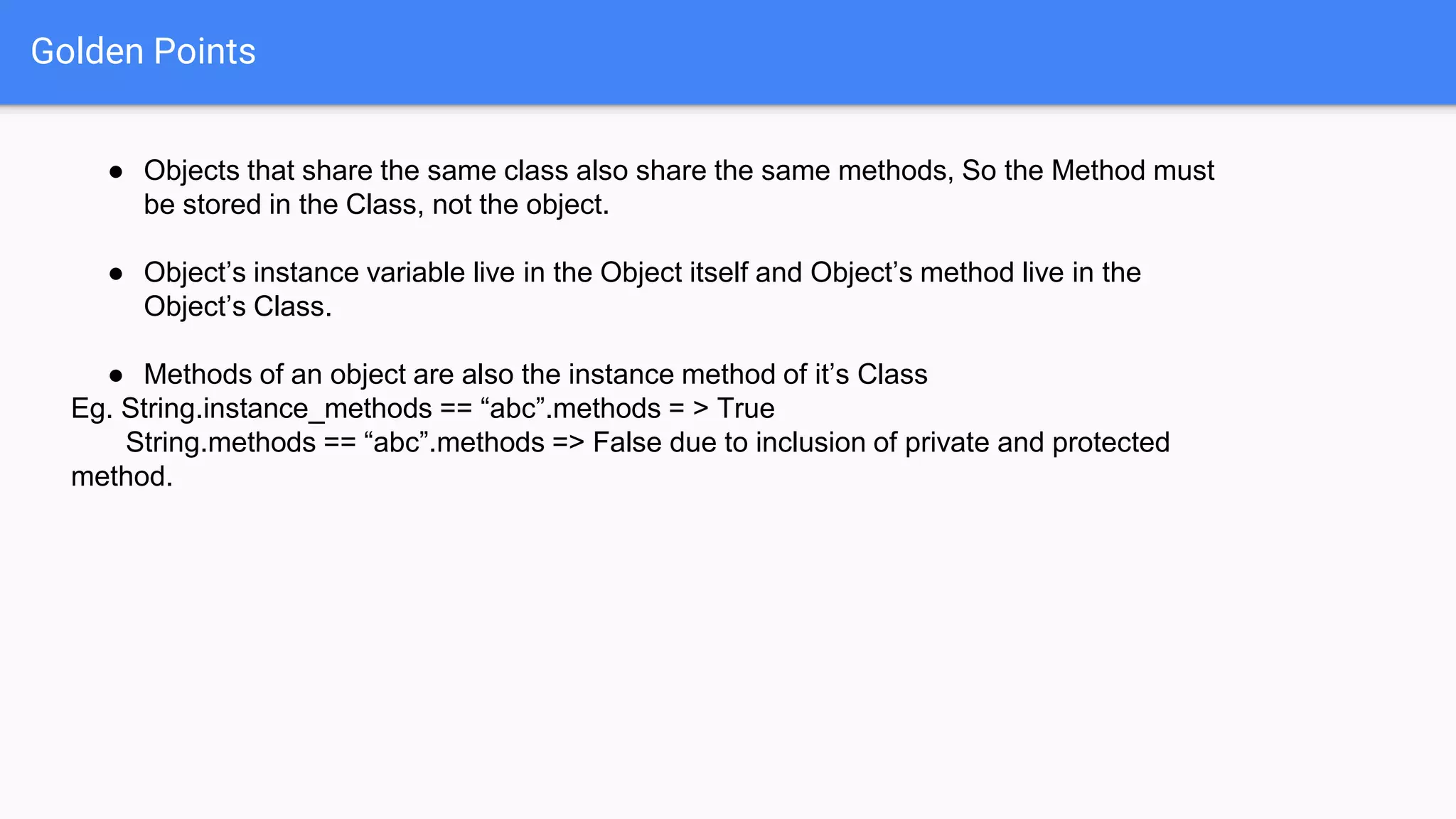
Golden Points ● Objects that share the same class also share the same methods, So the Method must be stored in the Class, not the object. ● Object’s instance variable live in the Object itself and Object’s method live in the Object’s Class. ● Methods of an object are also the instance method of it’s Class Eg. String.instance_methods == “abc”.methods = > True String.methods == “abc”.methods => False due to inclusion of private and protected method.
Any Questions??????
Next Topics to cover: ● Design Pattern ● Practical Theory of Ruby Object Model ● Best Practices of Rails

Ruby object model - Understanding of object play role for ruby

  • 1.
    Ruby Object Model Thisis a game of object for Ruby
  • 2.
    Ruby is agame but Syntax is not game.
  • 3.
    This Theory helpsto solve two biggest Questions Which Class does any method come from ? What happen when we include any specific module?
  • 4.
    Ruby Objective Key points: Classes are Object. Closed to modifications and Open to extend.
  • 5.
  • 6.
    What is Kernel??? Kernelis a module which is included in the Object. Where These Method can be Call Without the receiver and functional Form. Eg. Array(1..5) Hash([1,2,3])
  • 7.
    Classes ● Approach inRuby is different having all the classes are open. ● Overview Problem: Make a method for all the type of string which convert it to alphanumeric string includes special character etc ? How To Do that ??????? Does Open Class will Help ?????????? If Yes then How ???????
  • 8.
    Solution : YesWe can do it via Open Class of Ruby class String def to_alphanumeric gsub /[^ws]/, '' end end “Sys@@#tango”.to_alphanumeric => “Systango” Open Class Problem -> Revised method problem
  • 9.
    Quiz Time class MyClass< String.new def self.to_s puts “Class method” end end MyClass.to_s What is the output? TypeError: Wrong argument type String (expected Class) Lesson: Classes inherit from classes only not from just any object
  • 10.
    Points to Remember: ●Class inherit from the Type Class only not by the Type Object. ● Any Creating a New Class then it goes to the object because Class is a Object. ● Objects that share the same class also share the same methods, so the methods must be stored in the class, not the object. ● An object’s instance variables live in the object itself,and an object’s methods live in the object’s class. That’s why objects of the same class share methods but don’t share instance variables String.instance_methods == "abc".methods # => true String.methods == "abc".methods # => false
  • 11.
    What is Self?? ● self is not the same as this in Java ● self is synonymous to current/default object ● Who gets to be self depends on Where self is
  • 12.
    The joy of“self” discovery p self class MyClass p self def self.my_class_method P self end def my_instance_method P self end end => main (Which the the top level of hierarchy Object Class) => MyClass (which is the type class) => MyClass (which is the type class explicit Reciever is Class Name) => Instance of class (Object which is called this method)
  • 13.
    what is “main”in ruby? puts self class Foo puts self end OUTPUT: main Foo - Everything in Ruby occurs in the context of some object. The object at the top level is called "main". It's basically an instance of Object with the special property that any methods defined there are added as instance methods of Object (so they're available everywhere). - Actually there is a main, but it is not a method; it's the top-level object that is the initial execution context of a Ruby program.
  • 14.
    Access modifiers ● Public ●Private : only accessible within the scope of a single object in which it is defined (truly private) ( Can’t call with an explicit receiver ) ● Protected: accessible from the scope of a method belonging to any object that’s an instance of the same class (Invoked by Object of the defining class and it’s subclasses) class MyClass protected def my_protected_method end public def my_public_method(other) self.my_protected_method other.my_protected_method end end #=> Works #=> NoMethodError mc1 = MyClass.new mc2 = MyClass.new mc1.my_public_method(mc2) mc1.my_protected_method
  • 15.
    Quiz Time class MyClass protected defmy_protected_method end def self.my_protected_method puts "Welcome" end public def my_public_method(other) self.my_protected_method other.my_protected_method end end mc1 = MyClass.new mc2 = MyClass.new mc1.my_public_method(mc2) MyClass.my_protected_method => Works => Works
  • 16.
    Ruby Variable Scoping ●Class Variable (@@) - Available from the Class Definition and any Subclasses ● Instance Variable (@) - Specific Object, Across all the methods in a class Instance ● Global Variable($) ● Local Variable => Every Object has it’s own list of Instance Variable,Independent of other Objects- even other objects of the Same Class.
  • 17.
    Quiz Time class A y=1 @p= 2 @q @@r = 2 def initialize @@t=3 @s = 2 end def welcome @indore = 1 @bhopal = 2 @jabalpur = 3 @@dhar = 3 end end p A.instance_variables p A.class_variables a = A.new b = A.new p a.instance_variables p A.class_variables p b.welcome p b.instance_variables => [:@p] => [:@@r] => [:@s] => [:@@r, :@@t] => [:@s, :@indore, :@bhopal, :@jabalpur]
  • 18.
    Module Module is justbunch of instance method with a couple of additional features ( A superClass and New Method) MyModule ->MyClass -> MyConstant ->MyConstant There are not same Alternative to Multiple Inheritance Code Examples: module MyModule def my_meth puts “my_meth() of MyModule” end end
  • 19.
    Case 1: IncludeMyModule instance methods as instance methods of myClass class MyClass include MyModule # Just include it… end
  • 20.
    Case 2: Includeinstance methods of MyModule as class methods of MyClass
  • 21.
    Quiz Time module MyModule defself.my_freakin_meth puts “my_freakin_meth() of MyModule” end end class MyClass include MyModule end MyClass.my_freakin_meth What is the output? #NoMethodError Lesson: When an object includes a module Module’s instance methods are included Module’s class methods are excluded
  • 22.
    Golden Points ● Objectsthat share the same class also share the same methods, So the Method must be stored in the Class, not the object. ● Object’s instance variable live in the Object itself and Object’s method live in the Object’s Class. ● Methods of an object are also the instance method of it’s Class Eg. String.instance_methods == “abc”.methods = > True String.methods == “abc”.methods => False due to inclusion of private and protected method.
  • 23.
  • 24.
    Next Topics tocover: ● Design Pattern ● Practical Theory of Ruby Object Model ● Best Practices of Rails