Definition Objects providea way to divide a program into independent sections. Often, you also need to turn a program into separate, independently running subtasks. Each of these independent subtasks is called a thread. A piece of code that run in concurrent with other threads. Thread is a statically ordered sequence of instructions.
5.
Motivation Resource utilizationPrograms sometimes have to wait for external operations such as input or output, and while waiting can do no useful work. It is more efficient to use that wait time to let another program run. Fairness Multiple users and programs may have equal claims on the machine's resources. It is preferable to let them share the computer via finer-grained time slicing than to let one program run to completion and then start another. Convenience Program with multiple tasks.
6.
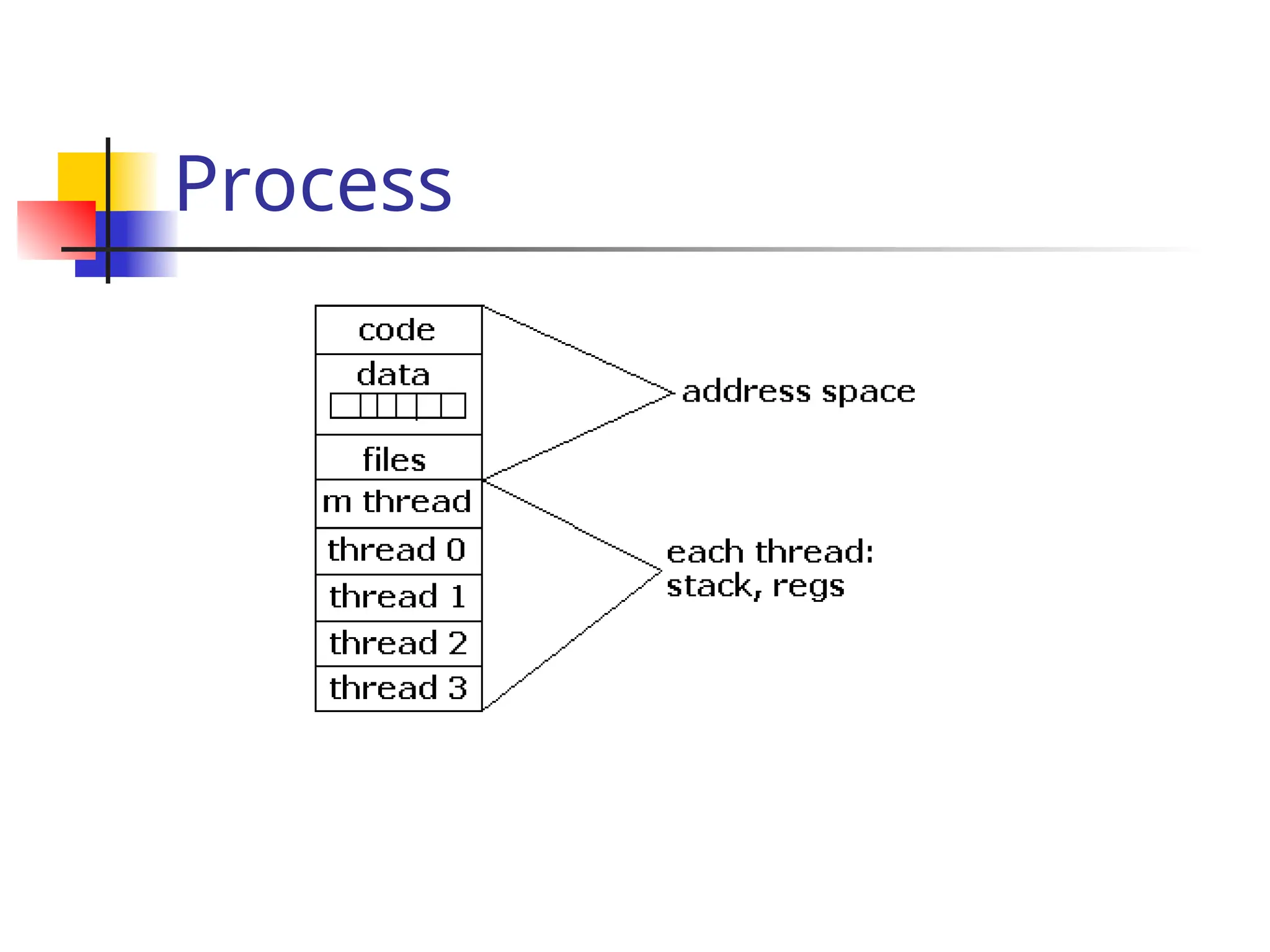
Process A processis a self-contained running program with its own address space. A multitasking operating system is capable of running more than one process (program) at a time. A thread is a single sequential flow of control within a process. A single process can thus have multiple concurrently executing threads So threads are lightweight processes.
Java Thread MemoryModel Memory that can be shared between threads is called shared memory or heap memory. All instance fields, static fields and array elements are stored in heap memory. Local variables, method parameters and catched exception parameters are never shared between threads and stored in local stack and registers.
9.
Threads compared withProcesses Processes are typically independent, while threads exist as subsets of a process Processes carry considerable state information, whereas multiple threads within a process share state as well as memory and other resources Processes have separate address spaces, whereas threads share their address space Processes interact only through system-provided inter-process communication mechanisms. Context switching between threads in the same process is typically faster than context switching between processes.
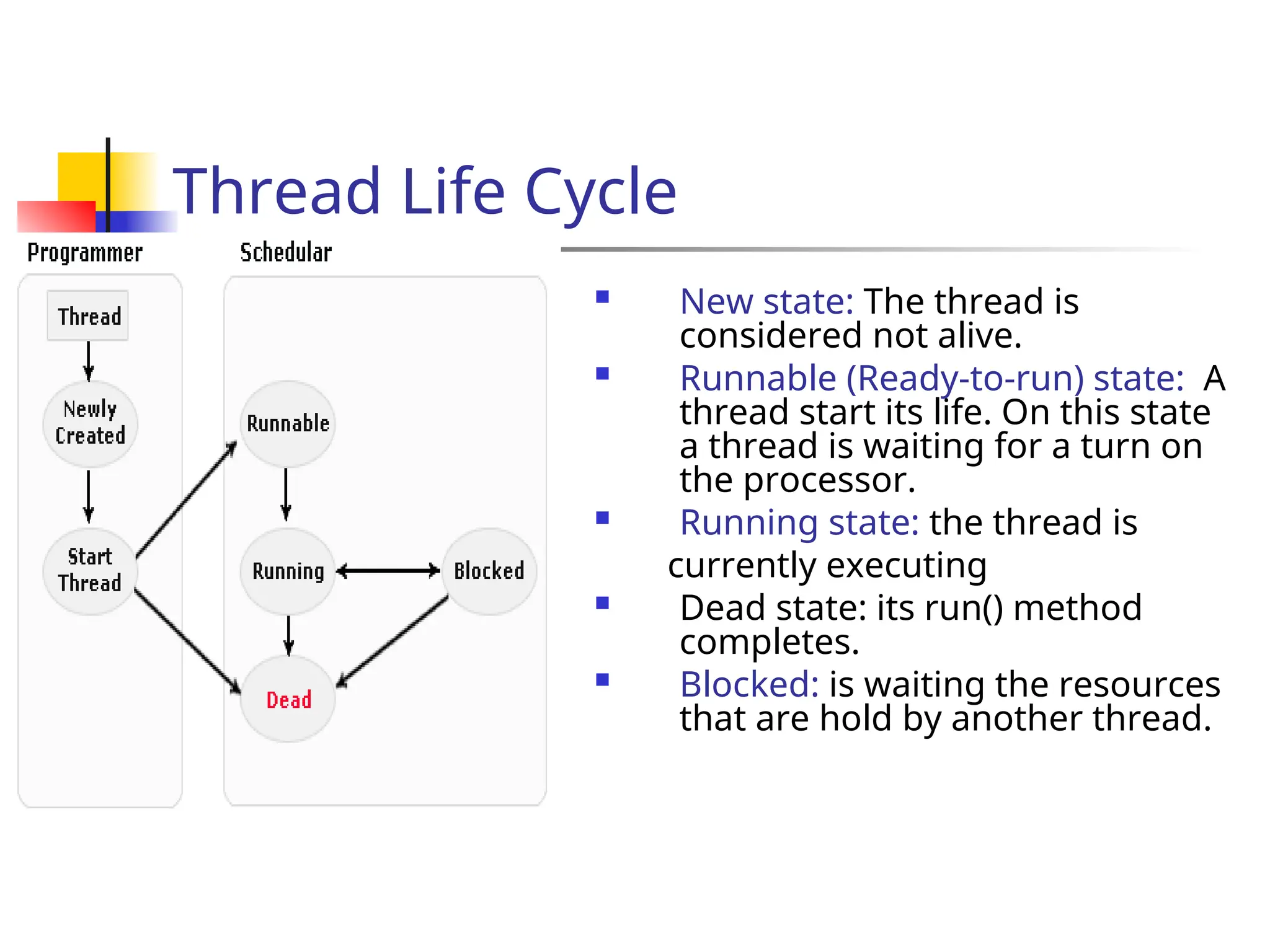
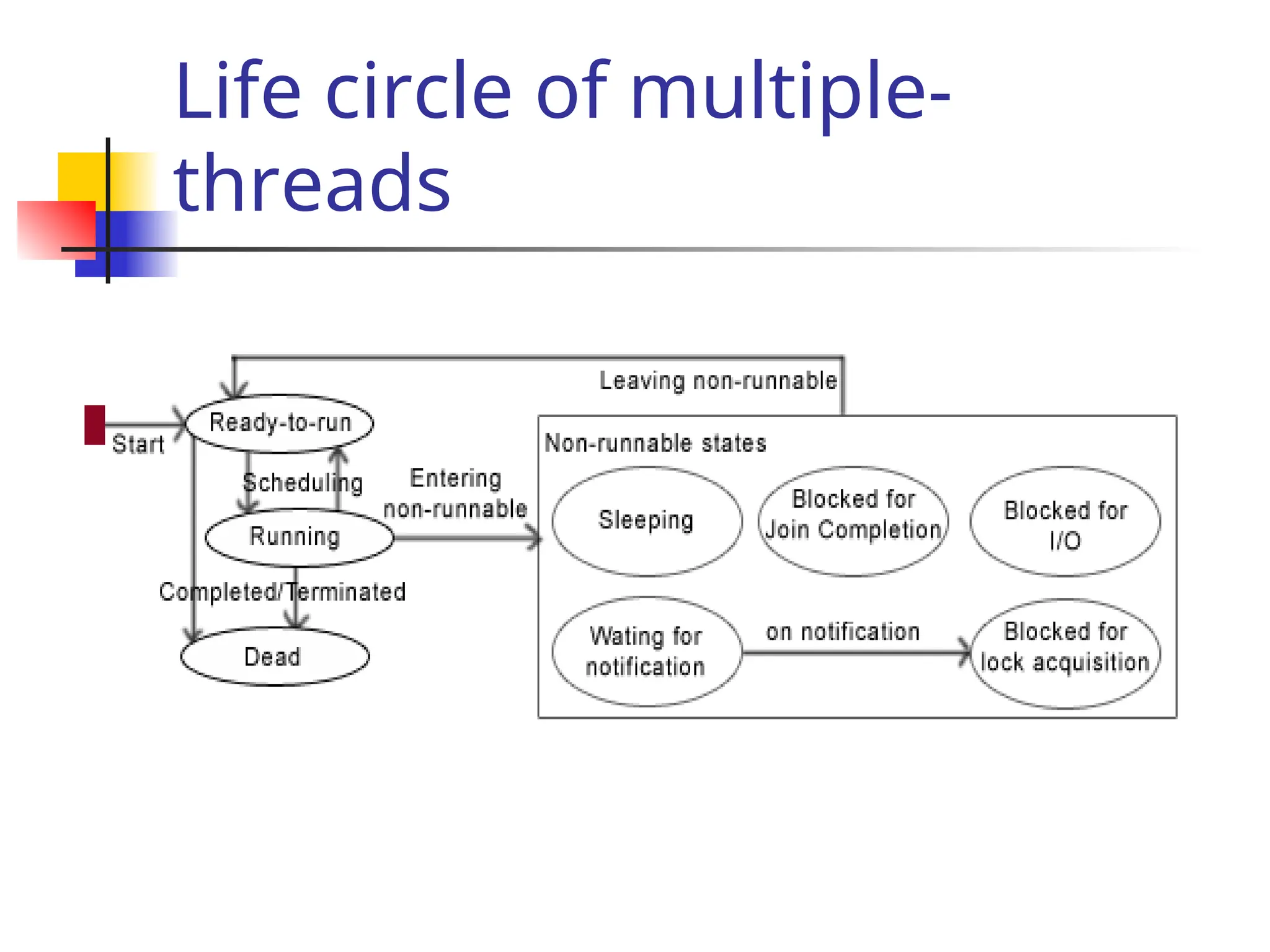
Thread Life Cycle New state: The thread is considered not alive. Runnable (Ready-to-run) state: A thread start its life. On this state a thread is waiting for a turn on the processor. Running state: the thread is currently executing Dead state: its run() method completes. Blocked: is waiting the resources that are hold by another thread.
Thread Creation Two ways: Extending the java.lang.Thread Class Implementing the java.lang.Runnable Interface Which to choose: If you extend the Thread Class, that means that subclass cannot extend any other Class, but if you implement Runnable interface then you can do this. And the class implementing the Runnable interface can avoid the full overhead of Thread class which can be excessive. Else use Thread
15.
Priority The priorityof a thread tells the scheduler how important this thread is. The thread scheduler can use the thread priorities to determine the execution schedule of threads. Priorities are integer values Thread.MIN_PRIORITY: 1 Thread.MAX_PRIORITY: 10 Thread.NORM_PRIORITY: 5
16.
Joining One threadmay call join( ) on another thread to wait for the second thread to complete before proceeding.
17.
Yielding Causes thecurrently executing thread to pause and allow other threads to execute. This hint (and it is a hint—there’s no guarantee your implementation will listen to it) takes the form of the yield() method. In general, yield() is useful only in rare situations and you can’t rely on it to do any serious tuning of your application
18.
Sleeping Causes thecurrently executing thread to pause for a given number of milliseconds. When you call sleep( ), it must be placed inside a try block because it’s possible for sleep( ) to be interrupted before it times out. It just stops the execution of the thread for a while. There is no guaranty that thread will resume the execution after the given number of milliseconds. Not to use in real-time application.
19.
Interrupting Interruption isa mechanism whereby a thread that is waiting (or sleeping) can be made to prematurely stop waiting. In general, InterruptedException is thrown when another thread interrupts the thread calling the blocking method. The other thread interrupts the blocking/sleeping thread by calling interrupt() on it.
20.
Daemon Thread A“daemon” thread is one that is supposed to provide a general service in the background as long as the program is running. Thus, when all of the non-daemon threads complete, the program is terminated. Conversely, if there are any non daemon threads still running, the program doesn’t terminate.
Improperly accessing resources Considerthe example where one task generates only even numbers. Scenario 1: Single Threaded Program Scenario 2: Multi Threaded Program Problem is not that the object goes through a state that violates invariance, but that methods can be called by threads while the object is in that intermediate unstable state.
24.
Colliding over resources If one thread tries to read the data and other thread tries to update the same data, it leads to inconsistent state. A race condition occurs when the order of execution of two or more threads may affect some variable or outcome in the program. Race conditions can be considered harmless provided end result is correct. Otherwise needs to be handled.
25.
Resolving shared resourceconflict Solution: Serialize access to shared resources Semaphore: Semaphore is an object containing a value and two operations and used for communication between threads. Java has built-in support to prevent collisions over resources in the form of the synchronized keyword. It works much like the Semaphore.
26.
Resolving shared resource conflict… Mutex: A mechanism in which a piece of code is running at a time by means of a lock (also called Monitor or Lock). Locks in Java are reentrant. Reentrancy means that locks are acquired on a per-thread basis rather than per-invocation basis. Synchronization: When one object pass a message to another object then both objects are in synchronized state. Synchronization needs if multiple objects passes the message to specific object. Atomic Operation: An atomic operation is one that cannot be interrupted by the thread scheduler. Volatile Variable: Every time the variable is used it must be read from main memory. Similarly, every time the variable is written, the value must be stored in main memory.
27.
Synchronization (Cont…) Onlymethods (or blocks) can be synchronized, Classes and variable cannot be synchronized. If two threads wants to execute a synchronized method in a class, and both threads are using the same instance of the class to invoke the method then only one thread can execute the method at a time. If you need to synchronize one method in a class, synchronize all of them, but this is not necessary. You can synchronize a block of code rather than a method. Constructors cannot be synchronized. Code inside the constructors can be synchronized. Rule zero of concurrent programming: never make any assumptions.
28.
Critical Sections Pieceof code that must be executed by one thread at a time Must have solution that guarantees: Mutual exclusion (correctness) Absence of deadlock/unnecessary delay (no hang up) Randomly entry (fairness) This is also called a synchronized block.
Inter-Thread Communication Whenmultiple threads are running inside an application, most of them will need to communicate with each other in some form. Threads can communicate each other using wait() and notify()/notifyAll() methods without any race condition. Wait-and-notify must be used in conjunction with the synchronized lock to prevent a race condition. Methods wait(), notify() and notifyAll() are part of the base class Object and not part of Thread, as is sleep(). Why???
31.
Inter-Thread Communication (Cont…) sleep()does not release the lock when it is called but method wait() does release the lock. The only place you can call wait( ), notify( ) or notifyAll( ) is within a synchronized method. Restaurant Example: The waitperson must wait for the chef to prepare a meal. When the chef has a meal ready, the chef notifies the waitperson, who then gets the meal and goes back to waiting. The chef represents the producer, and the waitperson represents the consumer.
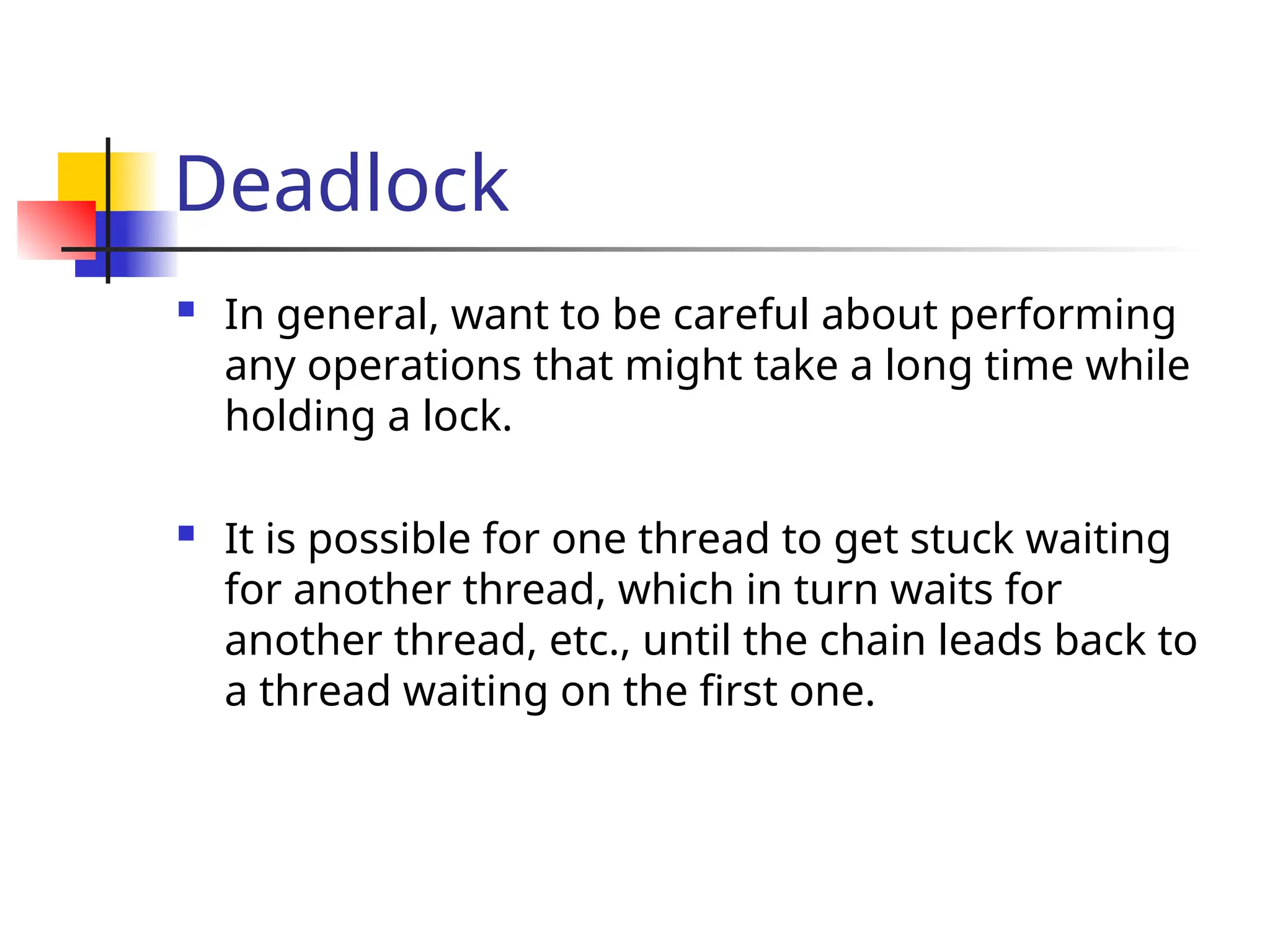
Deadlock In general,want to be careful about performing any operations that might take a long time while holding a lock. It is possible for one thread to get stuck waiting for another thread, which in turn waits for another thread, etc., until the chain leads back to a thread waiting on the first one.
34.
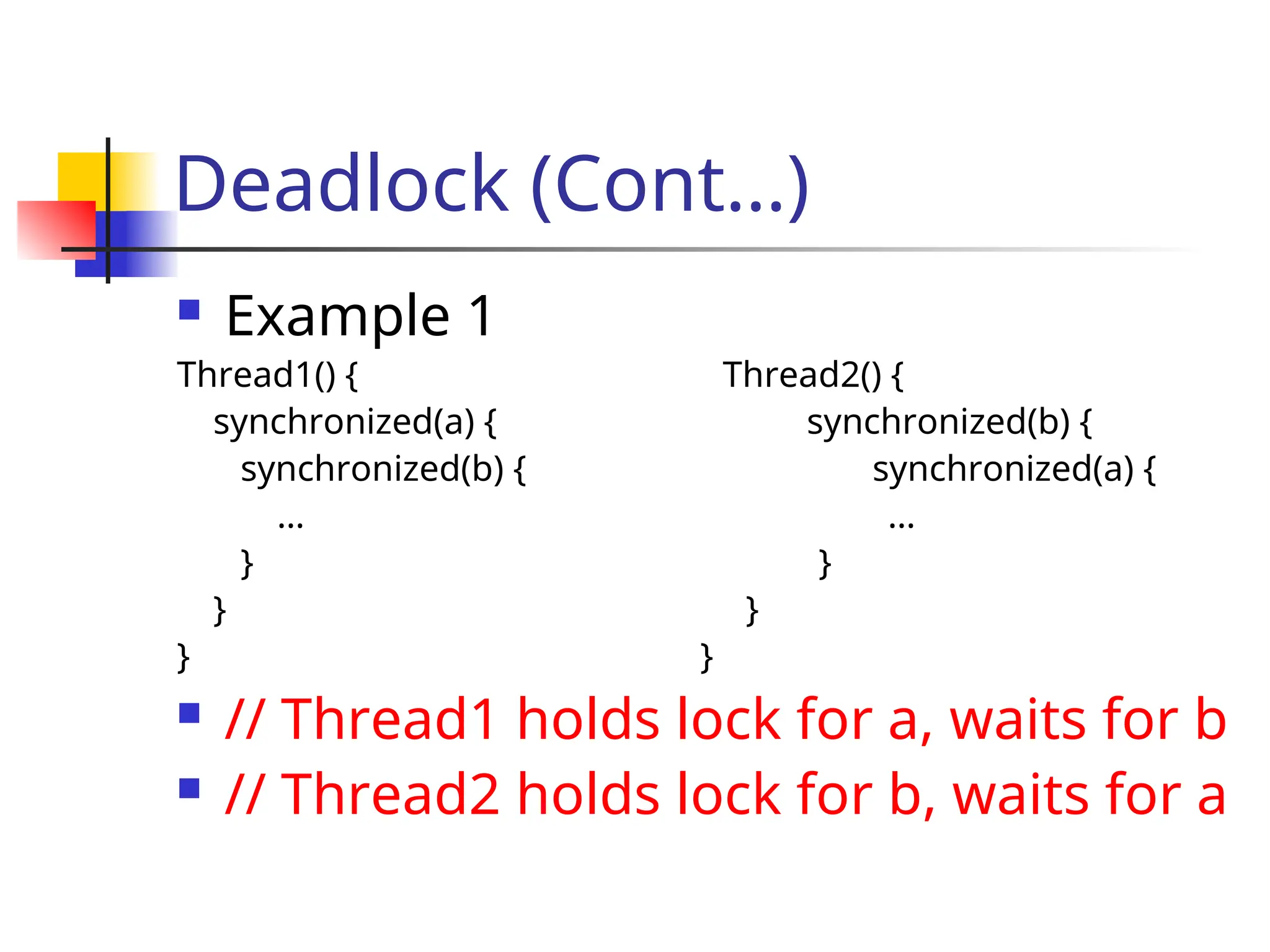
Deadlock (Cont…) Example1 Thread1() { Thread2() { synchronized(a) { synchronized(b) { synchronized(b) { synchronized(a) { … … } } } } } } // Thread1 holds lock for a, waits for b // Thread2 holds lock for b, waits for a
35.
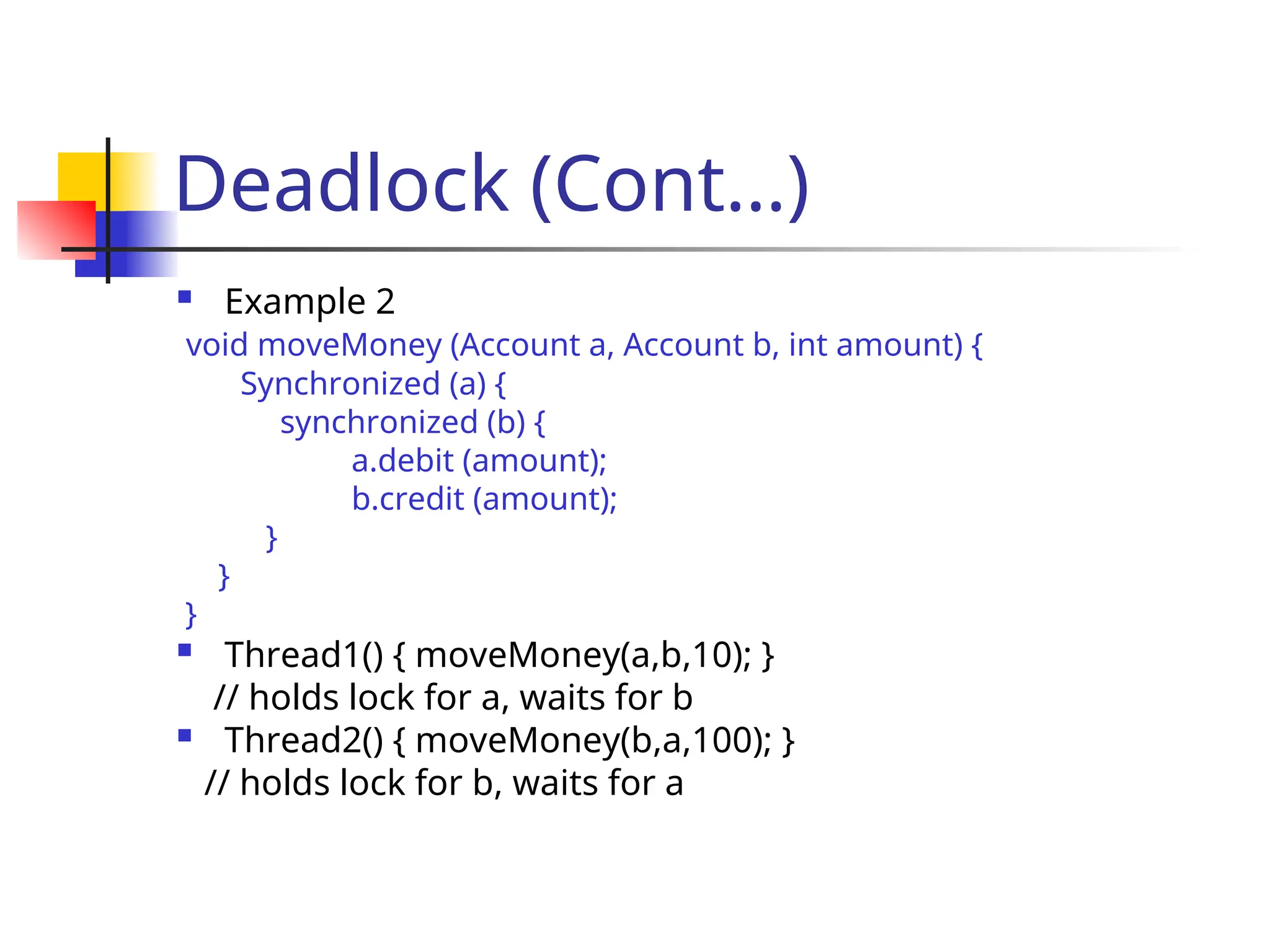
Deadlock (Cont…) Example2 void moveMoney (Account a, Account b, int amount) { Synchronized (a) { synchronized (b) { a.debit (amount); b.credit (amount); } } } Thread1() { moveMoney(a,b,10); } // holds lock for a, waits for b Thread2() { moveMoney(b,a,100); } // holds lock for b, waits for a
Other Stuff Theproper way to stop Interrupting a blocked thread Thread groups ThreadLocal & InheritableThreadLocal New Java API for Concurrency
38.
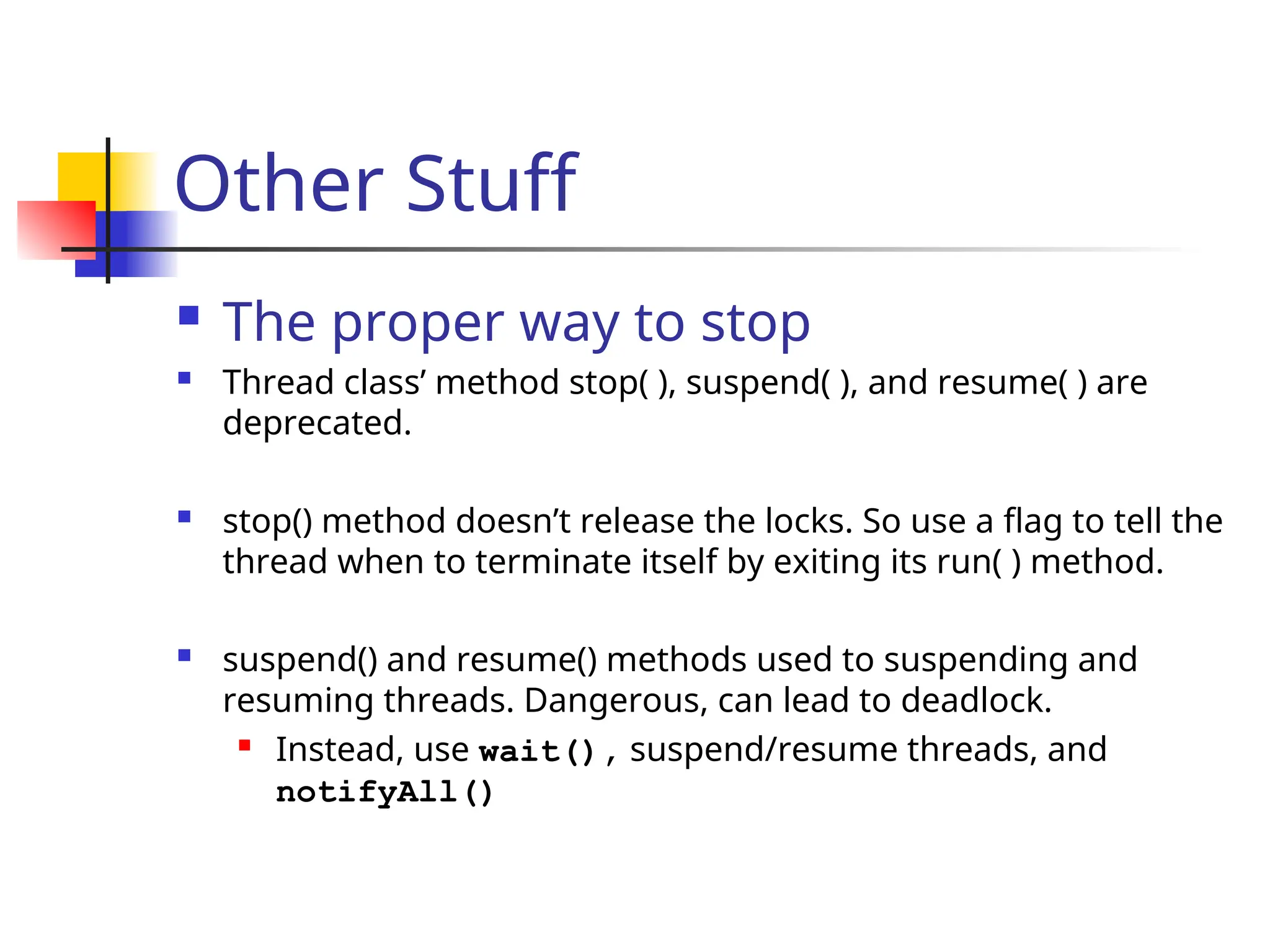
Other Stuff Theproper way to stop Thread class’ method stop( ), suspend( ), and resume( ) are deprecated. stop() method doesn’t release the locks. So use a flag to tell the thread when to terminate itself by exiting its run( ) method. suspend() and resume() methods used to suspending and resuming threads. Dangerous, can lead to deadlock. Instead, use wait(), suspend/resume threads, and notifyAll()
39.
Interrupting a blocked thread There are times when a thread blocks—such as when it is waiting for input—and it cannot poll a flag as it does in the previous example. In these cases, you can use the Thread.interrupt( ) method to break out of the blocked code. As a general guideline, the use of interrupt() should be reserved for situations where you want to interrupt a thread to signal it to die gracefully.
40.
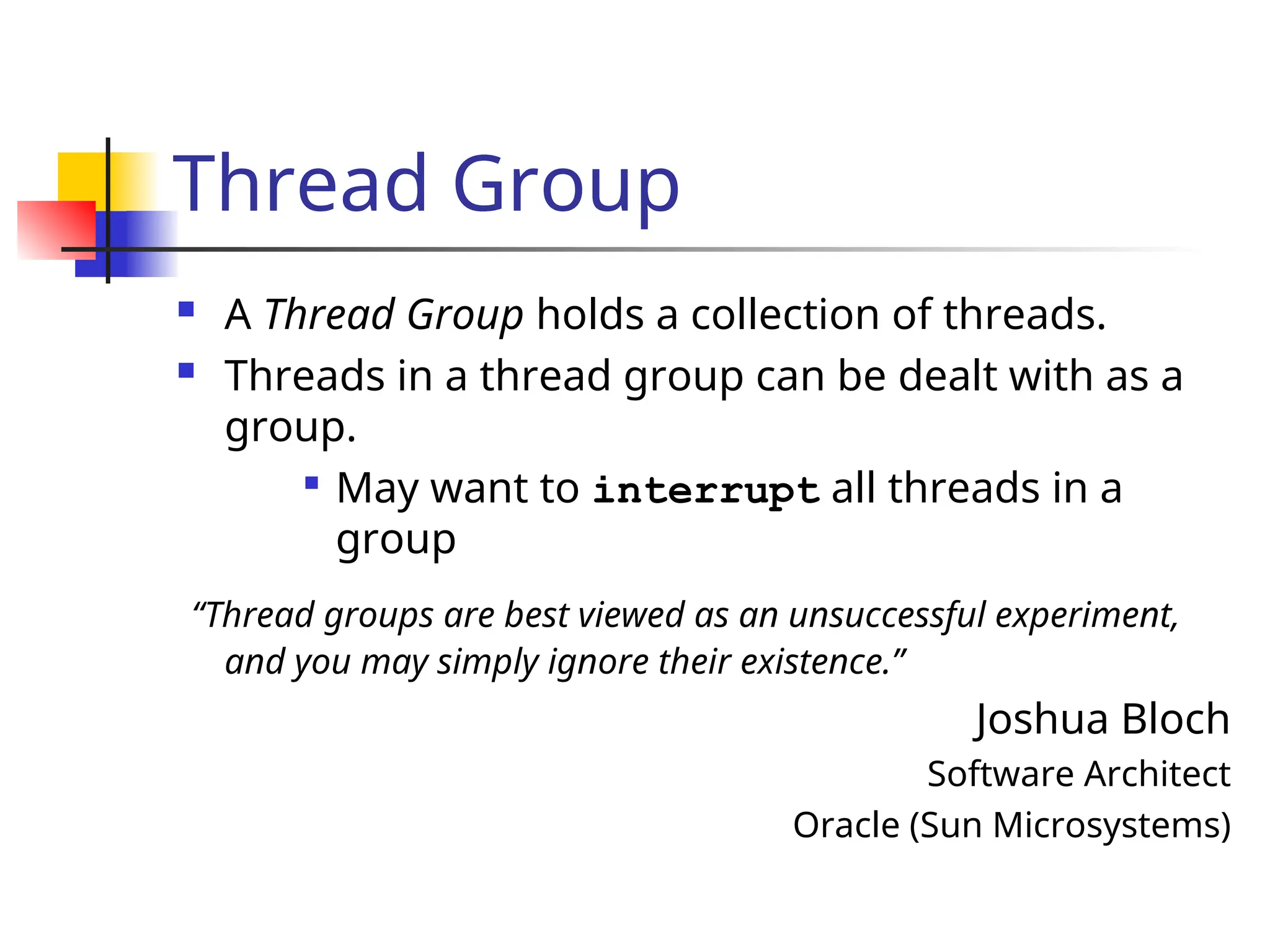
Thread Group AThread Group holds a collection of threads. Threads in a thread group can be dealt with as a group. May want to interrupt all threads in a group “Thread groups are best viewed as an unsuccessful experiment, and you may simply ignore their existence.” Joshua Bloch Software Architect Oracle (Sun Microsystems)
41.
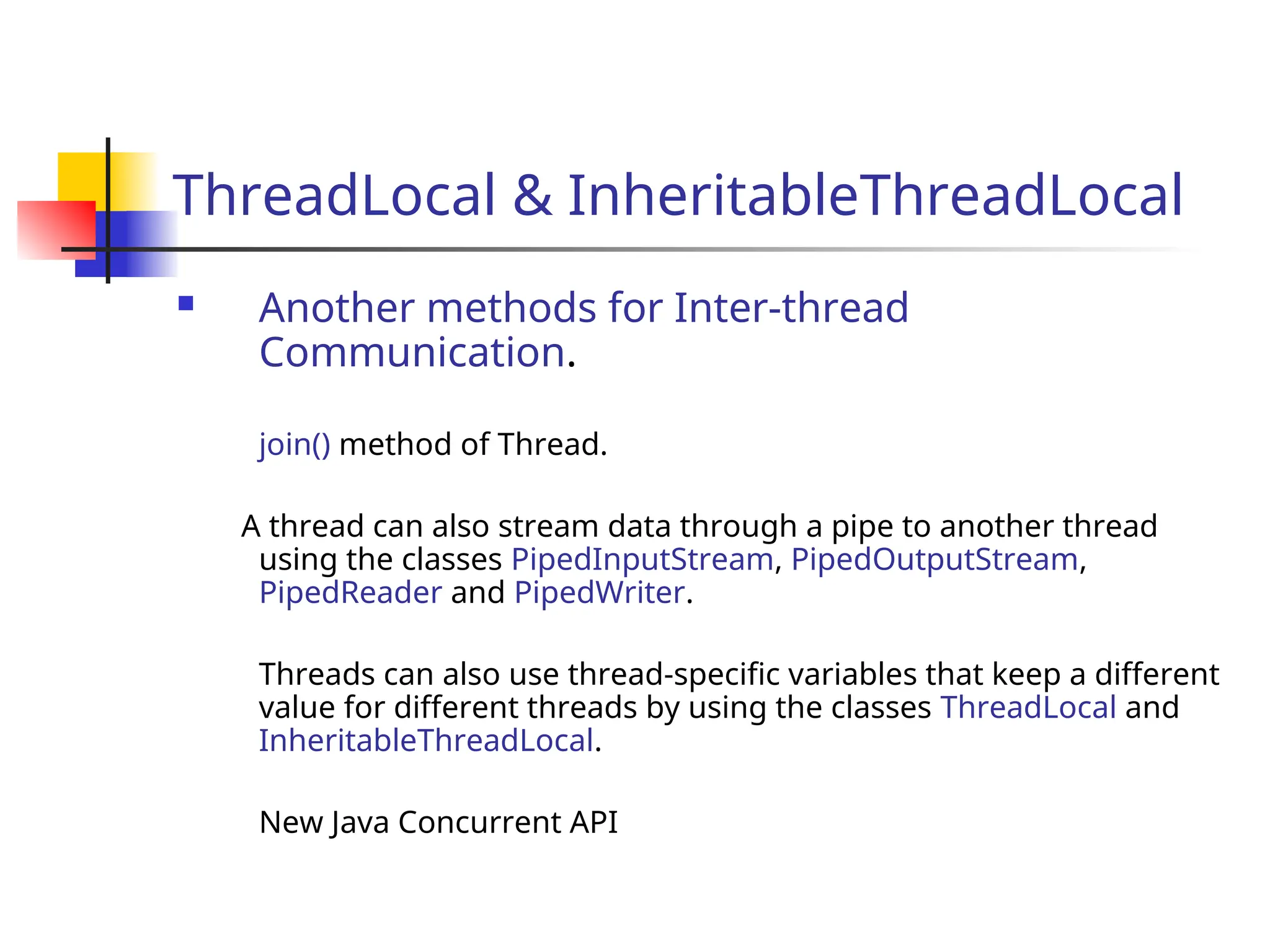
ThreadLocal & InheritableThreadLocal Another methods for Inter-thread Communication. join() method of Thread. A thread can also stream data through a pipe to another thread using the classes PipedInputStream, PipedOutputStream, PipedReader and PipedWriter. Threads can also use thread-specific variables that keep a different value for different threads by using the classes ThreadLocal and InheritableThreadLocal. New Java Concurrent API
42.
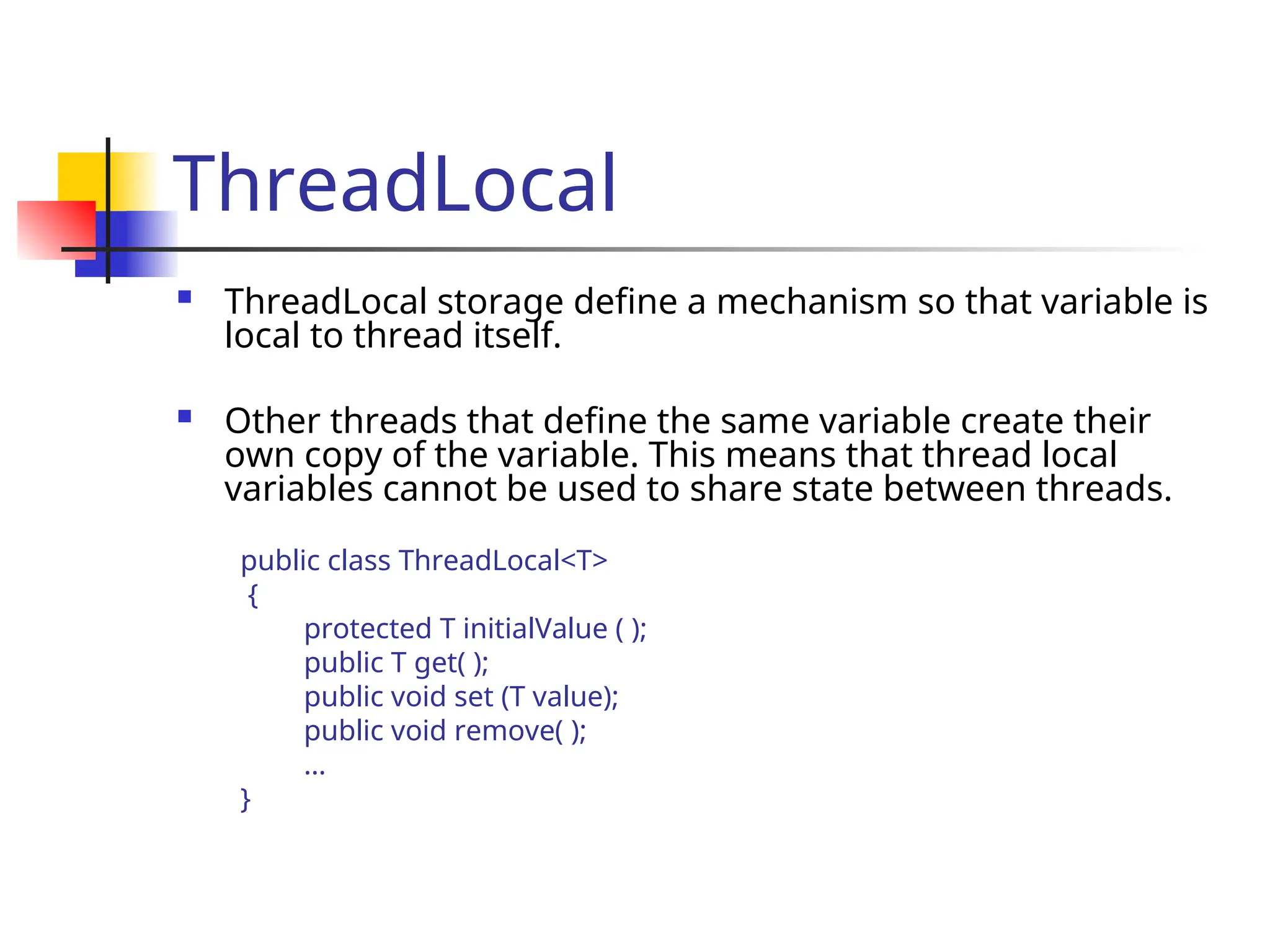
ThreadLocal ThreadLocal storagedefine a mechanism so that variable is local to thread itself. Other threads that define the same variable create their own copy of the variable. This means that thread local variables cannot be used to share state between threads. public class ThreadLocal<T> { protected T initialValue ( ); public T get( ); public void set (T value); public void remove( ); … }
43.
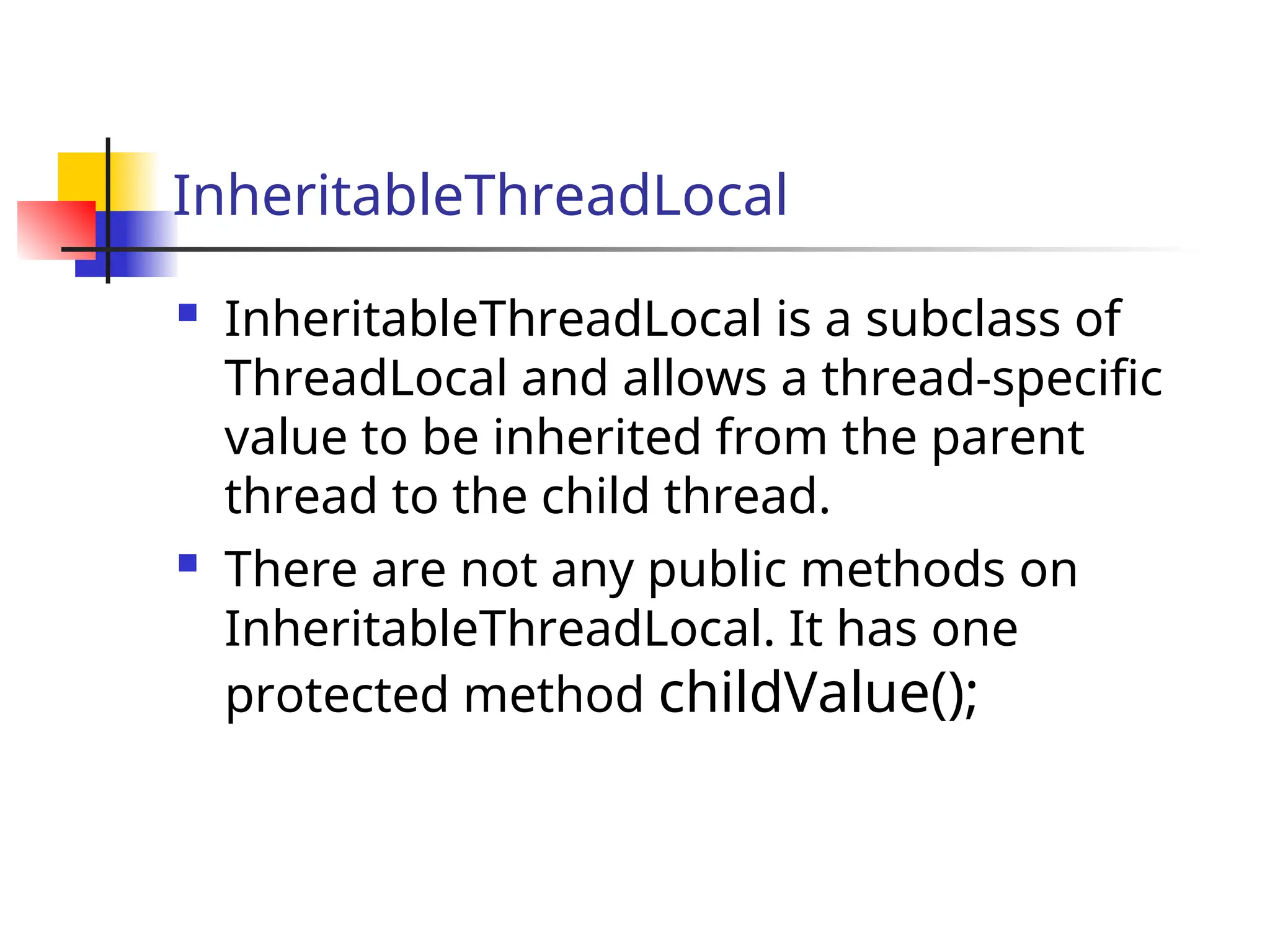
InheritableThreadLocal InheritableThreadLocal isa subclass of ThreadLocal and allows a thread-specific value to be inherited from the parent thread to the child thread. There are not any public methods on InheritableThreadLocal. It has one protected method childValue();
44.
New Java APIfor Concurrency Time out… Discuss later
Assignment Modify Restaurant.javaso that multiple Customers will place order requests with WaitPersons, who give the requests to the Chefs, who fulfill the orders and notify the appropriate WaitPerson, who gives it to the appropriate Customer. Solve the Dining Philosophers Problem. Use the classes PipedInputStream, PipedOutputStream, PipedReader and PipedWriter for Inter-Thread Communication.