Monetary Policy
Group members	PriyaDoshiRichaTalatiRonakSoniShibin JacobSnehaKapadiaVikasVerma
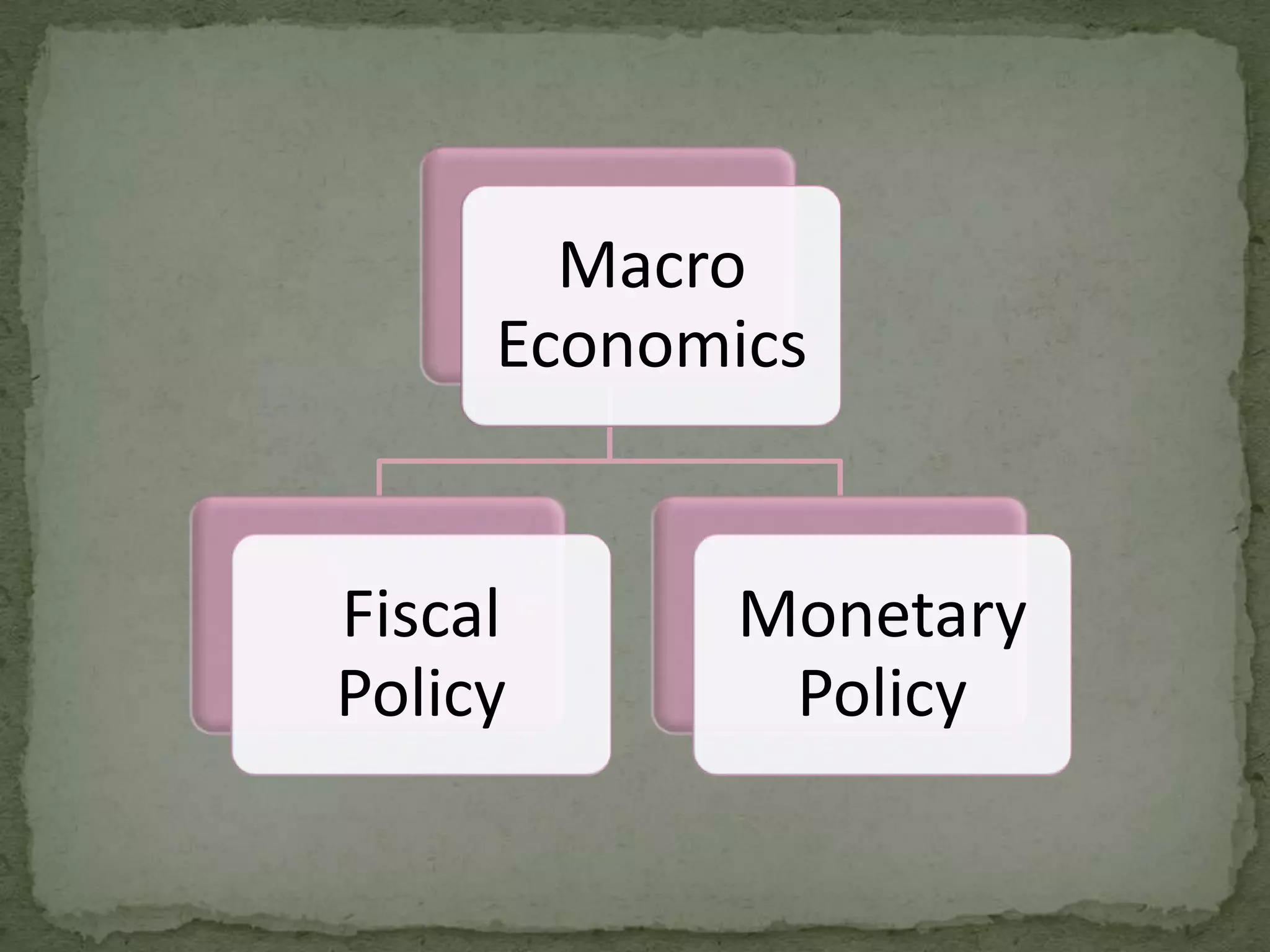
Any decision to change the level, composition or timing of govt. expenditure or to vary the burden, the structure or frequency of the tax payment is fiscal policy. -G.K. ShawThe Goal: Reduces the rate of inflation and stimulates economic growth in a period of recession.What is Fiscal Policy?
Monetary policy refers to the use of instruments under the control of the RBI to regulate the availability, cost and use of money and credit.The goal: achieving specific economic objectives, such as low and stable inflation and promoting growth.What is Monetary Policy?
Different interest rates prevalent in IndiaBank rate- The rate at which RBI lends money to domestic banking system.Call Money rate- The rate at which commercial bank borrows money from other commercial banks for a short period.Prime Lending rate- The rate at which the commercial banks can provide credit to industries or business.
Repo and Reverse Repo rate- The interest rate at which RBI provides loan to commercial banks is called Repo rate. The rate at which RBI takes short term credit is Reverse Repo rate.Deposit rate- The rate of interest at which the customers are paid interest on their bank deposits.Bond rate- To meet expenses for the development, Government issues the Bond maturing in definite period at a definite rate.
CRR- Banks in India are required to hold a certain proportion of their deposits in the form of  cash with Reserve Bank of India. This minimum ratio is known as the CRR or  Cash Reserve Ratio.SLR- The minimum percentage of deposits that the bank has to maintain in form of gold, cash or other approved securities is known as Statutory Liquidity Ratio.
The Reserve Bank of India (RBI) is the central banking system of India and controls the monetary policy of the rupee. The institution was established on 1 April 1935 and plays an important part in the development strategy of the government.
Role of RBI India’s monetary authoritySupervisor of financial systemIssuer of currencyManager of foreign exchange reservesBanker and debt manager to GovernmentBanker to BanksDevelopmental functionsResearch, data and knowledge sharing since 75 years:
Making of monetary policyMonetary policy is communicated to the public mostly by annual monetary policy statement in April and the mid-term review in October. The statements today are more analytical, introspective and elaborate. RBI website is an effective medium of communication.Governor, Deputy Governors, Committee of the Board meet every week to review the monetary, economic and financial conditions. Mechanisms such as resource management of banks, supervisory data, market information, economic and statistical analysis, etc. are usedPeriodic consultations with Ministry of Finance for significant technical, analytical, institutional and dynamic inputs.
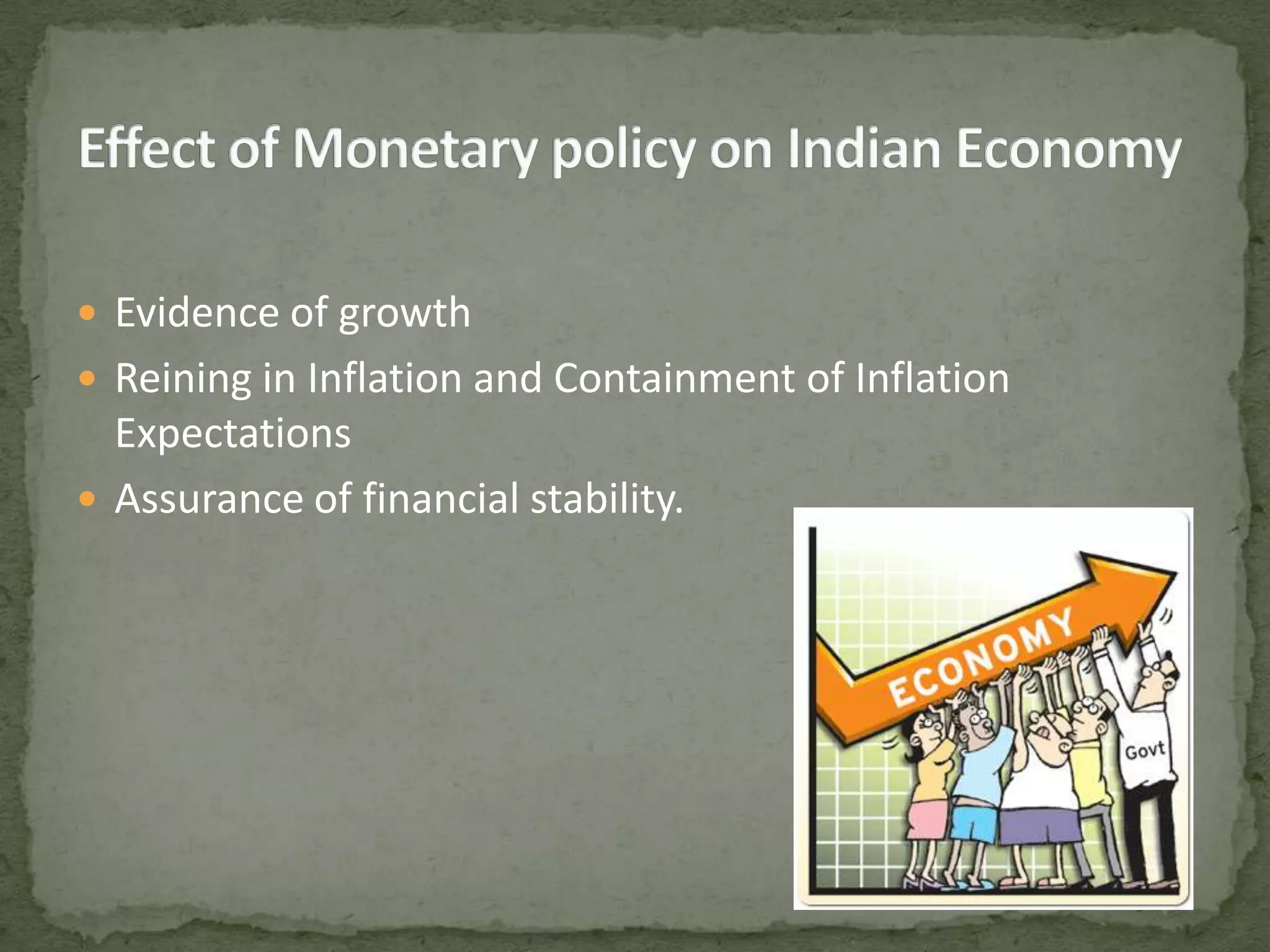
Evidence of growthReining in Inflation and Containment of Inflation ExpectationsAssurance of financial stability.Effect of Monetary policy on Indian Economy
Monetary policy cannot change long-term growth.There is no long term tradeoff between growth and inflation.Monetary policy can deliver low and stable inflation, and thereby reduce the volatility of the business cycle.It cannot really predict when inflationary pressures builds up.Limitations of Monetary Policy
It is divided into four SectionsThe State of the EconomyOutlook and ProjectionsThe Risk FactorsThe Policy StanceMonetary Policy 2010-11
The State of the EconomyRBI had projected the real GDP growth for 2009-10 at 7.5%.Central Statistical Organization in early Feb 2010 placed the real GDP growth during 2009-10 at 7.2%The headline inflation in Wholesale Price Index (WPI), accelerated from 0.5% in Sep 2009 to 9.9% in March 2010, exceeding the RBI’s baseline projection of 8.5%
 Scheduled commercial banks (SCBs) raised their deposit rates by 25-50 basis points between Feb and April 2010, signaling a reversal in the trend of deposit rates reduction.
The Union Budget for 2010-11 begun the process of fiscal consolidation by budgeting lower fiscal deficit (5.5% of GDP in 2010-11 compared to 6.7% in 2009-10) and revenue deficit (4% of GDP in 2010-11 as compared to 5.3% in 2009-10).Outlook and ProjectionsThe Indian economy is firmly on the recovery path.
Exports have been expanding since October 2009, a trend that is expected to continue.
The improved performance of the industrial sector is reflected in profitability of the corporate sector.
Sustenance of good performance of industrial and service sectors accompanied by rising demand, both domestic and external.Risk FactorsUncertainty persists about the pace and shape of global recovery.
Private demand in advanced economies continues to be weak due to high unemployment rates, weak income growth and tight credit conditions. 
Once the impact of public spending wanes, the recovery process can be stalled.
If global recovery gains momentum, commodity and energy prices, which have been on the rise, may harden further. The Policy StanceGrowth in 2010-11 is projected to be higher and more broad-based than in 2009-10.
Notwithstanding lower budgeted government borrowings in 2010-11 than in the year before.
Fresh issuance of securities will be 36.3% higher than last year. This presents a dilemma for the RBI.
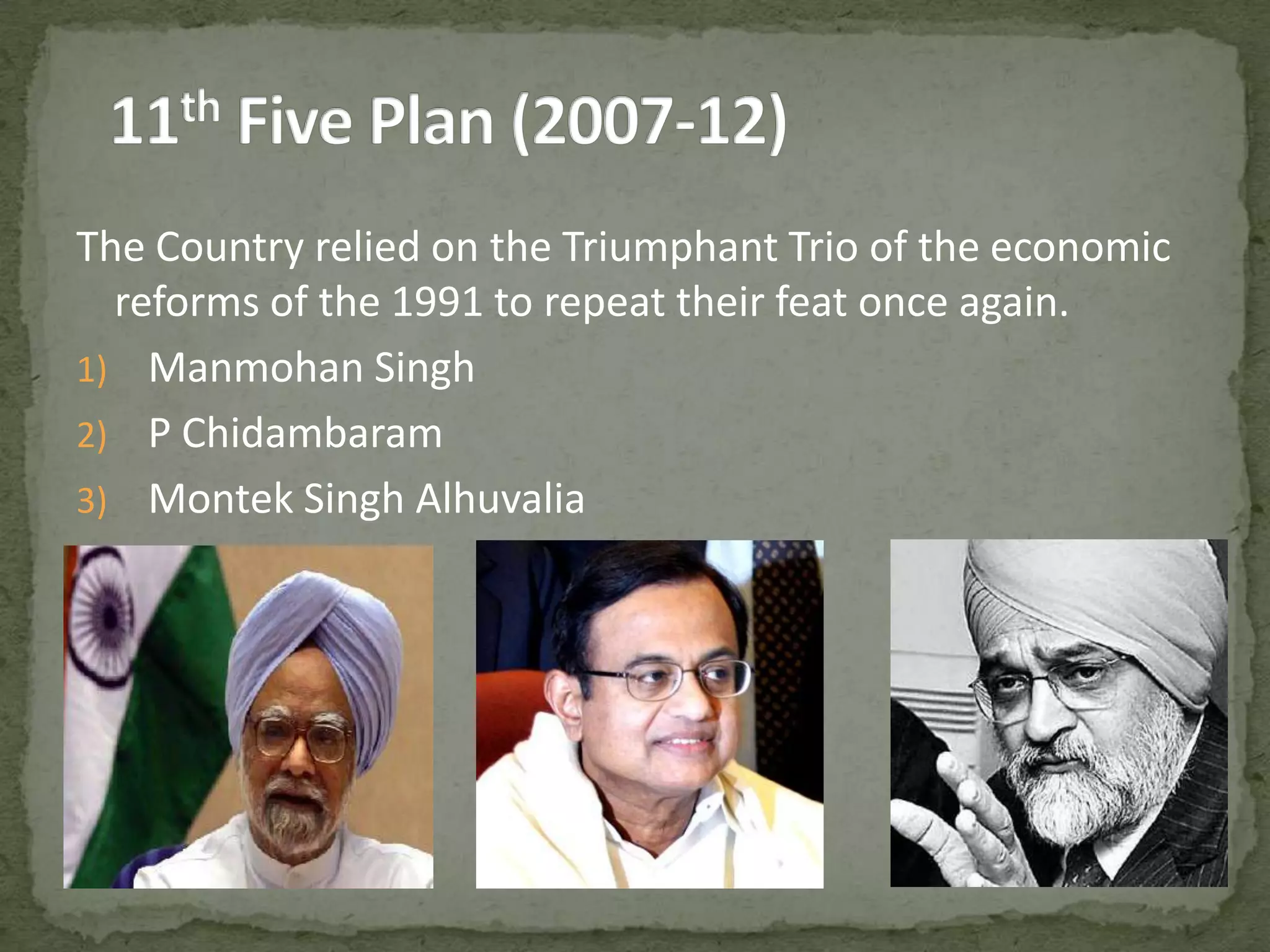
Monetary policy considerations demand absorption of surplus liquidity, debt management consideration warrant supportive liquidity conditions.11th Five Plan (2007-12)The Country relied on the Triumphant Trio of the economic reforms of the 1991 to repeat their feat once again.Manmohan SinghP ChidambaramMontek Singh Alhuvalia
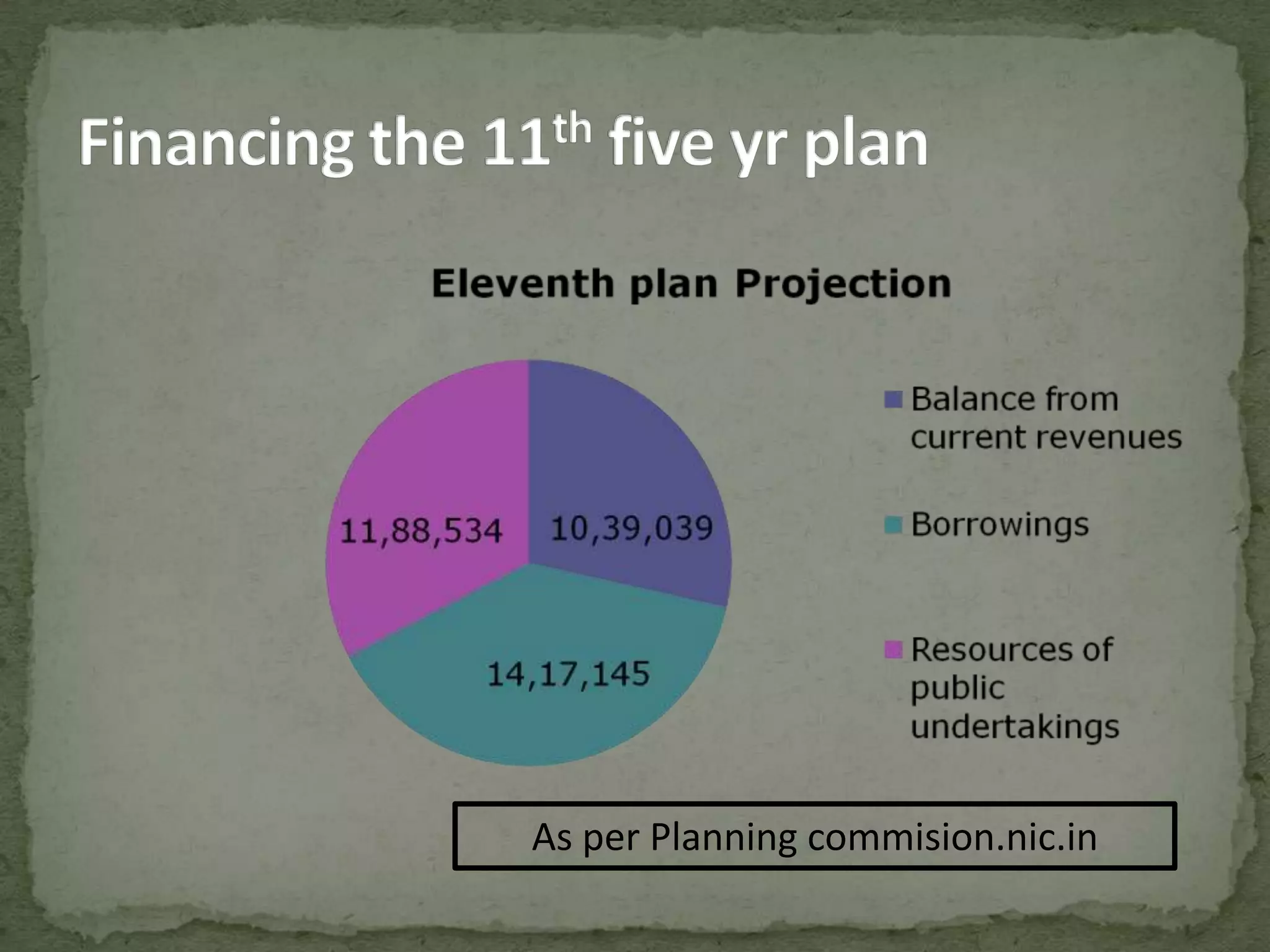
Financing the 11th five yr planAs per Planning commision.nic.in
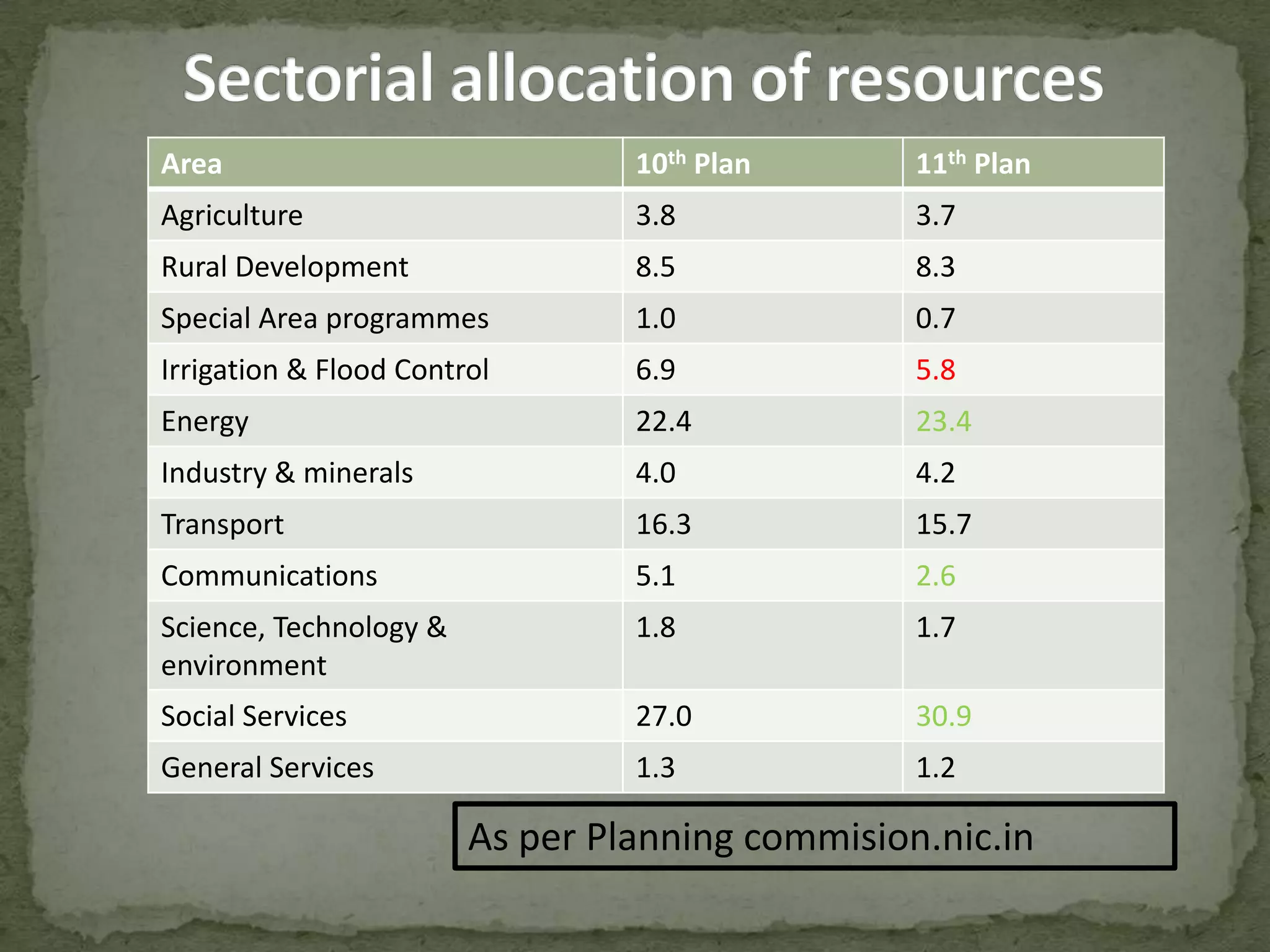
Sectorial allocation of resourcesAs per Planning commision.nic.in
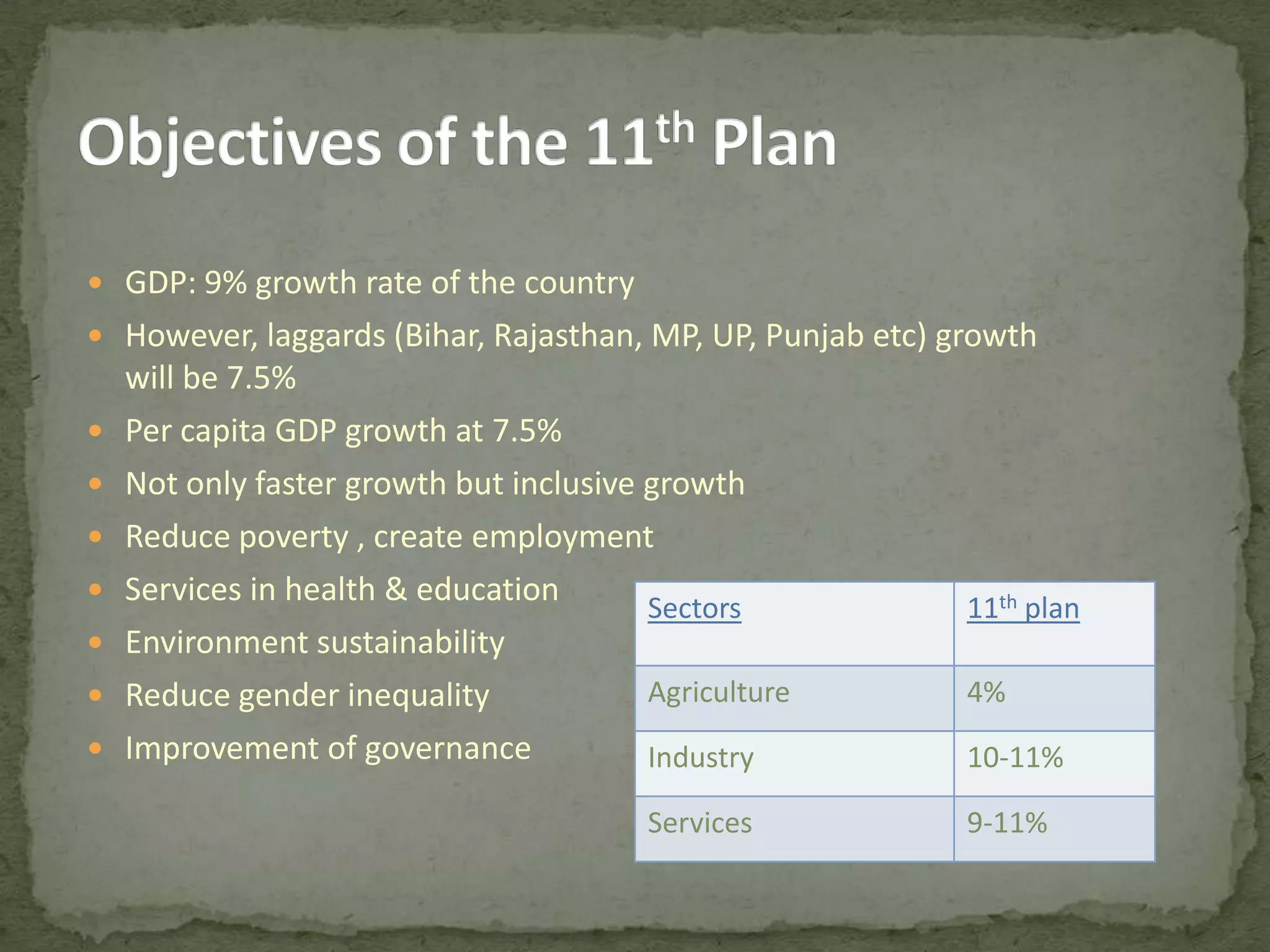
Objectives of the 11th PlanGDP: 9% growth rate of the countryHowever, laggards (Bihar, Rajasthan, MP, UP, Punjab etc) growth will be 7.5%Per capita GDP growth at 7.5%Not only faster growth but inclusive growthReduce poverty , create employmentServices in health & educationEnvironment sustainabilityReduce gender inequalityImprovement of governance
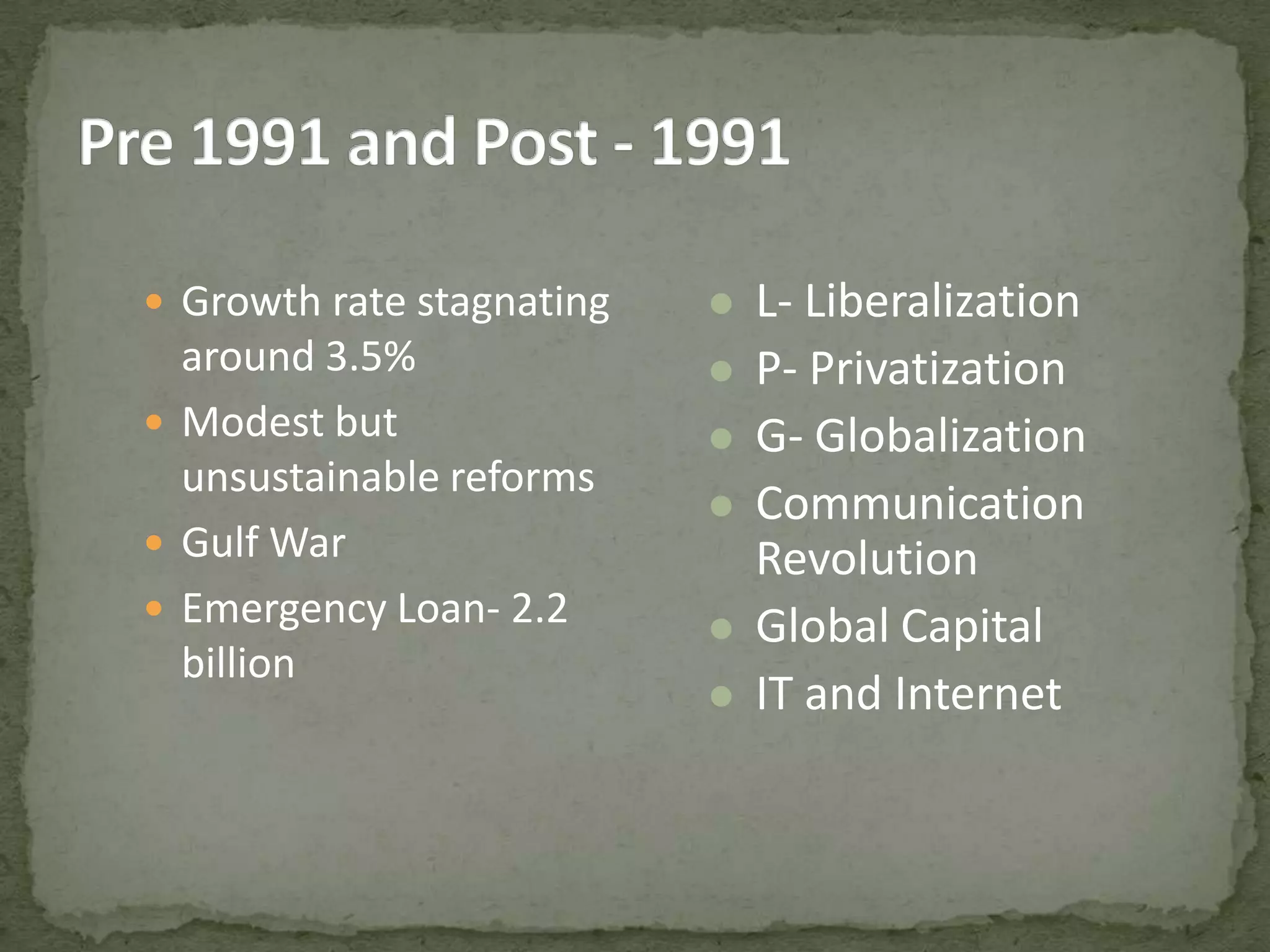
Pre 1991 and Post - 1991Growth rate stagnating around 3.5%Modest but unsustainable reforms Gulf WarEmergency Loan- 2.2 billion L- Liberalization
P- Privatization
G- Globalization
Communication Revolution
Global Capital
IT and Internet

Monetary policy of india

  • 1.
  • 2.
  • 4.
    Any decision tochange the level, composition or timing of govt. expenditure or to vary the burden, the structure or frequency of the tax payment is fiscal policy. -G.K. ShawThe Goal: Reduces the rate of inflation and stimulates economic growth in a period of recession.What is Fiscal Policy?
  • 5.
    Monetary policy refersto the use of instruments under the control of the RBI to regulate the availability, cost and use of money and credit.The goal: achieving specific economic objectives, such as low and stable inflation and promoting growth.What is Monetary Policy?
  • 6.
    Different interest ratesprevalent in IndiaBank rate- The rate at which RBI lends money to domestic banking system.Call Money rate- The rate at which commercial bank borrows money from other commercial banks for a short period.Prime Lending rate- The rate at which the commercial banks can provide credit to industries or business.
  • 7.
    Repo and ReverseRepo rate- The interest rate at which RBI provides loan to commercial banks is called Repo rate. The rate at which RBI takes short term credit is Reverse Repo rate.Deposit rate- The rate of interest at which the customers are paid interest on their bank deposits.Bond rate- To meet expenses for the development, Government issues the Bond maturing in definite period at a definite rate.
  • 8.
    CRR- Banks inIndia are required to hold a certain proportion of their deposits in the form of  cash with Reserve Bank of India. This minimum ratio is known as the CRR or  Cash Reserve Ratio.SLR- The minimum percentage of deposits that the bank has to maintain in form of gold, cash or other approved securities is known as Statutory Liquidity Ratio.
  • 9.
    The Reserve Bankof India (RBI) is the central banking system of India and controls the monetary policy of the rupee. The institution was established on 1 April 1935 and plays an important part in the development strategy of the government.
  • 10.
    Role of RBIIndia’s monetary authoritySupervisor of financial systemIssuer of currencyManager of foreign exchange reservesBanker and debt manager to GovernmentBanker to BanksDevelopmental functionsResearch, data and knowledge sharing since 75 years:
  • 11.
    Making of monetarypolicyMonetary policy is communicated to the public mostly by annual monetary policy statement in April and the mid-term review in October. The statements today are more analytical, introspective and elaborate. RBI website is an effective medium of communication.Governor, Deputy Governors, Committee of the Board meet every week to review the monetary, economic and financial conditions. Mechanisms such as resource management of banks, supervisory data, market information, economic and statistical analysis, etc. are usedPeriodic consultations with Ministry of Finance for significant technical, analytical, institutional and dynamic inputs.
  • 12.
    Evidence of growthReiningin Inflation and Containment of Inflation ExpectationsAssurance of financial stability.Effect of Monetary policy on Indian Economy
  • 13.
    Monetary policy cannotchange long-term growth.There is no long term tradeoff between growth and inflation.Monetary policy can deliver low and stable inflation, and thereby reduce the volatility of the business cycle.It cannot really predict when inflationary pressures builds up.Limitations of Monetary Policy
  • 14.
    It isdivided into four SectionsThe State of the EconomyOutlook and ProjectionsThe Risk FactorsThe Policy StanceMonetary Policy 2010-11
  • 15.
    The State ofthe EconomyRBI had projected the real GDP growth for 2009-10 at 7.5%.Central Statistical Organization in early Feb 2010 placed the real GDP growth during 2009-10 at 7.2%The headline inflation in Wholesale Price Index (WPI), accelerated from 0.5% in Sep 2009 to 9.9% in March 2010, exceeding the RBI’s baseline projection of 8.5%
  • 16.
     Scheduled commercial banks(SCBs) raised their deposit rates by 25-50 basis points between Feb and April 2010, signaling a reversal in the trend of deposit rates reduction.
  • 17.
    The Union Budgetfor 2010-11 begun the process of fiscal consolidation by budgeting lower fiscal deficit (5.5% of GDP in 2010-11 compared to 6.7% in 2009-10) and revenue deficit (4% of GDP in 2010-11 as compared to 5.3% in 2009-10).Outlook and ProjectionsThe Indian economy is firmly on the recovery path.
  • 18.
    Exports have beenexpanding since October 2009, a trend that is expected to continue.
  • 19.
    The improved performanceof the industrial sector is reflected in profitability of the corporate sector.
  • 20.
    Sustenance of goodperformance of industrial and service sectors accompanied by rising demand, both domestic and external.Risk FactorsUncertainty persists about the pace and shape of global recovery.
  • 21.
    Private demand inadvanced economies continues to be weak due to high unemployment rates, weak income growth and tight credit conditions. 
  • 22.
    Once the impactof public spending wanes, the recovery process can be stalled.
  • 23.
    If global recoverygains momentum, commodity and energy prices, which have been on the rise, may harden further. The Policy StanceGrowth in 2010-11 is projected to be higher and more broad-based than in 2009-10.
  • 24.
    Notwithstanding lower budgetedgovernment borrowings in 2010-11 than in the year before.
  • 25.
    Fresh issuance ofsecurities will be 36.3% higher than last year. This presents a dilemma for the RBI.
  • 26.
    Monetary policy considerationsdemand absorption of surplus liquidity, debt management consideration warrant supportive liquidity conditions.11th Five Plan (2007-12)The Country relied on the Triumphant Trio of the economic reforms of the 1991 to repeat their feat once again.Manmohan SinghP ChidambaramMontek Singh Alhuvalia
  • 27.
    Financing the 11thfive yr planAs per Planning commision.nic.in
  • 28.
    Sectorial allocation ofresourcesAs per Planning commision.nic.in
  • 29.
    Objectives of the11th PlanGDP: 9% growth rate of the countryHowever, laggards (Bihar, Rajasthan, MP, UP, Punjab etc) growth will be 7.5%Per capita GDP growth at 7.5%Not only faster growth but inclusive growthReduce poverty , create employmentServices in health & educationEnvironment sustainabilityReduce gender inequalityImprovement of governance
  • 30.
    Pre 1991 andPost - 1991Growth rate stagnating around 3.5%Modest but unsustainable reforms Gulf WarEmergency Loan- 2.2 billion L- Liberalization
  • 31.
  • 32.
  • 33.
  • 34.
  • 35.
  • 46.
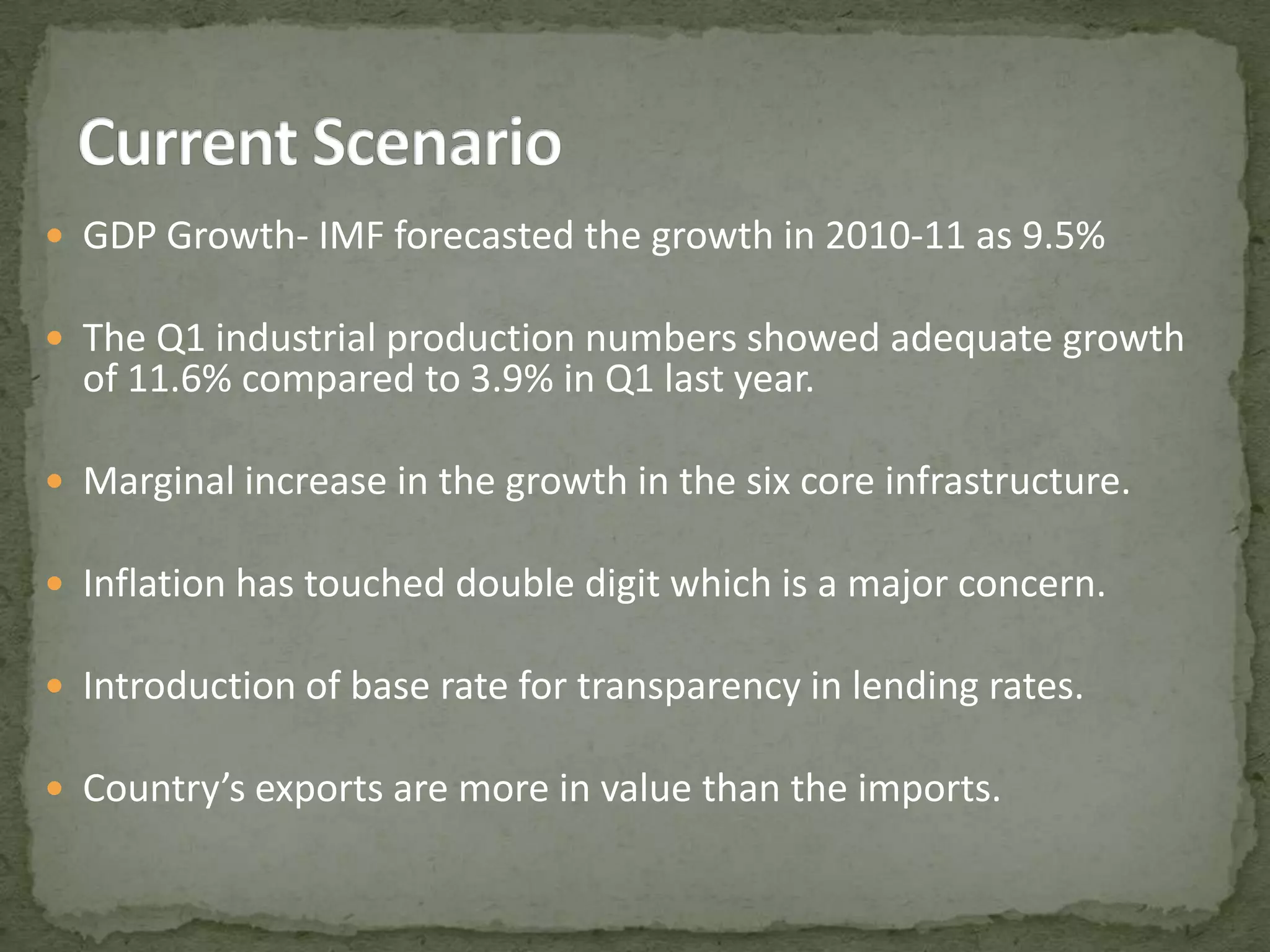
    GDP Growth- IMFforecasted the growth in 2010-11 as 9.5%The Q1 industrial production numbers showed adequate growth of 11.6% compared to 3.9% in Q1 last year.Marginal increase in the growth in the six core infrastructure.Inflation has touched double digit which is a major concern.Introduction of base rate for transparency in lending rates.Country’s exports are more in value than the imports.Current Scenario
  • 47.
    To conclude, monetarypolicy is helpful in attaining growth with stability. However, there are challenges in maintaining the momentum. We need to make the growth meaningful to the millionsof poor and unemployed.Six most important challenges are agricultural growth, infrastructure development, fiscal consolidation, social infrastructure particularly primary education and basic health, managing globalisation and good governance.Concluding Observations
  • 48.
    The conduct ofmonetary policy will continue to provide support to these areas.Stability, especially price and financial stability; will undoubtedly facilitate accelerated growth.
  • 49.
    India, today, standsat a new threshold, with greater triumphs and achievements in sight.Never before in recorded history have so many people been in a position to rise and that so quickly. Jai Hind!
  • 50.
    Rbi.orgIndiamicrofinance.comCluteinstitute-onlinejournals.comBook: India monetarypolicy by C. RangarajanWe are extremely thankful to Rajlaxmi Madam for her guidance.Bibliography