The Derivative 2.7 as a Function
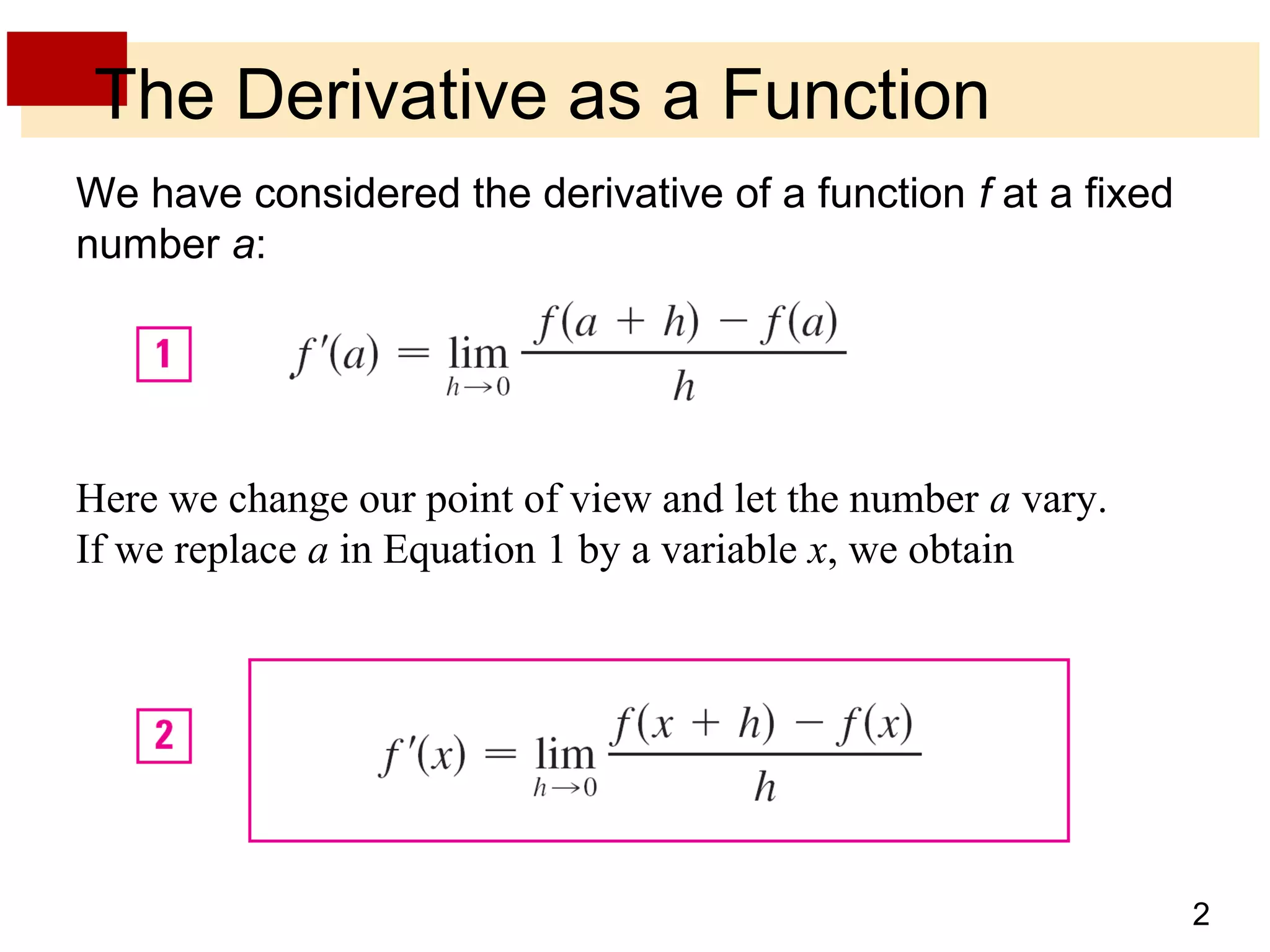
2 The Derivative as a Function We have considered the derivative of a function f at a fixed number a: Here we change our point of view and let the number a vary. If we replace a in Equation 1 by a variable x, we obtain
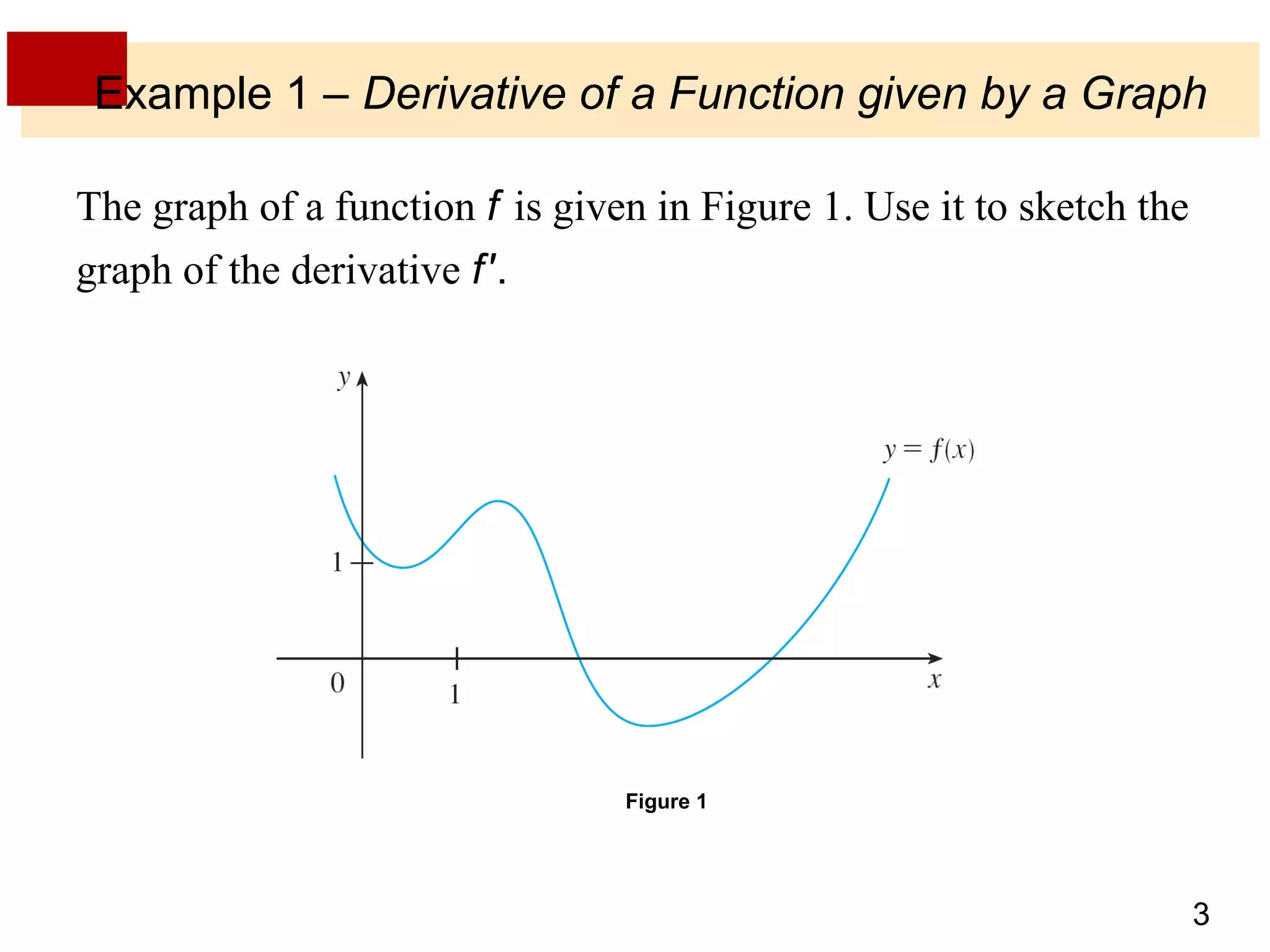
Example 1 – Derivative of a Function given by a Graph The graph of a function f is given in Figure 1. Use it to sketch the graph of the derivative f ′. 3 Figure 1
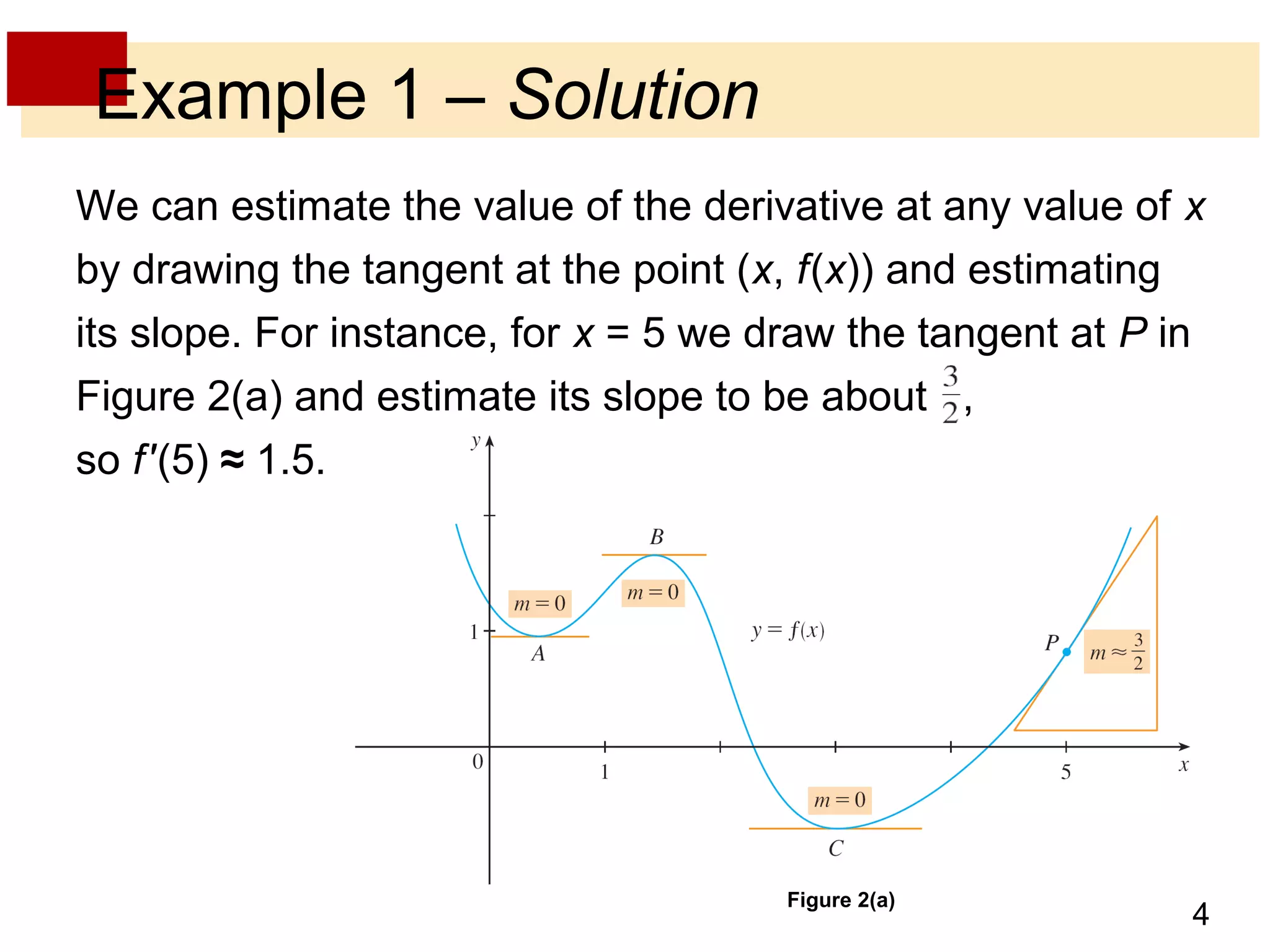
Example 1 – Solution We can estimate the value of the derivative at any value of x by drawing the tangent at the point (x, f (x)) and estimating its slope. For instance, for x = 5 we draw the tangent at P in Figure 2(a) and estimate its slope to be about , so f ′(5) ≈ 1.5. 4 Figure 2(a)
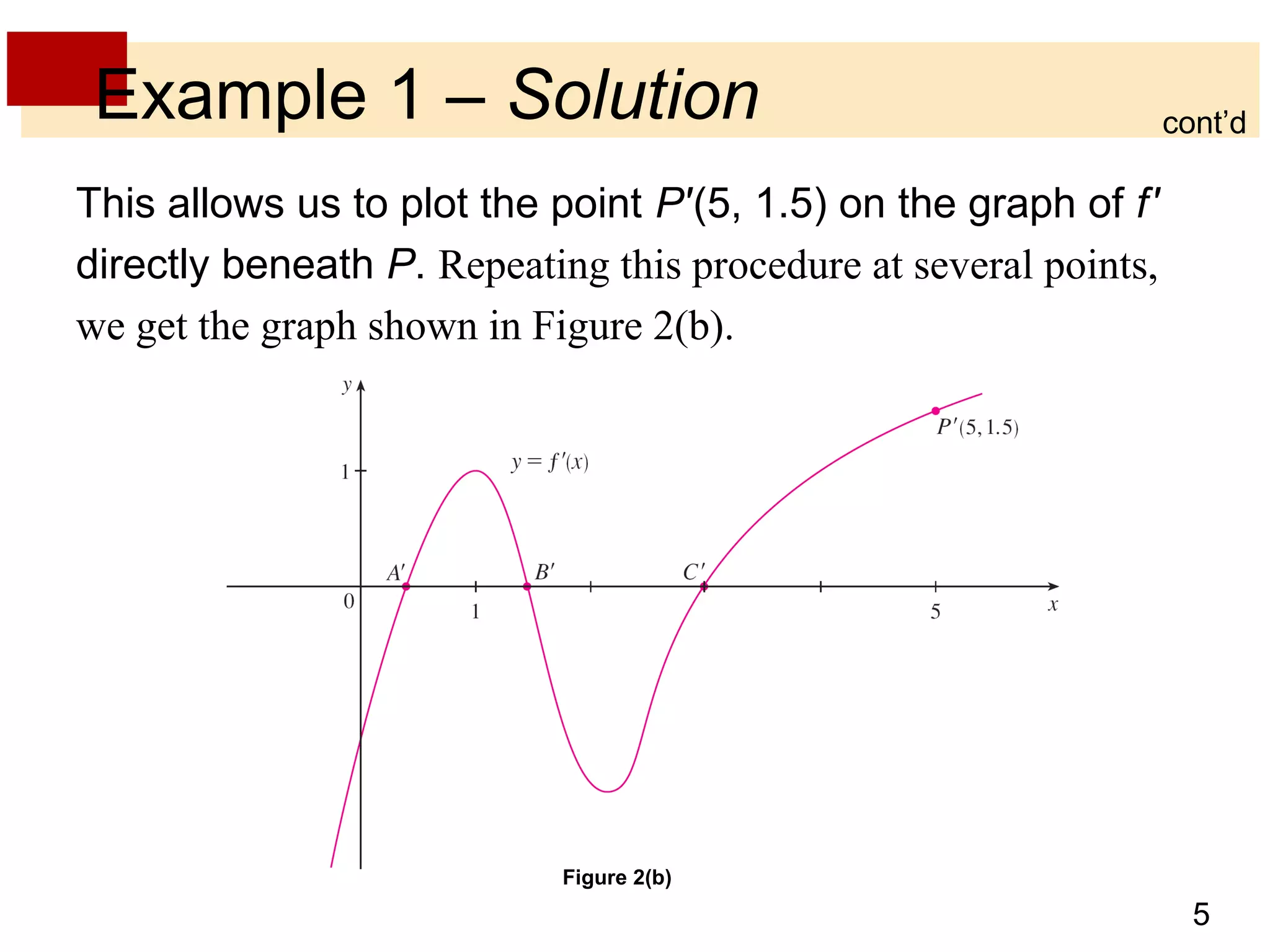
5 Example 1 – Solution This allows us to plot the point P ′(5, 1.5) on the graph of f ′ directly beneath P. Repeating this procedure at several points, we get the graph shown in Figure 2(b). Figure 2(b) cont’d
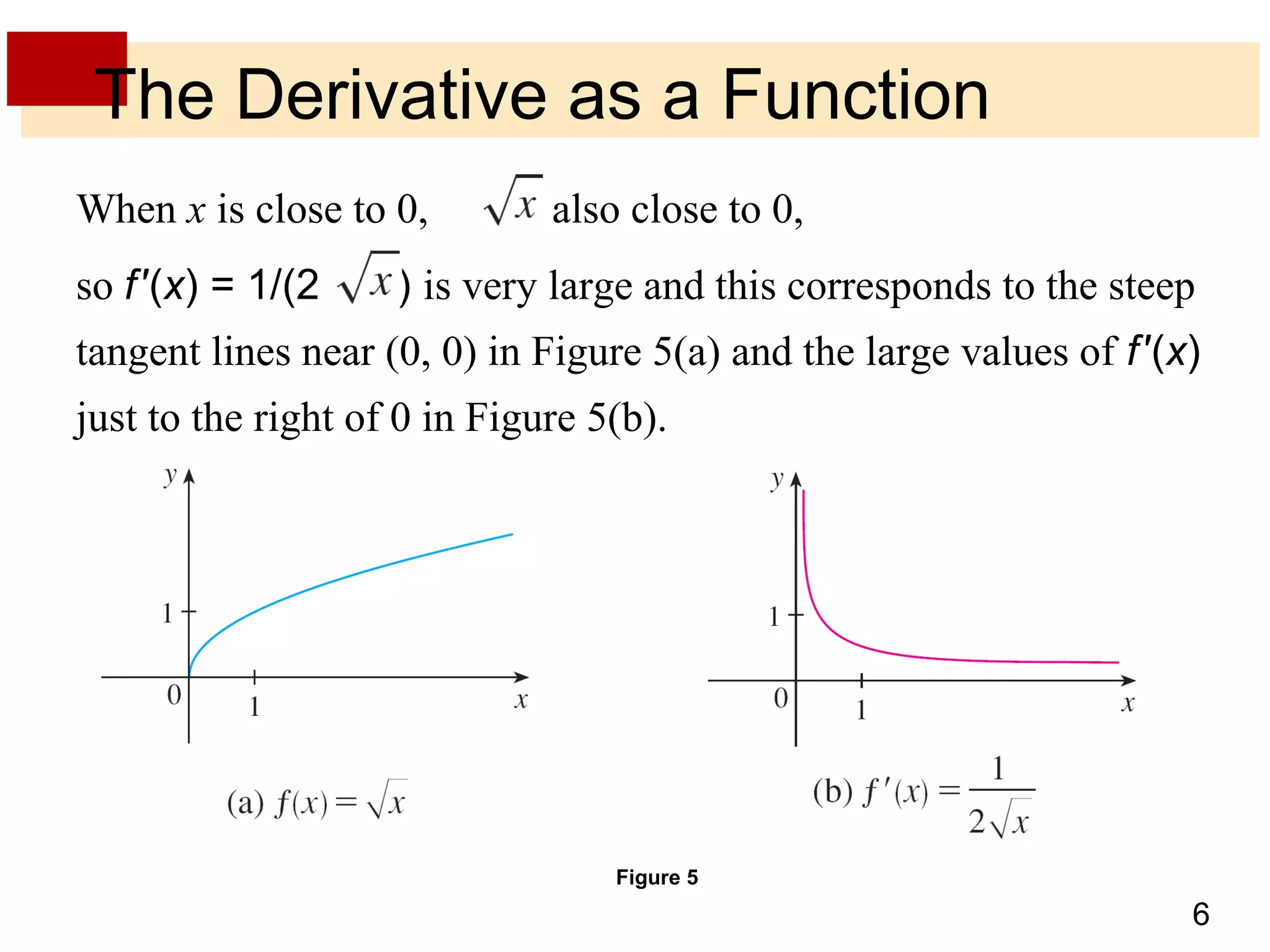
The Derivative as a Function When x is close to 0, is also close to 0, so f ′(x) = 1/(2 ) is very large and this corresponds to the steep tangent lines near (0, 0) in Figure 5(a) and the large values of f ′(x) just to the right of 0 in Figure 5(b). 6 Figure 5
7 The Derivative as a Function When x is large, f ′(x) is very small and this corresponds to the flatter tangent lines at the far right of the graph of f and the horizontal asymptote of the graph of f ′.
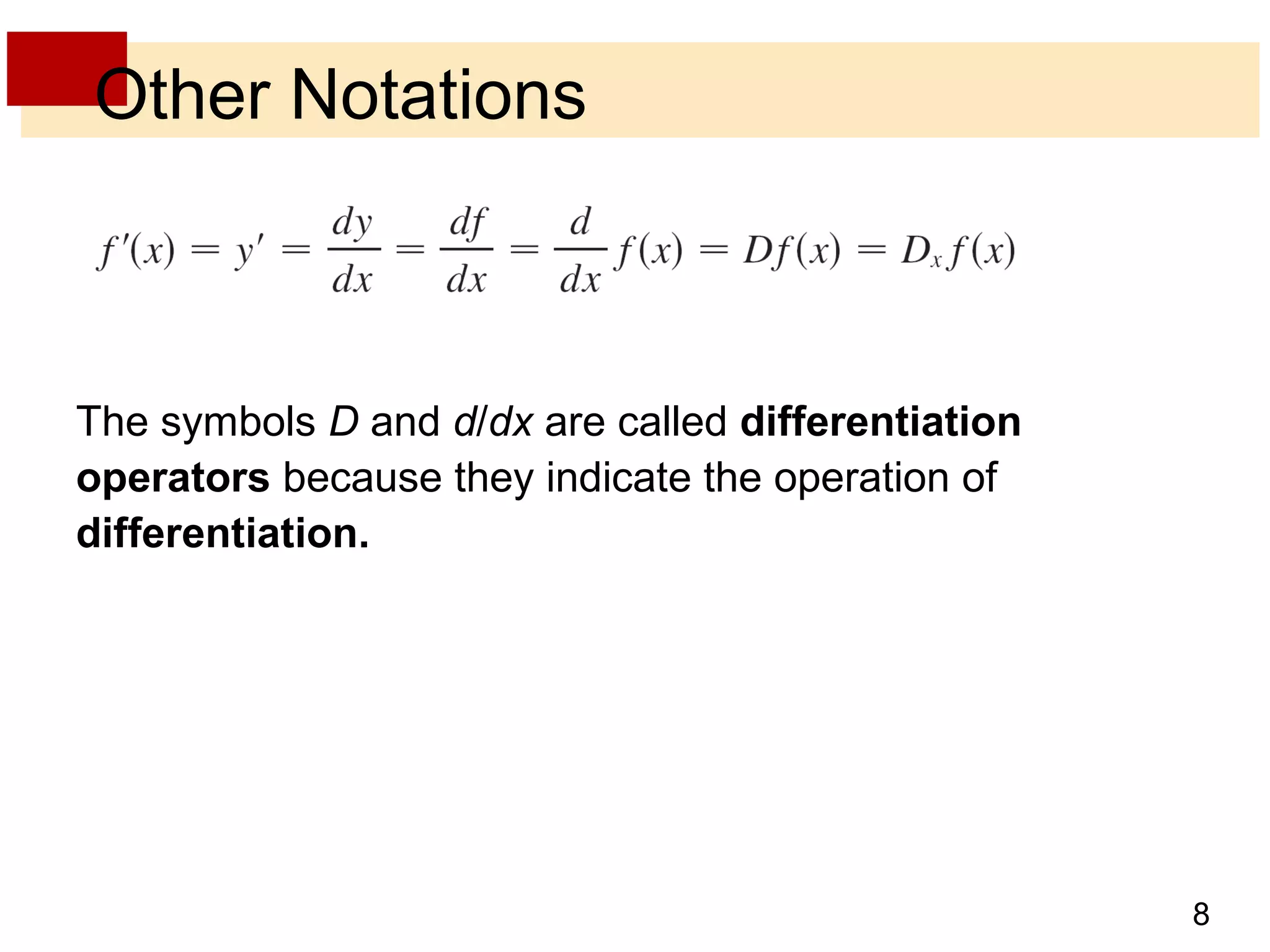
8 Other Notations The symbols D and d/dx are called differentiation operators because they indicate the operation of differentiation.
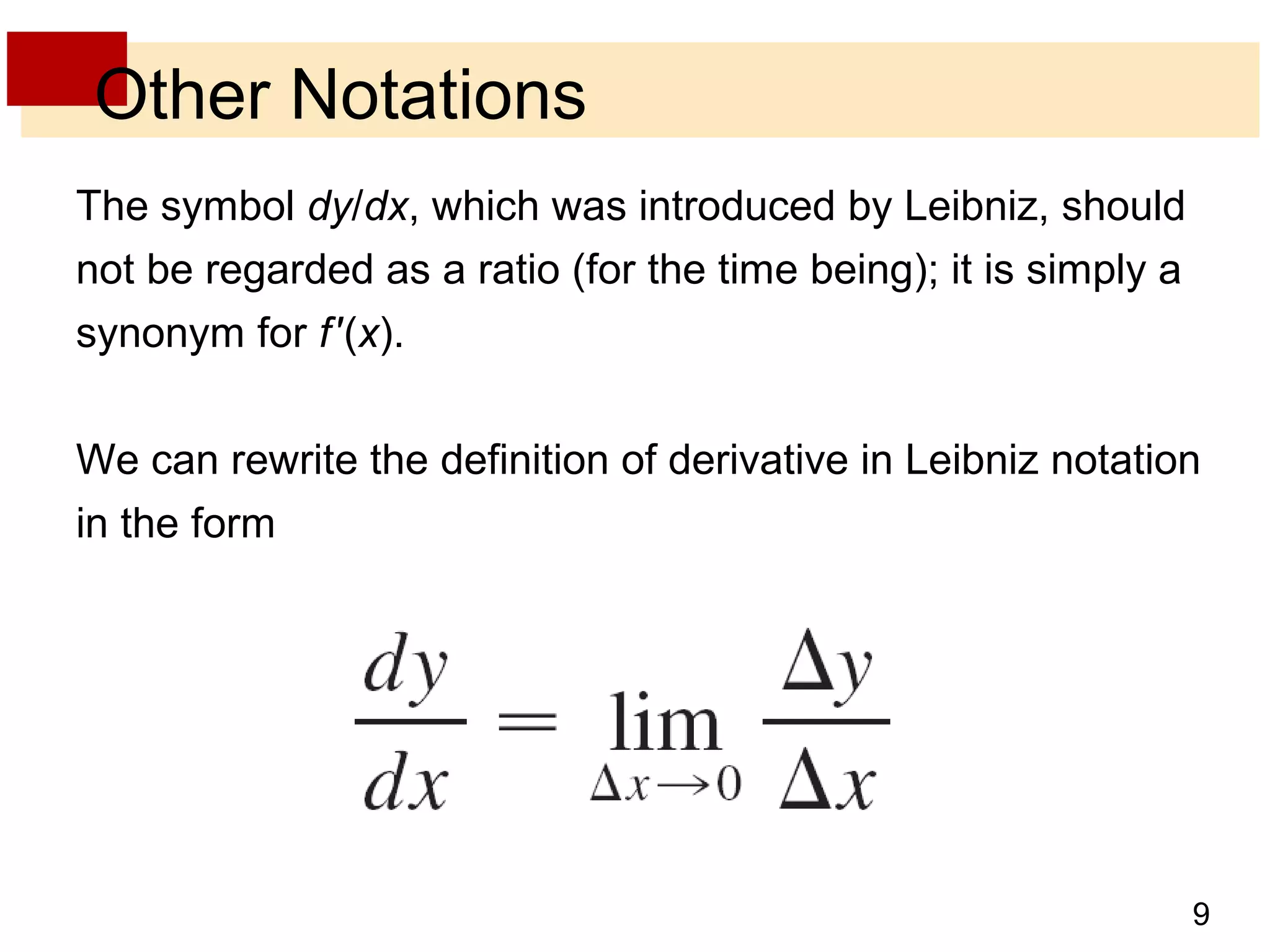
9 Other Notations The symbol dy/dx, which was introduced by Leibniz, should not be regarded as a ratio (for the time being); it is simply a synonym for f ′(x). We can rewrite the definition of derivative in Leibniz notation in the form
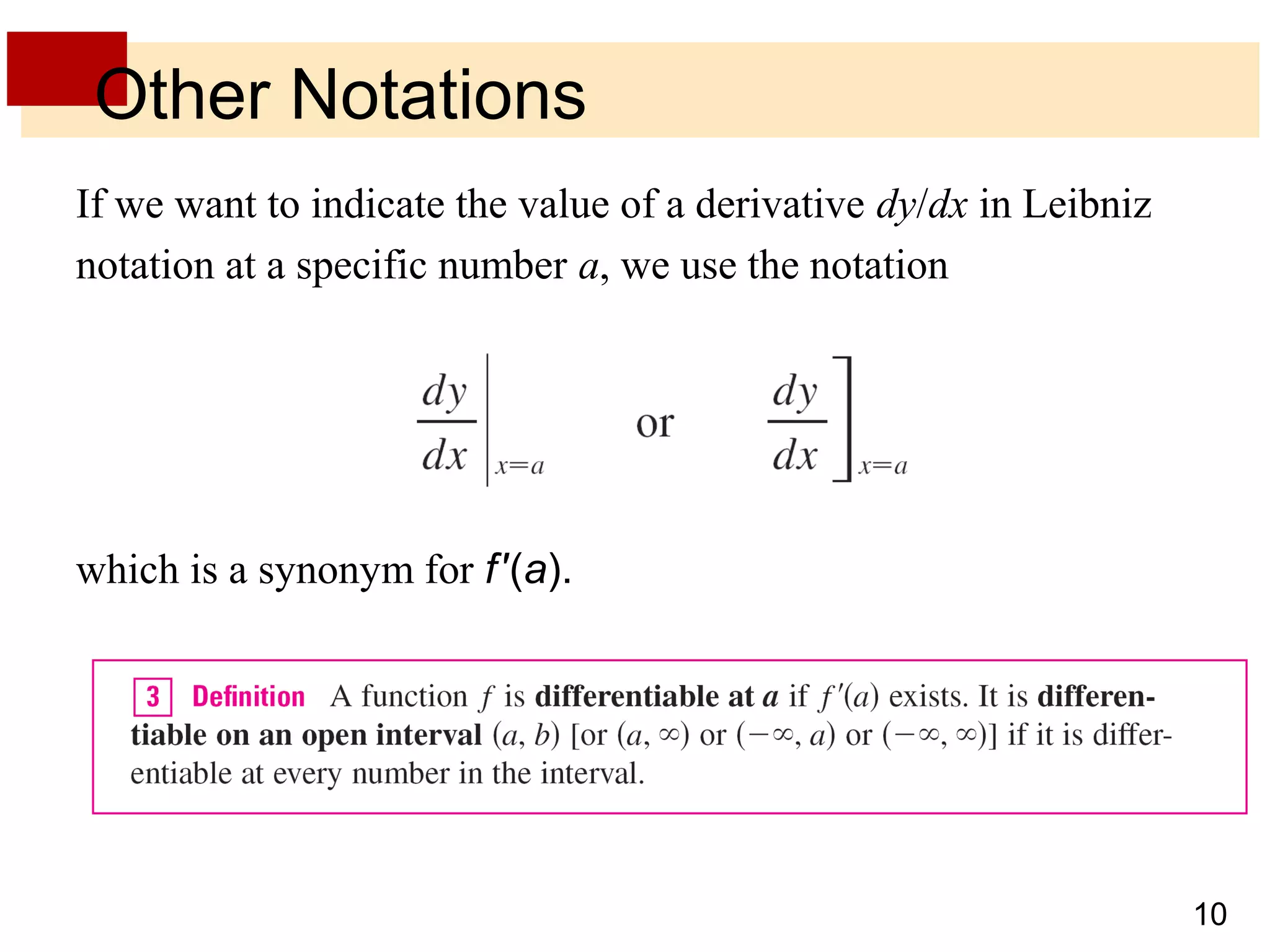
10 Other Notations If we want to indicate the value of a derivative dy/dx in Leibniz notation at a specific number a, we use the notation which is a synonym for f ′(a).

Lecture 7(b) derivative as a function

  • 1.
    The Derivative 2.7as a Function
  • 2.
    2 The Derivativeas a Function We have considered the derivative of a function f at a fixed number a: Here we change our point of view and let the number a vary. If we replace a in Equation 1 by a variable x, we obtain
  • 3.
    Example 1 –Derivative of a Function given by a Graph The graph of a function f is given in Figure 1. Use it to sketch the graph of the derivative f ′. 3 Figure 1
  • 4.
    Example 1 –Solution We can estimate the value of the derivative at any value of x by drawing the tangent at the point (x, f (x)) and estimating its slope. For instance, for x = 5 we draw the tangent at P in Figure 2(a) and estimate its slope to be about , so f ′(5) ≈ 1.5. 4 Figure 2(a)
  • 5.
    5 Example 1– Solution This allows us to plot the point P ′(5, 1.5) on the graph of f ′ directly beneath P. Repeating this procedure at several points, we get the graph shown in Figure 2(b). Figure 2(b) cont’d
  • 6.
    The Derivative asa Function When x is close to 0, is also close to 0, so f ′(x) = 1/(2 ) is very large and this corresponds to the steep tangent lines near (0, 0) in Figure 5(a) and the large values of f ′(x) just to the right of 0 in Figure 5(b). 6 Figure 5
  • 7.
    7 The Derivativeas a Function When x is large, f ′(x) is very small and this corresponds to the flatter tangent lines at the far right of the graph of f and the horizontal asymptote of the graph of f ′.
  • 8.
    8 Other Notations The symbols D and d/dx are called differentiation operators because they indicate the operation of differentiation.
  • 9.
    9 Other Notations The symbol dy/dx, which was introduced by Leibniz, should not be regarded as a ratio (for the time being); it is simply a synonym for f ′(x). We can rewrite the definition of derivative in Leibniz notation in the form
  • 10.
    10 Other Notations If we want to indicate the value of a derivative dy/dx in Leibniz notation at a specific number a, we use the notation which is a synonym for f ′(a).