INTRODUCTION TO OPERATING SYSTEMS
AGENDA • Introduce myself • Operating system questions for interviews • Introduction to operating system with example • Kernel vs Operating System • Examples of operating system and kernel • Introduction to system calls • Introduction to interrupts
Before proceeding further… • Do not forget to subscribe to the channel. • Share this with your friends(Saturday 5PM class IST) • Telegram link: https://t.me/joinchat/OcDlRxsp56Z1yiqQJu9unw • Email doesn’t scale - https://bit.ly/2LVLWWy • Planning to take practical classes related to operating system(linux) • Have doubts? Ask in comments or while I am live • Will try explaining your doubts in next classes
Full classes schedule • Introduction to operating system and what all topics to focus for interviews • Process management (process vs program, process control block, process states, process lifecycle - fork(), exec(), wait(), exit(), zombie and orphan process) • Interprocess communication (Multiprocessing, multithreading and challenges) • Process Scheduling Algorithms • Process synchronization(mutex, semaphore and deadlock) • Memory management part 1(Virtual memory, physical vs logical address space) • Memory management part2(Demand paging, page replacement algorithms) • Miscellaneous(filesystem and other topics which were left)
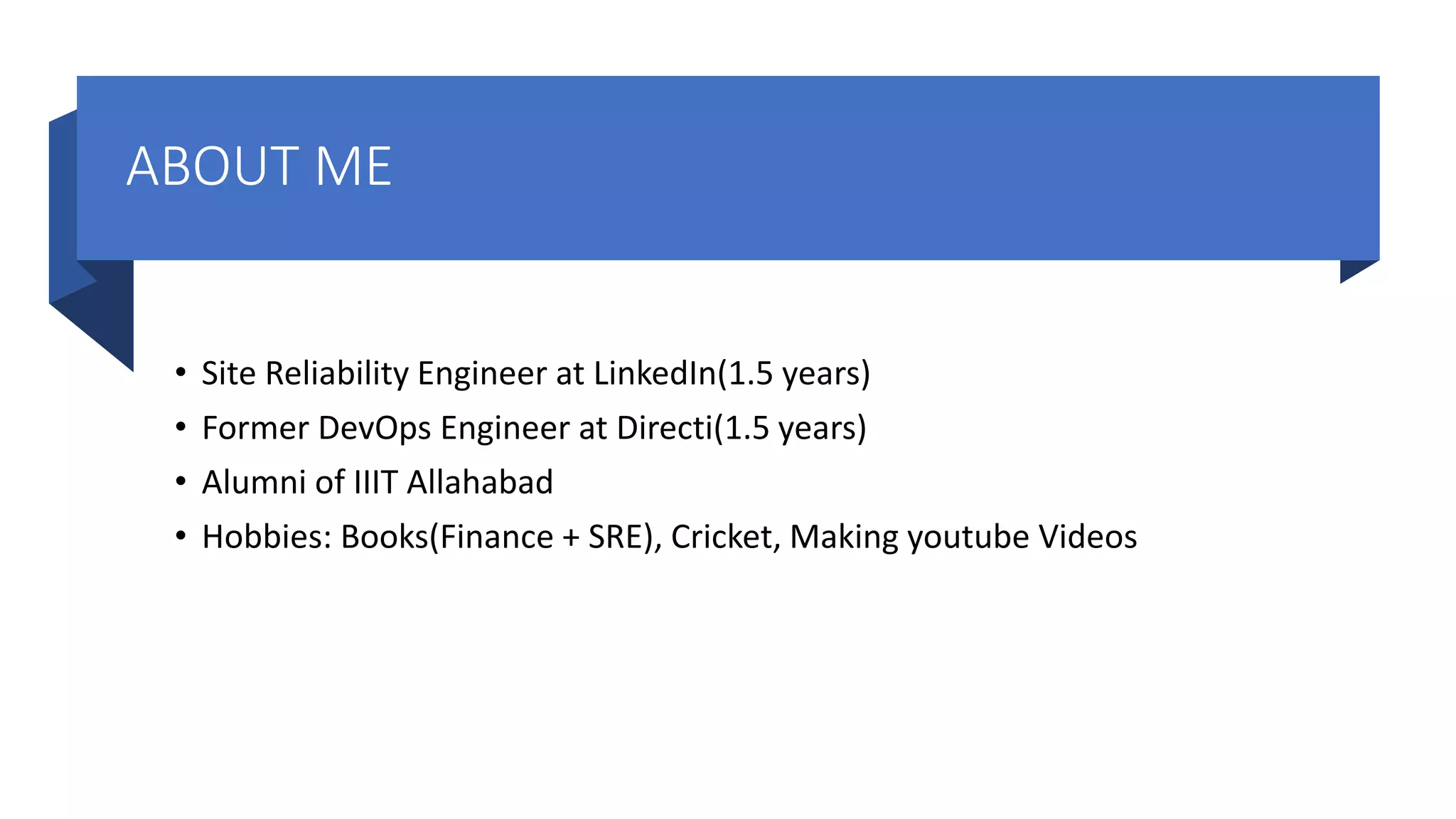
ABOUT ME • Site Reliability Engineer at LinkedIn(1.5 years) • Former DevOps Engineer at Directi(1.5 years) • Alumni of IIIT Allahabad • Hobbies: Books(Finance + SRE), Cricket, Making youtube Videos
OPERATING SYSTEM QUESTIONS ASKED IN INTERVIEWS
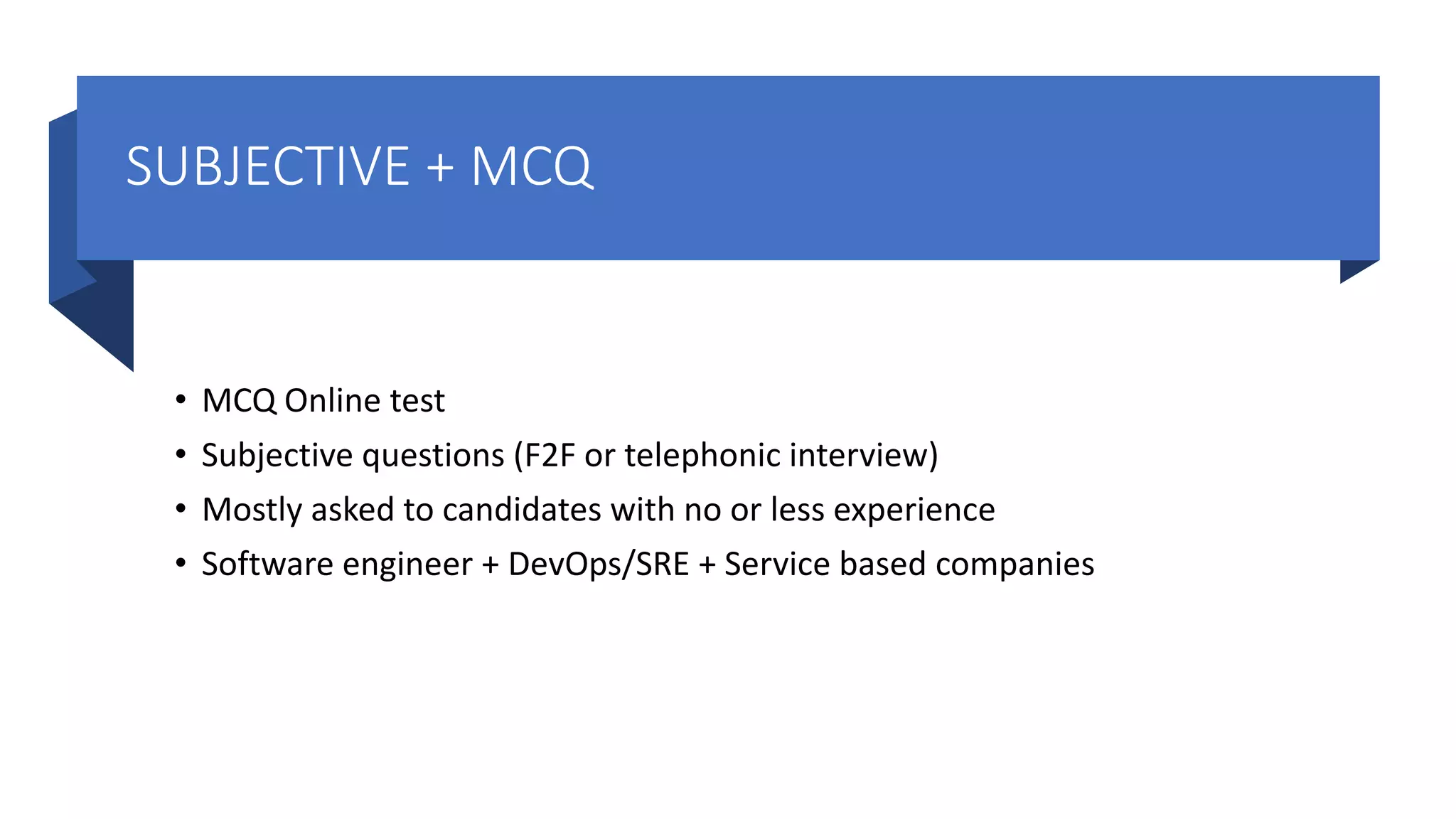
SUBJECTIVE + MCQ • MCQ Online test • Subjective questions (F2F or telephonic interview) • Mostly asked to candidates with no or less experience • Software engineer + DevOps/SRE + Service based companies
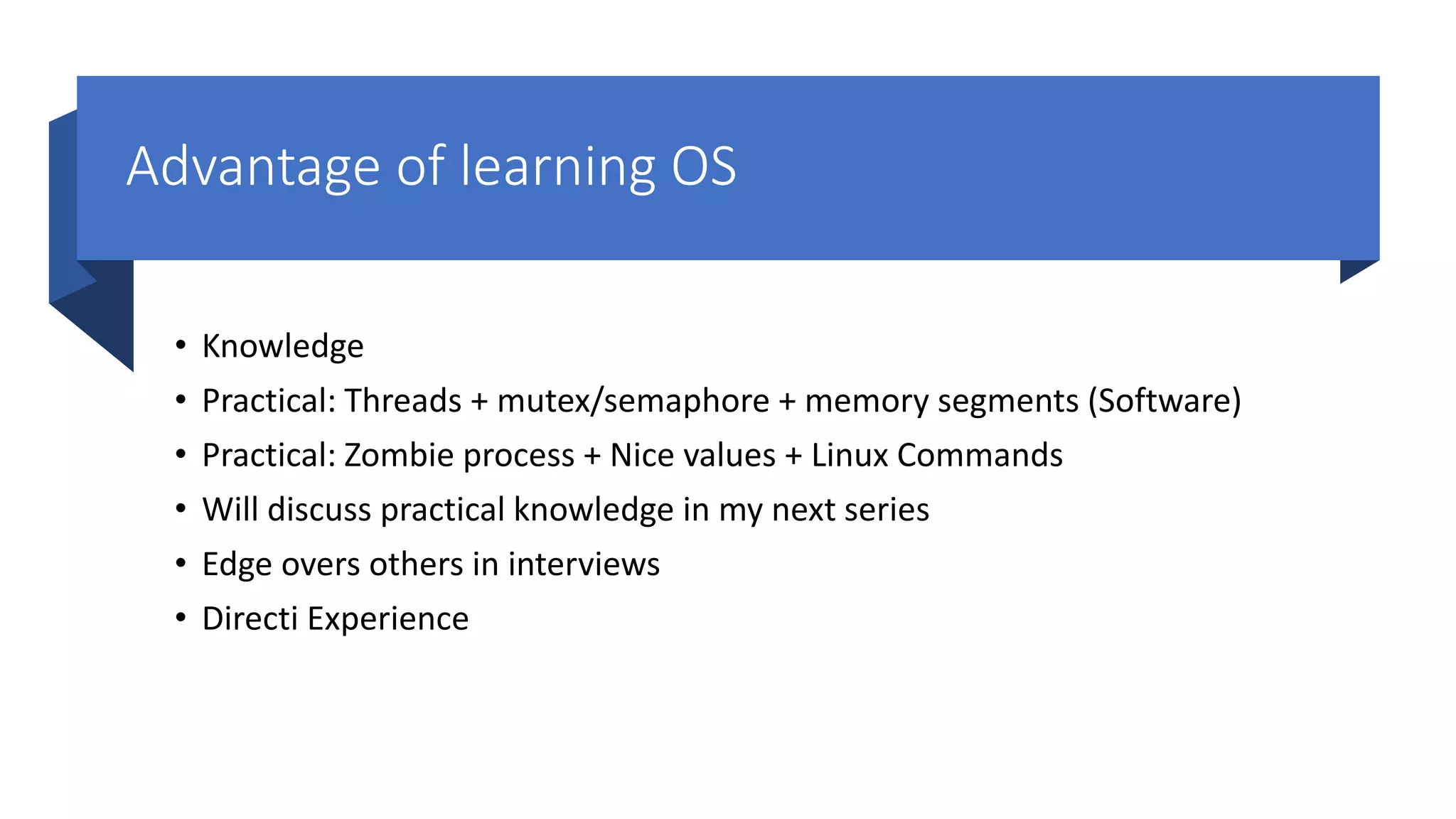
Advantage of learning OS • Knowledge • Practical: Threads + mutex/semaphore + memory segments (Software) • Practical: Zombie process + Nice values + Linux Commands • Will discuss practical knowledge in my next series • Edge overs others in interviews • Directi Experience
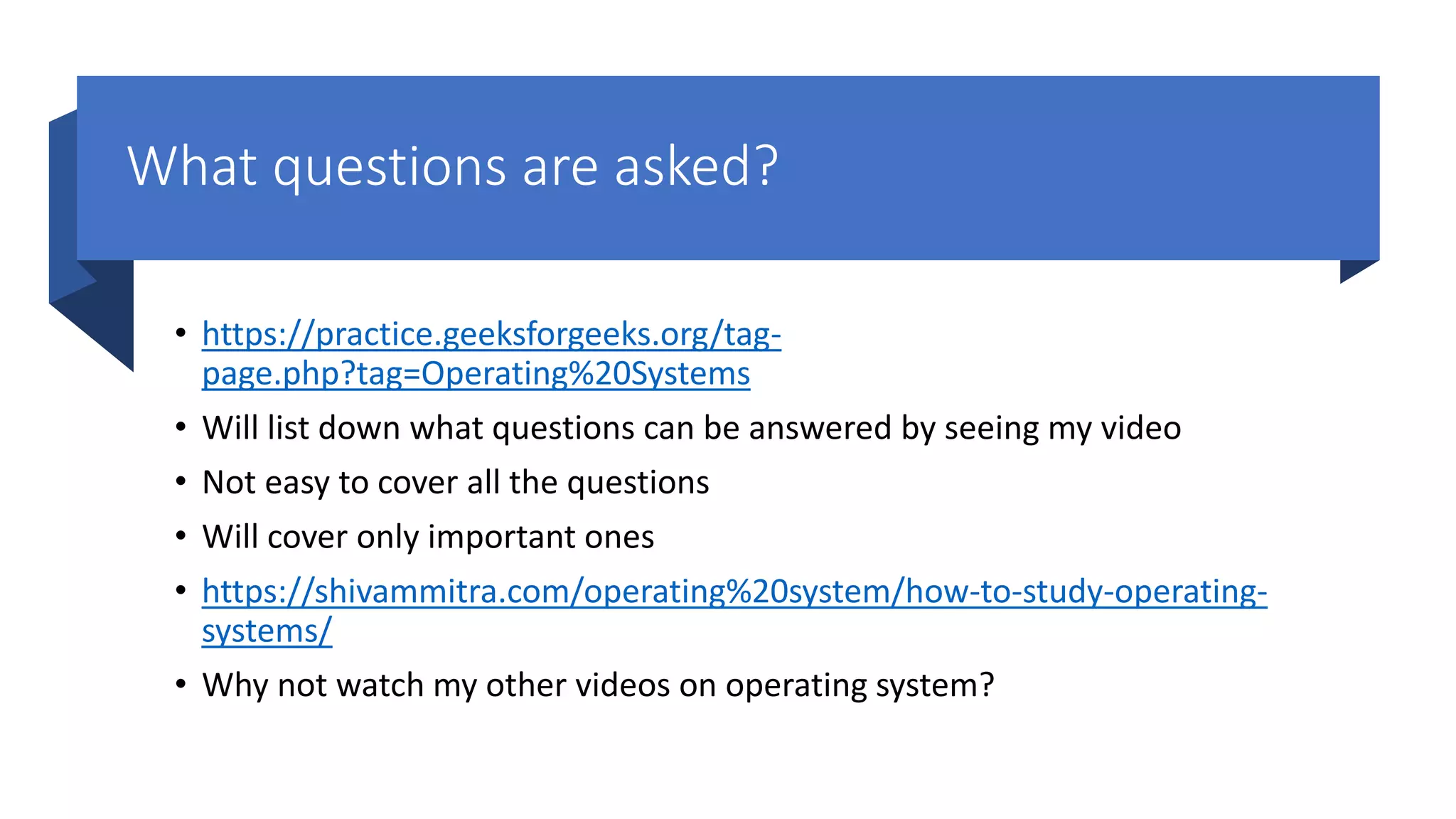
What questions are asked? • https://practice.geeksforgeeks.org/tag- page.php?tag=Operating%20Systems • Will list down what questions can be answered by seeing my video • Not easy to cover all the questions • Will cover only important ones • https://shivammitra.com/operating%20system/how-to-study-operating- systems/ • Why not watch my other videos on operating system?
QUESTIONS WHICH YOU WILL BE ABLE TO ANSWER AFTER THIS VIDEO? • What is operating system? • Explain the architecture of operating system. • Difference between operating system and kernel • What are the functions of operating system • Give some examples of popular operating system and kernel • What are system call with examples • What are interrupts with examples
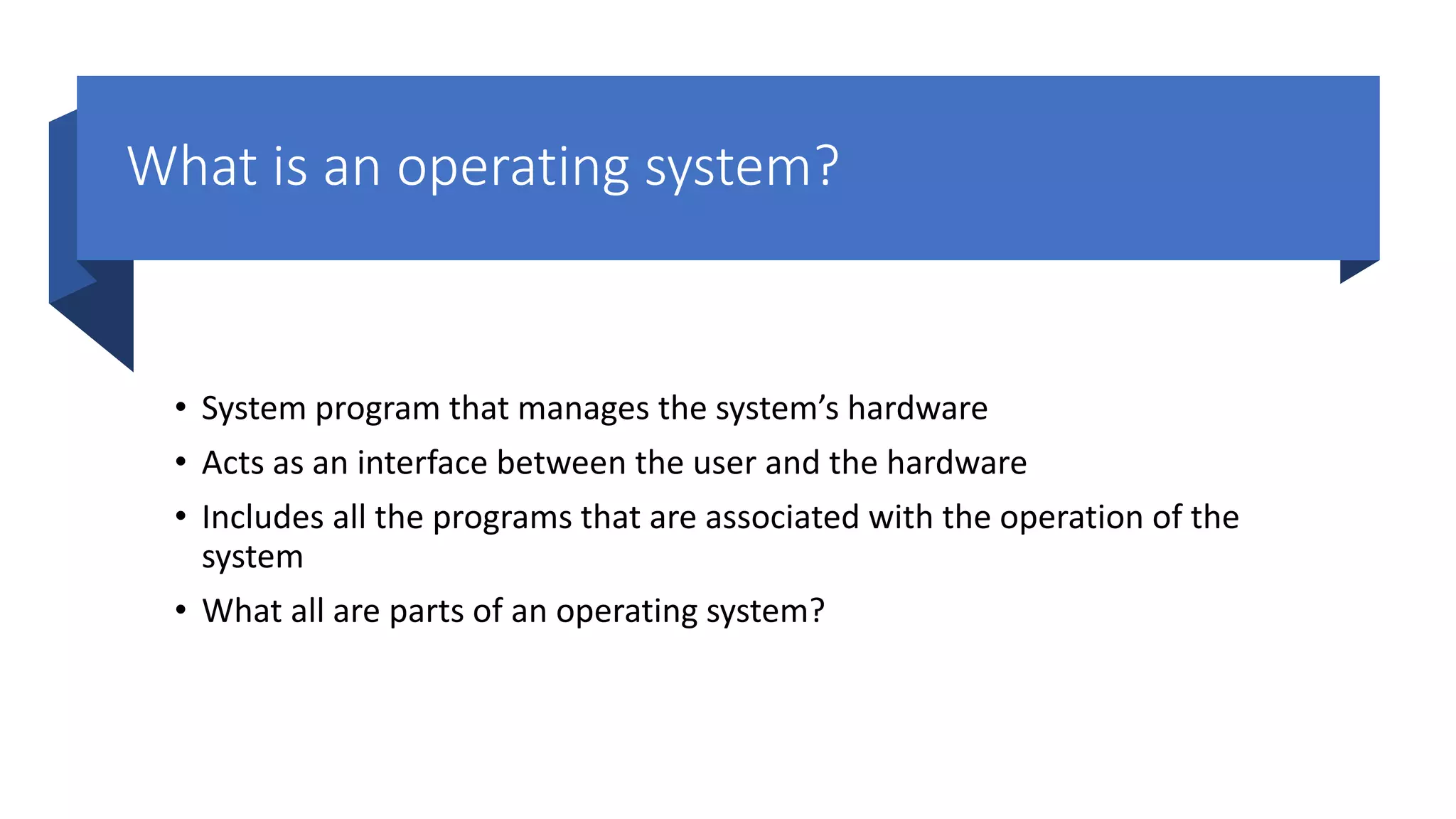
What is an operating system? • System program that manages the system’s hardware • Acts as an interface between the user and the hardware • Includes all the programs that are associated with the operation of the system • What all are parts of an operating system?
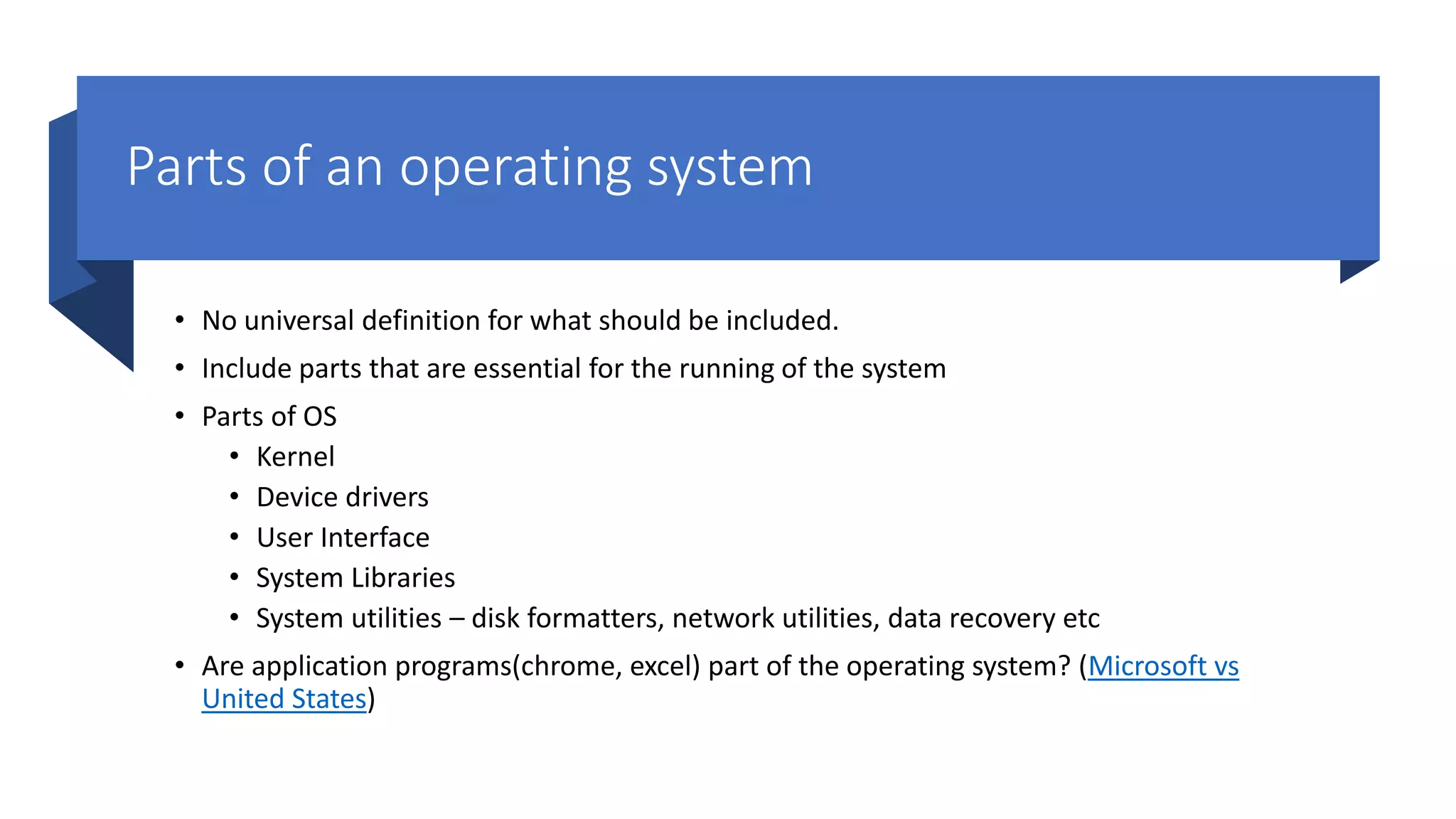
Parts of an operating system • No universal definition for what should be included. • Include parts that are essential for the running of the system • Parts of OS • Kernel • Device drivers • User Interface • System Libraries • System utilities – disk formatters, network utilities, data recovery etc • Are application programs(chrome, excel) part of the operating system? (Microsoft vs United States)
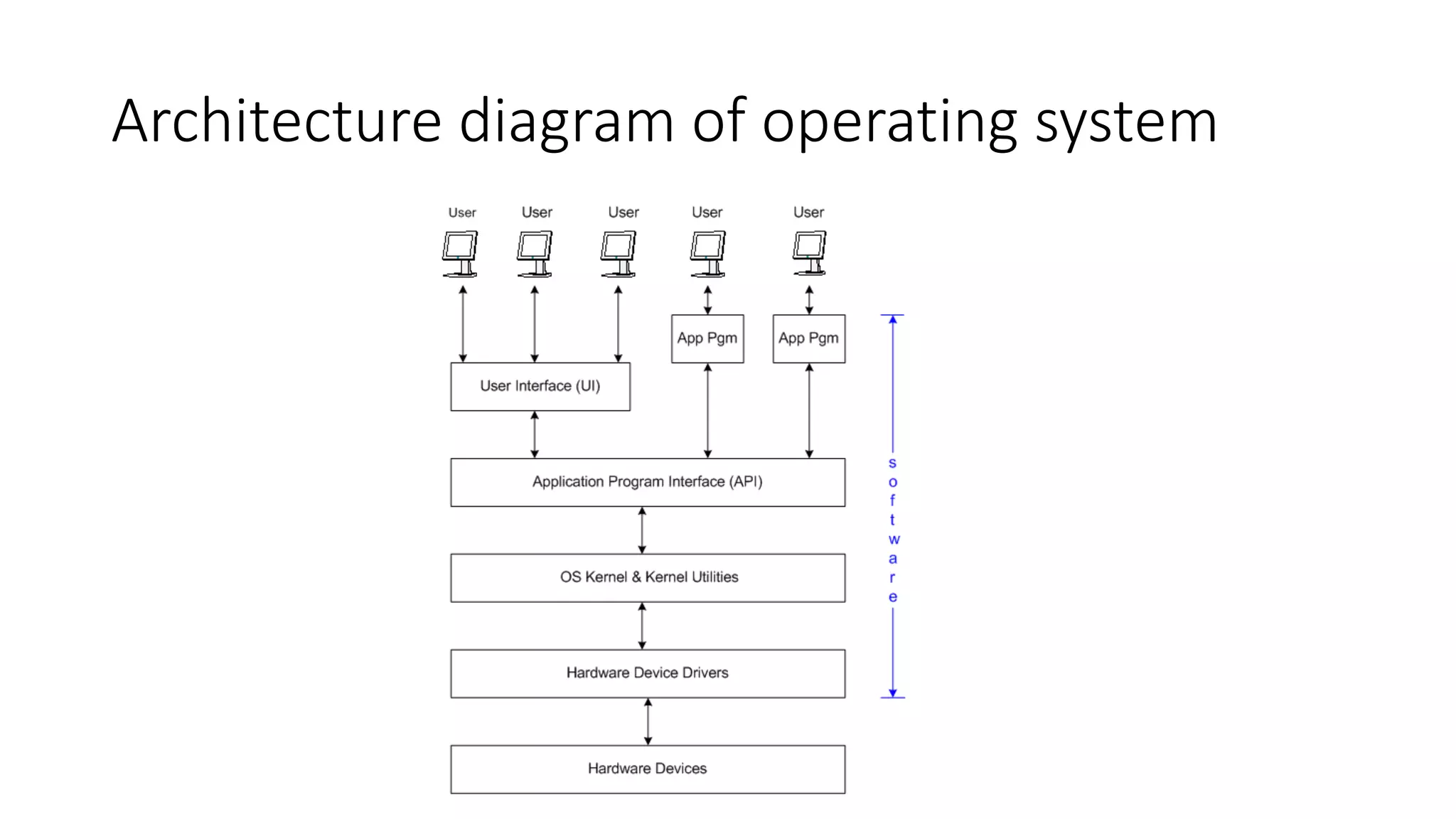
Architecture diagram of operating system
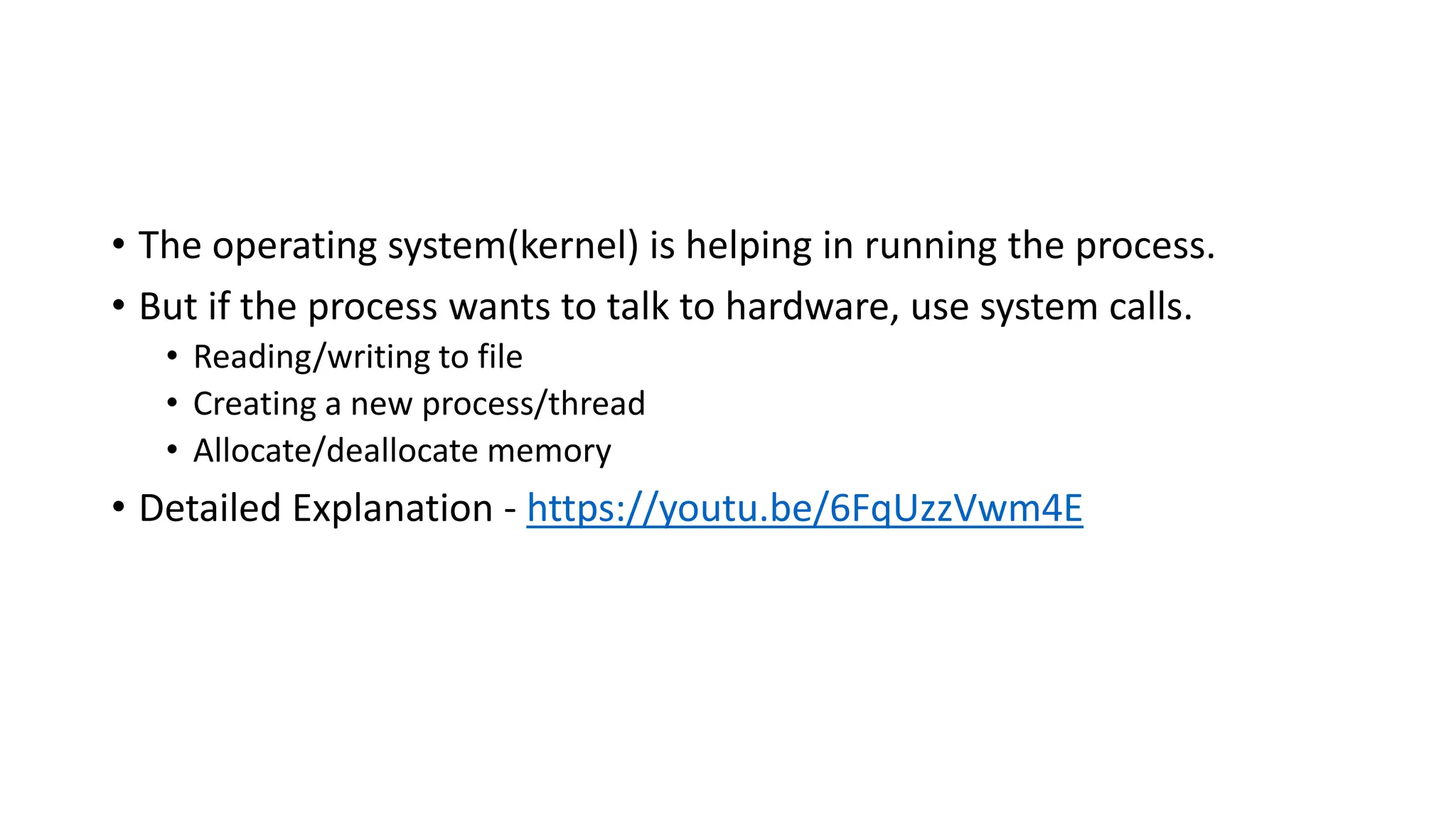
• The operating system(kernel) is helping in running the process. • But if the process wants to talk to hardware, use system calls. • Reading/writing to file • Creating a new process/thread • Allocate/deallocate memory • Detailed Explanation - https://youtu.be/6FqUzzVwm4E
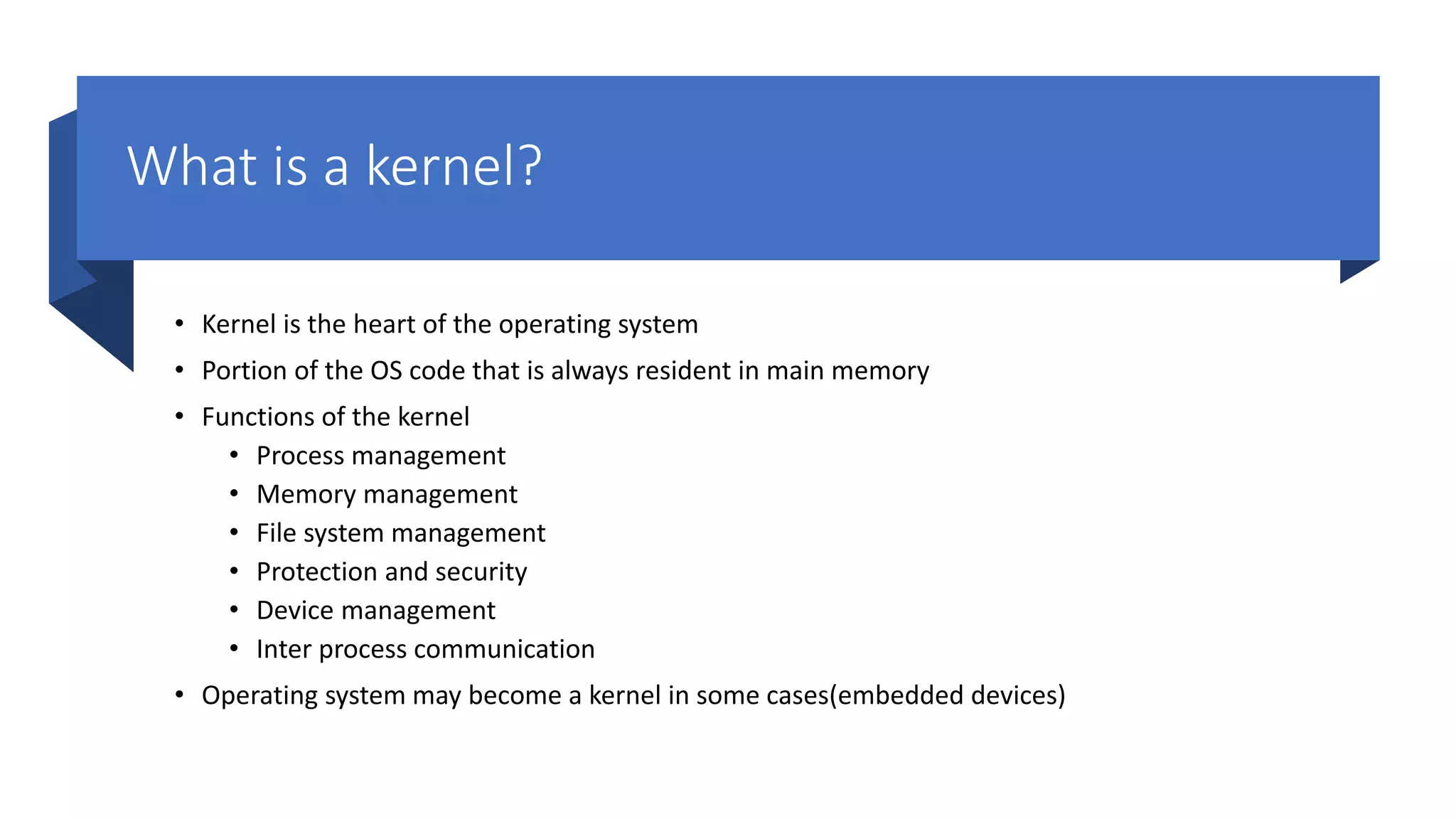
What is a kernel? • Kernel is the heart of the operating system • Portion of the OS code that is always resident in main memory • Functions of the kernel • Process management • Memory management • File system management • Protection and security • Device management • Inter process communication • Operating system may become a kernel in some cases(embedded devices)
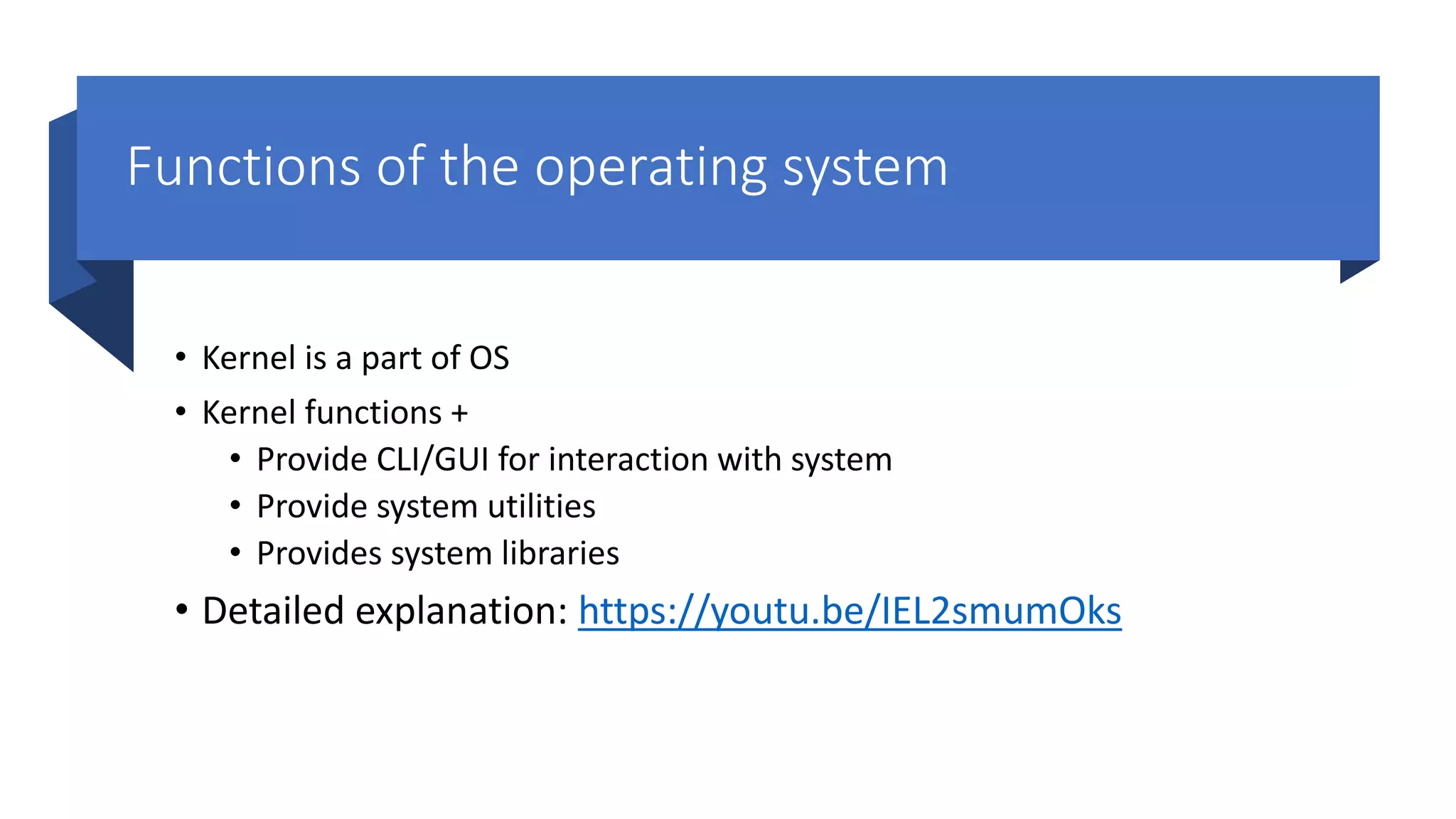
Functions of the operating system • Kernel is a part of OS • Kernel functions + • Provide CLI/GUI for interaction with system • Provide system utilities • Provides system libraries • Detailed explanation: https://youtu.be/IEL2smumOks
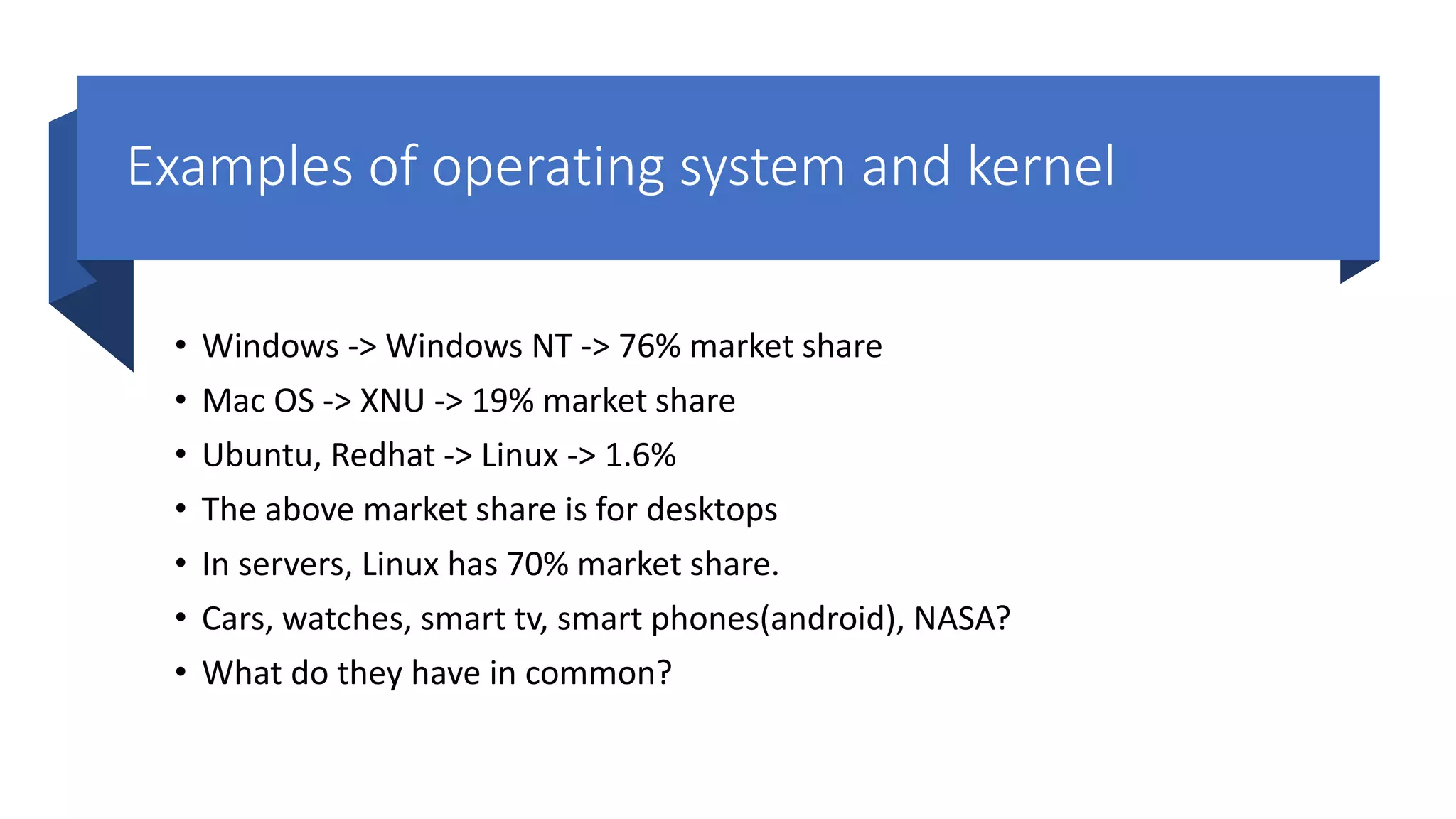
Examples of operating system and kernel • Windows -> Windows NT -> 76% market share • Mac OS -> XNU -> 19% market share • Ubuntu, Redhat -> Linux -> 1.6% • The above market share is for desktops • In servers, Linux has 70% market share. • Cars, watches, smart tv, smart phones(android), NASA? • What do they have in common?
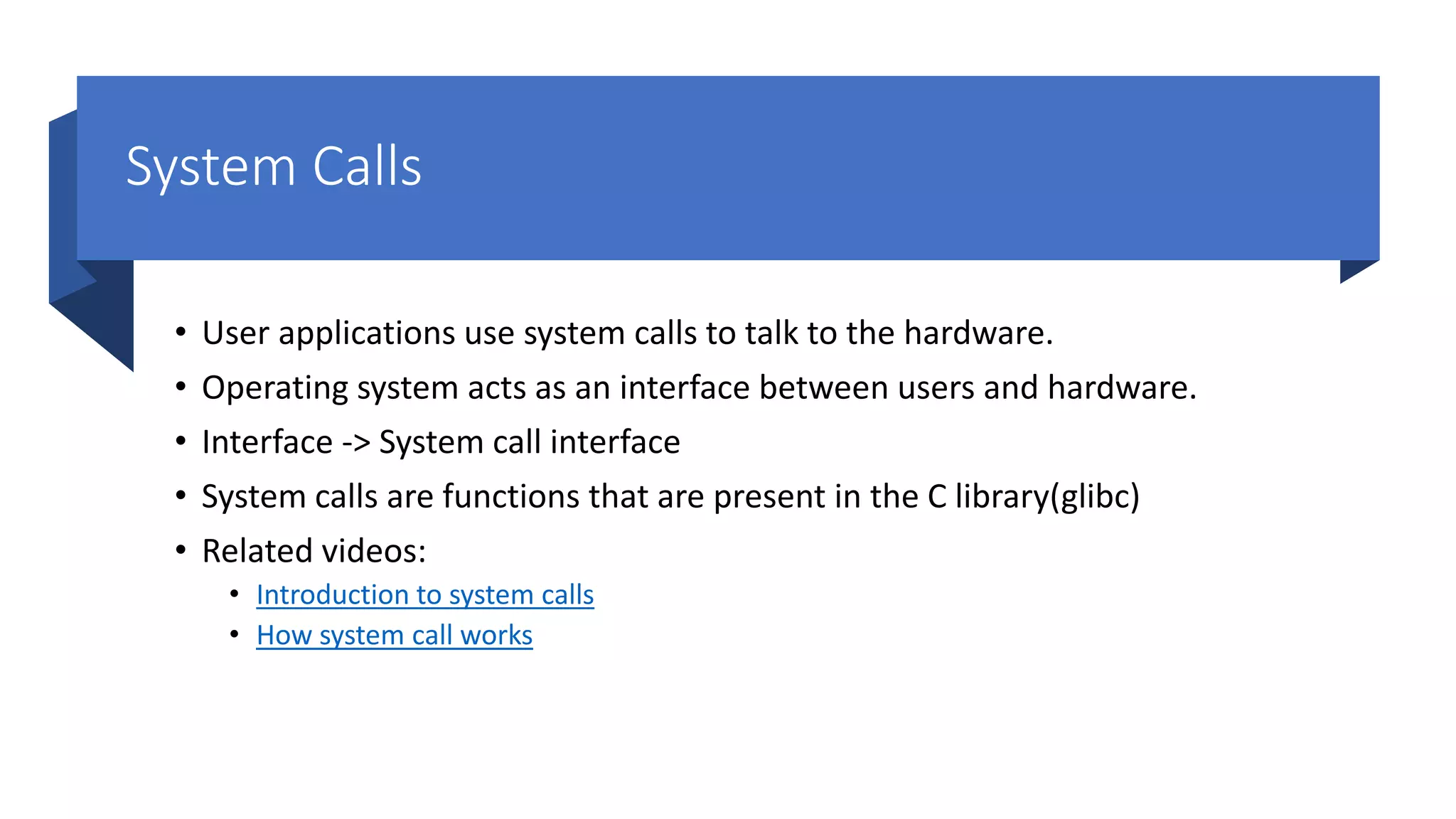
System Calls • User applications use system calls to talk to the hardware. • Operating system acts as an interface between users and hardware. • Interface -> System call interface • System calls are functions that are present in the C library(glibc) • Related videos: • Introduction to system calls • How system call works
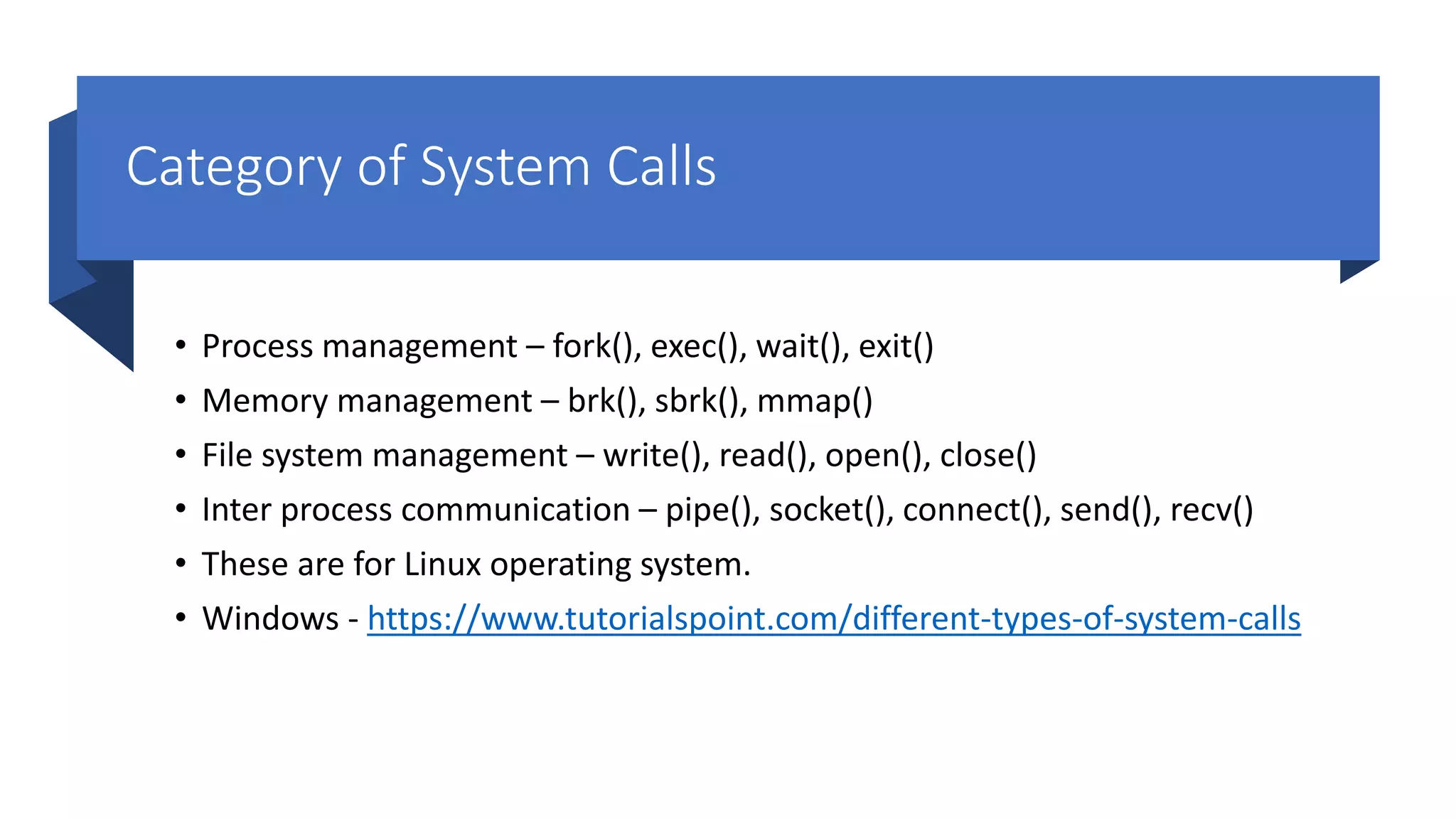
Category of System Calls • Process management – fork(), exec(), wait(), exit() • Memory management – brk(), sbrk(), mmap() • File system management – write(), read(), open(), close() • Inter process communication – pipe(), socket(), connect(), send(), recv() • These are for Linux operating system. • Windows - https://www.tutorialspoint.com/different-types-of-system-calls
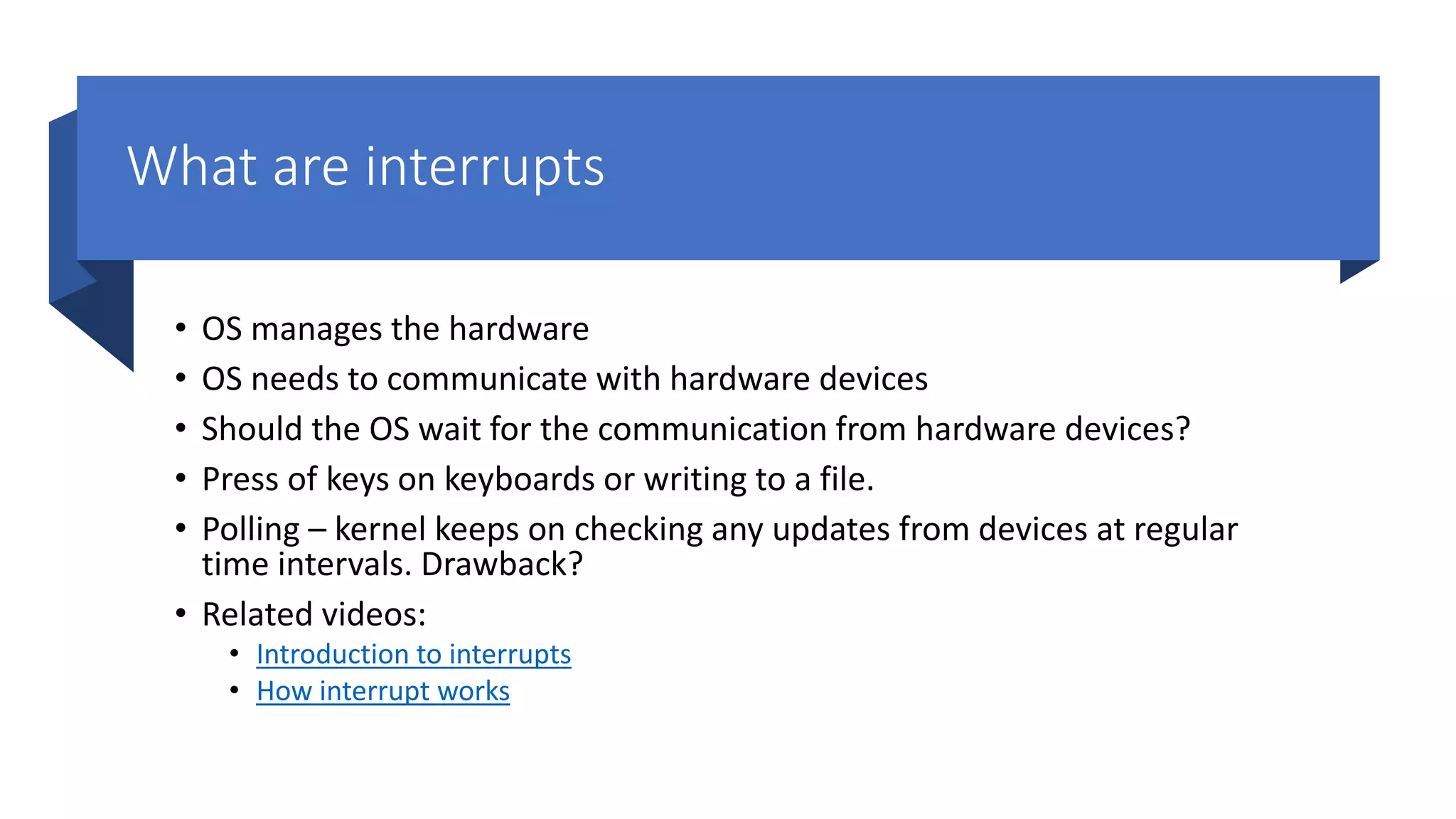
What are interrupts • OS manages the hardware • OS needs to communicate with hardware devices • Should the OS wait for the communication from hardware devices? • Press of keys on keyboards or writing to a file. • Polling – kernel keeps on checking any updates from devices at regular time intervals. Drawback? • Related videos: • Introduction to interrupts • How interrupt works
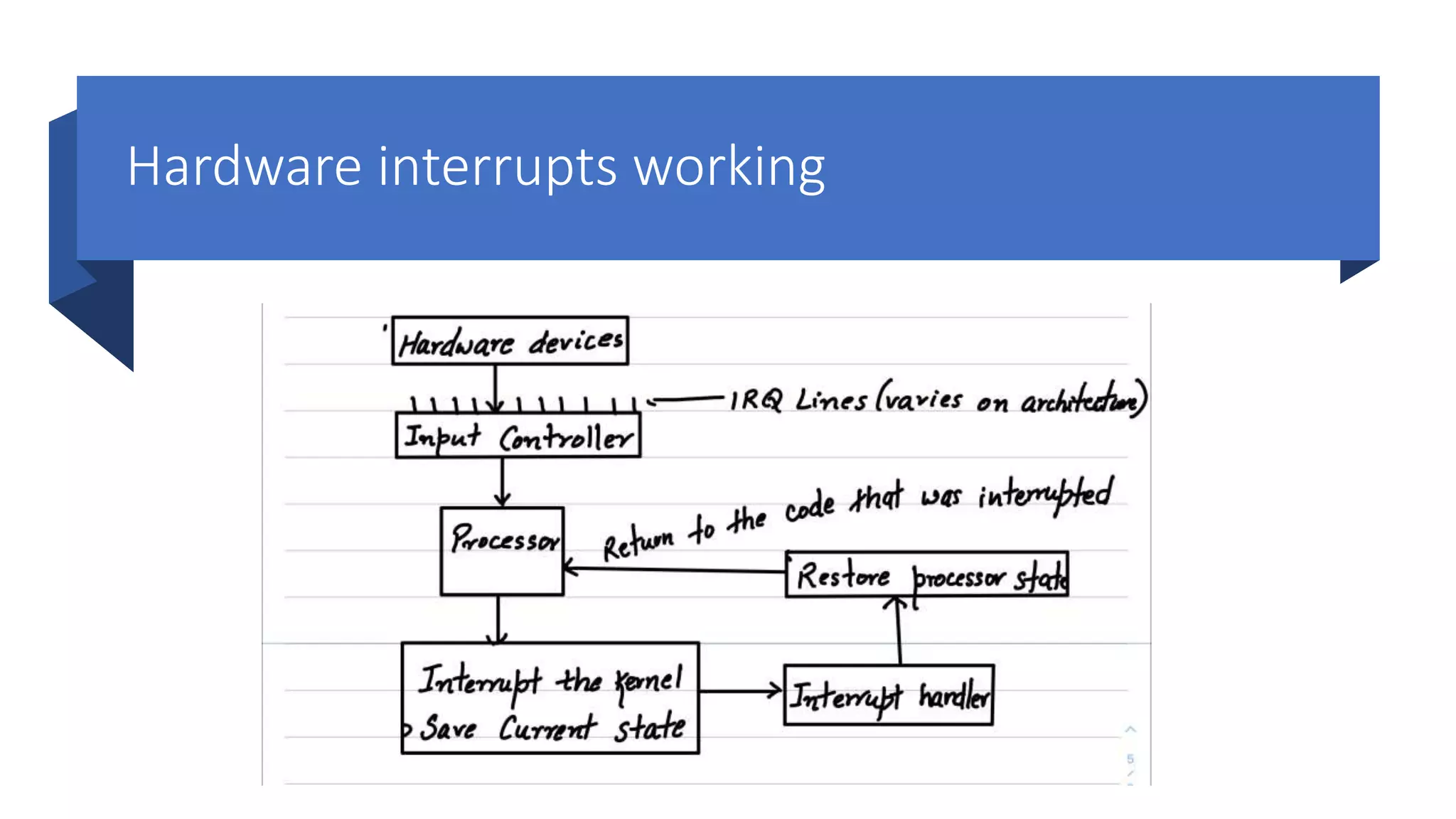
Interrupts (Continued) • An interrupt is an input signal to the processor indicating an event requires immediate attention. • The current process running on the processor gets interrupted. • Interrupt handler code is then run. • Types of interrupts • Hardware interrupts • Software interrupts
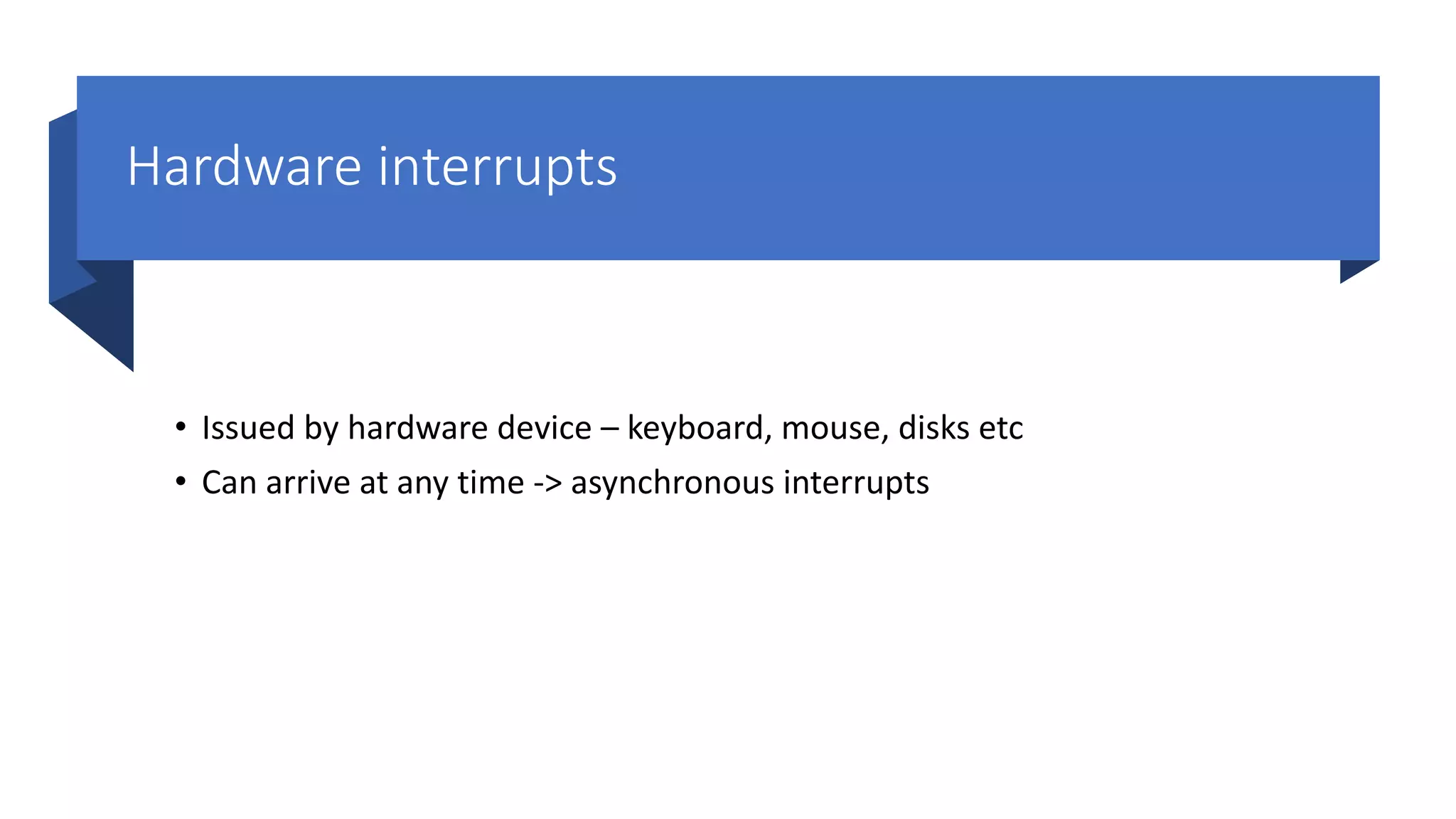
Hardware interrupts • Issued by hardware device – keyboard, mouse, disks etc • Can arrive at any time -> asynchronous interrupts
Hardware interrupts working
Software interrupts • Issued by the processor itself • Caused by program that is running on the processor -> synchronous interrupts • System calls are also called using interrupts(traps) • https://youtu.be/UFBe1HdN8h0 • Segmentation fault, page fault, divide by zero etc
Software interrupts working
Next class (Process management) • How kernel runs your program? • Program vs process • Process control block • Process states • Process lifecycle(fork(), exec(), wait(), exit()) • Zombie and orphan process

Introduction to operating system, system calls and interrupts

  • 1.
  • 2.
    AGENDA • Introduce myself •Operating system questions for interviews • Introduction to operating system with example • Kernel vs Operating System • Examples of operating system and kernel • Introduction to system calls • Introduction to interrupts
  • 3.
    Before proceeding further… •Do not forget to subscribe to the channel. • Share this with your friends(Saturday 5PM class IST) • Telegram link: https://t.me/joinchat/OcDlRxsp56Z1yiqQJu9unw • Email doesn’t scale - https://bit.ly/2LVLWWy • Planning to take practical classes related to operating system(linux) • Have doubts? Ask in comments or while I am live • Will try explaining your doubts in next classes
  • 4.
    Full classes schedule •Introduction to operating system and what all topics to focus for interviews • Process management (process vs program, process control block, process states, process lifecycle - fork(), exec(), wait(), exit(), zombie and orphan process) • Interprocess communication (Multiprocessing, multithreading and challenges) • Process Scheduling Algorithms • Process synchronization(mutex, semaphore and deadlock) • Memory management part 1(Virtual memory, physical vs logical address space) • Memory management part2(Demand paging, page replacement algorithms) • Miscellaneous(filesystem and other topics which were left)
  • 5.
    ABOUT ME • SiteReliability Engineer at LinkedIn(1.5 years) • Former DevOps Engineer at Directi(1.5 years) • Alumni of IIIT Allahabad • Hobbies: Books(Finance + SRE), Cricket, Making youtube Videos
  • 6.
  • 7.
    SUBJECTIVE + MCQ •MCQ Online test • Subjective questions (F2F or telephonic interview) • Mostly asked to candidates with no or less experience • Software engineer + DevOps/SRE + Service based companies
  • 8.
    Advantage of learningOS • Knowledge • Practical: Threads + mutex/semaphore + memory segments (Software) • Practical: Zombie process + Nice values + Linux Commands • Will discuss practical knowledge in my next series • Edge overs others in interviews • Directi Experience
  • 9.
    What questions areasked? • https://practice.geeksforgeeks.org/tag- page.php?tag=Operating%20Systems • Will list down what questions can be answered by seeing my video • Not easy to cover all the questions • Will cover only important ones • https://shivammitra.com/operating%20system/how-to-study-operating- systems/ • Why not watch my other videos on operating system?
  • 10.
    QUESTIONS WHICH YOUWILL BE ABLE TO ANSWER AFTER THIS VIDEO? • What is operating system? • Explain the architecture of operating system. • Difference between operating system and kernel • What are the functions of operating system • Give some examples of popular operating system and kernel • What are system call with examples • What are interrupts with examples
  • 11.
    What is anoperating system? • System program that manages the system’s hardware • Acts as an interface between the user and the hardware • Includes all the programs that are associated with the operation of the system • What all are parts of an operating system?
  • 12.
    Parts of anoperating system • No universal definition for what should be included. • Include parts that are essential for the running of the system • Parts of OS • Kernel • Device drivers • User Interface • System Libraries • System utilities – disk formatters, network utilities, data recovery etc • Are application programs(chrome, excel) part of the operating system? (Microsoft vs United States)
  • 13.
    Architecture diagram ofoperating system
  • 14.
    • The operatingsystem(kernel) is helping in running the process. • But if the process wants to talk to hardware, use system calls. • Reading/writing to file • Creating a new process/thread • Allocate/deallocate memory • Detailed Explanation - https://youtu.be/6FqUzzVwm4E
  • 15.
    What is akernel? • Kernel is the heart of the operating system • Portion of the OS code that is always resident in main memory • Functions of the kernel • Process management • Memory management • File system management • Protection and security • Device management • Inter process communication • Operating system may become a kernel in some cases(embedded devices)
  • 16.
    Functions of theoperating system • Kernel is a part of OS • Kernel functions + • Provide CLI/GUI for interaction with system • Provide system utilities • Provides system libraries • Detailed explanation: https://youtu.be/IEL2smumOks
  • 17.
    Examples of operatingsystem and kernel • Windows -> Windows NT -> 76% market share • Mac OS -> XNU -> 19% market share • Ubuntu, Redhat -> Linux -> 1.6% • The above market share is for desktops • In servers, Linux has 70% market share. • Cars, watches, smart tv, smart phones(android), NASA? • What do they have in common?
  • 18.
    System Calls • Userapplications use system calls to talk to the hardware. • Operating system acts as an interface between users and hardware. • Interface -> System call interface • System calls are functions that are present in the C library(glibc) • Related videos: • Introduction to system calls • How system call works
  • 20.
    Category of SystemCalls • Process management – fork(), exec(), wait(), exit() • Memory management – brk(), sbrk(), mmap() • File system management – write(), read(), open(), close() • Inter process communication – pipe(), socket(), connect(), send(), recv() • These are for Linux operating system. • Windows - https://www.tutorialspoint.com/different-types-of-system-calls
  • 21.
    What are interrupts •OS manages the hardware • OS needs to communicate with hardware devices • Should the OS wait for the communication from hardware devices? • Press of keys on keyboards or writing to a file. • Polling – kernel keeps on checking any updates from devices at regular time intervals. Drawback? • Related videos: • Introduction to interrupts • How interrupt works
  • 22.
    Interrupts (Continued) • Aninterrupt is an input signal to the processor indicating an event requires immediate attention. • The current process running on the processor gets interrupted. • Interrupt handler code is then run. • Types of interrupts • Hardware interrupts • Software interrupts
  • 23.
    Hardware interrupts • Issuedby hardware device – keyboard, mouse, disks etc • Can arrive at any time -> asynchronous interrupts
  • 24.
  • 25.
    Software interrupts • Issuedby the processor itself • Caused by program that is running on the processor -> synchronous interrupts • System calls are also called using interrupts(traps) • https://youtu.be/UFBe1HdN8h0 • Segmentation fault, page fault, divide by zero etc
  • 26.
  • 27.
    Next class (Processmanagement) • How kernel runs your program? • Program vs process • Process control block • Process states • Process lifecycle(fork(), exec(), wait(), exit()) • Zombie and orphan process