Diffie-hellman Algorithm Presented by: 1. Asmita 2.Sadiqa Date: 07/11/2018
Techniques for encryption • There are two basic techniques for encrypting information: • symmetric encryption (also called secret key encryption) and • asymmetric encryption (also called public and private key encryption.)
History • The Diffie-Hellman algorithm was developed by Whitfield Diffie and Martin Hellman in 1976. • This algorithm was devices not to encrypt the data but to generate same private cryptographic key at both ends so that there is no need to transfer this key from one communication end to another.
Diffie-hellman algorithm • Asymmetric Encryption of data requires transfer of cryptographic private key. • The most challenging part in this type of encryption is the transfer of the encryption key from sender to receiver without anyone intercepting this key in between. • This transfer or rather generation on same cryptographic keys at both sides secretively was made possible by the Diffie-Hellman algoritHm.
Defination • Diffie – Hellman algorithm is an algorithm that allows two parties to get the shared secret key using the communication channel, which is not protected from the interception but is protected from modification.
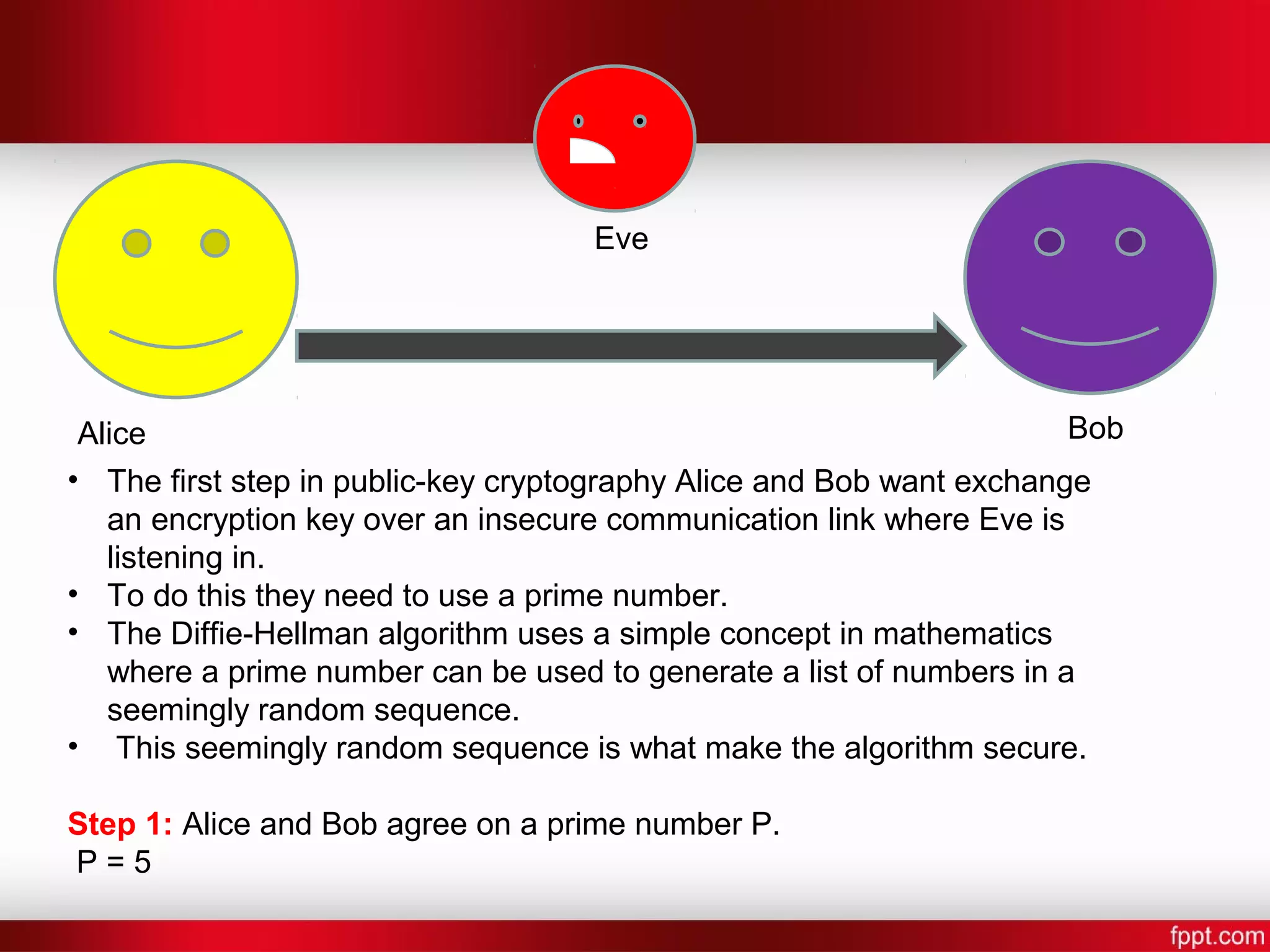
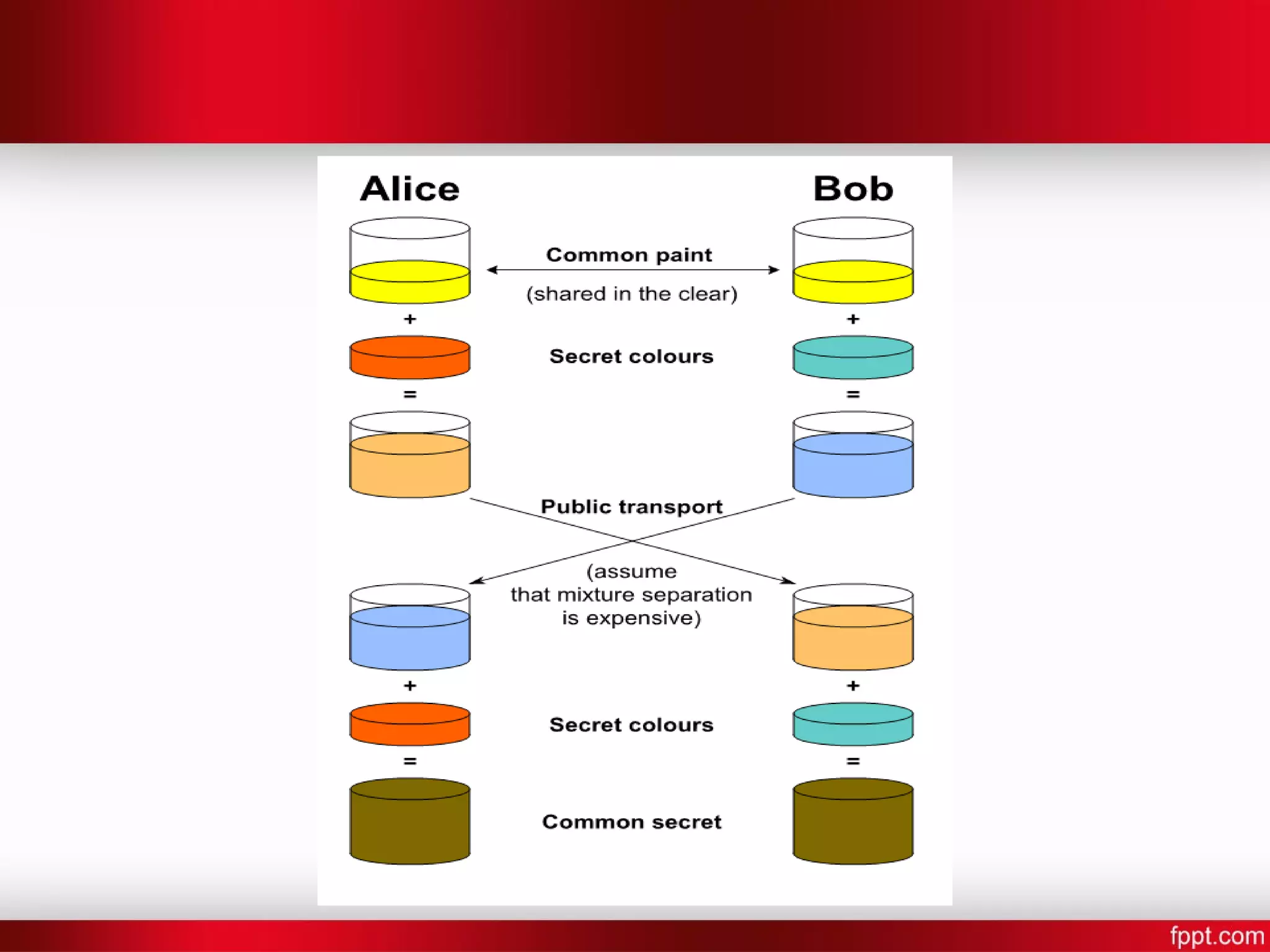
Alice Bob • The first step in public-key cryptography Alice and Bob want exchange an encryption key over an insecure communication link where Eve is listening in. • To do this they need to use a prime number. • The Diffie-Hellman algorithm uses a simple concept in mathematics where a prime number can be used to generate a list of numbers in a seemingly random sequence. • This seemingly random sequence is what make the algorithm secure. Step 1: Alice and Bob agree on a prime number P. P = 5 Eve
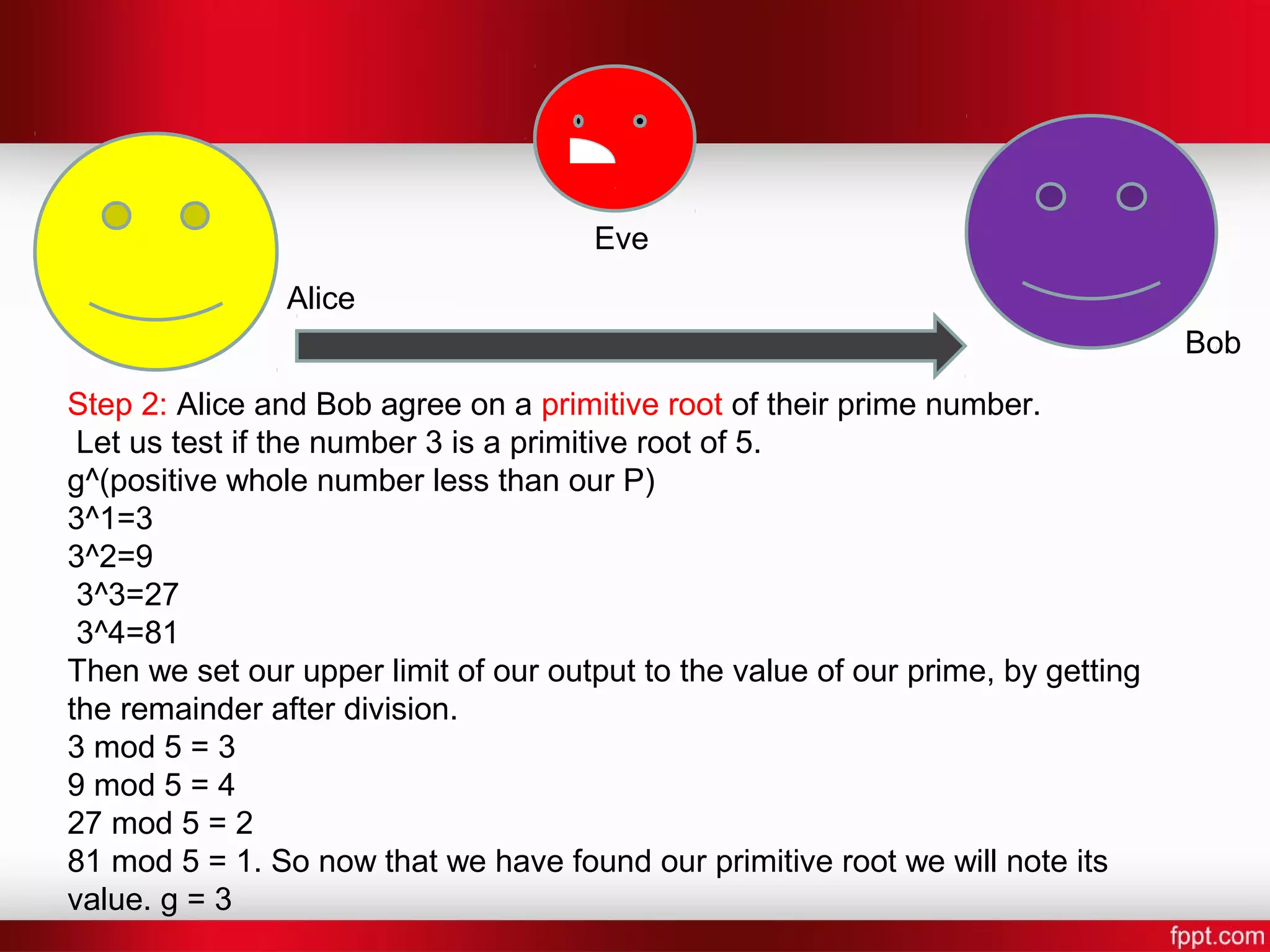
Alice Bob Eve Step 2: Alice and Bob agree on a primitive root of their prime number. Let us test if the number 3 is a primitive root of 5. g^(positive whole number less than our P) 3^1=3 3^2=9 3^3=27 3^4=81 Then we set our upper limit of our output to the value of our prime, by getting the remainder after division. 3 mod 5 = 3 9 mod 5 = 4 27 mod 5 = 2 81 mod 5 = 1. So now that we have found our primitive root we will note its value. g = 3
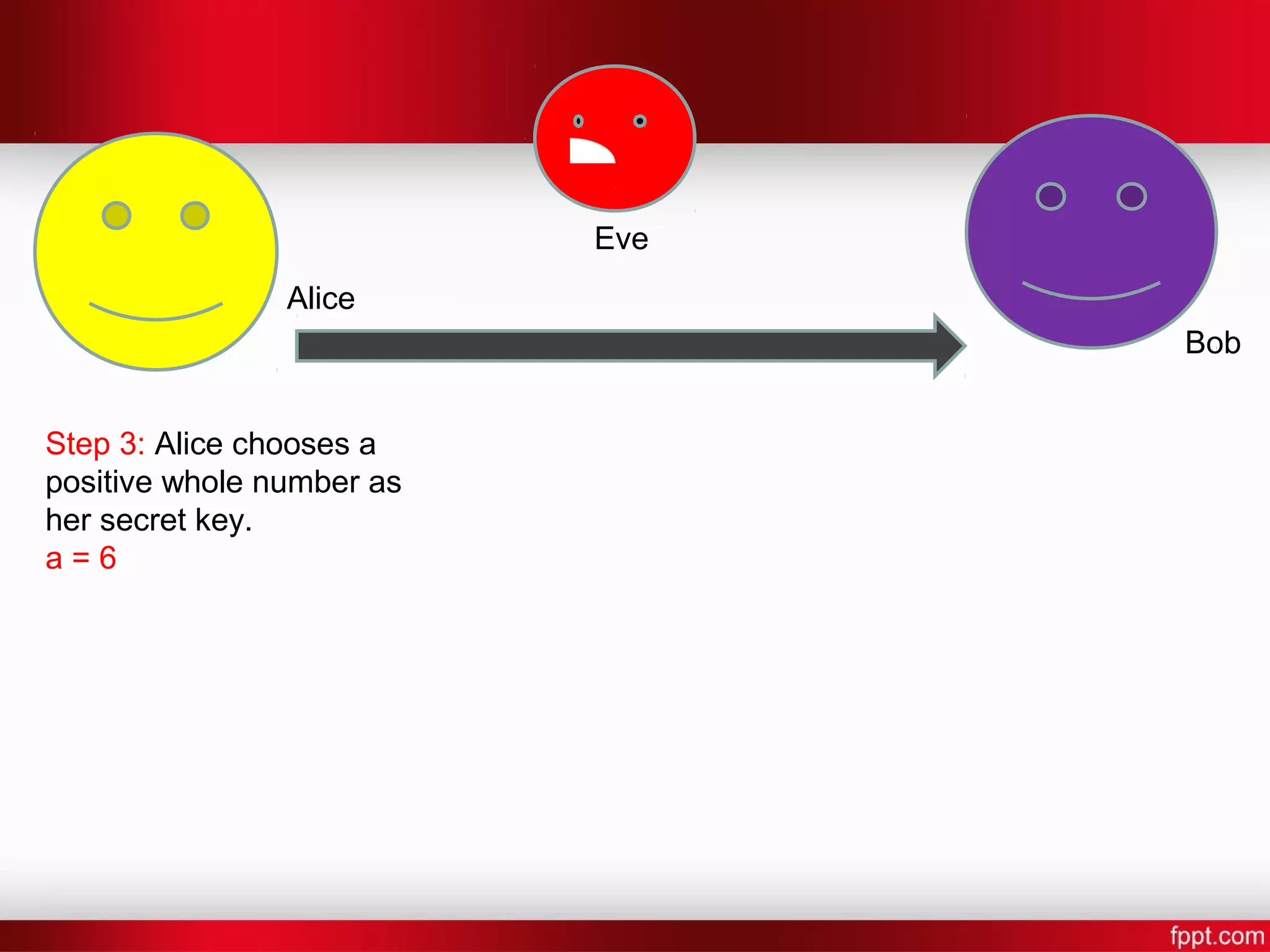
Alice Bob Eve Step 3: Alice chooses a positive whole number as her secret key. a = 6
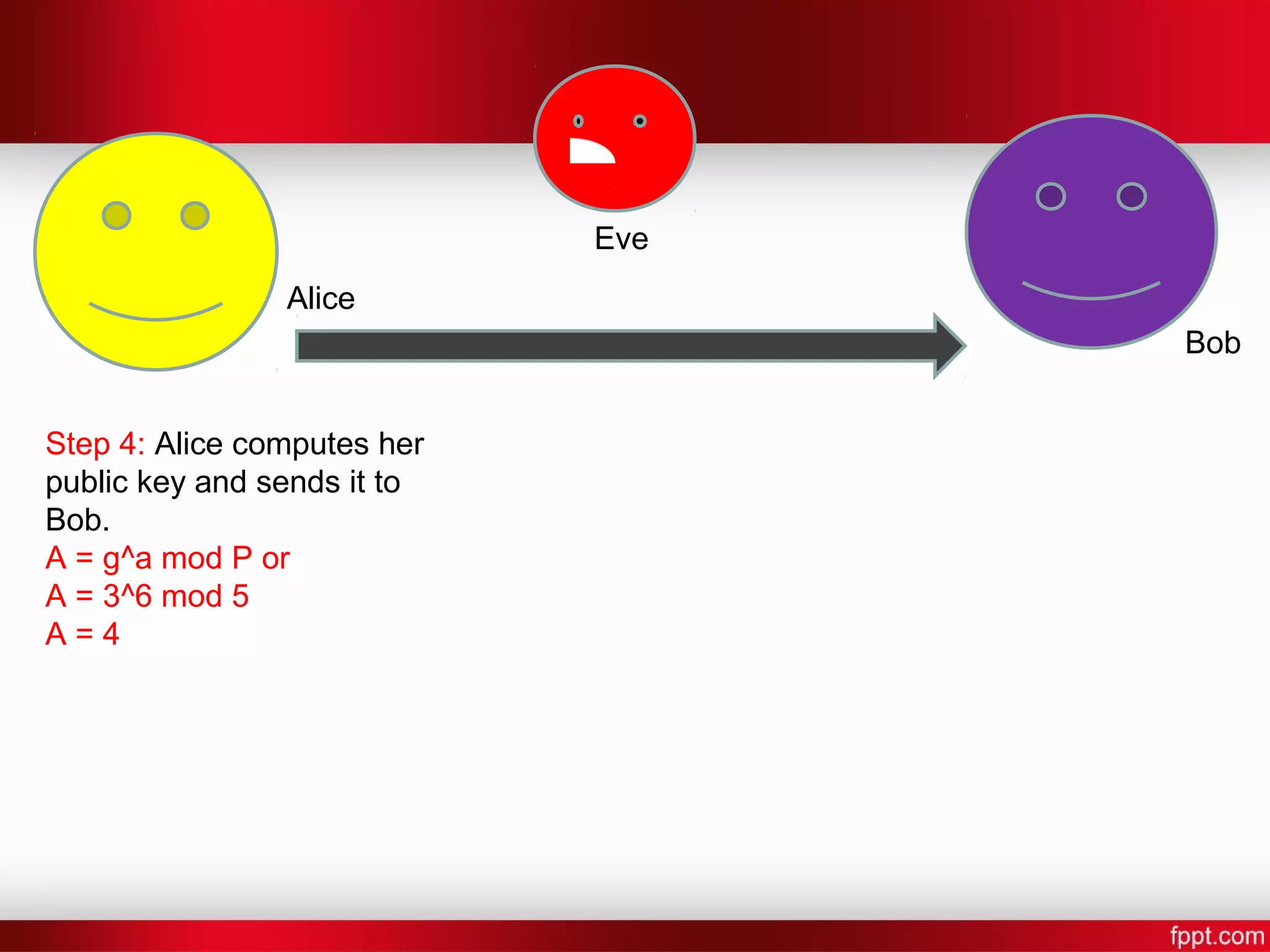
Alice Bob Eve Step 4: Alice computes her public key and sends it to Bob. A = g^a mod P or A = 3^6 mod 5 A = 4
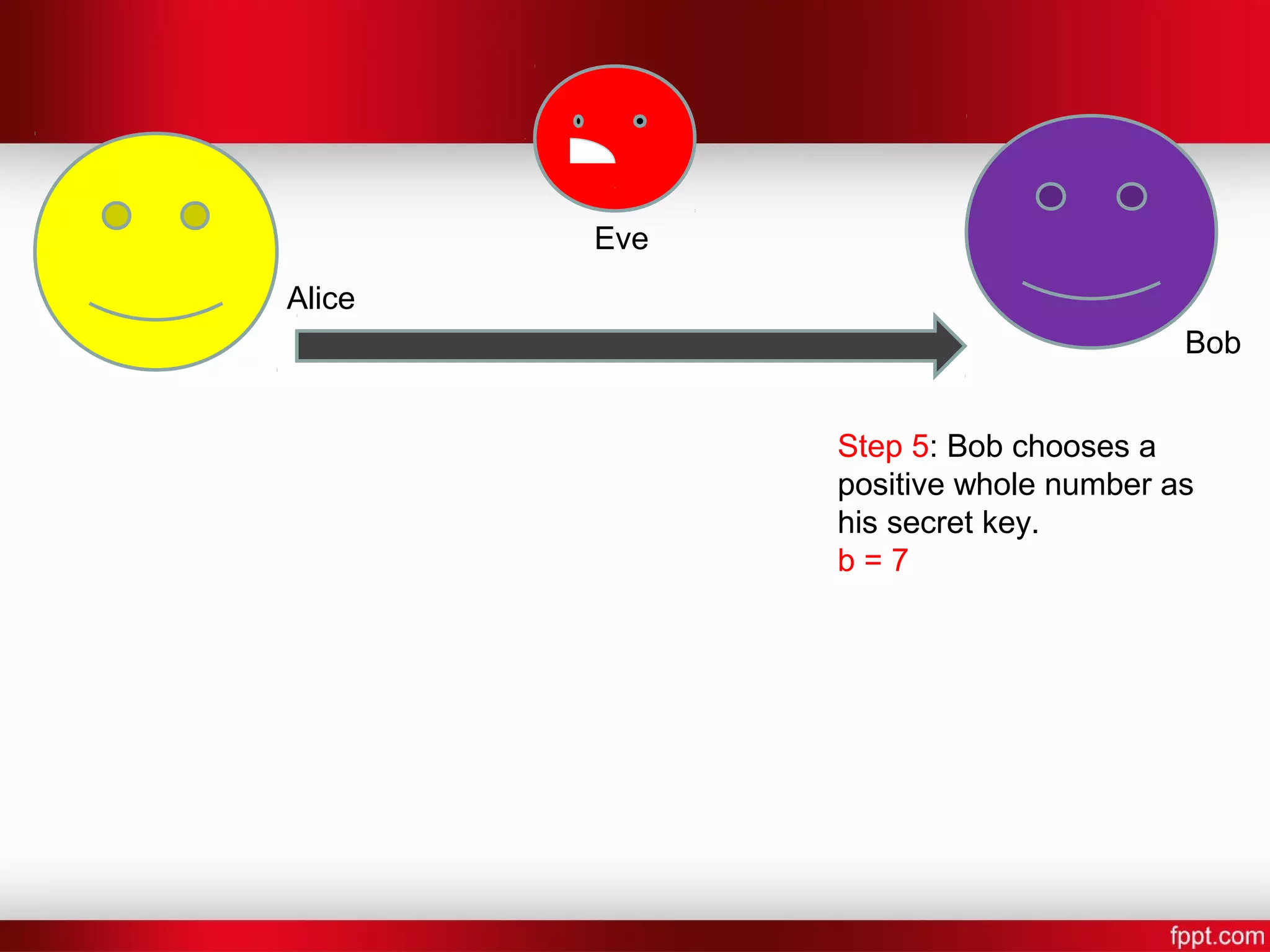
Alice Bob Eve Step 5: Bob chooses a positive whole number as his secret key. b = 7
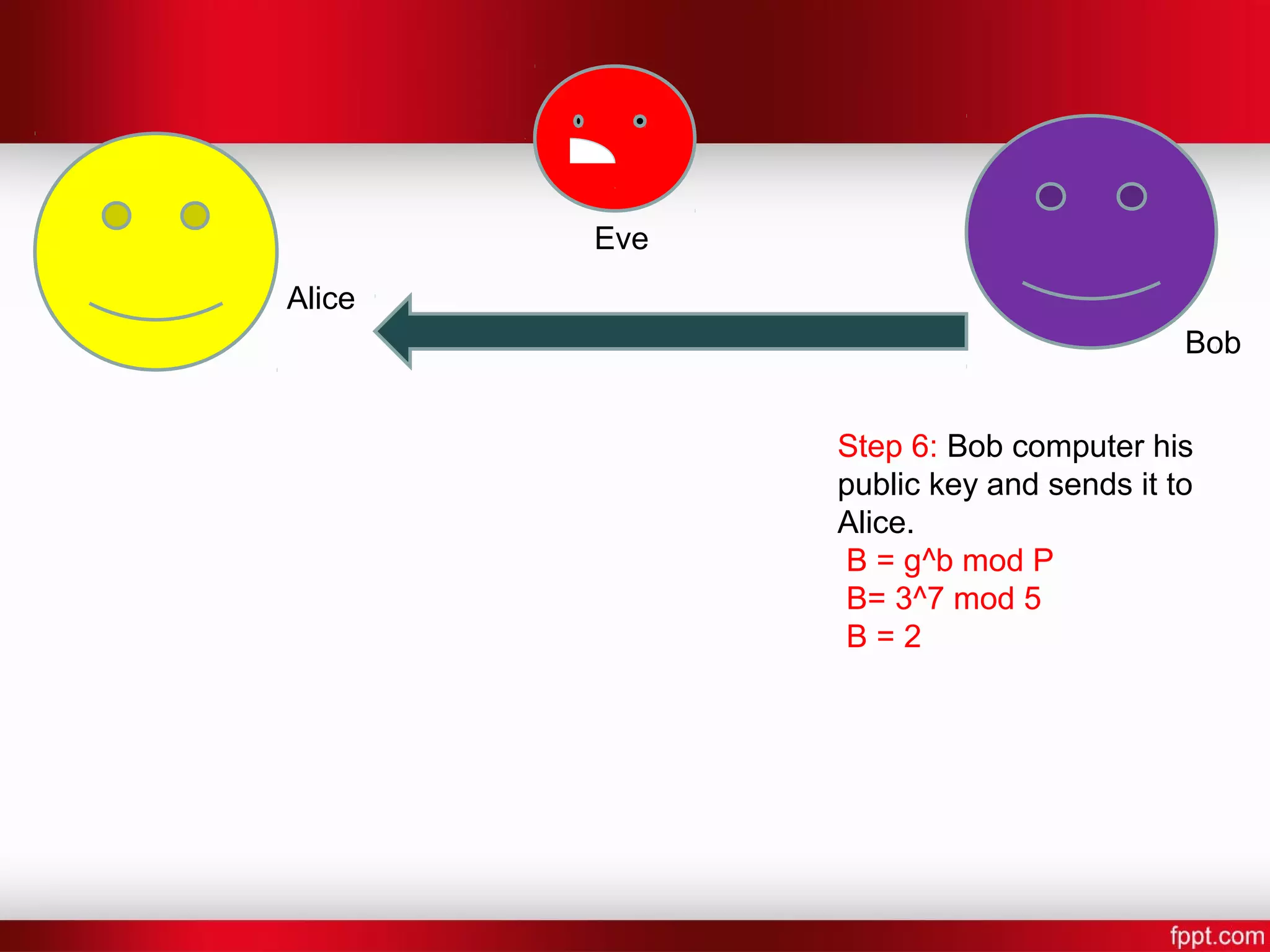
Alice Bob Eve Step 6: Bob computer his public key and sends it to Alice. B = g^b mod P B= 3^7 mod 5 B = 2
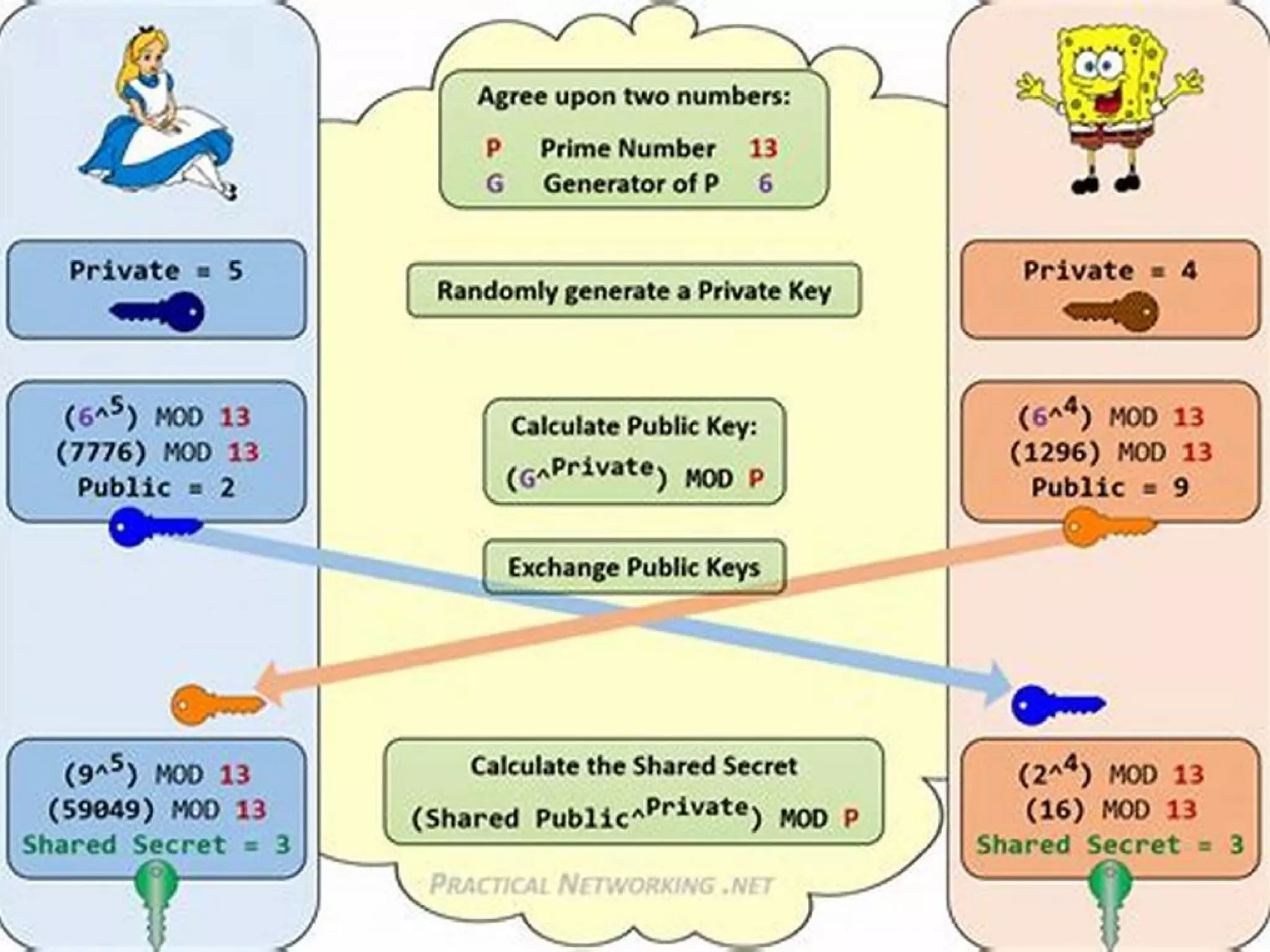
Alice Bob Eve Step 7: Alice and Bob now compute a shared secret key [Shared Key] = [other persons public key]^[their own secret key] mod P Bob: S = 4^7 mod 5 Alice: S = 2^6 mod 5 S = 4
Advantages & Disadvantages • Advantages: – The sender and receiver have no prior knowledge of each other. – Communication can take place through an insecure channel. – Sharing of secret key is safe. • Disadvantage: A problem with asymmetric encryption, however, is that it is slower than symmetric encryption. It requires far more processing power to both encrypt and decrypt the content of the message.

Diffie-hellman algorithm

  • 1.
    Diffie-hellman Algorithm Presented by:1. Asmita 2.Sadiqa Date: 07/11/2018
  • 2.
    Techniques for encryption •There are two basic techniques for encrypting information: • symmetric encryption (also called secret key encryption) and • asymmetric encryption (also called public and private key encryption.)
  • 3.
    History • The Diffie-Hellmanalgorithm was developed by Whitfield Diffie and Martin Hellman in 1976. • This algorithm was devices not to encrypt the data but to generate same private cryptographic key at both ends so that there is no need to transfer this key from one communication end to another.
  • 4.
    Diffie-hellman algorithm • AsymmetricEncryption of data requires transfer of cryptographic private key. • The most challenging part in this type of encryption is the transfer of the encryption key from sender to receiver without anyone intercepting this key in between. • This transfer or rather generation on same cryptographic keys at both sides secretively was made possible by the Diffie-Hellman algoritHm.
  • 5.
    Defination • Diffie –Hellman algorithm is an algorithm that allows two parties to get the shared secret key using the communication channel, which is not protected from the interception but is protected from modification.
  • 6.
    Alice Bob • Thefirst step in public-key cryptography Alice and Bob want exchange an encryption key over an insecure communication link where Eve is listening in. • To do this they need to use a prime number. • The Diffie-Hellman algorithm uses a simple concept in mathematics where a prime number can be used to generate a list of numbers in a seemingly random sequence. • This seemingly random sequence is what make the algorithm secure. Step 1: Alice and Bob agree on a prime number P. P = 5 Eve
  • 7.
    Alice Bob Eve Step 2: Aliceand Bob agree on a primitive root of their prime number. Let us test if the number 3 is a primitive root of 5. g^(positive whole number less than our P) 3^1=3 3^2=9 3^3=27 3^4=81 Then we set our upper limit of our output to the value of our prime, by getting the remainder after division. 3 mod 5 = 3 9 mod 5 = 4 27 mod 5 = 2 81 mod 5 = 1. So now that we have found our primitive root we will note its value. g = 3
  • 8.
    Alice Bob Eve Step 3: Alicechooses a positive whole number as her secret key. a = 6
  • 9.
    Alice Bob Eve Step 4: Alicecomputes her public key and sends it to Bob. A = g^a mod P or A = 3^6 mod 5 A = 4
  • 10.
    Alice Bob Eve Step 5: Bobchooses a positive whole number as his secret key. b = 7
  • 11.
    Alice Bob Eve Step 6: Bobcomputer his public key and sends it to Alice. B = g^b mod P B= 3^7 mod 5 B = 2
  • 12.
    Alice Bob Eve Step 7: Aliceand Bob now compute a shared secret key [Shared Key] = [other persons public key]^[their own secret key] mod P Bob: S = 4^7 mod 5 Alice: S = 2^6 mod 5 S = 4
  • 15.
    Advantages & Disadvantages •Advantages: – The sender and receiver have no prior knowledge of each other. – Communication can take place through an insecure channel. – Sharing of secret key is safe. • Disadvantage: A problem with asymmetric encryption, however, is that it is slower than symmetric encryption. It requires far more processing power to both encrypt and decrypt the content of the message.