CODE REFACTORING IN SOFTWARE DEVELOPMENT
What is Code Refactoring? Code refactoring is a crucial process in software development that restructures code without affecting the application's external behavior. It aims to improve readability and maintainability by eliminating redundant sections, fixing bugs, and implementing best coding practices. This ensures scalable, flexible, and future-proof applications.
Reasons to Use Code Refactoring Code refactoring simplifies complex code, removes redundant elements, enhances program quality, and functionality, reduces bugs, and improves maintainability, enabling future modifications without introducing new issues. Boosts Code Readability
Refactoring enhances code quality, helps developers identify bugs, and streamlines code structure. It analyzes existing code, identifies areas for improvement, and implements changes to improve readability and maintainability. It removes redundant code for an organized codebase. Identifies Bugs Faster Code refactoring improves software performance by optimizing code, eliminating bottlenecks, reducing complexity, and enhancing efficiency. It also enables software adaptation and evolution, ensuring compatibility with future updates and changes. Performance optimization
Code refactoring helps developers understand algorithmic logic by breaking complex code into manageable components, enabling better understanding, bug identification, and enhanced collaboration by making the codebase more approachable. Improves productivity Refactoring enhances code structure, organization, and design without altering functionality, allowing developers to seamlessly incorporate new features or improvements. Up-to-date Software Code
Refactoring code accelerates development, improving performance and reducing maintenance costs, ensuring faster time to market and staying competitive in the software industry. Faster Time To Market Code refactoring saves developers time and money by eliminating complex algorithm training, reducing development costs and reducing development segments. Saves Development Efforts and Costs
Challenges & Solutions- Code Refactoring Establishing clear goals and objectives is crucial for a successful refactoring process. This helps in prioritizing and planning efforts, analyzing codebases, identifying areas for improvement, and setting specific targets to enhance functionality, performance, or maintainability. Undefined objectives can result in overinvestment and inefficiencies, potentially hindering project success. Ambiguous Objectives
Refactoring offers benefits but also carries risk, potentially introducing bugs or disrupting existing systems. It aims to improve code structure, readability, and maintainability, reducing complexity, and enhancing organization. This ensures flexibility, scalability, and easier debugging for future enhancements. Interrupting Existing Functionalities Software refactoring is suitable for large, complex codebases, but requires careful planning and resource allocation. Defining goals and prioritizing objectives ensures efficient allocation of time, effort, and personnel, while focusing on critical areas for improvement. Excessive Time & Resources
Best Code Refactoring Techniques Red-Green refactoring is a popular technique in agile, test-driven development, enhancing code design and functionality while maintaining underlying behavior. Developers create failing test cases (red) and minimal code (green) to pass the test. Red-Green-Refactor
Refactoring by abstraction is advantageous for large codebases, as it involves systematic restructuring while maintaining functionality. By creating an abstraction layer, software development companies can gradually refactor smaller sections and replace them with the new layer. Refactoring by Abstraction Preparatory refactoring is a crucial process for developers to improve code quality and maintainability, proactively addressing code smells and design issues, ensuring robust and scalable systems, and reducing bug introduction. Preparatory Refactoring
Simplifying refactoring is a valuable technique in software development, improving code quality, readability, and maintainability while reducing complexity and technical debt. Simplifying Method Refactoring technique minimizes redundancies by extracting common code into separate methods, making code more modular and reusable. Inlining code eliminates unnecessary abstraction, improving clarity and maintainability in legacy codebases. Composing Method
Refactoring at a routine interval During code review Before and after adding new features or functionalities Experiencing performance issues Well, there is no best time to refactor the code! Refactoring is the practice of improving the structure and design of existing code without changing its functionality. Below are some common situations to further help you determine the right time to refactor code. Is there a specific time to refactor the software code?
A well-structured codebase facilitates debugging, maintenance, and collaboration among team members. Refactoring code is a wise decision, leading to efficient development processes and business growth. A trusted technology partner, like Hidden Brains, is essential for success in the ever-evolving software landscape. This not only leads to a more efficient and effective development process but also helps facilitate business growth with effective Custom Software Development Services. The Bottomline
Phone Number +1 323-908-3492 GET IN TOUCH Email Website biz@hiddenbrains.com www.hiddenbrains.com

Code Refactoring in Software Development

  • 1.
  • 2.
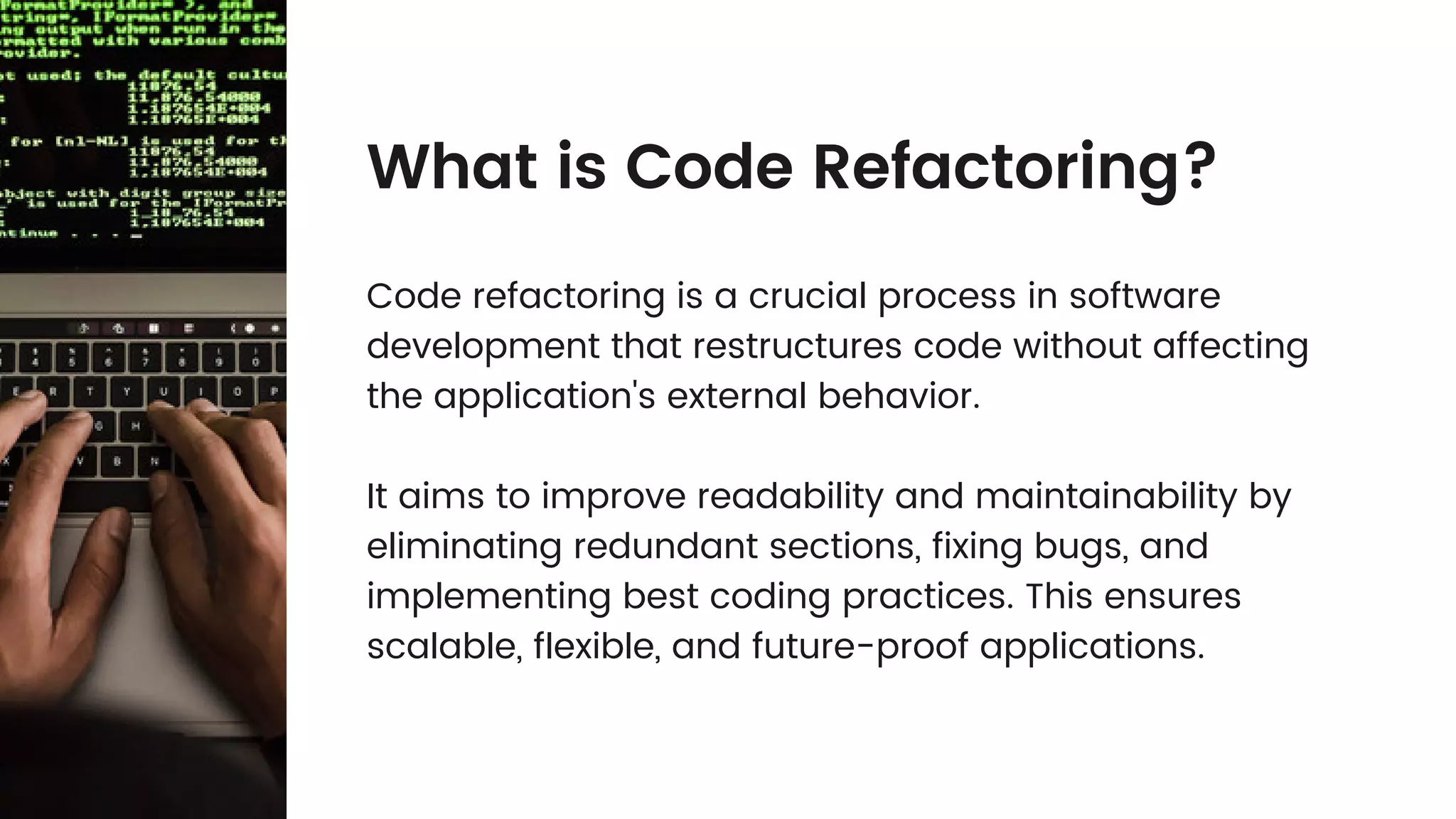
    What is CodeRefactoring? Code refactoring is a crucial process in software development that restructures code without affecting the application's external behavior. It aims to improve readability and maintainability by eliminating redundant sections, fixing bugs, and implementing best coding practices. This ensures scalable, flexible, and future-proof applications.
  • 3.
    Reasons to UseCode Refactoring Code refactoring simplifies complex code, removes redundant elements, enhances program quality, and functionality, reduces bugs, and improves maintainability, enabling future modifications without introducing new issues. Boosts Code Readability
  • 4.
    Refactoring enhances codequality, helps developers identify bugs, and streamlines code structure. It analyzes existing code, identifies areas for improvement, and implements changes to improve readability and maintainability. It removes redundant code for an organized codebase. Identifies Bugs Faster Code refactoring improves software performance by optimizing code, eliminating bottlenecks, reducing complexity, and enhancing efficiency. It also enables software adaptation and evolution, ensuring compatibility with future updates and changes. Performance optimization
  • 5.
    Code refactoring helpsdevelopers understand algorithmic logic by breaking complex code into manageable components, enabling better understanding, bug identification, and enhanced collaboration by making the codebase more approachable. Improves productivity Refactoring enhances code structure, organization, and design without altering functionality, allowing developers to seamlessly incorporate new features or improvements. Up-to-date Software Code
  • 6.
    Refactoring code acceleratesdevelopment, improving performance and reducing maintenance costs, ensuring faster time to market and staying competitive in the software industry. Faster Time To Market Code refactoring saves developers time and money by eliminating complex algorithm training, reducing development costs and reducing development segments. Saves Development Efforts and Costs
  • 7.
    Challenges & Solutions-Code Refactoring Establishing clear goals and objectives is crucial for a successful refactoring process. This helps in prioritizing and planning efforts, analyzing codebases, identifying areas for improvement, and setting specific targets to enhance functionality, performance, or maintainability. Undefined objectives can result in overinvestment and inefficiencies, potentially hindering project success. Ambiguous Objectives
  • 8.
    Refactoring offers benefitsbut also carries risk, potentially introducing bugs or disrupting existing systems. It aims to improve code structure, readability, and maintainability, reducing complexity, and enhancing organization. This ensures flexibility, scalability, and easier debugging for future enhancements. Interrupting Existing Functionalities Software refactoring is suitable for large, complex codebases, but requires careful planning and resource allocation. Defining goals and prioritizing objectives ensures efficient allocation of time, effort, and personnel, while focusing on critical areas for improvement. Excessive Time & Resources
  • 9.
    Best Code RefactoringTechniques Red-Green refactoring is a popular technique in agile, test-driven development, enhancing code design and functionality while maintaining underlying behavior. Developers create failing test cases (red) and minimal code (green) to pass the test. Red-Green-Refactor
  • 10.
    Refactoring by abstractionis advantageous for large codebases, as it involves systematic restructuring while maintaining functionality. By creating an abstraction layer, software development companies can gradually refactor smaller sections and replace them with the new layer. Refactoring by Abstraction Preparatory refactoring is a crucial process for developers to improve code quality and maintainability, proactively addressing code smells and design issues, ensuring robust and scalable systems, and reducing bug introduction. Preparatory Refactoring
  • 11.
    Simplifying refactoring isa valuable technique in software development, improving code quality, readability, and maintainability while reducing complexity and technical debt. Simplifying Method Refactoring technique minimizes redundancies by extracting common code into separate methods, making code more modular and reusable. Inlining code eliminates unnecessary abstraction, improving clarity and maintainability in legacy codebases. Composing Method
  • 12.
    Refactoring at aroutine interval During code review Before and after adding new features or functionalities Experiencing performance issues Well, there is no best time to refactor the code! Refactoring is the practice of improving the structure and design of existing code without changing its functionality. Below are some common situations to further help you determine the right time to refactor code. Is there a specific time to refactor the software code?
  • 13.
    A well-structured codebasefacilitates debugging, maintenance, and collaboration among team members. Refactoring code is a wise decision, leading to efficient development processes and business growth. A trusted technology partner, like Hidden Brains, is essential for success in the ever-evolving software landscape. This not only leads to a more efficient and effective development process but also helps facilitate business growth with effective Custom Software Development Services. The Bottomline
  • 14.
    Phone Number +1 323-908-3492 GETIN TOUCH Email Website biz@hiddenbrains.com www.hiddenbrains.com