Chapter 13
 Procedural programming focuses on the process/actions that occur in a program  Object-Oriented programming is based on the data and the functions that operate on it. Objects are instances of ADTs that represent the data and its functions
 If the data structures change, many functions must also be changed  Programs that are based on complex function hierarchies are:  difficult to understand and maintain  difficult to modify and extend  easy to break
 class: like a struct (allows bundling of related variables), but variables and functions in the class can have different properties than in a struct  object: an instance of a class, in the same way that a variable can be an instance of a struct
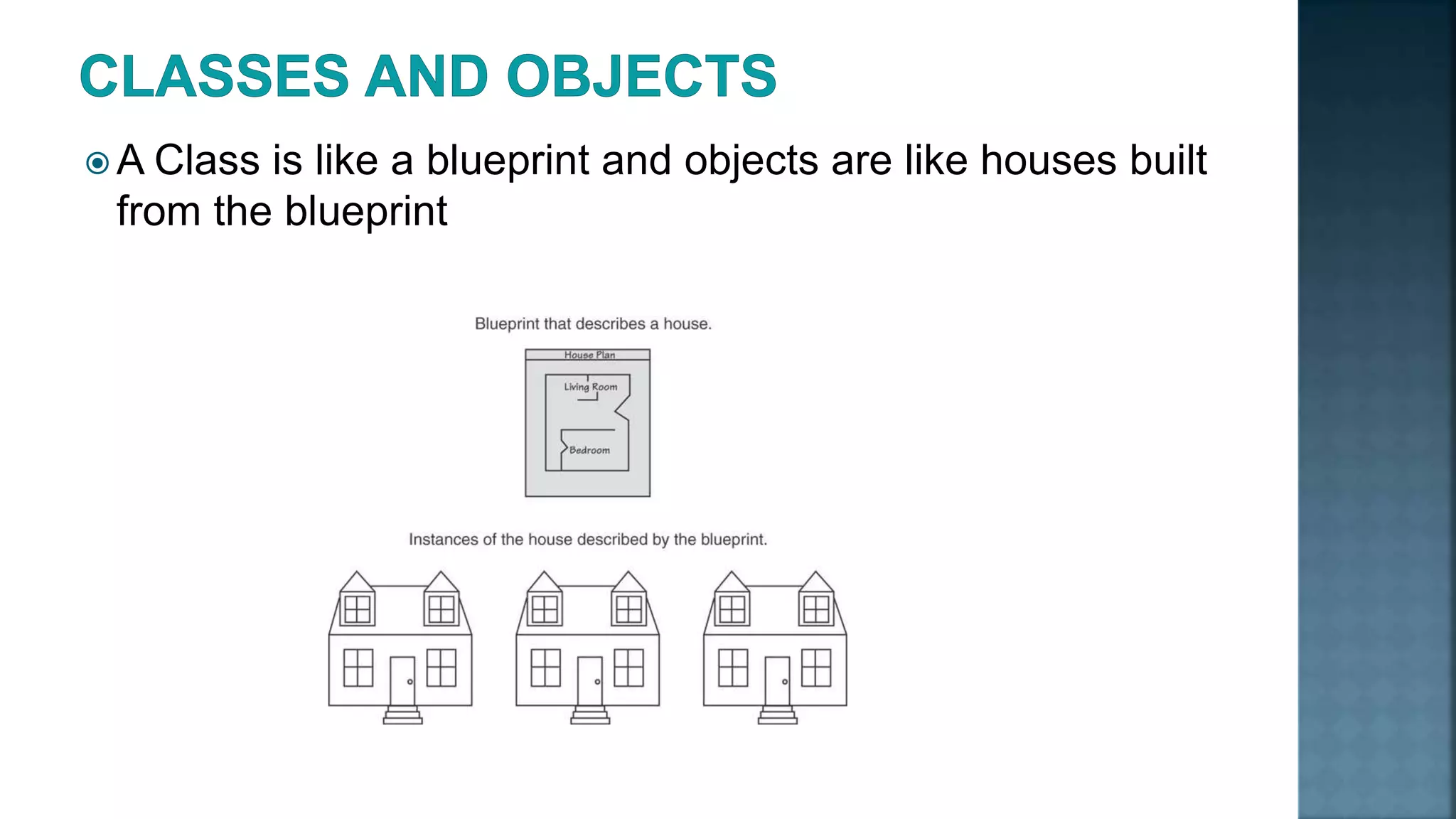
 A Class is like a blueprint and objects are like houses built from the blueprint
 attributes: members of a class  methods or behaviors: member functions of a class
 data hiding: restricting access to certain members of an object  public interface: members of an object that are available outside of the object. This allows the object to provide access to some data and functions without sharing its internal details and design, and provides some protection from data corruption
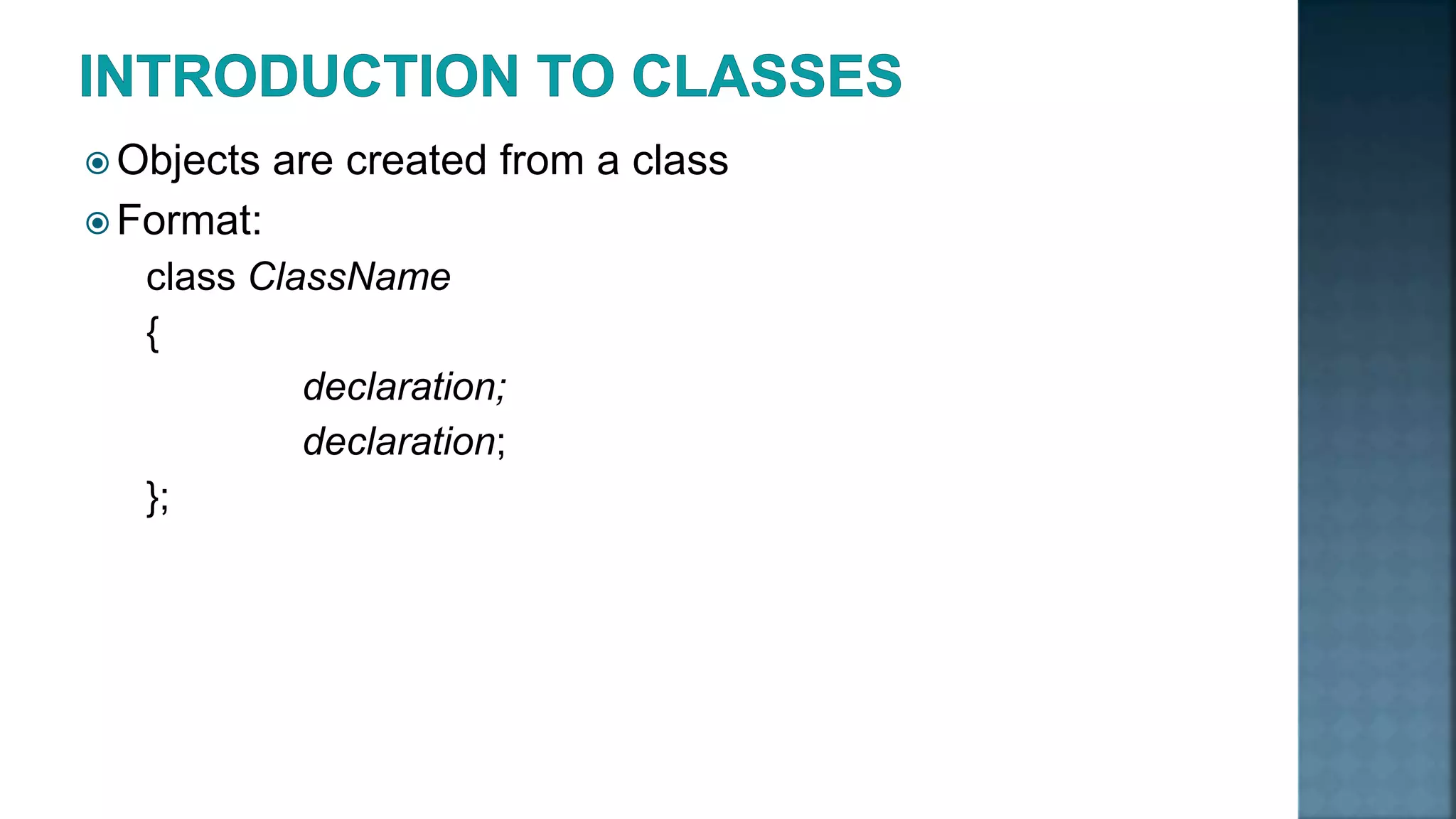
 Objects are created from a class  Format: class ClassName { declaration; declaration; };
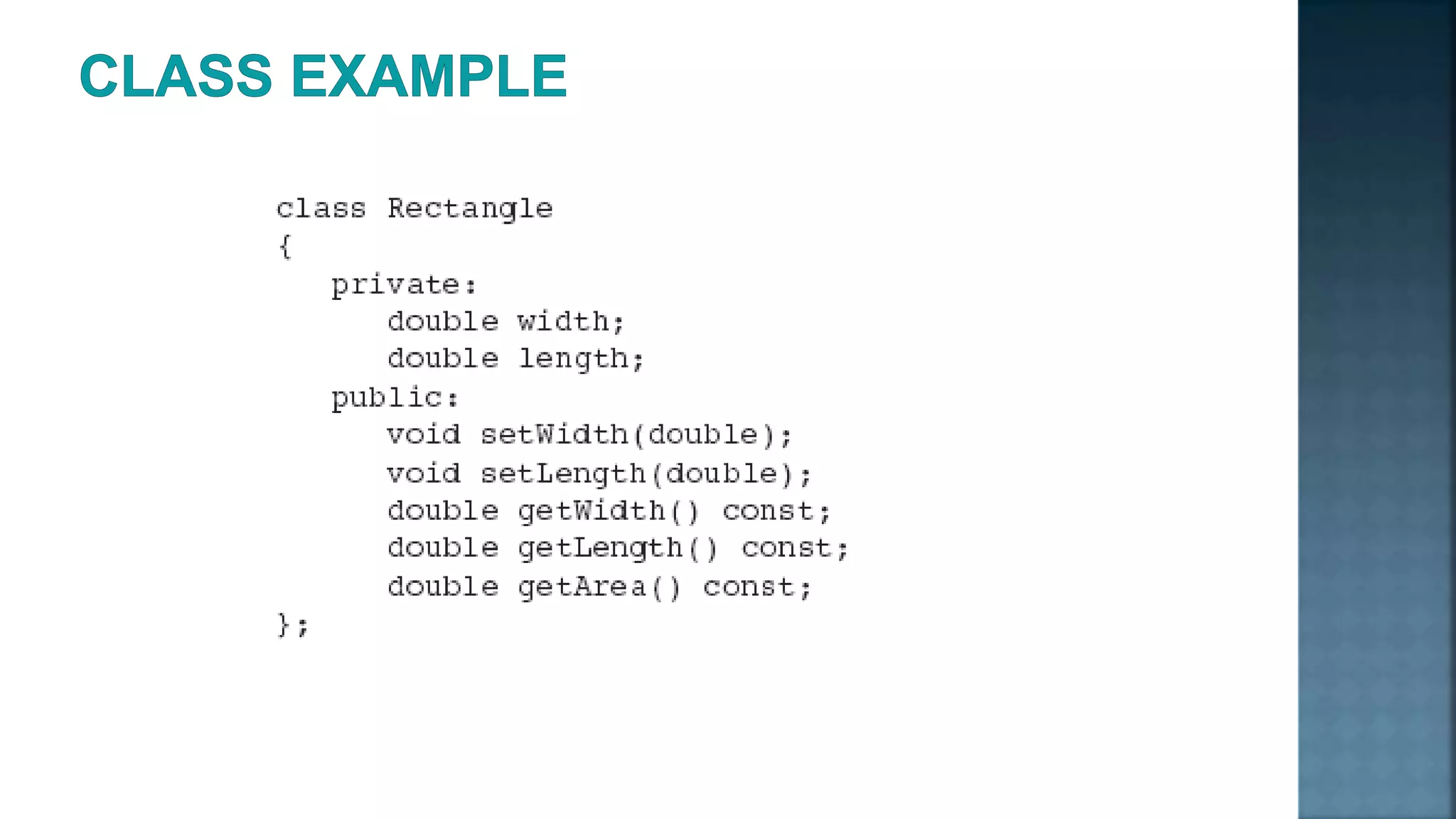
 Used to control access to members of the class  public: can be accessed by functions outside of the class  private: can only be called by or accessed by functions that are members of the class
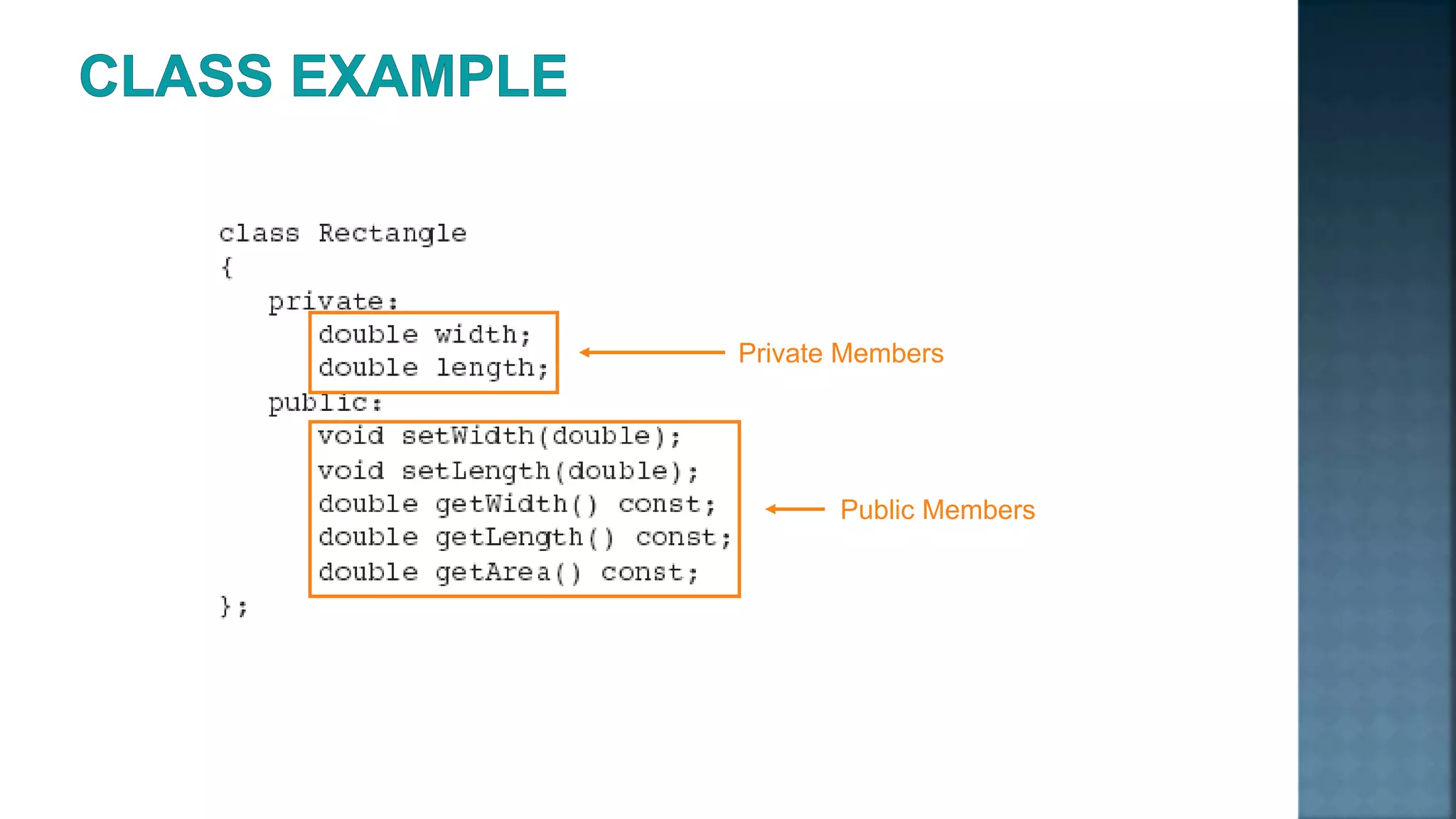
Private Members Public Members
 Can be listed in any order in a class  Can appear multiple times in a class  If not specified, the default is private
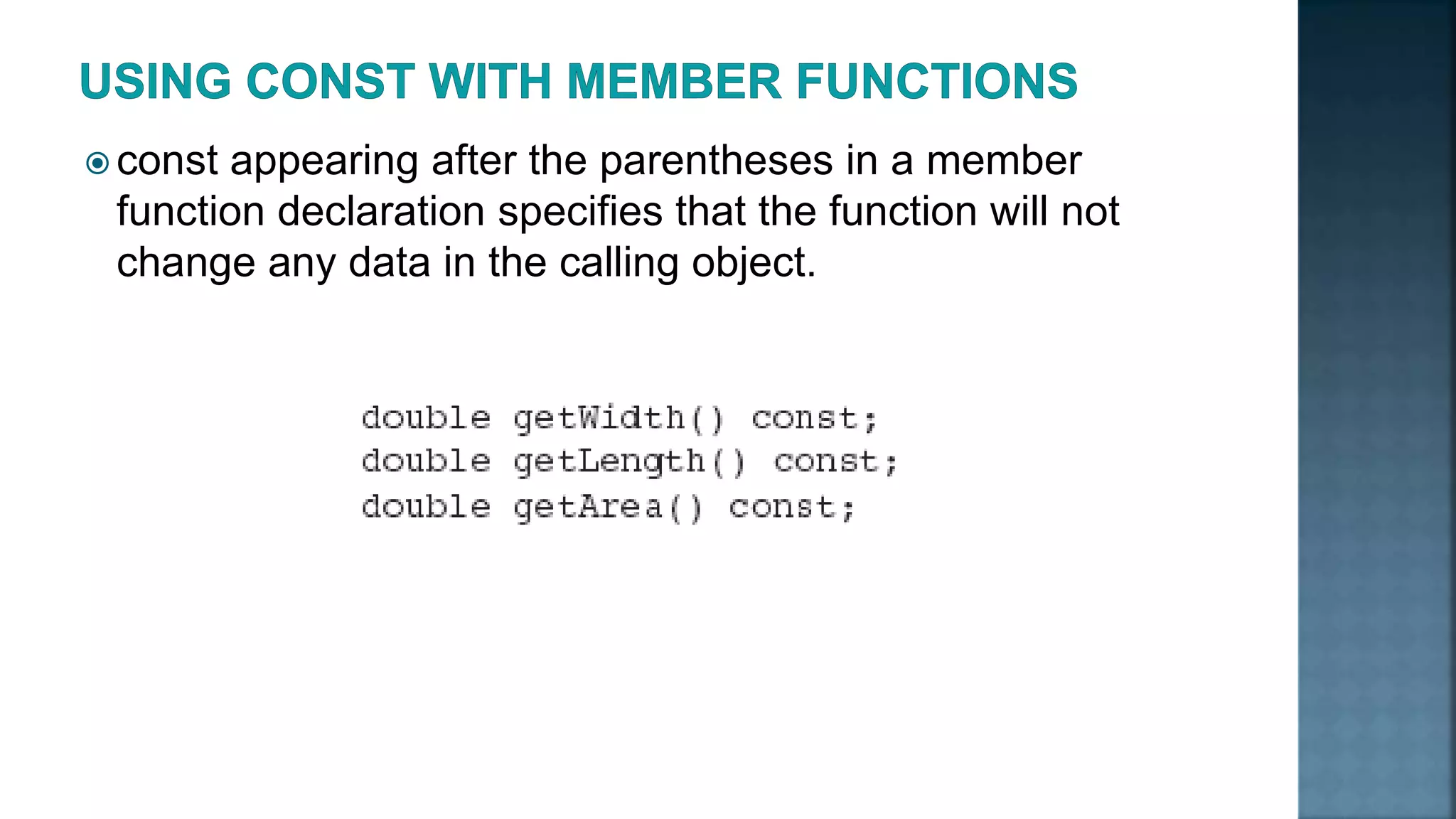
 const appearing after the parentheses in a member function declaration specifies that the function will not change any data in the calling object.
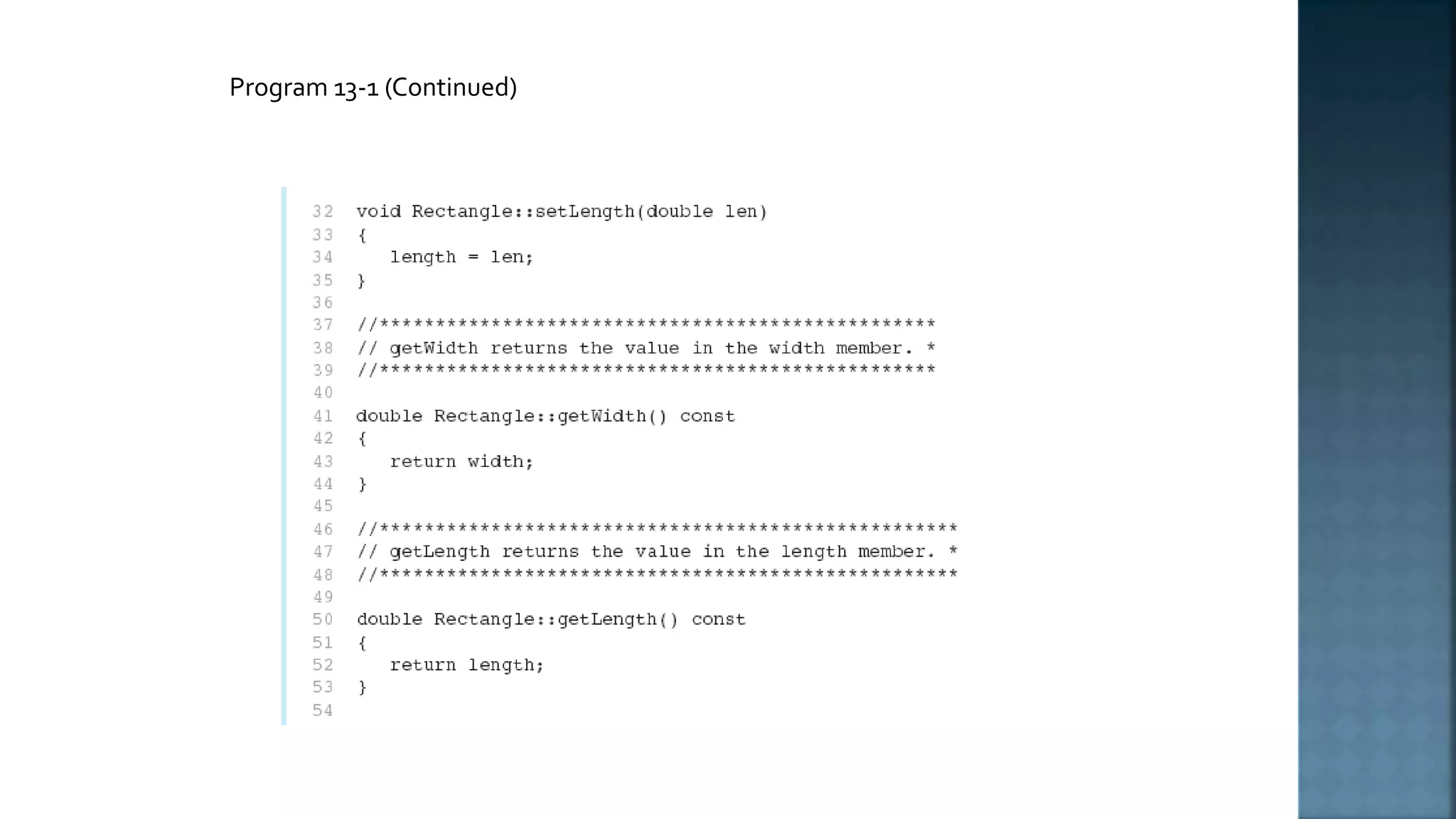
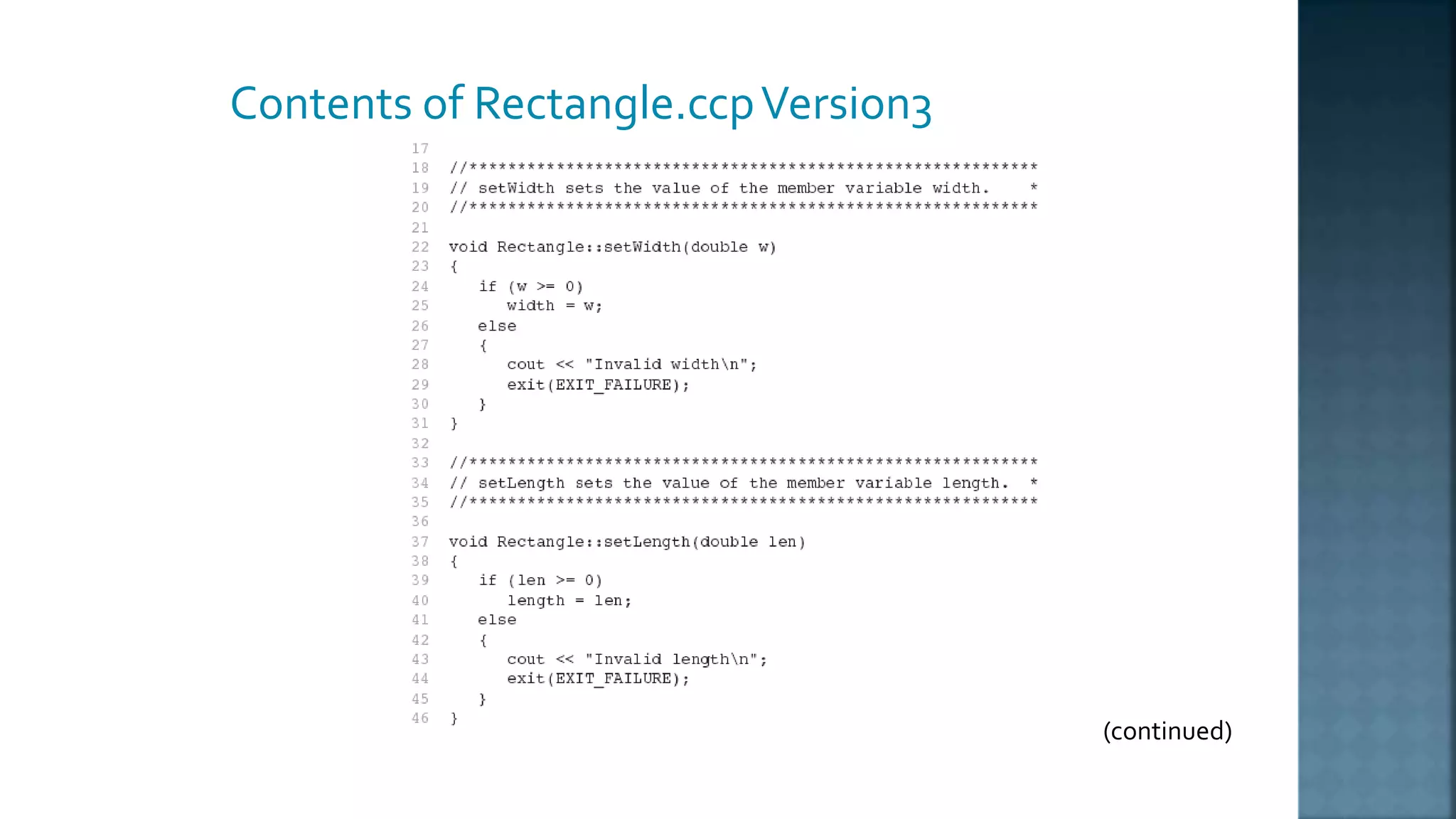
 When defining a member function:  Put prototype in class declaration  Define function using class name and scope resolution operator (::) int Rectangle::setWidth(double w) { width = w; }
 Mutator: a member function that stores a value in a private member variable, or changes its value in some way  Accessor: function that retrieves a value from a private member variable. Accessors do not change an object's data, so they should be marked const.
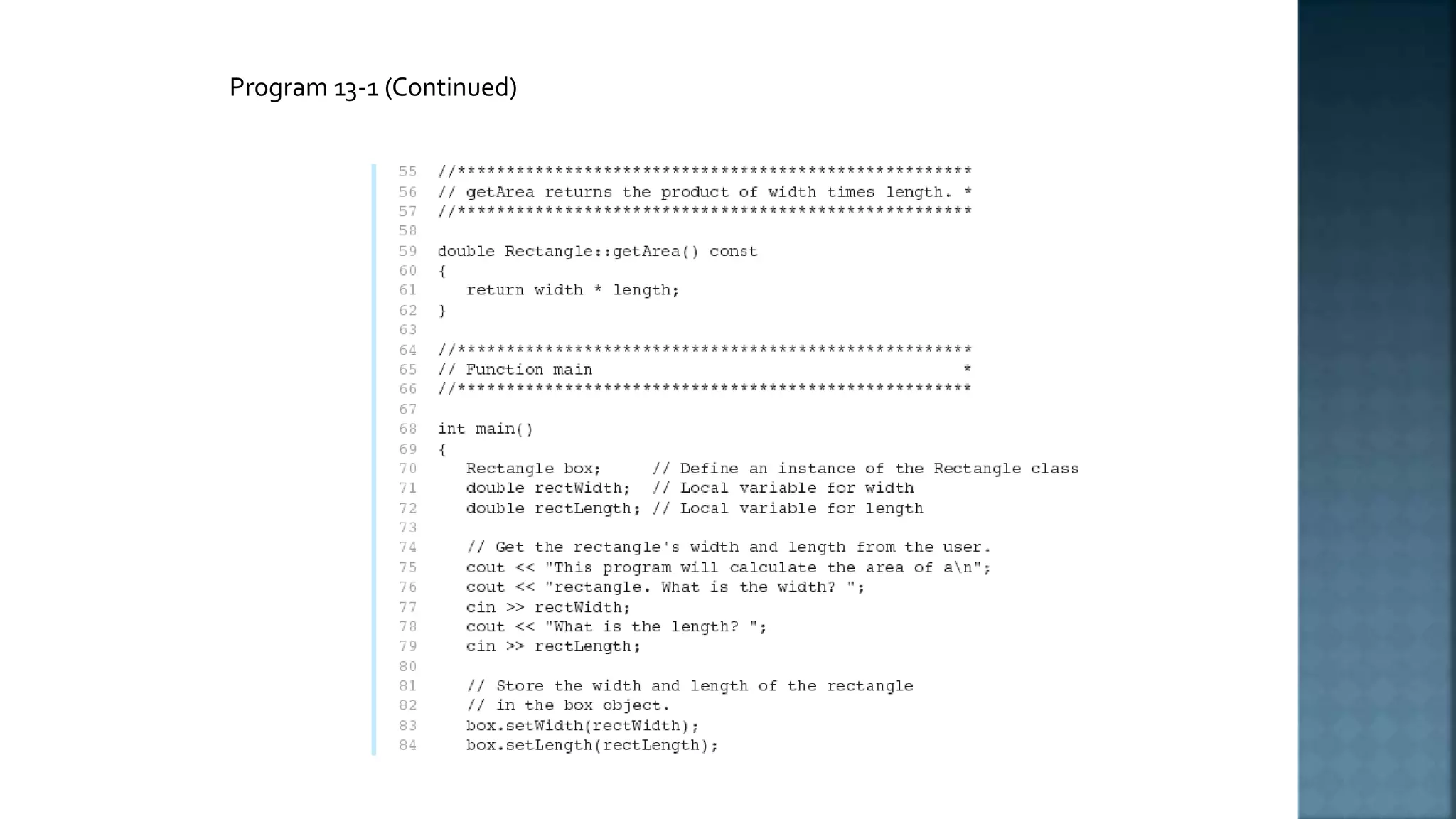
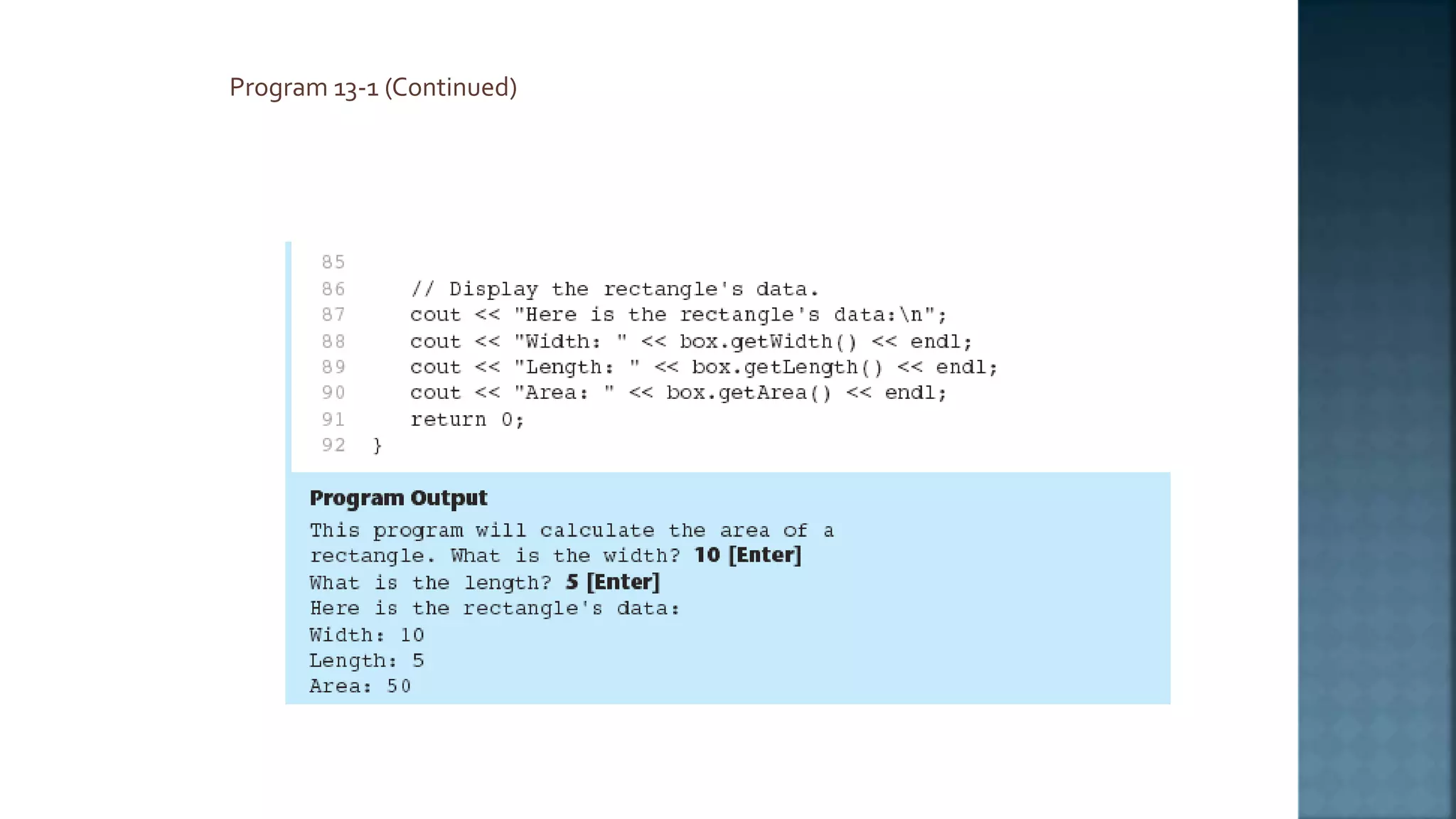
 An object is an instance of a class  Defined like structure variables: Rectangle r;  Access members using dot operator: r.setWidth(5.2); cout << r.getWidth();  Compiler error if attempt to access private member using dot operator
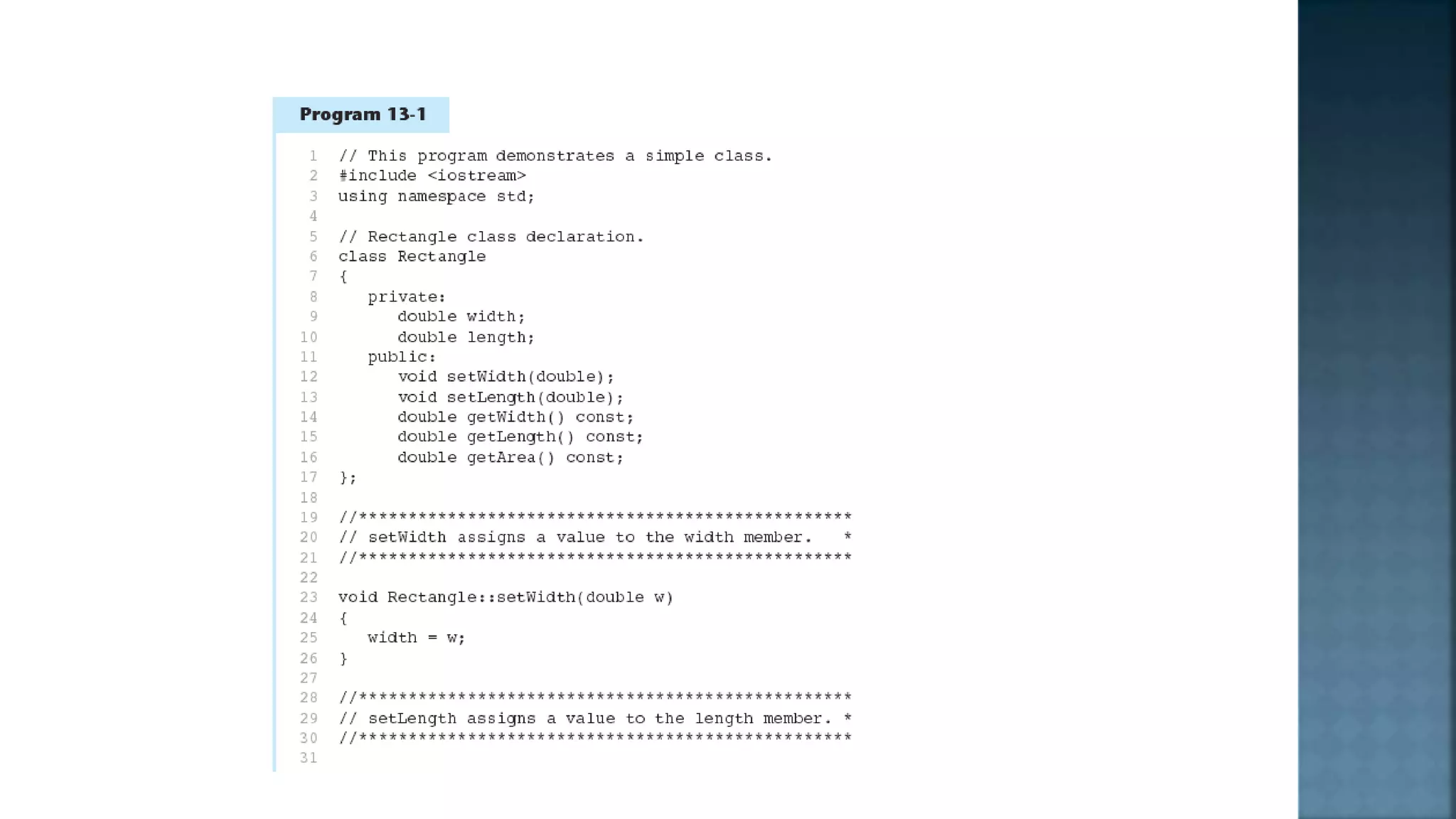
Program 13-1 (Continued)
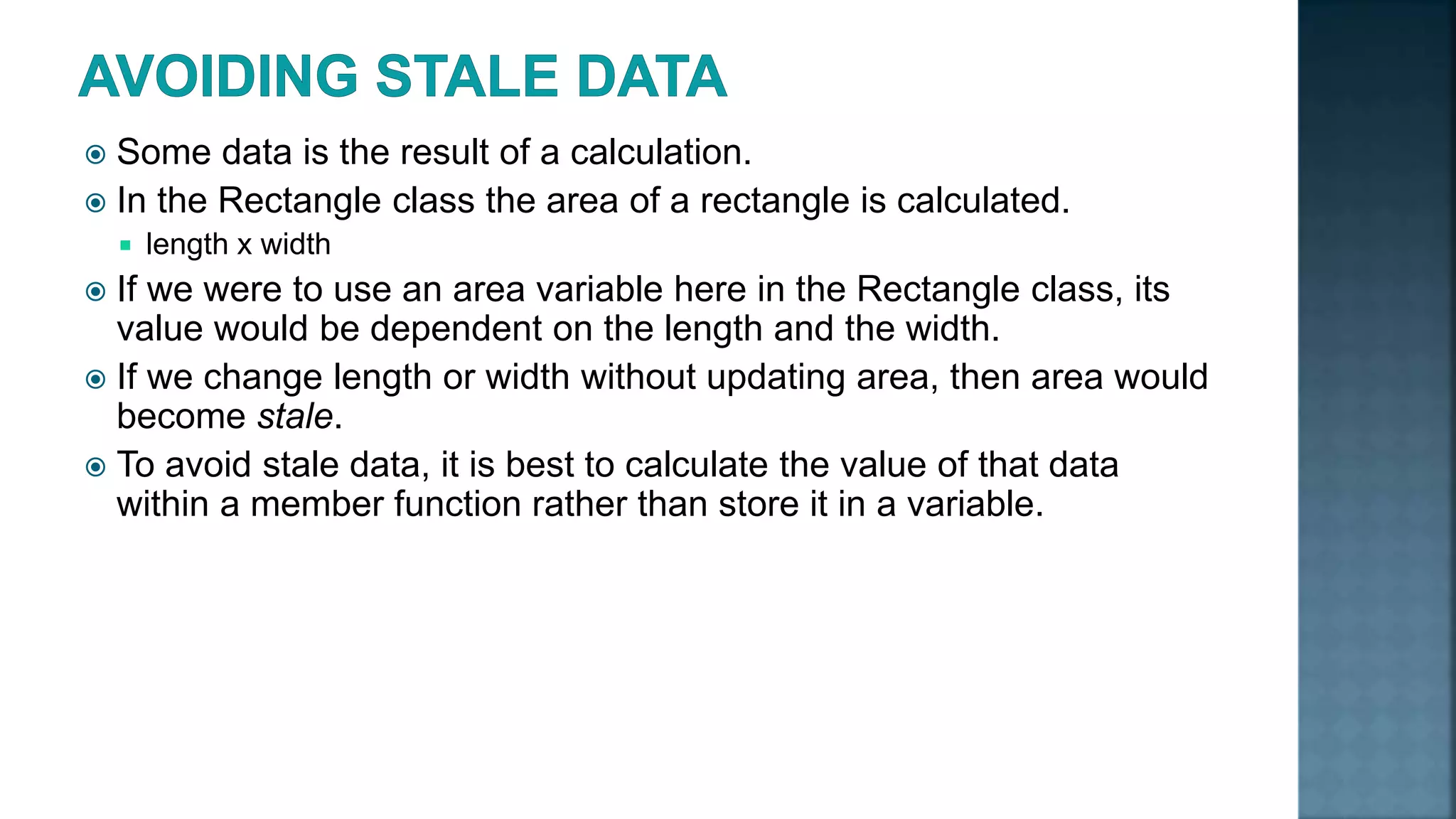
 Some data is the result of a calculation.  In the Rectangle class the area of a rectangle is calculated.  length x width  If we were to use an area variable here in the Rectangle class, its value would be dependent on the length and the width.  If we change length or width without updating area, then area would become stale.  To avoid stale data, it is best to calculate the value of that data within a member function rather than store it in a variable.
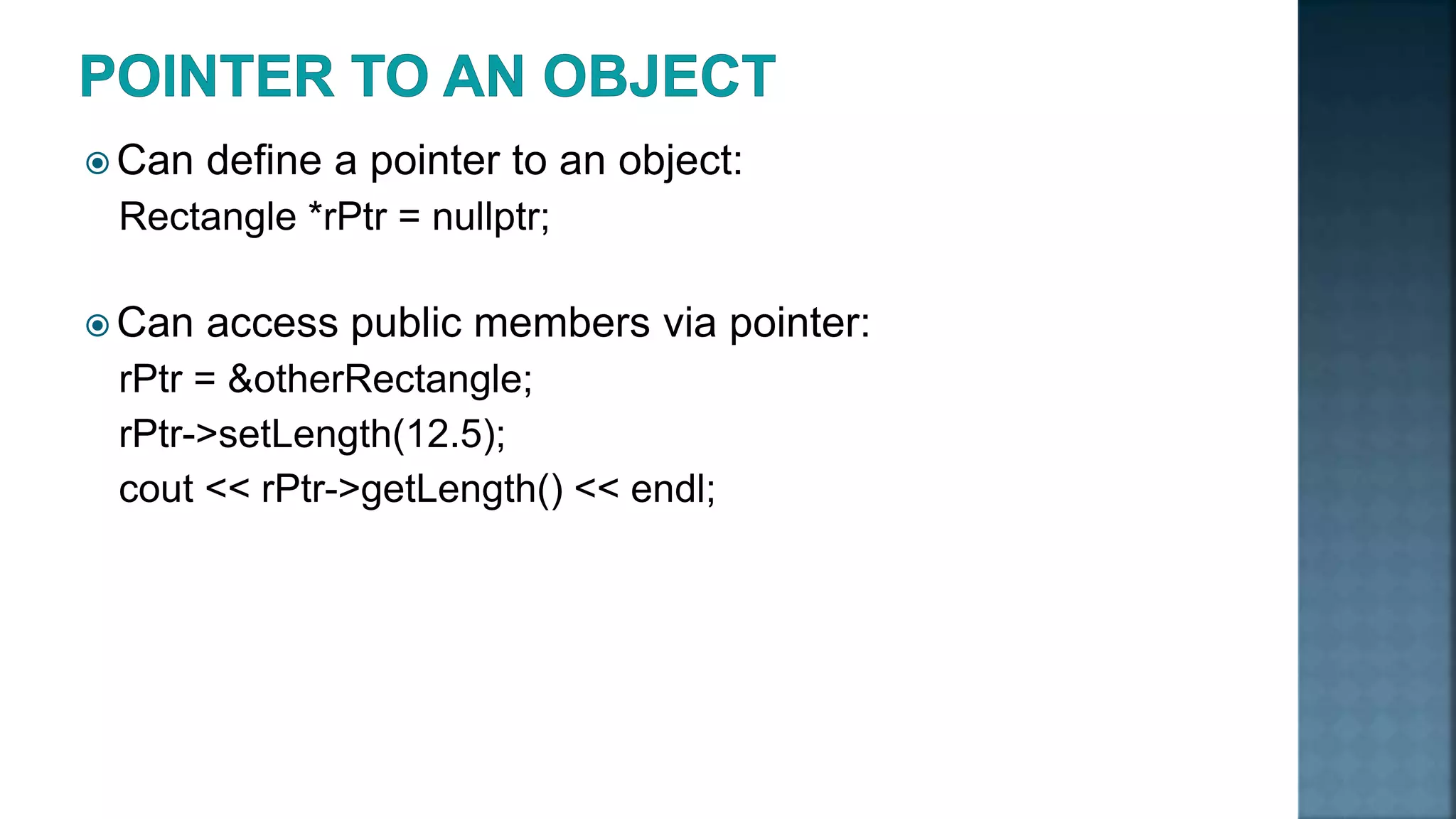
 Can define a pointer to an object: Rectangle *rPtr = nullptr;  Can access public members via pointer: rPtr = &otherRectangle; rPtr->setLength(12.5); cout << rPtr->getLength() << endl;
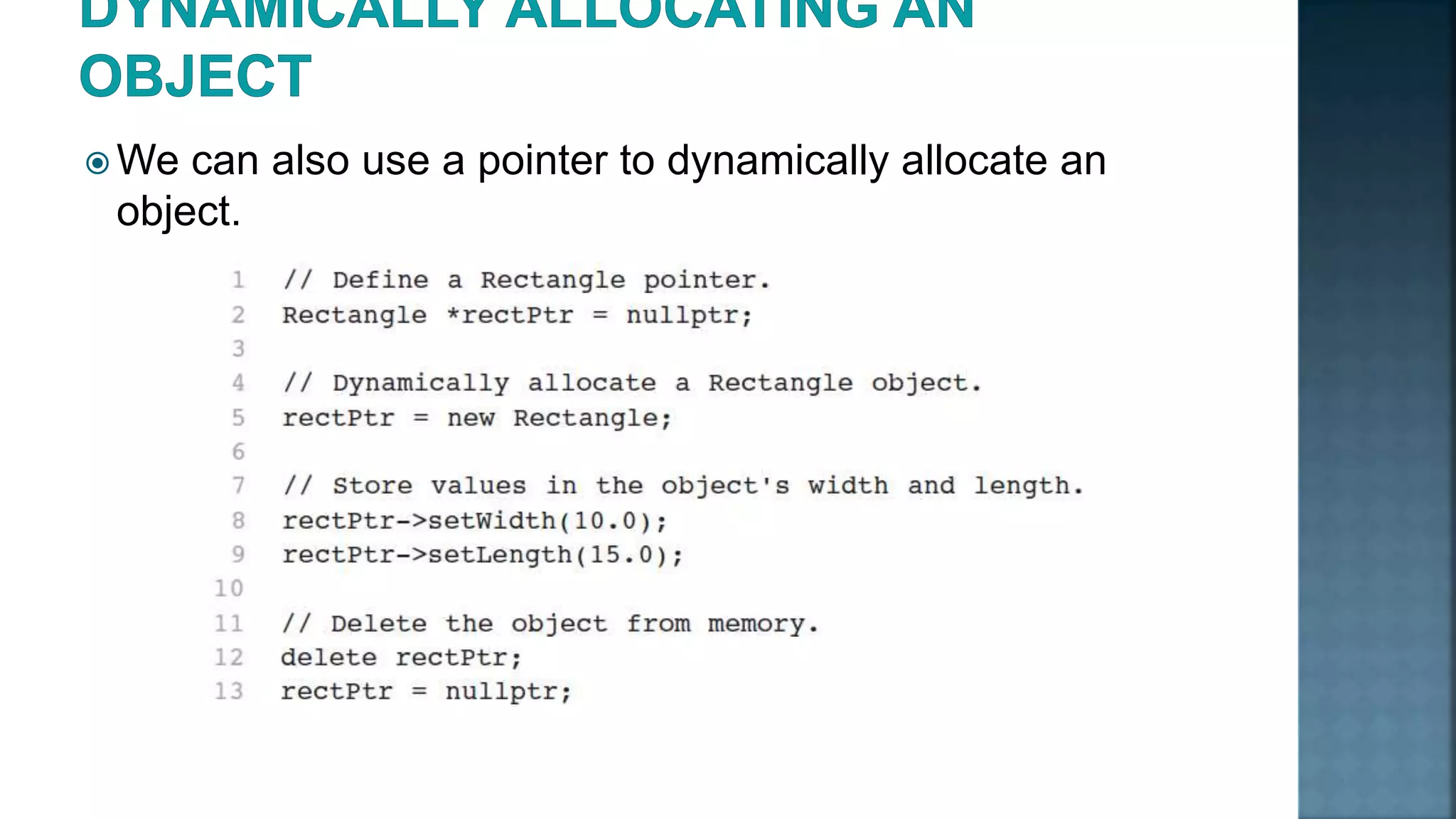
 We can also use a pointer to dynamically allocate an object.
 Making data members private provides data protection  Data can be accessed only through public functions  Public functions define the class’s public interface
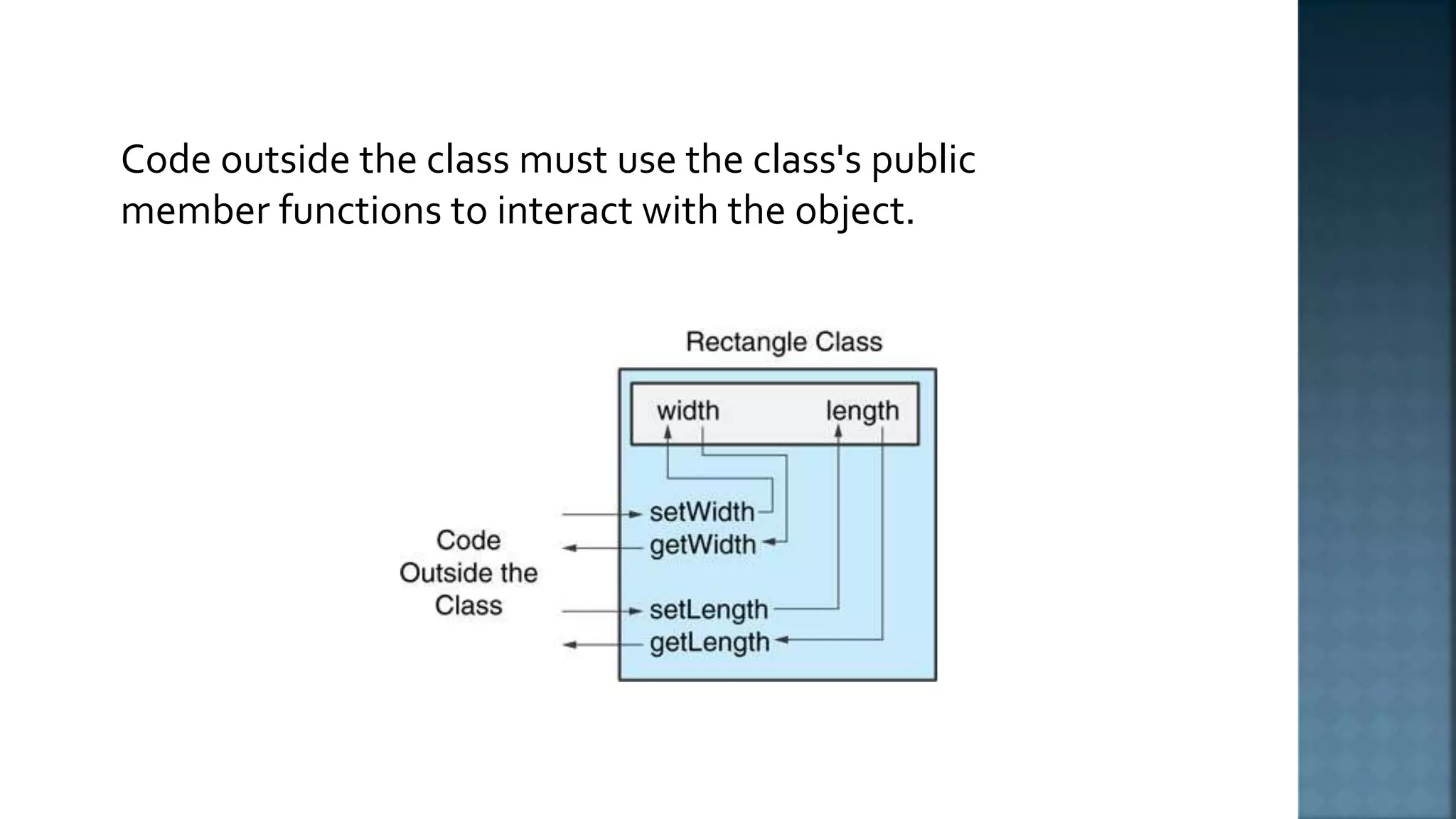
Code outside the class must use the class's public member functions to interact with the object.
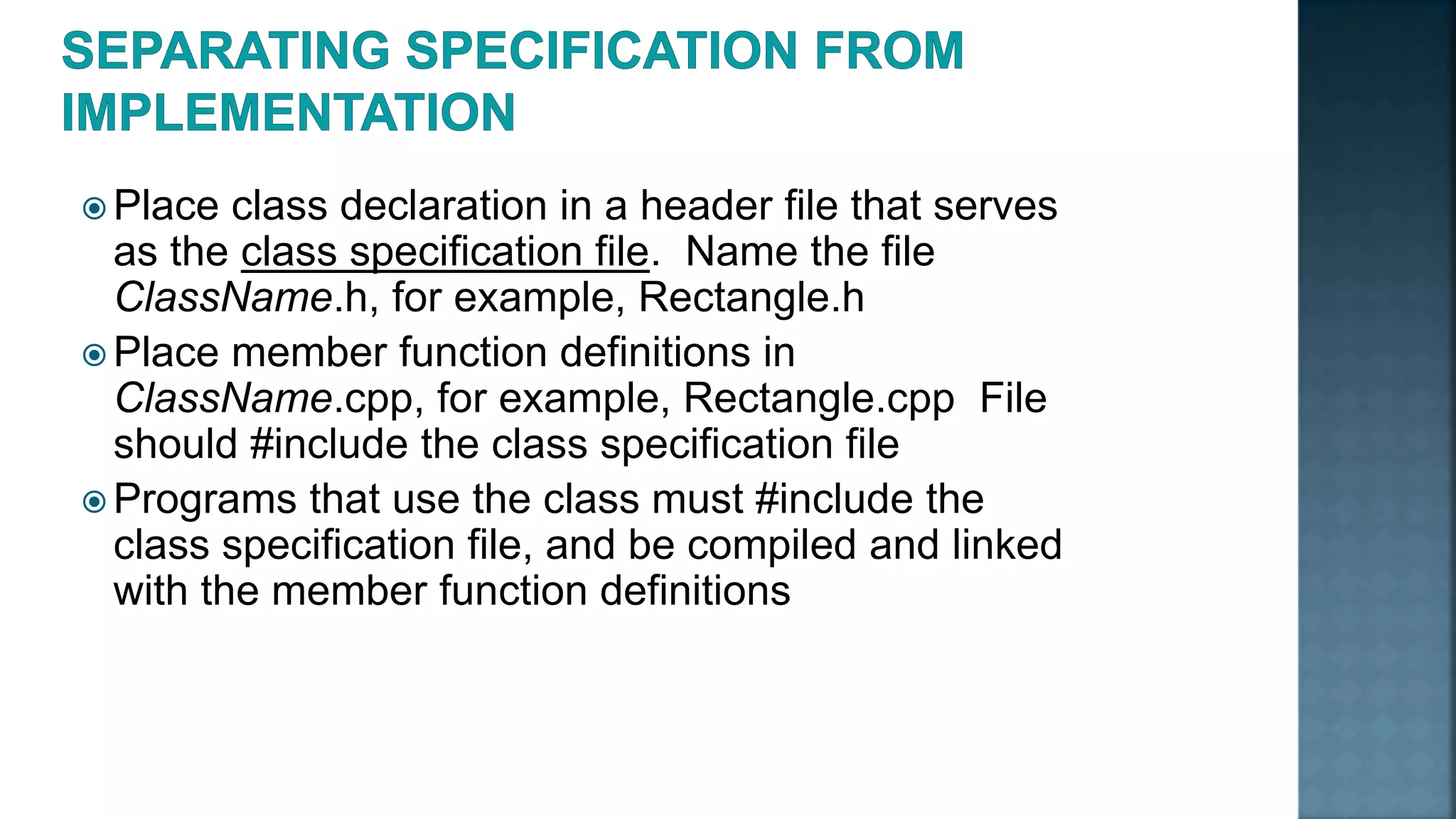
 Place class declaration in a header file that serves as the class specification file. Name the file ClassName.h, for example, Rectangle.h  Place member function definitions in ClassName.cpp, for example, Rectangle.cpp File should #include the class specification file  Programs that use the class must #include the class specification file, and be compiled and linked with the member function definitions
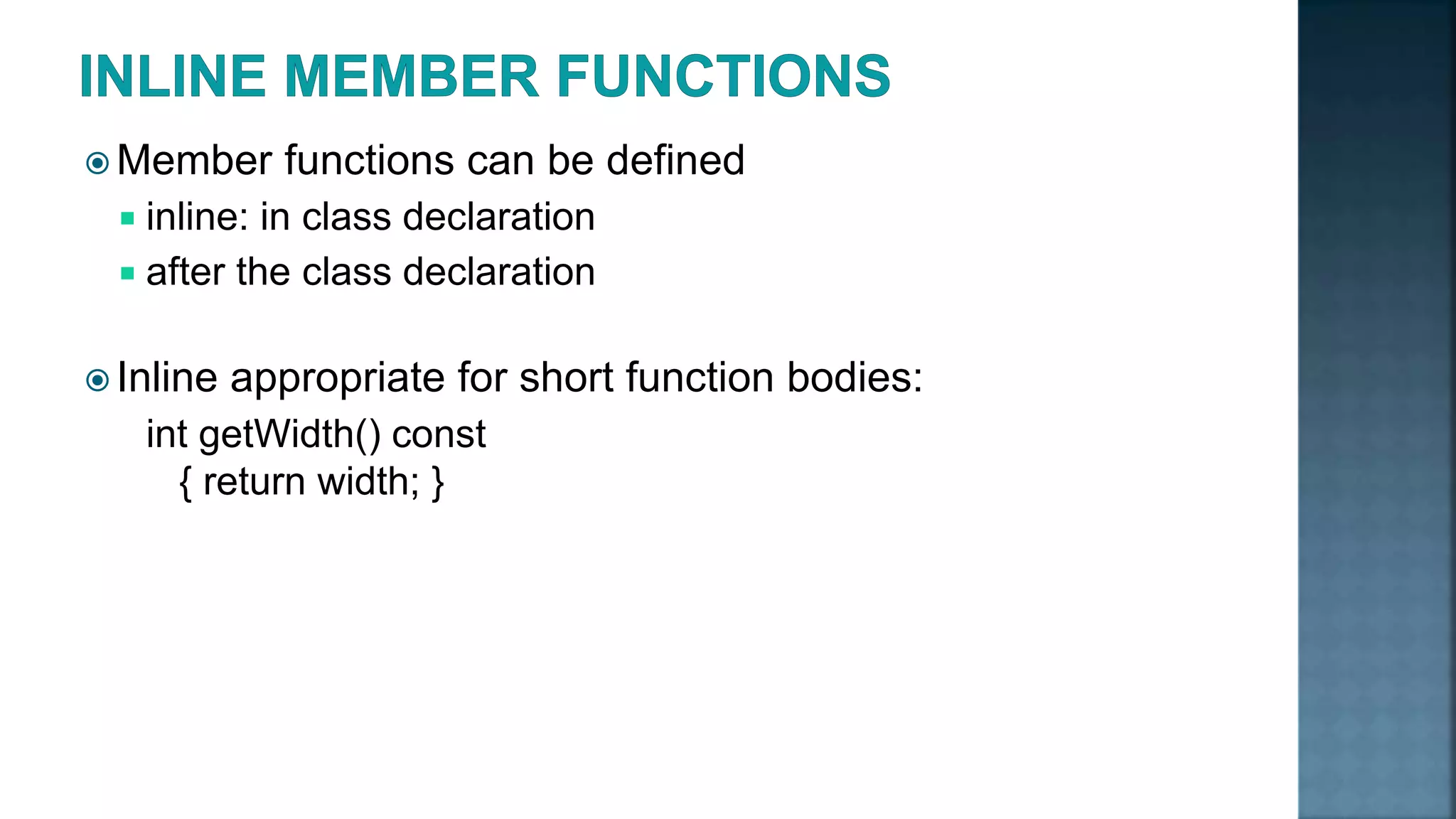
 Member functions can be defined  inline: in class declaration  after the class declaration  Inline appropriate for short function bodies: int getWidth() const { return width; }
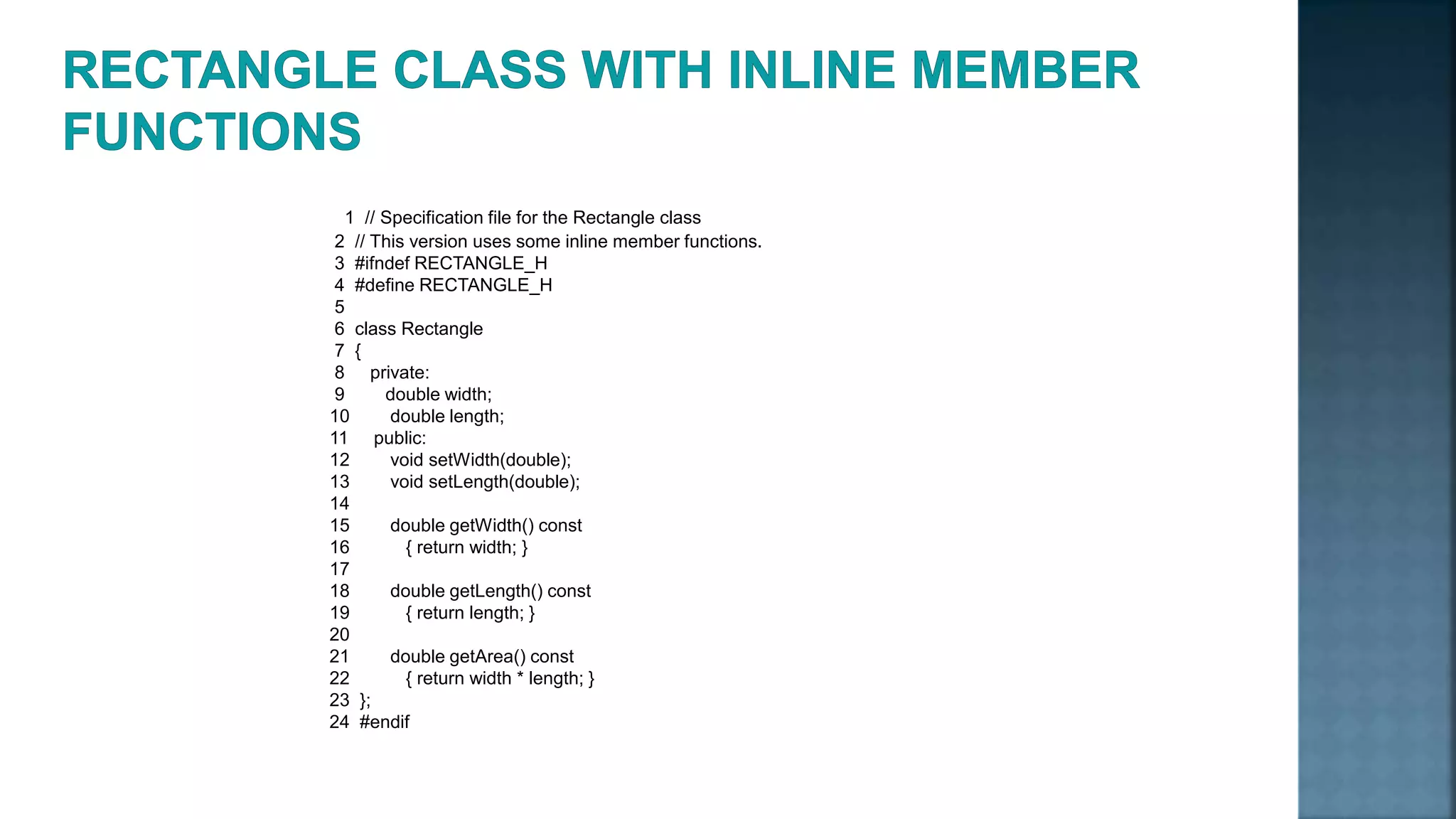
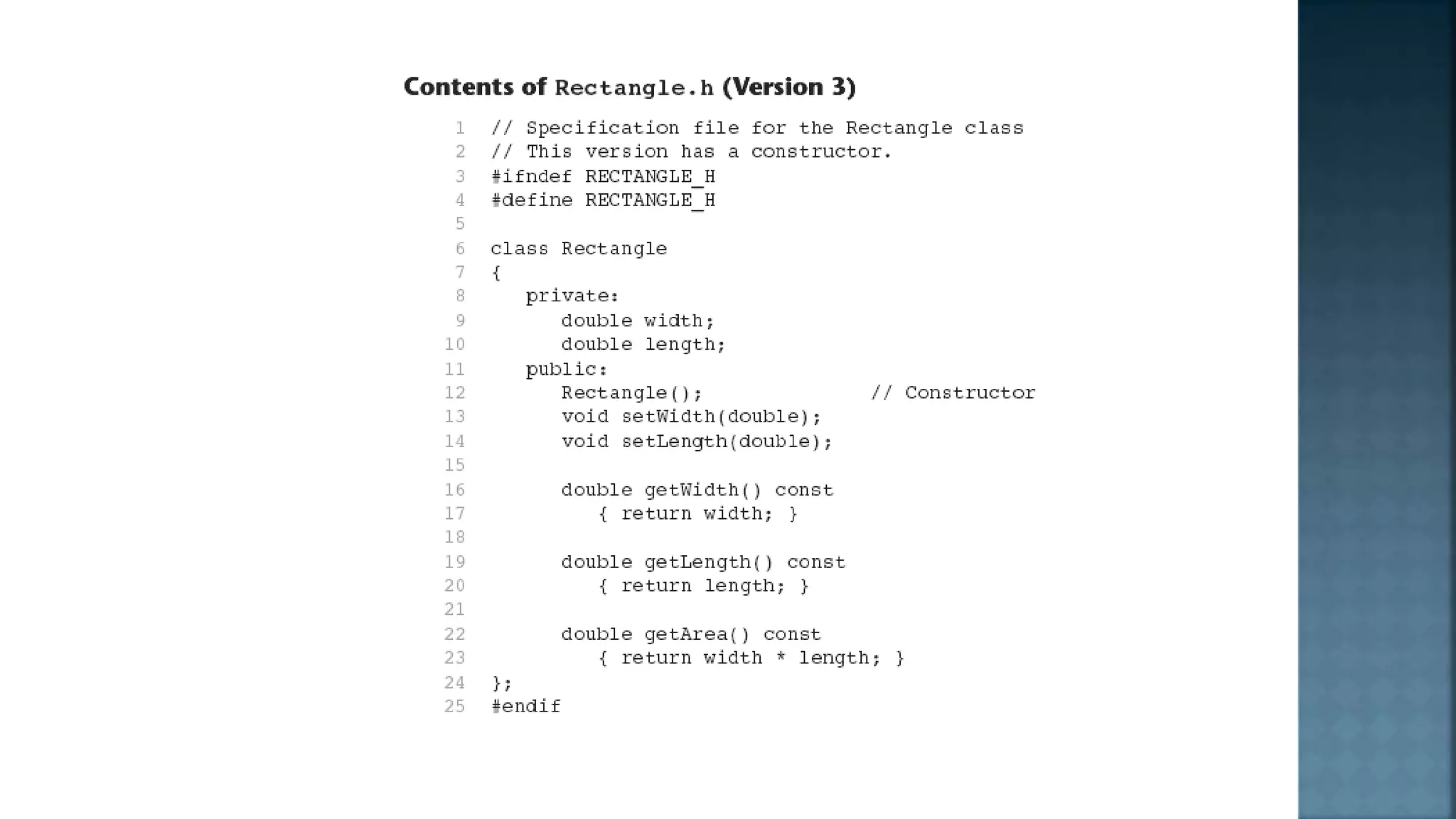
1 // Specification file for the Rectangle class 2 // This version uses some inline member functions. 3 #ifndef RECTANGLE_H 4 #define RECTANGLE_H 5 6 class Rectangle 7 { 8 private: 9 double width; 10 double length; 11 public: 12 void setWidth(double); 13 void setLength(double); 14 15 double getWidth() const 16 { return width; } 17 18 double getLength() const 19 { return length; } 20 21 double getArea() const 22 { return width * length; } 23 }; 24 #endif
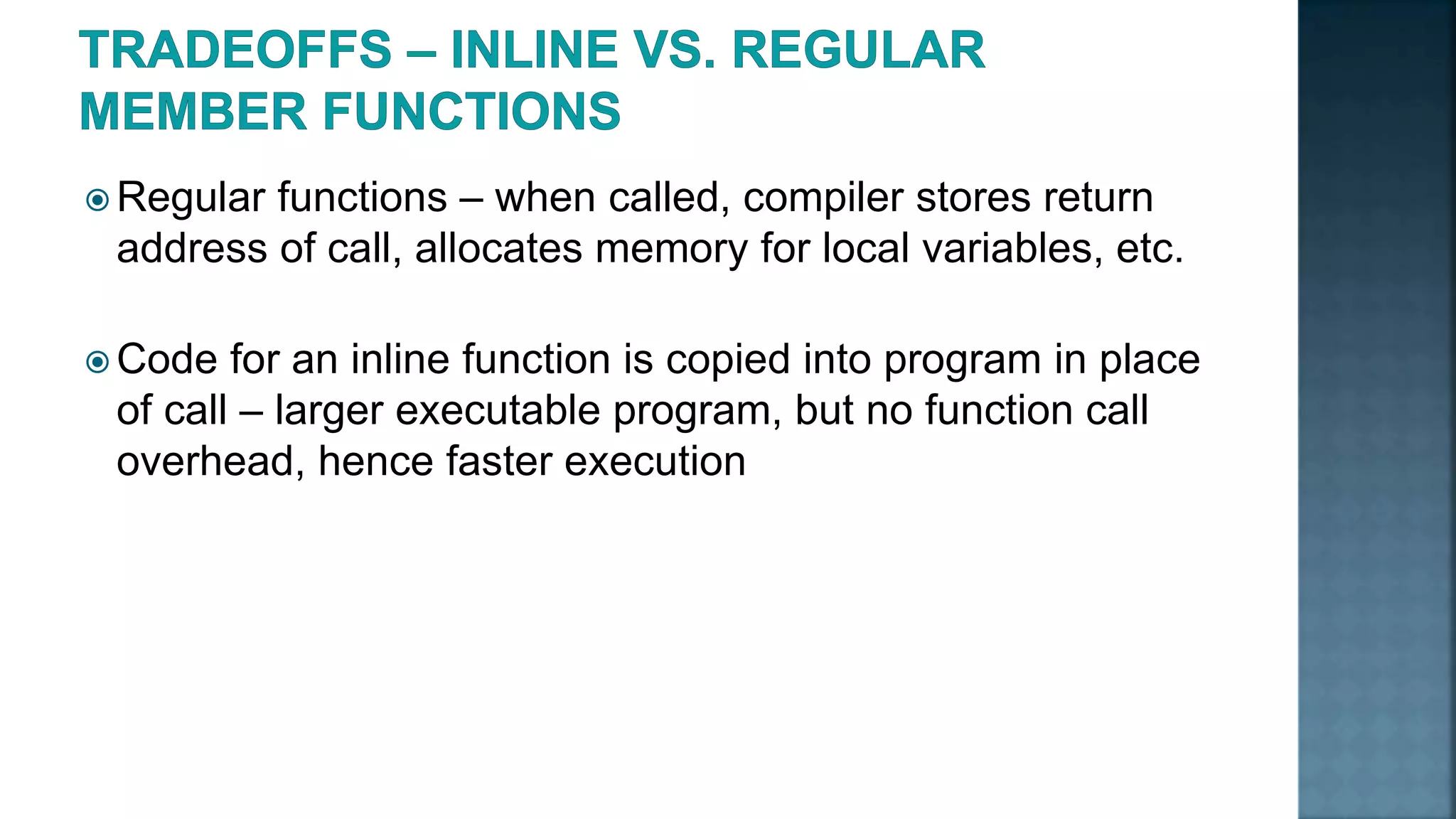
 Regular functions – when called, compiler stores return address of call, allocates memory for local variables, etc.  Code for an inline function is copied into program in place of call – larger executable program, but no function call overhead, hence faster execution
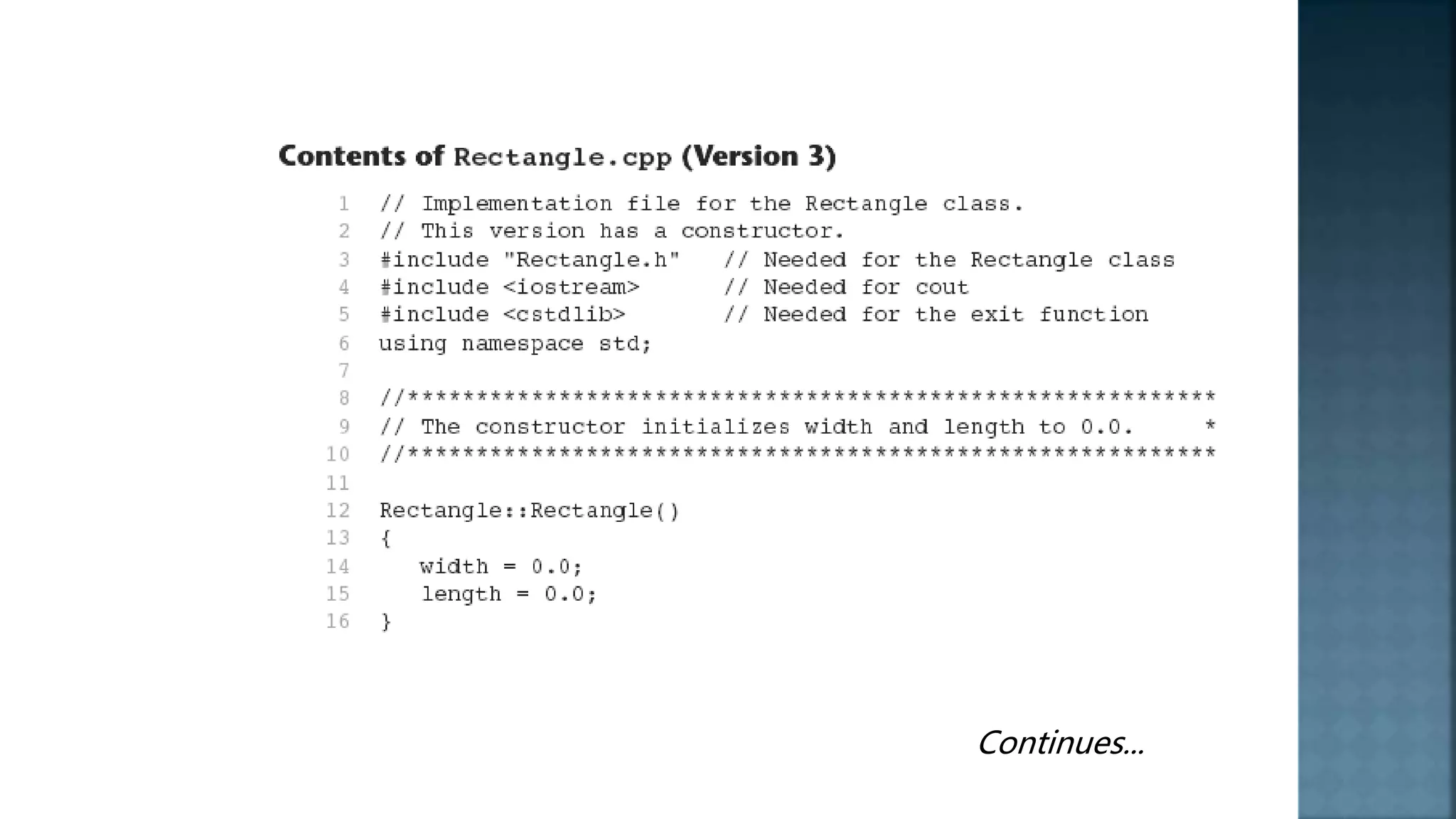
 Member function that is automatically called when an object is created  Purpose is to construct an object  Constructor function name is class name  Has no return type
Continues...
Contents of Rectangle.ccpVersion3 (continued)
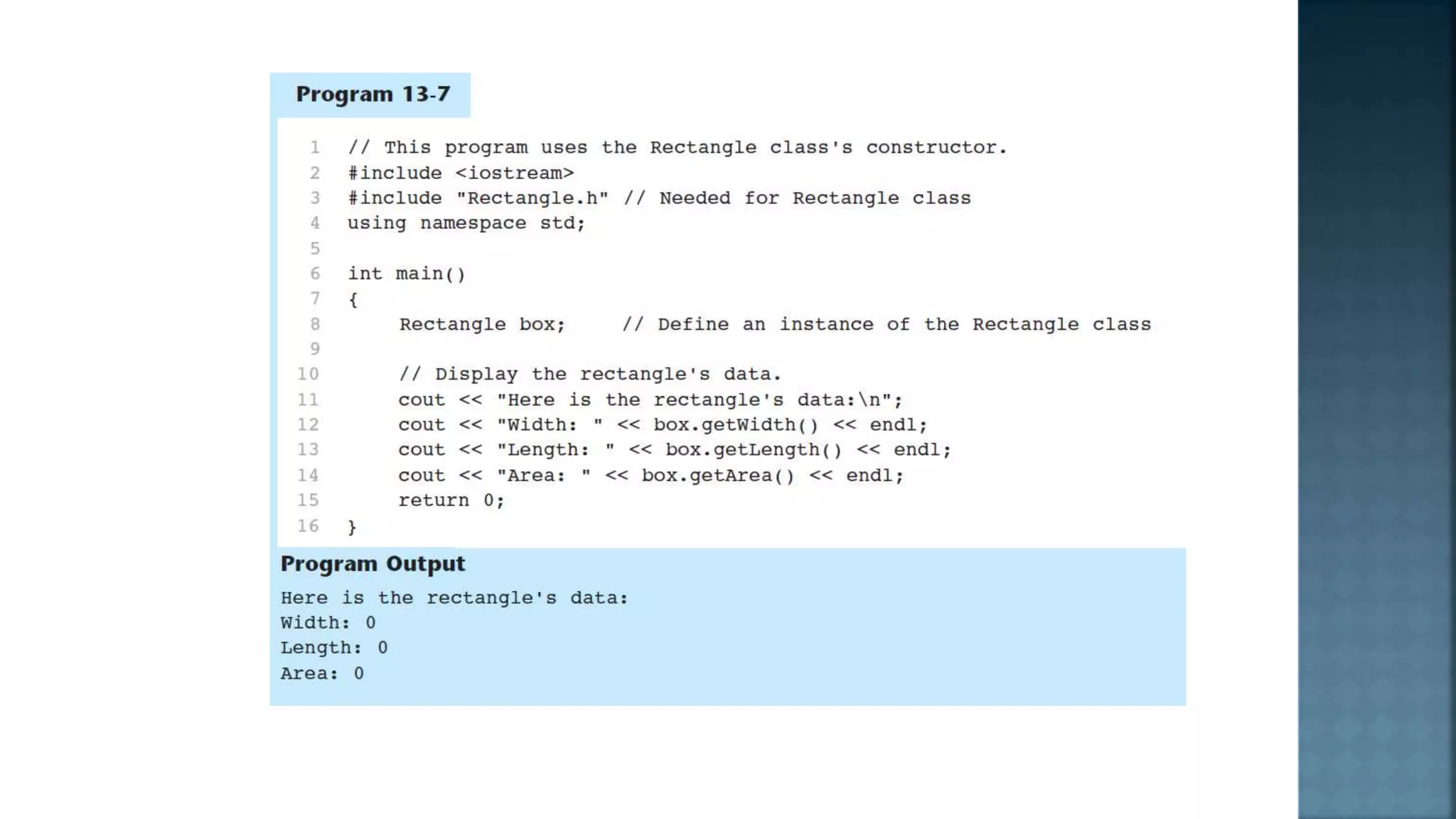
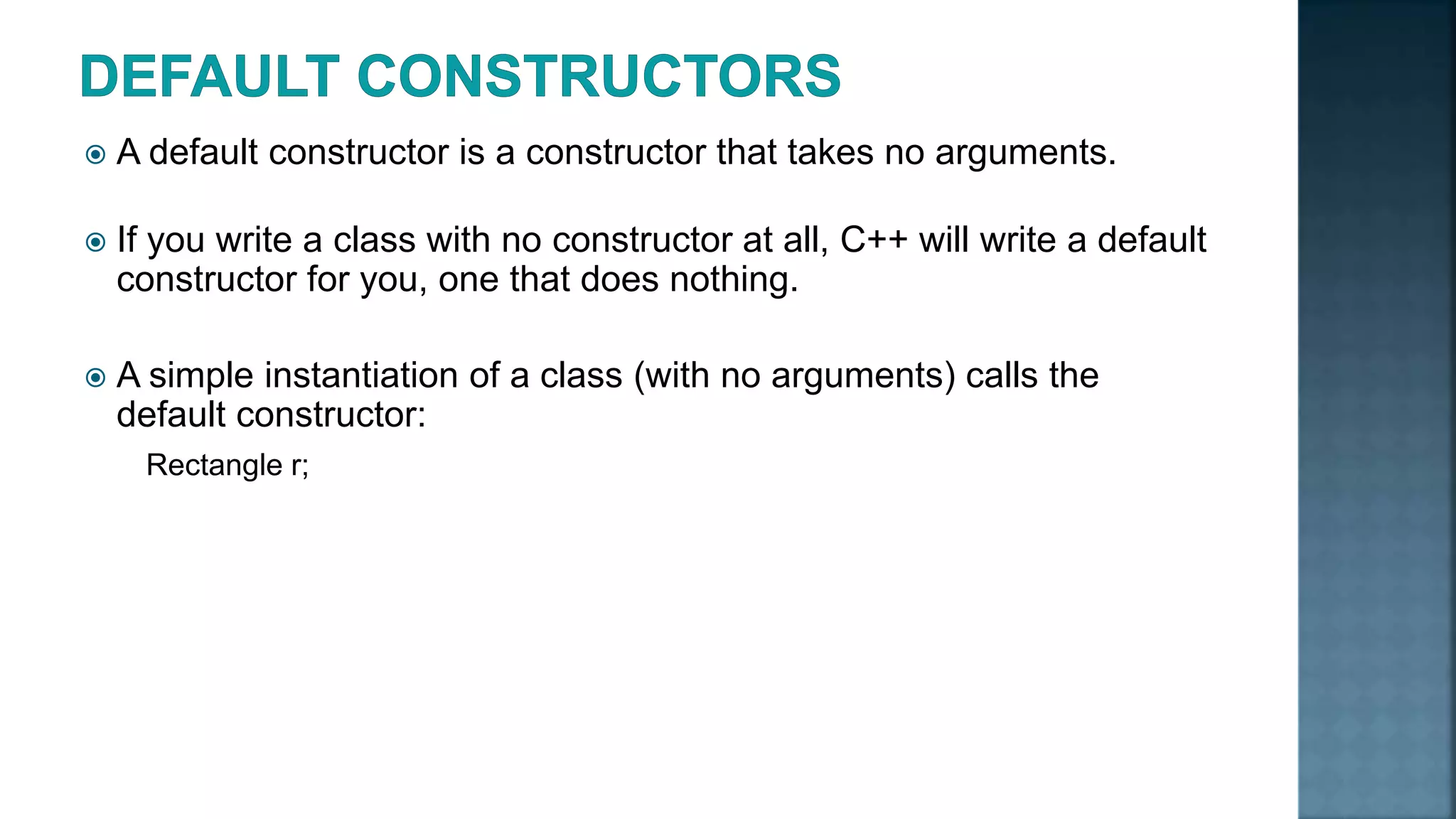
 A default constructor is a constructor that takes no arguments.  If you write a class with no constructor at all, C++ will write a default constructor for you, one that does nothing.  A simple instantiation of a class (with no arguments) calls the default constructor: Rectangle r;
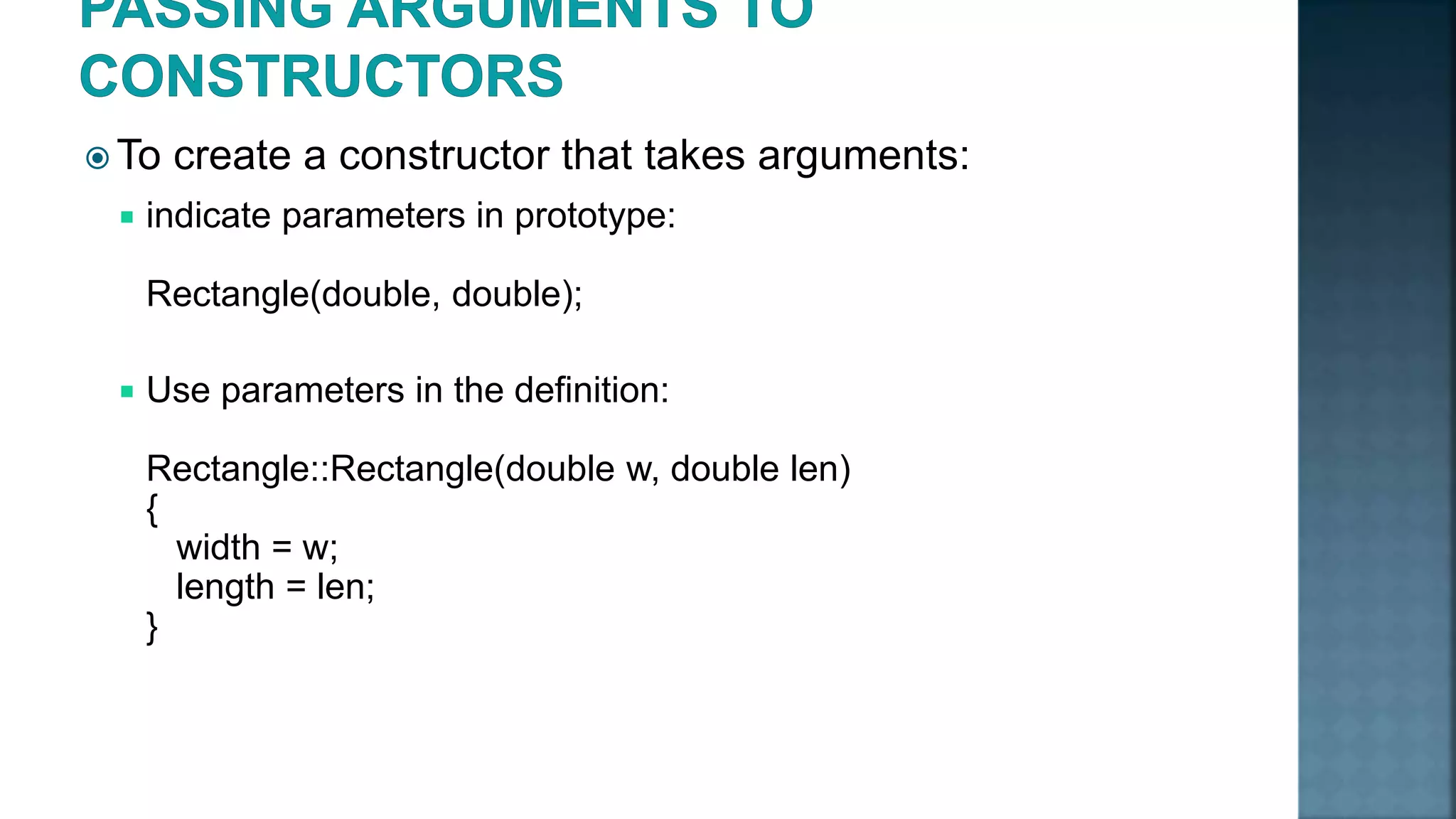
 To create a constructor that takes arguments:  indicate parameters in prototype: Rectangle(double, double);  Use parameters in the definition: Rectangle::Rectangle(double w, double len) { width = w; length = len; }
 You can pass arguments to the constructor when you create an object: Rectangle r(10, 5);
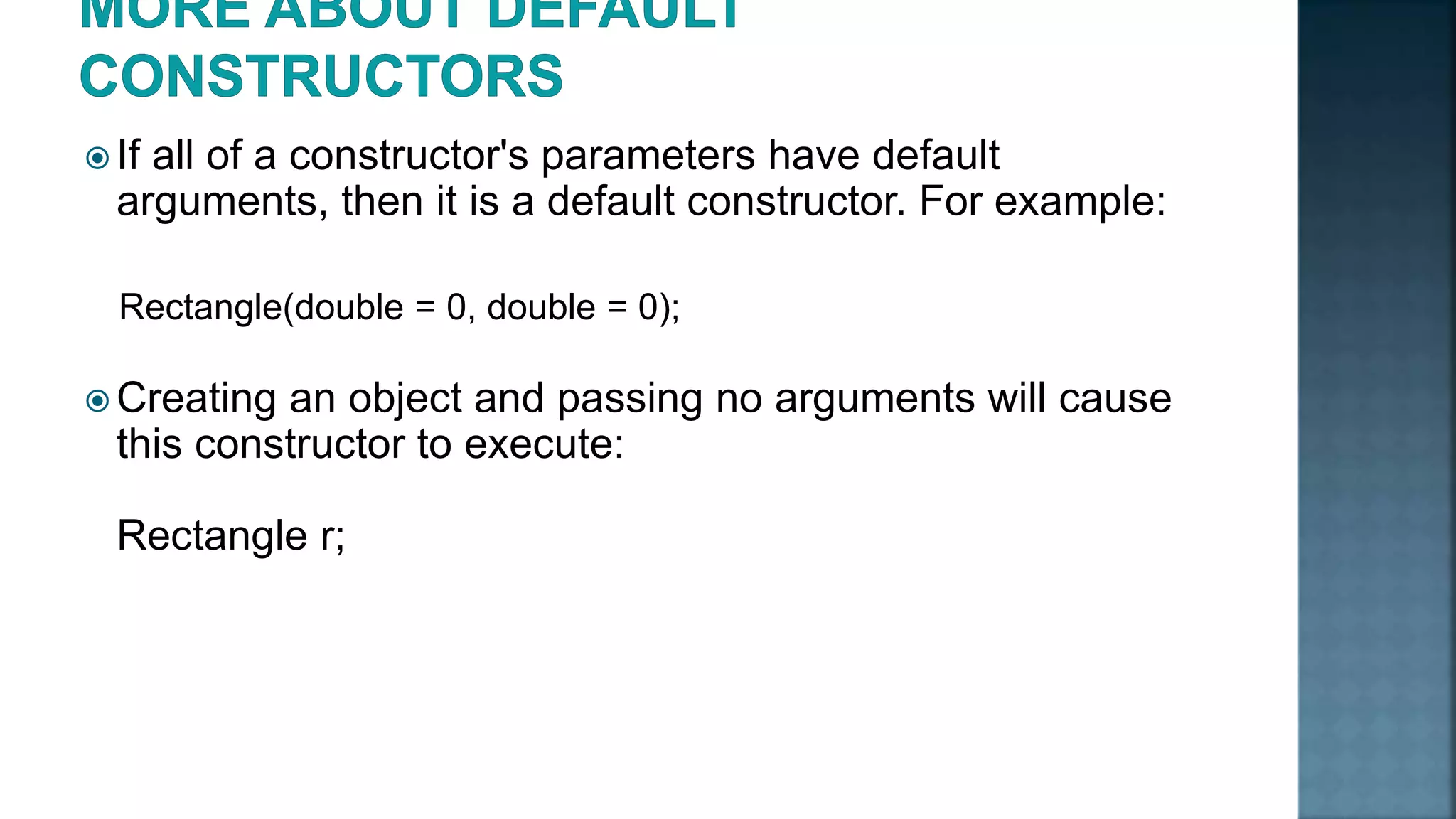
 If all of a constructor's parameters have default arguments, then it is a default constructor. For example: Rectangle(double = 0, double = 0);  Creating an object and passing no arguments will cause this constructor to execute: Rectangle r;
 When all of a class's constructors require arguments, then the class has NO default constructor.  When this is the case, you must pass the required arguments to the constructor when creating an object.
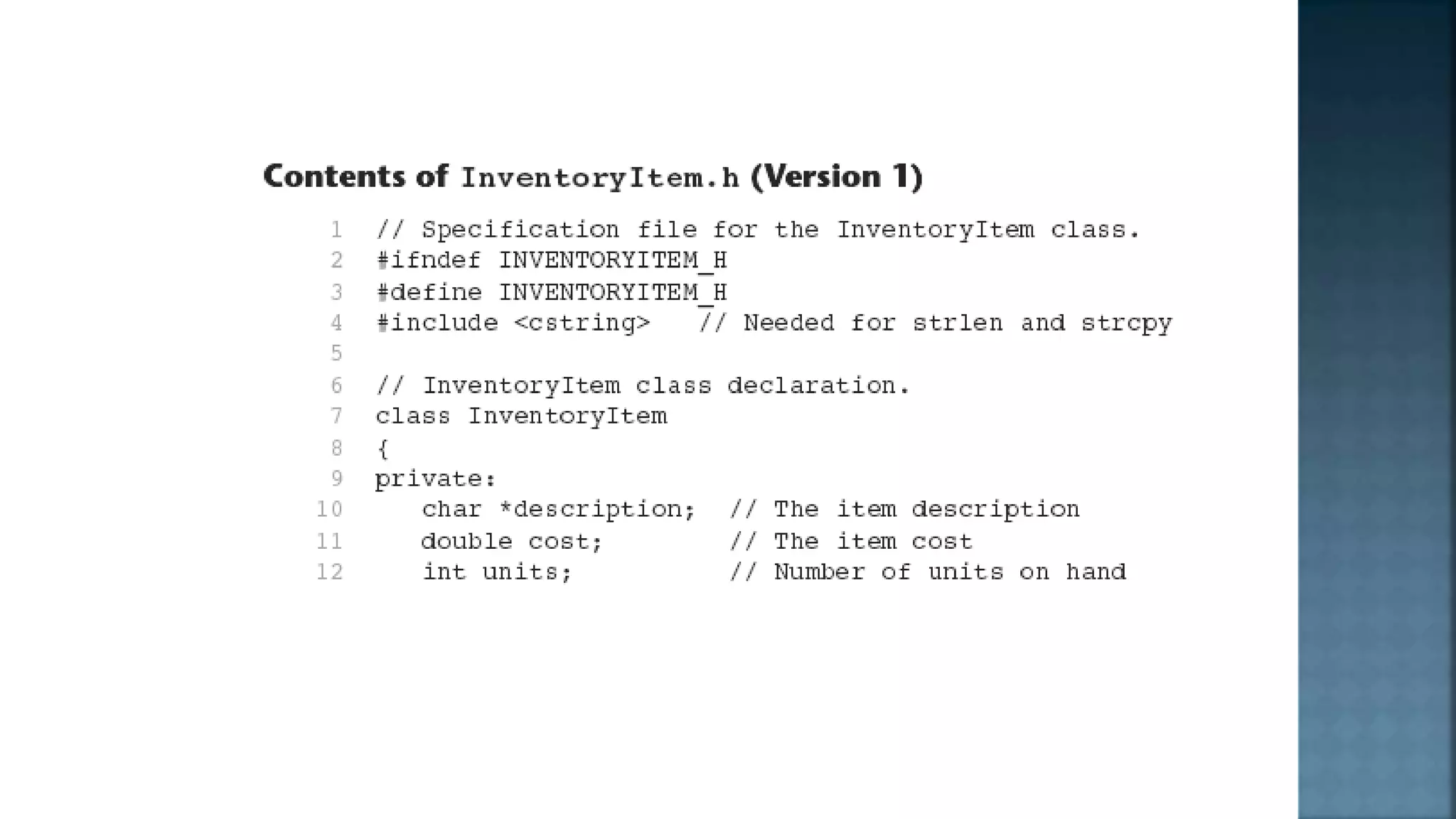
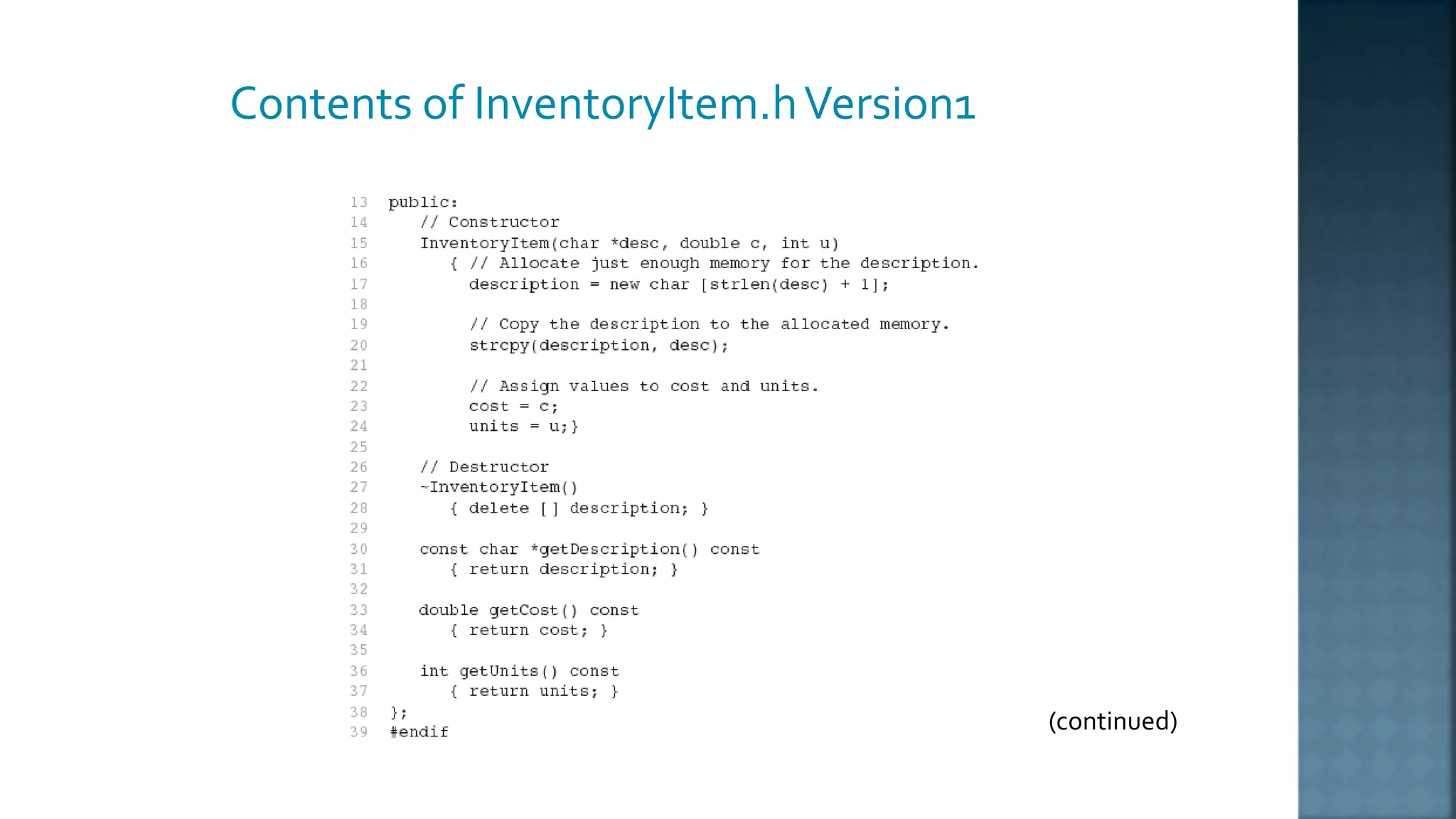
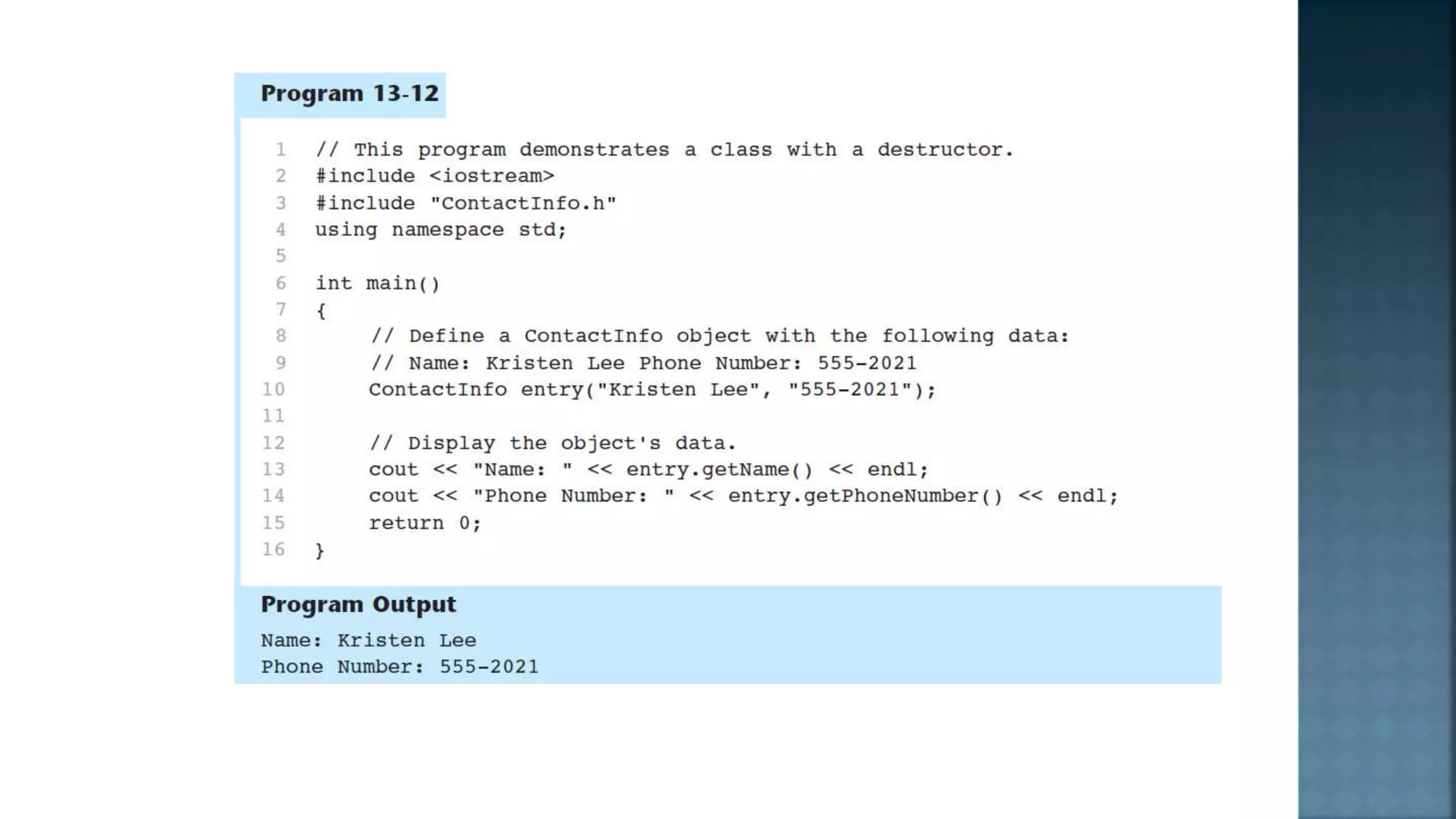
 Member function automatically called when an object is destroyed  Destructor name is ~classname, e.g., ~Rectangle  Has no return type; takes no arguments  Only one destructor per class, i.e., it cannot be overloaded  If constructor allocates dynamic memory, destructor should release it
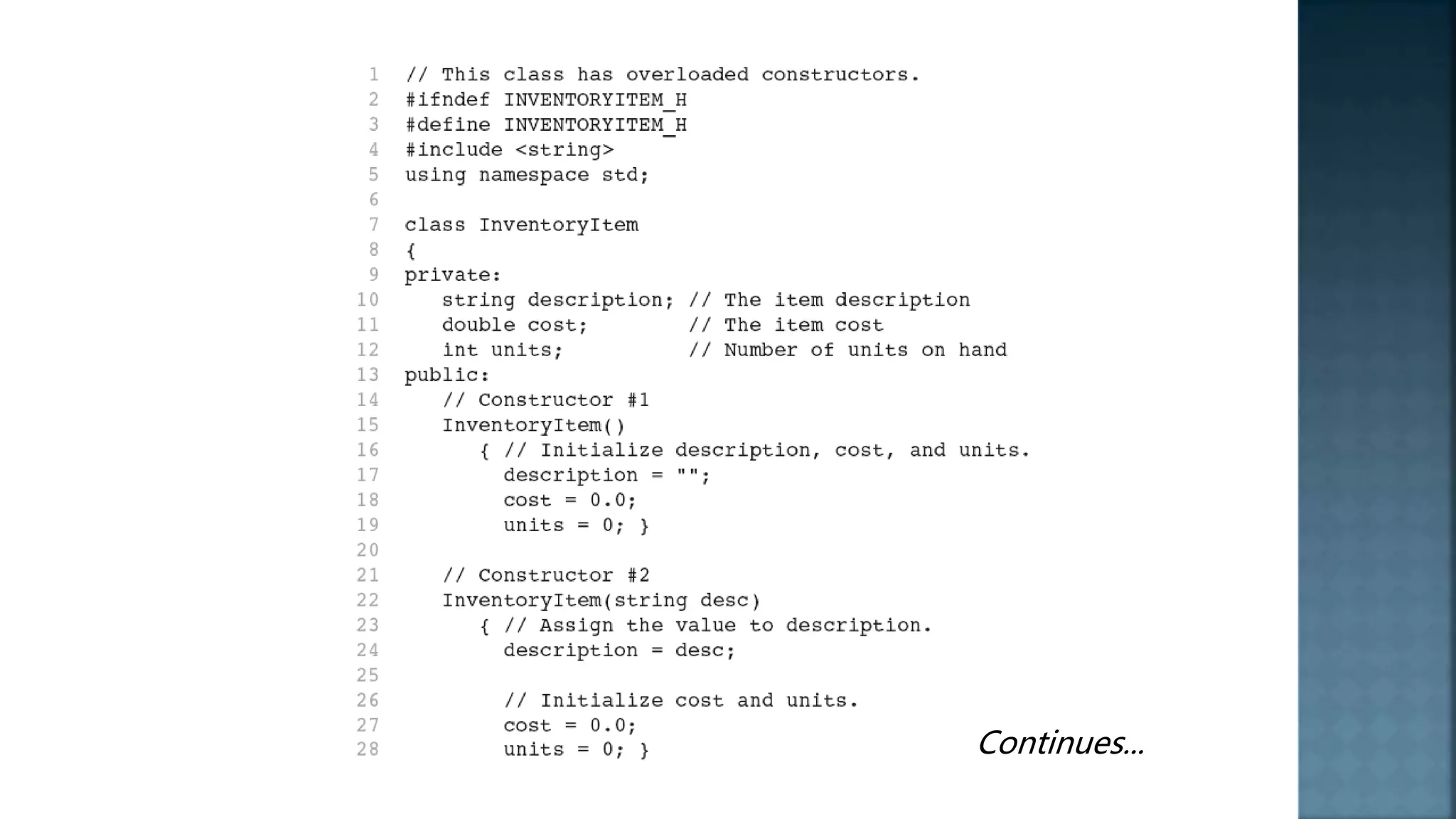
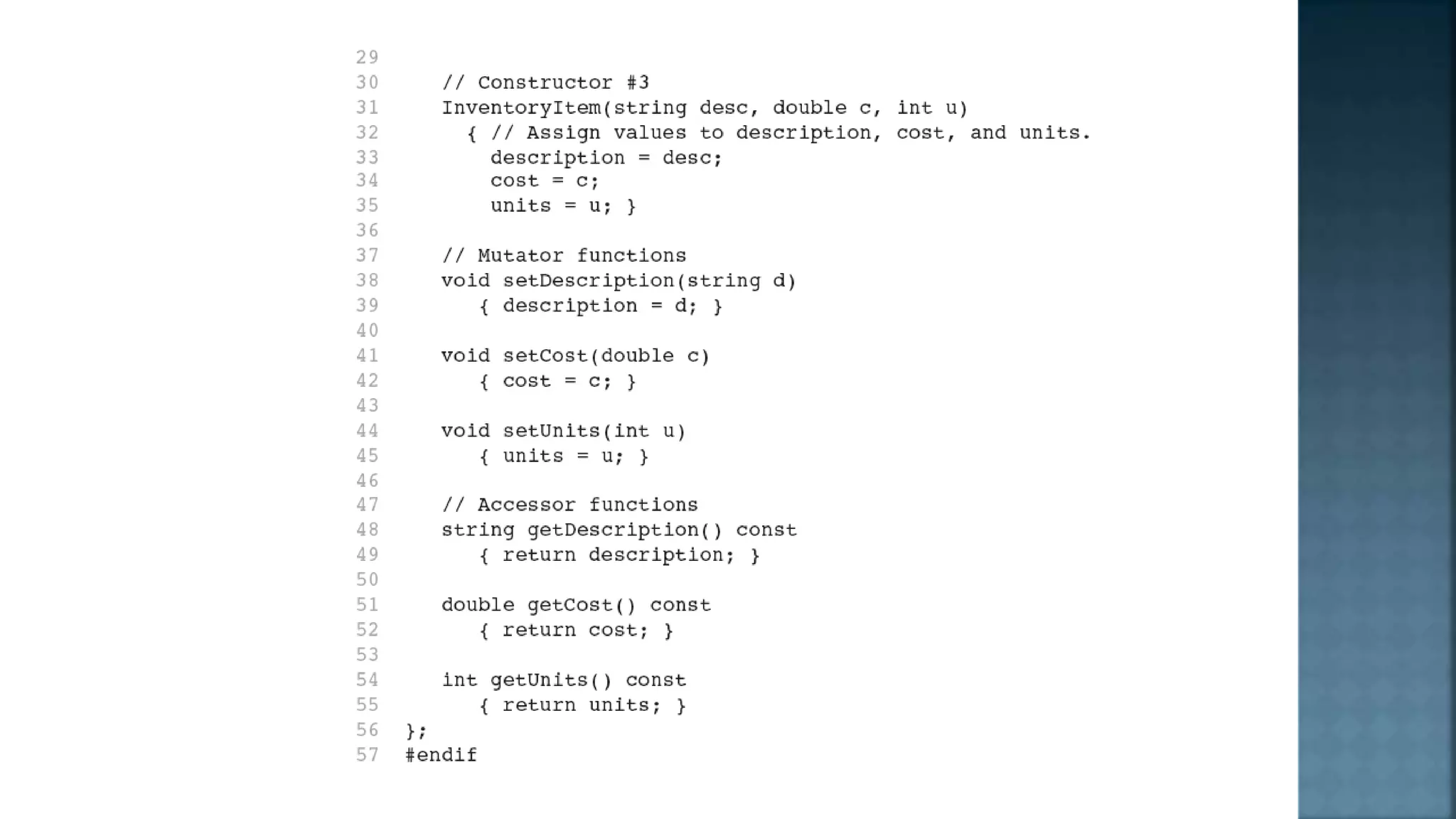
Contents of InventoryItem.hVersion1 (continued)
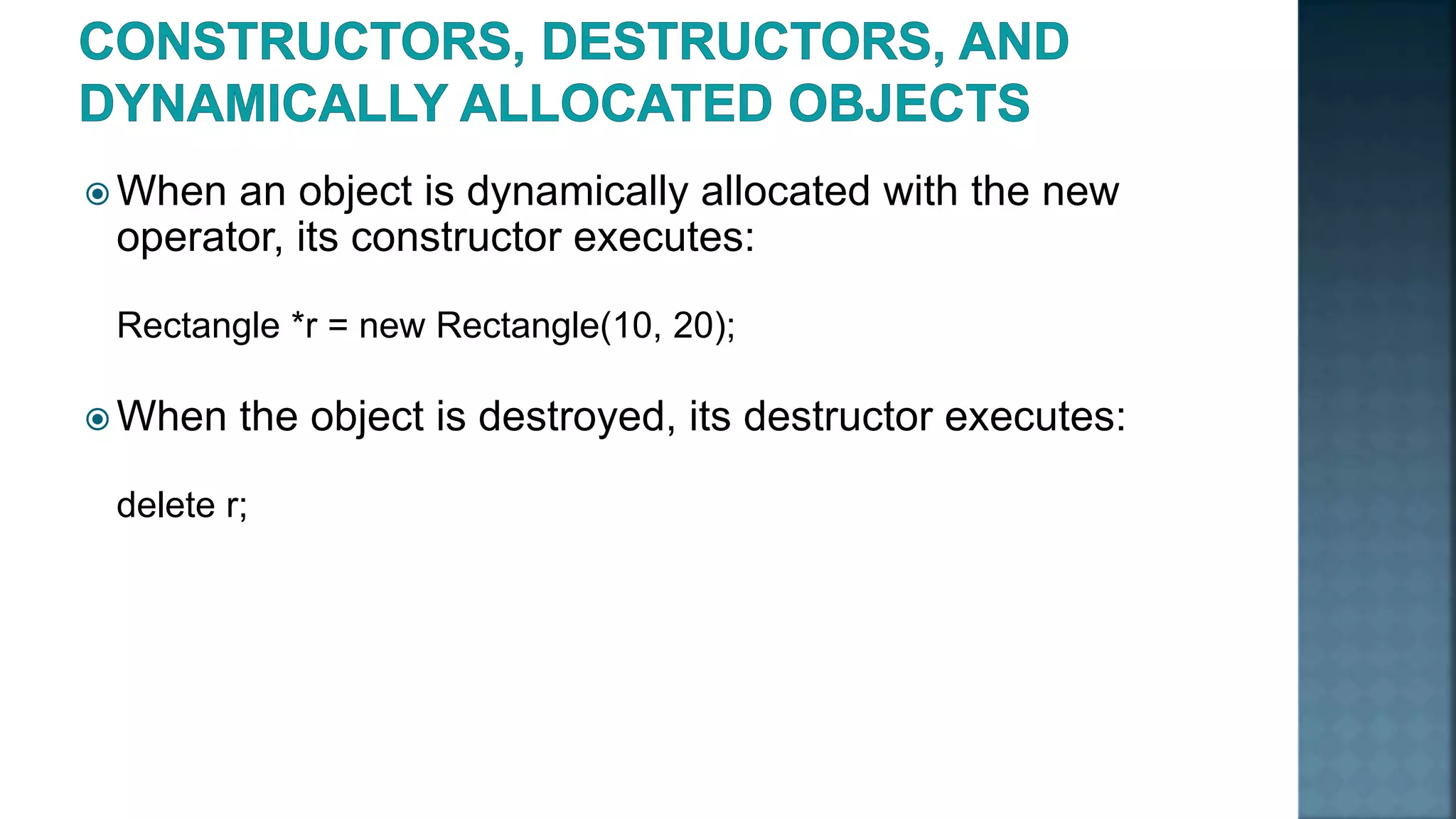
 When an object is dynamically allocated with the new operator, its constructor executes: Rectangle *r = new Rectangle(10, 20);  When the object is destroyed, its destructor executes: delete r;
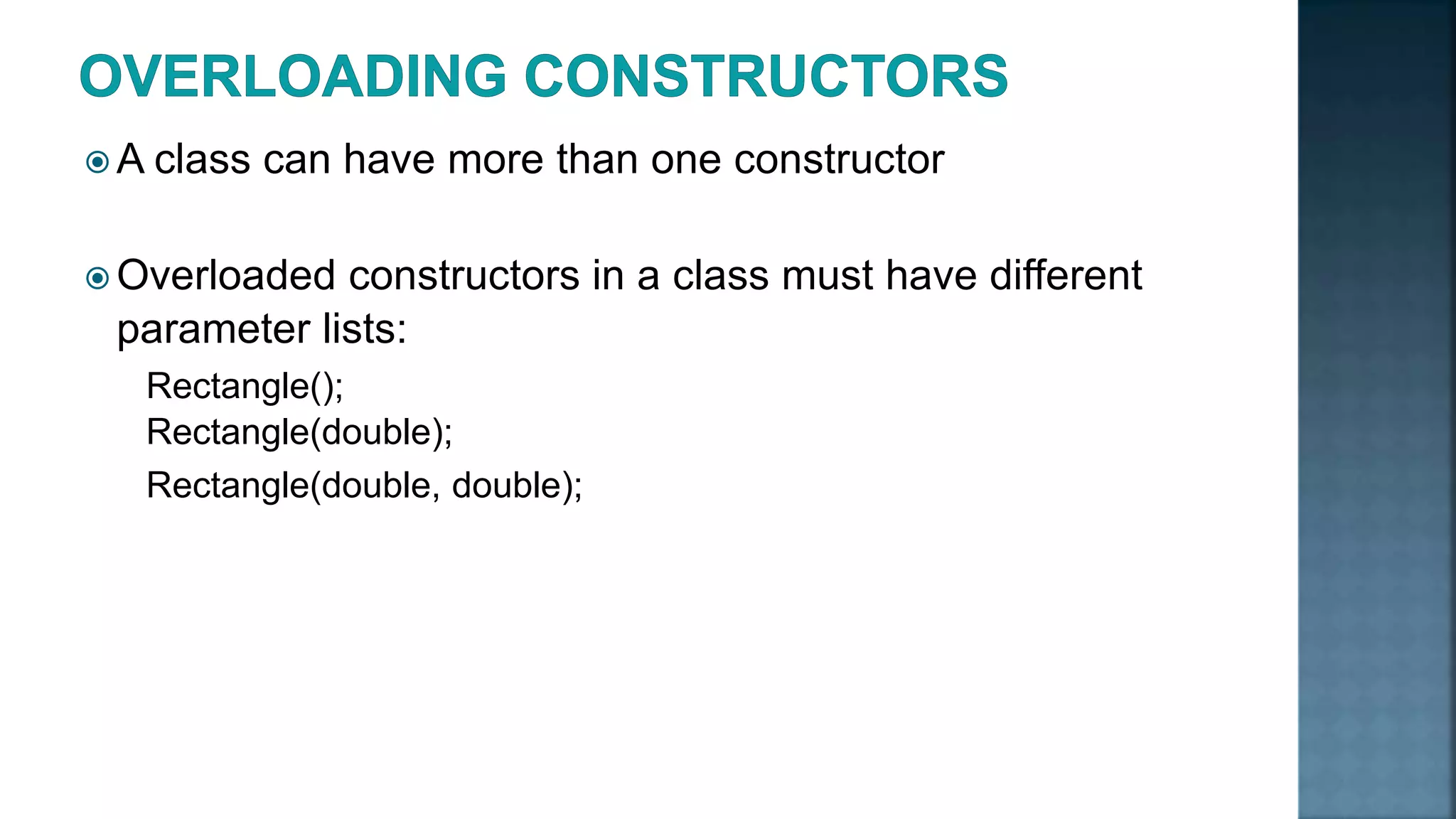
 A class can have more than one constructor  Overloaded constructors in a class must have different parameter lists: Rectangle(); Rectangle(double); Rectangle(double, double);
Continues...
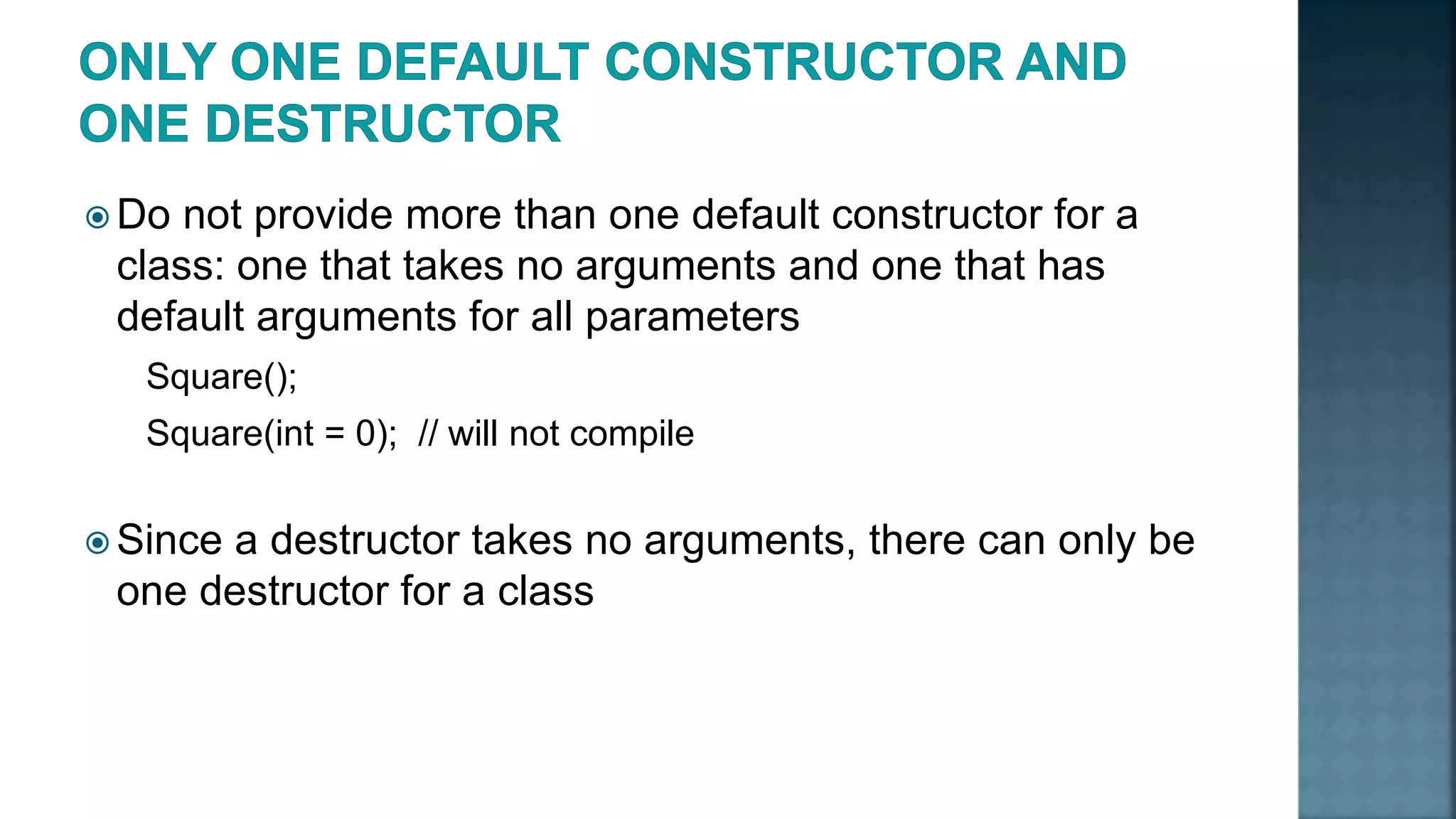
 Do not provide more than one default constructor for a class: one that takes no arguments and one that has default arguments for all parameters Square(); Square(int = 0); // will not compile  Since a destructor takes no arguments, there can only be one destructor for a class
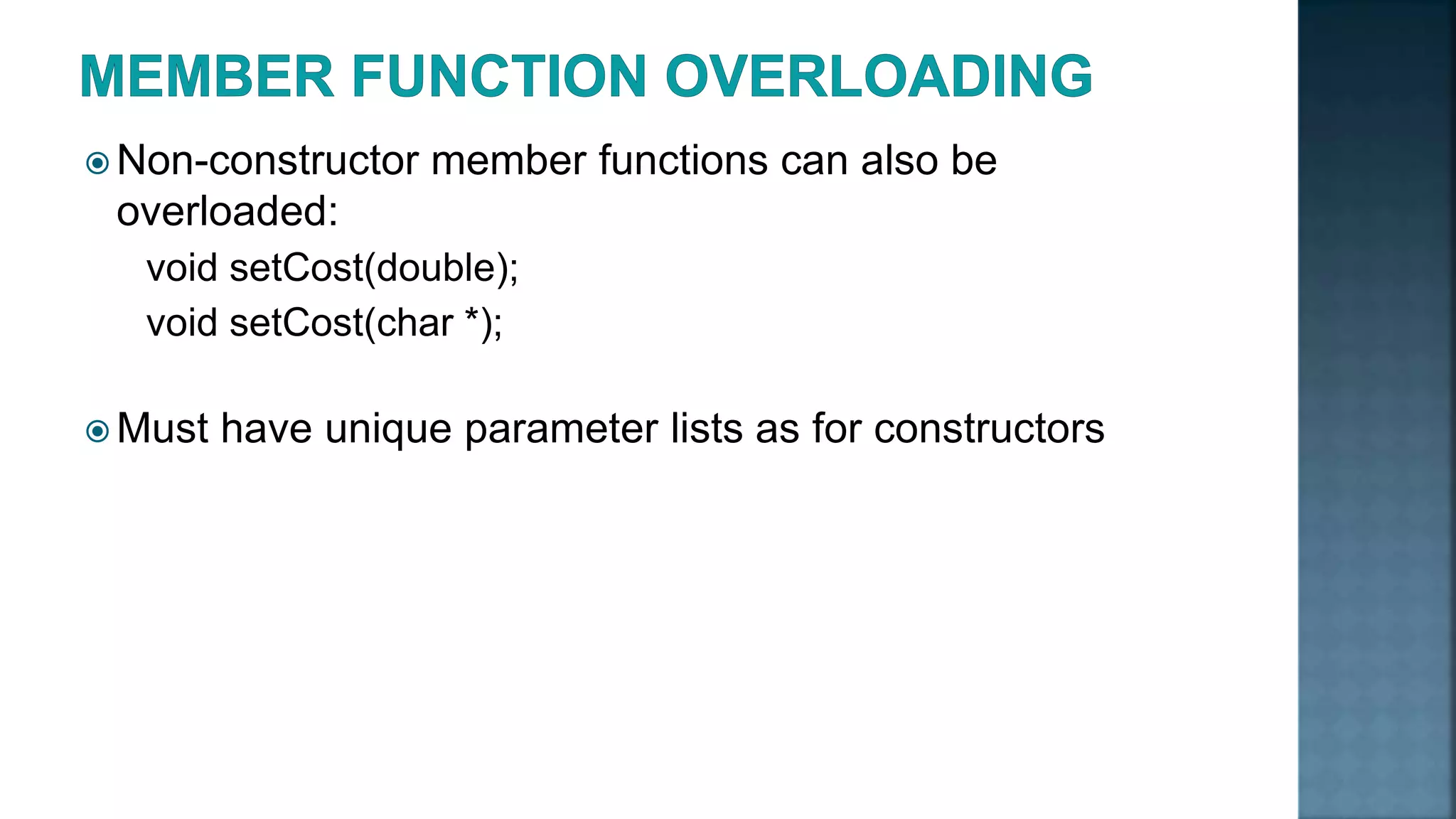
 Non-constructor member functions can also be overloaded: void setCost(double); void setCost(char *);  Must have unique parameter lists as for constructors
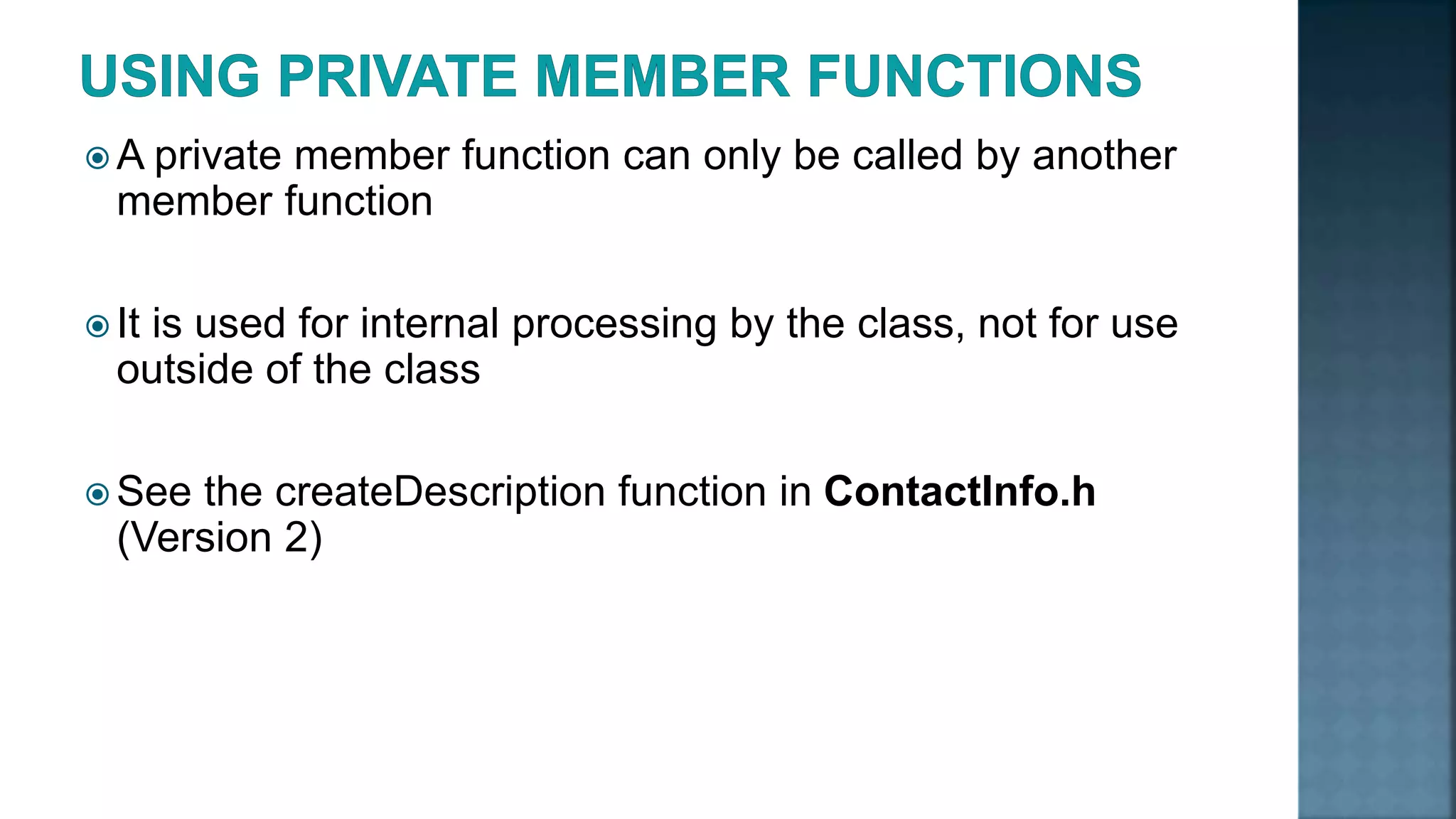
 A private member function can only be called by another member function  It is used for internal processing by the class, not for use outside of the class  See the createDescription function in ContactInfo.h (Version 2)
 Objects can be the elements of an array: InventoryItem inventory[40];  Default constructor for object is used when array is defined
 Must use initializer list to invoke constructor that takes arguments: InventoryItem inventory[3] = { "Hammer", "Wrench", "Pliers" };
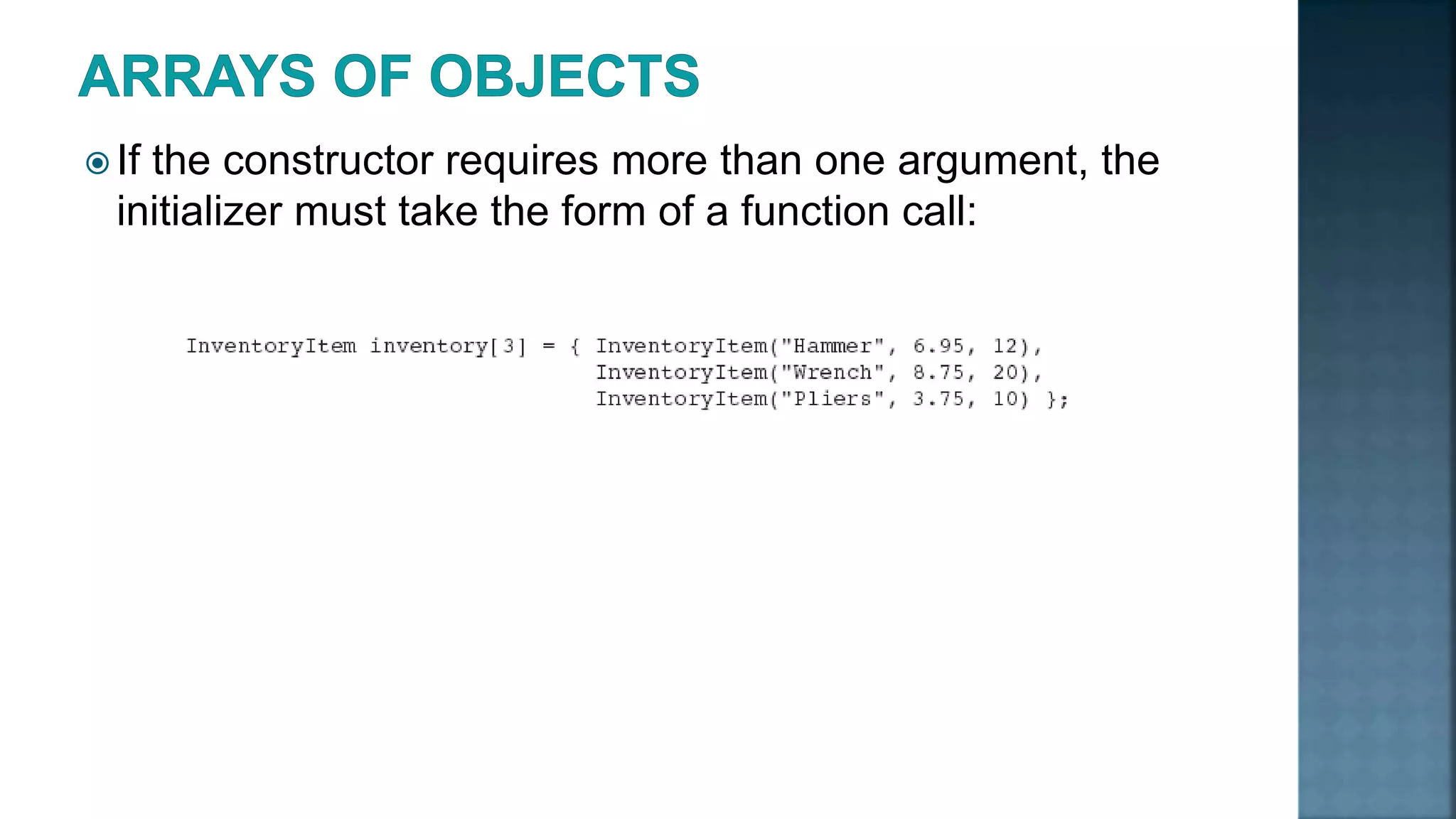
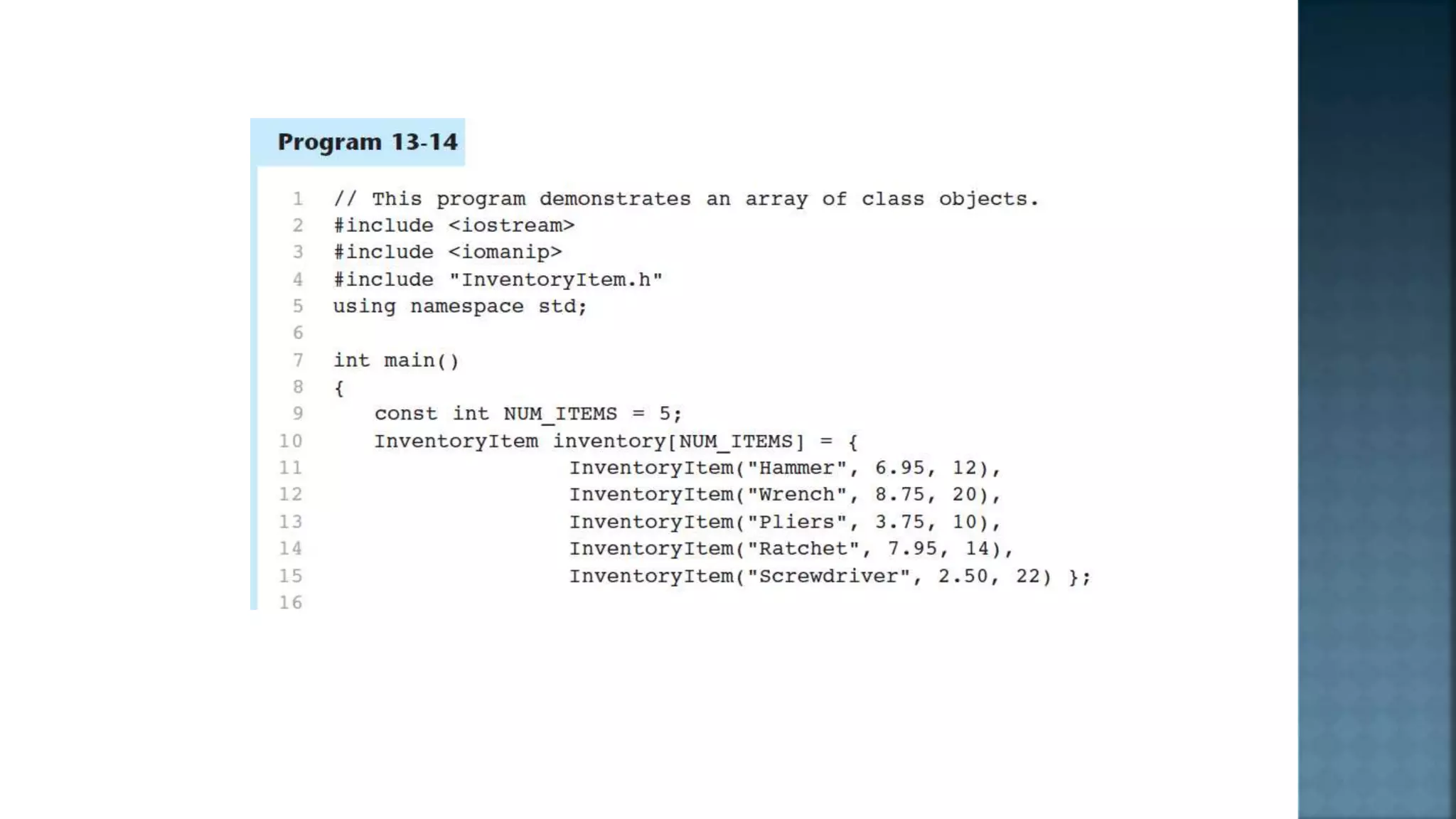
 If the constructor requires more than one argument, the initializer must take the form of a function call:
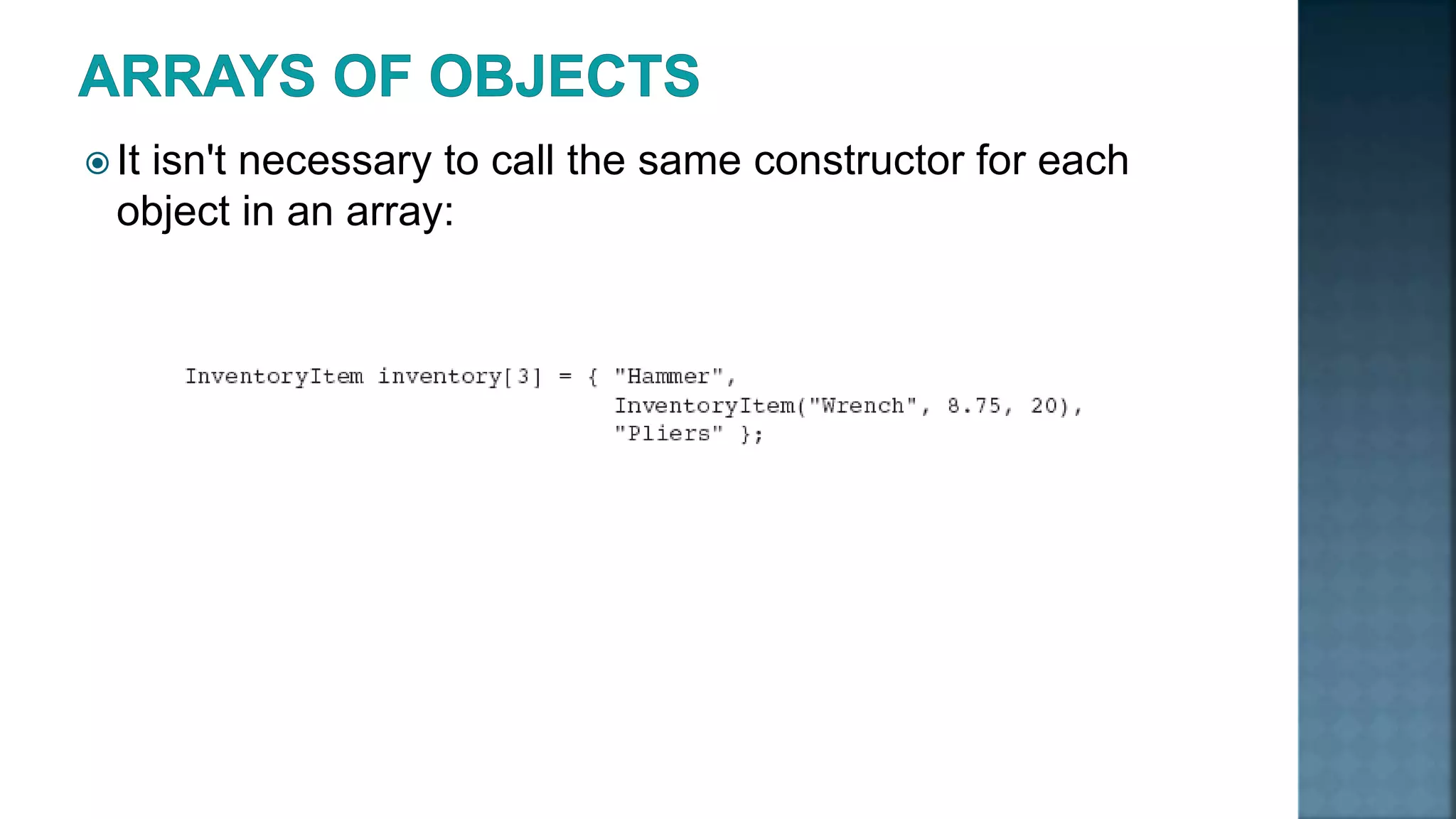
 It isn't necessary to call the same constructor for each object in an array:
 Objects in an array are referenced using subscripts  Member functions are referenced using dot notation: inventory[2].setUnits(30); cout << inventory[2].getUnits();
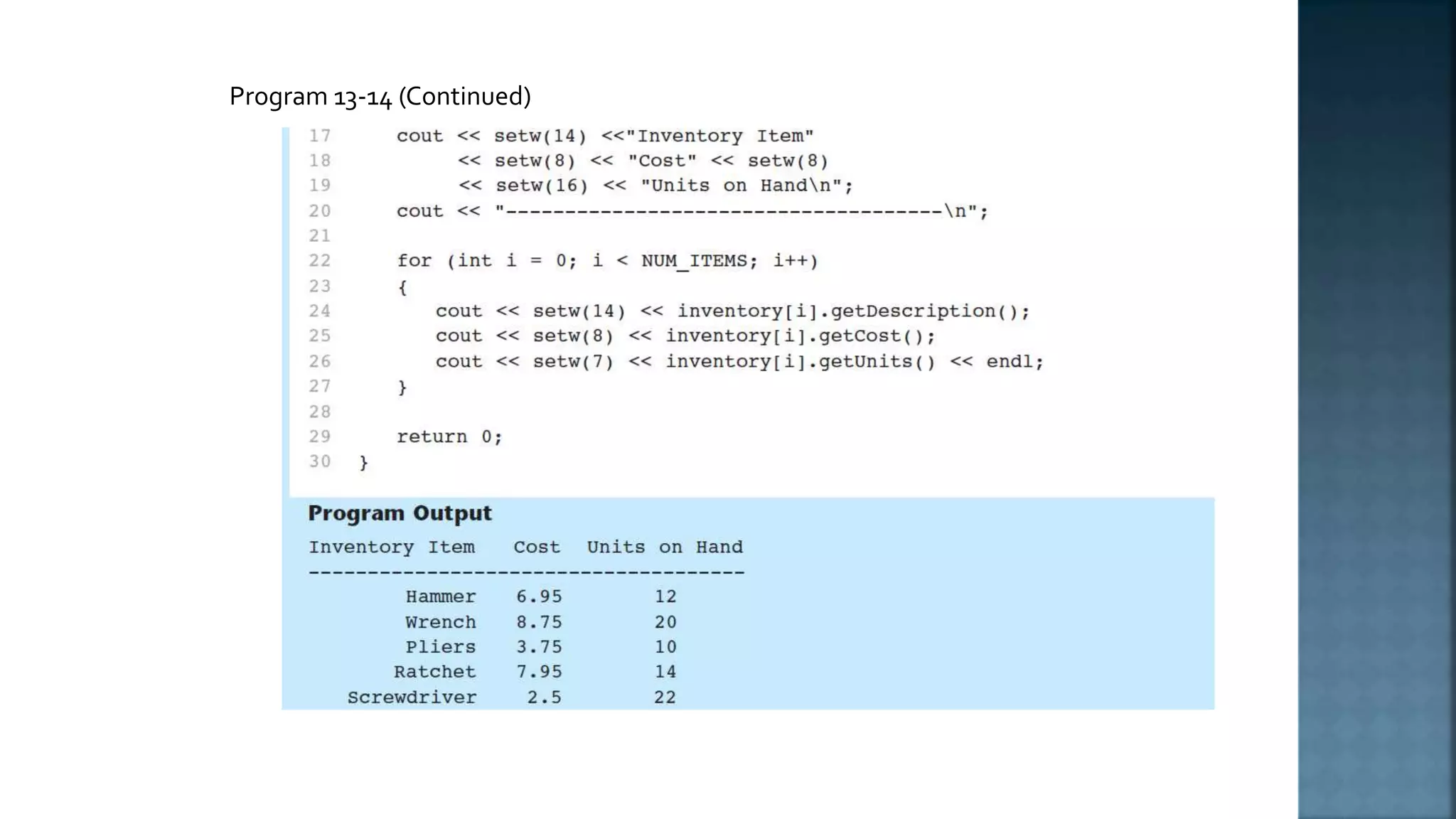
Program 13-14 (Continued)
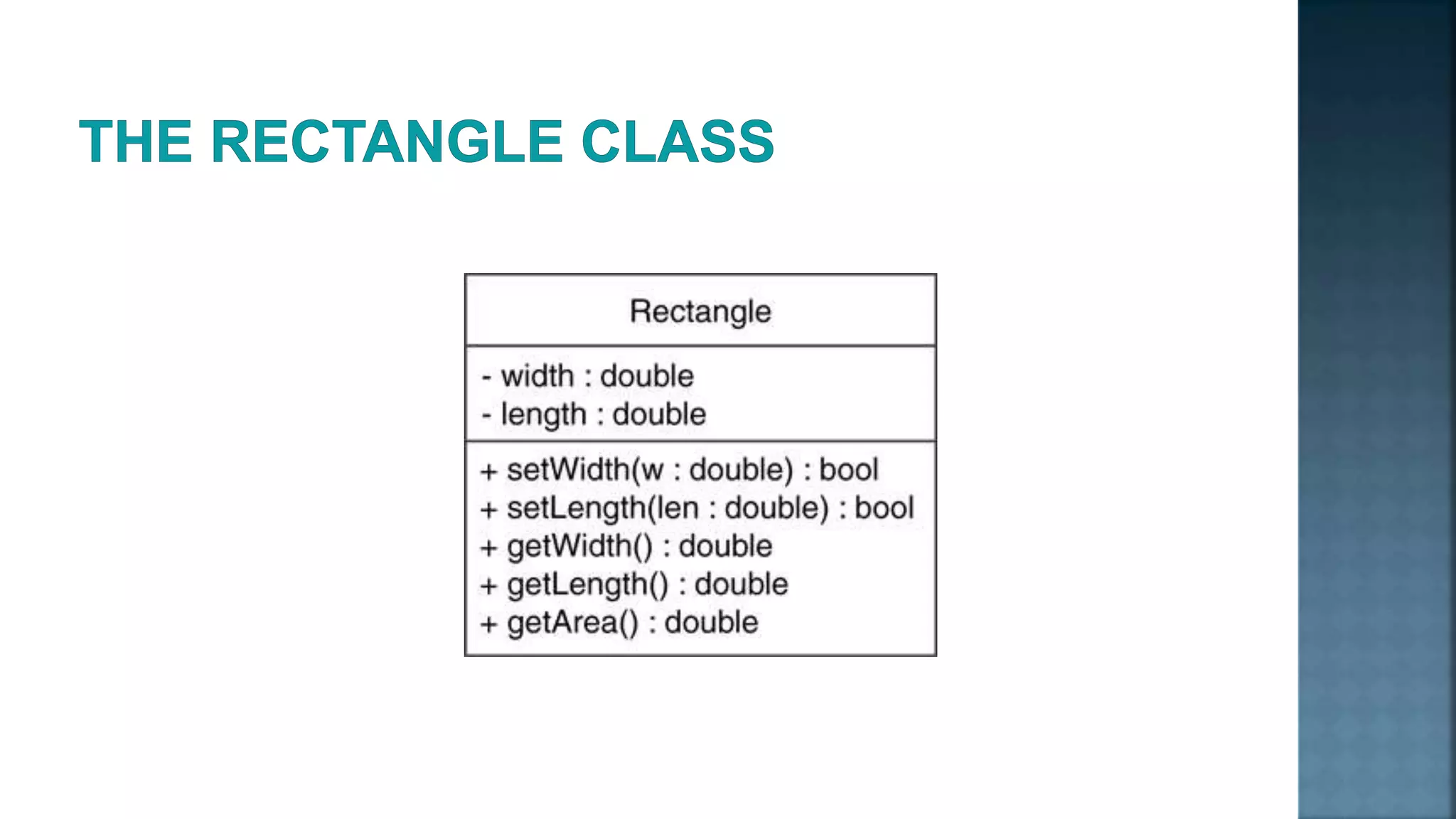
 UML stands for Unified Modeling Language.  The UML provides a set of standard diagrams for graphically depicting object-oriented systems
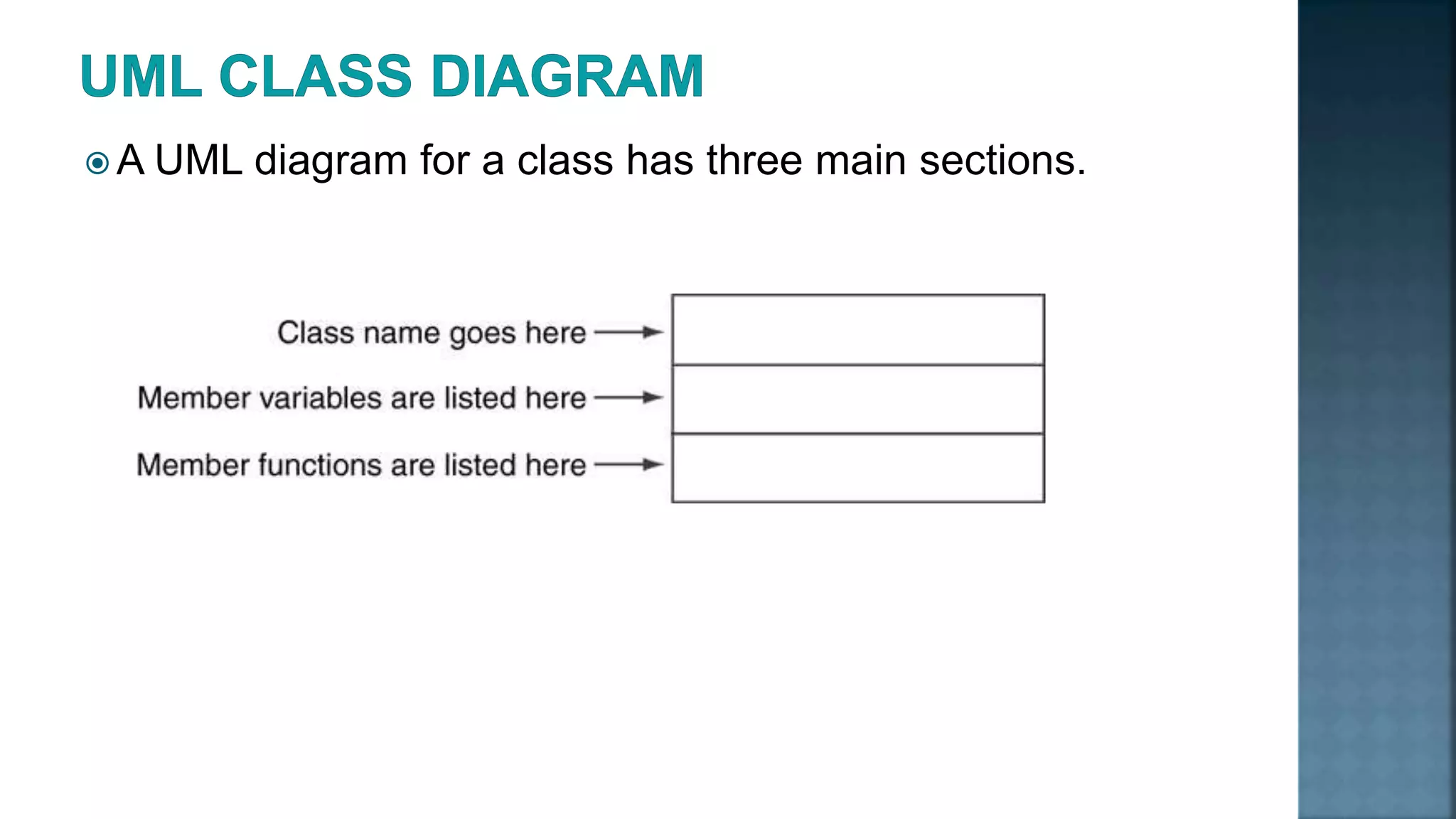
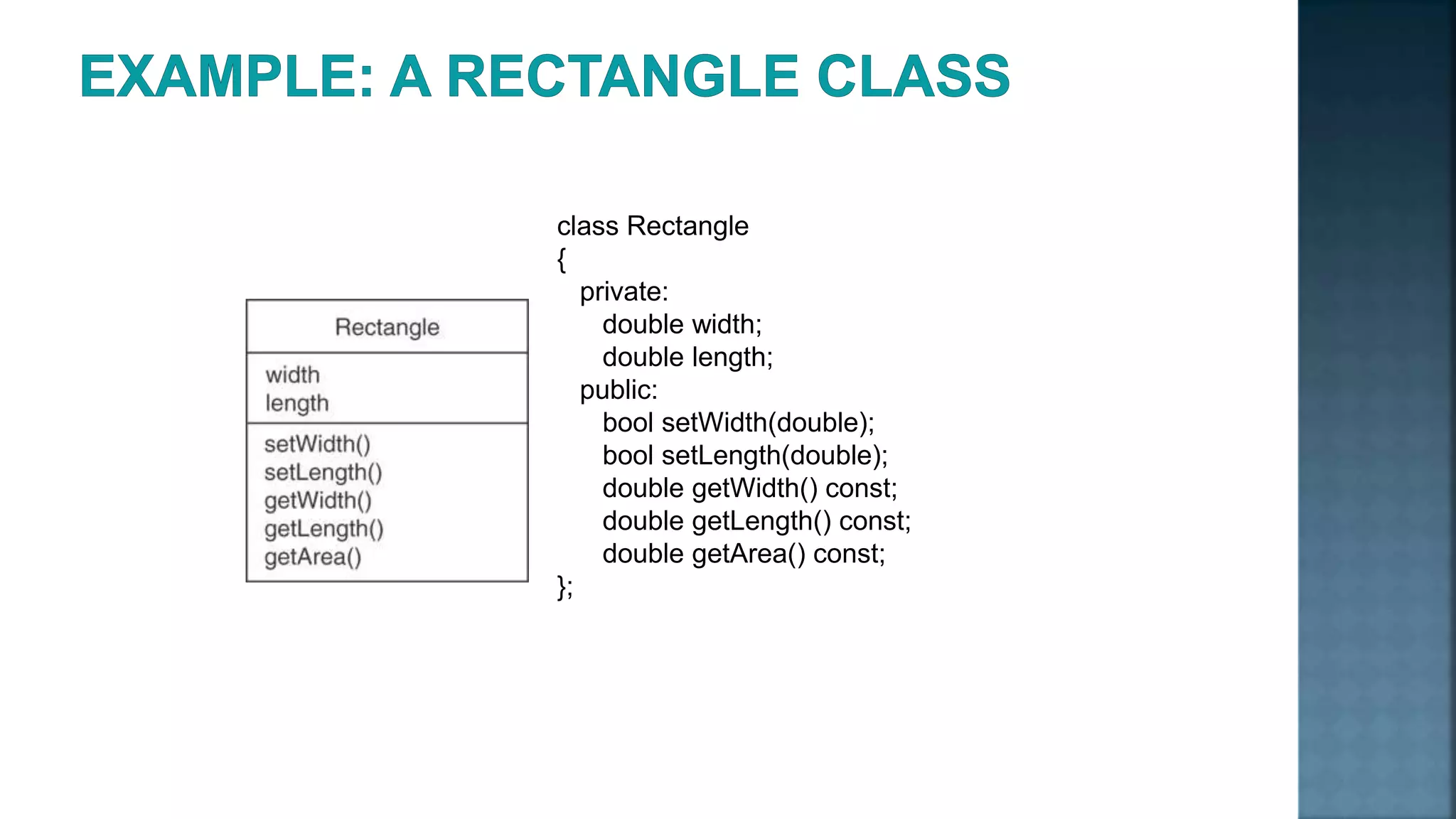
 A UML diagram for a class has three main sections.
class Rectangle { private: double width; double length; public: bool setWidth(double); bool setLength(double); double getWidth() const; double getLength() const; double getArea() const; };
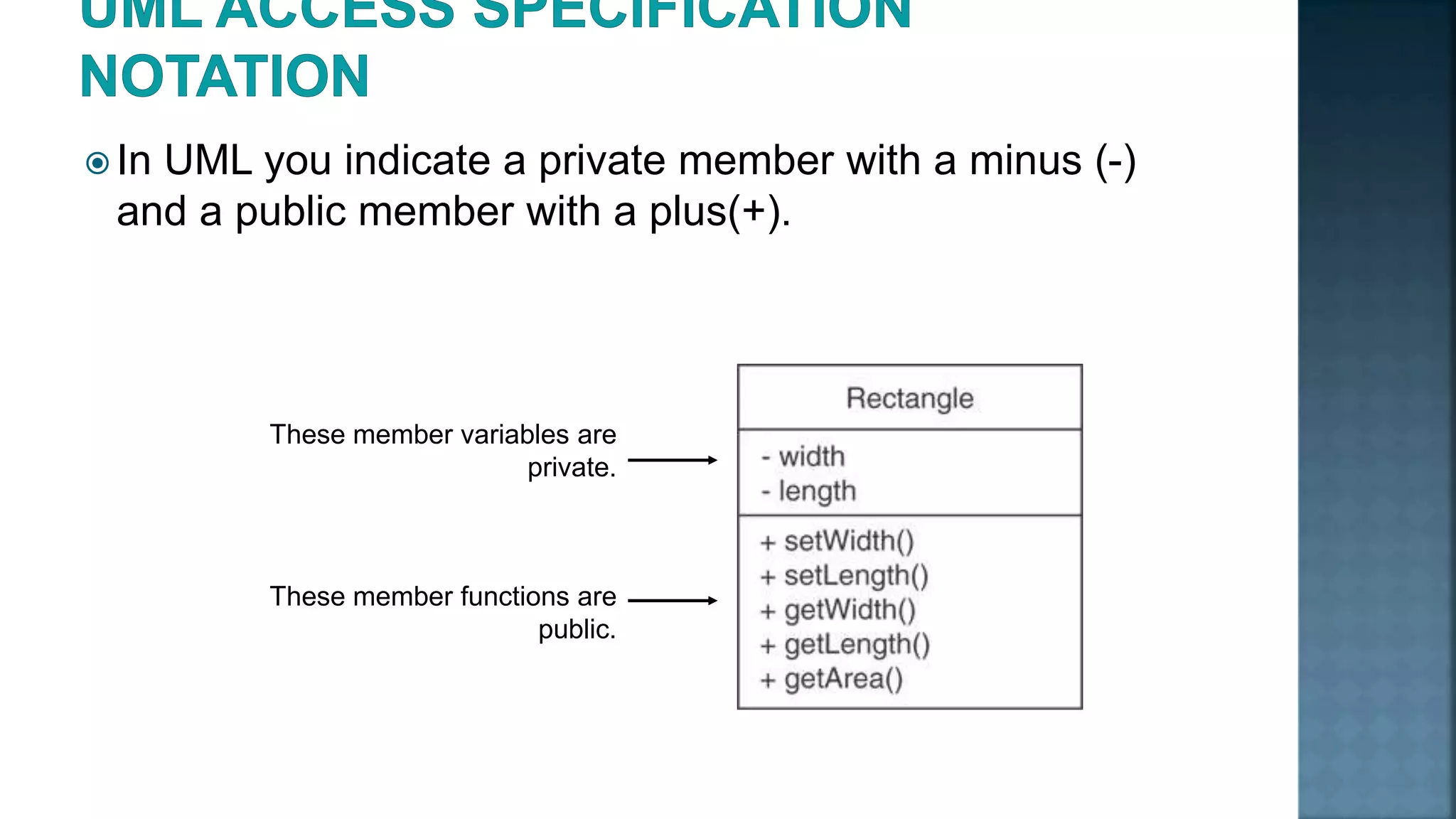
 In UML you indicate a private member with a minus (-) and a public member with a plus(+). These member variables are private. These member functions are public.
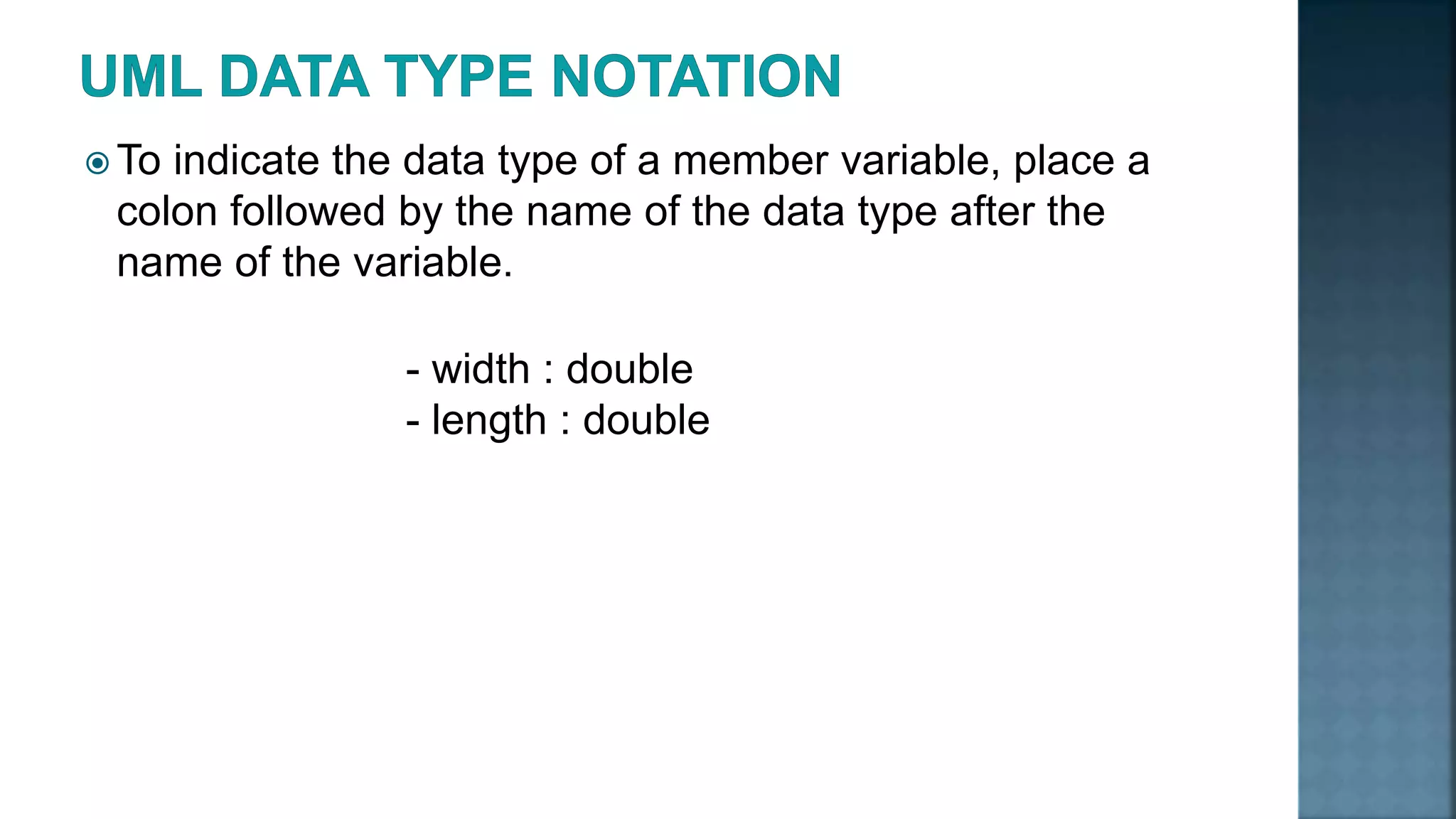
 To indicate the data type of a member variable, place a colon followed by the name of the data type after the name of the variable. - width : double - length : double
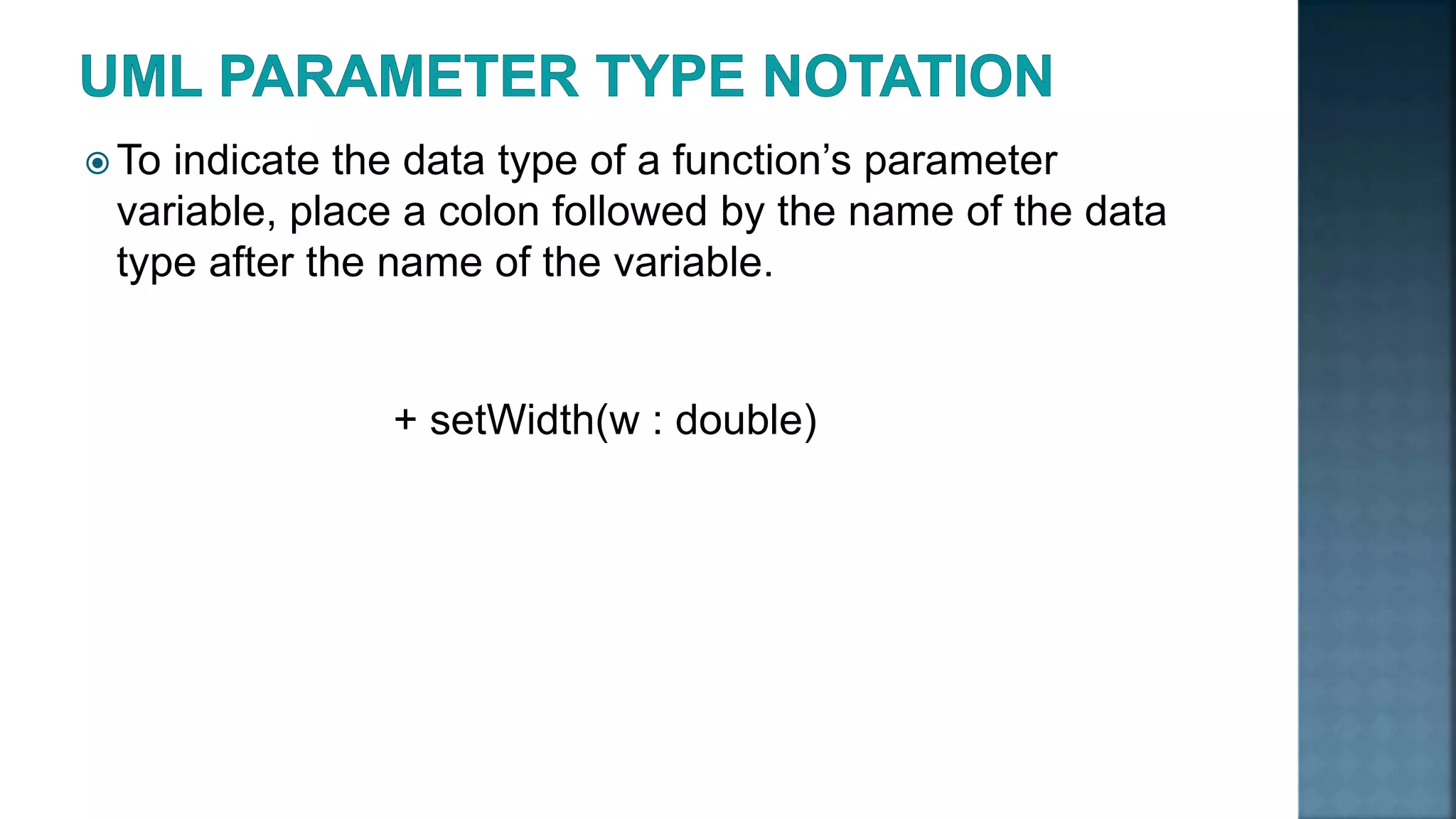
 To indicate the data type of a function’s parameter variable, place a colon followed by the name of the data type after the name of the variable. + setWidth(w : double)
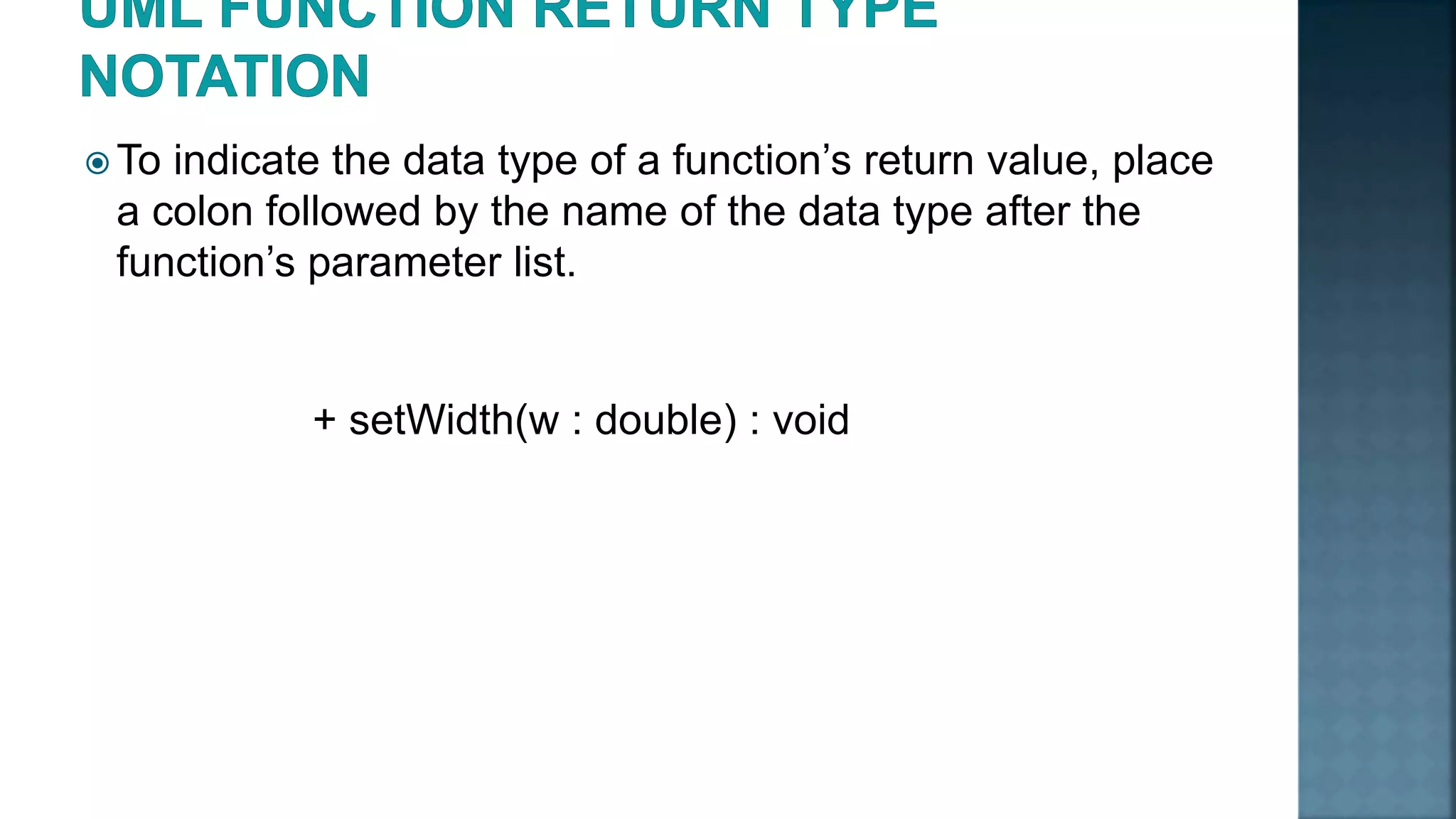
 To indicate the data type of a function’s return value, place a colon followed by the name of the data type after the function’s parameter list. + setWidth(w : double) : void
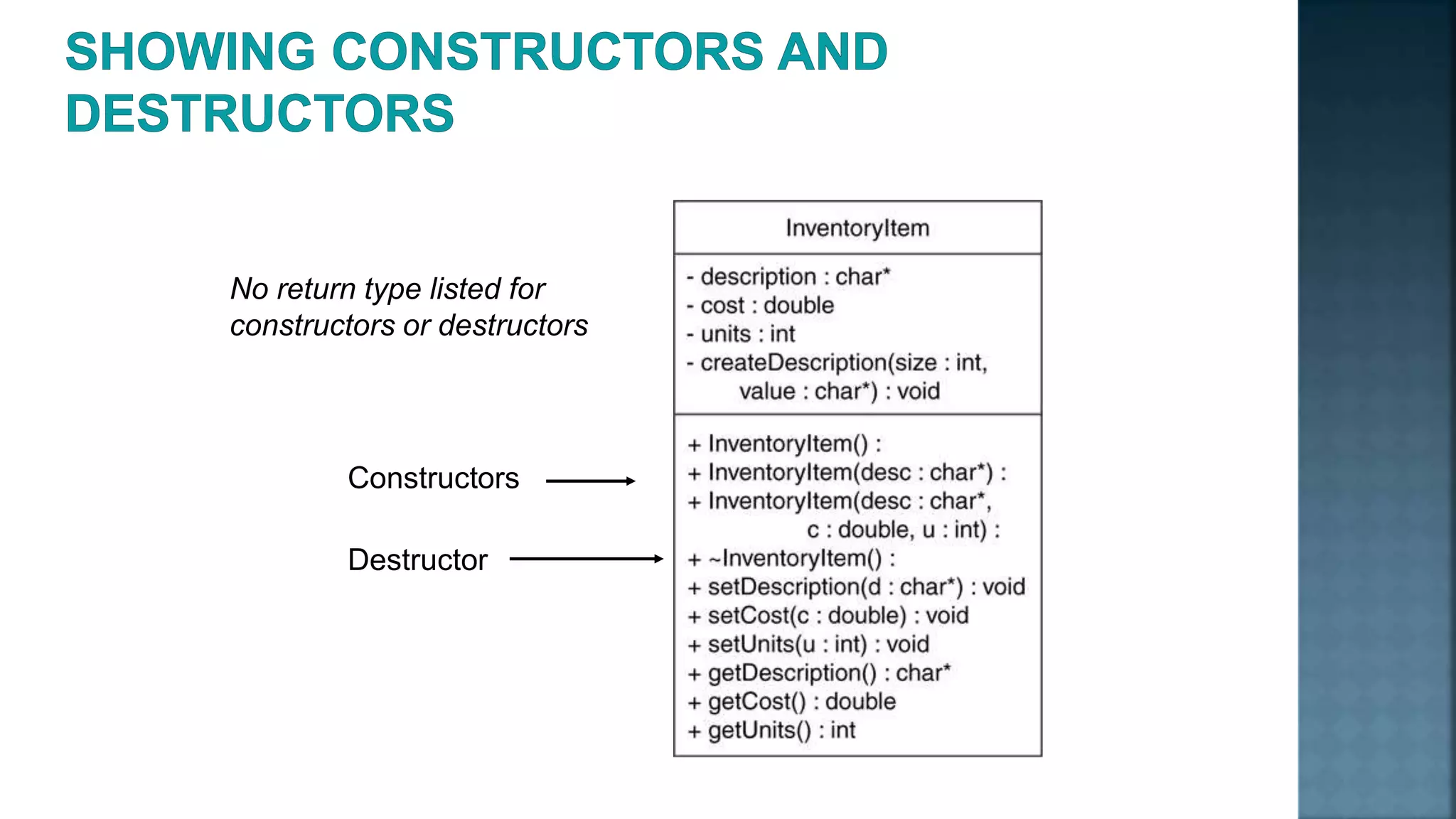
Constructors Destructor No return type listed for constructors or destructors

Chapter 13 introduction to classes

  • 1.
  • 2.
     Procedural programmingfocuses on the process/actions that occur in a program  Object-Oriented programming is based on the data and the functions that operate on it. Objects are instances of ADTs that represent the data and its functions
  • 3.
     If thedata structures change, many functions must also be changed  Programs that are based on complex function hierarchies are:  difficult to understand and maintain  difficult to modify and extend  easy to break
  • 4.
     class: likea struct (allows bundling of related variables), but variables and functions in the class can have different properties than in a struct  object: an instance of a class, in the same way that a variable can be an instance of a struct
  • 5.
     A Classis like a blueprint and objects are like houses built from the blueprint
  • 6.
     attributes: membersof a class  methods or behaviors: member functions of a class
  • 7.
     data hiding:restricting access to certain members of an object  public interface: members of an object that are available outside of the object. This allows the object to provide access to some data and functions without sharing its internal details and design, and provides some protection from data corruption
  • 8.
     Objects arecreated from a class  Format: class ClassName { declaration; declaration; };
  • 10.
     Used tocontrol access to members of the class  public: can be accessed by functions outside of the class  private: can only be called by or accessed by functions that are members of the class
  • 11.
  • 12.
     Can belisted in any order in a class  Can appear multiple times in a class  If not specified, the default is private
  • 13.
     const appearingafter the parentheses in a member function declaration specifies that the function will not change any data in the calling object.
  • 14.
     When defininga member function:  Put prototype in class declaration  Define function using class name and scope resolution operator (::) int Rectangle::setWidth(double w) { width = w; }
  • 15.
     Mutator: amember function that stores a value in a private member variable, or changes its value in some way  Accessor: function that retrieves a value from a private member variable. Accessors do not change an object's data, so they should be marked const.
  • 16.
     An objectis an instance of a class  Defined like structure variables: Rectangle r;  Access members using dot operator: r.setWidth(5.2); cout << r.getWidth();  Compiler error if attempt to access private member using dot operator
  • 18.
  • 19.
  • 20.
  • 21.
     Some datais the result of a calculation.  In the Rectangle class the area of a rectangle is calculated.  length x width  If we were to use an area variable here in the Rectangle class, its value would be dependent on the length and the width.  If we change length or width without updating area, then area would become stale.  To avoid stale data, it is best to calculate the value of that data within a member function rather than store it in a variable.
  • 22.
     Can definea pointer to an object: Rectangle *rPtr = nullptr;  Can access public members via pointer: rPtr = &otherRectangle; rPtr->setLength(12.5); cout << rPtr->getLength() << endl;
  • 23.
     We canalso use a pointer to dynamically allocate an object.
  • 24.
     Making datamembers private provides data protection  Data can be accessed only through public functions  Public functions define the class’s public interface
  • 25.
    Code outside theclass must use the class's public member functions to interact with the object.
  • 26.
     Place classdeclaration in a header file that serves as the class specification file. Name the file ClassName.h, for example, Rectangle.h  Place member function definitions in ClassName.cpp, for example, Rectangle.cpp File should #include the class specification file  Programs that use the class must #include the class specification file, and be compiled and linked with the member function definitions
  • 27.
     Member functionscan be defined  inline: in class declaration  after the class declaration  Inline appropriate for short function bodies: int getWidth() const { return width; }
  • 28.
    1 // Specificationfile for the Rectangle class 2 // This version uses some inline member functions. 3 #ifndef RECTANGLE_H 4 #define RECTANGLE_H 5 6 class Rectangle 7 { 8 private: 9 double width; 10 double length; 11 public: 12 void setWidth(double); 13 void setLength(double); 14 15 double getWidth() const 16 { return width; } 17 18 double getLength() const 19 { return length; } 20 21 double getArea() const 22 { return width * length; } 23 }; 24 #endif
  • 29.
     Regular functions– when called, compiler stores return address of call, allocates memory for local variables, etc.  Code for an inline function is copied into program in place of call – larger executable program, but no function call overhead, hence faster execution
  • 30.
     Member functionthat is automatically called when an object is created  Purpose is to construct an object  Constructor function name is class name  Has no return type
  • 32.
  • 33.
  • 35.
     A defaultconstructor is a constructor that takes no arguments.  If you write a class with no constructor at all, C++ will write a default constructor for you, one that does nothing.  A simple instantiation of a class (with no arguments) calls the default constructor: Rectangle r;
  • 36.
     To createa constructor that takes arguments:  indicate parameters in prototype: Rectangle(double, double);  Use parameters in the definition: Rectangle::Rectangle(double w, double len) { width = w; length = len; }
  • 37.
     You canpass arguments to the constructor when you create an object: Rectangle r(10, 5);
  • 38.
     If allof a constructor's parameters have default arguments, then it is a default constructor. For example: Rectangle(double = 0, double = 0);  Creating an object and passing no arguments will cause this constructor to execute: Rectangle r;
  • 39.
     When allof a class's constructors require arguments, then the class has NO default constructor.  When this is the case, you must pass the required arguments to the constructor when creating an object.
  • 40.
     Member functionautomatically called when an object is destroyed  Destructor name is ~classname, e.g., ~Rectangle  Has no return type; takes no arguments  Only one destructor per class, i.e., it cannot be overloaded  If constructor allocates dynamic memory, destructor should release it
  • 42.
  • 44.
     When anobject is dynamically allocated with the new operator, its constructor executes: Rectangle *r = new Rectangle(10, 20);  When the object is destroyed, its destructor executes: delete r;
  • 45.
     A classcan have more than one constructor  Overloaded constructors in a class must have different parameter lists: Rectangle(); Rectangle(double); Rectangle(double, double);
  • 46.
  • 48.
     Do notprovide more than one default constructor for a class: one that takes no arguments and one that has default arguments for all parameters Square(); Square(int = 0); // will not compile  Since a destructor takes no arguments, there can only be one destructor for a class
  • 49.
     Non-constructor memberfunctions can also be overloaded: void setCost(double); void setCost(char *);  Must have unique parameter lists as for constructors
  • 50.
     A privatemember function can only be called by another member function  It is used for internal processing by the class, not for use outside of the class  See the createDescription function in ContactInfo.h (Version 2)
  • 51.
     Objects canbe the elements of an array: InventoryItem inventory[40];  Default constructor for object is used when array is defined
  • 52.
     Must useinitializer list to invoke constructor that takes arguments: InventoryItem inventory[3] = { "Hammer", "Wrench", "Pliers" };
  • 53.
     If theconstructor requires more than one argument, the initializer must take the form of a function call:
  • 54.
     It isn'tnecessary to call the same constructor for each object in an array:
  • 55.
     Objects inan array are referenced using subscripts  Member functions are referenced using dot notation: inventory[2].setUnits(30); cout << inventory[2].getUnits();
  • 57.
  • 58.
     UML standsfor Unified Modeling Language.  The UML provides a set of standard diagrams for graphically depicting object-oriented systems
  • 59.
     A UMLdiagram for a class has three main sections.
  • 60.
    class Rectangle { private: double width; doublelength; public: bool setWidth(double); bool setLength(double); double getWidth() const; double getLength() const; double getArea() const; };
  • 61.
     In UMLyou indicate a private member with a minus (-) and a public member with a plus(+). These member variables are private. These member functions are public.
  • 62.
     To indicatethe data type of a member variable, place a colon followed by the name of the data type after the name of the variable. - width : double - length : double
  • 63.
     To indicatethe data type of a function’s parameter variable, place a colon followed by the name of the data type after the name of the variable. + setWidth(w : double)
  • 64.
     To indicatethe data type of a function’s return value, place a colon followed by the name of the data type after the function’s parameter list. + setWidth(w : double) : void
  • 66.
    Constructors Destructor No return typelisted for constructors or destructors