Change Relational DB to Graph DB with OrientDB Speaker : Apaichon Punpas Sponsor By เครือข่ายโปรแกรมเมอร์ไทย โค้ดชิวๆ
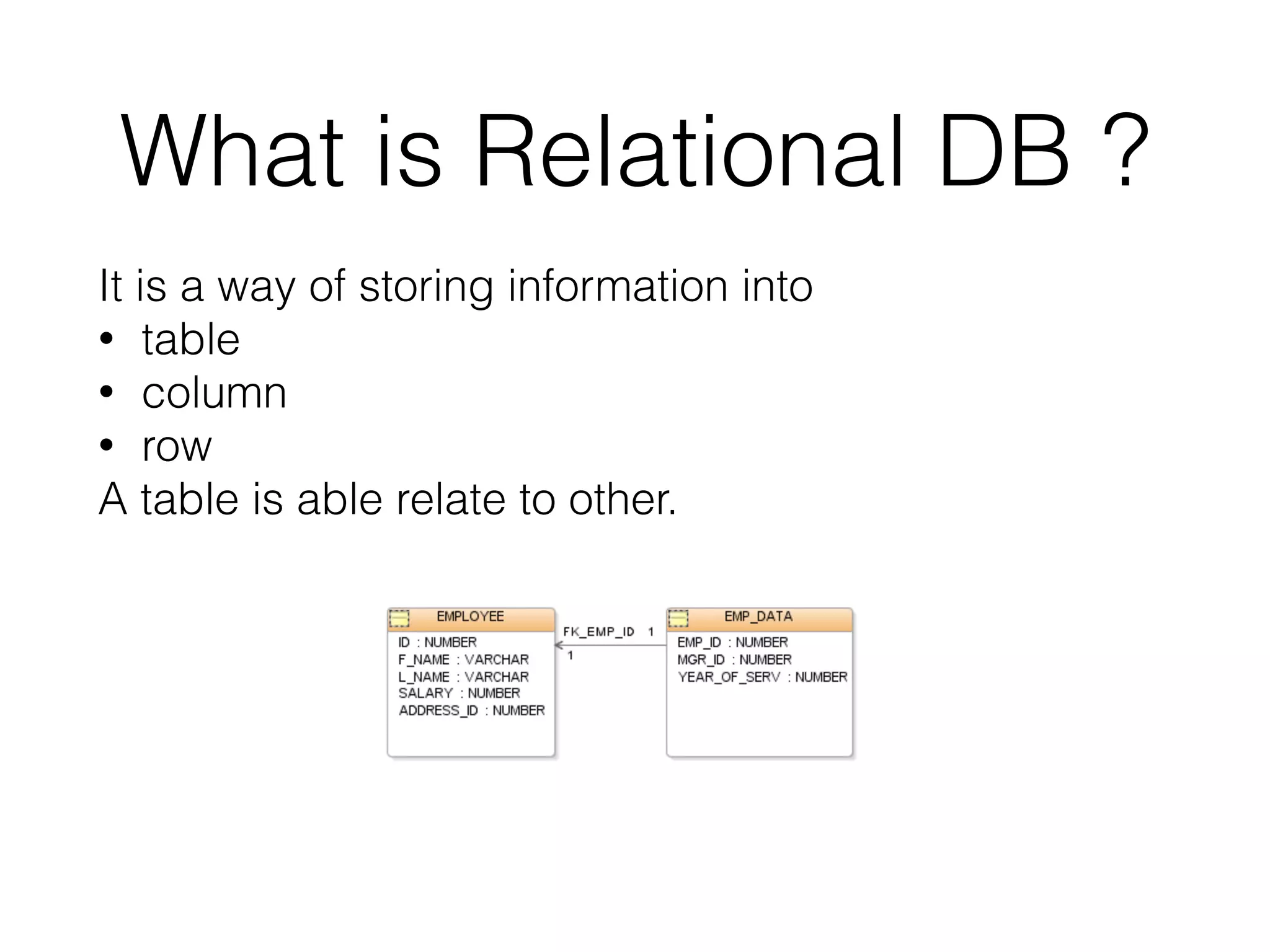
What is Relational DB ? It is a way of storing information into • table • column • row A table is able relate to other.
What is NoSQL ? A NoSQL (often interpreted as Not only SQL) database provides a mechanism for storage and retrieval of data that is modeled in means other than the tabular relations used in relational databases. Motivations for this approach include simplicity of design, horizontal scaling, and finer control over availability.
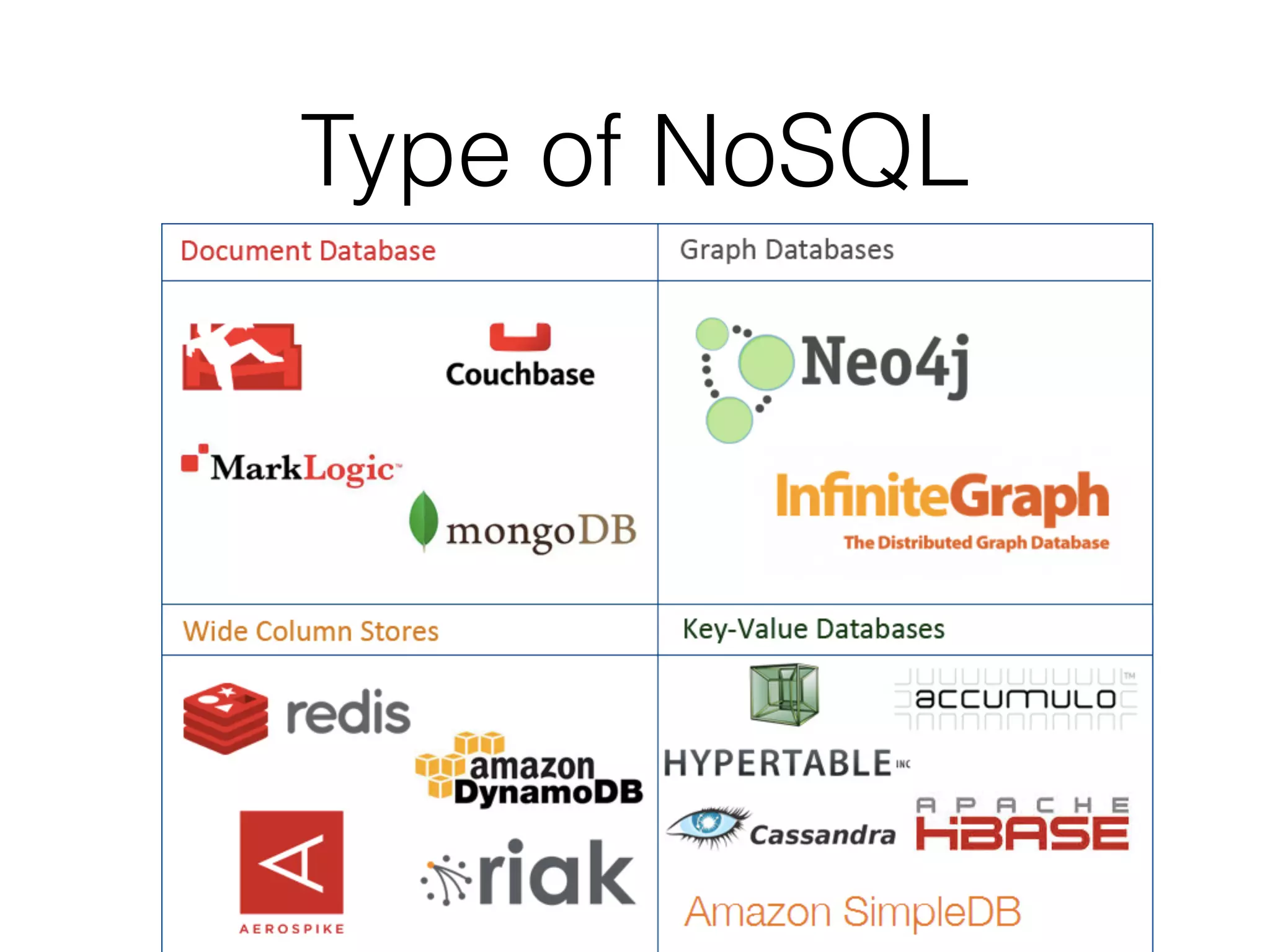
Type of NoSQL
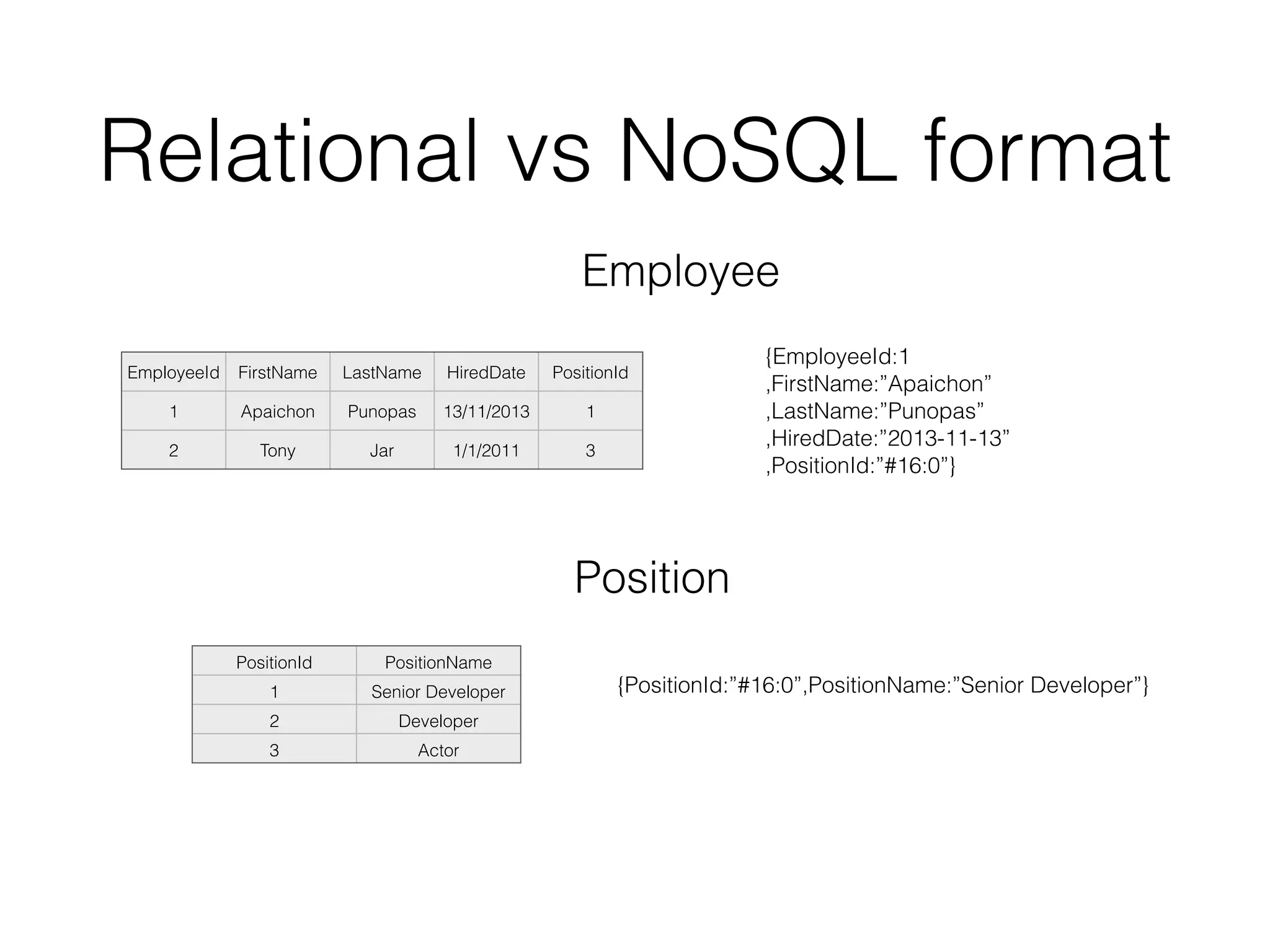
Relational vs NoSQL format EmployeeId FirstName LastName HiredDate PositionId 1 Apaichon Punopas 13/11/2013 1 2 Tony Jar 1/1/2011 3 PositionId PositionName 1 Senior Developer 2 Developer Manager3 Actor {EmployeeId:1 ,FirstName:”Apaichon” ,LastName:”Punopas” ,HiredDate:”2013-11-13” ,PositionId:”#16:0”} {PositionId:”#16:0”,PositionName:”Senior Developer”} Employee Position
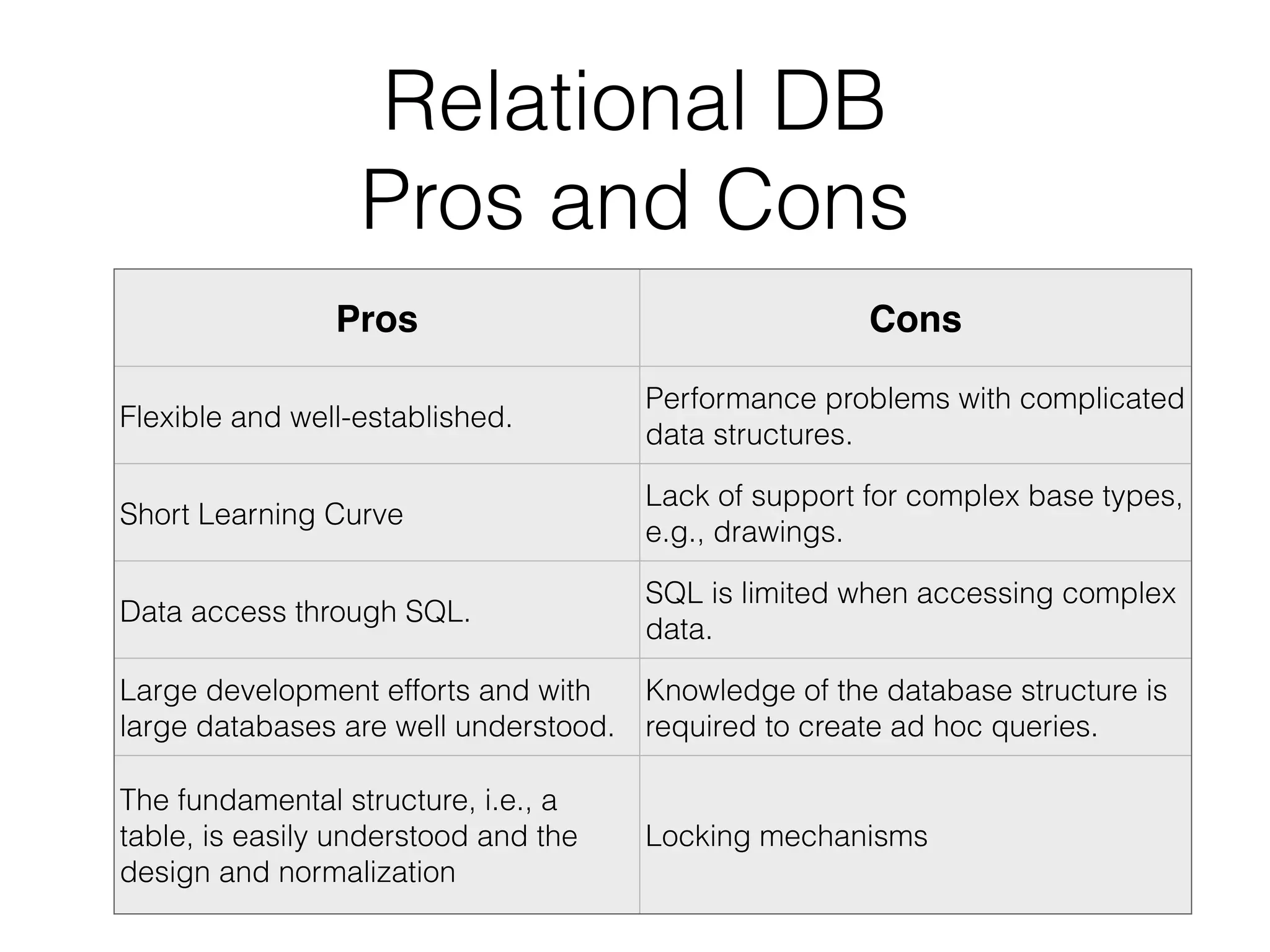
Relational DB Pros and Cons Pros Cons Flexible and well-established. Performance problems with complicated data structures. Short Learning Curve Lack of support for complex base types, e.g., drawings. Data access through SQL. SQL is limited when accessing complex data. Large development efforts and with large databases are well understood. Knowledge of the database structure is required to create ad hoc queries. The fundamental structure, i.e., a table, is easily understood and the design and normalization Locking mechanisms
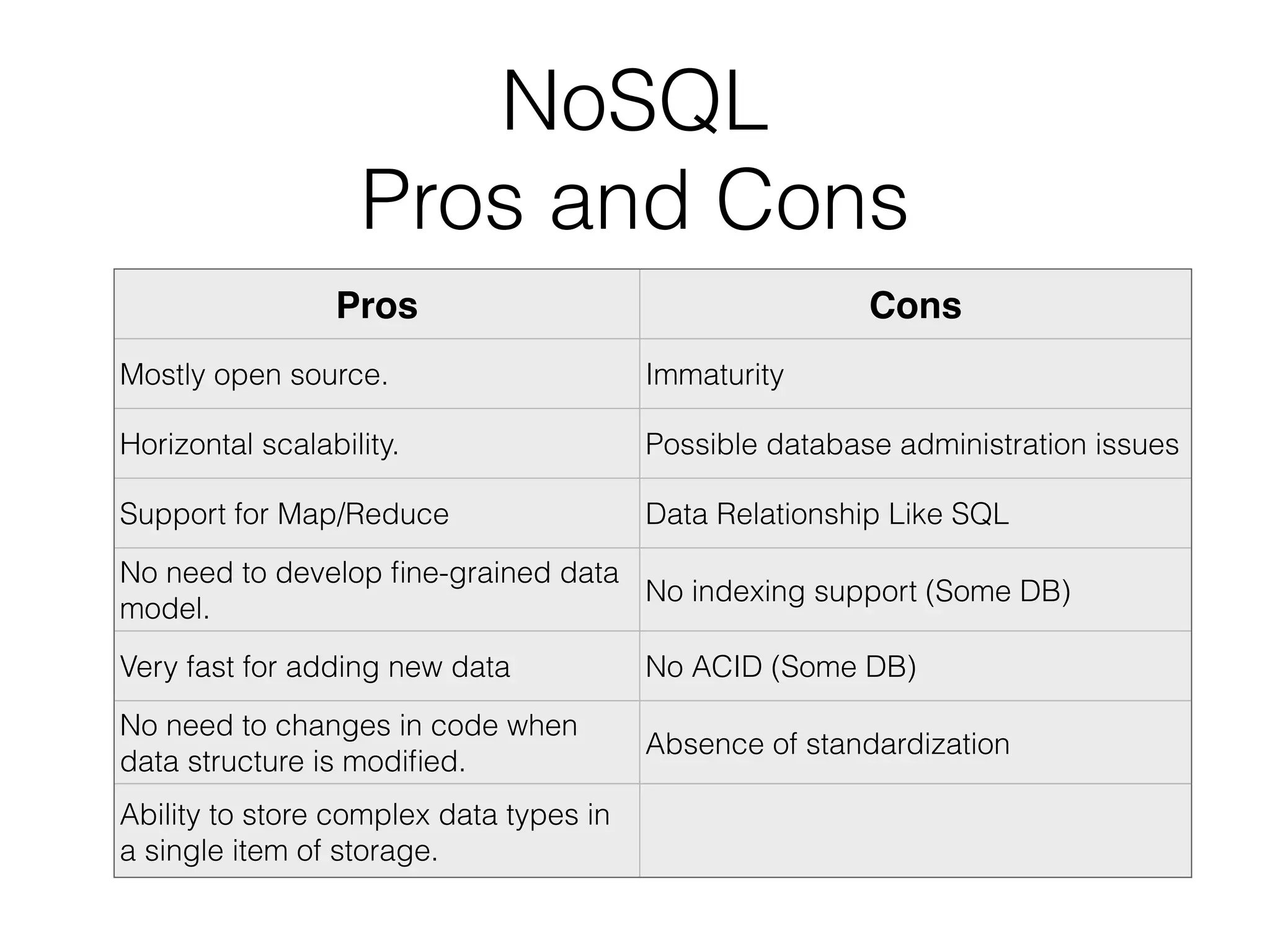
NoSQL Pros and Cons Pros Cons Mostly open source. Immaturity Horizontal scalability. Possible database administration issues Support for Map/Reduce Data Relationship Like SQL No need to develop fine-grained data model. No indexing support (Some DB) Very fast for adding new data No ACID (Some DB) No need to changes in code when data structure is modified. Absence of standardization Ability to store complex data types in a single item of storage.
Who are using No SQL ? • All big companies using NoSQL
Who are using OrientDB ? THJUG • Nobody uses Java anymore, I'm nobody A.K.A • Nobody uses OrientDB anymore, I'm nobody
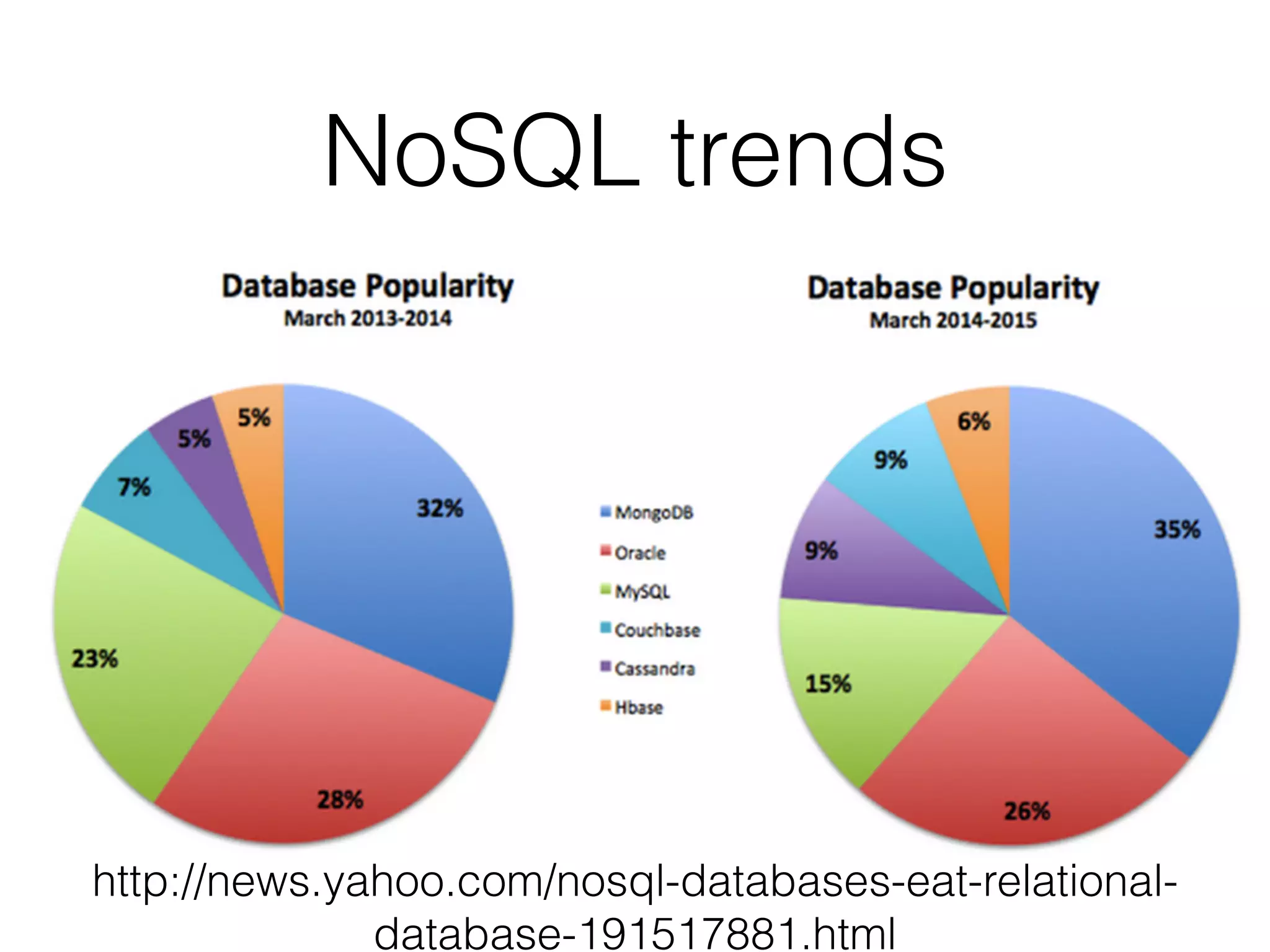
NoSQL trends http://news.yahoo.com/nosql-databases-eat-relational- database-191517881.html
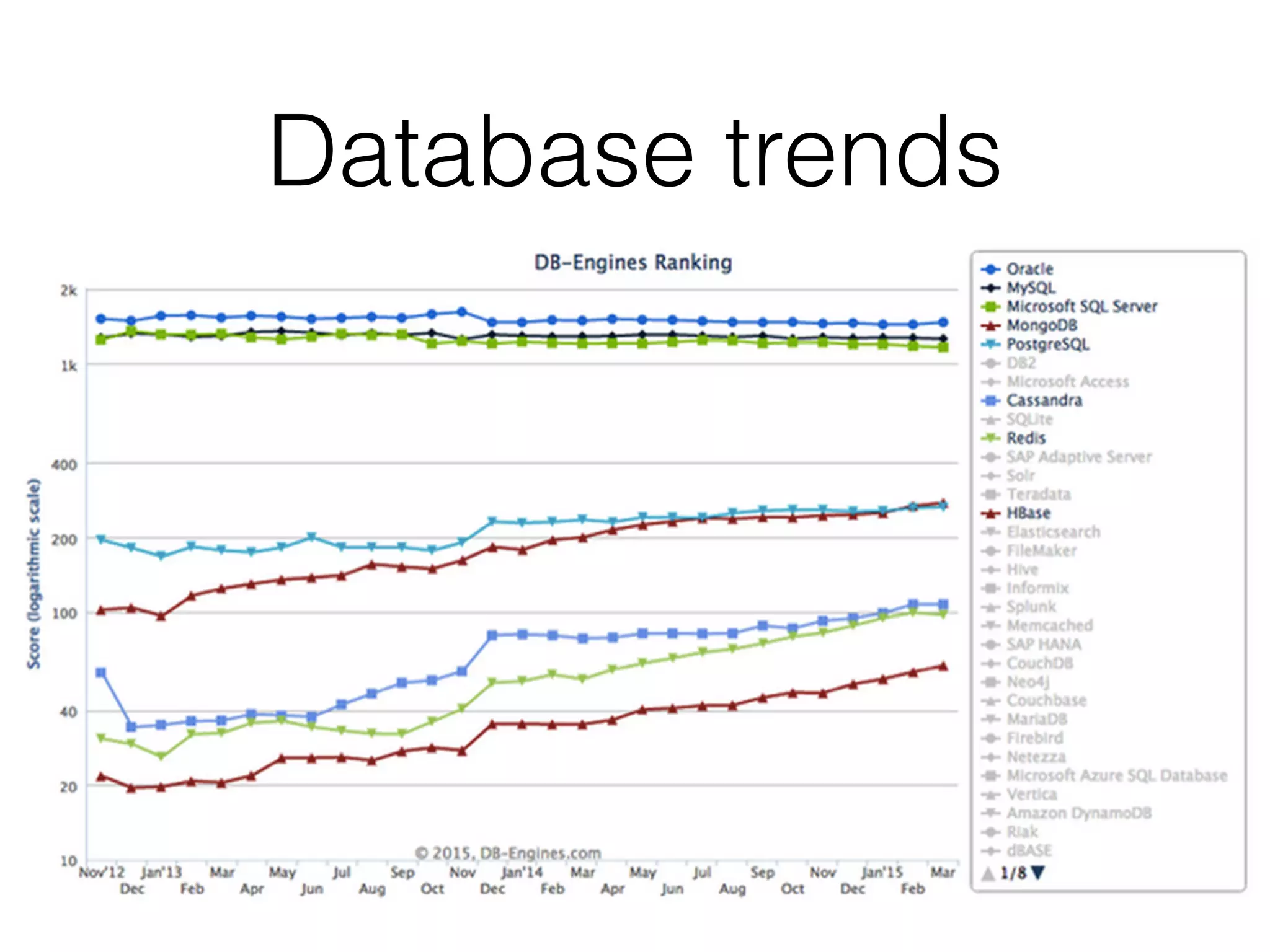
Database trends
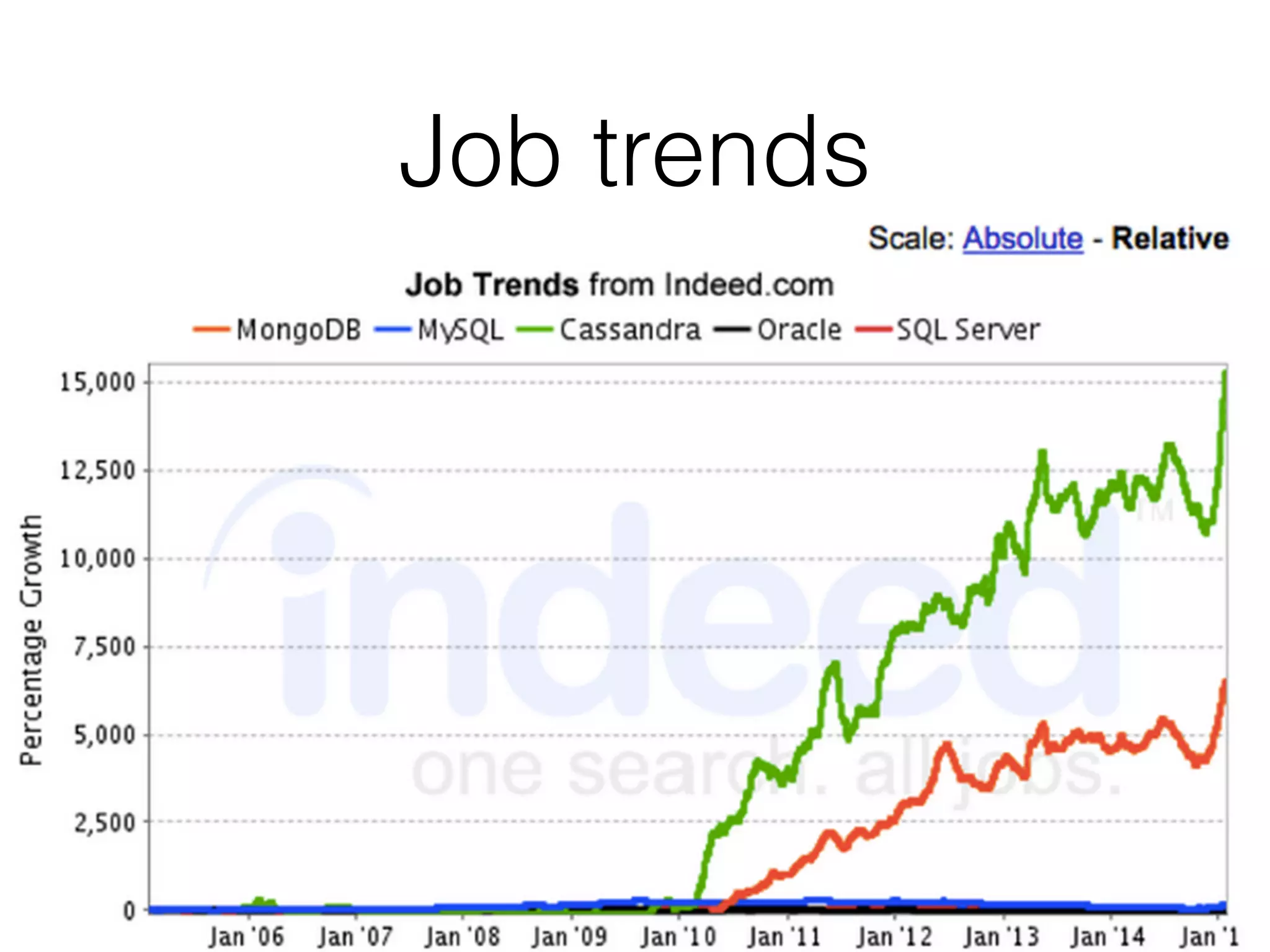
Job trends
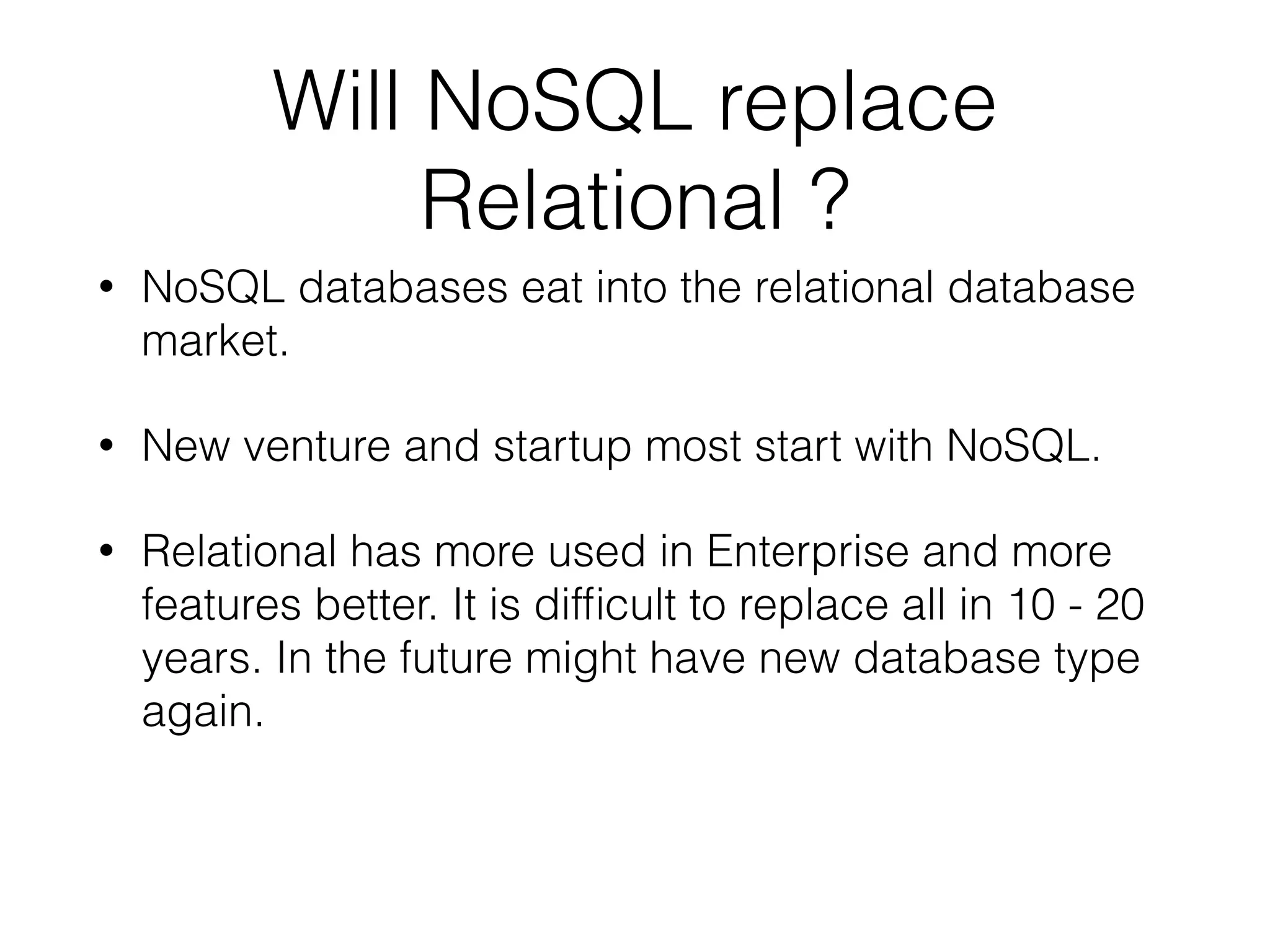
Will NoSQL replace Relational ? • NoSQL databases eat into the relational database market. • New venture and startup most start with NoSQL. • Relational has more used in Enterprise and more features better. It is difficult to replace all in 10 - 20 years. In the future might have new database type again.
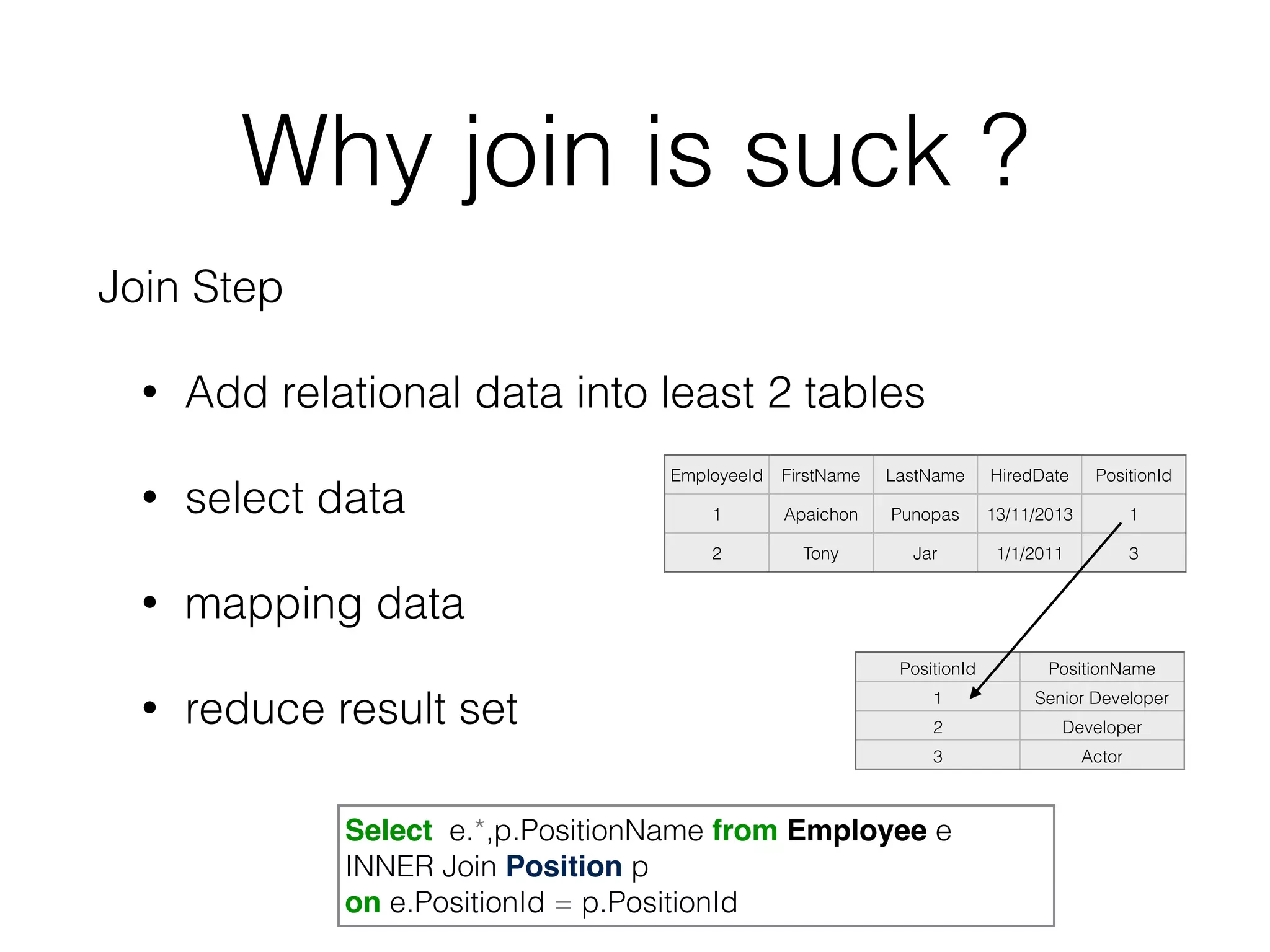
Why join is suck ? Join Step • Add relational data into least 2 tables • select data • mapping data • reduce result set EmployeeId FirstName LastName HiredDate PositionId 1 Apaichon Punopas 13/11/2013 1 2 Tony Jar 1/1/2011 3 PositionId PositionName 1 Senior Developer 2 Developer Manager3 Actor Select e.*,p.PositionName from Employee e INNER Join Position p on e.PositionId = p.PositionId
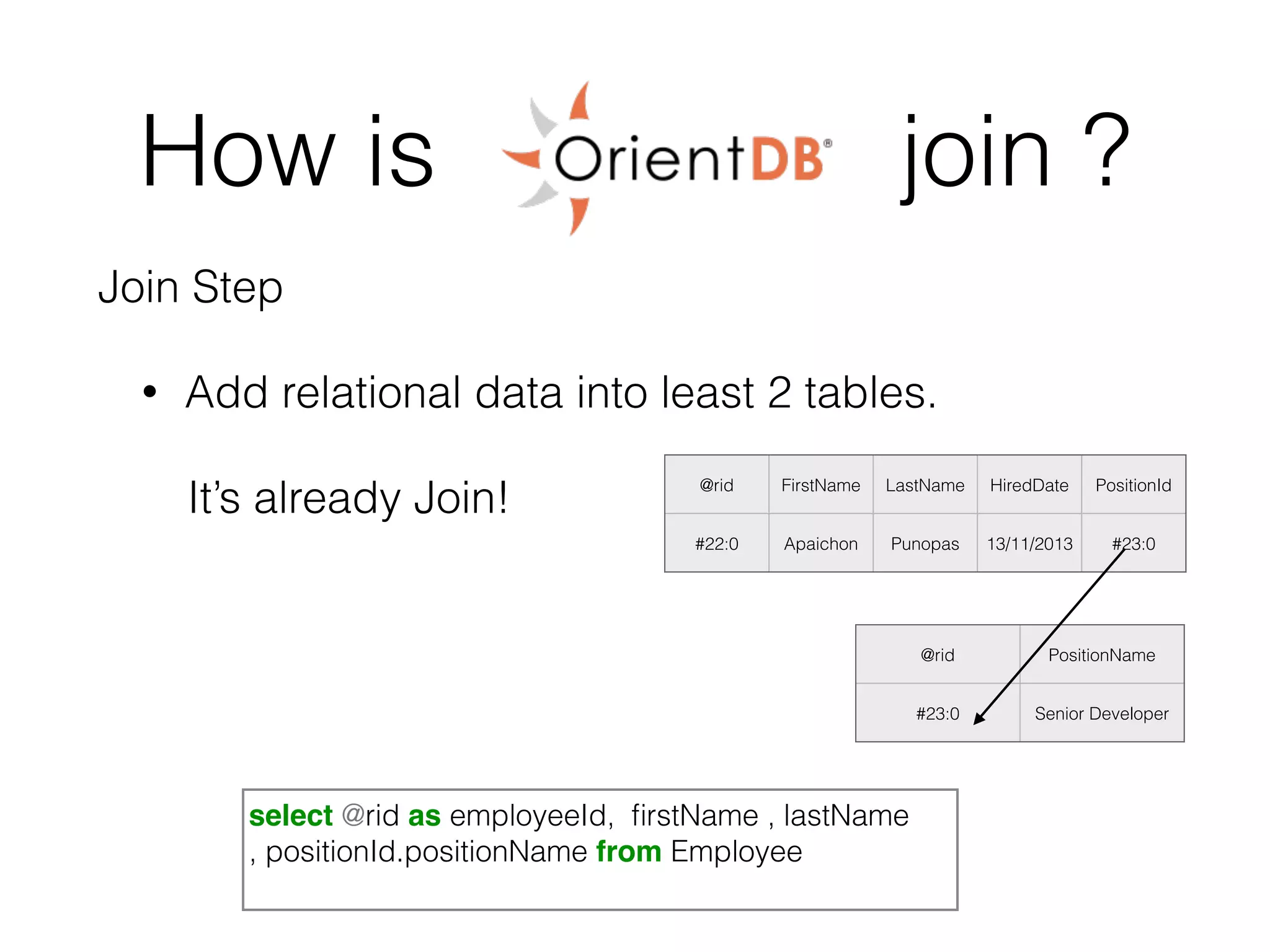
How is OrientDB join ? Join Step • Add relational data into least 2 tables. It’s already Join! @rid FirstName LastName HiredDate PositionId #22:0 Apaichon Punopas 13/11/2013 #23:0 @rid PositionName #23:0 Senior Developer select @rid as employeeId, firstName , lastName , positionId.positionName from Employee
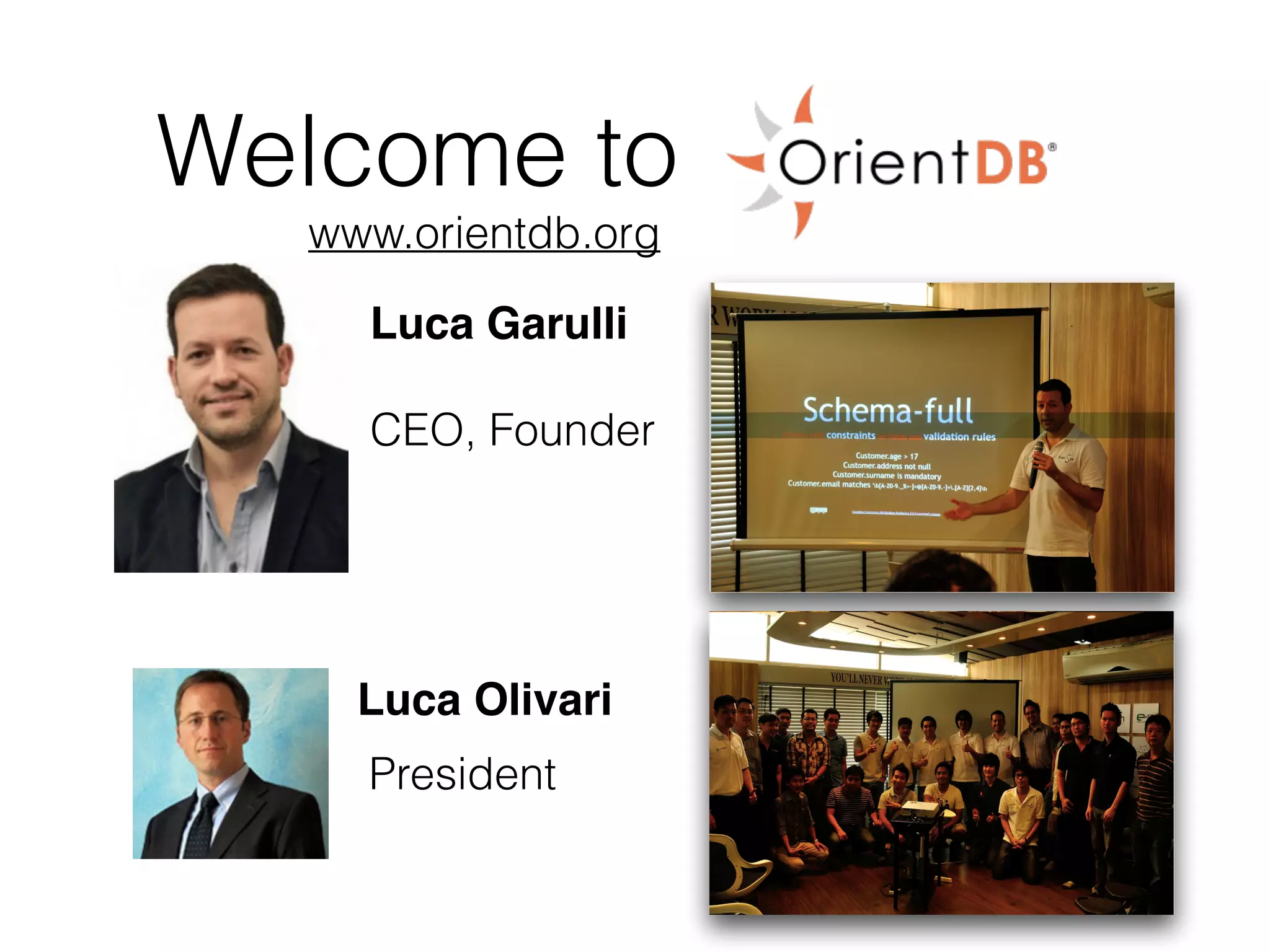
Welcome to OrientDB Luca Garulli CEO, Founder Luca Olivari President www.orientdb.org
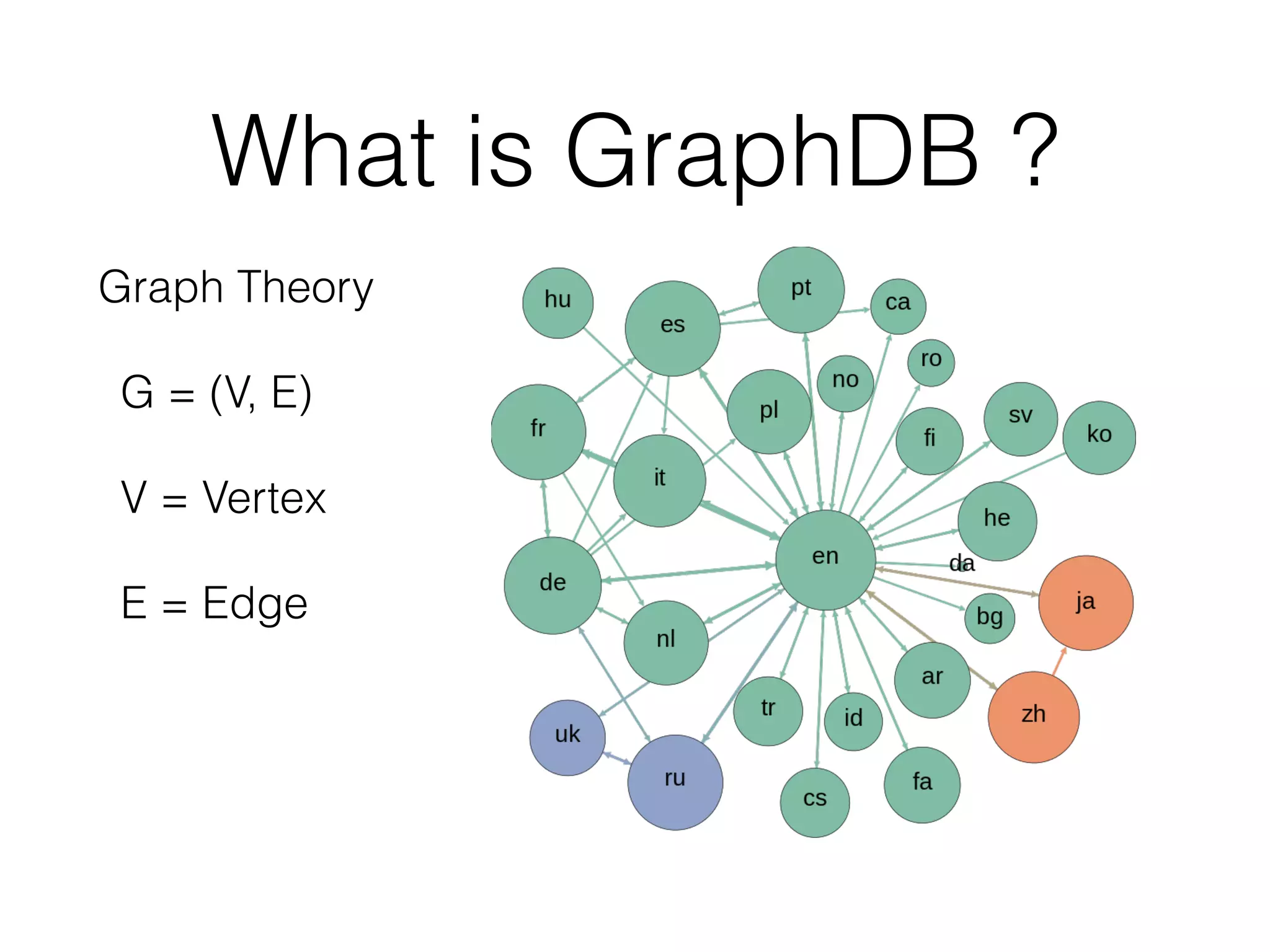
What is GraphDB ? Graph Theory G = (V, E) V = Vertex E = Edge
Certificate of chievement This%certificate%is%awarded%to% Attendee Your%understand%Graph%Theory.% Apaichon Punopas เครือข่าย โปรแกรมเมอร์ไทย
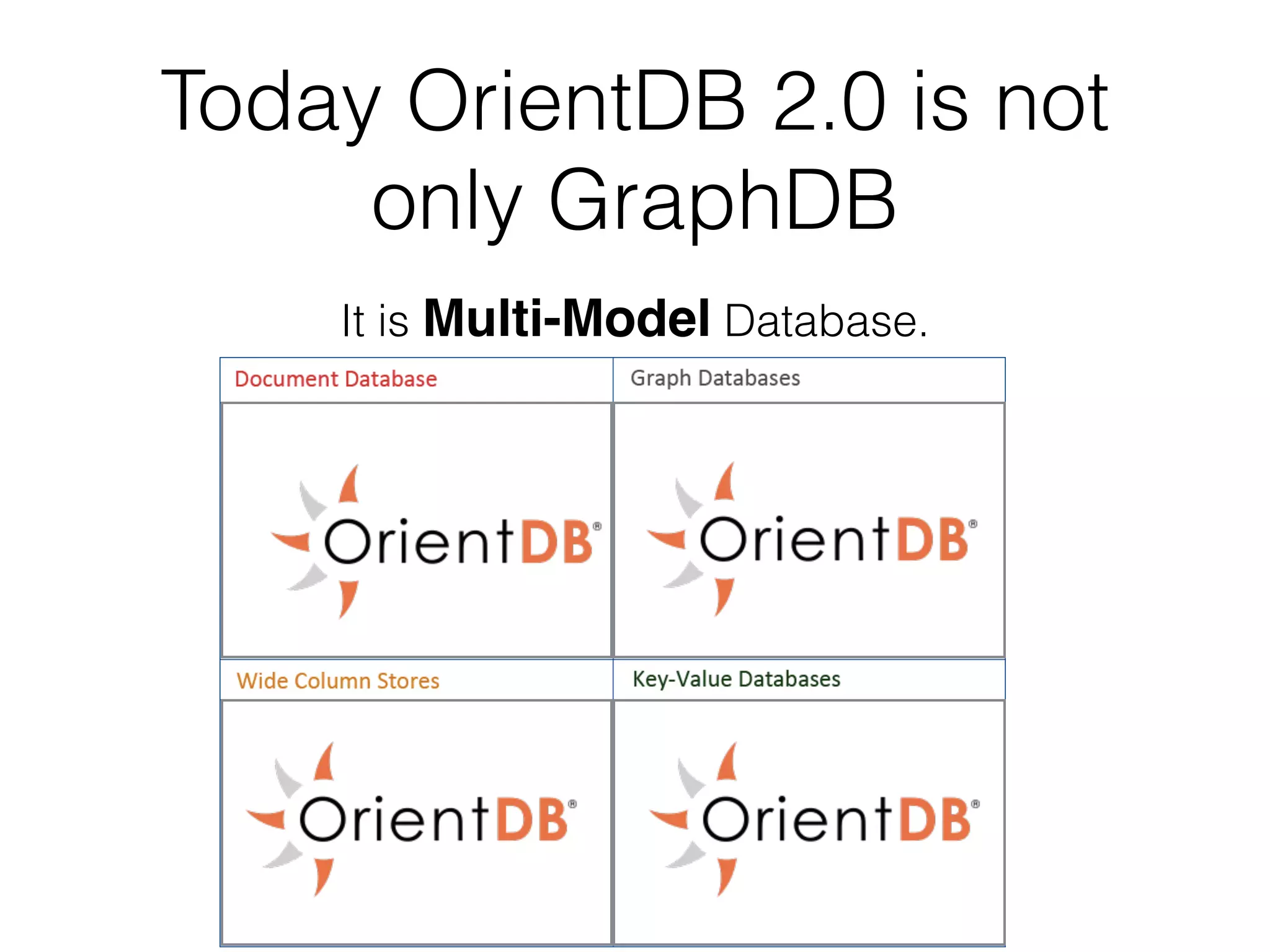
Today OrientDB 2.0 is not only GraphDB It is Multi-Model Database.
Document Model The data in this model is stored inside documents. A document is a set of key/value pairs (also referred to as fields or properties) where a key allows access to its value. Values can hold primitive data types, embedded documents, or arrays of other values. {firstName:”A",lastName:"LA" , friends:[{firstName:”A"} ,{firstName:"B" , lastName: “lB”}] }
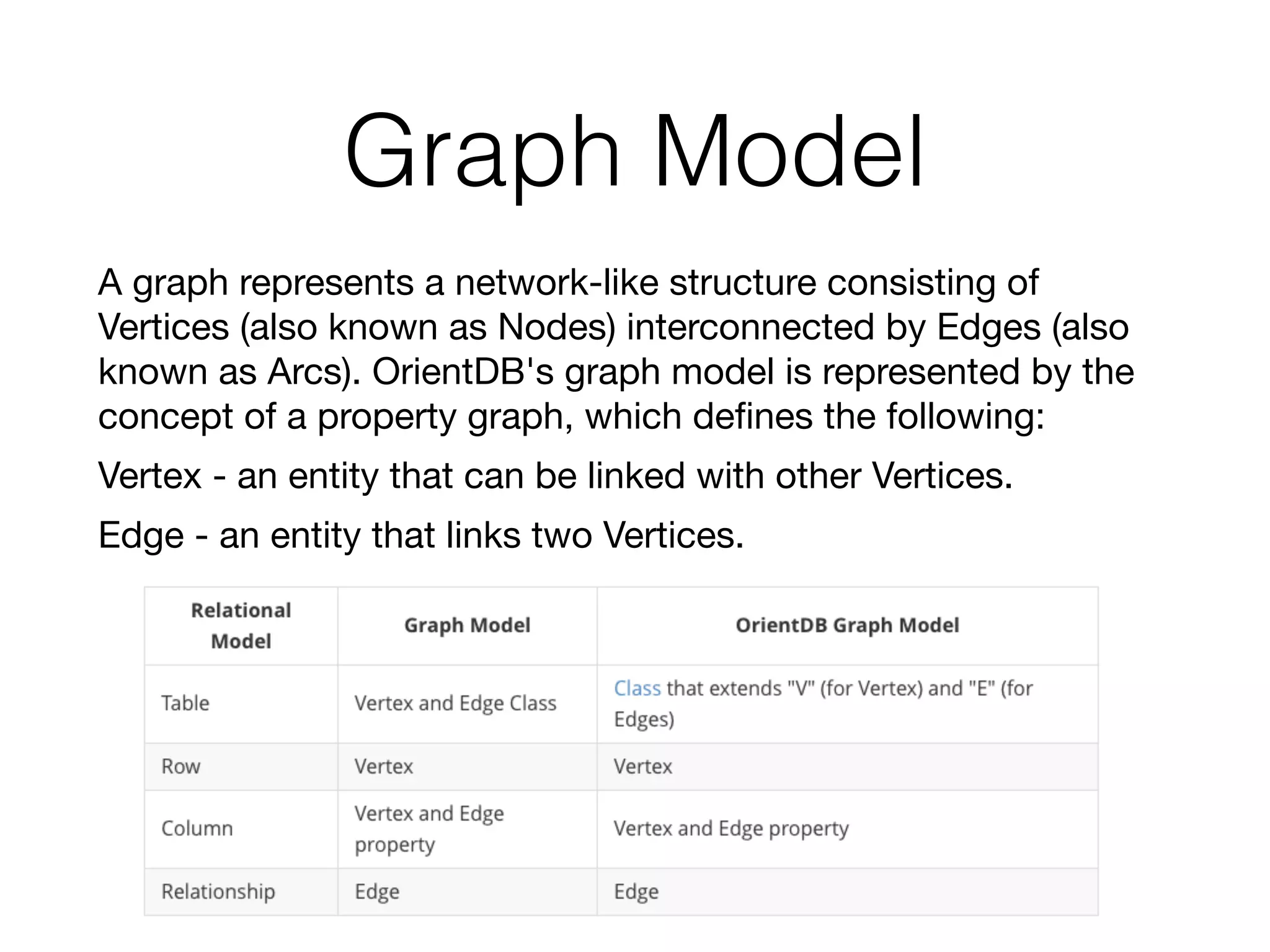
Graph Model A graph represents a network-like structure consisting of Vertices (also known as Nodes) interconnected by Edges (also known as Arcs). OrientDB's graph model is represented by the concept of a property graph, which defines the following: Vertex - an entity that can be linked with other Vertices. Edge - an entity that links two Vertices.
Support Types • Popular types same as other database such as boolean , integer ,double , string , binary , etc • Embleded -> JSON such as {name:”A” , friends: [{name:”B” },name:{“C”}] • Link -> RecordID
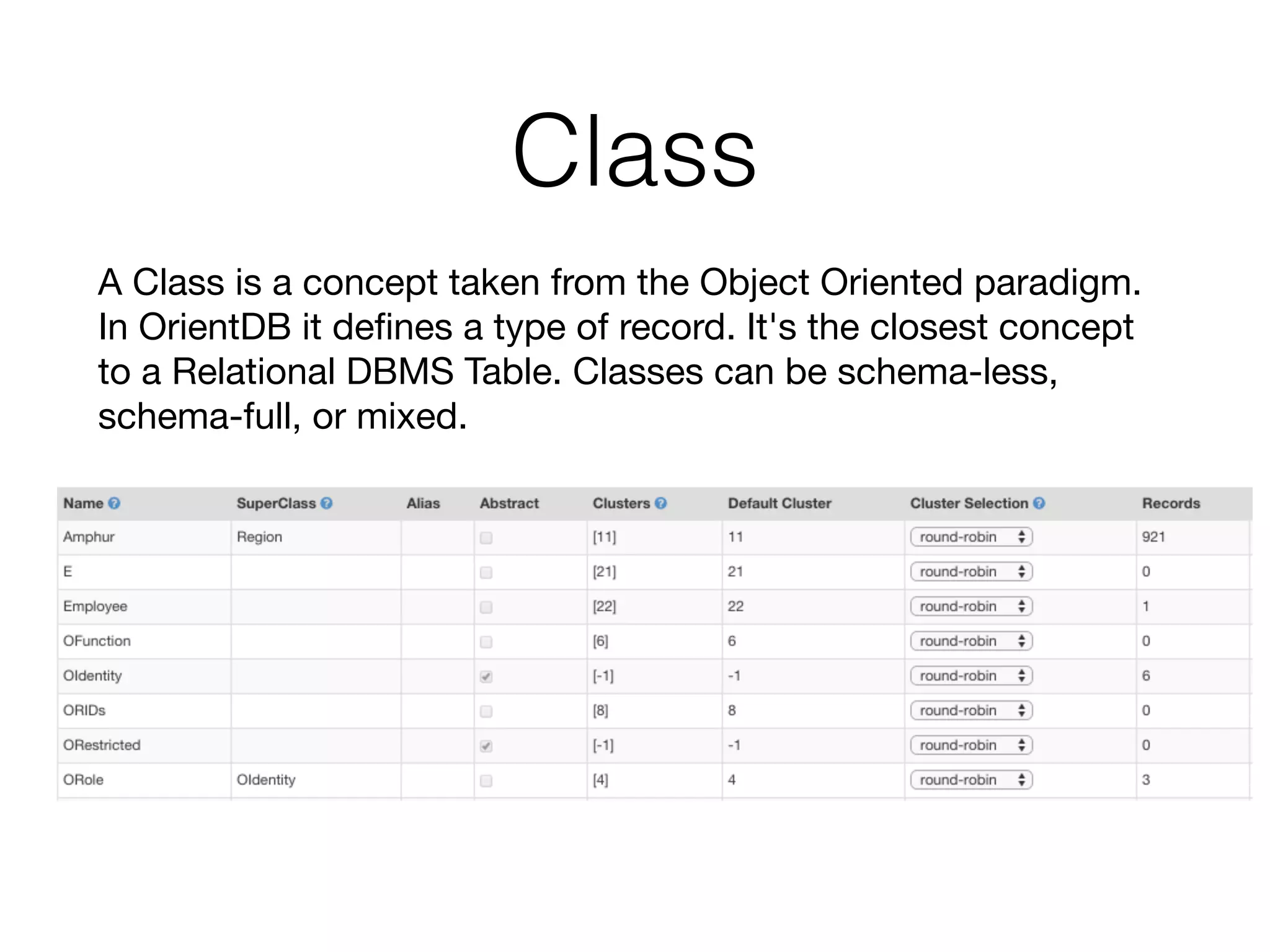
Class A Class is a concept taken from the Object Oriented paradigm. In OrientDB it defines a type of record. It's the closest concept to a Relational DBMS Table. Classes can be schema-less, schema-full, or mixed.
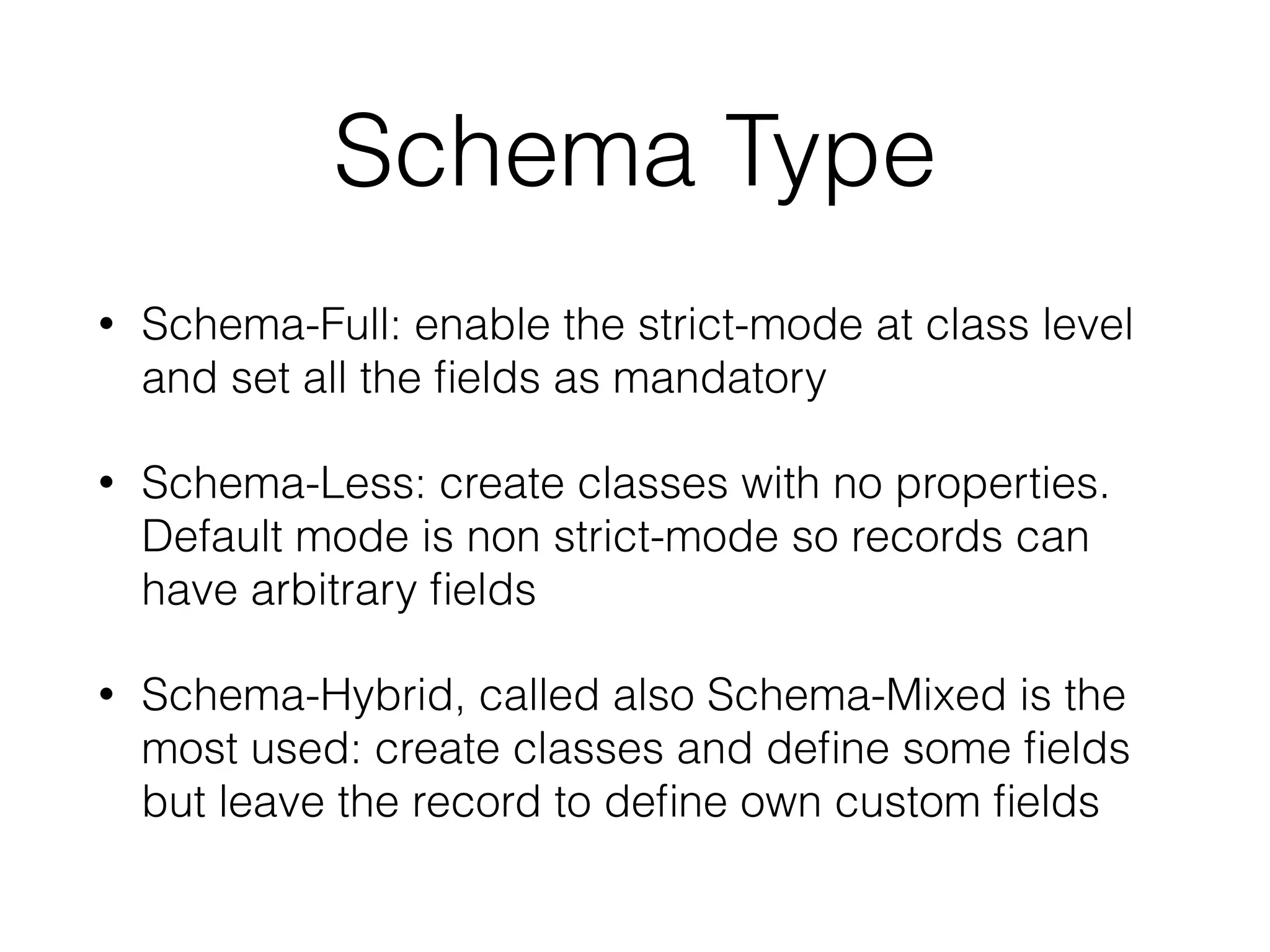
Schema Type • Schema-Full: enable the strict-mode at class level and set all the fields as mandatory • Schema-Less: create classes with no properties. Default mode is non strict-mode so records can have arbitrary fields • Schema-Hybrid, called also Schema-Mixed is the most used: create classes and define some fields but leave the record to define own custom fields
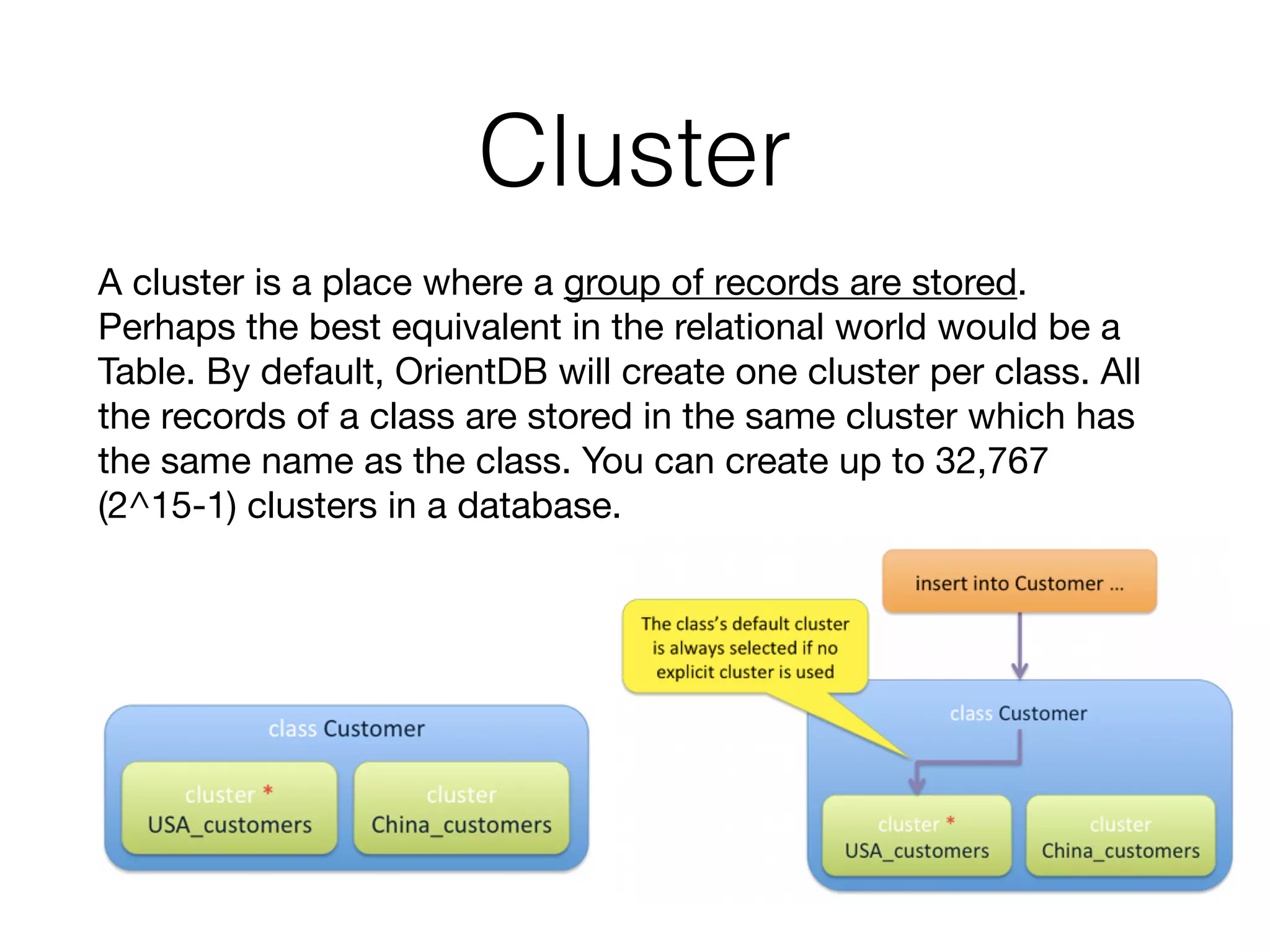
Cluster A cluster is a place where a group of records are stored. Perhaps the best equivalent in the relational world would be a Table. By default, OrientDB will create one cluster per class. All the records of a class are stored in the same cluster which has the same name as the class. You can create up to 32,767 (2^15-1) clusters in a database.
Record ID In OrientDB each record has its own self-assigned unique ID within the database called Record ID or RID. It is composed of two parts: • cluster-id is the id of the cluster. Each database can have a maximum of 32,767 clusters (2^15-1) • cluster-position is the position of the record inside the cluster. Each cluster can handle up to 9,223,372,036,854,780,000 (2^63) records, namely 9,223,372 Trillion of records! #<cluster-id>:<cluster-position>
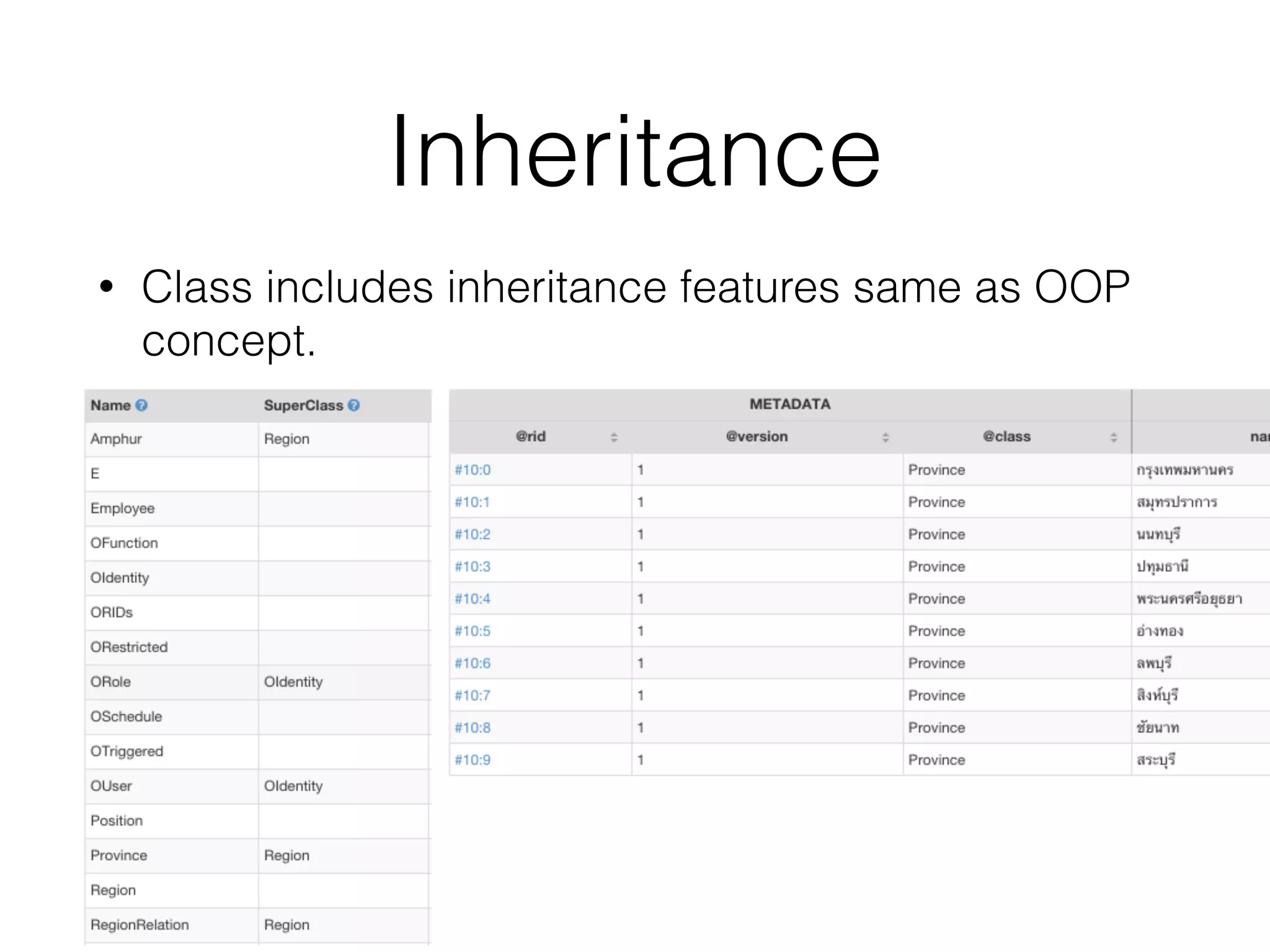
Inheritance • Class includes inheritance features same as OOP concept.
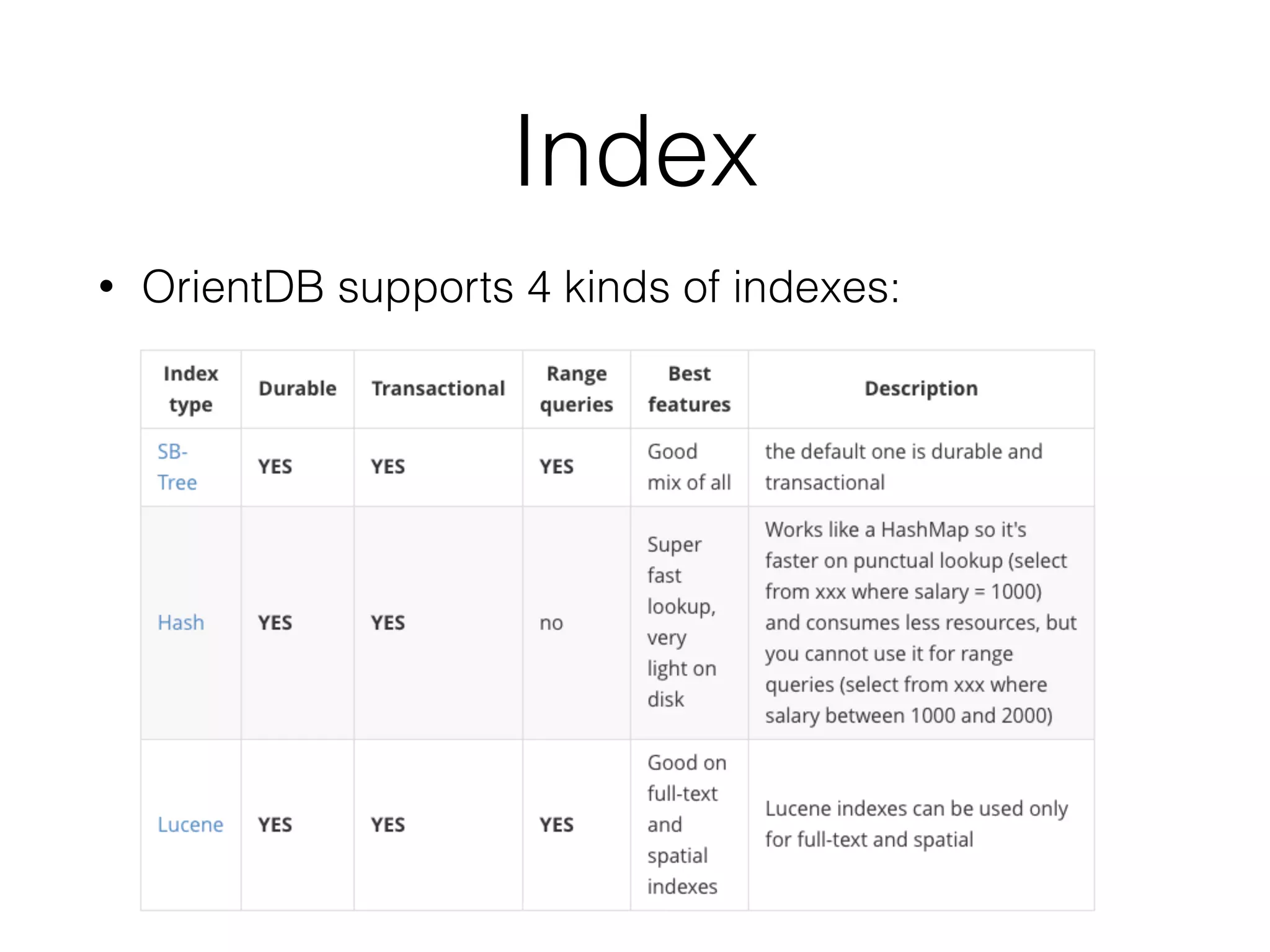
Index • OrientDB supports 4 kinds of indexes:
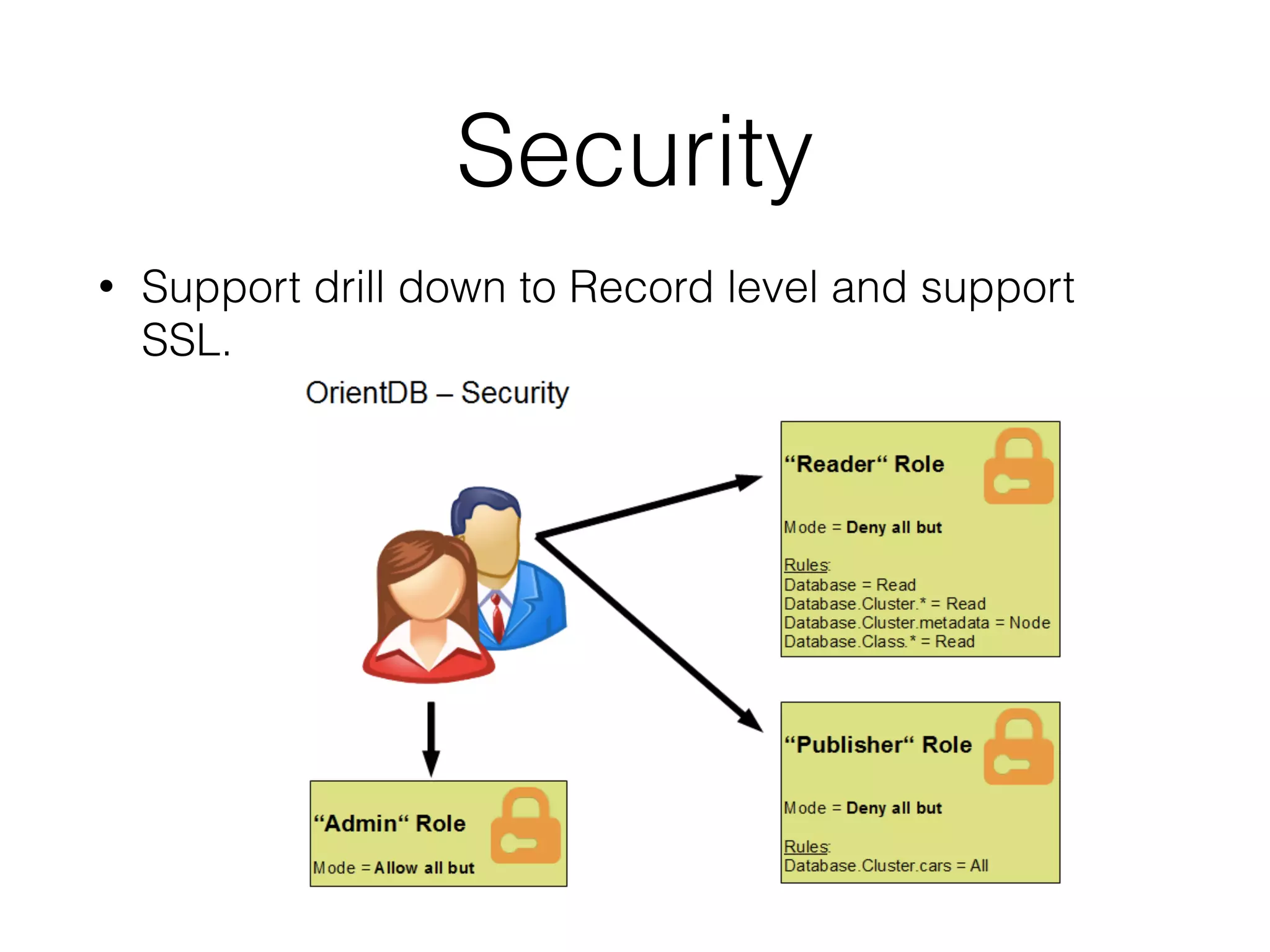
Security • Support drill down to Record level and support SSL.
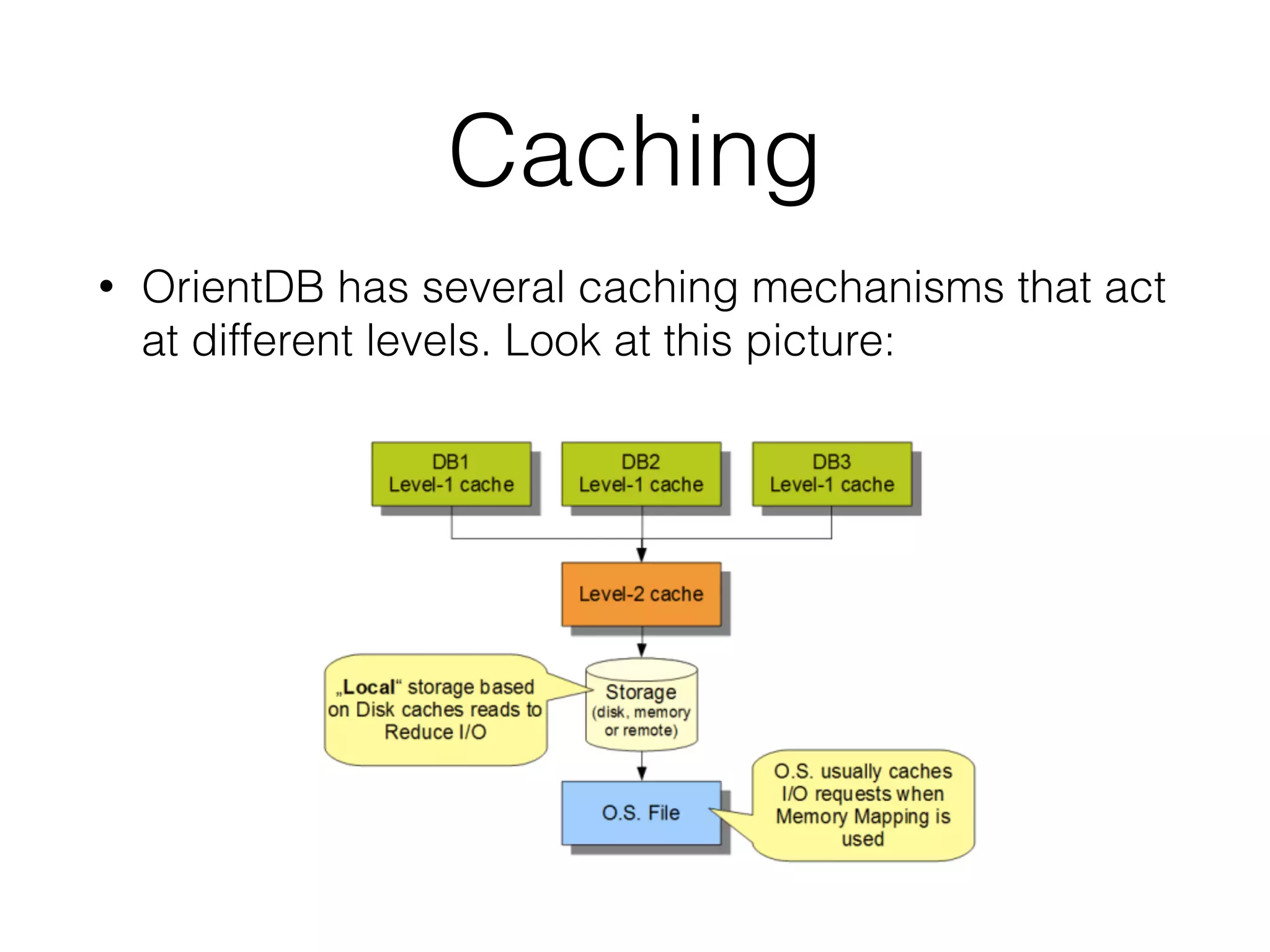
Caching • OrientDB has several caching mechanisms that act at different levels. Look at this picture:
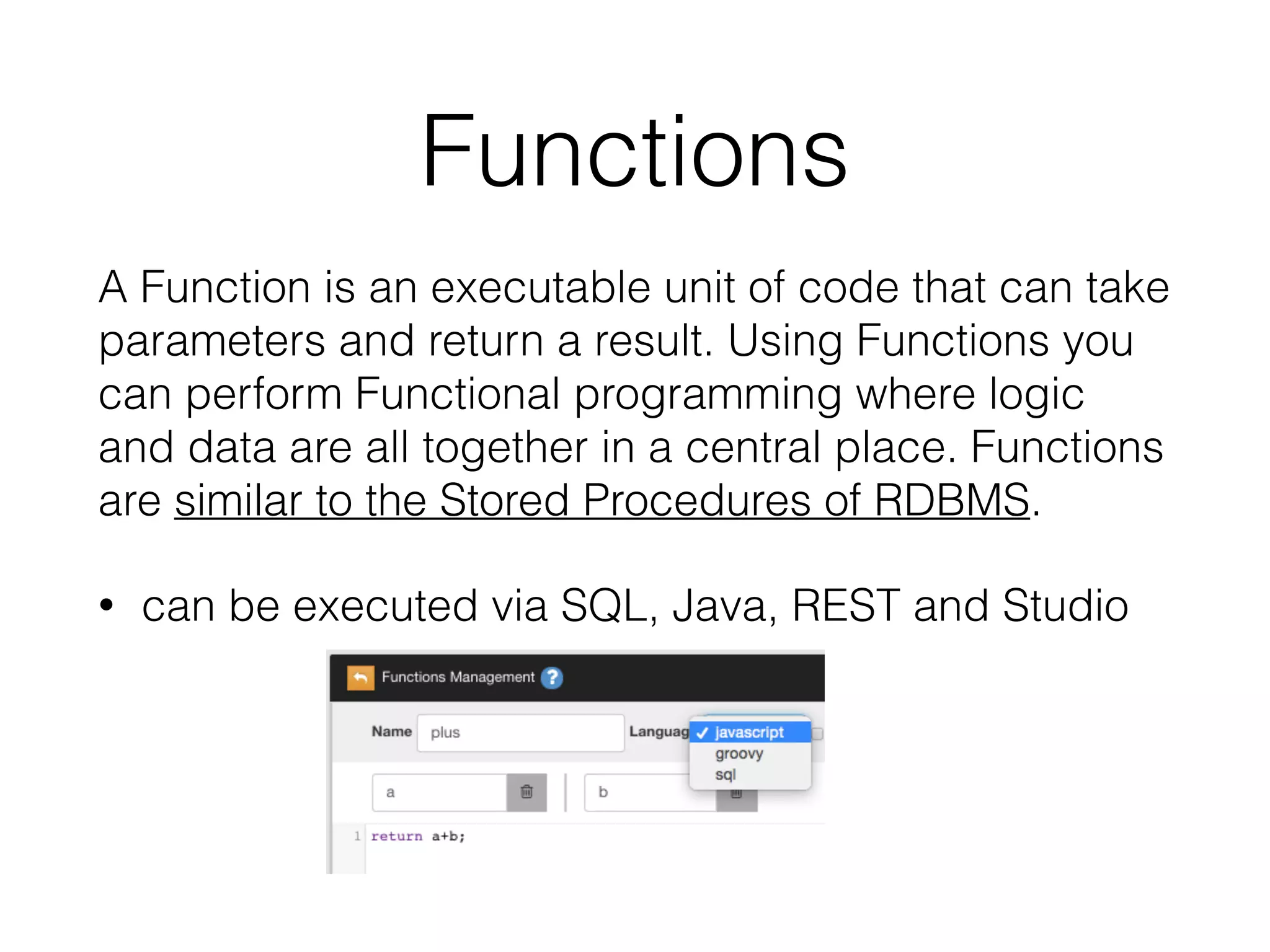
Functions A Function is an executable unit of code that can take parameters and return a result. Using Functions you can perform Functional programming where logic and data are all together in a central place. Functions are similar to the Stored Procedures of RDBMS. • can be executed via SQL, Java, REST and Studio
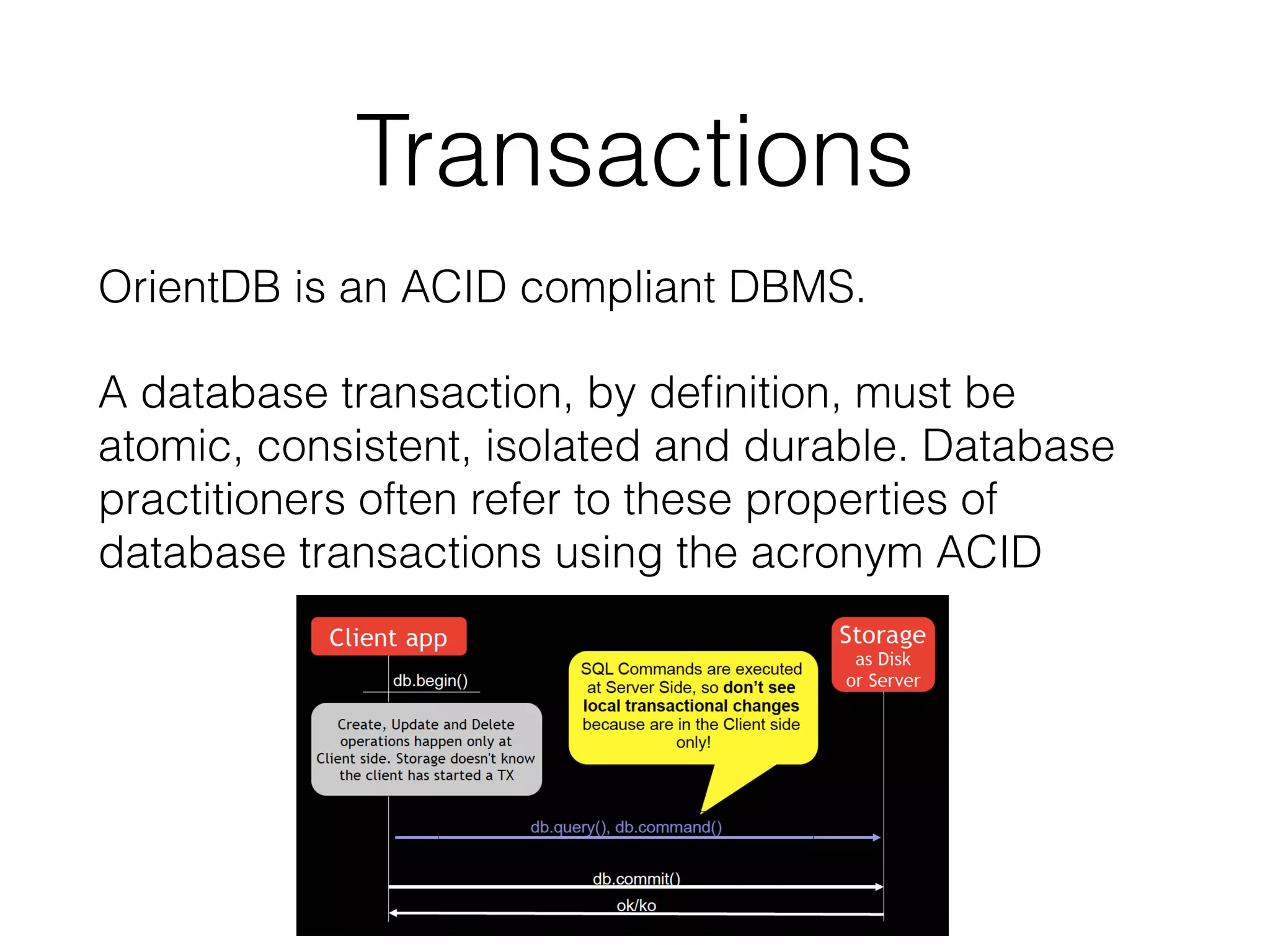
Transactions OrientDB is an ACID compliant DBMS. A database transaction, by definition, must be atomic, consistent, isolated and durable. Database practitioners often refer to these properties of database transactions using the acronym ACID
Hooks (Triggers) • Hook works like a trigger. Hook lets to the user application to intercept internal events before and after each CRUD operation against records. You can use to write custom validation rules, to enforce security or even to orchestrate external events like the replication against a Relational DBMS.
API OrientDB supports 3 kinds of drivers: • Native binary remote, that talks directly against the TCP/IP socket using the binary protocol • HTTP REST/JSON, that talks directly against the TCP/IP socket using the HTTP protocol • Java wrapped, as a layer that links in some way the native Java driver. This is pretty easy for languages that run into the JVM like Scala, Groovy and JRuby
Scalability
Programming Language Driver • Most popular language are supported.
SQL Most NoSQL products have a custom query language. OrientDB focuses on standards when it comes to query languages. Instead of inventing "Yet Another Query Language", we started from the widely used and well understood SQL.
SQL - Select • select from OUser • select from #10:3 • select from [#10:1, #10:3, #10:5] • select from OUser where name like 'l%' • select sum(salary) from Employee where age < 40 group by job • select from Employee where any() like ‘Apa%' • select from china:Customers
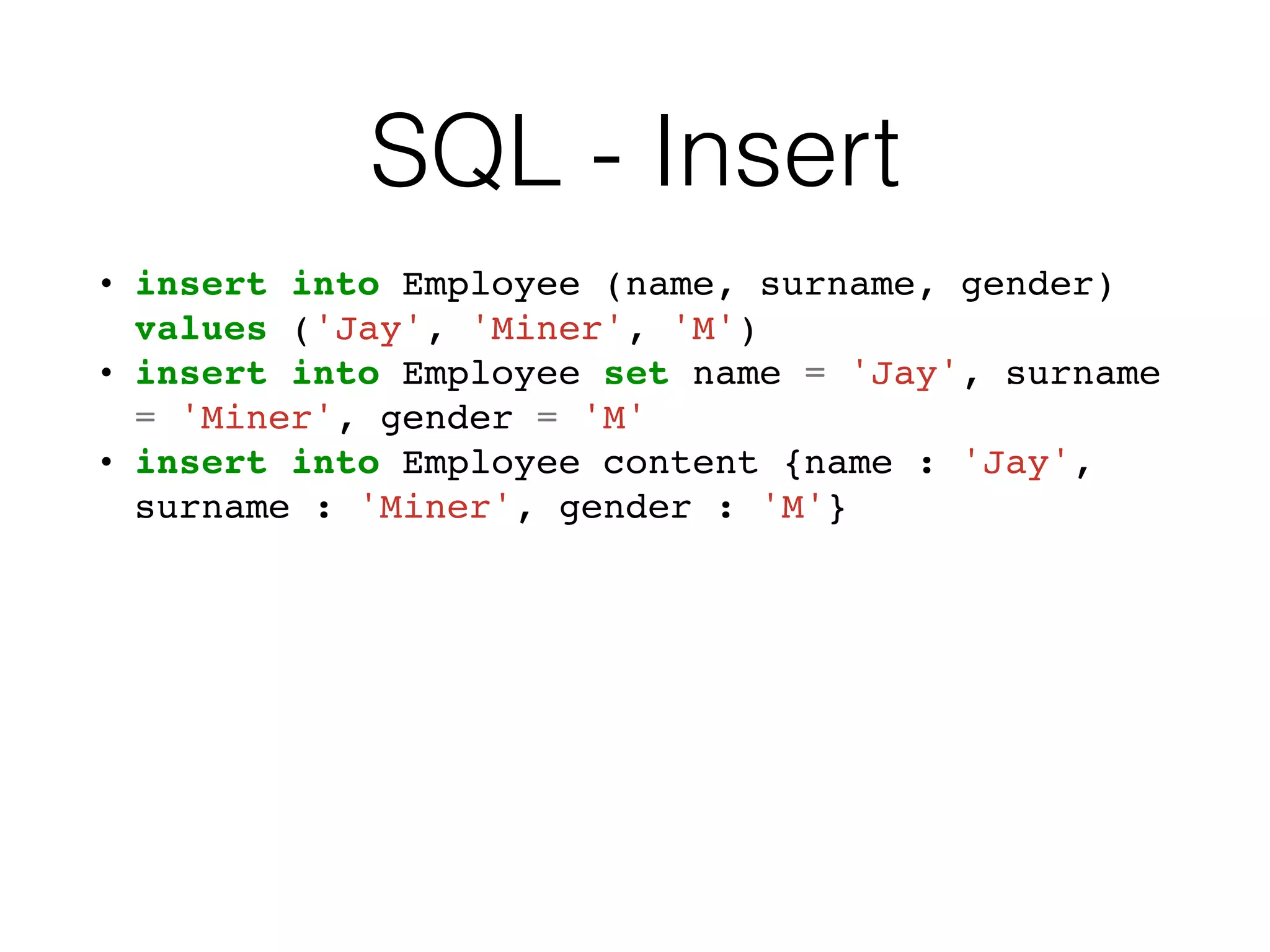
SQL - Insert • insert into Employee (name, surname, gender) values ('Jay', 'Miner', 'M') • insert into Employee set name = 'Jay', surname = 'Miner', gender = 'M' • insert into Employee content {name : 'Jay', surname : 'Miner', gender : 'M'}
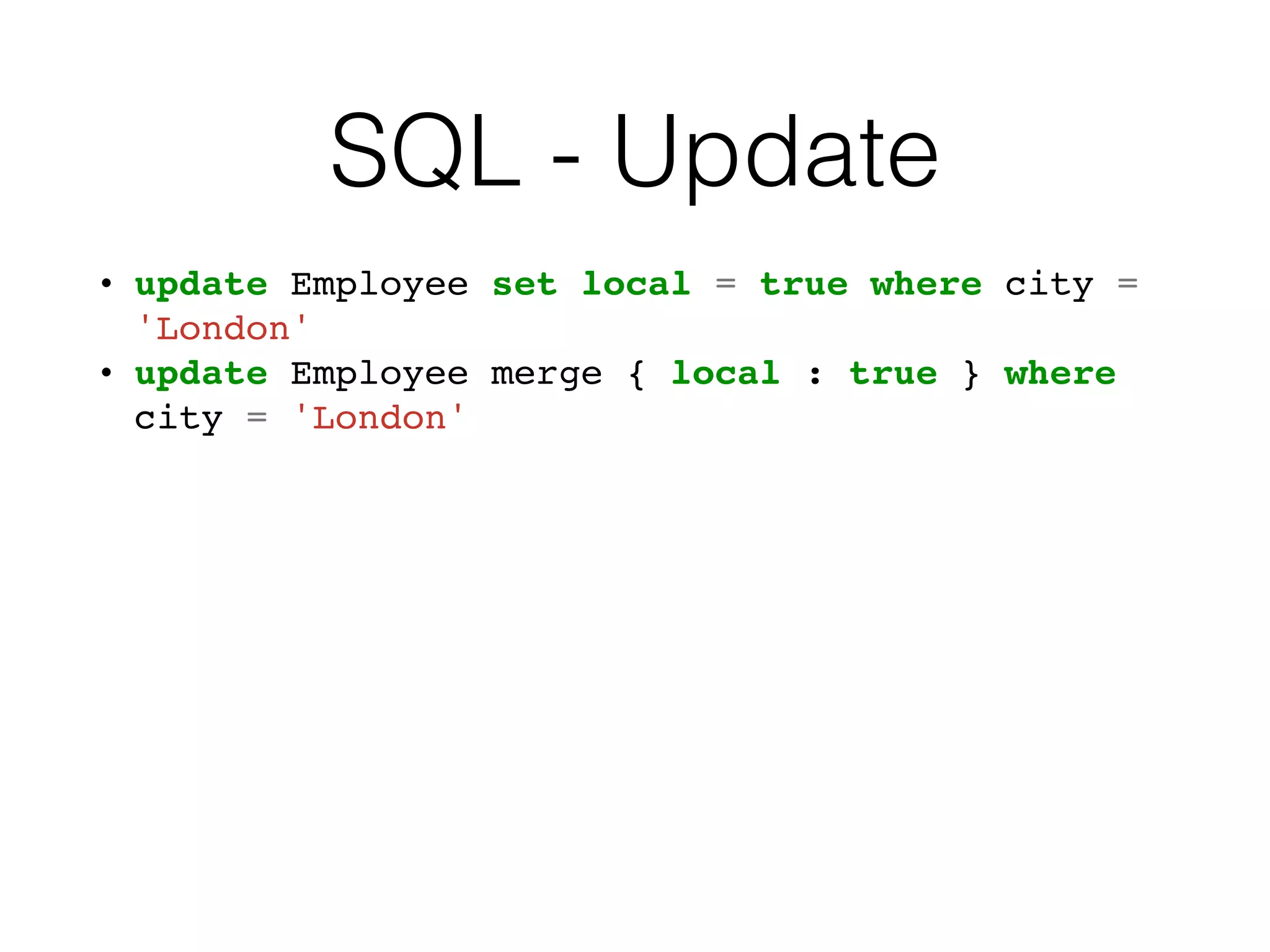
SQL - Update • update Employee set local = true where city = 'London' • update Employee merge { local : true } where city = 'London'
Delete •delete from Employee where city <> 'London' •delete from [#24:0,#24:1,#24:2]
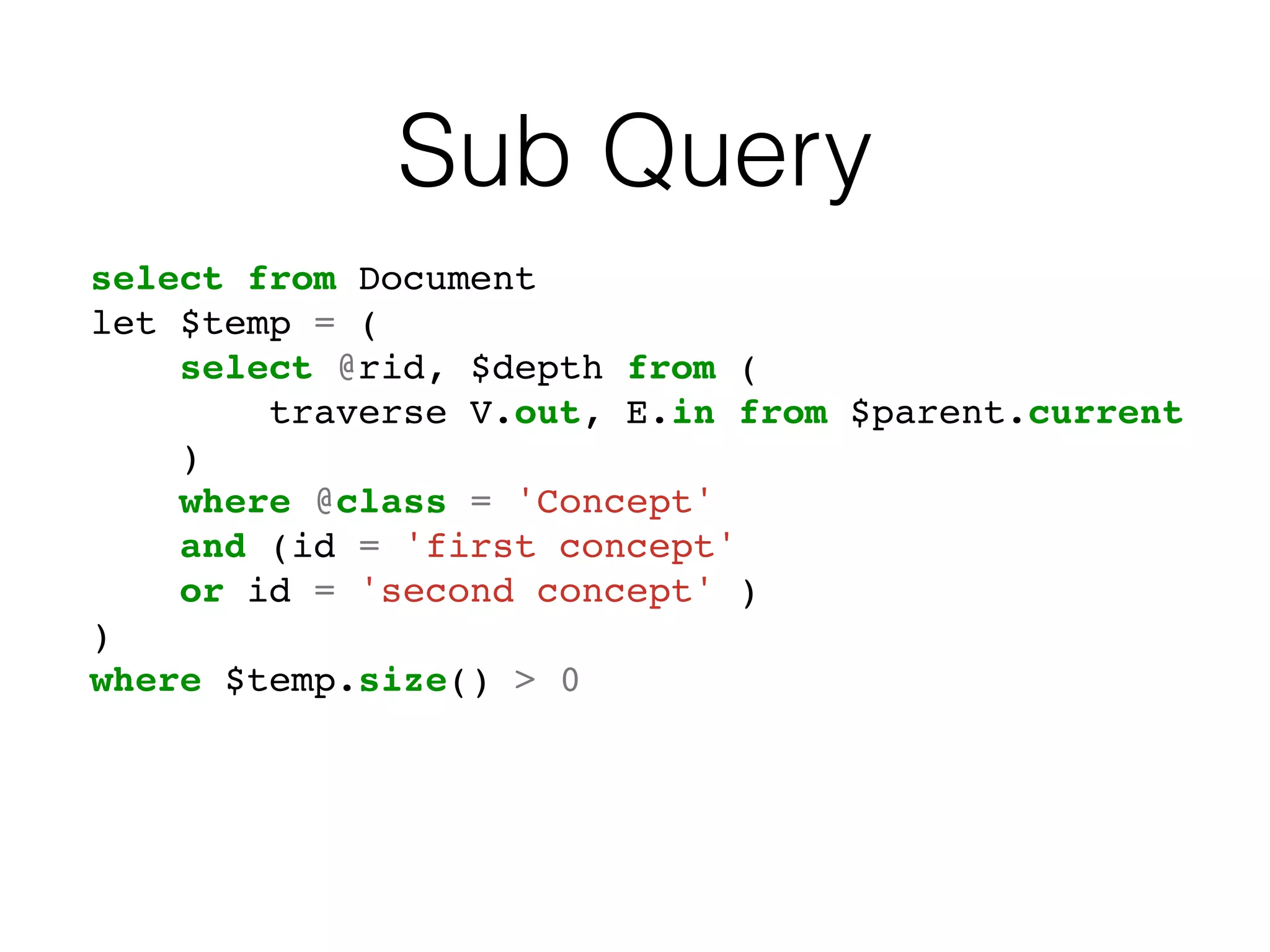
Sub Query select from Document let $temp = ( select @rid, $depth from ( traverse V.out, E.in from $parent.current ) where @class = 'Concept' and (id = 'first concept' or id = 'second concept' ) ) where $temp.size() > 0
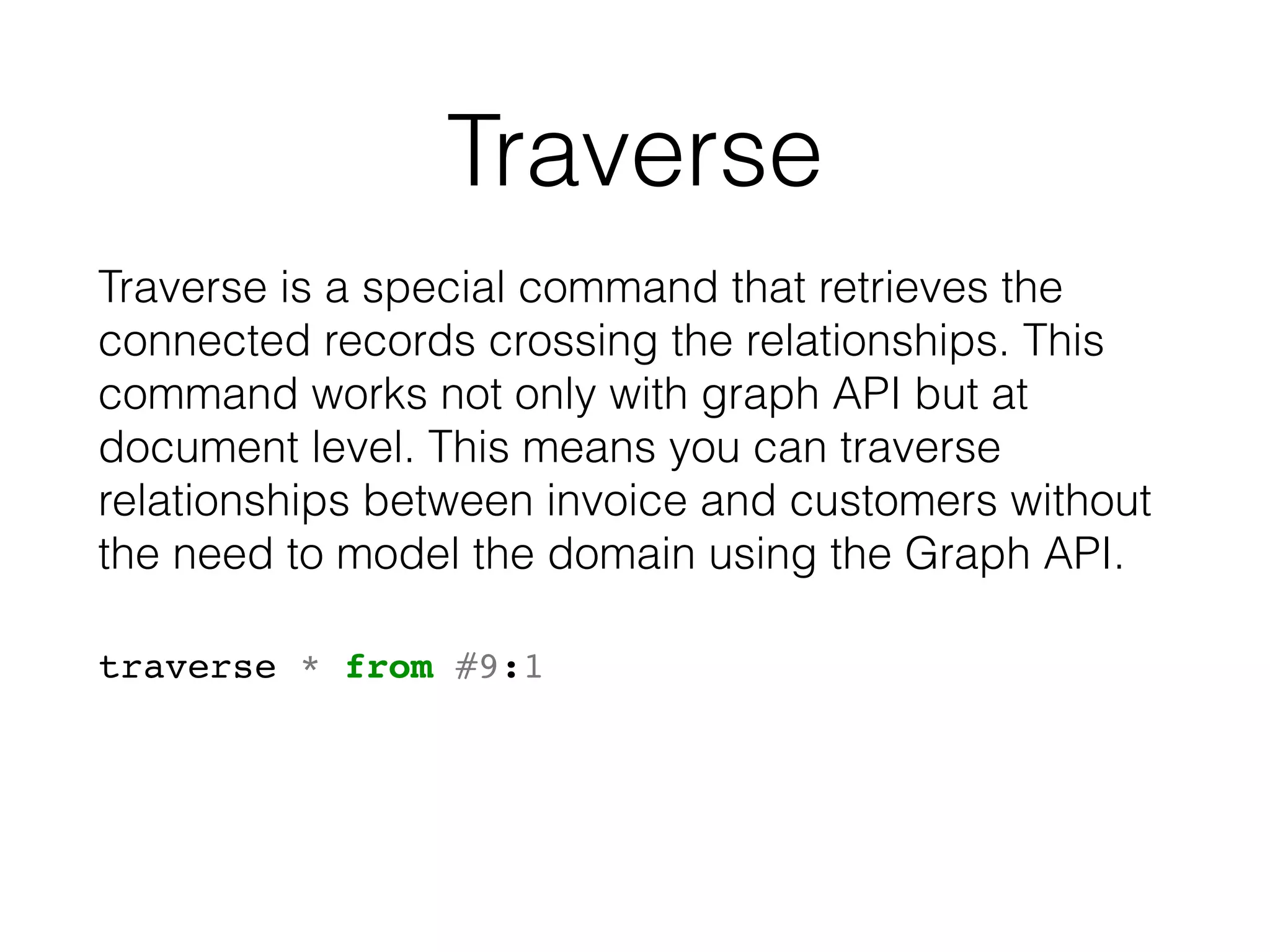
Traverse Traverse is a special command that retrieves the connected records crossing the relationships. This command works not only with graph API but at document level. This means you can traverse relationships between invoice and customers without the need to model the domain using the Graph API. traverse * from #9:1
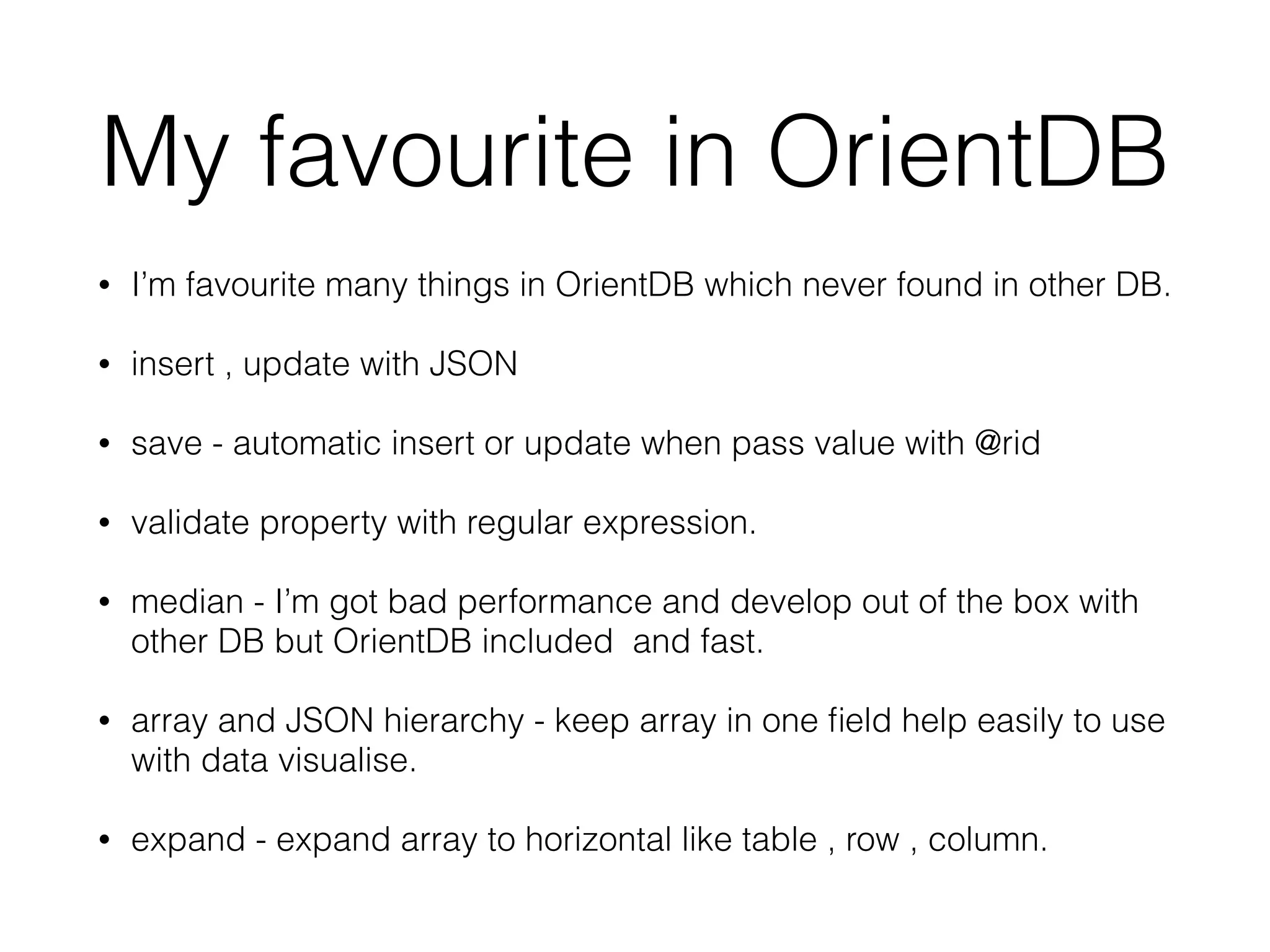
My favourite in OrientDB • I’m favourite many things in OrientDB which never found in other DB. • insert , update with JSON • save - automatic insert or update when pass value with @rid • validate property with regular expression. • median - I’m got bad performance and develop out of the box with other DB but OrientDB included and fast. • array and JSON hierarchy - keep array in one field help easily to use with data visualise. • expand - expand array to horizontal like table , row , column.
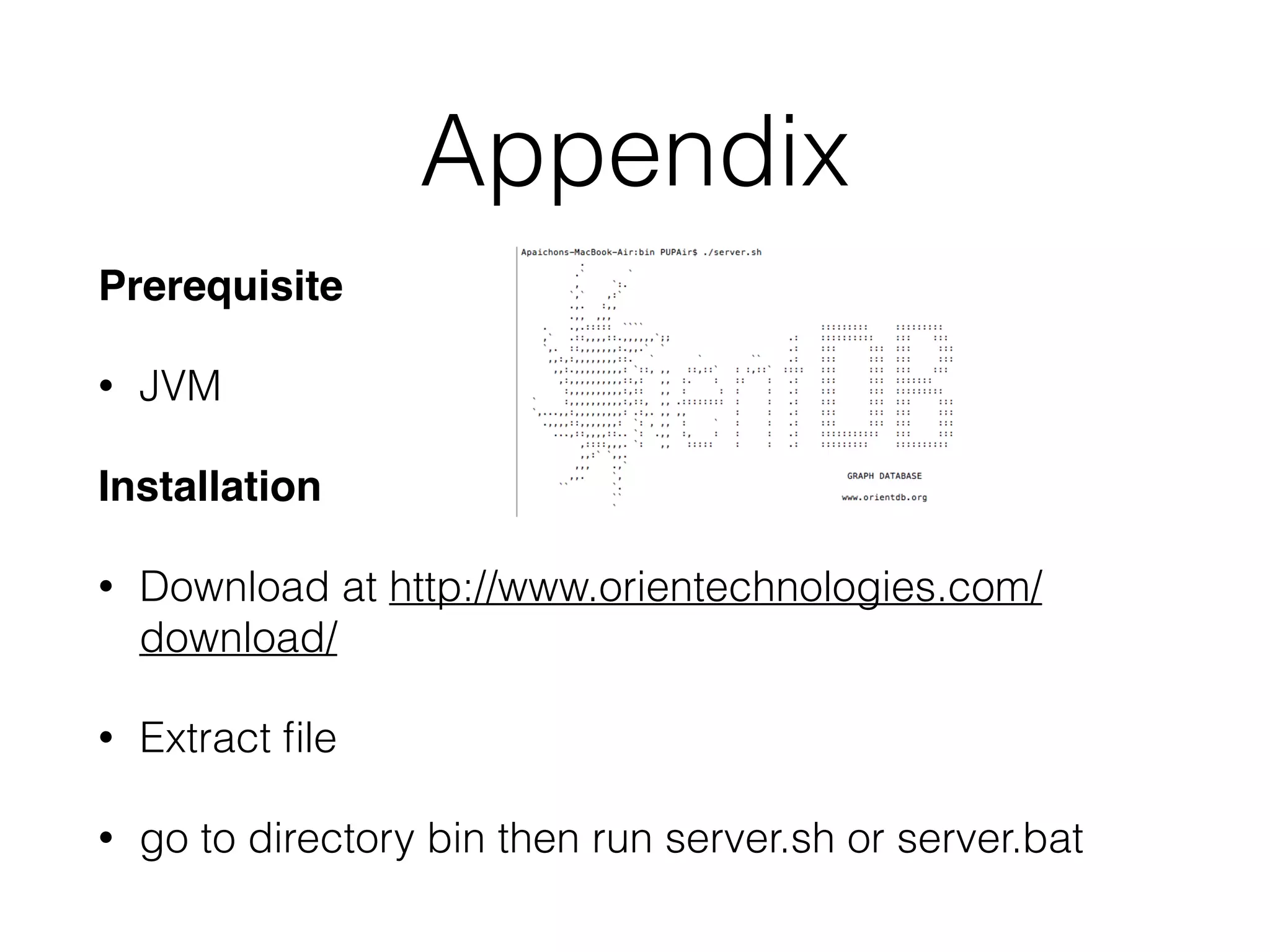
Appendix Prerequisite • JVM Installation • Download at http://www.orientechnologies.com/ download/ • Extract file • go to directory bin then run server.sh or server.bat
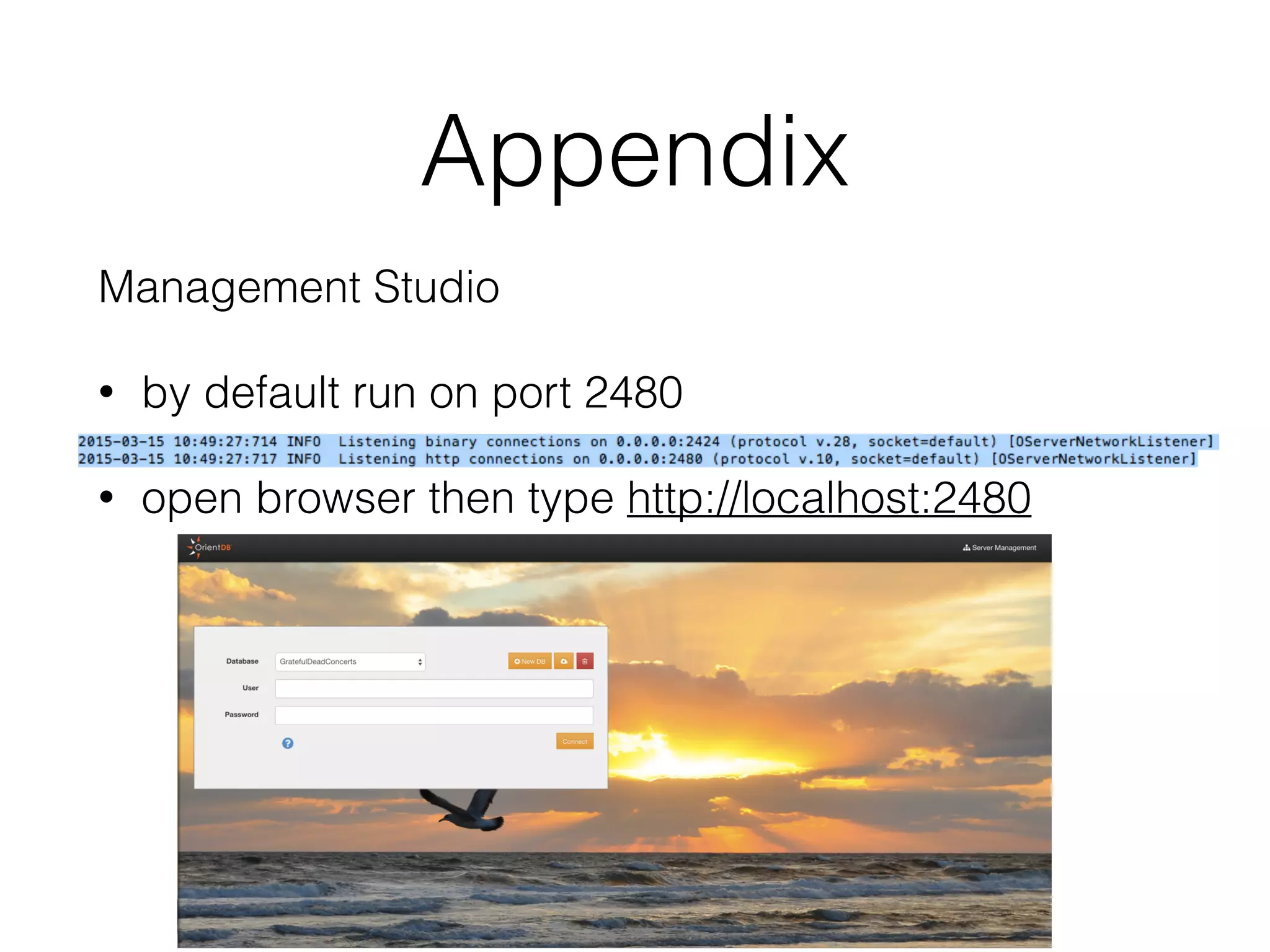
Appendix Management Studio • by default run on port 2480 • open browser then type http://localhost:2480
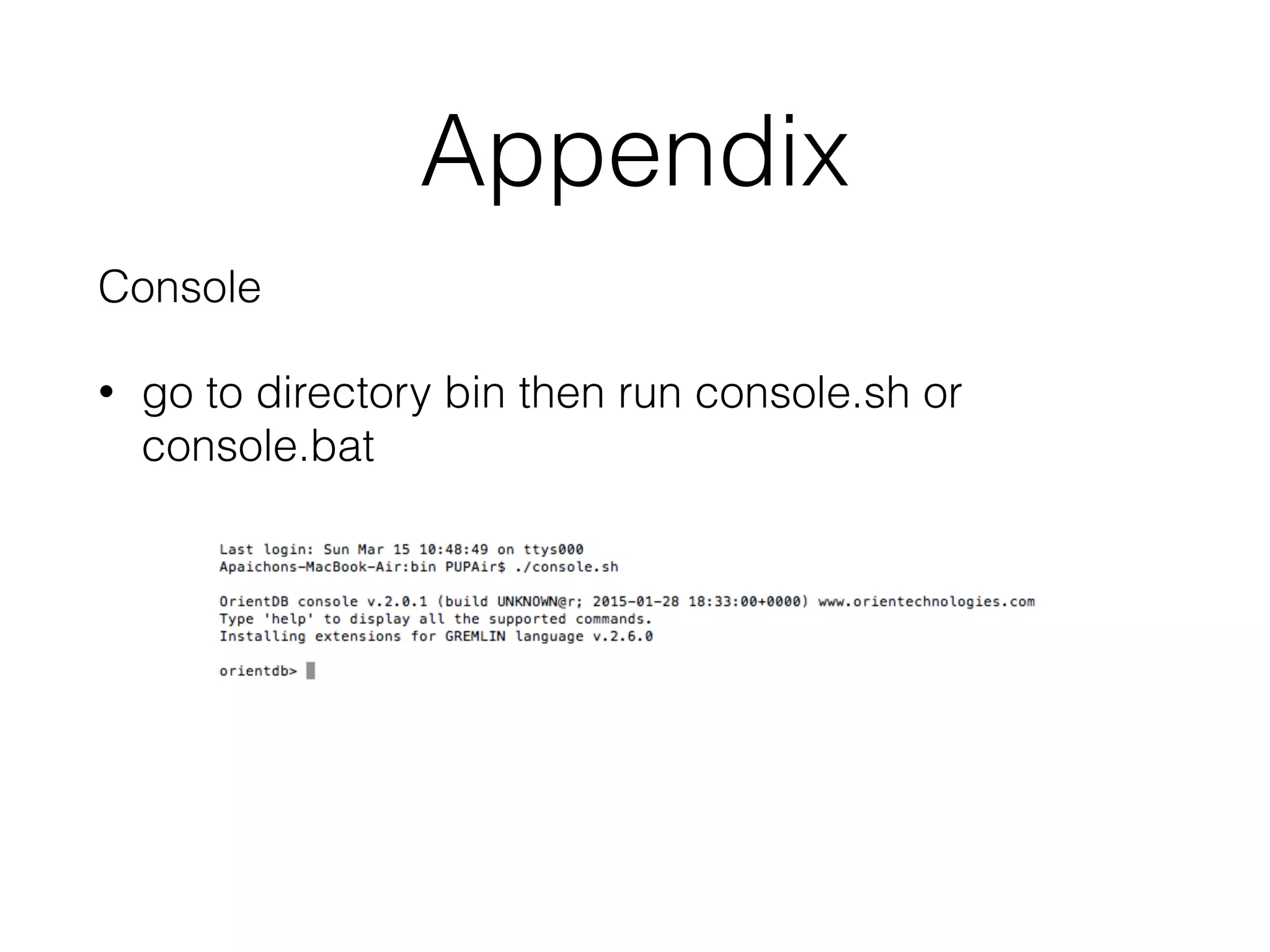
Appendix Console • go to directory bin then run console.sh or console.bat
Thank you • Delicious and Enjoy to use

Change RelationalDB to GraphDB with OrientDB

  • 1.
    Change Relational DBto Graph DB with OrientDB Speaker : Apaichon Punpas Sponsor By เครือข่ายโปรแกรมเมอร์ไทย โค้ดชิวๆ
  • 2.
    What is RelationalDB ? It is a way of storing information into • table • column • row A table is able relate to other.
  • 3.
    What is NoSQL? A NoSQL (often interpreted as Not only SQL) database provides a mechanism for storage and retrieval of data that is modeled in means other than the tabular relations used in relational databases. Motivations for this approach include simplicity of design, horizontal scaling, and finer control over availability.
  • 4.
  • 5.
    Relational vs NoSQLformat EmployeeId FirstName LastName HiredDate PositionId 1 Apaichon Punopas 13/11/2013 1 2 Tony Jar 1/1/2011 3 PositionId PositionName 1 Senior Developer 2 Developer Manager3 Actor {EmployeeId:1 ,FirstName:”Apaichon” ,LastName:”Punopas” ,HiredDate:”2013-11-13” ,PositionId:”#16:0”} {PositionId:”#16:0”,PositionName:”Senior Developer”} Employee Position
  • 6.
    Relational DB Pros andCons Pros Cons Flexible and well-established. Performance problems with complicated data structures. Short Learning Curve Lack of support for complex base types, e.g., drawings. Data access through SQL. SQL is limited when accessing complex data. Large development efforts and with large databases are well understood. Knowledge of the database structure is required to create ad hoc queries. The fundamental structure, i.e., a table, is easily understood and the design and normalization Locking mechanisms
  • 7.
    NoSQL Pros and Cons ProsCons Mostly open source. Immaturity Horizontal scalability. Possible database administration issues Support for Map/Reduce Data Relationship Like SQL No need to develop fine-grained data model. No indexing support (Some DB) Very fast for adding new data No ACID (Some DB) No need to changes in code when data structure is modified. Absence of standardization Ability to store complex data types in a single item of storage.
  • 8.
    Who are usingNo SQL ? • All big companies using NoSQL
  • 9.
    Who are usingOrientDB ? THJUG • Nobody uses Java anymore, I'm nobody A.K.A • Nobody uses OrientDB anymore, I'm nobody
  • 10.
  • 11.
  • 12.
  • 13.
    Will NoSQL replace Relational? • NoSQL databases eat into the relational database market. • New venture and startup most start with NoSQL. • Relational has more used in Enterprise and more features better. It is difficult to replace all in 10 - 20 years. In the future might have new database type again.
  • 14.
    Why join issuck ? Join Step • Add relational data into least 2 tables • select data • mapping data • reduce result set EmployeeId FirstName LastName HiredDate PositionId 1 Apaichon Punopas 13/11/2013 1 2 Tony Jar 1/1/2011 3 PositionId PositionName 1 Senior Developer 2 Developer Manager3 Actor Select e.*,p.PositionName from Employee e INNER Join Position p on e.PositionId = p.PositionId
  • 15.
    How is OrientDBjoin ? Join Step • Add relational data into least 2 tables. It’s already Join! @rid FirstName LastName HiredDate PositionId #22:0 Apaichon Punopas 13/11/2013 #23:0 @rid PositionName #23:0 Senior Developer select @rid as employeeId, firstName , lastName , positionId.positionName from Employee
  • 16.
    Welcome to OrientDB LucaGarulli CEO, Founder Luca Olivari President www.orientdb.org
  • 17.
    What is GraphDB? Graph Theory G = (V, E) V = Vertex E = Edge
  • 18.
    Certificate of chievement This%certificate%is%awarded%to% Attendee Your%understand%Graph%Theory.% ApaichonPunopas เครือข่าย โปรแกรมเมอร์ไทย
  • 19.
    Today OrientDB 2.0is not only GraphDB It is Multi-Model Database.
  • 20.
    Document Model The datain this model is stored inside documents. A document is a set of key/value pairs (also referred to as fields or properties) where a key allows access to its value. Values can hold primitive data types, embedded documents, or arrays of other values. {firstName:”A",lastName:"LA" , friends:[{firstName:”A"} ,{firstName:"B" , lastName: “lB”}] }
  • 21.
    Graph Model A graphrepresents a network-like structure consisting of Vertices (also known as Nodes) interconnected by Edges (also known as Arcs). OrientDB's graph model is represented by the concept of a property graph, which defines the following: Vertex - an entity that can be linked with other Vertices. Edge - an entity that links two Vertices.
  • 22.
    Support Types • Populartypes same as other database such as boolean , integer ,double , string , binary , etc • Embleded -> JSON such as {name:”A” , friends: [{name:”B” },name:{“C”}] • Link -> RecordID
  • 23.
    Class A Class isa concept taken from the Object Oriented paradigm. In OrientDB it defines a type of record. It's the closest concept to a Relational DBMS Table. Classes can be schema-less, schema-full, or mixed.
  • 24.
    Schema Type • Schema-Full:enable the strict-mode at class level and set all the fields as mandatory • Schema-Less: create classes with no properties. Default mode is non strict-mode so records can have arbitrary fields • Schema-Hybrid, called also Schema-Mixed is the most used: create classes and define some fields but leave the record to define own custom fields
  • 25.
    Cluster A cluster isa place where a group of records are stored. Perhaps the best equivalent in the relational world would be a Table. By default, OrientDB will create one cluster per class. All the records of a class are stored in the same cluster which has the same name as the class. You can create up to 32,767 (2^15-1) clusters in a database.
  • 26.
    Record ID In OrientDBeach record has its own self-assigned unique ID within the database called Record ID or RID. It is composed of two parts: • cluster-id is the id of the cluster. Each database can have a maximum of 32,767 clusters (2^15-1) • cluster-position is the position of the record inside the cluster. Each cluster can handle up to 9,223,372,036,854,780,000 (2^63) records, namely 9,223,372 Trillion of records! #<cluster-id>:<cluster-position>
  • 27.
    Inheritance • Class includesinheritance features same as OOP concept.
  • 28.
    Index • OrientDB supports4 kinds of indexes:
  • 29.
    Security • Support drilldown to Record level and support SSL.
  • 30.
    Caching • OrientDB hasseveral caching mechanisms that act at different levels. Look at this picture:
  • 31.
    Functions A Function isan executable unit of code that can take parameters and return a result. Using Functions you can perform Functional programming where logic and data are all together in a central place. Functions are similar to the Stored Procedures of RDBMS. • can be executed via SQL, Java, REST and Studio
  • 32.
    Transactions OrientDB is anACID compliant DBMS. A database transaction, by definition, must be atomic, consistent, isolated and durable. Database practitioners often refer to these properties of database transactions using the acronym ACID
  • 33.
    Hooks (Triggers) • Hookworks like a trigger. Hook lets to the user application to intercept internal events before and after each CRUD operation against records. You can use to write custom validation rules, to enforce security or even to orchestrate external events like the replication against a Relational DBMS.
  • 34.
    API OrientDB supports 3kinds of drivers: • Native binary remote, that talks directly against the TCP/IP socket using the binary protocol • HTTP REST/JSON, that talks directly against the TCP/IP socket using the HTTP protocol • Java wrapped, as a layer that links in some way the native Java driver. This is pretty easy for languages that run into the JVM like Scala, Groovy and JRuby
  • 35.
  • 36.
    Programming Language Driver • Mostpopular language are supported.
  • 37.
    SQL Most NoSQL productshave a custom query language. OrientDB focuses on standards when it comes to query languages. Instead of inventing "Yet Another Query Language", we started from the widely used and well understood SQL.
  • 38.
    SQL - Select •select from OUser • select from #10:3 • select from [#10:1, #10:3, #10:5] • select from OUser where name like 'l%' • select sum(salary) from Employee where age < 40 group by job • select from Employee where any() like ‘Apa%' • select from china:Customers
  • 39.
    SQL - Insert •insert into Employee (name, surname, gender) values ('Jay', 'Miner', 'M') • insert into Employee set name = 'Jay', surname = 'Miner', gender = 'M' • insert into Employee content {name : 'Jay', surname : 'Miner', gender : 'M'}
  • 40.
    SQL - Update •update Employee set local = true where city = 'London' • update Employee merge { local : true } where city = 'London'
  • 41.
    Delete •delete from Employeewhere city <> 'London' •delete from [#24:0,#24:1,#24:2]
  • 42.
    Sub Query select fromDocument let $temp = ( select @rid, $depth from ( traverse V.out, E.in from $parent.current ) where @class = 'Concept' and (id = 'first concept' or id = 'second concept' ) ) where $temp.size() > 0
  • 43.
    Traverse Traverse is aspecial command that retrieves the connected records crossing the relationships. This command works not only with graph API but at document level. This means you can traverse relationships between invoice and customers without the need to model the domain using the Graph API. traverse * from #9:1
  • 44.
    My favourite inOrientDB • I’m favourite many things in OrientDB which never found in other DB. • insert , update with JSON • save - automatic insert or update when pass value with @rid • validate property with regular expression. • median - I’m got bad performance and develop out of the box with other DB but OrientDB included and fast. • array and JSON hierarchy - keep array in one field help easily to use with data visualise. • expand - expand array to horizontal like table , row , column.
  • 45.
    Appendix Prerequisite • JVM Installation • Downloadat http://www.orientechnologies.com/ download/ • Extract file • go to directory bin then run server.sh or server.bat
  • 46.
    Appendix Management Studio • bydefault run on port 2480 • open browser then type http://localhost:2480
  • 47.
    Appendix Console • go todirectory bin then run console.sh or console.bat
  • 48.
    Thank you • Deliciousand Enjoy to use