 冬季促销!
冬季促销! 
Ruby 组合模式讲解和代码示例
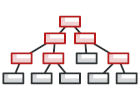
组合是一种结构型设计模式, 你可以使用它将对象组合成树状结构, 并且能像使用独立对象一样使用它们。
对于绝大多数需要生成树状结构的问题来说, 组合都是非常受欢迎的解决方案。 组合最主要的功能是在整个树状结构上递归调用方法并对结果进行汇总。
复杂度:
流行度:
使用实例: 组合模式在 Ruby 代码中很常见, 常用于表示与图形打交道的用户界面组件或代码的层次结构。
识别方法: 组合可以通过将同一抽象或接口类型的实例放入树状结构的行为方法来轻松识别。
概念示例
本例说明了组合设计模式的结构并重点回答了下面的问题:
- 它由哪些类组成?
- 这些类扮演了哪些角色?
- 模式中的各个元素会以何种方式相互关联?
main.rb: 概念示例
# The base Component class declares common operations for both simple and # complex objects of a composition. class Component # @return [Component] def parent @parent end # Optionally, the base Component can declare an interface for setting and # accessing a parent of the component in a tree structure. It can also provide # some default implementation for these methods. def parent=(parent) @parent = parent end # In some cases, it would be beneficial to define the child-management # operations right in the base Component class. This way, you won't need to # expose any concrete component classes to the client code, even during the # object tree assembly. The downside is that these methods will be empty for # the leaf-level components. def add(component) raise NotImplementedError, "#{self.class} has not implemented method '#{__method__}'" end # @abstract # # @param [Component] component def remove(component) raise NotImplementedError, "#{self.class} has not implemented method '#{__method__}'" end # You can provide a method that lets the client code figure out whether a # component can bear children. def composite? false end # The base Component may implement some default behavior or leave it to # concrete classes (by declaring the method containing the behavior as # "abstract"). def operation raise NotImplementedError, "#{self.class} has not implemented method '#{__method__}'" end end # The Leaf class represents the end objects of a composition. A leaf can't have # any children. # # Usually, it's the Leaf objects that do the actual work, whereas Composite # objects only delegate to their sub-components. class Leaf < Component # return [String] def operation 'Leaf' end end # The Composite class represents the complex components that may have children. # Usually, the Composite objects delegate the actual work to their children and # then "sum-up" the result. class Composite < Component def initialize @children = [] end # A composite object can add or remove other components (both simple or # complex) to or from its child list. # @param [Component] component def add(component) @children.append(component) component.parent = self end # @param [Component] component def remove(component) @children.remove(component) component.parent = nil end # @return [Boolean] def composite? true end # The Composite executes its primary logic in a particular way. It traverses # recursively through all its children, collecting and summing their results. # Since the composite's children pass these calls to their children and so # forth, the whole object tree is traversed as a result. def operation results = [] @children.each { |child| results.append(child.operation) } "Branch(#{results.join('+')})" end end # The client code works with all of the components via the base interface. def client_code(component) puts "RESULT: #{component.operation}" end # Thanks to the fact that the child-management operations are declared in the # base Component class, the client code can work with any component, simple or # complex, without depending on their concrete classes. def client_code2(component1, component2) component1.add(component2) if component1.composite? print "RESULT: #{component1.operation}" end # This way the client code can support the simple leaf components... simple = Leaf.new puts 'Client: I\'ve got a simple component:' client_code(simple) puts "\n" # ...as well as the complex composites. tree = Composite.new branch1 = Composite.new branch1.add(Leaf.new) branch1.add(Leaf.new) branch2 = Composite.new branch2.add(Leaf.new) tree.add(branch1) tree.add(branch2) puts 'Client: Now I\'ve got a composite tree:' client_code(tree) puts "\n" puts 'Client: I don\'t need to check the components classes even when managing the tree:' client_code2(tree, simple) output.txt: 执行结果
Client: I've got a simple component: RESULT: Leaf Client: Now I've got a composite tree: RESULT: Branch(Branch(Leaf+Leaf)+Branch(Leaf)) Client: I don't need to check the components classes even when managing the tree: RESULT: Branch(Branch(Leaf+Leaf)+Branch(Leaf)+Leaf)