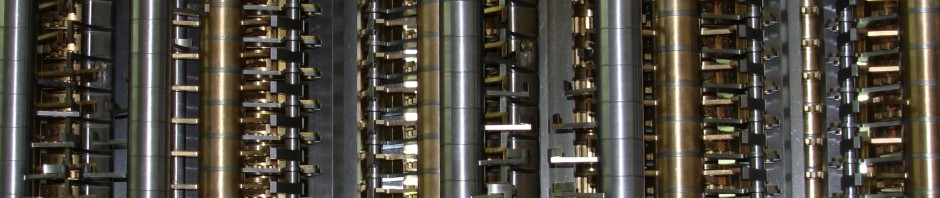
My friend Alan Jeffrey passed away earlier this year. I described his professional life at a Celebration in Oxford on 2nd November 2024. This post is a slightly revised version of what I said.
Edinburgh, 1983–1987
I’ve known Alan for over 40 years—my longest-standing friend. We met at the University of Edinburgh in 1983, officially as computer science freshers together, but really through the clubs for science fiction and for role-playing games. Alan was only 16: like many in Scotland, he skipped the final school year for an earlier start at university. It surely helped that his school had no computers, so he wasted no time in transferring to a university that did. His brother David says that it also helped that he would then be able to get into the student union bars.
Oxford, 1987–1991
After Edinburgh, Alan and I wound up together again as freshers at the University of Oxford. We didn’t coordinate this; we independently and simultaneously applied to the same DPhil programme (Oxford’s name for the PhD). We were officemates for those 4 years, and shared a terraced hovel on St Mary’s Road in bohemian East Oxford with three other students for most of that time. He was clever, funny, kind, and serially passionate about all sorts of things. It was a privilege and a pleasure to have known him.
Alan had a career that spanned academia and industry, and he excelled at both. He described himself as a “semanticist”: using mathematics instead of English for precise descriptions of programming languages. He had already set out in that direction with his undergraduate project on concurrency under Robin Milner at Edinburgh; and he continued to work on concurrency for his DPhil under Bill Roscoe at Oxford, graduating in 1992.
Chalmers, 1991–1992
Alan spent the last year of his DPhil as a postdoc working for K V S Prasad at Chalmers University in Sweden. While there, he was assigned to host fellow Edinburgh alumnus Carolyn Brown visiting for an interview; Carolyn came bearing a bottle of malt whisky, as one does, which she and Alan proceeded to polish off together that evening.
Sussex, 1992–1999
Carolyn’s interview was successful; but by the time she arrived at Chalmers, Alan had left for a second postdoc under Matthew Hennessy at the University of Sussex. They worked together again when Carolyn was in turn hired as a lecturer at Sussex. In particular, they showed in 1994 that “string diagrams”—due to Roger Penrose and Richard Feynman in physics—provide a “fully abstract” calculus for hardware circuits, meaning that everything true of the diagrams is true of the hardware, and vice versa. This work foreshadowed a hot topic in the field of Applied Category Theory today.
Matthew essentially left Alan to his own devices: as Matthew put it, “something I was very happy with as he was an exceptional researcher”. Alan was soon promoted to a lectureship himself. He collaborated closely with Julian Rathke, then Matthew’s PhD student and later postdoc, on the Full Abstraction Factory project, developing a bunch more full abstraction results for concurrent and object-oriented languages. That fruitful collaboration continued even after Alan left Sussex.
DePaul, 1999–2004
Alan presented a paper A Fully Abstract Semantics for a Nondeterministic Functional Language with Monadic Types at the 1995 conference on Mathematical Foundations of Programming Semantics in New Orleans. I believe that this is where he met Karen Bernstein, who also had a paper. One thing led to another, and Alan took a one-year visiting position at DePaul University in Chicago in 1998, then formally left Sussex in 1999 for a regular Associate Professor position at DePaul. He lived in Chicago for the rest of his life.
Alan established the Foundations of Programming Languages research group at DePaul, attracting Radha Jagadeesan from Loyola, James Riely from Sussex, and Corin Pitcher from Oxford, working among other things on “relaxed memory”—modern processors don’t actually read and write their multiple levels of memory in the order you tell them to, when they can find quicker ways to do things concurrently and sometimes out of order.
James remembers showing Alan his first paper on relaxed memory, co-authored with Radha. Alan thought their approach was an “appalling idea”; the proper way was to use “event structures”, an idea from the 1980s. This turned in 2016 into a co-authored paper at LICS (Alan’s favourite conference), and what James considers his own best ever talk—an on-stage reenactment of the to and fro of their collaboration, sadly not recorded for posterity.
James was Alan’s most frequent collaborator over the years, with 14 joint papers. Their modus operandi was that, having identified a problem together, Alan would go off by himself and do some Alanny things, eventually coalescing on a solution, and choose an order of exposition, tight and coherent; this is about 40% of the life of the paper. But then there are various tweaks, extensions, corrections… Alan would never look at the paper again, and would be surprised years later to learn what was actually in it. However, Alan was always easy to work with: interested only in the truth, although it must be beautiful. He had a curious mix of modesty and egocentricity: always convinced he was right (and usually right that he was right). Still, he had no patience for boring stuff, especially university admin.
While at DePaul, Alan also had a significant collaboration with Andy Gordon from Microsoft on verifying security protocols. Their 2001 paper Authenticity by Typing for Security Protocols won a Test Of Time Award this year at the Symposium on Computer Security Foundations, “given to outstanding papers with enduring significance and impact”—recognition which happily Alan lived to see.
Bell Labs, 2004–2015
After the dot com crash in 2000, things got more difficult at DePaul, and Alan left in 2004 for Bell Labs, nominally as a member of technical staff in Naperville but actually part of a security group based at HQ in Murray Hill NJ. He worked on XPath, “a modal logic for XML”, with Michael Benedikt, now my databases colleague at Oxford. They bonded because only Alan and Michael lived in Chicago rather than the suburbs. Michael had shown Alan a recent award-winning paper in which Alan quickly spotted an error in a proof—an “obvious” and unproven lemma that turned out to be false—which led to their first paper together.
(A recurring pattern. Andy Gordon described Alan’s “uncanny ability to find bugs in arguments”: he found a type unsoundness bug in a released draft specification for Java, and ended up joining the standards committee to help fix it. And as a PhD examiner he “shockingly” found a subtle bug that unpicked the argument of half of the dissertation, necessitating major corrections: it took a brave student to invite Alan as examiner—or a very confident one.)
Michael describes Alan as an “awesome developer”. They once had an intern; it didn’t take long after the intern had left for Alan to discard the intern’s code and rewrite it from scratch. Alan was unusual in being able to combine Euro “abstract nonsense” and US engineering. Glenn Bruns, another Bell Labs colleague, said that “I think Alan was the only person I’ve met who could do theory and also low-level hackery”.
At Bell Labs Alan also worked with Peter Danielsen on the Web InterFace Language, WIFL for short: a way of embedding API descriptions in HTML. Peter recalls: “We spent a few months working together on the conceptual model. In the early stages of software development, however, Alan looked at what I’d written and said, “I wouldn’t do it that way at all!”, throwing it all away and starting over. The result was much better; and he inadvertently taught me a new way to think in JavaScript (including putting //Sigh… comments before unavoidable tedious code.)”
Mozilla Research, 2015–2020
The Bell Labs group dissolved in 2015, and Alan moved to Mozilla Research as a staff research engineer to work on Servo, a new web rendering engine in the under-construction programming language Rust.
For one of Alan’s projects at Mozilla, he took a highly under-specified part of the HTML specification about how web links and the back and forwards browser buttons should interact, created a formal model in Agda based on the existing specification, identified gaps in it as well as ways that major browsers did not match the model, then wrote it all up as a paper. Alan’s manager Josh Matthews recalls the editors of the HTML standard being taken aback by Alan’s work suddenly being dropped in their laps, but quickly appreciated how much more confidently they could make changes based on it.
Josh also recalled: “Similarly, any time other members of the team would talk about some aspect of the browser engine being safe as long as some property was upheld by the programmer, Alan would get twitchy. He had a soft spot for bad situations that looked like they could be made impossible by clever enough application of static types.”
In 2017 Alan made a rather surprising switch to working on augmented reality for the web, partly driven by internal politics at Mozilla. He took the lead on integrating Servo into the Magic Leap headset; the existing browser was clunky, the only way to interact with pages being via an awkward touchpad on the hand controller. This was not good enough for Alan: after implementing the same behaviour for Servo and finding it frustrating, he had several email exchanges with the Magic Leap developers, figured out how to access some interfaces that weren’t technically public but also were not actually private, and soon he proudly showed off a more natural laser pointer-style means of interacting with pages in augmented reality in Servo—to much acclaim from the team and testers.
Roblox, 2020–2024
Then in 2020, Mozilla’s funding stream got a lot more constrained, and Alan moved to the game platform company Roblox. Alan was a principal software engineer, and the language owner of Luau, “a fast, small, safe, gradually typed embeddable scripting language derived from Lua”, working on making the language easier to use, teach, and learn. Roblox supports more than two million “content creators”, mostly kids, creating millions of games a year; Alan’s goal was to empower them to build larger games with more characters.
The Luau product manager Bryan Nealer says that “people loved Alan”. Roblox colleagues appreciated his technical contributions: “Alan was meticulous in what he built and wrote at Roblox. He would stress not only the substance of his work, but also the presentation. His attention to detail inspired the rest of us!”; “One of the many wonderful things Alan did for us was to be the guy who could read the most abstruse academic research imaginable and translate it into something simple, useful, interesting, and even fun.” They also appreciated the more personal contributions: Alan led an internal paper reading group, meeting monthly to study some paper on programming or networking, but he also established the Roblox Book Club: “He was always thoughtful when discussing books, and challenged us to think about the text more deeply. He also had an encyclopedic knowledge of scifi. He recommended Iain M. Banks’s The Culture series to me, which has become my favorite scifi series. I think about him every time I pick up one of those books.”
Envoie
From my own perspective, one of the most impressive things about Alan is that he was impossible to pigeonhole: like Dr Who, he was continually regenerating. He explained to me that he got bored quickly with one area, and moved on to another. As well as his academic abilities, he was a talented and natural cartoonist: I still have a couple of the tiny fanzine comics he produced as a student.
Of course he did some serious science for his DPhil and later career: but he also took a strong interest in typography and typesetting. He digitized some beautiful Japanese crests for the chapter title pages of his DPhil dissertation. Alan dragged me in typography with him, a distraction I have enjoyed ever since. Among other projects, Alan and I produced a font containing some extra symbols so that we could use them in our papers, and named it St Mary’s Road after our Oxford digs. And Alan produced a full blackboard bold font, complete with lowercase letters and punctuation: you can see some of it in the order of service. But Alan was not satisfied with merely creating these things; he went to all the trouble to package them up properly and get them included in standard software distributions, so that they would be available for everyone: Alan loved to build things for people to use. These two fonts are still in regular use 35 years later, and I’m sure they will be reminding us of him for a long time to come.

![\displaystyle \begin{array}{@{}l} \mathit{primes} = \mathit{sieve}\;[2.\,.] \;\textbf{where} \\ \qquad \mathit{sieve}\;(p:\mathit{xs}) = p : \mathit{sieve}\;[ x \mid x \leftarrow \mathit{xs}, x \mathbin{\mathrm{mod}} p \ne 0] \end{array}](https://s0.wp.com/latex.php?latex=\displaystyle++\begin{array}{@{}l}+\mathit{primes}+=+\mathit{sieve}\;[2.\,.]+\;\textbf{where}+\\+\qquad+\mathit{sieve}\;(p:\mathit{xs})+=+p+:+\mathit{sieve}\;[+x+\mid+x+\leftarrow+\mathit{xs},+x+\mathbin{\mathrm{mod}}+p+\ne+0]+\end{array}+&bg=ffffff&fg=000000&s=0&c=20201002)
 takes a stream of candidate primes; the head
  of this stream is a prime, and the remaining primes are obtained by removing all multiples of
  is tested for divisibility. O’Neill calls this bogus common version “trial division”, and argues that the Genuine Sieve of Eratosthenes should eliminate every multiple of
  of the natural numbers are touched when eliminating multiples of 2, less than
  of the remaining candidates for multiples of 3, and so on. As an additional optimization, it suffices to eliminate multiples of
  , since by that point all composite numbers with a smaller nontrivial factor will already have been eliminated.
![\displaystyle \begin{array}{@{}l@{\;}l} \multicolumn{2}{@{}l}{\mathit{primes}, \mathit{composites} :: [\mathit{Integer}]} \\ \mathit{primes} & = 2 : ([3.\,.] \mathbin{\backslash\!\backslash} \mathit{composites}) \\ \mathit{composites} & = \mathit{mergeAll}\;[ \mathit{multiples}\;p \mid p \leftarrow \mathit{primes} ] \\ \end{array}](https://s0.wp.com/latex.php?latex=\displaystyle++\begin{array}{@{}l@{\;}l}+\multicolumn{2}{@{}l}{\mathit{primes},+\mathit{composites}+::+[\mathit{Integer}]}+\\+\mathit{primes}+&+=+2+:+([3.\,.]+\mathbin{\backslash\!\backslash}+\mathit{composites})+\\+\mathit{composites}+&+=+\mathit{mergeAll}\;[+\mathit{multiples}\;p+\mid+p+\leftarrow+\mathit{primes}+]+\\+\end{array}+&bg=ffffff&fg=000000&s=0&c=20201002)
 , which unions a set of sets to a set; but
 }&bg=ffffff&fg=000000&s=0&c=20201002) is the obvious implementation of list difference of sorted streams (hence, representing set difference):
is the obvious implementation of list difference of sorted streams (hence, representing set difference):![\displaystyle \begin{array}{@{}l@{\;}l@{\;}l} \multicolumn{3}{@{}l}{(\mathbin{\backslash\!\backslash}) :: \mathit{Ord}\;a \Rightarrow [a] \rightarrow [a] \rightarrow [a]} \\ (x:\mathit{xs}) \mathbin{\backslash\!\backslash} (y:\mathit{ys}) & \mid x < y & = x:(\mathit{xs} \mathbin{\backslash\!\backslash} (y:\mathit{ys})) \\ & \mid x == y & = \mathit{xs} \mathbin{\backslash\!\backslash} \mathit{ys} \\ & \mid x > y & = (x:\mathit{xs}) \mathbin{\backslash\!\backslash} \mathit{ys} \end{array}](https://s0.wp.com/latex.php?latex=\displaystyle++\begin{array}{@{}l@{\;}l@{\;}l}+\multicolumn{3}{@{}l}{(\mathbin{\backslash\!\backslash})+::+\mathit{Ord}\;a+\Rightarrow+[a]+\rightarrow+[a]+\rightarrow+[a]}+\\+(x:\mathit{xs})+\mathbin{\backslash\!\backslash}+(y:\mathit{ys})+&+\mid+x+<+y+&+=+x:(\mathit{xs}+\mathbin{\backslash\!\backslash}+(y:\mathit{ys}))+\\+&+\mid+x+==+y+&+=+\mathit{xs}+\mathbin{\backslash\!\backslash}+\mathit{ys}+\\+&+\mid+x+>+y+&+=+(x:\mathit{xs})+\mathbin{\backslash\!\backslash}+\mathit{ys}+\end{array}+&bg=ffffff&fg=000000&s=0&c=20201002)
 generates the multiples of
 ![\displaystyle \begin{array}{@{}l} \mathit{multiples}\;p = \mathit{map}\; (p\times)\;[p.\,.] \end{array}](https://s0.wp.com/latex.php?latex=\displaystyle++\begin{array}{@{}l}+\mathit{multiples}\;p+=+\mathit{map}\;+(p\times)\;[p.\,.]+\end{array}+&bg=ffffff&fg=000000&s=0&c=20201002)
![{[ [ 4, 6.\,.], [ 9, 12.\,.], [ 25, 30.\,.], \dots ]}](https://s0.wp.com/latex.php?latex={[+[+4,+6.\,.],+[+9,+12.\,.],+[+25,+30.\,.],+\dots+]}&bg=ffffff&fg=000000&s=0&c=20201002) . You might think that you could have defined instead
. You might think that you could have defined instead ![{\mathit{primes} = [2.\,.] \mathbin{\backslash\!\backslash} \mathit{composites}}](https://s0.wp.com/latex.php?latex={\mathit{primes}+=+[2.\,.]+\mathbin{\backslash\!\backslash}+\mathit{composites}}&bg=ffffff&fg=000000&s=0&c=20201002) , but this doesn’t work: this won’t compute the first prime without first computing some composites, and you can’t compute any composites without at least the first prime, so this definition is unproductive. Somewhat surprisingly, it suffices to “prime the pump” (so to speak) just with 2, and everything else flows freely from there.
, but this doesn’t work: this won’t compute the first prime without first computing some composites, and you can’t compute any composites without at least the first prime, so this definition is unproductive. Somewhat surprisingly, it suffices to “prime the pump” (so to speak) just with 2, and everything else flows freely from there. , which merges two sorted duplicate-free streams into one (hence, representing set union):
![\displaystyle \begin{array}{@{}l@{\;}l@{\;}l} \multicolumn{3}{@{}l}{\mathit{merge} :: \mathit{Ord}\;a \Rightarrow [a] \rightarrow [a] \rightarrow [a]} \\ \mathit{merge}\;(x:\mathit{xs})\;(y:\mathit{ys}) & \mid x < y & = x : \mathit{merge}\;\mathit{xs}\;(y:\mathit{ys}) \\ & \mid x == y & = x : \mathit{merge}\;\mathit{xs}\;\mathit{ys} \\ & \mid x > y & = y : \mathit{merge}\;(x:\mathit{xs})\;\mathit{ys} \end{array}](https://s0.wp.com/latex.php?latex=\displaystyle++\begin{array}{@{}l@{\;}l@{\;}l}+\multicolumn{3}{@{}l}{\mathit{merge}+::+\mathit{Ord}\;a+\Rightarrow+[a]+\rightarrow+[a]+\rightarrow+[a]}+\\+\mathit{merge}\;(x:\mathit{xs})\;(y:\mathit{ys})+&+\mid+x+<+y+&+=+x+:+\mathit{merge}\;\mathit{xs}\;(y:\mathit{ys})+\\+&+\mid+x+==+y+&+=+x+:+\mathit{merge}\;\mathit{xs}\;\mathit{ys}+\\+&+\mid+x+>+y+&+=+y+:+\mathit{merge}\;(x:\mathit{xs})\;\mathit{ys}+\end{array}+&bg=ffffff&fg=000000&s=0&c=20201002)
+=+\mathit{merge}\;\mathit{xs}\;(\mathit{mergeAll}\;\mathit{xss})}&bg=ffffff&fg=000000&s=0&c=20201002) , but again this is unproductive. After all, you can’t merge the infinite stream of sorted streams
, but again this is unproductive. After all, you can’t merge the infinite stream of sorted streams ![{[ [5,6.\,.], [4,5.\,.], [3,4.\,.], \dots ]}](https://s0.wp.com/latex.php?latex={[+[5,6.\,.],+[4,5.\,.],+[3,4.\,.],+\dots+]}&bg=ffffff&fg=000000&s=0&c=20201002) into a single sorted stream, because there is no least element. Instead, we have to exploit the fact that we have a sorted stream of sorted streams; then the binary merge can exploit the fact that the head of the left stream is the head of the result, without even examining the right stream. So, we define:
into a single sorted stream, because there is no least element. Instead, we have to exploit the fact that we have a sorted stream of sorted streams; then the binary merge can exploit the fact that the head of the left stream is the head of the result, without even examining the right stream. So, we define:![\displaystyle \begin{array}{@{}l} \mathit{mergeAll} :: \mathit{Ord}\;a \Rightarrow [[a]] \rightarrow [a] \\ \mathit{mergeAll}\;(\mathit{xs}:xss) = \mathit{xmerge}\;\mathit{xs}\;(\mathit{mergeAll}\;xss) \medskip \\ \mathit{xmerge} :: \mathit{Ord}\;a \Rightarrow [a] \rightarrow [a] \rightarrow [a] \\ \mathit{xmerge}\;(x:\mathit{xs})\;\mathit{ys} = x : \mathit{merge}\;\mathit{xs}\;\mathit{ys} \end{array}](https://s0.wp.com/latex.php?latex=\displaystyle++\begin{array}{@{}l}+\mathit{mergeAll}+::+\mathit{Ord}\;a+\Rightarrow+[[a]]+\rightarrow+[a]+\\+\mathit{mergeAll}\;(\mathit{xs}:xss)+=+\mathit{xmerge}\;\mathit{xs}\;(\mathit{mergeAll}\;xss)+\medskip+\\+\mathit{xmerge}+::+\mathit{Ord}\;a+\Rightarrow+[a]+\rightarrow+[a]+\rightarrow+[a]+\\+\mathit{xmerge}\;(x:\mathit{xs})\;\mathit{ys}+=+x+:+\mathit{merge}\;\mathit{xs}\;\mathit{ys}+\end{array}+&bg=ffffff&fg=000000&s=0&c=20201002)
 yields the infinite sequence of prime numbers, using the genuine algorithm of Eratosthenes.
 ,
,  ,
,+\quad+\Leftrightarrow+\quad+(\forall+n+\in+\mathbb{N}+\mathbin{.}+\mathit{approx}\;n\;\mathit{xs}+=+\mathit{approx}\;n\;\mathit{ys})+&bg=ffffff&fg=000000&s=0&c=20201002)
![\displaystyle \begin{array}{@{}l@{\;}l@{\;}l} \multicolumn{3}{@{}l}{\mathit{approx} :: \mathit{Integer} \rightarrow [a] \rightarrow [a]} \\ \mathit{approx}\;(n+1)\;[\,] & = & [\,] \\ \mathit{approx}\;(n+1)\;(x:\mathit{xs}) & = & x : \mathit{approx}\;n\;\mathit{xs} \end{array}](https://s0.wp.com/latex.php?latex=\displaystyle++\begin{array}{@{}l@{\;}l@{\;}l}+\multicolumn{3}{@{}l}{\mathit{approx}+::+\mathit{Integer}+\rightarrow+[a]+\rightarrow+[a]}+\\+\mathit{approx}\;(n+1)\;[\,]+&+=+&+[\,]+\\+\mathit{approx}\;(n+1)\;(x:\mathit{xs})+&+=+&+x+:+\mathit{approx}\;n\;\mathit{xs}+\end{array}+&bg=ffffff&fg=000000&s=0&c=20201002)
 is undefined; the function
  preserves the outermost
  constructors of a list, but then chops off anything deeper and replaces it with
  (undefined). So, the lemma states that to prove two infinite lists equal, it suffices to prove equal all their finite approximations.
 is the
  th prime (so
  ). Bird therefore defines
![\displaystyle \begin{array}{@{}ll} \mathit{prs}\;n & = \mathit{approx}\;n\;(2 : ([3.\,.] \mathbin{\backslash\!\backslash} \mathit{crs}\;n)) \\ \mathit{crs}\;n & = \mathit{mergeAll}\;[\mathit{multiples}\;p \mid p \leftarrow \mathit{prs}\;n] \end{array}](https://s0.wp.com/latex.php?latex=\displaystyle++\begin{array}{@{}ll}+\mathit{prs}\;n+&+=+\mathit{approx}\;n\;(2+:+([3.\,.]+\mathbin{\backslash\!\backslash}+\mathit{crs}\;n))+\\+\mathit{crs}\;n+&+=+\mathit{mergeAll}\;[\mathit{multiples}\;p+\mid+p+\leftarrow+\mathit{prs}\;n]+\end{array}+&bg=ffffff&fg=000000&s=0&c=20201002)
 to be well defined at least up to the first composite number greater than
  , because then
 }&bg=ffffff&fg=000000&s=0&c=20201002) , which will in turn supply
, which will in turn supply }&bg=ffffff&fg=000000&s=0&c=20201002) , and so on. It is a “non-trivial result in Number Theory” (in fact, a consequence of
, and so on. It is a “non-trivial result in Number Theory” (in fact, a consequence of  ; therefore it suffices that
 is the
  ) and
) and  . Completing the proof is set as Exercise 9.I of TFWH, and Answer 9.I gives a hint about using induction to show that
  . (Incidentally, there is a typo in TFWH: both the body of the chapter and the exercise and its solution have “
 ” instead of “
 (which equals
  ) could be constructed from
  (which equals
  ) and
) and  (which equals
 ![{[9,12.\,.]}](https://s0.wp.com/latex.php?latex={[9,12.\,.]}&bg=ffffff&fg=000000&s=0&c=20201002) ); but this means that the 6 and 8 would have to come out of nowhere. Nevertheless, the claim in Exercise 9.I is valid. What should the hint for the proof have been?
); but this means that the 6 and 8 would have to come out of nowhere. Nevertheless, the claim in Exercise 9.I is valid. What should the hint for the proof have been?![\displaystyle \mathit{crsOf}\;\mathit{qs} = \mathit{mergeAll}\;[\mathit{multiples}\;p \mid p \leftarrow \mathit{qs}]](https://s0.wp.com/latex.php?latex=\displaystyle++\mathit{crsOf}\;\mathit{qs}+=+\mathit{mergeAll}\;[\mathit{multiples}\;p+\mid+p+\leftarrow+\mathit{qs}]+&bg=ffffff&fg=000000&s=0&c=20201002)
}&bg=ffffff&fg=000000&s=0&c=20201002) ; this allows us to consider
; this allows us to consider  in isolation from
  . In fact, I claim (following a suggestion generated by Geraint Jones and Guillaume Boisseau at our Algebra of Programming research group) that if
  where
where  , then
  has a well-defined prefix consisting of all the composite numbers
  such that
  and
and  with
with  , in ascending order, then becomes undefined. That’s not so difficult to see from the definition:
  contains the multiples of
  ; all these streams get merged; but the result gets undefined (in
  of the last stream. In particular,
 }&bg=ffffff&fg=000000&s=0&c=20201002) has a well-defined prefix consisting of all the composites up to
has a well-defined prefix consisting of all the composites up to  , then becomes undefined, as required.
 works along the grain of
  . I believe we want something instead like an “Approx While Lemma”, where
  is to
is to  is to
is to  :
:![\displaystyle \begin{array}{@{}l} \mathit{approxWhile} :: (a \rightarrow \mathit{Bool}) \rightarrow [a] \rightarrow [a] \\ \mathit{approxWhile}\;p\;(x:\mathit{xs}) \mid p\;x = x : \mathit{approxWhile}\;p\;\mathit{xs} \end{array}](https://s0.wp.com/latex.php?latex=\displaystyle++\begin{array}{@{}l}+\mathit{approxWhile}+::+(a+\rightarrow+\mathit{Bool})+\rightarrow+[a]+\rightarrow+[a]+\\+\mathit{approxWhile}\;p\;(x:\mathit{xs})+\mid+p\;x+=+x+:+\mathit{approxWhile}\;p\;\mathit{xs}+\end{array}+&bg=ffffff&fg=000000&s=0&c=20201002)
 retains elements of
  and unbounded streams
  (that is,
  ),
),+\quad+\Leftrightarrow+\quad+(\forall+b+\in+\mathit{bs}+\mathbin{.}+\mathit{approxWhile}\;(\le+b)\;\mathit{xs}+=+\mathit{approxWhile}\;(\le+b)\;\mathit{ys})+&bg=ffffff&fg=000000&s=0&c=20201002)
}&bg=ffffff&fg=000000&s=0&c=20201002) and hence for
and hence for ![\displaystyle \begin{array}{@{}ll} \multicolumn{2}{@{}l}{\mathit{insertsort} :: [\mathit{Integer}] \rightarrow [\mathit{Integer}]} \\ \mathit{insertsort}\;[\,] &= [\,] \\ \mathit{insertsort}\;(a:x) &= \mathit{insert}\;a\;(\mathit{insertsort}\;x) \medskip \\ \multicolumn{2}{@{}l}{\mathit{insert} :: \mathit{Integer} \rightarrow [\mathit{Integer}] \rightarrow [\mathit{Integer}]} \\ \mathit{insert}\;b\;[\,] &= [b] \\ \mathit{insert}\;b\;(a:x) \\ \qquad \mid b \le a &= b : a : x \\ \qquad \mid b > a &= a : \mathit{insert}\;b\;x \end{array}](https://s0.wp.com/latex.php?latex=\displaystyle++\begin{array}{@{}ll}+\multicolumn{2}{@{}l}{\mathit{insertsort}+::+[\mathit{Integer}]+\rightarrow+[\mathit{Integer}]}+\\+\mathit{insertsort}\;[\,]+&=+[\,]+\\+\mathit{insertsort}\;(a:x)+&=+\mathit{insert}\;a\;(\mathit{insertsort}\;x)+\medskip+\\+\multicolumn{2}{@{}l}{\mathit{insert}+::+\mathit{Integer}+\rightarrow+[\mathit{Integer}]+\rightarrow+[\mathit{Integer}]}+\\+\mathit{insert}\;b\;[\,]+&=+[b]+\\+\mathit{insert}\;b\;(a:x)+\\+\qquad+\mid+b+\le+a+&=+b+:+a+:+x+\\+\qquad+\mid+b+>+a+&=+a+:+\mathit{insert}\;b\;x+\end{array}+&bg=ffffff&fg=000000&s=0&c=20201002)
![\displaystyle \begin{array}{@{}ll} \multicolumn{2}{@{}l}{\mathit{quicksort} :: [\mathit{Integer}] \rightarrow [\mathit{Integer}]} \\ \mathit{quicksort}\;[\,] & = [\,] \\ \mathit{quicksort}\;(a:x) &= \mathit{quicksort}\;y \mathbin{{+}\!\!\!{+}} [a] \mathbin{{+}\!\!\!{+}} \mathit{quicksort}\;z \\ & \qquad \mathbf{where}\; \begin{array}[t]{@{}ll} y &= [ b \mid b \leftarrow x, b \le a ] \\ z &= [ b \mid b \leftarrow x, b > a ] \end{array} \end{array}](https://s0.wp.com/latex.php?latex=\displaystyle++\begin{array}{@{}ll}+\multicolumn{2}{@{}l}{\mathit{quicksort}+::+[\mathit{Integer}]+\rightarrow+[\mathit{Integer}]}+\\+\mathit{quicksort}\;[\,]+&+=+[\,]+\\+\mathit{quicksort}\;(a:x)+&=+\mathit{quicksort}\;y+\mathbin{{+}\!\!\!{+}}+[a]+\mathbin{{+}\!\!\!{+}}+\mathit{quicksort}\;z+\\+&+\qquad+\mathbf{where}\;+\begin{array}[t]{@{}ll}+y+&=+[+b+\mid+b+\leftarrow+x,+b+\le+a+]+\\+z+&=+[+b+\mid+b+\leftarrow+x,+b+>+a+]+\end{array}+\end{array}+&bg=ffffff&fg=000000&s=0&c=20201002)
+\end{array}+&bg=ffffff&fg=000000&s=0&c=20201002)

![\displaystyle \begin{array}{@{}ll} \multicolumn{2}{@{}l}{\mathit{readDate} :: \mathit{String} \rightarrow \mathit{Date}} \\ \mathit{readDate}\;s & = \mathit{Date}\;\{ \mathit{day} = d, \mathit{month} = m, \mathit{year} = y \} \\ & \qquad \mathbf{where}\; \begin{array}[t]{@{}ll} d & = ... s ... \\ m & = ... s ... \\ y & = ... s ... \end{array} \end{array}](https://s0.wp.com/latex.php?latex=\displaystyle++\begin{array}{@{}ll}+\multicolumn{2}{@{}l}{\mathit{readDate}+::+\mathit{String}+\rightarrow+\mathit{Date}}+\\+\mathit{readDate}\;s+&+=+\mathit{Date}\;\{+\mathit{day}+=+d,+\mathit{month}+=+m,+\mathit{year}+=+y+\}+\\+&+\qquad+\mathbf{where}\;+\begin{array}[t]{@{}ll}+d+&+=+...+s+...+\\+m+&+=+...+s+...+\\+y+&+=+...+s+...+\end{array}+\end{array}+&bg=ffffff&fg=000000&s=0&c=20201002)
![{[1,2,3]}](https://s0.wp.com/latex.php?latex={[1,2,3]}&bg=ffffff&fg=000000&s=0&c=20201002) and
and ![{[4,5,6]}](https://s0.wp.com/latex.php?latex={[4,5,6]}&bg=ffffff&fg=000000&s=0&c=20201002) to
to ![{[(1,4),(2,5),(3,6)]}](https://s0.wp.com/latex.php?latex={[(1,4),(2,5),(3,6)]}&bg=ffffff&fg=000000&s=0&c=20201002) , and for simplicity let’s say pruning the result to the length of the shorter input. One can again solve the problem by case analysis on the input, but the fact that there are two inputs makes that a bit awkward—whether to do case analysis on one list in favour of the other, or to analyse both in parallel. For example, here is the outcome of case analysis on the first input, followed if that is non-empty by a case analysis on the second input:
, and for simplicity let’s say pruning the result to the length of the shorter input. One can again solve the problem by case analysis on the input, but the fact that there are two inputs makes that a bit awkward—whether to do case analysis on one list in favour of the other, or to analyse both in parallel. For example, here is the outcome of case analysis on the first input, followed if that is non-empty by a case analysis on the second input: ![\displaystyle \begin{array}{@{}ll} \multicolumn{2}{@{}l}{\mathit{zip} :: [\alpha] \rightarrow [\beta] \rightarrow [(\alpha,\beta)]} \\ \mathit{zip}\;x\;y &= \begin{array}[t]{@{}l} \mathbf{if}\; \mathit{null}\;x \;\mathbf{then}\; [\,] \;\mathbf{else} \\ \qquad \mathbf{if}\; \mathit{null}\;y \;\mathbf{then}\; [\,] \;\mathbf{else} \\ \qquad \qquad (\mathit{head}\;x,\mathit{head}\;y) : \mathit{zip}\;(\mathit{tail}\;x)\;(\mathit{tail}\;y) \end{array} \end{array}](https://s0.wp.com/latex.php?latex=\displaystyle++\begin{array}{@{}ll}+\multicolumn{2}{@{}l}{\mathit{zip}+::+[\alpha]+\rightarrow+[\beta]+\rightarrow+[(\alpha,\beta)]}+\\+\mathit{zip}\;x\;y+&=+\begin{array}[t]{@{}l}+\mathbf{if}\;+\mathit{null}\;x+\;\mathbf{then}\;+[\,]+\;\mathbf{else}+\\+\qquad+\mathbf{if}\;+\mathit{null}\;y+\;\mathbf{then}\;+[\,]+\;\mathbf{else}+\\+\qquad+\qquad+(\mathit{head}\;x,\mathit{head}\;y)+:+\mathit{zip}\;(\mathit{tail}\;x)\;(\mathit{tail}\;y)+\end{array}+\end{array}+&bg=ffffff&fg=000000&s=0&c=20201002)
![\displaystyle \begin{array}{@{}ll} \multicolumn{2}{@{}l}{\mathit{zip} :: [\alpha] \rightarrow [\beta] \rightarrow [(\alpha,\beta)]} \\ \mathit{zip}\;x\;y &= \begin{array}[t]{@{}l} \mathbf{if}\; \mathit{null}\;x \lor \mathit{null}\;y \;\mathbf{then}\; [\,] \;\mathbf{else} \\ \qquad (\mathit{head}\;x,\mathit{head}\;y) : \mathit{zip}\;(\mathit{tail}\;x)\;(\mathit{tail}\;y) \end{array} \end{array}](https://s0.wp.com/latex.php?latex=\displaystyle++\begin{array}{@{}ll}+\multicolumn{2}{@{}l}{\mathit{zip}+::+[\alpha]+\rightarrow+[\beta]+\rightarrow+[(\alpha,\beta)]}+\\+\mathit{zip}\;x\;y+&=+\begin{array}[t]{@{}l}+\mathbf{if}\;+\mathit{null}\;x+\lor+\mathit{null}\;y+\;\mathbf{then}\;+[\,]+\;\mathbf{else}+\\+\qquad+(\mathit{head}\;x,\mathit{head}\;y)+:+\mathit{zip}\;(\mathit{tail}\;x)\;(\mathit{tail}\;y)+\end{array}+\end{array}+&bg=ffffff&fg=000000&s=0&c=20201002)
![\displaystyle \begin{array}{@{}ll} \multicolumn{2}{@{}l}{\mathit{selectSort} :: [\mathit{Integer}] \rightarrow [\mathit{Integer}]} \\ \mathit{selectSort}\;x & = \mathbf{if}\; \mathit{null}\;x \;\mathbf{then}\; [\,] \;\mathbf{else}\; a : \mathit{selectSort}\;(x \mathbin{\backslash\!\backslash} [a]) \\ & \qquad \mathbf{where}\; a = \mathit{minimum}\;x \end{array}](https://s0.wp.com/latex.php?latex=\displaystyle++\begin{array}{@{}ll}+\multicolumn{2}{@{}l}{\mathit{selectSort}+::+[\mathit{Integer}]+\rightarrow+[\mathit{Integer}]}+\\+\mathit{selectSort}\;x+&+=+\mathbf{if}\;+\mathit{null}\;x+\;\mathbf{then}\;+[\,]+\;\mathbf{else}\;+a+:+\mathit{selectSort}\;(x+\mathbin{\backslash\!\backslash}+[a])+\\+&+\qquad+\mathbf{where}\;+a+=+\mathit{minimum}\;x+\end{array}+&bg=ffffff&fg=000000&s=0&c=20201002)
 denotes list
  removed).
 to construct an intermediate tree, followed by structural recursion
  over that tree to produce the resulting list:
 ![\displaystyle \begin{array}{@{}ll} \multicolumn{2}{@{}l}{\mathit{quicksort} :: [\mathit{Integer}] \rightarrow [\mathit{Integer}]} \\ \mathit{quicksort} & = \mathit{flatten} \cdot \mathit{build} \medskip \\ \multicolumn{2}{@{}l}{\mathbf{data}\;\mathit{Tree} = \mathit{Empty} \mid \mathit{Node}\;\mathit{Tree}\;\mathit{Integer}\;\mathit{Tree}} \medskip\\ \multicolumn{2}{@{}l}{\mathit{build} :: [\mathit{Integer}] \rightarrow \mathit{Tree}} \\ \mathit{build}\;[\,] & = \mathit{Empty} \\ \mathit{build}\;(a:x) &= \mathit{Node}\;(\mathit{build}\;y)\;a\;(\mathit{build}\;z) \\ & \qquad \mathbf{where}\; \begin{array}[t]{@{}ll} y &= [ b \mid b \leftarrow x, b \le a ] \\ z &= [ b \mid b \leftarrow x, b > a ] \end{array} \medskip \\ \multicolumn{2}{@{}l}{\mathit{flatten} :: \mathit{Tree} \rightarrow [\mathit{Integer}]} \\ \mathit{flatten}\;\mathit{Empty} & = [\,] \\ \mathit{flatten}\;(\mathit{Node}\;t\;a\;u) &= \mathit{flatten}\;t \mathbin{{+}\!\!\!{+}} [a] \mathbin{{+}\!\!\!{+}} \mathit{flatten}\;u \end{array}](https://s0.wp.com/latex.php?latex=\displaystyle++\begin{array}{@{}ll}+\multicolumn{2}{@{}l}{\mathit{quicksort}+::+[\mathit{Integer}]+\rightarrow+[\mathit{Integer}]}+\\+\mathit{quicksort}+&+=+\mathit{flatten}+\cdot+\mathit{build}+\medskip+\\+\multicolumn{2}{@{}l}{\mathbf{data}\;\mathit{Tree}+=+\mathit{Empty}+\mid+\mathit{Node}\;\mathit{Tree}\;\mathit{Integer}\;\mathit{Tree}}+\medskip\\+\multicolumn{2}{@{}l}{\mathit{build}+::+[\mathit{Integer}]+\rightarrow+\mathit{Tree}}+\\+\mathit{build}\;[\,]+&+=+\mathit{Empty}+\\+\mathit{build}\;(a:x)+&=+\mathit{Node}\;(\mathit{build}\;y)\;a\;(\mathit{build}\;z)+\\+&+\qquad+\mathbf{where}\;+\begin{array}[t]{@{}ll}+y+&=+[+b+\mid+b+\leftarrow+x,+b+\le+a+]+\\+z+&=+[+b+\mid+b+\leftarrow+x,+b+>+a+]+\end{array}+\medskip+\\+\multicolumn{2}{@{}l}{\mathit{flatten}+::+\mathit{Tree}+\rightarrow+[\mathit{Integer}]}+\\+\mathit{flatten}\;\mathit{Empty}+&+=+[\,]+\\+\mathit{flatten}\;(\mathit{Node}\;t\;a\;u)+&=+\mathit{flatten}\;t+\mathbin{{+}\!\!\!{+}}+[a]+\mathbin{{+}\!\!\!{+}}+\mathit{flatten}\;u+\end{array}+&bg=ffffff&fg=000000&s=0&c=20201002)
 datatype, the first as structural corecursion and the second as structural recursion. A similar explanation applies to any divide-and-conquer algorithm; for example, MergeSort is another divide-and-conquer sorting algorithm, with the same intermediate tree shape, but this time with a simple splitting phase and all the comparisons in the recombining phase:
 ![\displaystyle \begin{array}{@{}ll} \multicolumn{2}{@{}l}{\mathit{mergesort} :: [\mathit{Integer}] \rightarrow [\mathit{Integer}]} \\ \mathit{mergesort} & = \mathit{mergeAll} \cdot \mathit{splitUp} \medskip \\ \multicolumn{2}{@{}l}{\mathit{splitUp} :: [\mathit{Integer}] \rightarrow \mathit{Tree}} \\ \mathit{splitUp}\;[\,] & = \mathit{Empty} \\ \mathit{splitUp}\;(a:x) &= \mathit{Node}\;(\mathit{splitUp}\;y)\;a\;(\mathit{splitUp}\;z) \\ & \qquad \mathbf{where}\; (y,z) = \mathit{halve}\;x \medskip \\ \multicolumn{2}{@{}l}{\mathit{halve} :: [\mathit{Integer}] \rightarrow ([\mathit{Integer}],[\mathit{Integer}])} \\ \mathit{halve}\;[\,] & = ( [\,], [\,]) \\ \mathit{halve}\;[a] & = ( [a], [\,]) \\ \mathit{halve}\;(a:b:x) & = (a:y,b:z) \;\mathbf{where}\; (y,z) = \mathit{halve}\;x \medskip \\ \multicolumn{2}{@{}l}{\mathit{mergeAll} :: \mathit{Tree} \rightarrow [\mathit{Integer}]} \\ \mathit{mergeAll}\;\mathit{Empty} & = [\,] \\ \mathit{mergeAll}\;(\mathit{Node}\;t\;a\;u) &= \mathit{merge}\;(\mathit{mergeAll}\;t)\;(\mathit{merge}\;[a]\;(\mathit{mergeAll}\;u)) \medskip \\ \multicolumn{2}{@{}l}{\mathit{merge} :: ([\mathit{Integer}],[\mathit{Integer}]) \rightarrow [\mathit{Integer}]} \\ \mathit{merge}\;[\,]\;y & = y \\ \mathit{merge}\;x\;[\,] & = x \\ \mathit{merge}\;(a:x)\;(b:y) & = \begin{array}[t]{@{}l@{}l@{}l} \mathbf{if}\; a \le b\; & \mathbf{then}\; & a : \mathit{merge}\;x\;(b:y) \\ & \mathbf{else}\; & b : \mathit{merge}\;(a:x)\;y \end{array} \end{array}](https://s0.wp.com/latex.php?latex=\displaystyle++\begin{array}{@{}ll}+\multicolumn{2}{@{}l}{\mathit{mergesort}+::+[\mathit{Integer}]+\rightarrow+[\mathit{Integer}]}+\\+\mathit{mergesort}+&+=+\mathit{mergeAll}+\cdot+\mathit{splitUp}+\medskip+\\+\multicolumn{2}{@{}l}{\mathit{splitUp}+::+[\mathit{Integer}]+\rightarrow+\mathit{Tree}}+\\+\mathit{splitUp}\;[\,]+&+=+\mathit{Empty}+\\+\mathit{splitUp}\;(a:x)+&=+\mathit{Node}\;(\mathit{splitUp}\;y)\;a\;(\mathit{splitUp}\;z)+\\+&+\qquad+\mathbf{where}\;+(y,z)+=+\mathit{halve}\;x+\medskip+\\+\multicolumn{2}{@{}l}{\mathit{halve}+::+[\mathit{Integer}]+\rightarrow+([\mathit{Integer}],[\mathit{Integer}])}+\\+\mathit{halve}\;[\,]+&+=+(+[\,],+[\,])+\\+\mathit{halve}\;[a]+&+=+(+[a],+[\,])+\\+\mathit{halve}\;(a:b:x)+&+=+(a:y,b:z)+\;\mathbf{where}\;+(y,z)+=+\mathit{halve}\;x+\medskip+\\+\multicolumn{2}{@{}l}{\mathit{mergeAll}+::+\mathit{Tree}+\rightarrow+[\mathit{Integer}]}+\\+\mathit{mergeAll}\;\mathit{Empty}+&+=+[\,]+\\+\mathit{mergeAll}\;(\mathit{Node}\;t\;a\;u)+&=+\mathit{merge}\;(\mathit{mergeAll}\;t)\;(\mathit{merge}\;[a]\;(\mathit{mergeAll}\;u))+\medskip+\\+\multicolumn{2}{@{}l}{\mathit{merge}+::+([\mathit{Integer}],[\mathit{Integer}])+\rightarrow+[\mathit{Integer}]}+\\+\mathit{merge}\;[\,]\;y+&+=+y+\\+\mathit{merge}\;x\;[\,]+&+=+x+\\+\mathit{merge}\;(a:x)\;(b:y)+&+=+\begin{array}[t]{@{}l@{}l@{}l}+\mathbf{if}\;+a+\le+b\;+&+\mathbf{then}\;+&+a+:+\mathit{merge}\;x\;(b:y)+\\+&+\mathbf{else}\;+&+b+:+\mathit{merge}\;(a:x)\;y+\end{array}+\end{array}+&bg=ffffff&fg=000000&s=0&c=20201002)

 and
and  on lists, and list homomorphisms with an associative binary operator. For simplicity, I’m only going to be discussing finite lists.
![\displaystyle \begin{array}{@{}ll} \multicolumn{2}{@{}l}{\mathit{foldr} :: (\alpha \rightarrow \beta \rightarrow \beta) \rightarrow \beta \rightarrow [\alpha] \rightarrow \beta} \\ \mathit{foldr}\;(\oplus)\;e\;[\,] & = e \\ \mathit{foldr}\;(\oplus)\;e\;(a:x) & = a \oplus \mathit{foldr}\;(\oplus)\;e\;x \end{array}](https://s0.wp.com/latex.php?latex=\displaystyle++\begin{array}{@{}ll}+\multicolumn{2}{@{}l}{\mathit{foldr}+::+(\alpha+\rightarrow+\beta+\rightarrow+\beta)+\rightarrow+\beta+\rightarrow+[\alpha]+\rightarrow+\beta}+\\+\mathit{foldr}\;(\oplus)\;e\;[\,]+&+=+e+\\+\mathit{foldr}\;(\oplus)\;e\;(a:x)+&+=+a+\oplus+\mathit{foldr}\;(\oplus)\;e\;x+\end{array}+&bg=ffffff&fg=000000&s=0&c=20201002)
 to be expressible as a
 ![\displaystyle \begin{array}{@{}l} h = \mathit{foldr}\;(\oplus)\;e \quad\Longleftrightarrow\quad h\;[\,] = e \;\land\; h\;(a:x) = a \oplus (h\;x) \end{array}](https://s0.wp.com/latex.php?latex=\displaystyle++\begin{array}{@{}l}+h+=+\mathit{foldr}\;(\oplus)\;e+\quad\Longleftrightarrow\quad+h\;[\,]+=+e+\;\land\;+h\;(a:x)+=+a+\oplus+(h\;x)+\end{array}+&bg=ffffff&fg=000000&s=0&c=20201002)
 into a
 \;e+=+\mathit{foldr}\;+(\otimes)\;e'+\quad+\Longleftarrow\quad+g\;e+=+e'+\;\land\;+g\;(a+\oplus+b)+=+a+\otimes+g\;b+\end{array}+&bg=ffffff&fg=000000&s=0&c=20201002)
\;e}&bg=ffffff&fg=000000&s=0&c=20201002) is surjective. If
is surjective. If +=+a+\otimes+g\;b+&bg=ffffff&fg=000000&s=0&c=20201002)
 of the form
 \;e\;x}&bg=ffffff&fg=000000&s=0&c=20201002) for some
for some \;e+\cdot+\mathit{map}\;g+=+\mathit{foldr}\;((\oplus)+\cdot+g)\;e+&bg=ffffff&fg=000000&s=0&c=20201002)
+\cdot+g)}&bg=ffffff&fg=000000&s=0&c=20201002) ” is a concise if opaque way of writing the binary operator pointfree:
” is a concise if opaque way of writing the binary operator pointfree: +\cdot+g)\;a\;b+=+g\;a+\oplus+b}&bg=ffffff&fg=000000&s=0&c=20201002) .
.![\displaystyle \begin{array}{@{}ll} \multicolumn{2}{@{}l}{\mathit{foldl} :: (\beta \rightarrow \alpha \rightarrow \beta) \rightarrow \beta \rightarrow [\alpha] \rightarrow \beta} \\ \mathit{foldl}\;(\oplus)\;e\;[\,] & = e \\ \mathit{foldl}\;(\oplus)\;e\;(a:x) & = \mathit{foldl}\;(\oplus)\;(e \oplus a)\;x \end{array}](https://s0.wp.com/latex.php?latex=\displaystyle++\begin{array}{@{}ll}+\multicolumn{2}{@{}l}{\mathit{foldl}+::+(\beta+\rightarrow+\alpha+\rightarrow+\beta)+\rightarrow+\beta+\rightarrow+[\alpha]+\rightarrow+\beta}+\\+\mathit{foldl}\;(\oplus)\;e\;[\,]+&+=+e+\\+\mathit{foldl}\;(\oplus)\;e\;(a:x)+&+=+\mathit{foldl}\;(\oplus)\;(e+\oplus+a)\;x+\end{array}+&bg=ffffff&fg=000000&s=0&c=20201002)
 , the universal property entails abstracting that argument on the left in favour of a universal quantification on the right:
 ![\displaystyle \begin{array}{@{}l} h = \mathit{foldl}\;(\oplus) \quad\Longleftrightarrow\quad \forall b \;.\; h\;b\;[\,] = b \;\land\; h\;b\;(a:x) = h\;(b \oplus a)\;x \end{array}](https://s0.wp.com/latex.php?latex=\displaystyle++\begin{array}{@{}l}+h+=+\mathit{foldl}\;(\oplus)+\quad\Longleftrightarrow\quad+\forall+b+\;.\;+h\;b\;[\,]+=+b+\;\land\;+h\;b\;(a:x)+=+h\;(b+\oplus+a)\;x+\end{array}+&bg=ffffff&fg=000000&s=0&c=20201002)
\;e+\cdot+\mathit{map}\;f+=+\mathit{foldl}\;((\cdot+f)+\cdot+(\oplus))\;e+&bg=ffffff&fg=000000&s=0&c=20201002)
+\cdot+(\oplus))\;b\;a+=+b+\oplus+f\;a}&bg=ffffff&fg=000000&s=0&c=20201002) . There is also a fusion theorem:
. There is also a fusion theorem: \;e+=+\mathit{foldl}\;(\otimes)\;(f\;e))+\quad\Longleftarrow\quad+f\;(b+\oplus+a)+=+f\;b+\otimes+a+&bg=ffffff&fg=000000&s=0&c=20201002)
\;e\;x+=+\mathit{foldl}\;(\oplus)\;e\;x+&bg=ffffff&fg=000000&s=0&c=20201002)
 is associative with neutral element
 \;e\;x+=+\mathit{foldl}\;(\otimes)\;e\;x+&bg=ffffff&fg=000000&s=0&c=20201002)
 (that is,
 +=+(a+\oplus+b)+\otimes+c}&bg=ffffff&fg=000000&s=0&c=20201002) ) and
) and  (for all
  , but fixed
 \;e\;x+=+\mathit{foldl}\;(\mathit{flip}\;f)\;e\;(\mathit{reverse}\;x)+&bg=ffffff&fg=000000&s=0&c=20201002)
 (but curiously, also a slight strengthening: apparently all we require is that
  , not that both equal
  ; for example, we still have
 \;1+=+\mathit{foldl}\;(+)\;1}&bg=ffffff&fg=000000&s=0&c=20201002) , even though
, even though  is not the neutral element for
  ).
). —so:
—so: +\\+=+&+\qquad+\{+g+\cdot+h+=+\mathit{id}+\}+\\+&+h\;(a+:+g\;(h\;x))+\\+=+&+\qquad+\{+\mbox{let+}+a+\oplus+b+=+h\;(a+:+g\;b)+\}+\\+&+a+\oplus+h\;x+\end{array}+&bg=ffffff&fg=000000&s=0&c=20201002)
![{e = h\;[\,]}](https://s0.wp.com/latex.php?latex={e+=+h\;[\,]}&bg=ffffff&fg=000000&s=0&c=20201002) , we have
, we have \;e+&bg=ffffff&fg=000000&s=0&c=20201002)
 is a fold, but not the least bit injective. Is there a simple condition that is both sufficient and necessary for a function to be a fold? There is! The condition is that lists equivalent under
 +=+h\;(a:x')+&bg=ffffff&fg=000000&s=0&c=20201002)
 of a function
 }&bg=ffffff&fg=000000&s=0&c=20201002) such that
such that  ; this condition is equivalent to
 )}&bg=ffffff&fg=000000&s=0&c=20201002) for every
for every \;e}&bg=ffffff&fg=000000&s=0&c=20201002) and
and +\\+=+&+\qquad+\{+h+\mbox{+as+}+\mathit{foldr}+\}+\\+&+a+\oplus+h\;x+\\+=+&+\qquad+\{+\mbox{assumption}+\}+\\+&+a+\oplus+h\;x'+\\+=+&+\qquad+\{+h+\mbox{+as+}+\mathit{foldr}+\mbox{+again}+\}+\\+&+h\;(a:x')+\end{array}+&bg=ffffff&fg=000000&s=0&c=20201002)
 for some
  (and it doesn’t matter what value
 +&bg=ffffff&fg=000000&s=0&c=20201002)
 , as long as indeed
  that also satisfies
  entails the same outcome
 +=+h\;(a:x)}&bg=ffffff&fg=000000&s=0&c=20201002) for
for  . Intuitively, it is not necessary to completely invert
  (for which indeed
  implies
 +=+\mathit{sum}\;(a:x')}&bg=ffffff&fg=000000&s=0&c=20201002) ), we could pick
), we could pick ![{g\;b = [b]}](https://s0.wp.com/latex.php?latex={g\;b+=+[b]}&bg=ffffff&fg=000000&s=0&c=20201002) . In particular,
. In particular,  is obviously in the range of
 }&bg=ffffff&fg=000000&s=0&c=20201002) is chosen to be some
is chosen to be some  , and so by construction
 )+=+h\;x}&bg=ffffff&fg=000000&s=0&c=20201002) —in other words,
—in other words, +\}+\\+&+h\;(a+:+x')+\\+=+&+\qquad+\{+h\;x'+=+h\;x+\mbox{;+assumption}+\}+\\+&+h\;(a:x)+\\+\end{array}+&bg=ffffff&fg=000000&s=0&c=20201002)
![\displaystyle \begin{array}{@{}ll} \multicolumn{2}{@{}l}{\mathit{hom} :: (\beta\rightarrow\beta\rightarrow\beta) \rightarrow (\alpha\rightarrow\beta) \rightarrow \beta \rightarrow [\alpha] \rightarrow \beta} \\ \mathit{hom}\;(\odot)\;f\;e\;[\,] & = e \\ \mathit{hom}\;(\odot)\;f\;e\;[a] & = f\;a \\ \mathit{hom}\;(\odot)\;f\;e\;(x \mathbin{{+}\!\!\!{+}} y) & = \mathit{hom}\;(\odot)\;f\;e\;x \;\odot\; \mathit{hom}\;(\odot)\;f\;e\;y \end{array}](https://s0.wp.com/latex.php?latex=\displaystyle++\begin{array}{@{}ll}+\multicolumn{2}{@{}l}{\mathit{hom}+::+(\beta\rightarrow\beta\rightarrow\beta)+\rightarrow+(\alpha\rightarrow\beta)+\rightarrow+\beta+\rightarrow+[\alpha]+\rightarrow+\beta}+\\+\mathit{hom}\;(\odot)\;f\;e\;[\,]+&+=+e+\\+\mathit{hom}\;(\odot)\;f\;e\;[a]+&+=+f\;a+\\+\mathit{hom}\;(\odot)\;f\;e\;(x+\mathbin{{+}\!\!\!{+}}+y)+&+=+\mathit{hom}\;(\odot)\;f\;e\;x+\;\odot\;+\mathit{hom}\;(\odot)\;f\;e\;y+\end{array}+&bg=ffffff&fg=000000&s=0&c=20201002)
 and
and \;f\;e}&bg=ffffff&fg=000000&s=0&c=20201002) .) The Haskell library
.) The Haskell library  defines an analogous method, whose list instance is
 ![\displaystyle \mathit{foldMap} :: \mathit{Monoid}\;\beta \Rightarrow (\alpha \rightarrow \beta) \rightarrow [\alpha] \rightarrow \beta](https://s0.wp.com/latex.php?latex=\displaystyle++\mathit{foldMap}+::+\mathit{Monoid}\;\beta+\Rightarrow+(\alpha+\rightarrow+\beta)+\rightarrow+[\alpha]+\rightarrow+\beta+&bg=ffffff&fg=000000&s=0&c=20201002)
 instance rather than being passed explicitly.
 ):
): \;f\;e+=+\mathit{hom}\;(\odot)\;\mathit{id}\;e+\cdot+\mathit{map}\;f+&bg=ffffff&fg=000000&s=0&c=20201002)
\;f\;e+=+\mathit{foldr}\;(\lambda\;a\;b+\;.\;+f\;a+\odot+b)\;e+=+\mathit{foldl}\;(\lambda\;b\;a+\;.\;+b+\odot+f\;a)\;e+&bg=ffffff&fg=000000&s=0&c=20201002)
 such that
 \;e+=+\mathit{foldl}\;(\otimes)\;e+&bg=ffffff&fg=000000&s=0&c=20201002)
 and associative
 \;f\;e+&bg=ffffff&fg=000000&s=0&c=20201002)
+=+h\;(a:x')+&bg=ffffff&fg=000000&s=0&c=20201002)
![\displaystyle h\;x = h\;x' \Longrightarrow h\;(x \mathbin{{+}\!\!\!{+}} [a]) = h\;(x' \mathbin{{+}\!\!\!{+}} [a])](https://s0.wp.com/latex.php?latex=\displaystyle++h\;x+=+h\;x'+\Longrightarrow+h\;(x+\mathbin{{+}\!\!\!{+}}+[a])+=+h\;(x'+\mathbin{{+}\!\!\!{+}}+[a])+&bg=ffffff&fg=000000&s=0&c=20201002)
+&bg=ffffff&fg=000000&s=0&c=20201002)
+\mathbin{{+}\!\!\!{+}}+g\;(h\;y))+\\+=+&+\qquad+\{+h+\mbox{+is+rightwards;+}+h\;(g\;(h\;x))+=+h\;x+\}+\\+&+h\;(x+\mathbin{{+}\!\!\!{+}}+g\;(h\;y))+\\+=+&+\qquad+\{+h+\mbox{+is+leftwards;+}+h\;(g\;(h\;y))+=+h\;y+\}+\\+&+h\;(x+\mathbin{{+}\!\!\!{+}}+y)+\end{array}+&bg=ffffff&fg=000000&s=0&c=20201002)
+=+\mathit{sort}\;x+\odot+\mathit{sort}\;y}&bg=ffffff&fg=000000&s=0&c=20201002) . It also gives a specification of
. It also gives a specification of  —in this case,
  suffices, because
 \;e\;x+=+\mathit{hom}\;(\cdot)\;(\oplus)\;\mathit{id}\;x\;e+&bg=ffffff&fg=000000&s=0&c=20201002)
)+=+(a\oplus)+\mathbin{\$}+(b\oplus)+\mathbin{\$}+(c\oplus)+\mathbin{\$}+e+=+((a\oplus)+\cdot+(b\oplus)+\cdot+(c\oplus))\;e+&bg=ffffff&fg=000000&s=0&c=20201002)
 is right-associating, loose-binding function application). To be more precise:
 \;e+\\+=+&+\qquad+\{+\mbox{map-fold+fusion:+}+(\$)\;(a\oplus)\;b+=+a+\oplus+b+\}+\\+&+\mathit{foldr}\;(\$)\;e+\cdot+\mathit{map}\;(\oplus)+\\+=+&+\qquad+\{+\mbox{fusion:+}+(\$+e)\;\mathit{id}+=+e+\mbox{+and+}+(\$+e)\;((\oplus)+\cdot+f)+=+(\oplus)\;(f\;e)+=+(\$)\;(\oplus)\;((\$+e)\;f)+\}+\\+&+(\$+e)+\cdot+\mathit{foldr}\;(\cdot)\;\mathit{id}+\cdot+\mathit{map}\;(\oplus)+\\+=+&+\qquad+\{+(\cdot)+\mbox{+and+}+\mathit{id}+\mbox{+form+a+monoid}+\}+\\+&+(\$+e)+\cdot+\mathit{hom}\;(\cdot)\;(\oplus)\;\mathit{id}+\end{array}+&bg=ffffff&fg=000000&s=0&c=20201002)
 can be represented as a finite state machine over states
  , with a state transition function of type
  , and such a function is clearly not associative. But by mapping this function over the sequence of symbols, we get a sequence of
  functions, which should be subject to composition. Composition is of course associative, so can be computed in parallel, in
  steps on
  s will always kill an incoming carry, and a
 +\oplus+b+&+=+1+\\+(0,0)+\oplus+b+&+=+0+\\+(x,y)+\oplus+b+&+=+b+\end{array}+&bg=ffffff&fg=000000&s=0&c=20201002)
 ;
;  and
and  are both left zeroes of composition, and
  is neutral). Better still, we can compute the carry-in at all positions using a
  , which for an associative binary operator can also be performed in parallel in
 }&bg=ffffff&fg=000000&s=0&c=20201002) , with
, with  a set, and
 +::+M+\rightarrow+M+\rightarrow+M}&bg=ffffff&fg=000000&s=0&c=20201002) an associative binary operator with neutral element
an associative binary operator with neutral element  , there is another monoid
 ,\mathit{id})}&bg=ffffff&fg=000000&s=0&c=20201002) on the carrier
on the carrier +\mid+x+\in+M+\}}&bg=ffffff&fg=000000&s=0&c=20201002) of endomorphisms of the form
of endomorphisms of the form }&bg=ffffff&fg=000000&s=0&c=20201002) ; the mappings
; the mappings +::+M+\rightarrow+N}&bg=ffffff&fg=000000&s=0&c=20201002) and
and +::+N+\rightarrow+M}&bg=ffffff&fg=000000&s=0&c=20201002) are both monoid homomorphisms, and are each other’s inverse. (Cayley’s Theorem is what happens to the
are both monoid homomorphisms, and are each other’s inverse. (Cayley’s Theorem is what happens to the \;f\;e+\\+=+&+\qquad+\{+\mbox{Second+Homomorphism+Theorem}+\}+\\+&+\mathit{foldr}\;((\oplus)+\cdot+f)\;e+\\+=+&+\qquad+\{+\mbox{The+Trick}+\}+\\+&+(\$+e)+\cdot+\mathit{hom}\;(\cdot)\;((\oplus)+\cdot+f)\;\mathit{id}+\end{array}+&bg=ffffff&fg=000000&s=0&c=20201002)
+\cdot+f}&bg=ffffff&fg=000000&s=0&c=20201002) takes a list element
takes a list element }&bg=ffffff&fg=000000&s=0&c=20201002) . The change of representation from
. The change of representation from  is the same as in The Trick, and is also what underlies Hughes’s
  Patterns in Functional Programming