- Took H. to school, back to mail. Bashed out a LXF column, filed bugs variously. Please by the BBC's Michael Sparks's Kamaelia project for making good use of threads in Python - seems like a good approach.
- Up-loaded my slides from Linux Expo Live. Lunch. Back for more mail catchup, bug bits, and boot profiling. Tried to get my needinfo problem under control, generated lots of info.
- Out for a Sad Dads drinking evening in town,
2008-10-23: Thursday.
- Up all to early & off to Linux Expo Live - remarkably fewer exhibitors and attendees than expected. Caught up with Roger & Malcolm. Had an interesting panel discussion, and gave a quick Linux Desktop update.
- Annoyingly compiz and metacity seem to rather like trying to run at the same time - which gives a somewhat surreal double window decoration experience; must get bug filing.
- Enjoyed part of Ulrich's paper (pdf) What every programmer should know about memory - whatever his attitude to glibc contributions, the man is a masterly writer of papers.
2008-10-22: Wednesday.
- Brief mail touch, on to conference prep; frantic slide drawing much of the morning and afternoon; interspersed with OO.o team and customer conf-calls. Dinner, worked late on slides.
- Apparently it's a surprise to some people that employees file patents; I happen think that's a wise precaution, particularly since Novell uses them only defensively - prefering to compete on technical merit. Of course, ultimately software patents are bad news, my short lobbying experience against them (in Europe) was highly interesting - particularly inasmuch that some of the UK Patent Office appear to be Linux users.
- Dug out the USB ID for my ultra-cheap Alba mp3 player, fiddled with a .fdi file and lo - it works with Banshee just as nicely as the IPod, filed patch; apparently lsusb sees it as a SigmaTel device.
2008-10-21: Tuesday.
- Up early, shunted mail; prodded my OO.o build, it seems the gcj build option (I was using by accident) has bit-rotted in some unfortunate way (to do with imports and ridljar); switched to openjdk for some more joy. Poked at a Beta3 pre-build live-CD, filed a few bugs.
- Apparently some people mis-understood the nn vs. kohei graph perhaps due to the small scale, the time period (as labeled) is since 1st Jan 2006 - ie. 30+ months. Some others moan about the focus on code which of course excludes translation; clearly if you include those changes we might see lots of people from all over the world contributing l10n, (which of course is great in itself). Why exclude l10n ? Primarily because, though it is immensely valuable work, without improved software to translate, the task eventually runs into a wall of 100% completion (which must be nice). L10n is a derivative task of developing the underlying software: if the l10n change rate is dropping, is that because we are nearing complete translation ? or is it that there are fewer people contributing ? hard to say & potentially misleading. Secondly - the necessity of a fair comparison, in this case with Linux: which has little-to-no l10n component. Finally, as I understand the mechanics: l10n is often proxied via release engineering into the source tree, meaning the data as to whose hard work each string was is lost. Clearly the process of getting a reasonable view of the data includes winnowing out various classes of things: eg. auto-generated source files, or HTML web-pages (which tend to get checked into CVS), and so on - clearly that is no surprise.
- Played with multi-head some more; discovered
~/.config/monitors.xmlis worth backing up after getting it right (with xorg.conf).
2008-10-20: Monday.
- To work, still pretty groggy. Sexy new SanDisk SSD arrived to play with, nice ! Re-read SUSE bug definitions - perhaps my bugs are not all so critical. Chewed mail over.
- More work prepping for Linux Expo Live later this week. There is -so- much work going into the Linux desktop, it's really relatively hard to summarise. Lunch, clarity. Chat with Guy.
2008-10-19: Sunday.
- Up early, dealt with babes. Off to NCC, manned the creche with Ruth. Back for lunch with Martin; felt terrible most of the afternoon, nasty cold, tried to sleep on the sofa. Bed early.
2008-10-18: Saturday.
- Up late, held the fort with the babes, while J. went to shop, delayed by racing traffic and the ongoing clock-tower traffic stupidity. The new dig up the roads scheme for reducing congesting traffic.
- Lunch, children played in the garden. Watched Rattatoille on the wall with them; Tea, and packed them off to bed. Out to DT & Zoe's for a birthday party - lots of fun.
2008-10-17: Friday.
- Really pleased to see Peter's blog about AEGIS, and good to see Cambridge involved too; good to see some more millions poured into making our a11y even more effective - clearly some great people involved there.
- Prodded mail; spoke to 'Fan' at the Hotel in Beijing to get a reservation, and confirmation number; finally got and printed that. Churned through older E-mail, cycled off to post my passport to CIBT.
- Interesting to see Thorsten's patch statistics for up-stream OO.o. These were not included in my contribution numbers, and are interesting enough. I'm not convinced the apparent recent decrease in submitted patches is statistically significant either, indeed the metric itself is pretty weak. Having said that, it's great to see Caolan (RedHat)'s heroic effort across the board (and in particular removing unused code) recognised with 1st place by miles; if there were ~550 patches filed so far in 2008; Caolan carried nearly 30% of the work by himself, with another 10% from the Novell guys in the top 10 [ pmladek, kohei, thb, kendy ] - and a great showing from Pavel (l10n++) & Tono (on the mingw port I guess). It's a shame not to post the raw data / spreadsheet for further mining though. Having said that - while 550 patches sounds a lot, is it really ? hard to say without a comparison to another live project.
- Discovered my calc is using a layout'ed "find" dialog; spent some time tweaking the XML for that to make it prettier and knocking up an E-mail for Janneke. Chased, reproduced & filed fontconfig related crasher.
- Lunch; Phoned Morris Armitage - apparently their new terms of business they sent are not those that they'll be using for us; funny people. Phoned Furniture Village's Cyrill - replacement for beetle infested sofa, removed ~10 weeks ago still pending.
- Dug at on-screen display bug, apparently down to some odd defaults. More gdm poking, gave up - dug at OpenJDK briefly instead, pinged Andrew. Dinner with babes, J. out to a girls night.
- Poked at UML - no matter how many hackers there are on Linux, it seems UML can't keep up, which is a shame - it should be dead useful. Chat with Miguel.
2008-10-16: Thursday.
- Wow, another day of mail; how dull. Flora finally got my VISA approval thing from China, nice work! Now to persuade the printer to print it. Call with JP. Kelli's staff.
- Tried to get evince to render my Chinese VISA PDF no chinese fonts - filed a bug, tried Windows XP instead - wow, amazingly more broken (no doubt a version issue), but nice. It looks like evince might be a great target for some PackageKit hooks via a. "you are missing all the interesting fonts, click here ..." type feature, assuming of course that it's not there already - interestingly the latest Acrobat has this on Win32.
2008-10-15: Wednesday.
- To work, pondered mail much of the day, chat with Caolan & Thorsten. Listened to half the ops conf-call, customer conf call, chat with Patrick.
- For some odd reason my Dell / (mostly) intel machine is wedging itself quite frequently with Beta2, seems X related - annoying to chase. Up late, call with Guy - plugged away at Empathy.
Pitch Forkage
Bad, bad cutlery !
Apparently people are trying to stick 'forks' into each other (and in particular me) these days cf. Simon & Roy's noted enthusiasm for this. Apparently (particularly according to medieval, western, knife manufacturers everywhere) the fork is hell-spawn, not to mention economically damaging, particularly when bundled with rice. But, what is a fork ? Wikipedia's write-up is helpful but extremely broad.
Historical antecedents
Back in the day - I used Slackware Linux (cue nostalgia for antique hardware etc.) but now I read up on it, I seem to have been duped: Slackware seems to have been based on a fork of SLS! - I was cheated out of using the real thing. Worse than that, apparently SLS was forked again by that Ian Murdock guy into something called Debian. Sadly, since then, SLS appears to have gone the way of the "Save the Stegosaurus" campaign.
Of course - there are now hundreds of Linux Distributions, each with different choices built in, many with different packages. Of course, there is some nuance here - is Mandriva a fork of RedHat ? is Ubuntu a fork of Debian ? is Mepis a further fork of Ubuntu ? are these cycles of creative destruction: branching, tweaking, trail-blazing new directions, including new features, and/or failing and disappearing bad ? should we have a central planning committee wielding powerful legal tools to pro-actively stamp them out ? or are they a positive side-effect of open-ness: allowing bad ideas to be weeded out by survival-of-the-fittest ?Waffling and yardsticks
What makes a fork ? Can a budding etymologist confirm the relation to the unix 'fork' system call ? If you use that, in a miracle of copy-on-write-ness; post fork, anything you change is not shared with the parent process ?
Why are linux distributions not generally seen as forks ? I hypothesise that the answer is primarily that development is (for the most part) not independent - distros work on the same underlying code, and (hopefully) contribute their changes back to the common underlying code-pool. Of course, they tend to put different branding on top, have different configuration settings, and often include packages specific to their own distribution, some of them (sadly) not Free software.
What about branching ? is
cvs tag -b gnome-2-22a fork ? do projects go forking themselves regularly as wikipedia suggests ? again, usually people don't call this a fork - it's a branch, and code changes go into both sides of the branch. What then about adding components to a package ? is writing a new out-of-tree kernel module a fork ? what if you give it to some of your friends ? Does this apply more broadly ? is open-sourcing Solaris creating a fork of the GNU/Linux stack - by replacing a key component with a duplicate ? or is that just duplication ? or is Linux itself a fork/ duplication of PrimevalNix and thus intrinsically bad ? does licensing matter ? is duplication for licensing reasons acceptable ? how about purely for ownership ?David A. Wheeler's forking appendix (to his interesting paper) postulates intent here; is the intent to become a competing or replacement project ? Well, certainly I'd like go-oo to become, as long as Sun pointlessly excludes our features, a replacement distribution (NB. not fork) of OO.o to the one Sun controls: simply because I'd like to get this injustice addressed, but of course, I'd far prefer to have a single up-stream community controlled source for OO.o.
Re-applying this to the world of OO.o, lets look first at StarOffice - was that a fork of OO.o ? in the past when it included proprietary closed source pieces and custom tweaks, and clearly was intended to compete with OO.o, did Sun fork it's 'own' project ? or was that a commercial re-distribution of OO.o with bits added ? How about ooo-build / go-oo ? that includes plenty of patches that for one reason & another (mostly the pain threshold) are not yet up-stream, the snapshot looking far worse than it is, since many patches have already gone up-stream over the years. Of course go-oo also includes some pieces (mostly well separated) that Sun simply refuses to accept up-stream because it wants to own them. Does that make it a fork ? if so, who is to blame for any negative effect ?
Conclusions
Some issues are great for endless charged debate - to quote Yes Minister, The problem is all my facts are statistics, and all your statistics are facts. I (of course) pass on useful and relevant information; it is other people that gossip, I take a lively interest in my surroundings; it's the other people that are nosy etc. People can call go-oo a fork certainly, it's a convenient way of putting it in a box marked 'evil' without mature consideration - but perhaps for consistency they need to call rather a number of other things forks, putting us in good company. Personally, I think forking is sometimes justified, but is go-oo really a fork ? you decide. Whatever your answer, it is totally facile to insinuate that because we encourage people to work on go-oo, that none of their work will get into Sun's OO.o - some of it will (we hope), and we'd love Sun to take the components too, under the copy-left license of their choice.
2008-10-14: Tuesday.
- Prodded mail, specced up some work for a new OO.o hacker / volunteer, good stuff. After much digging, once again managed to find
paman- the pulseaudio thingit that lets you actually set the output volume level to a sane level (thus saving neck injury while trying to get the ear near the speakers). For some reason I keep forgetting it's name. Why the underlying device likes to have a really low level in the first place is beyond me. - Prodded a fun samba autotools issue, soon fixed. Lunch, with Laura & Benjy. Voted for the OpenSUSE board suitably. Call with Frank, Holger, Guy & Peter.
2008-10-13: Monday.
- Up earlyish, packed people off to school. Poked at yast2-gtk, fixed up the regression tests, created a new version with more nice fixes from Ricardo. Recalled I need to commit to the osc branch I created.
- Noticed some of the on-line interest in my article last Friday;
- LWN's excerpt of my conclusion is perhaps more stark when dis-connected from my definition of an 'active developer' (and the several caveats around that); obviously the real number of active developers (in either the Linux kernel or OO.o) is unlikely to actually dip around release time, yet it's clearly an interesting metric.
- The high-bloodpressure-brigade apparently think I'm a hijacker (clearly an under-emotive & balanced view; After all, I have a beard; what more proof should be necessary !). Admittedly I would love to see some sensible changes in control & direction for OO.o, but I happen to think these would be good for Sun as well as OO.o. As for the rampant factual inaccuracies the most amusing is the apparent lack of understanding that Sun's OO.o 3.0 ships with built in MS/OOX import too, oh and that Sun have a patent cease-fire in-place with Microsoft.
- Of course, it's right to be frustrated that OO.o is not getting enough developers - join the club. This guy clearly has the right attitude, apparently I should get actively involved in OO.o (the sad truth being that I have less time than ever before on it currently - with lots of other Desktoppy things to look at). In general though, that's excellent advice, please do mail me if you are a developer and want to get actively involved, we can help out.
- Poked at espeak vs. festival, some Evolution bits - seemingly performance is substantially improving wrt. the sqlite re-work. Lunch, Clarity, FATE, hopefully, eventually back to prodding gdm.
- Interested that Roy published Simon's (apparently private) E-mail: verbatim; quick call with Simon. Fascinating to hear Simon holding forth on behalf of the OO.o engineering community, while in the same breath accusing me of spin; cue reality check. In other sections we start with a reasonable summary: "he doesn't trust Sun to use the aggregated copyright wisely." before moving on to something I happen to be sure is a rather egregious falsehood: "Note that the aggregated copyright has been used twice in the last 4 years, once to drop SISSL as a dual license (an act that got IBM to start contributing) and once to adopt LGPLv3 instead of LGPLv2.". If this is so, and the ownership rights are just used to simplify really occasional re-licensing between free-software licenses (and they're not needed to drop a second license), it should be trivial to proscribe that use in the SCA, and I (for one) would be thrilled; sadly it is not so. Much more spin than substance there, but I'll go easy on Simon since apparently it was not for publication & thus not dissection proof, or apparently well researched.
2008-10-12: Sunday.
- Mini lie-in; walked to All-Saints - Hannah singing in a harvest festival thingit - complete with carboard combine harvester animated by several fun-sized people. Good stuff.
- Left H. for lunch with Naomi B. and headed home, dinner, cycling practice with N. in the road - nine steps without falling over. Went to pick H. up, who griped about tucking her dress into her knickers to ride back; un-tucked it as soon as the Father's back was turned, and managed to wreck her favorite dress in the chain - it's a (own) goal ! poor dear.
- Piano practice, and put babes to bed. Out for a drink with Chris, up rather late.
2008-10-11: Saturday.
- Up early, let J. sleep. Sawed extraneous chair in half from the front room - lots of cotton wadding, and horse-hair bits in there. Off to the tip, amusinglyrecognised from my hackergotchi by some member of the cognoscenti. Home, cleaned perishing mould from the windows: easier than expected, thank God the moulds havn't worked out how to eat my tasty plastic windows yet.
- Off to Thetford Forest's High Lodge for picnic and play with the girls. Discovered the new, and unfeasibly large Pyramid Slide rather a triumph of fun loving over the health & safety nuts. Lifted small people up inside at length.
2008-10-10: Friday.
- Up early, experimented cycling H. to school before punting that to J. hmm. Baby-sat a bit, and onto compiz - Beta3 should be in rather good shape, osc down so filed bugs variously. Poked at yast2.
- Prodded at boot charts; it seems on my machine, Jon's sexy new gdm - complete with nice a11y features, speech and so on, appears to start an entire session before noticing it is in auto-login mode & tearing it down again, poked at that.
- Lunch, sidetracked by an interesting OO.o crasher. Poked at gdm again; halfline pointed me at
daemon/INTERNALSwhich is somewhat helpful, but these async, multi-process, intensive IPC designs are still hard to grok; bother.
Measuring the true success of OpenOffice.org
What is success?
Is success measured in downloads, or up-loads? are bugs filed as good as bugs fixed? are volunteer marketers as valuable as volunteer developers? If we have lots of bugs filed and lots of volunteer management material is that success? is the pace of change important? Does successful QA exist to create process to slow and reject changes, or by accelerating inclusion of fixes improve quality? Is success having complete, up-to-date and detailed specifications for every feature? Is success getting everyone to slavishly obey laborious multi-step processes, before every commit? Alternatively does success come through attracting and empowering developers, who have such fun writing the code that they volunteer their life, allegiance and dreams to improve it?
I encourage people to download & use OpenOffice.org in one of it's derivatives. I'm pleased when people file bugs, help with the QA burden, promote the projet etc. However, in a Free Software project the primary production is developing and improving the software - ie. hacking. So the question is: how is OpenOffice.org doing in this area? Are we a success in attracting and retaining hackers? Is the project sufficiently fun to be involved in that lots of people actually want to be involved?
As we are finally on the brink of switching away from the creaking (22 years old) CVS (provided by Collab.net), to an improved Sun hosted Subversion (sadly not a DRCS) - Kohei and I created a set of scripts to crunch the raw RCS files as they go obsolete. They reveal an interesting picture.
Caveats
As with any measurement task, we believe these numbers are fairly reasonable; and we try to make them meaningful. On the other hand perhaps there is some horrendous thinko in the analysis, bug reports appreciated. It'd also be nice to see if the internal Sun statistics match these.
Firstly - the data is dirty; since we're analysing RCS files; so - when files are moved to the binfilter, or even renamed they have been simply re-committed - causing huge commit spikes. Similarly license changes, header guard removals and various other automated clean-ups, or check-ins of external projects cause massive signal swamping spikes. We have made some (incomplete) attempts to eliminate a few of these. In recentish times all work happens on a CVS branch, which is later merged release engineers (who appear to have done ~50% of the commits themselves), so we filter their (invaluable) contribution out by account name (cf. rt's oloh score).
Secondly - another distorting factor is that we chart only lines added: in fact when you change a line it is flagged as an add and a remove; so the number is more correctly lines added or changed. This of course fails to capture some of the best hacking that is done: removing bloat, which should be a prioirity. In the Linux kernel case this metric also gives extra credit to bad citizens that dump large drivers packed with duplicated functionality, and worse it rewards cut & paste coding. I don't often agree with Bill Gates but:
Measuring programming progress by lines of code is like measuring aircraft building progress by weight.
still at least the 'lines changed' facet should be helpful.Thirdly - release cycles cause changes in contribution patterns, clearly frantic activity during feature development lapses into more bug-fixing later in the cycle. Thus we expect to see some sort of saw-shape effect.
Fourthly, working on OO.o is infernally difficult, getting code up-stream is extremely and unnecessarily painful - this results in many contributors leaving their code in patches attached to bugs in the issue tracker, and we make no account for these; these changes (if they are committed at all) would appear to be Sun commits. Thus it is possible that there is at least somewhat wider contribution than shown. Clearly we would hope that full-time contributors would tend to commit directly to CVS themselves.
Magnitude of contributions
This graph is more meaningless than it might first appear, the raw data still shows noise like individuals committing obvious sillies copying chunks of OO.o to the binfilter eg. To some extent it is further distorted by us trying to clean this up for the past couple of years before giving up:
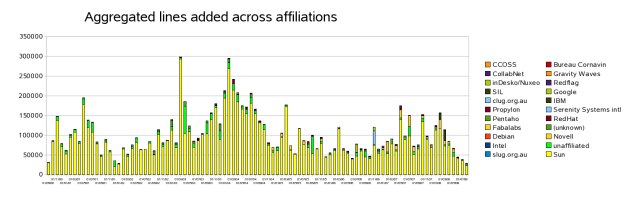
So the data is not that useful. Is it more useful to look at an individual to see if they are contributing something? If we threshold the data we can at least approximate an activity metric / boolean. The graph below shows two developers - the Sun developer Niklas Nebel, and the Novell hacker Kohei Yoshida. Both work primarily on calc, and you can see the large bar when Kohei committed his solver to a branch at the end of 2006.
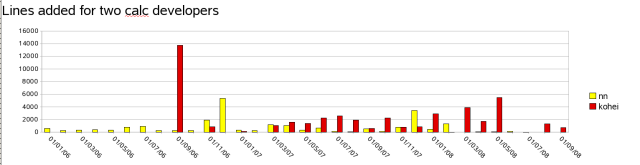
It seems clear that we can at least approximate activity with some thresholding. More interesting than this though, we can see a most curious thing. Despite Calc (apparently) being the relative weakness of OO.o, and Niklas being the maintainer of the calc core engine, and the calc "Project Lead" (with special voting privileges for the 'community' council), in fact he hasn't committed any real amount of code recently. That jumps out in the comparison with (vote-less) Kohei in the last six months. It is very sad indeed to all but loose Niklas from the project, though at least we'll see him at OOoCon. Verifying this counter-intuitive result with bonsai reveals the same picture.
Activity graphs
Extending this metric to the entire project we see perhaps a more interesting picture. By thresholding contributions at one hundred lines of code added/changed per month, we can get a picture of the number of individuals committing code to OO.o. Why one hundred? why not? it's at least a sane floor. Clearly we get a metric that is very easy to game, but luckily that's hard to do retrospectively.
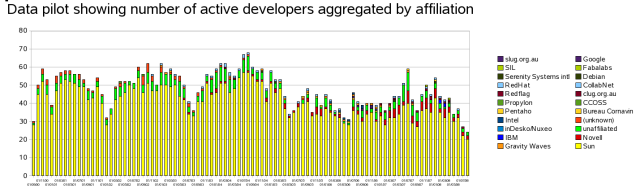
It is clear that the number of active contributors Sun brings to the project is continuing to shrink, which would be fine if this was being made up for by a matched increase in external contributors, sadly that seems not to be so. Splitting out just the external contributors we see some increase, but not enough:
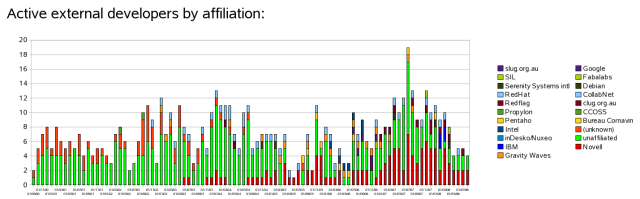
Novell's up-stream contribution appears small in comparison with the fifteen engineers we have working on OO.o. This has perhaps two explanations: of course we continue to work on features that are apparently not welcome in Sun's build cf. the rejection of Kohei's solver late in 2007, and much of the rest of our work happens in ooo-build, personal git repositories, and is subsequently filed as patches in IZ.
A comparison
So, it should be clear that OO.o is a profoundly sick project, and worse one that doesn't appear to be improving with age. But what does a real project look like that is alive? By patching Jonathon Corbet's gitdm I generated some similar activity statistics for the Linux kernel, another project of equivalent code size, and arguably complexity:
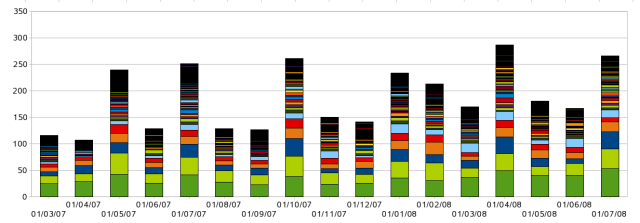
Graph showing number and affiliation of active kernel developers (contributing more than 100 lines per month).
Quick affiliation key, from bottom up: Unknown, No-Affiliation, IBM, RedHat, Novell, Intel ...There are a number of points of comparison with the data pilot of active developers aggregated by affiliation for OO.o.
Similarities: both graphs show the release cycle. Spikes of activity at the start reducing to release. Linux' cycle is a loose 3 months, vs. OO.o's 6 months.
Differences: most obviously, magnitude and trend: OO.o peaked at around 70 active developers in late 2004 and is trending downwards, the Linux kernel is nearer 300 active developers and trending upwards. Time range - this is drastically reduced for the Linux kernel - down to the sheer volume of changes: eighteen months of Linux' changes bust calc's row limit, where OO.o hit only 15k rows thus far. Diversity: the linux graph omits an in-chart legend, this is a result of the 300+ organisations that actively contribute to Linux; interestingly, a good third of contribution to Linux comes from external (or un-affiliated) developers, but the rest comes from corporates. What is stopping corporations investing similarly in OO.o?Conclusions
Crude as they are - the statistics show a picture of slow disengagement by Sun, combined with a spectacular lack of growth in the developer community. In a healthy project we would expect to see a large number of volunteer developers involved, in addition - we would expect to see a large number of peer companies contributing to the common code pool; we do not see this in OpenOffice.org. Indeed, quite the opposite we appear to have the lowest number of active developers on OO.o since records began: 24, this contrasts negatively with Linux's recent low of 160+. Even spun in the most positive way, OO.o is at best stagnating from a development perspective.
Does this matter? Of course, hugely ! Everyone that wants Free software to succeed on the desktop, needs to care about the true success of OpenOffice.org: it is a key piece here. Leaving the project to a single vendor to resource & carry will never bring us the gorgeous office suite that we need.
What can be done? I would argue that in order to kick-start the project, there is broadly a two step remedy:
- Kill the ossified, paralysed and gerrymandered political system in OO.o. Instead put the developers (all of them), and those actively contributing into the driving seat. This in turn should help to kill the many horribly demotivating and dysfunctional process steps currently used to stop code from getting included, and should help to attract volunteers. Once they are attracted and active, listen to them without patronizing.
- Distance the project from Sun: perhaps less branding, certainly less top-down control, reduce the requirement to 'share' all your rights over to Sun before you can contribute to the project. Better still, share ownership of the code with a non-profit foundation to guarantee stability and an independent future for the code-base.
Unfortunately, the chances of either of these points being addressed in full seem fairly remote - though, perhaps there will continue to be some grudging movement in these directions.
A half-hearted open-source strategy (or execution) that is not truly 'Open' runs a real risk of capturing the perceived business negatives of Free software: that people can copy your product for free, without capturing many of the advantages: that people help you develop it, and in doing so build a fantastic support and services market you can dominate. It's certainly possible to cruise along talking about all the marketing advantages of end-user communities, but in the end-game, without a focus on developers, and making OO.o truly fair and fun to contribute to - any amount of spin will not end up selling a dying horse.
Postscript
Why is my bug not fixed? why is the UI still so unpleasant? why is performance still poor? why does it consume more memory than necessary? why is it getting slower to start? why? why? - the answer lies with developers: Will you help us make OpenOffice.org better? if so, probably the best place to get started is by playing with go-oo.org and getting in touch, please mail us.
Finally - we invite you to repeat the analysis, the raw spreadsheet data (for data-miners) is here: ooo-stats.ods linux-stats.ods and the RCS parsing scripts parse_rcs.py with dependants in that same directory.
2008-10-09: Thursday.
- To work; turns out my USB key, while having reasonable burst read speeds makes for a thoroughly pathetic root file-system; and while excellent at seeky reads (Alt-F2 doesn't kill the machine grokking .desktop files), is overall slower than a turgid slugnoodle.
- Greg Swift reports, that instead of editing my
~/.ssh/known_hostsfile I should be doingssh-keygen -R, which is a good point, though hopefully something I'll have to do a lot less of now. - Started to poke at an interesting bug Thomas Biege threw up. Since my 11.0 OO.o build is broken on 11.1 Beta2, decided to use the new split builds we have in 11.1 - grabbed the
OpenOffice_org-libs-gui.src.rpmpackage (11Mb), and zypper got me another 46Mb of -devel package (we're working on shrinking that too). Realised I need to tweak/usr/lib/ooo3/solver/LinuxIntelEnv.Set.shto add an/opt/icecream/binto CC & CXX, then:sudo bash -l -c "/usr/bin/rpmbuild --eval '%define jobs 10' -ba SPECS/OpenOffice_org-libs-gui.spec"and bingo, it built for 10 minutes and died with some Java problem; bother (missing some package dep somehow). Luckily I had enough built to debug, and committed some deferred dependency generation speedup before hitting the gdb-is-not-working issue: filed that instead. - Lunch with Laura, back - prodded text; tried to get compiz working on my hardware - eventually it did: a beautiful accelerated experience on top of radeonhd, prodded multi-monitor support too. Prodded wall plugin crasher with David.
2008-10-08: Wednesday.
- An exciting morning of bug filing, and investigation. Finally set too with the evolution snapshots which avoided at least one already-fixed bug being filed again; nice.
- Poked at the session bus problem, which (it seems) doesn't like root connecting to it, causing grief for yast. Discovered my setting for "what happens when the suspend button is pressed" was "Do nothing" - which explains the absence of action on Fn-F4: with users like this who needs real bugs ?
- Prodded the build service - Darix kindly helped me create a home project, such that osc branch doesn't complain
no permission to create project ..., which is great. Apparently the latest osc needs --no-verify to build things, and flies more gracefully withsu-wrapper = sudoin ~/.oscrc. - Lunch, looong analyst call. Did a live-install to a USB key - wow, it's a really nice installation workflow, albeit the write-rate to the key is impossibly bad: 1Mb / second x 4+Gb == 67+ minutes, fun - almost makes sense to write it to an on-spinning-disk ext3 image, then blit it en-masse across.
2008-10-07: Tuesday.
- Poked at bugs; downgraded to xorg B1 to test things. Since I regularly re-install machines locally, I'm ~always getting irritating messages of the form "REMOTE HOST IDENTIFICATION HAS CHANGED" and having to edit
~/.ssh/known_hosts- which is hyper-irritating. Dear lazyweb, is there a good way to turn off such checking but only for a local sub-net ? - lejo read the manual for me; and dug out:
Host 192.168.0.* UserKnownHostsFile=no StrictHostKeyChecking=no
thanks. - Signed up for the UKUUG conference finally, only to realise it overlaps with OOoCon - bother. Managed to catch rsync faliing nastily - another variant of an out-of-space problem; this time, not having enough space to duplicate my 700+Mb Sent mail folder, before updating it: --inplace fixed that.
- Lunch, backed up, installed Beta2 on the laptop - looking interesting, filed bugs left & right, and worked on one or two. Pleased with RadeonHD - I seem to have a beautiful X server with DRI, and working hot-plug multi-head bits out of the box: nice. If only compiz wasn't broken. Hesitantly switched to the latest Evolution, and filed bugs.
- More paperwork, mail sending, helped bathe the babes: Elisabeth is known as the 'sitting duck' in honour of the various (regularly un-successful) attempts to love her by her sisters in creative ways; as in "my hair has all been loved off" etc.
2008-10-06: Monday.
- Poked mail, estimated travel budget for the next financial year, call with Henne; Clarity. Poked at yast2-gtk a little wrt a11y. Nice to see Mike's ORBit2 / root stuff working nicely. Nailed hideous yast2 interaction bug - whereby 'log' assumes it can hang about to the
const char *s you pass to it forever.
2008-10-05: Sunday.
- Lie in, to NCC; Tony spoke on an overview of Judges. Mike & Leanne back for lunch, tidied up, some Violin practice with N., put the kids to bed, slept.
2008-10-04: Saturday.
- Dealt with babes to give J. a lie in. J cycled into town to get the market shop done. Poked at yet more architectural drawings trying to fit stairs into here and there, printed and read the fire regulations, inner rooms on floor three are not kosha: bother.
- Lunch; took H. to the Funky Fun House for Loren's party, lots of playing, some 'disco' thing afterwards, it never ceases to amaze me that the Barbie Girl song is thought to be at all suitable for young children. Took a tired Naomi Brighty home early with H.
2008-10-03: Friday.
- Prodded mail, somehow a mass of tiny administrative irritations has accumulated over the last days; started on them somewhat reluctantly. Prodded Evolution gingerly with Sankar, then split-build image issues.
- Phoned Abbey's Zoe Burnett to be re-assured that my flexible mortgage is in fact not structured as a savings account, hence the tax-free interest, and as such is neither covered by government guarentee, and would not be lost in the case of a collapse; good.
- OO.o call, call with JP, call with Kelli, I'm at other people's call it seems.
2008-10-02: Thursday.
- Mail, poked Tor wrt. DNS lookups on Win32, wrote up PDX summary finally, chat with Olaf, backed up laptop, poked at Evolution some more with Sankar.
- Lunch with Mary Rogers, back to work, Kelli's staff, sync with Roger. M. waking people up multiply in the night.
2008-10-01: Wednesday.
- Back to work, poked mail. Set off a build of the latest layout work from Janneke, annoyed by helpex performance (building 8-way with icecream it bites). Seems to do 3 system calls per line read from a 300k line file, a million sys-calls here & there - but where is it slow ? Made the code 40% faster but realised that the real system hit is from the well-known ext3 / page write-back / sync evilness; and the fact we generate 100's of Mb of output file, bother.
- Lunch, Nick came over, chat with Guy, OO.o team meeting, call with Florian, call with Guy. Out to Alpha in the evening.
2008-09-30: Tuesday.
- Up early, interested to see go-oo getting hammered in a performance comparison. A really interesting site Andrew has put together, and embarassing to look so bad. A large part of the problem is with comparing go-oo's 'Universal' build, (built with an ancient tool-chain so it actually runs on ~all Linux's) with Fedora's nice, natively compiled version (using native system libraries); though of course not wanting to switch O/S to test something is understandable - clearly go-oo runs rather faster on OpenSUSE. Having said all that, for me - the most depressing thing is to (re?)-discover Andrew's site, and see that despite the huge amount of work Novell / I have put into trying to make OO.o faster, much of which is now up-stream, we are losing the fight: Is OpenOffice getting faster "In conclusion, OpenOffice.org is generally getting slower with each release." - thanks for keeping us honest Andrew.
- Poked Fridrich wrt. binutils versions, prodded yast2 settings. Lunch, prodded architect some more, verified my stacked chart bug is fixed in OO.o 3.0.
- Hour long trip to see the doctor for the snip (or, as it turned out the cauterise) - so far, not much more painful than substantial dental work. In consequence missed most of the core-team meeting.
2008-09-29: Monday.
- Up early, mail pokeage, wrote some perl scripts to analyse git logs. More mail, wrote a screed, call with Sean Atkinson, nice to hear from him.
- Sat in on the end of Hannah's first piano lesson, out for a run afterwards.
2008-09-28: Sunday.
- Lie in for J. got the kids marshaled, tried to keep E. quiet. Off to NCC, Helen speaking. Had Leyla & Nathan back for lunch, good to meet them.
- Out to Cheeky Monkeys for George's party with the girls: lots of leaping, jumping, tumbling, ball-pool action etc. Managed to avoid getting sucked in for the most part.
2008-09-27: Saturday.
- Lie in; read the economist while J. shopped. Bruce & Anne arrived for lunch, good to see them. Clive helped cook a great meal. Played with the children for much of the afternoon, and tidied up. Bed early.
2008-09-26: Friday.
- Mail, call with Hallski, more mail, wrote up notes from yesterday. Lunch, caught up with Morten, call with Alex, took a look at novell-ipsec, hmm.
- Call with Stephan & Gary, then with Guy, then with Kelli - more talking than programming is bad.
- Sue & Clive arrived, got too with frantic child cleaning, putting to bed etc. Laura baby-sat, while we went out with Sue & Clive to Cherly's chocolate meal: which was rather excellent. Caught up with Rachel, fine wine, fine food & cholocate in every course. Bed late.
2008-09-25: Thursday.
- Up in the night, prodded mail. Off to the dentist, and back for an interview. Struggling with linux kernel gitdm output, since 2.6.15 we have 96k changes, somewhat more than the 64k rows we have, interesting having cropped from 2.6.24 to today, the DataPilot seems to require more memory than quite reasonable to crunch it: ~2Gb mapped or so before an allocation failed.
- Lunch during conf-call, call with hpj & networky people. Series of back-to-back calls all afternoon & early evening, desktop staff, DE meeting etc. bed early.
2008-09-24: Wednesday.
- Up with the babes; H. still unhappy about going to school for some reason. Got everyone dressed up & packed into the car, only to discover that M. (the Peatle) had turned the light on and drained the battery. J. cycled in instead, while I put it on charge, and taped up the switch in the roof to avoid repeat use. Surely there should be some software fix there (since it's apparently centrally controlled).
- Swallowed & re-gurgitated mail. Architect called, apparently my stair would fit. Back to stats generation. Out in the evening to an Alpha dinner at NCC, good stuff.
2008-09-23: Tuesday.
- Feeling deadly jet-lagged. To work anyway, H. complaining about having to go to school: apparently football is the cause (very understandable). Backed up the laptop. Tried to install the latest evo. snapshot - apparently killed by gratuitous .so bumping on libedataserver: wow.
- Did the Employee Engagement survey; more mail chew, Clarity, call with JP, Lunch, phoned Morris Armitage to chase missing rent, and Graham to chase missing drawings.
- More mail thrash. Booked flights to OOoCon / Beijing, dug at VISA pieces. Core team call, quick chat with Brian/Tim. Worked on some statistics.
2008-09-22: Monday.
- Slept through the morning, trains home; lovely to see the wonderful wife & kidlets again. Read stories in a loop, before being read to by H. and doing some subtractions with her. Fine meal in the evening, bed very early.
2008-09-21: Sunday.
- Up early, breakfast with Thiery from Airbus working on their interesting avionics, as well as video for Linux. Off to First Baptist's early service; small congregation, but a good sermon. Back to the hotel, phoned home.
- Profiled my new sandisk 8GB USB key, it can do the same 25Mb/sec that the built-in EEPC SSD does - good to have that baseline. Off to the airport with Alasdair - good to get some vicarious sight-seeing in.
- What with the general disapprobation from kernel people about OO.o's pagein binary (that maps and touches each page linearly), I did a little testing of launching OO.o from flash; interestingly, even with a free-seek medium, pagein gives a win:
So 10% slower without pagein ie. just relying on the posix_fadvise for shared libraries - even on cheap seeking SSD, and even though the pagein -should- load more data than we actually use; sad.type readings average with pagein 4.160, 4.081, 3.987, 4.023 4.06 without pagein 4.311, 4.759, 4.379, 4.571 4.51 - Interested by the push-back to Greg's talk. While it was perhaps a tad sharp, and could have been more broadly generalised; his numbers reflect my day-to-day experience of the developer community. Perhaps the most encouraging thing is that a lack of up-stream contribution to the shared code-base is now (rightly) seen as a negative thing, and I'm pleased by Mark's recent commitments to resource Canonical's up-stream contribution. It's also interesting how quickly the 'objective' conspiriacy theorists start slinging allegations - personally my bias is clear: if someone doesn't want to use my beloved SUSE for whatever reason, I heartily recommend Fedora to them - if only because of the huge number of developers I respect & call friends that are paid by RedHat, working together with us on projects I care about. In time, I looking forward to being able to recommend Ubuntu for the same reasons, at least to that tiny minority that dislike green colour schemes.
- Met interesting girl (Marketa) on the plane from Vancouver (to Prague) from her cruise ship: the Star Princess, an economist and hair dresser / beauty therapist. Managed to avoid any beauty therapy.
- Thinking of desktop cold-start times, it's interesting to think how little data we extract from 3Mb of scattered hash files in
/usr/share/locale-bundle/en_GB/LC_MESSAGES/*an lsof on those shows an interesting picture. Strangely, when I log in. I only see less than a handful of translated strings on my desktop - surely we an do better here. Perhaps some LD_PRELOAD'ed gettext pre-cache might save some seeks.
2008-09-20: Saturday.
- Up disgracefully late, after watching Bridget Jones II, and (of course in the US) about half of another movie on another channel interleaved in the advert breaks - roll on cheap VOD in every room.
- Off to the Leibowitz's in an incompetant Taxi driver's car, had lunch with Rebecca, Max & Dhananjay, admired their home. Back to Dhanajay's to meet his family & learn more of Intel micro-architecture, kindly dropped back at the hotel.
- Finally caught up with some of the pending tasks, dug at binutils to find a good place for some fallocate system calls. Out for a great dinner with Bastien, back & talked to Alasdair until late.
2008-09-19: Friday.
- Breakfast with Jan Kara prodding the kernel in various places. Off to the dbus / plumbing talk. Finished the kernel round-up, chat with Keith, off for a fine lunch with Bastien, Jon, Colin and Dan.
- Back to pick up Dave, Simon, Wim and on for some applied all-afternoon drinking and food. Taxi back, bed.
2008-09-18: Thursday.
- Breakfast at the conference; Jonathon's keynote was interesting. On to Dirk's 5 second startup talk, switched to Chris's btrfs talk. Caught up with Simon and the latest telepathy bits.
- Lunch, and talked with an X guy at length about graphics memory management issues. Great to catch up with Dan Williams, amusingly we diagnosed my laptop's screwed up NetworkManager resume behavior as yet another
dbus-senddoesn't instance - as reported in March, now affecting/usr/lib/pm-utils/sleep.d/10NetworkManager. NB. people using dbus-send must add --print-reply if they want to reliably send a message. - Chat with Jim Gettys, and Kay Sievers, system-tap talk, and off to NetApp sponsored cocktail party. Caught up with Dirk & Alasdair, realised I was missing the speakers dinner & split to there. Good to catch up with Jon, David & Leonard.
2008-09-17: Wednesday.
- Up earlyish, poked at iogrind; off to the conference with some RedHat networking guys. Met up with a ton of interesting people, got the laptop to project (somehow), synched with Matt Wilcox and Margaret. Greg's keynote - fairly amusing.
- I/O talk - incredibly well attended; showed people iogrind, and promoted my crazy ideas - at least, in passing. Jan Kara did a great spiel on recursive mtime, hopefully a useful concrete win to come out of it.
- Out for lunch with Ted, back to the tracing miniconf; and on to Linus' detailed git tutorial: discovered
git grep. Out to a nice Intel sponsored dinner in the evening - Intel knows how to throw a good party.
2008-09-16: Tuesday.
- Up too early, breakfast, packed, bid 'bye to the children. Taxi to the station, wrote minutes on the train. More admin on the train etc. Back on-line on the heathrow express.
- Pleased to discover the pretty right-click 'Power History' graphing in gnome-power-manager. Fascinated to find the lady next to me is a Neuroscientist with all manner of interesting insights into the brain. Also dead pleased with AirCanada's in-seat power, wow, a God-send.
- Hacked on re-factoring iogrind; I wonder if VOD in-flight entertainment systems in part pay for themselves with reduced toilet capacity requirements - by substantially staggering demand.
2008-09-15: Monday.
- Up early, poked at mail, call with Florian, interview with Richard. Posted scanned drawings to the architect - hopefully he can sort something out.
- Installed the latest evolution daily snapshot for 11.0, which Chen has made available I'm still convinced daily builds are the best solution wrt. filing good bug reports. Backed up laptop, incl. mail, Clarity.
- Accessibility call with Marco, Mike & co. New couple: Peter & Greta came over for dinner, up late.
2008-09-14: Sunday.
- Lie in, off to NCC, out for lunch with Jon & Alba & Mike, admired J&A's wedding photos. Back, slugging, up late finishing stair-well drawings: how to support the floor over the stair well ?
2008-09-13: Saturday.
- Up with the babes, off to the market while J. slept. Spent some time reading the 2000 Building Regulations in regard to stair design; brushed up my technical drawing recollections & managed to fit a turning stair into the available space to the loft (on paper).
- Watched Pygmalyon on DVD with the children. Zoe, Dt, Simon & Mike over to watch Ratatouille in the evening: rather pleased - in contrast to Nemo's tedium, this held real plot interest.
2008-09-12: Friday.
- CJ Murfits builders came over to quote on the task. Tired - up late last night trying to fit another set of stairs into the house (we need more stairs).
- Lots of eAdmin, started digging at Empathy. Quick chat with Ganesh, dug at empathy at some length - some good things in there. Call with Pilsbury, then Jared.
2008-09-11: Thursday.
- Up early, back a bit better after reading that bed-rest is not helpful, and gentle exercise is better. Cycled H. to school to further cement the theory, seems fine.
- Shoveled mail; pleased the swarf from Kjartan cleaning up bugzilla and polishing the code (as normal): a consistent Gnome hero over the last decade. Read a passing paper.
- Peter from Rentokil appeared again, with his hair-raising tales of various forms of creature; treated the lounge again.
- Hacked frantically on LXF column once again on the deadline, inspiration or condensed perspiration ? chat with Ross, Kelli's staff, one to one with her. More perl hackery.
2008-09-10: Wednesday.
- Couldn't sleep, poked mail, up-loaded iogrind to gitorious. Read some kernel bits. Breakfast.
- Fixed up some iogrind pieces, looked at showing blkparse output on the fsview - to blend some real-life data with the fiction that iogrind's simulator produces.
- OO.o team meeting, some great VBA updates from Noel, look out for him at OOoCon. Then gtk+ 3.0 call with ISVs. Call with Patrick, cell group cancelled.
2008-09-09: Tuesday.
- Up to help get kids ready for school; tried to work, back to bed-ridden state, paracetamol and sleep. More joy after lunch, so much to do. Poked mail, caught up with people, booked Portland hotel, chatted with Eric. Staff sync with Roger, call with Kelli.
2008-09-08: Monday.
- Woke in the UK; train home, twisted my back horribly (no doubt the flight), and can barely stand up, or lie down; bother. Slept much of the morning. Tried to help J. much of the afternoon.
2008-09-07: Sunday.
- Up late; Finagle a circular-sawed Bagle, then Park Street at 11am; soaked up the sun on Boston common, which apparently also doubles up as a home for the bewildered. Out for lunch with Guy to Gaslight - very nice. Wandered the streets of the neighbourhood for a while, and experienced Guys' fantastic roof deck.
2008-09-06: Saturday.
- Up early, tad of evolution cleanup; lunch with Miguel at Charlies; back to his home to meet Maria & Mother in law; Duncan showed up, then Guy. Out shopping for oysters with Guy, who dropped me back; bed.
2008-09-05: Friday.
- Final meeting action; dissolved. Caught up with Brady, Miguel, Aaron. Out for dinner with Miguel, Nirav, Aaron & Alex and his interesting quantum computing friends.
2008-09-04: Thursday.
- More meeting action; out for dinner with Kelli & co. at Legals, stayed up late with JP, Alex and Nirav.
2008-09-03: Wednesday.
- Up jet-laggedly early, poked mail, breakfast with the guys; off to the office for early meetings with Guy. Laptop-free meetings all day. Out to CBC in the evening with Brad Taylor, Aaron & some of the lads.
2008-09-02: Tuesday.
- Up early, packed more. Drove to Ely with the wifelet, once again falling ill as I leave - poor creature. Train to Cambridge, and onwards to Kings X. Finally got around to looking into the firefox / flash plugin crasher that plagues my youtube usage in 11.0. Turns out to be hard to debug when off-line, tried to make a smaller test-case without much luck.
- Flight arrived eventually, taxi to the office, booked a room, out for dinner with Kelli's team, Nat & Miguel - good stuff, bed early, tired.
2008-09-01: Monday.
- Spare part arrived for Laura's laptop, spent a while soldering it on remembered to use flux properly this once; looks excellent, and actually robust. Re-assembled everything, gaining only one screw. Quite a nice enclosure really.
- To work, poked at an ORBit2 pre-processing bug with Kjartan, and some split build buits with calc. Filed emacs bug - loading ORBit2 idl generated headers seems to cause slowness and grief. Clarity.
- Building estimator arrived, showed him around variously. Installed 11.1 Alpha 2 - interesting, filed strange passwd bug. Tried to update my KDE4 build environment, while having the icecream cluster to hand. Spent some time doing a write-up while it built.
- Packed for flight tomorrow, a week of meetings in Boston.
2008-08-31: Sunday.
- Off to NCC, Emily & Keith's last day - somewhat tearful; Tony gave a summary of Grapevine, back for quick lunch. Much more house prepping, cleaning, barbeque lighting, wafting. A sudden rush of very small children for Myriam's second birthday party.
- Very pleasant, leisurly afternoon, apparently two-year olds have more fun playing amongst themselves than in barely-understood party games. Caught up with the neighbours happily. Mike popped around in the evening to help with the leftovers.
2008-08-30: Saturday.
- Off to the market - bought up excessive amounts of good things to barbeque tomorrow. Back for lunch, cleaned the house, concreted the inspection hole some more - played with a blowlamp and some spare tarmac - apparently, you can indeed make it more malleable with a flame, and it resists burning nicely.
- Amused to recieve duplicate payment reminders from Rentokil to Furniture Village, still at my house: apparently they have serious back-office issues. Lots of tidying of the house, washing of clothes & dishes, cleaning. Sandy around in the evening, long time no see.
2008-08-29: Friday.
- Miriam's birthday today - much excitement, dolls house from Grandfather unveiled, and packed with suitable dollies from us. Dug at mail, interesting.
- Gave up trying to unwind my dbus threaded oddness, and just created a connection per thread. Lunch, the rest of the family out with Nicki. Poked mango, FATE bits.
- Poked at more mail, split build bits with Calc, Chinese travel, dunged out the disk to install 11.1 Alpha2.
- Listened to the audio walk through of an accessible install of OpenSUSE. Wow, that is a great recording, gives me a palpable feeling of the sensation - not being able to see his screen. It sounds like he is using Ricardo's yast2-gtk installer, with Orca, and well - the flow should be vastly easier in 11.1 - with Mike Gorse' yast2/root a11y; even so lots of obvious improvements leap from the speaker.
2008-08-28: Thursday.
- Up early, poked mail & Srini, tweaked code. Caught up with Julian's valgrind hackery. Did some more analysis of the configmgr deadlock - a simple lock ordering problem, with the magic of apartments and configmgr2 trying to be a separate thread-safe piece.
- Wrote up some notes for Frank. Dug at FATEal issues, long planning call in the afternoon, chat with JP.
2008-08-27: Wednesday.
- To work, chewed away at script to analyse evolution code ownership, generated list of yet more hundreds of clean files to update.
- Poked at a configmgr deadlock - apparently there is a nasty issue with the idle writer thread that does a service activation, while holding the config lock, while the service activation can do config lookups (holding it's own lock). Urgh.
- Quick lunch with Lydia, good to see her. Back to a surprisingly interesting all afternoon security meeting. Up late digging into some dbus oddness.
2008-08-26: Tuesday.
- To work - hack week, but lots of mail. Phoned BCD - glad they booked my flights, albeit without confirming to me. Phoned Rentokil's Tracy to re-explain that Furniture Village are still, not co-located with my home; gave their real address.
- Quick chat with Srini, more mail, told Clarity what I've been up to. Call with Janneke about layout. Encouraging to see all the great work happening while I'm away: must go away more often. Committed Mike's ORBit2 root/a11y tweak.
- Off to collect some spare laminate flooring from Julie, lunch, sync call with JP. Poked at OO.o local linking speedup, which seems to have bit-rotted a little.
- There are times when you need a strong stomach to read some C++, a classic example today; the somewhat pathetic non-existence of constructor chaining (cf. C# eg.): INI_LIST type macros; this simple 60+ line macro saves you typing all those huge constructor function calls (most of them to a constructor, with at least one fn. call in the arguments) multiple times: that means you can easily create a leviathan .text section, without even trying hard.
2008-08-25: Monday.
- Up early, re-admired laptop, ordered replacement power jack from the US, $33 vs. £100 to fix it professionally. Bank holiday today - missing a day of hack-week, bother.
- Out to Ely, to wander the cathedral, played with the frizbee, swings, slides, clambering etc. Back, a little more castle work; lunch. David left for home, missing the Veggi-Tales DVD & pop-corn, really good to see him.
2008-08-24: Sunday.
- Off to Rock in the morning, J. dealt with the babes, solid sermon. Back for lunch at our place, with James, Kate & Peter. Fed them up. Played with the babes a little, examined the problems of in-castle shelf and sofa construction.
- Laura & Creighton arrived with broken Acer laptop. Diverted to this task, then out to Hope Baptist in Teversham to hear James speak in the evening - stayed for some after-service snacks, a fine community going there, interesting people.
- Back for dinner & more laptop disassembly - having removed almost every screw - and levered lots of plastic bits (many of which surprisingly failed to noticably break) located, and de-soldered the evily under-engineered power-jack. Never seen something so important, so obviously flimsy - the tragedy of the thing is that a beautiful and hyper-complex working laptop, should be laid low by a tiny piece of broken wire doing the simplest of tasks.
2008-08-23: Saturday.
- Off to the market to stock up on good things, good to be home. David arrived at lunch time, great to see him. H. desparately eager to be building the castle afterwards. Instead headed to the gallops on bicycles to remove the rush from the children.
- Back home; expert flag-pole & flag creation & errection from David and Julia. Talked until late.
2008-08-22: Friday.
- Up earlyish, off to buy a 'big girl' car seat with the Peetle (Myriam), for a solidly successful potty-training experience all week, she seems very pleased with it.
- Packed everything rather slowly, and got the car stuffed full, roof box & all. Bid 'bye to the parents & brother & Ilona. Set off for a speedy & uneventful trip home.
2008-08-21: Thursday.
- Lie in, slugged in the morning; out to Worthing to another park / playground in the afternoon, train ride around the park, lots of paddling and splashing around. Back, watched Herriot in the evening.
2008-08-20: Wednesday.
- J. lie in, played with babes. Rained much of the day - played Lego in the morning with them: made castles, tried to identify female lego 'men'. Lunch.
- Out to the lagoons on the front in the afternoon in the rain, played in the playground. Back, to watch the end of The Sound of Music.
2008-08-19: Tuesday.
- Lie in, then out to the Booth Museum of stuffed animals (mostly birds) or Victorian Taxidemi (depending on how you look at it). Good fun, some interesting pieces.
- Home to join in with Father's exciting drain-rodding experience, what fun - mercifully finished this before meeting Robert's charming new girlfriend Ilona. Lunch.
- Out swimming with the babies, Rob & Ilona - lots of fun, splashing, swimmin etc. Back to watch The Enormous Crocodile and other Rohld Dahl bits, and the beginning of The Sound of Music.
- Put the children to bed, played guitar with Dad's accordian practice (no better time to start to learn an instrument than your seventies) which went well. Dinner, talked late.
2008-08-18: Monday.
- Up early, J's lie in. Played with the babies, trained Dad on the uber-slow, but functional laptop. Off to St. Annes Wells garden in the afternoon - lots of slides & swings to play on. Slugged, watched the olympics a little. Robert feeling unwell sadly.
- Watched some of Dawkins on the TV, interesting - must get around to reading his latest book, if I can get it second hand somewhere. Sadly, he reminds me of myself age 16 - irritated by being made to study the arts, and wanting to focus solely on maths & science. Luckily later in life I discovered that, in fact, science has answers only for part of our experience, and that studying romance, history, art, theology is highly valuable. Amused by some of the hubris and misrepresentation applied to Rowan Williams - and the apparent lack of grasp of the history of thought on these topics for the last millenia: eg. the action of chance in producing us - who has not heard the stories of the meeting of people's parents as if at random, and been glad that < insert improbable event > occured, lest we not exist at all ? My personal favorite experience of seeing emminent scientists (eg. the UK's Chief Scientist) tying themselves in conceptual knots, and failing to understand was at a small lecture on a basic topic from the head of the History & Philosophy of Science faculty at Cambridge, an undergraduate course highly recommended before over-prognostication in public on these matters. As a banal analogy Ali G's demand to a vegetarian Eat this chicken, or I kill this other chicken ! condenses a fine moral dilema worthy of detailed consideration into a forum where an answer simply cannot be provided or even explored.
2008-08-17: Sunday.
- Lie-in, and off to St. Lukes. Dealt with three in the creche, interesting talk to an ex. professor of parasitology afterwards, caught up with old friends.
- Returned to Father's birthday party - seventy-two sounds old, but he's active and in good spirits. Wandered across the parks to the new Hove Park playground, refurbished and in great condition. Thomas left in the evening - sad to see him go.
2008-08-16: Saturday.
- Up early, frantic packing for a week and house cleaning; set off, late for Auntie Louise & Uncle Anthony's 50th wedding anniversary celebration: some serious goodness there. Lots of great food, a fine party.
- Out to a small local fair with Stephanie, Adrian, Adam & co. went on a tiny dragon roller-coaster with the babes. Back, set off to my parents for a week off; arrived happily. Thomas & Robert also there, good to see them.
2008-08-15: Friday.
- Phil the friendly beetle-killer arrived from Rentokil, with a water based spray, and a van full of interesting goodies; helped get him ensconced under the floor.
- Tried to make systemtap do my bidding. Found out more about kernels, the split between -obj and source, symlinks in
/lib/modules/`uname -r`/build, and so on. Finally found the bug is fixed in HEAD systemtap anyway, filed a SUSE issue, sent off a trivial patch. Sadly when it runs, it does something -so- strange to my system that it terrifies me; will come back later. - Poked at mail. Discovered that the versionrc type files installed all over the place in OO.o are all generated from scp, which is fun; though the syntax for creating a simple flat text file with some substitutions is quite amazing - ~8 lines per line of output, with a magic 'Order' identifier and so on, turns a 30 line file into 255 hard-to-read lines.
- Finally got the split build actually working (for some value of work - no python or java components registered). The rest is just re-factoring & polish. Started a from-scratch re-build of it all again. Found another parallel build issue - I guess the nice thing about that is that OO.o's magic perl build scripts can do quite a good job of finding parallelism.
- Frank encouraged me to test systemtap under kvm, great plan got that going, upgraded the kernel etc. Quick call with Jared. System-tap working perfectly with a matching kernel & debuginfo package - clearly we need the NT_GNU_BUILD_ID feature turned on somewhere.
2008-08-14: Thursday.
- Burned images for Mary Rogers with brasero, filed misc. bugs against it around the place. Poked mail, played with builder to create a bootable USB key image, filed bugs. Cyberorg used kiwi to do a rather better job.
- Knocked up an LXF column. Visit from Michael - the building regs inspector, he inspected things thoroughly. Phoned Rentokil to point out that builling Furniture Village at my address is unlikely to work that well.
- Tested Cyberorg's lovely Icecream iso - some OpenSUSE JEOS-like goodness - insert, boot, compile and watch your builds fly.
- While discussing with Mark Wielaard SUSE's lack of kernel debuginfo packages for updated kernels (bug) he pointed me at system tap example scripts - tried to play with the candy.
2008-08-13: Wednesday.
- Up early, mail; nursed overnight build breakage of my own creation. Quick visit to the Doctor, knocked something up about icecream.
- Lunch, Team meeting - some good talks & great work going on.
- Dinner with Mary Rogers, somewhat surprised to see the US moving troops into the war-zone in Georgia - even if for humanitarian purposes; still surprised to see the media talking about "Russian Citizens" in South Ossetia - the recipients of a recent passport hand-out precisely for this propaganda purpose apparently.
- Discovered Cyberorg just created an OpenSUSE/LTSP/Icecream setup to make it easy to re-use all those wasted Windows machines nearby for building things; nice indeed.
2008-08-12: Tuesday.
- Dug at mail, booked flights, more mail, chat with Srini, more inbox action - sigh. Kocked up a new python script to work out who has contributed to OO.o recently rather more accurately than last time. Created a perl script (which I still preferred to python for some reason, perhaps force of habit) to parse svn annotate output in various trivial ways.
- Finally got the ooo-build source split work underway again just as they day ends - Chris came over for a chat, good to see him again.
2008-08-11: Monday.
- Up early, checked mail - lots of interesting stuff, it's good to be back (at least for a week). Churned through FATE mail, booked travel variously.
- Lunch, tended the split build, more misc. tweaks. Massaged Mike's ORBit2 patch a little and committed it. Fixed up a ton of ant files to have more pleasant paths.
- Dinner, J. cut my hair; knocked up a quick prototype list to seed a membership process for OO.o, to try to get really representative council elections going.
2008-08-10: Sunday.
- Off to NCC earlier than normal for breakfast before the service, good fun really. Met Charl and Sanmarie from South Africa, and had them over for lunch, and biking to the race-course. Really great to meet them.
2008-08-09: Saturday.
- Cleaned out & thoroughly hoovered the afflicted room, discovered 3 other beetles - apparently the local spiders had wrapped them up, though whether they died after laying their eggs, no idea.
- Out to Molly's party with three babelets - 'Mr Marvel' was doing some entertainment for the children: simple magic, Punch & Judy, that sort of thing. Fine lunch, and a mini-disco-thinglet, mercifully very innocuous afterwards - lots of little girls jumping up and down.
- Back for lunch, the same chaps arrived to remove the sofa as had delivered it: wrapped it in plastic (much good may that do them), and hoiked it out.
- Off to James & Kate's 5th wedding anniversary party: great fun, lots of interesting people; good to see Rob & Sarah there - with Philip; you always meet interesting people at J&K's somehow. Back, bed exhausted.
2008-08-08: Friday.
- Phoned Furniture Village's Wayne who promised people to at least remove the beetle-eaten sofa, and provide a replacement; good. Cleaned up Bert's hedge cuttings - a rainy day. Spent a lot of time doing some months of filing, and starting on tax returns.
2008-08-07: Thursday.
- Up early, mailed photographs of beetle to Rentokil, and off to the smashing Dinosaur Adventure Park near Norwich, good stuff. Lovely weather, despite the Met Office's dire predictions & weather map.
- Interested by Bob Sutor's comments that the Linux desktop needs better designers. No doubt he's right and luckily it's easy for IBM to fix that: bring some to the party (though clearly hackers are needed to implement their output & win people over to it). Having said that, is Notes or even Workplace nearer the summit of usability perfection, or even efficiency in the use of resources ?
2008-08-06: Wednesday.
- Prodded mail properly for the first time: wow, there is a lot of it. Played with Empathy some more, looks good, writing down the minor irritations for future reference / fixing. Call with Florian.
- Caught up with a certain amount of admin / bug filing. Call from Murfitts / builders wrt. a deadline for their quote: end of the month. Played with Conduit a little on the local network. Lunch with Laura.
- OO.o team meeting, call with JP, call with Grant, more talk with JP. After much digging into rpm things, I discovered that the mystic spec file goodness:
make %{?jobs:-j%jobs}is best handled with somerpmbuild --eval '%define jobs 8' -ba foo.specthan otherwise, sadly much googling, manual and code reading didn't make this at all obvious. - When is Open Source not that open source ? - when it is inorganic of course; J. reading a book Swindled currently on fake food (it's not as good as expected, perhaps like the food). Should we have an open-source FDA, that can name & shame harmful additives ?
- Dunged out the laptop disk, somehow filled 250Gb rather too quickly, kicked off some new m28 split builds.
- Poked at the sofa again: just playing with finding the depth of the various holes with some wire - when (much to my amazement) I hooked a hugeish beetle out of one of the holes; somewhat surprising to say the least. Stuck it on one of the Rentokill beetle sticking pads, though clearly these are designed for lesser beasts - it could move slowly around / off it. Managed to clap it inside a jam-jar, and kill it with some handy permethrin woodworm killer. Examining it it seems to be a False Powder Post beetle identical to the picture here: , Wikipedia is surprisingly unhelpful about Bostrichidae sadly.
2008-08-05: Tuesday.
- Up in the night with an upset M. encouraging reports of increased potty training success yesterday. Breakfast with Will, got down to work. Pleased to review a nice patch from Mike Gorse making the fast Unix Domain Socket path in ORBit2 work for the root user, making yast2 accessible as root, and (incidentally) speeding up startup of ~all Gnome apps just a little.
- Lots of interesting tweaks from Will, got Icecream setup locally to accelerate builds. Spent some time reading KDE code, debugging bits, Kopete, QObject, MOC output, KConfigXT etc. interesting stuff.
- Rentokill chaps arrived: Eddie Milton and Andy, admired the holes, helped chop open some of the plastic fabric covering, admired the rather shocking piece of timber, no obvious conclusions but that things came out, not in. Dropped Will off at the station. Dinner, babes to bed etc.
2008-08-04: Monday.
- Up, poked mail, synched with Will caught train with him to Cambridge, prodded mail; introduced to the joys of icecream. Rob arrived, lots of Telepathyesque discussion. Out for lunch with the Collabora team. Back, more talking, out to the Eagle in the evening for a pub dinner, back to Newmarket.
2008-08-03: Sunday.
- J. lie in, out to the market with M. Applied slugging, and attempted potty training, with mixed success. Watched Mole DVDs in the afternoon.
2008-08-02: Saturday.
- E. back to shorter sleeping cycles. Off to the market in the morning, forbidden from buying flowers for the lovely wifelet [ the infamous credit crunch you see ]. Back, for lunch. Various fruitless attempts at potty-training M. - she can do it easily, she just doesn't want to.
- Out in the afternoon to Lackford Lakes in the pouring rain; thankfully perfectly timed, such that the rain stopped as we got out, and we had the place to ourselves.
2008-08-01: Friday.
- E. slept for 8 hours in the night, wow - exciting stuff. Off to NCC to fix their networking, ripped up floors, pulled through old wiring variously. Interrupted by Andy from Furniture Village - who clownishly tried to suggest that perhaps the beetles came from the outside [ clearly laying their eggs on plastic, and then the larvae eating a 5mm hole in the plastic, then the wood: seems likely ]. Sent him off with suitable photos.
- Back to NOD, got the wiring done, and spent a while training a chap in the making of ethernet cables: somehow I (foolishly) assumed that every young adult can read the names of colors - got there in the end. Called back to talk to Rentokil's "Eddie", tried to setup an appointment for him to see it too: should charge an entrance fee apparently.
2008-07-31: Thursday.
- Tried to catch up on urgent mail very quickly, without much joy. Off to Bressingham Steam Museum, for a fine day out with the children: Tesco vouchers took the entry cost to under 2 UKP, and somehow - after chatting to a passing local journalist pleasantly, we ended up with a free season ticket; neat.
- Took lots of hot & exhausted children home with some considerable extra griminess from clambering on big engines (etc.) riding on the merry-go-round, tired too. Poked mail again, worked away at it until too late, sigh.
2008-07-30: Wednesday.
- Phoned furniture village to call out their insect inspector. Dealt with shady 'Frank Smart' who apparently has taken a load of my personal data in an un-authorised fashion from our letting agency. Filled forms, sorted building papers, much admin - while baby sitting.
- Called Nildram to try to have them explain where many of my packets are going - apparently they like to disappear on-route, in an intermittent fashion. Very clueful L2 guy, but no obvious solution.
- Into Town to negotiate with, and help out our existing letting agent: nice chap. Back, Victoria, Mike & Rebeccah over for tea - lovely to see them, had a great evening.
2008-07-29: Tuesday.
- Set off for home after lunch, got back, tried to plan the rest of the week off, dealt with post and accumulated answer-phone messages.
- Discovered some fairly amazing exit holes, complete with swarf in our new Furniture Village (where quality is always guaranteed) leather sofa. Somewhat disturbing that the neat circular exit holes are 5-6mm, which is somewhat large by wood-boreing standards I think. Yet more amazingly, the neatly drilled hole extends through the plastic webbing covering the timber. Quality surely entails using treated wood, right ?
2008-07-28: Monday.
- Up at 6:15am, tried to keep M. quiet and sleep in her bed, despite demands of 'arms', 'cuddle', 'drinks' etc. Watched children's DVDs from newspapers for a while. Woke J. for breakfast.
- Out to Sizewell beach with Anne, much fun had by all, digging a trench in the sand, and building a castle under the breaking waves. Swam with the children - an experience marred only by a large number of white jellyfish many (apparently) dead. Appreciated the view of the nuclear power station ~3% of the UK's power (according to the Economist). Particularly interesting too the small amount of string that takes all that power to the consumer.
- Back for lunch, to wash sand off the kit; and out to the Aldeburgh park for swinging action: H. learned to swing without holding on: good fun. Back for baby bathing, dinner and bed.
2008-07-27: Sunday.
- Up early again with M. off to Aldeburgh CofE where we were married; rather a good sermon: he explained the passage clearly & took it seriously.
- Sue & Clive left before lunch. Out to the swimming pool with three, leaving E. in the afternoon: pretty taxing keeping three small people afloat and alive, even without E. - good fun though.
2008-07-26: Saturday.
- Much of the morning spent with children, or preparing food and furniture for the big combined birthday party. The stream of relations arrived - lovely food & wine, almost too hot weather. A great celebration of ageing Griffins.
2008-07-25: Friday.
- Up early, slept in M's bed trying to keep her quiet until a human hour; breakfast. Off to the Aldeburgh sea-front boating lake with (birthday-boy) Bruce's new radio-controlled boat. Played with that - though clearly it is either too fast, or the pool is too small.
- Wandered the beach, back to B&A's; paddling pool out, and reading of the paper; lunch. Sue, Clive & Adam arrived in the afternoon and helped prep for tomorrow's party. Fish & chip supper, and bed early.
2008-07-24: Thursday.
- Semi-lie-in, the children's light failed to come on early, and new things in their bedroom distracted them until 7:30 or so. Breakfast, idly packed swathes of the house into the car. Set off for Aldeburgh.
- Smooth journey, despite jam-packed roof-box, and car full of fun-sized people & their accoutrements. Arrived, light lunch outside: very hot indeed, played with scooters, radio-controlled spider, and other misc. delights of the Griffin residence; read the paper.
2008-07-23: Wednesday.
- Lazed in bed, playing with daughters etc. for a long time - the start of two weeks of paternity leave; nice. J. took everyone on a picnic while I finished up some queued work, before we quit tomorrow for Aldeburgh.
- Gotcha'd by perl's broken syscopy documentation, as apparently reported in 2002 bother. Interested in el-reg's reporting of Verison's LiMo choice:
We chose LiMo because it's a collaborative effort. It's not just one company runs the place. We like that. We like a collegial and collaborative effort, where there is no barrier to entry on the part of developers and, at the end of the day, there is no one entity that can say 'OK, here's how we were playing now. The rules are changed.' LiMo will be our preferred OS because of this openness.
Whether sincere or not, I couldn't agree more. Give me a genuine, open, plural community any day over a single vendor dominated one. - Finally created the first draft of a paper on culture I've been meaning to get to for a while. Knocked off to play with returning kids, have dinner, bathe them & put to bed.
- Hunting around for keys to car roof-box, eventually located them; fitted box, un-packed all manner of wonderful things from Julia's friend - moving away, with lots to give away.
2008-07-22: Tuesday.
- H's birthday, some presents in bed, breakfast - packed everyone off for the last day of term. Mail, poked at more splitting action, finally made make_installer.pl obey me.
- Out to Newmarket Open Door to see about keeping their network going during building work - pleasingly the SLED10 system there seems to have been running beautifully as a router and workstation for 'yoof' for the last ~20 months, without any problems; nice.
- OO.o team meeting, out to Pizza Express for a birthday dinner with all & sundry; back - presents, bed-time; back to prod the building pieces.
2008-07-21: Monday.
- J's birthday - up early, fed babes, poked mail. Amused to see Red Bean's take on virtual software. More split bits, misc. research. Read the nice LXF review of OpenSUSE 11.0, good stuff.
- Conf-call with Mike, Mark & Rob wrt. a11y - sounds like they're doing some great work there. Oddly un-productive ODF/Wiki IRC meeting.
2008-07-20: Sunday.
- NCC, Tony speaking, met Mike a Sandwich Forensic Scientist, had him over for dinner. Played in the garden on & off - cycling practice. Bathed everyone, bedtime stories all together. Bed peacefully modulo the loss of M. precious 'Duch' (cloth) - and inadequate replacements thereof.
2008-07-19: Saturday.
- Up early, frenzied party preparation, out to the market with Colin. More cleaning, and preparing, made boat-cakes; girls got into pretty dresses.
- Deluge of little girls arrived - lots of fun games: musical dots, pass the parcel, jumping around with cups of water, a post-box race thing. Fine party food, etc. Lots of tired & happy girls to put to bed.
2008-07-18: Friday.
- Off to get the car serviced; admired the Prius - albeit with it's tiny battery, adjacent to a large amount of effectively wasted boot space: odd. I'd love a plugin Prius, with a real battery; and 6 seats - waiting is the only option.
- Plugged away at scp2 translation, remembered to write up the split-build stuff for Ingo. Finally escaped for lunch, Bruce & Anne visiting, quick lunch; banged out an LXF column on GUADEC, call with Catherine. Annoyed by an Evo/GWise bug - chased that down to a missing mutex.
- Fixed annoying warning in orbit2. Banged away at make_installer to rip it's guts about: frankly scp2 seems so unpleasant and unnecessary for Linux systems, it seems of dubious usefulness. Discovered to my joy the hard-coded magic of 'gid_File_Lib_Vcl' - which has to be there as a magic template, and the tens of lines of cut-and-paste that proove that it really has to be there in several places; bother.
- Barbara & Colin arrived for the weekend. Dinner with them, up lateish preparing H's cake and catching up.
2008-07-17: Thursday.
- Realised that I'd changed my splitting strategy since building the URE, tons of .rdb location issues: patched them all. Couple of conf-calls, wrote up some minutes.
- Discovered I get two weeks of paternity leave, but have to take them adjacently, and soon. Submitted layout paper for OOoCon, this year just before the deadline as opposed to just after. Back to packaging.
2008-07-16: Wednesday.
- Mail pokeage, admin do-age, fix misc patches, idle splitting, more GUADEC follow-up mail. Lunch, meetings all afternoon: JP's staff, OPS meeting, DE meeting.
- Out in the evening to work-around oddness with Chris' disk; pleased to see XGL working on his ancient built-in Intel chip-set, neat. Out for a drink later.
2008-07-15: Tuesday.
- Amy took H. to school, prodded mail - well pleased that firefox 3 managed to save & restore (over a hardware lock-up) not only the pages I was viewing, but the small essay I had typed into a text field; nice.
- Poked at an at-spi problem for Mark & Mike, all the same problems come back every now and then to bite us: thank God some of us have made all the right mistakes before.
- Helped N. with her cycling on the road before lunch: improving - 5 paces without falling off; lunch. Team meeting, more splittage.
2008-07-14: Monday.
- Up early; Amy took H. to school - walked with her to the post-box. Back, dug at the mail. Read up on Caolan's recommendation of strict aliasing - interesting stuff.
- Poked at DNS lookups, apparently Nildram can't answer them quickly; even back-to-back; annoying. More mail, prodded package splitting in the background, fixed my breakage for Rene. Nildram finally fixed the issue somehow.
- Found the business cards of the interesting chap I got chatting to on the flight in, from Zero Waste a company apparently converting tyres to oil.
- Woke M,, lunch, set off to collect H. waylaid by J. returning from the hospital, E. discharged, great. Back to work. Finished expense filing, more split build tending.
2008-07-13: Sunday.
- Let J. have a lie-in; dressed everyone up & headed off to church. John & Alba's marriage being blessed - lovely service, great to see them looking so happy: did creche. Service sadly cut short by having to take E. to Bury for the penultimate set of antibiotics.
- Home for lunch, tried to get cleaned up a bit. Played with the babes in the road on bicycles & scooters - N. improving nicely & very stoical when bashed variously. Bed early.
2008-07-12: Saturday.
- Up early, quick breakfast, checked mail; set off for the airport - amazing to see the queueing ships, presumably waiting to go through the strait. Arrived at the airport, no passport, grief. Applied prayer, & hunting - phoned Hubert who located it at the front-desk (apparently this is a feature-not-bug). JP very kindly rescued me by taxi & I made it to the plane, thank God.
- Thinking over GUADEC, having talked at length to Tim, I'm just slightly convinced that ABI breakage is worthwhile in the short term; and having given lots of grief about it, that it will be measured & manageable for existing software to move without huge disruption; and that the gain is real.
- Uneventful flight home, wonderful to hug little people left & right, and relieve the parents of their labour of love. Lots of fun, though far harder work than conferencing.
2008-07-11: Friday.
- Up too early, off to Jonny's Evolution / MAPI talk, where we announced the evolution re-licensing, and dropping of the copyright assignment: read Srini's mail here (appallingly wrapped due to mailer/connectivity issues at GUADEC). This is great news in general, and good wrt. getting the Evolution / MAPI connector shipped.
- Lunch with JRB, chat with Jon about gdm, and Richard about PackageKit. Long and interesting talk with Mark, rather re-assured that his passion for bzr is for the love of it, not self-interest; must take a look at it. Caught up somewhat with Matthew & Rob, on to Federio's keynote & then out for dinner with Miguel, Owen, Gabriel etc. at a fantastic restaurant. Back early with JP, via the blue mosque.
- Sad to see that Joe Barr passed on.
2008-07-10: Thursday.
- Off to the conference with JP & Aaron, skipped breakfast somehow; call with the lovely wife: E. improving markedly, thank God. Great Telepathy talk from Rob, and interesting talk from Michael on Moonlight: I didn't realise how de-coupled from Mono 1.0 is.
- Lunch with Federico & a GSOC guy working on memory fragmentation detection with valgrind: interesting. Chatted to Tim at some length after lunch, met Ryan Lortie for the 1st time: most interesting. Call to the long-suffering parents at home, apparently coping.
- Owen's talk - interesting, and another, great talk with Ryan. Wandered the outside & off to the ship-board collabora party: excellent beer and copious food, cake cutting for Gnome's 10'th birthday from both of it's founders: good times. Boats have a certain partying auora, since the first GUADEC. Back late with JP, talk, mail, bed.
2008-07-09: Wednesday.
- Breakfast with JP & HPJ, off to the conference. Luis' opening keynote, long & interesting talk with Dirk, interview with Andreas, waylaid by long talk with Mark Shuttleworth.
- Lunch with JP, caught up with Federico's sexy UI ideas; chatted with the Evo. team, Owen, JRB. Afternoon, chatted to Tim at great & interesting length; Dinner with Mikael & Richard too.
- Back, for a musical bonanza on the roof; and lots of interesting people: Karl, Leonart, Philipp, Don, Vincent, and many others. Back to the hotel - spent much of the night checking mail, downloading things & talking to JP.
2008-07-08: Tuesday.
- Up several times in the night with various childly complaints, and again early: M & D kindly took them to school & went to the market, poked mail. Dug at a main-menu performance issue - could well be the thumbnail leakage problem:
hmm. Apparently we shove all those into a hash_table in the slab too gnome-thumbnail.c (read_md5_dir)$ ls -lR ~/.thumbnails | wc -l 12798 - Dug at logistics for flight to Turkey today. Synched with parents, train, plane - poked at mail and pending tasks: ship-wrecked by an unbelievable concurrency issue in gtype.c (again, again).
- Got to the hotel, out for a quick dinner with Aaron, Gabriel & Rufus; on for drinks & laughs with Miguel the leftist: an his interesting new visions. On for more drinks with Alp, Andrea, Rob & co. bed too late.
2008-07-07: Monday.
- Cheryl took H. to school, great. Poked mail quickly, captured bug list from the old laptop install; fell over an interesting b-a-s staleness issue, despite the nice fix from Ray to slave it to the session dbus lifecycle. Apparently the session dbus refuses to behave itself properly and quit on Zap nicely, so the great concept fails in practice. Isolated the (proable) root cause of b-a-s not quitting cleanly itself.
- Pleased to read Brian Proffitt's Sun should loosen up article:
The company must learn to let go a little bit and let the open source ecology proceed naturally. In the short term, Sun might lose a little bit of advantage in the market, but long term, it is has a better shot at success.
Start with OO.o: give us real, meritocratic governance and real (instead of sham) compromise on code ownership (as we have outlined & requested) - instead of trying mightily to avoid both issues while feigning 'Open'ness. - J. arrived home in distress from the Doctor's. E. has a temperature, bubbling at the mouth rather & she's heading off to Bury Hospital; called the parents. Put N. to bed, and committed b-a-s fix.
- Pleased to see docs on how to track down wireless / NetworkManager issues; it often seems pinning blame on the kernel vs. hal vs. NM comprehensively is too hard.
- Got the Peetle up, lunch, tried to work while lego towers were built by the remaning girls. Mum & Dad arrived, got a bit of work done. Dinner, packed things for J.
- Dad drove me to Bury St. Edmonds hospital, found J. and E. in a state of some exhaustion & drip-fed-antibiotic goodness, poor dears. Talked with J. bid 'bye. Drove home, dug at mail, pinged misc. pending business.
2008-07-06: Sunday.
- Dealt with the kids while J. slept, NCC - Janice spoke well. Heavy showers (as forcast) rained off a joint rounders match. Home, lunch. Installed SL11.0 on the hold-out laptop downstairs with some dodgy pre-beta of SLED10 still on it - nice: 3D effects work beautifully.
- Breakthrough in toilet training for Myriam - apparently the comprehension of the (now) impossibly attractive prospect of the phased incentives: sweets, 'barbie pull-ups', playing with dad, 'big-girl' knickers & finally a new car-seat pushed the balance. Also, fairly sure the individually wrapped & choose-able chocolates, and the sudden interest from big-sisters in 'helping' helped mightily.
2008-07-05: Saturday.
- Up early, J.'s mastitis rumbling on (poor dear); she slept while I waited for the builder. Builder never turned up, phoned him, still never arrived. Bother.
- Lunch, off to the Newmarket Carnival - mercifully rain-free. Wandered the show, paying through the nose for fairground rides for innumerable little people. All Saints got to the final of the tug-of-war. Had a beer with Chris & admired his steam roller, still going strong.
2008-07-04: Friday.
- Poked mail, call with Vincent, into ESC meeting. Interested by the do we need users discussion in KDE-land. Personally, (for a broad definition of developer), I couldn't agree more: just taste the OO.o community - where non-developers are 'empowered' more than developers - for a while to experience how bad it can get. Of course, this is unrelated wrt. the target of the software you develop - that clearly has to be users.
- Continued source-split work vs. m21 - better, I don't have to do the patch forward porting in the same pass. ESC meeting finished early. More mail chewage.
2008-07-03: Thursday.
- Poked mail, realised today is an all-day OpenOffice ESC conf-call; fun (or not). Call with Florian at lunch, lunch. More ESC conf-calling, interview. Late for Kelli's staff, desktop meeting.
- Pleased to see militant leftists frustrated at the happy ending of the personal tragedy [ no doubt justified as: for the greater good of making property history ] of Ingrid B. Also amusing to see another leftist darling: Chavez, caught supporting armed aggression in a neighbouring country (while pumping up the gini co-efficient at home), all in a good cause no doubt.
- Dinner, chatted with Sue in the garden - most pleasant.
2008-07-02: Wednesday.
- Prodded mail, back to the split package building interest: lots of very slow & intricate work; pulled some patches up to m22. Call with Janneke, lunch. Packed beb303-m2 for Rene.
- Conf-call with the desktop crew.
2008-07-01: Tuesday.
- Poked mail, read reports, annotated them; agenda poking. Tweaked source packing script. Call with Naji, OO.o team meeting, corporate call.
- Fascinated to watch a small bug crawling between the backlight and the LCD - gives a great insight into the internal geometry of the panel: like xroach, but far slower & un-kill-able (without a permanant splat).
- Long and interesting team meeting. Put babes to bed, out for a run with Suzannah; dinner, bed.
2008-06-30: Monday.
- Cycled H. to school, brief mail pokeage, more paper work reading. Dug at packaging, in parallel with misc bits, chat with Simon, Lunch.
- Call with JP, poked Kohei. The newest go-oo version with all manner of nice features beyond what is in Sun's OO.o got released, lots of bug fixes and improvements there.
- Hyper-lengthy phone-call in the afternoon / evening, slogged away at packaging pieces in between. Pleasant dinner with Suzannah - great to have her here to help, baby-wise.
2008-06-29: Sunday.
- Off to NCC, Helen spoke. Lunch, George's party in the afternoon - much fun with a strange parent vs. children game with footballs & a parachute. Bed early, exhausted as normal.
2008-06-28: Saturday.
- Up at 6:30, out for a run - try to get the back into shape. Breakfast with the girls, off into town to the market. Back, out to Cheeky Monkeys in the afternoon for Benjy's party - much fun; playing in ball pools etc. Back late, children dunked & put to bed, sleep.
2008-06-27: Friday.
- The parents went home after helping us so much all this week. Poked mail, pleased to have some really great documents from the KDE team to read.
- Attempted to run a .Net application on windows: eventually found the ".Net framework 2.0 configuration" tool (festering away in some obscure and un-findable place). Amusingly the tool itself (presumably written in .Net) apparently had insufficient trustworthiness to operate on it's own settings for an individual assembly: turned all .Net security off instead, cunning.
- Lunch - Auntie Louise around; good to see her. Back, re-massaged tar balls - dug at .spec files endlessly, interview.
2008-06-26: Thursday.
- Glad that you can't fool everyone all of the time: Sun's still screwing up. Nowhere is that more evident than in OpenOffice.org: strangled on the alter of Sun's proprietary advantage. When will we have a project that is run for the benefit of the project itself ? by people who care about the long term viability & world-dominating prospects of the code ?
- Poked mail, features & bugs. Still blundered on removing inlines, and got UML to compile and even run eventually: really sweet for using a debugger to understand code flow; still can't find my hard-copy of RML's magnum opus though.
- Spent a while digging at OO.o build infrastructure, and source packaging, tried chopping up the source another way. Amused during the work to appreciate an outbreak of humour from the Strba, apparently the unpack script nowadays has:
echo "Unpacking OO.o build tree - [ go and have some $DRINK ] ..."with a fully configurable:AC_ARG_WITH(drink, [ --with-drink The parameter is a favourite drink that unpack should advice you to take. Example: --with-drink=coffee], ,)
- the joys of community; tweaked the spelling: 'advise' - thank goodness the default is still tea (for the UK), and not Coca-Cola. Chat with Rene.
2008-06-25: Wednesday.
- Committed my sabayon login speedup / fix, Federico liked it at some stage I recall. More work / Fate bits. Architects call - rambled extensively, prodded Julian. Added a patch to check for ant-apache-regex in OO.o's configure.
- Firefox 3.0 seems to do a simply terrible job of scaling images, for no reason I can work out. Then again, I'd love to have a 'default zoom' that can be set instead of the (different) default font size bits: who cares about font sizes in points - I just want everything bigger.
- Read a nice write-up from Lubos; dunged out my disk. Rene kindly cleaned up my ant patch. F. Alexander pointed out that I can solve my firefox zoom broken-ness by installing a plugin (on every computer I use) - No Squint - which is just what I want. As with all plugins though - the very concept of shipping squint-full software, that can be fixed after the fact with an optional download is somewhat mind-blowing.
- Continuing to have an evil time compiling a UML kernel; apparently the SUSE gcc doesn't like the latest git kernel much, which is sad: even ooo-build builds with that.
2008-06-24: Tuesday.
- More mail backlog catchup; poked at SDL qemu irritation whereby emulation stops making progress when you switch to another virtual workspace. it seems a failing X11_GrabInput is causing the problem: why spend all your life grabbing an unwilling X server ?
- Irritated enough by the less-than-helpful "Create Document" nautilus functionality; dug at nautilus trying to teach it to follow the KDE document template work. Built the latest ooo-build HEAD.
- Lunch, interrupted by call with Andy, team meeting, call with Guy. Back to templates hackerage. Tried to make user-mode-linux compile - more difficult than anticipated: when you avoid the interesting crasher / gcc optimiser bug, you hit other nasties.
- Worked late, finished and posted the nautilus template patch - it's nice to get to some hacking again after a long break from it.
2008-06-23: Monday.
- Started on the mail - it's great to see the back-log of OO.o team mail: doing some great work. Re-tested my last Xen bug having installed more RAM - still failing, hmm.
- Beautiful boxed set of OpenSUSE 11.0 arrived - installed that, and burned some DVDs for friends. Filed some more bugs, updated others, got on top of the Clarity backlog.
2008-06-22: Sunday.
- NCC - Tony preaching, did creche - showed off E. to all and sundry. Emily & Keith also brought their new baby Grace for the first time: a joyful time.
- Home, lunch - to bed for a few hours myself. Mum & Dad arrived to help out next week, great to see them. Amused by the choral arrangement of spiderpig, and the apparent Dutch appreciation of PhatFish.
2008-06-21: Saturday.
- Avoided walking into town in the rain with the children - J. finally getting nearly enough sleep: great. Chris came over, good to see him - had some peace while the children all watched a DVD & retired into the child-free front-room.
2008-06-20: Friday.
- Laura ('LawLaw') came over to see the baby and to let Benjy / Grace play with our little ones. Took M. to clinic - still complaining of her arm; nurse diagnoses nothing really wrong, excellent.
2008-06-19: Thursday.
- Took H. and N. to school & pre-school: managed to forget ~everything: book-bag, water, hat; bother. M. managed to throw a tantrum while walking home from school when it turned out her father was not going to carry her - and in doing so, twisted her wrist painfully: lots of tearful grief from that. Tania brought us a fine dinner.
2008-06-18: Wednesday.
- Dropped H. at school; and off to Cheeky Monkeys a children's play place with H/M/E - to celebrate my birthday: much diving into ball pools, sliding on slides & so on. Met an interesting friend of Kate & James' there - Trish / Jo - the latter on leave from working with tearfund in Sudan. Claire kindly brought us an immense and tasty dinner.
2008-06-17: Tuesday
- Up early, Elizabeth (the 4th) encouragingly learning to sleep for longer at night - after some paternal viciousness injected into the process of keeping her waiting for 3 hours during the day. Rachel cooked us a fine meal in the evening.
2008-06-16: Monday
- Mum & Dad took H. to school, up lateish, cleaned house, washed up, nappies on, put babes to bed: no idea how J. does all this when I'm at work normally. M&D left for home; brief blogging action.
- Out to collect H. with N. Estimator around to examine the building task, a professional free-lance estimator apparently, though less thorough than the chap who would do the work himself interestingly.
- Dinner, bed as early as possible.
2008-06-15: Sunday
- Up late, Mum took the children to All Saints, T. looked after the baby, and R. played rough & tumble with H. while J. slept. M & D cooked a lovely roast lunch while I tidied up, and disposed of remains of yesterday.
- J. E. and M. up after lunch, Sue, Clive & Adam arrived, brothers left, took bigger babes to a party with Mum - some sleep, hectic schedule. Up to collect kiddies.
- Cheryl & Emily arrived with a fine cake, J. to bed, more slugging and eventually tried to sleep. E. up almost the entire night, interspersed with N. crying for a drink and M. wanting kisses; sigh. Exhausting.
2008-06-14: Saturday
- Poor wife labouring on & on, Laura arrived to help with the children, Ann & Nina arrived to help with the baby. Lots of stirling work from J. Cheryl & Laura took the children away; yet more final stage pushing - for an hour or more.
- Eventually decided hospital would be better; ambulance at speed to Bury St Edmonds, plenty of contractions in the ambulance: and a ton of electronic paperwork: filling out various details. J. gave birth shortly after arriving to a beautiful baby girl: Elizabeth Julia Hope Meeks; 8lb4oz.
- Spent a long while waiting before the baby was old enough to get it's FooBaa score - midwife eventually arrived to do that. Passed the time by reading the frankly hideous woman's magazines in the hospital: simply unbelievable - a cross between voyeurism and soft porn apparently.
- Father came to pick us up, Mum & Dad having arrived and collected the children. Home, just as Thomas arrived; Robert came later, and Bruce & Anne - all to see E.
- Spent the afternoon playing in the sun with the babes, talking to the family, J. slept - exhausted. Stayed up rather late to avoid waking J. brothers both practicing their dancing & showing pictures of the latest & greatest ladies.
2008-06-13: Friday
- Up rather early, filed a Xen bug before breakfast, poked mail. Breakfast, back to the mail. For fans of the asymtotic approach to perfection the Happiness Nowhere spoof Mac ad is lecker.
- Some poking at FATE, merged nice patch from Mike Gorse to fix dbind array usage. Picked up Naomi from pre-school while J. slept. Lunch.
- Booked GUADEC travel. Miguel has a really nice write-up of the new Monodevelop / OpenOffice.org integration templates complete with pretty screenshots.
- Played with qemu - some beautiful stuff; finally discovered ctrl-alt-1 and the fun that lurks there. Wife reports more persistent contractions - life apparently about to get noiser.
- Stayed up, watched Parenthood with the wife as she laboured, got a few hours sleep - contractions not well established or regular.
2008-06-12: Thursday
- Decadence, sweet decadence! Some interesting discussion on planet gnome on the subject. As a hacker who manages to age without apparently getting wiser - I have to say, I am highly suspicious of change for it's own sake.
- This is particularly true when you take into account the typical hacker tendency to start things that never get finished. Those who would deny this tendency, should introspect: how many TeX-like bug-free & finished programs have they created; vs. how many mouldering half-finished proof-of-concepts ?. When I cast around for the programmers I respect most perhaps they have some of these defining characteristics:
- Hackers that produced libraries or applications that have stood the test of time: became the canonical solutions in a given area, were cleanly designed & maintainable - and as such began to be taken for granted & disappear from view. ie. I love people that finish things.
- Alternatively I see giants who took broken unfinished things, and heaved them upwards into a more usable, polished & consistent state - eg. getting nautilus from where Eazel left it to today's version.
- Those who lead others by example: sheer hard work, determination and working to include, build and keep a developer community; oh and who compromise to ally with, and include other people. For example if your Foo project seeks to revolutionise the desktop - best to join up with Baa project and Baz project with similar goals, before trying to persuade everyone to work with you.
- Then of course, there is a wonderful (albit brief) paper by Jamie Zawinski on the revolutionary CADT development model. I'm personally not so convinced that version 0.8 is always followed (on re-write) by 0.8, often AFAICS it's 0.7 or 0.5. Having said that getting to 0.9 is perhaps possible, if the re-write is done by people wiser after suffering all the original mistakes. Sadly though re-writes are done by 'fresh blood'. Perhaps the reduction in CADT in GNOME is due (as people have pointed out) to an increasing proportion of the middle-aged: with pictures of babies replacing bungee-jumpers on the planet.
- Pyro / web-desktop type ideas as a way forward: I used to (somewhat) sneer at people who describe themselves thus: "I program HTML". Then I tried to make a web-site look as I wanted it to (ie. not grotesquely ugly), wow - perhaps they were onto something. Some think there is a pile of broken mess in our desktop, but at least you know where you are with a GtkHBox.
- Then of course - there is the thesis itself: of decadence. If people want pervasive & noticeable change you can instantly see - it means several things: potentially huge code changes, new metaphores and lots of experimentation. Doing that will inevitably screw up lots of the new things: or worse, they will be an excellent idea (eg. spatial nautilus) that the users will revolt against. Of course, that is no reason not to try, but the bigger the project, the harder it becomes, and the more necessary it is to have a clear and substantial benefit articulated.
- Personally, I think the thesis of slow decay is unconvincing: I look at the wider Linux desktop of which GNOME is a key part, and see us actually getting to a place where it works well enough that the positive feedback that entails gets us yet more users, developers and improvements. Simply because the UI involved in say draining the package management swamp is small - doesn't mean the effort fixing the mess is (or would be any easier in a new paradigm). Similarly, when it comes to resourcing decisions eg. I applaud Soeren, Federico & the X guys for working on the inglorious draining of the swamp of multi-monitor hot-plug from hardware to end-user. They could of course have been doing something else: perhaps adding 3D gizmos that only render properly on ultra-new hardware - would that be time better spent ? Personally I'm excited about new things like PackageKit, PulseAudio, working multi-display hot-plug, (finally) pervasive free-software X drivers, the latest compiz effects, and so on.
- I guess, ultimately we should aim at making our libraries and infrastructure as (apparently) boring as the kernel: which people take for granted, is just there, and expands incrementally. That might leave us to move up-stack and make our applications integrate beautifully with all our new technologies; dunging out the old libraries & APIs to make further change possible, and adding user functionality people want to use: but then, I'm always on the look out for more ooo-build hackers I guess.
- This is particularly true when you take into account the typical hacker tendency to start things that never get finished. Those who would deny this tendency, should introspect: how many TeX-like bug-free & finished programs have they created; vs. how many mouldering half-finished proof-of-concepts ?. When I cast around for the programmers I respect most perhaps they have some of these defining characteristics:
- Got on with reading mail & working instead of pontificating. Spent a while trying to debug an odd problem with a child of X locking up at 100% in Pclose, looked like some horrific kernel issue; dug at the results of
echo t > /proc/sysrq-triggera little but got no-where in the end. Well pleased with X / drm / radeonhd stability - in comparison with the proprietary drivers, I spent an hour SIGKILL'ing X, switching consoles, modprobe -r'ing, starting and killing compiz and so on, and the machine is still alive. - Bit of OO.o code review on the side; poked at xen & xenner some more.
2008-06-11: Wednesday
- Still, still no baby, Ann came for a mid-wifely visit, no particular conclusions yet. More prodding at beagle related I/O metric generation. Interleaved that with some more attempts to get DRI working, after poking in the debugger at some length to work out why
R500 support requires a newer drm.- I actually read the drm readme, and discoveredmake installneeds running inlinux-coreas well as the top-level (obviously). - DRI success on my RV530 (M56GL) - but only as far as 'glxgears', compiz seems to wedge the X server, and gdb crashed on attach; bother. Finally got to E-mail, also started logging my desktop I/O usage to see how it looks during the day & do some number crunching on that. Popped into the KDE team meeting.
- Pleased with the chart anti-aliasing caused by Radek's nice EMF+ rendering patches; disk stats over a ~three minute period of normal desktop use:
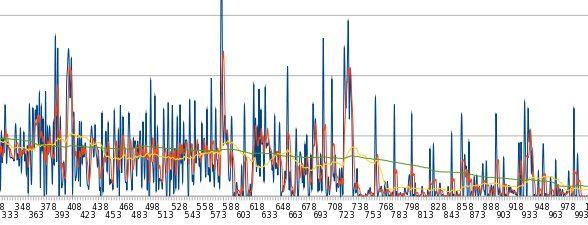
The question is - when should beagle start and stop indexing the latest file data ? I'm sure some algorithmic genius, such as Morten knows the answer; and/or if you play my disk activity backwards as audio: does it contains some hidden message: answers on the back of a post-card.
2008-06-10: Tuesday
- Still no baby, J. getting concerned: perhaps a good sign. Call from Robert, call from at-build wrt. a building quote (not to be confused with ooo-build). Started playing with banshee & filing bugs.
- Reflected on the parable of the wise & foolish builders in light of Lake Delton.
- Federico pointed out that my cross-thread GObject construction race is actually a live bug, and I'm being a dofus since the apparent fix was included & in-effective; re-filed & started to chase.
- TimJ nailed it from my repeatable test, and pointed out an interesting paper The Problem with Threads:
I conjecture that most multi-threaded general-purpose applications are, in fact, so full of concurrency bugs that as multi-core architectures become commonplace, these bugs will begin to show up as system failures. This scenario is bleak for computer vendors: their next generation of machines will become widely known as the ones on which many programs crash.
The solution is of course obvious: to give staggering amounts of highly parallel beefy hardware to an infinite number of free-software hackers. Failing that, CPU vendors could do a lot worse than invest a fortune in Julian's helgrind thread checker. - Lunch. Worked on some somewhat less interesting analysis task. Read the recent Ray Ozzie (transcript - sorry .doc: "really understanding the importance of interoperability") take on Open Source - that it is "potentially much more disruptive than Google". I couldn't agree more, particularly vs. an over-emphasis on open-standards (that allow proprietary software to interoperate) at the expense of open-source innovation. I take issue with this chasing the tail-lights meme I hear in several places: it's total rubbish, at least when applied to open-source. Yes we can, and yes we should do it: would the GNU project exist if someone hadn't been willing to chase some (very distant) tail-lights in persuit of freedom ? pre-emptive capitulation is just really silly.
- Dinner, worked late - call with JP, poked at beagle's I/O usage a bit. Tried to build a new set of dri pieces for the latest radeonhd: stymied.
2008-06-09: Monday
- Cycled H. to school - lovely day, getting slightly fitter against the odds. Still no baby - Anne (the midwife) around to inquire as to where it has got to - inconclusive.
- Poked mail. Thrilled to find that between me seeing the critical yast2-gtk installer bug on Friday, and Monday morning - Ricardo fixed it and Coolo packaged it: nice. Also, Ricardo implemented a beautiful map based timezone selector widget to match Qt, though it'll miss 11.0.
- Set too trying to reproduce and file a number of bugs. Caught nautilus synchronously statting bookmarks on every new window - which is really bad with stale NFS mounts.
- Lunch; managed to reproduce an evil GTheme warning bug I've been trying to catch for some weeks now - only to discover it was a race in GObject class initialization that Tim just fixed, hey ho: down to zero inexplicable-and-scary bugs to track. Discovered that the latest banshee is available as 'banshee-1' instead of 'banshee' in OpenSUSE: nice.
- Amused by the latest NetworkManager feature interacting with my eponymous wireless network:

- Pizza for dinner, played with the children in the garden, bed; back to work for a bit.
2008-06-08: Sunday
- Lie in, off to an outreach thing ont the council estate near the churc: bouncy castle, free hot-dogs, cakes & drinks - Pete doing a storming job in some goal-shooting game; fun in the sun.
- Home, babes to bed - played "hang-man" in the garden with Hannah, seemingly 3 letter words are hard to beat, or just obscure ones: "coccyx" a personal favorite. Woked the babes up - very unhappy & sleepy.
- Interesting chat with Heather about prayer for Israel: which of course, has to be a good thing in itself. It's always interesting to me - the several steps in the chain from a solid faith in Christ, to eschatological views I can understand but don't share, to the leap that we should (somehow) be actively involved in ensuring prophecy is fulfilled (God is surely strong enough to accomplish this himself), and yet further to almost unqualified support for evil done to fulfill some people's idea of what God said will happen. For me, it is sad to see those who should yearn to act justly and to love mercy, and to walk humbly with their God end up twisted in knots by speculative theology, and apparently going in a different direction.
- Play, tea, bath, bed. Fine Gordon sermon He Built an Altar on Genesis 12. Some fascinating insights.
- The altar as an analog of Kuduru stones - marking out land as belonging to various people - erected by kings almost like a title deed. Indeed, 'altars' being created not always to sacrifice on but apparently for a similar purpose.
- The radical difference in the Israelite altar vs. pagan ones: worshiping the God 'who is', built very simply with un-dressed stones: with the maker's marks un-blemished by man's. cf. the law of the altar: Ex 20 either just earth for sacrifices, or un-dressed stones.
- God's ultimate ownership of everything, as soverign - whether palestine, England, or our lives: Abraham's confession of himself as God's own: calling on the name of the Lord.
2008-06-07: Saturday.
- Off to the market with the babes in the rain; back - bought new pair of Opterons - that will hopefully work in my motherboard, and have a power save mode (as well as being faster); hopefully will save the world, and some fan noise.
- Finally got downstairs connected to up-stairs via ethernet. Lunch - pork spare ribs: unexpectedly good. More teaching of small children to balance on bicycles, scooters etc. in the light drizzle.
- Watched Howel's Moving Castle again with the babes in the afternoon; hopefully they understood just a bit more. Tea, lightning shower for children, put them to bed; poked mail briefly.
2008-06-06: Friday
- Up early, tried to file Xen bugs, but got side-tracked by a cracking memory leak in nautilus: apparently piling up (26Mb) of duplicate status bar messages on the (invisible) desktop window status-bar; in parallel with finally being able to repeat the "package updating the theme / icon cache crashes firefox" (seemingly a GtkPlug issue), hopefully all the detours result in a far better OpenSUSE 11.0.
- Filed many virt-manager bugs; that beastie needs some usability love. Long lunch break to make up for last night - picked up H. from school, chatted with Janine & watched her boys play. Call with Patrick. Discovered the
ftwglibc call - I wonder how efficient it's I/O is.
2008-06-05: Thursday
- Poked mail, quick call with Alex, dug at the kernel some more. Call with Jo, filed some more bugs. Sadly yesterday's Xen install failed to boot, tried again and finally had some joy with OS11.0 RC1 on some more hardware: perhaps my Core/Duo is the problem. More installing & bug filing joy.
- Lunch. Back - to discover amazing mails being filtered out of my inbox; set too debugging filters with a helpful tip from Andre. Hideous - discovered Evo had been putting all mail with RE in the subject in some stupid place. Discovered a load of mail I apparently lost: bother: it seems "Filter on Subject" with a certain [subject] RE: foo - can give a seriously unhelpful filter. Started re-reading mail from 27th Feb.
- Kelli's staff. Poked NCC to buy some more RAM for an elderly, but still much loved AMD64 Opteron machine (circa 2004). Worked rather late, encouraging call with Calvin.
2008-06-04: Wednesday
- Poked at bugs, good to see Federico's fixes for my two file-selector issues. Got a lot of nice structural drawings in the post from Charles Tallack - soon there will be steelwork everywhere it seems: amazing what can be done with a few 10cm steel joists.
- Tried to find a working E-mail address for someone and failed: the second instance in two days - blog entries everywhere, photos, etc. but no (functioning) address: how irritating - I imagine an increasingly common problem - you can find people's detailed accounts of dental flossing, but not how to mail them.
- Lunch with Lydia. Buried under FATE mail from Guy. Annoyingly it seems emacs wedges pretty hard when a11y is turned on under GNOME - why ? last I looked stack-traces from emacs were not friendly. Managed to get further with virt-manager/xen than ever before - looking nice; read some of xenner.
- Found & chased a nasty crasher in OO.o's png loader - why do we have custom PNG loading code in OO.o instead of using libpng ? perhaps quicker than the Sun/legal paperwork to get libpng included, but certainly buggier ?
- Cell group in the evening, only Simon & Lydia, good fun though.
2008-06-03: Tuesday
- Up; poked at mail etc. Extremely pleased to see Nat's pet project (SUSE Studio) get announced publicly for the first time at LinuxTag. There is some minimal screencast (NB. it takes some time to load in the popup). As you expect from the Friedman Franchise, it's extremely cool: if you build virtual appliances, you'll be wanting to sign up to have a play. Conversely if you just havn't got into this whole virtualisation thing, now is a good time to start - made easy for you by:

- Chat with Alex - who has an exciting plan around KVM & Xenner. Filed my clock time set fix; dug at strange firefox / theme change crasher issue. Found, analysed & filed a nasty file-selector crasher for Federico; Lunch. Dunged out some longer term bugs, core team meeting.
- Poked at a11y for tools running as root; apparently there is no good way to do this securely. Probably the best approach is for the root runnign tool to detect the user account for which it is running, and create it's sockets in /tmp/orbit-$USER for them - with relevant permissions. Currently connecting to the registryd works fine, but getting ORCA to connect back doesn't.
- Watched Howl's Moving Castle again, some great artwork - admiring the castle (built by a daemon) - it's tempting to make comparisons with various pieces of software. There are some suspiciously over-engineered guns poking out everywhere, as everywhere in the fine parody of an over-militarised society.
2008-06-02: Monday
- Baby due today - lets see if it arrives. Poked mail, filed bugs, started RC1 installation. Unfeasibly pleased to discover the compiz wall plugin: to feed my need for fast, multiple desktops: pretty. Worked on slide-ware and older mail.
- Lunch; call with Nirav, poked idly at various bugs. Dinner with the babelets, bath & put them to bed. Back for conf-call.
2008-06-01: Sunday
- Up lateish, off to church: John spoke well on Romans; Jim Gilbert showed a rather neat albeit short short of SM Lockridge's Thats My King, good stuff.
- Back, watched a fun Japanese cartoon / film with the kids from DT & Zoe. Diary sync, prepped more quote requests for local builders. Hannah's birthday party invites created, long call with the parents, then Robert.
2008-05-31: Saturday
- Off to the market, shopping; home - back to bed. Up, lunch, out with N. & M. to the playground while H. went to Keziah's party. More cycling practice in the afternoon, some useful slugging.
2008-05-30: Friday
- Cooked breakfast; more practice with H. - now getting remarkably good at balancing - counting her progress in paces of un-interrupted bicycle free-wheeling.
- Packed, and drove home; more practice in the street - discovered the brake chaffing the (somewhat bent) front wheel, and fixing this doubled H.'s best-distance to 70+ paces: nice.
- DVD for the children, combined with efforts to write a covering letter describing the building work we want done; failed. J. out baby-sitting, and got back to it - alternating with E-mail and so on.
2008-05-29: Thursday
- Breakfast; off into Aldeburgh to wander through the town. Traditional admiration of the RNLI life boat. Back - spent a fun time helping H. learn to steer a bike & balance herself - with a suitably de-pedalled children's bike from the local tip: 3 for a pound. Great time.
- Lunch, more balance training (in the rain) after lunch; poked mail.
2008-05-28: Wednesday
- Poked mail quickly, some debugging fun with Rodrigo. Curious about the AMD 780 radeonhd work; I updated my git repo and was unfeasibly pleased to see the 3D / DRI work by Matthias Hopf starting to appear there.
- Found gbookmarkfile doing a thousand or so time() syscalls for no reason while digging through strace code. Poked at gvim - which appears to provoke compiz into doing it's window-selection effect: XWarpPointer is even more harmful than I thought, as you see in this gvim KWin 3.1 workaround.
- Lunch, some more work; dropped Rodrigo at the train station. Poked at pulseaudio a little. Filed and isolated a silly in the PolicyKit adjust date dialog; filed GL transition crasher, tried to create a simple test-case to make gdb misbehave even with debuginfo symbols.
- Set off for Aldeburgh with the family for a break; got the children into bed; fine dinner.
2008-05-27: Tuesday
- Up early, breakfast - disappeared up-stairs with Rodrigo for some mail processing. Poked at super-irritating pulseaudio glitch-fest on my oldest, slowest machine - stracing the daemon we see that it's waking up 5x per second (or so) and some rather unfortunately long poll response times: eg.
1211970599.543457 poll({snip fd details}], 14, 186) = 1 1211970599.543928 gettimeofday({1211970599, 544334}, NULL) = 0ie. we ask to sleep for 186us, and we get control back to call gettimeofday 471us later. Of course, quite why we are waking up -so- frequently, and reading ~20 bytes of samples, and going back to sleep for such a short time is unclear to me; 260 poll / recvmsg's per second - just to play a mp3; odd. Could it be that this is the solution ? Unfortunately esd works (apparently) perfectly on the same machine at a much more sedate 14 2k reads per second instead. - Hit upon a nice e-d-s crasher. Wrestled with memos, and got some sent in the end, and the web tool setup for vacation Thur/Fri. Lunch. Call with Jeff, interview.
- Hacked with Rodrigo on misc. bugs. Out for Dinner with Rodrigo & his sister Eva's family - pleasant; bed late.
2008-05-26: Monday
- National holiday. Lie in, took N. out for a treat with her Father: went to Ely, wandered around the Cathedral, had 'chips' for lunch at a local pub. Back to a playground in the grounds, and thence home.
- N. sickening on return home - perhaps too much wandering in the rain. Set too getting the new phone extension wired up, the conduit fitted, network connection point wired etc. A fair degree of success.
- Dinner, bed early; up to fetch Rodrigo from Stanstead rather late, returned home; bed again.
2008-05-25: Sunday
- Mini lie-in for J. extreme potatoe & carrot peeling action. Off to NCC - DT speaking for the first time: caught some good stuff from the creche.
- Home for lunch with Elisabeth, Josh sadly flying, fine chicken crock pot; talked and played with the children for some time; watched Madeline.
- Dinner, Martin, DT & Zoe around to watch I am Legend in the evening: a surprisingly good film. Bed late.
2008-05-24: Saturday
- Up lateish; into town with N. to do the shopping variously. Lunch; out to Mepal Outdoor Centre - for assorted play-ground, climbing fun. Lots of child near-submergal experiences in the 1 metre deep ball-pool: quite fun.
2008-05-23: Friday
- SUSE rock-star Michael Matz made my whole month with his three line gdb patch to make debugging un-instrumented x86 binaries work again; nice.
- Gave up on hoping that Gnome would serve my blog sanely - apparently asking for it is a denial of service attack. Duplicated it at
http://www.go-oo.org/~michael/blog/index.atom. - To further confirm Michael Matz is my hero - I did a comparison of OO.o debugging. OO.o is interesting because the debuginfo package you need is 275Mb small - but of course, you actually need rather more than that: the glib debuginfo package and various other pieces. Here is the trace before the patch:
(gdb) bt #0 0xffffe430 in __kernel_vsyscall () #1 0xb6eb21d7 in *__GI___poll (fds=0x8641990, nfds=6, timeout=599) at ../sysdeps/unix/sysv/linux/poll.c:87 #2 0xb554f6f2 in ?? () from /usr/lib/libglib-2.0.so.0 #3 0x08641990 in ?? () #4 0x00000006 in ?? () #5 0x00000257 in ?? () #6 0x08641990 in ?? () #7 0x00000006 in ?? () #8 0x00000000 in ?? ()
And afterwards:(gdb) bt #0 0xffffe430 in __kernel_vsyscall () #1 0xb6eb21d7 in *__GI___poll (fds=0x8641990, nfds=6, timeout=599) at ../sysdeps/unix/sysv/linux/poll.c:87 #2 0xb554f6f2 in ?? () from /usr/lib/libglib-2.0.so.0 #3 0xb554f9d8 in g_main_context_iteration () from /usr/lib/libglib-2.0.so.0 #4 0xb5b3d68d in ?? () from /usr/lib/ooo-2.0/program/libvclplug_gtk680li.so #5 0xb54f4751 in X11SalInstance::Yield () from /usr/lib/ooo-2.0/program/libvclplug_gen680li.so #6 0xb7e06cf1 in Application::Yield () from /usr/lib/ooo-2.0/program/libvcl680li.so #7 0xb7e06d3f in Application::Execute () from /usr/lib/ooo-2.0/program/libvcl680li.so #8 0x08071c53 in desktop::Desktop::Main () #9 0xb7e0a27e in ?? () from /usr/lib/ooo-2.0/program/libvcl680li.so #10 0xb7e0a41a in SVMain () from /usr/lib/ooo-2.0/program/libvcl680li.so #11 0x08066c60 in main ()
Save your download bandwidth quota (and the planet too) by grabbing a new gdb for your OpenSUSE 11.0 from here. - Discovered & filed a juicy gcc -Os crasher. Lunch - Tina and children visiting, good to meet her. Back to work, mail to chew. Finally got around to writing up some of my thoughts on how to make the OO.o Community Council more relevant, representative and frankly interesting to people, that Louis asked for; posted for discussion, though missing the drawings. Call with Kelli.
2008-05-22: Thursday
- Poked at mail, waded through bugzilla entries - filing bugs certainly creates lots of work. Apparently USB died on my machine, the hardware flaked which is interesting & unusual. Made some floppy disks to flash the BIOS just in case that helps - brought back some heady memories of using Linux for the first time. I should really build a VM with the DOS games we wrote back in the day in assembler.
- The Microsoft announcement that they will natively support ODF is at some level encouraging. And better - MS will join the ODF TC and contribute: which could be really interesting (be careful what you wish for). Of course this may end up being really good for ODF: it all depends if the blatant psuedo-technical competitive marketing continues in the (already dysfunctional) TC context. We'll at least see if all those who kept chanting:
"MS should build the extensions they need for interop on top of ODF"
were actually sincere, or whether they now switch to an equally shrill albeit contradictory:"They are evily embracing and extending our standard"
Given the feature sub-set problem in ODF, can you have the embrace without the extend ? Of course, it is possible that MS (unlike Novell) have no real interest in improving the serious inadequacies around interop. in ODF, in which case their customers will just get upset:"why does my document look different when I save as ODF, and re-load it in Word"
Can you imagine the synthetic outrage that either of these will generate ? Then again, perhaps they will want to improve interop. in the standard, at which point we will inevitably quickly hit the:
or even
"Why, when I select ODF mode, do so many features disappear in the UI""This can't go into the standard because there is no implementation in OO.o [or perhaps the more sophisticated 'multiple implementations']"
type argument, or will that be waived - in which case we will hit the:"OO.o can't load & render it's native file format"
chestnut - which of course has always been true of KOffice's ODF use and which we keep hearing re-iterated in various forms about Office 12 and OpenXML. Anyway - at the end of whatever "pick your own fight" session we're in for, when all the dazed, confused and exhausted pundits grind to a halt there are perhaps two lessons that will become obvious here:- Oh what a tangled web we weave when first we practice to decieve
- Open Standards are good but Free software is far better.
- Woke Florian up, while he was on vacation: drat, should have known he would travel to some exotic spot. FreeDos fails to boot on the hardware on which I need to flash the BIOS. Whence, a working DOS boot CD ? finally found a dusty floppy that worked, flashed the BIOS & USB returns: amazing.
- Lunch, back - a deadlock in b-a-s: drat; debugged it; it turned out to be an horribly evil nasty - when do you avoid emitting 'broken' callbacks in the mainloop when a connection dies.
- Various conf-calls in the evening - found an extraordinary busy-loop in gnome-keyring-daemon, apparently burning up ten+ seconds during login: not ideal.
2008-05-21: Wednesday
- Started trying to debug the non-booting / kernel panic of my AMD64 machine: most odd - played with install and remove of packages: still some odd things going on there. Tried to track down an intermittent firefox crash in valgrind: with no joy. Filed a broken USB issue (hmm) - tried the latest kotd: still no USB, not good.
- Lunch, Lydia around. Poked #sysadmins about my strange blog woes, good to see Jeff again. Interesting that
www.gnome.organswers replies to queries rather differently depending on where they come from (apparently) - some people just get ECONNRESET almost immediately (perhaps a firewall issue). Of course, wget works from everywhere - here is the query it does:GET /~michael/blog/index.atom HTTP/1.0 User-Agent: Wget/1.11.1 Accept: */* Host: www.gnome.org Connection: Keep-Alive
vs. the query the uber-powerful (etc.) feedparser code does (apparently due to some fun charset love:GET /~michael/blog/index.atom HTTP/1.0 Host: www.gnome.org A-im: feed Accept-encoding: gzip, deflate Accept: application/atom+xml,application/rdf+xml,application/rss+xml,application/x-netcdf,application/xml;q=0.9,text/xml;q=0.2,*/*;q=0.1 User-agent: Planet go-oo +http://planet.go-oo.org/ Planet/2.0 +http://www.planetplanet.org UniversalFeedParser/4.1 +http://feedparser.org/
Presumably the latter looks like a DDOS attack, but only from some IPs (perhaps go-oo.org has a dodgy 2nd hand Russian-Mafia-style IP address). - Pondered LXF column. Kendy produced a lovely patch to reduce the N^2 statting stupidity in OO.o trying to find java at OO.o startup I was moaning about - should more than halve OO.o startup time in a virtualised world.
- Out into Cambridge by bus to meet Christian & Rob at the Cambridge Camra beer festival. Unexpectedly met an old acquaintance Christian Ashby outside, also Simon Kelso, then tons of people inside: Steve Macintyre, Andrew Haley, Matthew Garret, Ben, and lots of fun people from Amino and SolarFlare; with more random acquaintances: Keith Cooper & Alan. Apparently Cambridge has a higher density of cool kids than most places it seems.
2008-05-20: Tuesday
- Poked mail variously. Installed SUSE Linux 10.0 in a virtual machine, to play with it's gdb a bit; poked Clarity for last week.
- Migrated my blog to PyBlosxom and all entries back to 1999 - helped by the obscenely simple format. Hacked the python a little to reduce bloatage & synched. Hopefully that decisively fixes the permalinkage problem.
- Got a better trace from gdb in 10.0 and updated bug. Lunch. Called to school to pick up H. - no water at the school, somehow managed to get involved with trouble-shooting the cause of the problem, examining the (empty) tanks on the roof, and so on; interesting albeit inconclusive.
- OO.o team meeting. Spent a while chasing some nasty problem with gstreamer targetting esd (when no esd is available) inside Pidgin. Found & nailed it.
2008-05-19: Monday
- Cycled H. to school. Poked at OS11.0 bugs. Downloaded the latest Lenovo bootable-CD BIOS update for my T60p - sadly it didn't seem to like the idea of multiple browser windows - and managed to popup download bits elsewhere. Merged nice yast-gtk patch from Sanford Amstrong to make the package manager more intuitive.
- Lunch, call with JP, chased extraordinary xkb/libxklavier keyboard problems at length, and still fruitlessly; drat. Back-ported ORBit2 fix.
2008-05-18: Sunday
- Dealt with babes while J. slept; packed the car, set off to Princes Risborogh for Adam Mark Hawkins (my 1st nephew)'s Christening. Lots of family & friends, great to see them all - happened in the tiny church across the lane; next to JK's mansion: good service even for the paedobaptistically unconvinced.
- Back for a lovely garden party - fine food, good company - caught up with all and sundry; lovely sunny day - played in the river - acclimatised N. to dogs (reduced the shrieking problem a little). Played badmington, talked about engineering design of JCBs etc. a fine time.
2008-05-17: Saturday
- Attempted lie-in; more wallowing under the floor getting the phone cable routed correctly. Amazingly - the cable that was jammed under the floor last week came free immediately this week: creep (or something). Managed to get it routed to almost where it needs to be; ~just too short for a beautiful job sadly.
- J. made fine chocolate cakes with H. & N. (complete with rather sweet chef's hat for N.). Out to Bury St. Edmonds for a swimming bonanza: complete with slide & Pirate ship. M. finally found her confidence in the water - and turned into an un-stoppable repeat slider. Great fun.
- Back, jacker pots, bed.
2008-05-16: Friday
- Couldn't sleep, up rather early, poked mail - bits of hacking.
- Amused by the metasploit motivational posters. Quick chat with the evo guys, read some code. More bug mail thrash. Pleased to measure oowriter launching in ~500ms (according to the RTL_LOGFILE timing debug in the main binary), at least wall-clock time of oowriter is around ~1 second for me in factory.
- Prodded my gdb bug again; why should prologue analysis be necessary to walk the %ebp chain ? valgrind manages to do a great job here in the same test case.
- Knocked off early. J. out to Laura's party - back to work for a bit. Dug at a really strange xkb / libxklavier bug: most amazing, still no progress on it.
2008-05-15: Thursday
- H. sick in the morning, J. to doctors; poked mail - pleased to see Ricardo's nice yast2-gtk fixes landing. Finally realised that the Debian / Ubuntu security hole affects us too - we work with Debian-ites and allow people with their keys to connectt to our systems. That makes it less funny - also (I guess encouragingly) GNOME SVN is unavailable while the situation is unwound: it'd have been nice to find some easy-to-use "strong key checker" to quickly run over lots of public keys to disable broken ones.
- Finally annoyed enough to create a cut-down test case for the gdb back-tracing inadequacies experienced over the last months - wrt. it giving up prematurely in various ways - filed it.
- More code reading; finished J's tax return with her, worked late. Spent a while poking at PyBlosxom - looks pleasant, and I should be able to migrate the last ~decade of blog entries into it (I hope); we can't have Dave complaining my musings are hard to link to.
2008-05-14: Wednesday
- Turned to valgrinding for my strange X kb problem; poked the X server, found a few trivial things. Lost a chunk of time when xorg-x11-driver-input.spec deleted all of
/usr/src/packages/BUILDand then unpacked SOURCES/*.tar.bz2 poked Stefan & Petr. - Off into Cambridge to visit consultant; traffic amazingly bad.
- Bathed babes, wife sniffed out a problem with N. cell group in the evening.
2008-05-13: Tuesday
- J's hips playing up - the effort of lugging around a baby for too long; dropped H. at school for her. Prodded mail. Dug around at yast2-gtk yet more, fixed a number of strange sizing issues.
- Lunch; OO.o team meeting, call with JP. Poked at OpenSolaris again: this time a race to boot; both virtualised in KVM, on the same hardware, running similar desktop software: Gnome. OpenSUSE 11.0 boots to a fully logged in desktop on 1 CPU in 56 secs while in parallel OpenSolaris takes 89 seconds to get only to gdm. Allowing for an extra 12sec cold login experience on opensolaris, it's around half the speed of linux. Clearly this is not yet optimised for desktop-size-memory, single-CPU machines: but no surprises there.
2008-05-12: Monday
- Cycled H. to school; poked at mail - delved into autobuild. Fixed a couple of rather critical yast2 bugs, Rodrigo kindly volunteered to add them to autobuild.
- Looked at reports of poor performance on OO.o startup; finally found an area where strace makes a noticeable difference to performance:
javaldx. The purpose of javaldx is to (cunningly) grope your system - to look for performance-enhancing java goodness: here are some stats:
Of course, we like to re-stat the same place a good few times, presumably we don't trust the kernel that much: 51k stats ofsyscalls 182000 of which lstat64's 161000 normal (warm) start 0.74 secs under strace 11.7 secs strace log size 17Mb /usr, 14k of/usr/lib, 13k of/homeetc. sigh. Perhaps the frenzy is just revenge for not having any java on the live-CD system. - Chased my nautilus (non) re-thumbnailing issue a little. Wrote an ical scrubbing script, and sent calendar data off to Federico; more bug pokeage.
- Booted opensolaris in KVM (eventually) - though it was clearly not a happy operating-system with only 512Mb of virtual RAM; despite having ~the whole live-CD in Linux' page-cache. Tried to get to the root account: no
sudo;su -prompts for a non-obvious password; interestingly vs. openSUSE's 11.0' LiveCD there is no OpenOffice included; odd. Interesting to poke at baobab to see the size breakdown of the live-cd - odd to have 130Mb of fonts included, and nothing much to use them; Solaris suffers from the gconf.xml.defaults malaise too - of ramming tons of translations into a single file: when will the world stop doing this: 50Mb of irrelevance ? - Deciced to race the install in with an identical VM with openSUSE (1 CPU each) - apparently both do an image copy. Started openSUSE at 67% of opensolaris, got bored enough that when I came back at 84% of opensolaris, OS11.0 install was long finished, re-booted & did the post-install setup; overall OpenSUSE at least 3x faster to install, prolly more. Unfortunately, having not created a user account, and given a blank root password - I can't log in; hey ho. Persuaded to file my opensolaris bugs - at least they run a recent version of bugzilla there, in contrast to OO.o.
2008-05-11: Sunday
- Up lateish, off to NCC Tony spoke, continuing the Romans series. Back, lunch, babes to sleep. Off to Pete & Shelley's in the afternoon to train their new puppy in the ways of children, and visit the menagerie of farmyard animals at their home; much fun - except for N. whose irrational terror of animals continues. Gordon sermon in the evening on the covenant in Genesis 15.
2008-05-10: Saturday
- Up early, off to the market; J. out to pregnancy crisis centre. Spent much of the morning & until late in the evening fitting conduit, and trying to get networking cable routed via an impossibly twisty route from under the downstairs floor to the loft. Eventually achieved it - helped by the old decaying rubber power cables left under the floor providing a way to thread new cables round rather easily.
2008-05-09: Friday
- Up, prepped babes for (pre-)school; recovered my x86_64 RAID setup; good; poked at and filed Noel's gcc buglet with test case. Managed (by swapping disks variously) to get 11.0 Beta2 installed on the system whose only chance of boot media is a floppy disk: looking good there too.
- Lunch, Bruce & Anne around - lovely to see them, back from Paris. Nailed three nasty yast2-gtk bugs. Poked at Chentil's nice catch for an allocation bug in g_base64_decode, fixes my evolution / groupwise bug.
2008-05-08: Thursday
- Awoke in the morning, to discover a crushed mouse in the "better mousetrap", the part-time vegan (have to one-up Miguel) in me not inconsiderably upset by this; binned it.
- To work, phone call with Noel - who has isolated a most interesting 64bit compiler bug afflicting the OO.o test-tool: nice. Dug at mail. Filed bugs, played with Soeren's display properties capplet, and was unfeasibly pleased to see it working so nicely.
- Amused by Philip's extraordinary analysis of BS 1363 as Wikipedia says This plug is often described as the safest in the world. What is meant by this concern for static electricity is quite unclear to me; by design (as is common), the earth pin is connected before the live & neutral pins are so the device casing is earthed: ie. it should not be possible to have a device (even with a live -> earth fault) whose casing is live & un-earthed. Consequently - you can touch the earth pin as much as you like (or drop tin foil on it or whatever) and if you get a static shock - this is because you have a nylon carpet you were just shuffling about on: you would get the same effect from the tap, a lamp-post, or well anything good earth.
- Call with Florian, lunch with Lydia. Booted the Gnome Live-CD on x86_64 - looks beautiful, configured my awkward monitor correctly too: nice. Did the install with yast-ncurses to avoid the now fixed yast2-gtk live installer bug.
- Chased nasty nautilus bug a bit; played with the babes; conference call with Greg & crew on the OSRB - interesting. Installed all the good stuff onto the x86_64 live CD install system: the joy of zypper etc.
2008-05-07: Wednesday
- Cycled H. to school. Sucked into bug mail somehow, ended up debugging evolution, ended up improving some debugging code in ORBit2, and chasing the problem a little further at least. Nice to see Ray fixing bonobo-activation lifecycle issues.
- Lunch, knocked up a quick pattern lint tool for coolo to help avoid future factory breakage with broken patterns. Phoned letting agent to why 2007 was missing a month - Lizzy to investigate.
- Enlightening call about artwork with Jakub and Garret, fixed nasty yast2 gtk bug killing popups from the second stage of the installer.
- Cell group in the evening; back late. Lay in bed, admiring the wife, the ceiling, trying to sleep & that sort of thing Is that scratching noise you !? - discovered a mouse under the chaise-longue: cue sudden wifely exit & a most interesting bonding exercise: man with mouse - involving the ineffective persuit around the room of a tiny, fast (and remarkably sweet) little creature by a large, slow & clumsy me. Piled furniture on the bed to get a better view: confounded by it hiding under the edge of the carpet. Eventually lost it under the door into the rest of the house. Set traps, back to bed. It's comforting that it really preferred to scurry across the floor - perhaps the stereotypical women have the right idea standing on chairs to avoid them.
2008-05-06: Tuesday
- Up early, poked mail, chat with JP. Reflected on my love for nice lab manuals to write notes in during the day: I think the answer is laptop computers., most amusing.
- Tried to re-build
lzma-alpha-develanddeltarpmon my old server system to make an applydeltaiso that can operate on the new openSUSE ISOs: failed, bother. Time to upgrade that system to an upgradeable system. - Installed OS11.0 Beta2 on more hardware, filed more bugs - but looking rather good. Lunch. Spent a good while chasing a most irritating keyboard / keymap issue. Then another set of curious nasties around a strange gdm / gconf interaction, and more bugs - new betas are exciting.
- H. discovered a Bratz bag in a pile of second-hand (mostly) good-things we were passing on; bother - she appears insanely pleased with this grey bag with the apparently ugly & unpleasant girls tacked onto it.
2008-05-05: Monday
- May Bank Holiday (or Labour day) - thank God for organized labour, and that it doesn't strike on labour day (or something). Lie in. Hugh, Emma & Duncan from across the road around to play in the garden.
- Lunch, out to Reach Fair (now in it's 800th+ year) in the afternoon - fun rides, ice creams, etc. met up with Chris & Cheryl selling chocolates. Tea with Nick & Hannah (and Charlie & Tania), and myriad children. M. (under 2) did a stirling job of climbing the rope ladder into the tree-house: apparently insufficient fear.
- Back, did J.'s tax return in the evening.
2008-05-04: Sunday
- To NCC, Thea speaking on the assurance of salvation. Back for lunch; applied slugging for much of the afternoon - in the sun in the garden. Got the paddling pool out and inflated it (via. some parental hyper-ventilation).
- Finished The Midnight Folk good fun. Considered the evils of re-building half of the house down while living in the other half - pwrt. it's effect on network connectivity: searched the house for suitable places for new conduit to re-route phone & network: [ you can never have enough handy conduits ]. J. found a great location after a number of less fortunate suggestions.
2008-05-03: Saturday
- Up early, to the market - bought lots of good things; back. Babes to bed - set too filling up our inspection hole & tamping the earth down with a handy 4x2.
- Discovered some handy mortar there to throw on top. Lunch. Contemplated means of making handy blocks of tarmac more viscous: is J's best baking tray in the oven right ? would a naked flame be a good idea (for this block of ~crude oil & stones) ? no conclusion.
- Set too plumbing in the new water-butt: which has a cunning filling / overflowing mechanism requiring only one pipe: managed eventually to cut it into the adjacent down-pipe. Bed early.
2008-05-02: Friday
- Phoned Nildram to enquire how my line upgrade was going; apparently the wrong number & postcode conspired to produce the wrong results; interesting. Poked at mail & web bits.
- Call with Florian, Lunch. Call with JP, chat with Jon. Fun call with Kelli, it's been too long, call with Jacob.
2008-05-01: Thursday
- Bummed around much of the day writing text, dropped another three meetings, nice - played around with Xen a bit: seems like a great way to wedge your whole machine: but I can do that more simply with cat /dev/random > /proc/kmem. If only KVM worked on my hardware. Then again could we not with a hack to 'as' insert hooks for all the trap-able instructions as we compile the kernel - and get a fully para-virtualised KVM ? (ignorance is bliss).
- Various meetings, call with Hub, Guy, Kelli, missed Ralf etc. Parents arrived for a while in the evening
2008-04-30: Wednesday
- Cycled H. to school. Dug at bugs. Call wiht Vincent, fixed the SmsGenerateClientID calls in gnome-session - trivial patch, Vincent kindly auto-buildified it: why spend minutes (on aggregate) generating random numbers, when you can do it ~instantly instead ?
- Magnus pointed out that it was not clear that I have been for some month or so the Linux Desktop Architect at Novell (with a special OpenOffice interest) - hopefully it is now clear: what it means though, if anything is another matter. Clearly filling the inimitable Robert Love's shoes will be difficult.
- Worked on a couple of papers, filed misc. bugs etc. Discovered pop.ximian.com has returned: with 51k un-read mails (mostly spam no doubt); interesting. More bug work.
- Lunch with Lydia then OO.o team meeting. Massaged some web bits with Jon. More bug filing, commenting etc. Poked at Clarity - back-filled my timesheets with sensible-ish data.
- Cell group in the evening, dropped 1 meeting.
2008-04-29: Tuesday
- Poked at mail. Amazed to discover that setting up the machine with a non-resolving hostname is apparently a non-bug; despite the appalling symptoms of timeout-ness that it brings. Dug at reducing the worst breakage here, it seems SmsGenerateClientID cause serious grief when the networking is broken - of course, even starting an interactive shell also takes serious time in such a situation, urgh.
- Poked at the sabayon login performance problem I'm seeing, submitted a fix. Back to back conference calls. Call with Dave, on to evolution bug filing, built the latest gnome-2-22 packages to try to isolate the bug. Call with Radek, Kendy & Jon.
- Spent the evening with slices of the wife - between lengthy incoming phone calls for her; started The Box of Delights in the not-horribly-abridged version: wow, the book not only makes more sense, but is far better too.
2008-04-28: Monday
- Cycled H. to school, mail shovelling. Most interesting mail from Michael Wolf on the garment-ISBN idea:
- Apparently clothier's don't like the idea: clearly fewer garments might be bought if there were fewer simpler models, or clear "most popular, hard-wearing, 10-million sold" type designs.
- Having said that, if I could easily buy an identical copy of my shoes-that-fit and-don't-look-impossible-lame I would pay a premium, if only to avoid the existing hole in the sole problem. But I'd need to be certain it was an identical copy.
- Ultimately my problem is not a lack of willingness to buy new clothes - simply an appalling level of frustration at the body-shape-warping field that appears to exist in clothes shops: such that what fits inside, doesn't outside. Sitting in a chair inside eg. is comfortable - but as you sit down to drive your car home - your reproductive chances are instantly crippled: why ?
- Similarly shoes - when (apparently) by random you strike on something that actually fits, and doesn't look impossibly incongruous: it would be wonderful to be able to order an indefinite line of replacement. The alternative of course is to always buy garments 10 at a time, which beside the expense is inevitably going to suffer from scarcity: only 2 on the rack, or quality - why did I buy 10 when they wear out after only 6 months ?
- Then of course there is the time - no doubt there are hordes of men (secure in their sexuality), who simply love the tactile experience of pushing through odiferous, heaving hordes of people, queueing, caressing canvas, tweaking tweed etc. and who willing spend hours finding a new pair of shoes that actually fit (nevermind being reasonably priced): however I am not among this group - I like to spend my weekends relaxing with the family.
- More mail & bugs. Chat with Keith Curtis - dug into a most curious configmgr bug. Most amused by The Justice Diet.
- Interestingly, Don Smith pointed me at Leapfrog IP which might help solve my clothing woes one day, but looks a bit far out.
- Fixed some bugs for Martin, and released a new iogrind-0.0.3 (with Sankar's pre-warming work).
2008-04-27: Sunday
- Off to NCC, leaving J. at home to look after a sick M. Did creche, home again - bummed about - mostly with M. sleeping / sogging on me. Got the new DVD machine setup, Mole & Cinderealla DVDs for the children.
- Martin, Simon, DT & Zoe over in the evening to watch the final Return of the King movie in the evening - the super, mega extra extended version: loong, but good. Bed late.
2008-04-26: Saturday
- Up early, into town to the market & on a shopping spree. Lovely to see a mother hen & beautiful baby chicks at a stall in the market (where we buy our free-range eggs) - a wonderful picture of tender care & protection as the chicks bury themselves under their mother's wings.
- On to Currys to buy a DVD player - pleased to see they are running OpenOffice on Win32 on all their point-of-sale machines: saddened to see (from the splash) it's (up-stream) OO.o 1.0 - and calc crashes on start. Interesting to notice their POS vertical app is Java / Eclipse.
- Back, Charles Tallack structural engineer, arrived to examine our existing loft conversion & work out how to make our extension structurally sound: an interesting problem it seems. Nice to be able to discuss static indeterminacy, hogging, vaulting, bending moments & so on once again. Pleased to discover that the wall I thought was cinder/fluff is actually brick supporting the center of the floor. Amused to hear of a lady knocking through her entire ground floor - at a cost of UKP 270k Everything must be knocked through !.
- Jane & Lilly popped over to play with the girls, James & Kate came for tea & we managed, once again, to stay up exceedingly late without either noticing, or covering much of what we meant to speak about: still very unconvinced wrt. the non-existence of nation states before C18.
- James gave a great pointer to Structured Procrastination:
At this point you may be asking, "How about the important tasks at the top of the list, that one never does?" Admittedly, there is a potential problem here.
As a perennial procrastinator, this is pure gold: the brief paper on perfectionsm, also invaluable: Philosophers' - who would be without them ?
2008-04-25: Friday
- Up in the night - dug at mail; hacked at a small test app for helgrind, and sent it to Julian, back to bed. Myriam had a temperature when it woke. It sat reading (the pictures) in a book & singing in it's own little way behind me while J. went to work: lovely.
- Pleased to see Kohei's nice work to make OO.o's structure more comprehensible for beginners, a sample wrt. calc:
and of course the monster odg file so far (YMMV - re-factoring bit-rots such things over time etc.) - Call with Florian. Ted wrote an interesting blog on OpenSolaris - a telling critique of trying to use "Open Source" as a veneer: As a tactical measure, astroturfing is certainly a valid marketing trick. But after three years, the excuse of "just you wait a little longer, we're just trying to figure this open source community stuff out", is starting to wear a little thin.. My experience suggests that if you care about creating an open (transparent, fair anyone?) & organic community there are a ton of structural and open-ness issues that have to be tackled head-on, that go far beyond simply including the word Open in your project name (or Joint, or Shared in your copyright assignment). Of course, if you're only interested in the marketing, not the software - then the status-quo probably works too. To be fair - the transition from closed to organic open-source is difficult, and Sun is a pioneer in the field, but it'd be nice to see even a little commitment to progress here: particularly for those who find hacking interesting.
- More testing of helgrind on factory - generated some updated glibc-2.8 suppressions, and sent off some debugging info for Julian. Finally got around to AIA votes, only to discover I missed the deadline - disorganisation hurts apparently - nevertheless I'm sure something sensible will happen.
- Had a go at Clarity the (scientologically?) correct way of tracking your daily work: though sadly no project for inter-toe fluff removal, so the numbers will be somewhat inaccurate.
- Interesting call with Roman Drahtmueller, sharp guy; he can even helpfully disentangle my incoherent & context-free ramblings. More document churn, call with Patrick.
2008-04-24: Thursday
- Up early, poked at Evolution - for some reason the latest builds are horribly dead-locky; call with Will & Vincent. Built my own evolution from gnome-2-22 in the end: works nicely.
- Filed expenses for a hour or so; good to get more drudgery out of the way. Poked Kelli, JP, Amy - time for some crazy hackery.
2008-04-23: Wednesday
- Cycled H. to school, poked the mail mound, filed bugs, ran
zypper dup- still unreasonably pleased by it's general sexiness, apparently born of long suffering. - Dodgy looking letter from Rodburghe debt collection: persuing the previous owner of our home - the trail is I suspect a little cold 3+ years after he moved out.
- Spent a while investigating a serial-port console to debug a hard lockup: only to discover I don't have a serial port - bother. Filed more bugs, and yet more, installed on more hardware.
- Surprised & pleased with the apparent, relative competence of the UK tax authorities - sending me a tax form - customised for me with only 3 boxes to fill in.
- Poked Guy, wrote verbiage for LXF. While digging for paperwork discovered a huge block of JCA forms, from my sadly horribly misguided Sign the JCA today campaigns of yester-year - hopefully they can be redeemed as new, non-evil drawing paper: with cryptic, colorful children's crayon drawings on the back. Call with Hubert.
- Dug briefly at packages sizes on the live CD, interesting.
2008-04-22: Tuesday
- To work, call with Alex, all manner of interesting things. Report writing, quick call with Jan wrt. layout, got a DEV300 build of OO.o going. Chat with Hubert. Call with Kelli's team until late.
- Out for dinner with the wifelet - the first time in ages: to celebrate our 6th Wedding Anniversary - clearly, I got a good deal: she's lovelier today than when I married her; to highlight the lack of justice in life: she got me. Fine Indian (Bangladeshi) meal.
2008-04-21: Monday
- Cycled H. to school; started on the mail. Spoke to Nildram to upgrade to an 8Mbit connection (from 2), hopefully that will feed my factory following habit more efficiently.
- Read more papers, pleased to see Quentin's DisplayLink looking so slick.
- Poked at OpenSUSE 11.0 Beta1, fixed the yast2 live installer buglet - some uninitialized thing, from an unusual wizard combinaton with another strange combo box behaviour tacked on. Looks good now.
- More digging in the evening, got to the bottom of the foundations around 2 feet down: interesting.
2008-04-20: Sunday
- Up early - wedding anniversary; off to Hertford Town Church to speak on 1 Cor 13. Back to Charles & Tania's for lunch, enjoyed their company for much of the afternoon, back, babes to bed, bed early again.
2008-04-19: Saturday
- Lie in, off to Bury St Edmonds - stocked up at the market; attempted to buy shoes: sigh. I would pay a substantial premium (15%+) if each of my items of clothing came with an ISBN-alike, with which (on the rare occasion that I buy something that is both comfortable and hard wearing), I could buy an identical duplicate at some later stage. Furthermore, I'm certain it'd be good for the environment, put a break on the pointlessly changing fashions of the world (currently apparently pointlessly pointy toes), and: unfortunately, I'm a S/W engineer not a retailer or I'd do it myself.
- Off to play in the Cathedral Gardens, lots of fun - albeit rather cold; home in the end, dinner, babes to bed, bed very early.
2008-04-18: Friday
- Net connection DOA; interesting, call with Naji, call with Jan B, more typing; diagrams, more typing, lunch. More bug massage, upgraded factory again - yet more fixes & improved packaging - really great to see
zypper dupworking so nicely. - John & Christine around for dinner - really good to get to know them a bit better, lovely couple.
2008-04-17: Thursday
- Poked mail, prodded bugs. The news appears increasingly surreal today - with part of the $1bn worth of MySQL moving in a closed-source direction, while questions as to Is Solaris truly open source make interesting reading: From what we can tell, the company [Sun] wants to exist by both fueling and then riding off community-based development. Which is not the exact same thing as community development itself, at least for fervent believers of the idea. Whether volunteer developers will rally around software still primarily associated with a single company remains to be seen ... (or not seen as the case may be). Then of course Google's Android appears to worry Sun execs: "Anything that creates a more diverse or fractured platform is not in (developers') best interests," said Rich Green, - apparently sublimely unaware that fragmentation may be a direct result of Sun's approach to 'open'source. "Android ... will be available as open source under a nonrestrictive license," Google said in a statement.. Echos from other places of the continued demand that all of OpenOffice.org be entirely Sun owned ?
- More bug testing in factory; amused to find & fix another trivial 2-line OO.o bug, breaking the gtk+ systray applet, as missed by the extra-onerous Sun CWS process. Prodded some web bits.
- Had fun chopping through some tarmac and digging an inspection hole to see what state the foundations are in along the side of the house. Amazed by how deep the sewer inspection hole is - 4feet or so: children suitably interested in the concept that their 'waste water' can be seen shortly afterwards passing the hole. Dug my own hole at a safe distance - 1foot down came to some concrete, left getting below that to another day.
- Call with Guy, Kelli's staff, call with Torsten Duwe. Dinner, back to work writing a paper.
2008-04-16: Wednesday
- Cycled H. to school, prodded mail, OPS architects call, call with Rodrigo, Will & Vincent. Lunch, call with DT. Poked at yast2-gtk, fixed some warnings, prodded Xen a little - installed SLED10 inside a VM: failed, filed bugs.
- Fixed a gio issue - a real joy to work on Gnome - identified the issue in the debugger, filed the patch, got review, tested it, commited to HEAD and gtk-2-16, all inside 10 minutes of work for a 1-line patch; a huge contrast to the pain of getting a similar change up-stream into OO.o.
- Cell group in the evening.
2008-04-15: Tuesday
- Up early, to work: noticed the first spam arriving in my calendar "VERY URGENT" indeed; sigh. More mail & bug pokeage, bug testing etc. Noticed that some packages have a -debuginfo and -debugsource separation now: neat, hopefully will help with OO.o debugging.
- Conf call with Brady, OO.o team meeting, conf call with Naji, DE meeting - a wipe-out of an afternoon. Tried to untangle a most interesting threading issue for people that close the ORBit2 'main thread' (needed for back-compatibility) - YaST2 likes to do all it's GUI work in a thread, except for the 'destroy all windows' at the end (apparently).
- Out for a run, played with babes, dinner, Gordon sermon on Genesis 12; sleep.
2008-04-14: Monday
- Up; cycled H. to school; started on the mail pile in earnest; filed misc. bugs. Great to see Steve Macintyre elected Debian Project Leader.
- Poked at scim login performance again (it's a huge CPU & disk hog for some strange reason [ perhaps the setlocale per-locale-ever-invented is to blame? ]), poked Mike about it.
- Ever more mail chewing - call with JP. Good to see both Caolan and Thorsten leaping around up in the air.
- Upgraded to the latest factory, filed bugs.
2008-04-13: Sunday
- Played with babes - M. not even distracted by her milk obsession from the paternal embrace. Back to sleep. Off to NCC, did the creche - rather fun on this occasion - lots of bounce for some reason. Back home, slugged with babes, watched Madeline, Ham, Egg & Chips dinner, played in the garden; put the babes to bed & more expert slugging.
2008-04-12: Saturday
- Up early; caught a chunk of Noel's talk, and an interesting chunk of digital signature goodness. Then Cedric showed his nice Eclipse integration work. Eric showed some interesting things in the formula editor.
- Lunch at a Pizza place, then back to the office to quit, bid 'bye to a few of those with more of a love of central Prague than climbing, then on to the ropes course: an initial disaster with doko's shoulder, mixed with some seriously fun climbing action.
- Taxi & plane home - poked at a system-monitor performance problem; apparently the alpha channel on the GdkWindow means that we have to use XRender to composite things instead of XCopyArea - which breaks performance badly with radeonhd; odd.
- Sat on the plane next to a truly amazing cross-section of foul-spoken, under-age peer-group-pressure victims; under ate-eens, ate-enn-f birfday, like: you never did !; and similar conversation to rot the mind.
- Back to the beautiful wife & sleeping children; lovely.
2008-04-11: Friday
- Up early; breakfast & headed to the conf, bright & early. Shaun speaking, great to see the IRC-bot you can ask to build OO.o for you. Jan & Ricardo's nice layout talk, then Caolan's CallCatcher talk.
- Lunch; short talk on the OO.o code, missed Radek's cool GL transition meeting - thankfully meeting cancelled, so could attend Julian's cool talk on new valgrind features: particularly the new
svn://svn.valgrind.org/valgrind/branches/OTRACK_BY_INSTRUMENTATIONwork that can pin-point long after the fact, where the dangerous uninitialized memory that you branch on was allocated & thus give much faster bug location. - Tim did a great talk (and demo) on the real complexities of complex text rendering: really fun - then some straightening out of the ooo-build freeze / release process from Petr.
- Out in the evening with everyone for an OpenSUSE sponsored meal, beer; a good time had by all - and great to meet new people like Michel from linagora.
2008-04-10: Thursday
- Up early, got my phone unlocked; sync with JP. Much amusement at the parlous state of Britain's prisons - as Noel says they have a captive market, but Tor wonders if the price is simply far higher inside.
- Filed bugs, talk on bugs; found & fixed our spell-checking blocker during the talk: valgrind - the hackers friend. Conf-call with JP, caught up with Martin Vidner: interesting. Met up with the guys coming into down & out to dinner on the tram - with Martin, Julian, Tim, Radek & co.
- Back to the hotel early, doko arrived, sat drinking in the hotel lobby until late; still no slide-ware for tomorrow.
2008-04-09: Wednesday
- Lots of interesting lightning talks, great to see what people are up to in the team around the place. Pleased to see the HP hardware out there; a rather interesting machine.
- Various meetings; poked at my system - amazingly
dbus-daemon-launch-helperappears not to launch anything; apparently a 'security' feature, bother. - Out to the crazy bob-sleigh
2008-04-08: Tuesday
- Up, poked at slides, breakfast, on to meet up with the team, various team talks & so on. Met up with Pete Lowe (from CH, now working at SuSE Prague). Tried to help out with Sun's latest Java / a11y / CORBA problem. Filed queued up factory bugs.
- Debugged strange wireless bugs, chased a couple of e-d-s crashers & filed bugs. Talked over the team with JP. Out to the fine local pizza place for dinner.
2008-04-07: Monday
- Up at 3ish, taxi to the airport, Boingo still being good, though apparently hard to switch from their more expensive per-use plan. Poked mail, filed bugs.
- To the office by bus & tube; met up with increasing numbers of team people, Kendy, Petr, Radek; great to see them. Dug at file-system issues with Jan Kara, caught up with Pavel Machek, filed X bug for him; out for lunch with Thomas, Jiri, Jan, Lubos & team.
- Back, caught up with Lubos at some length; interesting. Poked JP, out for a fine dinner with the team, Lubos & Michael Matz in the evening.
2008-04-06: Sunday
- Up lateish, off to NCC; Al & Amanda speaking on their work for YWAM; lunch. Lots of running around the garden with the babes, dunged the shed out a little. Cleaning, packing etc. in the evening; bid wife & babes goodbye.
2008-04-05: Saturday
- Up early, into town to the market with the babes. Home, babes to bed, tried to sleep myself.
- Lunch, and out to Lackford, wandered around; met a modern Shepherd, with a one dayold lamb - very sweet, children stroked at it, though N. very nervously: extremely sweet. Apparently the land it's raised on is covered-over land-fill, and the inexplicable waist-high steel pipes every now & then are for venting methane: the rolling contours due to settling: would never have guessed.
- Watched the 2nd Lord of the Rings in the evening, in the extra extended super directors-cut version; still a cracking movie.
2008-04-04: Friday
- Pleased by the extraordinary Cormorant poem - Mother is learning - better said than read though. Document massage & posting; set off back to Newmarket.
- Long drive, quick lunch, long phone call. More mail, poked at a panel issue. Out to buy printer ink & new journals. Dinner. Read and tried to understand the recently posted external contribution guidelines, curious - up late.
- Amused by the classic excuse for poor software engineering (it's saved my personal bacon several times): by As far as Windows 7 goes, I'm looking forward to it being a more visible demonstration of how the fundamental architectural changes in Windows Vista are actually the platform's biggest innovation. - it may be late, buggy, and un-sellable, but boy - if only you could read/understand the beautiful architecture! Having said that, sometimes it's even true. Some claim that even breaks backwards binary compatibility, can it really be ?
2008-04-03: Thursday
- Up early, started reading mail, filed some more bugs in factory. More research. Shipwrecked by an evolution bug, turned into a filing spree, provoked into providing info on several other pending issues too.
- Lunch, more typing against the clock, poked Alex. Deadline suddely evaporated at the post: nice. Call with David, then Guy. Really pleased that Caolan's can make it to GoOOCon next week & doing a call-catcher talk.
- Stayed up talking to the parents, good to have some time with them, not goggling at the box.
2008-04-02: Wednesday
- Up in the night, mail, back to bed; up late. More mail, downloaded some new evolution packages to isolate a crasher. Interested by Greg's latest Kernel Development paper, particularly Who is Sponsoring the Work - clearly that hugely impacts the ability to support Linux, the only conventional distros represented in the top 30 appear to be from Red Hat, Novell, Oracle, to Mandriva (at 0.4%).
- Finally got around to spamming the gcc/binutils/libc lists with my vtrelocs win. Lots of research, paper writing etc. Call with JP. Ralf all-hands call. Cracking cold, gone to the chest.
- Dinner, watched the end of the Fellowship of the Ring, back to work, feeling horribly groggy. Experienced the nice 'Merge' function for contacts in the latest Evo, the duplication-without-assistance dialog always really irritated me before; great to see it fixed. Continued report writing.
2008-04-01: Tuesday
- Up; dealt with babes while J. slept until the parents awoke. Set up machines, started to poke at mail.
- Want to work on OO.o ? we're looking to hire a(nother) Win32 build engineer for OO.o to grow our team - requirements would be some soup like: OO.o, Win32, cygwin, unix, gcc, MSVC, dmake, autotools, gtk+ that sort of thing. We're looking at lower-cost locations, but perhaps an outstanding candidate could change that. Poke jpr at novell, and CC me.
- Poked bugs, team meeting, OPS all-hands call. Call with Alex. Met Elaine in the evening, and talked to her about FairTrade.
2008-03-31: Monday
- Last day of the holiday year: time for some holiday. Lie in, played Lego with H. & N. for a while - building a castle. Managed to defer the inevitable discussion of the location of the princess in favour of more interesting structural considerations for a few hours; good fun.
- Lunch; out to the Brighton Sea Life centre - saw a lot of sea life (strangely), crowd control of small people wandering off in every direction - a fine break.
- Feeling pretty groggy / coldy, numb in the mind. Slugged by Fellowship of the Ring in the evening; dreamed of lego.
2008-03-30: Sunday
- Up early, packed everything for a week into the car, off to Church - managed to arrive ~1hr late, Jim had managed to stall people for a while it seems; grief - preached.
- Drove to the parent's, slugged, bathed babies. Ordered easy pizza (from the easy-jet founder) - efficient, nice web-site, quick to arrive: shame about the pizza itself. Watched 'Mr Benn' and Jane Eyre, M&D arrived in the end, helped them unpack, bed.
2008-03-29: Saturday
- Up early, avoided the market. Played with babes in the garden: decided to level the area for the water-butt outside. Did that, enlisted little girls to gather small stones, and made up a concrete base for it. The rain started shortly afterwards - be interesting to see how weak the concrete will be.
- Babes out to a party, while I worked on my talk for tomorrow: Acts 15 a key text for church governance, a view I don't share sometimes called dispensationalism, and legalism too; borrowed extensively from Gordon's talk on the same. Bed.
2008-03-28: Friday
- Up in the night, wrote a small test for Havoc to demonstrate the dbus issue more repeatably, consoled baby, back to bed. Up lateish, poked mail - started working back through the most critical non-dealt-with pieces of the last fortnight.
- Poked at Ricardo's recent nice work; dug at IssueZilla, and was pleased to notice the look of the web page has apparently improved no end, as has the front page: apparently some usability common-sense has been applied too: nice.
- Pleased to see the Enterprise DB guys get more investment, great to meet Gregory and Heikki at FOSDEM, hopefully we'll see PostgreSQL getting more love and marketing out there.
- Conversely, amazed to see Miguel sounding off again on OpenXML the danger being that people think his ill-advised, spontaneous, personal prognostication has any bearing on Novell's position here; which is not to support OpenXML at ISO.
- LXF column deadline landed on me unexpectedly, tasks appear to collaborate with each other & try to jump me all at once, worked at that for a bit.
- Screwed over by 'Fresh Mobile', nice - they activate their SIMs in the shop so they starts expiring immediately, apparently to screw over people buying in advance; hey ho, presumably I should have simultaneously bought a complex financial instrument to hedge against the mobile company being lame.
- Interested by Sun's latest actions with NetApp - even the journalist notes that: Sun has been the aggressor since NetApp’s initial strike. - the real question is: what makes anyone sure that NetApp made the initial strike; that is not what they say. Personally I'm a fan of using extensive amounts of open source code.
- Massaged slide-ware & finally sent it, ditto for column; phew, tweaked Thorsten's blog feed setup.
2008-03-27: Thursday
- To work, tested new USB DVD writer - seems to work nicely, good. Dug for the factory debuginfo repository, and finally found it, installed misc. debuginfo packages. Built SLED10 dbus package & started code-reading.
- Finally found the hideous bug in dbus causing asynchronous messages to be lost in certain cases, on slower machines, from short-lived processes, (sometimes); urgh - shutdown/race conditions are always fun.
- Started chasing a fix - unfortunately the obvious fix doesn't work - and worse, in doing that I notice that dbus adds duplicate poll records for the same fd, that -sounds- like it should work fine, except for the kernel bug, still 2.4 is old; and of course it's less efficient. Worse the (separate) OUT poll is processed before the IN poll.
- Call with JP, Kelli's staff, etc. Finally got a semi-serious patch for dbus that fixes the problem, and makes my NetworkManager setup work reliably: good. Chat with Dirk, DE meeting, call with Julian Seward. Failed to get to most of the important thing I was supposed to do today: bother.
2008-03-26: Wednesday
- Breakfast with Jared, to the office - hacked a little, caught up with Garret - great to see him; long talk with Stefan.
- All afternoon meetings, Lubos arrived; all afternoon meeting with the KDE team. Chased some evil networking issue on the plane some more. Home to the family.
2008-03-25: Tuesday
- Up too early, drove to Stanstead, flight to Nuremburg, found an office near Timo, most people out on vacation sadly. Caught up with the KDE team, started shovelling mail & updating my system. Lunch at the Italian place with the KDE crew. Snowing on and off quite impressively.
- Poked at the Brainshare demos.
- Out in the evening with Will, Dirk, Stephan & Jared, great German food, conversation & snow; nice.
2008-03-24: Monday
- Family fun-day in the freezing cold - character building. Bouncy castle (or at least slide), lots of small people keeping warm by bouncing etc. Back home, played by the fire much of the afternoon.
2008-03-23: Sunday
- Woken early - mandatory snow-man creation in the garden: good fun, snow-ball fights with Hannah & Naomi - fun. Off to NCC, exciting car handling on the snow, Tony speaking, more slugging.
2008-03-22: Saturday
- Up early, off to the market in the rain while J. slept. Miserable day - rain & snow & so on.
2008-03-21: Friday
- Bank holiday - lie in until ~midday. Wrote slide-ware for a couple of hours, extracted some information from a malfunctioning NetworkManager. Played with the babes, spent time with the wifelet.
2008-03-20: Thursday
- Slept briefly on the plane, home - lunch, Kelli's staff meeting. Poked at hardware, knocked off early.
2008-03-19: Wednesday
- Up early, to the conference, poked mail. Watched the keynote with Kelli & Guy, some good demo pieces working nicely. Lunch with Calvin and Zonker, poked mail quickly. Meeting with David, Kelli, Jared & Guy.
- Synched very quickly with Srini, bid 'bye to those within range, off to the airport, call with JP. Continued the deskice / OO.o re-work - finally got it to work with my server, nice, committed for the Friday demo, poked Srini.
- Boarded, interesting but concerned young financial analyst next to me on the plane. Read Immendio's gtk vision which is easier to understand as prose rather than slideware. I must say I begin to like it a bit more with more detail, and with at least some rational for the ABI pain.
- Mercifully the connecting Virgin flight was also delayed; just got ticketed - synced mail: Boingo appear to authenticate more reliably over T-mobile's network than T-mobile do.
- Amused by Glyn's post on community dysfunction - in my not so humble opinion there are two types of 'community': organic ones - created by developers for developers that then (perhaps) grow into something more structured; and synthetic ones where some meta-community-maestro decides to create a ton of pointless structure and process, while hoping the developers (for whom all this fluff is supposed to exist), will just turn up, and feel empowered to get things done. "wow, you created all these rules, just for me ?! I'm touched". Clearly it is probably possible to create a successful synthetic community, in the same way it's probably possible to successfully construct a raspberry tort from only crude-oil. You would imagine that years of deep thought on the subject of community dynamics would have discovered that relationship is key, and that communities typically nucleate around groups of developers. Perhaps the cult of structure is inspired by the death of common sense that is the American Legal system.
- When your bathroom becomes dirty and gross, do you demolish it and build a new bathroom ? No you clean it up ... - some wisdom from Federico.
2008-03-18: Tuesday
- Up lateish. Off to the conference, met with Kelli, enjoyed Nat's spiel, and back to digging at scim - much hackage later discovered that I'd fixed a non-problem (as normal); bother.
- More work - playing with this & that, chatting with Greg, JR, et. al. Misc OO.o trouble shooting, demo prep for Friday.
- Met Stephanie in the evening; lovely girl. Excellent dinner with with her, Nat, Miguel & co. Drinks afterwards & caught up with David Reveman & his interesting work. Bed late.
2008-03-17: Monday
- Up early, off to the conference - worked on boot performance, call with Stefan. Keynotes happened, some interesting bits, caught up with Greg KH, and off to DE panel on the 'fossa' technical vision.
- Back, met up with Miguel, hacked some demos together, gate-crashed the end of Alan's OpenOffice talk and gave them. Caught up with Alan, and set out to find Brady's bunch. Dinner with Kelli, Guy, Miguel & co.
2008-03-16: Sunday
- Up lateish, breakfast on the hoof to a church Google suggested was the nearest, interesting but sound interactive preaching style, and extraordinarily male congregation - perhaps a result of their homeless outreach.
- Back to the hotel, called home, applied slugging for some considerable time - good to have a break. Back to the conference venue in the afternoon, dropped the car back with Guy & Michelle, and out for a fine burger dinner with them.
2008-03-15: Saturday
- Up early, to the office - managed to get into Scott's office at the cost of a woken Kelli. Burned DVDs, installed software, profiled things, hacked on deskice.
- Checked out & drove north, picked up Guy on the way. Hacked a few pieces here and there for the demo machines, just shed-loads of hardware running SLED here, really encouraging to see. Spent some time reading udev, and poking at boot-charts.
- Out for dinner with Marie, Whitney, Guy & Zonker - back to poke hardware briefly with Guy. Got slightly addicted to bootchart. Careered around the convention centre in funky electric golf-cart, kindly dropped off at the hotel by Guy; bed.
2008-03-14: Friday
- Up at 5am, met up with Brady for some hacking; got things setup for Kevin Smith & co. Tried to call home severally - H. reported to Mother in the garden I heard daddy on the Radio! apparently: actually related to careful placement of the answer-phone, lovely creatures.
- Talked with Gary, Jared, Brady, demo conf-call, lunch, chatted with Federico, back to work.
- Side-tracked by Kelli into a chunk of work, hunted the campus for a tiny torx screwdriver, managed to break into the hardware only at great length with Jeremy Mecham's help. Out to scour the area for SATA disks, found one, bent some metalwork up to fit it.
- Abandoned work & out for dinner with Guy @ Tim's house, great to meet the family & relax a little, drove back to bed.
2008-03-13: Thursday
- Up extremely early, dealt with M. out of bed & being naughty. First train from Newmarket, Kings Cross, Paddington, Heathrow. Hacked at libgnomeui on SLED10 - interesting problems. Amazed by the random non-Novell chap on the train in front. His loud pronouncements of the form: "I am the PM ... we'll just find a technical peon to do it" - what an attitude, what a partnership.
- Arrived, poked mail, spammed Brady & Florian, managed to get a missing gtk2 SRPM via t-mobile (a triumph in itself), strange DNS problems abound.
- Mikael has a nice reply to my concerns wrt. gtk3; and it's encouraging to see a continued commitment to incrementalism. Having said that, I'm still missing a single concrete case described where ABI breakage is actually necessary - I would say I'd like just one, but that's not quite true. Some detailed examples of the effort put in when making a given change to avoid ABI impact would be great to have: as a non-gtk hacker I just don't have visibility there & it'd be great to understand.
- Chatted to a lady: 'Jamie' on the plane for a while, fixed misc. back-porting problems, generated new libgnomeui srpm; watched silly movies; finally arrived; caught up on mail, filed bugs. Bed early, exhausted.
2008-03-12: Wednesday
- Dropped H. to school, poked mail. Interested by the discussions around ABI compatibility in gtk+, and a hypothetical gtk 3. While there is much that I think is good in Imendio's vision - pwrt. more aggressive deprecation of bad ideas (such as exposing struct members), and describing the API with an IDL (roll on the day that D-BUS developers do this), I'm concerned. Clearly I have a desktop focus, perhaps that is my problem, but some points for thought:
- Size - the deprecated pieces in gtk+ have little-to-no real performance cost on the desktop - particularly compared to the other (slowly fading) deprecated libraries higher up the stack. Presumably for Mobile devices, a tweaked build that removes deprecated functionality is possible.
- Application realities - tookits (no matter how beautiful) need applications. Unfortunately, applications have a fairly slow uptake of new toolkit features for several reasons:
- Ignorance - often app authors just don't know about the latest, coolest new toolkit feature.
- Feature gaps - eg. E-Table vs. GtkTreeView performance is apparently -still- an issue (years on).
- Compatibility - maintaining updated applications (security fixes, critical features etc.) can be done -far- more effectively for 'Enterprise' platforms, when there are no strong dependencies on new technologies in newer versions. This saved energy makes the 'cutting edge' sharper too cf. problems with Firefox, Evolution, OO.o.
- Time - changing a toolkit to beautify it is a small cost. Changing all the users of that toolkit to match is a huge cost. Applications often have far more code, spread over fewer developers - since code sharing happens more readily lower in the stack. It took until ~last year to finally distribute the last Gnome 1.x app: gnucash.
- Duplication cost - a huge problem with Gnome 2.x with the uncertainty around it, the need to ship product on the old platform & so on was feature duplication. We saw the birth of multiple redundant technologies: CamelObject vs. GObject, E-Table vs. GtkTreeView eg. and these decisions still bite us (albeit quite gently) years later. What features will be vital in gtk 3.x ? they will also be need for 2.x apps.
- A clear rational - the only clear rational I can see for ABI breakage, is compelling proof that critical features cannot reasonably be implemented inside gtk+. That may well be the case already; certainly I can believe that some esthetic contortions may be required to accomodate some. I'd love to see some really clear examples of where our currently exposed ABI is making things impossible going forward.
- Back to E-mail, got SLED10 booting again & switched back to that. Plagued by
svn: This client is too old to work with working copy '.'; please get a newer Subversion clienteverywhere; if only there were some 'downgrade' feature. - Somehow annoyingly missed out on a demo with Brady & co, but eventually managed to get my icecore & deskice working together: nice.
2008-03-11: Tuesday
- Up early, prodded bugs gingerly. Filed expenses while building OO.o, a pleasing concurrence of two long-running less-than-fun tasks. Played with the latest deskice, need to setup a new icecore server on SLED.
- Team meeting, call with Jan wrt. layout. More fiddling with yast2 trying to make other partitions boot properly.
2008-03-10: Monday
- High winds overnight & lashing rain, neighbour's bins liberally sprinkling the neighbourhood with (what were) dry re-cycleables. Took H. to school in the car.
- Poked the factory machine, filed misc. bugs. Responded to Charles, who certainly bulked up the GoOOoCon thread on dev (for those that missed it).
- Call with Mike Gorse, starting work on at-spi. More mailing action, installed
NetworkManager-novellvpn-gnome, which I hadn't realised is in the public channel these days (making life unfeasibly easy). - More plugging away at system setup - horribly time-consuming. Set new from-clean OO.o builds running with Florian's work, sorted receipts.
2008-03-09: Sunday
- Up early, played with little girls while J. (and H.) slept. Off to NCC - Simon Matthews speaking, sadly on Creche. Home, lunch, played hide & seek, watched Mole DVD, general slugging.
- Watched Inside Man, a film I would heartily recommend, bed.
2008-03-08: Saturday
- Up earlyish, porridge & off to Bruce & Anne's. Had a lovely time with Sue & Clive & my 1st nephew: Adam. Wandered around the warren, read the end of the last Harry Potter, read about the lighthouse constructed on the Bell Rock amazing to think that the 110ft lighthouse was being flooded by wave/water before it's top/light was put on during a storm.
- Fine food, out for a walk on the warren, watched an immense cloud of small birds flying, (part of a 30k strong flock apparently), very beautiful against the evening sky. Bit of tea, drove home, put the babes to bed.
2008-03-07: Friday
- Up at 4am for a two hour conf-call / Evo PRD review. Decided now is the best time to switch to the new 200Gb disk Calvin sent me: got the USB / SATA thing setup, transfered most of the data; then foolishly switched disks without getting grub as happy as it could be. Protracted hours of re-booting, re-configuring grub, trying to work around the cunning chatty (device-specific) device names
/dev/disk/by-id/scsi-SATA<essay here>-part1etc. Eventually installed 11.0 Alpha2 and set off an update to factory. - Knocked up a response to Charles & Cor's concerns during the update while suffering some very curious X server bugs. Pleased and encouraged by Eike's interpretation of the (still un-announced) SCA exemption rubric. Still puzzled as to how this agreement can be effective yesterday when the most important piece of it (to OO.o) is missing, but perhaps I'm just too eager to see the detail.
2008-03-06: Thursday
- Buried under a mountain of mail, research and other (surprisingly interesting), but non-hacking tasks. Call with Florian. Poked bugs, dunged out non-urgent tasks . Team meeting.
- Today Sun announced their move to LGPLv3, personally I welcome that.
- The LGPLv3 is a fine license; as I said five months ago; Novell welcomes & supports the GPLv3 and intends to include code licensed under it in our distribution. Of course, ooo-build will be switching to this too (as soon as Sun manages to get the huge license-header-change CWS nominated & we include that build).
- I'm pleased the Lesser GPLv3 was retained, the LGPL allows ISVs to write proprietary plugins & components, and re-use OO.o via it's sexy UNO component technology in ways that that are also possible with MS Office: with which we obviously compete for mind-share & developers - that is good for the project.
- On the other hand, by sticking with the SCA, Sun appears to only be accepting half of the license itself. When will Sun be willing to accept code under the terms of the LGPLv3 into OpenOffice.org ? then again there is a glimmer of hope on this front too (for 'non-core' code):
- There are some titillating hints that this sorry situation might improve (which if so is clearly to be applauded) in the OpenOffice SCA variant, in section 7. we hear of Exempted contribution guidelines. I look forward to reading them: will they contain satisfying change & real movement towards the strong, transparent and fair community process that Jim promised ? a bland re-statement of the status-quo would be extremely disappointing.
- Finally, from the announcement: "The new license is a major reason to exchange the Joint Copyright Assignment(JCA) with the Sun Contributor Agreement (SCA)." - where is the major reason ? apparently a number of steps in the 'major' reasoning were omitted for brevity - can someone expand ? Why does the LGPLv3 mean people have to assign stronger rights to Sun ? (or is the SCA friendlier ? the most critical piece referenced in the agreement appears to be missing in action).
2008-03-05: Wednesday
- Up early; chatted to Bob, took H. to school. Poked mail - poked bugs. Incidentally - we're not fussy wrt. people being existing OO.o hackers at GoOOCon simply being a hacker, interested in OO.o is fine.
- Dug at libgnomeui / GtkFileSelectorGnomeVFS, a certain amount of fun-packed evil demo-hackerage, and pristine fields of joy await. Found a theoretical buglet code-reading, and a more irritating asychronous race as well (fun to catch in gdb). Poked Federico severally.
2008-03-04: Tuesday
- Up repeatedly in the night with Myriam, eventually had to sleep in her bed, bother. Disassembled, and ground the bathroom tap seating down with Father, added more greasy string, re-assembled: need a new washer it seems.
- David Mansergh sent me a set of photos of Rupert: back in the day when Ximian was a high-risk concern, Nat's re-assuring philosophy was to keep $1500 in the bank, and if things went bad - to drop everything, and travel the world on the cheap. It seems that since Rupert (prematurely?) retired as a mascot, the kind folks at Quantel have been helping him out along these lines, eg. on Safari, and elsewhere:
- Poked at cheese & my ultra-cheap webcam on SL11.0 - non functioning, since it has never worked, hard to isolate why. Filed misc. bugs. Alp pointed me at Biro which might be a good option for a clean/small/efficient dbus/C binding.
- Team meeting, call with Radek, call with Noel. Poked at VBA pieces. Poked with Petr at the web-page for the GoOOCon2008: we decided to open up the last couple of days of our annual team meeting to general OpenOffice hackers, and we're looking forward to getting some hard-core hackery cooked there:
Logo based on image by Stefan Bauer under license, origin
Well worth reading the wiki page - we promise it will be really boring to non-developers, so we're hoping to attract only people interested in talking about OpenOffice, it's code, build-system, that sort of thing. On the other hand, if you like that sort of thing, and you didn't get a personal invite: please do mail me, we'd love to see you. Of course, in the unlikely event that you can afford to go to OOoCon 2008 Beijing, but not to GoOOCon2008 Prague as well (a cheap location) please do go to Beijing instead, it's the official version; otherwise both is a good option; Go OO.o ! - Robert arrived in the evening, stayed up talking to him, good to see one's brothers in the flesh.
2008-03-03: Monday
- Up late, to work, poked mail. Call with Florian. Hacked away a little, pushed some simple prototype dbus bindings to
http://people.gnome.org/~michael/git/dbind.git/that allows more friendly use of structured types, for a method of type:struct TeamName { string id; string name; string url; } array>TeamName< GetTeamList();
you can do:typedef struct { char *name, *id, *url; } TeamSpace; ... GPtrArray *spaces; dbind_context_method_call (ctx, NULL, DESKICE_PATH, DESKICE_NAMESPACE, "GetTeamList", &error, "=>a(sss)", &spaces); for (i = 0; i < spaces->len; i++) { TeamSpace *space = spaces->pdata[i]; fprintf (stderr, "\t%d: %s, %s, %s\n", i, space->name, space->id, space->url); } - Type informed marshalling & walking of the C ABI is rather nice, simple & abstract. Unfortunately, it could work a lot more efficiently (cf. ORBit2), and the impl. of the various dbus message iterators appears to leave scope for substantial improvement. Also, clearly the forward/backwards compatibility possibilities of having 2 lots of type info are not exploited, but at least I can live with myself using the API.
- Implemented a type-drive deep free, and hacked this all into deskice, starting to look quite sweet. Dinner with the parents.
- More deskice hackery in the evening; read the gtkfilechooser widget, 12k lines - grief, it seems a lot of things got shoved into there. Worked late, caught up with Federico.
2008-03-02: Sunday
- Up early, off to C3 in Cambridge - good to see lots of old friends from NCC there; J. went on to the Birthday party at the Funky Fun House, we returned for hot-dogs. Lost David somehow, watched Radek's fine mole DVDs. Parents arrived in the evening, good to see them too.
2008-03-01: Saturday
- Up in the night a lot with the 'peetle beetle' (M. is collecting silly names); she also insists on climbing the climbing frame & jumping on the top without holding on. Rounded up children, left J. to sleep while went to the market.
- Home, slugged, David arrived for lunch: good to see him; lunch. Out to Nowton Park for a fine walk, found a carved panda & dragon, saw fish, sat in the odd tree: good stuff.
- Back in the evening, tea, bathed babes; talked until late.
2008-02-29: Friday
- Up early, to work; poked at an ORBit2 bug (really the clock applet setting a NULL string on a gconf key). Of course, gconf has several pre-conditions to check for & fail in this case, but (sadly) whatever distribution thought it would be a great ideal to speed up their build with --enable-debug=no (instead of the more sensible minimal). This turns on G_DISABLE_CHECKS so:
#define g_return_if_fail(expr) G_STMT_START{ (void)0; }G_STMT_END
Unfortunately, that means that people's stack traces are pretty meaningless. Strange too, I thought Sun proved (in the past) that the best option here was:
#define g_return_if_fail(expr) G_STMT_START{ if (G_UNLIKELY (!(expr))) return; }G_STMT_END
which retained the condition, without the large warning function call / string. - Poked at mail. Apparently other people also suffer from the dbus API usability problems, and there is some fragmentation here: Hoger Macht has the wonderfully named liblazy to solve the problem; then there is Rob's dbus-glib (which also helps for the most simple cases, while apparently leaving the harder cases with a mess of GValues). Fragmentation breeds fragmentation, but perhaps by writing yet-another binding, of exceeding sweetness, the situation can be improved ?
- Chewed mail, tweaked bugs.
2008-02-28: Thursday
- Up lateish, to work; call with Srini. Up-loaded slides from my recent lightning talk on iogrind. Poked at fsview of my ~/.evolution - which is apparently spread nicely over the entire disk.
- Pulled the latest evolution snapshot from srinidhi's build-service repo; looks nice, filed bugs. Updated to factory & filed more bugs.
- Yet more mail work, and back to deskice work, made it distcheck. Dinner, J. out to study with Mary, back to the hacking.
- Dug at dbus - wow, what a nightmare of hand-written marshalling - bit tounge, clenched fists and typed big, bulky, slow code to de-marshal a simple array of structures. Hopefully someone, somewhere wrote a better binding for C; poked Rob Taylor.
2008-02-27: Wednesday
- Cycled H. to school; considered project names - really imperative to choose an initial vowel so as complexity bundling happens, you are included: consider the problems of replacing Apache with Zeus in the LAMP stack eg. Then again SQL seemed to manage somehow. Wrote notes. Battled the dreamhost control center.
- Mail action; call with Jeff, team meeting, call with Calvin. Finally got to some hacking - sadly the most productive part of the day is always just before I knock off (why?).
- Cell group, meeting until late with Brady, Kelli, Jared & JP.
2008-02-26: Tuesday
- To work again; read Behdad's nice preload paper that I'd somehow missed before. Poked Chris wrt. btrfs directory layout.
- Wrote LXF column; pleased to see Linus giving sensibly qualified support to Microsoft's recent direction (great, but can go further). Of course, if Miguel were to say the same things obviously, he would get flamed.
- Interested to see my friend Christian's interesting confidence & comment on the 10 Commandments ( Exodus 20) (which incidentally I applaud, discussion of such things is good, albeit time consuming):
- Uraeus: Yet I remember when we where thought the ten commandments in school I started wondering about how if those where the direct words of God
Fair enough, and a good question to ask: the passage says And God spoke all these words: but can we know that ? and (separately) how can we know anything ? epistemology is an interesting field of course.
Uraeus (emphasis mine): they by their wording seemed to clearly indicate that women where the property of men since it said you should not covet your neighbors wife, and putting women on the same level as oxes and donkeys in that regard.
That would be a substantial accusation of course: this Woman & Man both made in the image of God, should one be the property of the other ? lets read the text:"You shall not covet your neighbor's house. You shall not covet your neighbor's wife, or his manservant or maidservant, his ox or donkey, or anything that belongs to your neighbor."
There are several simple points to make here:- In contemporary English, it sounds revolting - the 'house' comes first after all. Well, translation is not trivial - and worse tends to be hampered by human conservatism, cf. people preferring unclear & out of date translations (or those that are similar to them). As I understand it, the Hebrew word translated House matches this English word well, but not in all it's senses: the sense of "only bricks and mortar" is not suitable; in the sense of "household", "his life" and "everything he owns" it does match: ie. this is an all-encompasing heading, followed by elaboration.
- Clearly, contrast and enumeration serve to augment the all-encompasing nature of the command. After the initial "don't want what others have got" (colloquilized). The verb is then repeated, and we get down to details, with a spectrum of things you might want to covet: from the closest to his heart (the wife), to the donkey, or anything [else].
- The insinuation (cf. Bishop Spong) that this is in some sense a list of inferior chattels, is not present, but on the other hand, there is clear mutual-possesion in marriage and simply because she is "my wife", does not mean I am not "her husband".
- Androcentric language is clearly used in scripture, and the law is casuistic: the coveting of husbands is clearly not acceptable either, or of Kangaroos (or whatever). At a minimum, for economy of language generic terms for humankind (such as 'man') are regularly used; and context is important.
- There is nothing like this command in other ANE law codes: prosecution would be somewhat hard; it's a pure moral command from the God that knows our hearts & minds.
- Far from being sexist, or anachronistic, the 10 commandments were, (and still are) extremely radical. "You shall not murder" for other ANE laws (arguably not informed by the national experience of slavery in Egypt) - the penalty for killing very much depended on whom you killed: aristocrats, citizens, slaves, women (vs. men), the unborn etc. each a different value & hence penalty. None of that context & baggage dilutes God's radical view of human worth here (as one example).
Uraeus: ... was edited as they didn't include the implicit endorsement of human slavery that I find the the English version.
Well, of course this is nonsense - and particularly ironic given the pedigree of many of those who fought for the abolition of slavery: their faith was what propelled them. Even more ironically, the 10 commandments - particularly the eighth commandment was a key text in that struggle: indeed, the only application of the death penalty for theft is that of stealing persons NB. the translation 'kidnap' is of the same verb here 'to steal'. ie. taking free people, and enslaving them, though of course, there is a lot more to be said on the topic.
Personally, I'm a fan of William Cowper's poem from the time of abolition, still useful today for those of a racist bent; that "Every reader of Scripture should know":That souls have no discriminating hue,
Alike important in their Maker's view;
That none are free from blemish since the fall,
And love divine has paid one price for all.
Anyhow, as Christian apparently experienced in childhood, often children are offered inadaquate and unsatisfying (or even no) explanations, which is really a great shame; Worship God with your whole ... mind. Having said that, it's easy to ask more questions in a minute than can ever be answered in a lifetime, if ever, however interesting they are. - Lunch. Mail, bug massage. Chat with Radek. Objective and Competancy(?) Management tool bits - built OO.o in the background: which will complete first ?
- Finally some hacking, deskice, OO.o unit-test bits, etc.
2008-02-25: Monday
- Up early, interesting breakfast with Joe; lots of opportunities there, clearly. Meetings with JP's team much of the day, great to see OpenSUSE's Gnome being cleaned up.
- Code reading on the train. Finally back home to my darling wife & children, lovely to be back with them.
2008-02-24: Sunday
- Up earlyish, breakfast & taxi to the conference - caught the end of the KDE talk; then JP's well attended Gnome talk; Then Eike's calc formula internals talk; the calc team now have some nice details in the wiki which is great.
- Chat with Simon Phipps on the way back to the OpenSUSE booth. Lunch with Mark Wielaard.
2008-02-23: Saturday
- Breakfast, back to work on talks. Taxi to the conference, manic OpenSUSE DVD distribution at the booth, fun. Caught up with lots of people, met up with Thorsten, Lunch, caught up with Rob. Did lightning talk on iogrind; wandered off to help out some PostgreSQL guys examine their file-system layout & tweak their performance with it.
- Caught up with Eike, Stephan, and Louis: the Sun/OO.o contingent. Sculled around, out to eat with the lads & on to the Gnome party - up rather late.
2008-02-22: Friday
- Up early, prodded mail, and started to get the laptop setup for FOSDEM. Got DRI working, external monitors cloning, files backed up, a11y updated, etc. I hadn't noticed Calvin's interesting blog on the topic; no idea why; perhaps reading more RSS daily would help An RSS feed a day keeps the ignorance away
- Picked Naomi up from pre-schoo, lunch with her & the wifelet, who took me to Cambridge; train - thankfully the Eurostar is only ~60mins from Cambridge now. Cut down iogrind slides for a lightning talk tomorrow at FOSDEM, started on an a11y slide-deck. Met a Chris Nice in passing on his way to Brussels too.
- More slide-ware hackery, intense draw usage, filed some bugs by E-mail. More unit-test .rdb file work - to avoid problems with parallelism, install one .rdb file per module, and merge at unit test time.
- Arrived, met up with the Novell desktop lads, and out for dinner; good fun & on to the beer meeting - met up with Wim, Alp, Rob & co. Back with JP, Fridrich, poked mail.
2008-02-21: Thursday
- Up extraordinarily early, Thorsten & boys kindly gave a lift to the bus station, bus, plane, train. Hacked unit testage some more, further investigation of vtreloc details - an impressively quadratic tail-off in the number of unique named relocations (bindings) in various different libraries. Found some interesting oddities in configmgr symbol exposure.
- Bruce picked me up, home, slept. Up, dealt with the children while J. took H. swimming, tried to attend a staff meeting in parallel with little success, bother.
- Heated up dinner, fed babes, bathed, read stories to etc. babes, put them to bed. Back to mail, bugzilla etc. Looks like a fascinating new development from Microsoft, and a coup for the lads in the Interop. group there. Of course, there seems to be a few 'Z's missing from RAND, but I look forward to seeing more detail.
- And the plaudits keep coming: Roy Fielding resigns from OpenSolaris - as someone who really enjoyed working with Sun for a long time, and is mostly saddened by the huge opportunity they are peeing away here, this is a shame, again a medly of excerpting (emphasis mine):
Sun didn't just make vague statements to me about OpenSolaris; they made promises about it being an open development project. That's the only way they could get someone like me to provide free labor for their benefit. Given Sun's recent track record on breaking promises, another one doesn't surprise me at all. ... Sun gave up its right to make arbitrary decisions regarding the phrase "OpenSolaris" as part of its public agreement with the community in the form of the Charter. ... Sun agreed that "OpenSolaris" would be governed by the community and yet has refused, in every step along the way, to cede any real control over the software produced or the way it is produced, ... Rather than be honest about it and restructure the community to correspond to this MySolaris style of over-the-wall development, Sun prefers to lie to the external community members while ignoring their input. Yes, Sun has the legal right to make that decision, just as it has a legal right to dissolve the charter and start over with a new governance model. The choices being made are NOT the problem. The problem is the way that the choices are being made WHILE, at the same time, portraying the project in public as a community-driven effort. ... Sun should move on, dissolve the charter that it currently ignores, and adopt the governing style of MySQL.
- Of course - the MySQL comparison (and it's famous 'model') is completely irrelevant to OpenSolaris, as can be understood by a trivial inspection of who pays their revenue, but perhaps more of that tomorrow: briefly, the MySQL model kills external community contribution, but can bring in cash (if it works, and therein lies the hitch).
2008-02-20: Wednesday
- After a frustrating time re-working the calc unit testing, re-started iterating from the working configmgr case. Unwound a nasty with the solver's Setup.xcu having non-conforming ${PRODUCTVERSION} values instead of (schema conforming) values like 2.4. A custom Setup.xcu in the (transient, per-test) user install would be better perhaps.
- Lunch with Thorsten, interesting discussion. Call with Jan wrt. layout. More unit test hacking, managed to get enough of the infrastructure bootstrapped & working to run a first simple calc unit test - adding two ones via a spreadsheet, in the build tree.
- Continued hacking away at prettifying the infrastructure; dumped the code, and the tiny skeleton generation pieces into comphelper, with some fixes to regcomp, all that's required is some intense Win32 / OSX fixing love. Set off a from-clean build.
- Bite to eat, filed a bug or two. Out for dinner at a fine, old german restaurant in the evening, good fun, bed rather late.
2008-02-19: Tuesday
- Up early; missed the train due to an omitted phone; slightly late - hacked on bootstrapping calc from a unit-test on the train. Great presentation from Gregor on the build-bots, updated the ESC dashboard.
- Lunch, more discussion of what needs fixing, and some added impetus with deadlines. Back on the train which sadly broke before it got there. Lift with Thorsten back to Buxtehude, then a space for "real work"(TM). Amused by Federico's baby pictures. I guess the most exciting development from the ESC meeting was Heiner's commitment to move OO.o fast to svn, and within a year to a DSCM - git / mercurial / bzr (to be decided later).
- Lots of mail. Curious to read champion Ben Rockwood's Sun Confirms Inflexability & Community Disregard post; I don't know Ben, or the facts of the matter, and apparently he's not a hacker, and clearly I care not at all for what 'OpenSolaris' stands for; but caveat's aside, some of his blog reads to the OO.o experience:
Sun is making decisions "for" the community with no regard to the membership or Governing Board ... Sun is holding all the keys and while I trust 99% of the Sun employees involved in the community, the fact remains that it would seem that none of them had a hand in this decision ... OpenSolaris as it was conceived by the community is a sham. ... we have open source but we don't have open development. Sun has done an admirable job with releasing code, but Sun's track history in the arena of open development efforts with the free software community has been abysmal ... the MySQL model, which I refer to as "glass house development", that is, you can look in at whats going on but you're not part of the action.
- Back to unit test hackerage; got Thorsten setup with MSDN, ordered pizza.
2008-02-18: Monday
- Up early, breakfast with the family good to inflict my poor German on the children; chewed over the various corporatey type things with Thorsten.
- Train to Hammerbrook, hacked a little bit on unit testing / uno infrastructure setup. ESC meeting all day with the lads. Out in the evening; good to catch up with everyone, and get to know Heiner a little better. Back on the train late with Thorsten.
2008-02-17: Sunday
- Up lateish, off to NCC - a family service, Helen speaking. Back for a quick lunch, and off to the airport; visiting Thorsten & Hamburg. Read the Economist for a while, before sucummbing to poking my local icecore server.
- Thorsten picked me up from the central station, admired his fine, extremely tidy home; dinner, chewed things over, bed late.
2008-02-16: Saturday
- Up early, off to the market with the babes, a buying frenzy. Home, packed babes off with Mum to Olivier's birthday party. Back, M. to bed, house cleaning, slept myself.
- Slugged mightily in the afternoon, packed, bed early: still enjoying Understanding Dispensationalism: what could 'literal' mean - the irony of the acute imprecision around a common word is extraordinary; forgot to pack it.
2008-02-15: Friday
- Up early, dug at mail, pointed a new guy at the VBA work. Brainshare travel booking, at some length, ordered business cards, lots of tedious stuff.
- Spent a long time chasing strange deskice / dbus-sharp oddness, caught up with Alp, knocked off a patch. Amazed that d-bus appears to have no sane way of marshalling exceptions, though pleased that there is expansion space for this. Reliable determination of exactly what kind of unusual error occured has to be a useful feature.
2008-02-14: Thursday
- Children taking turns to wake their parents in the night. Drove everyone home, tiredly. Poked mail, setup some svn accounts. Fixed my deskice race-condition & committed various cleanups, good.
- Lunch. Chat with Kendy, back to ice-iness, call with Kelli, call with Fridrich, then Thorsten, then conf-call, and still the strange behaviour is unaccounted for. Dinner.
- Wrote briefing document, fiddled with hotel booking, bed late.
2008-02-13: Wednesday
- Up early, mail prodding & sending. Interested to see OpenSUSE being used for Video storage by the BBC, linked from the OpenSUSE Weekly News.
- Poked at baobab with Sankar, hopefully iogrind can help accelerate it; then back to deskice. Lunch, interview with Todd. More deskice polish.
- Out for dinner in the evening to the Parrot & Punch-Bowel with the wifelet, lovely meal and ad-hoc folk music from next-door, fine.
2008-02-12: Tuesday
- M. upset in the night; tired. Poked mail, boggled. Hacked away at deskice, great to see Srag helping out there. Added credentials storage to deskice, saves a lot of typing too. Further cleaned up un-readable monodevelop generated autotools output.
- Apparently BT removed the block on irc.gimp.org: nice people. Call with VJ after dinner.
2008-02-11: Monday
- Hack week this week: nice, this is the week where we do all those crazy, critical, but (somehow) never resourced fun hacks. Where the team takes time off from it's load of paperwork, iTeam formation, meeting attendance, conference-calling, union activities, specification writing (and all such other things that make life worth living), and focus on the tiresomely fun process of innovation. Lets see what happens. Chewed mail.
- Mathias Muller-Prove's blog on User Experience related topics can be read here for those interested. Kicked off the latest OO.o build.
- Prodded metacity on the new radeonhd driver - the 2D composited desktop appears to fly, yet supposedly, there is no 2D acceleration; I wonder how it can be so much worse with fbdev.
- Finished interview for opensuse. Lunch. Chat with Brady, phoned BT to complain that port 6667 is being blocked for irc.gimp.org but not irc.freenode.net. A fairly amazing experience with the (off-shored) call-center: Ulrichi, apparently completely ignorant of the basics of the internet, TCP/IP, what a 'port' number is, and so on. Luckily her supervisor's advice was to talk to PC World - some great insight there. After waiting for an interminable period, listening to (not bad) music, they cut me off: go BT ! tried E-mail instead.
- Patched deskice's autotools a little.
2008-02-10: Sunday
- Up early, packed car, off to NCC, spoke. On to Bruce & Anne's afterwards - a beautiful day. Slugged at their house for the afternoon, attempted to either use, or teach use of the pogo stick (with little success). Bed, slept badly.
2008-02-09: Saturday
- Lie in, breakfast, made a picnic lunch & set off for Thetford Forest - wandered, climbed on various large wooden toys, enjoyed the spring sunshine etc. A lovely time had by all.
- Back, worked on sermon for tomorrow, using John Jefferson Davis's analogy (from his book The Frontiers of Science and Faith) between the peculiar consequences of quantum mechanics, and the doctrines of pre-destination and the omniscience of God. Should buy that book.
2008-02-08: Friday
- Cycled H. to school, checked mail, thread calming and approaching communication: nice. Poked at building yast2 on Alpha2 - somewhat easier with the dependencies, hit by cryptic cmake errors, hey ho.
- Lunch, filed Alpha2 bugs, managed to get a local webdav server setup (eventually), lots of stale docs on-line sadly, the mod_dav faq did it in the end.
- Call with Kurt & Naji, call with Janina, dug into the X server for Stefan, found my bug. Dunged out the laptop with baobab (pretty circular space charts). Poked at Boyd & Brady's project, looking fun.
2008-02-07: Thursday
- Up late, poked mail. OpenSUSE Gnome meeting - well attended encouragingly. Poked at the new Conferencing product, and the lwp code some more.
- Got an Alpha2 install running to poke at yast2, call with Calvin, Rob, filed installation crasher.
2008-02-06: Wednesday
- The children took turns to wake us in the night - hmm. Up early, cycled H. to school, poked mail - what fun, sent Jon some hints on swampy bits in the toolkit/vcl interaction. Read Kohei's nice ScCompiler patch - finally, perhaps we can get the English to like entering formulae into calc =SUM(1,2,3) (without hurting our continental friends of course).
- Never realised that Stephen Fry grasped technology issues as well as begin rather a fine comedian.
- Thought I'd publish a (cryptic) internal presentation on vtable relocations I must say, the new chart color scheme is better - with a bit of gradient and some prettier borders the result would it'd look incredible. I'm looking forward to Armin's drawing-layer re-work landing.
- Reported / updated various bugs, extraordinary OOo dev mail thread, chased an X server issue. Poked at a strange DT_NEEDED issue with calendar-lookup-applet: most odd.
- Pleased to see IBM's Lotus Workplace code finally starting to land in OO.o CVS, particularly the long-awaited Lotus Word-Pro filter (at least for 1.1.x) - interesting to read the code having spent too long trying, unsucessfully to unwind the binary file format - cool!
- Up very late waiting for a meeting with Kelli & transcribing a sermon for Sunday; no meeting, bed 12pm.
2008-02-05: Tuesday
- Up, slightly better, talked to Duncan, poked at the yast2-web-wt prototype, interesting. Dug at mail. Installed 11.0 Alpha1 to poke at yast2-gtk a little, Coolo has kindly been doing a great job of keeping it building.
- Pleased that Joe Brockmeier's joining Novell got announced, we have a cool / new OpenSUSE community manager, neat. Team meeting.
2008-02-04: Monday
- H. to school, prodded the web. Burned old cruft to DVDs to clean up storage. Quick call with Jan wrt. translation. Read through the mass of bugzilla mail from the cleanup.
- Booked travel for FOSDEM possibly the best conference of the year, should be fun. Checked out a finance presentation. Caught the end of the ESC meeting, worked on a presentation for tomorrow. Felt grim all day. Chat with David in the evening - a skiing survivor.
2008-02-03: Sunday
- Off to NCC, Emily speaking (back from mission in New York), did creche, bounced babies etc. Back for lunch, snoozed on the sofa while H. played Childsplay's packman game.
- Hannah, Nick & Joni popped in for tea, had a lovely time with them. Bed early, J. caught up with Louise on the phone.
2008-02-02: Saturday
- Up early, took babes to the market, feeling pretty rotten. Out in the afternoon to Clair - with play-ground, ruined castle, abandoned railway station, and ducks: a fine time had by most.
- Back, babes to bed, watched The Departed a twisty, violent film, lots of suspense though.
2008-02-01: Friday
- Took H. to school, poked mail, quick call with Jarek K, prodded Win32's named pipe APIs, interesting, read the d-bus socket code, hmm. Dug through bug mail.
- There are times in life (like just before you install a load of unstable packages) that I really wish linux had file-system snapshots, Go Oracle, the on-line conversion from ext3 -> btrfs sounds insanely neat.
- Call with Thorsten & JP, Architect popped around in the middle. Created OpenID account thingit. Poked Nat's project. Played with Brady's new server, and read Java code.
2008-01-31: Thursday
- Up early, chewed mail, more gcc tweakage, improving the debug output to find my construction vtable issue. Bug triage day - lots of bug churn in the mail-box. Nailed the gcc issue, continued the OO.o build.
- Poked at libical memory management with PChenthill - most curious, and no doubt hides all manner of evils.
- Fixed a load of sillies in pagein-common, discovered with Sankar's work, iogrind claims that this should knock about 500ms off cold startup time, then again it claims we should cold start in 5 seconds where I see more like 20. Anyhow, a 10% win with little work is not so bad. The extra data read is the cost of reading more than you need, but linearly.
So in theory a 11% win. Attempted manual cold-start timings to check - the before/after times were 4.46sec to 4.07sec - ie. an 8.5% win close ? not at all - subsequent runs of the 'before' case yield times (for the same flush-all-caches, run gedit, quit, start OO.o) process of 4.4, 3.1, 2.5, 2.9, 2.7 secs. ie. totally non-deterministic as expected. Attached some iogrind photos to the issue.task before after pagein 3.4sec 93Mb 2.6sec 73Mb soffice.bin 1.2sec 10Mb 2.7sec 23Mb total 4.6sec 103Mb 5.3sec 96Mb - The hidden thunks OO.o build completed & runs nicely, good, must generate some callgrind numbers on linking cost.
- Bathed babes, dinner, back to catch up. Poked at yast2-gtk with Coolo. Poked Alex & HPJ about GVFS locking, read a little about webdav.
- Isolated & measured the vtreloc speedup with callgrind, only about 10% savings in instructions, L2 cache misses etc. hmm. And just a 4% memory saving, bother. Will focus on more memory savings instead then.
2008-01-30: Wednesday
- Up early, took H. to school, finally posted Muthu's letter, replaced Rose's battery (now charged), car started perfectly: good & bad - why was it flat ?
- Wrote my LXF column, booked flights variously. Back-ported the gdm xdmcp fixes to SL10.3, and filed; X crashes going from a 64bit system though - strange, poked at X there.
- Bruce & Anne over for lunch; good to see them. Filed X server bug. Played with sysprof and metacity - lots of time spent in
fbCompositeCopyAreammxbother, more investigation later. - Got gcc into shape wrt. copy constructors eventually and set off a new full build, giving a chance to profile the whole build via sysprof.
- Cell group in the evening, more poking at gcc corner cases afterwards, and got iogrind's valgrind snapshot synced with 3.3.0 and building on x86_64 again.
2008-01-29: Tuesday
- Prodded mail, nice - snapshot builds of the latest Evo for SL10.3 are at
http://download.opensuse.org/repositories/home:/srinidhi:/evolution-unstable/openSUSE_10.3/i586/and the Evo team are fixing bugs fast. - Interested to read Joseph Assad's thought provoking piece on the corporatisation of Free software. Poked at remote T+C performance, filed a tcpdump trace.
- Set off an OO.o build with hidden thunks turned on; hopefully it'll be a nice win - after a while though it stumbled over construction vtables: missing some vtreloc goodness.
- Team meeting, call with Tor, call with Thorsten, chat with jrb. Banged on gcc some more.
2008-01-28: Monday
- Up early, poked at a horrendous b-a-s deadlock, exacerbated by an un-diagnosed re-connection issue, hmm. Chewed & spewed mail, filed bugs.
- Got the GeodeLX xorg driver to do it's bit, at least some things are accelerated now, and a higher-res screen too.
- Poked at metacity, hacked up the client composite version detection for cow / named windows & sent to Thomas. Poked at gdm apparently there were a load of XDMCP fixes for horrific breakage that we missed in SL10.3, filed bug.
- Apparently the hideous fglrx external monitor driver bugs are un-fixable, and pessimism reigns: the joys of closed-source drivers. Switching to radeonhd looks like an attractive option.
- Dinner, J. out for lunch, conference call with Rich, Guy & co. call with Guy & David Reveman afterwards: an expert's insight into compositing problems.
2008-01-27: Sunday
- NCC, Tony speaking, J. did creche. DT & Zoe & John back for a buffet lunch: went well. Talked & caught up, it's been a long time. Out to try to jump-start Rose's car in middle - apparently the battery is dead, took it home to charge. Tea, Gordon sermon, bed.
2008-01-26: Saturday
- Up early, out to the market with the babes, stocked up on food, home, baby to bed, fine lunch. Out to a park near Milton, not such a great playground. Back for DVD, pizza for tea, then bed.
2008-01-25: Friday
- More UVC setup, poked mail, chased a gtkhtml2 issue: filed with a valgrind log. Battled X - my Ati FireGL flickers the external crt1 (only) as I press keys or move the mouse - amazing: fought it for a while, before trying to persuade another Intel card, then another Ati card to drive the 1920x1200 beast sensibly.
- Nick over for lunch. Then trying to get
X -query footo work - gdm reportsWARNING: gdm_xdmcp_handle_manage: Failed to look up session id random-number- irritating in the extreme. - Long call with Patrick & co. Back to work in the evening. Interestingly, metacity (once you fix the assumption that because the local machine has the latest composite extension, the remote X server must too) works rather better via remote X to my Ati RageXL, than it does locally, amazing. Discovered my screen corruption was prolly down to a (now fixed) bug in the Damage impl. in older fglrx drivers.
- Alex wanted to read my vtreloc patches ( binutils, glibc, gcc) of course, not finished yet. Managed to remove the 'stable-x86' pieces that had mangled my system, and get back to a more reasonable state, albeit without the latest evolution (sadly).
2008-01-24: Thursday
- Up early, J. off to the dentist, back to poking at relocations on writer start (from LD_DEBUG=bindings output):
Clearly there are a number of PLT/function bindings that we're not saving on startup. Browsing the remaining relocations I was rather amused to find 2400 relocations on startup (4%) are to please a cunning 31337 'memory-saving' strategy: the thinking goes like this:variant startup bindings current 91300 -Bsymbolic-functions 63600 -Bsym + vtrelocs 58100 - Instead of having lots of small strings in-line in several libraries, lets have a single copy of each string in a common library (svtools). [ so far, so clever ].
- Lets implement that using a symbol per string eg.
extern SVT_DLLPUBLIC sal_Char const SVTOOLS_CONSTASCII_DECL( sHTML_S_aacute, "aacute" );
[ oh dear ! - this of course generates a nice const char * rodata string - but it also generates another string in the svtools symbol table: "sHTML_S_aacute", plus another string in -each- shared library that refers to it ].
( sizeof "sHTML_S_" + sizeof (relocation) ) * ( num-references + 1 )and we loose performance: 2400 unique named relocations, searched across 50+ shared libraries: ~0.8% of OO.o CPU time on startup. And all in the name of efficiency. Unfortunately, the technique dates back to the dawn of time, (in cvs history terms), so it's hard to discern the intention. I wonder where else it's used.Anyhow, the 'best' fix (to save the optimisation) is to export one symbol, s_HTML_Strings that is an enumerated array of strings
#define sHTML_S_aacute s_HTML_Strings[eHTML_S_aAcute]
type thing. But for now, some search/replace action is perhaps easier. - Spammed the suse gcc team with my patches for comment, poked at Sankar's first iogrind patch - nice. Dug at mail, investigated generating live memory snapshots for running processes, ie. a simple core-dump to run 'strings' on, to try to work out how XYZ process managed to blow up the heap so comprehensively. Unfortunately, it's not easy
/proc/<pid>/memlooks like just what you want, until you try to use it - you have topreadthe addresses out. Dug at cryopid for some stealable code, before giving up. Presumably manual fun anddump binary memory filename start_addr end_addrin gdb is the best that can be done easily. - Huge 24inch screen arrived, got that setup - albeit the Mobility FireGL 5200 insists on flickering when you type (or move the mouse - interesting), then got SL10.3 installed on the AMD UVC prototype, now it has it's own screen: great to get a USB image booted and a (remote) network install done in a couple of hours. Amazon ordering frenzy, bed.
2008-01-23: Wednesday
- Full build died at start, with a missing patch - bother. Did more measurements on libsvx - annoyingly -Bsymbolic-functions is a higher impact change than vtrelocs:
Of course, a large proportion of OO.o startup is dominated by the cost of linking, in particular unique named relocation processing, around ~20% of the time; so extrapolating wildly, 10k -> 2k is a 5x speedup, yielding a ~15% CPU-time startup win. Or, with just -Bsymbolic-functions an overall 12% win.variant size unique named relocs fn / thunk unique named relocs current 10154324 10375 6650, 1718 -Bsymbolic-functions 10020556 3891 1404, 481 -Bsym + vtrelocs 9840180 2135 37, 0 - Amused by the onslaught of 'virtual' as a new marketing term: it's no longer a thin-client, its a "virtual display client", its no longer a 'pencil' but a "virtual marking solution" etc. Of course when there are already several other marketing terms in a product name it could become increasingly difficult to understand: eg. is a plain-old Xserver a "virtual java desktop display client solution" ?
- Comparing reloc runs is much helped by
echo "0" > /proc/sys/kernel/randomize_va_space. Found I wasn't linking the new libsvx correctly, fixed that. Of course the real benefit of vtrelocs is (having switched virtual function calls to going via the relevant vtable) not exporting any virtual symbols / thunks; but that's for the future. - Kicked off a full build of OO.o with the various new options, persuaded svn to update apply (it has the unfortunate weakness of failing to fully update, but retaining the same final status message). OO.o build fell-foul of cppu's gcc3.map hiding some vtables it shouldn't. Poked at pulling my iogrind / valgrind snapshot up to the lastest version, breaking it, bother. Some debugging of my evo. alarm issue.
2008-01-22: Tuesday
- Up lateish, H. off school & ill. Mail, back to gcc, somehow an off-by-one error in clobbering slots breaks everything, chased that down. Call with Rich: good chap.
- Hit more annoyance with copy relocations, interesting, albeit tiresome, consulted Richard & Michael, drew pictures of DSO initialization. Finally did the vtreloc processing just before 'init' pass - thus getting the ordering right, and avoiding copy-reloc problems; albeit un-protecting all shlibs for longer.
- Transfered vaction times for last year from one web tool, to another: fun. Restored / transfered my go-oo home directory, with various files / presentations etc. to the new server with Hub's help.
- Got svx working with new relocs: nice, 300k smaller too, sfx2 as well: looks like all is well, kicked off a full re-build overnight.
2008-01-21: Monday
- Up, poked at gcc some more - nice, new vtreloc generation entry point looks far, far more promising & reliable. Hacked away at some length, eventually back to square one(ish) but finally comprehensible and (hopefully) robust.
2008-01-20: Sunday
- Up early, took babes to church while J. slept, did creche with Ruth. Back, lunch, J, woke up late, Mary Poppins lots of lying around looking pitiful. Bed.
2008-01-19: Saturday
- Up in the night putting M. back in her bed, hacked on gcc. Lie in. J. in bed most of the afternoon, the whole family sickening, bother. Watched Angelina Ballerina again on the wall. Why not Angelina Boxerina ? after all, Gladiation is a noble sport that gives young, disenfranchised, ethnic persons their best chance to escape the ghetto (or something?).
2008-01-18: Friday
- Up early, took H. to school. Hacking - misc. simple fixes, acutely tantelising - copy relocations are just unpleasant. More hackerage, now thunks arrive to plague me, clearly it's necessary to expand copy relocation processing to thunks.
2008-01-17: Thursday
- Up early, H. to school, Ultrasound - baby looking good. Home, checked mail, J. packed & set off to Suzannah & Clive's to help with their first baby: Adam Mark Hawkins, 9lb1oz.
- Packed babes off to bed, poked at gcc - clobbered my alignment issue, .suse.vtrelocs generating really nicely, read the relinker script docs, and terminated the section nicely with QUAD(0).
- Quick call with Rob & Mark. Lunch, Laura dropped H. home kindly; cleaned up variously. Showed Angelina Ballerina while hacking on glibc: a couple of breakthroughs in simplicity of approach, and big strides: a cunning approach to sort vtrelocs by depth of derivation: got soffice.bin relocating nicely, but not vcl.
- Out for H's swimming lesson, back, jacket potatoes, bath and bed: quite an effort without J. Cleaned up, back to vtrelocs. Wrote a reference for Muthu of calc hacking fame, hopefully it'll help his career.
2008-01-16: Wednesday
- Up early, poked mail, people. Dug at gcc / binutils, it seems the arch-specific, total-evilness of collating & generating a custom section by munging relocs in other sections might not be necessary after all: which would be lovely. Perhaps just by merging & sorting sections in the right order, one per vtable, life will be good.
- Amazed by Sun's purchase of MySQL, of course one wishes them all the best. Lots of people mentioned possible synergies with OO.o base - which sounds like a great idea; unfortunately linking GPL stuff into the LGPL OO.o is in general a bad plan. Then of course, there is the binary, and (I very much suspect) not very backwards-compatible binary database which it would pay to keep outside of your .odb files. Having said that, clearly a load of work is needed on Base, in particular I'd love to see (and most of the code is there) a nice migration wizard (using a remote/ODBC connection of course) from Access to MySQL (or anything else) using the OO.o front-end - with the VBA work from Novell, and extracting the forms etc. that would be highly sweet.
- Ran evo in valgrind for much of the day; chewed through the output looking for my problem, filed a couple of bugs.
- Cell group in the evening, call with Suzannah. Kate & Milo Robson staying the night, great to see her & discuss our plans.
2008-01-15: Tuesday
- Slightly less groggy, mail pokeage; listened to OPS all-hands call. Submitted FOSDEM lightning talk on iogrind. Played with KWin, it too made an appalling mess of my screen: perhaps I really have a broken composite XServer impl, then again compiz works which is strange: perhaps starting from scratch with a composite manager makes things work better.
- More joy with gcc - by splitting vtreloc tables into their own sections, and adding (bogus) references to them from the tail of the vtable - to get the cgraph bits right.
2008-01-14: Monday
- Up, feeling awfully coldy, took H. to school, read mail, caught up. Still having nightmarish problems trying to debug the new glibc hackery for vtable relocs - tried to build as a system package perhaps that'll help gdb.
- Finally located my stupidity - magically linking the 'copyrel' test as a shlib, and expecting it to run as an app: silly; now to start compiling & testing OO.o with it.
- Fought various garbage collection problems whereby we output vtable construction data for vtables that didn't get emitted anyway (hmm), evil things lurk there, feeling pretty awful head-wise too.
- Finished DVD in the evening, J. out for PCC meeting, and surprise conf-call in the evening. Chat with Thomas until late, bed.
2008-01-13: Sunday
- M. crying fitfully most of the night, nightmarish: exahusted parent syndrome. J. up early to clean the church, breakfast - off to NCC, Janice speaking on Barnabus.
- Nyki and Nydia back for lunch, which was nice, joined by their Mum later, really good to meet them. Slugged by the fire, Prince of Egypt on the wall in the evening, bed extremely early.
2008-01-12: Saturday
- Up early, off to the market, shopped frenetically, back, cleaned, prepared house for N.'s party. Fun-sized people started arriving, played the guitar for musical-bumps, pass-the-parcel variously, another fabric painting bonanza; a fine tea, and finally most children left.
- Kate & James arrived, packed the babes off to bed, and enjoyed a fine evening with them - up rather late; cleaned up the house, while J. dropped them back. Bed.
2008-01-11: Friday
- Up early, pleased to read Joerg's nice blog on speeding up the OO.o qatesttool - this is some fantastic work. The more frequently we can run the full test suite, the more frequently we will catch bugs in both the code, and the tests, and the quicker we will iterate towards higher quality for both. My hope is - that with more automation, and (of course preferably) head-less, in-tree testing, we can increase the pace of integrations and reduce the fear & uncertainty of change: good stuff.
- Chased an evo crash - turned out to be a missing versioned dependency. Located the evo. crash on new appointment bug - a division by zero, filed a few more bugs with Srini. Committed an interesting ORBit2 fix from a J.Specht.
- Bruce & Anne over - Naomi's birthday, also Uncle Anthony & Auntie Louis, sadly missed them due to over-conference-callage.
2008-01-10: Thursday
- Off to the dentist - amazingly nothing requiring immediate, expensive surgery J. needs her first filling though: if she goes on like this, 3 fillings might see her out.
- Back, fighting the gcc build now - I could swear this used to be simpler, plugged on with it, the kindly Herr Matz reports that
--disable-bootstrapis the solution, nice. - Foolishly installed kdebase4 from stable-x86 to poke at KWin - is my Composite oddness an X-server bug ? apparently, getting kdebase4 required a newer OO.o and evolution. New evolution broken on start, dug at the code - discovered a locking rats nest; poked Srini / Psankar - perhaps fixing it will improve gwise stability nicely.
- Poked Psankar, who it seems is interested in hacking on iogrind - in his ITO, good man. Found, fixed the evo. bug - and got my calendar back.
- Finally nailed down all the stupid glibc problems - really working without any form of debugger at all is just exciting - doing the vtable relocs nicely now: great.
2008-01-09: Wednesday
- Up early, cycled H. to school, onto the mail. The book Getting things Done arrived - though finding time to read it is clearly an issue; as Fridrich kindly pointed out - I'm not doing anything (apparently).
- Got glibc built, and a development iteration gone around, added a DT_SUSE_VTRELOC tag into the mix, built the latest binutils & gcc, and started patching them; it helps to move 'elf' to the top of sysd-sorted.
- Out to a prayer meeting, took a chap called Chris that turned up to a friend's afterwards. Back, stayed up late for a call that didn't materialize, hmm.
2008-01-08: Tuesday
- Onwards with the mail, N. very sad and ill this morning, also hungry at lunch time poor thing. Got the OO.o GL transitions to work for me - amazingly cool, particularly Radek's new ones.
- LXF column bits, team meeting, filed a bug. Set of conf calls in the evening, tried to get glibc to configure and build in parallel - grief it's a beast.
2008-01-07: Monday
- Up, started out up the mail mountain, reviewed some patches, read interesting status reports, poked at bugs; good to be back. Call with Jan wrt. UI translation, dug at transex3 briefly.
- Lunch, more mail, call with JP, ESC call (late) - urgh. Got back to glibc hackery, trying to make things build. Babes sick & crying in the night sadly.
2008-01-06: Sunday
- Up early, dealt with babes, off to NCC - did creche with Dave Staff; back for lunch - all babes to bed. Book reading & slugging much of the afternoon, Transformers in the evening - how can it be that J. was ok with it & I disliked it ?
2008-01-05: Saturday
- Up at midday, lunch, towel rail erected in the bathroom only 3+ years behind schedule, J. suitably pleased.
- Played with children, read stories, slugged, snakes & ladders, dinner.
2008-01-04: Friday
- Up earlyish, took H. to school on the bike. Set too removing the side of the bath - an attempt to stop the sink filling the bath as it drains: emptied the U-bend, pretty clear anyway. Extended fun trying to get the overflow to stop leaking; bother.
- Lunch, out to collect Hannah from school, and on to the (expensive) Funky Fun House for some romping, clambering, sliding sort of action. Home, dinner, bed.
- Listened to a rather good sermon with the wifelet on Genesis 24, which it transpired I heard ~5 years ago in Boston, in person: re-assuringly the content was somewhat familiar.
2008-01-03: Thursday
- Up early, dealt with babes, set too fixing the never enough plugs situation in my office: mounting new power-strip on desk etc. should have enough for the immediate future at least.
- Laura over for lunch & Lydia too after a bit, good to catch up with them.
2008-01-02: Wednesday
- Lie-in, lunch, J. feeling dreadful went to sleep. Out into town with a gaggle of babies: traipsed around the place debugged DVD player S-video output & bought a longer cable.
- On to a car-wash: children enjoyed that of course, back - H. and N. helped unscrew screws on old radio kicking around to extract stereo jack socket: turned out to be mono instead, bother. Cut & spliced cables to create a suitable cable for the player. Watched DVD - a yet more convenient projector mounting operation.
2008-01-01: Tuesday
- Up early, looked after babes while J. slept. Packed car and set-off: an incredibly empty motorway sensation: presumably everyone will attempt to drive at the same time tonight in some hung-over fashion.
- Home, lunch, rotated bedrooms: Hannah to her own room, Miriam to the bottom bunk, Naomi to the top: hopefully no falling out of bed for anyone. Arranged 'pretties' in the new room (small ornaments on a set of shelves).
- Onwards to dunging out the U-bend and piping under the kitchen sink: apparently while I'm not looking a potent combination of fat & glue gets poured down there to make the task more interesting (and pungent).
- Dinner in the evening, Miriam being acutely objectionable, not to mention throwing herself on the ground to hurt herself (presumably to attract sympathy), eventually all to bed: a blog with artistic rememberance since the 19th.
My content in this blog and associated images / data under
images/anddata/directories are (usually) created by me and (unless obviously labelled otherwise) are licensed under the public domain, and/or if that doesn't float your boat a CC0 license. I encourage linking back (of course) to help people decide for themselves, in context, in the battle for ideas, and I love fixes / improvements / corrections by private mail.In case it's not painfully obvious: the reflections reflected here are my own; mine, all mine ! and don't reflect the views of Collabora, SUSE, Novell, The Document Foundation, Spaghetti Hurlers (International), or anyone else. It's also important to realise that I'm not in on the Swedish Conspiracy. Occasionally people ask for formal photos for conferences or fun.
Michael Meeks (michael.meeks@collabora.com)