


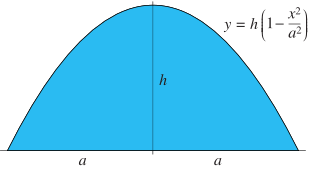
The arc length of the parabolic segment
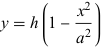 | (1) |
illustrated above is given by
 |  | 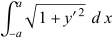 | (2) |
 |  | 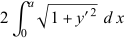 | (3) |
 |  | 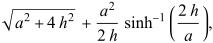 | (4) |
and the area is given by
 |  | 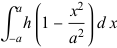 | (5) |
 |  |  | (6) |
(Kern and Bland 1948, p. 4). The weighted mean of  is
is
 |  | 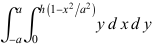 | (7) |
 |  |  | (8) |
so the geometric centroid is then given by
 |  |  | (9) |
 |  |  | (10) |
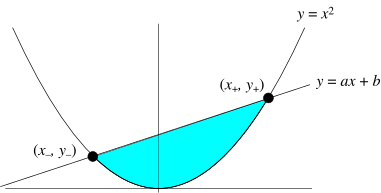
The area of the cut-off parabolic segment contained between the curves
 |  |  | (11) |
 |  |  | (12) |
can be found by eliminating  ,
,
 | (13) |
so the points of intersection are
 | (14) |
with corresponding  -coordinates
  . The area is therefore given by
 |  | ![int_(a-sqrt(a^2+4b))^(a+sqrt(a^2+4b))[(ax+b)-x^2]dx](https://mathworld.wolfram.com/images/equations/ParabolicSegment/Inline40.svg) | (15) |
 |  |  | (16) |
 |  |  | (17) |
The maximum area of a triangle inscribed in this segment will have two of its polygon vertices at the intersections  and
and  , and the third at a point
  to be determined. From the general equation for a triangle, the area of the inscribed triangle is given by the determinant equation
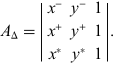 | (18) |
Plugging in and using  gives
gives
![A_Delta=1/2[b+(a-x^*)x^*]sqrt(a^2+4b).](https://mathworld.wolfram.com/images/equations/ParabolicSegment/NumberedEquation5.svg) | (19) |
To find the maximum area, differentiable with respect to  and set to 0 to obtain
 | (20) |
so
 | (21) |
Plugging (21) into (19) then gives
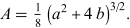 | (22) |
This leads to the result known to Archimedes in the third century BC, namely
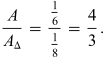 | (23) |
