

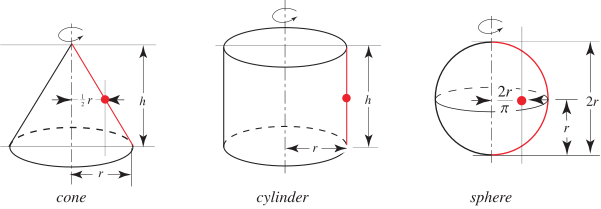
The first theorem of Pappus states that the surface area  of a surface of revolution generated by the revolution of a curve about an external axis is equal to the product of the arc length
  of the generating curve and the distance
  traveled by the curve's geometric centroid
  ,
,
 |
(Kern and Bland 1948, pp. 110-111). The following table summarizes the surface areas calculated using Pappus's centroid theorem for various surfaces of revolution.
| solid | generating curve |  |  |  |
| cone | inclined line segment |  |  |  |
| cylinder | parallel line segment |  |  |  |
| sphere | semicircle |  |  |  |
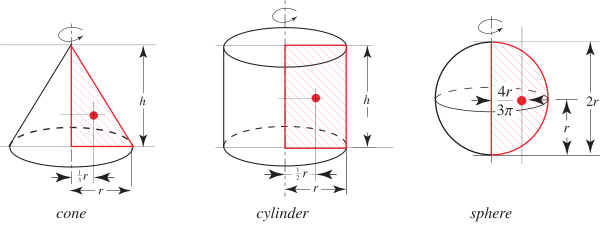
Similarly, the second theorem of Pappus states that the volume  of a solid of revolution generated by the revolution of a lamina about an external axis is equal to the product of the area
  of the lamina and the distance
  traveled by the lamina's geometric centroid
  ,
,
 |
(Kern and Bland 1948, pp. 110-111). The following table summarizes the surface areas and volumes calculated using Pappus's centroid theorem for various solids and surfaces of revolution.
| solid | generating lamina |  |  |  |
| cone | right triangle |  |  |  |
| cylinder | rectangle |  |  |  |
| sphere | semicircle |  |  |  |
