


The Legendre differential equation is the second-order ordinary differential equation
 | (1) |
which can be rewritten
![d/(dx)[(1-x^2)(dy)/(dx)]+l(l+1)y=0.](https://mathworld.wolfram.com/images/equations/LegendreDifferentialEquation/NumberedEquation2.svg) | (2) |
The above form is a special case of the so-called "associated Legendre differential equation" corresponding to the case  . The Legendre differential equation has regular singular points at
  , 1, and
  .
.
If the variable  is replaced by
  , then the Legendre differential equation becomes
 | (3) |
derived below for the associated ( ) case.
Since the Legendre differential equation is a second-order ordinary differential equation, it has two linearly independent solutions. A solution  which is regular at finite points is called a Legendre function of the first kind, while a solution
  which is singular at
  is called a Legendre function of the second kind. If
  is an integer, the function of the first kind reduces to a polynomial known as the Legendre polynomial.
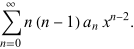
The Legendre differential equation can be solved using the Frobenius method by making a series expansion with  ,
,
 |  |  | (4) |
 |  |  | (5) |
 |  |  | (6) |
Plugging in,
 | (7) |
 | (8) |
 | (9) |
 | (10) |
 | (11) |
 | (12) |
 | (13) |
![sum_(n=0)^infty{(n+1)(n+2)a_(n+2)+[-n(n-1)-2n+l(l+1)]a_n}=0,](https://mathworld.wolfram.com/images/equations/LegendreDifferentialEquation/NumberedEquation5.svg) | (14) |
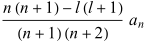
so each term must vanish and
![(n+1)(n+2)a_(n+2)+[-n(n+1)+l(l+1)]a_n=0](https://mathworld.wolfram.com/images/equations/LegendreDifferentialEquation/NumberedEquation6.svg) | (15) |
 |  |  | (16) |
 |  | )/((n+1)(n+2))a_n.](https://mathworld.wolfram.com/images/equations/LegendreDifferentialEquation/Inline32.svg) | (17) |
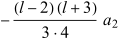
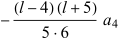
Therefore,
 |  |  | (18) |
 |  |  | (19) |
 |  | ![(-1)^2([(l-2)l][(l+1)(l+3)])/(1·2·3·4)a_0](https://mathworld.wolfram.com/images/equations/LegendreDifferentialEquation/Inline41.svg) | (20) |
 |  |  | (21) |
 |  | ![(-1)^3([(l-4)(l-2)l][(l+1)(l+3)(l+5)])/(1·2·3·4·5·6)a_0,](https://mathworld.wolfram.com/images/equations/LegendreDifferentialEquation/Inline47.svg) | (22) |
so the even solution is
![y_1(x)=1+sum_(n=1)^infty(-1)^n([(l-2n+2)...(l-2)l][(l+1)(l+3)...(l+2n-1)])/((2n)!)x^(2n).](https://mathworld.wolfram.com/images/equations/LegendreDifferentialEquation/NumberedEquation7.svg) | (23) |
Similarly, the odd solution is
![y_2(x)=x+sum_(n=1)^infty(-1)^n([(l-2n+1)...(l-3)(l-1)][(l+2)(l+4)...(l+2n)])/((2n+1)!)x^(2n+1).](https://mathworld.wolfram.com/images/equations/LegendreDifferentialEquation/NumberedEquation8.svg) | (24) |
If  is an even integer, the series
  reduces to a polynomial of degree
  with only even powers of
  and the series
  diverges. If
  is an odd integer, the series
  reduces to a polynomial of degree
  with only odd powers of
  and the series
  diverges. The general solution for an integer
  is then given by the Legendre polynomials
 |  | 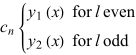 | (25) |
 |  | 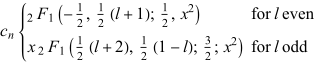 | (26) |
where  is chosen so as to yield the normalization
  and
and 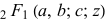 is a hypergeometric function.
A generalization of the Legendre differential equation is known as the associated Legendre differential equation.
Moon and Spencer (1961, p. 155) call the differential equation
![(1-x^2)y^('')-2xy^'-[k^2a^2(x^2-1)-p(p+1)-(q^2)/(x^2-1)]y=0](https://mathworld.wolfram.com/images/equations/LegendreDifferentialEquation/NumberedEquation9.svg) | (27) |
the Legendre wave function equation (Zwillinger 1997, p. 124).
