


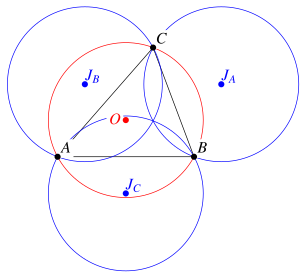
Johnson's theorem states that if three equal circles mutually intersect one another in a single point, then the circle passing through their other three pairwise points of intersection is congruent to the original three circles. If the pairwise intersections are taken as the vertices of a reference triangle  , then the Johnson circles that are congruent to the circumcircle of
  have centers
 |  |  | (1) |
 |  |  | (2) |
 |  |  | (3) |
where  ,
,  ,
,  , and
, and  are Conway triangle notation.
The centers of the Johnson circles form the Johnson triangle  which, together with
  , form an orthocentric system.
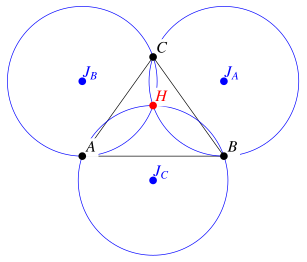
The point of threefold concurrence of the Johnson circles is the orthocenter  of the reference triangle
  .
.
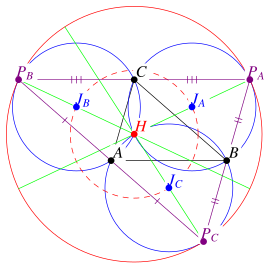
Note also that intersections of the directed lines from the orthocenter  of the reference triangle through the centers of the Johnson circles intersect the Johnson circles at the vertices of the anticomplementary triangle
  . The anticomplementary circle, with center
  and radius
  (where
  is the radius of the Johnson circles) therefore circumscribes the Johnson circles and is tangent to them at the points
  ,
,  , and
, and  .
.
