


Let  ,
,  , ... be an infinite series of real numbers lying between 0 and 1. Then corresponding to any arbitrarily large
  , there exists a positive integer
  and two subintervals of equal length such that the number of
  with
with  , 2, ...,
  which lie in one of the subintervals differs from the number of such
  that lie in the other subinterval by more than
  (van der Corput 1935ab, van Aardenne-Ehrenfest 1945, 1949, Roth 1954).
This statement can be refined as follows. Let  be a large integer and
  ,
,  , ...,
  be a sequence of
  real numbers lying between 0 and 1. Then for any integer
  and any real number
  satisfying
  , let
, let  denote the number of
  with
with  , 2, ...,
  that satisfy
  . Then there exist
  and
and  such that
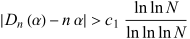 | (1) |
where  is a positive constant. Schmidt (1972) improved upon this result to obtain
 | (2) |
which is essentially optimal.
This result can be further strengthened, which is most easily done by reformulating the problem. Let  be an integer and
  ,
,  , ...,
  be
be  (not necessarily distinct) points in the square
  ,
,  . Then
![int_0^1int_0^1[S(x,y)-Nxy]^2dxdy>c_2lnN,](https://mathworld.wolfram.com/images/equations/DiscrepancyTheorem/NumberedEquation3.svg) | (3) |
where  is a positive constant and
  is the number of points in the rectangle
  ,
,  (Roth 1954). Therefore,
 | (4) |
and the original result can be stated as the fact that there exist  and
and  such that
 | (5) |
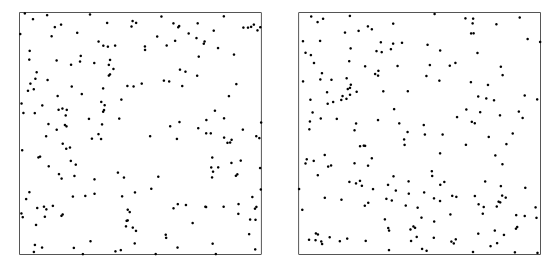
The randomly distributed points shown in the above squares have  and 9.11, respectively.
Similarly, the discrepancy of a set of  points in a unit
  -hypercube satisfies
 | (6) |
(Roth 1954, 1976, 1979, 1980).
