

The Descartes circle theorem, also called the kissing circles problem, is a special case of Apollonius' problem requiring the determination of a circle touching three mutually tangent circles. There are two solutions: a small circle surrounded by the three original circles, and a large circle surrounding the original three.
Frederick Soddy gave the formula for finding the radius of the so-called inner and outer Soddy circles given the radii of the other three. The relationship is
 | (1) |
where  are the curvatures of the circles with radii
  . Here, the negative solution corresponds to the outer Soddy circle and the positive solution to the inner Soddy circle.
This formula was known to Descartes and Viète (Boyer and Merzbach 1991, p. 159), but Soddy extended it to spheres. In  -dimensional space,
  mutually touching
  -spheres can always be found, and the relationship of their curvatures is
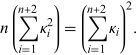 | (2) |
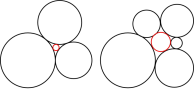
A generalization of the theorem to the case of an " -flower" consisting of
  tangent circles around the exterior of a central circle was given by Mathews and Zymaris (2025), who also derived an explicit equation satfied by their curvatures. In particular, let
  be the curvature of a central circle and
  be the curvatures for
  , ...,
  surrounding mutually tangent circles forming an
  -flower. Define
 |  |  | (3) |
 |  | 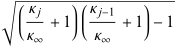 | (4) |
for  . Then for
  odd,
odd,
![(m_0^2i)/2[product_(j=1)^(n-1)(m_j-i)-product_(j-1)^(n-1)(m_j+1)]-product_(j=1)^((n-1)/2)(m_(2j-1)^2+1)=0](https://mathworld.wolfram.com/images/equations/DescartesCircleTheorem/NumberedEquation3.svg) | (5) |
and for  even
even
![i/2[product_(j-1)^(n-1)(m_j-i)-product_(j=1)^(n-1)(m_j+i)]-product_(i=1)^(n/2-1)(m_(2j)^2+1)=0,](https://mathworld.wolfram.com/images/equations/DescartesCircleTheorem/NumberedEquation4.svg) | (6) |
where  and
and  (Mathews and Zymaris 2025).
