


Consider the probability  that no two people out of a group of
  will have matching birthdays out of
  equally possible birthdays. Start with an arbitrary person's birthday, then note that the probability that the second person's birthday is different is
  , that the third person's birthday is different from the first two is
 ![[(d-1)/d][(d-2)/d]](https://mathworld.wolfram.com/images/equations/BirthdayProblem/Inline5.svg) , and so on, up through the
, and so on, up through the  th person. Explicitly,
 |  | 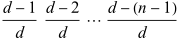 | (1) |
 |  | ![((d-1)(d-2)...[d-(n-1)])/(d^(n-1)).](https://mathworld.wolfram.com/images/equations/BirthdayProblem/Inline12.svg) | (2) |
But this can be written in terms of factorials as
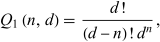 | (3) |
so the probability  that two or more people out of a group of
  do have the same birthday is therefore
 |  |  | (4) |
 |  | 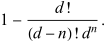 | (5) |
In general, let  denote the probability that a birthday is shared by exactly
  (and no more) people out of a group of
  people. Then the probability that a birthday is shared by
  or more people is given by
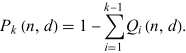 | (6) |
In general,  can be computed using the recurrence relation
![Q_k(n,d)=sum_(i=1)^(|_n/k_|)[(n!d!)/(d^(ik)i!(k!)^i(n-ik)!(d-i)!)sum_(j=1)^(k-1)Q_j(n-ik,d-i)((d-i)^(n-ik))/(d^(n-ik))]](https://mathworld.wolfram.com/images/equations/BirthdayProblem/NumberedEquation3.svg) | (7) |
(Finch 1997). However, the time to compute this recursive function grows exponentially with  and so rapidly becomes unwieldy.
If 365-day years have been assumed, i.e., the existence of leap days is ignored, and the distribution of birthdays is assumed to be uniform throughout the year (in actuality, there is a more than 6% increase from the average in September in the United States; Peterson 1998), then the number of people needed for there to be at least a 50% chance that at least two share birthdays is the smallest  such that
  . This is given by
  , since
 |  |  | (8) |
 |  |  | (9) |
The number  of people needed to obtain
  for
for  , 2, ..., are 2, 2, 3, 3, 3, 4, 4, 4, 4, 5, ... (OEIS A033810). The minimal number of people to give a 50% probability of having at least
  coincident birthdays is 1, 23, 88, 187, 313, 460, 623, 798, 985, 1181, 1385, 1596, 1813, ... (OEIS A014088; Diaconis and Mosteller 1989).
The probability  can be estimated as
 |  |  | (10) |
 |  | 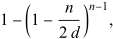 | (11) |
where the latter has error
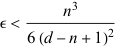 | (12) |
(Sayrafiezadeh 1994).
 can be computed explicitly as
 |  | 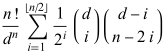 | (13) |
 |  | ![(d!)/(d^n(d-n)!)[_2F_1(1/2n,1/2(1-n);d-n+1;2)-1],](https://mathworld.wolfram.com/images/equations/BirthdayProblem/Inline53.svg) | (14) |
where  is a binomial coefficient and
  is a hypergeometric function. This gives the explicit formula for
  as
as
 |  |  | (15) |
 |  |  | (16) |
where  is a regularized hypergeometric function.
A good approximation to the number of people  such that
  is some given value can be given by solving the equation
![ne^(-n/(dk))=[d^(k-1)k!ln(1/(1-p))(1-n/(d(k+1)))]^(1/k)](https://mathworld.wolfram.com/images/equations/BirthdayProblem/NumberedEquation5.svg) | (17) |
for  and taking
 ![[n]](https://mathworld.wolfram.com/images/equations/BirthdayProblem/Inline67.svg) , where
, where ![[n]](https://mathworld.wolfram.com/images/equations/BirthdayProblem/Inline68.svg) is the ceiling function (Diaconis and Mosteller 1989). For
is the ceiling function (Diaconis and Mosteller 1989). For  and
and  , 2, 3, ..., this formula gives
  , 23, 88, 187, 313, 459, 622, 797, 983, 1179, 1382, 1592, 1809, ... (OEIS A050255), which differ from the true values by from 0 to 4. A much simpler but also poorer approximation for
  such that
  for
for  is given by
 | (18) |
(Diaconis and Mosteller 1989), which gives 86, 185, 307, 448, 606, 778, 965, 1164, 1376, 1599, 1832, ... for  , 4, ... (OEIS A050256).
The "almost" birthday problem, which asks the number of people needed such that two have a birthday within a day of each other, was considered by Abramson and Moser (1970), who showed that 14 people suffice. An approximation for the minimum number of people needed to get a 50-50 chance that two have a match within  days out of
  possible is given by
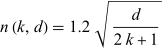 | (19) |
(Sevast'yanov 1972, Diaconis and Mosteller 1989).

 Matches." College Math. J. 17, 315-321, 1986.Hunter, J. A. H. and Madachy, J. S.