


A binomial number is a number of the form  , where
  , and
, and  are integers. Binomial numbers can be factored algebraically as
 | (1) |
for all  ,
,
 | (2) |
for  odd, and
![a^(nm)-b^(nm)=(a^m-b^m)[a^(m(n-1))+a^(m(n-2))b^m+...+b^(m(n-1))].](https://mathworld.wolfram.com/images/equations/BinomialNumber/NumberedEquation3.svg) | (3) |
for all positive integers  . For example,
 |  |  | (4) |
 |  |  | (5) |
 |  |  | (6) |
 |  |  | (7) |
 |  |  | (8) |
 |  |  | (9) |
 |  |  | (10) |
 |  |  | (11) |
 |  |  | (12) |
and
 |  |  | (13) |
 |  |  | (14) |
 |  |  | (15) |
 |  |  | (16) |
 |  |  | (17) |
 |  |  | (18) |
 |  |  | (19) |
 |  |  | (20) |
 |  |  | (21) |
Rather surprisingly, the number of factors of  with
with  and
and  symbolic and
  a positive integer is given by
  , where
  is the number of divisors of
  and
and  is the divisor function. The first few terms are therefore 1, 2, 2, 3, 2, 4, 2, ... (OEIS A000005).
Similarly, the number of factors of  is given by
  , where
 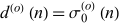 is the number of odd divisors of
  and
and  is the odd divisor function. The first few terms are therefore 1, 1, 2, 1, 2, 2, 2, 1,... (OEIS A001227).
In 1770, Euler proved that if  , then every odd factor of
 | (22) |
is of the form  . (A number of the form
  is called a Fermat number.)
If  and
and  are primes, then
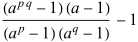 | (23) |
 not dividing
  .
. 
 Divide
  ." §B47 in
  Divides
  for All
  ." Proc. Amer. Math. Soc. 93, 218-220, 1985.Schinzel, A. "On Primitive Prime Factors of
  ." Proc. Cambridge Phil. Soc. 58, 555-562, 1962.Sloane, N. J. A. Sequences