Ansible role openjdk
Ansible Role for OpenJDK Installation.
| GitHub | Version | Issues | Pull Requests | Downloads |
|---|---|---|---|---|
 |  |  |  |  |
This example is taken from molecule/default/converge.yml and is tested on each push, pull request and release.
--- - hosts: all remote_user: root become: true roles: - role: buluma.bootstrap - role: buluma.maven - role: buluma.openjdkThe machine needs to be prepared. In CI this is done using molecule/default/prepare.yml:
--- - hosts: all remote_user: root become: true gather_facts: false roles: - role: buluma.bootstrap tasks: - name: Redhat | subscription-manager register ansible.builtin.raw: | set -eu subscription-manager register \ --username={{ lookup('env', 'REDHAT_USERNAME') }} \ --password={{ lookup('env', 'REDHAT_PASSWORD') }} \ --auto-attach args: executable: "/bin/bash" changed_when: false failed_when: false - name: Debian | apt-get install python3 ansible.builtin.raw: | set -eu apt-get update DEBIAN_FRONTEND=noninteractive apt-get install -y python3 args: executable: "/bin/bash" changed_when: false failed_when: false - name: Redhat | yum install python3 ansible.builtin.raw: | set -eu yum makecache yum install -y python3 args: executable: "/bin/bash" changed_when: false failed_when: false - name: Suse | zypper install python3 ansible.builtin.raw: | set -eu zypper -n --gpg-auto-import-keys refresh zypper -n install -y python3 args: executable: "/bin/bash" changed_when: false failed_when: false - name: prepare | all hosts: all remote_user: root become: true tasks: - name: Cp -rfT /etc/skel /root ansible.builtin.raw: | set -eu cp -rfT /etc/skel /root rm -rf /root/.bash_logout args: executable: "/bin/bash" changed_when: false failed_when: false - name: Setenforce 0 ansible.builtin.raw: | set -eu setenforce 0 sed -i 's/^SELINUX=.*$/SELINUX=permissive/g' /etc/selinux/config args: executable: "/bin/bash" changed_when: false failed_when: false - name: Systemctl stop iptables.service ansible.builtin.raw: | set -eu systemctl stop iptables.service systemctl disable iptables.service args: executable: "/bin/bash" changed_when: false failed_when: false - name: Systemctl stop firewalld.service ansible.builtin.raw: | set -eu systemctl stop firewalld.service systemctl disable firewalld.service args: executable: "/bin/bash" changed_when: false failed_when: false - name: Systemctl stop ufw.service ansible.builtin.raw: | set -eu systemctl stop ufw.service systemctl disable ufw.service args: executable: "/bin/bash" changed_when: false failed_when: false - name: Debian | apt-get install *.deb ansible.builtin.raw: | set -eu DEBIAN_FRONTEND=noninteractive apt-get install -y bzip2 ca-certificates curl gcc gnupg gzip hostname iproute2 passwd procps python3 python3-apt python3-jmespath python3-lxml python3-pip python3-setuptools python3-venv python3-virtualenv python3-wheel rsync sudo tar unzip util-linux zip args: executable: "/bin/bash" when: ansible_os_family | lower == "debian" changed_when: false failed_when: false # TODO: Pinning due to CVE-2024-3094 - name: Debian | Try to install xz-utils packages ansible.builtin.pip: name: xz-utils==5.4.6 state: present when: ansible_os_family | lower == "debian" changed_when: false failed_when: false - name: Fedora | yum install *.rpm ansible.builtin.raw: | set -eu yum install -y bzip2 ca-certificates curl gcc gnupg2 gzip hostname iproute procps-ng python3 python3-dnf-plugin-versionlock python3-jmespath python3-libselinux python3-lxml python3-pip python3-setuptools python3-virtualenv python3-wheel rsync shadow-utils sudo tar unzip util-linux xz yum-utils zip args: executable: "/bin/bash" when: ansible_distribution | lower == "fedora" changed_when: false failed_when: false - name: Redhat-9 | yum install *.rpm ansible.builtin.raw: | set -eu yum-config-manager --enable crb || echo $? yum-config-manager --enable codeready-builder-for-rhel-9-x86_64-rpms || echo $? yum install -y http://dl.fedoraproject.org/pub/epel/epel-release-latest-9.noarch.rpm yum install -y bzip2 ca-certificates curl gcc gnupg2 gzip hostname iproute procps-ng python3 python3-dnf-plugin-versionlock python3-jmespath python3-libselinux python3-lxml python3-pip python3-setuptools python3-virtualenv python3-wheel rsync shadow-utils sudo tar unzip util-linux xz yum-utils zip args: executable: "/bin/bash" when: ansible_os_family | lower == "redhat" and ansible_distribution_major_version | lower == "9" changed_when: false failed_when: false - name: Redhat-8 | yum install *.rpm ansible.builtin.raw: | set -eu yum install -y http://dl.fedoraproject.org/pub/epel/epel-release-latest-8.noarch.rpm yum install -y bzip2 ca-certificates curl gcc gnupg2 gzip hostname iproute procps-ng python3 python3-dnf-plugin-versionlock python3-jmespath python3-libselinux python3-lxml python3-pip python3-setuptools python3-virtualenv python3-wheel rsync shadow-utils sudo tar unzip util-linux xz yum-utils zip args: executable: "/bin/bash" when: ansible_os_family | lower == "redhat" and ansible_distribution_major_version | lower == "8" changed_when: false failed_when: false - name: Redhat-7 | yum install *.rpm ansible.builtin.raw: | set -eu subscription-manager repos --enable=rhel-7-server-optional-rpms || echo $? yum install -y http://dl.fedoraproject.org/pub/epel/epel-release-latest-7.noarch.rpm yum install -y bzip2 ca-certificates curl gcc gnupg2 gzip hostname iproute procps-ng python3 python3-jmespath python3-libselinux python3-lxml python3-pip python3-setuptools python3-virtualenv python3-wheel rsync shadow-utils sudo tar unzip util-linux xz yum-plugin-versionlock yum-utils zip args: executable: "/bin/bash" when: ansible_os_family | lower == "redhat" and ansible_distribution_major_version | lower == "7" changed_when: false failed_when: false - name: Suse | zypper -n install *.rpm ansible.builtin.raw: | set -eu zypper -n install -y bzip2 ca-certificates curl gcc gpg2 gzip hostname iproute2 procps python3 python3-jmespath python3-lxml python3-pip python3-setuptools python3-virtualenv python3-wheel rsync shadow sudo tar unzip util-linux xz zip args: executable: "/bin/bash" when: ansible_os_family | lower == "suse" changed_when: false failed_when: falseAlso see a full explanation and example on how to use these roles.
The default values for the variables are set in defaults/main.yml:
--- # OpenJDK release. openjdk_release: "17" # Specify JAVA_HOME. openjdk_home: "{{ _openjdk_home[openjdk_release] }}"- pip packages listed in requirements.txt.
The following roles are used to prepare a system. You can prepare your system in another way.
| Requirement | GitHub | Version |
|---|---|---|
| buluma.bootstrap |  |  |
| buluma.maven |  |  |
This role is a part of many compatible roles. Have a look at the documentation of these roles for further information.
Here is an overview of related roles:
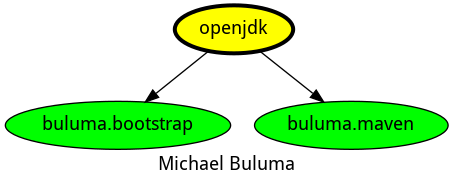
This role has been tested on these container images:
| container | tags |
|---|---|
| Ubuntu | all |
| EL | all |
| opensuse | all |
| Debian | all |
| Fedora | 38, 39, 40 |
The minimum version of Ansible required is 4.10, tests have been done to:
- The previous version.
- The current version.
- The development version.
If you find issues, please register them in GitHub