




Simple mocking library for asynchronous testing in Elixir.
Readme and documentation for last stable version are available on hex
- Mockery does not override your modules
- Mockery does not replace modules by aliasing
- Mockery does not require to pass modules as function parameter
- Mockery does not require to create callbacks or wrappers around libraries
- Mockery does not create modules during runtime (neither by
defmodule/2norModule.create/3) - Mockery does not allow to mock non-existent function
- Mockery does not share any data between test processes
- Mockery is not designed for libraries as it would force end user to download Mockery as dependency of dependency
- Mockery can interfere with Dialyzer when run with Mockery enabled (warnings can be suppressed via
:suppress_dialyzer_warnings— see the docs)
def deps do [ {:mockery, "~> 2.4", runtime: false} ] endAdd the following line to your config/test.exs file:
config :mockery, enable: trueAfter adding this setting, make sure to recompile your project.
To help the Elixir formatter recognize Mockery-specific macros (such as defmock, assert_called!, and refute_called!) without requiring parentheses, you should import the locals without parens configuration from Mockery in your .formatter.exs file:
[ inputs: ["{mix,.formatter}.exs", "{config,lib,test}/**/*.{ex,exs}"], import_deps: [:mockery] ]# lib/my_app/foo.ex defmodule MyApp.Foo do use Mockery.Macro alias MyApp.Bar def baz, do: mockable(Bar).function() enddefmodule MyApp.Controller do # ... use Mockery.Macro def all do mockable(MyApp.UserService).users() end def filtered do mockable(MyApp.UserService).users("filter") end end # tests defmodule MyApp.ControllerTest do # ... import Mockery test "mock any function :users from MyApp.UserService" do mock MyApp.UserService, :users, "mock" assert all() == "mock" assert filtered() == "mock" end test "mock MyApp.UserService.users/0" do mock MyApp.UserService, [users: 0], "mock" assert all() == "mock" refute filtered() == "mock" end test "mock MyApp.UserService.users/0 with default value" do mock MyApp.UserService, users: 0 assert all() == :mocked refute filtered() == :mocked end test "chaining multiple mocks for same module" do UserService |> mock([users: 0], "mock value") |> mock([users: 1], "mock value") # ... end endInstead of using a static value, you can use a function with the same arity as original one.
defmodule Foo do def bar(value), do: value end # prepare tested module defmodule Other do use Mockery.Macro def parse(value) do mockable(Foo).bar(value) end end # tests defmodule OtherTest do # ... import Mockery test "with dynamic mock" do mock Foo, [bar: 1], fn(value)-> String.upcase(value) end assert parse("test") == "TEST" end endFor cleaner code, you can use the defmock/2 or defmock/3 macro to define a private macro that expands to mockable/1 or mockable/2. This way, you can call the macro instead of using mockable directly.
Example:
defmodule Foo do use Mockery.Macro defmock :bar, Bar, by: BarGlobalMock def call_bar do bar().function_call() end endThis is equivalent to:
defmodule Foo do use Mockery.Macro def call_bar do mockable(Bar, by: BarGlobalMock).function_call() end end# prepare tested module defmodule Tested do use Mockery.Macro def call(value, opts) do mockable(Foo).bar(value) end end # tests defmodule TestedTest do # ... import Mockery.Assertions # use Mockery # when you need to import both Mockery and Mockery.Assertions test "assert any function bar from module Foo was called" do Tested.call(1, %{}) assert_called! Foo, :bar end test "assert Foo.bar/2 was called" do Tested.call(1, %{}) assert_called! Foo, :bar, arity: 2 end test "assert Foo.bar/2 was called with given args" do Tested.call(1, %{}) assert_called! Foo, :bar, args: [1, %{}] end test "assert Foo.bar/1 was called with given arg (using variable)" do params = %{a: 1, b: 2} Tested.call(params) assert_called! Foo, :bar, args: [^params] # we need to use pinning here since assert_called!/3 is a macro # and not a regular function call and it gets expanded accordingly end test "assert Foo.bar/2 was called with 1 as first arg" do Tested.call(1, %{}) assert_called! Foo, :bar, args: [1, _] end test "assert Foo.bar/2 was called with 1 as first arg 5 times" do # ... assert_called! Foo, :bar, args: [1, _], times: 5 end test "assert Foo.bar/2 was called with 1 as first arg from 3 to 5 times" do # ... assert_called! Foo, :bar, args: [1, _], times: {:in, 3..5} end test "assert Foo.bar/2 was called with 1 as first arg 3 or 5 times" do # ... assert_called! Foo, :bar, args: [1, _], times: {:in, [3, 5]} end endMockery.Assertions.assert_called!/3 macro has its Mockery.Assertions.refute_called!/3 counterpart.
For more information see docs
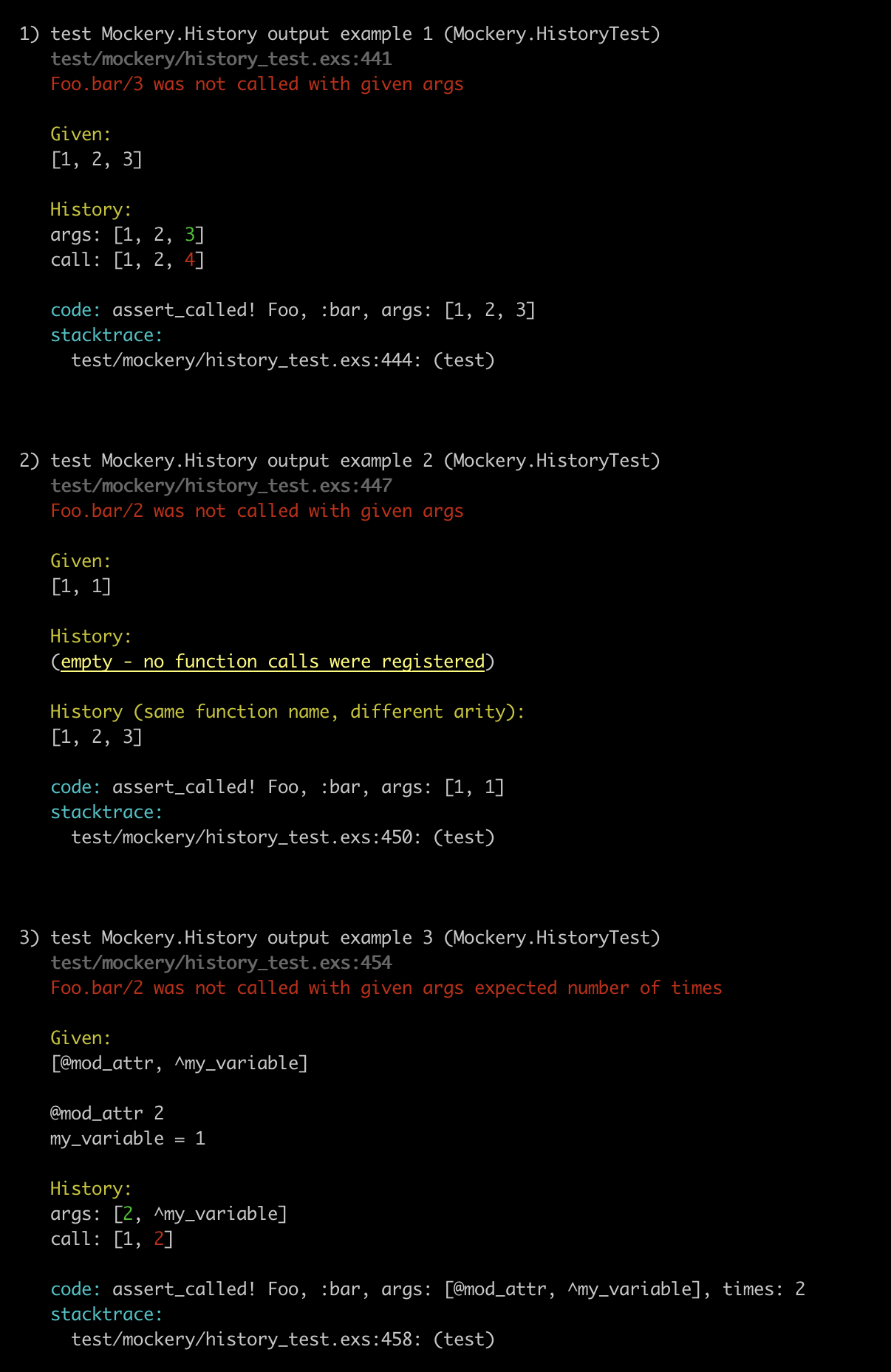
Mockery.History module provides more descriptive failure messages for Mockery.Assertions.assert_called!/3 and Mockery.Assertions.refute_called!/3 that includes a colorized list of arguments passed to a given function.
Disabled by default. For more information see docs
Useful when you need to use the same mock many times across different tests
defmodule Foo do def bar, do: 1 def baz, do: 2 end defmodule FooGlobalMock do def bar, do: :mocked end # prepare tested module defmodule Other do use Mockery.Macro def bar, do: mockable(Foo, by: FooGlobalMock).bar() def baz, do: mockable(Foo, by: FooGlobalMock).baz() end # tests defmodule OtherTest do # ... test "with global mock" do assert Other.bar == :mocked assert Other.baz == 2 end endGlobal mock module doesn't have to contain every function exported by the original module, but it cannot contain a function which is not exported by the original module.
It means that:
- when you remove a function from the original module, you have to remove it from global mock module or Mockery will raise exception
- when you change a function name in the original module, you have to change it in global mock module or Mockery will raise exception
- when you change a function arity in the original module, you have to change it in global mock module or Mockery will raise exception
For advanced usage examples see EXAMPLES.md
Copyright 2017-2025 Tobiasz Małecki tobiasz.malecki@appunite.com
Licensed under the Apache License, Version 2.0 (the "License"); you may not use this file except in compliance with the License. You may obtain a copy of the License at
http://www.apache.org/licenses/LICENSE-2.0
Unless required by applicable law or agreed to in writing, software distributed under the License is distributed on an "AS IS" BASIS, WITHOUT WARRANTIES OR CONDITIONS OF ANY KIND, either express or implied. See the License for the specific language governing permissions and limitations under the License.