


English | 简体中文 | Deutsch | Español | français | 日本語 | 한국어 | Português | Русский


Curvine is a high-performance, concurrent distributed cache system written in Rust, designed for low-latency and high-throughput workloads.
For more detailed information, please refer to:
- Official Documentation
- Quick Start
- User Manuals
- Detailed Usage Instructions
- Benchmark
- DeepWiki
- Commit convention
- Contribute guidelines
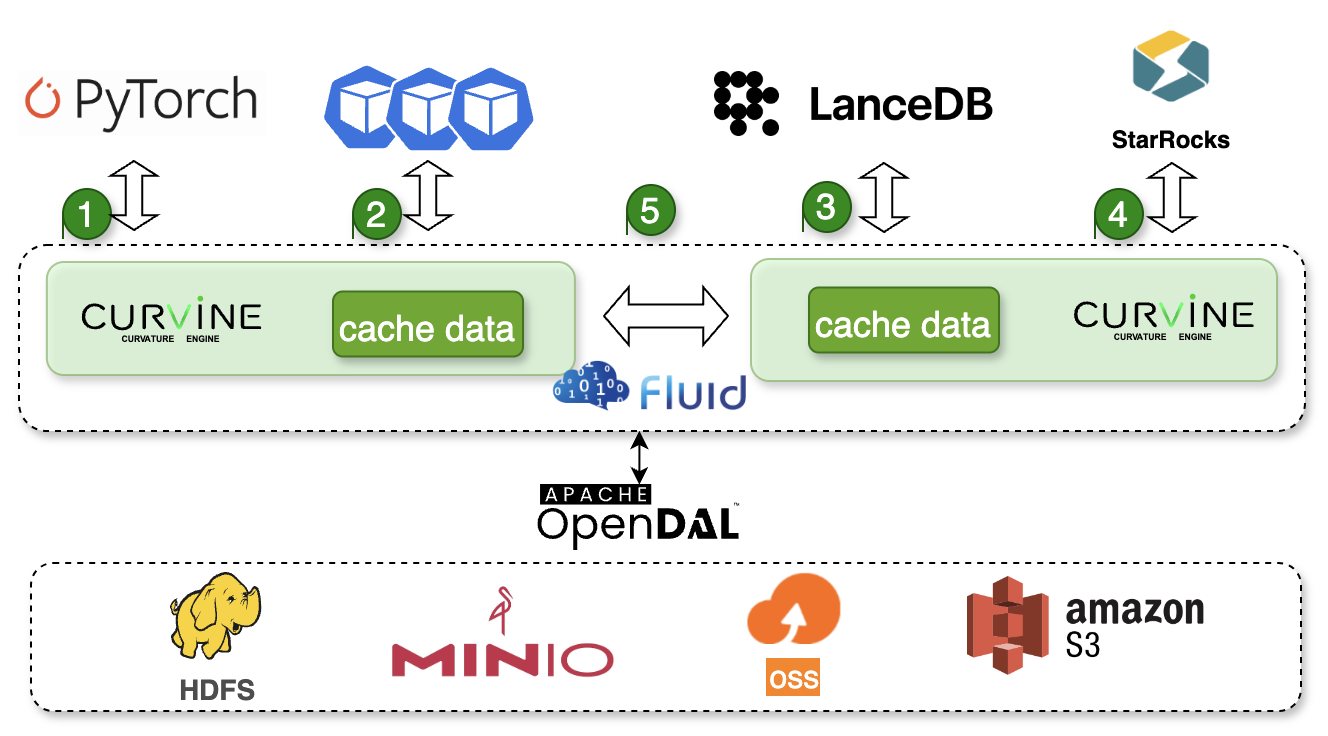
- Case1: Training acceleration
- Case2: Model distribution
- Case3: Hot table data acceleration
- Case4: Shuffle acceleration
- Case5: Multi-cloud data caching
- Multi-Cloud Support: Curvine is compatible with object storage services from multiple cloud providers as its underlying storage layer, enabling transparent data migration across different vendors' object storage platforms.
- Cloud-Native: Curvine supports CSI-based cloud-native integration with Kubernetes, enabling deployment and management of Curvine clusters via Helm charts.
- Multi-tir Cache: Supports multi-tir cache strategies for memory, SSD, and HDD.
- POSIX Semantic Support: Curvine delivers comprehensive POSIX semantic compatibility, implementing a high-performance FUSE layer to facilitate the manipulation of distributed cached data as if it were local disk storage.
- Compatibility with S3 and HDFS Protocols: The system supports both S3 and HDFS read/write interfaces, facilitating seamless integration with artificial intelligence and big data technology ecosystems.
- High Performance: Curvine employs "zero-copy" techniques multiple times throughout its data read/write pipeline and leverages asynchronous operations. Additionally, its core engine is built with Rust, ensuring optimal performance is achieved.
- Raft Consensus: Uses the Raft algorithm to ensure the master's data consistency and high availability.
- Monitoring and Metrics: Curvine features a comprehensive built-in observability metrics system, facilitating detailed monitoring of the performance of each component.
- Web Interface: Provides a web management interface for convenient system monitoring and management.
- Rust 1.86+
- Linux or macOS (Limited support on Windows)
- FUSE library (for file system functionality)
Officially Supported Linux Distributions
| OS Distribution | Kernel Requirement | Tested Version | Dependencies |
|---|---|---|---|
| CentOS 7 | ≥3.10.0 | 7.6 | fuse2-2.9.2 |
| CentOS 8 | ≥4.18.0 | 8.5 | fuse3-3.9.1 |
| Rocky Linux 9 | ≥5.14.0 | 9.5 | fuse3-3.10.2 |
| RHEL 9 | ≥5.14.0 | 9.5 | fuse3-3.10.2 |
| Ubuntu 22 | ≥5.15.0 | 22.4 | fuse3-3.10.5 |
This project requires the following dependencies. Please ensure they are installed before proceeding:
- GCC: version 10 or later (Installation Guide)
- Rust: version 1.86 or later (Installation Guide)
- Protobuf: version 3.x
- Maven: version 3.8 or later (Install Guide)
- LLVM: version 12 or later (Installation Guide)
- FUSE: libfuse2 or libfuse3 development packages
- JDK: version 1.8 or later (OpenJDK or Oracle JDK)
- npm: version 9 or later (Node.js Installation)
- Python: version 3.7 or later (Installation Guide)
You can either:
- Use the pre-configured
curvine-docker/compile/Dockerfile_rocky9to build a compilation image - Reference this Dockerfile to create a compilation image for other operating system versions
- We also supply
curvine/curvine-compileimage on dockerhub
Using make to build:
# Build all modules make all # Build core modules only: server client cli make build ARGS="-p core" # Build fuse and core modules make build ARGS="-p core -p fuse"Using build.sh directly:
# Build all modules sh build/build.sh # Display command help sh build/build.sh -h # Build core modules only: server client cli sh build/build.sh -p core # Build fuse and core modules sh build/build.sh -p core -p fuseBuilding Docker images:
# or use curvine-compile:latest docker images to build make docker-build # or use curvine-compile:build-cached docker images to build, this image already cached most dependency crates make docker-build-cachedAfter successful compilation, target file will be generated in the build/dist directory. This file is the Curvine installation package that can be used for deployment or building images.
cd build/dist # Start the master node bin/curvine-master.sh start # Start the worker node bin/curvine-worker.sh startMount the file system
# The default mount point is /curvine-fuse bin/curvine-fuse.sh startView the cluster overview:
bin/cv reportAccess the file system using compatible HDFS commands:
bin/cv fs mkdir /a bin/cv fs ls /Access Web UI:
http://your-hostname:9000 Curvine uses TOML - formatted configuration files. An example configuration is located at conf/curvine-cluster.toml. The main configuration items include:
- Network settings (ports, addresses, etc.)
- Storage policies (cache size, storage type)
- Cluster configuration (number of nodes, replication factor)
- Performance tuning parameters
Curvine adopts a master-slave architecture:
- Master Node: Responsible for metadata management, worker node coordination, and load balancing.
- Worker Node: Responsible for data storage and processing.
- Client: Communicates with the Master and Worker nodes via RPC.
The system uses the Raft consensus algorithm to ensure metadata consistency and supports multiple storage strategies (memory, SSD, HDD) to optimize performance and cost.
Curvine performs excellently in high-concurrency scenarios and supports:
- High-throughput data read and write
- Low-latency operations
- Large-scale concurrent connections
Please read Curvine Contribute guidelines
Curvine is licensed under the Apache License 2.0.